
Life, 1910-03-17 · page 3 of 36
Life — March 17, 1910 — page 3: what you’re looking at
What you’re looking at
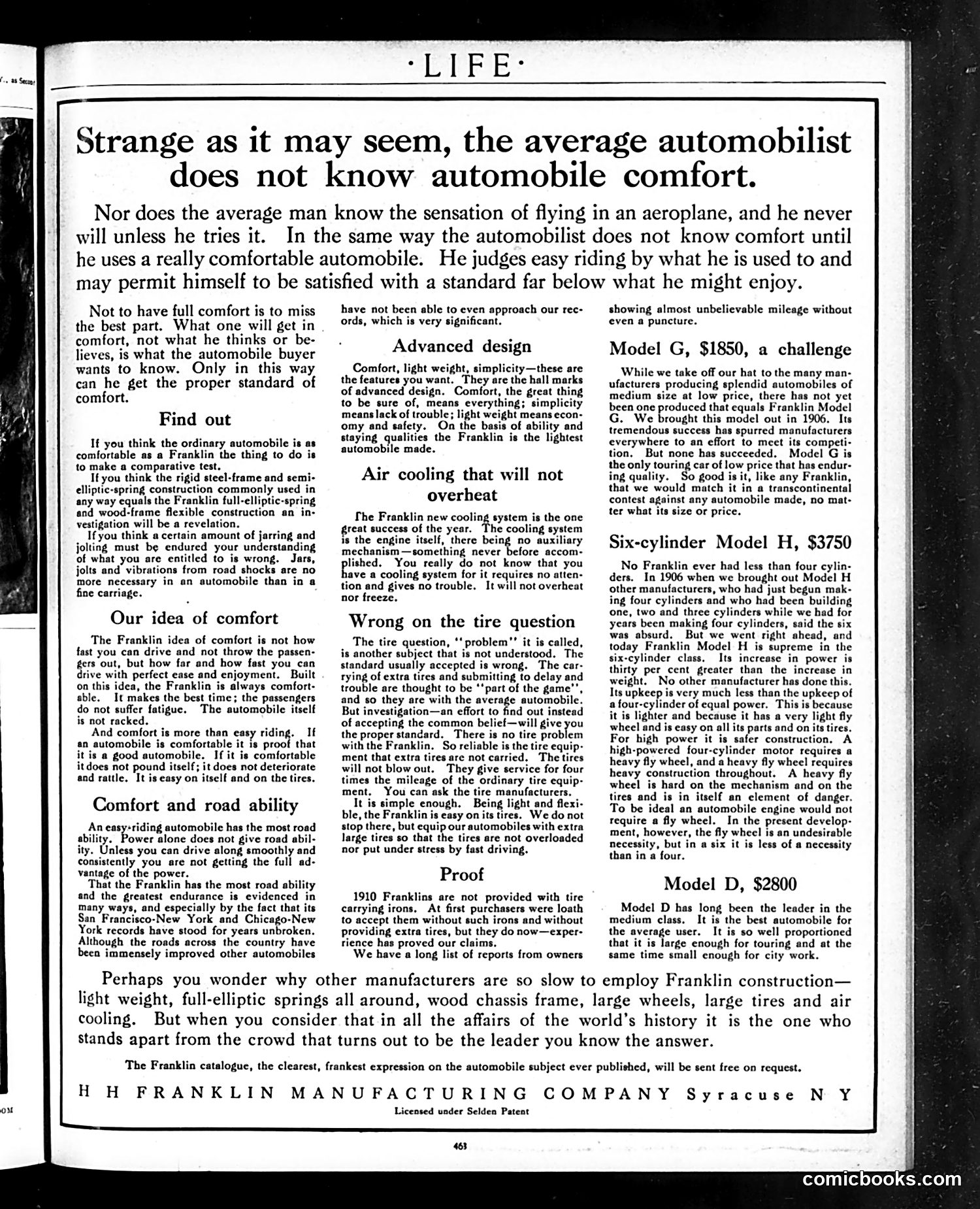
This page is primarily **Franklin automobile advertising**, not satire or political commentary. It's a straightforward promotional piece from the H.H. Franklin Manufacturing Company of Syracuse, New York. The ad argues that average car owners don't truly understand automobile comfort until experiencing a Franklin. It compares this to how someone hasn't truly experienced flight until trying an airplane. The copy emphasizes Franklin's distinctive features: light weight, advanced air-cooling system (rather than water cooling), and reliable tire construction. Three specific models are highlighted with prices: Model G ($1,850), Model H ($3,750), and Model D ($2,800). This represents early 20th-century automotive marketing—educational, feature-focused, and designed to persuade middle-class readers that Franklin's engineering philosophy offered superior comfort and reliability compared to competitors.
📄 Transcribed text from this page (OCR, searchable)
Machine-transcribed from the original scan — historical spelling and the odd misread are preserved.
trange as it may seem, the average automobilist does not know automobile comfort. Nor does the average man know the sensation of flying in an aeroplane, and he never will unless he tries it. In the same way the automobilist does not know comfort until he uses a really comfortable automobile. He judges easy riding by what he is used to and may permit himself to be satisfied with a standard far below what he might enjoy. Not to have full comfort is to miss the best part. What one will get in comfort, not what he thinks or be- lieves, is what the automobile buyer wants to know. Only in this way can he get the proper standard of comfort. Find out If you think the ordinary automobile is as comfortable as a Franklin the thing to do is to make a comparative test. If you think the rigid steel-frame and semi- elliptic-spring construction commonly used in any way equals the Franklin full-elliptic-spring and wood-frame flexible construction an in- vestigation will be a revelation. Ifyou think a certain amount of jarring and jolting must be endured your understanding of what you are entitled to is wrong. Jars, jolts and vibrations from road shocks are no more necessary in an automobile than in a fine carriage. Our idea of comfort The Franklin idea of comfort is not how fast you can drive and not throw the passen- gers out, but how far and how fast you can drive with perfect ease and enjoyment. Built on this idea, the Franklin is always comfort- able. It makes the best time; the passengers do not suffer fatigue. The automobile itself is not racked. And comfort is more than riding. If an automobile is comfortable it is proof that it is a good automobile. If it is comfortable itdoes not pound itself; it does not deteriorate and rattle. It is easy on itself and on the tires. Comfort and road ability An easy+riding automobile has the most road bility. Power alone does not give road abil- Unless you can drive along smoothly and consistently you are not getting the full ad- vantage of the power. That the Franklin has the most road ability and the greatest endurance is evidenced in d especially by the fact that its New York and Chicago-New is have stood for years unbroken. Although the roads across the country have been immensely improved other automobiles have not been able to even approach our rec- ords, which is very significant. Advanced design Comfort, light weight, simplicity—these are the features you want. They are the hall marks of advanced design. Comfort, the great thing to be sure of, means everything; simplicity means lack of trouble; light weight means econ- omy and safety. On the basis of ability and staying qualities the Franklin is the lightest automobile made. Air cooling that will not overheat Lhe Franklin new cooling system is the one reat success of the year. The cooling system is the engine itself, there being no auxiliary mechanism—something never before accom- pine. You really do not know that you ve a cooling system for it requires no atten- tion and gives no trouble. It will not overheat nor freeze, Wrong on the tire question The tire question, ‘‘ problem’ it is called, is another subject that is not understood. The standard usually accepted is wrong. The car- rying of extra tires and submitting to delay and trouble are thought to be **part of the game"’, and so they are with the average automobile. But investigation—an effort to find out instead of accepting the common belief—will give you the proper standard. There is no tire problem with the Franklin. So reliable is the tire equip- ment that extra tires are not carried. The tires will not blow out. They give service for four times the mileage of the ordinary tire equip- ment, You can ask the tire manufacturers. It is simple enough. Being light and flexi- ble, the Franklin is easy on its tires. We do not stop there, but equip our automobiles with extra large tires so that the tires are not overloaded nor put under stress by fast driving. Proof 1910 Franklins are not provided with tire carrying irons, At first purchasers were loath to pt them without such irons and without providing extra tires, but they do now—exper- rience has proved our claims. We have a long list of reports from owners showing almost unbelievable mileage without even a puncture. Model G, $1850, a challenge While we take off our hat to the many man- ufacturers producing splendid automobiles of medium size at low price, there has not yet been one produced that equals Franklin Model G. We brought this model out in 1906. Its tremendous success has spurred manufacturers everywhere to an effort to meet its competi- tion, But none has succeeded. Model G is the only touring car of low price that has endur- ing quality. good is it, like any Franklin, that we would match it in a transcontinental contest against any automobile made, no mat- ter what its size or price. Six-cylinder Model H, $3750 No Franklin ever had less than four cylin- ders. In 1906 when we brought out Model H other manufacturers, who had just begun mak- ing four cylinders and who had been building ‘one, two and three cylinders while we had for years been making four cylinders, said the six was absurd. But we went right ahead, and today Franklin Model H is supreme in the six-cylinder class, Its increase in power is thirty per cent greater than the increase in weight. No other manufacturer has done this. Its upkeep is very much less than the upkeep of a four-cylinder of equal power. This is because it is lighter and because it has a very light fly wheel and is easy on all its parts and on its tires. For high power it is safer construction, A high-powered four-cylinder motor requires a heavy fly wheel, and a heavy fly wheel requires heavy construction throughout. A heavy fly wheel is hard on the mechanism and on the tires and itself an clement of danger. To be ideal an automobile engine would not require a fly wheel. In the present develop- ment, however, the fly wheel is an undesirable necessity, but in a six it is less of a necessity than in a four. Model D, $2800 Model D has long been the leader in the medium class. It is the best automobile for the average user. It is so well proportioned that it is large enough for touring and at the same time small enough for city work. Perhaps you wonder why other manufacturers are so slow to employ Franklin construction— light weight, full-elliptic springs all around, wood chassis frame, large wheels, large tires and air cooling. But when you consider that in all the affairs of the world’s history it is the one who stands apart from the crowd that turns out to be the leader you know the answer. The Franklin catalogue, the clearest, frankest expression on the automobile subject ever published, will be sent free on request. H H FRANKLIN MANUFACTURING COMPANY Syracuse N Y Licensed under Selden Patent comicbooks.com