
Life, 1910-03-17 · page 22 of 36
Life — March 17, 1910 — page 22: what you’re looking at
What you’re looking at
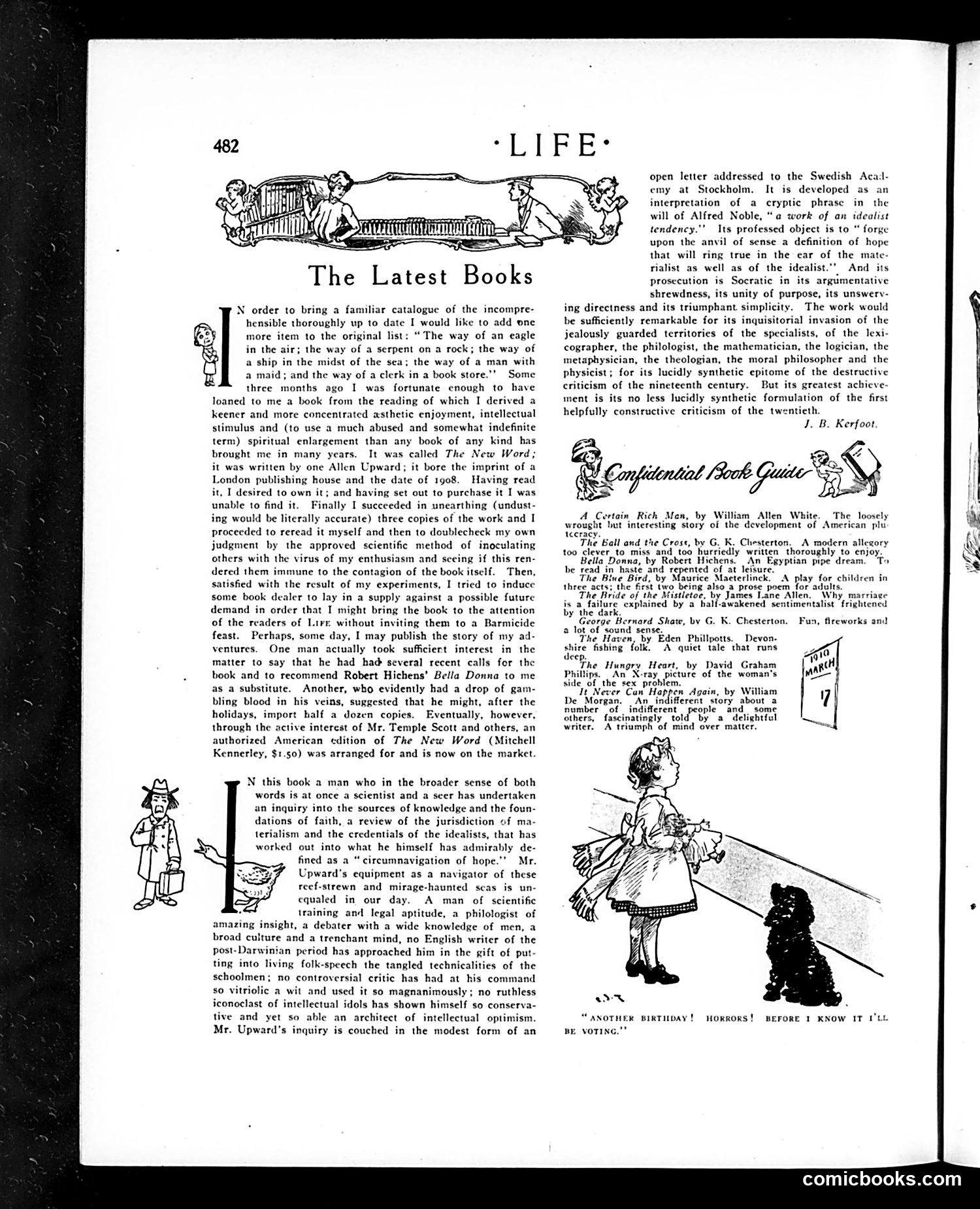
This page is primarily a book review section titled "The Latest Books," not a political cartoon page. The reviewer discusses *The New Word* by Allen Upward (1908), an philosophical inquiry framed as an open letter to the Swedish Academy addressing Alfred Nobel's bequest for works of "idealist tendency." The small illustration at bottom right depicts a child's birthday scene with the caption "Another birthday! Horrors! Before I know it I'll be voting"—a light social joke about time passing quickly and the burden of adult responsibilities. The "Confidential Book Guide" sidebar recommends other contemporary titles, including works by William Allen White and G.K. Chesterton. There is no significant political satire or caricature. This is straightforward literary criticism from the early 20th century, reflecting intellectual concerns about reconciling materialism with idealism—a major philosophical debate of the post-Darwinian era.
📄 Transcribed text from this page (OCR, searchable)
Machine-transcribed from the original scan — historical spelling and the odd misread are preserved.
arr aT Te eC SS The Latest Books N order to bring a familiar catalogue of the incompre- hensible thoroughly up to date I would like to add one more item to the original list: “The way of an eagle in the air; the way of a serpent ona rock; the way of a ship in the midst of the sea; the way of a man with a maid; and the way of a clerk ina book store.” Some three months ago I was fortunate enough to have loaned to me a book from the reading of which I derived a keener and more concentrated xsthetic enjoyment, intellectual stimulus and (to use a much abused and somewhat indefinite term) spiritual enlargement than any book of any kind has brought me in many years. It was called The New Word; it was written by one Allen Upward; it bore the imprint of a London publishing house and the date of 1908. Having read it, I desired to own it; and having set out to purchase it I was unable to find it. Finally I succeeded in unearthing (undust- ing would be literally accurate) three copies of the work and I proceeded to reread it myself and then to doublecheck my own judgment by the approved scientific method of inoculating others with the virus of my enthusiasm and sceing if this ren- dered them immune to the contagion of the book itself. Then, satisfied with the result of my experiments, I tried to induce some book dealer to lay in a supply against a possible future demand in order that I might bring the book to the attention of the readers of Lirr. without inviting them to a Barmicide feast. Perhaps, some day, I may publish the story of my ad- ventures. One man actually took sufficiert interest in the matter to say that he had had several recent calls for the book and to recommend Robert Hichens’ Bella Donna to me as a substitute. Another, who evidently had a drop of gam- bling blood in his veins, suggested that he might, after the holidays, import half a dozen copies. Eventually, however, through the active interest of Mr. Temple Scott and others, an authorized American edition of The New Word (Mitchell Kennerley, $1.50) was arranged for and is now on the market. N this book a man who in the broader sense of both words is at once a scientist and a scer has undertaken an inquiry into the sources of knowledge and the foun- dations of faith, a review of the jurisdiction of ma- terialism and the credentials of the idealists, that has worked out into what he himself has admirably de- fined as a “circumnavigation of hope."” Mr. Upward’s equipment as a navigator of these reef-strewn and mirage-haunted scas is un- equaled in our day. A man of scientific training and legal aptitude, a philologist of amazing insight, a debater with a wide knowledge of men, a broad culture and a trenchant mind, no English writer of the post-Darwinian period has approached him in the gift of put ting into living folk-speech the tangled technicalities of the schoolmen; no controversial critic has had at his command so vitriolic a wit and used it so magnanimously ; no ruthless iconoclast of intellectual idols has shown himself so conserva- tive and yet so able an architect of intellectual optimism. Mr. Upward’s inquiry is couched in the modest form of an open letter addressed to the Swedish Acail- emy at Stockholm. It is developed as an interpretation of a cryptic phrase in the will of Alfred Noble, “a work of an idealist tendency.” Its professed object is to “ forge upon the anvil of sense a definition of hope that will ring true in the ear of the mate- rialist_as well as of the idealist." And its prosecution is Socratic in its argumentative shrewdness, its unity of purpose, its unswerv- ing directness and its triumphant simplicity. The work would be sufficiently remarkable for its inquisitorial invasion of the jealously guarded territories of the specialists, of the lexi- cographer, the philologist, the mathematician, the logician, the metaphysician, the theologian, the moral philosopher and the physicist; for its lucidly synthetic epitome of the destructive criticism of the nineteenth century. But its greatest achieve- ment is its no less lucidly synthetic formulation of the first helpfully constructive criticism of the twentieth. J. B. Kerfoot A Certain Rich Men, by William Allen White. The loosely wrought but interesting siory of the development of American plu tceracy. The Ball and the Crost, by G. K. Chesterton, A modern allegory too clever to miss and too hurriedly written thoroughly to enjoy. Bella Donna, by Robert Hichens. An Egyptian pipe dream. To be read in haste and repented of at leisure. The Bine Bird, by Maurice Maeterlinck. A play for children in three acts; the first two being also.a prose poem for adults. The Bride of the Mistletoe, by James Lane Allen. Why ma is a failure explained by a balf-awakened sentimentalist frig by the dark, George Bernard Shate, by G. a lot of sound sense. The Haven, by Eden Phillpotts. Devon. shire fishing folk. A quiet tale that runs dee The Hungry Heart, by David Graham ips. An X-ray picture of the woman's side of the sex problem. 7 It Never Can Happen Again, by William De Morgan. An_ indifferent story about a number of indifferent people and some others, fascinatingly told by a delightful writer. A triumph of mind over matter. . Chesterton, Fun, flreworks and NOTHER BIRTHDAY! HORRORS! BEFORE 1 KNOW IT I'LL BE VOTING."* comicbooks.com