
A complete issue · 80 pages · 1909
Life — December 2, 1909
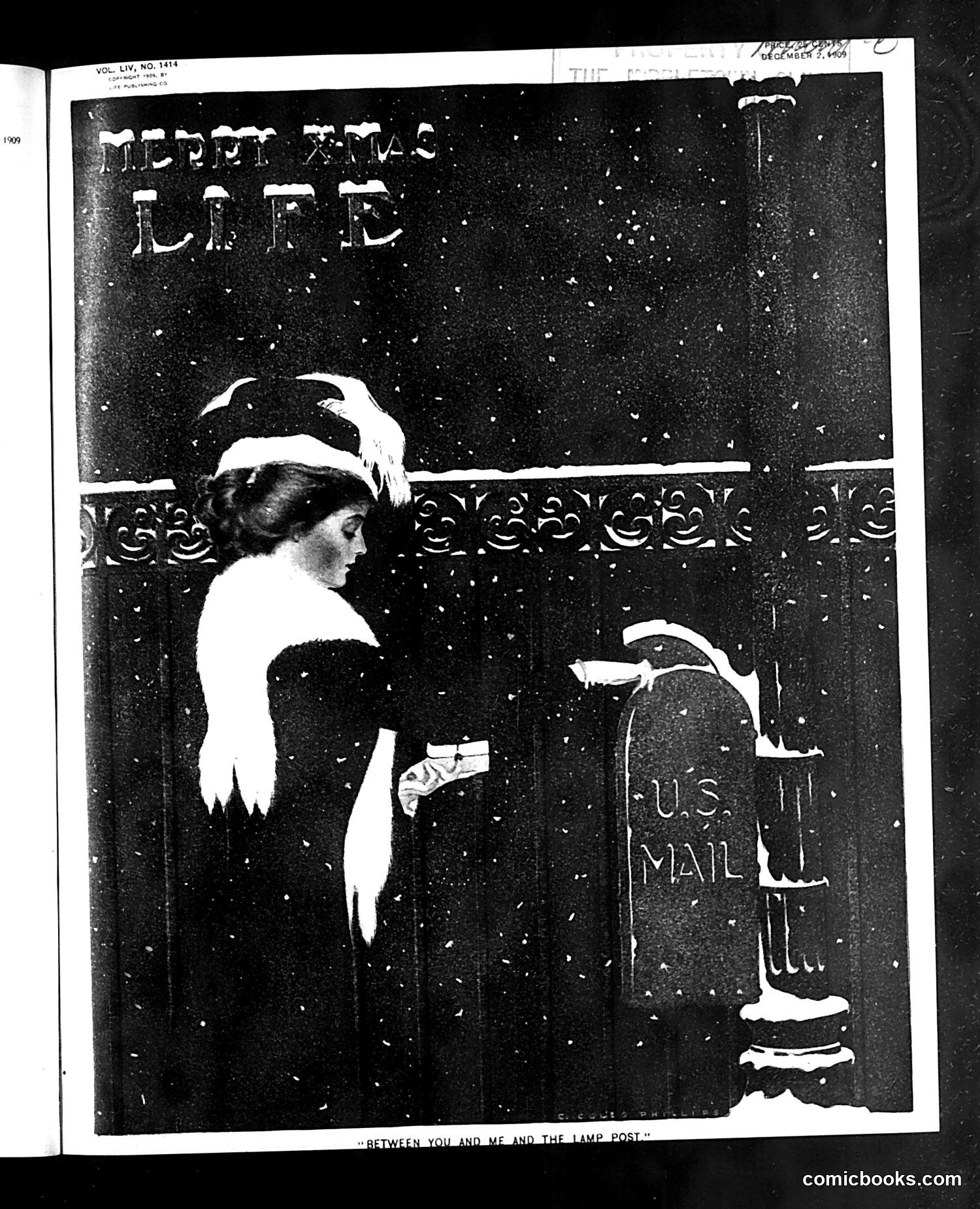
This illustration shows a woman in winter attire (hat and coat) depositing mail into a U.S. mailbox during snowfall. The caption "Between You and Me and the Lamp Post" suggests confidential communication. The cartoon likely satirizes private correspondence or secret messages sent through the mail system. The phrase implies intimate, whispered conversation—"between you and me"—while the public mailbox represents the opposite: official, documented communication. The winter setting and snow add atmosphere to what appears to be commentary on the contrast between private intent and public record when using the postal service. Without additional context about the specific publication date, the exact target of satire remains unclear, though it may reference wartime censorship or surveillance concerns.
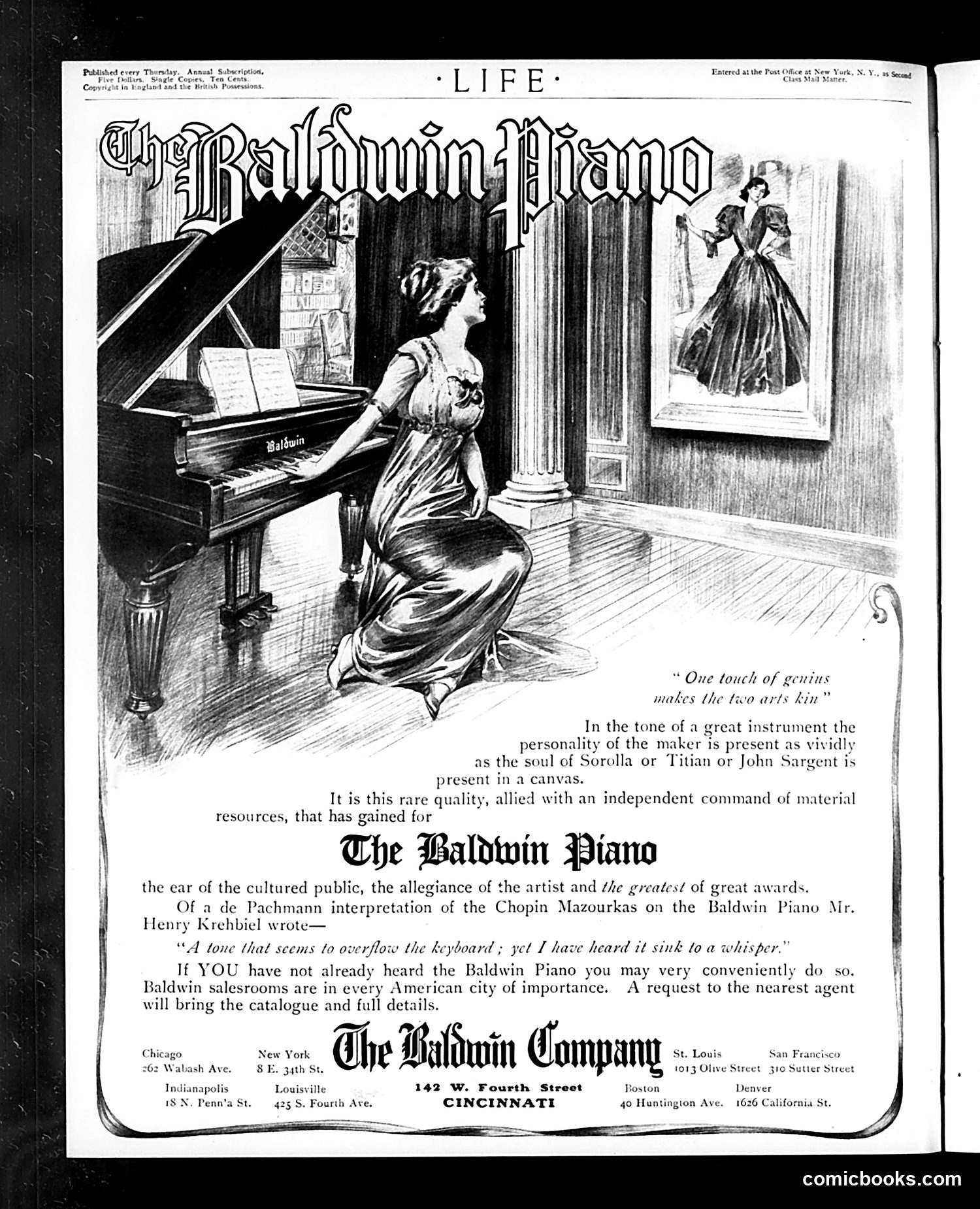
This page is primarily a **commercial advertisement**, not political satire. It promotes Baldwin pianos to wealthy, cultured consumers. The illustration shows an elegantly dressed woman at a Baldwin piano, gazing at a fashion illustration on the wall—a visual pun suggesting that pianos, like fine clothing, are markers of refined taste and status. The accompanying text quotes Henry Krehbiel (a real music critic) praising the Baldwin's tonal quality, comparing it to legendary painters like Sorolla and Titian. The tagline "One touch of genius makes the two arts kin" links piano-playing to visual art, positioning piano ownership as a sign of cultural sophistication. The advertisement targets the "cultured public" and "artist[s]," emphasizing that Baldwin pianos were instruments for the wealthy elite, not ordinary households.
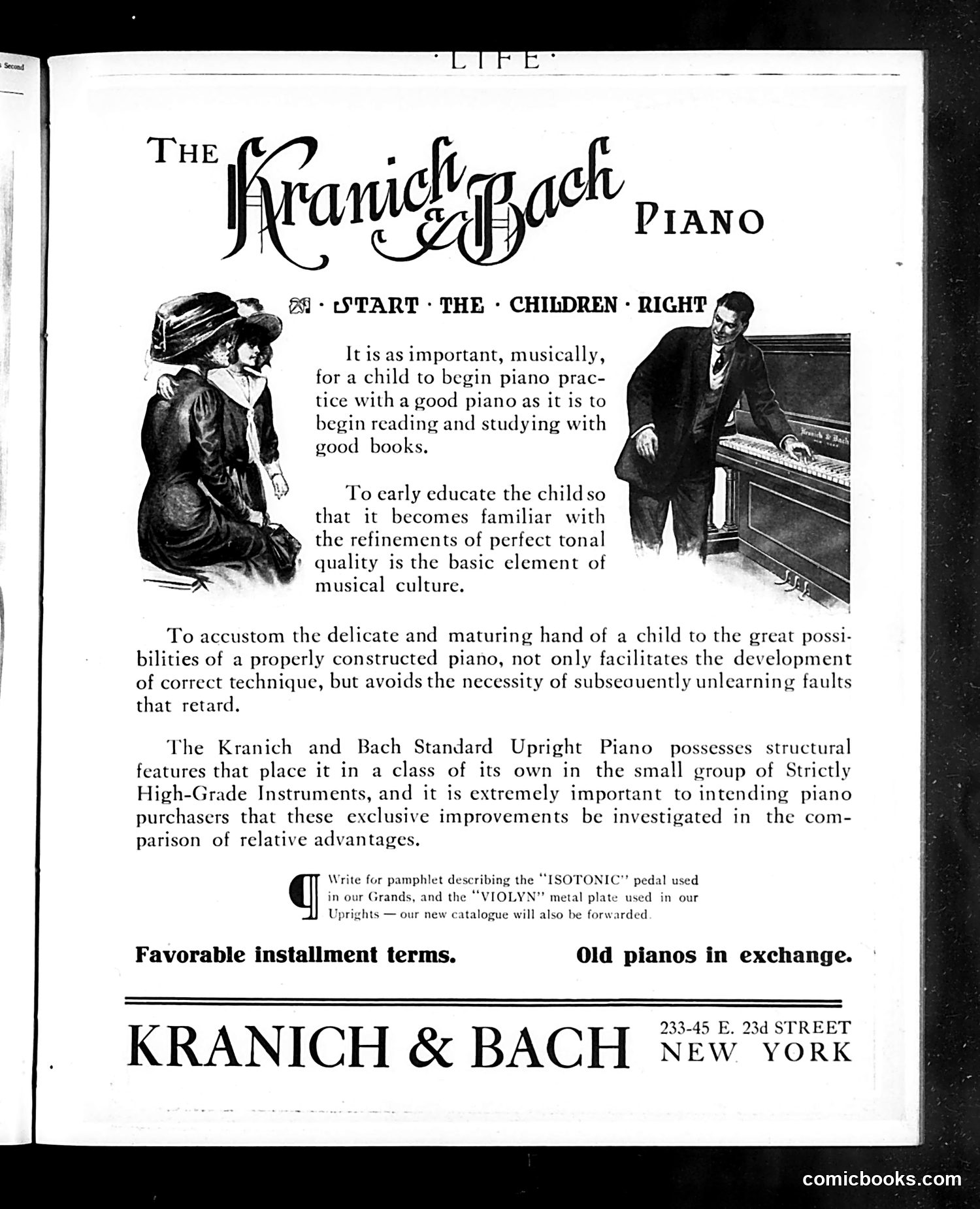
This is **not a political cartoon or satire** — it's a straightforward advertisement for Kranich & Bach pianos, placed in *Life* magazine. The page promotes the company's upright pianos for children's music education. The two illustrated figures (a woman with a child, and a man at a piano) are generic representations meant to convey respectability and refinement, not specific people or caricatures. The advertising copy emphasizes that quality instruments are essential for proper musical development in children, comparing piano selection to choosing good books. The ad highlights the Kranich & Bach brand's "strictly high-grade" construction and offers "favorable installment terms" and trade-in options for old pianos. This represents typical early-20th-century marketing positioning pianos as markers of cultural sophistication and family status.
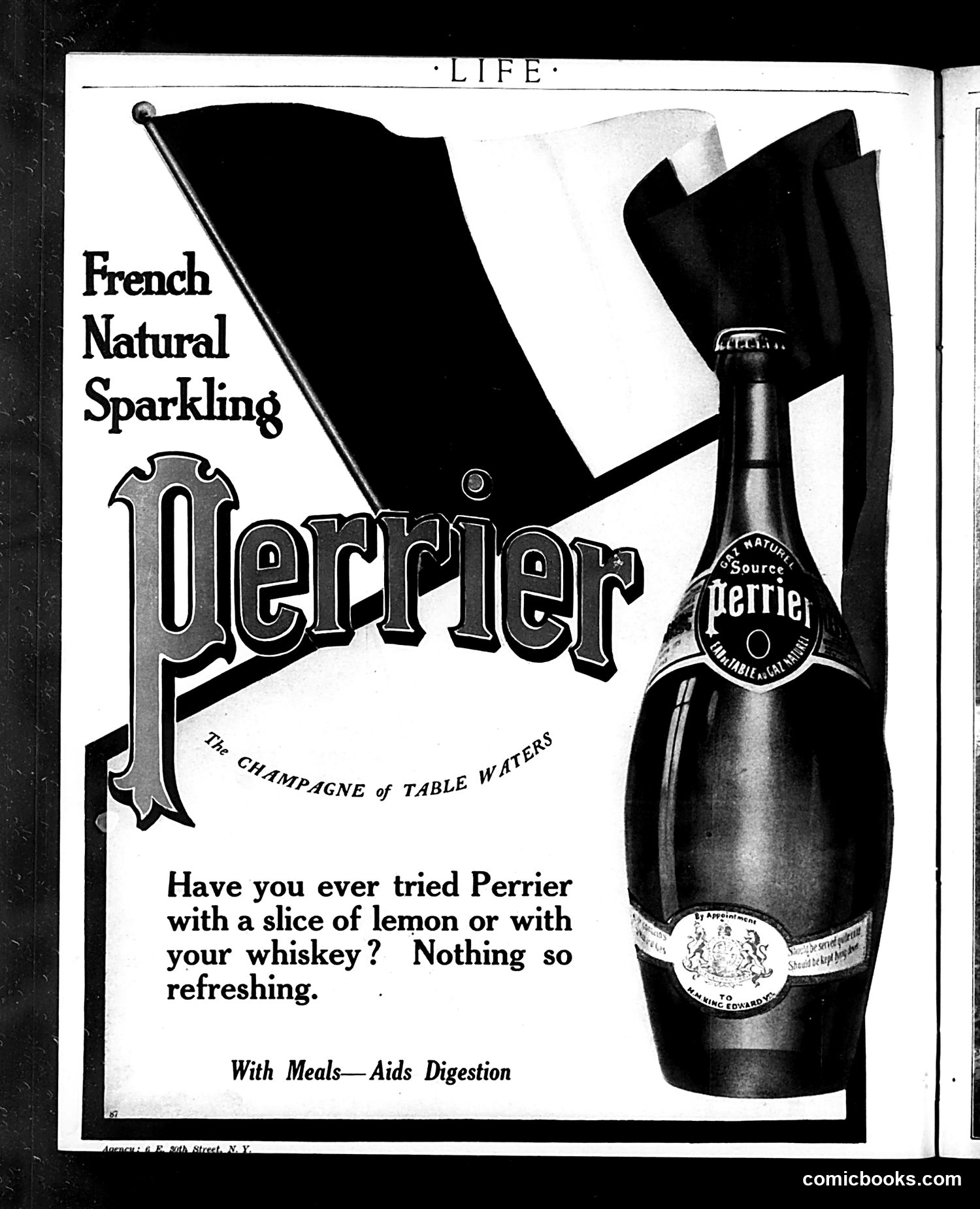
This is a **product advertisement**, not satire or political content. It promotes Perrier, a French sparkling water brand, positioned as "The Champagne of Table Waters." The ad uses early 20th-century advertising conventions: an elegant bottle illustration and aspirational messaging. The copy suggests serving Perrier with lemon or whiskey, emphasizing its refreshing qualities and digestive benefits—a health claim common in vintage beverage advertising. The decorative French flag imagery appeals to consumer associations between French products and sophistication. The "With Meals—Aids Digestion" tagline reflects period attitudes about sparkling water's medicinal properties, before modern regulatory standards restricted such health claims. This represents straightforward commercial marketing rather than editorial satire.
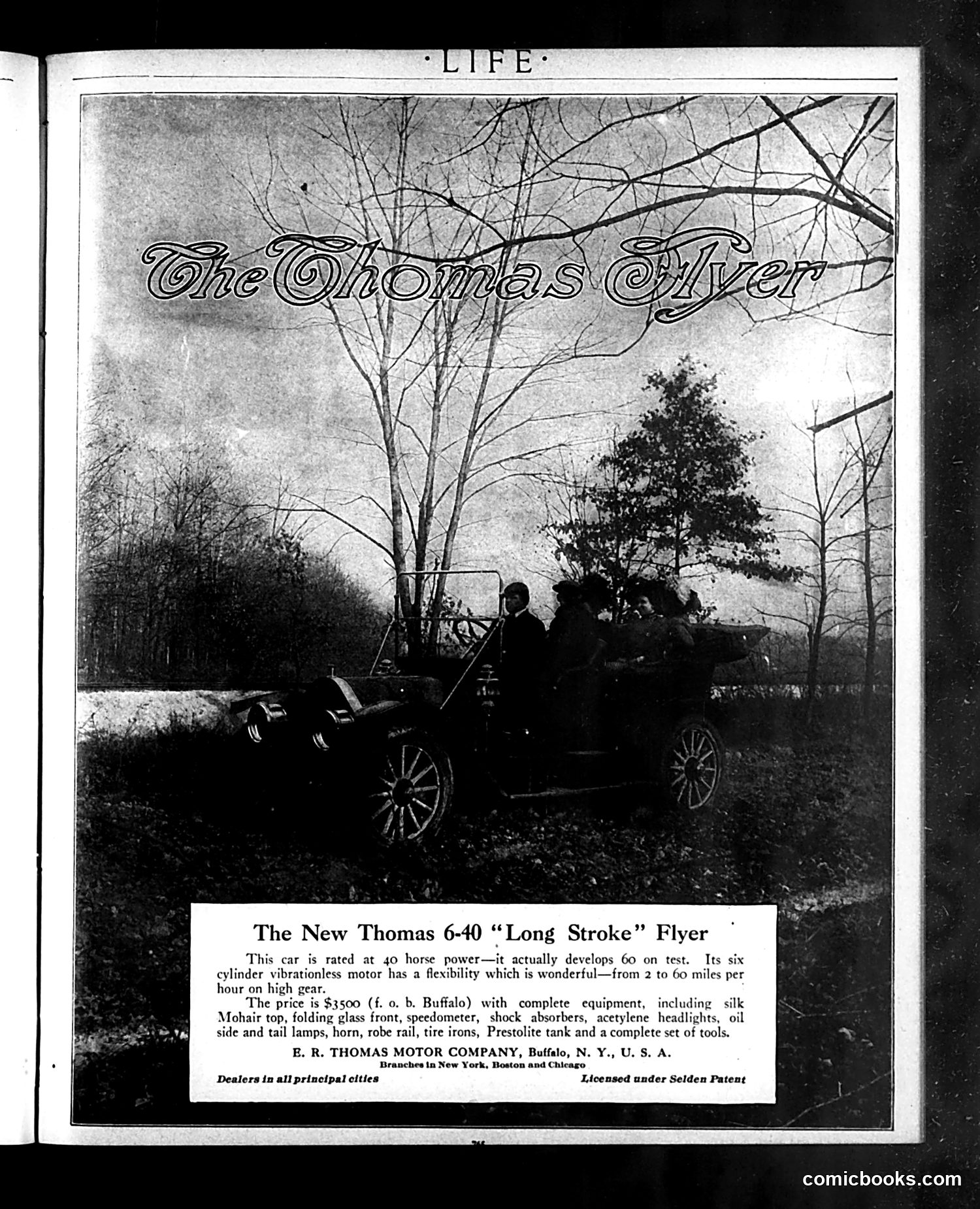
This page is primarily **advertising, not satire or political cartoon**. It features a full-page advertisement for the Thomas Motor Company's "6-40 'Long Stroke' Flyer" automobile, positioned under the magazine's "Life" header. The advertisement includes a photograph of an early 1900s motorcar with several passengers on a rural road lined with bare trees. The accompanying text promotes the vehicle's technical specifications: 40 horsepower, six-cylinder vibrationsless motor, and detailed equipment features including a silk Mohair top, folding glass front, and acetylene headlights. The company, based in Buffalo, NY, with branches in New York, Boston, and Chicago, emphasizes the car's $1,500 price and complete equipment package. This is straightforward commercial promotion rather than satirical commentary.
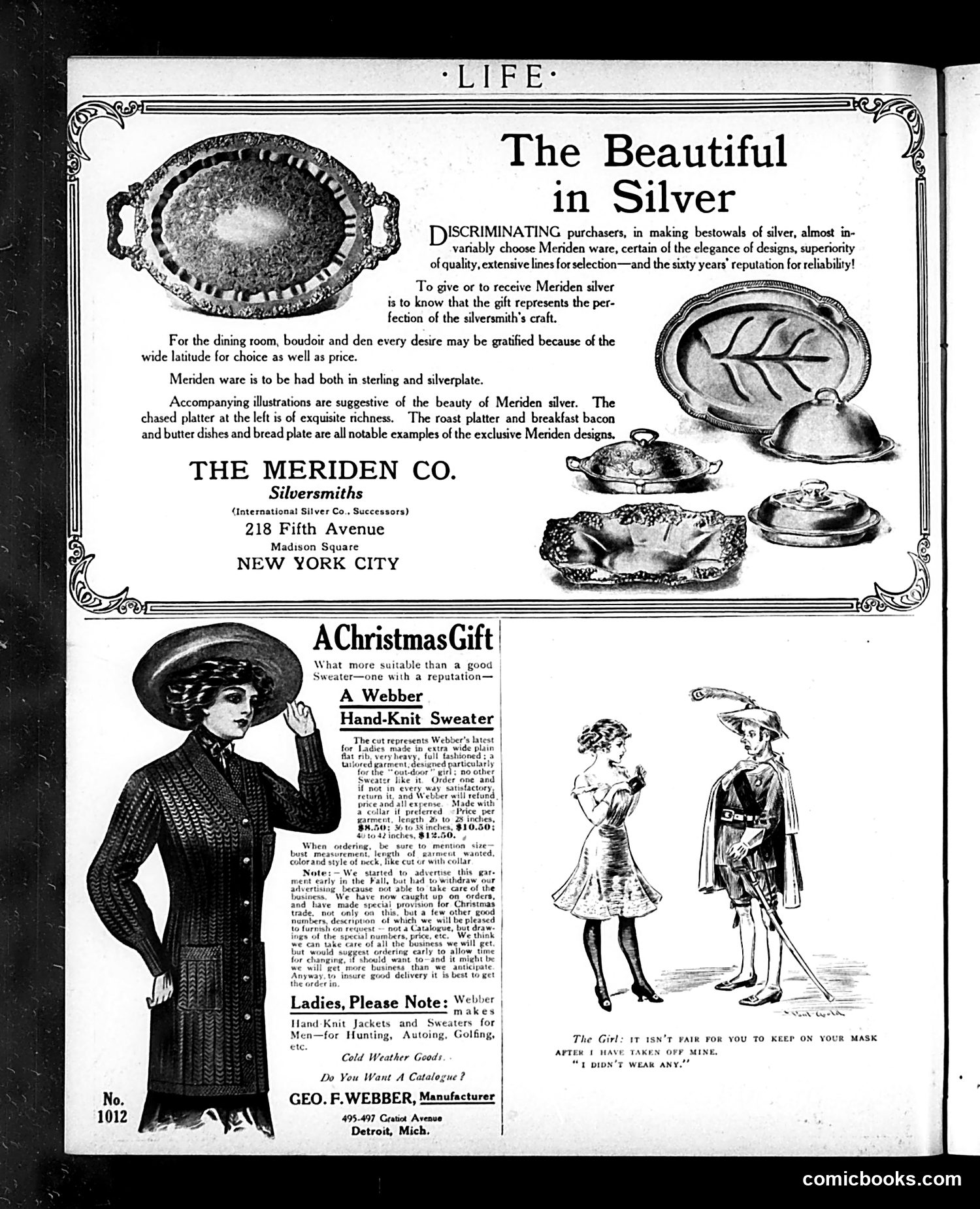
This page is primarily **advertising**, not political satire. The top half features a full-page ad for The Meriden Company's silver products, emphasizing quality craftsmanship for discriminating buyers seeking prestigious gifts. Images showcase various decorative serving pieces. The lower half contains two unrelated advertisements: one for Webber Hand-Knit Sweaters (positioned as a Christmas gift), and a small cartoon illustration labeled "The Girl" showing two figures with dialogue: "IT ISN'T FAIR FOR YOU TO KEEP ON YOUR MASK AFTER I HAVE TAKEN OFF MINE" / "I DIDN'T WEAR ANY." This final cartoon appears to be a light social commentary on romantic vulnerability or deception—likely suggesting one party was never genuine, despite the other's openness. The humor relies on period courtship conventions.
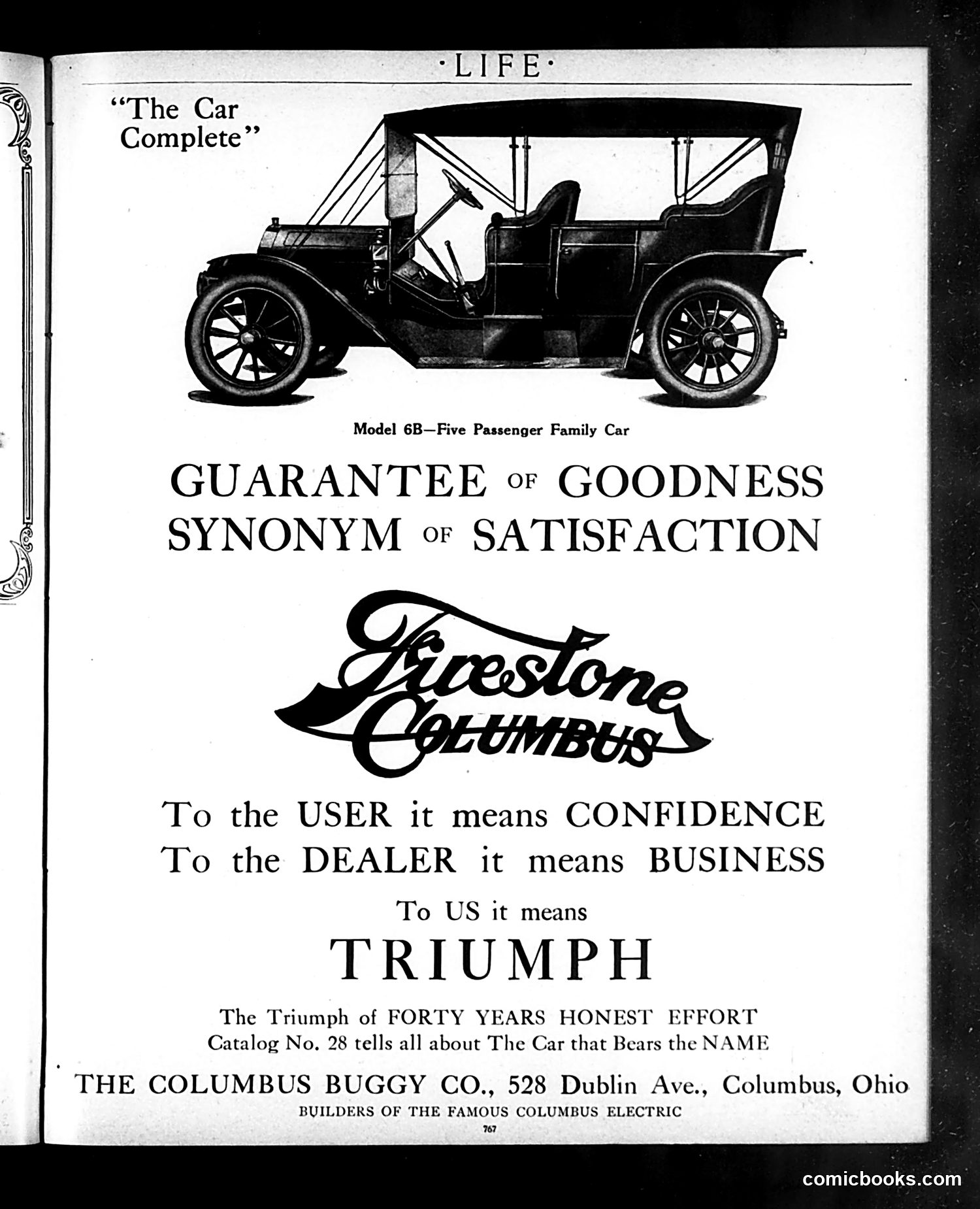
This is an advertisement, not political satire. It promotes the Firestone Columbus automobile tire and the Model 6B Five Passenger Family Car from The Columbus Buggy Company of Columbus, Ohio. The ad uses marketing language common to early automotive advertising, claiming the product represents "forty years honest effort" and positions the brand name as synonymous with quality and satisfaction. It addresses three audiences: users gain "confidence," dealers gain "business," and the company achieves "triumph." The illustration shows a simple line drawing of an early automobile with an open-air design, typical of 1910s-era vehicles. There is no political cartoon or satire present—this is straightforward commercial advertising from Life magazine's pages.
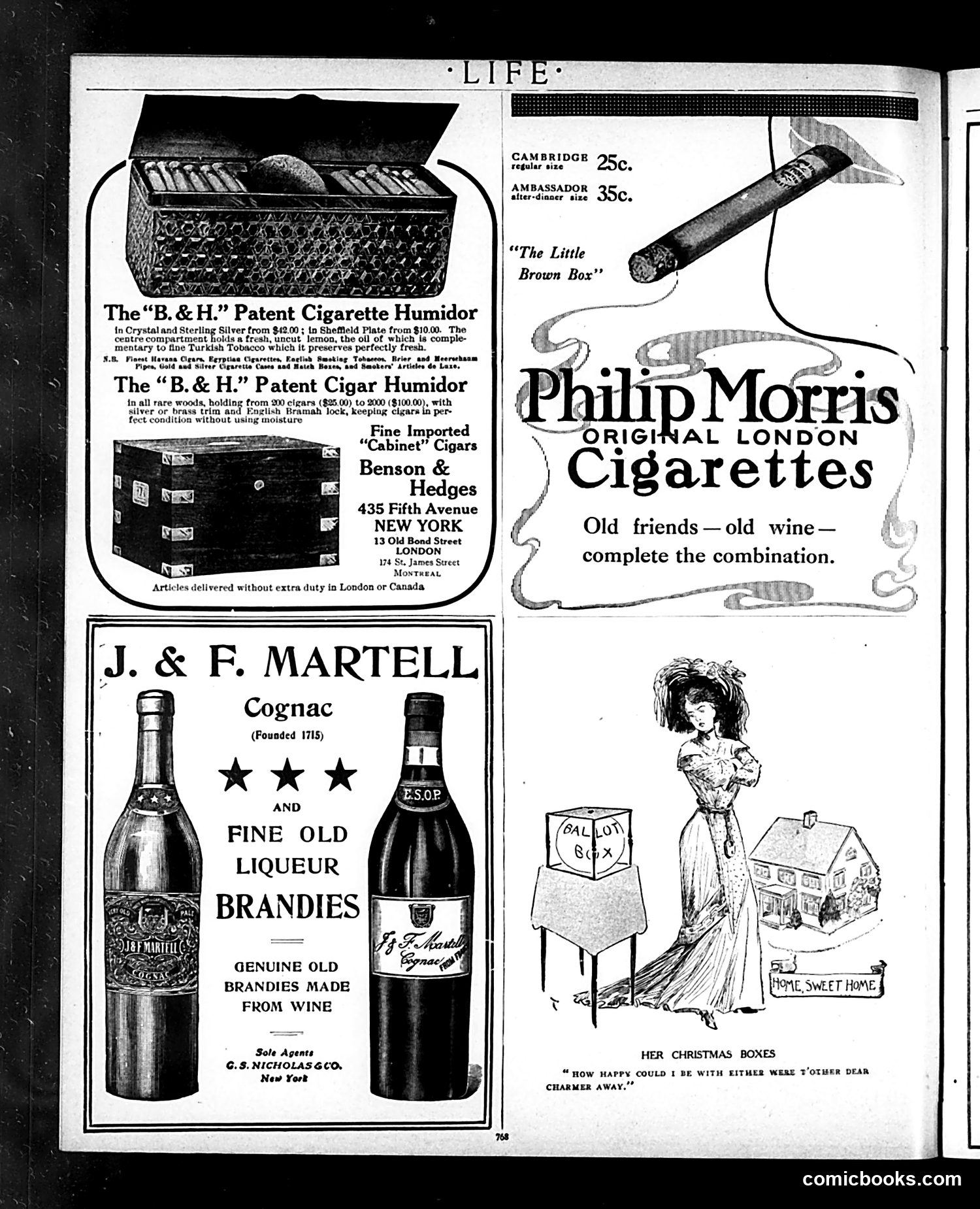
This page is **primarily advertising**, not satire or political commentary. It contains four product advertisements from the early 20th century: 1. **B&H Patent Cigarette Humidor** - a storage box with crystal lining and lemon oil to keep cigars fresh 2. **Benson & Hedges Cabinet Cigars** - fine imported cigars sold in New York and London 3. **Philip Morris Cigarettes** - "Original London Cigarettes" with the tagline "Old friends—old wine—complete the combination" 4. **J. & F. Martell Cognac** - brandy founded 1715, sold by G.S. Nicholas & Co. in New York The only image with narrative content is a small illustration for Martell showing a woman with Christmas boxes labeled "Home Sweet Home," with text reading "How happy could I be with either were t'other dear charmer away" — a period romantic reference, likely to encourage gifting alcohol during holidays.
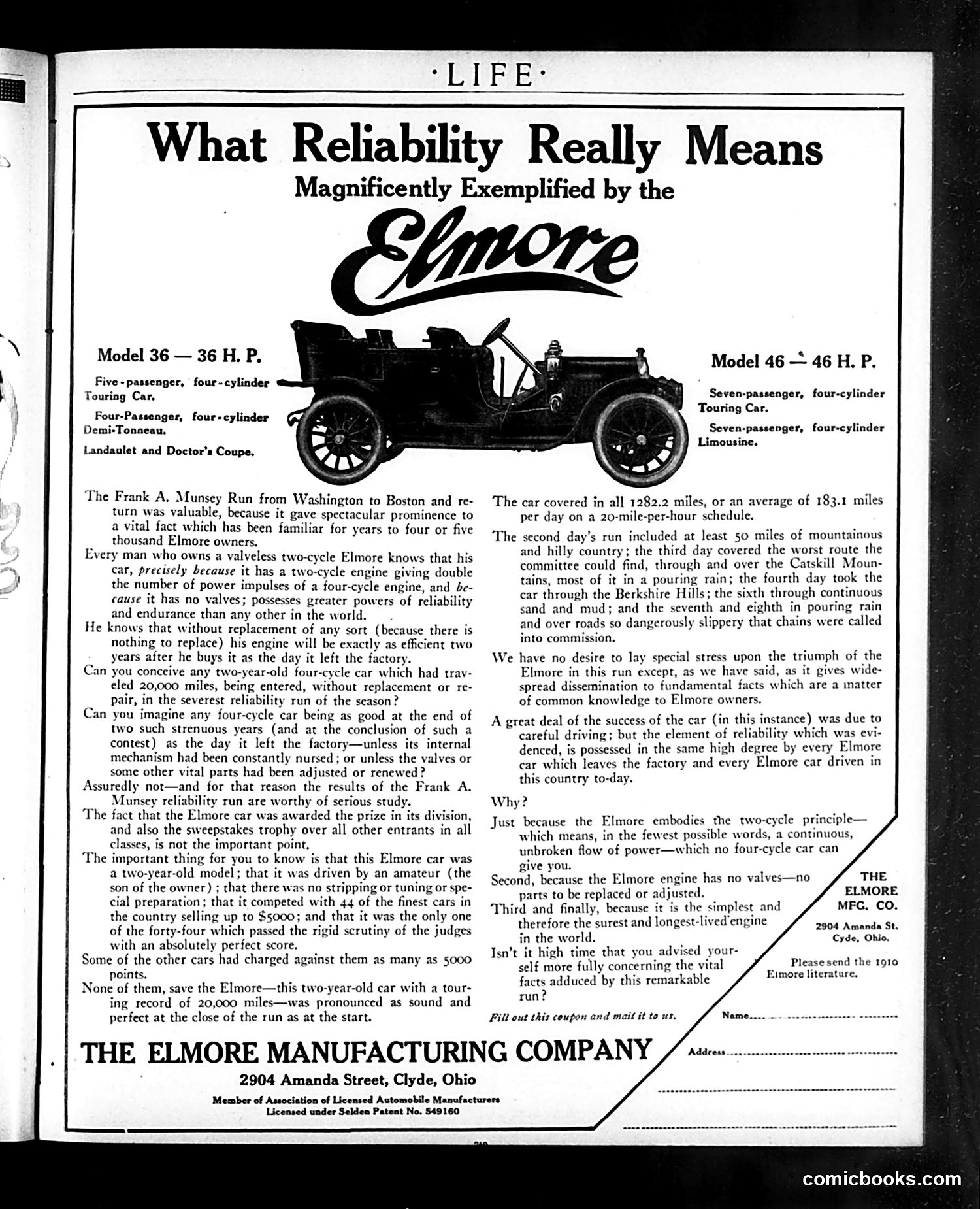
This page is **primarily an automobile advertisement**, not satirical content. It's a 1910s-era ad for the Elmore automobile, published in *Life* magazine. The ad describes the Frank A. Munsey "reliability run" from Washington to Boston—a real promotional event where an Elmore car performed successfully. The advertisement emphasizes the car's engineering advantages: a two-cycle engine with no valves, simplified internal mechanics, and superior durability compared to competitors. The "satire" here is subtle advertising rhetoric: the piece frames the Elmore's simplicity as superiority over more complex four-cycle engines, using the Munsey Run's success as proof. It's marketing disguised as editorial content—a common *Life* magazine practice blending humor, journalism, and paid promotion. There are no political figures or caricatures; this is straightforward early automotive advertising.
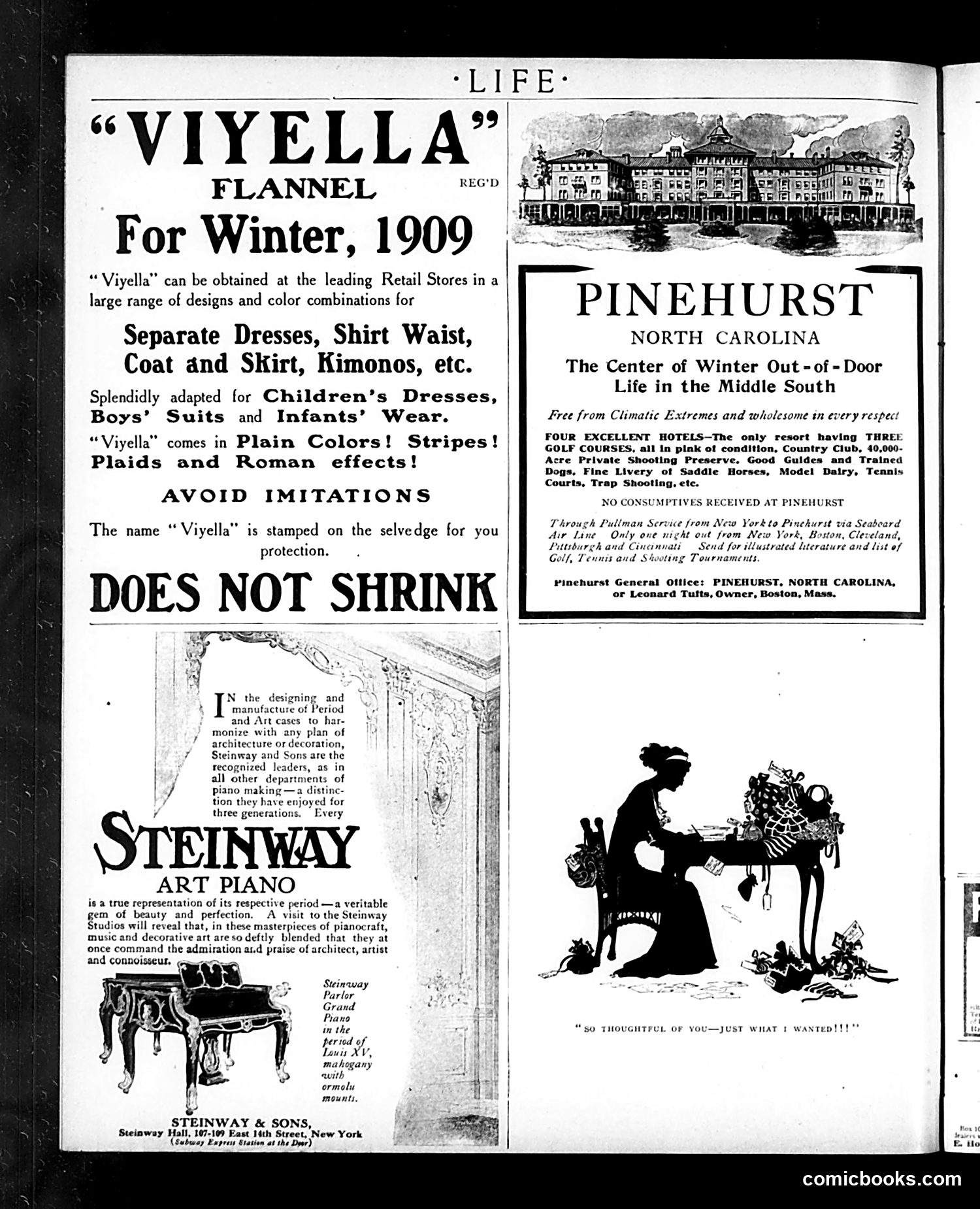
This page is **primarily advertising** from Life magazine's 1909 winter issue. The left side advertises "Viyella" flannel fabric that "does not shrink," marketed for children's and infants' clothing. Below that is a Steinway piano advertisement emphasizing the brand's three-generation reputation for quality. The right side features a Pinehurst, North Carolina resort advertisement promoting winter activities (golf, hunting, shooting). **The only cartoon** is a small silhouette illustration accompanying the Pinehurst ad, showing a woman at a desk with the caption "So thoughtful of you—just what I wanted!!!" This appears to be gentle domestic humor about gift-giving, not political satire. The page contains no political commentary or caricatures of public figures.
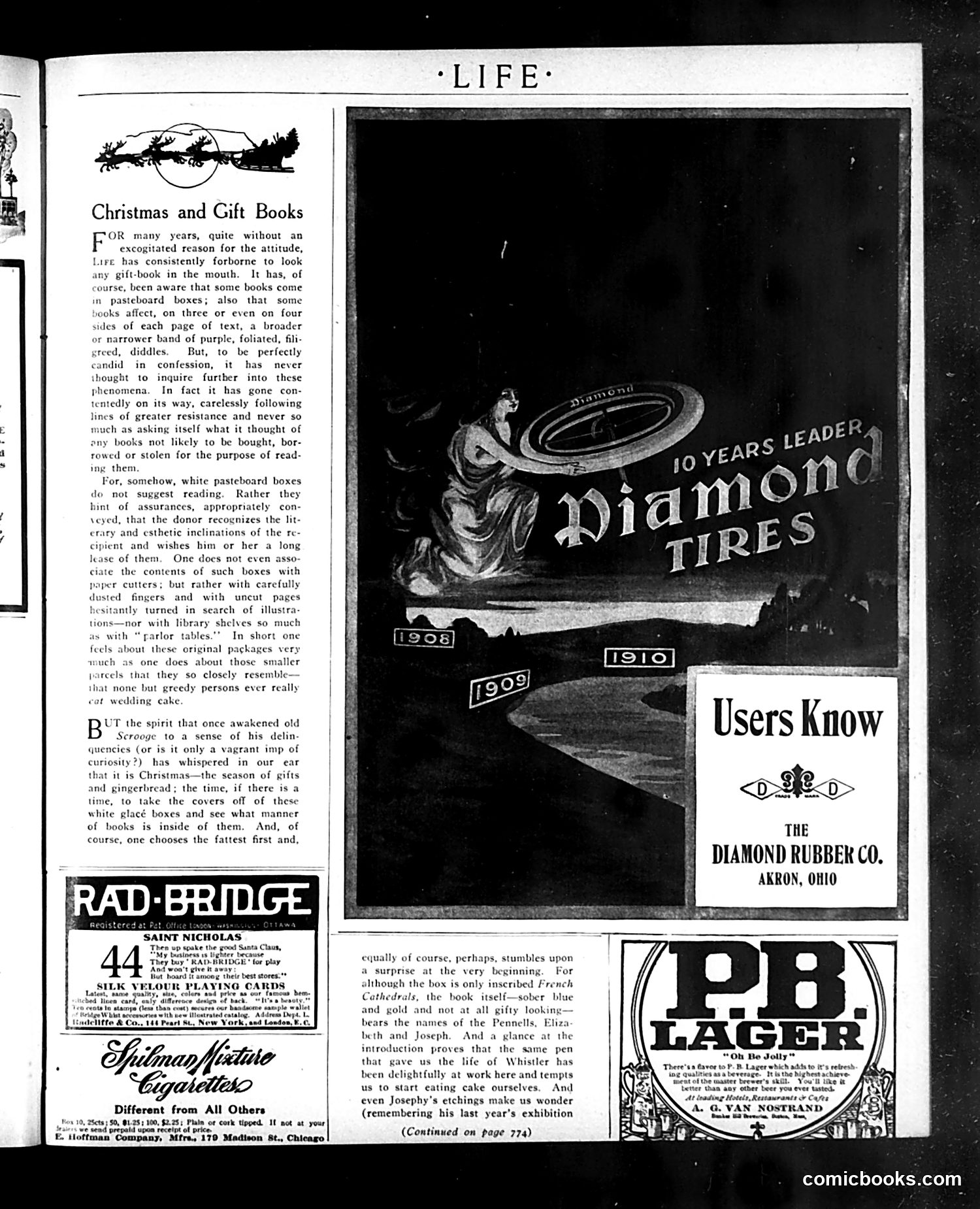
This page is primarily **advertising and editorial content** rather than political satire. The left column contains an editorial essay titled "Christmas and Gift Books," discussing the tradition of giving books as gifts—particularly noting how books come in decorative boxes and the practice of examining them before purchasing. The right side features **product advertisements**: - A Diamond Tires ad (1908-1910 comparison imagery) - A Rad-Bridge playing cards advertisement - A PBR Lager beer advertisement The editorial text mentions "Scrooge" in reference to the Christmas season and gift-giving customs, making a literary allusion rather than political commentary. There is **no political cartoon or satire visible** on this page—it's a standard early 20th-century magazine layout mixing editorial content with period advertisements.
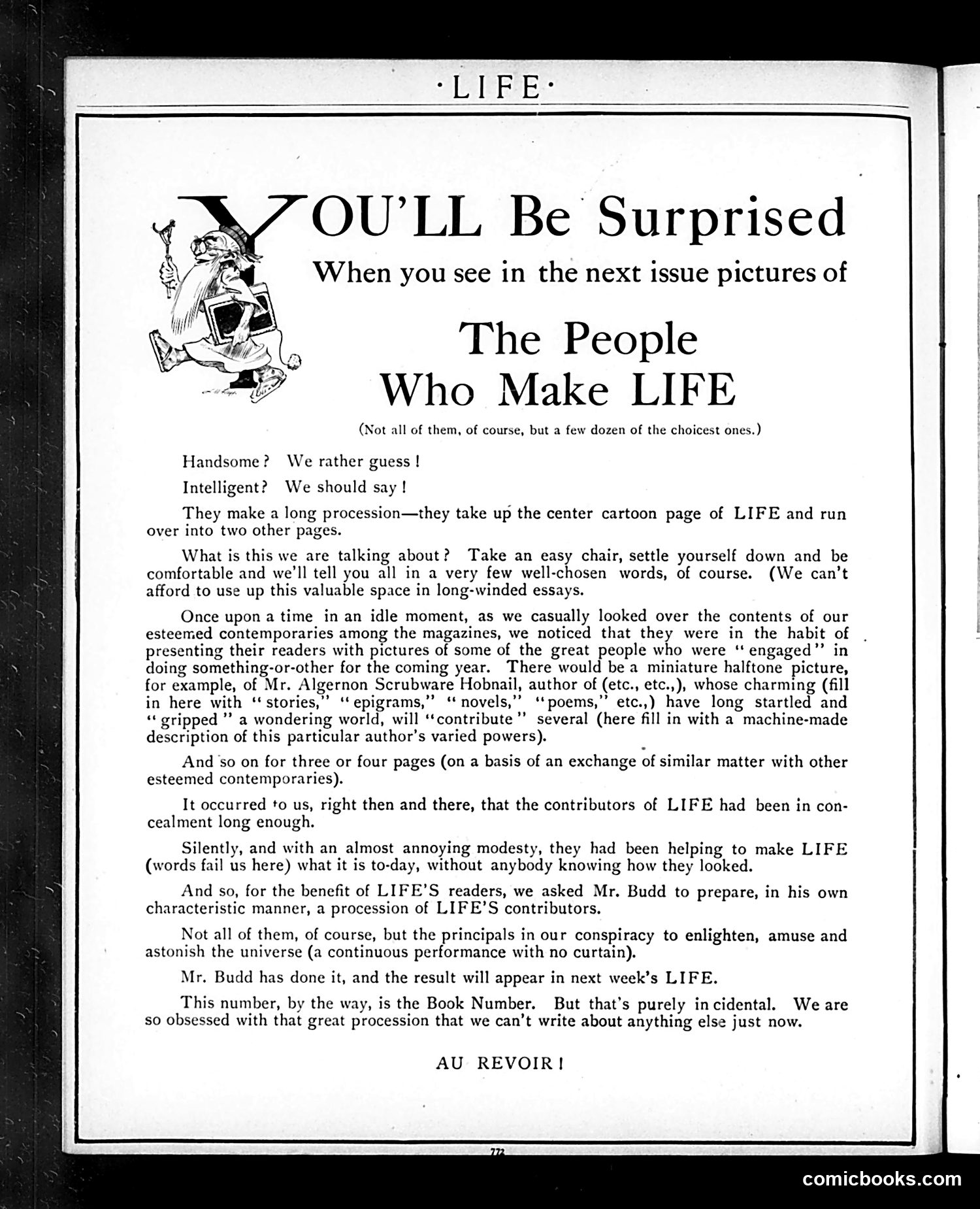
This is a promotional announcement for an upcoming feature in *Life* magazine. The page teases that the next issue will showcase portraits and profiles of notable contributors to the publication—described as "handsome" and "intelligent" people who work behind the scenes. The text mentions specifically that **Algernon Scrubbware Hobnail** (an author) will be featured among "a few dozen of the choicest ones." The whimsical name suggests this may be a fictitious or satirical example rather than an actual contributor. The announcement's tone is tongue-in-cheek, boasting that these people have been secretly helping create *Life* magazine "without anybody knowing how they looked." It's essentially *Life* magazine promoting itself and its creative team to readers in a self-congratulatory, humorous way.
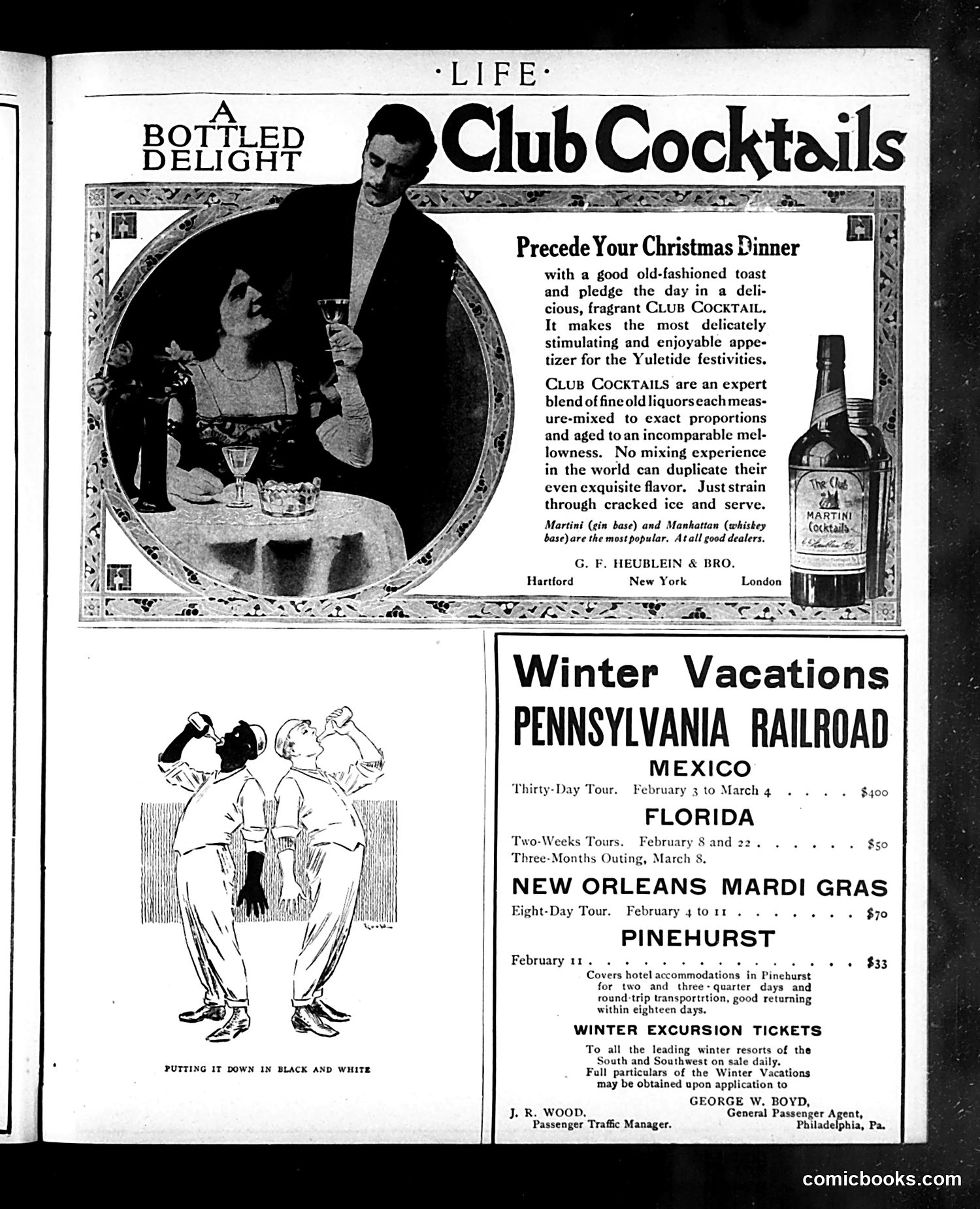
This page contains two distinct elements: **Top Half: Club Cocktails Advertisement** An ad for pre-mixed cocktails by G.F. Heublein & Bro., positioned as an elegant pre-dinner drink for Christmas celebrations. The illustration shows a well-dressed couple enjoying cocktails, reflecting 1920s-30s sophistication and leisure culture. **Bottom Half: Mixed Content** A cartoon labeled "Putting It Down in Black and White" depicts a rotund man in formal wear apparently struggling with or being overwhelmed by three small figures—likely satirizing some contemporary social or political situation, though the specific reference is unclear without additional context. The right side features Pennsylvania Railroad winter vacation advertisements to Mexico, Florida, New Orleans, and Pinehurst, targeting affluent travelers seeking warm-weather escapes. The page reflects early 20th-century lifestyle advertising and social commentary.
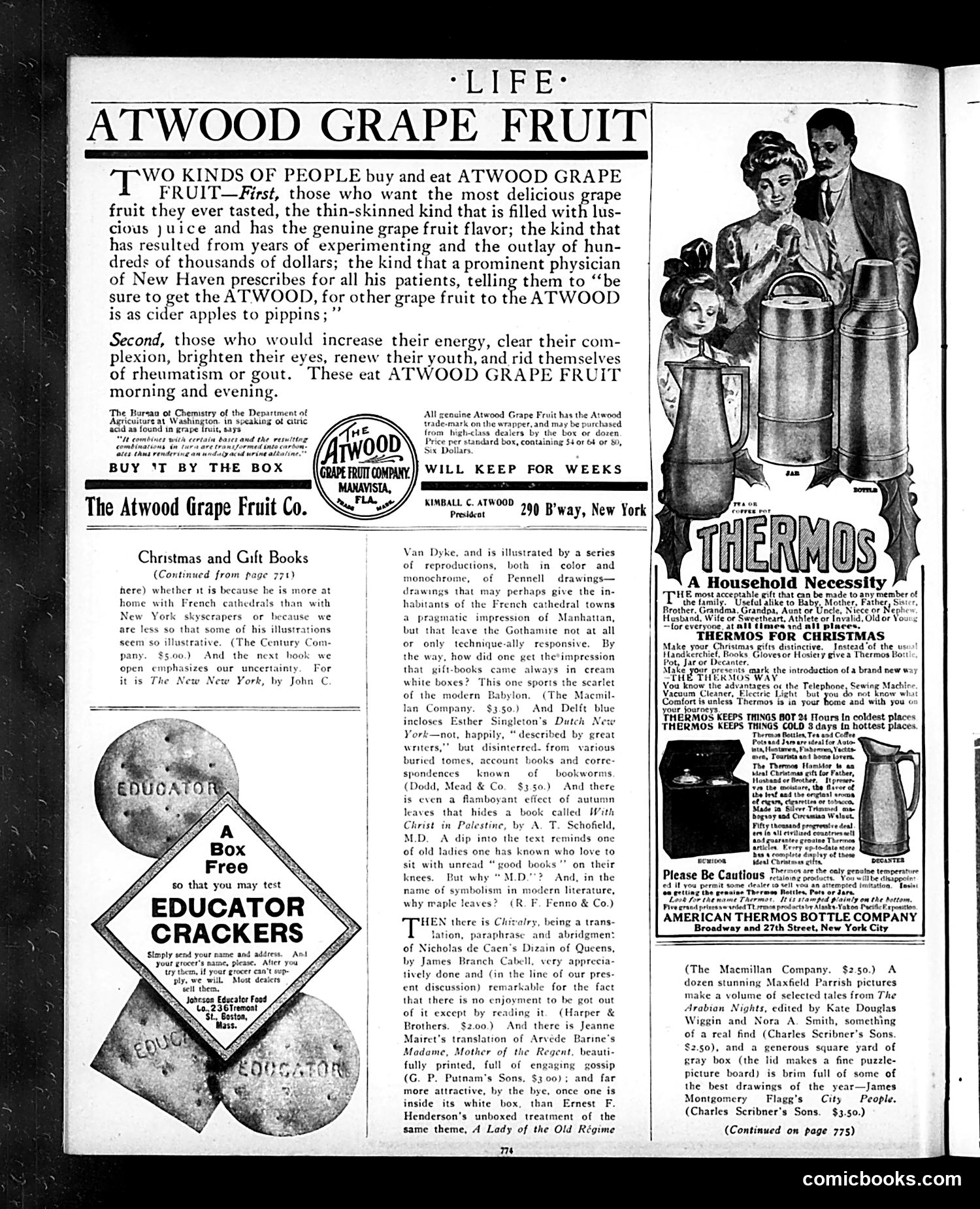
This page is primarily **commercial advertising** rather than political satire. The dominant content is an advertisement for Atwood Grape Fruit, a branded citrus product marketed to two consumer types: those seeking premium quality fruit and those pursuing health benefits (energy, complexion improvement, rheumatism relief). The ad references a **New Haven physician** who allegedly prescribed Atwood fruit exclusively—a common marketing tactic using medical authority. The company cites the Department of Agriculture's analysis of the fruit's malic acid content to suggest scientific validation. A secondary advertisement for **Educator Crackers** appears below, offering free samples. The page also contains a book review section discussing Christmas gift selections from various publishers, unrelated to the fruit advertisement. There is no political cartoon or satire visible. This appears to be a typical early 20th-century magazine page mixing editorial content with product advertising, relying on health claims and testimonial authority common to that era's marketing practices.
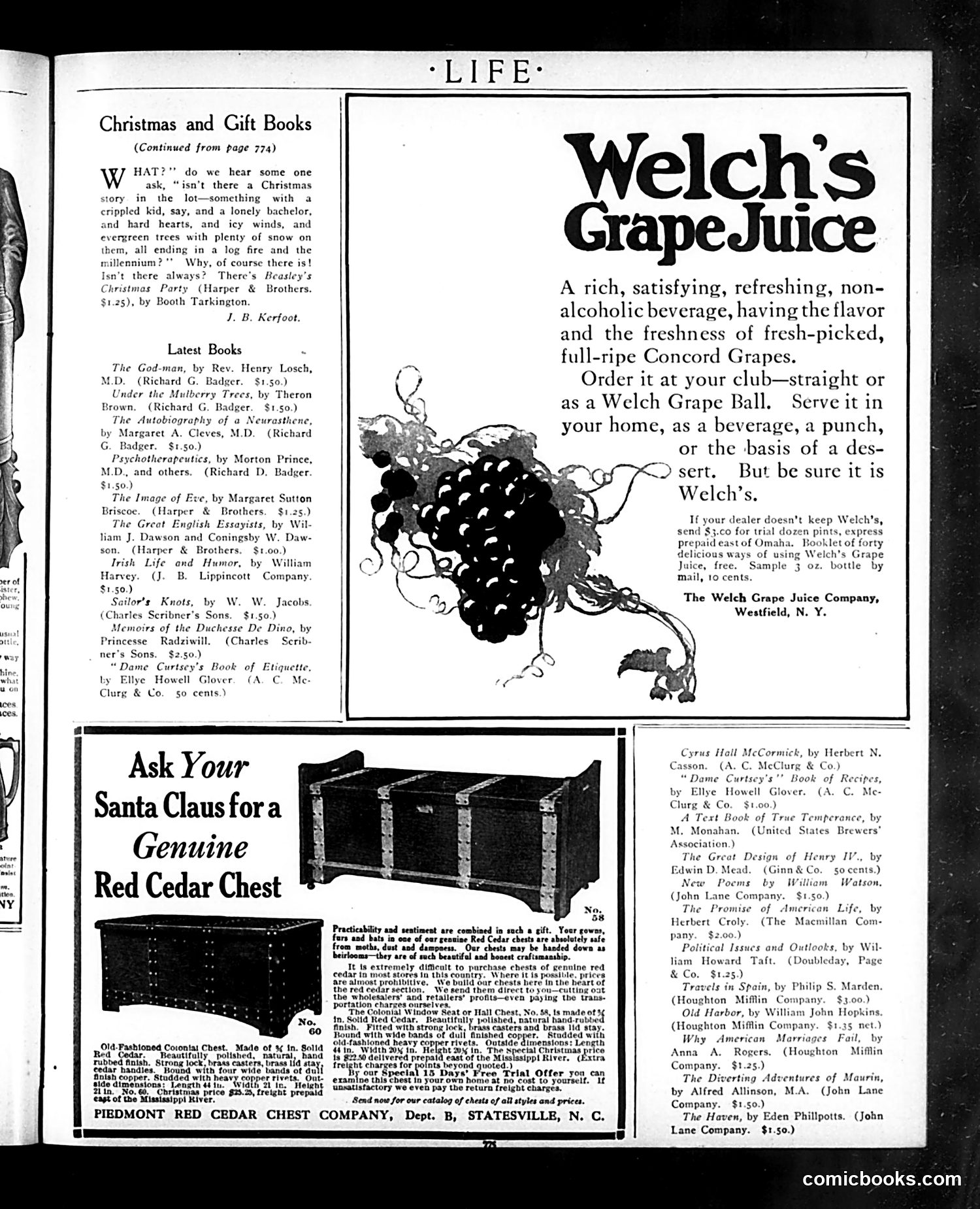
This page contains **book reviews and advertisements**, not political cartoons. The "Christmas and Gift Books" section reviews recent publications, including Booth Tarkington's *Beasley's Christmas Party*—a sentimental holiday story matching the clichéd tropes the reviewer humorously lists (crippled child, lonely bachelor, redemptive snowfall, fireplace ending). The advertisements promote two products: 1. **Red Cedar Chest**: A storage trunk marketed as a practical yet sentimental gift, emphasizing its moth-proof qualities and honest craftsmanship. The company undercuts retail markup by selling directly to consumers. 2. **Welch's Grape Juice**: A non-alcoholic beverage marketed as suitable for serving at clubs or home gatherings—notably emphasizing it's a temperance alternative, likely relevant to early-20th-century prohibition-era concerns about alcohol consumption. Both ads appeal to middle-class values: domestic sentiment, practical utility, and moral propriety. The page reflects period consumer culture and social anxieties.
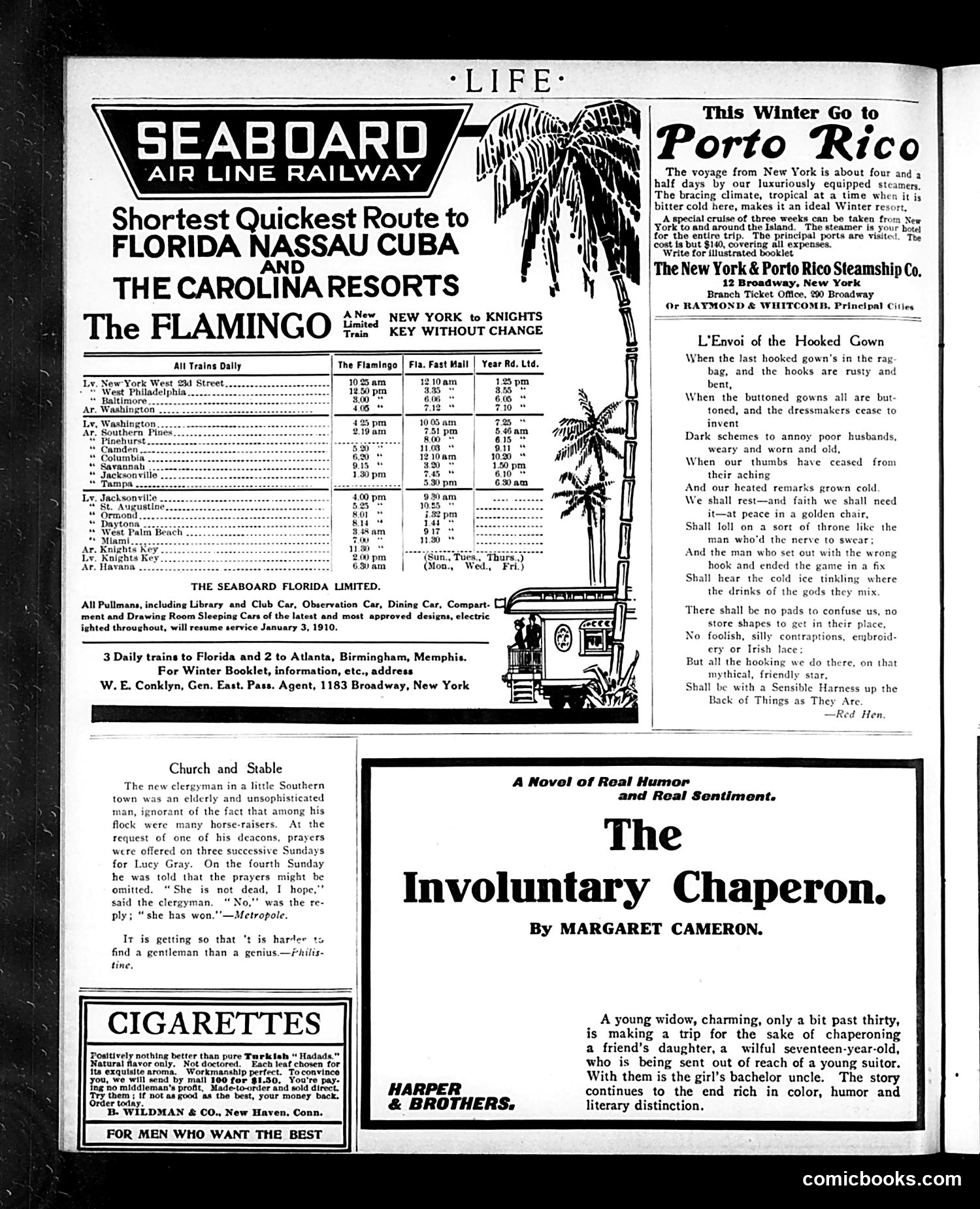
This page is primarily **advertising and announcements**, not political satire. The main content includes: **Travel Advertisements:** The Seaboard Air Line Railway promotes train service to Florida, Nassau, and Cuba; the New York & Porto Rico Steamship Company advertises Caribbean cruises—reflecting early 1900s leisure travel for the wealthy. **"L'Envoi of the Hooked Gown":** A humorous poem mocking women's fashion struggles, specifically the frustration of hook-and-eye closures on garments and the constant demands of dress redesign that irritate husbands. **"Church and Stable":** A brief anecdote about a naive clergyman praying for "Lucy Gray," unaware she's a racehorse, not a parishioner—gentle satire of rural religious innocence. **Book Advertisement:** *The Involuntary Chaperon* by Margaret Cameron, a novel about a widow chaperoning a young woman to prevent an unsuitable romance. **Cigarette Advertisement:** For Turkish cigarettes. The page reflects 1910s concerns: leisure travel, women's fashion frustrations, and light social humor rather than political commentary.
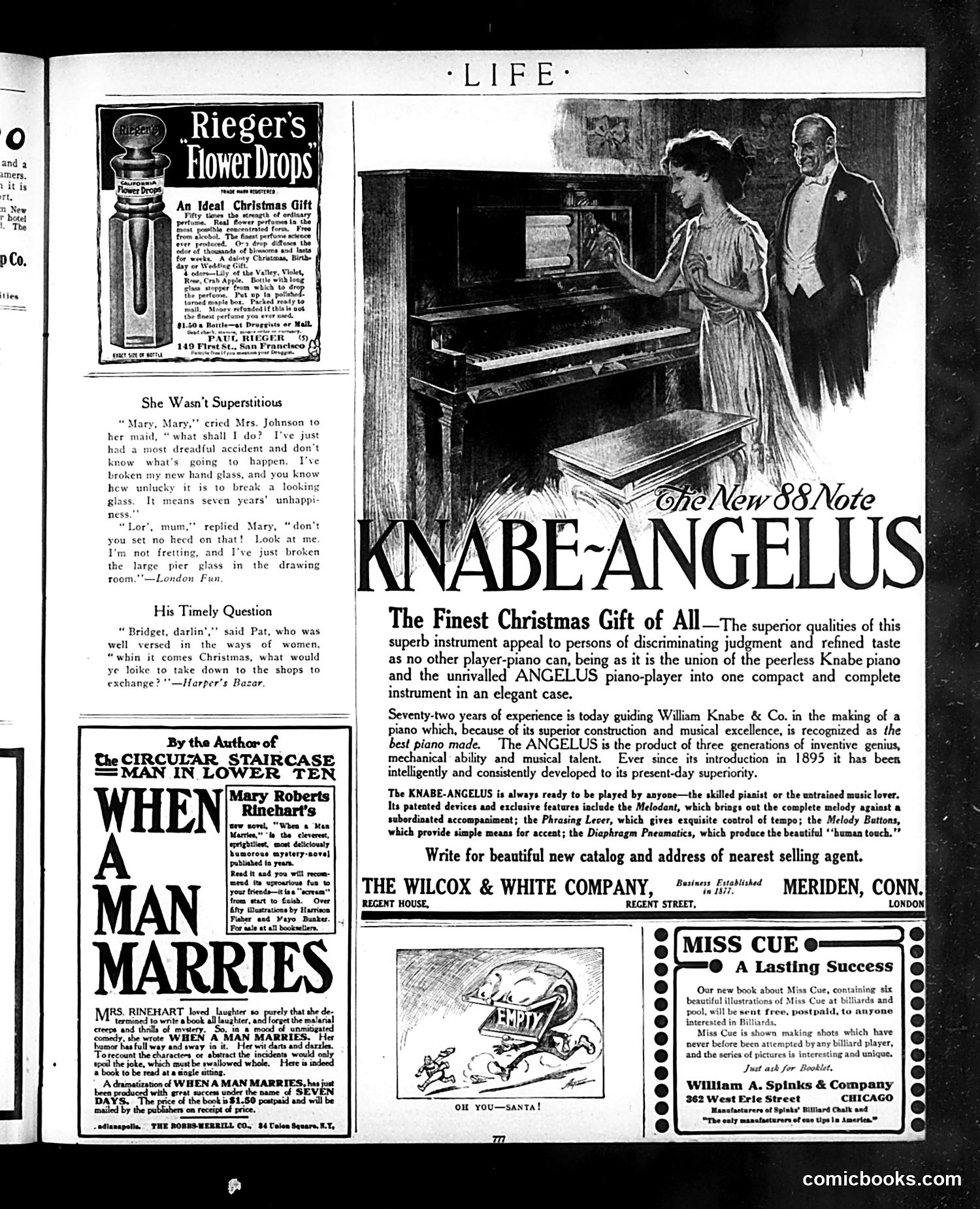
This page is primarily **advertising**, not political satire or comics. It contains several product advertisements aimed at Christmas gift-giving: **Main content includes:** - Rieger's Flower Drops perfume ad - Knabe-Angelus player piano (the largest ad, showing a well-dressed couple admiring the instrument) - "When a Man Marries" book promotion by Mary Roberts Rinehart - Miss Cue billiards instruction book - Wilcox & White Company piano-player advertisement **The humor pieces** are minor filler items: - "She Wasn't Superstitious": A brief joke about a maid breaking a mirror without concern for the "seven years bad luck" superstition - "His Timely Question": A mild Irish-stereotyped joke about a man asking his maid what Christmas gift she wants The page reflects **early 20th-century consumer culture and gift-giving conventions** rather than political commentary. The ads emphasize refinement, taste, and luxury goods as appropriate presents for the affluent.
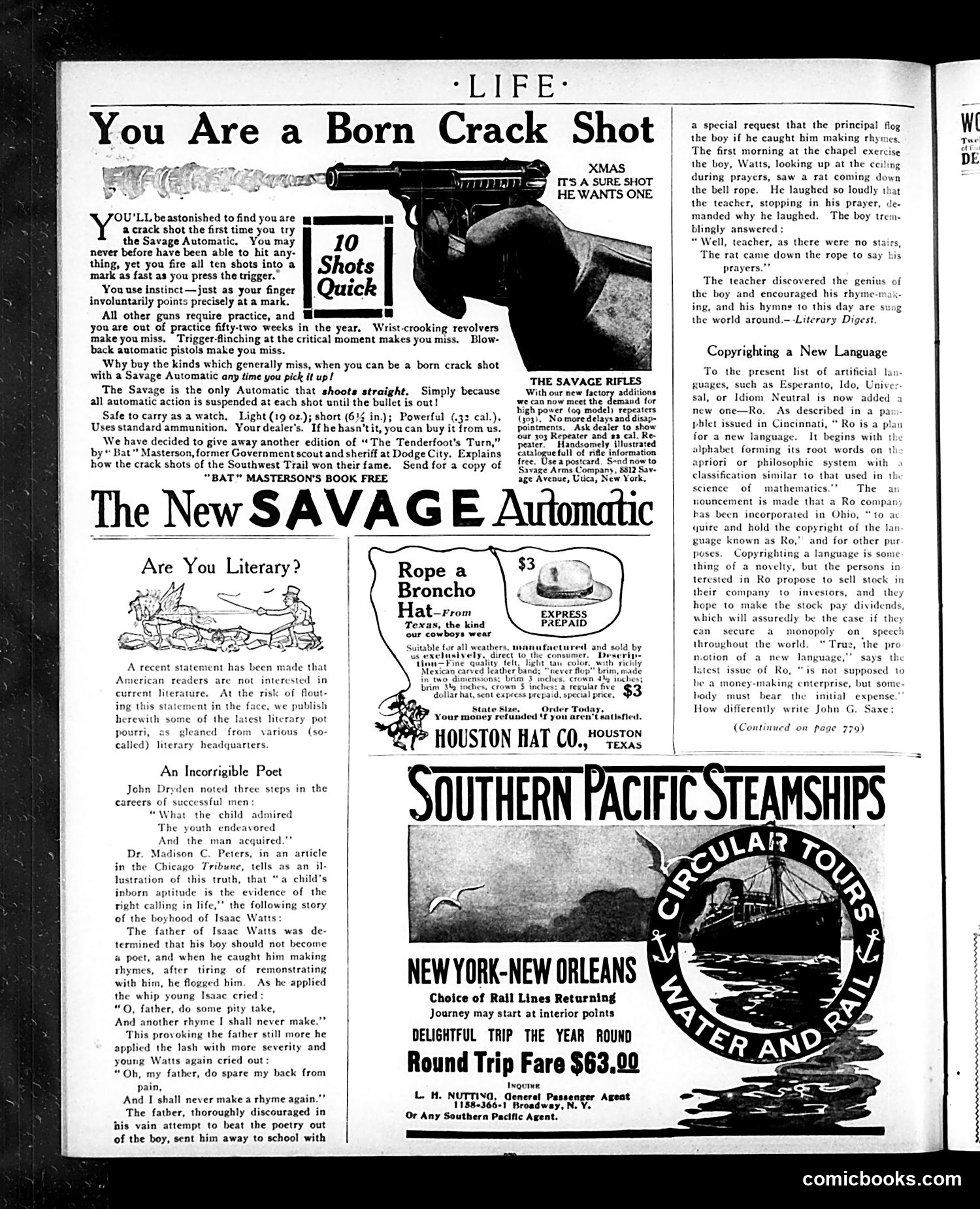
This page combines editorial content with period advertising. The main feature, "You Are a Born Crack Shot," is a **Savage Automatic rifle advertisement** disguised as lifestyle editorial—a common early 20th-century marketing tactic. It claims the rifle's design allows anyone to shoot accurately without training, using pseudo-scientific language about "instinct" and automatic mechanisms. The secondary feature, "An Incorrigible Poet," recounts the anecdote of Isaac Watts (hymn writer) whose father beat him to discourage poetry-writing, yet Watts continued composing—even rhyming pleas for mercy during floggings. The piece celebrates artistic calling as innate and unstoppable. The advertisements include a cowboy hat company, steamship cruises, and rail travel—typical leisure-class products of the era. **Context modern readers miss**: These pieces reflect pre-WWI American confidence in technology and individualism, plus romanticization of both frontier masculinity (crack shots, cowboys) and artistic genius.
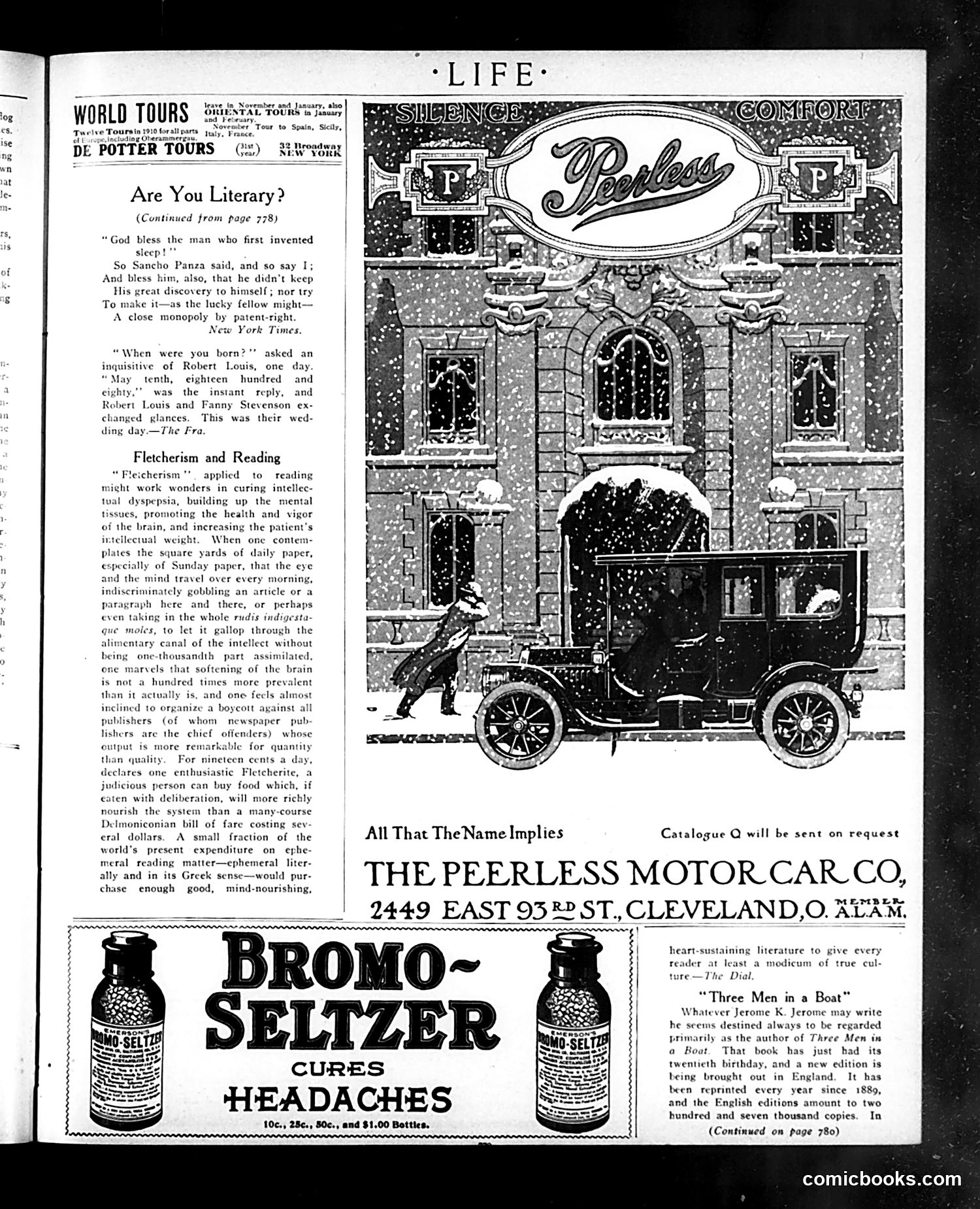
This page contains **no political cartoon**—it's primarily literary content and advertisements from an early 1900s *Life* magazine. The main text discusses "Fletcherism," a dietary fad where food should be chewed thoroughly for mental and physical health. The author sarcastically compares mindless newspaper reading to poor digestion—people consume news rapidly without actually absorbing or thinking about it, causing "intellectual dyspepsia." The page includes: - A travel advertisement (De Potter Tours) - An anecdote about Robert Louis Stevenson's wedding - A critique of sensationalist publishing - A large **Peerless Motor Car advertisement** showing a wealthy couple in an automobile (common luxury marketing of the era) - A Bromo-Seltzer headache remedy ad - A note about Jerome K. Jerome's book *Three Men in a Boat* reaching its twentieth anniversary The satirical point targets both publishers for quantity-over-quality content and readers for passive, uncritical consumption.
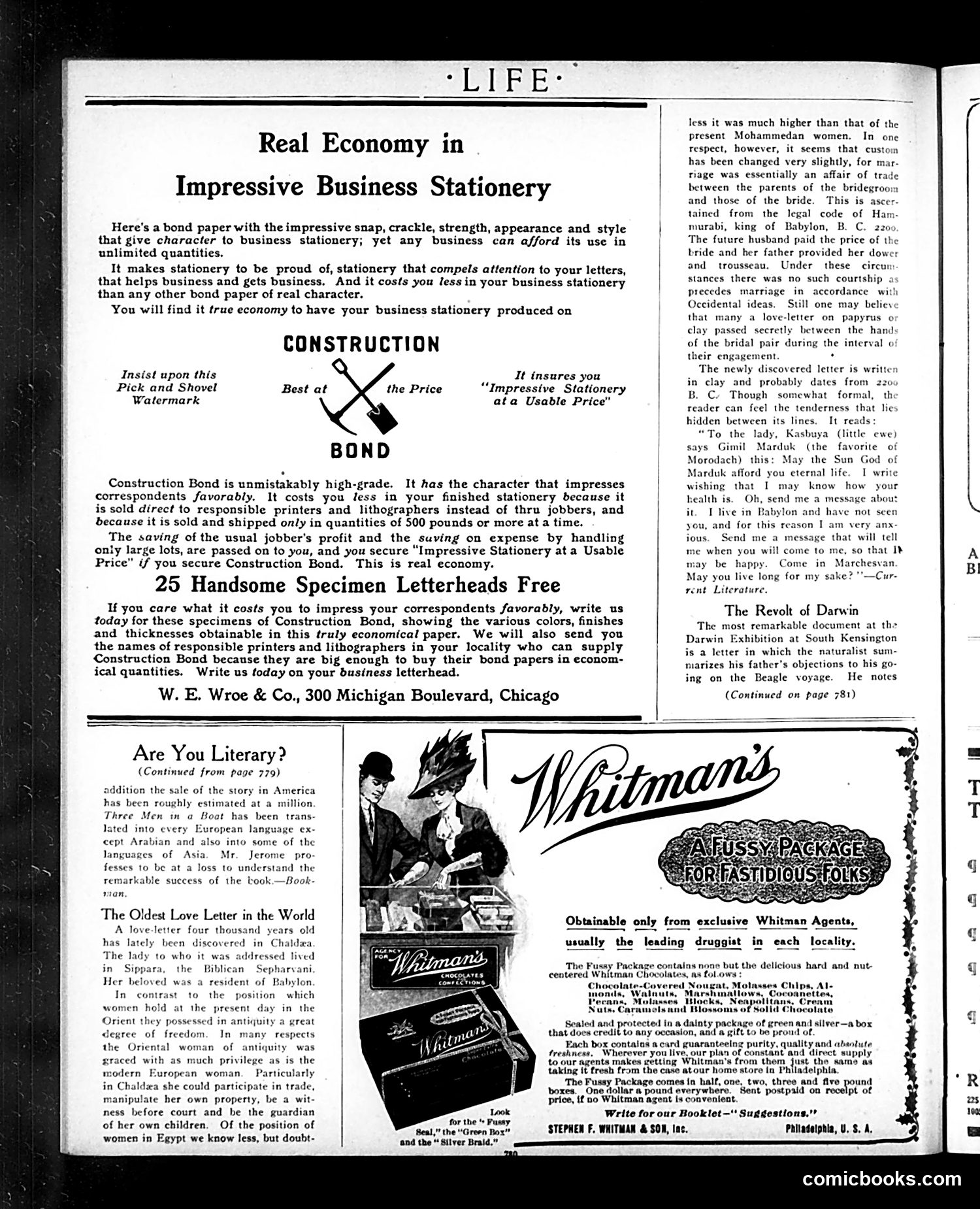
This page is primarily **advertising**, not political satire. The dominant content is a full-page advertisement for "Construction Bond" business stationery (W. E. Wroe & Co., Chicago), emphasizing economy and professional appearance. The page includes a secondary article titled "Are You Literary?" discussing historical love letters, including a 4,000-year-old Babylonian letter and references to Darwin's correspondence. There's also an advertisement for Whitman's chocolates. The only visual element approaching cartoon form is an illustration of a woman at a desk with Whitman's candy boxes—this is purely commercial imagery, not satirical commentary. **Conclusion**: This is a standard early 20th-century magazine page mixing editorial content with advertisements. There are no political cartoons, social satire, or caricatures to analyze. The "cartoon" reference in your prompt doesn't apply here.
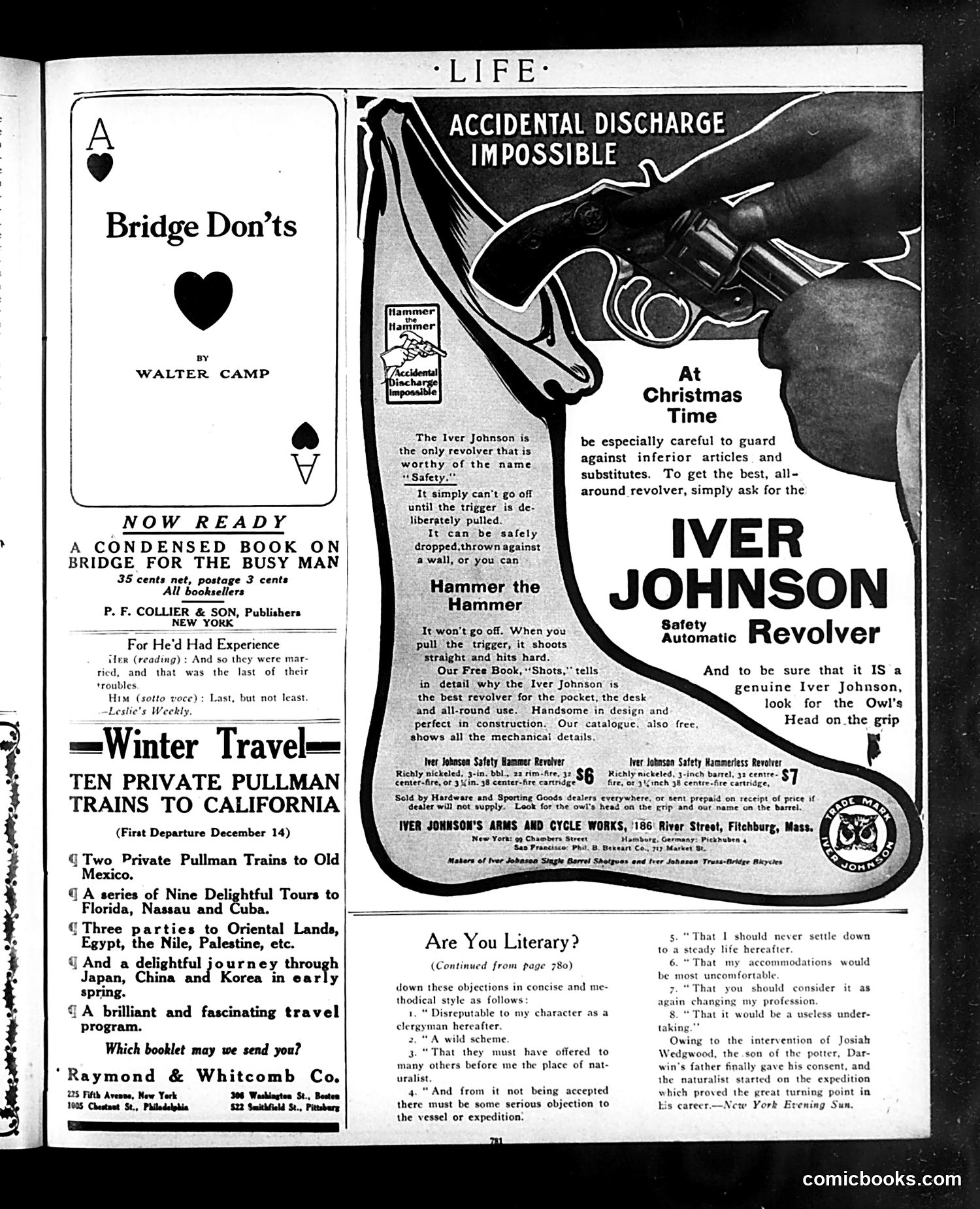
This page is primarily **advertising**, not satire or political commentary. The dominant content is a large advertisement for the **Iver Johnson Safety Automatic Revolver**, marketed as a Christmas gift. The ad emphasizes the gun's safety features—it cannot discharge accidentally and requires deliberate trigger-pulling—appealing to gift-buyers seeking a "safe" firearm. Supporting ads include travel packages from Raymond & Whitcomb Co. (winter trains to California, Mexico, and the Orient) and a book on bridge by Walter Camp. The only editorial content is a small "Are You Literary?" piece (continued from page 780) discussing Charles Darwin's hesitation about joining a scientific expedition, resolved when Josiah Wedgwood's intervention convinced Darwin's father. The page reflects early 20th-century consumer culture: firearms marketed as holiday gifts, luxury travel for the wealthy, and leisure activities like bridge. No political satire is evident.
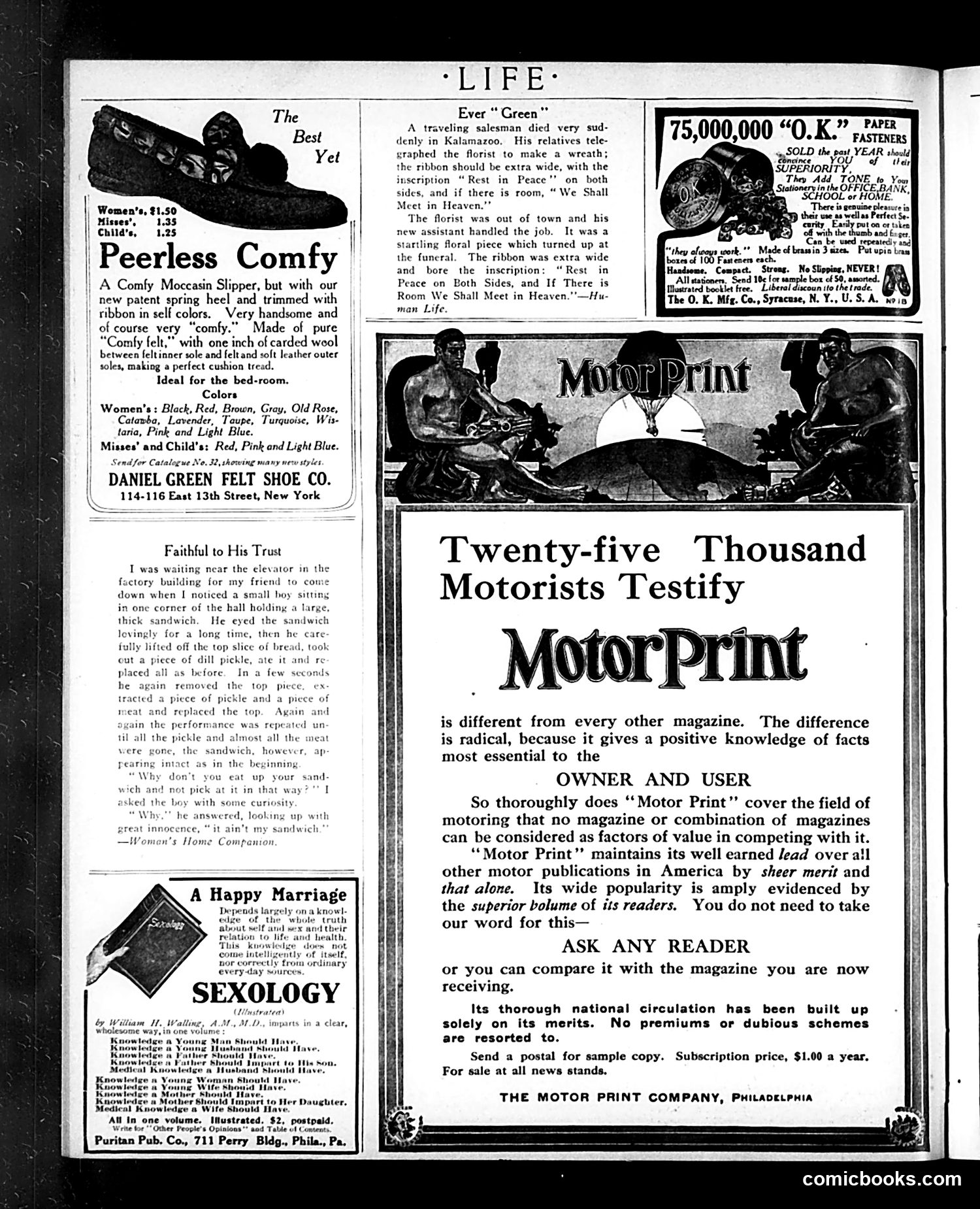
This page is primarily **advertising content** rather than editorial satire. The left column features a shoe advertisement for "Peerless Comfy" by Daniel Green Felt Shoe Co., promoting a women's moccasin slipper with decorative ribbon in various colors. Below that is a brief anecdotal story titled "Faithful to His Trust" about a boy eating a sandwich at a factory. The lower left contains an advertisement for a book on "Sexology" by William H. Walling, marketed as marital advice. The right side is dominated by a full-page advertisement for **Motor Print magazine**, claiming 25,000 motorists endorse it as superior to competitor publications. The ad emphasizes the magazine's exclusive focus on automotive knowledge for owners and users. No political cartoons or satire appear on this page.
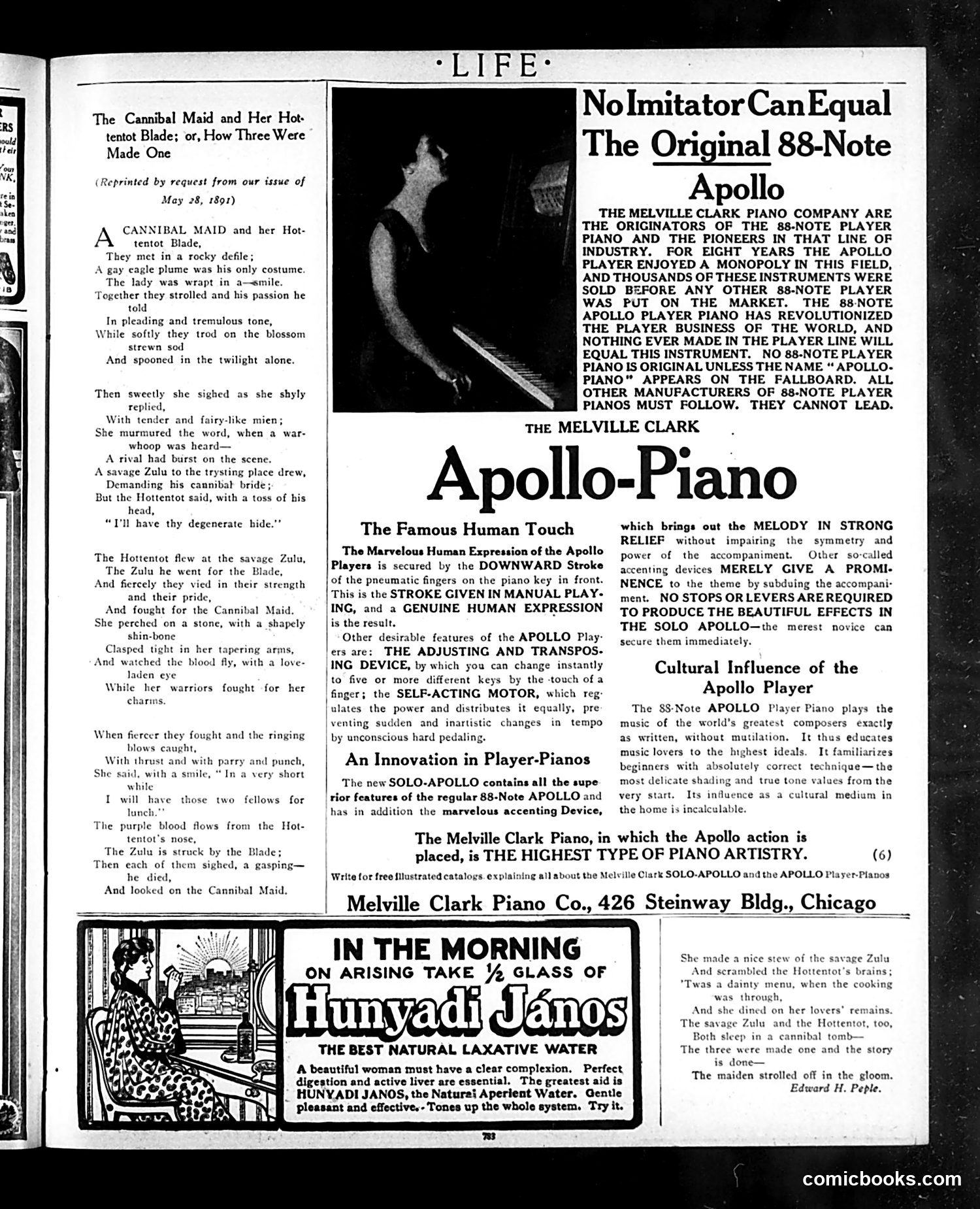
This page reprints a humorous poem from Life magazine (May 1891) depicting a love triangle among African and Indigenous peoples portrayed in exaggerated, dehumanizing stereotypes typical of that era. The narrative—a Hottentot man and Zulu rival fighting over a "cannibal maid" while she watches—uses racist caricature for comedic effect. The woman's final line about having "those two fellows for lunch" plays on period stereotypes about cannibalism. **Context for modern readers:** This reflects 19th-century attitudes treating non-Western peoples as exotic curiosities suitable for ridicule. The humor relied on audiences accepting dehumanizing racial stereotypes as entertainment. The page's bulk comprises **advertisements** for the Apollo Player Piano, emphasizing its superiority as an "original" 88-note instrument and its cultural value as a "medium in the home."
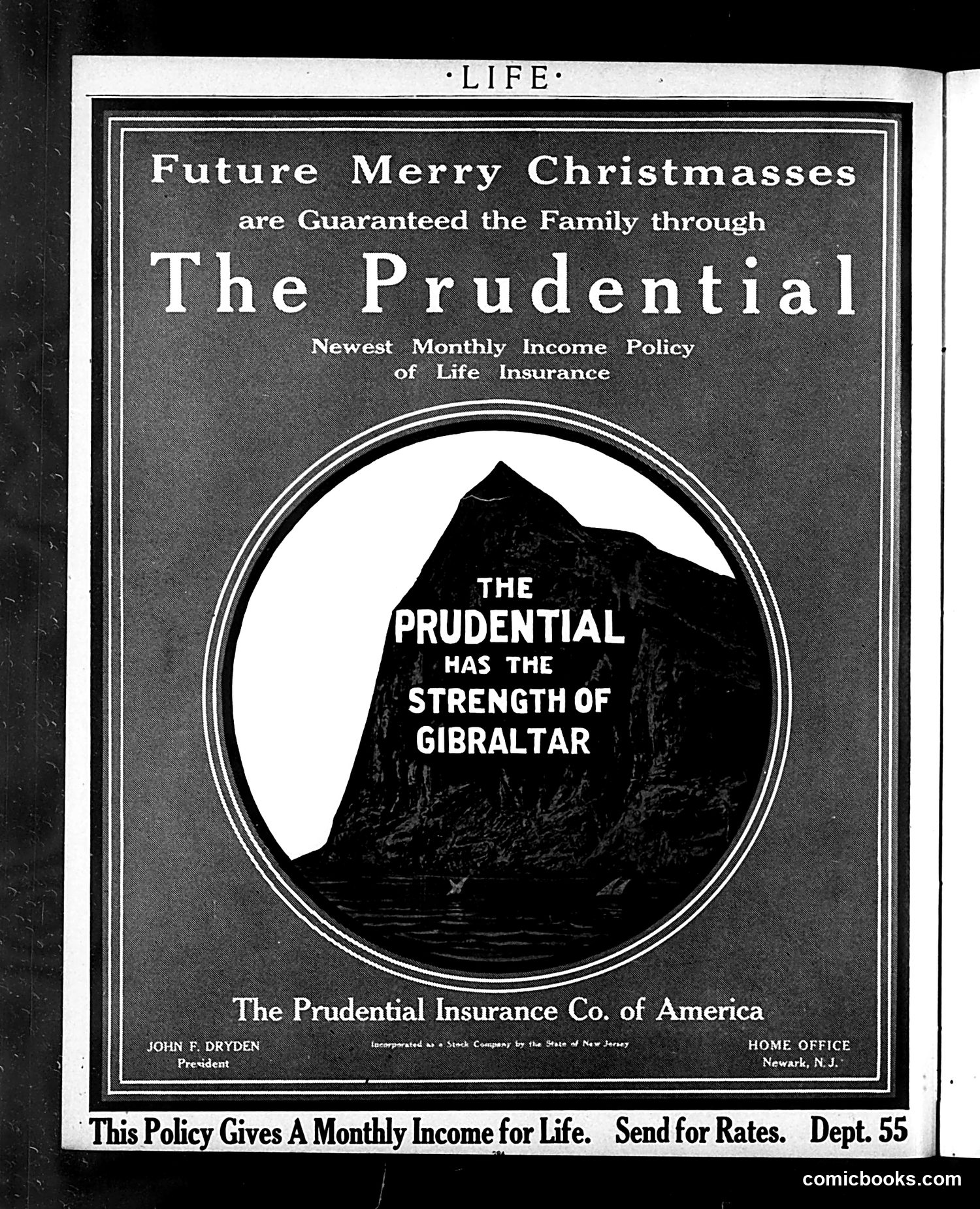
This is a **full-page advertisement**, not satire or political commentary. It promotes The Prudential Insurance Company's "Monthly Income Policy of Life Insurance." The ad uses **Gibraltar** (the famous Rock of Gibraltar) as a metaphor for strength and stability, claiming Prudential offers comparable security for families' financial futures. The striking image shows the rock silhouetted against moonlight—a visual symbol of permanence and protection. The headline promises "Future Merry Christmasses are Guaranteed the Family," appealing to consumers' desire to ensure their loved ones' comfort after death. The company's president, John F. Dryden, is named, with the home office location (Newark, N.J.) provided. This represents early 20th-century life insurance marketing—positioning insurance as a moral obligation and patriotic duty to protect one's family through financial prudence.
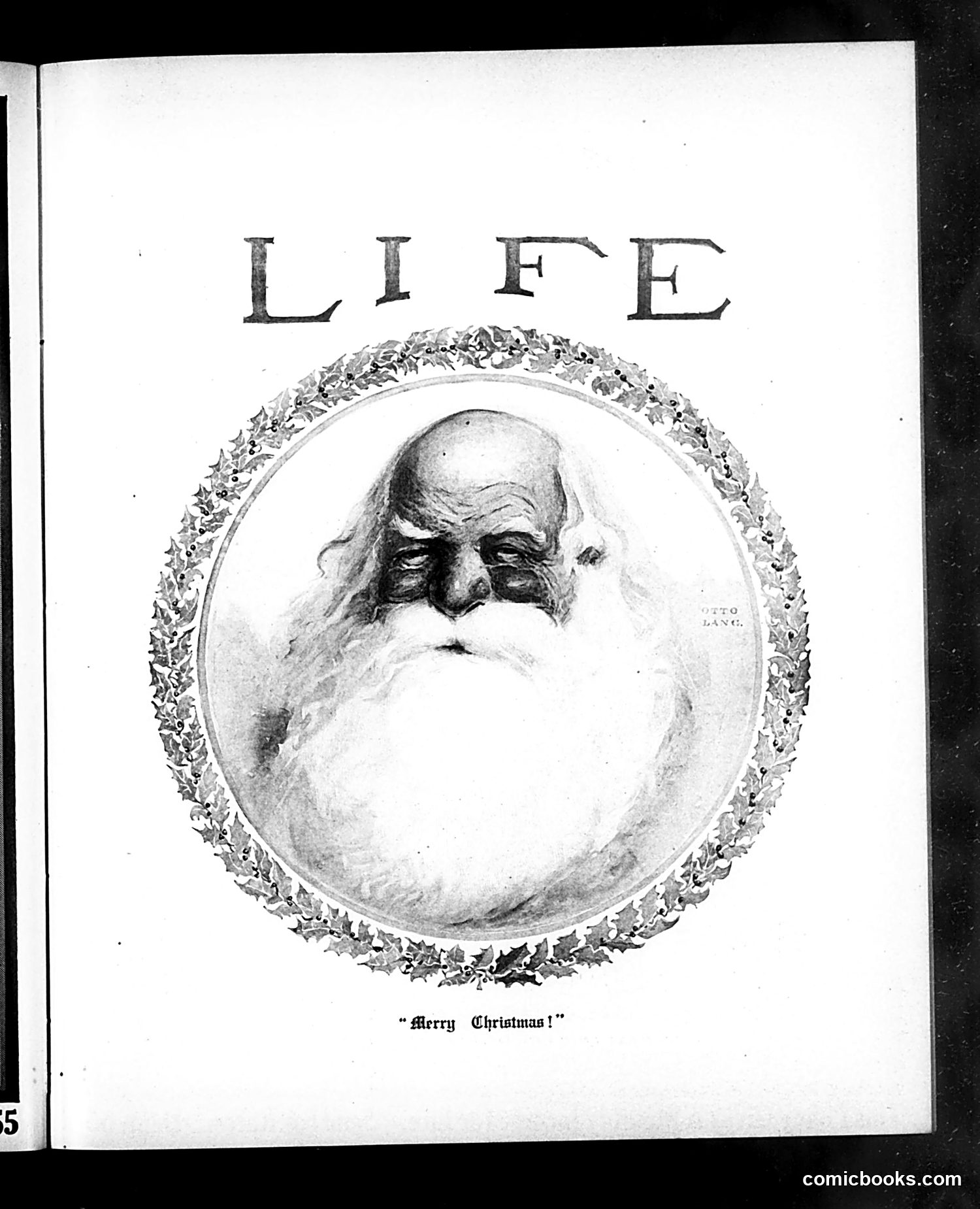
This is a cover page from *Life* magazine featuring a large circular portrait of an elderly man with a prominent white beard, surrounded by a decorative holly wreath border. The word "LIFE" appears at the top, with "Merry Christmas!" quoted below the image. The bearded figure appears to be a representation of Santa Claus or Father Christmas, a common seasonal motif for holiday issues of satirical magazines. The elaborate wreath framing emphasizes the Christmas theme. The artist's signature "OTTO LANG" appears in the portrait. Without additional context about the specific issue date, the precise satirical intent remains unclear, though the jolly holiday personification was typical for *Life*'s festive cover designs during the early 20th century.
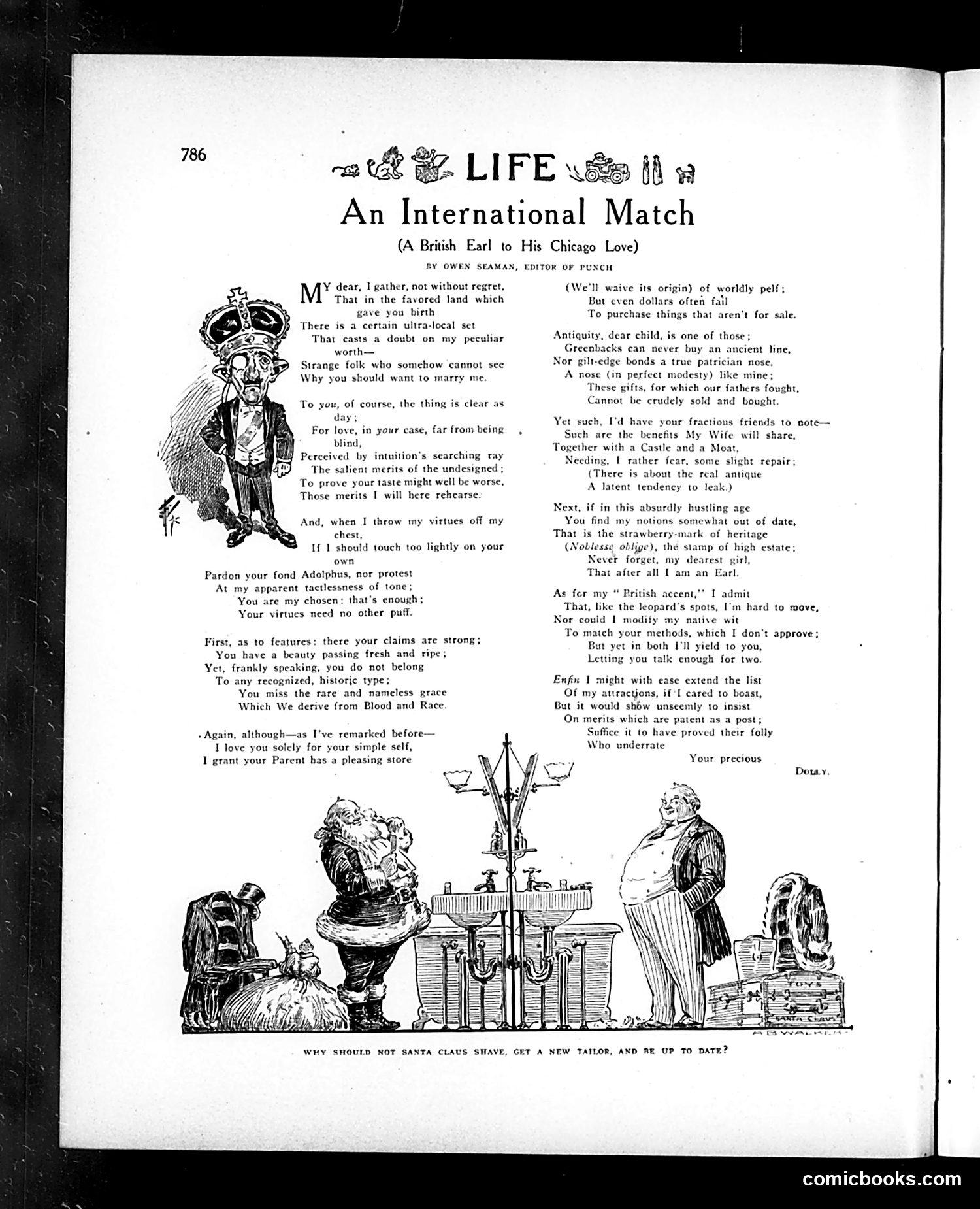
This is a satirical poem by Owen Seaman (editor of *Punch*) mocking a British aristocrat's condescending courtship of a wealthy American woman. The "Earl" lectures his Chicago fiancée on why she should be grateful to marry him despite her social inferiority. The satire targets class pretension: the Earl boasts of his "blood and race," historic nose, and ancient castle (needing repairs), while dismissing her wealth as mere "greenbacks" unable to purchase true nobility. He condescends about her "ultra-local" upbringing, outdated notions being a mark of superiority, and his "British accent" being unchangeable—yet expects her to "talk enough for two." The cartoon illustrates the absurd power dynamics: a portly, aging nobleman facing a wealthy American woman across a scale. The final caption asks why Santa shouldn't get a new tailor and "be up to date"—suggesting the Earl himself is as outdated as old Saint Nick. This reflects early-20th-century American anxieties about wealthy heiresses marrying impoverished European titles.
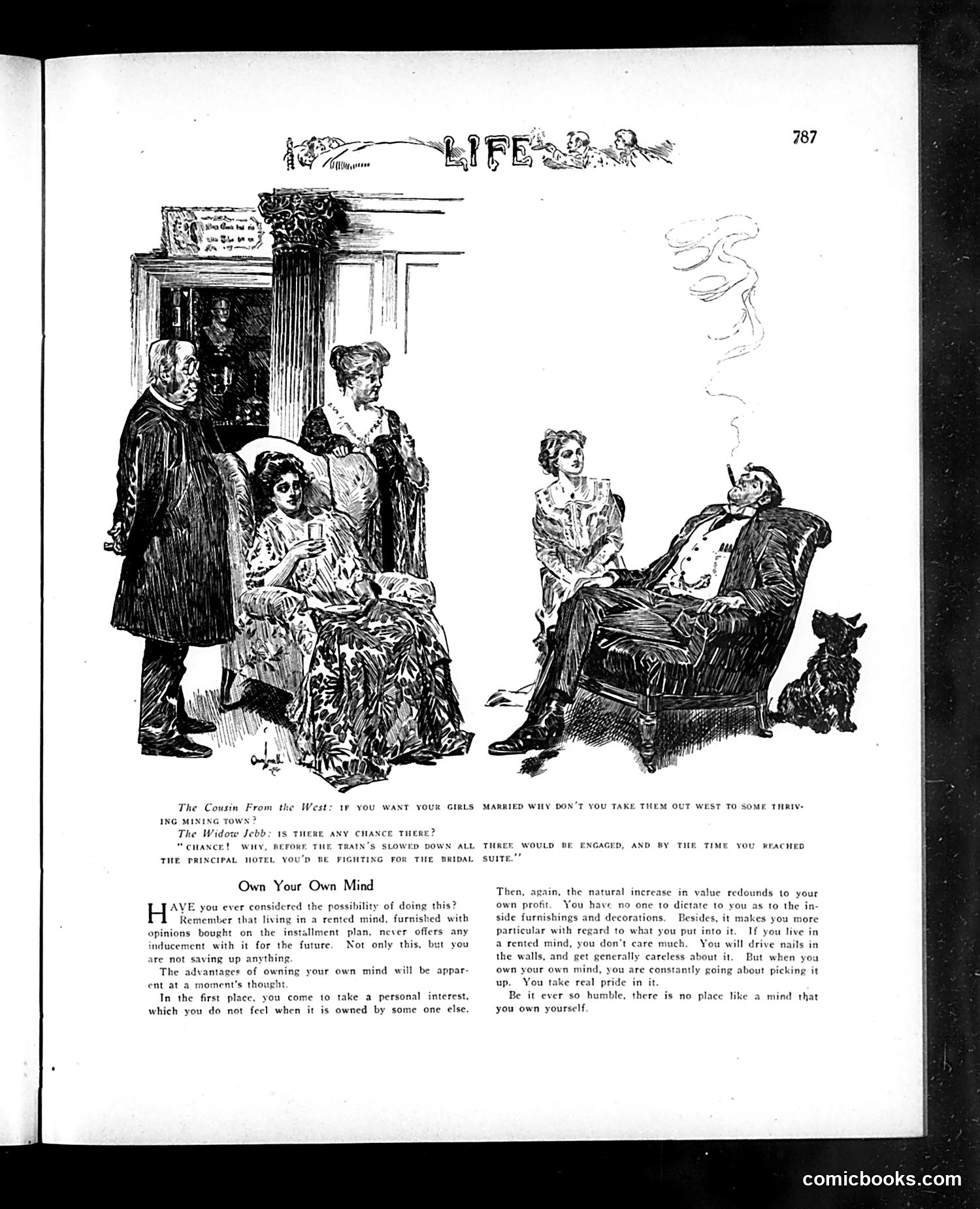
The page contains two distinct pieces: **Top cartoon:** A social satire titled "The Cousin From the West." A wealthy visitor from a mining town suggests sending unmarried girls west to find husbands, claiming they'd be engaged before the train stopped. The widow Jebb skeptically asks if there's "any chance"—the joke being that the cousin is clearly exaggerating the marriage prospects out west, likely implying the region is remote or rough enough that any eligible woman would be quickly claimed. **Bottom article:** "Own Your Own Mind" is a philosophical essay (not a cartoon) advocating intellectual independence. It uses real-estate metaphors—comparing borrowed opinions to renting furnished apartments—to argue that people should develop their own thoughts rather than uncritically adopt others' ideas. The message: independent thinking is more valuable and personally satisfying than passive acceptance of conventional wisdom. Both pieces reflect early-20th-century concerns about conformity, regional differences, and individual agency.
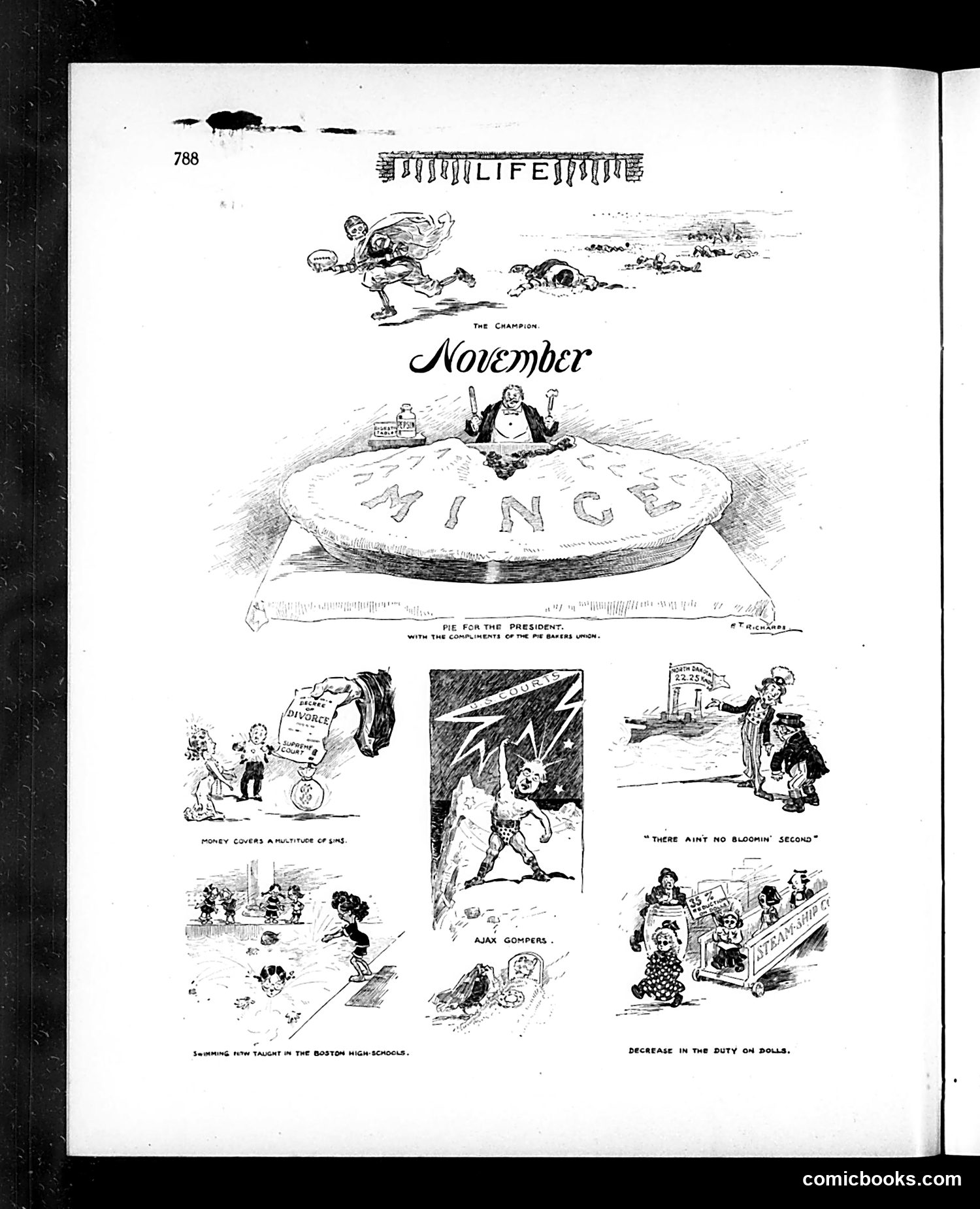
This page contains political cartoons mocking November 1909 events. The central image shows a man emerging from a giant pie labeled "mince," captioned "Pie for the President"—likely referencing President Taft and a pie-baking industry gesture or scandal. Other vignettes satirize contemporary issues: "Money Covers a Multitude of Sins" appears to critique financial corruption; "Ajax Gompers" likely mocks labor leader Samuel Gompers; "There Ain't No Bloomin' Second" references British slang about second chances; and scenes about Boston high schools and toy tariffs mock educational and trade policy. "The Champion" depicts a running figure, possibly alluding to sporting or political competition. The cartoons employ visual puns and exaggeration typical of Life's satirical style, targeting politicians, business figures, and contemporary social controversies with humor accessible to educated readers of the era.
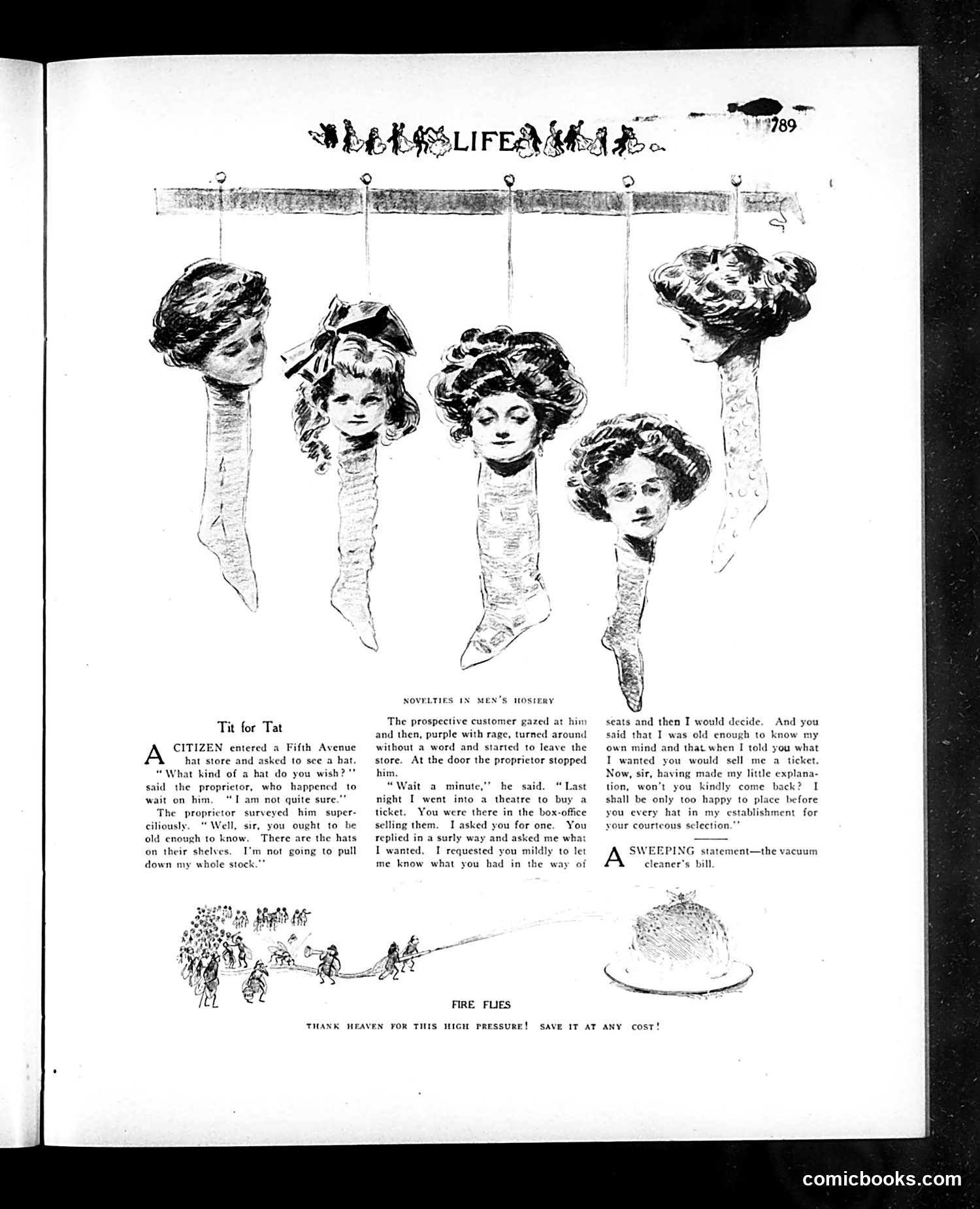
This cartoon satirizes rudeness and poor customer service in retail establishments. A hat-shop proprietor treats a customer dismissively, refusing to show merchandise and telling him to choose from the shelves himself. The customer recognizes the proprietor as the same man who worked at a theater box office, where he was equally rude when selling tickets. The joke's "tit for tat" point: the customer reveals he's the *same person* the proprietor was discourteous to previously, using that experience to shame him into better behavior. The satire criticizes how service workers—particularly in early 20th-century retail—often treated customers with contempt rather than helpfulness. The accompanying illustrations labeled "Novelties in Men's Hosiery" and "Fire Flies" appear to be unrelated satirical advertisements or filler content typical of Life magazine's format.
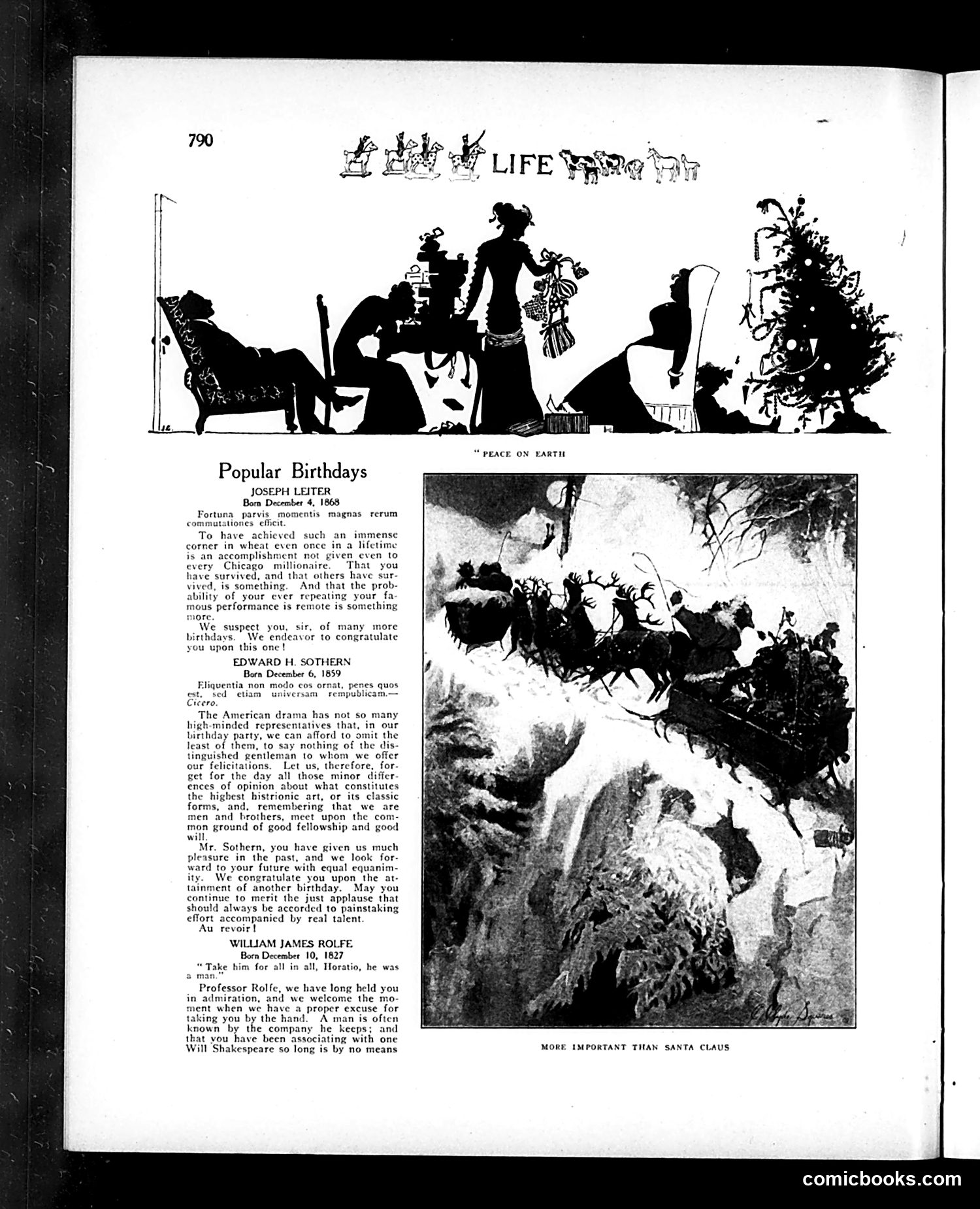
This page celebrates three prominent Americans' birthdays through satirical congratulatory letters: **Joseph Leiter** (wheat speculator) - The text mocks his famous wheat-market corner, suggesting he's unlikely to repeat such a feat and that his survival (and others') following the financial maneuver is itself noteworthy. **Edward H. Sothern** (actor) - A respectful tribute calling him a rare "high-minded representative" of American drama, with tongue-in-cheek appeals to set aside theatrical debates on his birthday. **William James Rolfe** (Shakespeare scholar) - Playfully credits him for his long association with Shakespeare, implying this connection elevates his reputation. The silhouette illustration above depicts a wealthy family's Christmas morning, captioned "Peace on Earth." The photograph below ("More Important Than Santa Claus") shows Santa with reindeer—likely contrasting commercial Christmas imagery with the magazine's focus on notable individuals worth celebrating.
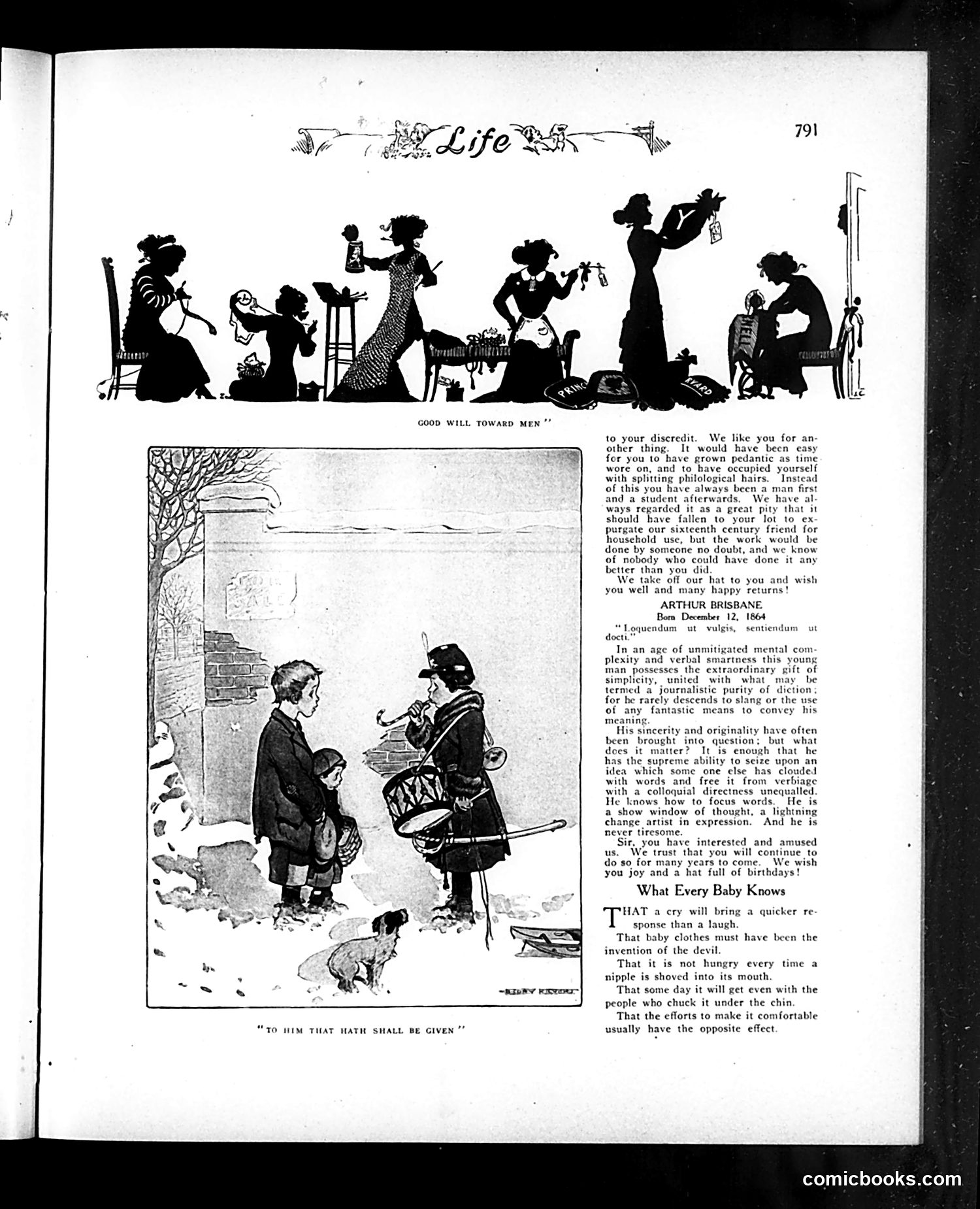
This Life magazine page contains two distinct pieces: **Upper silhouette:** "Good Will Toward Men" depicts women engaged in domestic labor—cleaning, cooking, childcare, sewing. The title's ironic juxtaposition suggests commentary on society's expectation that women perform unpaid household work as a moral duty or virtue. **Lower cartoon:** "To Him That Hath Shall Be Given" shows what appears to be a Salvation Army or charitable worker distributing aid to poor children in winter. The biblical title (Matthew 25:29) sarcastically critiques wealth inequality: those already privileged receive more, while the poor struggle. The scene depicts class disparity and inadequate charity. **Text sections:** Arthur Brisbane's birthday tribute praises someone for intellectual simplicity and journalistic clarity (unclear who specifically). "What Every Baby Knows" humorously lists infant frustrations—restrictive clothing, forced feeding, discomfort from well-meaning adults—expressing the baby's perspective on parental/societal impositions. The page overall satirizes social hypocrisy: domestic servitude, inadequate charity, and adult disregard for children's actual needs.
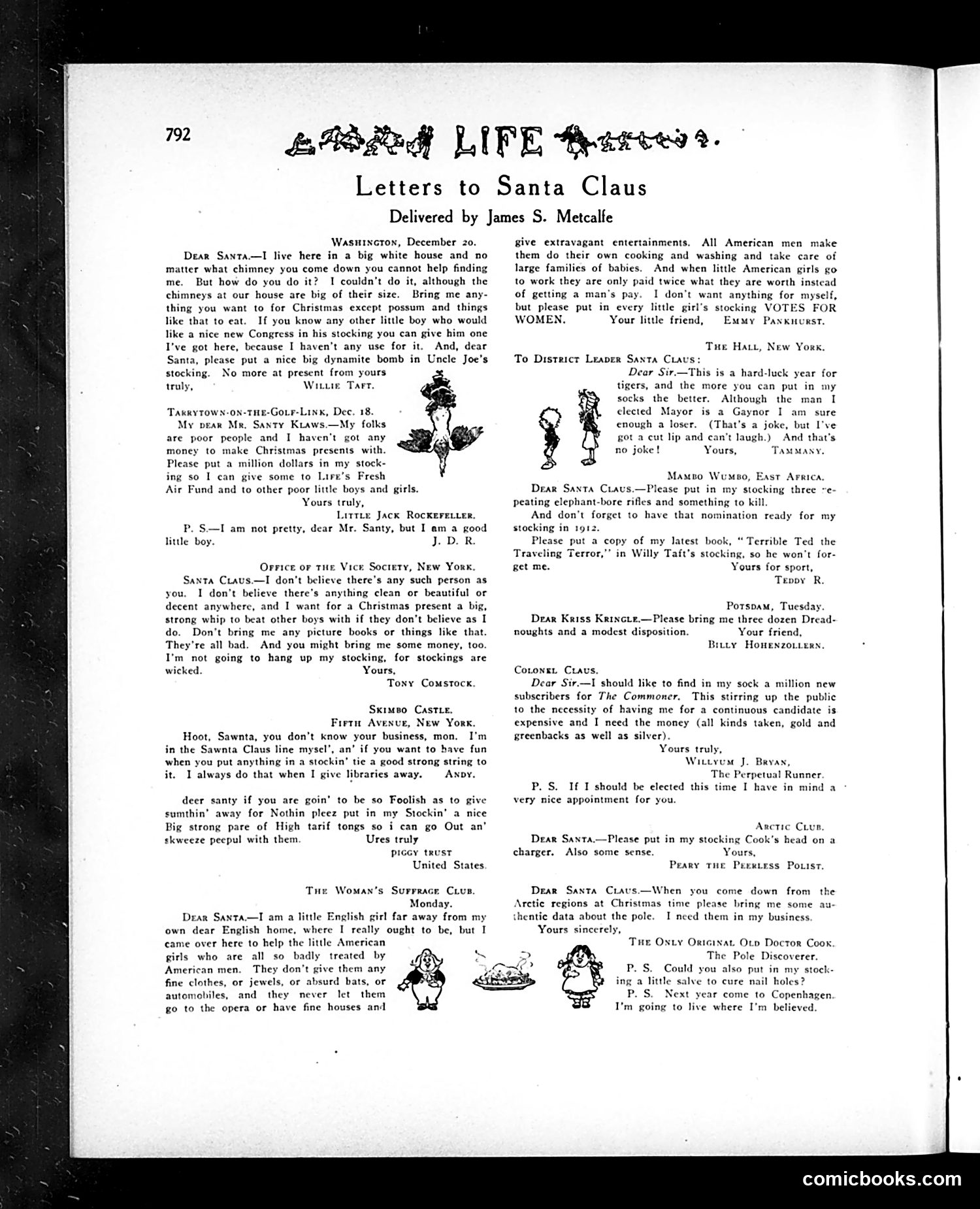
This page presents satirical letters purporting to be from famous figures of the era, each revealing their character through their Christmas wishes to Santa. **Key figures and satire:** - **Willie Taft** (President): Requests a "dynamite bomb" for "Uncle Joe" (likely Senator Joseph Cannon), and a new Congress—mocking political dysfunction. - **Little Jack Rockefeller**: Ironically claims poverty while asking for a million dollars, satirizing the famous wealthy family. - **Tony Comstock**: From the "Vice Society," requests a whip to beat non-believers—mocking moral crusaders as tyrannical. - **Andy** (cartoonist/illustrator): Makes crude jokes about tariffs and "squeezing people." - **Emily Pankhurst**: The British suffragette requests "Votes for Women" for all girls—advancing the contemporary women's suffrage movement. - **Theodore Roosevelt** ("Terrible Ted"): Wants rifles and ammunition, satirizing his reputation as a hunter and militarist. - **Billy Hohenzollern** (German Kaiser): Requests "Dreadnoughts" (warships), mocking militarism and imperial arms races. The satire targets political corruption, wealth inequality, moral hypocrisy, militarism, and gender discrimination through these "wish lists."
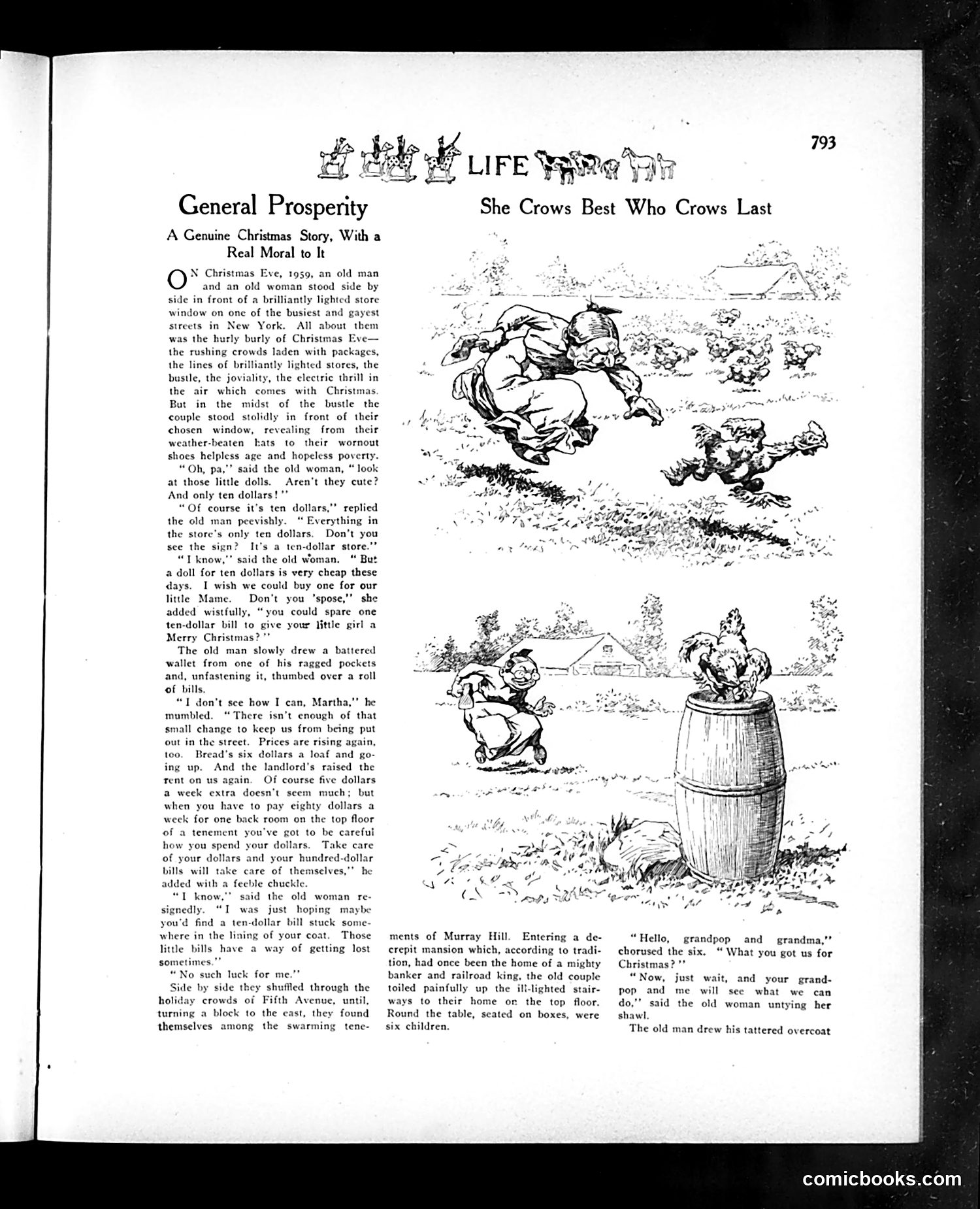
This story critiques the vast wealth inequality of early 1900s America through bitter irony. The title "General Prosperity" is sarcastic: while the nation claims economic success, an elderly couple cannot afford a ten-dollar doll for their grandchild. The setup contrasts sharply: bustling Fifth Avenue department stores with Christmas abundance versus the couple's destitution. Key details underscore their poverty: bread costs six dollars a loaf, rent is eighty dollars weekly for a single back room, and they live in a converted mansion ("once been the home of a mighty banker") now subdivided into tenements. The couple's impossible choice—buy a toy or avoid eviction—exposes how "general prosperity" excludes the working poor. Their six grandchildren await Christmas gifts the elderly cannot provide. The story's "real moral" appears to be a call to conscience: genuine prosperity cannot coexist with such desperate poverty amid abundance.
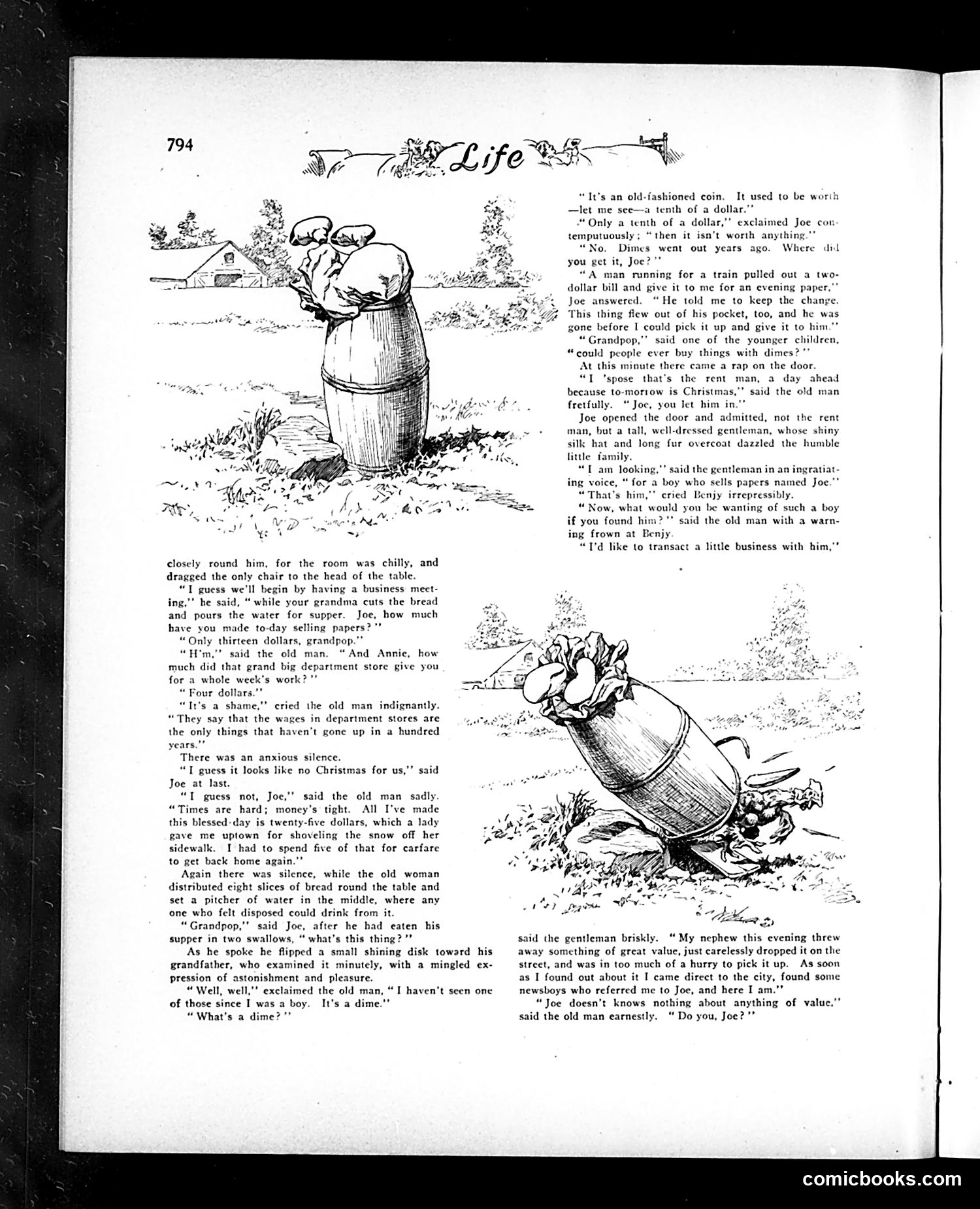
This satirical story-cartoon critiques **economic inequality and wage stagnation** in early 20th-century America. **The Setup:** A poor family (grandfather, Joe the newsboy, and others) struggles during the Christmas season. Their wages are pittiful—Joe earns thirteen dollars selling papers, his sister Annie makes four dollars weekly at a department store. The grandfather notes, bitterly, that department-store wages "haven't gone up in a hundred years." **The Satire:** A well-dressed gentleman arrives searching for Joe, claiming his nephew lost something "of great value." When Joe produces an old dime he found, the story implies the gentleman may offer a reward—suggesting that a *discarded dime* from the wealthy is worth more to him than acknowledging the poverty surrounding him. **The Point:** The contrast between the gentleman's silk hat and furs versus the family's meager bread-and-water supper exposes class disparity. The old dime—worthless to modern commerce but precious to the desperate poor—symbolizes how the wealthy's carelessness can appear as fortune to those struggling below.
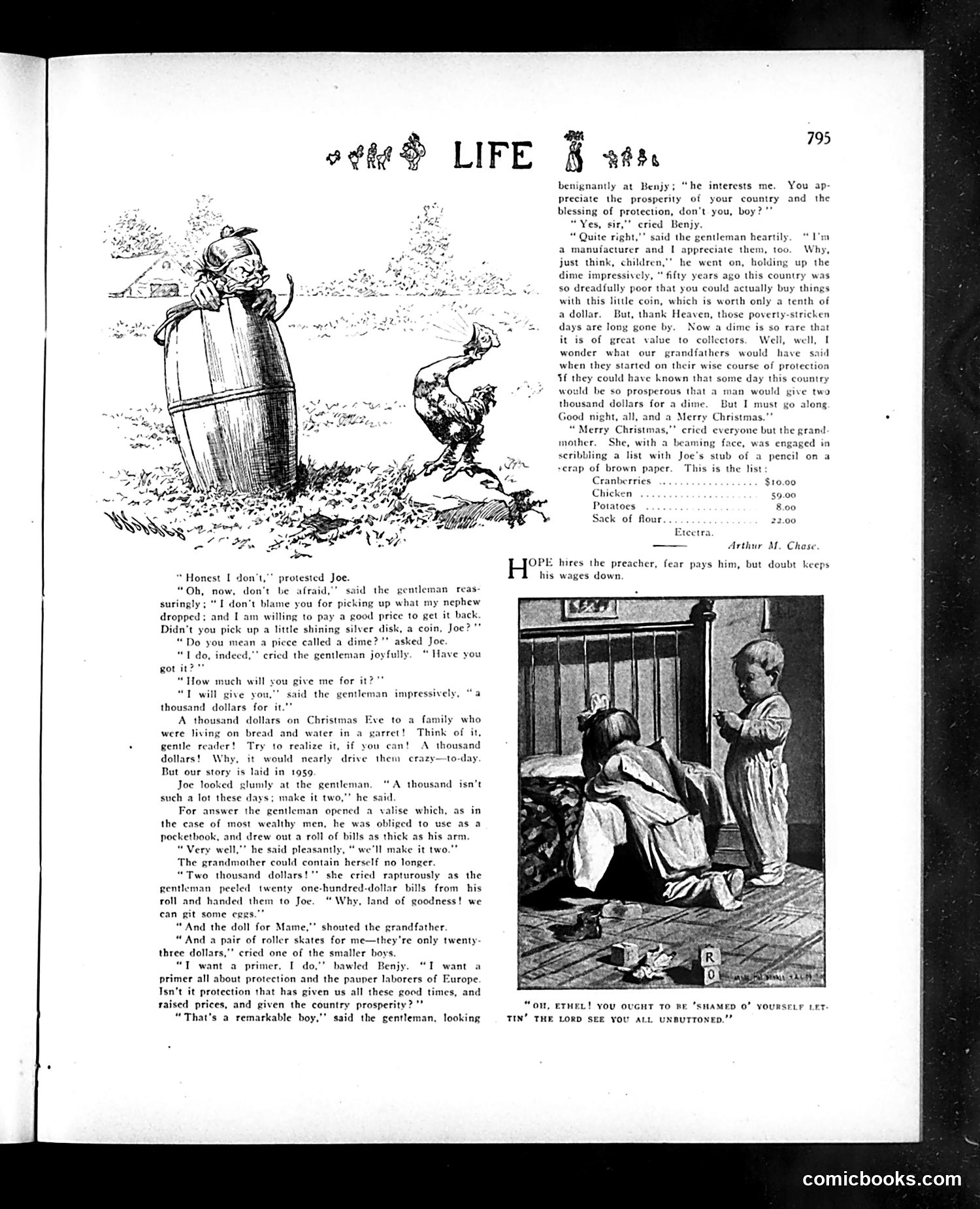
This satirical story mocks **protectionist economic policy** (likely Gilded Age tariffs). A wealthy manufacturer rewards a poor boy with $2,000 for a dime, claiming this demonstrates how protective tariffs have made America prosperous. The gentleman explicitly teaches young Benjy that protection created national wealth and rising prices. The satire's point: protectionist advocates claimed tariffs benefited common people, but this story reveals the absurdity—the family is so impoverished they celebrate being able to buy basic food. The "prosperity" has inflated prices so drastically that a dime (once worth real purchasing power) is now a collector's rarity worth $2,000. By showing a destitute family on "bread and water," the cartoonist exposes how protective tariffs actually harmed working poor while enriching manufacturers, contradicting the protective tariff argument that such policies lifted all economic classes. The story's nostalgic reference to 1859 suggests longing for an earlier, less manipulated economy.
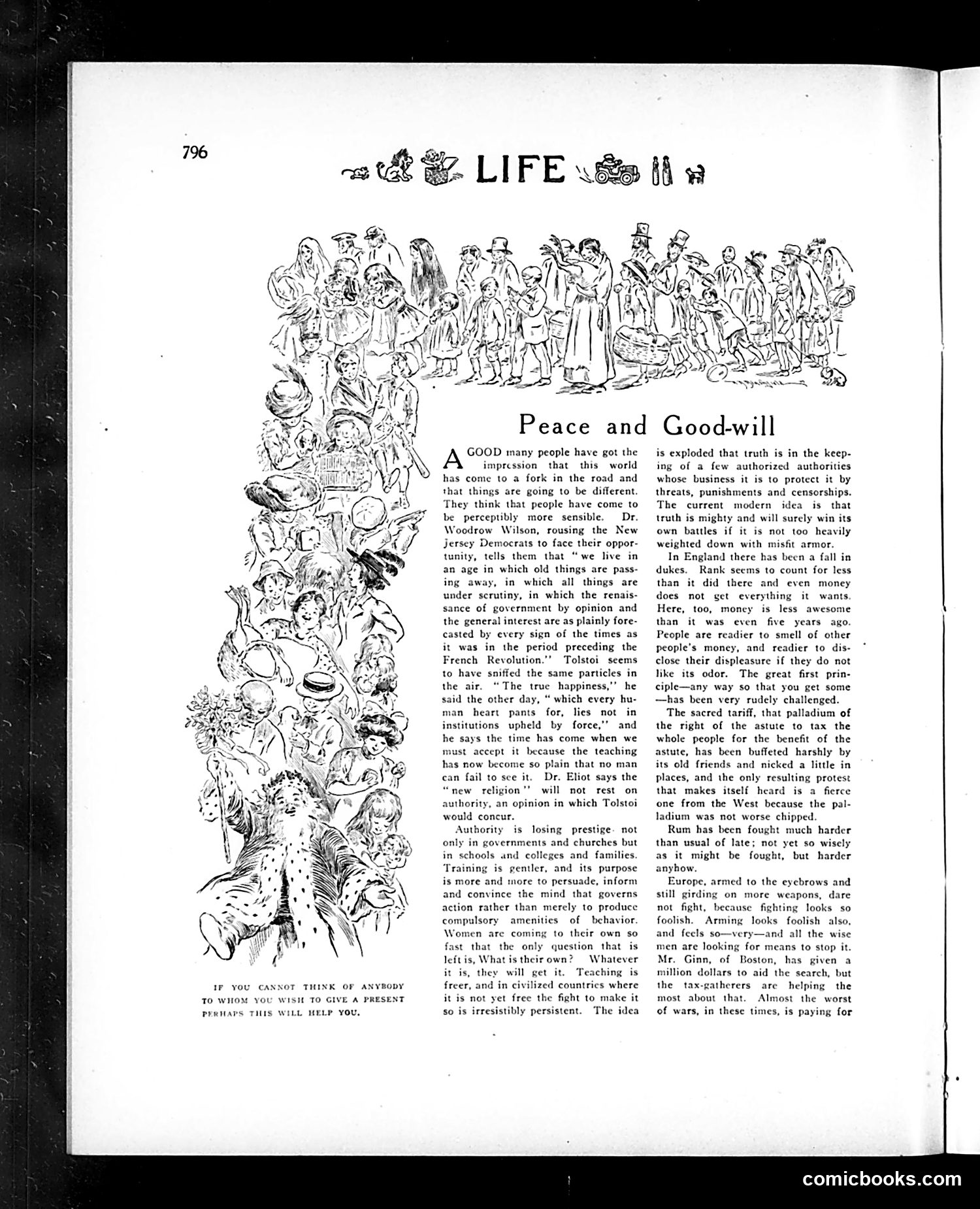
This page presents an editorial essay (not a cartoon) examining what the author perceives as a fundamental shift in American and Western attitudes toward authority and tradition. **Main Theme:** The author argues that society is experiencing a genuine transformation—old hierarchies (government, churches, families, rank, wealth) are losing their coercive power. Leaders like Woodrow Wilson and Tolstoy recognize that people increasingly demand persuasion rather than force. **Specific Social References:** - The "fall in dukes" in England and declining respect for aristocratic rank - The tariff system (protective tariffs benefiting industrialists), being challenged despite business resistance - Temperance campaigns against alcohol gaining traction - European militarism appearing increasingly foolish rather than honorable - Boston philanthropist Mr. Ginn donating to peace research **The Point:** Rather than cynical satire, this expresses optimistic faith that modern society is evolving toward voluntarism—that authority based on threats is becoming obsolete, replaced by reasoned persuasion. The ornate crowd illustration emphasizes humanity's collective consciousness awakening. The motto at bottom—"If you cannot think of anybody to whom you wish to give a present, perhaps this will help you"—suggests readers send the magazine as a gift.
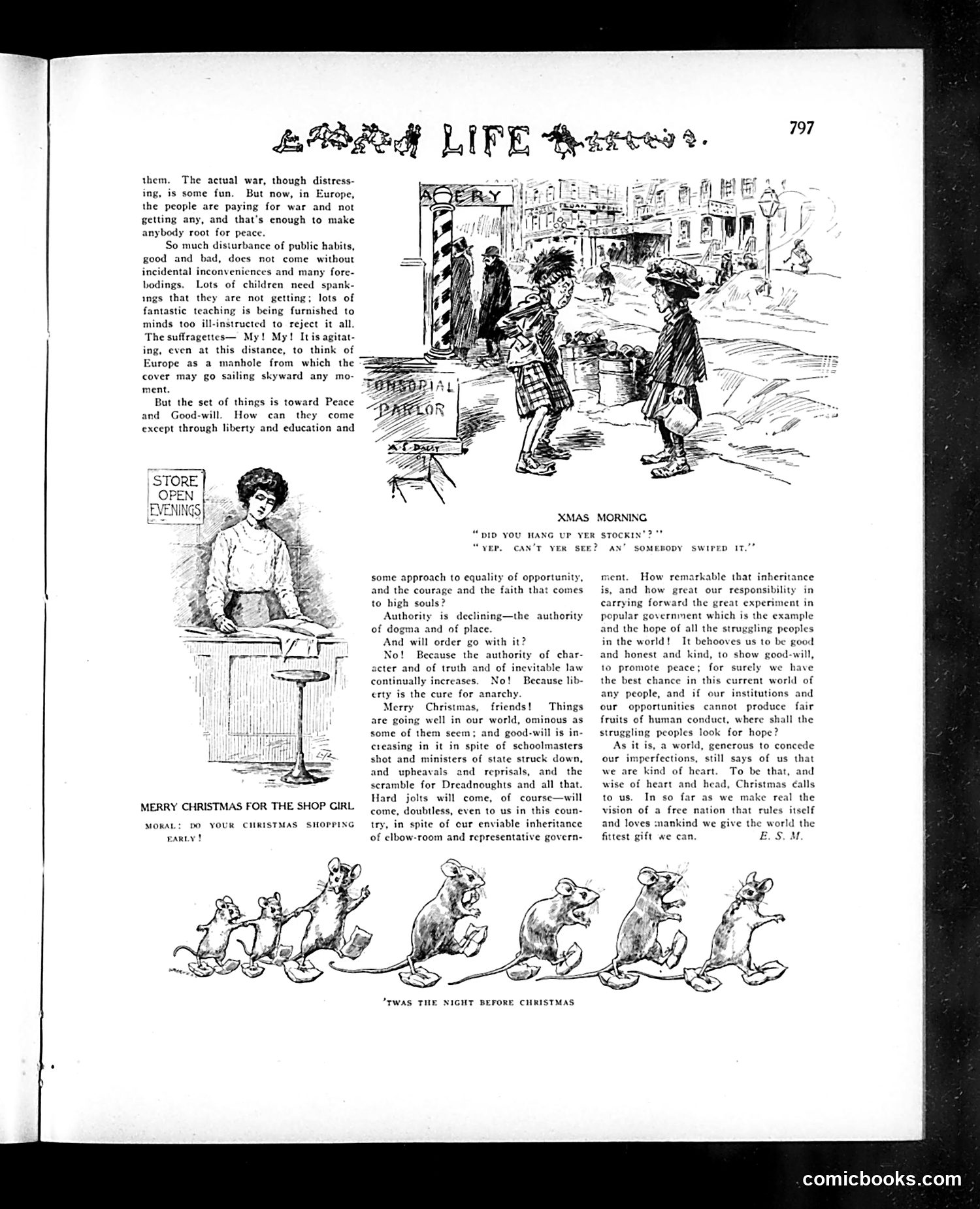
This page presents Christmas-themed editorial and cartoons during World War I. The main text argues that peace requires "liberty and education" and celebrates America's democratic inheritance as a model for struggling peoples worldwide. The cartoons illustrate this message: "Xmas Morning" shows children discovering their stockings were stolen—a commentary on wartime deprivation affecting even innocent civilians. The caption "Did you hang up yer stockings?" / "Yep, can't yer see? An' somebody swiped it" humorously depicts theft as a Christmas casualty. "The Night Before Christmas" parody (bottom) reimagines Clement Clarke Moore's famous poem in this war context, likely referencing scarcity rather than abundance. The "Merry Christmas for the Shop Girl" cartoon emphasizes consumer duty: workers should shop early to support commerce. The moral reflects both patriotic economic participation and concern for working women's circumstances during wartime. The page advocates American exceptionalism and moral responsibility while acknowledging real hardships and social disruptions (suffragettes, labor unrest, military spending) accompanying the war.
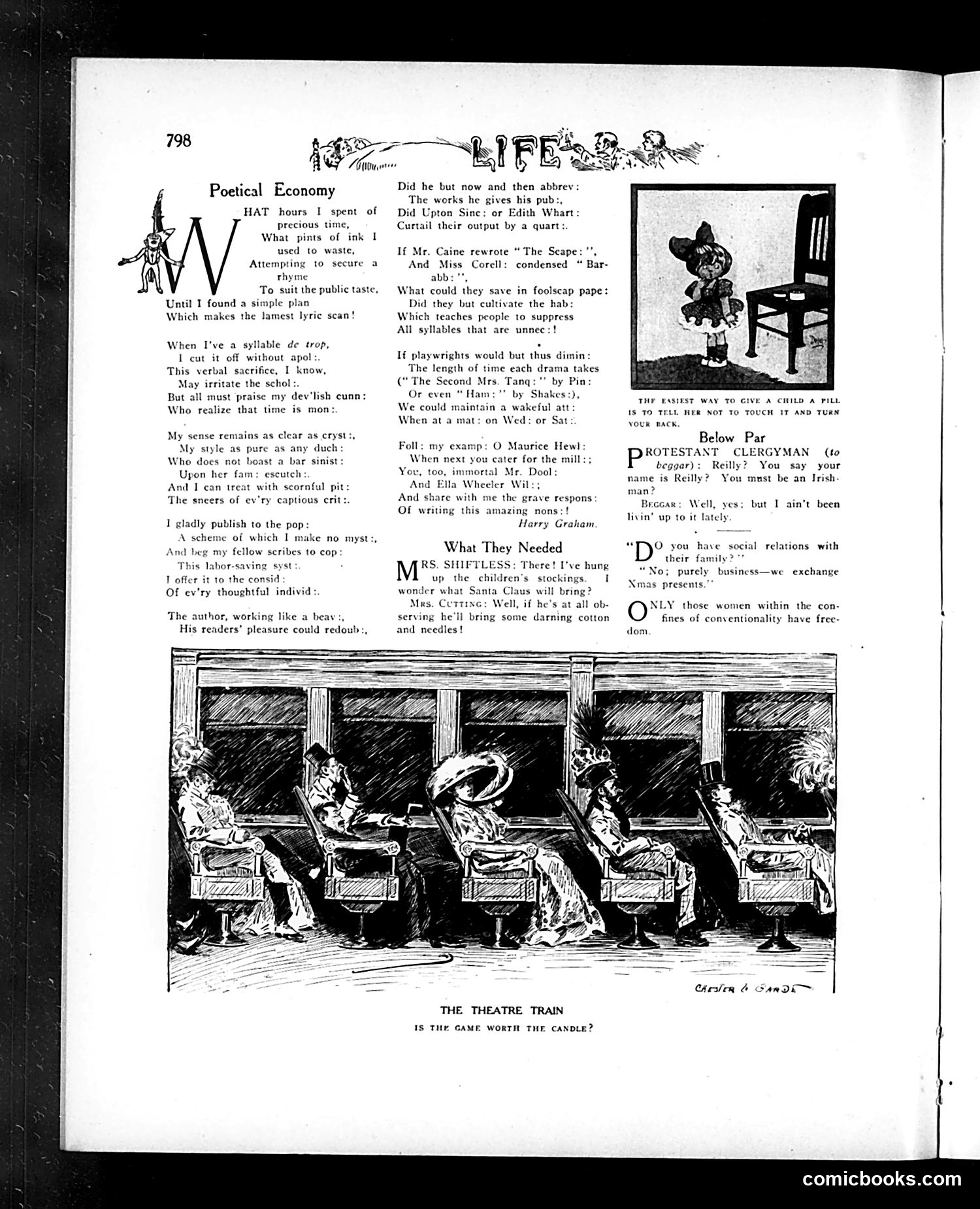
**"Poetical Economy"** (left column): A humorous poem by Harry Graham mocking modern writers' verbosity. The author satirizes literary giants like Upton Sinclair and Edith Wharton, suggesting they could improve their work by abbreviating words—cutting syllables, shortening play running times, even trimming Shakespeare's "Hamlet." The joke is that the poem itself practices this absurd economy, omitting letters throughout ("abb:" for "abbreviate," "schol:" for "scholar"). It's a meta-joke ridiculing both bloated writing and the poet's own clumsy solution. **"What They Needed"** (top right): A domestic humor cartoon where Mrs. Shiftless wonders what Santa will bring her children. Her friend Mrs. Cutting suggests he'll bring "darning cotton and needles"—implying the Shiftless household is so neglectful that mending supplies would be more useful than toys. It comments on poor housekeeping. **"Below Par"** and **"The Theatre Train"** cartoon: Brief social commentary pieces on conventionality and leisure activities. The page exemplifies Life's satirical approach to contemporary culture and social behavior.
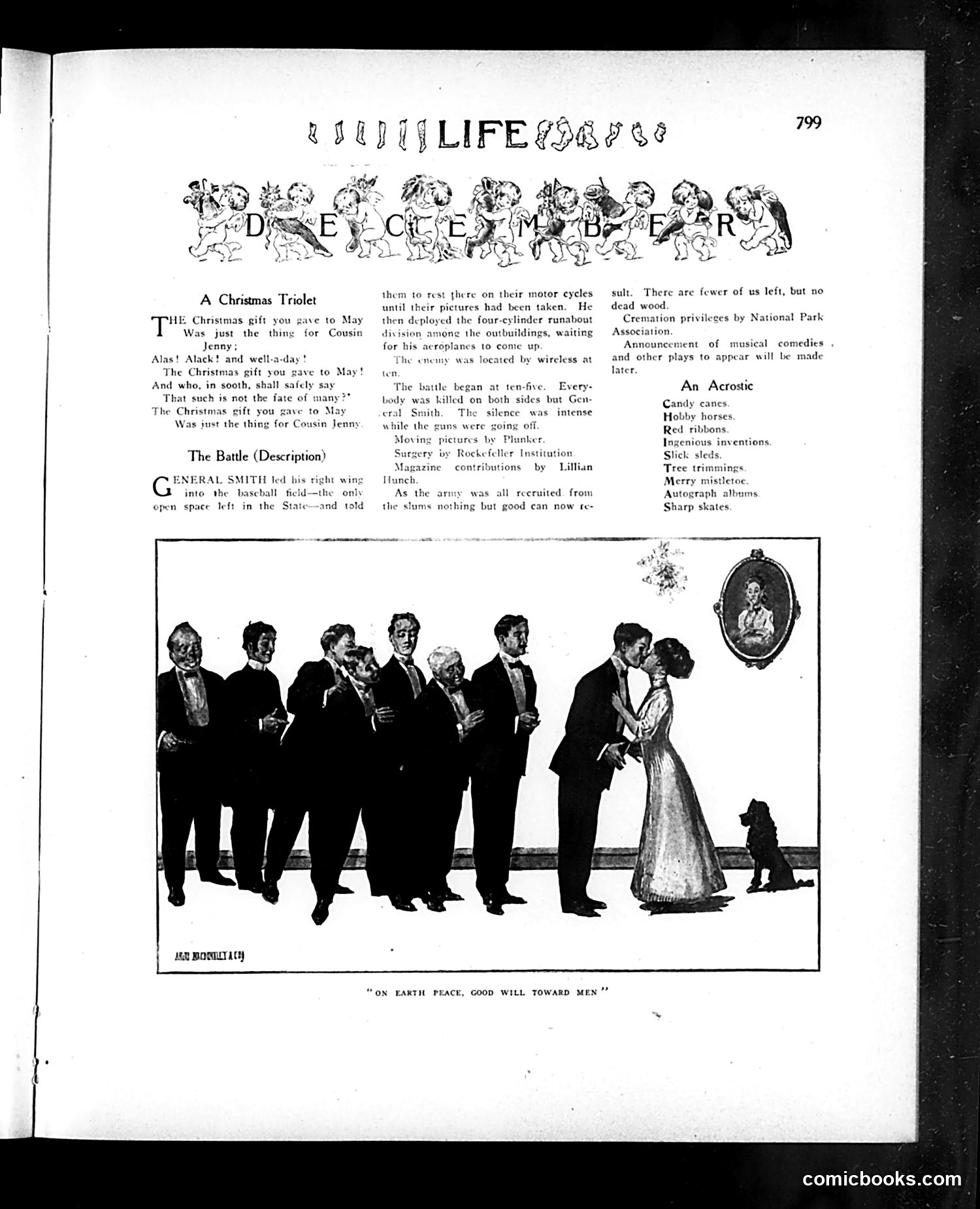
This page from *Life* magazine contains a Christmas-themed satirical piece. The main illustration depicts a formal group of men in suits alongside a woman and child, captioned "On Earth Peace, Good Will Toward Men"—a biblical reference ironically juxtaposed against what appears to be a satirical narrative about "General Smith" conducting a mock military "battle" using automobiles and motorcycles. The humor relies on early-20th-century anxieties about new motor vehicles and modern warfare technology. The detailed description of deploying "four-cylinder runabout divisions" and waiting for "aeroplanes" parodies military strategy applied absurdly to civilian automobiles. The accompanying poem "A Christmas Triolet" jokes about regifting—giving someone else's unwanted present onward to another person—suggesting this was already a recognizable social practice worthy of satire. The page also includes an "Acrostic" Christmas list of period-appropriate gifts (candy canes, sleds, ice skates), reflecting holiday expectations of the era.
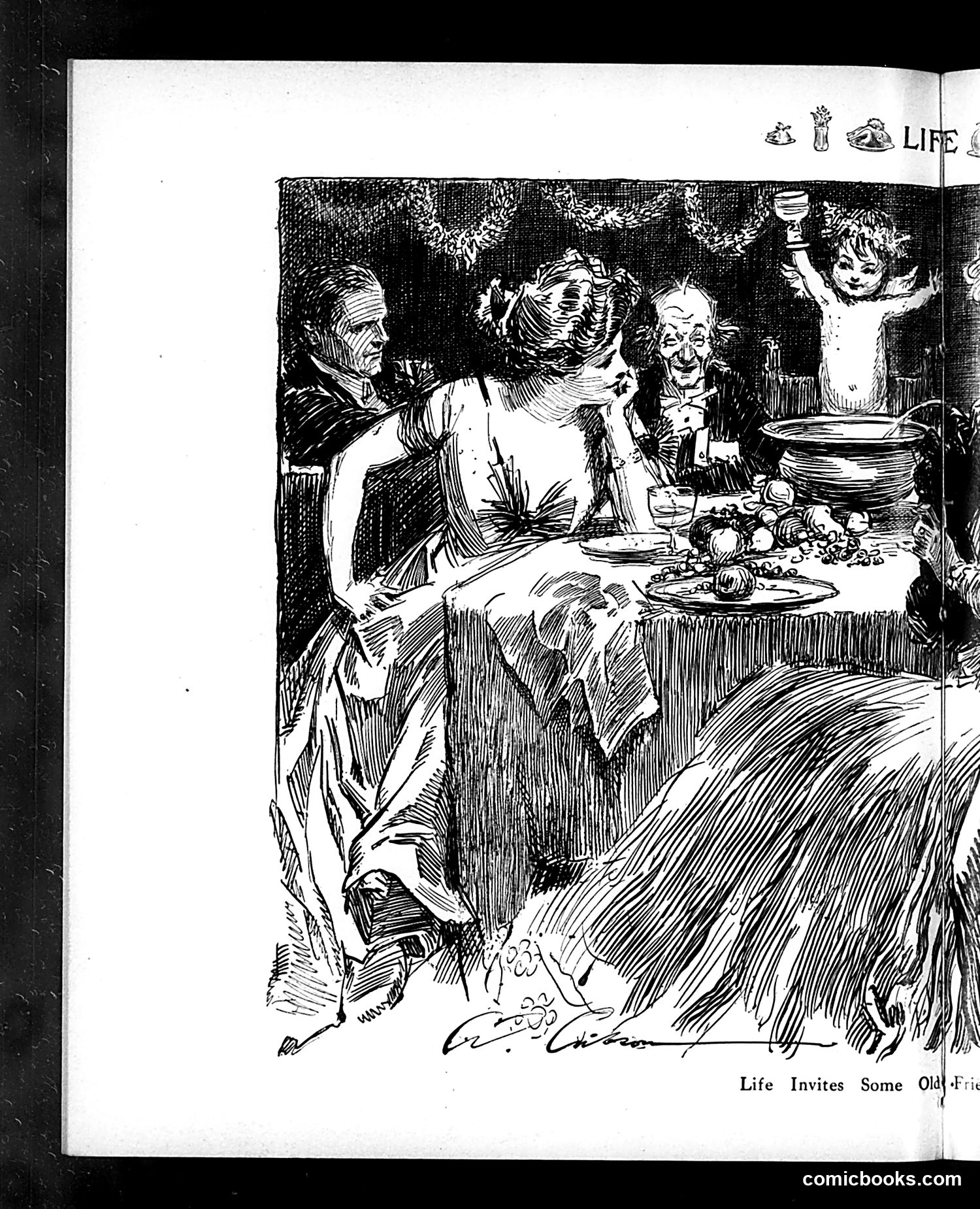
This page shows a satirical illustration titled "Life Invites Some Old Friends." The sketch depicts a fancy dinner party scene with a well-dressed woman at the center of a table, surrounded by three caricatured male figures with exaggerated facial features. The drawing style uses cross-hatching typical of early 20th-century satirical magazines. The caption suggests the cartoon is making a social commentary about entertaining or reuniting with undesirable acquaintances. However, without the complete caption or additional context, the specific identities of the "old friends" being satirized remain unclear. The illustration appears to mock either pretentious social gatherings or the discomfort of obligatory socializing with disagreeable people. The exaggerated caricatures suggest these are likely recognizable public figures of the era, though their specific identities cannot be confirmed from the visible text alone.
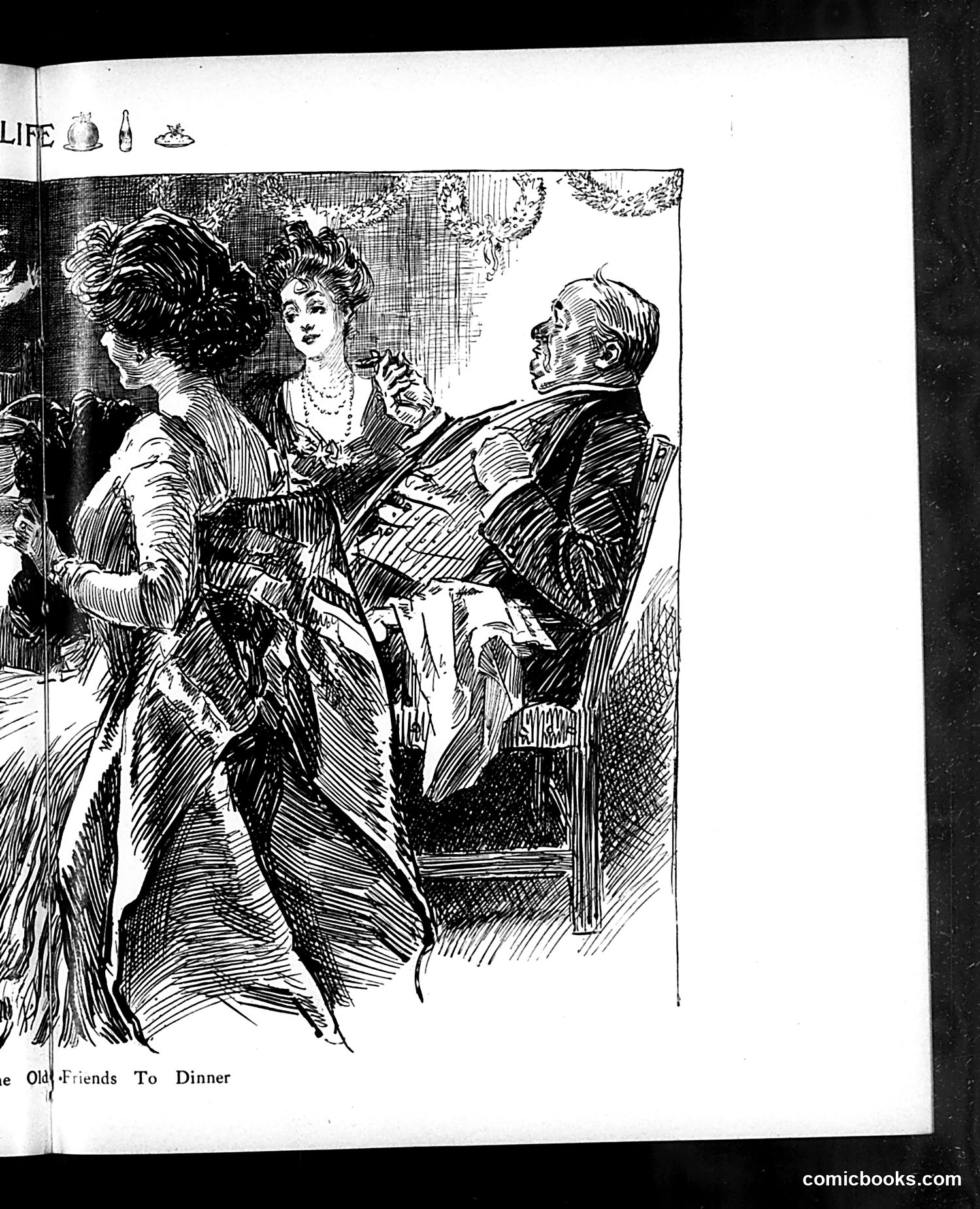
This appears to be a page from *Life* magazine featuring an illustration titled "Old Friends To Dinner." The sketch depicts a social gathering of three figures in early 20th-century dress: two women and a man in formal attire, engaged in conversation in what appears to be an interior setting with decorative elements like garland. The illustration is rendered in the magazine's characteristic pen-and-ink style. Without additional context or a visible caption explaining the specific satire, the exact political or social commentary remains unclear. It may reference contemporary social customs, etiquette, or interpersonal dynamics of the era, but the OCR text is too fragmentary to determine the specific joke or reference with confidence.
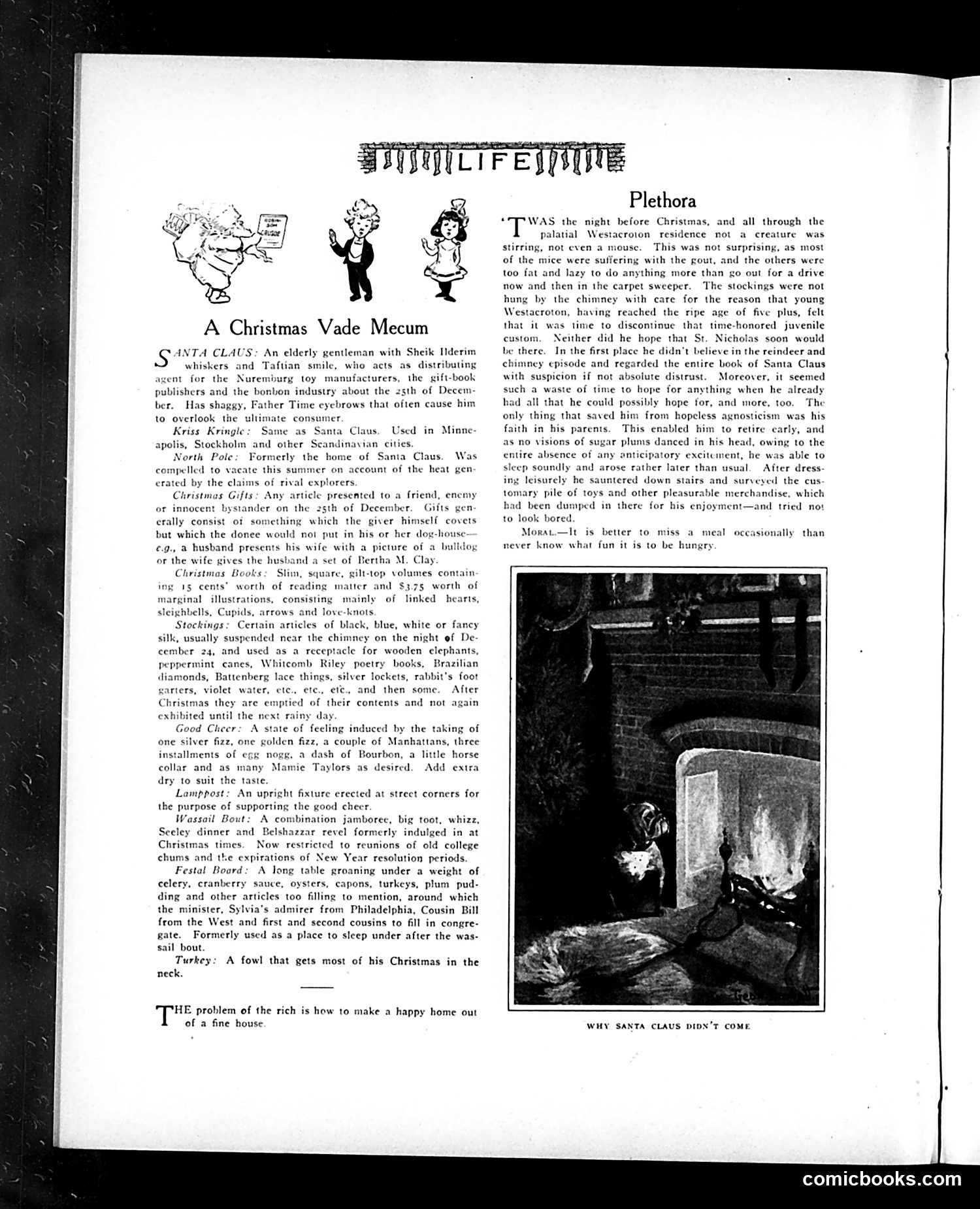
This page offers a satirical "dictionary" of Christmas customs for the wealthy American class circa early 1900s. The left column humorously defines holiday terms with sharp social commentary: **Key targets:** - **Santa Claus/Kriss Kringle**: Portrayed as a commercial agent for toy manufacturers and the "bonbon industry" - **Christmas Gifts**: Defined as items "the giver himself covets but which the donee would not put in his or her dog-house" — mocking insincere gift-giving - **Christmas Books**: Expensive volumes ($3.75) containing only 15 cents' worth of actual content - **"Good Cheer"**: A catalog of alcoholic drinks, satirizing holiday excess - **"Wassail Bout"**: Now restricted to "old college chums" — mocking that revelry has become exclusive rather than communal The accompanying story "Plethora" (right) continues the satire, describing an overfed, jaded wealthy family where even the mice are "too fat and lazy" and the precocious child has already stopped believing in Santa. **The satire's point**: Christmas has become commercialized, materialistic, and hollow among the rich—genuine joy replaced by obligation and excess.
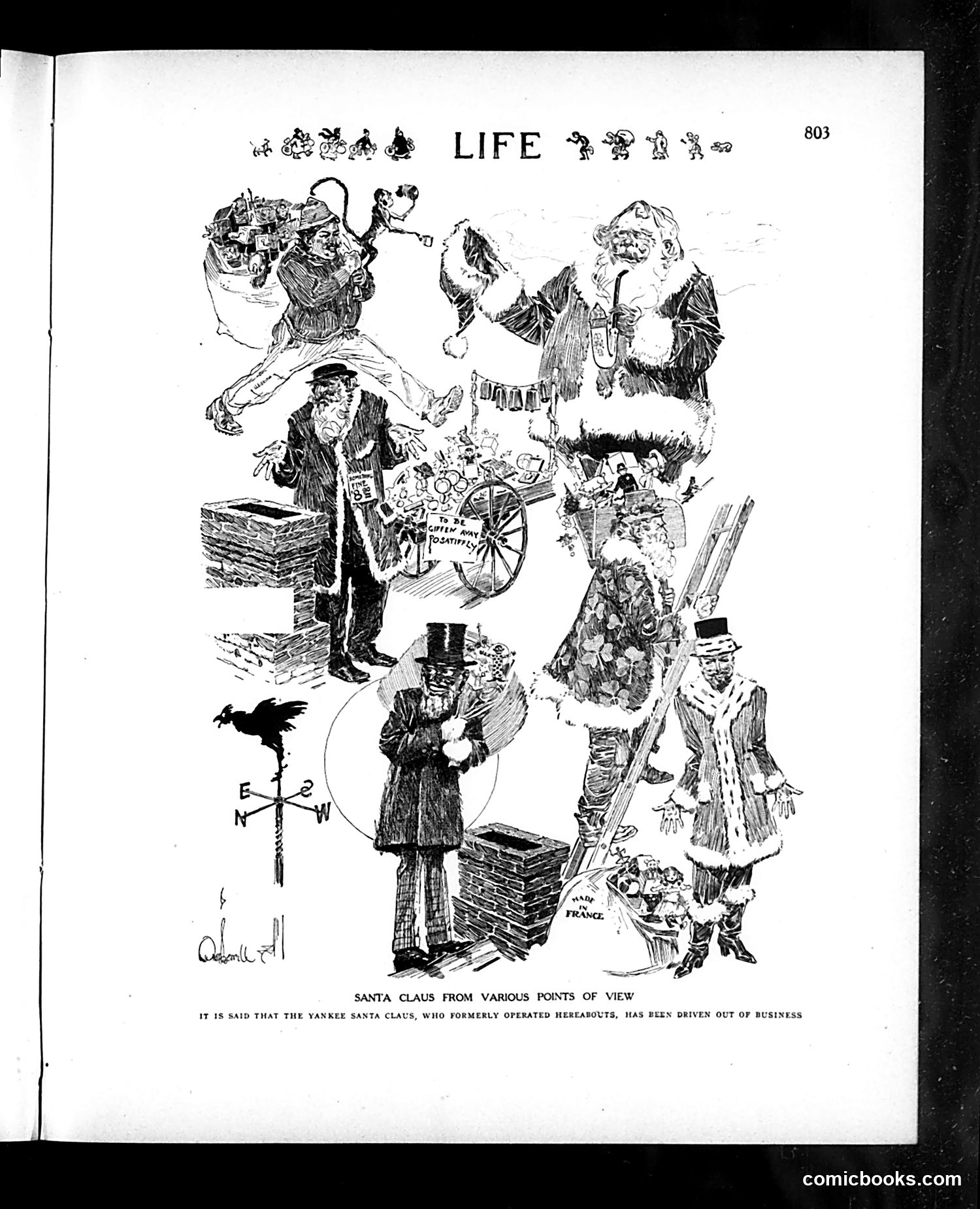
This satirical cartoon from *Life* magazine depicts multiple caricatured versions of Santa Claus labeled as "various points of view," with a caption stating that "Yankee Santa Claus" has been "driven out of business." The cartoon appears to comment on how different national or cultural groups have appropriated or reinterpreted the American Santa Claus tradition. The various grotesque Santa figures likely represent European or other international versions, suggesting competition with or displacement of the American commercial Santa model. The stacks of money visible in the image emphasize that this is fundamentally about commercialization and profit—implying that the "Yankee Santa" was an American business enterprise that has lost market dominance. The compass and period details suggest international trade or cultural export concerns, likely reflecting early 20th-century American anxieties about foreign competition in even traditionally American commercial traditions.
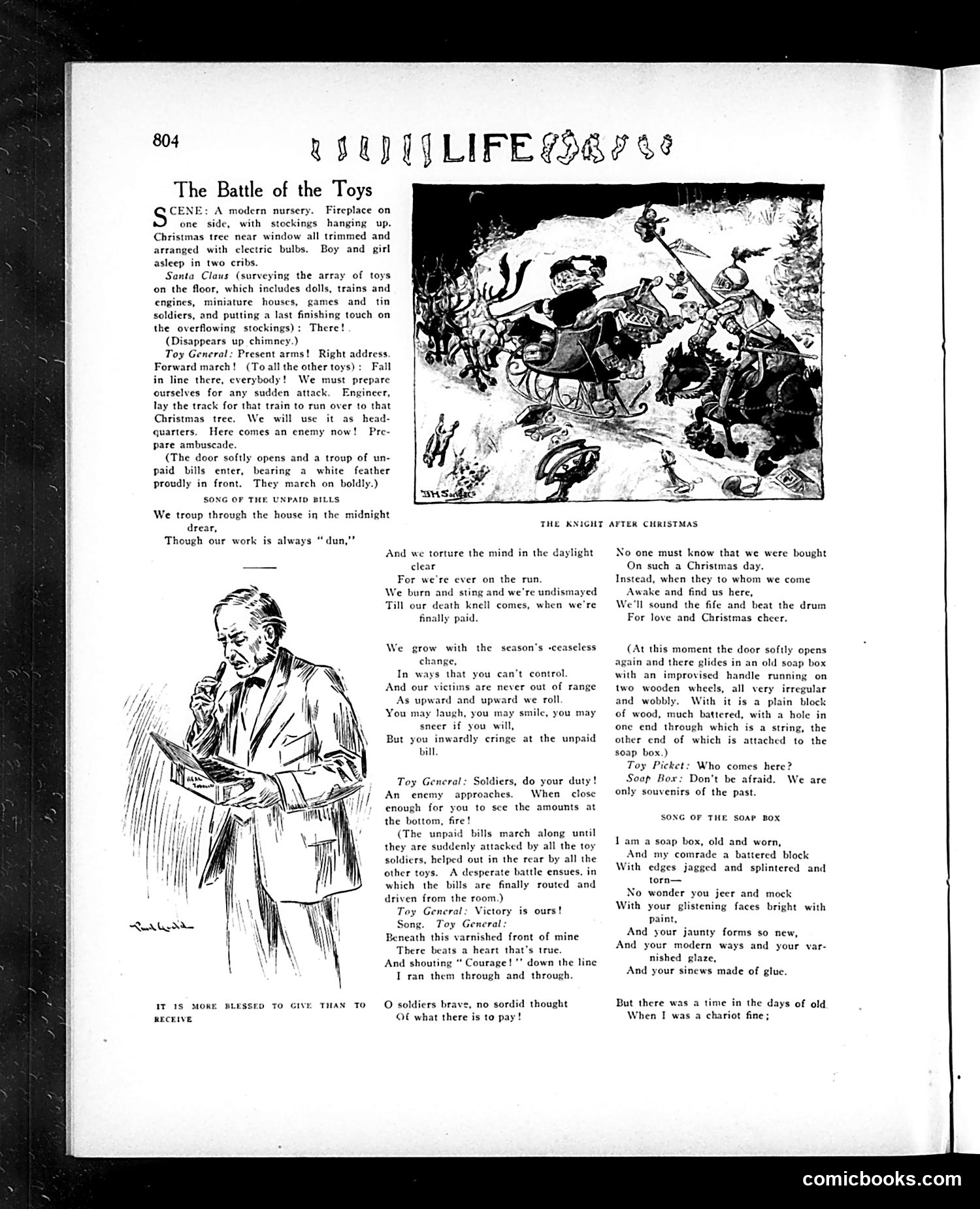
This is a Christmas-themed satirical sketch depicting toys as soldiers defending against an invasion of "unpaid bills" — personified as enemy forces marching into the nursery. The humor operates on multiple levels: **The central joke:** While Santa fills children's stockings with toys on Christmas, parents accumulate unpaid debts from purchasing gifts. The toys ironically celebrate their victory over the bills while concealing a darker truth: they themselves were "bought on such a Christmas day," representing financial obligations disguised as holiday joy. **Secondary satire:** The "Soap Box" and wooden block characters represent older, simpler toys from previous generations, contrasting with modern manufactured goods. Their wistful nostalgia mocks contemporary consumer culture and planned obsolescence. **The broader message:** The sketch satirizes how Christmas commercialism creates financial stress for families, with debt chasing parents even as children sleep peacefully, unaware of the economic "battle" their gifts represent.
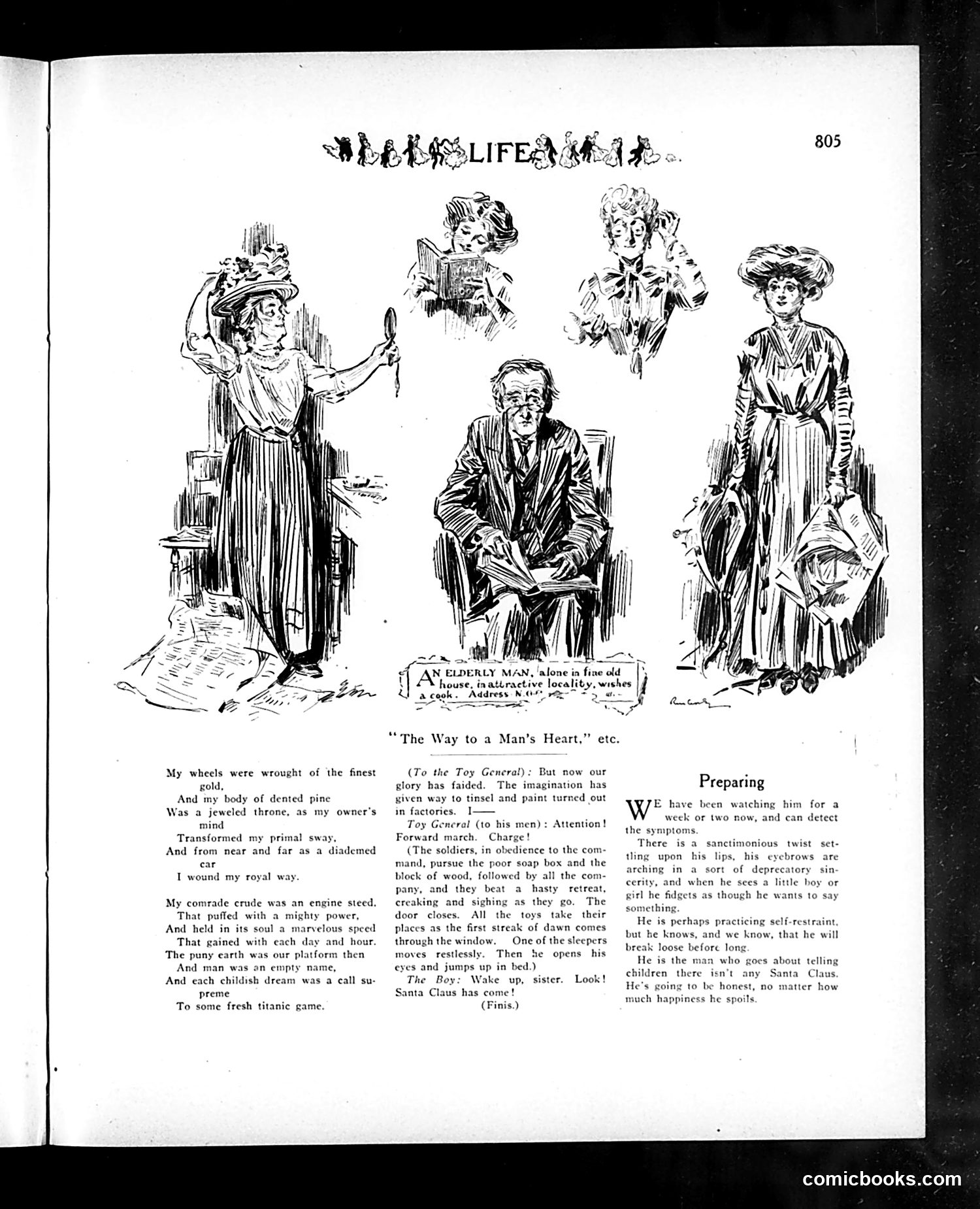
This page combines nostalgic poetry with satirical commentary on childhood innocence versus adult disillusionment. The left column presents verse about a child's imaginative play—transforming a wooden toy into a "jeweled throne" and engaging in grand fantasies with toy soldiers. The illustration at top left depicts this youthful wonder. The center section, titled "The Way to a Man's Heart," depicts a dialogue between an "Elderly Man" and a "Toy General." The elderly man laments that childhood imagination has been replaced by mass-produced "tinsel and paint turned out in factories." This critiques commercialization destroying authentic play. The right column, "Preparing," describes a man exhibiting suspicious behavior—fidgeting around children, practicing restraint, clearly eager to reveal something. The implication: he's about to tell children "there isn't any Santa Claus," destroying their innocence. The satire targets how modern life—commercialism, adult cynicism—erodes childhood wonder that once defined human experience. The illustrations show the generational loss of genuine imagination.
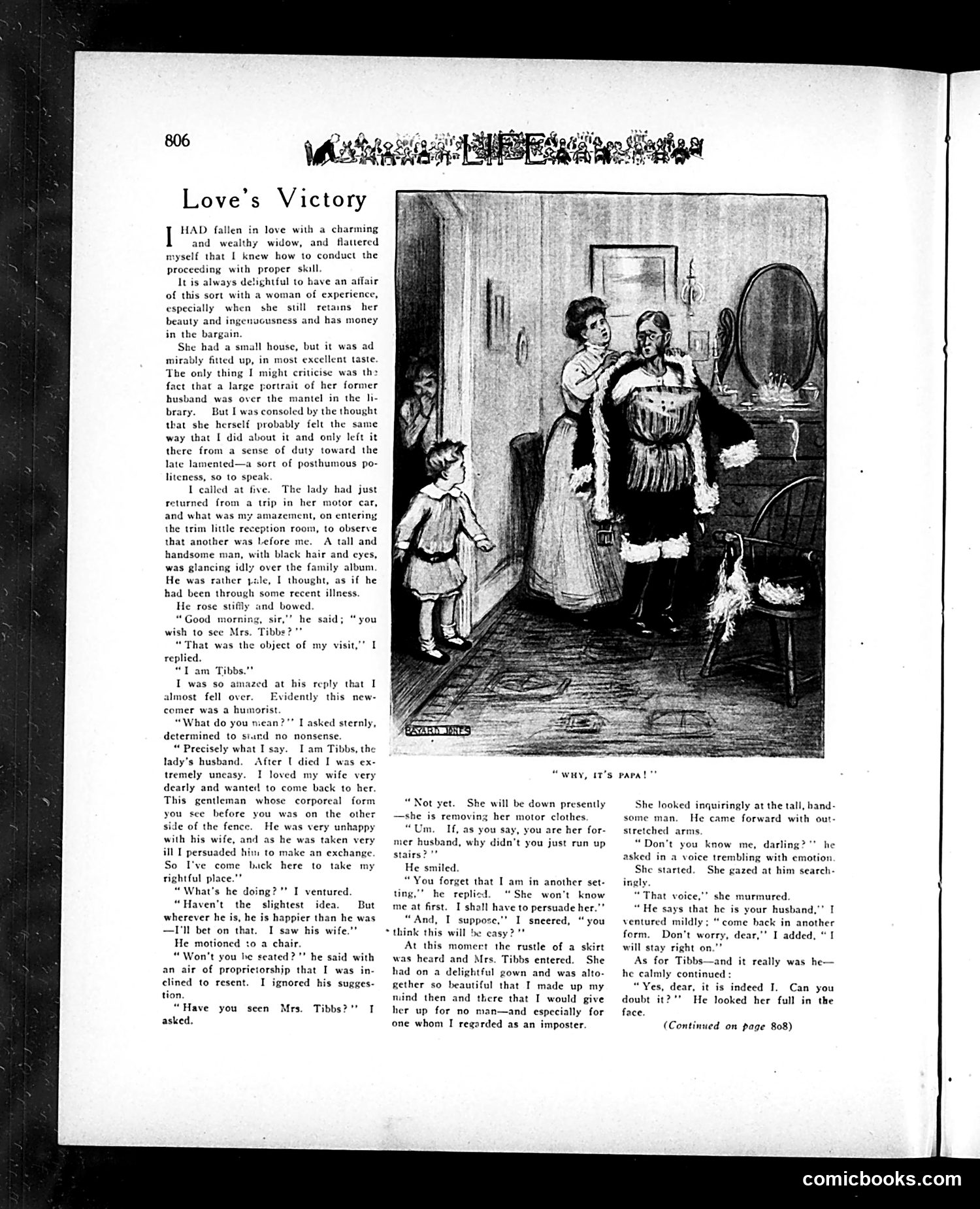
This is a humorous short story with accompanying illustration, not a political cartoon. The narrative is a romantic comedy playing on supernatural and absurdist premises popular in early 20th-century magazine fiction. The setup: A narrator has fallen in love with a wealthy widow, Mrs. Tibbs. Upon visiting her home, he encounters a tall, pale man who claims to be Mrs. Tibbs's deceased husband—who has arranged a body-swap with an unhappy man on "the other side of the fence" (an afterlife reference). The dead husband has returned in this borrowed body to reclaim his wife. The humor derives from the narrator's comic predicament: he must now compete for the widow's affections against her resurrected husband, while the illustration shows the awkward domestic scene unfolding. The story plays on period themes of materialism (the wealthy widow), propriety, and the supernatural—common tropes in Life magazine's satirical fiction.

This is not a cartoon or satirical content—it's a **straightforward advertisement** for Pond's Extract, a household remedy product. The page features a full-page ad from Pond's Extract Company (New York) emphasizing the product's 60-year track record. The copy claims the extract is "soothing, refreshing and healing" and markets it as "the most useful household remedy." The ad includes a product bottle image and warns consumers to buy only sealed bottles and refuse substitutes—a common concern in an era before strict FDA regulation when counterfeit medicines were widespread. There is no satire, political commentary, or caricature present. This represents the commercial advertising that filled Life magazine alongside its actual editorial content.
This is a serialized short story (continued from page 810) involving a supernatural body-swap plot. The narrator has encountered a man named Polter who resembles the deceased John Tibbs. After arranging a "psychic exchange," the narrator has taken over Polter's body and returned to Mrs. Tibbs's house in Tibbs's own clothing. The satire targets **spiritualism and the occult crazes** popular in the early 20th century. The casual acceptance that body-swapping is "easily arranged" through spiritual mediums mocks believers who took psychic phenomena seriously. The comedic premise—that the narrator can simply swap bodies with a stranger and impersonate a dead husband—ridicules the gullibility of spiritualist enthusiasts. Mrs. Tibbs's earlier skepticism about the imposter's appearance (too tall, wrong whiskers) adds humor: even supernatural explanations can't overcome basic physical implausibility. The story satirizes both spiritualist fraud and the desperation of grieving people seeking contact with the dead.
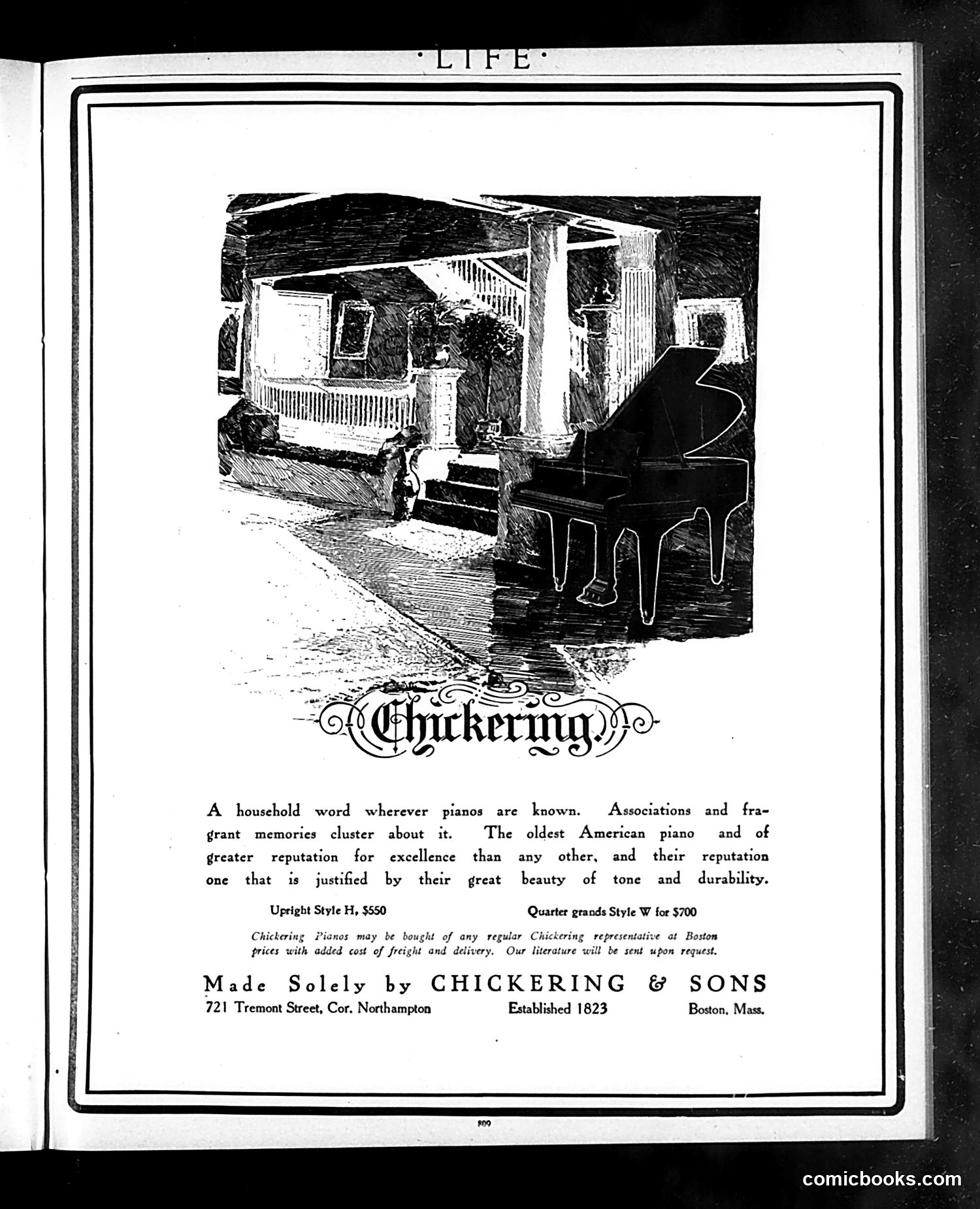
This is a **piano advertisement**, not a political cartoon. The page shows a woodcut-style illustration of a grand piano in an elegant parlor setting, with a woman at the keyboard and classical architectural details visible through windows. The ad copy emphasizes Chickering & Sons' reputation as "the oldest American piano" with superior "beauty of tone and durability." Two models are priced: the Upright Style H at $550 and Quarter grands Style W at $700—substantial sums in this era, suggesting this targets affluent households. The only "satire" present is mild: the title "Chickering" appears in ornate Victorian lettering, and the ad plays on the aspirational associations pianos held in upper-class American culture—they were status symbols denoting refinement and musical education. This represents straightforward early-20th-century magazine advertising, not editorial commentary or humor.
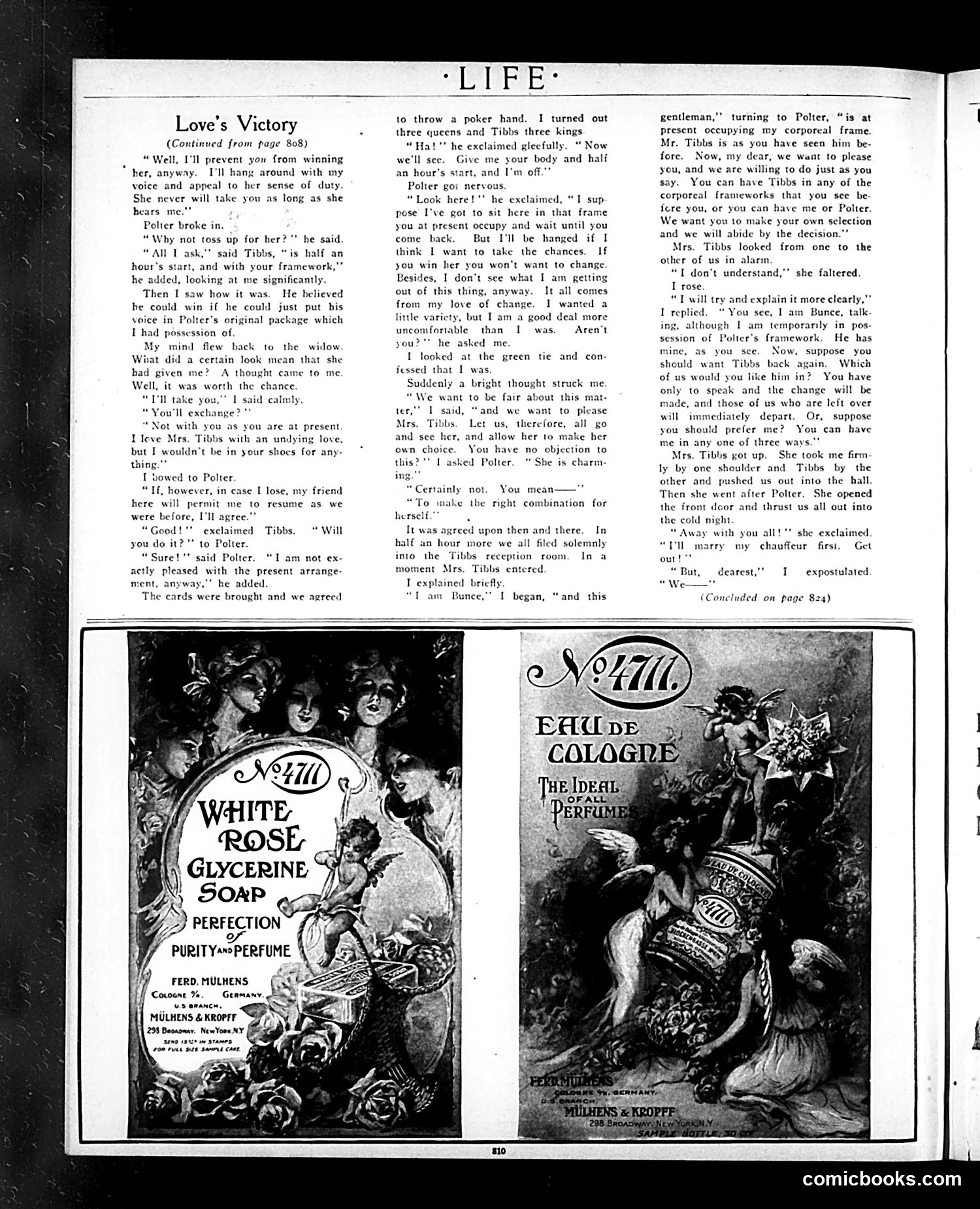
This page continues a serialized science fiction story about body-swapping. The plot involves three men—Bunce, Polter, and Tibbs—competing for Mrs. Tibbs's affection. Through an earlier magical or technological exchange, they've swapped bodies. The narrative culminates with the men offering Mrs. Tibbs her choice of which man she prefers, in whichever body. The satire targets **marriage and female agency**: the story presents the absurd premise that a wife might choose her husband based on physical appearance or personality independent of the body/person, suggesting contemporary anxieties about women's liberation and marital choice. By literally separating bodies from personalities, the story jokes about whether women value their husbands as complete persons or merely as attractive/appealing packages. The page also features two **period advertisements** for Mulhens & Kropff perfume and soap, typical of Life's commercial content. The story's conclusion (cut off) presumably reveals Mrs. Tibbs's actual preference.

This page is **not satirical content but a commercial advertisement**. It's a full-page ad for the Truffault-Hartford Shock Absorber, manufactured by the Hartford Suspension Company in Jersey City, New Jersey. The image shows a technical diagram of the shock absorber component with its mechanical parts labeled, designed to appeal to early automotive consumers. The tagline—"Indispensable For Comfortable Motoring"—uses a common advertising strategy promising improved ride quality, a significant selling point during the early automobile era when road conditions were poor. This represents typical **Life magazine advertising**, which frequently included automotive products alongside satirical content. There are no political references or satirical figures present.
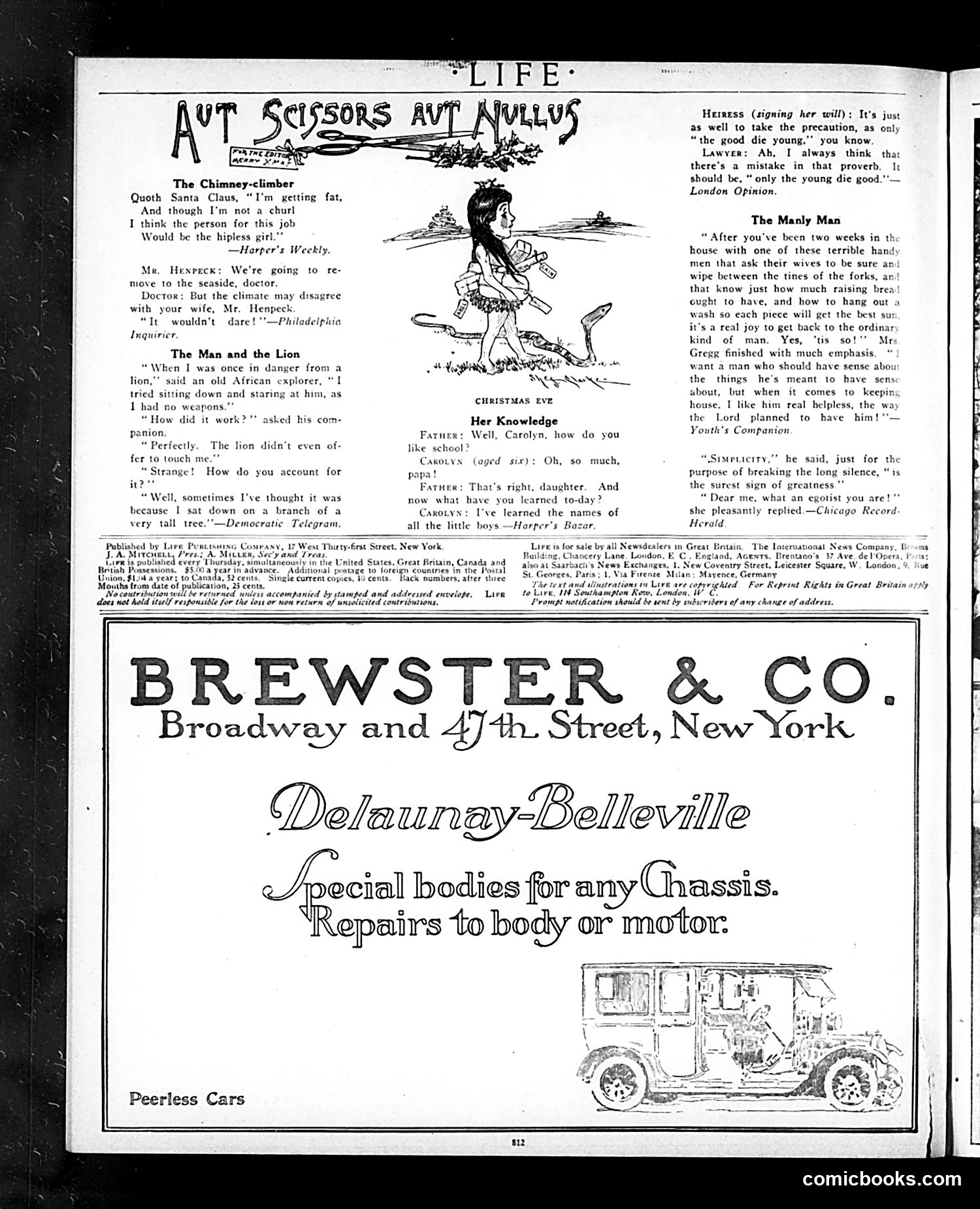
This page from *Life* magazine contains several brief humorous anecdotes rather than political cartoons. The humor targets domestic and social conventions of the era: **"The Chimney-climber"** references the "flapper" craze—the slim, hip-less silhouette fashionable in the 1920s, joking that such a figure would be ideal for Santa's chimney work (unlike traditional, rounder body types). **"The Manly Man"** satirizes husbands obsessively concerned with household details (fork-tine cleanliness, laundry technique), suggesting women prefer men who are usefully incompetent domestically—a commentary on evolving gender roles and domestic expectations. **"Her Knowledge"** presents a six-year-old more interested in boys than schoolwork, playing on period anxieties about childhood innocence. **"Her Heiress"** jokes darkly about a wealthy woman's pessimism regarding longevity. The page is primarily filler content and advertising (Brewster & Co. automobiles occupy the lower half), typical of *Life's* mixed editorial/commercial format.
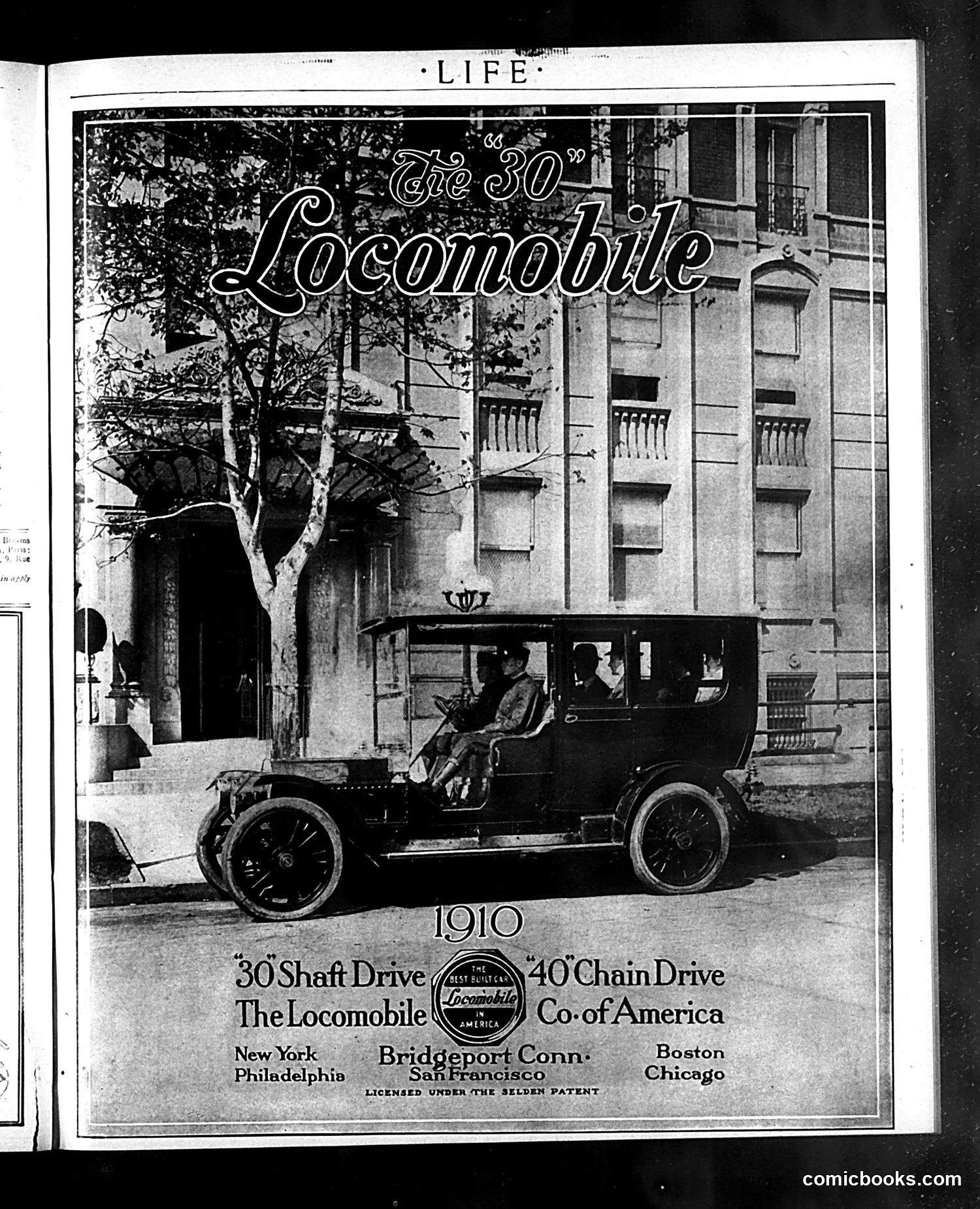
This is a **product advertisement**, not political satire. The page promotes the 1910 Locomobile automobile, featuring a photograph of an early motorcar parked before an elegant building with classical architecture. The ad emphasizes two drive-system options: "30 Shaft Drive" and "40 Chain Drive," highlighting the technical choice between competing transmission technologies of that era. The Locomobile Company of America lists multiple headquarters (Bridgeport, Connecticut being primary, with offices in New York, Philadelphia, Boston, Chicago, and San Francisco). The "Licensed under the Selden Patent" notice references a significant historical patent dispute in early automotive manufacturing. This represents straightforward early-1900s automobile marketing to wealthy consumers, not satirical content.
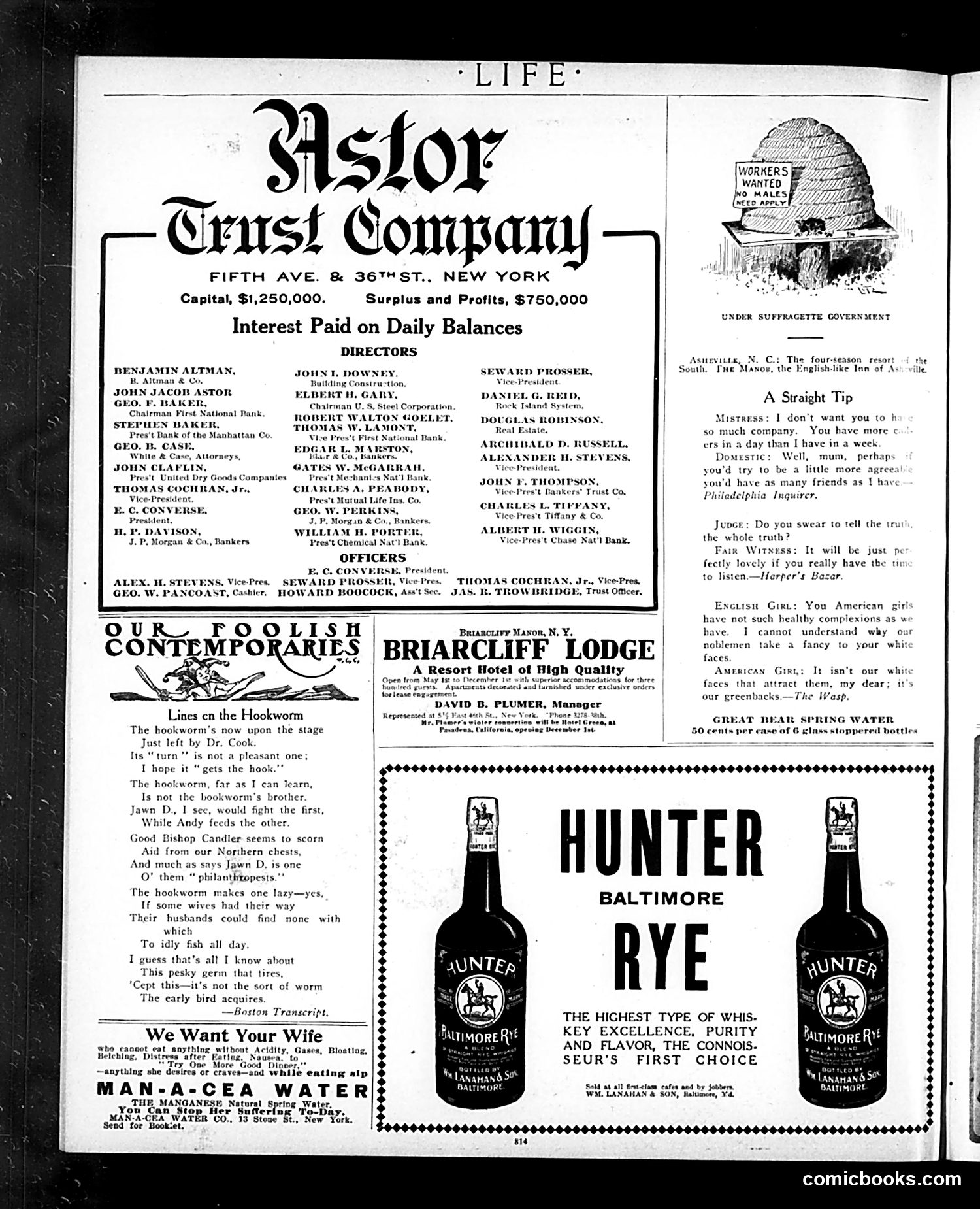
This page is primarily **advertising and business notices** rather than political satire. However, it contains one notable satirical element: The **"Astor Trust Company" masthead** includes a small caption "UNDER SUFFRAGETTE GOVERNMENT." This references the women's suffrage movement, which was actively campaigning for voting rights during this era. The joke suggests that if women gained political power (via suffrage), they might control major financial institutions—presented as an absurd hypothetical to contemporary readers who opposed women's voting rights. The page also includes a humorous poem "Lines on the Hookworm" about a parasitic disease then prevalent in the American South, and several comedic dialogue snippets about marriage and courtship. The remaining content consists of advertisements for banks, hotels, whiskey, and patent medicines—typical of Life's revenue model. Most humor derives from period-specific references (Dr. Cook's Arctic expedition, Bishop Candler) rather than visual satire.
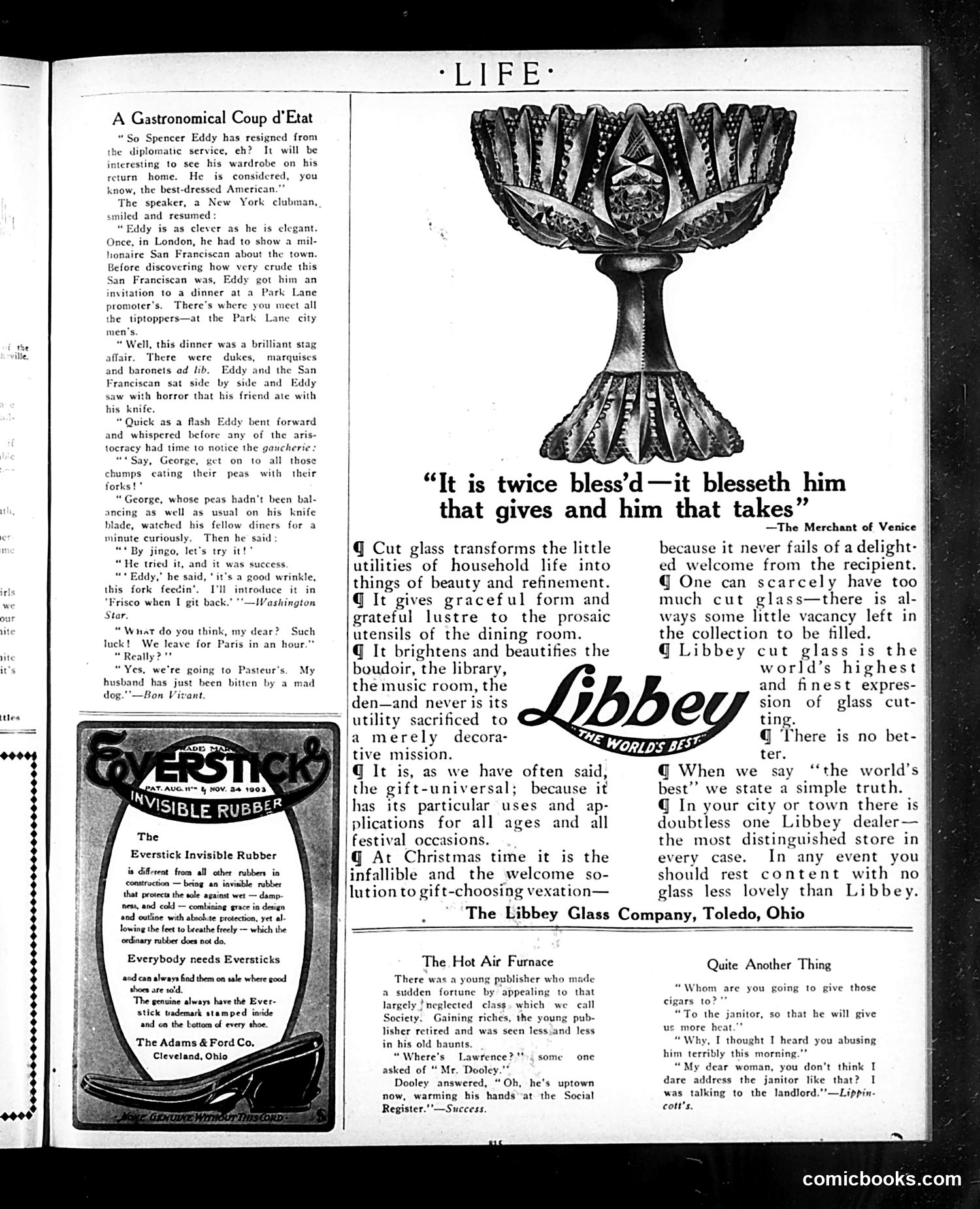
This page contains two satirical anecdotes about American social pretension, plus period advertisements. **"A Gastronomical Coup d'Etat"** mocks diplomatic society through Spencer Eddy, a real diplomat known as "the best-dressed American." The joke: Eddy teaches a wealthy but uncouth San Franciscan proper dining etiquette (not eating peas with a knife), but the Californian then plans to introduce fork-eating as an innovation back home—inverting the hierarchy. The humor targets American wealth's lack of refinement and Western naïveté about Old World manners. **"The Hot Air Furnace"** (incomplete) appears to satirize a young publisher who gained sudden wealth courting "Society" and subsequently abandoned his former haunts—likely mocking social climbing and pretension. **Advertisements** dominate: Everstick rubber shoes, Libbey cut glass, and Adams & Ford rubber products. The Libbey ad quotes Shakespeare to sell luxury glassware, exemplifying period advertising's aspirational tone. The overall theme: American social anxiety about refinement and class status.
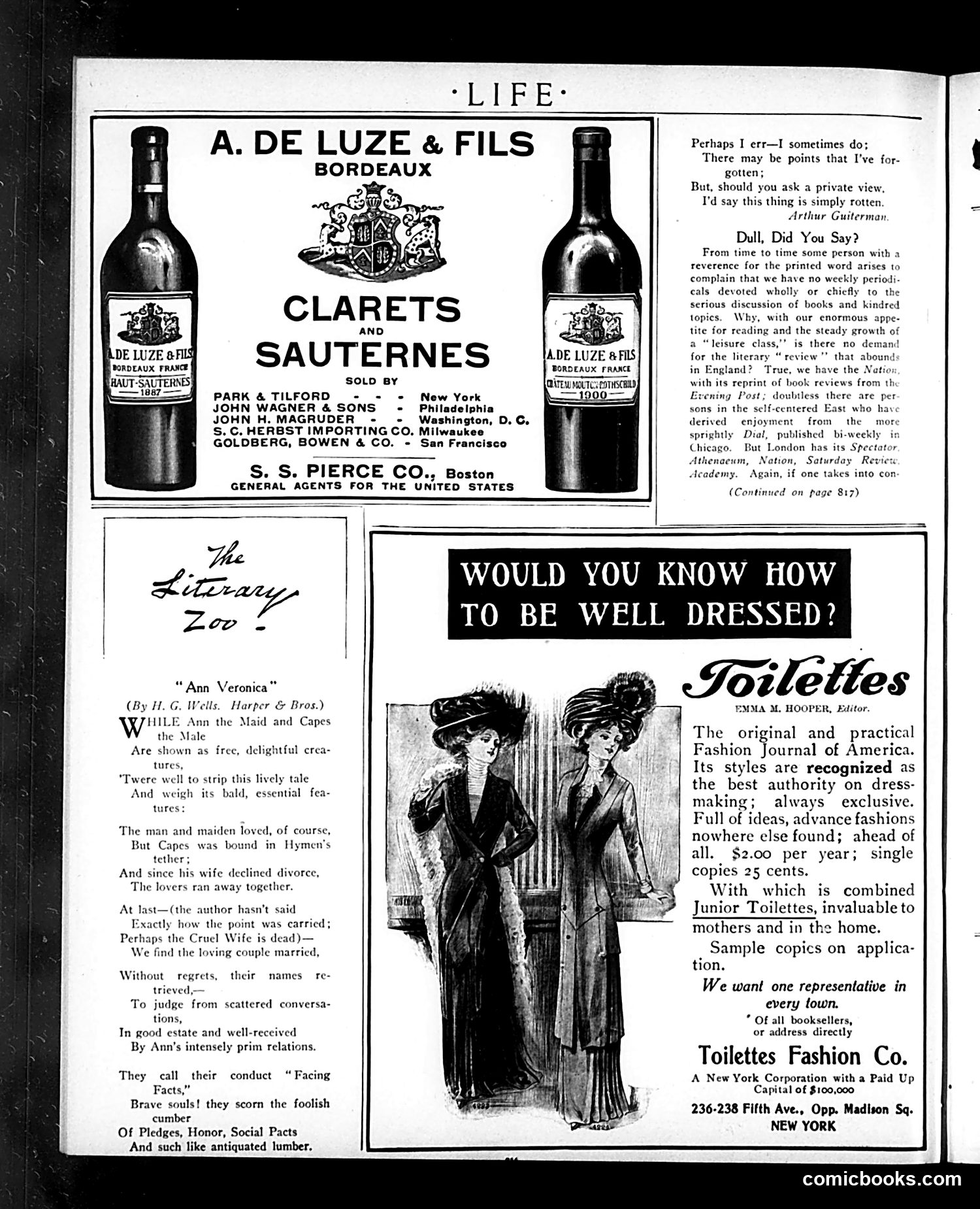
This page is primarily **advertising and literary content** rather than political satire. The main elements include: **Wine Advertisement** (top): A. de Luze & Fils promotes Bordeaux clarets and Sauternes through major American retailers. **Literary Critique** (left): Arthur Guiterman's satirical poem reviews H.G. Wells' *Ann Veronica*, criticizing the novel's moral stance. The poem argues that the book—which depicts an unmarried couple running away together and later marrying—endorses behavior Guiterman considers immoral: abandoning marriage vows and social conventions. He calls their conduct "rotten" despite the characters' justification as "Facing Facts" and rejecting "antiquated" social pledges. **Fashion Magazine Advertisement** (right): *Toilettes* advertises itself as America's authoritative fashion journal, offering dressmaking guidance and advance fashions. The Guiterman piece reflects **early 20th-century conservative anxieties** about changing sexual and marital attitudes depicted in progressive literature—Wells' novel was considered scandalous for its sympathetic treatment of infidelity and elopement.
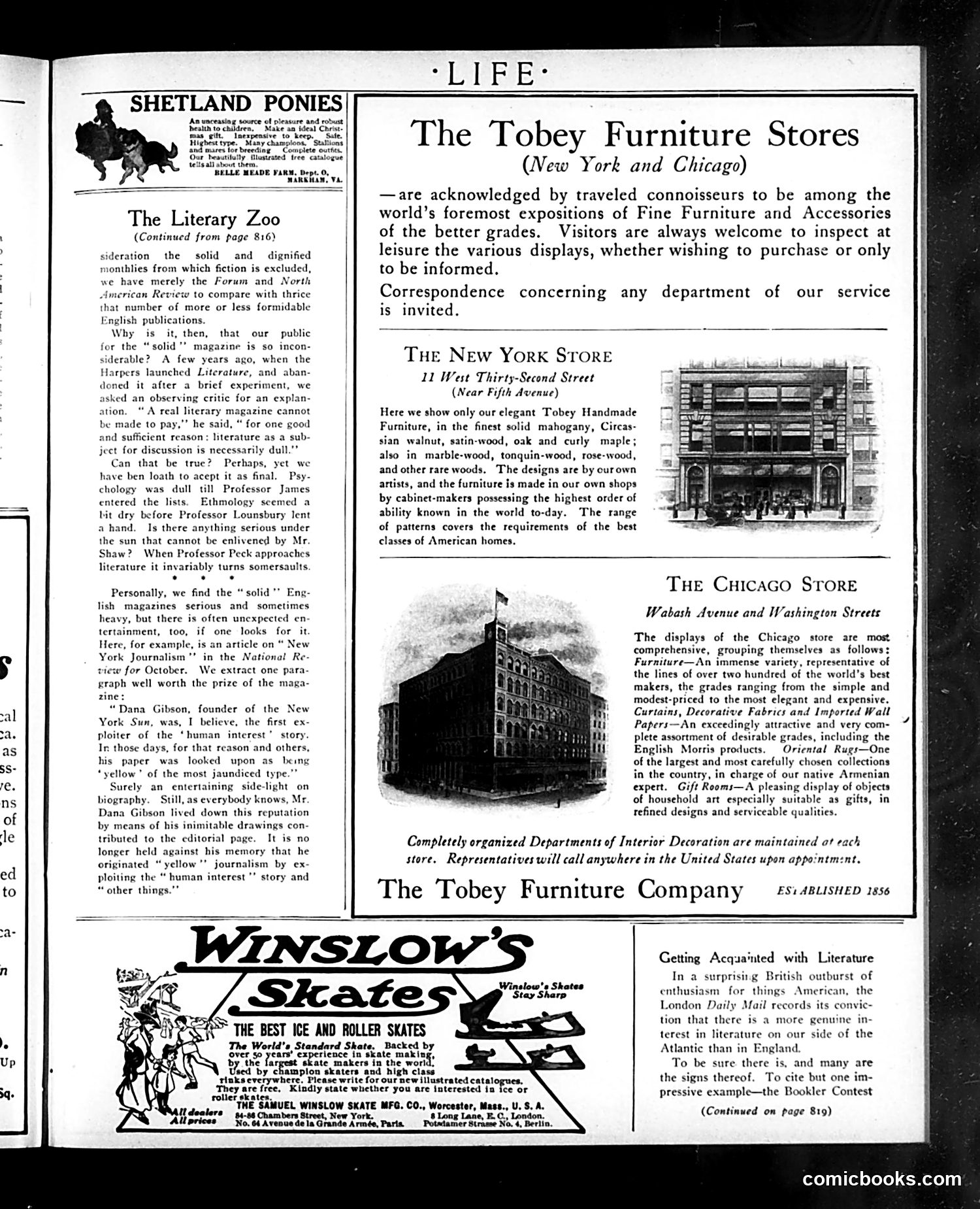
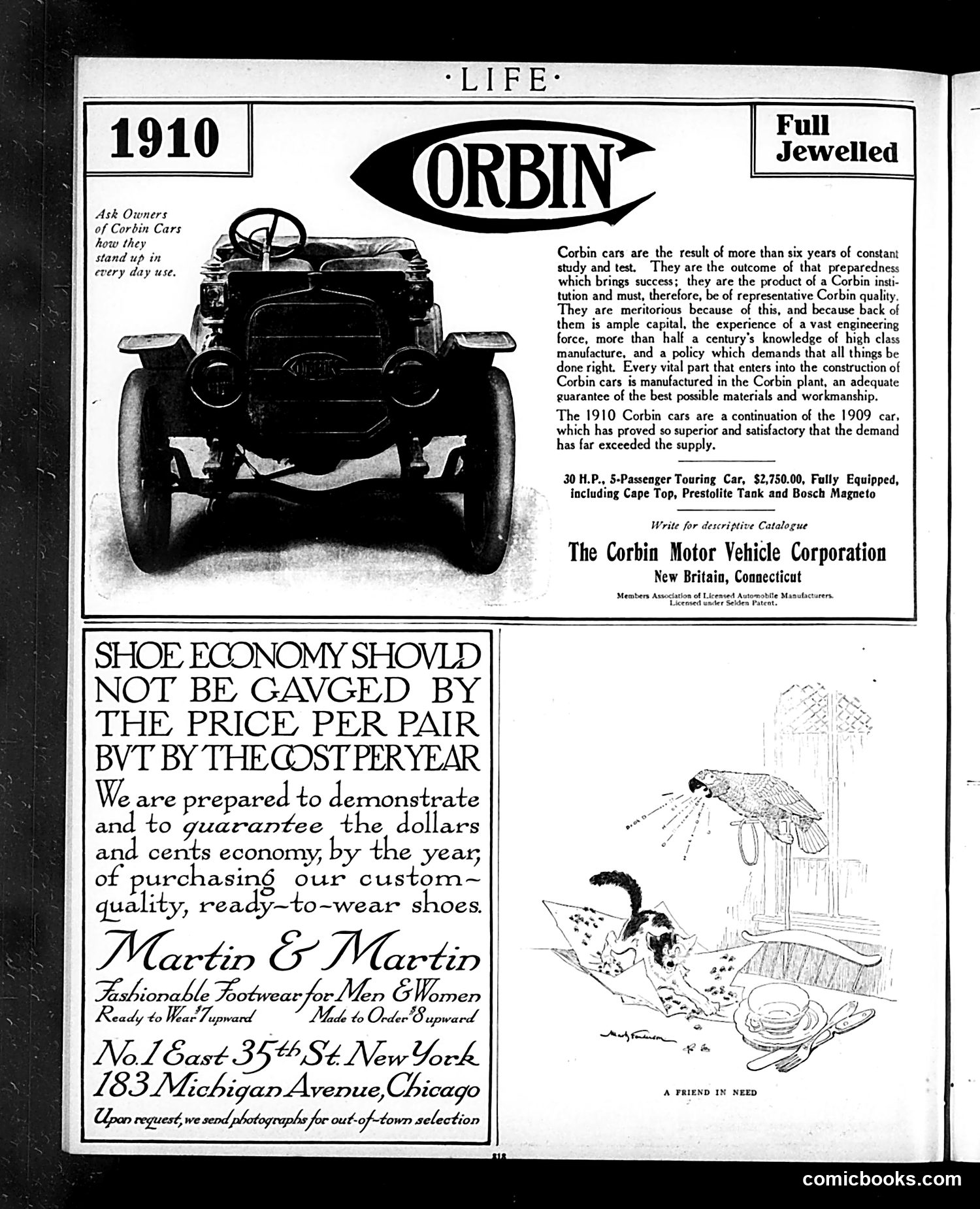
This page is primarily **advertising**, not satirical content. It contains three commercial notices: 1. **Corbin automobiles** (top): A luxury car ad emphasizing quality, engineering, and reliability. The 1910 model costs $2,750 fully equipped—positioning it as a premium product for wealthy buyers. 2. **Martin & Martin shoes** (bottom left): An economic argument that shoes should be evaluated by yearly cost-of-ownership, not per-pair price. This targets middle-class consumers seeking durability and value. 3. **"A Friend in Need"** (bottom right): A small illustration showing a bird helping another bird—likely a standalone filler cartoon without apparent satire, simply depicting kindness or mutual aid. The page reflects 1910 consumer culture: automobiles were luxury goods, and shoe companies marketed practicality to cost-conscious buyers. No political satire is evident.
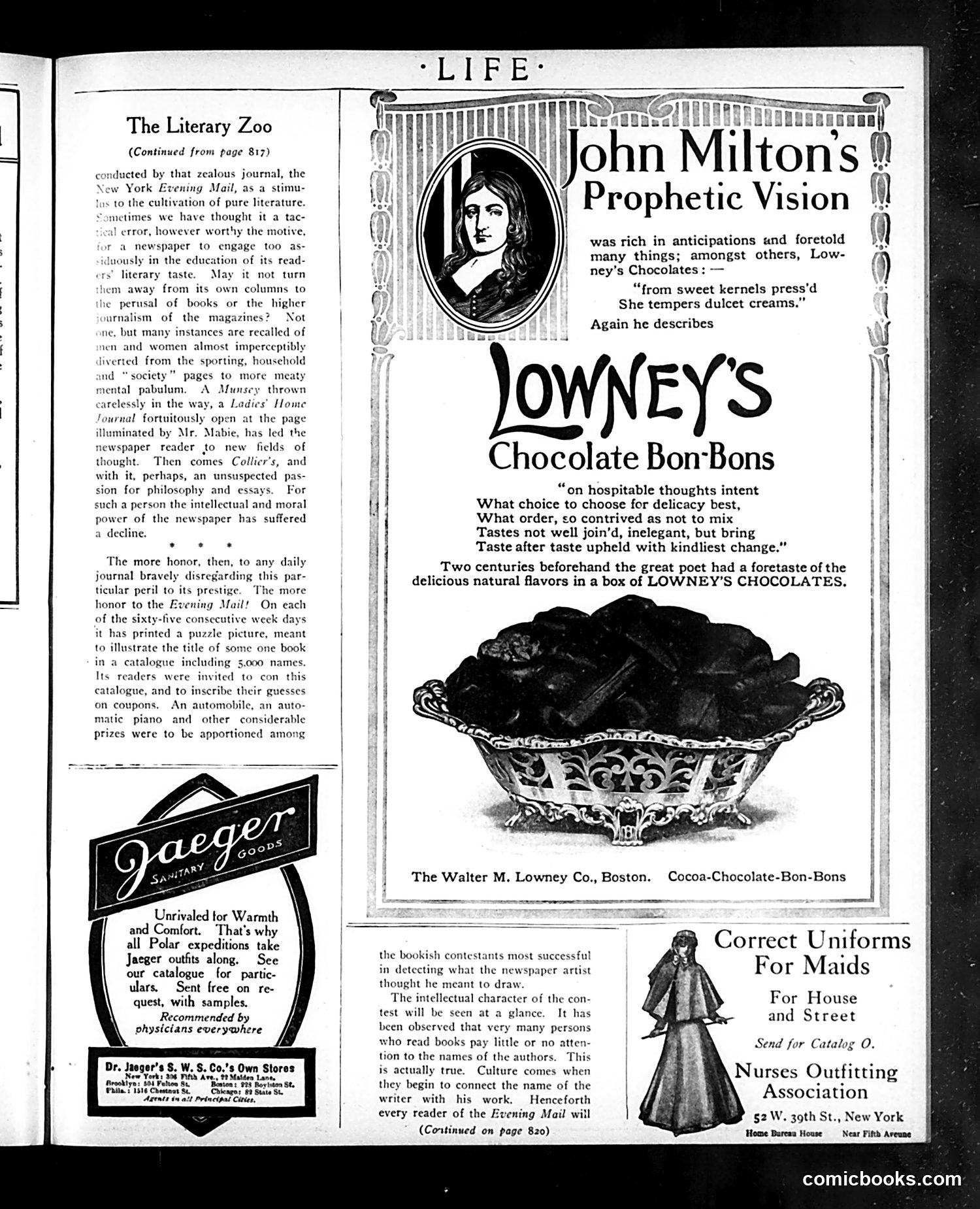
This page primarily consists of **advertisements mixed with editorial content** rather than political satire. The main content—"The Literary Zoo" (continued article)—discusses how newspapers like the *Evening Mail* promote literature through puzzles and contests. The piece debates whether newspapers should educate readers toward "serious" literature, warning that exposure to quality journalism and books might actually divert readers *away* from newspapers toward higher intellectual pursuits—a somewhat self-aware, ironic concern. The advertisements are notably **nostalgic and pseudo-intellectual**: A Lowney's Chocolate ad quotes John Milton's *Paradise Lost* to suggest the candy's superiority, implying that even a 17th-century poet would have enjoyed these chocolates. Other ads promote Jaeger sanitary goods, nurses' uniforms, and maids' clothing. **For modern readers**: This reflects an early-20th-century anxiety about mass media's role in culture—newspapers wrestling with whether educating their audience serves their own interests. The chocolate ad's literary pretension is charmingly absurd by today's standards.
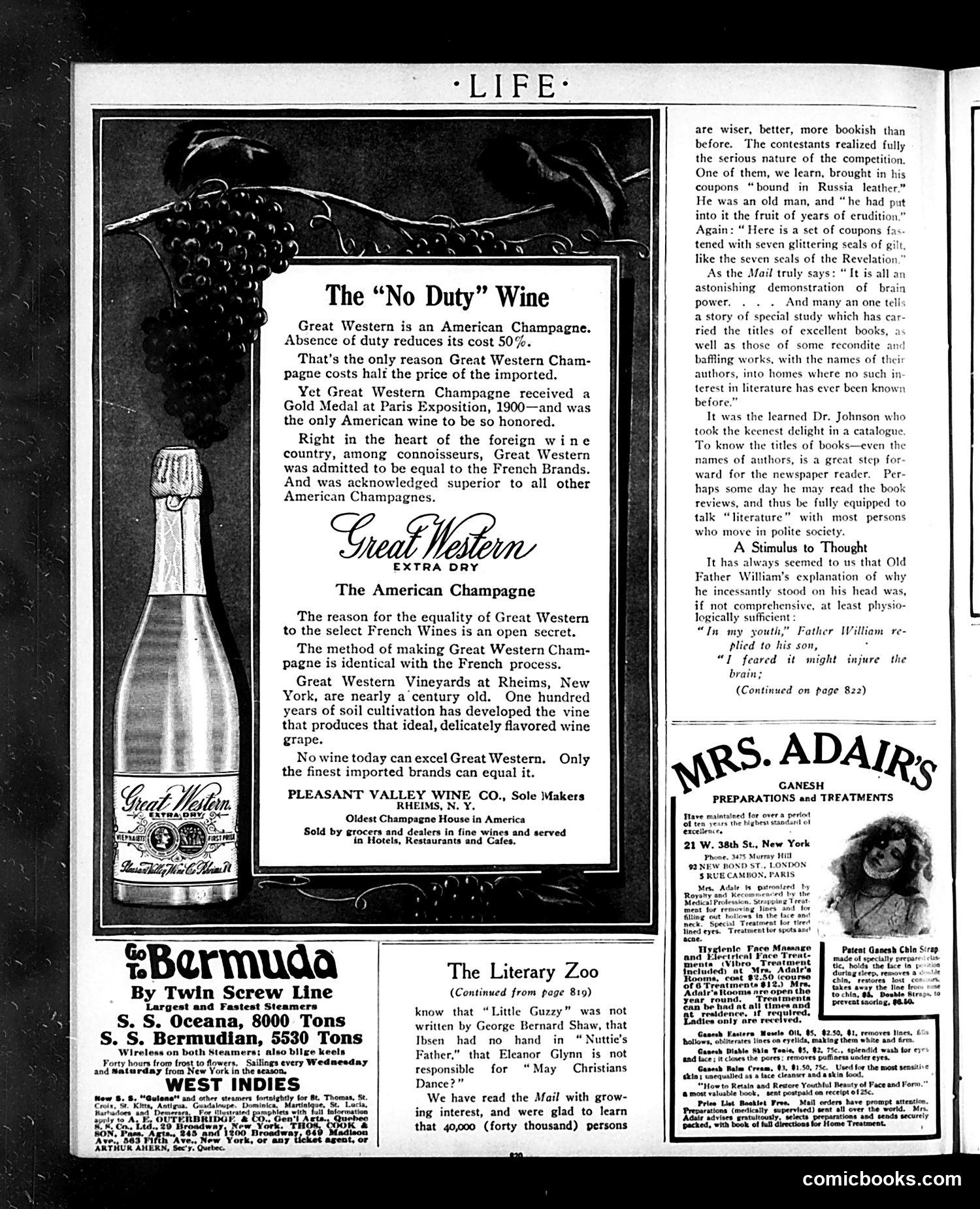
This page is primarily **advertising**, not political satire. The dominant content is a full-page advertisement for Great Western Champagne, promoting an American wine produced in Rheims, New York. The ad's central argument addresses **tariff policy**: Great Western costs half the price of imported French champagne because it avoids import duties ("absence of duty reduces its cost 50%"). Yet it won a Gold Medal at the 1900 Paris Exposition and was judged equal to French brands by connoisseurs abroad. The ad thus argues for American industrial quality while benefiting from protective tariffs—a common nationalist economic argument of the early 1900s. The page also contains minor advertisements for Mrs. Adair's beauty treatments, Bermuda steamship travel, and "The Literary Zoo" column continuation. No political cartoons appear here.
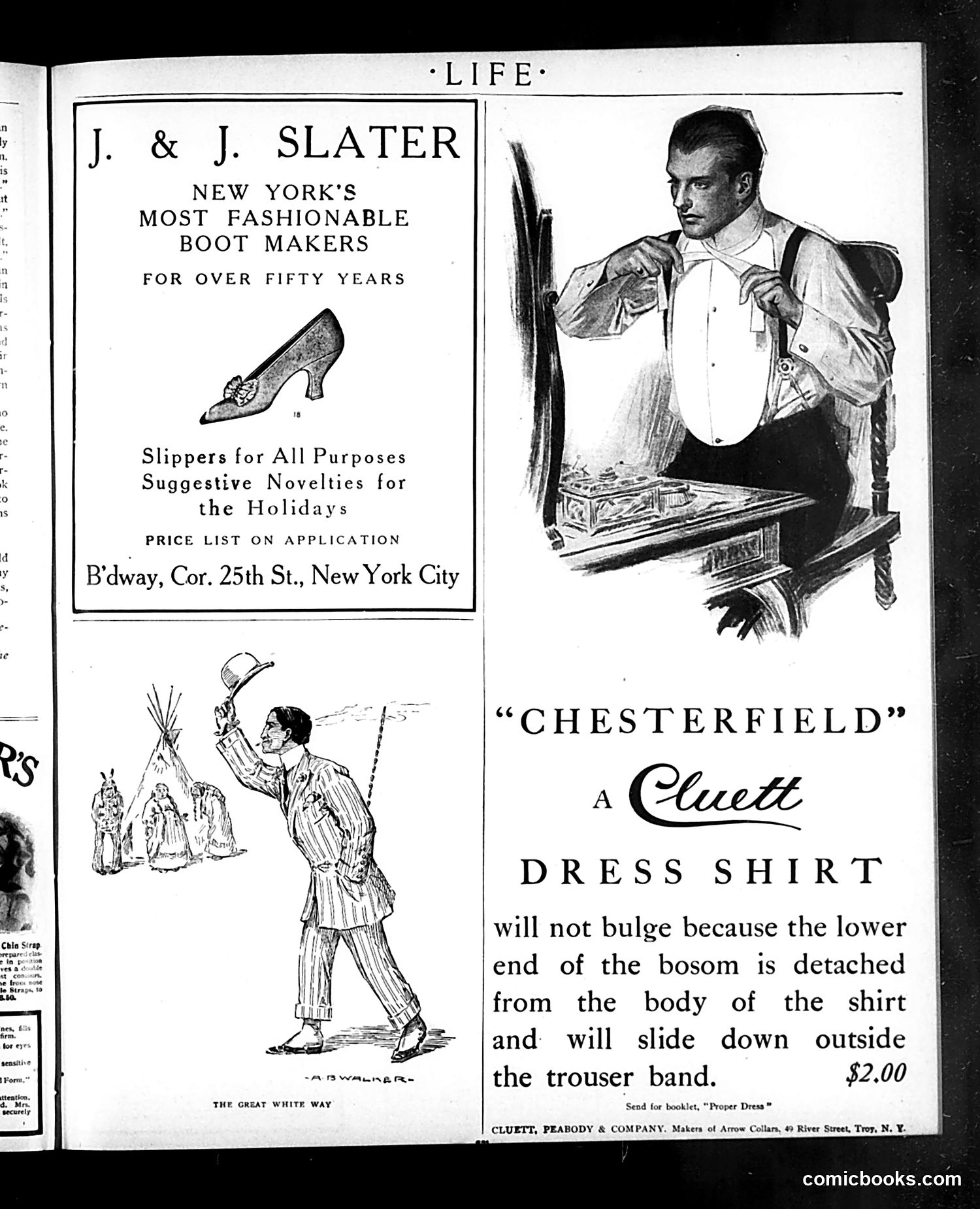
This is primarily a **advertisements page** from *Life* magazine, not a political cartoon or satire. The page contains three distinct ads: 1. **J. & J. Slater**: A boot and slipper maker advertising holiday gifts, located on Broadway at 25th Street, New York. 2. **"The Great White Way"**: A cartoon illustration (unclear reference—possibly related to Broadway entertainment or a specific product/show). 3. **Chesterfield Dress Shirt by Cluett**: The main advertisement features a well-dressed man in formal attire (tuxedo) promoting a $2.00 dress shirt. The copy explains the shirt's innovative design: the detachable bosom prevents bulging by sliding down outside the trouser band—a practical solution for formal wear of that era. These are straightforward commercial advertisements with no apparent political satire or social commentary.
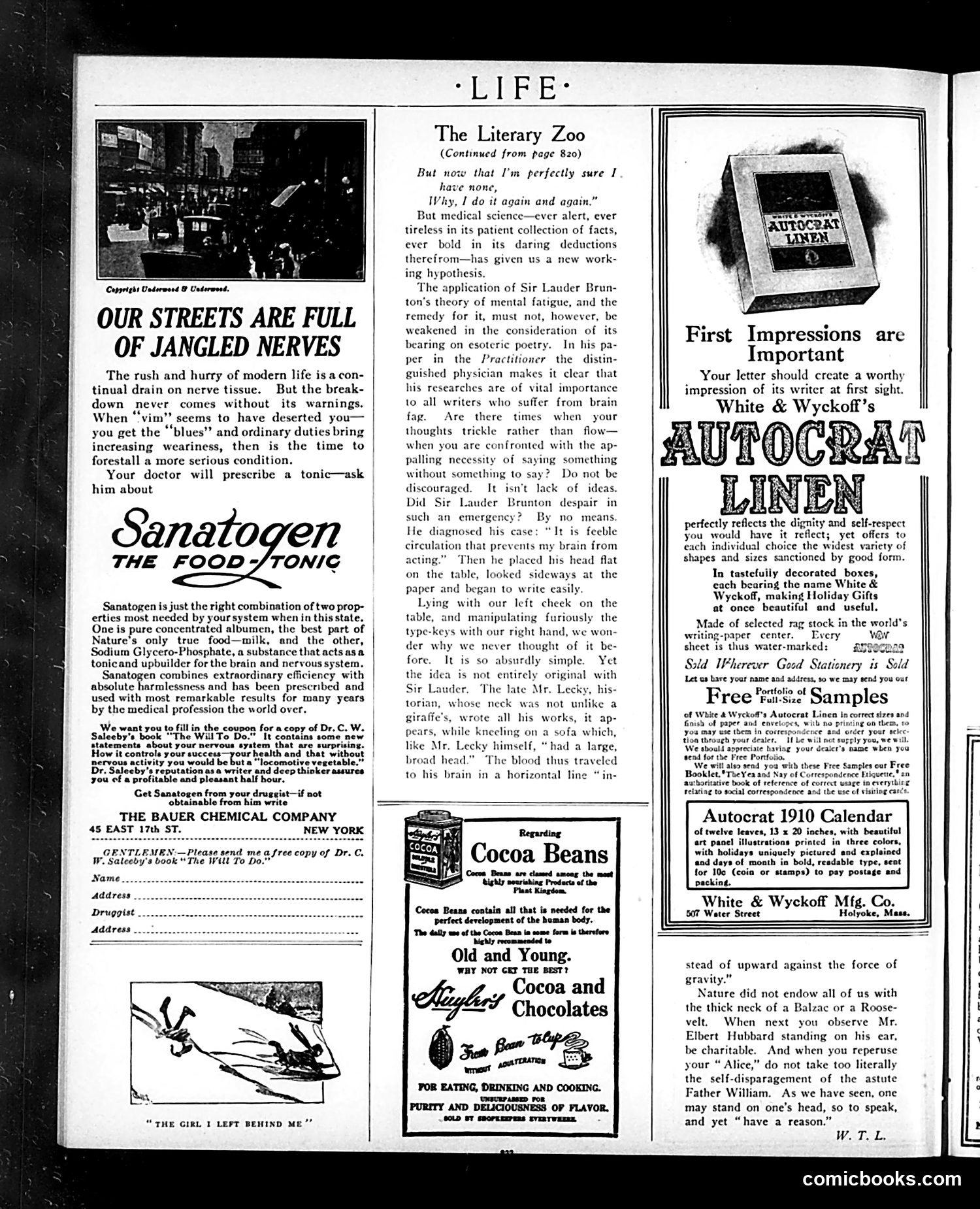
This page is primarily **advertising and literary content** rather than political satire or comics. The main elements include: **"Our Streets Are Full of Jangled Nerves"**: An advertisement for Sanatogen, a "food tonic" marketed to address modern urban stress and nervous exhaustion. The ad reflects early 20th-century medical attitudes blaming "nerve tissue" depletion for fatigue and depression—conditions we'd now recognize as stress or depression. **"The Literary Zoo"**: A humorous essay discussing writers' mental fatigue, referencing Sir Lauder Brunton's medical theory that poor circulation causes writer's block. The joke suggests absurd remedies like lying flat or kneeling on furniture to improve blood flow to the brain. **Product advertisements**: For Autocrat Linen stationery and Ainslet Cocoa and Chocolates, emphasizing quality and health benefits. The page reflects period concerns about "modern life" causing nervous strain—a common theme in early 1900s advertising—and the era's somewhat questionable understanding of circulation and mental performance.
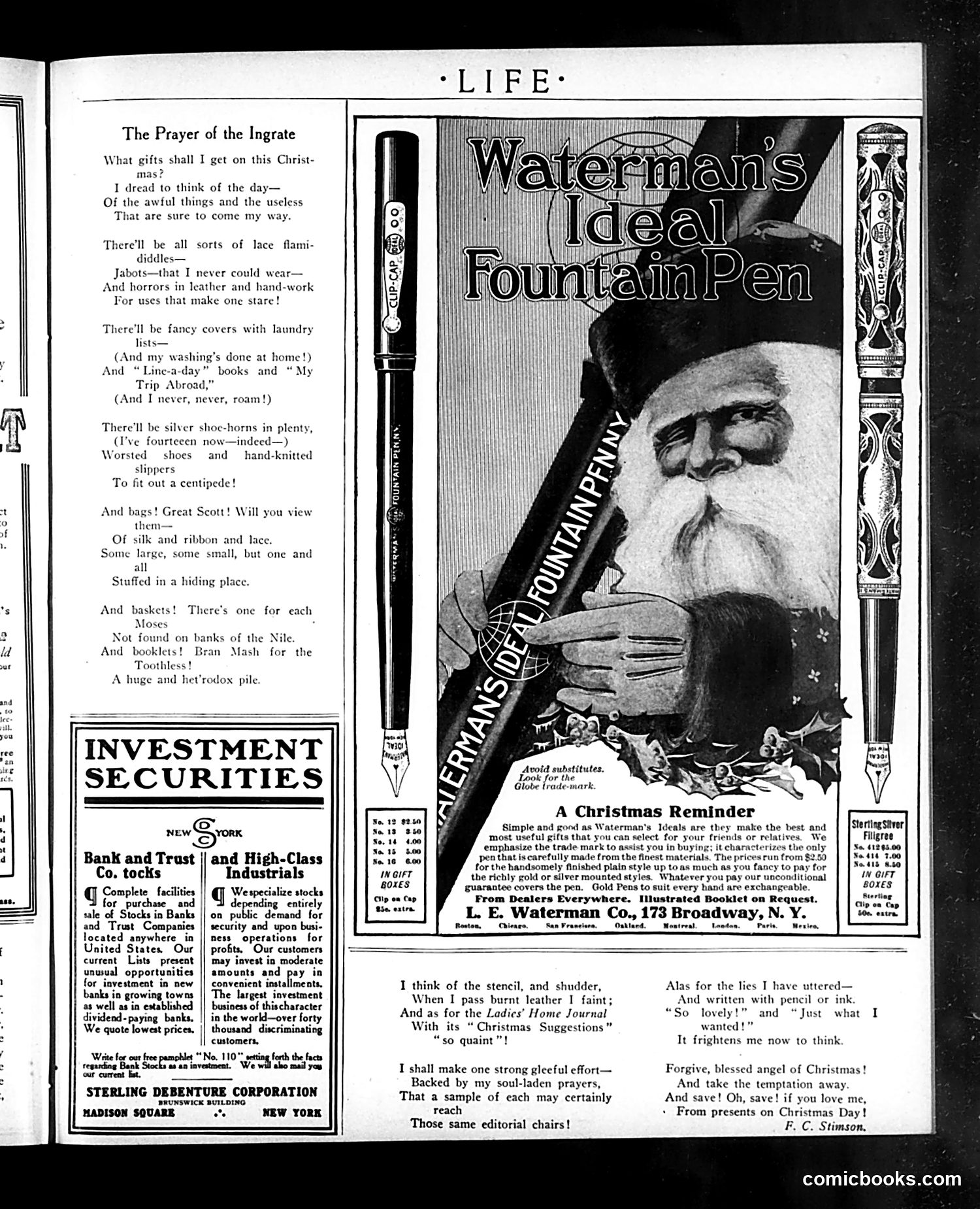
This page contains a satirical poem titled "The Prayer of the Ingrate" that mocks wealthy people complaining about receiving too many Christmas gifts. The speaker dreads the holiday because they'll be showered with useless luxury items: lace jabots, fancy bags, ornamental shoe-horns (they already own fourteen), hand-knitted slippers, and unwanted books like *Ladies' Home Journal*. The satire's point is clear: the poem ridicules the absurd ingratitude of the privileged classes who have so much excess they can't even enjoy gift-giving. The accumulation of redundant, impractical items—especially the joke about "silver shoe-horns in plenty" and slippers "to fit out a centipede"—emphasizes wasteful overindulgence. The page also advertises Waterman's fountain pens as practical, useful gifts that contrast with the frivolous items the poem mocks. The financial advertisements (investment securities, bank stocks) further frame this as commentary on the wealthy.
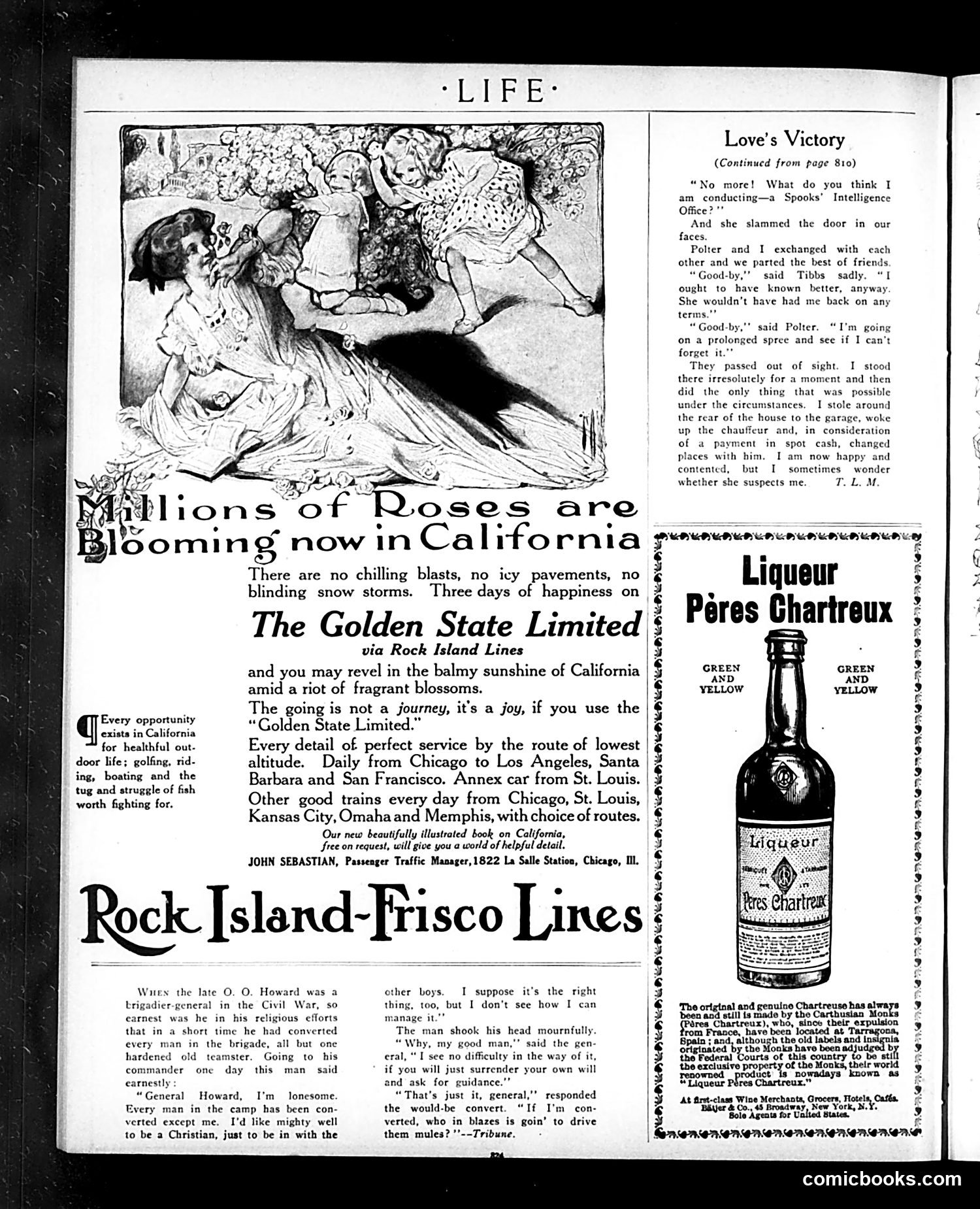
This page is primarily **advertisements and fiction serialization** rather than political satire. The main content includes: 1. **"Love's Victory" story continuation** — a romantic narrative where a character resolves a love triangle by impersonating a chauffeur to win back a woman's affection. The conclusion suggests he's successfully deceiving her. 2. **"The Golden State Limited" railroad advertisement** — promoting luxurious train travel to California via Rock Island Lines, emphasizing sunshine and leisure activities as escape from harsh winters. 3. **A brief anecdote about General O.O. Howard** (Civil War figure) converting soldiers to Christianity, ending with a teamster's practical objection: if converted, who will drive the mules? This is gentle humor about religious zeal versus practical concerns. 4. **Liqueur Pères Chartreux advertisement** — promoting the genuine liqueur made by Carthusian monks. **Context for modern readers:** The deception ending in "Love's Victory" would be presented as romantically clever rather than problematic. The California ad appeals to leisure travel as status. The General Howard anecdote reflects period attitudes about religion and working-class practicality.
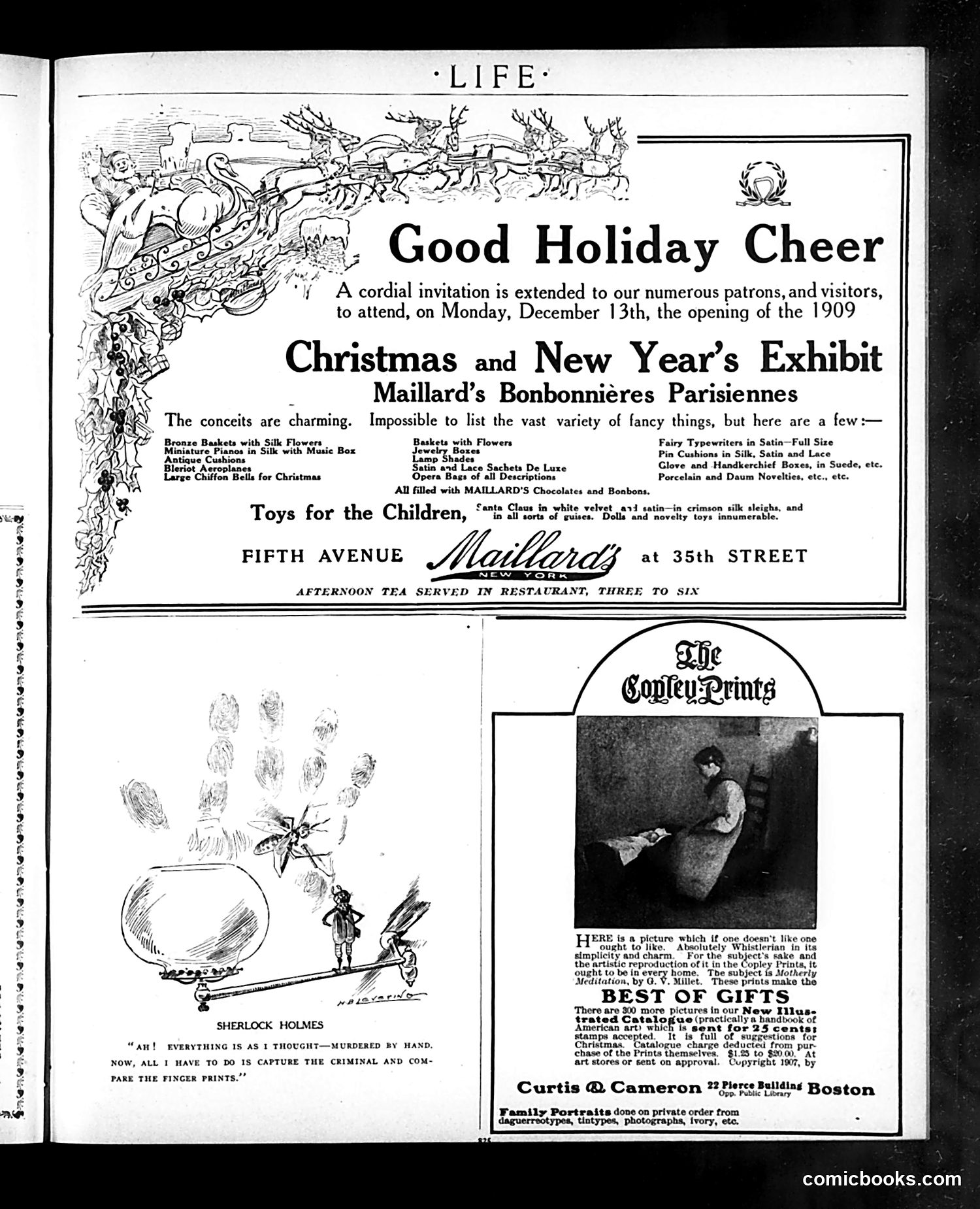
This page is primarily **advertising**, not political satire. The top half promotes Maillard's luxury chocolates and bonbons for the 1909 Christmas season at their Fifth Avenue store, listing ornamental gift boxes shaped like pianos, typewriters, and sleighs. The lower section contains two unrelated advertisements: one for Copley Prints featuring a reproduction of Millet's "Motherly Meditation," and another for Curtis & Cameron's portrait services in Boston. The only cartoon appears left-center: a **Sherlock Holmes illustration** showing the detective examining fingerprints to catch a criminal. This references Arthur Conan Doyle's famous detective character and reflects early-20th-century fascination with forensic science and fingerprint identification as a modern crime-solving method. The page reflects Gilded Age consumer culture—luxury goods marketed to wealthy patrons—rather than political commentary.
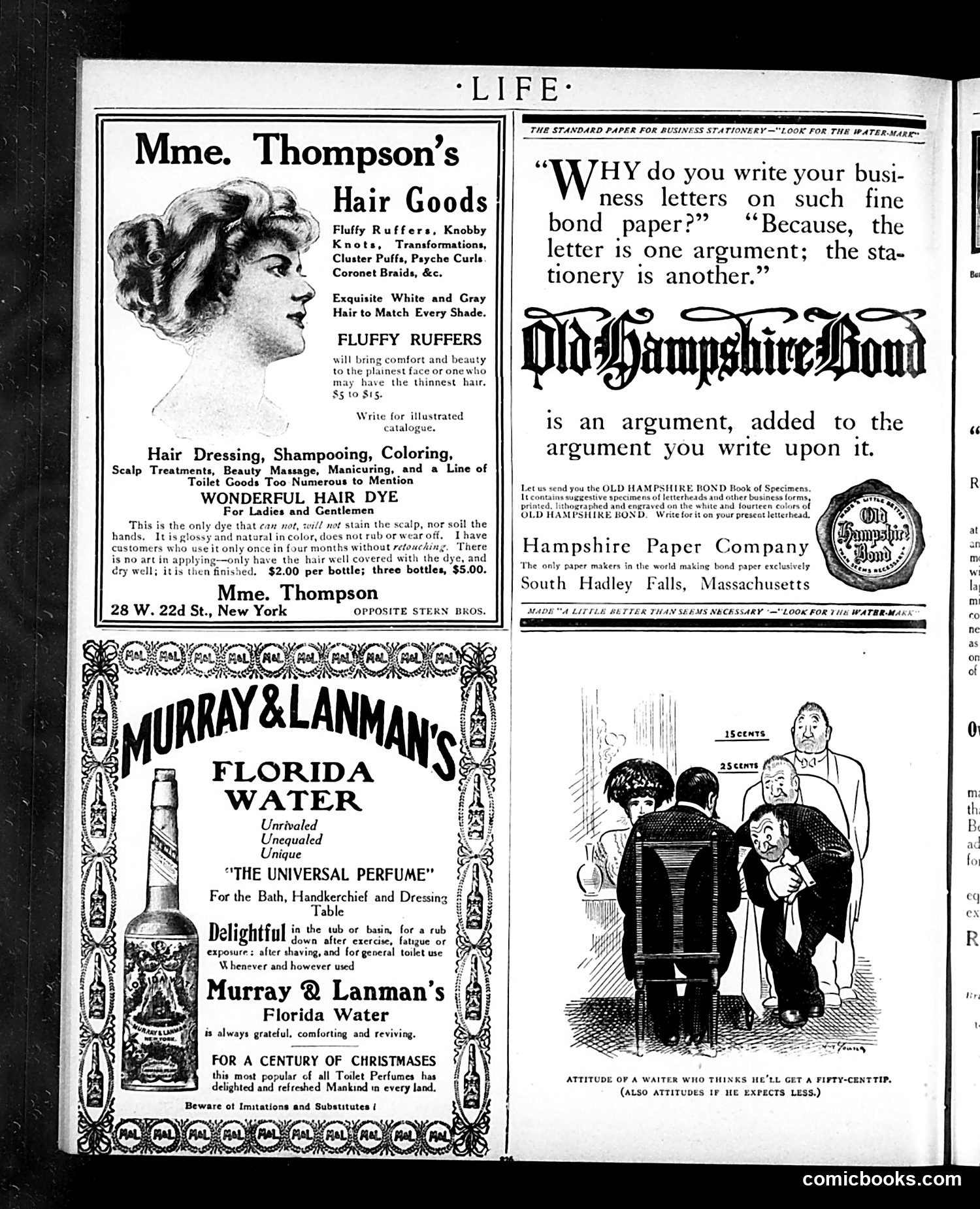
This page is primarily **advertisements** interspersed with one cartoon. The cartoon at bottom right depicts a waiter's exaggerated body language—hunched, ingratiating posture—toward customers. The caption explains he adopts this deferential attitude when expecting a fifty-cent tip, with a sardonic note that his posture changes if he expects less. The joke satirizes the **service industry's tip-dependent economy**: workers adjust their behavior and dignity based on anticipated gratuities, implying both the awkwardness of tipping culture and workers' financial desperation. The page otherwise features period advertisements for hair goods (Mme. Thompson's), stationery (Hampshire Paper), and Florida Water cologne. These ads use typical early-20th-century appeals to beauty and refinement. The Hampshire Paper ad makes a metacommentary on stationery quality as reflecting the writer's credibility—an argument about professionalism through material goods.
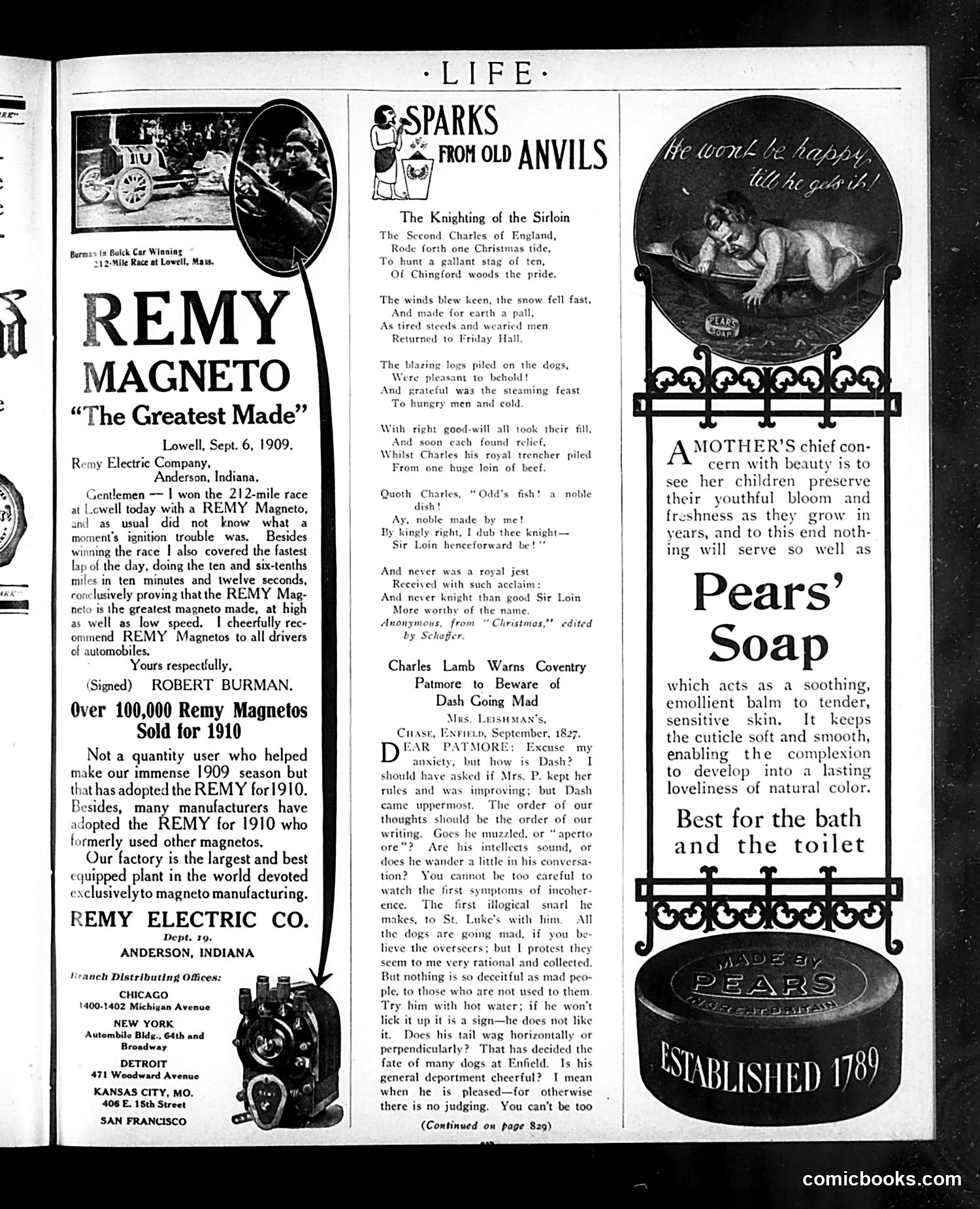
This page comprises **advertisements and literary content** rather than political cartoons. The left side features a **Remy Magneto advertisement**, citing race-car driver Robert Burman's endorsement of the electrical ignition system after winning a 212-mile race in 1909. This represents early automotive advertising emphasizing technological reliability—magnetos were crucial for engine ignition before modern starters. The center contains two **whimsical literary pieces**: a poem about King Charles II dubbing a cut of beef "Sir Loin" (a pun on "sirloin"), and a letter from essayist Charles Lamb humorously advising on observing a friend's dog ("Dash") for signs of madness—reflecting 19th-century concerns about rabies and the comic anthropomorphization of pets. The right side shows a **Pears' Soap advertisement** with classical imagery, promoting the product for preserving youthful skin—typical of Edwardian beauty marketing targeting mothers concerned with their children's complexions. No political satire is evident; this is a lifestyle/consumer magazine page mixing ads with light literature.
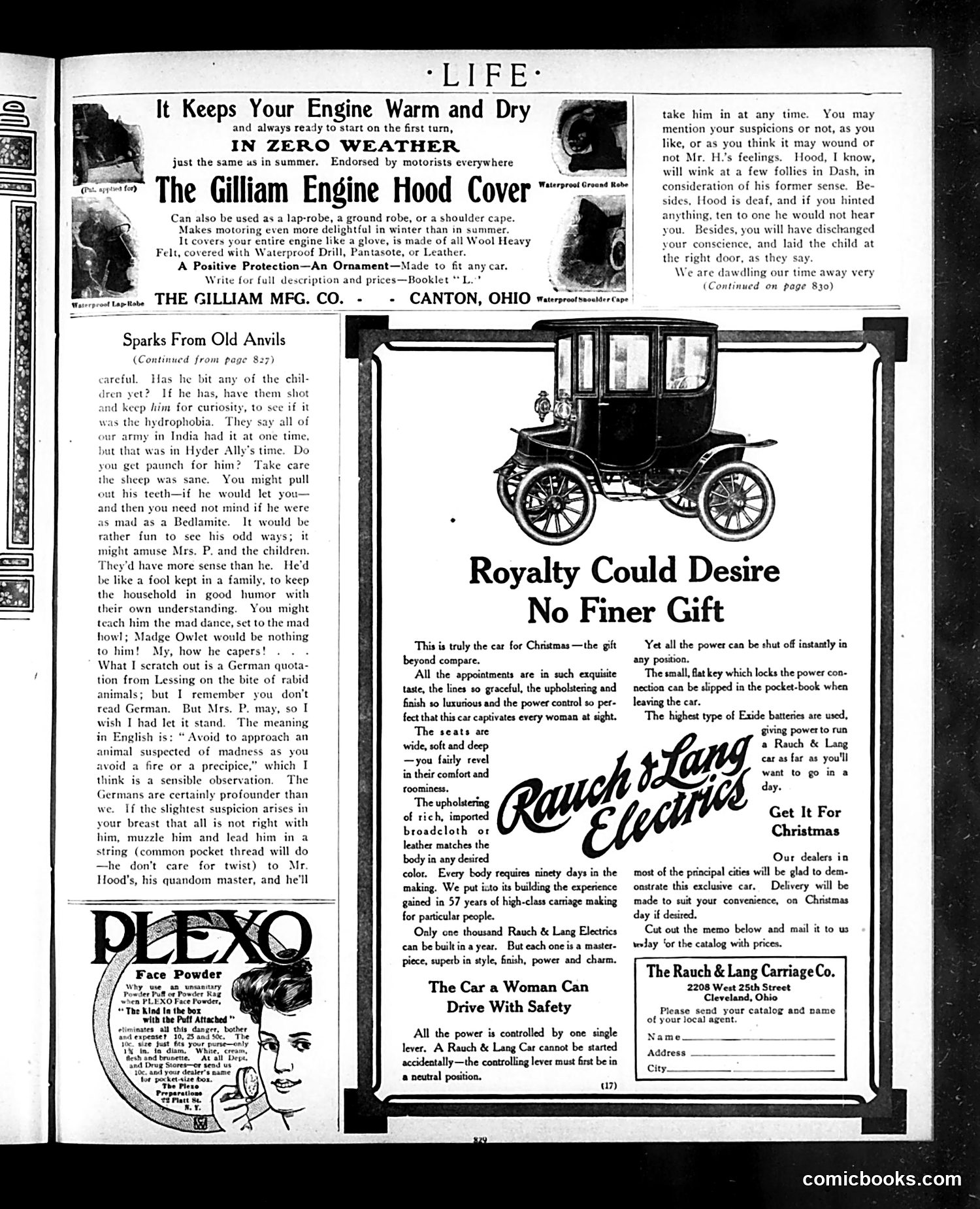
This page consists primarily of **period automobile and consumer product advertisements** rather than satirical cartoons. The main content includes: 1. **The Gilliam Engine Hood Cover** (top): An automotive accessory ad emphasizing winter functionality—keeping engines warm in zero-degree weather. 2. **"Royalty Could Desire No Finer Gift"** (center): A luxury car advertisement for the **Rauch & Lang Electrics**, marketed as a Christmas gift. The ad emphasizes safety features ("a woman can drive with safety"), comfort, and exclusivity (only 1,000 built yearly). This reflects early 1900s attitudes about women drivers and automobiles as status symbols. 3. **"Sparks From Old Anvils"** (left): A literary column discussing animal behavior and German philosophy—unrelated to satire. 4. **Plexo Face Powder** (bottom left): A cosmetics advertisement. These are straightforward advertisements typical of Life's advertising revenue model, not satirical commentary.
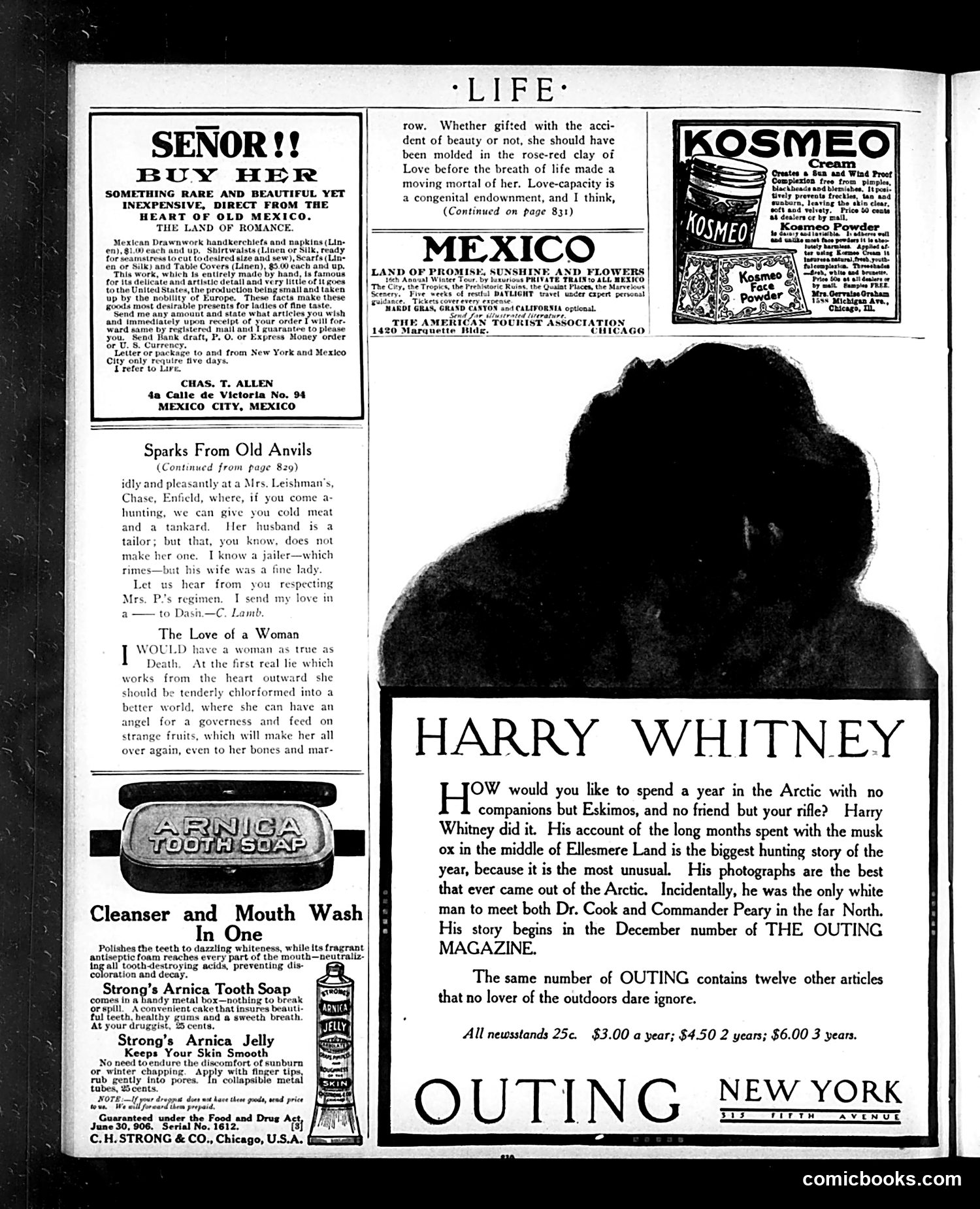
This page is primarily **advertising and promotional content** rather than political satire or comics. The main elements are: **"Señor!! Buy Her" Advertisement**: A commercial pitch selling Mexican handcrafted items (linens, naprics, scarfs) to American customers. It plays on contemporary romantic stereotypes of Mexico as "the land of romance," appealing to wealthy buyers seeking "rare and beautiful yet inexpensive" gifts. **Literary Excerpts**: The page includes snippets from "Sparks from Old Anvils" and "The Love of a Woman"—sentimental prose pieces typical of Life's editorial content. **Product Advertisements**: Standard early-20th-century ads for toiletries (Strong's Arnica Tooth Soap, Kosmeo Powder, Arnica Jelly). **Magazine Promotion**: A substantial feature promoting *Outing Magazine*, highlighting explorer Harry Whitney's Arctic hunting account. The page reflects Period attitudes toward Mexico and consumer marketing rather than political commentary or satire.
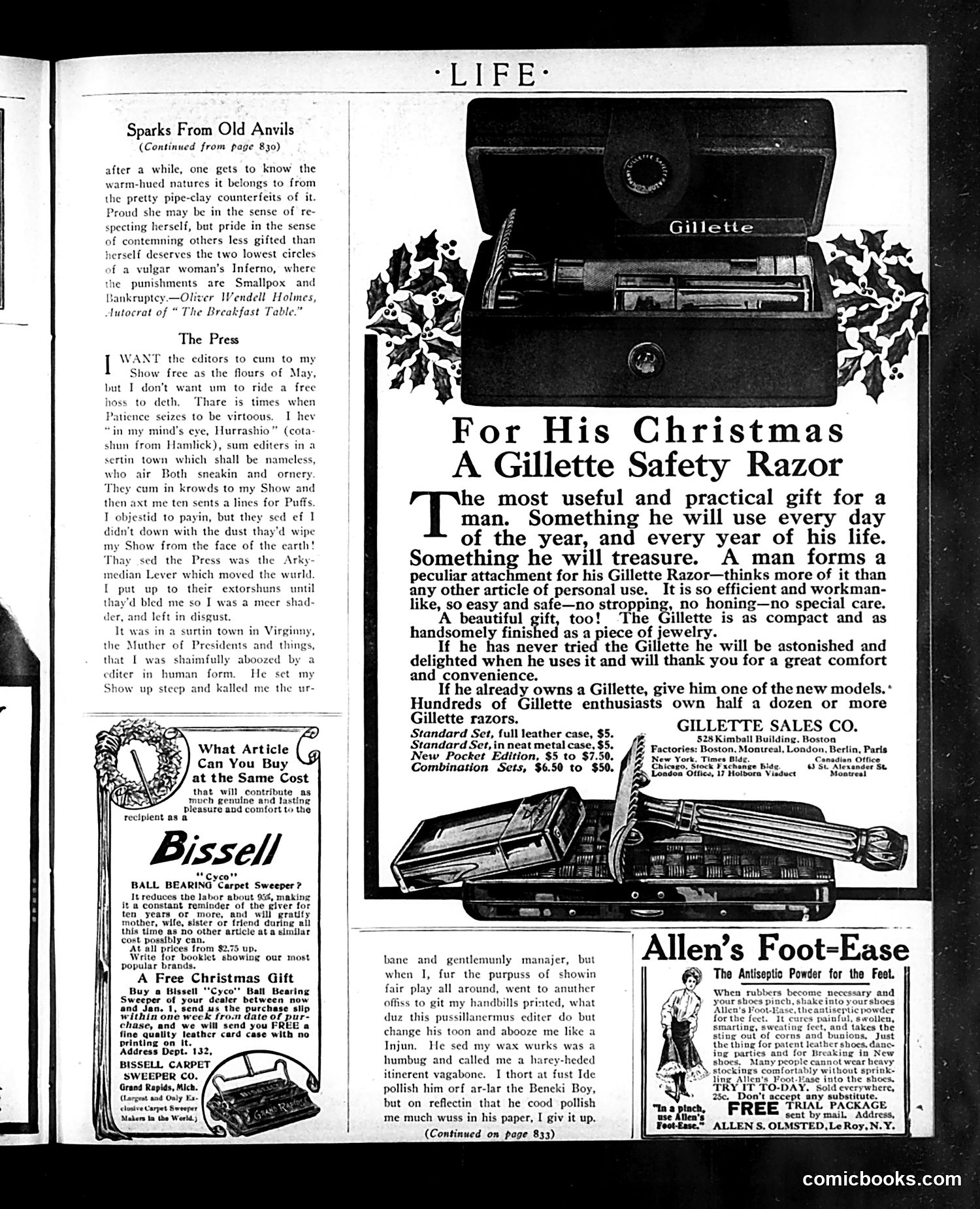
This is primarily a **commercial advertising page** rather than political satire. The main content consists of two large product advertisements: 1. **Gillette Safety Razor ad** (center/right): Promotes razors as ideal Christmas gifts, emphasizing their daily utility and durability. The copy highlights that men form "peculiar attachments" to their razors and suggests buying multiple models. 2. **Bissell Carpet Sweeper ad** (left): Markets ball-bearing sweepers as practical gifts that provide "ten years or more" of utility, appealing to gift-givers seeking lasting value. The page also includes a **serialized essay** titled "Sparks From Old Anvils" (a literary column) and "The Press" section—an autobiographical anecdote in deliberately misspelled dialect about a show promoter's conflicts with editors who extort advertising payment. The overall page represents **early 20th-century consumer magazine content**: mixing literature with advertisements targeting holiday shoppers. There is no political cartoon or satire present.
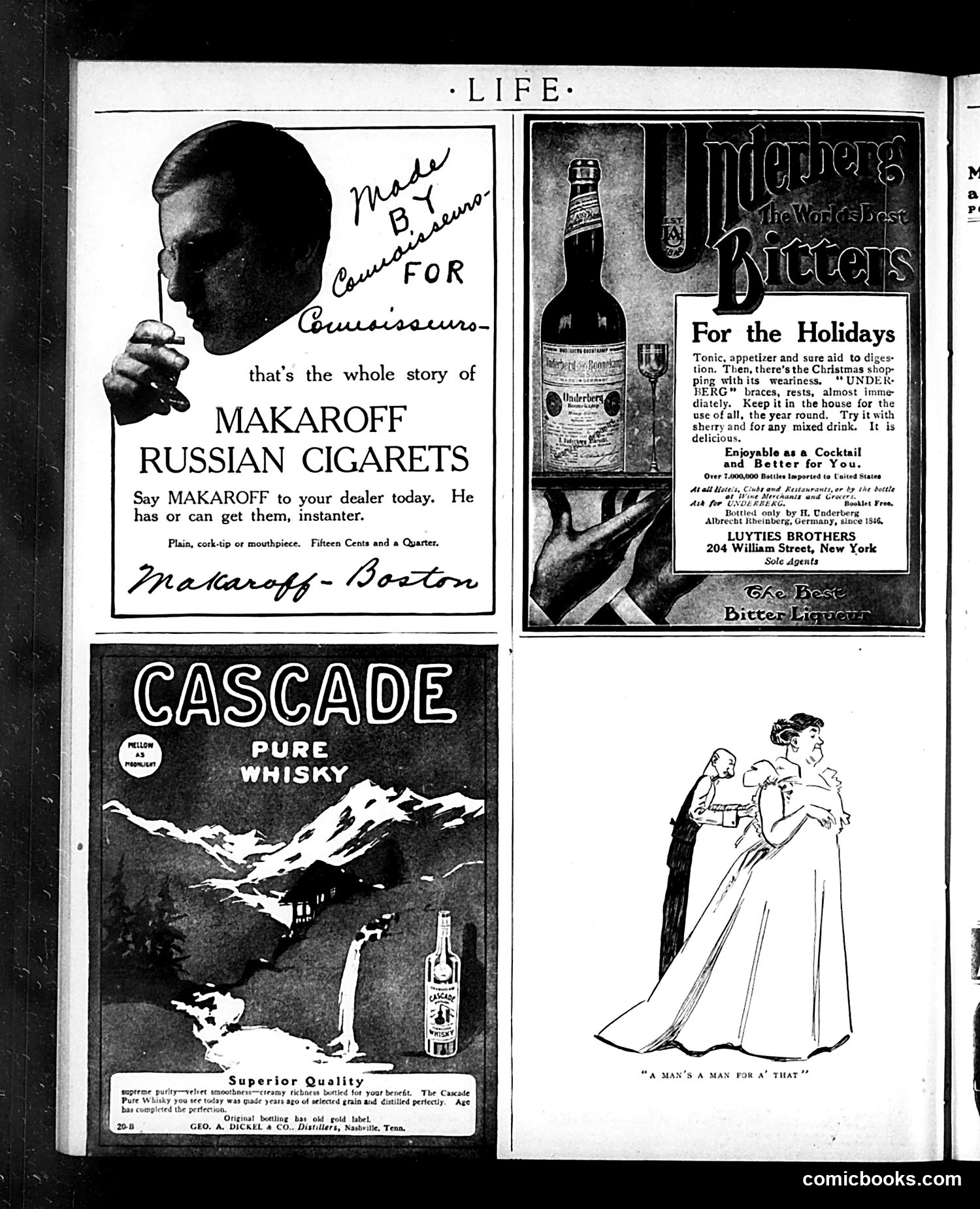
This page is primarily **advertising**, not satirical content. It contains four commercial advertisements from what appears to be an early 20th-century magazine: 1. **Makaroff Russian Cigarets** - A signed endorsement ad featuring a man's portrait, emphasizing the product's availability and affordability (15¢-25¢) 2. **Cascade Pure Whisky** - Promoting whisky from Nashville distillers, emphasizing age and quality 3. **Underberg** - A digestive tonic/liqueur marketed for holidays and mixed drinks, imported from Germany 4. **A small illustration** captioned "A Man's a Man for a' That" (a Robert Burns reference) showing a romantic couple The page reflects pre-Prohibition American advertising, when alcohol and tobacco were openly promoted. There is **no political satire or cartoon humor** visible—just straightforward product marketing typical of Life magazine's commercial pages during this era.
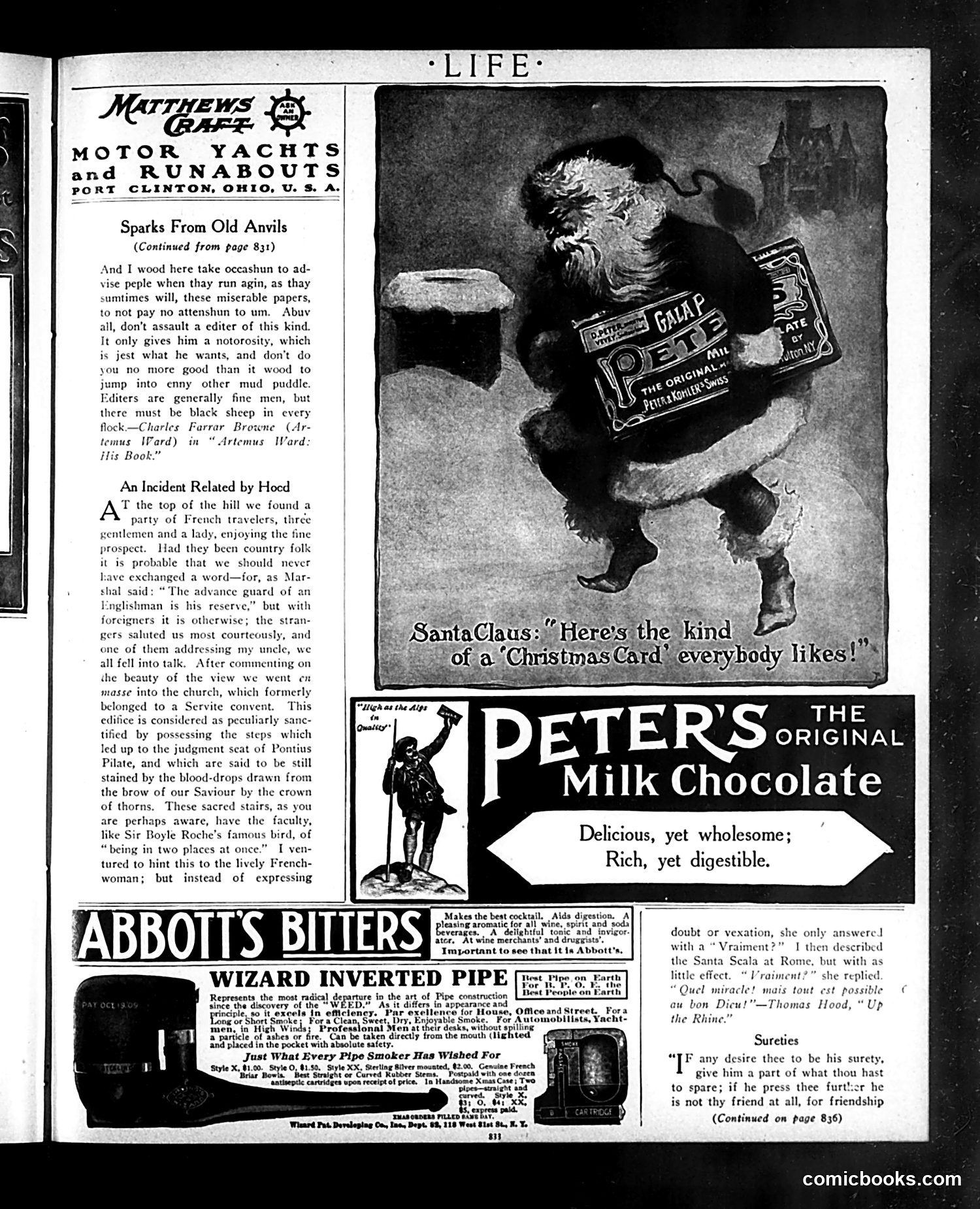
This page mixes advertisements with reprinted literary passages. The main visual element is an illustration of Santa Claus holding a box of Peter's Milk Chocolate, with the caption "Here's the kind of a 'Christmas Card' everybody likes!" This appears to be a commercial endorsement using holiday imagery. The text sections are literary excerpts—including a humorous passage attributed to 19th-century humorist Artemus Ward (Charles Farrar Browne) about newspaper editors, and an anecdote about French travelers visiting a church in Rome, featuring a witty French woman who responds to everything with "Vraiment?" (Really?). The advertisements promote motor yachts, Abbott's Bitters, Peter's Chocolate, and an "Inverted Pipe" smoking device. The page is primarily commercial content typical of Life magazine's era, mixing consumer products with cultural commentary and reprinted humor.
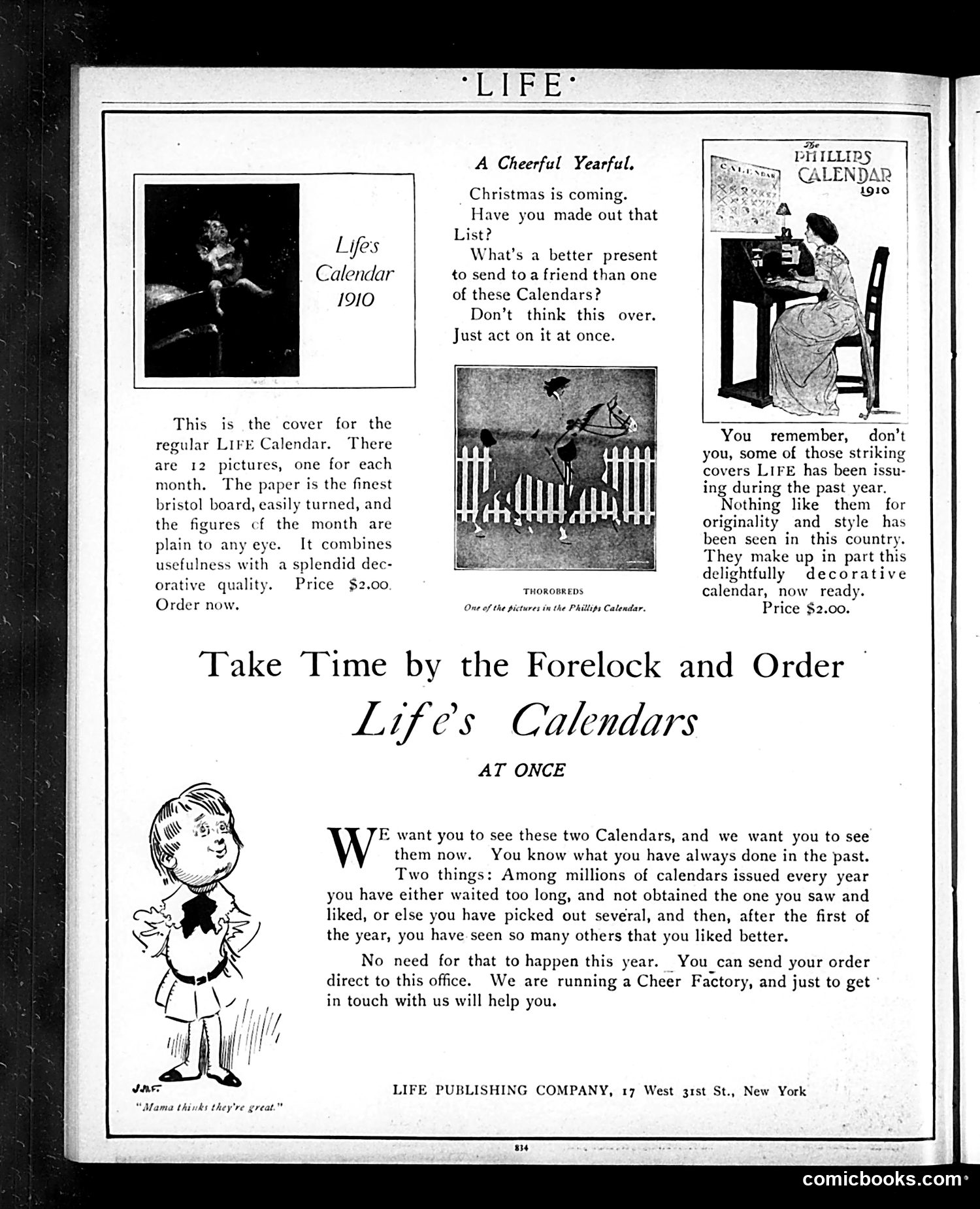
This is primarily a **calendar advertisement** rather than political satire. Life Publishing Company promotes two 1910 calendars: their own and Phillips Calendar. The page features sample images—including "Thorobreds" (a horse illustration) and a domestic scene of a woman at a desk—to showcase the calendars' artistic quality and decorative appeal as Christmas gifts. The humorous element appears in the central text block, which gently mocks consumer behavior: people typically either procrastinate obtaining desired calendars or later regret their choices after seeing better options. The small cartoon girl with the caption "Mama thinks they're great" adds light charm. The "Cheer Factory" reference is Life's playful self-description, positioning the magazine as a happiness-producing enterprise. The appeal emphasizes immediate ordering to avoid past disappointments—a straightforward marketing pitch using gentle humor rather than satire.
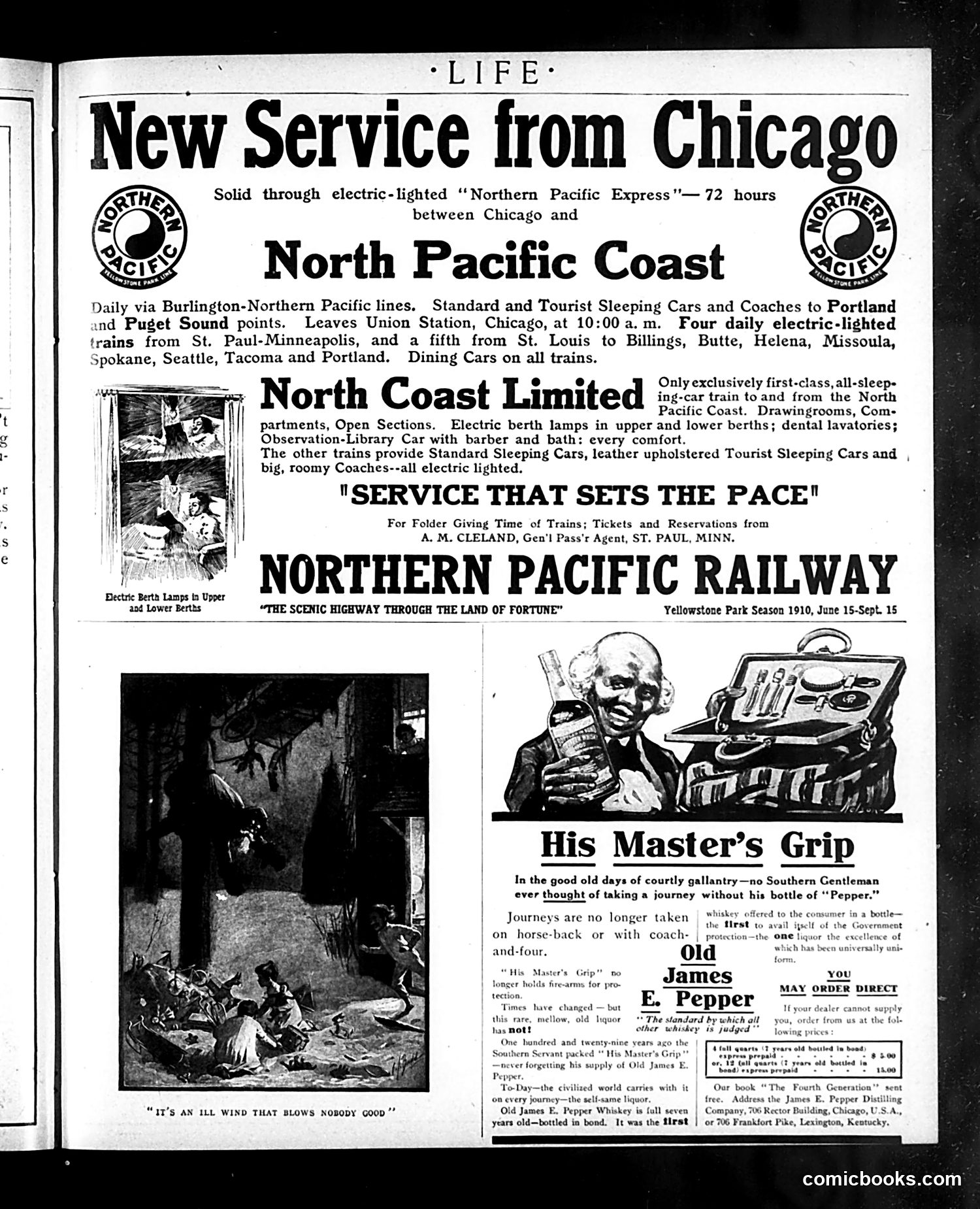
This page is primarily **railroad and whiskey advertising** from circa 1910, not political satire. The top half promotes the Northern Pacific Railway's new "Northern Pacific Express" train service from Chicago to the Pacific Coast—emphasizing speed (72 hours), comfort features (electric lighting, sleeping cars, dining cars), and scenic routes through Yellowstone. The bottom half advertises **Old James E. Pepper Whiskey** through a nostalgic narrative. The cartoon depicts an older gentleman with a traveling case, invoking a romanticized antebellum Southern past ("good old days of courtly gallantry"). The pitch argues that just as 19th-century gentlemen never traveled without whiskey, modern travelers should similarly pack Old James E. Pepper—positioning the product as an essential travel companion for the civilized gentleman. The phrase "It's an ill wind that blows nobody good" suggests the whiskey brand benefits from travel culture itself. There's no political message—only period advertising reflecting early-1900s consumer marketing and nostalgic Americana.
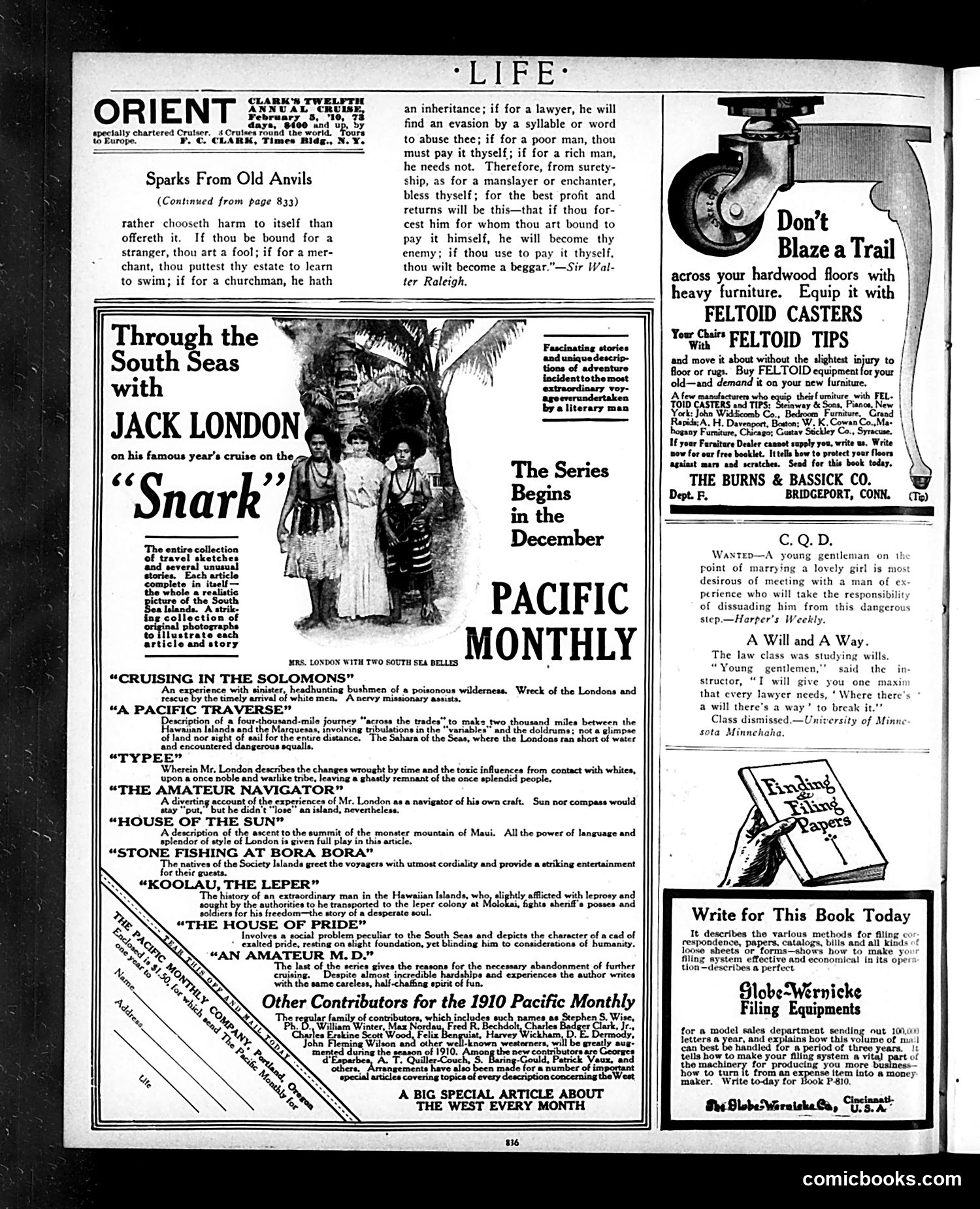
This page is primarily **advertising and literary promotion** rather than political satire. The main content announces Jack London's serialized travel writings for *Pacific Monthly* magazine, beginning in December, featuring his yacht cruise through the South Seas aboard the "Snark." The page includes: 1. **Jack London series promotion** - Articles with sensational titles ("Headhunting Bushmen," "Wreck of the Londons," "Stone Fishing at Bora Bora") appealing to early-1900s audiences' fascination with exotic colonial adventure and "primitive" cultures. 2. **Period advertising** - Including Feltoid casters for furniture and Globe-Wernické filing equipment, typical commercial placements. 3. **Quotation section** ("Sparks From Old Anvils") - A Sir Walter Raleigh quote cynically warning against lending money, reflecting early-20th-century attitudes toward financial obligation. The content reflects contemporary American interests in imperial adventure narratives and "discovery" of non-Western peoples, rather than offering satirical commentary.
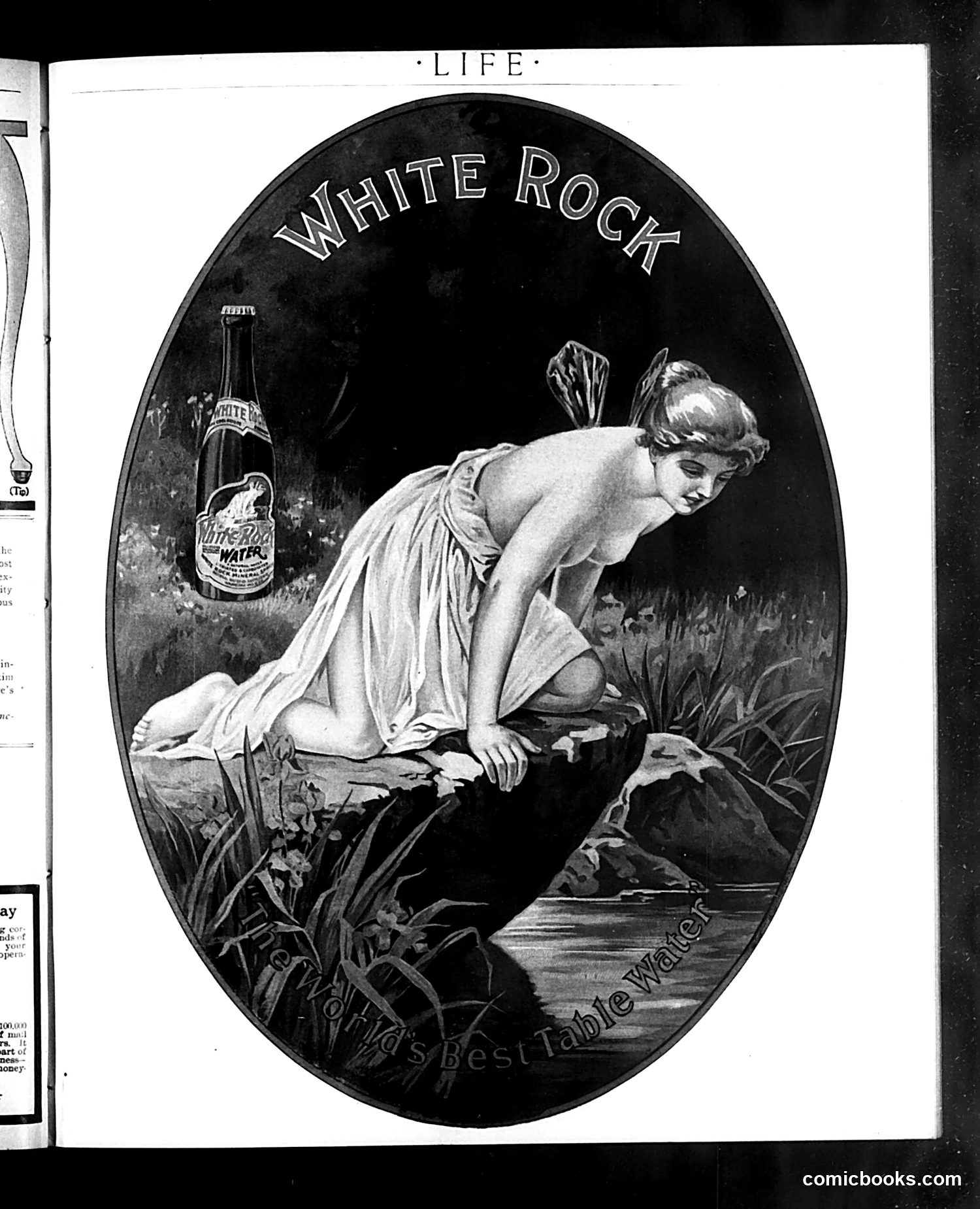
This is a vintage advertisement for White Rock beverages, not political satire. The image shows a classical-style female figure in draped clothing, positioned near water in a naturalistic setting. A White Rock bottle appears prominently in the background. The ad exemplifies early 20th-century commercial art, using idealized feminine imagery and classical artistic conventions to market the product. The figure's graceful pose and the pastoral landscape were typical marketing strategies of the era, suggesting purity, naturalness, and elegance associated with the brand. This represents the kind of illustrated advertising that dominated *Life* magazine during this period, using aspirational imagery rather than direct product information to appeal to consumers.
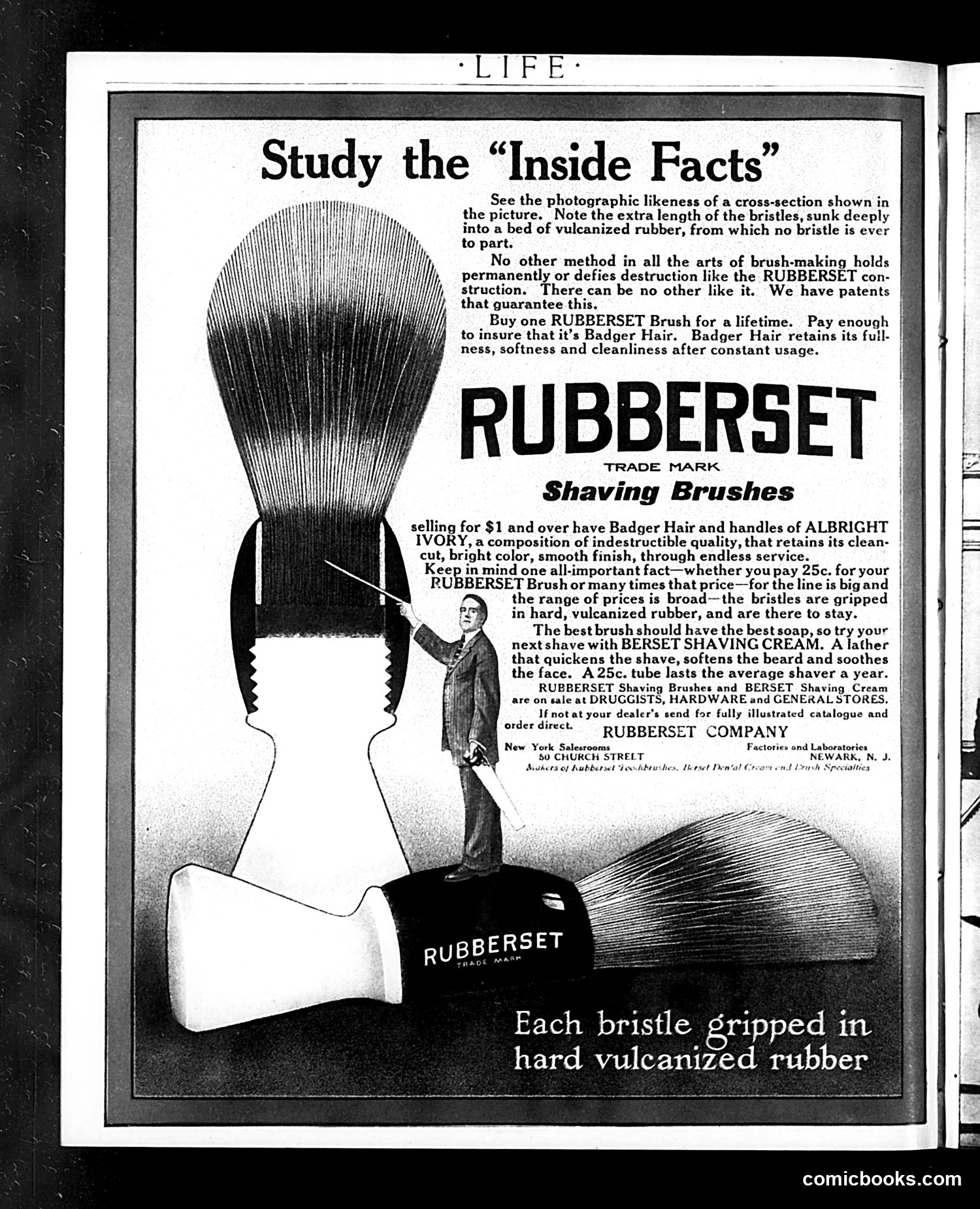
This is a **product advertisement**, not political satire or a cartoon. It promotes Rubberset brand shaving brushes in Life magazine. The page uses technical illustration and persuasive copy to highlight the product's construction method—bristles embedded in vulcanized rubber rather than traditional approaches. A cross-section diagram and side-view of the brush dominate the layout, with a small figure of a man included for scale comparison, emphasizing the brush's substantial size. The ad's appeal targets middle-class male consumers by promising durability ("a lifetime"), quality materials (badger hair, ivory handles), and affordability across price points (25¢ to over $1). The repeated phrase "inside facts" and technical language ("vulcanized rubber," "patents") suggest competitive advertising warfare—assuring buyers that Rubberset's patented construction method is superior and inimitable. This reflects early 20th-century advertising strategies emphasizing manufacturing innovation and scientific superiority to justify premium pricing.
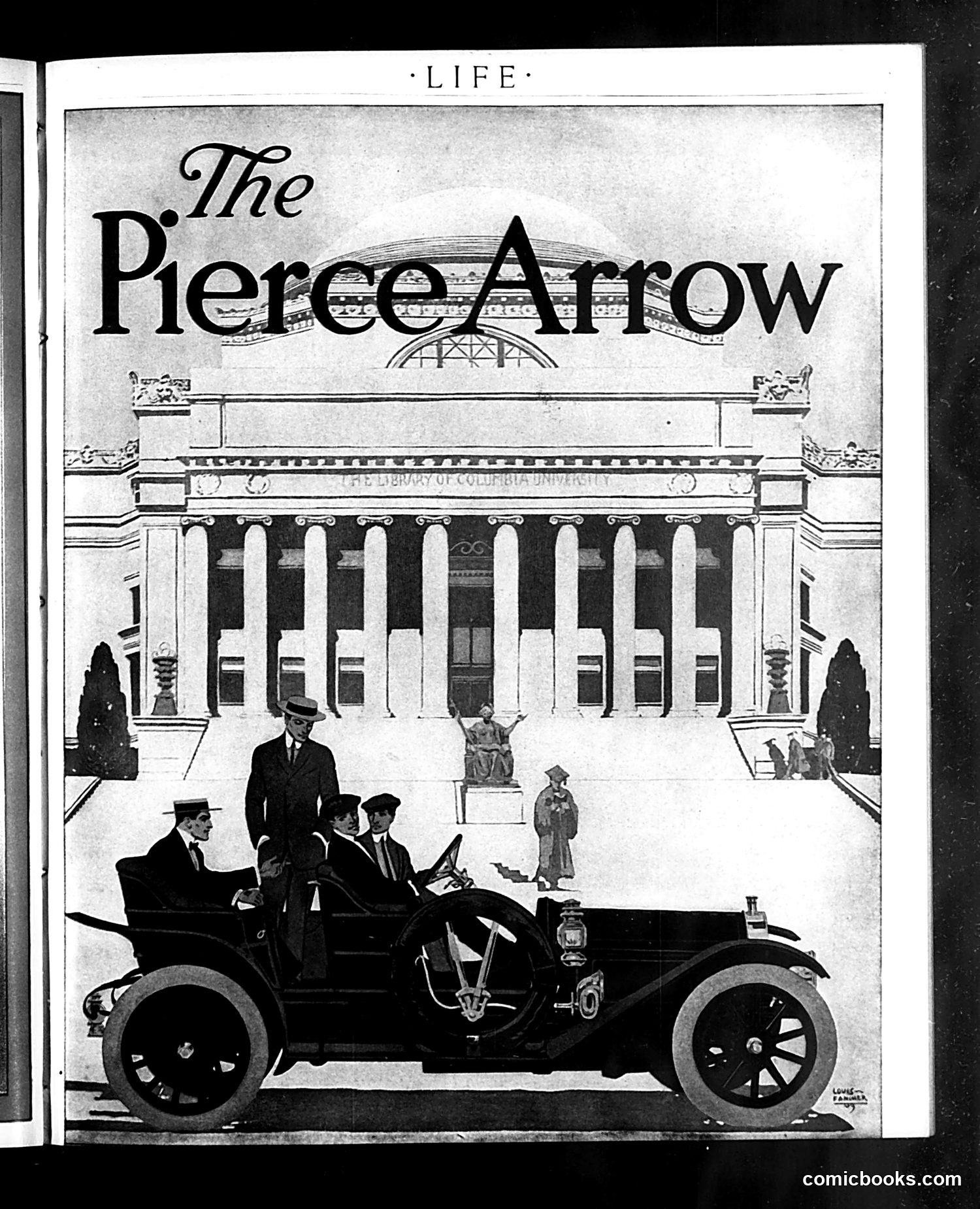
This is an advertisement for Pierce-Arrow automobiles, presented as a cover or feature in *Life* magazine. The image shows a luxury car with well-dressed passengers in formal attire (top hats and suits) parked before a neoclassical government building—likely the Columbia University library based on visible text, though it could represent any prestigious institution. The satire appears to target the pretensions of wealthy automobile owners: the fancy car and formal dress suggest these are important dignitaries or elite citizens. The joke likely plays on the contrast between the automobile's modernity and the classical architecture, or on the ostentatious display of wealth. Pierce-Arrow was a prestigious luxury brand, so the ad positions ownership as a marker of status and refinement.
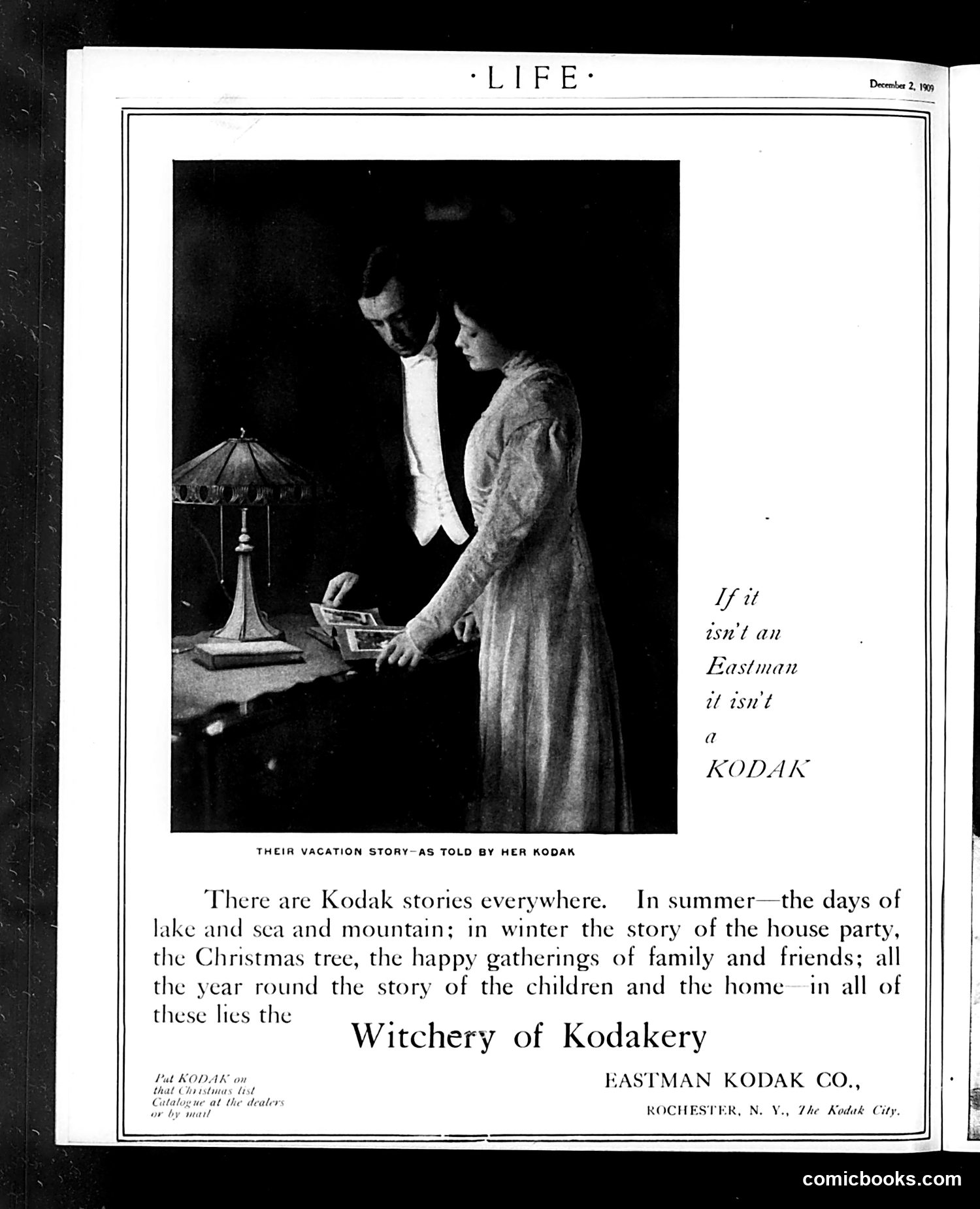
This is a **Kodak advertisement**, not a political cartoon. The page features a romantic scene of a couple examining photographs by lamplight, with the caption "Their Vacation Story—As Told by Her Kodak." The ad's messaging centers on the slogan "If it isn't an Eastman it isn't a KODAK" and promotes the concept of "Witchery of Kodakery"—the idea that Kodak cameras capture and preserve life's precious moments throughout the year: summer vacations, winter gatherings, Christmas celebrations, and family life. The advertisement targets middle-class consumers by emphasizing how photography preserves memories of leisure activities and domestic happiness. The romantic framing suggests that sharing vacation photographs is itself an intimate, meaningful experience. This is straightforward brand marketing positioning Kodak cameras as essential to documenting and memorializing family life, not satire or political commentary.