
Life, 1909-12-02 · page 9 of 80
Life — December 2, 1909 — page 9: what you’re looking at
What you’re looking at
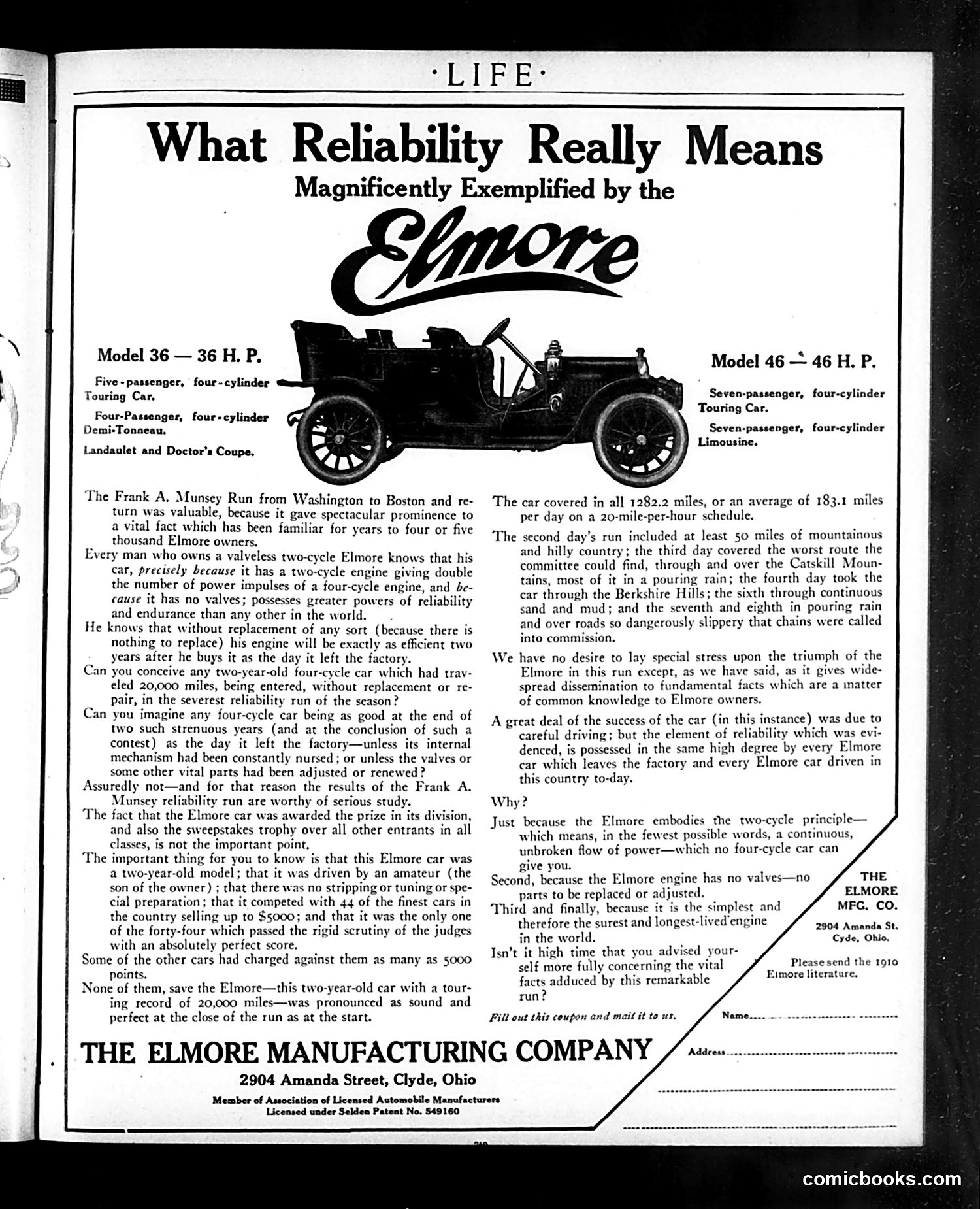
This page is **primarily an automobile advertisement**, not satirical content. It's a 1910s-era ad for the Elmore automobile, published in *Life* magazine. The ad describes the Frank A. Munsey "reliability run" from Washington to Boston—a real promotional event where an Elmore car performed successfully. The advertisement emphasizes the car's engineering advantages: a two-cycle engine with no valves, simplified internal mechanics, and superior durability compared to competitors. The "satire" here is subtle advertising rhetoric: the piece frames the Elmore's simplicity as superiority over more complex four-cycle engines, using the Munsey Run's success as proof. It's marketing disguised as editorial content—a common *Life* magazine practice blending humor, journalism, and paid promotion. There are no political figures or caricatures; this is straightforward early automotive advertising.
📄 Transcribed text from this page (OCR, searchable)
Machine-transcribed from the original scan — historical spelling and the odd misread are preserved.
What Reliability Really Means Magnificently Exemplified by the Model 36 — 36 H. P. Five-passenger, four-cylinder Touring Car, ta Four-Passenger, four-cylinder Gj Demi-Tonneau. Landaulet and Doctor's Coupe. The Frank A. Munsey Run from Washington to Boston and re- turn was valuable, because it gave spectacular prominence to a vital fact which has been familiar for years to four or five ___ thousand Elmore owners. Every man who owns a valveless two-cycle Elmore knows that his car, precisely because it has a two-cycle engine giving double the number of power impulses of a four-cycle engine, and be- cause it has no valves; possesses greater powers of reliability and endurance than any other in the world. He knows that without replacement of any sort (because there is nothing to replace) his engine will be exactly as efficient two years after he buys it as the day it left the factory. Can you conceive any two-year-old four-cycle car which had trav- eled 20,000 miles, being entered, without replacement or re- pair, in the severest reliability run of the season? Can you imagine any four-cycle car being as good at the end of two such strenuous years (and at the conclusion of such a contest) as the day it left the factory—unless its internal mechanism had been constantly nursed ; or unless the valves or some other vital parts had been adjusted or renewed ? Assuredly not—and for that reason the results of the Frank A. Munsey reliability run are worthy of serious study. The fact that the Elmore car was awarded the prize in its division, and also the sweepstakes trophy over all other entrants in all classes, is not the important point. The important thing for you to know is that this Elmore car was a two-year-old model; that it was driven by an amateur (the son of the owner) ; that there was no stripping or tuning or spe- cial preparation; that it competed with 44 of the finest cars in the country selling up to $5000; and that it was the only one of the forty-four which passed the rigid scrutiny of the judges with an absolutely perfect score. Some of the other cars had charged against them as many as 5000 points. None of them, save the Elmore—this two-year-old car with a tour- ing record of 20,000 miles—was pronounced as sound and perfect at the close of the run as at the start. Model 46 — 46 H. P. Seven-passenger, four-cylinder Touring Car. Seven-passenger, four-cylinder Limousine. The car covered in all 1282.2 miles, or an average of 183.1 miles per day on a 20-mile-per-hour schedule. The second day’s run included at least 50 miles of mountainous and hilly country; the third day covered the worst route the committee could find, through and over the Catskill Moun- tains, most of it in a pouring rain; the fourth day took the car through the Berkshire Hills; the sixth through continuous sand and mud; and the seventh and eighth in pouring rain and over roads so dangerously slippery that chains were called into commission, have no desire to lay special stress upon the triumph of the Elmore in this run except, as we have said, as it gives wide- spread dissemination to fundamental facts which are a matter of common knowledge to Elmore owners. A great deal of the success of the car (in this instance) was due to careful driving; but the clement of reliability which was evi- denced, is possessed in the same high degree by every Elmore car which leaves the factory and every Elmore car driven in this country to-day. Why? Just because the Elmore embodies the two-cycle principle— which means, in the fewest possible words, a continuous, unbroken flow of power—which no four-cycle car can give you. Second, because the Elmore engine has no valves—no parts to be replaced or adjusted. Third and finally, because it is the simplest and therefore the surest and longest-lived engine in the world. Isn’t it high time that you advised your- self more fully concerning the vital facts adduced by this remarkable run? THE ELMORE MFG, CO. 2904 Amanda St. Cyde, Ohio. Please send the 1910 E1more literature. Fill out this coupon and mait it to us, THE ELMORE MANUFACTURING COMPANY 2904 Amanda Street, Clyde, Ohio bile Manufacturers Member of Association of Licensed Auto: Licensed under Selden Patent No. 549160 comicbooks.com