
Life, 1909-12-02 · page 44 of 80
Life — December 2, 1909 — page 44: what you’re looking at
What you’re looking at
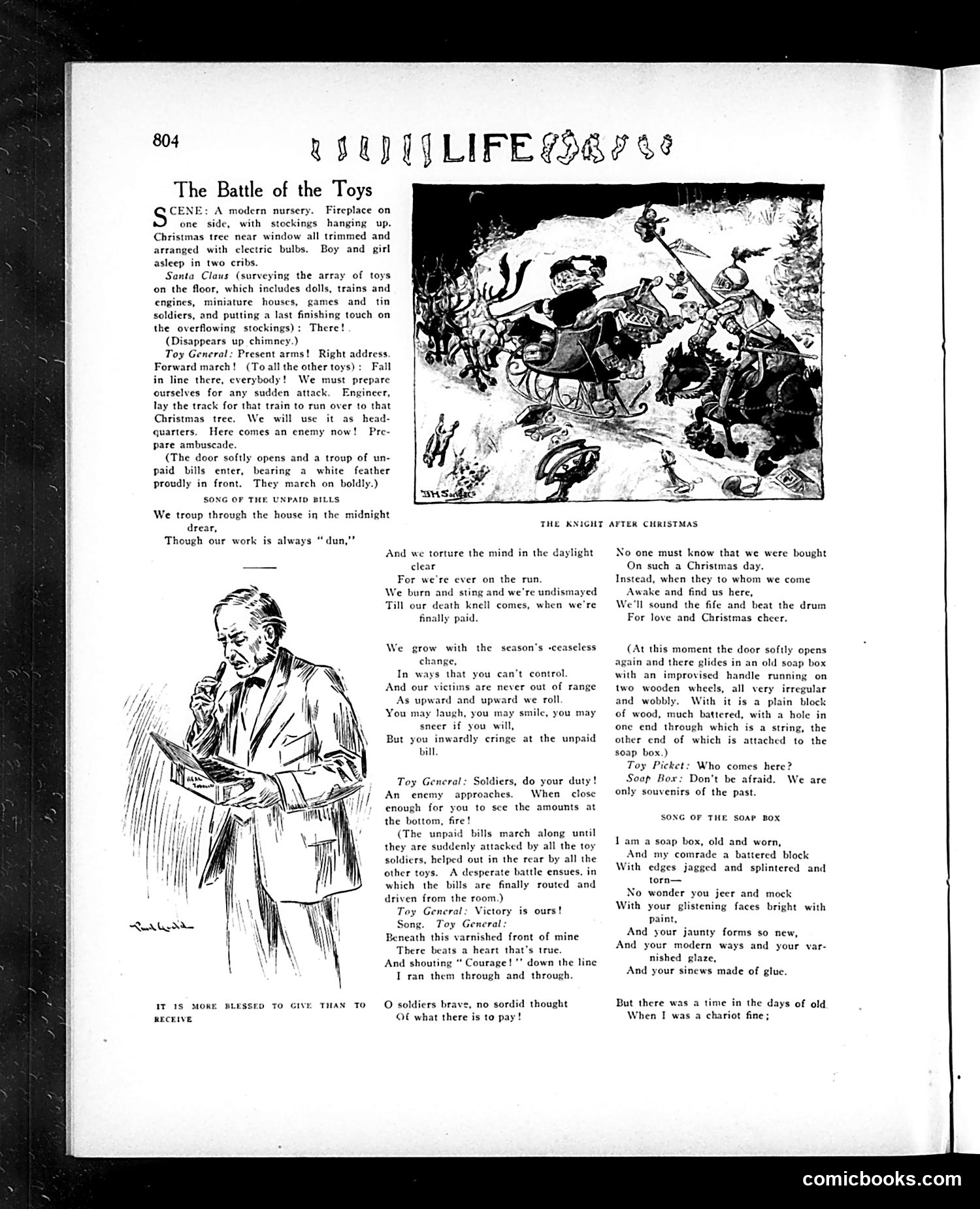
This is a Christmas-themed satirical sketch depicting toys as soldiers defending against an invasion of "unpaid bills" — personified as enemy forces marching into the nursery. The humor operates on multiple levels: **The central joke:** While Santa fills children's stockings with toys on Christmas, parents accumulate unpaid debts from purchasing gifts. The toys ironically celebrate their victory over the bills while concealing a darker truth: they themselves were "bought on such a Christmas day," representing financial obligations disguised as holiday joy. **Secondary satire:** The "Soap Box" and wooden block characters represent older, simpler toys from previous generations, contrasting with modern manufactured goods. Their wistful nostalgia mocks contemporary consumer culture and planned obsolescence. **The broader message:** The sketch satirizes how Christmas commercialism creates financial stress for families, with debt chasing parents even as children sleep peacefully, unaware of the economic "battle" their gifts represent.
📄 Transcribed text from this page (OCR, searchable)
Machine-transcribed from the original scan — historical spelling and the odd misread are preserved.
804 LSUPUI LIFE 9a ose The Battle of the Toys ScEE A modern nursery. Fireplace on one side, with stockings hanging up. Christmas tree near window all trimmed and arranged with clectric bulbs. Boy and girl asleep in two cribs. Santa Claus (surveying the array of toys on the floor, which includes dolls, trains and engines, miniature houses, games and tin soldiers, and putting a last finishing touch on the overflowing stockings): There! (Disappears up chimney.) Toy General; Present arms! Right address. Forward march! (To all the other toys) : in line there, everybody! ourselves for any sudden attack Fall We must prepare Engineer, lay the track for that train to run over to that Christmas tree. We will use it as quarters. Here comes an enemy now! pare ambuscade. head- Pre- (The door softly opens and a troup of un- paid Lills enter, bearing a white proudly in front. SONG OF THE UNPAID BILLS feather They march on boldly.) We troup through the house in the midnight drear, Though our work is always “dun,” IT 1S MORE BLESSED To GIVE THAN TO RECEIVE THE KNIGHT AFTER CHRISTMAS And we torture the mind in the daylight clear For we're ever on the run. We burn and sting and we're undismayed Till our death knell comes, when we're finally paid. with the season's «ceaseless ng In ways that you can't control And our victims are never out of range As upward and upward we roll y laugh, you may smile, you may sneer if you will, But you inwardly cringe at the unpaid bill We grow Toy General: Soldiers, do your dut: An enemy approaches. When close enough for you to see the amounts at the bottom, fire! (The unpaid bills march along until they are suddenly attacked by all the toy soldiers, helped out in the rear by all the other toys. A desperate battle ensues, in which the bills are finally routed and driven from the room.) Toy General: Victory is ours! Song. Toy General: Beneath this varnished front of mine There beats a heart that's true. And shouting “ Courage!" down the line I ran them through and through. O soldiers bra’ no sordid thought OC what there is to pay! No one must know that we were bought On such a Christmas day. Instead, when they to whom we come Awake and find us here, We'll sound the fife and beat the drum For love and Christmas cheer. (At this moment the door softly opens again and there glides in an old soap box with an improvised handle running on two wooden wheels, all very irregular and wobbly. With it is a plain block of wood, much battered, with a hole in one end through which is a string, the other end of which is attached to the soap box.) Toy Picket: Who comes here? Soap Box: Don't be afraid. We are only souvenirs of the past. SONG OF THE SOAP BOX 1am a soap box, old and worn, And my comrade a battered block With edges jagged and splintered and torn— No wonder you jeer and mock With your glistening faces bright with paint, And your jaunty forms so new, And your modern ways and your var- nished glaze, And your sinews made of glue. But there was a time in the days of old When I was a chariot fine; comicbooks.com