
Life, 1909-12-02 · page 36 of 80
Life — December 2, 1909 — page 36: what you’re looking at
What you’re looking at
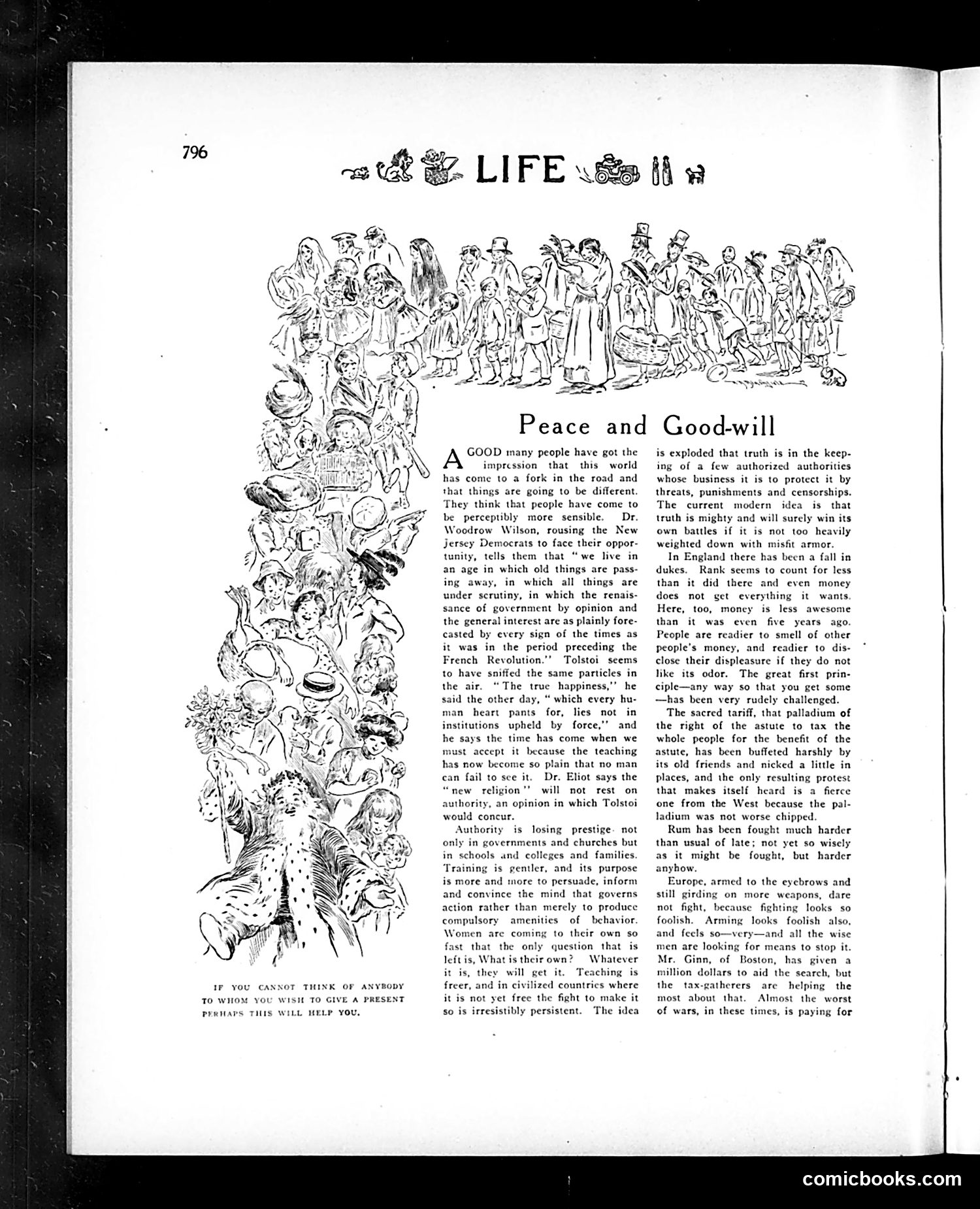
This page presents an editorial essay (not a cartoon) examining what the author perceives as a fundamental shift in American and Western attitudes toward authority and tradition. **Main Theme:** The author argues that society is experiencing a genuine transformation—old hierarchies (government, churches, families, rank, wealth) are losing their coercive power. Leaders like Woodrow Wilson and Tolstoy recognize that people increasingly demand persuasion rather than force. **Specific Social References:** - The "fall in dukes" in England and declining respect for aristocratic rank - The tariff system (protective tariffs benefiting industrialists), being challenged despite business resistance - Temperance campaigns against alcohol gaining traction - European militarism appearing increasingly foolish rather than honorable - Boston philanthropist Mr. Ginn donating to peace research **The Point:** Rather than cynical satire, this expresses optimistic faith that modern society is evolving toward voluntarism—that authority based on threats is becoming obsolete, replaced by reasoned persuasion. The ornate crowd illustration emphasizes humanity's collective consciousness awakening. The motto at bottom—"If you cannot think of anybody to whom you wish to give a present, perhaps this will help you"—suggests readers send the magazine as a gift.
📄 Transcribed text from this page (OCR, searchable)
Machine-transcribed from the original scan — historical spelling and the odd misread are preserved.
CANNOT THINK OF ANYBODY WISH TO GIVE A PRESENT GOOD many people have got the impression that this world has come to a fork in the road and that things are going to be different. They think that people have come to be perceptibly more sensible. Dr. Woodrow Wilson, rousing the New Jersey Democrats to face their oppor- tunity, tells them that “we live in an age in which old things are pass- ing away, in which all things are under scrutiny, in which the renais- sance of government by opinion and the general interest are as plainly fore- casted by every sign of the times as it was in the period preceding the French Revolution.” Tolstoi_ seems to have sniffed the same particles in the air. “The true happiness,” he said the other day, “ which every hu- man heart pants for, lies not in institutions upheld by force,’ and he says the time has come when we must accept it because the teaching has now become so plain that no man can fail to sce it. Dr. Eliot says the “new religion’? will not rest on authority, an opinion in which Tolstoi would concur. Authority is losing prestige. not only in governments and churches but in schools and colleges and families. Training is gentler, and its purpose is more and more to persuade, inform and convince the mind that governs action rather than merely to produce amenities of behavior. are coming to their own so the only question that leftis, What is their own? Whatever it is, they will get it ching is freer, and in civilized countries where it is not yet free the fight to make it Peace and Good-will is exploded that truth is in the keep- ing of a few authorized authorities whose business it is to protect it by threats, punishments and censorships. The current modern idea is that truth is mighty and will surely win its own battles if it is not too heavily weighted down with misfit armor. In England there has been a fall in dukes. Rank seems to count for less than it did there and even money does not get everything it wants Here, too, moncy is less awesome than it was even five years People are readier to smell of other people's money, and readier to dis- close their displeasure if they do not like its odor. The great first prin- ciple—any way so that you get some —has been very rudely challenged. The sacred tariff, that palladium of the right of the astute to tax the whole people for the benefit of the astute, has been buffeted harshly by its old friends and nicked a little in places, and the only resulting protest that makes itself heard is a fierce one from the West because the pal- ladium was not worse chipped Rum has been fought much harder than usual of late; not yet so wisely as it might be fought, but harder anyhow. Europe, armed to the eyebrows and still girding on more weapons, dare not fight, because fighting looks so foolish. Arming looks foolish and feels so—very—and all the wise men are looking for means to stop it. Mr. Ginn, of Boston, has given a million dollars to aid the search, but the tax-gatherers are helping the most about that. Almost the worst also, To wom PERHAPS THIS WILL HELP You, so is irresistibly persistent. The idea of wars, in these times, is paying for comicbooks.com