
Life, 1909-12-02 · page 42 of 80
Life — December 2, 1909 — page 42: what you’re looking at
What you’re looking at
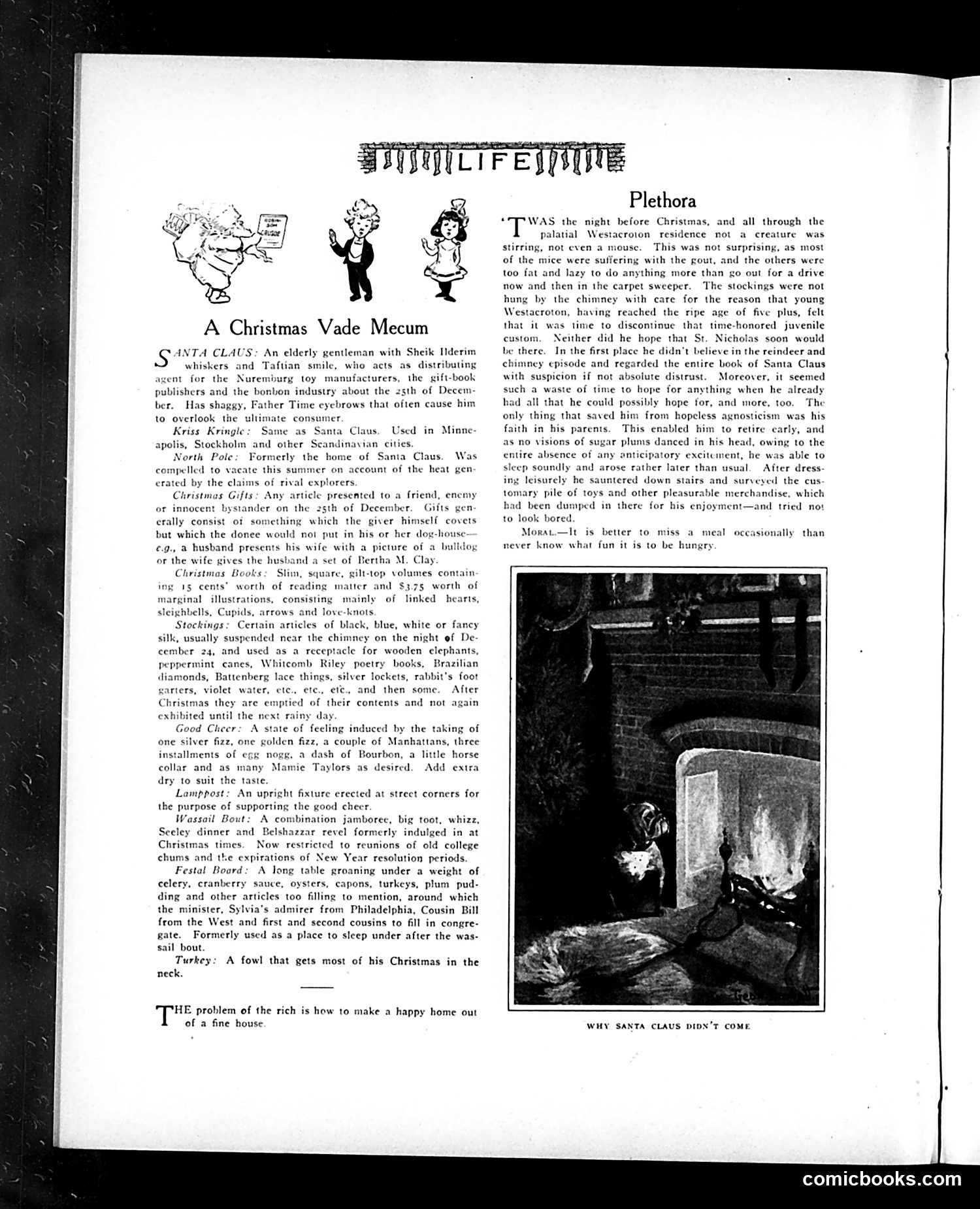
This page offers a satirical "dictionary" of Christmas customs for the wealthy American class circa early 1900s. The left column humorously defines holiday terms with sharp social commentary: **Key targets:** - **Santa Claus/Kriss Kringle**: Portrayed as a commercial agent for toy manufacturers and the "bonbon industry" - **Christmas Gifts**: Defined as items "the giver himself covets but which the donee would not put in his or her dog-house" — mocking insincere gift-giving - **Christmas Books**: Expensive volumes ($3.75) containing only 15 cents' worth of actual content - **"Good Cheer"**: A catalog of alcoholic drinks, satirizing holiday excess - **"Wassail Bout"**: Now restricted to "old college chums" — mocking that revelry has become exclusive rather than communal The accompanying story "Plethora" (right) continues the satire, describing an overfed, jaded wealthy family where even the mice are "too fat and lazy" and the precocious child has already stopped believing in Santa. **The satire's point**: Christmas has become commercialized, materialistic, and hollow among the rich—genuine joy replaced by obligation and excess.
📄 Transcribed text from this page (OCR, searchable)
Machine-transcribed from the original scan — historical spelling and the odd misread are preserved.
A Christmas Vade Mecum 4INTA CLAUS: An elderly gentleman with Sheik Ilderim whiskers and Taftian smile, who acts as distributing agent for the Nuremburg toy manufacturers, the gift-book the bonbon industry about the 23th of Decem- her Time eyebrows that often cause him timate consumer, publishers an ber. Has shaggy, to overlook the Kriss Kringle: Same as Santa Claus, Used in Minne apolis, Stockholm and other Scandinavian cities North Pole; Formerly the home of Santa Claus. Was compelled to vacate this summer on account of the heat gen. erated by the claims of rival explorers. Christmas Gifts: Any article presented to a friend, enemy or innocent bystander on the 25th of December. Gifts gen erally consist of something which the giver himself covets but which the donee would not put in his or her dog-house ¢.9. a busband presents his wife with a picture of a by or the wife gives the husband a set of Bertha M. Clay Christmas Books: Slim, square, gilt-top volumes contain worth of ing 15 cents’ worth of reading matter and $3.75 rginal illustrations, consisting mainly of linked hearts, sleighbells, Cupids, arrows and love-knots Stockings: Certain articles of black, blue, white or fancy silk, usually suspended near the chimney on the night ef De- cember 24, and used as a receptacle for wooden elephants, peppermint canes, Whitcomb Riley poetry books, Brazilian diamonds, Battenberg lace things, silver lockets, rabbit's foot let water, etc., ete. ete, and then some. After ain garters, Christmas they are emptied of their contents and not : exhibited until the next rainy day Good Cheer: A state of feeling induced by the taking of one silver fizz, one golden fizz, a couple of Manhattans, three nogg, a dash of Bourbon, a little horse lors as desired. Add extra installments of eg collar and as many Mamie dry to suit the taste. Lamppost: An upright fixture erected at street corners for the purpose of supporting the good cheer. Wassail Bout: A combination jamboree, big toot, whizz, Seeley dinner and Belshazzar revel formerly indulged in at Christmas times. Now restricted to reunions of old college chums and the expirations of New Year resolution periods Festal Board: A Jong table groaning under a weight of celery, cranberry sauce, oysters, capons, turkeys, plum pud- ding and other articles too filling to mention, around which the minister, Sylvia’s admirer from Philadelphia, Cousin Bill from the West and first and second cousins to fill in congre- gate. Formerly used as a place to sleep under after the was- ail bout Turkey: A fowl that gets most of his Christmas in the neck. HE problem of the rich is how to make a happy home out of a fine house. Plethora “Tas the night before Christmas, and all through the alatial Westacroton residence not a creature was Stirring, not even a mous This was not surprising, as most with the gout, and the others were go out for a drive of the mice were suffering too fat and lazy to do anything more t now and then in the carpet sweeper. The stockings were not hung by the chimney with care for the reason that young Westacroton, having reached the ripe age of five plus, felt that it was time to discontinue that time-honored juvenile custom, Neither did he hope that St. Nicholas soon would be there. In the first place he didn’t believe in the reindeer and chimney episode and regarded the entire book of Santa Claus with suspicion if not absolute distrust. Moreover, it seemed h a waste of time to hope for anything when he already J all that he could possibly hope for, and more, too. The only thing that saved him from hopeless faith in his parents. This enabled him to retire carly, and as no visions of sugar plums danced in his head, owing to the tire absence of any anticipatory excitement, he was able to fter dress- ing leisurely he sauntered down stairs and surveyed the cus. tomary pile of toys and other pleasurable merchandise, which had been dumped in there for his enjoyment—and tried not agnosticism was his © sleep soundly and arose rather later than usual to look bored Morat.—It is better to miss a meal occasionally than never know what fun it is to be | ingry WHY SANTA CLAUS DIDN’T COME comicbooks.com