
A complete issue · 44 pages · 1909
Life — August 5, 1909
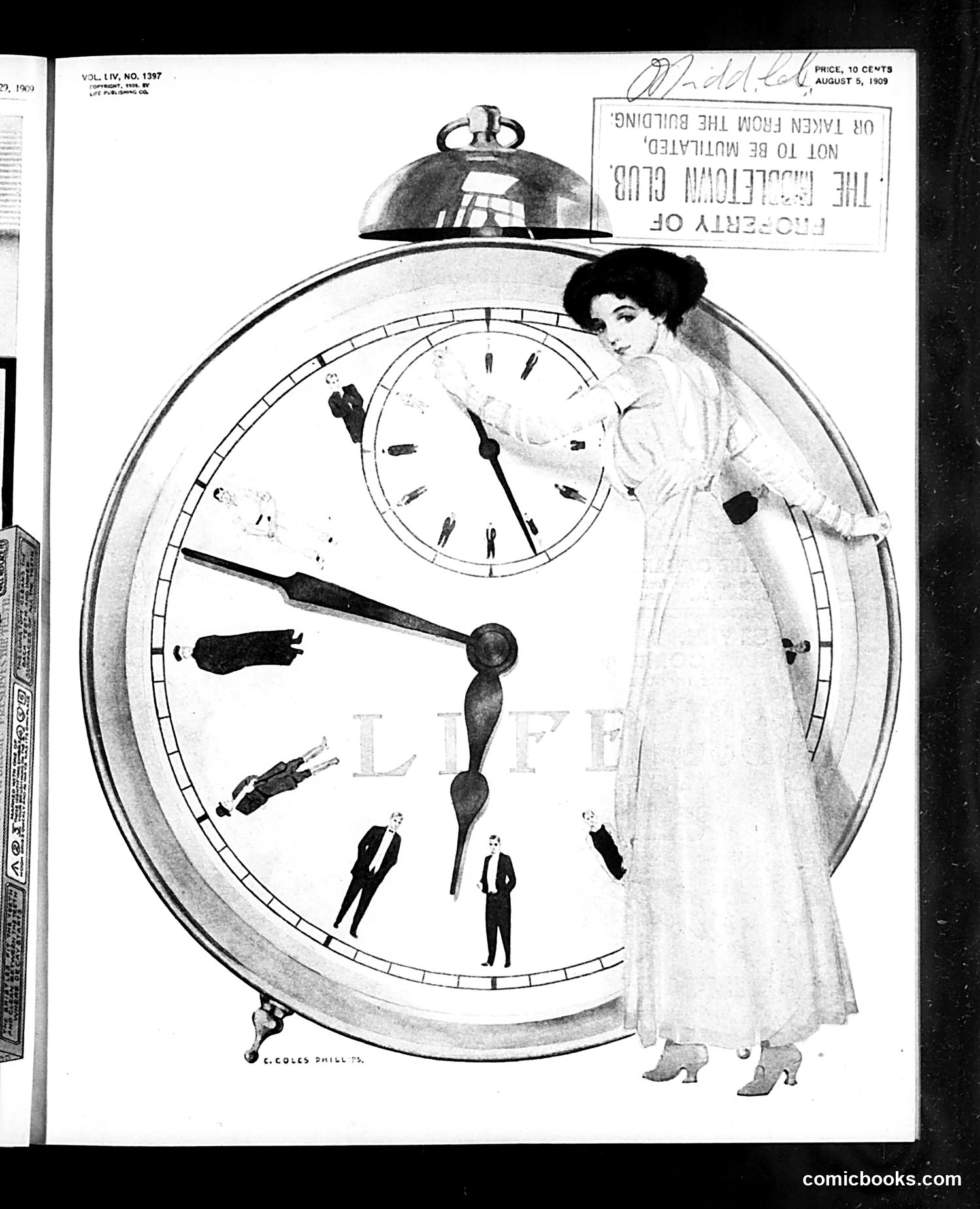
This cover depicts a woman in white adjusting the hands of an enormous alarm clock, with small male figures positioned around the clock face like hour markers. The satire concerns **time management and women's schedules**, a contemporary topic in 1909. The woman appears to represent either an idealized "New Woman" managing her day or, more likely, **a wife/household manager controlling the schedules of the men in her life**—suggested by the businessmen illustrated as replaceable "hours" on the clock. The headline (partially visible, reversed) references "The 'Huckleberry Finn' Craze" and something about "printing" and "not to be imitated." This reflects early-20th-century anxieties about **female authority in domestic and social spheres**, presented with the magazine's characteristic humor.
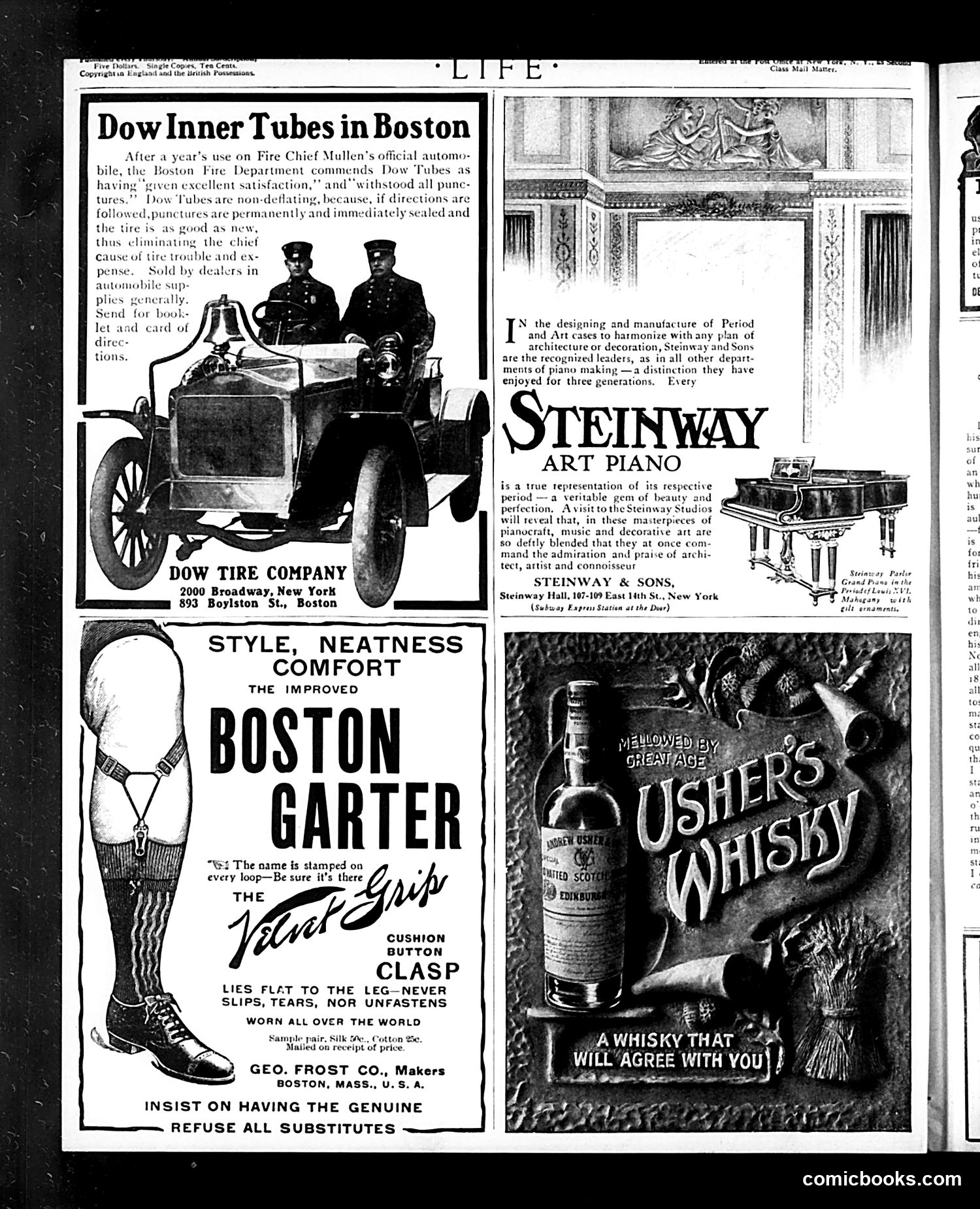
This page is **primarily advertisements** rather than editorial content or political satire. The four ads shown are: 1. **Dow Inner Tubes** (Boston): Features firefighters demonstrating tire reliability, emphasizing safety and durability for the Boston Fire Department's chief. 2. **Steinway Art Piano**: Highlights the piano manufacturer's reputation for quality across generations. 3. **Boston Garter**: An undergarment advertisement emphasizing comfort and reliability, with "Velvet Grip" cushion button technology. 4. **Usher's Whisky**: Promotes Scottish whisky with the tagline "A Whisky That Will Agree With You." No political satire or caricature appears present. The page reflects early-20th-century consumer advertising focused on reliability, comfort, and quality goods.
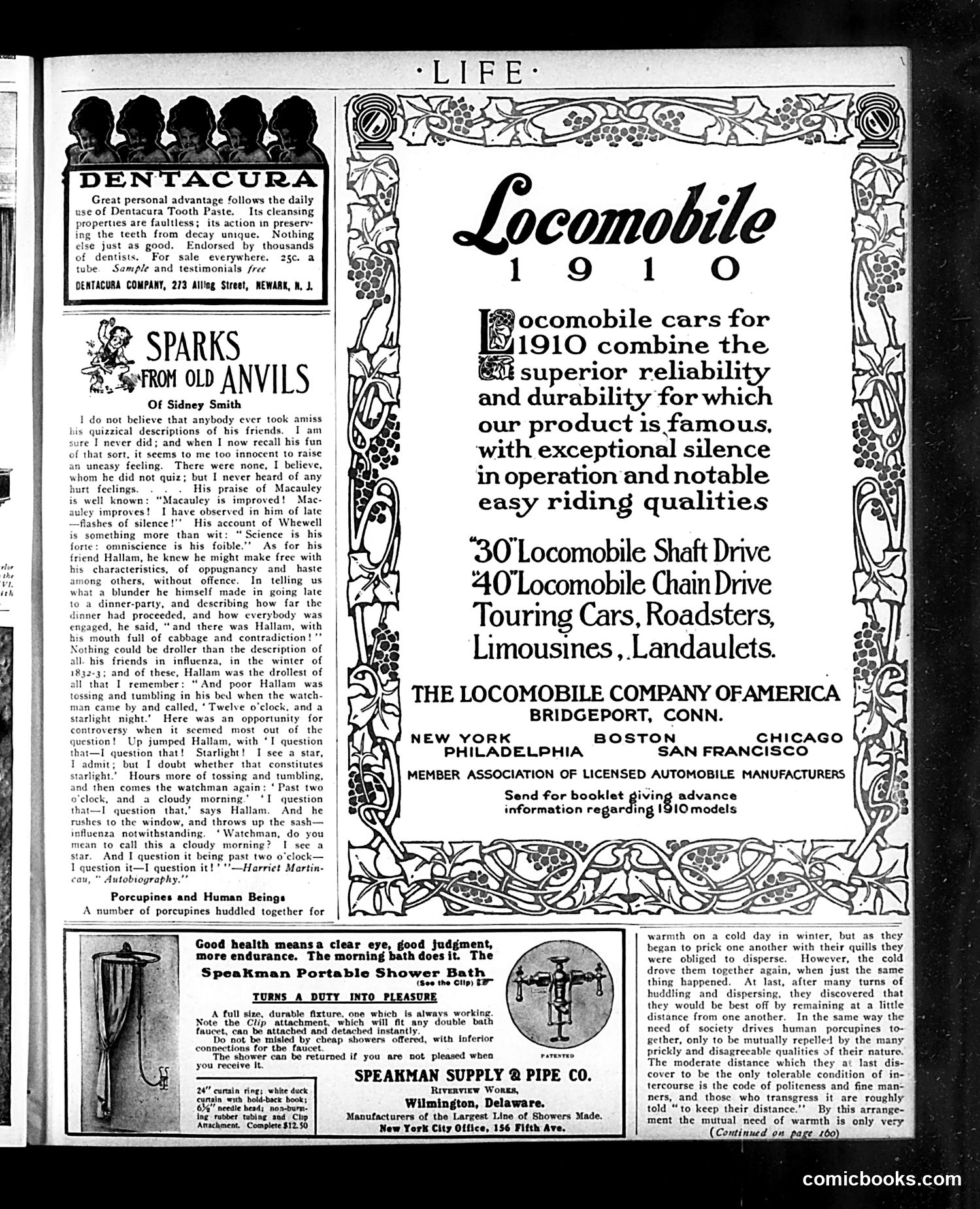
This page is primarily **advertising**, not satire or political commentary. The dominant content features a large Locomobile automobile advertisement (1910 models) highlighting various car types and the manufacturer's headquarters in Bridgeport, Connecticut. The left side contains smaller ads: Dentacura tooth paste and a Sparkman Supply & Pipe Co. advertisement. There's also a brief humorous piece titled "Sparks from Old Anvils" about Sidney Smith's witty observations—apparently anecdotes meant for light entertainment rather than political satire. The "Porcupines and Human Beings" section discusses porpoise behavior, likely a nature curiosity piece typical of Life magazine's miscellaneous content. Overall, this is a commercial magazine page mixing advertisements with light humor and nature observations, not political cartooning.
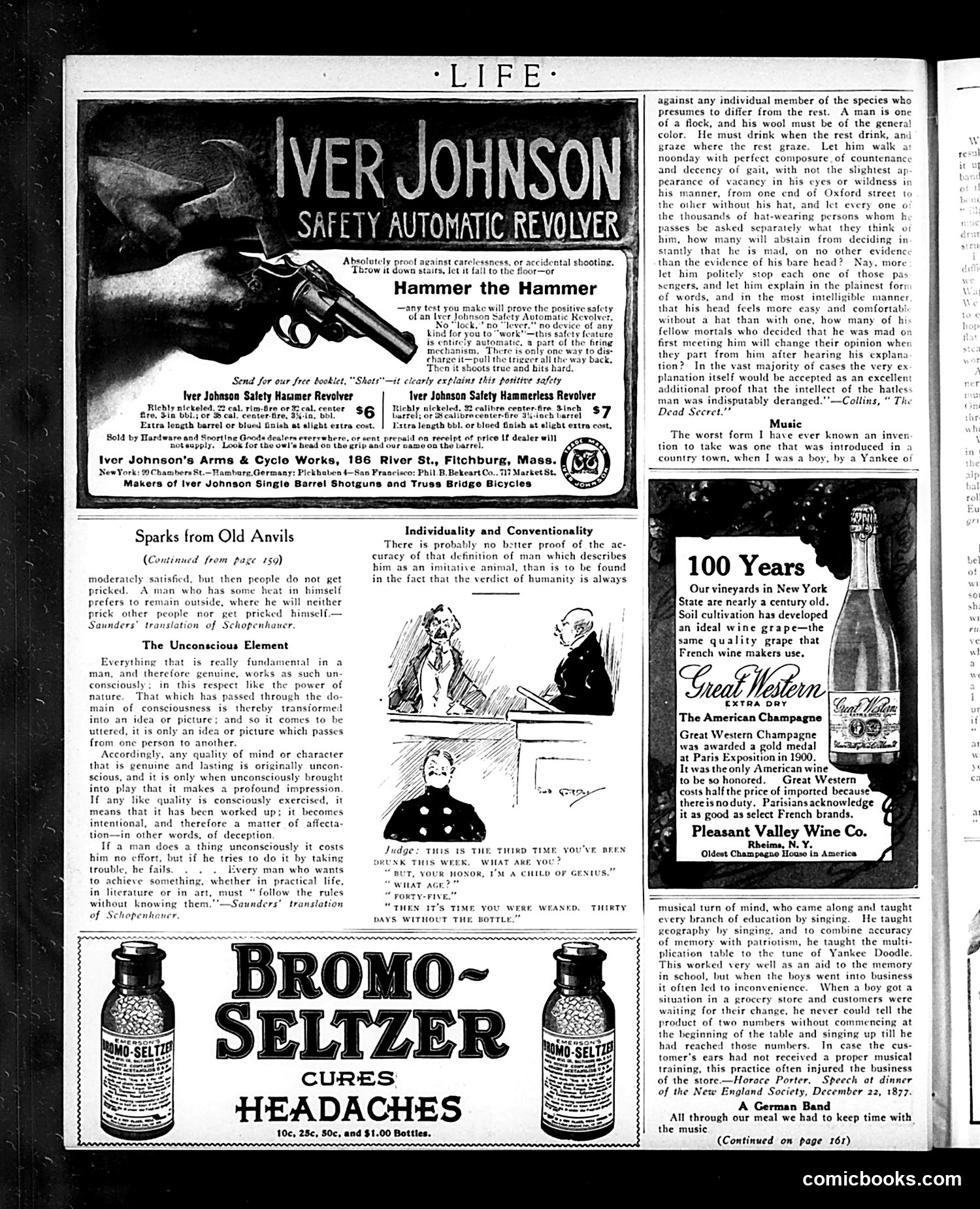
This page is primarily **advertising**, not political satire. The dominant content includes: 1. **Iver Johnson Safety Automatic Revolver** - A large advertisement emphasizing the weapon's safety features ("Hammer the Hammer"), aimed at preventing accidental discharge. 2. **Bromo-Seltzer** - A headache remedy advertisement featuring distinctive bottles. 3. **Great Western Champagne** - A wine advertisement noting 100 years of New York vineyard operation. The only cartoon content appears to be a small middle illustration labeled "Individuality and Conventionality," showing figures in social interaction, with accompanying text discussing unconscious behavior and human nature. The page reflects early 20th-century magazine format, mixing editorial content about music with commercial advertisements rather than political commentary.
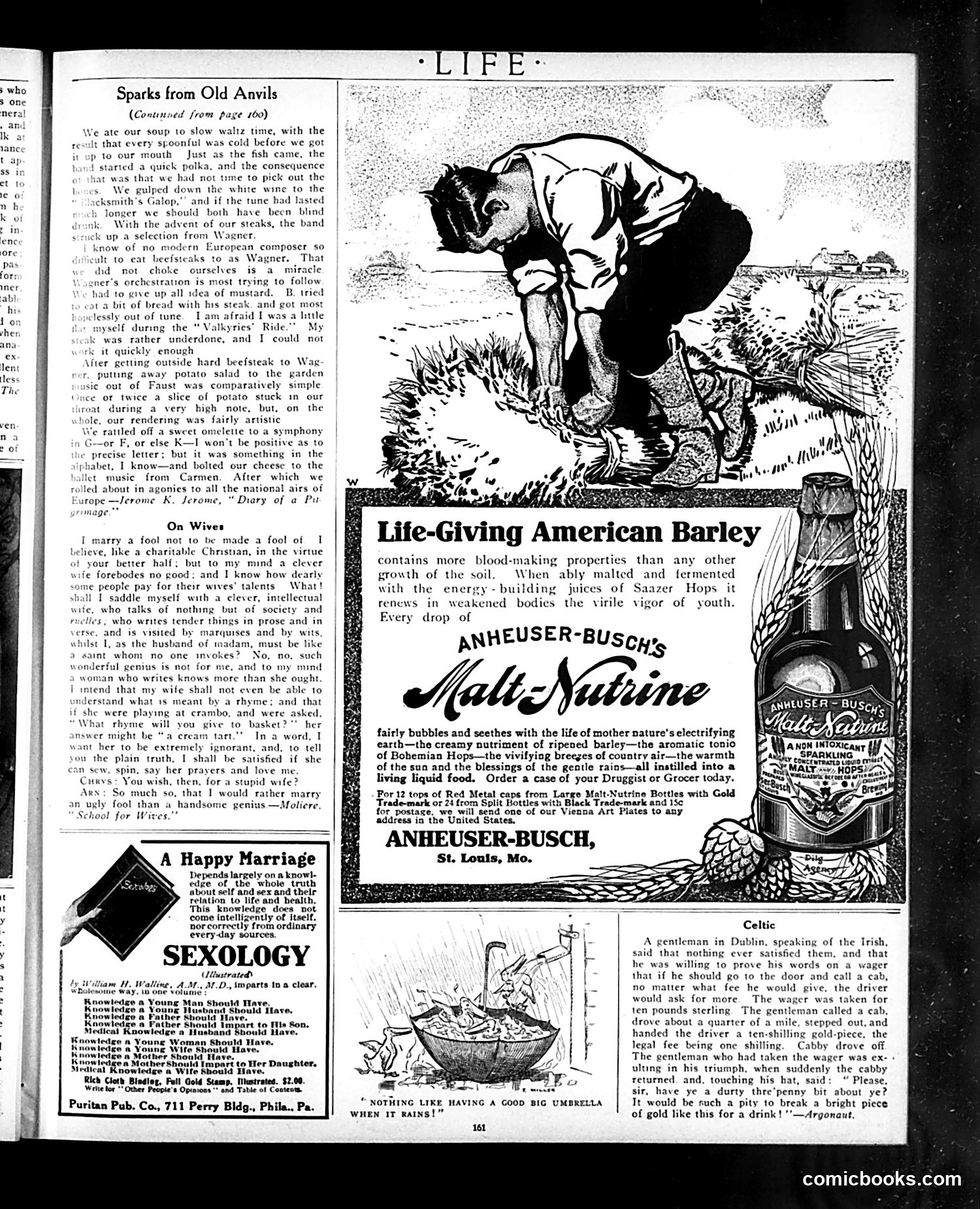
This page is primarily **advertising**, not satire or political commentary. The dominant feature is a large Anheuser-Busch Malt Nutrine advertisement promoting their malt extract beverage as health-giving and nutritious. The upper left contains "Sparks from Old Anvils," a humorous essay about dining experiences and Wagner's music. Below that is "On Wives," offering satirical observations about marriage and women's intellectual capabilities—typical early 20th-century social humor reflecting period attitudes. The "Sexology" advertisement promotes a self-help book about relationships and health. The "Celtic" anecdote is a brief joke about an Irish cab driver and a wager over an umbrella. The illustrations are generic—a farmer bending over, an umbrella in rain—accompanying the text rather than serving as independent political cartoons. This is primarily a **commercial and entertainment page**, not political satire.
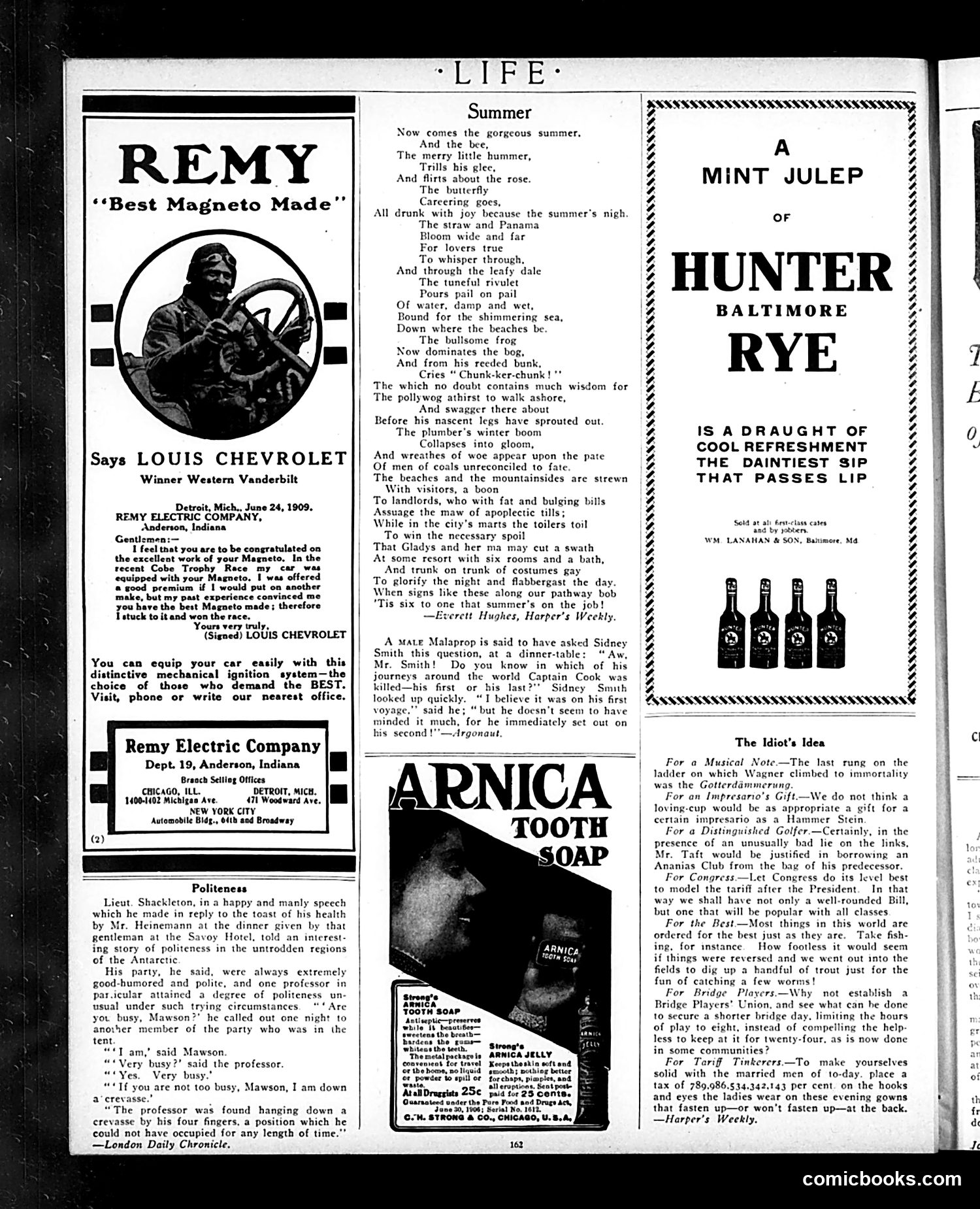
This page is primarily **advertisements and light humor** rather than political satire. **Content includes:** - **Remy Electric Company ad**: Features Louis Chevrolet (race car winner) endorsing an automotive ignition system - **"Summer" poem**: A whimsical verse about the season, likely by Everett Hughes per Harper's Weekly attribution - **"Politeness" section**: A humorous anecdote about Lieutenant Shackleton (Antarctic explorer) and Professor Mawson, joking about politeness and proper behavior - **Hunter Rye advertisement**: Baltimore whiskey marketed as refreshing - **Arnica Tooth Soap ad**: Dental product advertisement The page reflects early 1900s advertising style and light satirical humor targeting educated readers, with no significant political commentary. The Shackleton reference dates this to the Antarctic expedition era (early 1900s).
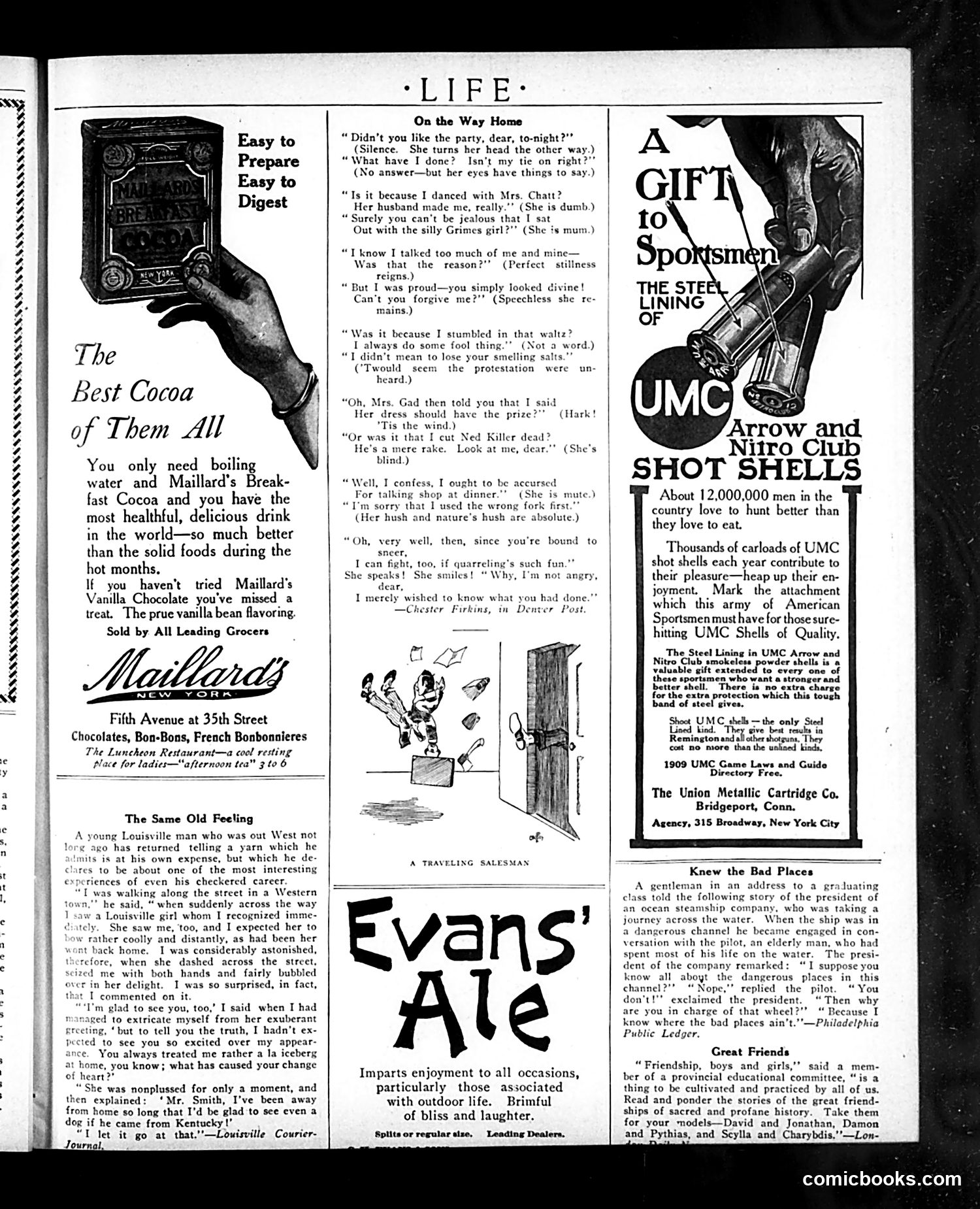
This page is primarily **advertising and light humor** rather than political satire. The main content includes: 1. **Maillard's Cocoa ad** — promoting instant cocoa as superior to hot foods during hot months 2. **"The Same Old Feeling"** — a humorous anecdote about a man reuniting with a woman he knew years ago; she mistakes his excitement for romantic interest, but he's actually just relieved to see a familiar face from home 3. **Evans' Ale ad** — emphasizing enjoyment and outdoor recreation 4. **UMC Ammunition ad** — targeting sportsmen/hunters, promoting shot shells 5. **Small cartoon** showing a traveling salesman (labeled as such in the text) The page reflects early 20th-century concerns: nostalgia, hunting culture, and consumer products. There's no clear political commentary—it's typical *Life* magazine fare mixing advertising with gentle domestic humor.
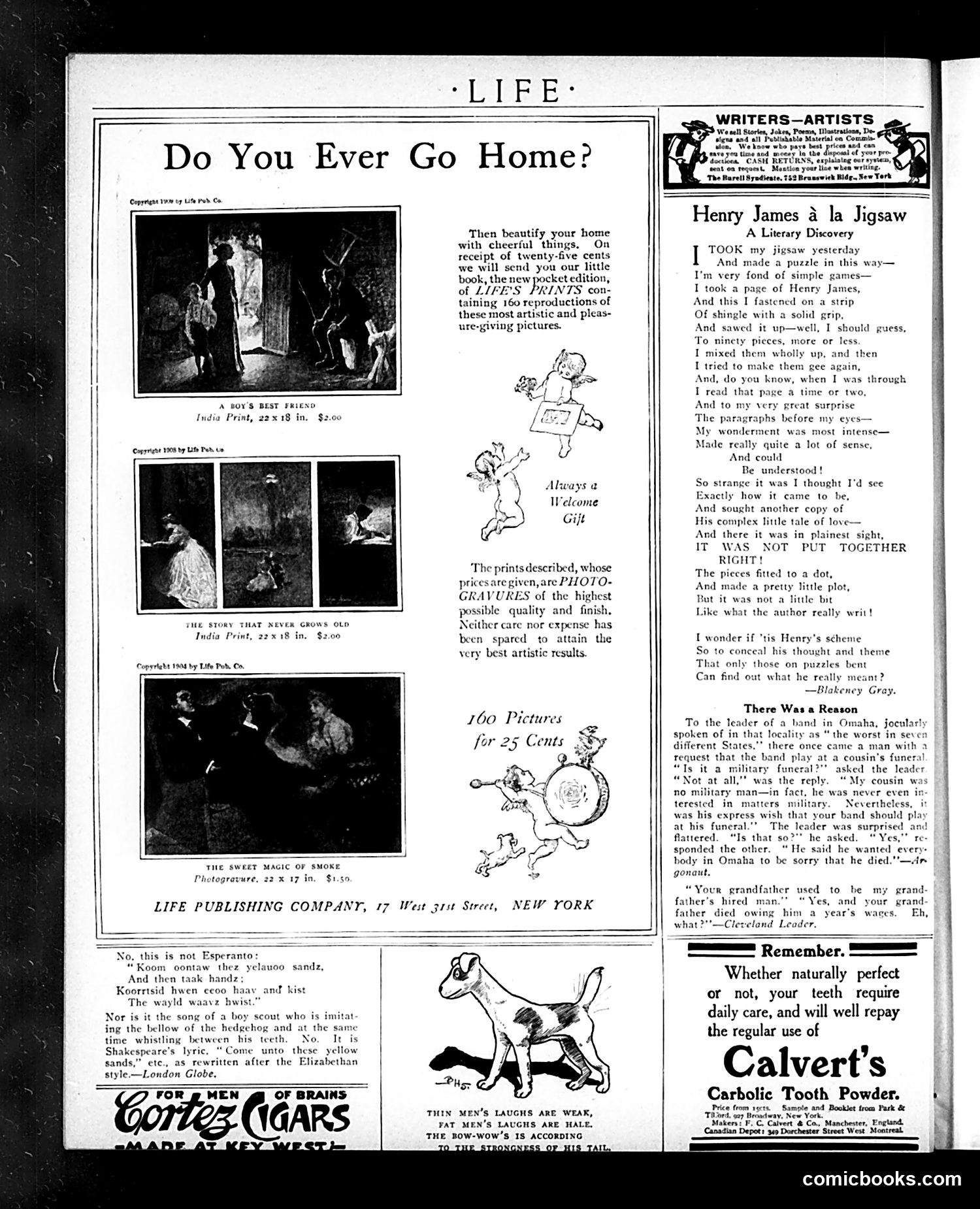
This page is primarily **advertising and literary content** rather than political satire. The left side features advertisements for "Life's Prints"—art reproductions offered by Life Publishing Company for 25 cents, showing three domestic interior scenes. The text emphasizes artistic quality and affordability for home decoration. The right side contains a literary piece titled "Henry James à la Jigsaw," a humorous poem about a reader who tore apart a Henry James book, mixed up the pages, and reassembled them incorrectly—finding the result incomprehensible (the joke being that Henry James was already notoriously difficult to read). Additional content includes anecdotes and advertisements for Cortez cigars and Calvert's tooth powder. No significant political or social satire is present.
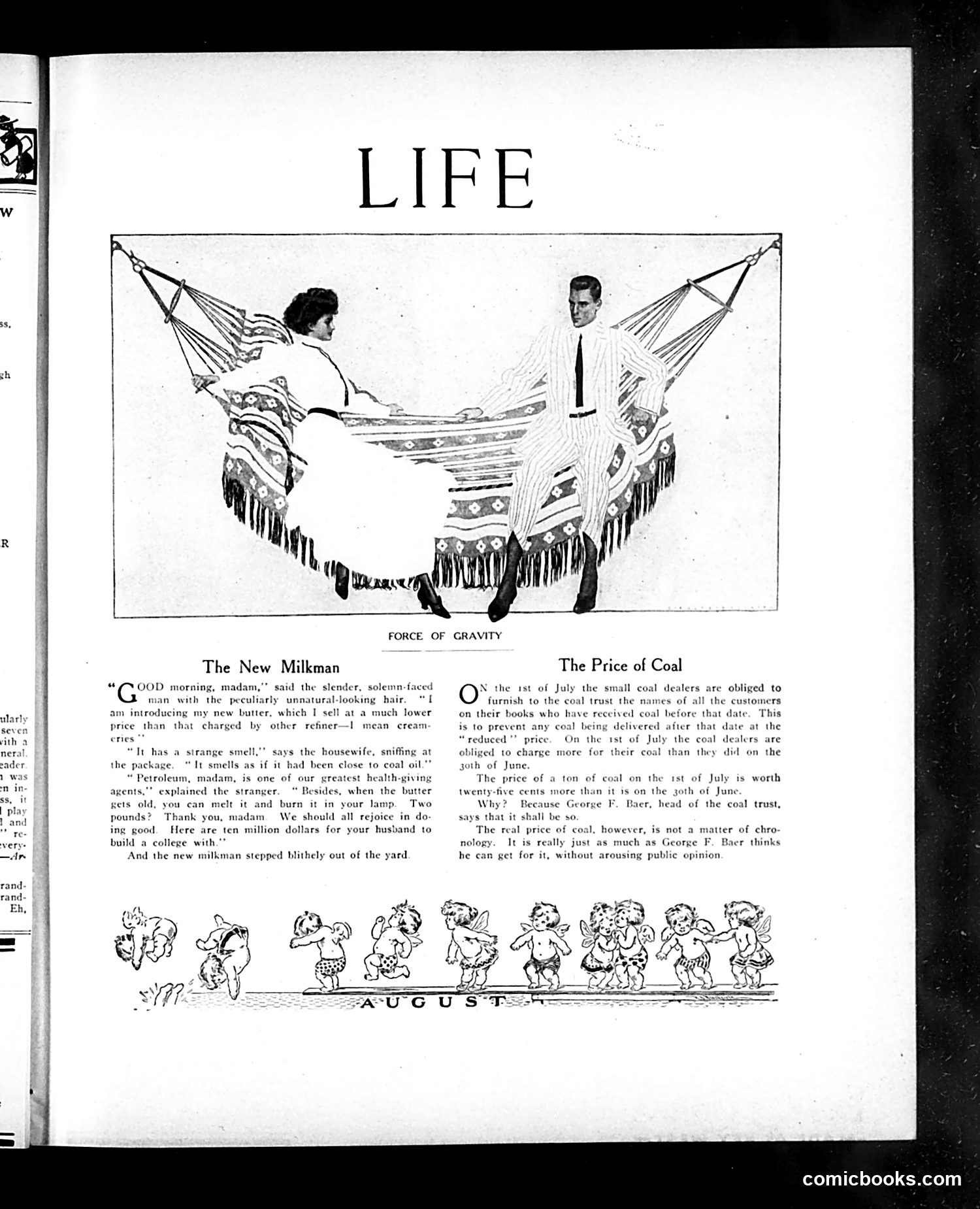
The top cartoon shows two men in hammocks with what appears to be a shared burden between them, illustrating the concept of "force of gravity"—likely a visual pun about shared weight or responsibility. Below are two satirical pieces: "The New Milkman" mocks a milkman who claims to be a "stranger" offering suspiciously cheap milk, hinting at fraud or adulteration. "The Price of Coal" references July 1st price increases imposed by coal dealers, suggesting the coal trust exploits customers by raising prices on specific dates regardless of actual market conditions. The piece criticizes George F. Baer, head of the coal trust, for manipulating prices without public justification. The bottom shows children dancing, marked "AUGUST."
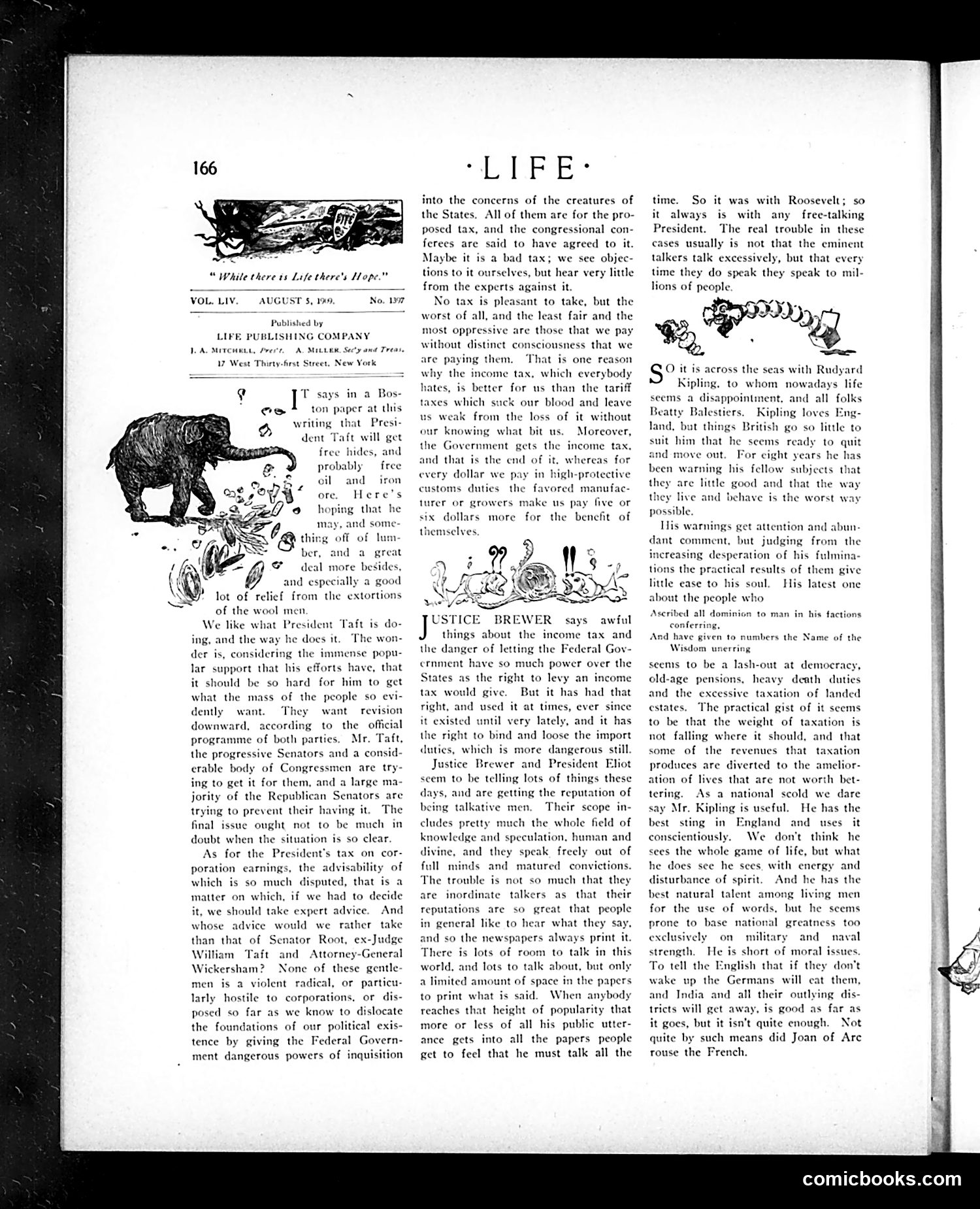
This page from *Life* magazine (Vol. LIV, August 5, dated No. 1397) contains editorial commentary criticizing the income tax and expanding federal government power. The text references President Taft and debates over tax policy, mentioning Justice Brewer's warnings about giving the Federal Government excessive power over states. The left side features an illustration of an elephant (likely representing the Republican Party or government apparatus) appearing to crush or burden smaller figures below—a visual metaphor for how taxation and federal authority oppress citizens. The commentary argues the income tax is unfair and gives dangerous powers to the Federal Government, reflecting early 20th-century conservative opposition to progressive taxation and federal expansion.
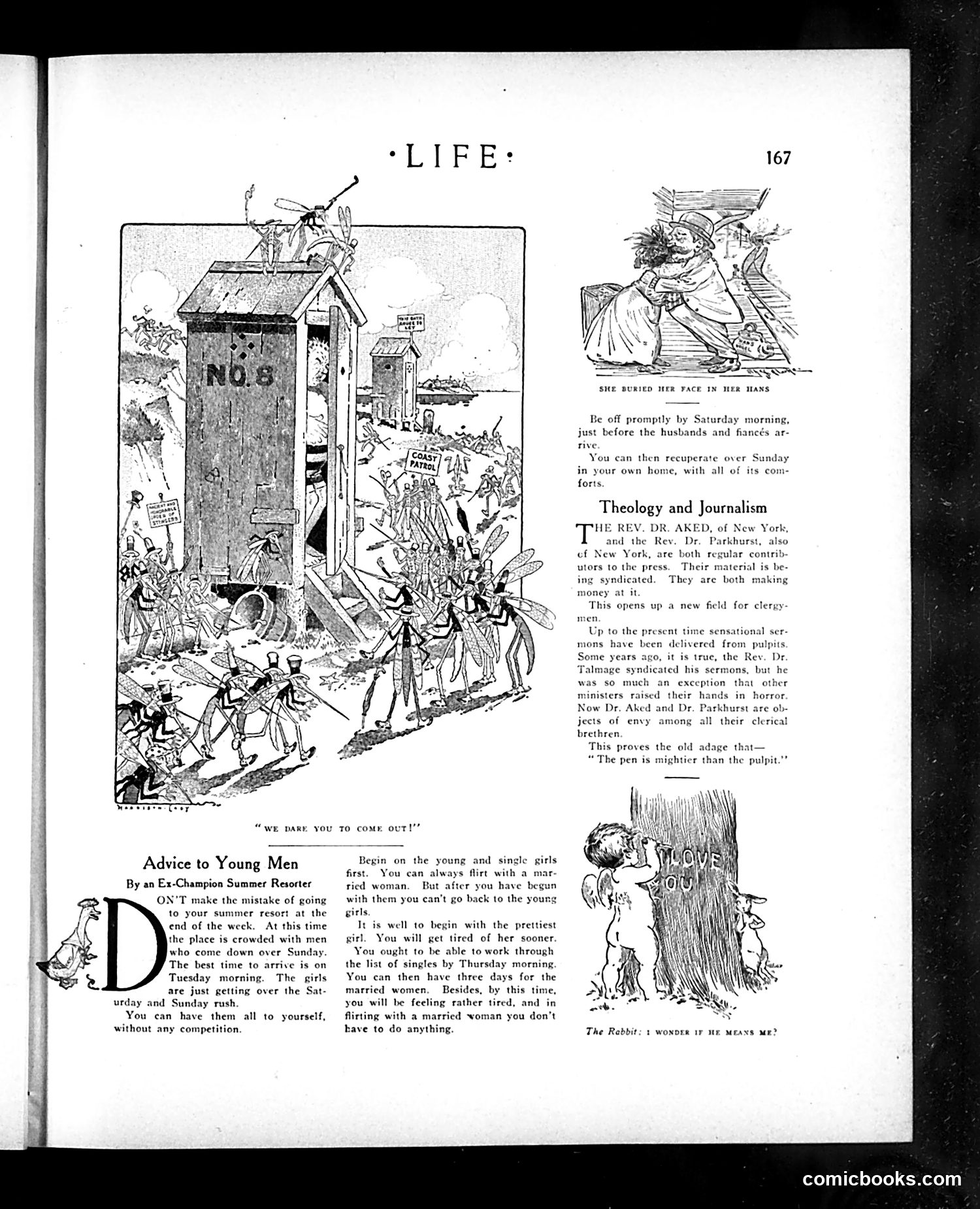
The main cartoon depicts a tall structure labeled "NO. 8" surrounded by numerous figures engaged in chaotic activity, with the caption "WE DARE YOU TO COME OUT!" The structure appears to represent a safe house or refuge, satirizing what the text below identifies as summer resort behavior. The accompanying article "Advice to Young Men" by an Ex-Champion Summer Rooster ridicules weekend social conventions at resort destinations. It mocks young men pursuing romantic encounters, advising them to target unmarried women first before moving to married women—presented as strategy rather than propriety. The cartoon likely satirizes the competitive, somewhat predatory social dynamics at turn-of-the-century summer resorts, where men pursued women in a structured hierarchy. The "dare" element suggests the satirical tone mocking this ritualized flirtation culture.
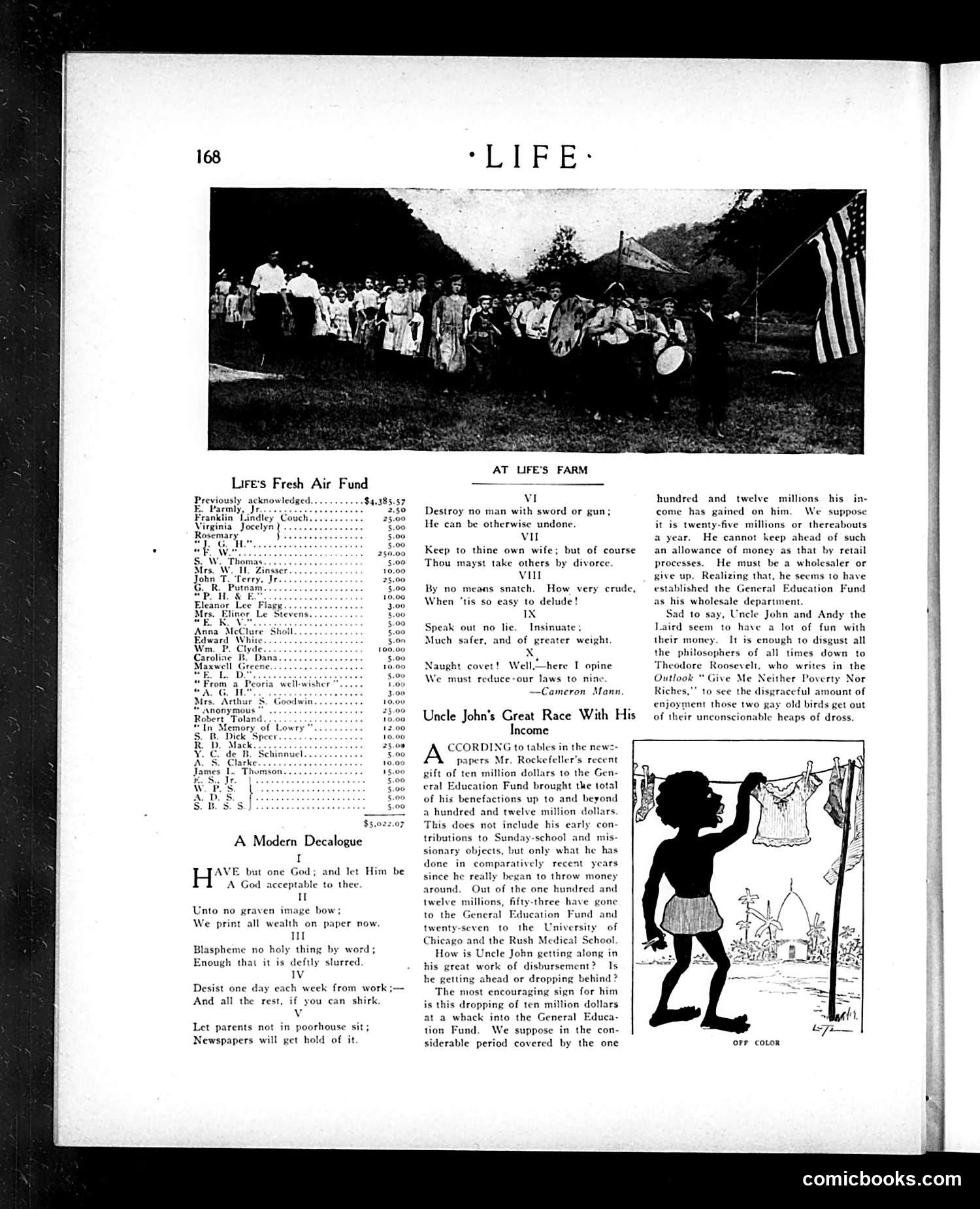
This page contains two distinct pieces: 1. **"At Life's Farm"**: A photograph showing a large outdoor gathering with an American flag visible, appearing to document a charitable or community event related to "Life's Fresh Air Fund" (a program providing outdoor experiences for underprivileged children). 2. **"Uncle John's Great Race With His Income"**: A satirical cartoon with accompanying article mocking wealthy philanthropist John D. Rockefeller. The piece humorously tracks how his charitable giving—particularly his recent $10 million donation to the General Education Fund—is outpacing his ability to accumulate wealth. The silhouette cartoon shows a figure struggling to keep up with his own generosity, satirizing the absurdity of a billionaire's "race" between earning and giving away money. The satire critiques both wealth inequality and performative philanthropy.
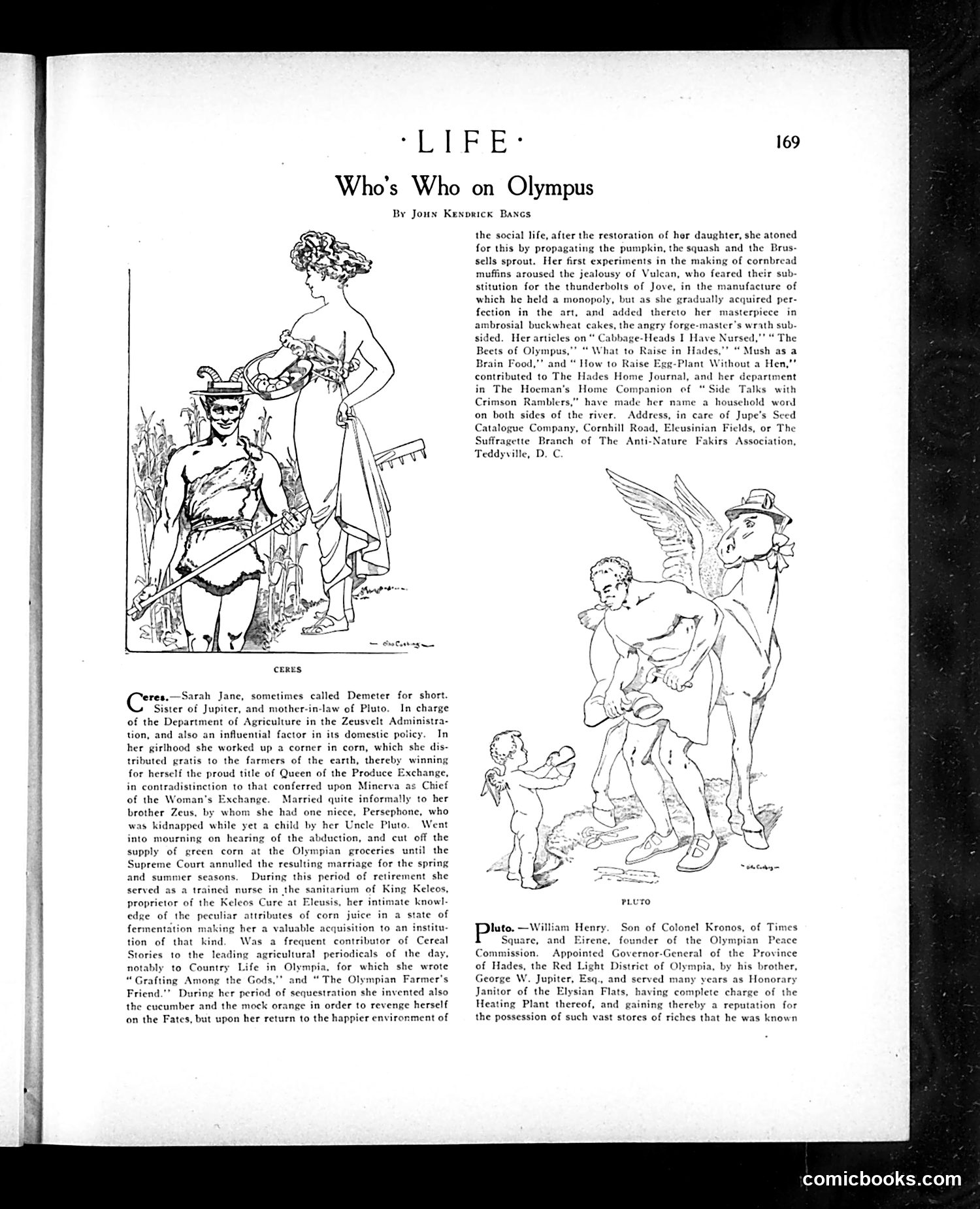
This page satirizes the Roosevelt administration by depicting government officials as Greek gods. The article by John Kendrick Bangs uses classical mythology as a humorous framework to mock New Deal agencies and their leaders. **Ceres** (shown in the left illustration) represents **Sarah Lane/Demeter**, described as sister of Jupiter and mother-in-law of Pluto. She oversees the "Department of Agriculture" in this satirical "Zeus-velt Administration," controlling grain distribution and the Produce Exchange—a jab at New Deal agricultural programs. **Pluto** (right illustration) represents **William Henry**, a government official managing the "Province of Hades" and various relief/welfare programs. The satire mocks New Deal bureaucracy by treating it as chaotic divine mythology, suggesting government overreach and confusion in Roosevelt's administration.
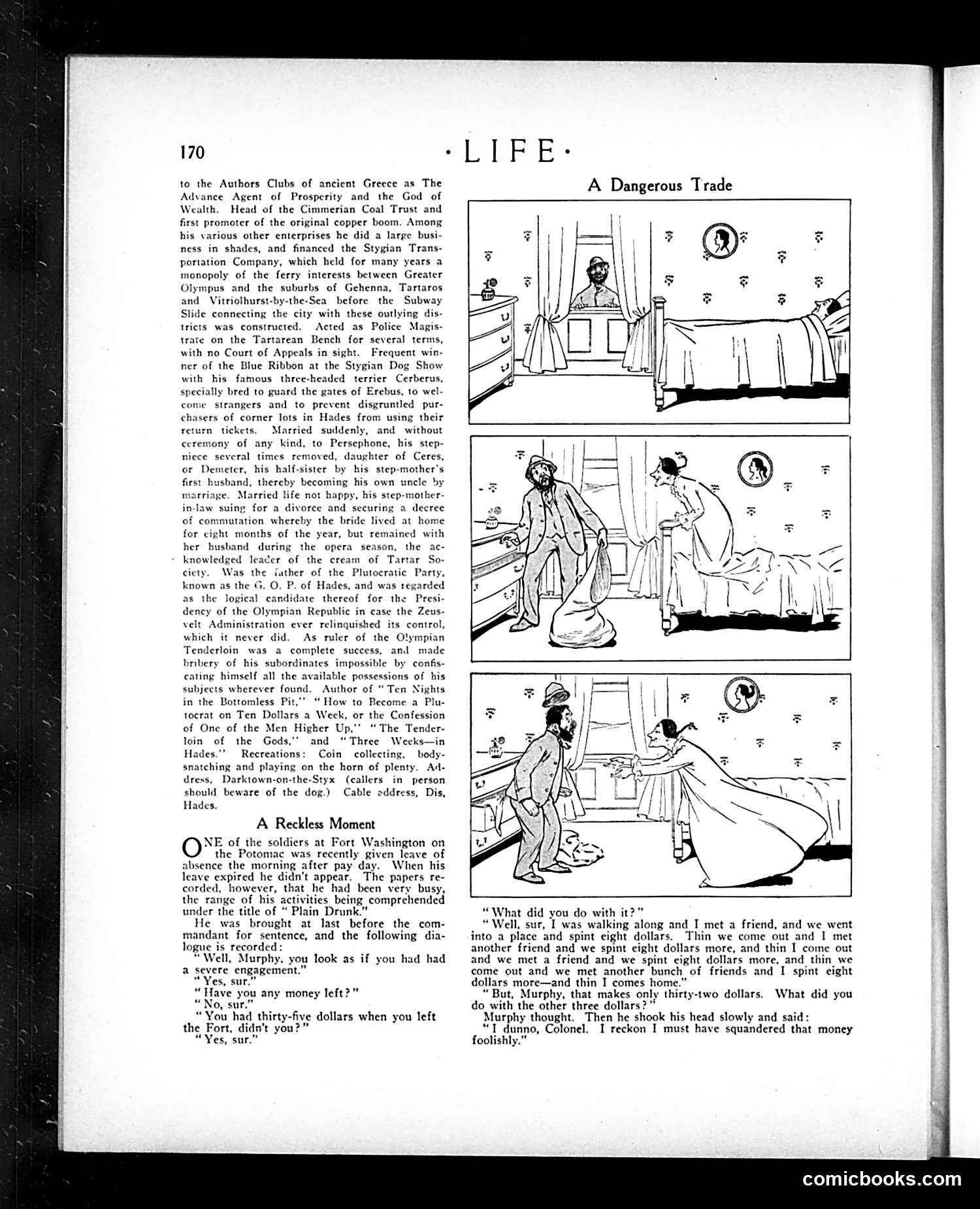
This page contains two satirical pieces typical of early 20th-century American humor: **"A Dangerous Trade"** (illustrated): A three-panel cartoon depicting a morality tale about frivolous spending. A well-dressed man squanders money repeatedly with friends in what appears to be bars or social establishments, returning home progressively more disheveled. The satire targets working-class profligacy and lack of financial responsibility. **"A Reckless Moment"** (text-based): A dialogue between a soldier (Murphy) and a Fort Washington commandant following Murphy's AWOL absence after payday. Murphy admits spending his entire $35 salary on repeated drinking with friends, accounting for only $32, with $3 unaccounted for. The commandant's disapproving questions and Murphy's befuddled responses create humor through the soldier's casual irresponsibility and inability to track his own spending. Both pieces satirize working-class men's weakness for alcohol and inability to manage money—common morality-lesson themes in early Life magazine humor.
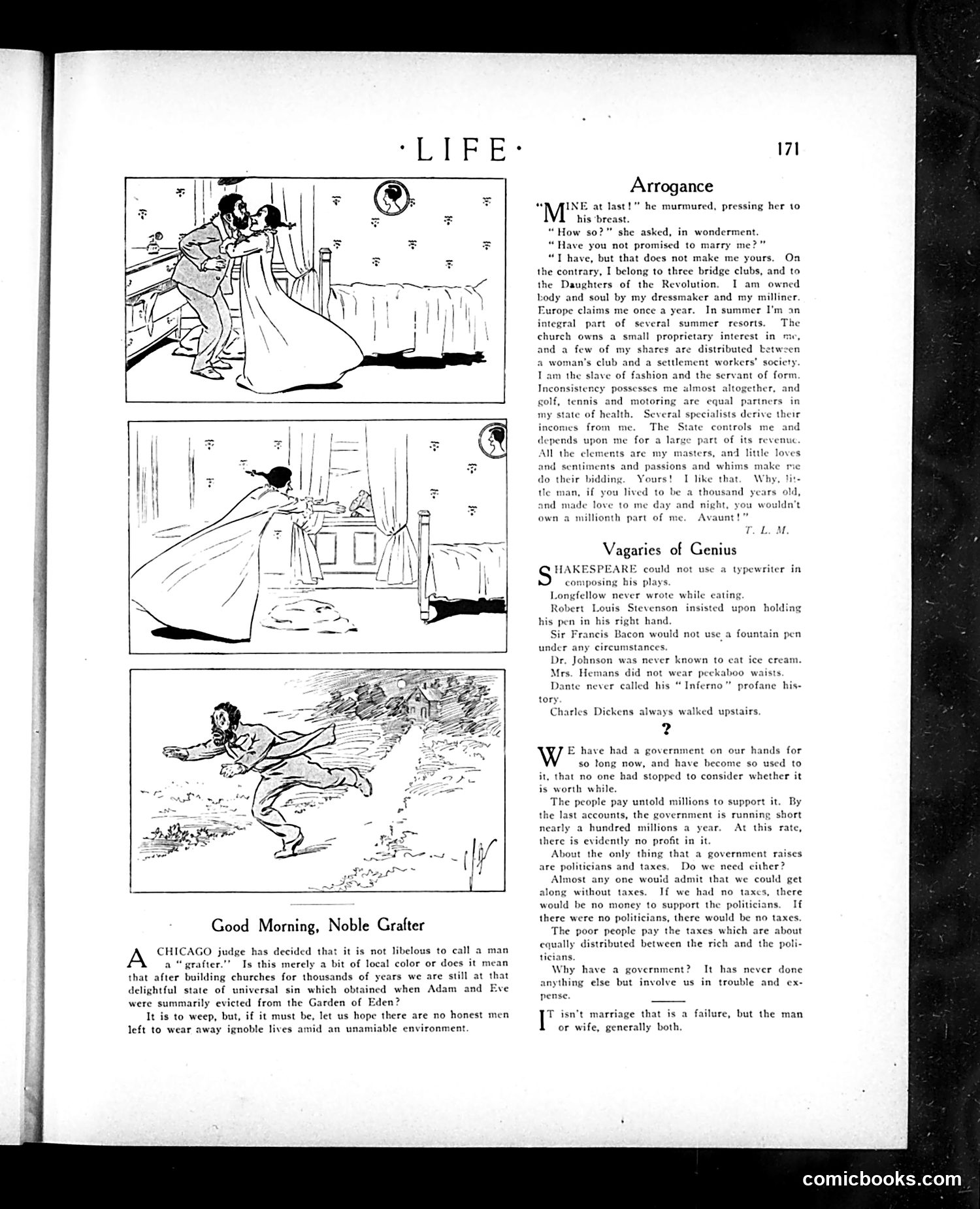
This page contains three satirical pieces typical of early 20th-century American humor: **"Arrogance"** (top): A couple's engagement scene where the woman declares she cannot truly belong to her fiancé. She humorously catalogs her competing obligations—bridge clubs, Daughters of the Revolution, her dressmaker, summer resorts, the church, specialists, and the state—concluding the man would own "a millionth part" of her at best. The satire mocks the fragmented modern woman's life and societal pressures on wealthy women. **"Vagaries of Genius"**: A humorous list of famous authors' quirky writing habits (Shakespeare avoiding typewriters, Dickens walking upstairs). This appears to be light, apolitical humor about eccentricity. **"Good Morning, Noble Grafter"**: A cynical piece questioning whether Chicago's legal ruling (calling someone a "grafter" isn't libelous) reveals endemic corruption. It argues government exists only to support politicians and collect taxes, criticizing both as unnecessary burdens on ordinary people. The final section dismisses marriage and government as inherent failures.
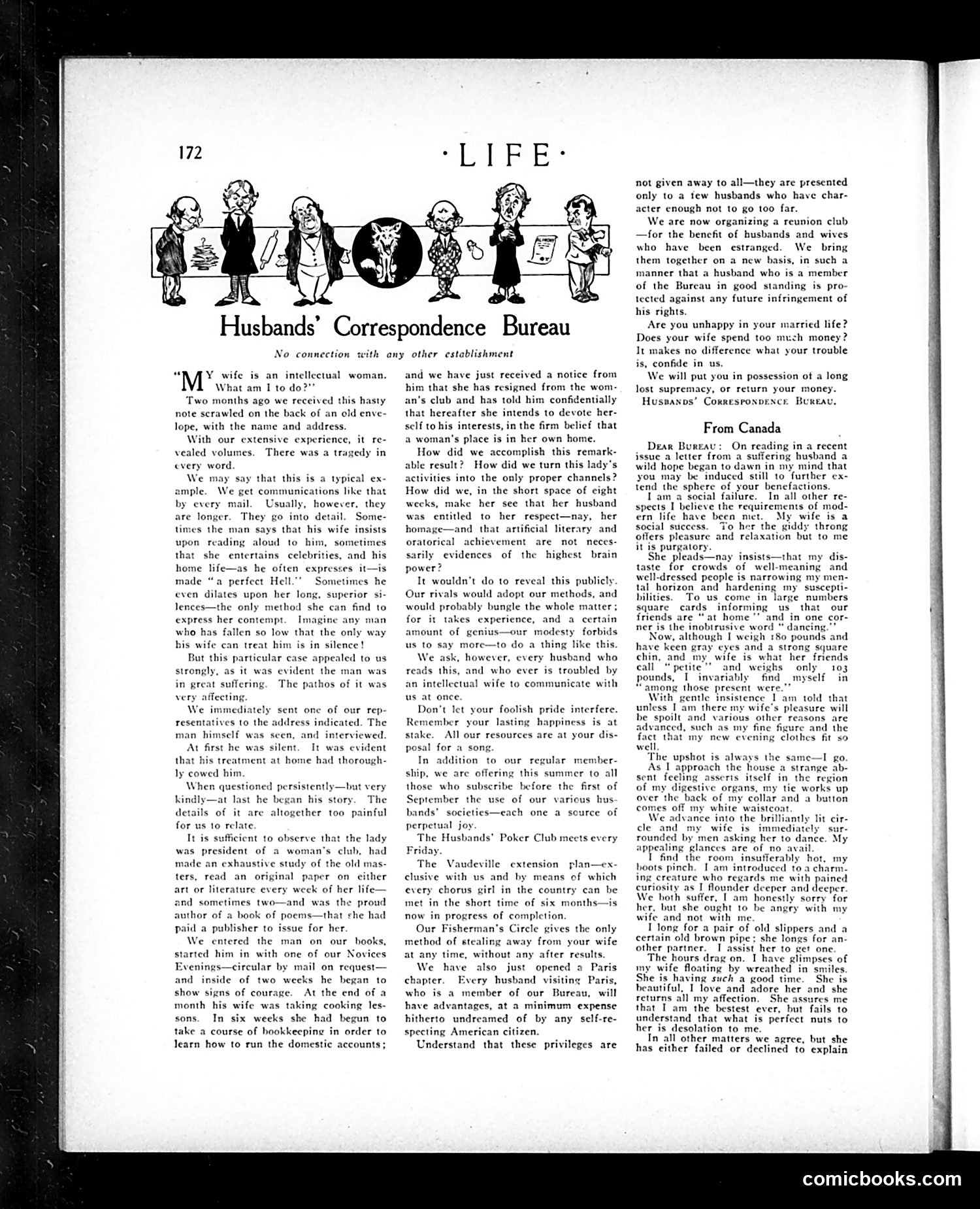
This satirical piece mocks early-1900s gender anxieties by presenting a fake "bureau" that "reforms" intellectual wives into submissive homemakers. The cartoon depicts various caricatured figures representing different husband types complaining to the bureau. The satire targets men threatened by educated, culturally-engaged women—specifically wives who are club presidents, art scholars, poets, and public speakers. The bureau claims to have "cured" one such wife by mysterious methods, transforming her from pursuing intellectual pursuits into believing "a woman's place is in her own home" and that she owes her husband "homage." The joke exposes the absurdity of male anxieties about female independence while simultaneously critiquing the period's actual pressure on women to abandon intellectual pursuits for domestic servitude. The tongue-in-cheek promotional tone ("perpetual joy," exclusive memberships) amplifies the satire, suggesting how ridiculous these gender expectations were becoming even to contemporary readers.
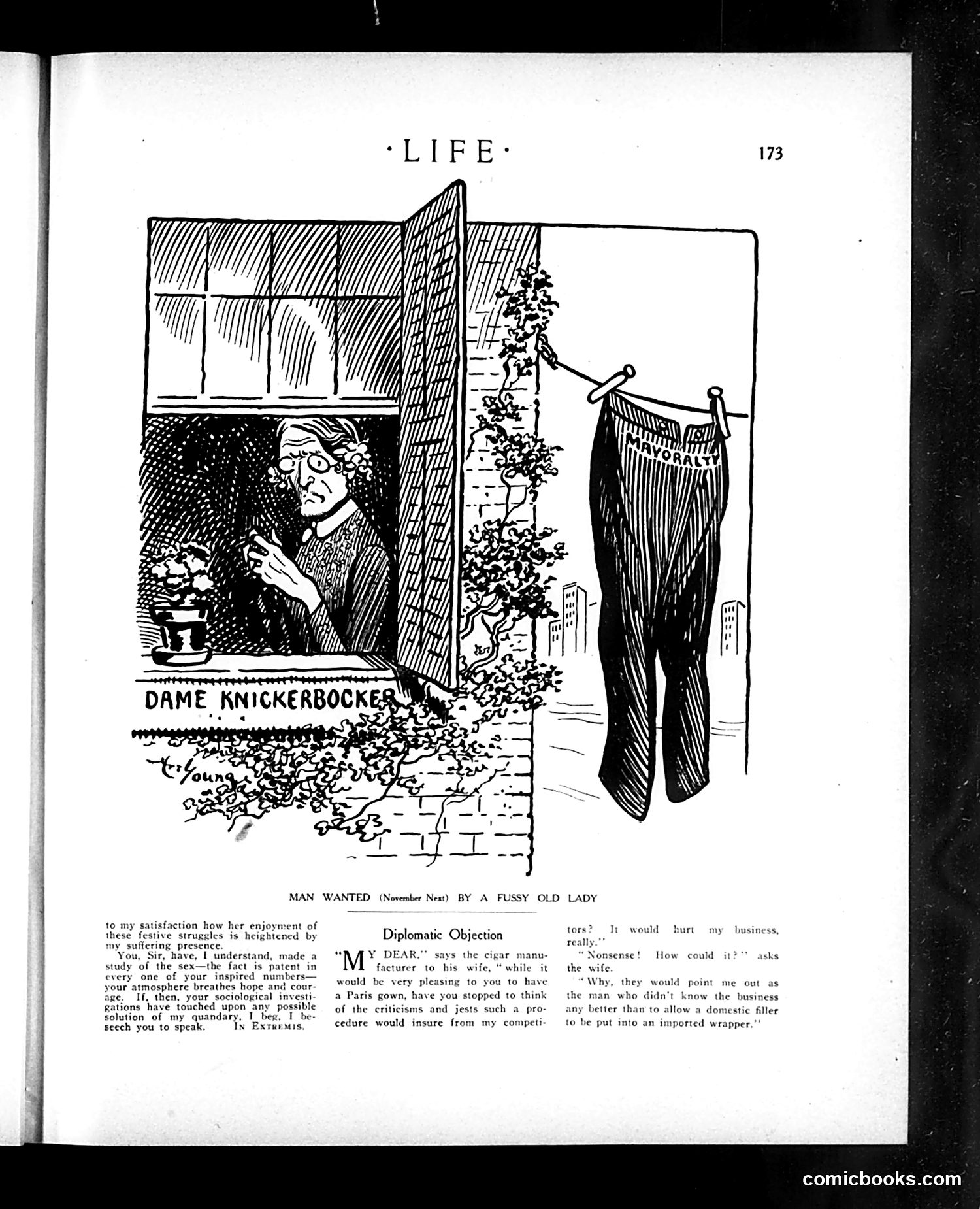
The page contains two satirical pieces from *Life* magazine (page 173). **Top cartoon:** Titled "Man Wanted (November Note) by a Fussy Old Lady," it depicts "Dame Knickerbocker" at a window, observing a pair of trousers hanging on a clothesline. The joke appears to be a visual pun about seeking a "man"—she's literally looking at male clothing rather than an actual person, satirizing either lonely elderly women or absurdist humor common to the era. **Bottom text piece:** "Diplomatic Objection" presents a dialogue between a cigar manufacturer and his wife about a Paris gown purchase. The wife worries that buying French goods will hurt his business reputation, while he argues critics won't notice. It satirizes both commercial protectionism and marital tension over conspicuous consumption during what appears to be a period of trade concerns. Both pieces use gentle domestic humor typical of early 20th-century American satirical magazines.
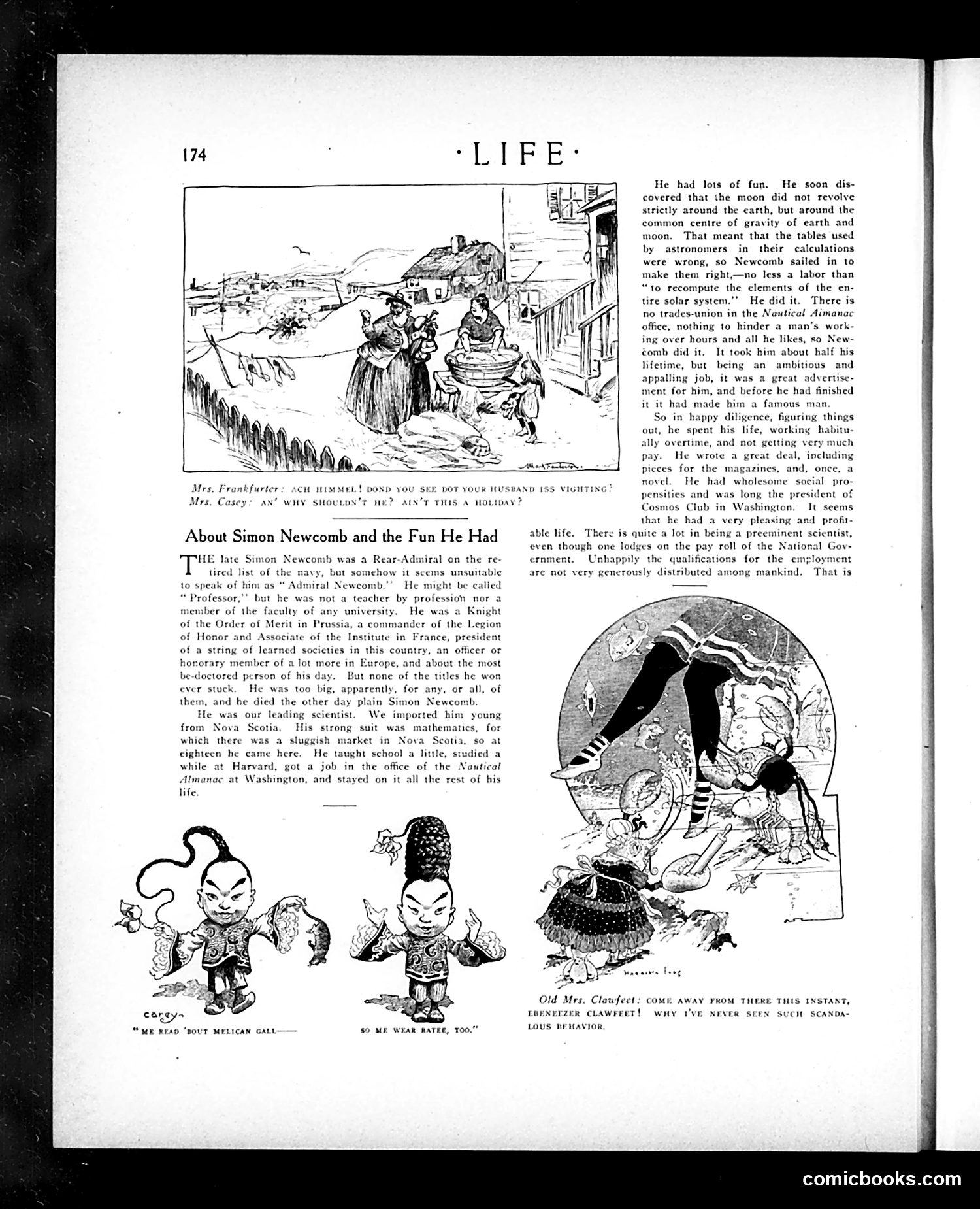
This page profiles **Simon Newcomb**, a late 19th-century scientist and Rear Admiral. The satirical point is that despite holding numerous prestigious titles (Knight of Prussian Merit, Legion of Honor, etc.), Newcomb preferred being called "Professor"—his *actual* accomplishment rather than his honors. The article humorously notes Newcomb spent half his lifetime recalculating astronomical tables after discovering the moon's orbital center, worked constantly without overtime pay, and never achieved wealth despite fame. The satire gently mocks the gap between scientific achievement and material reward. The **cartoons** below show: - Two caricatured figures in ethnic dress (labeled "COREY"), satirizing immigrant speech patterns - **Mrs. Clawfeet** scolding children for "scandalous behavior"—likely mocking both stern moralism and immigrant accents The page blends Newcomb's earnest biography with period satire targeting immigrants and social hypocrisy, typical of Life's turn-of-century humor.
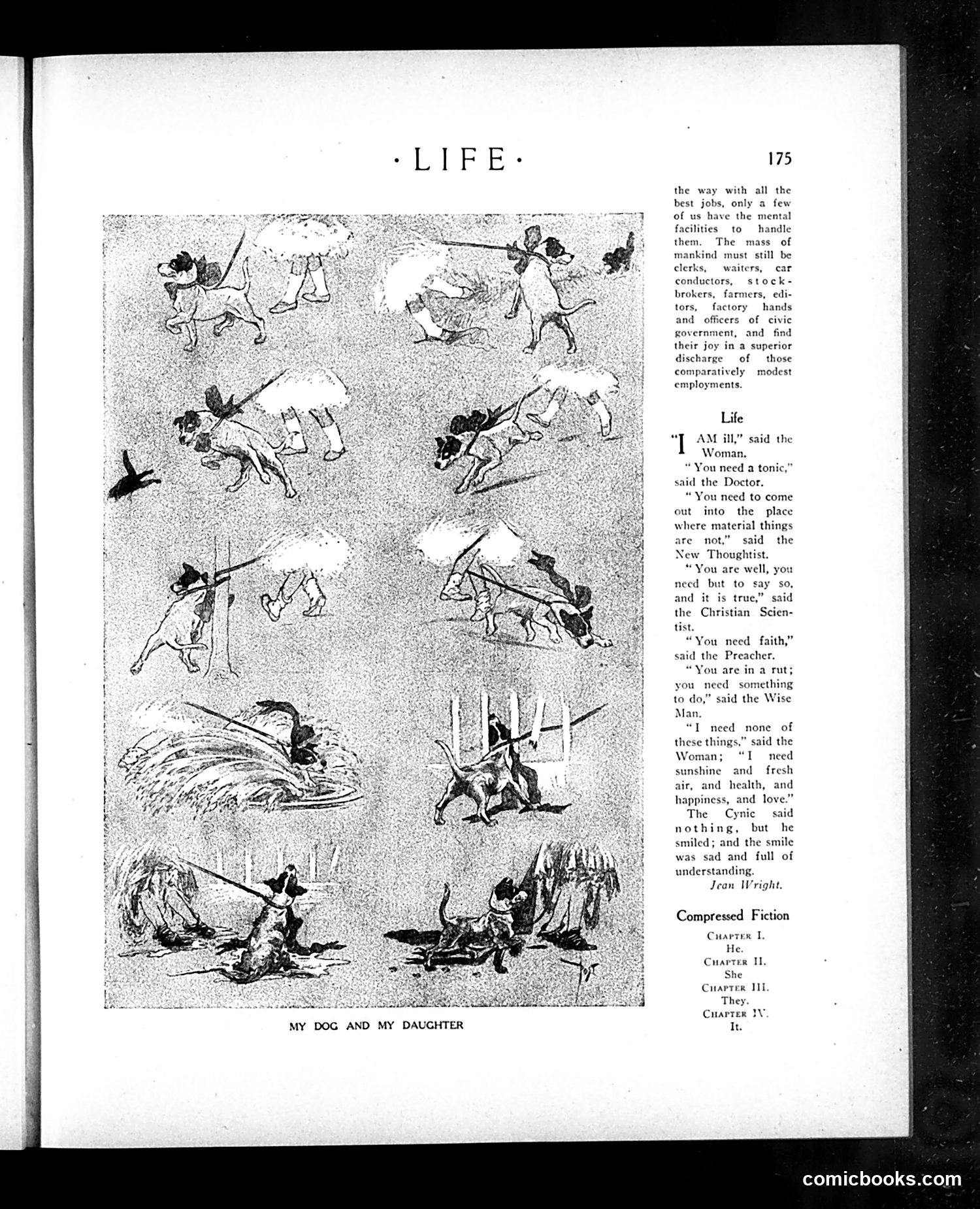
This page contains two distinct pieces of satirical content: **Left side:** A series of sketches titled "My Dog and My Daughter" depicting a dog and child in various playful activities—running, digging, playing together. The satire appears to mock the similarities between children and animals, suggesting they share comparable simplicity and instinct. **Right side:** A short story/dialogue titled "Life" featuring a sick Woman consulting various authorities—a Doctor, New Thoughtist, Christian Scientist, Preacher, and Wise Man—each offering conflicting remedies. The Woman dismisses all professional advice, stating she needs only "sunshine and fresh air, and health, and happiness, and love." A cynical observer smiles sadly at this exchange, understanding the futility. **The satire:** This mocks turn-of-the-century competing philosophies and professions (medicine, New Thought spiritualism, Christian Science, conventional religion) as equally ineffective. The Woman's simple wisdom and the Cynic's knowing smile suggest genuine human happiness requires no expert intervention—a critique of professionalization and intellectual pretension.
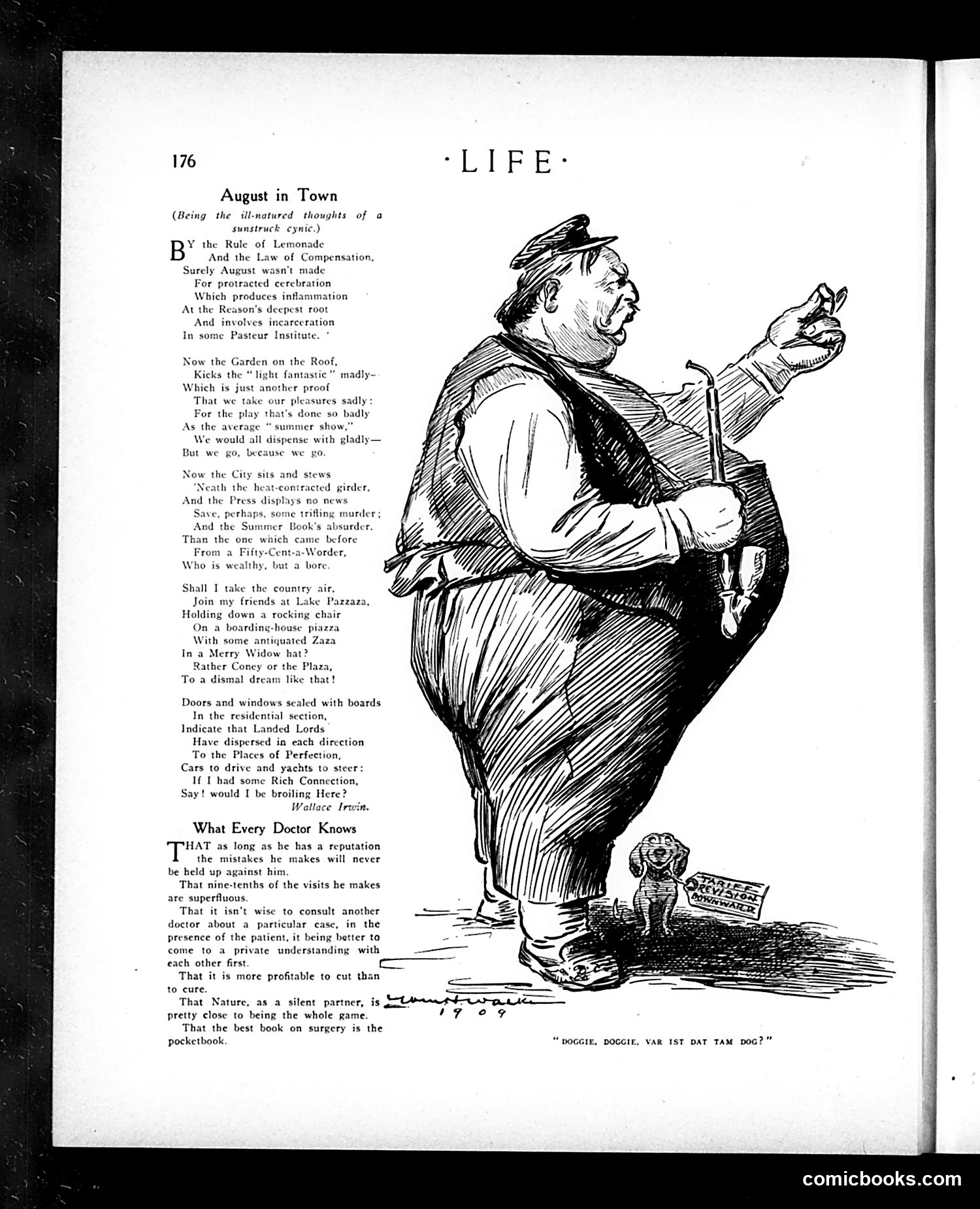
This Life magazine page contains two satirical pieces: **"August in Town"** is a poem by Wallace Irwin mocking New Yorkers stuck in the sweltering city during summer. The accompanying caricature shows a stout, uncomfortable man in formal dress—representing the wealthy urbanite too proud or habituated to leave despite the heat. The satire critiques how people endure miserable conditions ("we go, because we go") rather than actually seeking relief, and how the wealthy escape to exclusive destinations while ordinary people suffer. **"What Every Doctor Knows"** is cynical commentary on medical practice, suggesting doctors prioritize reputation and profit over patients' actual needs. It claims most doctor visits are unnecessary, that doctors collude with each other to avoid scrutiny, and that surgery is performed for financial gain rather than healing. The final line—a dog's accent—likely adds sarcastic humor, though its specific reference is unclear. Both pieces exemplify Life's satirical approach to American social hypocrisy and professional ethics.
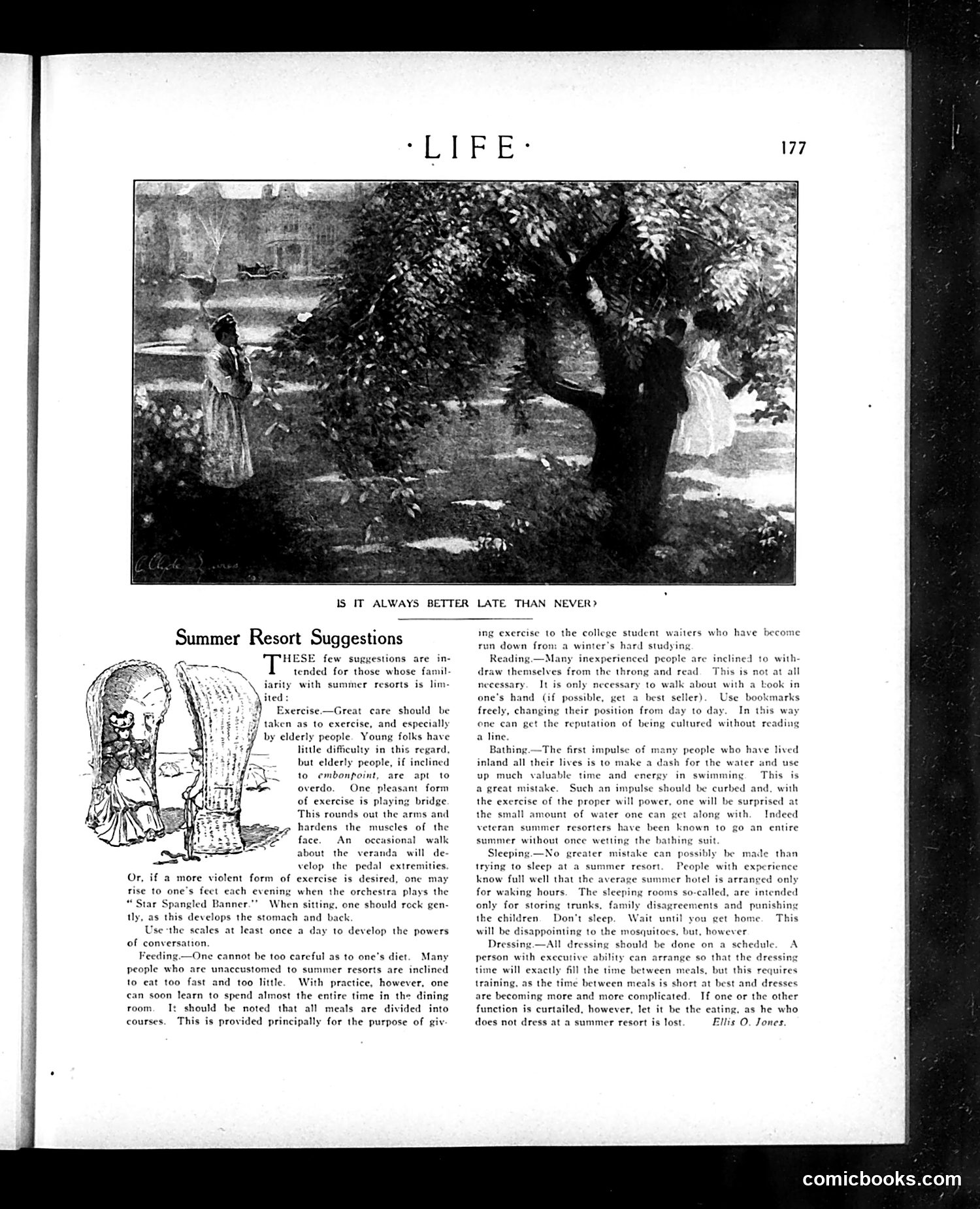
This page lampoons the pretensions and absurdities of American summer resort culture. The article, attributed to Ellis O. Jones, offers mock-serious "advice" that ridicules both resort guests and the resort lifestyle itself. The satire targets wealthy leisure travelers through exaggerated suggestions: playing bridge as "exercise," using bathroom scales to "develop conversation," eating constantly in the dining room, and obsessing over proper dress schedules. The piece mocks the artificiality of resort life—guests who avoid swimming (the whole point of a water resort), read books to appear cultured without actually engaging, and prioritize appearances over comfort. The headline "IS IT ALWAYS BETTER LATE THAN NEVER?" suggests criticism of people postponing actual living for an idealized resort experience. The accompanying photograph shows women in the outdoors, contrasting with the text's satirical advice to stay indoors or avoid genuine activity. Overall, this is gentle social commentary on the leisure class's disconnection from authentic experience and their anxiety about maintaining proper appearances.
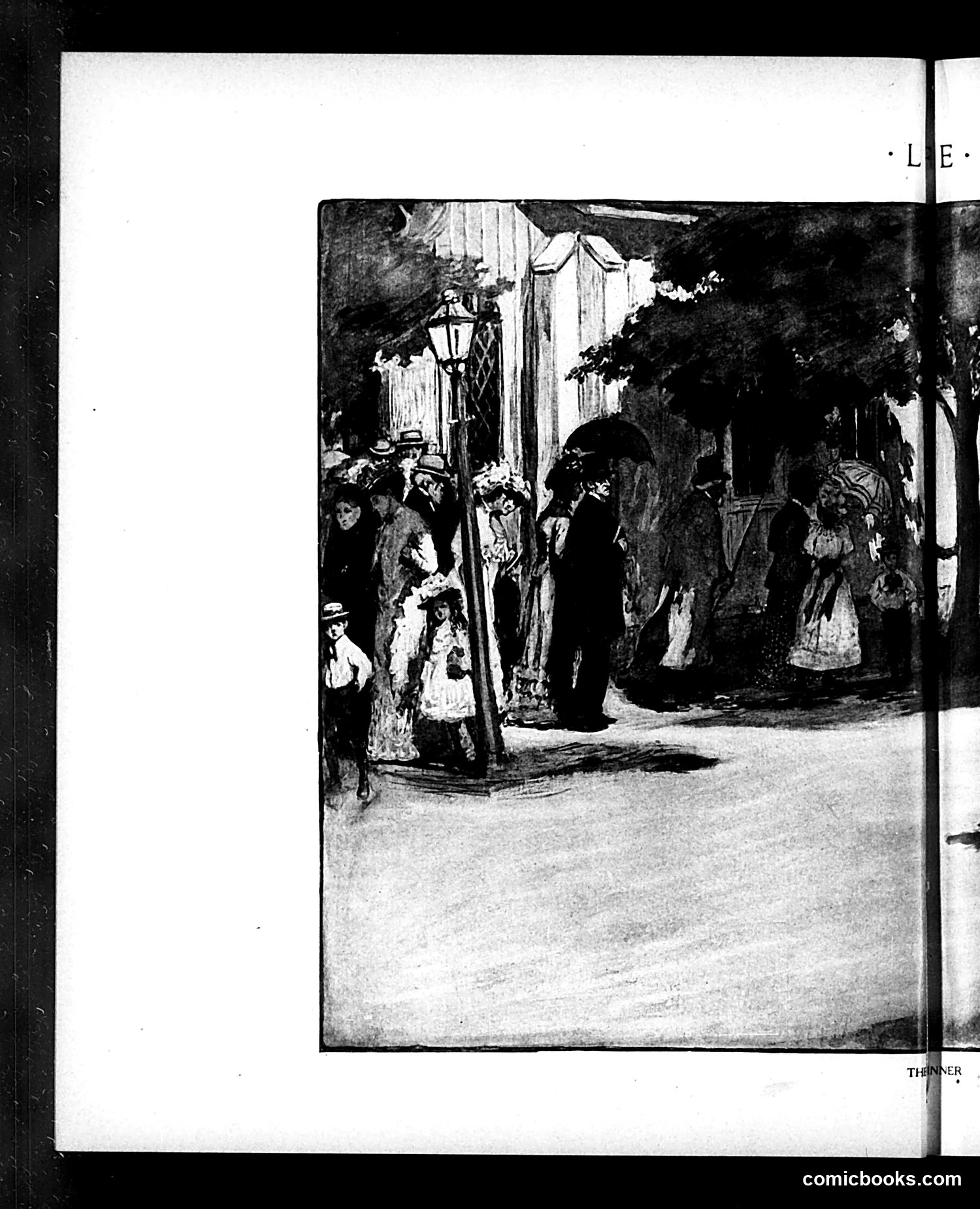
This page appears to be from *Life* magazine and features a black-and-white illustration credited to "THINNER" (visible at bottom right). The image depicts a nighttime street scene with multiple figures in period dress gathered outside what appears to be a building or establishment with a lamp. The scene suggests a social gathering or street life moment, possibly depicting working-class or bohemian activity. The artistic style and clothing suggest late 19th or early 20th century. However, without clearer text or additional context visible on this page, I cannot confidently identify the specific political or social commentary, the particular figures depicted, or the satirical point being made. The image quality and lack of accompanying caption text limit definitive interpretation of the cartoon's intended meaning.
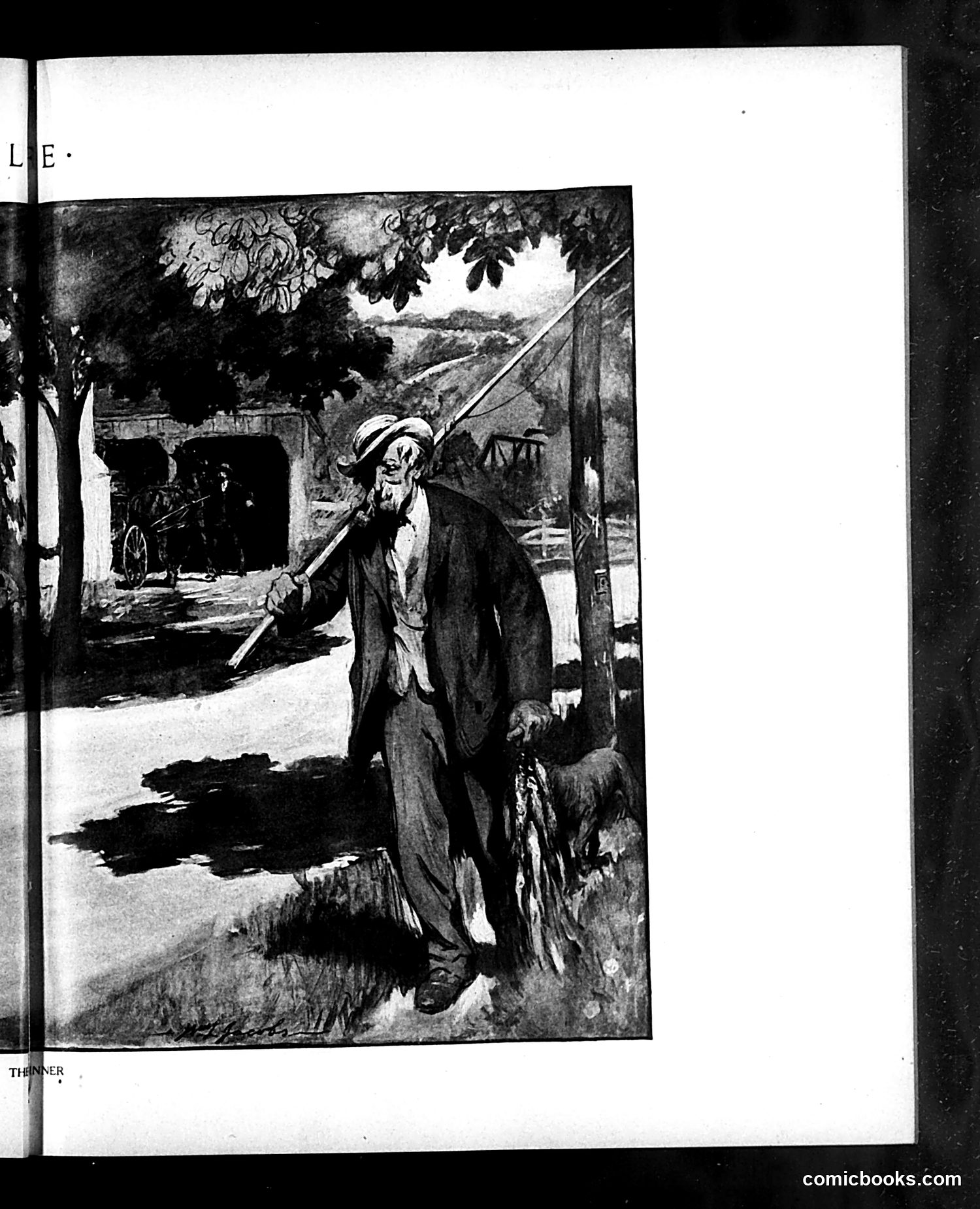
The OCR text is essentially unreadable garbled characters, so I must rely entirely on the image. This appears to be an illustration by **Thinner** (credited at bottom) showing a rural or rustic scene. An elderly man in worn clothing and a hat stands in a farmyard or village setting, holding a staff or walking stick. He has an exaggerated, weathered appearance typical of early 20th-century satirical art. Behind him are rural buildings, a cart, and grazing animals. Without legible text context, the specific satire is unclear—it could address rural poverty, aging laborers, agrarian conditions, or general social commentary on rural life. The cartoon's tone appears sympathetic rather than mocking, suggesting social criticism rather than ridicule of the figure depicted.
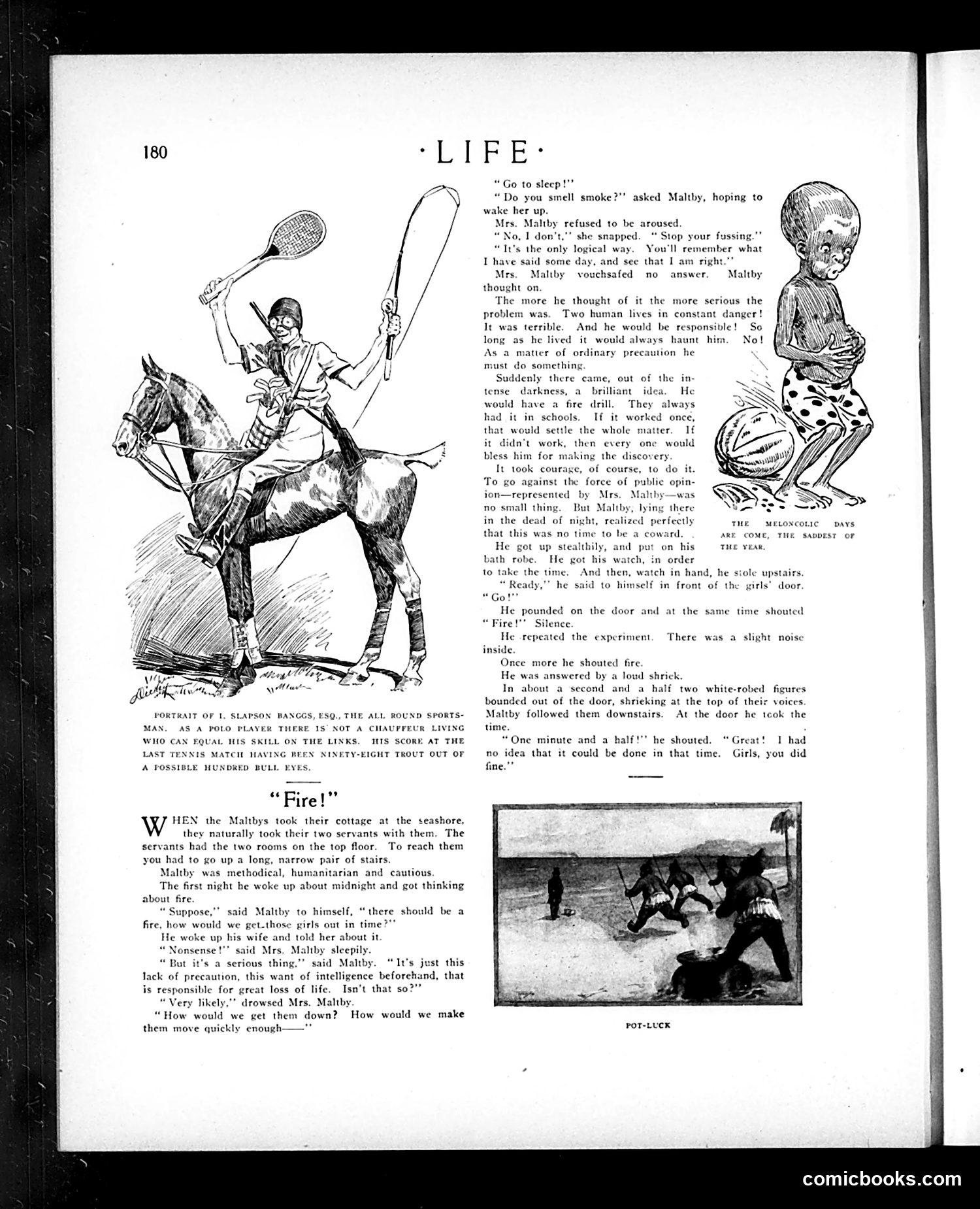
This is a humorous domestic narrative satirizing over-cautious husbands and safety obsession. Mr. Maltby, portrayed as methodical and anxious, becomes fixated on fire evacuation procedures after waking at midnight. His practical, sensible wife Mrs. Maltby dismisses his concerns—a common marital dynamic the satire exploits. The joke: Maltby conducts an unauthorized "fire drill," shouting "Fire!" to wake the female servants upstairs, timing their evacuation. His success vindicates his worry. The accompanying portrait of "Slapson Banggs, Esq." mocks sporting gentlemen who excel at leisure activities (polo, tennis) but lack practical sense—contrasting with Maltby's earnest preparation. The satire gently ridicules both masculine anxiety about catastrophe and the dismissive responses from practical women, reflecting early 20th-century gender relations and contemporary debates about household safety standards.
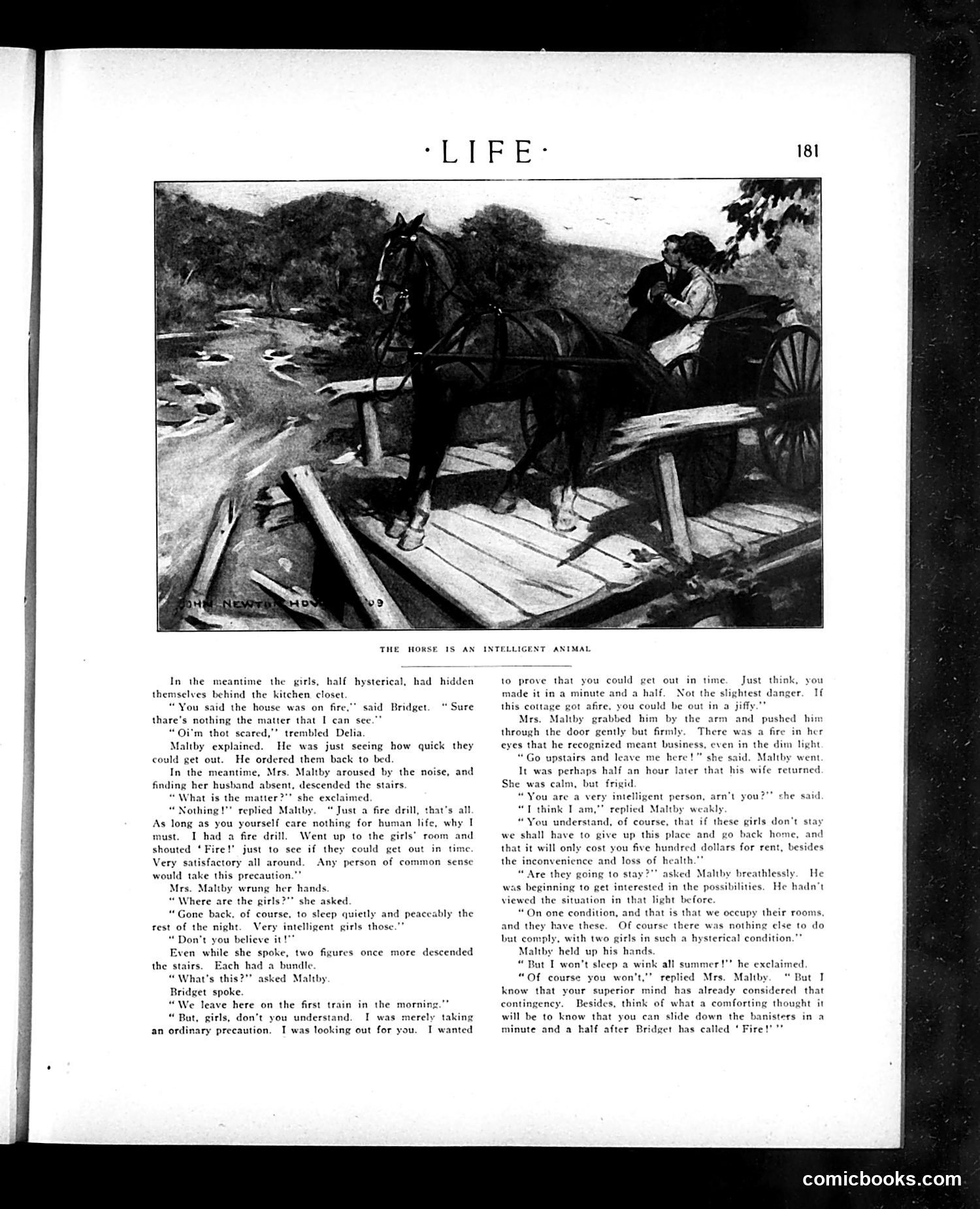
This is a domestic humor story (not a political cartoon) satirizing a husband's misguided "fire drill." Mr. Maltby conducts a surprise fire evacuation to test his household staff's response time, terrifying the maids Bridget and Delia. His wife arrives to find him conducting what he considers a reasonable safety precaution. The satire targets male self-importance and poor judgment: Maltby believes his "superior mind" justifies frightening the servants at night, dismissing legitimate concerns about their welfare. His wife's punishment is elegant—she forces him into the maids' cramped quarters for the summer and reminds him he can always test his own escape speed via the banisters, implying he's foolish rather than prudent. The title references the horse illustration (showing calm animals), suggesting humans should learn from animals' simple, unexcitable nature. The joke: intelligent people don't conduct dangerous pranks under the guise of safety.
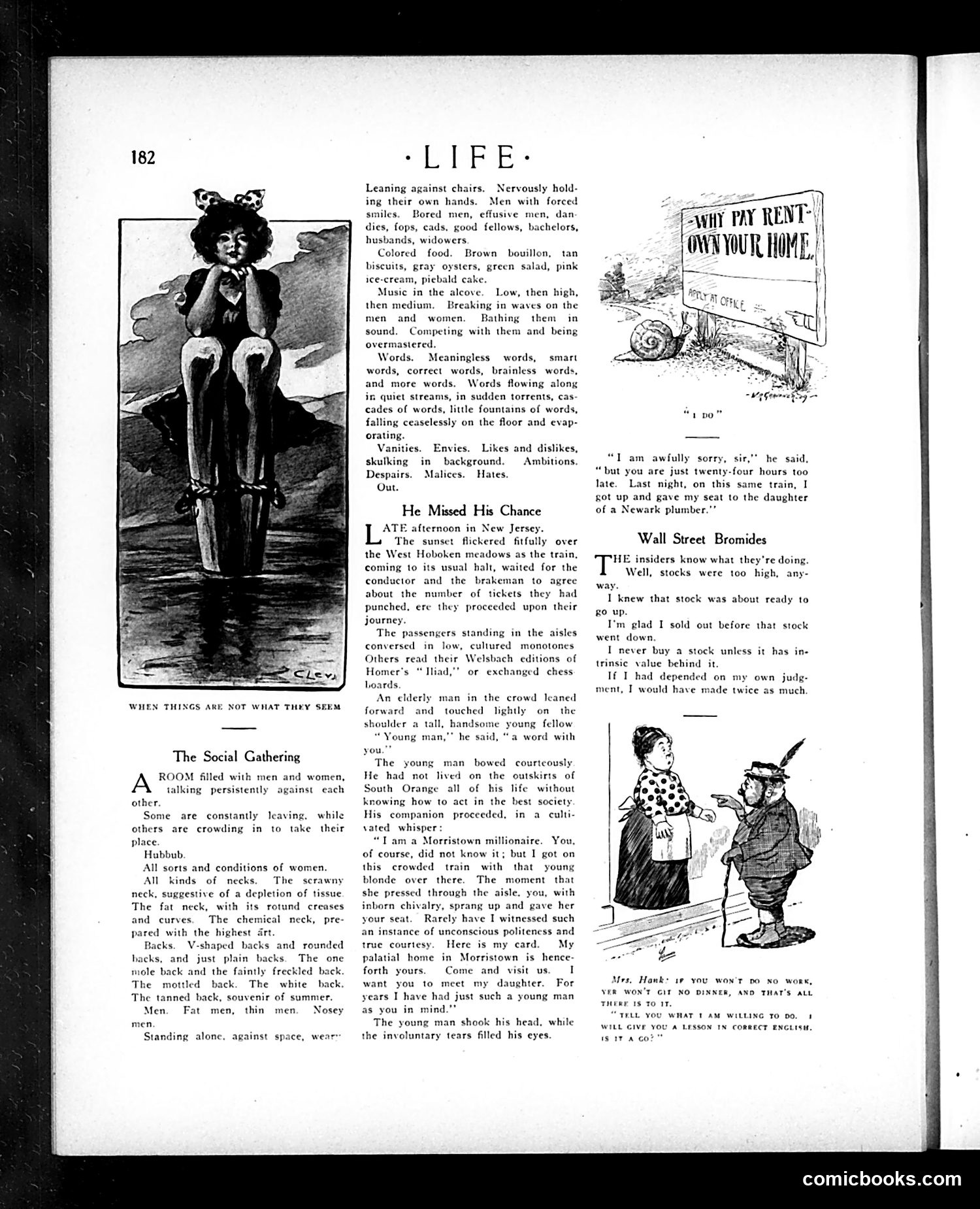
This page contains three satirical pieces mocking American social pretense and folly: **"When Things Are Not What They Seem"** (left illustration): A grotesque figure depicts the vapidity of social gatherings—cataloging the superficial variety of attendees, their forced manners, meaningless chatter, and underlying envies and hatreds concealed beneath polite society's surface. **"He Missed His Chance"**: A wealthy Morristown millionaire on a train approaches a young man who gave his seat to a blonde woman, offering him a card and inviting him to meet his daughter—only to learn the man gave his seat to a *Newark plumber's* daughter the previous night. The satire mocks both the arbitrary nature of social fortune and the irony of missing opportunity by mere hours. **"Wall Street Bromides"**: Brief cynical observations about stock market investors' self-deceptive rationalizations—claiming prescience about market movements while admitting they missed opportunities or got lucky. Overall, the page satirizes American pretense: social climbing, self-delusion about financial acumen, and the meaninglessness underlying genteel society.
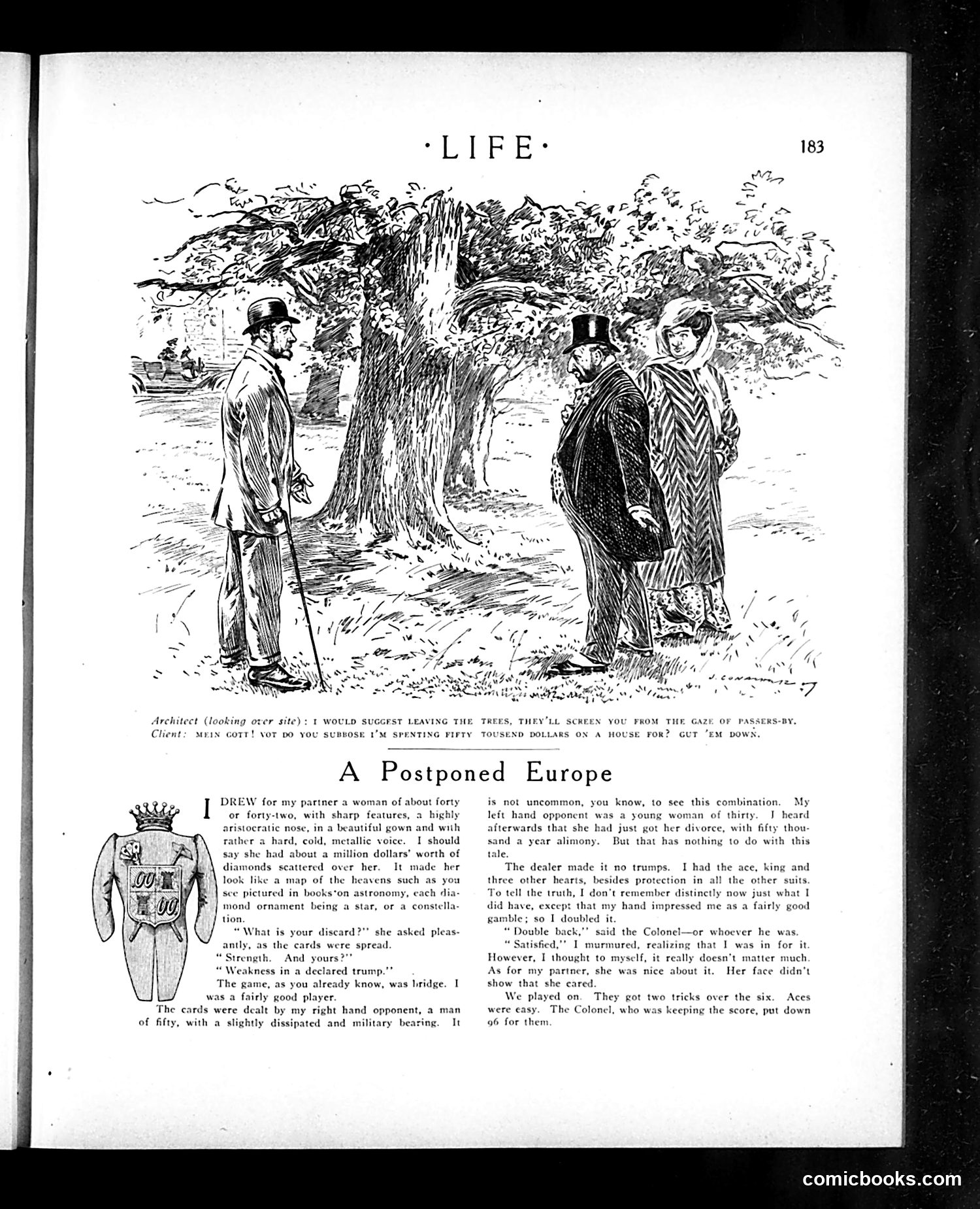
The top cartoon is a joke about German immigrant clients. An architect recommends leaving trees on the building site for screening, but the wealthy German client (indicated by "Mein Gott!" and German accent) protests spending $50,000 on a house only to cut down the trees—revealing misplaced priorities and immigrant "nouveau riche" stereotypes. The humor relies on ethnic caricature common to early 20th-century American satire. Below is the opening of "A Postponed Europe," a short story about a bridge card game. The narrator describes playing with three wealthy partners: a wealthy older woman covered in diamonds, a young divorced woman with alimony, and a military-bearing man (possibly a "Colonel"). The story satirizes high-society leisure activities and suggests romantic/financial entanglements among the wealthy. The title's meaning—why Europe is "postponed"—remains unclear from this excerpt alone.
This page from *Life* magazine depicts a satirical short story about class differences and social embarrassment in early 20th-century America. The narrative concerns a college mathematics professor who attends a bridge party at his wealthy friend Billy's house, intending to save money for a European trip. The professor discovers mid-game that the players are gambling at high stakes—a dollar per point—wagering sums ($143 total) that represent enormous money to him but mere casual stakes to the affluent guests. The satire targets the obliviousness of the wealthy ("Why, an evening at bridge... not even worth talking about") contrasted with the professor's financial anxiety. The reference to the Colonel casually mentioning having earned $143 "quicker" emphasizes how the rich treat significant sums as trivial. The story also highlights the social awkwardness of class mobility in this era: the professor cannot refuse Billy's invitation due to obligation for previous kindness, yet finds himself trapped in a situation fundamentally incompatible with his economic reality. The satire is gentle but pointed about American class stratification.
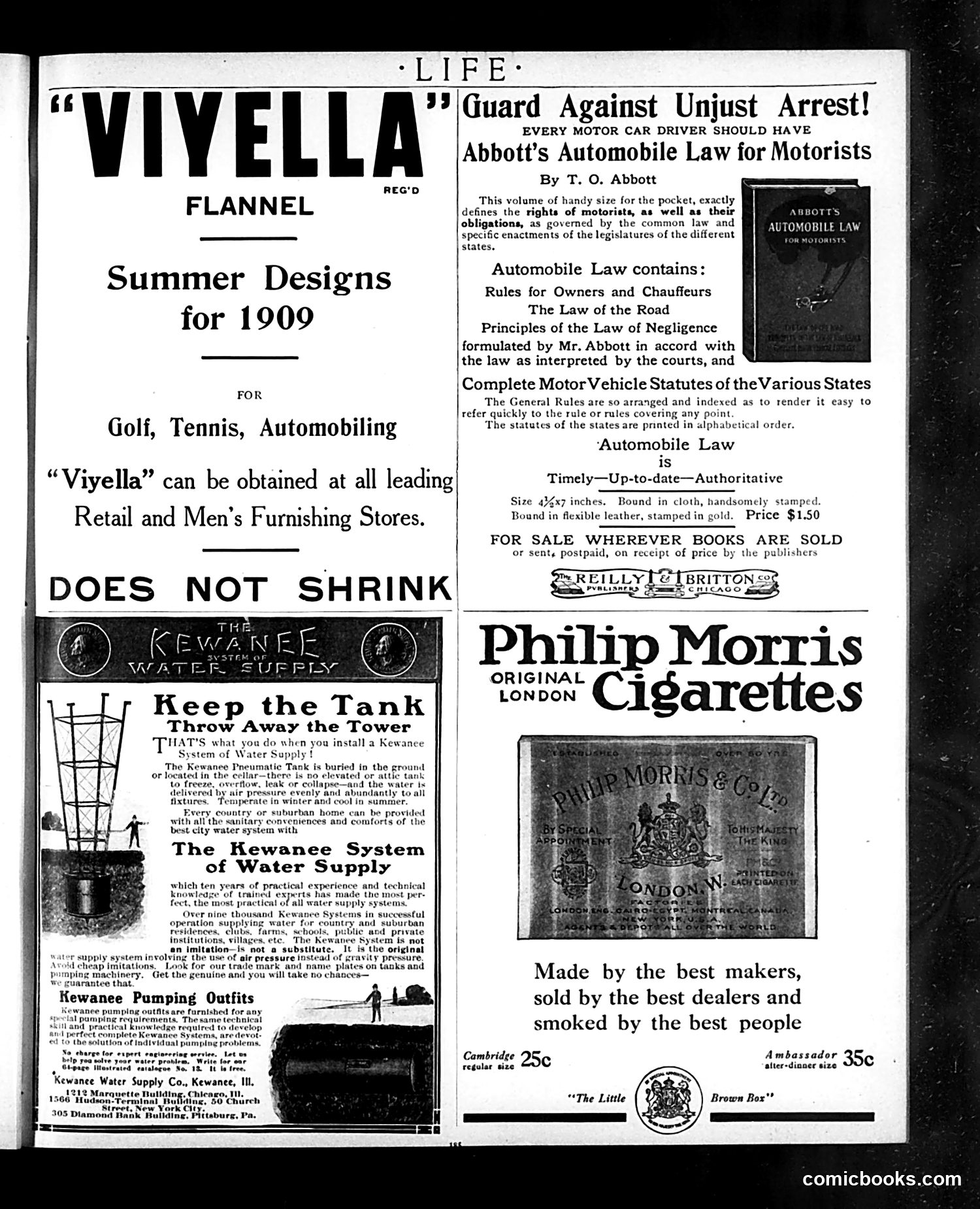
This page is primarily **advertising**, not satire or political commentary. It contains four commercial advertisements: 1. **Vivella Flannel** — promotes summer clothing for outdoor activities (golf, tennis, automobiling) 2. **Abbott's Automobile Law** — a pocket legal guide for motorists, addressing contemporary concerns about unjust arrest and motor vehicle regulations across different states. This reflects early-1900s anxieties about new automobile laws and drivers' rights. 3. **Kewanee Water Supply Systems** — promotes residential water tanks and pumping equipment, emphasizing modern sanitation and convenience for homes and institutions. 4. **Philip Morris Cigarettes** — advertises "Original London Cigarettes" in two sizes (Cambridge 25¢, Ambassador 35¢). The page reflects 1909 consumer culture: automobiles were new enough to require legal guides; indoor plumbing was still a luxury upgrade; and cigarettes were marketed as premium lifestyle products. There is no discernible political cartoon or satirical content.
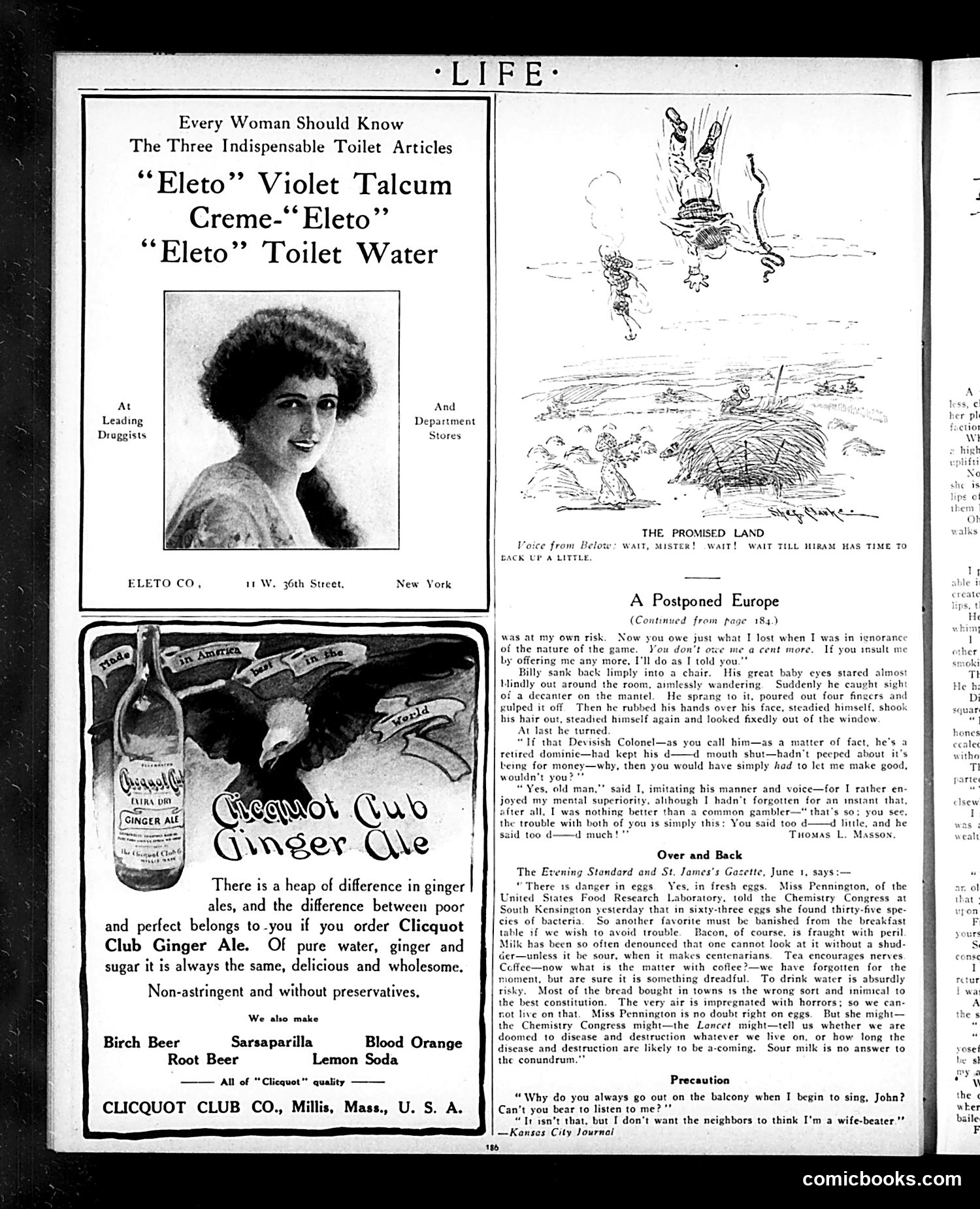
This page is **primarily advertising** interspersed with editorial content. The **advertisements** promote beauty products ("Eleto" toiletries) and beverages (Clicquot Club Ginger Ale), typical early 20th-century marketing targeting women ("Every Woman Should Know"). The **editorial cartoons and text** include: 1. **"The Promised Land"** – a satirical illustration depicting immigrants or lower-class figures waiting/climbing, suggesting delayed hopes or "backing up" to wait for better times. The caption's dialect ("WAIT TILL HIRAM HAS TIME") appears to mock working-class speech. 2. **"A Postponed Europe"** – a serialized story (continued from page 184) about characters named Billy and Colonel, involving gambling debts and moral compromise. 3. **"Over and Back"** – satirizes health anxieties, mocking scientific warnings about "dangerous" foods (eggs, milk, bread, water, tea). It humorously suggests everything is unsafe. 4. **"Precaution"** – a one-line joke where a husband goes to the balcony during his wife's singing to avoid *appearing* to beat her. The page reflects Life's satirical style: mocking consumer culture, class tensions, and contemporary anxieties about health and morality.
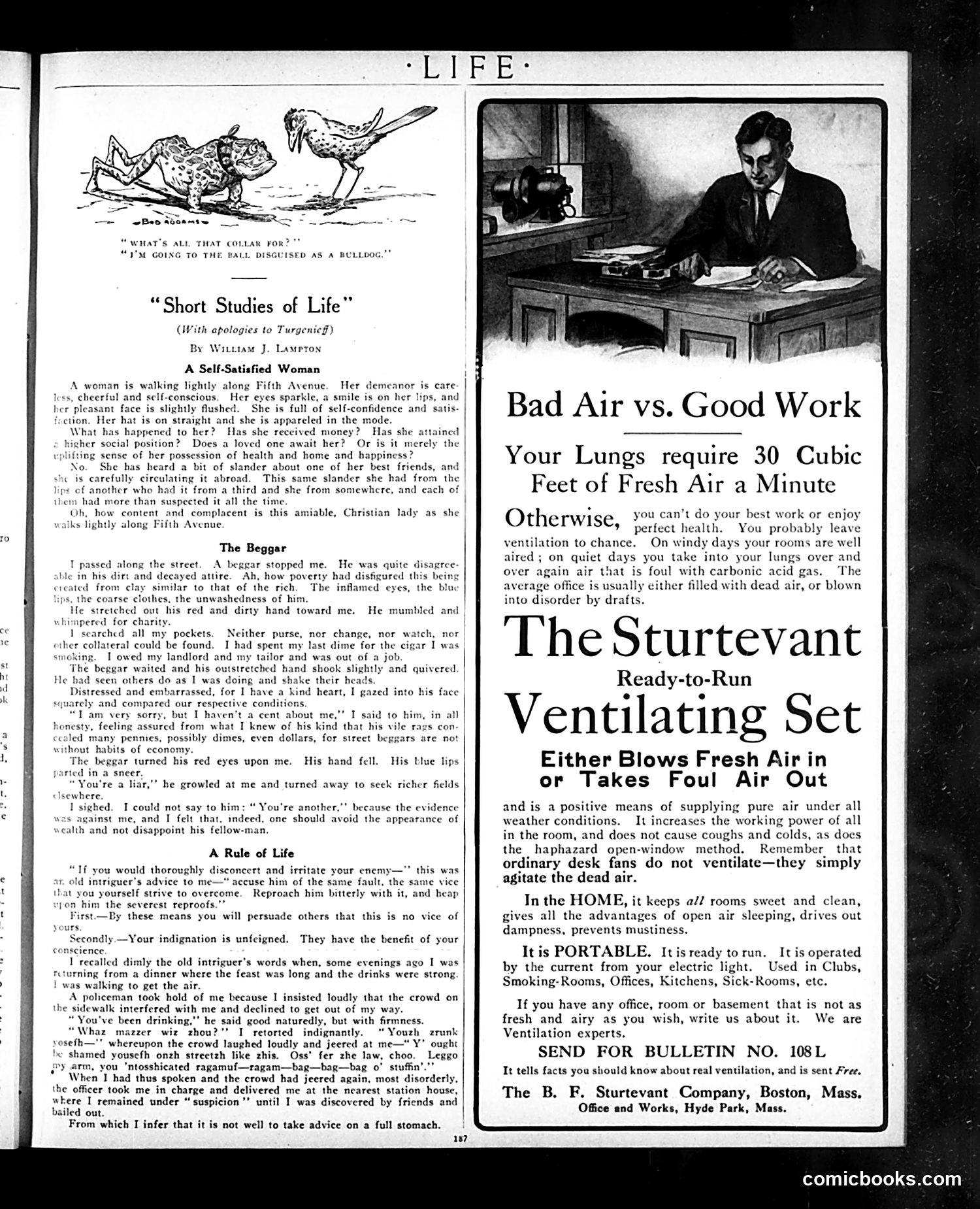
This page contains three satirical short stories by William J. Lampton mocking human hypocrisy and moral failings: **"A Self-Satisfied Woman"** ridicules a woman smugly walking Fifth Avenue, appearing virtuous and content. The joke: her happiness derives entirely from spreading malicious gossip about a friend—she's circulating slander she knows is unfounded. **"The Beggar"** presents ironic role-reversal. A broke narrator, unable to give a beggar money, claims he has nothing. The beggar calls him a liar—and he's right. The narrator admits he *does* have money (spent on cigars, owed to landlord), yet the beggar's accusation backfires socially because appearances matter more than truth. **"A Rule of Life"** describes a drunk man loudly accusing police and crowds of drunkenness—the very vice he's committing. The story suggests this rhetorical tactic works: the crowd laughs at *them*, not him. The cartoons above feature a creature in a collar "disguised as a bulldog"—likely mocking pretense and false appearances. **Overall theme**: Hypocrisy, self-deception, and how people escape moral accountability through rhetoric and social appearance.
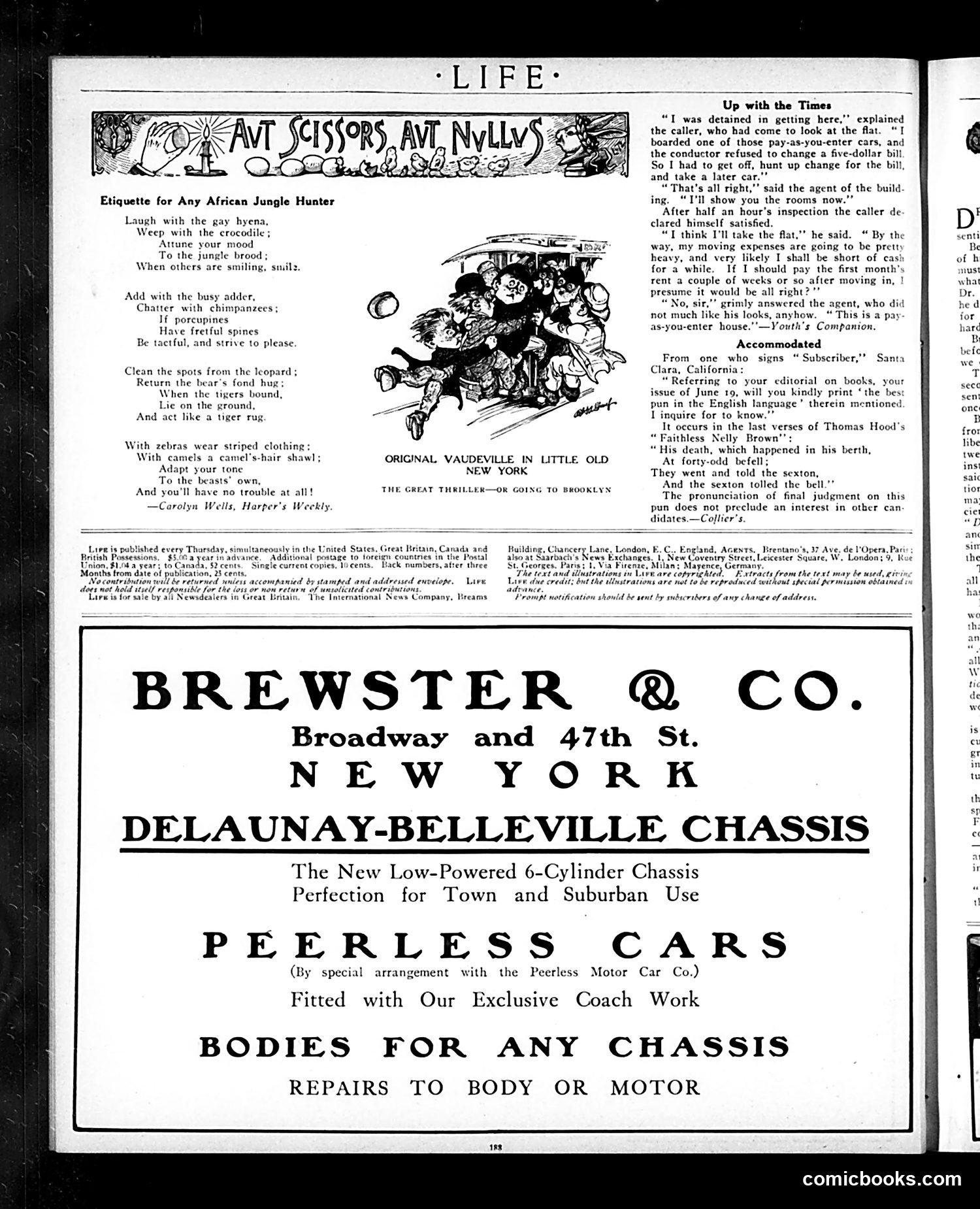
This Life magazine page (circa 1910s based on styling) contains humor pieces and advertising. **Top cartoon**: "Etiquette for Any African Jungle Hunter" is satirical advice humorously treating dangerous African wildlife as social equals requiring proper manners—"laugh with the hyena," "weep with the crocodile," wear stripes to match zebras. It mocks both overly elaborate etiquette guides and exoticized colonial attitudes toward Africa. **"Up with the Times"**: A brief joke about a pay-as-you-enter streetcar conductor's rigidity. A prospective apartment renter, delayed by the conductor's refusal to change his bill, later asks the landlord for late rent payment. The agent replies the building operates on "pay-as-you-enter" principles—a humorous commentary on modern transactional impersonality. The page is primarily advertising for Brewster & Co., promoting Delaunay-Belleville and Peerless automobiles and coach-building services.
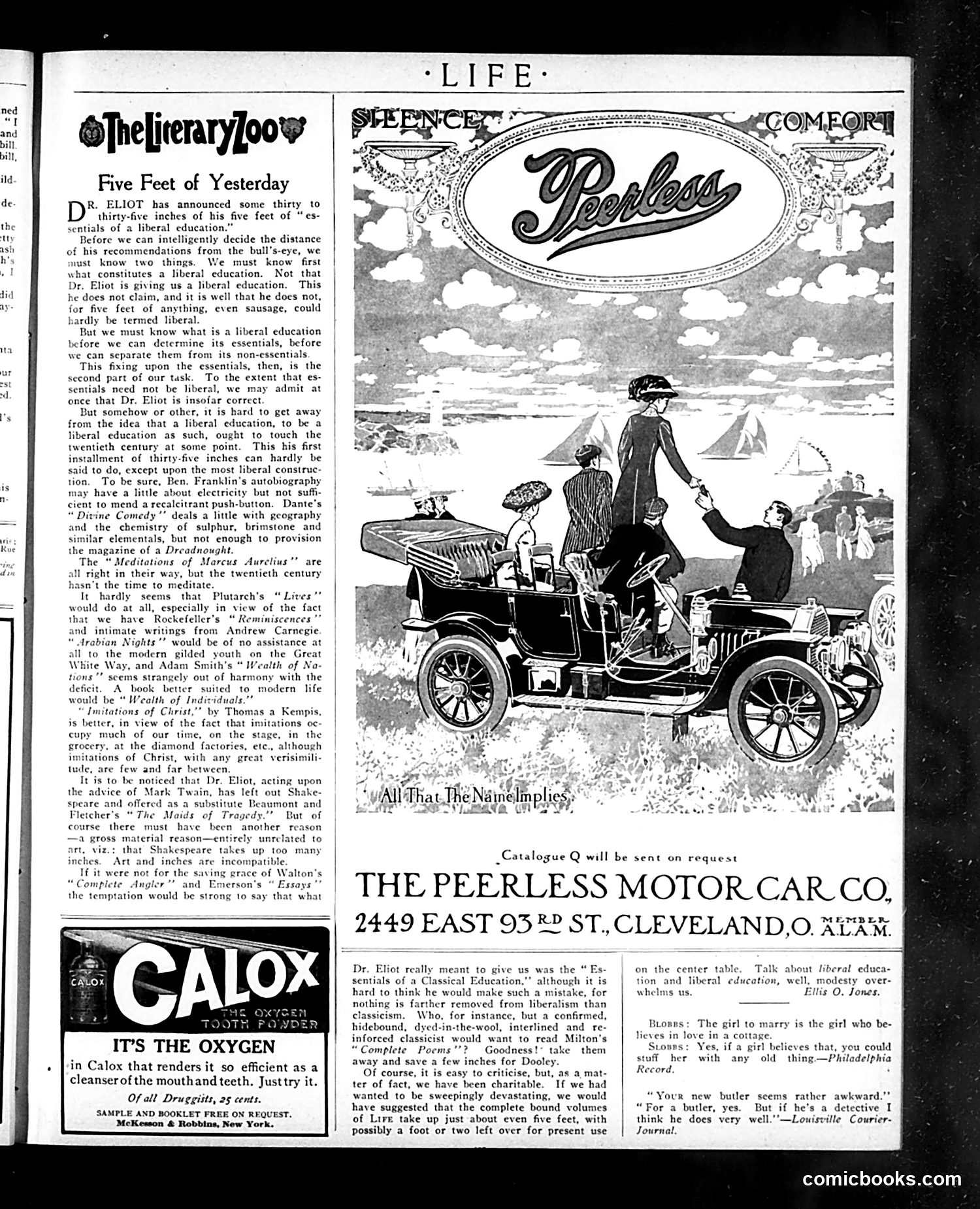
This is a literary critique satirizing Dr. Charles Eliot's (Harvard president) curated list of essential readings for liberal education, described as only "thirty to thirty-five inches" of books. The author mocks Eliot's classical selections—including Plutarch's *Lives*, Marcus Aurelius, and Dante—as antiquated and impractical for the modern (early 20th-century) world. The satire suggests these dusty classics are useless for contemporary life: Marcus Aurelius won't help with modern push-buttons; Dante's chemistry of brimstone won't provision a Dreadnought warship. The criticism peaks with absurdist humor: recommending Andrew Carnegie's *Reminiscences* over Plutarch, or a hypothetical "Wealth of Individuals" over Adam Smith. The piece ridicules prioritizing classical art over practical modern knowledge, and sarcastically notes Shakespeare was apparently excluded simply because it takes up "too many inches." The satire targets intellectual snobbery—claiming that limiting education to classical texts is "hidebound" and divorced from twentieth-century reality.
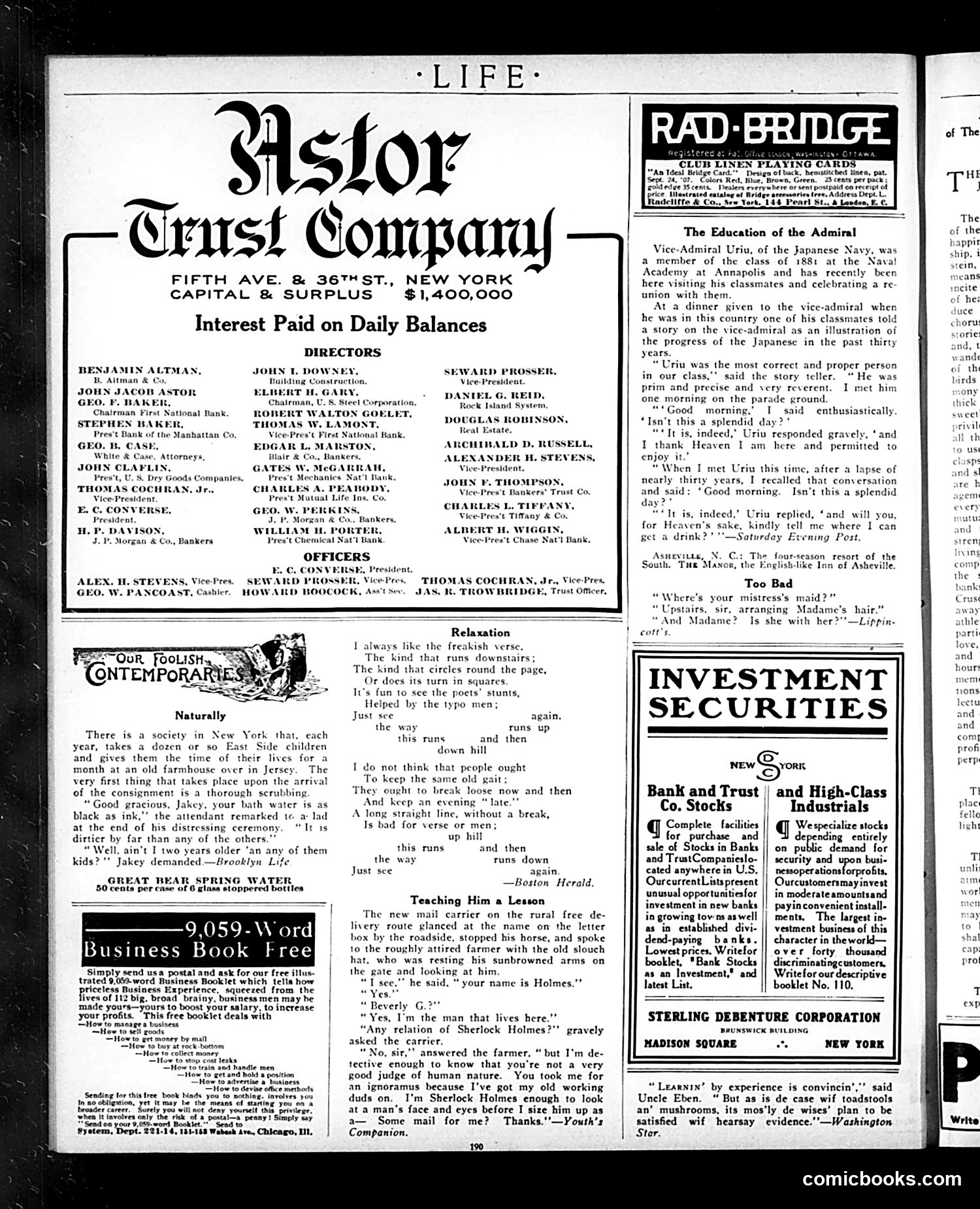
This page is primarily **advertising and business content** rather than political satire. The dominant feature is the Astor Trust Company banking advertisement listing prominent New York financiers and industrialists as directors—names like Benjamin Altman, John Jacob Astor, and J.P. Morgan representatives. The small humorous sections ("Our Foolish Contemporaries") include two light satirical pieces: one about East Side children at a Jersey farm, where a street boy jokes that he's dirtier because he's two years older; another about a rural mail carrier asking a farmer if he's related to Sherlock Holmes. These represent gentle, everyday humor rather than political commentary—satirizing innocent misunderstandings and social pretense rather than addressing current events. The page reflects Life magazine's mixed approach of serious financial advertising alongside whimsical, non-partisan humor typical of early 20th-century American publishing.
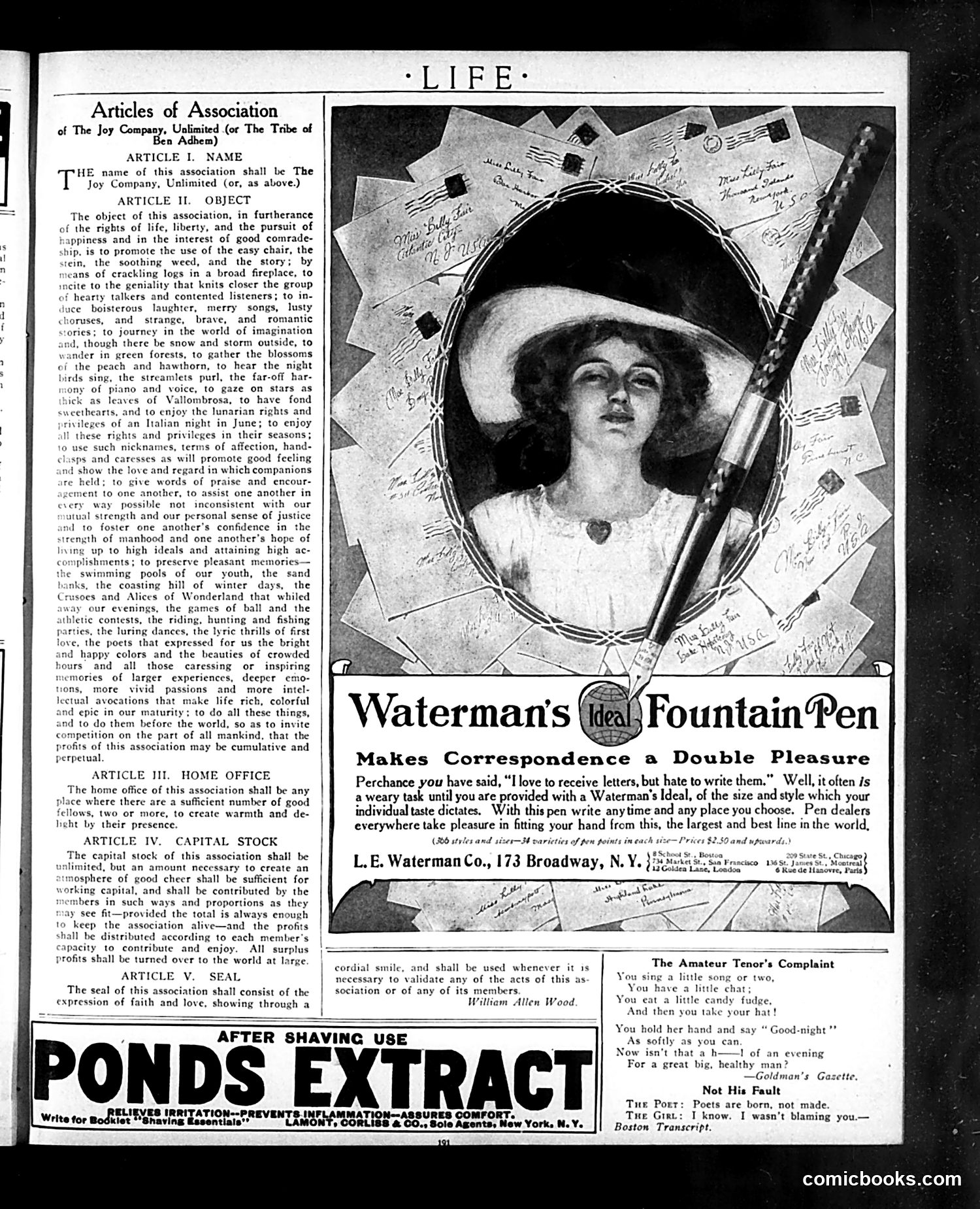
This page presents the satirical "Articles of Association" for "The Joy Company, Unlimited"—a mock organization devoted to pleasure, leisure, and companionship. The text parodies formal corporate bylaws while advocating for simple contentment: comfortable chairs, fireplaces, storytelling, laughter, romantic adventures, and cherished memories from youth. The satire targets the era's rigid formality and commercialism by treating joy itself as a business requiring official articles and capital stock. It's a gentle critique wrapped in nostalgia, celebrating pre-industrial pleasures (firelight, nature, unstructured socializing) against modernity. The page includes two advertisements—Waterman's Ideal Fountain Pen and Pond's Extract salve—typical period commercial placements. The humor lies in the contrast between the mock-serious organizational language and its frivolous subject matter.
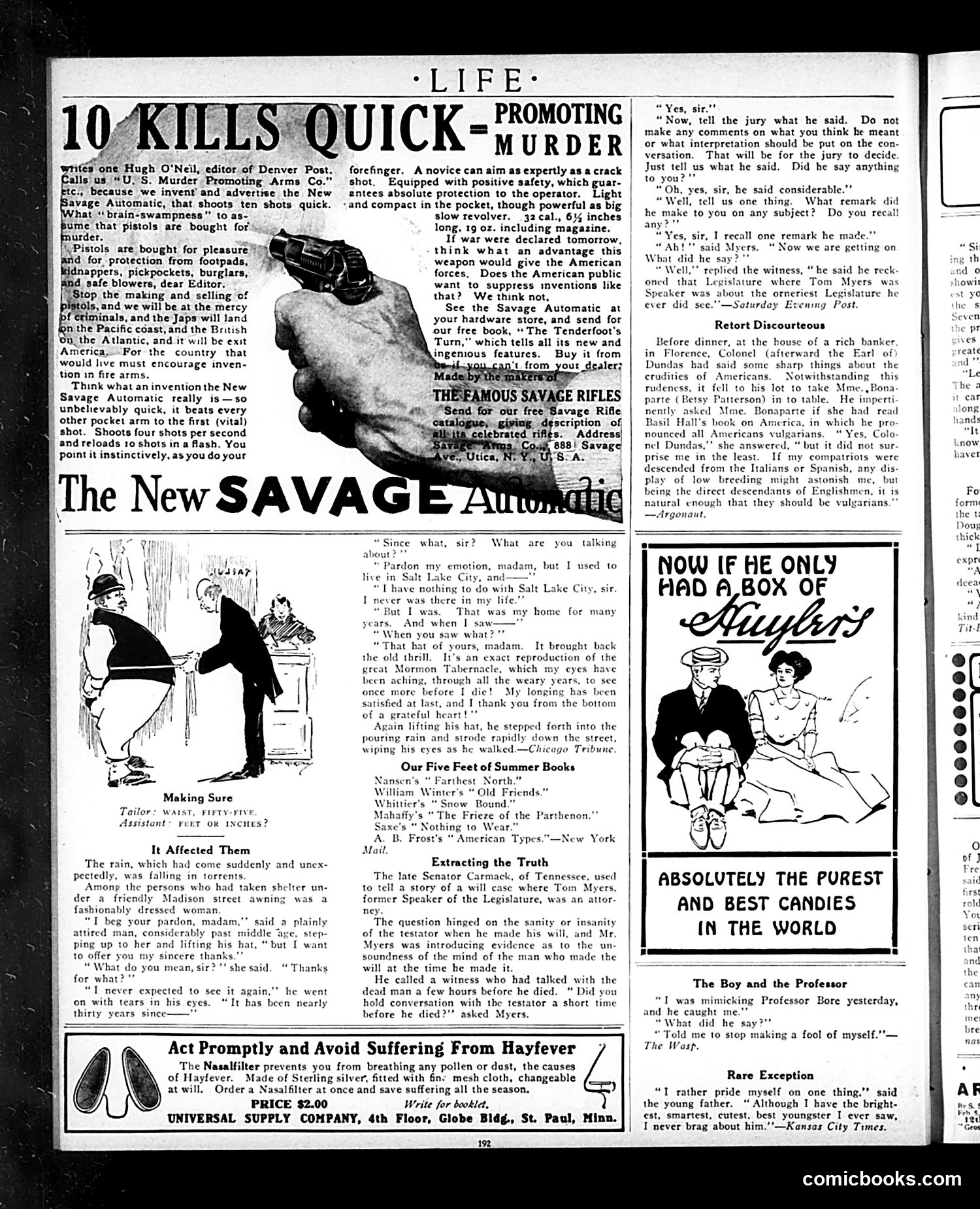
This page contains **advertisements and short humor pieces** rather than political cartoons. The dominant content is a **Savage Arms Company advertisement** promoting their automatic pistol. Notably, the ad directly addresses criticism from Hugh O'Neil (editor of the Denver Post) that the company is "promoting murder" by manufacturing quick-firing weapons. The company's response argues pistols are for legitimate protection and sport, not murder, and that suppressing such inventions would weaken America against foreign threats (mentioning Japan and Britain). **The humor pieces** include: - "Making Sure": A tailor measuring a customer's waist - "It Affected Them": A sentimental anecdote about a stranger thanking a woman for shelter - "Retort Discourteous": A story about Napoleon's wife cleverly insulting an Englishman - Various short jokes and observations The page reflects early 20th-century advertising practices and period attitudes toward firearms and manufacturing innovation.
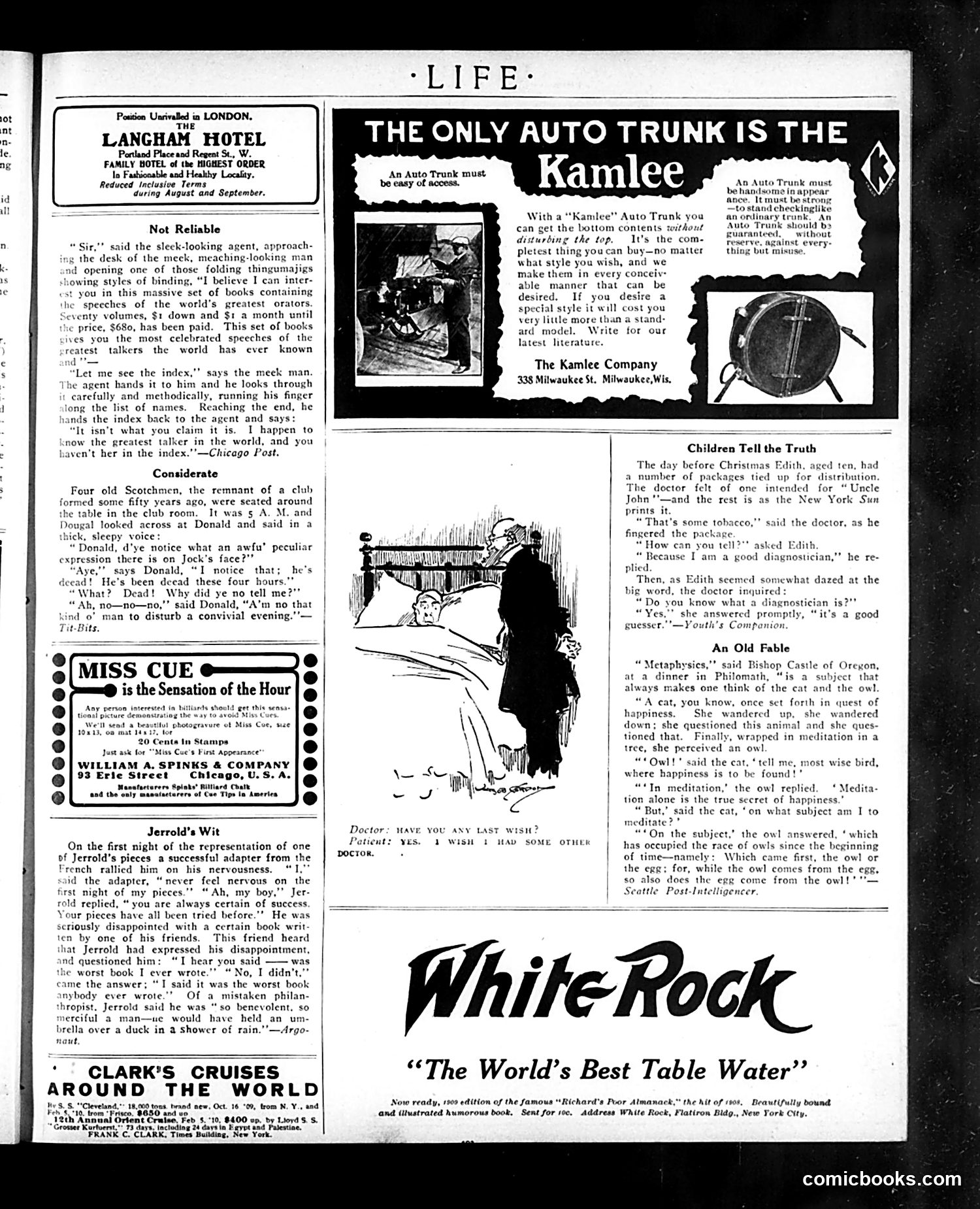
This page is primarily **advertisements and humorous short stories** rather than political satire. The main content includes: **Advertisements:** Hotel listings, the Kamlee auto trunk (a storage solution for early automobiles), White Rock table water, and Clark's world cruises. **Humor pieces:** - "Not Reliable" mocks a book salesman pitching an expensive 20-volume collection of world's greatest speeches to a meek man, who deflates him by noting the salesman omitted "the greatest talker in the world"—implying his wife. - "Considerate" jokes about Scottish clubmen discovering one member dead but deciding not to mention it to preserve the convivial evening. - "Children Tell the Truth" presents children's innocent but accurate medical observations. - "An Old Fable" retells a parable about a cat seeking happiness from an owl, emphasizing meditation. These are gentle, domestic humor pieces typical of early 20th-century American magazines—no particular political references or social commentary beyond light mockery of salesmen and domestic relations.
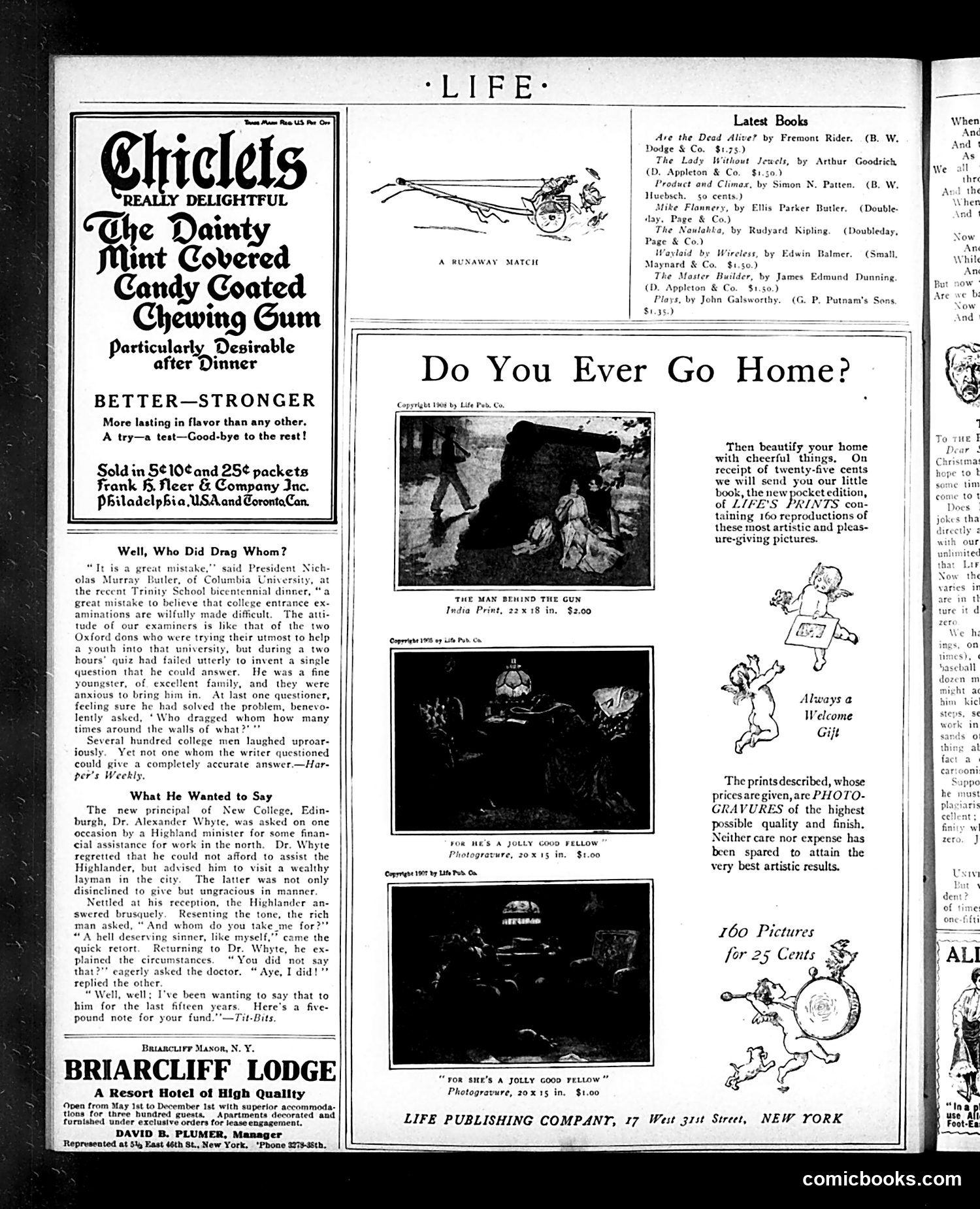
This page is primarily **advertising and promotional content** rather than political satire or comics. The main elements are: 1. **Chiclets gum advertisement** (left): A straightforward commercial for mint-covered chewing gum, marketed as "particularly desirable after dinner." 2. **Anecdotal humor pieces** ("Well, Who Did Drag Whom?" and "What He Wanted to Say"): These are brief, folksy stories about college entrance exams and a Scottish minister—gentle humor about academic pomposity and working-class directness, with no specific political targets. 3. **"Do You Ever Go Home?" feature** (center/right): Life Publishing promotes its own photogravure prints and book offerings, featuring atmospheric photographs titled "The Man Behind the Gun" and "For He's a Jolly Good Fellow." 4. **Briarcliff Lodge advertisement** (bottom left): A resort hotel promotion. The page reflects early 1900s magazine content—mixing light humor, advertisements, and self-promotion. There's no discernible political cartoon or satire with identifiable figures requiring historical context.
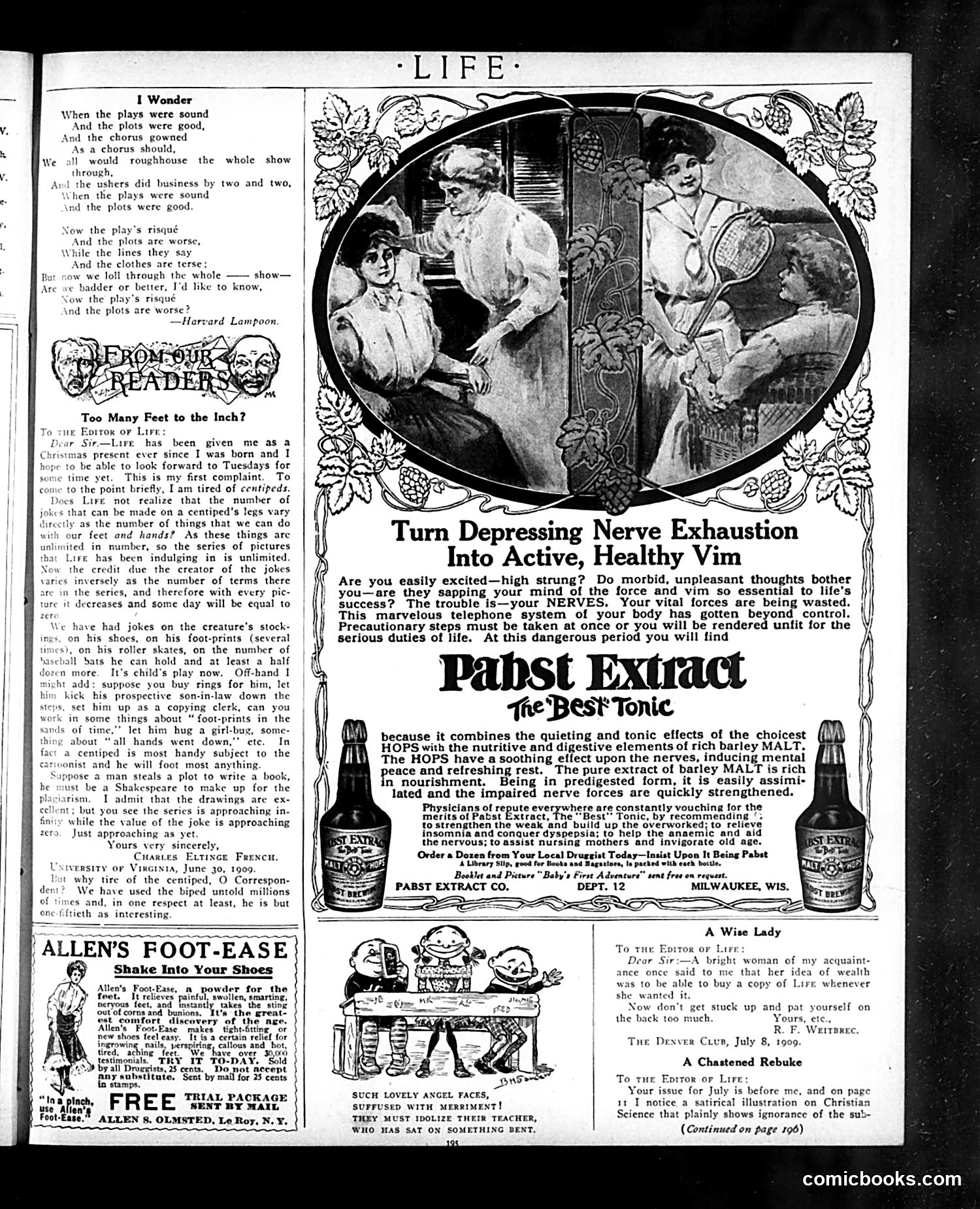
This page mixes satirical content with period advertising. The main cartoon element is "I Wonder," attributed to Harvard Lampoon, which critiques the decline of theatrical quality. It contrasts earlier eras when plays had sound plots and modest costuming against contemporary "risqué" productions with weak plots and skimpy clothing—satirizing the era's anxiety about modern entertainment's moral standards. The reader complaint about "Too Many Feet to the Inch" humorously attacks Life's repeated reliance on centipede jokes, arguing the publication has exhausted this gag by applying it to every conceivable scenario (stockings, shoes, roller skates, etc.), reducing satirical credit as variations multiply. The dominant feature is a Pabst Extract advertisement presenting a tonic as a cure for "nerve exhaustion"—a common early-1900s diagnosis. Period patent medicines often made dubious health claims; this ad specifically targets those experiencing anxiety, insomnia, or general weakness, reflecting contemporary preoccupations with nervous disorders. Allen's Foot-Ease powder advertisement appears below, typical of the era's foot-care products.
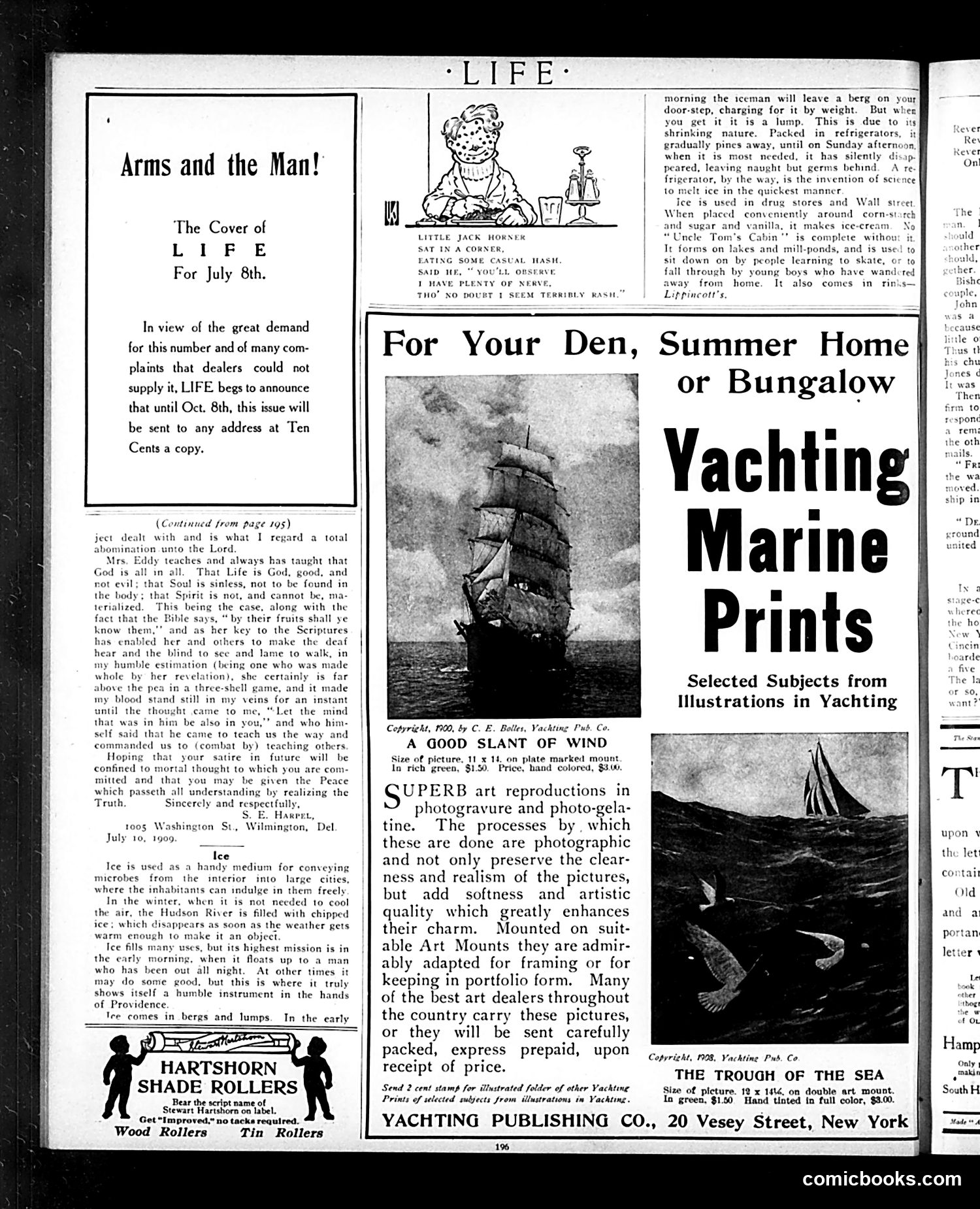
This page is primarily **advertising and administrative notices** with minimal editorial cartooning. The main content includes: 1. **"Arms and the Man!" announcement** — A notice that Life's July 8th cover issue is in high demand and will be reprinted through October 8th at ten cents per copy. 2. **"Little Jack Horner" cartoon** — A brief illustrated verse showing a figure eating "casual hash," with dialogue about having nerve despite appearing "terribly rash." This appears to be light satirical commentary, though the specific target is unclear from the visible text. 3. **"Ice" editorial** — A satirical piece mocking the ice delivery industry: icebergs shrink during delivery, arrive as "lumps," carry microbes from city interiors, and disappear when most needed on Sundays. It's gentle social satire about urban infrastructure failures. 4. **Nautical print advertisements** — The bulk of the page promotes yachting marine prints from Yachting Publishing Co., targeting affluent readers interested in summer homes and leisure imagery. The page reflects Life's mixed content model: light satire alongside upscale consumer advertising.
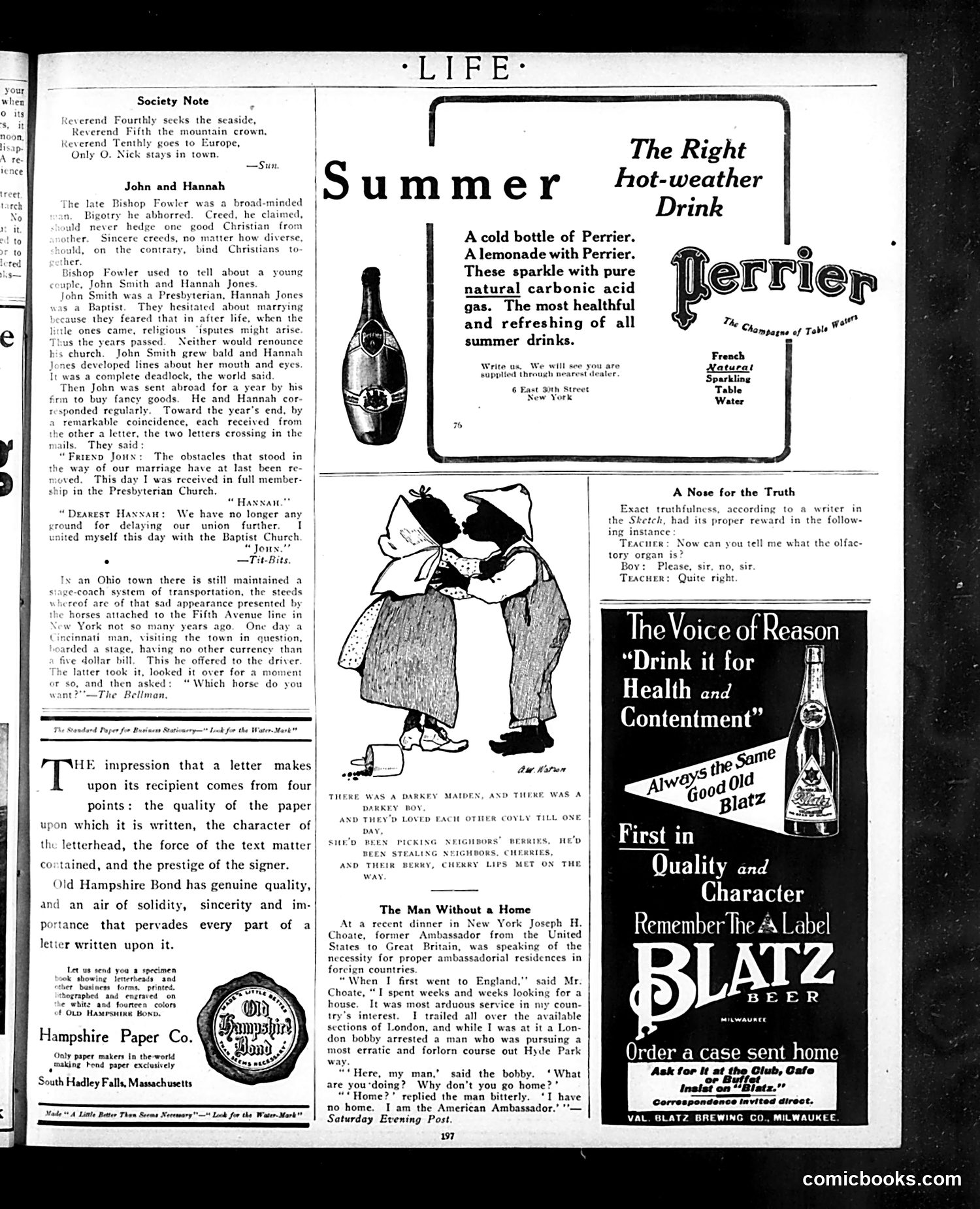
This page from *Life* magazine contains three distinct items: **"John and Hannah"** (top left): A sentimental story about a Presbyterian man and Baptist woman whose religious differences initially prevented marriage. The joke's punchline: while apart, each independently converts to the other's religion, removing the obstacle. The satire targets religious rigidity and the absurdity of denominational divisions among Christians. **"The Man Without a Home"** (bottom): Anecdote about Joseph H. Choate, a real former U.S. Ambassador to Britain, discussing housing difficulties. A London policeman arrests a homeless man and asks why he doesn't go home—the man replies he *is* the American Ambassador, implying even important officials struggle with housing. This mocks inadequate diplomatic accommodations. **Advertisements**: The page also features period beer and beverage ads (Perrier, Blatz Beer) emphasizing health claims—common in early 20th-century marketing. A small cartoon about "a darkey maiden" uses now-offensive racial terminology reflecting the era's casual racism in supposedly progressive publications.
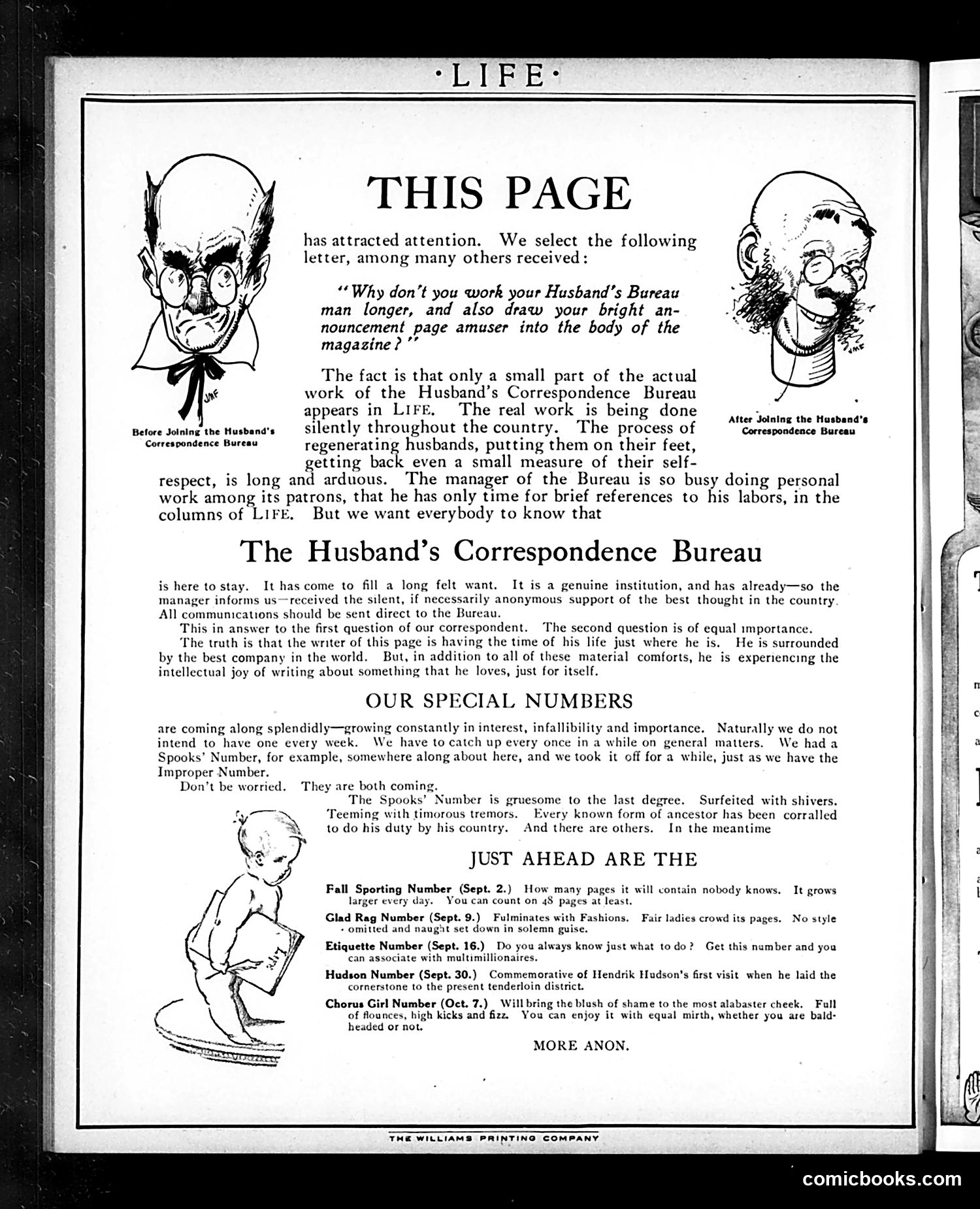
This is a satirical **advertorial** for Life magazine's fictional "Husband's Correspondence Bureau"—a humorous recurring feature. The two caricatured heads (labeled "Before" and "After") represent husbands supposedly "regenerated" by the Bureau's intervention. The satire targets **early 20th-century marriage dynamics**, mocking the idea that wives needed an institutional service to reform or improve their husbands. The Bureau's claim to work "silently throughout the country" regenerating husbands and restoring their "self-respect" is presented as a serious institution, but the exaggerated language and cartoon illustrations reveal it as tongue-in-cheek social commentary on marital discord. The page also promotes Life's upcoming "Special Numbers"—themed issues like the "Fall Sporting Number," "Chorus Girl Number," and others—demonstrating the magazine's editorial strategy of publishing occasional special editions alongside regular issues.
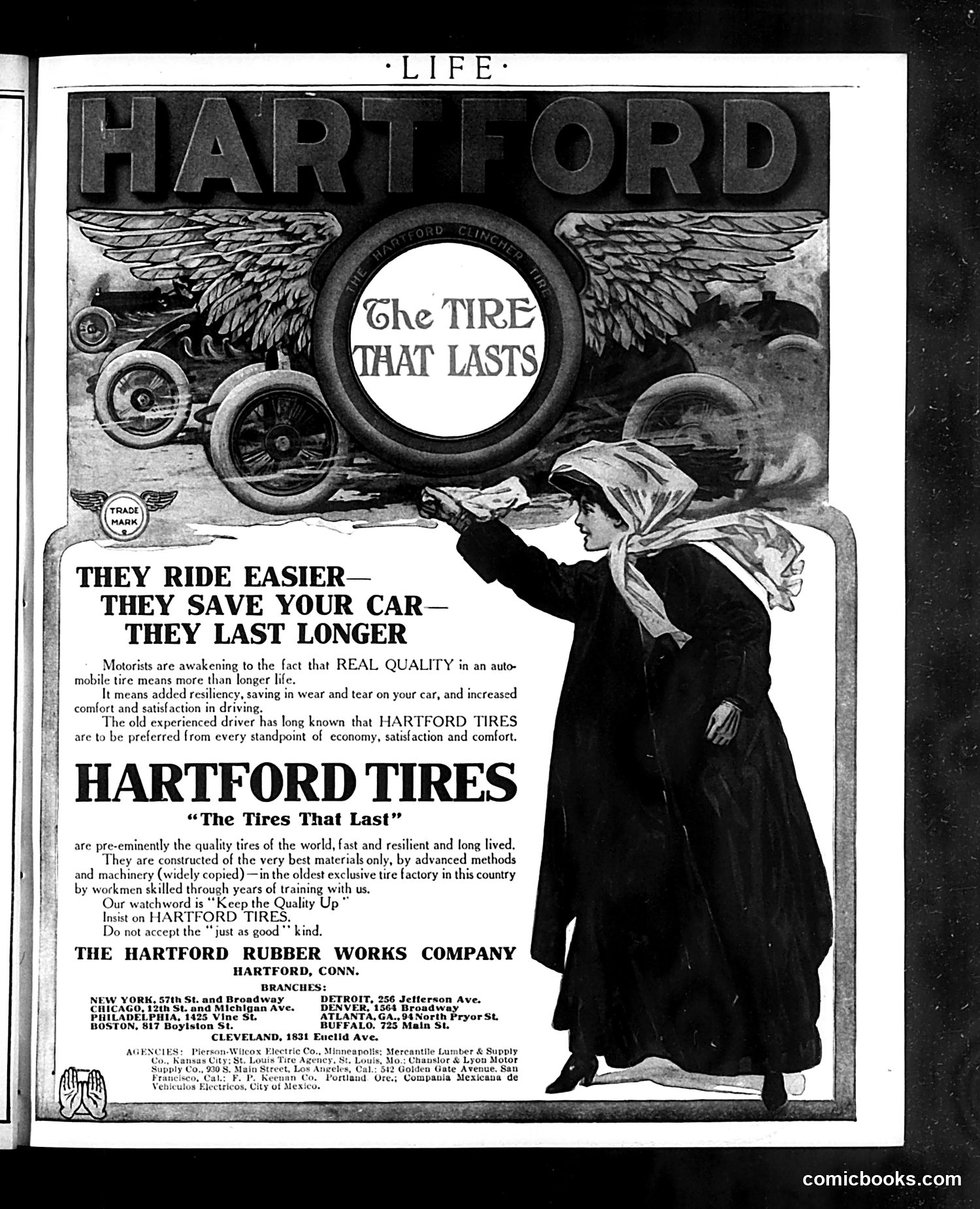
This is a **commercial advertisement**, not political satire. The page promotes Hartford Tires, a real automobile tire manufacturer based in Hartford, Connecticut. The imagery depicts a winged tire (suggesting speed and quality) alongside vintage early-1900s automobiles, with an illustrated woman in period dress pointing toward the product. The visual metaphor of wings suggests reliability and superior performance. The advertisement's messaging targets motorists by emphasizing practical benefits: durability ("The Tires That Last"), economy, and driving comfort. The copy positions Hartford Tires as premium quality, contrasting them against cheaper competitors ("Do not accept the 'just as good' kind"). This reflects early automotive-era marketing when tire quality significantly affected vehicle performance and safety. The company lists multiple U.S. branch offices and agencies, indicating substantial national distribution during what appears to be the 1910s-1920s period. There is no political commentary or satire present on this page.
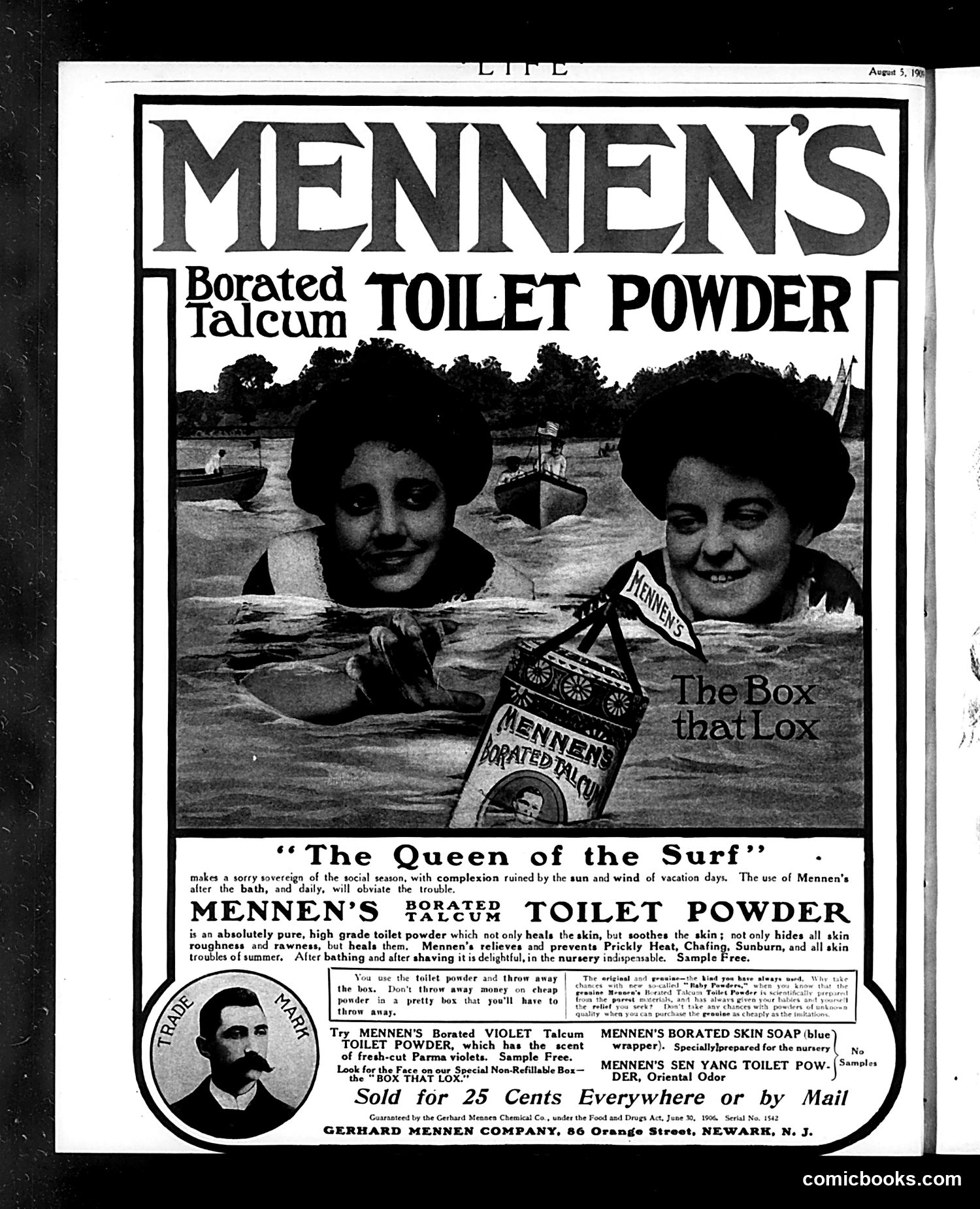
This is primarily a **product advertisement**, not political satire. It uses humor to sell toilet powder by mocking women's sun-damaged complexions from summer vacation. The image shows two women's heads emerging from water, captioned "The Queen of the Surf"—a satirical title suggesting that vacation beauty comes at a cost. The joke: a woman who spends summer at the beach gains a suntan and weathered skin, ruining her complexion. The solution: Mennen's Borated Talcum Toilet Powder, marketed as a remedy for sunburn, prickly heat, and skin roughness. The ad also promotes related Mennen's products (violet-scented powder, skin soap, Oriental-scented powder) and emphasizes value—mocking "cheap powder in a pretty box that you'll have to throw away." Published August 5, 1906, this reflects early-20th-century beauty standards: pale skin was desirable for women; tanned skin suggested lower-class outdoor labor, making this product aspirational for middle-class consumers.