
Life, 1909-08-05 · page 10 of 44
Life — August 5, 1909 — page 10: what you’re looking at
What you’re looking at
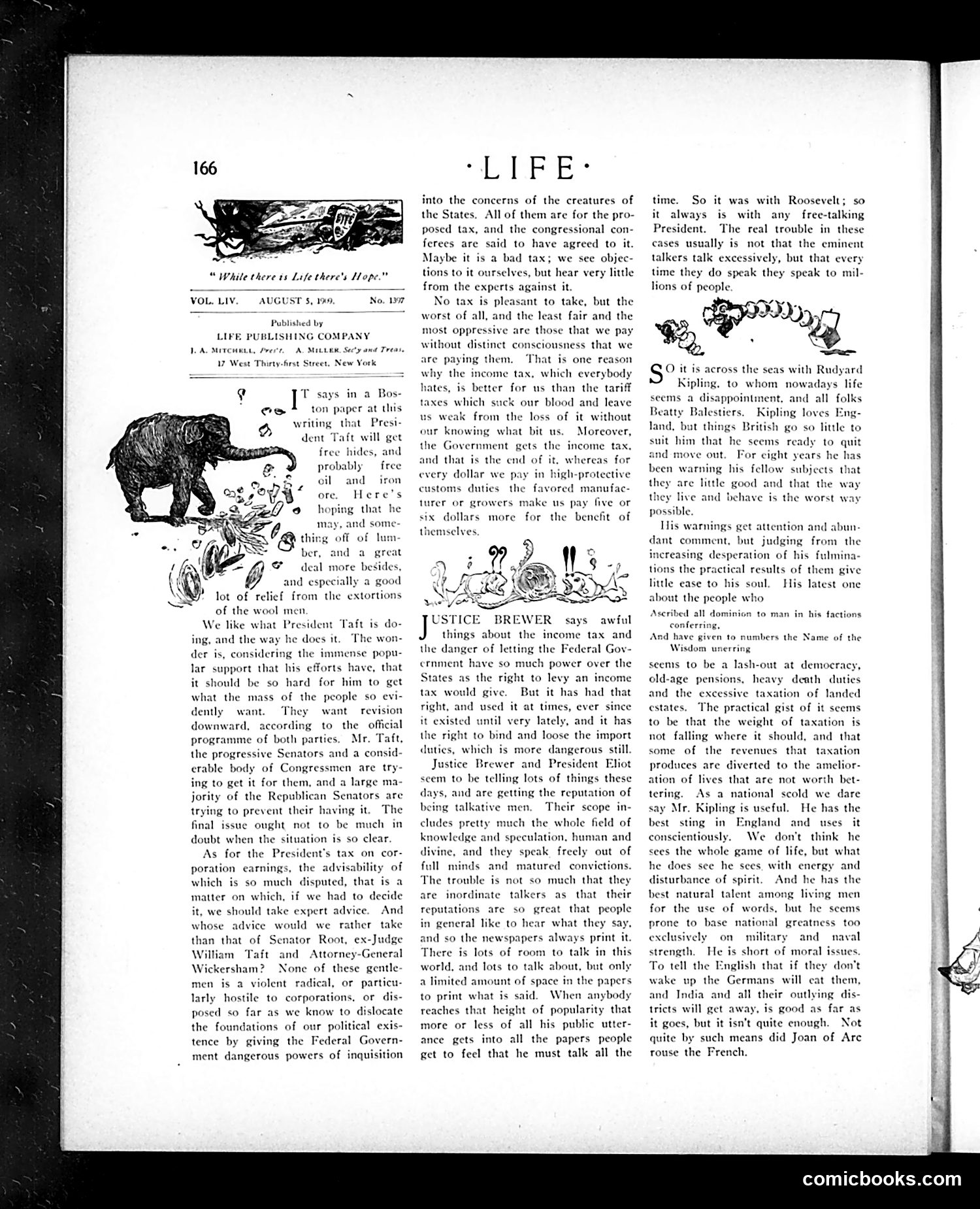
This page from *Life* magazine (Vol. LIV, August 5, dated No. 1397) contains editorial commentary criticizing the income tax and expanding federal government power. The text references President Taft and debates over tax policy, mentioning Justice Brewer's warnings about giving the Federal Government excessive power over states. The left side features an illustration of an elephant (likely representing the Republican Party or government apparatus) appearing to crush or burden smaller figures below—a visual metaphor for how taxation and federal authority oppress citizens. The commentary argues the income tax is unfair and gives dangerous powers to the Federal Government, reflecting early 20th-century conservative opposition to progressive taxation and federal expansion.
📄 Transcribed text from this page (OCR, searchable)
Machine-transcribed from the original scan — historical spelling and the odd misread are preserved.
“ While there ts Life there's Hop AUGUST 5$, 199, VOL. LIV. Published by LIFE PUBLISHING COMPANY 1A. Merentnnt, AM 17 West Thirty-first $ Prev Lam. Secty amt Treas. says in a B ton paper at tl writing that’ Presi dent Taft will get iree hides, and probably — free oil and ore. Here's hoping that he nd some- of lum iron and a great deal more besides, nd especially a good lot of relief from the extortions of the wool men We like what ing, and the way he does it der is, considering the immense popu- lar support that his efforts have, that it should be so hard for him to get what the mass of the people so evi- dently want. They want revision downward, according to the official programme of both parties. Mr. Taft, the progressive Senators and a consid- erable body of Congressmen are try- ing to get it for them, and a large ma- jority of the Republican Senators are trying to prevent their having it, The final issue ought not to be much in doubt when the situation is so clear. As for the President's tax on cor- poration earnings, the advisability of which is so much disputed, that is a matter on which, if we had to decide And take Taft is do- ‘The won- Preside it, we should take expert advice. whose would we rather than that of Senator Root, ex-Judge William Taft’ and Attorney-General Wickersham? None of these gentle- men is a violent radical, or particu- corporations, or dis- we know to dislocate the foundations of our political exis- tence by giving the Federal Govern- ment dangerous powers of inquisition advice larly hostile to posed so far as “aL FE * into the concerns of the creatures of the States. All of them are for the pro- posed tax, and the congressional con- ferees are said to have agreed to it. Maybe it is a bad tax; we see objec- tions to it ourselves, but hear very little from the experts against it. No tax is pleasant to take, but the worst of all, and the least fair and the most oppressive are those that we pay without distinct consciousness that we are paying them. That is one reason why the income tax, which everybody hates, is better for us than the tariff taxes which suck our blood and leave us weak from the loss of it without our knowing what bit us. Moreover, the Government gets the income tax. and that is the end of it, whereas for every dollar we pay in high-protective customs duties the favored manufac- turer or growers make us pay five or six dollars more for the benefit of themselves. USTICE BREWER | says awful things about the income tax and the danger of letting the Federal Gov- crnment have so much power over the States as the right to levy an income tax would give. But it has had that right, and used it at times, ever since it existed until very lately, and it has the right to bind and loose the import duties, which is more dangerous still. Justice Brewer and President Eliot seem to be telling lots of things these days, and are getting the reputation of being talkative men. Their scope in- cludes pretty much the whole field of knowledge and speculation, human and divine, and they speak freely out of full and matured convictions. The trouble is not so much that they talkers as that their people minds are inordinate reputations are so great that in general like to hear what they say, and so the newspapers always print it There is lots of room to talk in this world, and lots to talk about, but only a limited amount of space in the papers to print what is said. When anybody reaches that height of popularity that more or less of all his public utter- ance gets into all the papers people get to feel that he must talk all the So it was with Roosevelt; so it always is with any free-talking President. The real trouble in these cases usually is not that the eminent talkers talk excessively, but that every time they do speak they speak to mil- lions of people O it is across the seas with Rudyard Kipling, to whom nowadays life seems a disappointment, and all folks Beatty Balestiers. Kipling loves Eng- land, but things British go so little to suit him that he seems ready to quit nd move out. For cight years he has been warning his fellow subjects that they are little good and that the way live and behave is the worst way possible. time. His warnings get attention and abun- dant comment, but judging from the increasing desperation of his fulmina- tions the p: al results of them give little ease to his soul, His latest one about the people who Ascribed all doi to man in his factions conferri And ha Wisdom ur given to numbers the Name of the erring seems to be a lash-out at democracy, old-age pensions, heavy death duties and the excessive taxation of landed estates, The practical gist of it seems to be that the weight of taxation is not falling where it should, and that some of the revenues that taxation produces are diverted to the amelior- ation of lives that are not worth bet- tering. As a national scold we dare say Mr. Kipling is useful. He has the best sting in’ England and uses it conscientious]. We don't think he sees the whole game of life, but what he does see he sees, with energy and disturbance of spirit. And he has the best natural talent among living men for the use of words, but he seems prone to base national greatness too exclusively on military and naval strength. He is short of moral issues. To tell the English that if they don’t wake up the Germans will cat them, and India and all their outlying dis- tricts will get away, is good as far as it goes, but it isn’t quite enough. Not quite by such means did Joan of Arc rouse the French. comicbooks.com