
A complete issue · 28 pages · 1909
Life — July 22, 1909
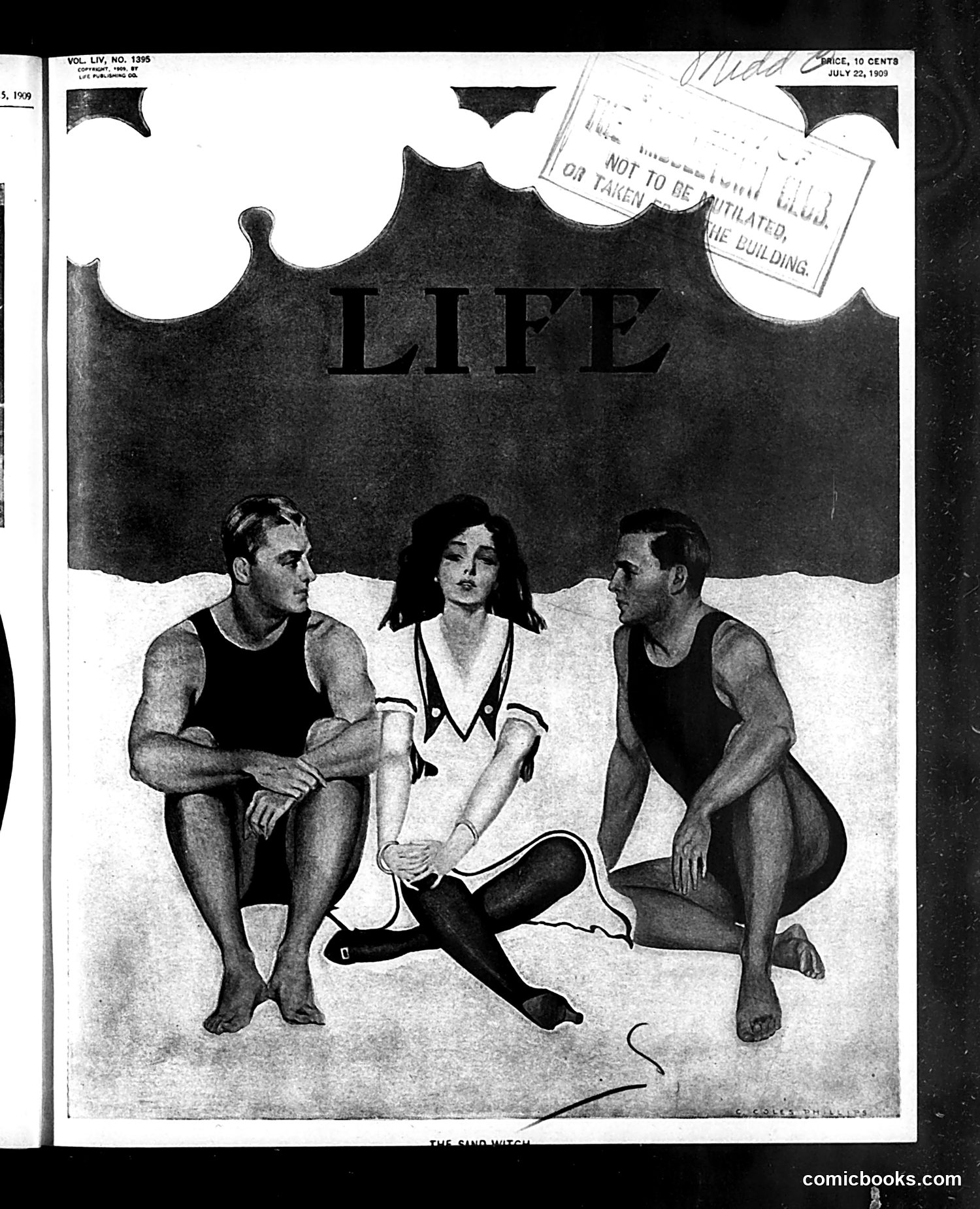
This 1909 *Life* magazine cover depicts three figures in swimwear on a beach beneath the word "LIFE." The composition suggests a romantic or social scenario—a woman seated between two men in casual beach attire. The title "The Sand Watch" appears to be a pun, likely referencing both an hourglass (sand watch) and the act of observing on the beach. The satire probably comments on beach culture, courtship rituals, or social dynamics of the Edwardian era—possibly mocking either the woman's divided attention between suitors or broader anxieties about modern leisure and gender relations. The specific social commentary remains unclear without additional context, though the intimate grouping suggests commentary on romantic or flirtation conventions.
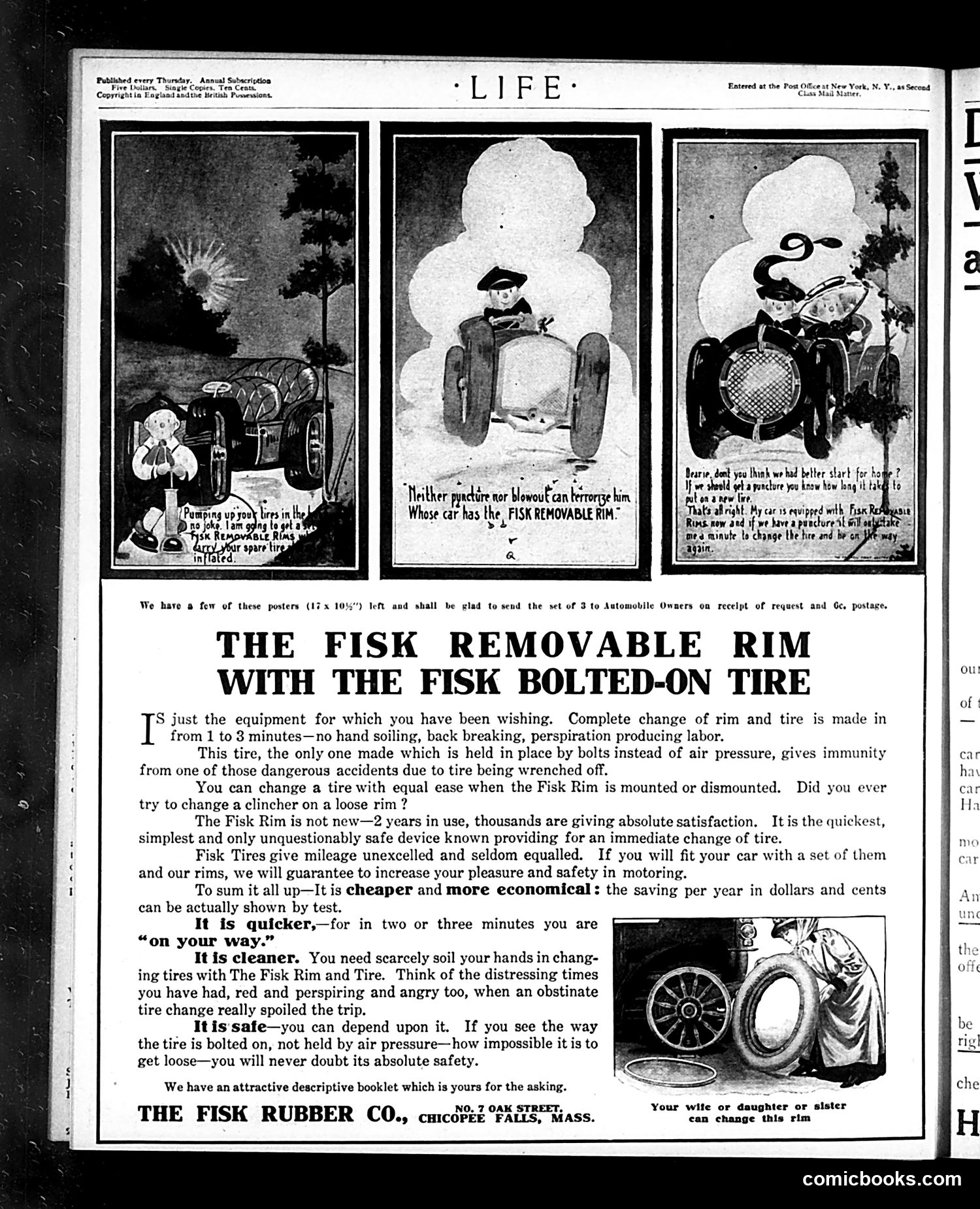
This page is primarily **advertising, not satire or political commentary**. The top third contains three cartoon panels promoting the Fisk Removable Rim with Bolted-On Tire—an early automotive innovation allowing quick tire changes without air pressure. The cartoons humorously depict tire-change scenarios: a driver stranded at night, someone stuck with a puncture, and a motorist explaining the superiority of bolted rims to skeptics. These use relatable frustrations of early motoring (flat tires, difficult changes) as advertising hooks. The text emphasizes the product's speed, cleanliness, and safety compared to traditional air-pressure tires. The final panel shows "Your wife or daughter or sister can change this rim"—reflecting period assumptions about women's capabilities and the product's ease of use. This is straightforward commercial content, not political satire.
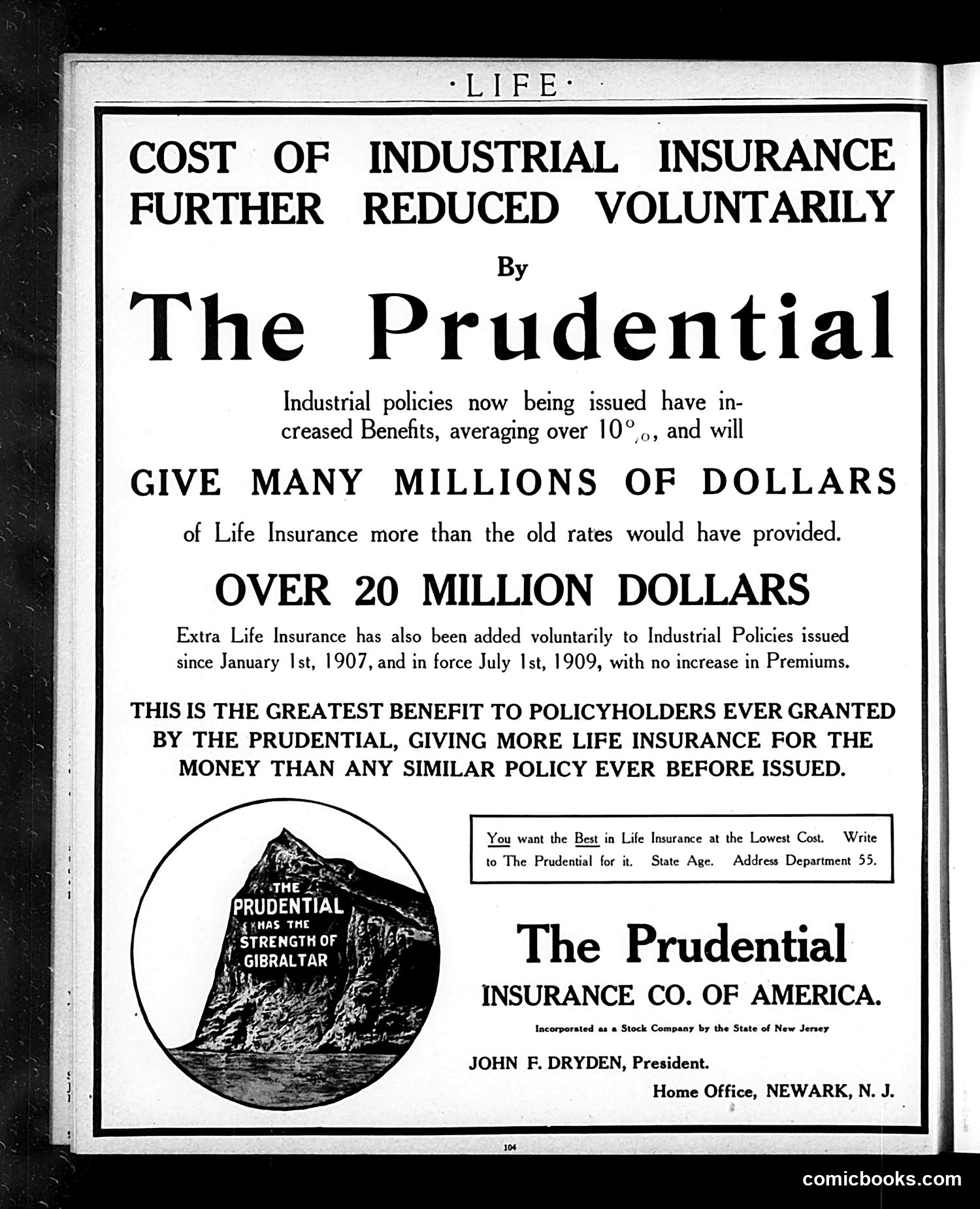
This page is **primarily an advertisement**, not satirical content. It promotes The Prudential Insurance Company of America's industrial life insurance policies. The ad announces that Prudential has voluntarily reduced costs on industrial insurance policies by over 10%, providing "many millions of dollars" in additional benefits to policyholders—specifically over $20 million in extra life insurance coverage added since January 1, 1907, with no premium increase. The only visual element is Prudential's corporate logo: the Rock of Gibraltar in a circle, with text reading "The Prudential Has the Strength of Gibraltar." This was the company's famous trademark, symbolizing stability and reliability. The ad targets working-class industrial workers by emphasizing affordability and value—"more life insurance for the money than any similar policy ever before issued."
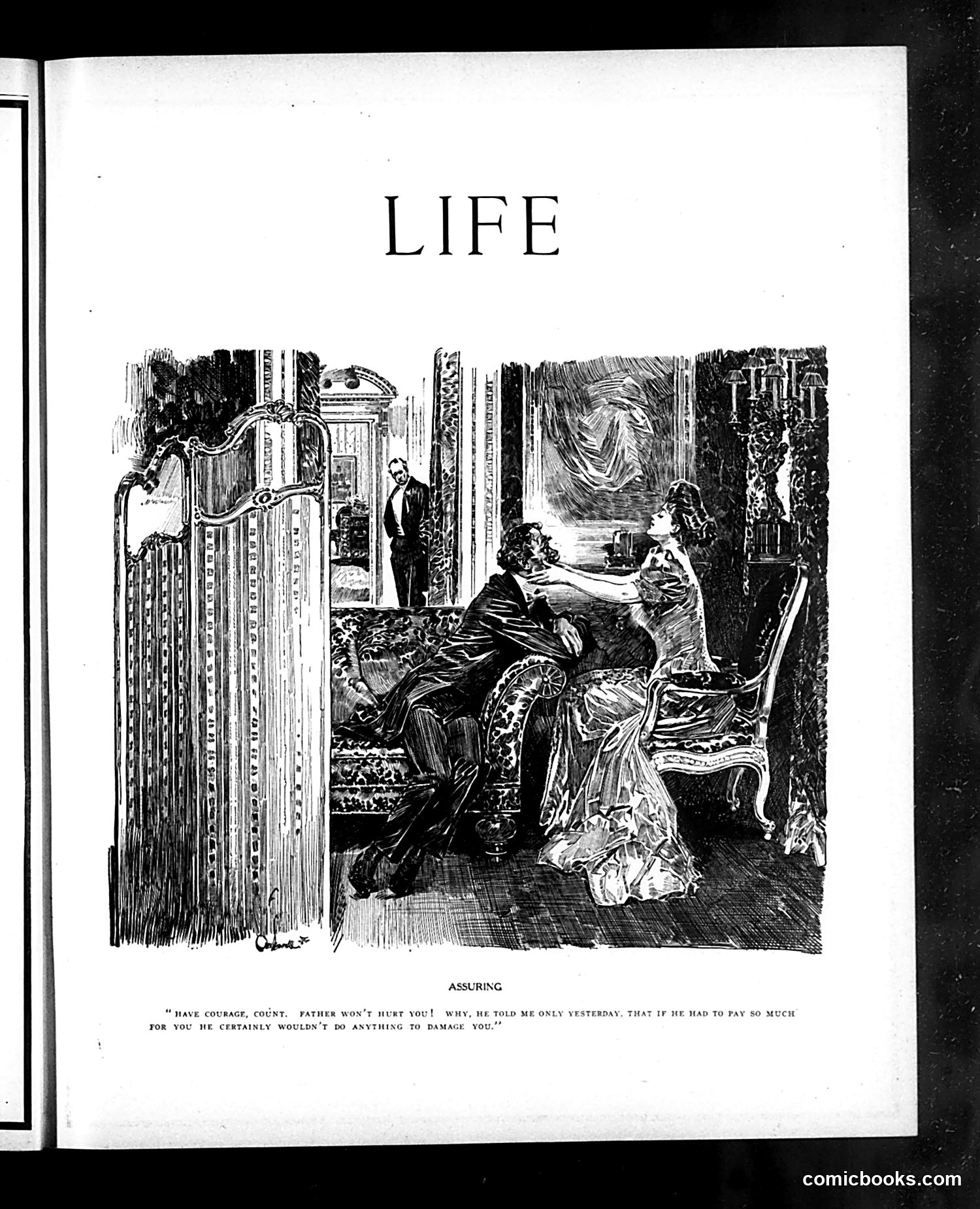
This illustration depicts a wealthy domestic scene where a man reassures a woman (likely his romantic interest or wife) about financial security. The caption reads: "Have courage, count. Father won't hurt you! Why, he told me only yesterday, that if he had to pay so much for you he certainly wouldn't do anything to damage you." The satire targets the commodification of women in upper-class society, particularly through marriage arrangements. The woman is positioned as a financial investment or property—her "value" measured in what her father demands as compensation. The man's reassurance ironically emphasizes this transactional view: she's protected not out of affection, but because she represents a substantial monetary investment he won't damage. The joke critiques materialistic marriage practices among the wealthy.
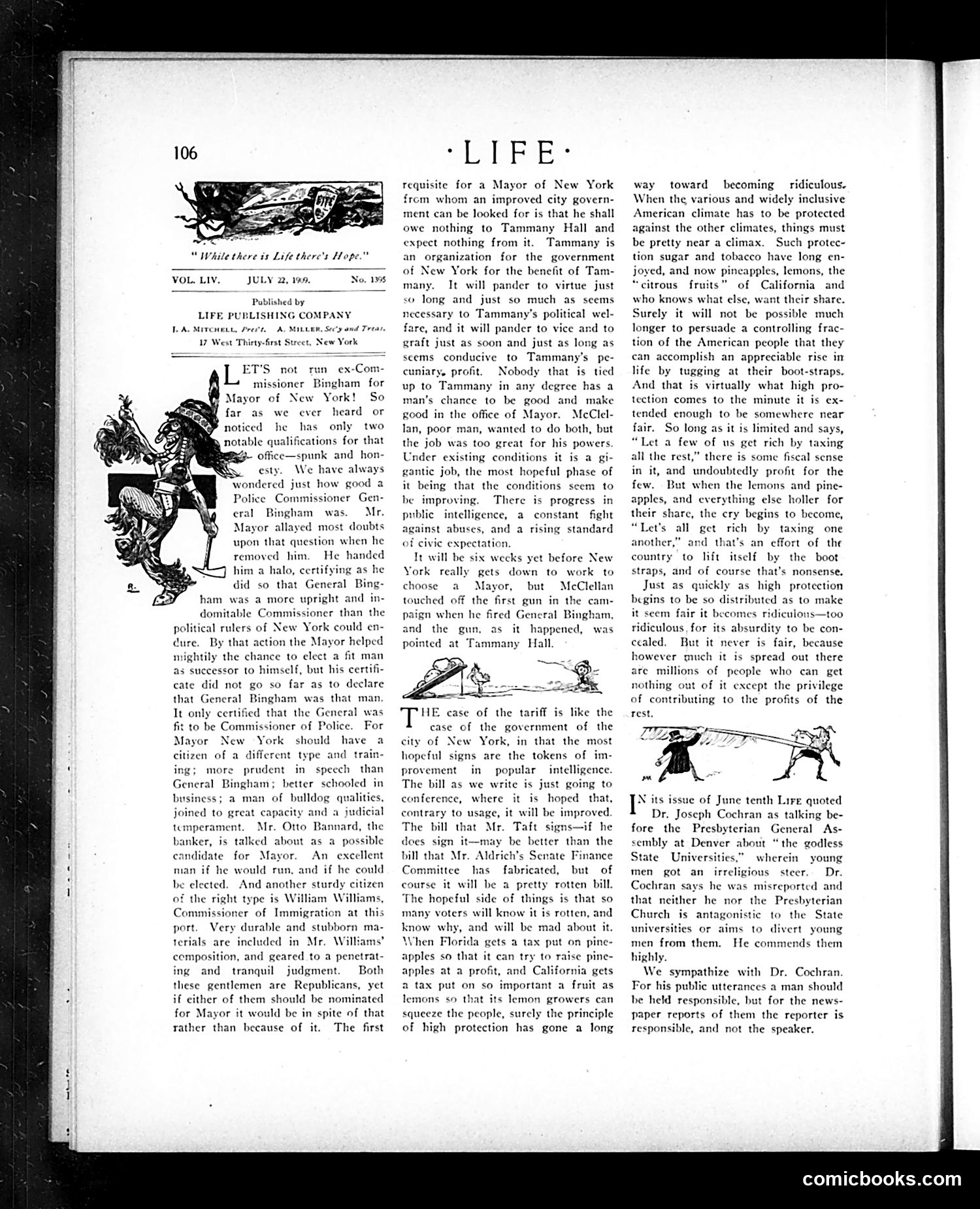
The page satirizes New York City politics, specifically criticism of Police Commissioner Bingham's tenure. The text mocks efforts to make him Mayor, arguing he's unqualified despite his "upright" reputation—being a good police commissioner doesn't make someone fit for higher office. The cartoon (upper left) depicts a figure in classical/theatrical dress, likely Bingham, appearing foolish or out of place—suggesting he'd be ridiculous in a mayor's role. The article also discusses tariff politics and Dr. Joseph Cochran's Presbyterian General Assembly speech opposing state universities, viewing them as threats to religious education. The overall tone is skeptical of political ambitions, institutional competence, and progressive educational policies typical of 1908 reform debates.
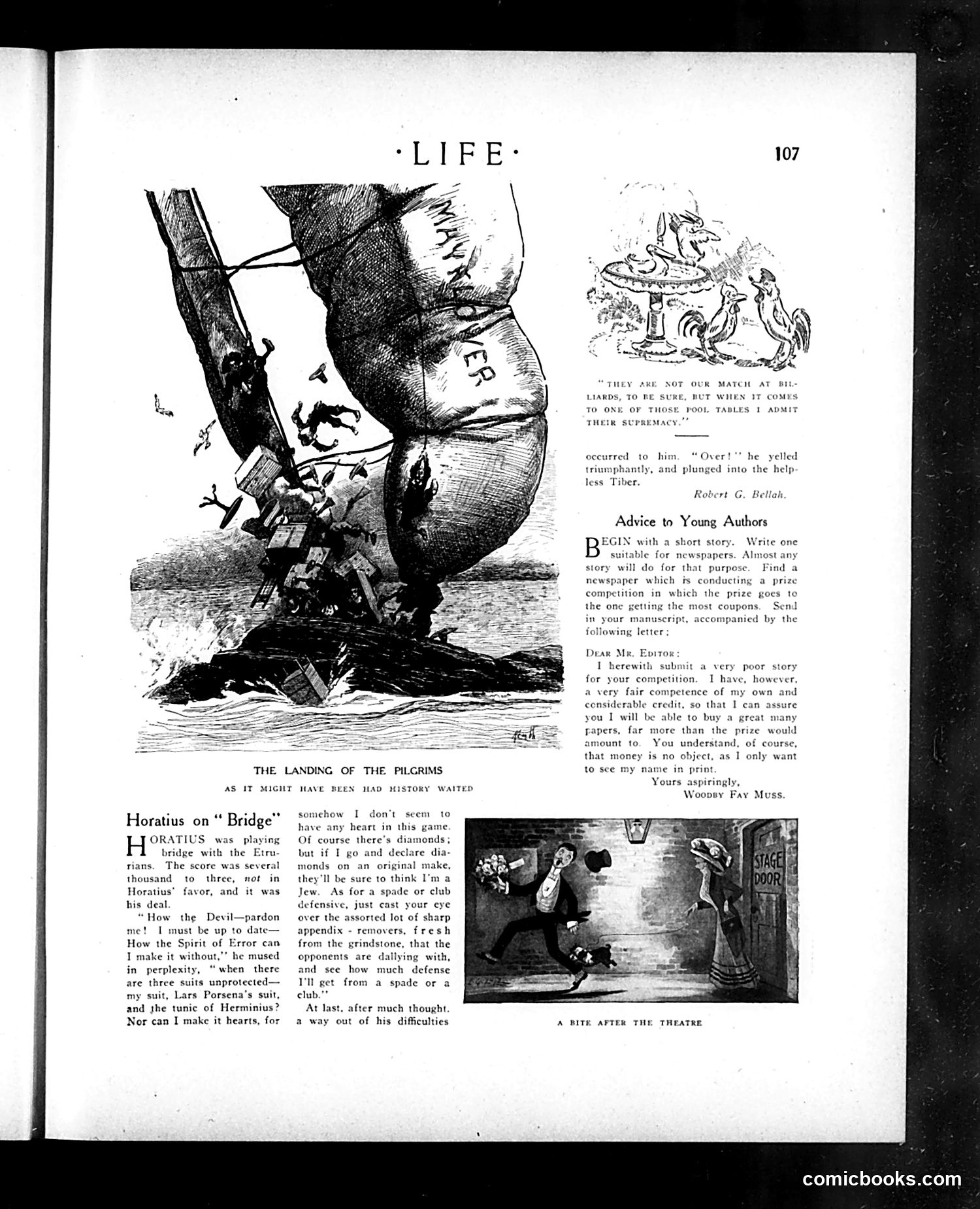
This page contains a satirical story titled "Horatius on 'Bridge'" about a card game where the protagonist Horatius plays bridge against opponents including "the Emir" and "Lars Porsena's suit." The narrative uses classical Roman references (Horatius, Lars Porsena) as humorous framing for what appears to be a contemporary bridge-playing scenario. The large left illustration shows "The Landing of the Pilgrims as it Might Have Been Had History Waited"—a surreal inversion where a massive boot crushes pilgrims and their ship, subverting the reverent historical narrative. This visual joke mocks nostalgic American mythology by presenting an absurdist "what if" scenario. The page also includes "Advice to Young Authors," showing Life's typical mix of humor, cultural commentary, and reader engagement through competitions and correspondence.
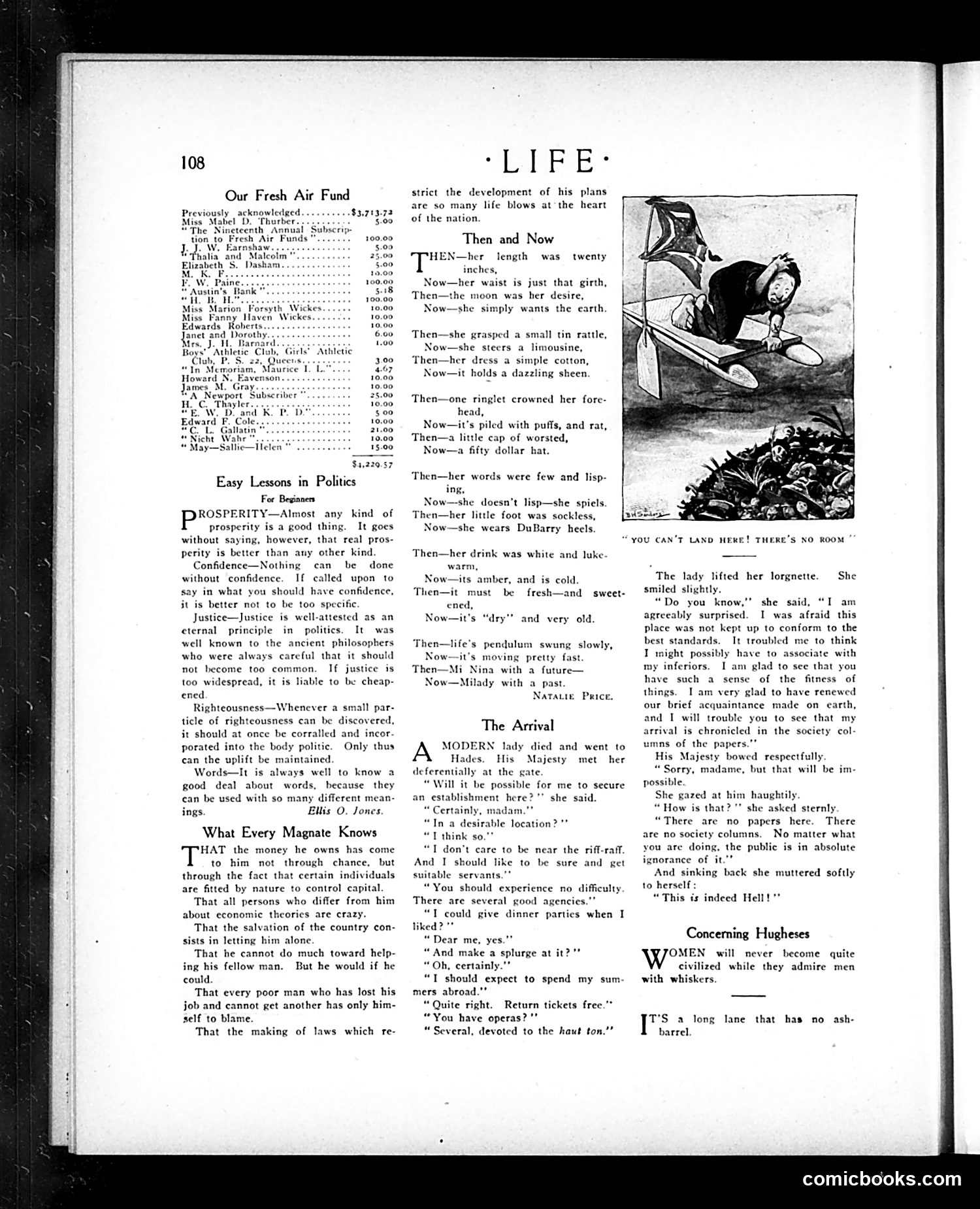
This page contains several distinct pieces: **"Then and Now"** is a poem contrasting a woman's past (twenty inches long, moonlit desires, simple pleasures) with her present (waist that girth, wanting earth, wearing a limousine and dollar hat). The accompanying illustration shows a woman in an elaborate hat unable to fit through a doorway—visual satire on modern women's excessive fashion and materialism compared to simpler times. **"Easy Lessons in Politics"** and **"What Every Magnate Knows"** appear to be satirical advice columns critiquing capitalism and social inequality, though text is partially cut off. **"The Arrival"** presents a comedic dialogue between a modern woman and Hades, satirizing upper-class pretension and social expectations about servants and propriety even in the afterlife. The overall theme mocks contemporary society's materialism and affectation among wealthy women.
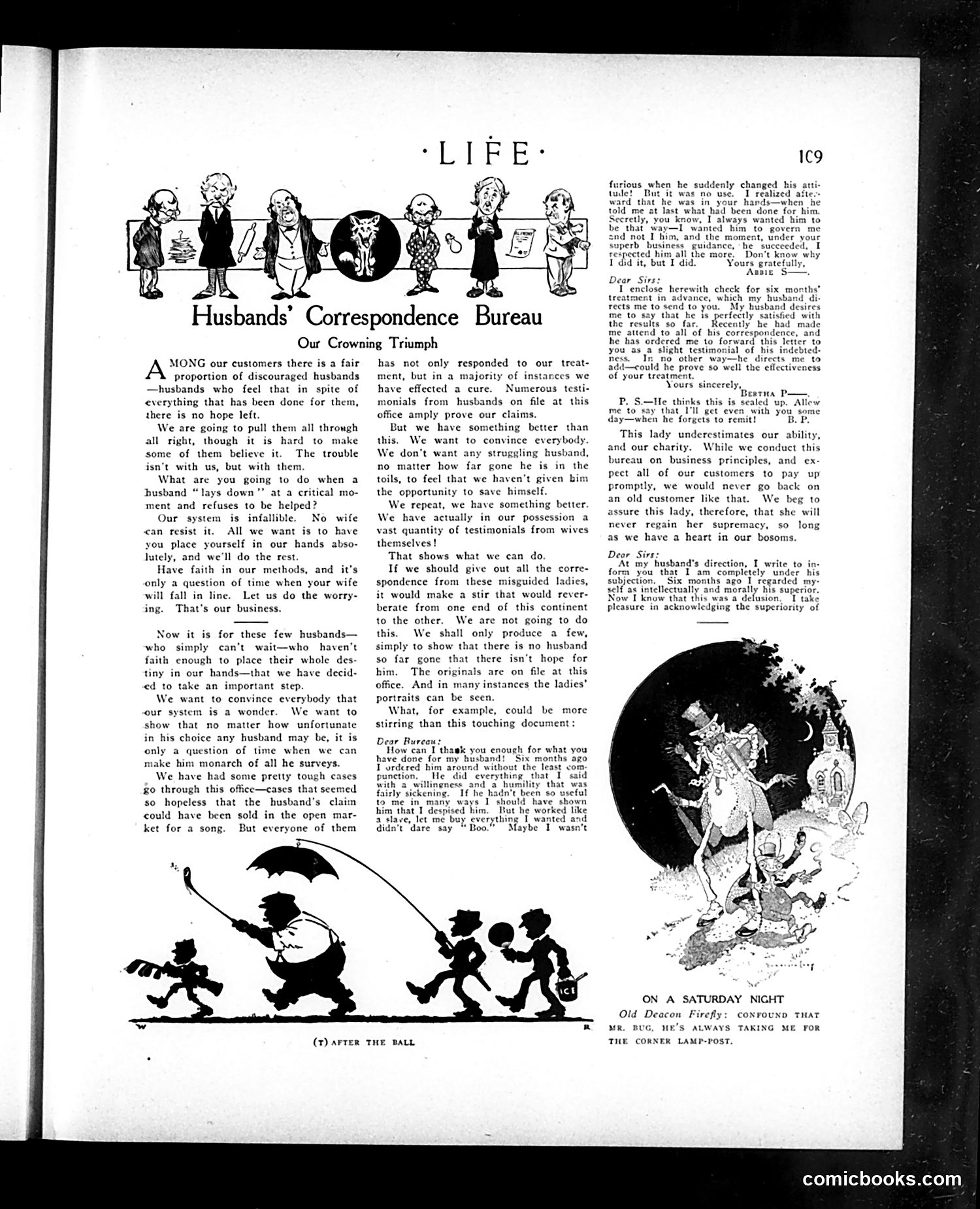
This satirical piece mocks a fictional service claiming to reform wayward husbands. The text claims their bureau has successfully improved husbands' behavior through correspondence with wives, using testimonials as "proof." The cartoon below, titled "(?) After the Ball," shows a silhouetted man being chased by children with umbrellas in the rain—suggesting chaos or misadventure following an evening out. The right illustration, "On a Saturday Night," depicts "Old Deacon Firefly" consistently taking "the corner lamp-post" (likely slang for drinking at a specific location), implying habitual misbehavior. The satire targets both the false advertising of "reform" services and the futility of trying to change husbands' established habits through mere correspondence—a commentary on marital frustration and masculine behavior circa early 1900s.
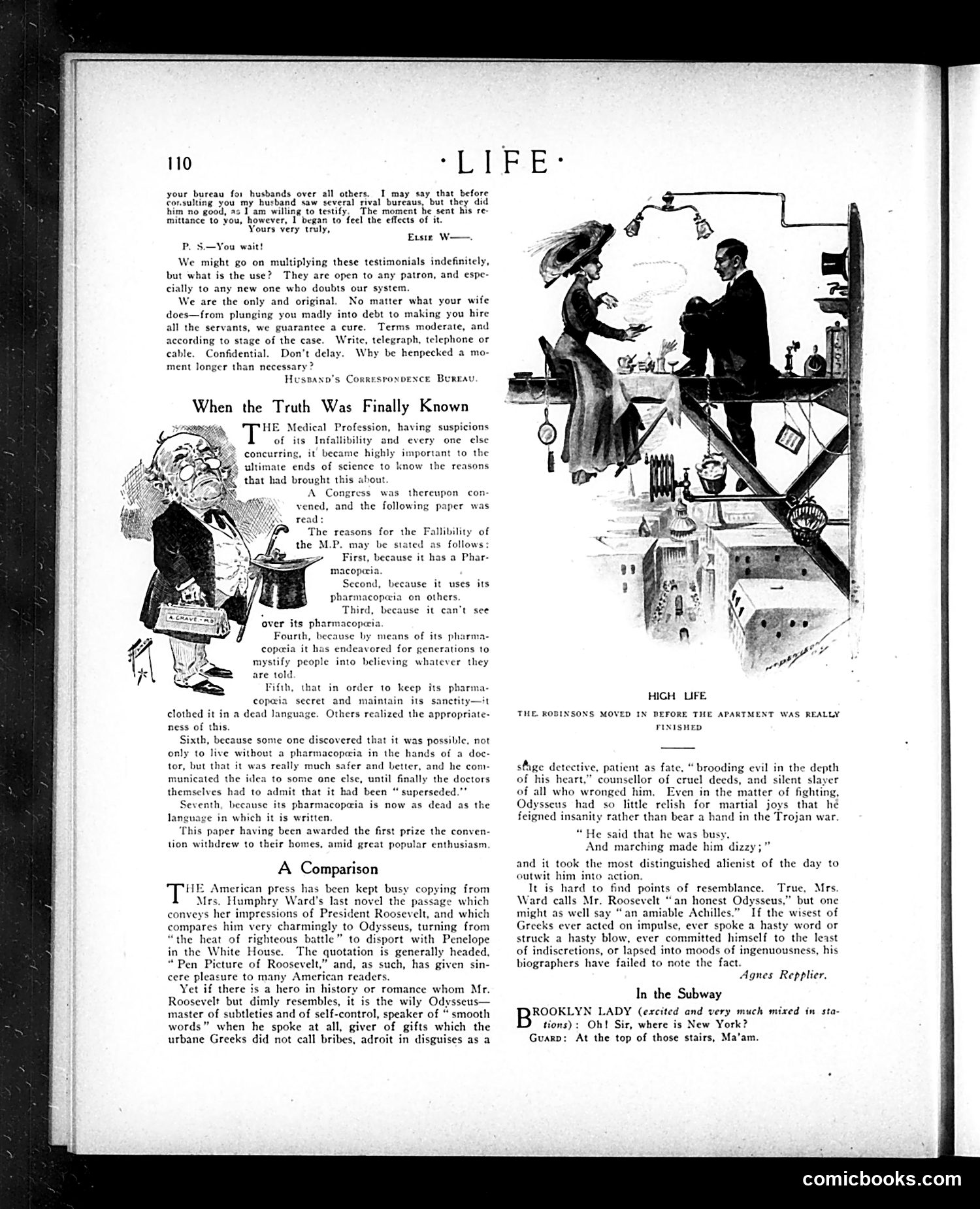
This page satirizes the medical profession's credibility problems through a mock-serious "Congress" format. The left illustration shows a caricatured doctor figure presenting reasons why the Medical Profession has lost public trust, including: it uses pharmacopoeia (medical knowledge) on unsuspecting patients, can't see beyond its own narrow perspective, and maintains secrecy to preserve authority rather than serve patients. The right illustration depicts a domestic scene labeled "High Life," showing a couple in what appears to be a doctor's office or consultation setting, likely illustrating the practical consequences of medical incompetence or deception in everyday life. The text below includes a comparative section about American press coverage and a satirical dialogue "In the Subway," suggesting broader cultural commentary on trustworthiness and authority during this era.
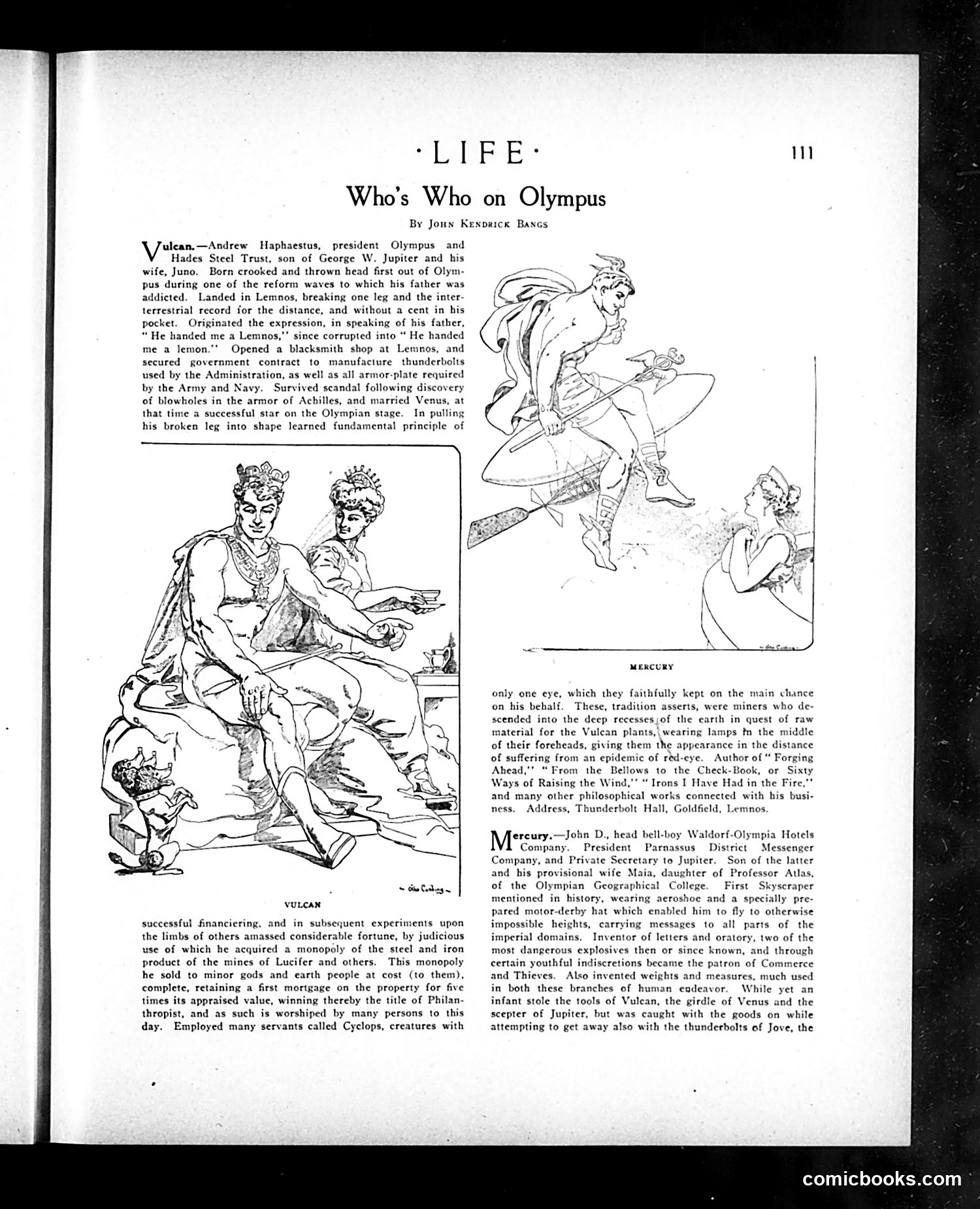
This page satirizes contemporary American business and industrial figures by casting them as Greek gods and mythological characters. The article by John Kendrick Bangs reimagines modern industrialists as Olympian deities. **Vulcan** (left illustration) represents Andrew Hephaestus, president of the Olympus and Hades Steel Trust—a tycoon compared to the god of metalworking and forges. The text mocks his background: born crooked, thrown from Olympus, yet became successful in steel manufacturing and armor production. **Mercury** (right illustration) represents John D., a Waldorf-Olympia Hotels Company president, depicted as the messenger god carrying messages across "imperial domains." The satire equates Gilded Age industrialists with classical gods, suggesting their outsized power and mythic status in American society.
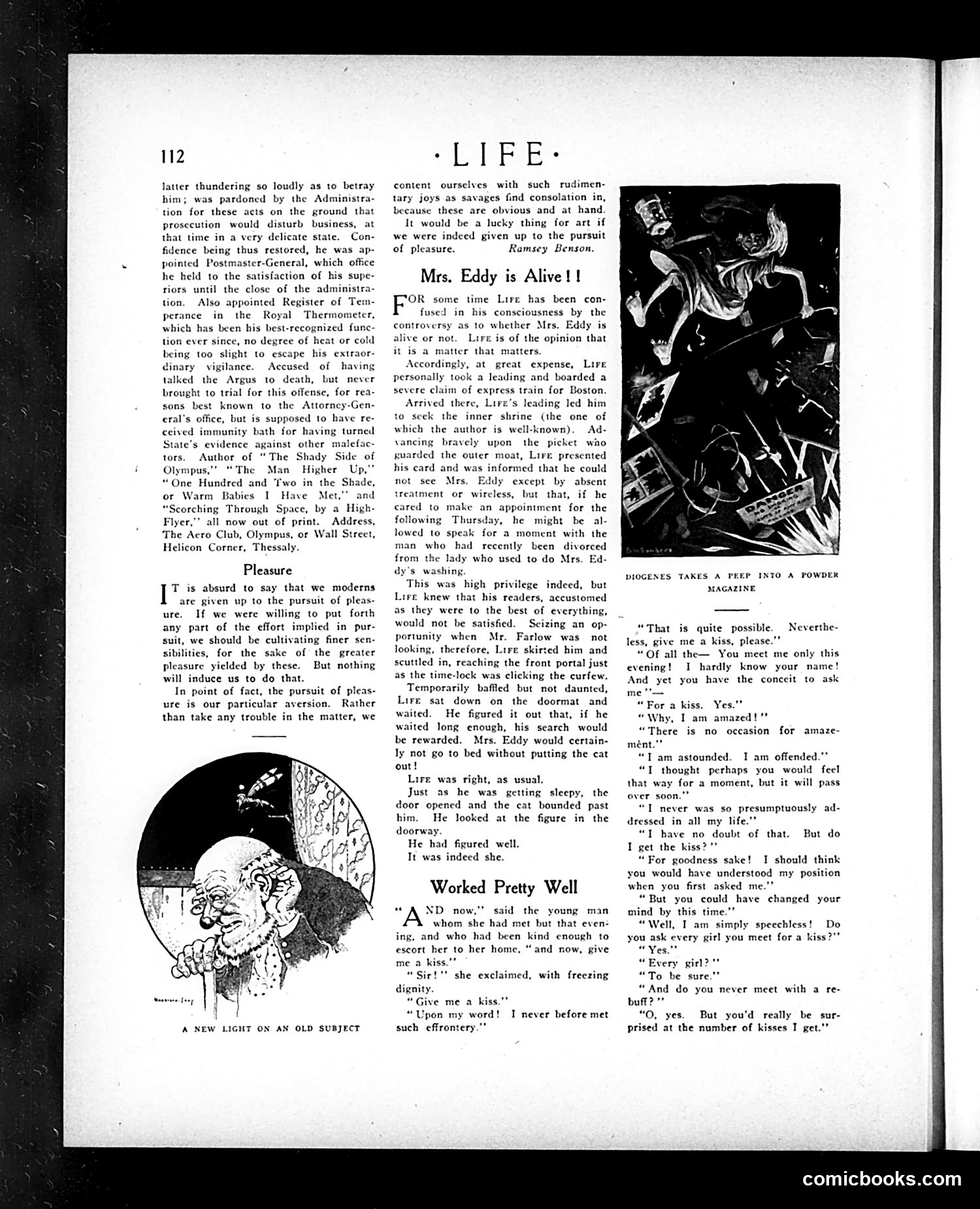
This page contains two sections: a satirical article titled "Mrs. Eddy is Alive!!" and a cartoon labeled "A New Light on an Old Subject." The "Mrs. Eddy" article appears to reference Mary Baker Eddy, founder of Christian Science, debating whether she was alive or dead—likely a topical controversy from the magazine's era. The piece satirizes Life magazine's effort to verify this claim through elaborate means. The cartoon below depicts an elderly person in profile wearing a hat. Its caption, "A New Light on an Old Subject," suggests it's making a visual joke about age or outdated thinking, though the specific reference remains unclear without additional historical context about contemporary figures or events. The page includes dialogue about romantic encounters, mixing the satirical article with general humor content typical of Life magazine's format.
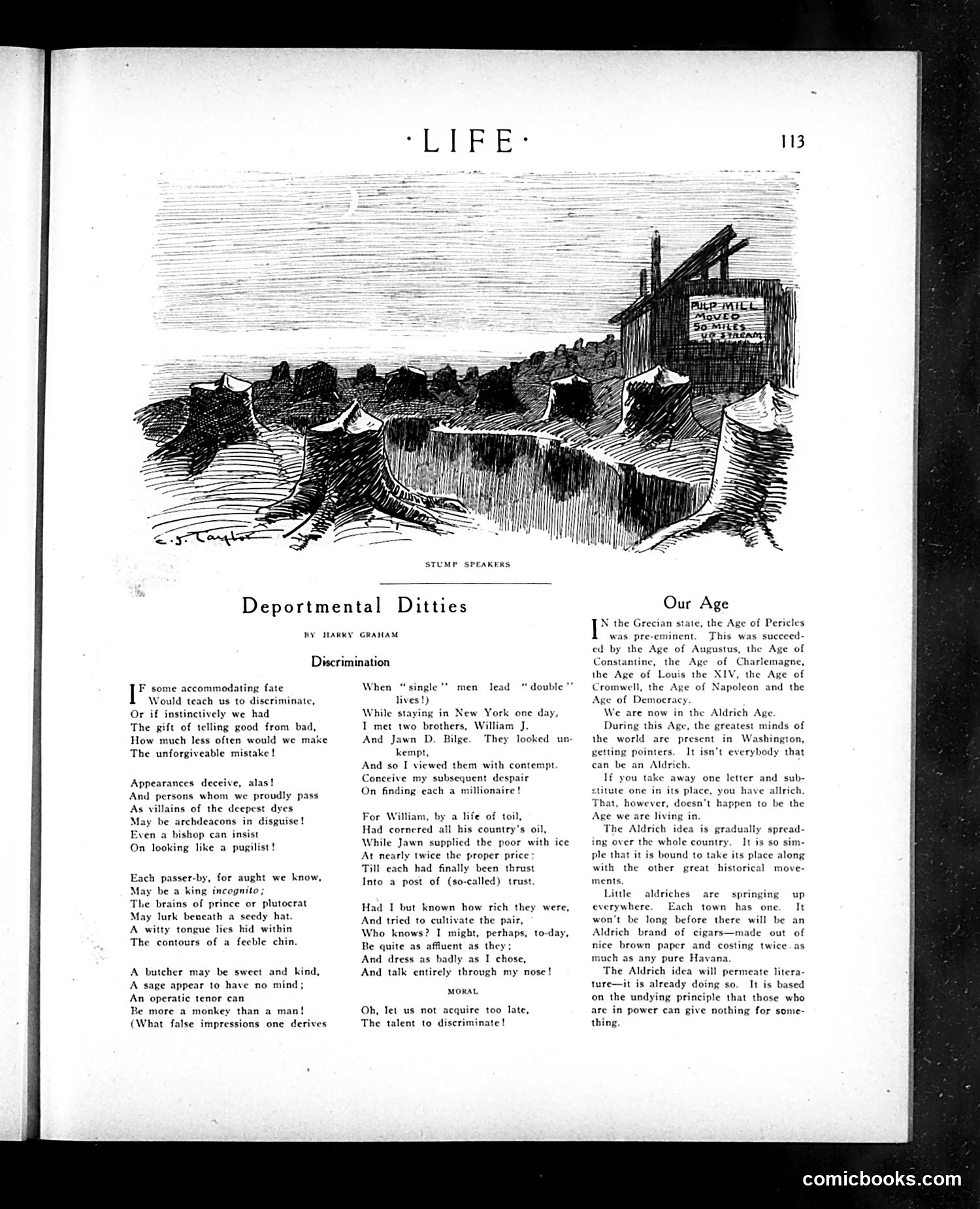
The page features a sketch titled "Stump Speakers" showing a dilapidated wooden structure with a sign reading "Moved 50 Miles" and scattered debris, depicting the physical relocation of political speaking venues. The poem "Departmental Ditties" by Harry Graham uses satire to critique discrimination and social class pretense. It mocks how people misjudge others based on appearance, describing encounters with poor brothers mistaken for wealthy men, and a wealthy man dressed poorly. The accompanying article "Our Age" by an unnamed author discusses historical eras and argues the Aldrich Age (likely referencing Senator Nelson Aldrich) represents the current era, positioning it as comparable to other defining historical periods while asserting that those in power cannot prevent social progress.
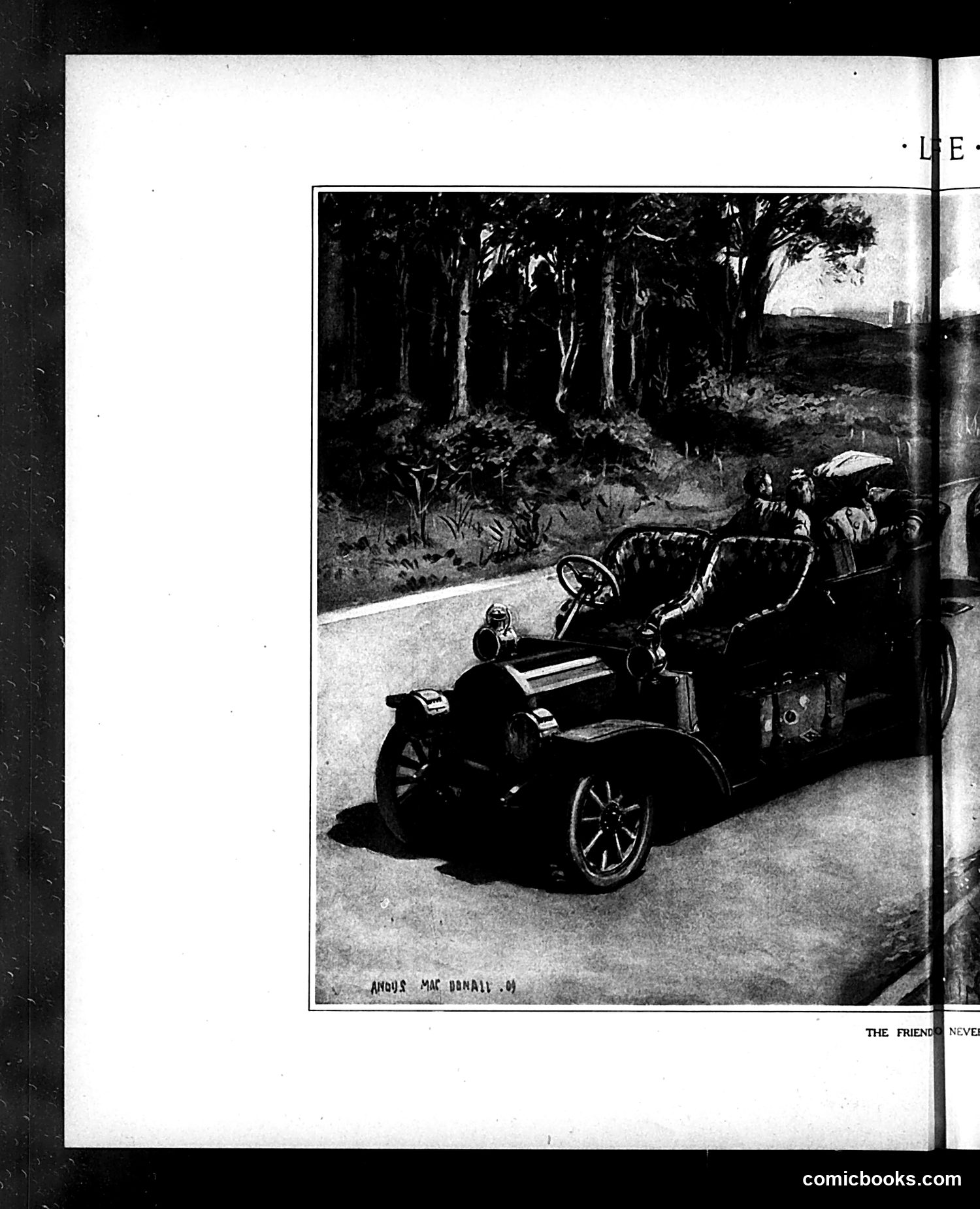
This appears to be a page from Life magazine featuring a black-and-white photograph of an early automobile (labeled "ANGUS MacDONALD" at the bottom) traveling on a tree-lined road. The vehicle carries multiple passengers, including what appears to be a driver and several others seated in the back. The partial text visible at the bottom reads "THE FRIEND NEVE[R]..." suggesting accompanying editorial text that is largely cut off in this reproduction. Without the complete article text or caption, I cannot definitively identify the specific political or social satire intended. The image itself simply documents an early motorcar scene, likely from the early 1900s based on the vehicle's design. The identity of "Angus MacDonald" and the satirical point remain unclear from the visible portions of this page.
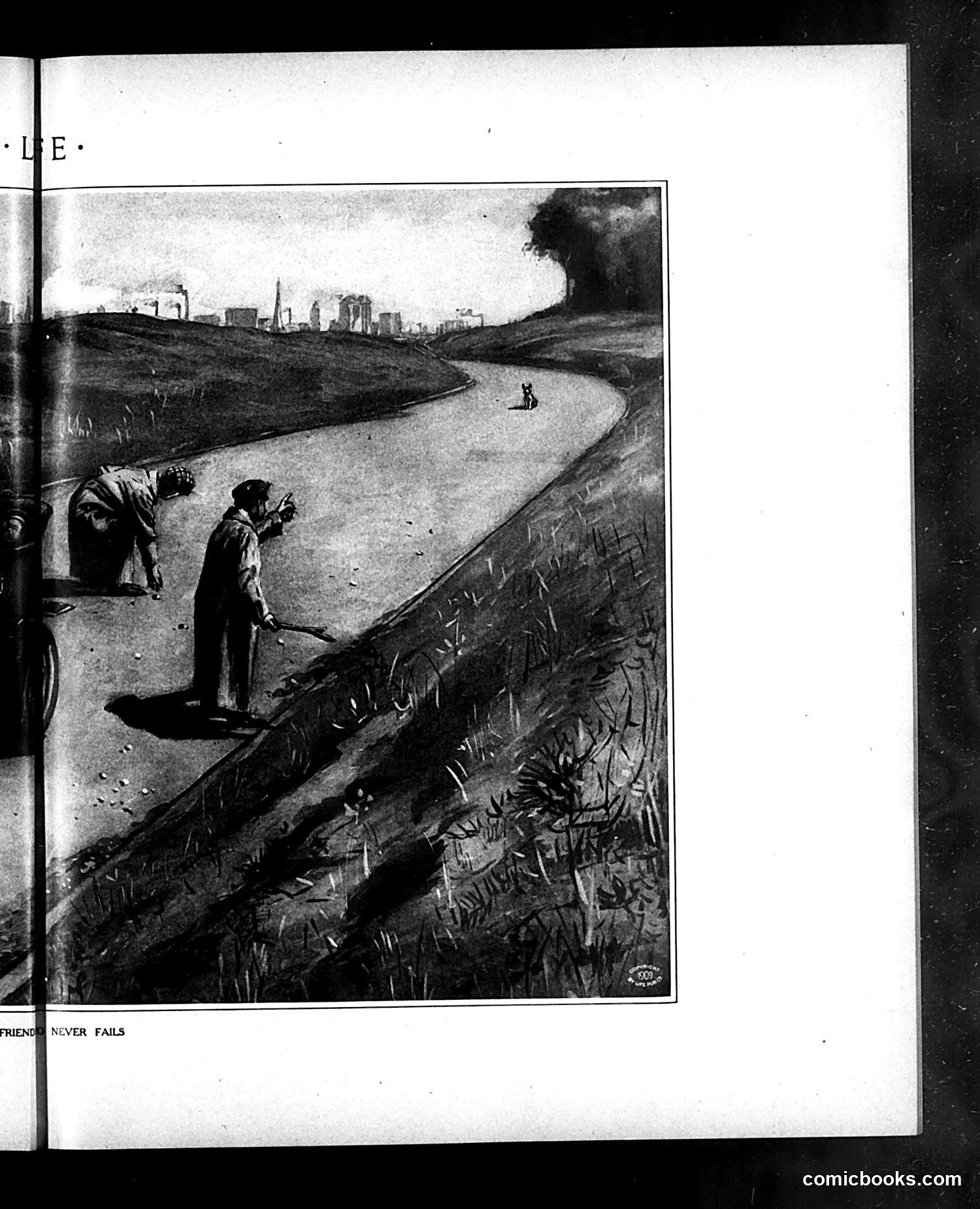
This page appears to be from Life magazine and depicts a pastoral landscape scene with two figures in the foreground near a fallen log, overlooking a winding river. A distant cityscape is visible on the horizon. The visible text reads "FRIEND NEVER FAILS" at the bottom, suggesting this is illustrative content accompanying a story or article about friendship or loyalty. However, without additional context or clearer OCR text from the article itself, I cannot definitively identify the specific political or social satire intended. The image appears more illustrative than satirical—it seems to depict an ordinary scene of companionship in nature rather than a political cartoon with identifiable caricatures or contemporary references. To accurately explain the satirical intent and context for modern readers, I would need more legible accompanying text or caption information from the original publication.
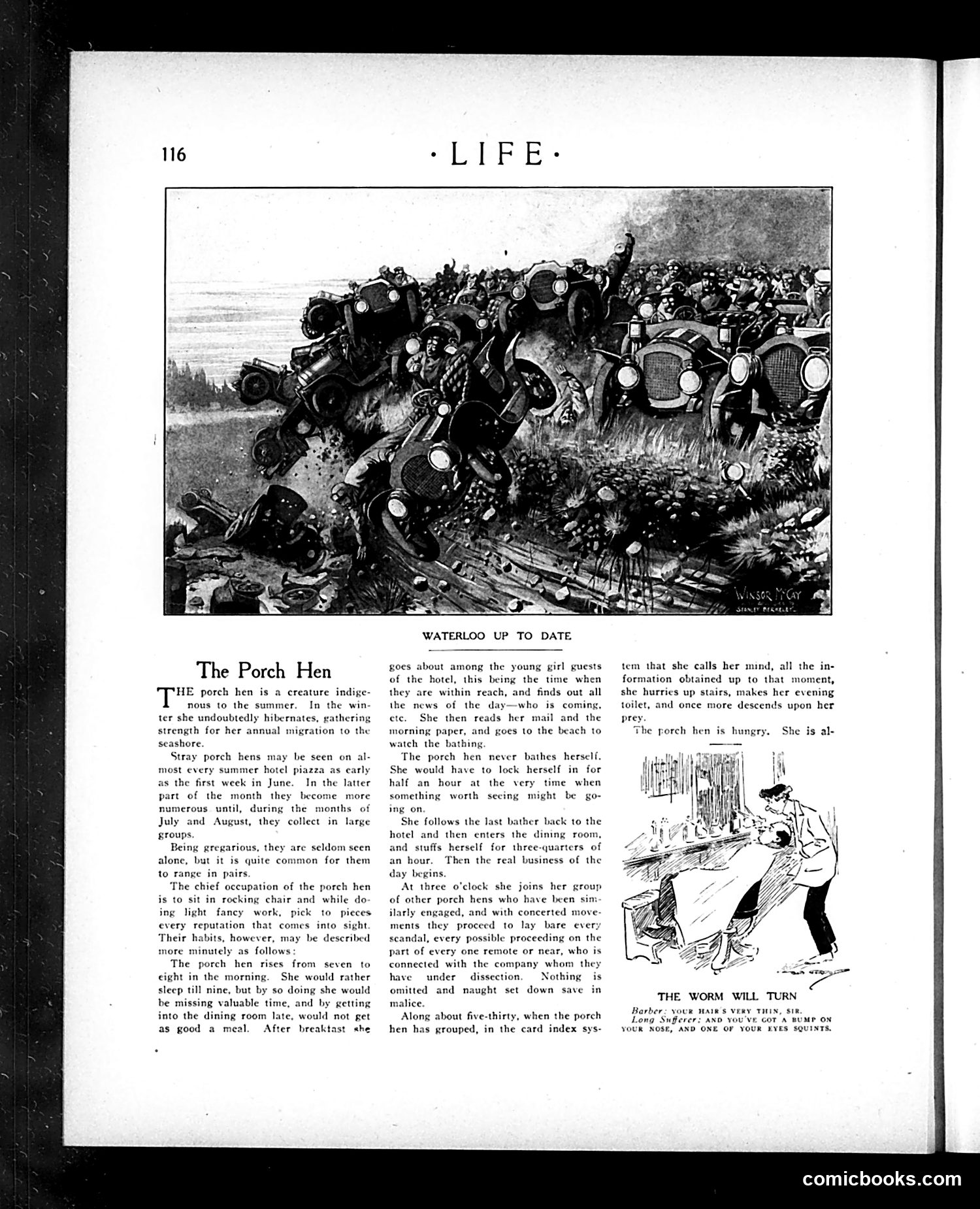
This is a humorous sociological sketch satirizing the "porch hen"—a parasitic summer hotel fixture of the early 20th century. The article describes a female guest who arrives in June and lounges on hotel porches all summer, her primary occupation being gossip. She rises early to eavesdrop on younger guests, reads mail, watches bathing, eats heavily, and spends afternoons systematically cataloguing and spreading scandal about hotel patrons "with concerted movements." The satire mocks idle, wealthy women vacationing at resort hotels who contributed nothing but participated in destructive gossip. The small cartoon "The Worm Will Turn" at page's bottom shows witty comeuppance: a barber insulted by a customer criticizing his thin hair responds by listing the customer's own physical flaws—the social commentary being that even the service class has limits to tolerating rudeness. Both pieces target specific social behaviors Life's readers would recognize.
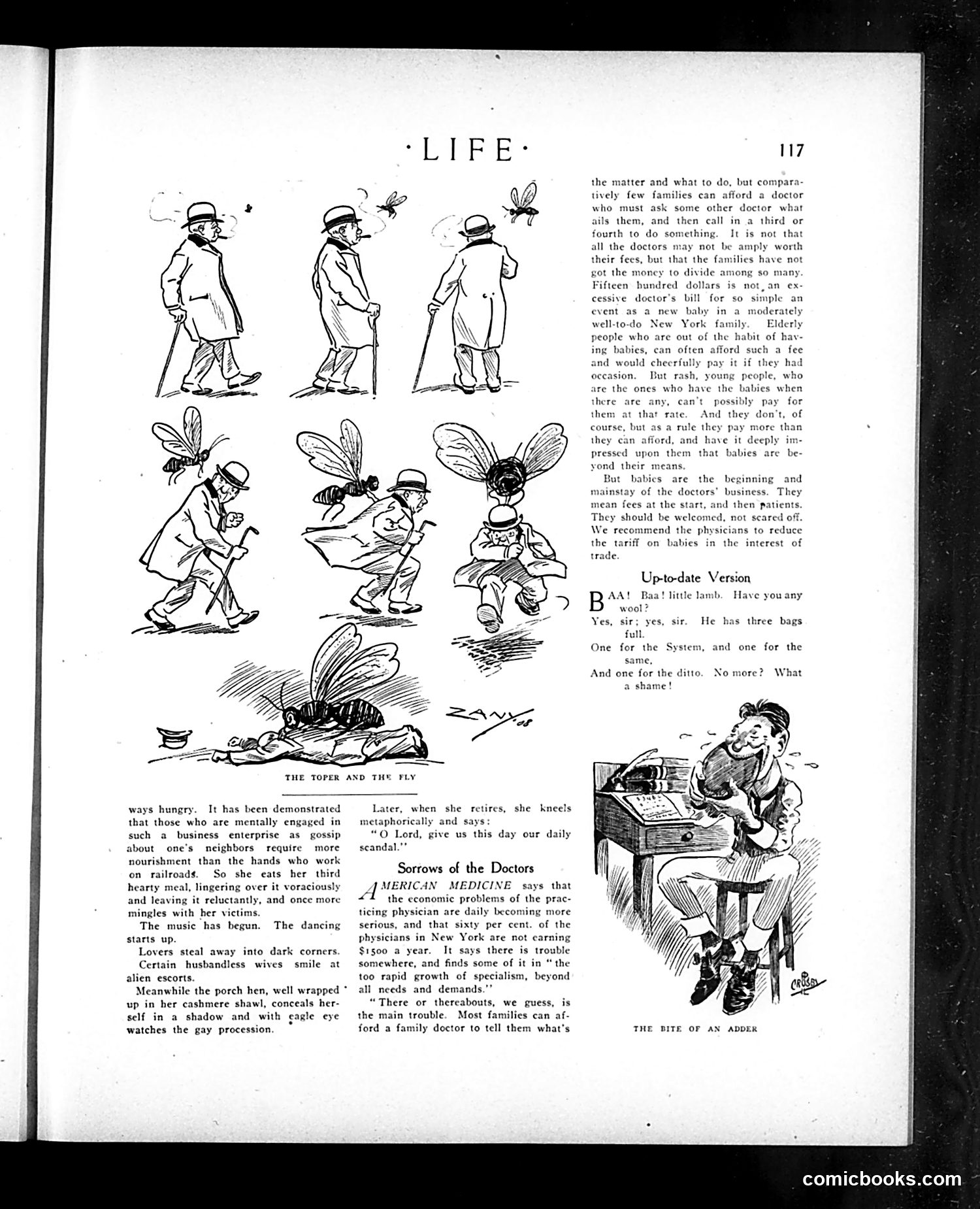
**Top Cartoon**: Six panels depicting a man (the "toper"—a drunkard) in various poses, with a fly as his companion. The title "The Toper and the Fly" suggests a satirical fable about drunkenness and its consequences, though the exact moral is unclear from the image alone. **Main Article**: Satirizes the medical profession's economic struggles. The piece notes that 60% of New York physicians earn under $1,500 annually, blaming "too rapid growth of specialism." The satire's point: families can afford a general practitioner but cannot pay multiple specialists (referenced as asking "a third or fourth" doctor). The article argues doctors should reduce fees for childbirth care—babies are essential to their practice—yet poor young families (who actually have babies) cannot afford current rates, while wealthy elderly patients who don't need obstetric services can pay easily. This exposes class inequality in medicine. **Bottom Cartoon**: "The Bite of an Adder"—appears to be a modern adaptation of the nursery rhyme "Baa Baa Black Sheep," likely mocking contemporary social issues, though details remain unclear.
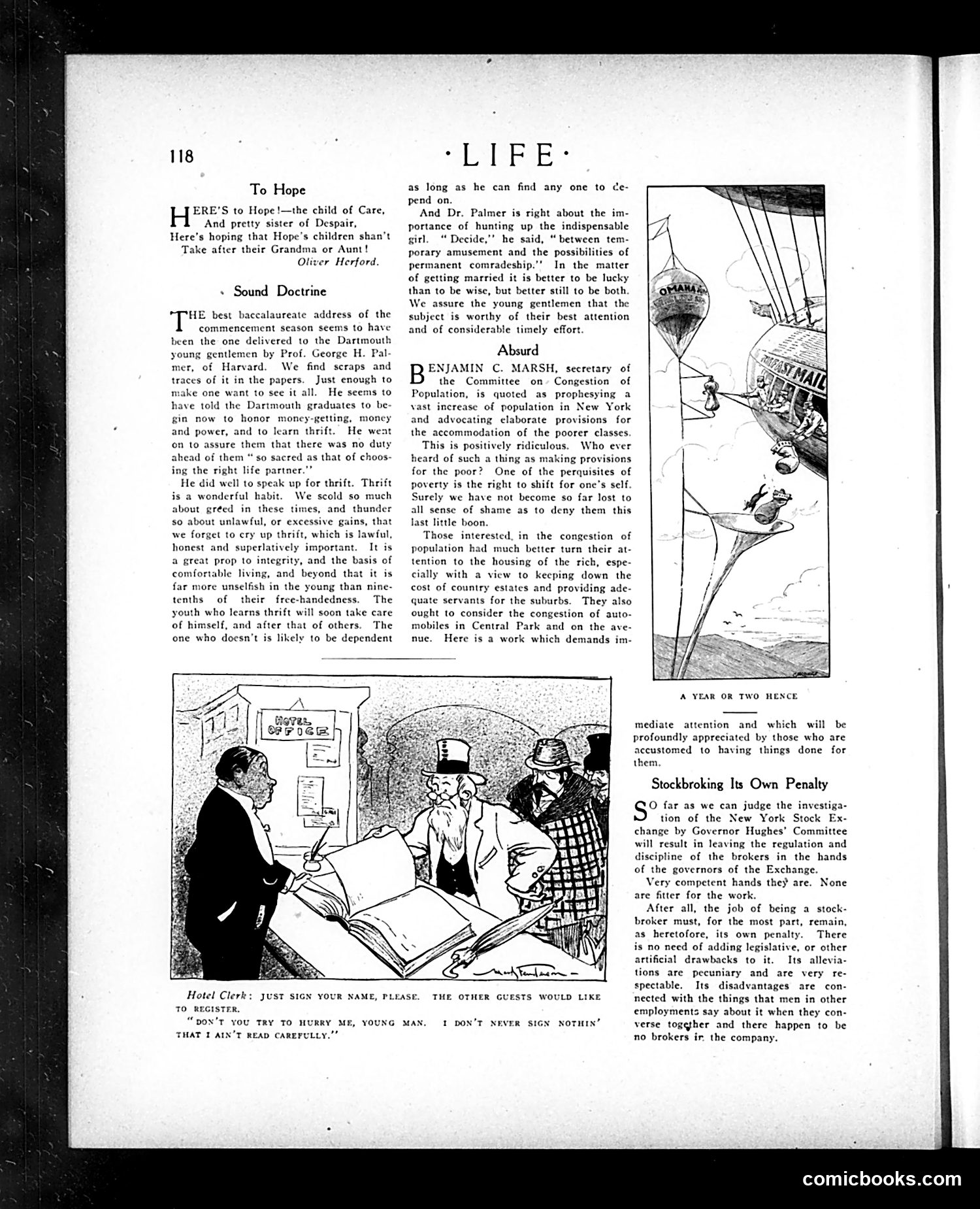
This page contains three separate satirical pieces typical of Life's style: **"To Hope"** is a brief poetic toast by Oliver Herford wishing that Hope's descendants avoid negative family traits. **"Sound Doctrine"** praises Harvard Professor George H. Palmer's commencement speech to Dartmouth graduates, endorsing his advice about thrift, money, and choosing a marriage partner wisely. **"Absurd"** satirizes Benjamin C. Marsh's advocacy for housing provisions for poor people during New York's population growth. The passage drips with sarcasm, mocking the very idea of helping the poor—suggesting poverty itself is meant to be a hardship that forces self-reliance. This reflects Gilded Age attitudes opposing social welfare. **The cartoon** shows a hotel clerk asking a guest to sign the register. The guest refuses, claiming he "don't never sign nothin'"—satirizing widespread illiteracy and distrust of written documents among working-class Americans of the era. The page's satirical tone ranges from gentle to caustic, reflecting Life's role as social commentary for educated, affluent readers.
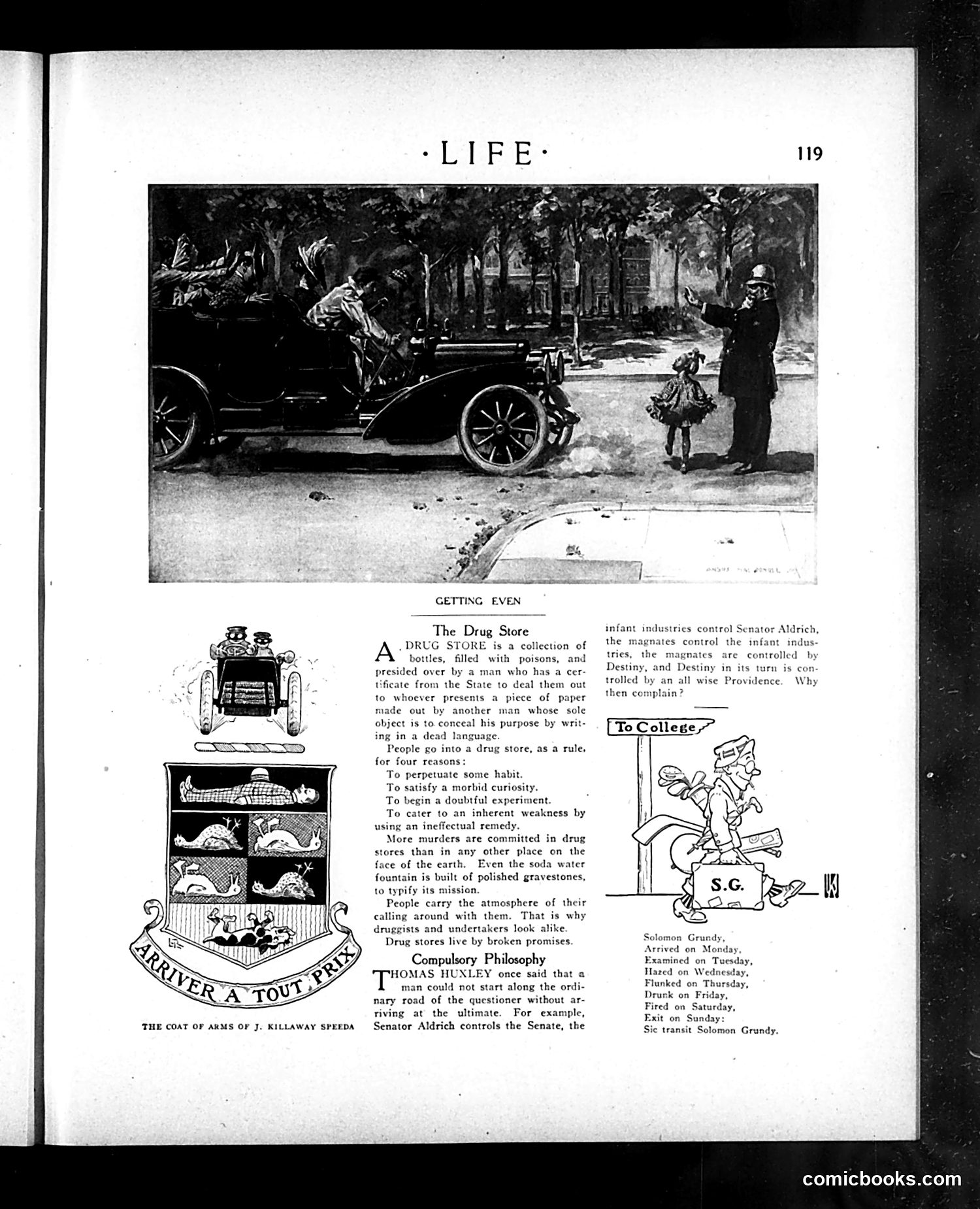
This page contains two distinct satirical pieces: **"Getting Even: The Drug Store"** offers cynical social commentary on pharmacies and druggists. The text sarcastically describes drug stores as places where poisons are dispensed by credentialed dealers using Latin prescriptions to obscure their purposes. It claims drug stores enable "four reasons" people visit: habit, curiosity, experimentation, and ineffectual remedies—implying they perpetuate human weakness rather than health. The final jab—"More murders are committed in drug stores than any other place"—is hyperbolic satire suggesting pharmacies are complicit in slow self-destruction through addiction and false remedies. **"Compulsory Philosophy"** references Thomas Huxley's philosophical point about ultimate questions, then applies it to political corruption. Using Senator Aldrich as an example, it traces a chain of control: Aldrich controls the Senate, magnates control industries, and "Providence" controls destiny—suggesting hidden hierarchies manipulate American systems while ordinary citizens remain unaware. The top illustration "Getting Even" shows a wealthy man in a car encountering a working-class family, likely depicting class disparities the magazine critiques.
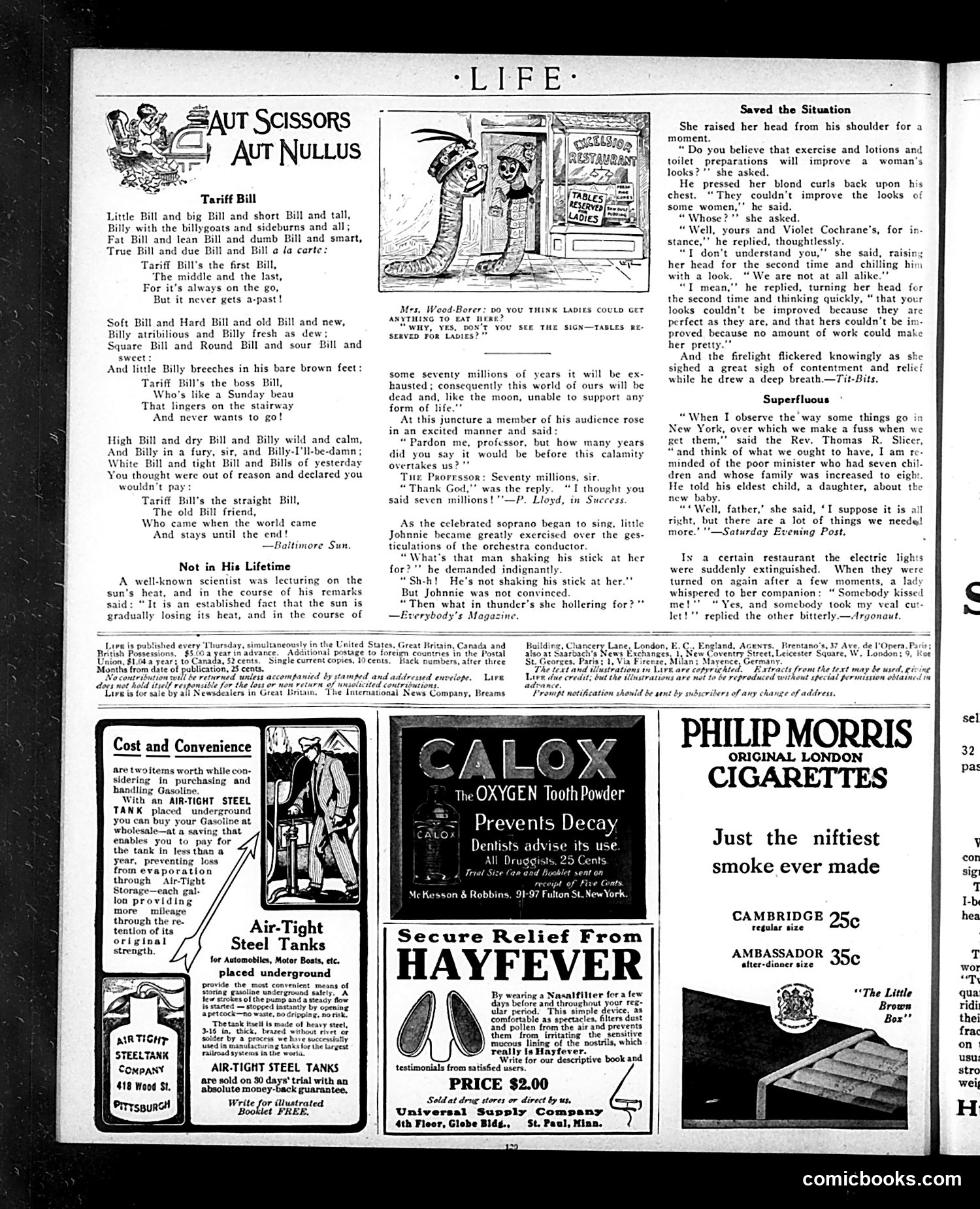
This page contains humorous satirical content typical of early 20th-century American humor magazines: **"Tariff Bill" poem**: A playful critique of tariff legislation, personifying "Tariff Bill" as an unwanted houseguest who perpetually lingers ("comes when the world came / And stays until the end"). The poem mocks how tariff debates dominated political discourse, using repetitive "Bill" variations to suggest the issue's inescapability and tedium. **Short humorous anecdotes** address contemporary concerns: a scientist's revelation that Earth will die in "seventy millions" of years (dark humor about existential dread), a confused child at a concert, and romantic miscommunications about women's appearance and worth. **The cartoon** shows a wood-boring insect at a restaurant asking about food, with the punchline being tables "reserved for ladies"—gentle satire on women-only dining spaces that were apparently common. The page reflects early 1900s preoccupations: protectionist economics, scientific advancement anxiety, domestic relations, and evolving gender roles in public spaces. The humor relies on wordplay and situational irony rather than visual sophistication.
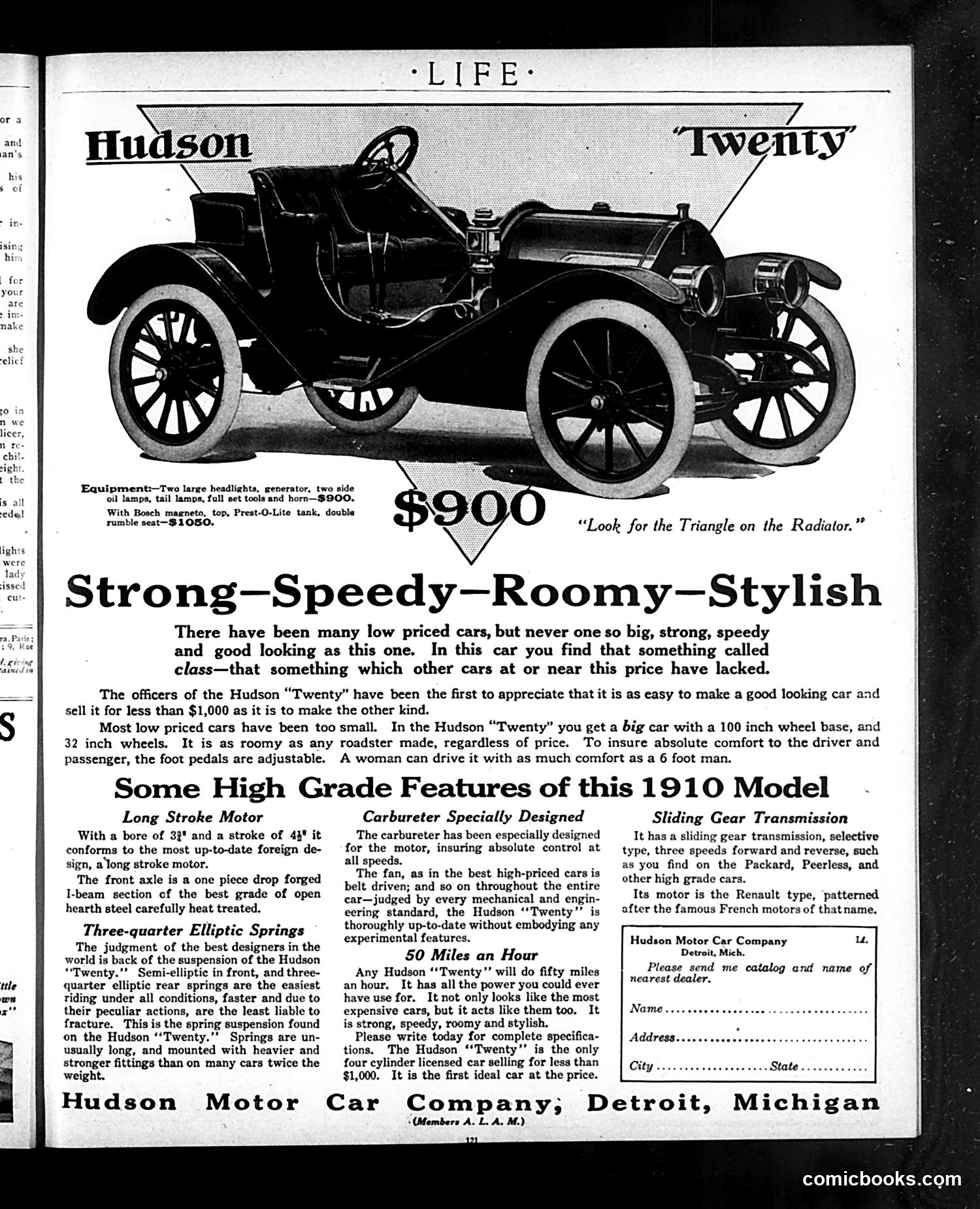
This is **not a cartoon or satire**—it's a straightforward automobile advertisement from Life magazine's 1910 era. The page promotes the Hudson "Twenty" automobile, priced at $900, positioning it as an affordable luxury car that combines quality engineering with low cost. The advertisement argues the Hudson offers "class" that competitors lack, emphasizing its spaciousness (100-inch wheelbase), power (50 mph capability), and refined mechanical features (long-stroke motor, elliptic springs, sliding gear transmission) typically found in expensive vehicles. The sales pitch targets middle-class buyers by stressing that a woman or small man can operate it comfortably—a notable selling point for 1910, when automobiles were still relatively new. The "Triangle on the Radiator" is the Hudson brand identifier. This reflects the early automotive era when manufacturers competed on engineering specifications and value proposition rather than styling or brand lifestyle messaging.
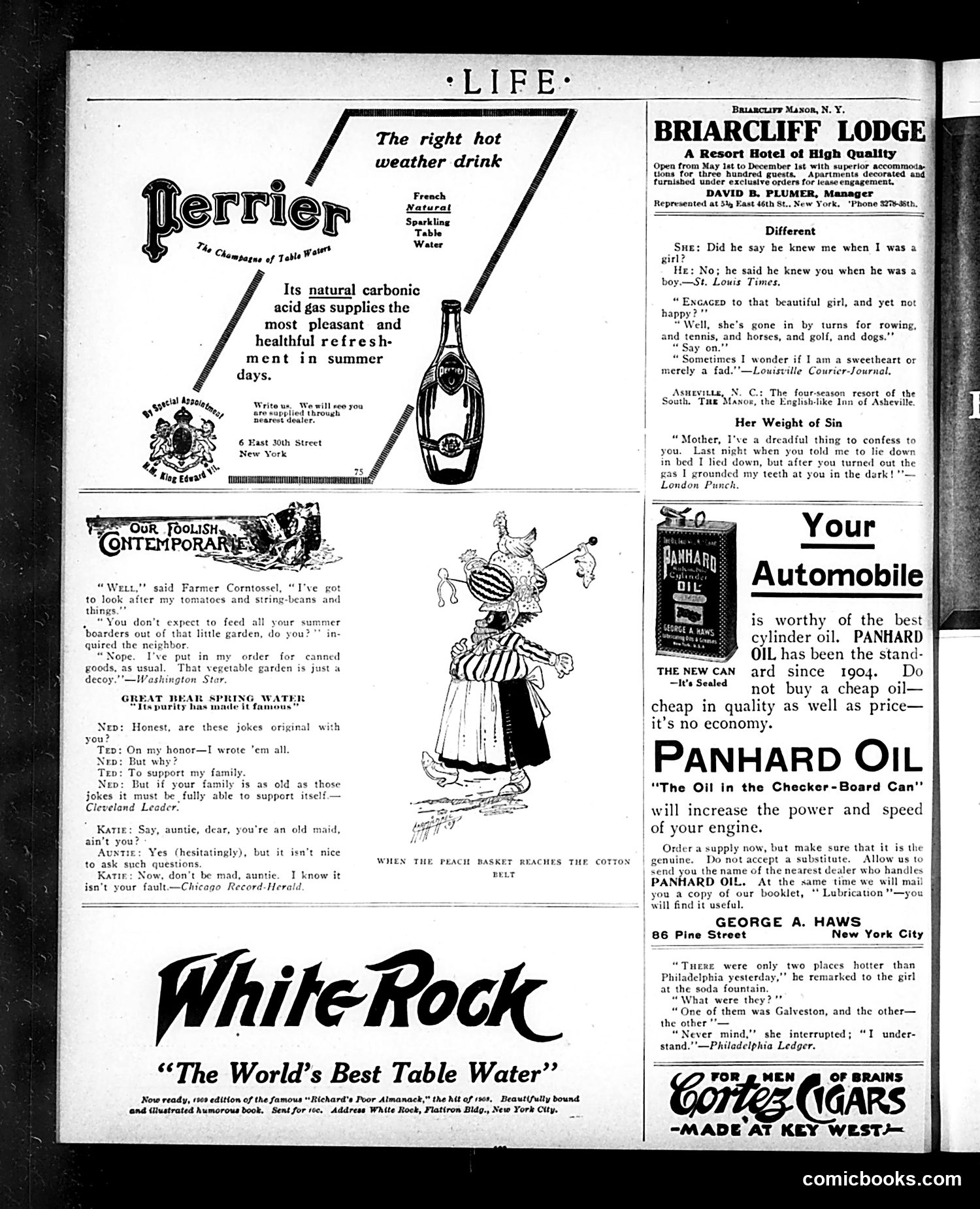
This page is primarily **advertising and humor content** rather than political satire. It contains: **Main advertisements:** - Perrier sparkling water ("the right hot weather drink") - White Rock table water ("The World's Best Table Water") - Panhard Oil for automobiles - Briarcliff Lodge resort hotel - Cortez cigars **Humor section ("Our Foolish Contemporaries"):** A series of short jokes and humorous anecdotes, including: - A farmer's joke about growing canned goods in his garden - Exchanges about whether jokes are original - Romantic quips (a woman teasing a man about knowing her since childhood) - A child's confession about grinding her teeth at her mother **The cartoon** shows a woman in period dress with a balloon labeled "WHEN THE PEACH BASKET REACHES THE COTTON BELT"—likely a rural/agricultural reference, though its specific meaning is unclear without additional context. The page reflects early 1900s advertising culture and light domestic humor typical of Life magazine's satirical approach to everyday American life and manners.
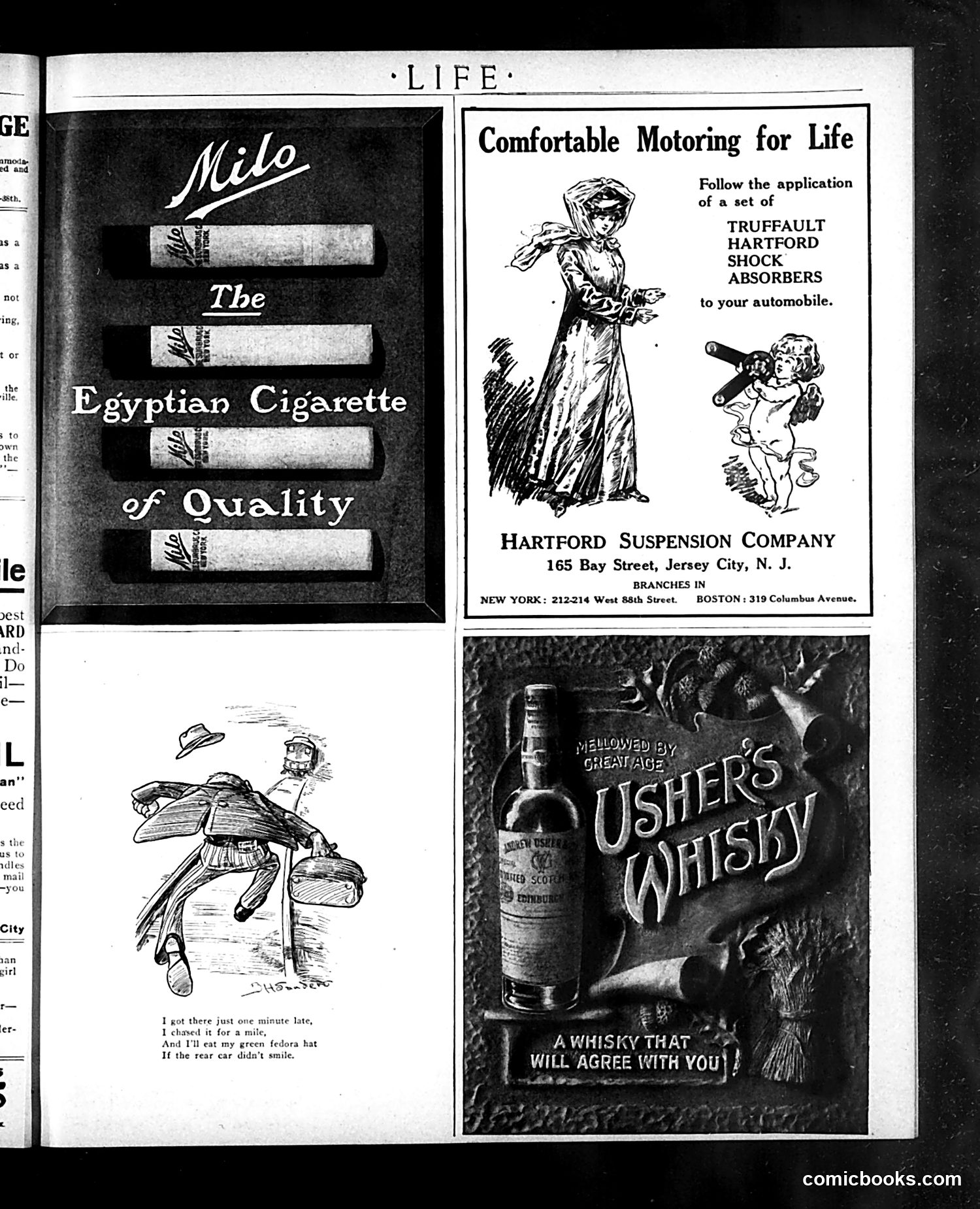
This page is primarily **advertising**, not political satire. It contains three distinct advertisements: 1. **Milo Egyptian Cigarettes** (top left): A straightforward product display showing cigarette packages, emphasizing "Quality." 2. **Hartford Suspension Company** (top right): An automobile parts ad featuring a woman and cherub figure promoting shock absorbers for comfortable driving. The cherub imagery suggests smoothness and luxury. 3. **Usher's Whisky** (bottom): Advertises "a whisky that will agree with you," playing on the common concern that alcohol could cause digestive upset—a selling point during Prohibition's end (1933). The small cartoon at bottom left appears unrelated to these ads—a humorous sketch about someone checking a car's rear end, with accompanying verse. This appears to be a typical **Life magazine advertising page** from the 1920s-30s, mixing commercial pitches with light humor. There is no discernible political commentary.
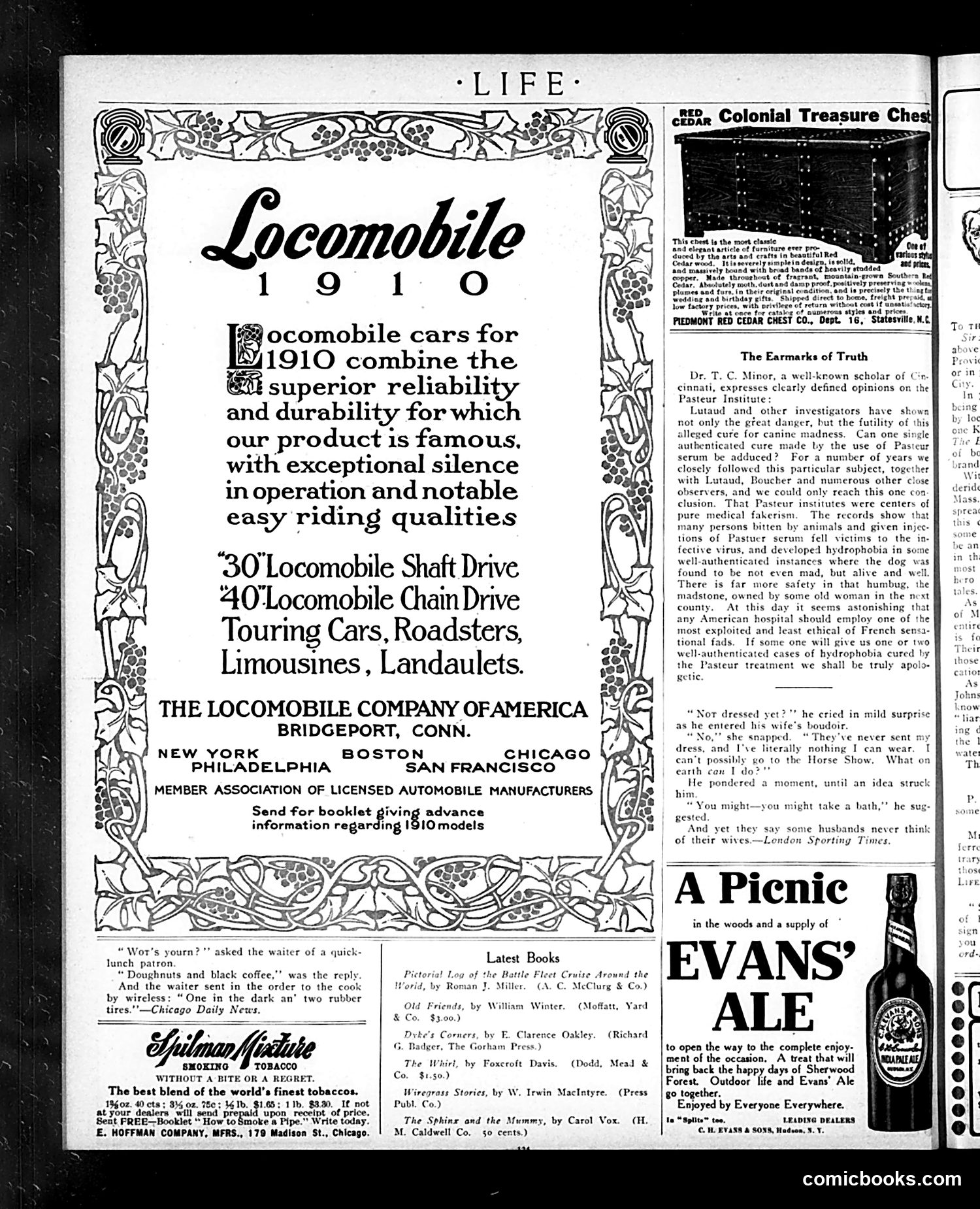
This page is **primarily advertising** for automobiles and consumer goods, with minimal editorial cartooning. The dominant content is a **Locomobile automobile advertisement** featuring decorative Art Nouveau styling. It promotes 1910 models emphasizing "reliability and durability" with "exceptional silence in operation"—highlighting mechanical innovations contemporary readers would find noteworthy. The page includes a brief satirical anecdote ("The Earmarks of Truth") attacking the **Pasteur Institute's rabies treatments**, claiming they were fraudulent "medical fakerism" compared to folk remedies. This reflects early 20th-century skepticism of germ theory. Additional humor includes a **brief joke** about a wife with nothing to wear for the Horse Show, and a wireless-relay diner anecdote ("One in the dark an' two rubber tires"). The remaining space features book reviews, tobacco advertising, and an **Evans' Ale advertisement** appealing to outdoor recreation enthusiasts. The page reflects 1910 consumer culture: automobiles, skepticism toward new medicine, and leisure pursuits targeting affluent readers.
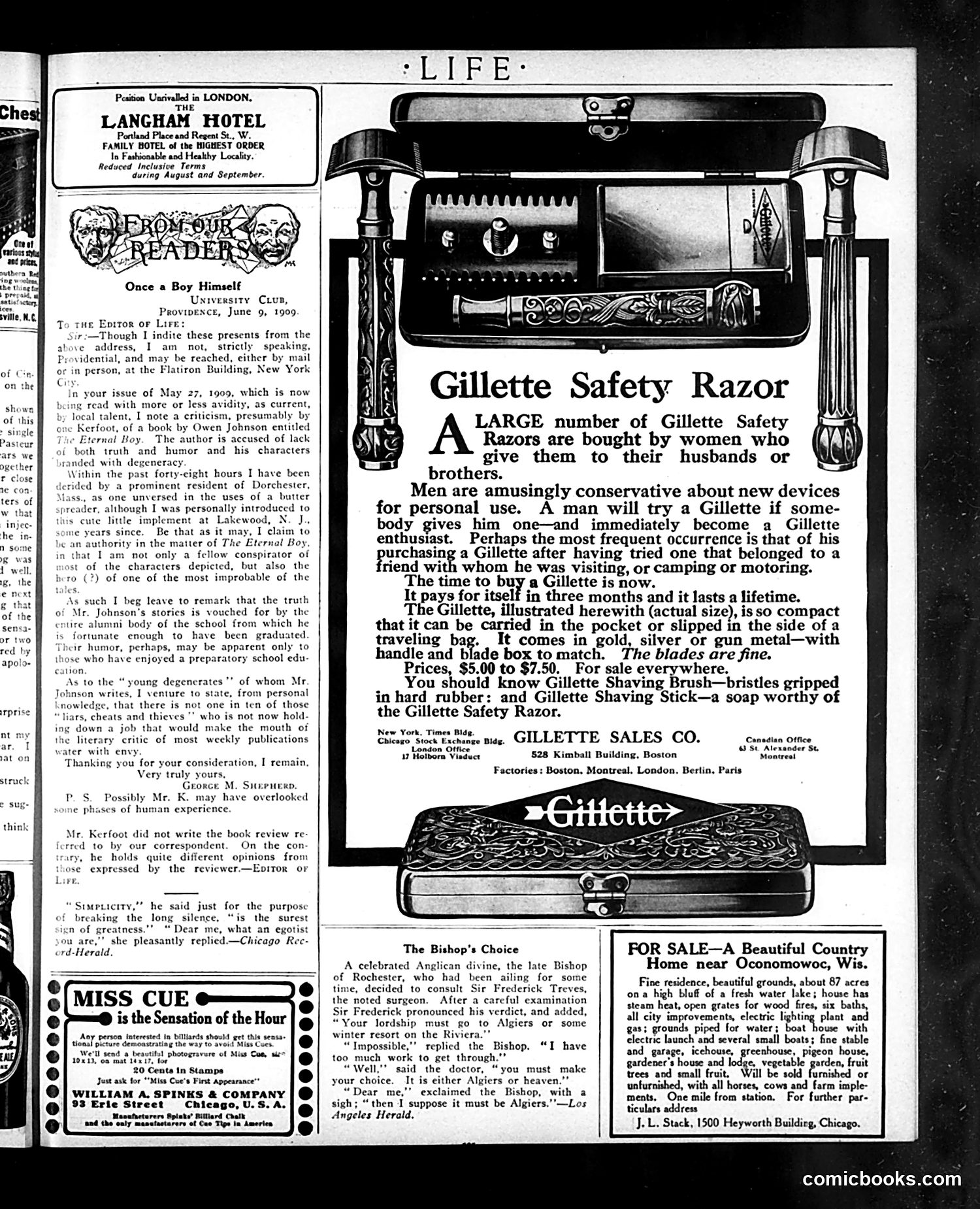
This page is primarily **advertising**, not political satire. The dominant content is a large Gillette Safety Razor advertisement occupying the right half and bottom of the page. The ad's humor is gentle social observation rather than satire: it notes that men are "amusingly conservative about new devices for personal use" and that razors are often purchased by women as gifts for husbands or brothers. The joke relies on gender dynamics of the era—women as gift-givers introducing men to modern conveniences. The left side contains a **reader's letter** defending Owen Johnson's novel *The Eternal Boy* against a negative review, and unrelated small advertisements (Miss Cue billiards, the Langham Hotel). There is **no political cartoon** on this page. The "Miss Cue" section appears to be a novelty photograph about billiards, not editorial commentary. For modern readers: this is a standard early-1900s magazine page mixing reader correspondence with product advertising, using mild gender humor to market razors.
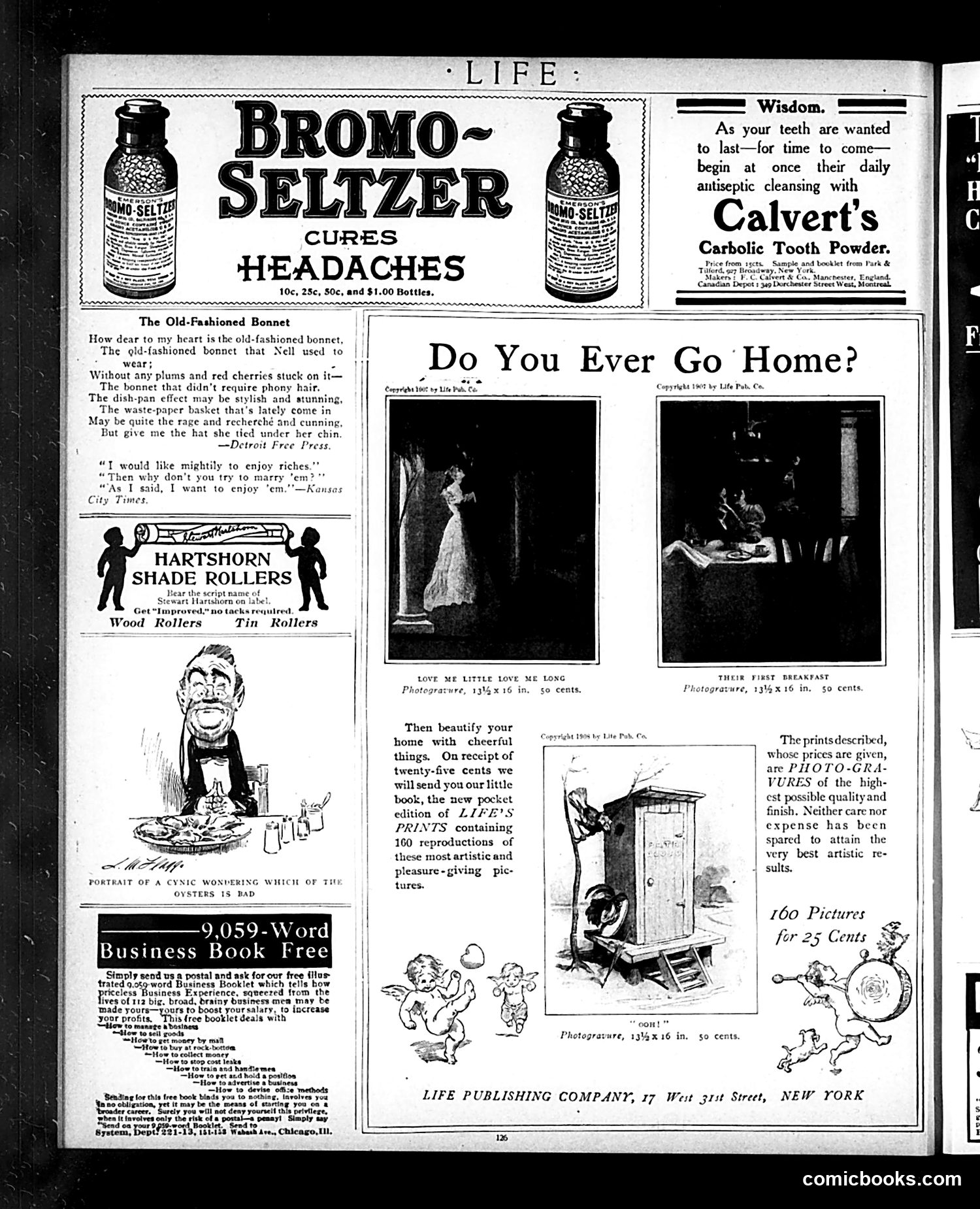
This page is primarily **advertisements and light humor** rather than political satire. The main cartoon—"Portrait of a Cynic Wondering Which of the Oysters Is Bad"—shows a man examining oysters with suspicion. The joke relies on period anxieties about food safety; oysters were known to cause illness, so the "cynic" humorously debates which one might poison him. It's a dark joke about uncertain food quality in that era. The poetry and jokes are gentle social commentary: "The Old-Fashioned Bonnet" nostalgically critiques current women's fashions (described as impractical—"dish-pan effect," "waste-paper basket" shapes). The marriage joke mocks wealthy women as commodities. The rest of the page features **product advertisements** (Bromo-Seltzer, Calvert's toothpaste, shade rollers) and promotional content for Life Publishing Company's photo-art books and a business advice booklet—standard magazine filler of the era. No major political figures or events are referenced here.
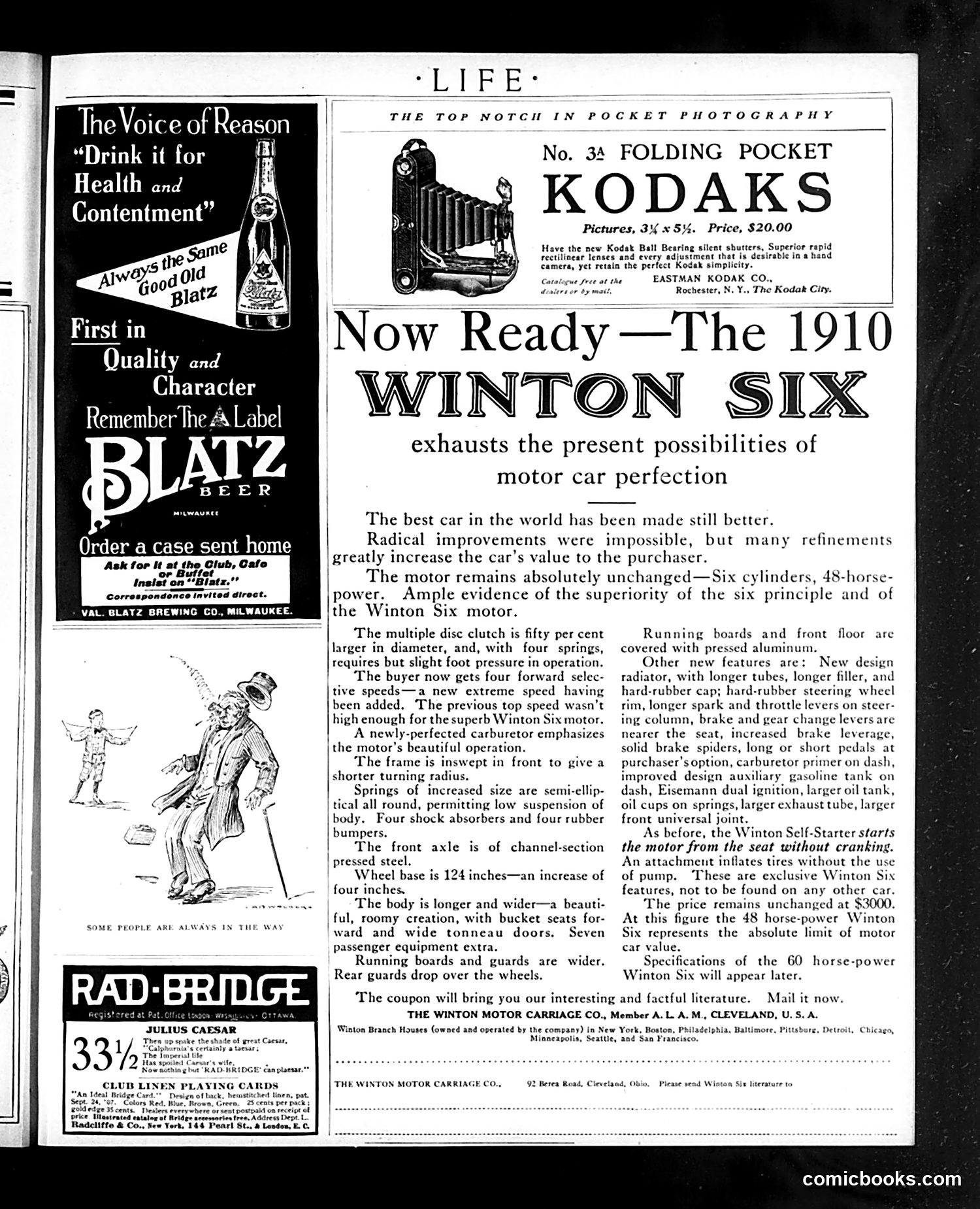
This page is primarily **advertising**, not political satire. The dominant content is a large advertisement for the 1910 Winton Six automobile, which claims to represent "the absolute limit of motor car value" at $3,000. The small cartoon labeled "SOME PEOPLE ARE ALWAYS IN THE WAY" (lower left) depicts a figure being knocked over—likely a visual gag about pedestrians encountering automobiles, reflecting early 20th-century anxieties about motor traffic in cities. Supporting advertisements include Blatz Beer ("Drink it for Health and Contentment"), Kodak folding pocket cameras, Rad-Bridge playing cards, and a Hadcliffe bridge design product. The Winton Six ad emphasizes incremental refinements (new carburetor, transmission speeds, radiator design) rather than revolutionary changes, claiming the previous model "wasn't high enough" in top speed—a humorous acknowledgment of competitive automotive marketing hyperbole of the era.
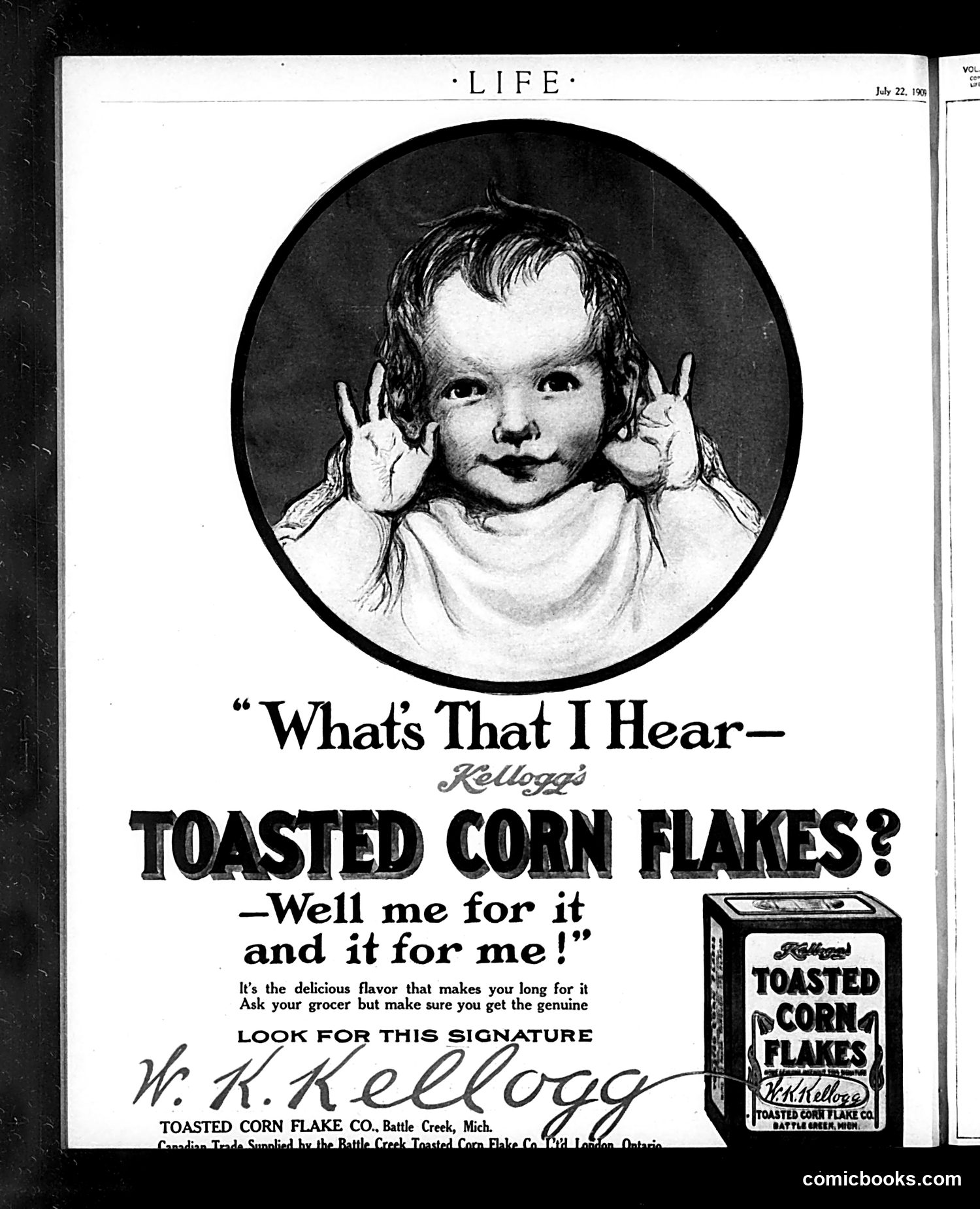
This is a **Kellogg's Toasted Corn Flakes advertisement**, not political satire. It features a smiling toddler making peace signs with both hands, captioned with childlike speech: "What's That I Hear—Kellogg's Toasted Corn Flakes? Well me for it and it for me!" The ad uses cute baby imagery and broken child-speech to humorously suggest even infants crave the cereal's "delicious flavor." The signature of W.K. Kellogg authenticates the product. This represents early 20th-century advertising strategy: using adorable children and playful language to create brand appeal and suggest universal desire for the product. The "look for this signature" instruction emphasizes brand protection against counterfeits—common in this era.