
Life, 1909-07-22 · page 13 of 28
Life — July 22, 1909 — page 13: what you’re looking at
What you’re looking at
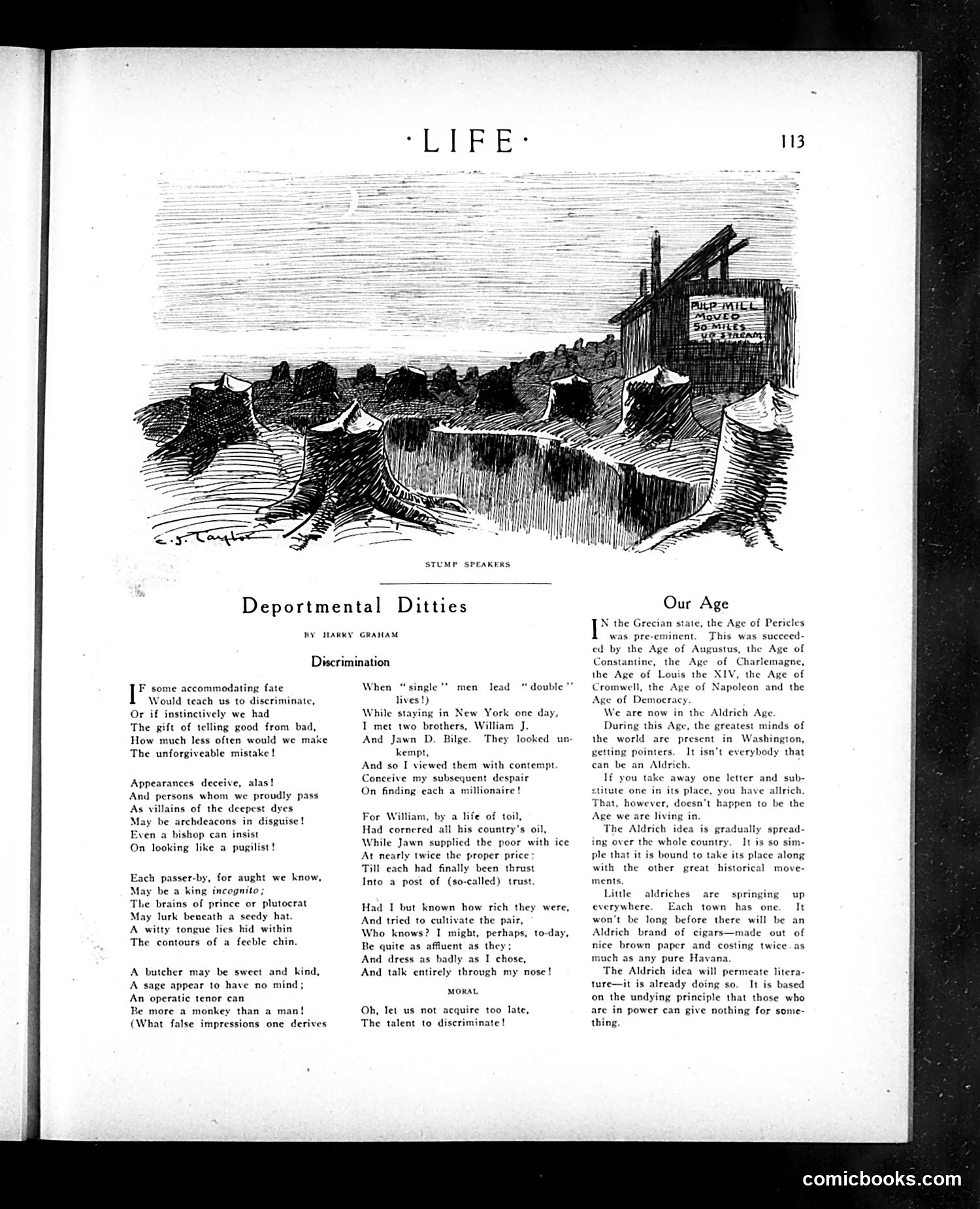
The page features a sketch titled "Stump Speakers" showing a dilapidated wooden structure with a sign reading "Moved 50 Miles" and scattered debris, depicting the physical relocation of political speaking venues. The poem "Departmental Ditties" by Harry Graham uses satire to critique discrimination and social class pretense. It mocks how people misjudge others based on appearance, describing encounters with poor brothers mistaken for wealthy men, and a wealthy man dressed poorly. The accompanying article "Our Age" by an unnamed author discusses historical eras and argues the Aldrich Age (likely referencing Senator Nelson Aldrich) represents the current era, positioning it as comparable to other defining historical periods while asserting that those in power cannot prevent social progress.
📄 Transcribed text from this page (OCR, searchable)
Machine-transcribed from the original scan — historical spelling and the odd misread are preserved.
STUMP SPEAKERS Deportmental Ditties BY MARKY GRAMAM Discrimination I some accommodating fate Would teach us to discriminate, Or if instinctively we had The gift of telling good from bad, How much less often would we make The unforgiveable mistake! Appearances deceive, alas! And persons whom we proudly pass As villains of the deepest dyes May be archdeacons in disguise! ven a bishop can insist On looking like a pugilist! Each passer-by, for aught we know, May be a king incognito; The brains of prince or plutocrat May lurk beneath a seedy hat. A witty tongue lies hid withi The contours of a feeble chin. A butcher may be sweet and kind, A sage appear to have no mind; An operatic tenor can Be more a monkey than a man! (What false impressions one derives When ‘single’? men lead “double” lives!) While staying in New York one day, 1 met two brothers, William J. And Jawn D. Bilge. They looked un kemp And so I viewed them with contempt Conceive my subsequent despair On finding each a millionaire! For William, by a life of toil, Had cornered all his country’s oil, While Jawn supplied the poor with ice At nearly twice the proper price; Till each had finally been thrust Into a post of (so-called) trust Had I but known how rich they were, And tried to cultivate the pair, Who knows? I might, perhaps, to-day, Be quite as affluent as they; And dress as badly as I chose, And talk entirely through my nose! MORAL Oh, let us not acquire too late, The talent to discriminate! N the Grecian state, the Age of Pericles was pre-eminent. This was succced- cd by the Age of Augustus, the Age of Constantine, the Age of Charlemagne, the Age of Louis the XIV, the Age of Cromwell, the Age of Napoleon and the Age of Democracy. We are now in the Aldrich Age. During this Age, the greatest minds of the world are present in Washington, getting pointers. It isn’t everybody that can be an Aldrich. If you take away one letter and sub- etitute one in its place, you have allrich That, however, doesn’t happen to be the Age we are living in. he Aldrich idea is gradually spread- ing over the whole country. It is so sim- ple that it is bound to take its place along with the other great histori ove- ments. Little aldriches are springing up everywhere. Each town has one. It won't be long before there will be an Aldrich brand of cigars—made out of nice brown paper and costing twice. as much as any pure Havana The Aldrich idea will permeate litera ture—it is already doing so. It is based on the undying principle that those who are in power can give nothing for some- thing. comicbooks.com