
Life, 1909-07-22 · page 10 of 28
Life — July 22, 1909 — page 10: what you’re looking at
What you’re looking at
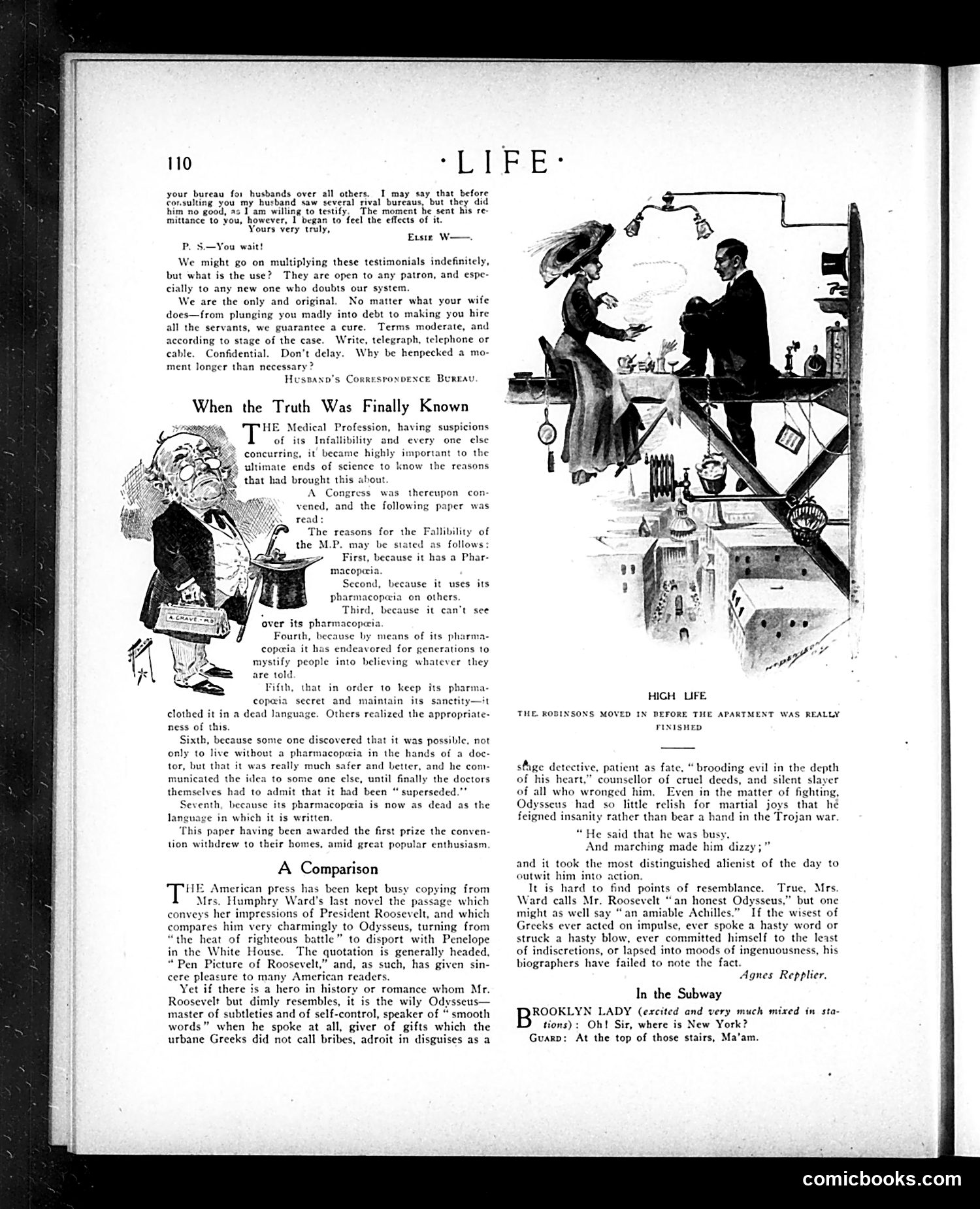
This page satirizes the medical profession's credibility problems through a mock-serious "Congress" format. The left illustration shows a caricatured doctor figure presenting reasons why the Medical Profession has lost public trust, including: it uses pharmacopoeia (medical knowledge) on unsuspecting patients, can't see beyond its own narrow perspective, and maintains secrecy to preserve authority rather than serve patients. The right illustration depicts a domestic scene labeled "High Life," showing a couple in what appears to be a doctor's office or consultation setting, likely illustrating the practical consequences of medical incompetence or deception in everyday life. The text below includes a comparative section about American press coverage and a satirical dialogue "In the Subway," suggesting broader cultural commentary on trustworthiness and authority during this era.
📄 Transcribed text from this page (OCR, searchable)
Machine-transcribed from the original scan — historical spelling and the odd misread are preserved.
110 -LIFE: your bureau for husbands over all others. I may say that before consulting you my busband saw several rival bureaus, but they did him no good, as I am willing to testify, The moment he sent his re- mittance to you, however, 1 began to feel the effects of it. Yours very truly, E.siz W—. P. 5.—You wait! We might go on multiplying these testimonials indefinitely, but what is the use? They are open to any patron, and espe- cially to any new one who doubts our system. We are the only and original. No matter what your wife does—from plunging you madly into debt to making you hire all the servants, we guarantee a cure. Terms moderate, and according to stage of the case. Write, telegraph, telephone or cable. Confidential. Don’t delay. Why be henpecked a mo- ment longer than necessary? Hespann’s Corresroxpence Bureau. When the Truth Was Finally Known HE Medical Profession, having suspicions of its Infallibility and every one else Ye) concurring, it became highly important to the 4 ultimate ends of science to know the reasons Je that had brought this about q A Congress was thereupon con- Aa vened, and the following paper was read: The reasons for the Fallibility of may be stated as follows: First, because it has a Phar- , because it uses its pharmacopeia on others. . Third, because it can't see over its pharmacopei Fourth, because by means of its pharma- copia it has endeavored for generations to mystify people into believing whatever they are told Fifth, that in order 10 keep its pharma- copaia secret and maintain its sanet clothed it ina dead language. Others realized the appropriate ness of this. Sixth, because some one discovered that it was possible, not only to live without a pharmacopaia in the hands of a doc- tor, but that it was really much safer and better, and he com- municated the idea to some one else, until finally the doctors themselves had to admit that it had been “ superseded.” Seventh, because its pharmacopaia is now as dead as the language in which it is written is paper having been awarded the first prize the conven- tion withdrew to their homes, amid great popular enthusiasm A Comparison HE American press has been kept busy copying from Mrs, Humphry Ward's last novel the passage which conveys her impressions of President Roosevelt, and which compares him very charmingly to Odysseus, turning from “the heat of righteous battle” to disport with Penelope in the White House. The quotation is generally headed, “Pen Picture of Roosevelt,” and, as such, has given sin- cere pleasure to many American readers. Yet if there is a hero in history or romance whom Mr. Roosevelt but dimly resembles, it is the wily Odysseus— master of subtleties and of self-control, speaker of “ smooth words” when he spoke at all, giver of gifts which the urbane Greeks did not call bribes, adroit in disguises as a HIGH LIFE THE. RODINSONS MOVED IN BEFORE THE APARTMENT WAS REALLY rINisnep detective, patient as fate, “ brooding evil in the depth of his heart,” counsellor of cruel deeds, and silent slayer of all who wronged him, Even in the matter of fighting, Odysseus had so little relish for martial joys that he feigned insanity rather than bear a hand in the Trojan war. “ He said that he was busy, And marching made him dizzy and it took the most distinguished alienist of the day to outwit him into action It is hard to find points of resemblance. True, Mrs Ward calls Mr. Roosevelt “an honest Odysseus,” but one might as well say “an amiable Achilles.” If the wisest of Grecks ever acted on impulse, ever spoke a hasty word or struck a hasty blow, ever committed himself to the least of indiscretions, or lapsed into moods of ingenuousness, his biographers have failed to note the fact. Agnes Repplier. In the Subway ROOKLYN LADY (excited and very much mixed in sta- tions): Oh! Sir, where is New York? Guarp: At the top of those stairs, Ma'am. comicbooks.com