
Life, 1909-07-22 · page 18 of 28
Life — July 22, 1909 — page 18: what you’re looking at
What you’re looking at
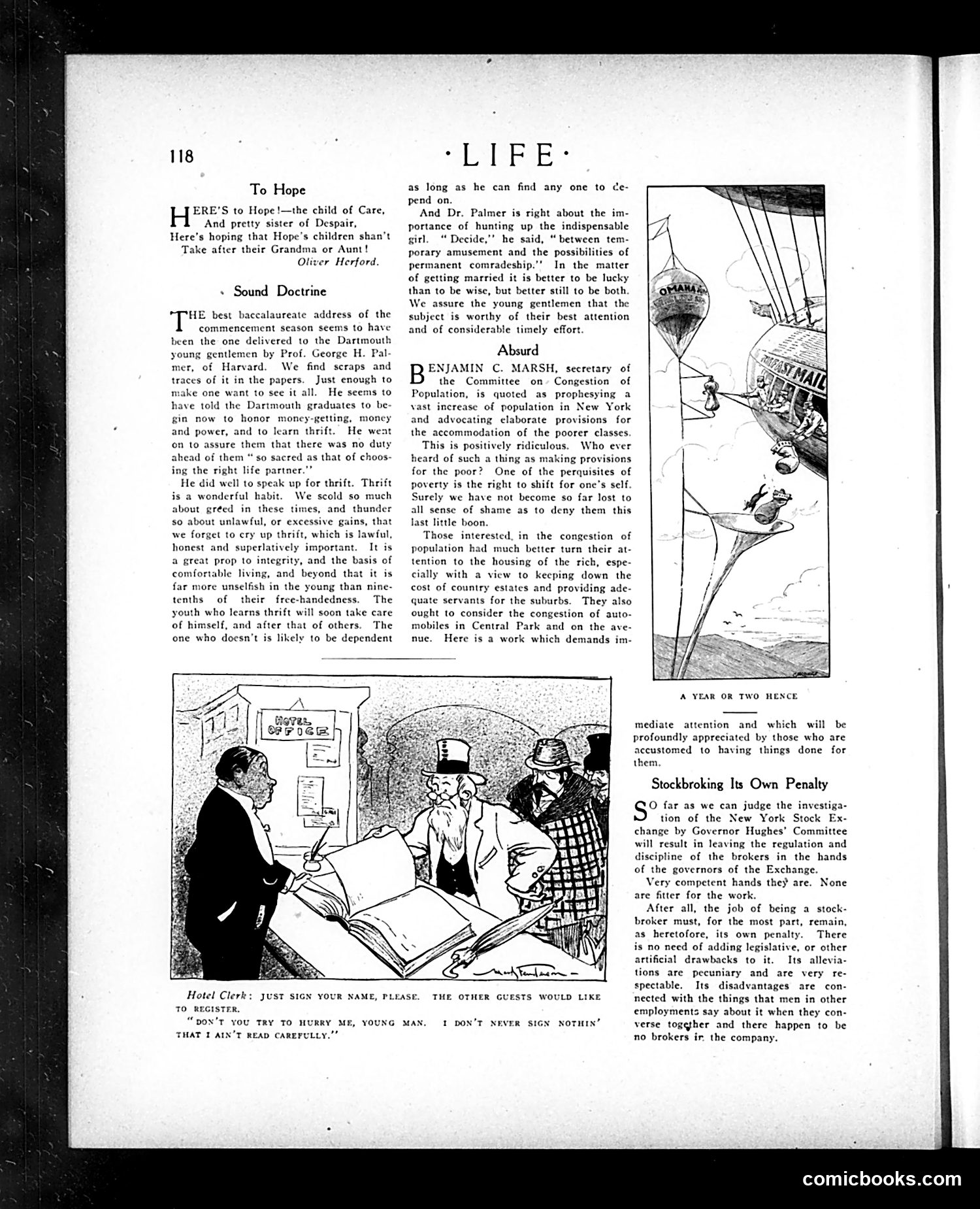
This page contains three separate satirical pieces typical of Life's style: **"To Hope"** is a brief poetic toast by Oliver Herford wishing that Hope's descendants avoid negative family traits. **"Sound Doctrine"** praises Harvard Professor George H. Palmer's commencement speech to Dartmouth graduates, endorsing his advice about thrift, money, and choosing a marriage partner wisely. **"Absurd"** satirizes Benjamin C. Marsh's advocacy for housing provisions for poor people during New York's population growth. The passage drips with sarcasm, mocking the very idea of helping the poor—suggesting poverty itself is meant to be a hardship that forces self-reliance. This reflects Gilded Age attitudes opposing social welfare. **The cartoon** shows a hotel clerk asking a guest to sign the register. The guest refuses, claiming he "don't never sign nothin'"—satirizing widespread illiteracy and distrust of written documents among working-class Americans of the era. The page's satirical tone ranges from gentle to caustic, reflecting Life's role as social commentary for educated, affluent readers.
📄 Transcribed text from this page (OCR, searchable)
Machine-transcribed from the original scan — historical spelling and the odd misread are preserved.
To Hope RE’S to Hope !—the child of Care, And pretty sister of Despair, Here’s hoping that Hope’s children shan’t Take after their Grandma or Aunt! Oliver Herford. + Sound Doctrine HE best baccalaureate address of the commencement season seems to have been the one delivered to the Dartmoui young gentlemen by Prof. George H. Pal mer, of Harvard. We find scraps and traces of it in the papers. Just enough to make one want to see it all. He seems to have told the Dartmouth graduates to be- gin now to honor money-getting, moncy and power, and to learn thrift. He weat on to assure them that there was no duty ahead of them “ so sacred as that of choos- ing the right life partner.”” He did well to speak up for thrift. Thrift is a wonderful habit. We scold so much about gréed in these times, and thunder so about unlawful, or excessive gains, that we forget to cry up thrift, which is lawful, honest and superlatively important. It is a great prop to integrity, and the basis of comfortable living, and beyond that it is far more unselfish in the young than nine- tenths of their frce-handedness. The youth who learns thrift will soon take care of himself, and after that of others. The one who doesn’t is likely to be dependent EE as long as he can find any one to ce- pend on. And Dr. Palmer is right about the im- portance of hunting up the indispensable girl.“ Decide,”” he said, “between tem- porary amusement and the possibilities of permanent comradeship."” In the matter of getting married it is better to be lucky than to be wise, but better still to be both. We assure the young gentlemen that the subject is worthy of their best attention and of considerable timely effort. Absurd ENJAMIN C. MARSH, secretary of the Committee on Congestion of Population, is quoted as prophesying a vast increase of population in New York and advocating elaborate provisions for the accommodation of the poorer classes. This is positively ridiculous. Who ever heard of such a thing as making provisions for the poor? One of the perquisites of poverty is the right to shift for one’s self. Surely we have not become so far lost to all sense of shame as to deny them this last little boon. Those interested, in the congestion of population had much better turn their at- tention to the housing of the rich, espe- cially with a view to keeping down the cost of country estates and providing ade- quate servants for the suburbs. They also ought to consider the congestion of auto- mobiles in Central Park and on the ave- nue. Here is a work which demands im- Hotel Clerk: TO REGISTER. “poN’T you TRY TO HURRY ME, YOUNG MAN, THAT I AIN’T READ CAREFULLY.” JUST SIGN YOUR NAME, PLEASE. THE OTHER GUESTS WOULD LIKE 1 DON’T NEVER SIGN NOTHIN’ A YEAR OR TWO HENCE mediate attention and which will be profoundly appreciated by those who are accustomed to having things done for them, Stockbroking Its Own Penalty O far as we can judge the investiga- tion of the New York Stock Ex- change by Governor Hughes’ Committee will result in leaving the regulation and discipline of the brokers in the hands of the governors of the Exchange. Very competent hands they are. None are fitter for the work. After all, the job of being a stock- broker must, for the most part, remain, as heretofore, its own penalty. There is no need of adding legislative, or other artificial drawbacks to it. Its allevia- tions are pecuniary and are very re- spectable. Its disadvantages are con- nected with the things that men in other employments say about it when they con- verse toggyher and there happen to be no brokers ir. the company. comicbooks.com