
Life, 1909-07-22 · page 6 of 28
Life — July 22, 1909 — page 6: what you’re looking at
What you’re looking at
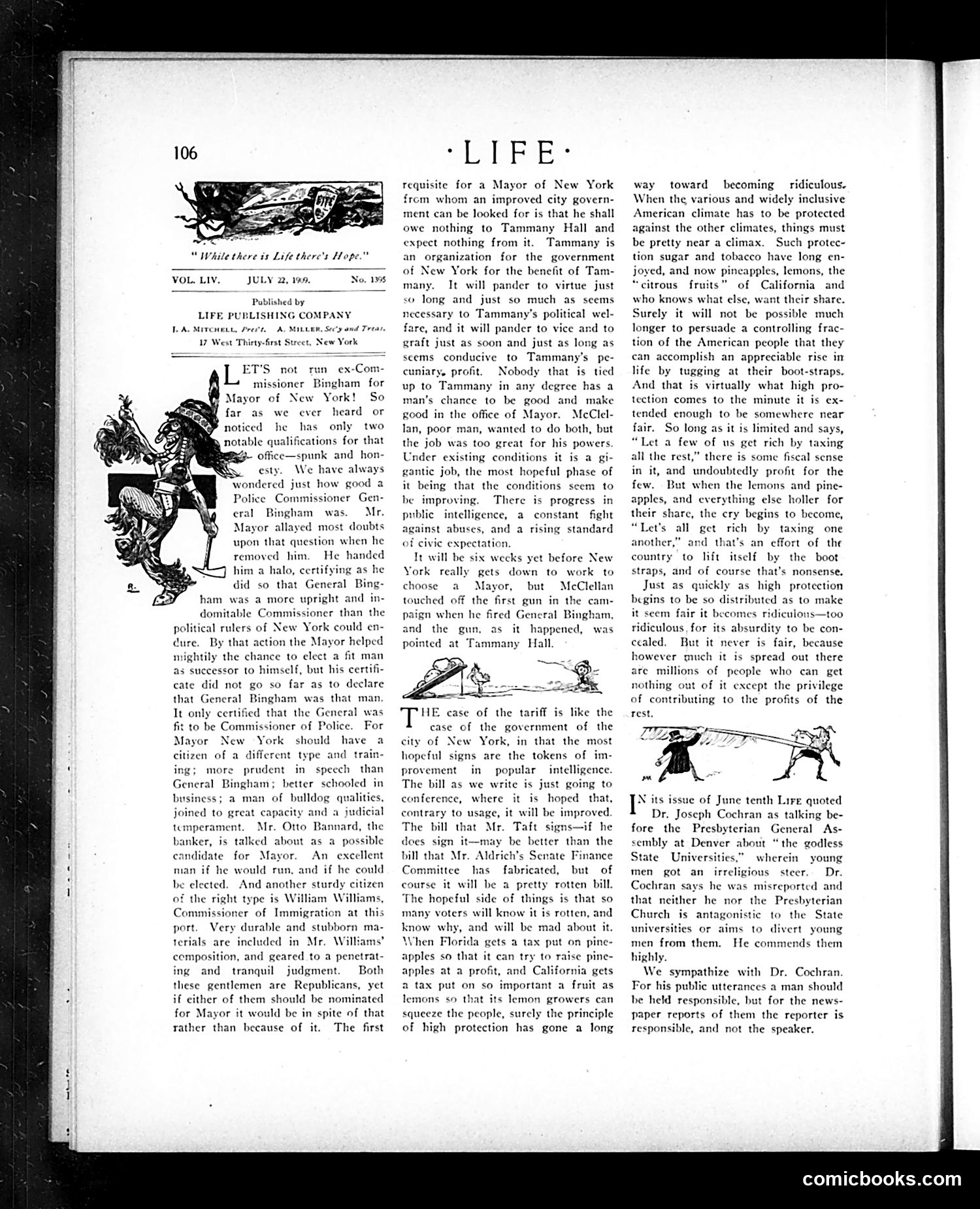
The page satirizes New York City politics, specifically criticism of Police Commissioner Bingham's tenure. The text mocks efforts to make him Mayor, arguing he's unqualified despite his "upright" reputation—being a good police commissioner doesn't make someone fit for higher office. The cartoon (upper left) depicts a figure in classical/theatrical dress, likely Bingham, appearing foolish or out of place—suggesting he'd be ridiculous in a mayor's role. The article also discusses tariff politics and Dr. Joseph Cochran's Presbyterian General Assembly speech opposing state universities, viewing them as threats to religious education. The overall tone is skeptical of political ambitions, institutional competence, and progressive educational policies typical of 1908 reform debates.
📄 Transcribed text from this page (OCR, searchable)
Machine-transcribed from the original scan — historical spelling and the odd misread are preserved.
“ While there is Life there's Hope JULY 2, 199. VOL. LIV. No, 139 Published by LIFE PUBLISHING COMPANY TA. Mironent, Pree. 17 West Thirty-first Street, New Ye A. MILLER, Sec'y and Trear. ET’S not run ex-Com- missioner Bingham for Mayor of New York! So far as we heard or noticed he has only two & notable qualifications for that 4. office—spunk and hon- esty. We have always wondered just how good a Police Commissioner Gen- eral Bingham was. Mr. ever Mayor allayed most doubts upon that question when he removed him. He handed him a halo, certifying as he did so that General Bing- ham was a more upright and in- domitable Commissioner than the political rulers of New York could en- i By that action the Mayor helped mightily the chance to elect a fit man as successor to himself, but his certifi- cate did not go so far as to declare that General Bingham was that man. It only certified that the General was fit to be Commissioner of Police. For Mayor New York should have a citizen of a different type and trai ing; more prudent in than General Bingham; better schooled in business; a man of bulldog qualities, joined to great capacity and a judicial temperament. Mr. Otto Bannard, the banker, is talked about as a possible candidate for Mayor. An excellent man if he would run, and if he could be elected. And another sturdy citizen of the right type is William Williams, Commissioner of Immigration at this port. Very durable and stubborn m terials are included in Mr. Williams’ composition, and geared to a penetrat- ing and tranquil judgment. Both these gentlemen are Republicans, yet if either of them should be nominated for Mayor it would be in spite of that rather than because of it. The first speech = ARG. requisite for a Mayor of New York from whom an improved city govern- ment can be looked for is that he shall owe nothing to Tammany Hall and expect nothing from it. Tammany is an organization for the government of New York for the benefit of Tam- many, It will pander to virtue just so long and just so much as seems necessary to Tammany’s political wel- fare, and it will pander to vice and to graft just as soon and just as long as seems conducive to Tammany’s pe- cuniary, profit, Nobody that is tied up to Tammany in any degree has a man’s chance to be good and make good in the office of Mayor. McClel- lan, poor man, wanted to do both, but the job was too great for his powers Under existing conditions it is a gi- gantic job, the most hopeful phase of it being that the conditions seem to be improving. There is progress public intelligence, a constant fight against abuses, and a rising standard civic expectation. It will be six weeks yet before New York really gets down to work to choose a Mayor, but McCle touched off the first gun in the cam- paign when he fired General Bingham, and the gun, as it happened, pointed at Tammany Hall was HE case of the tariff is like the case of the government of the city of New York, in that the most hopeful signs are the tokens of im- provement in popular intelligence. The bill as we write is just going to conference, where it is hoped that, contrary to usage, it will be improved The bill that Mr. Taft signs—if he does sign it—may be better than the bill that Mr. Aldrich’s Senate Finance Committ has fabricated, but of course it will be a pretty rotten bill. The hopeful side of things is that so many voters will know it is rotten, and know why, and will be mad about it. When Florida gets a tax put on pine- apples so that it can try to raise pine- apples at a profit, and California gets a tax put on so important a fruit as lemons so that its lemon growers can squeeze the people, surely the principle of high protection has gone a long way toward becoming ridiculous. When the various and widely inclusive American climate has to be protected against the other climates, things must be pretty near a climax. Such protec- tion sugar and tobacco have long en- joyed, and now pineapples, lemons, the citrous fruits” of California and who knows what else, want their share. Surely it will not be possible much longer to persuade a controlling frac- tion of the American people that they can accomplish an appreciable rise in life by tugging at their boot-straps. And that is virtually what high pro- tection comes to the minute it is ex- tended enough to be somewhere near fair. So long as it is limited and says, “Let a few of us get rich by taxing all the rest,” there is some fiscal sense in it, and undoubtedly profit for the few. But when the lemons and pine- apples, and everything else holler for their share, the ery begins to become, “Let's all get rich by taxing another,” and that's an effort of the country to lift itself by the boot straps, and of course that’s nonsense. Just as quickly as high protection begins to be so distributed as to make it seem fair it becomes culous—too ridiculous, for its absurdity to be con- cealed. But it never is fair, because however much it is spread out there are millions of people who can get nothing out of it except the privilege of contributing to the profits of the rest. one TLE its issue of June tenth Lire quoted Dr. Joseph Cochran as talking be- fore the Presbyterian General As- sembly at Denver about “the godless State Universities,” wherein young men got an irreligious steer. Dr. Cochran says he was misreported and that neither he nor the Presbyterian Church is antagonistic to the State universities or aims to divert young men from them. He commends them highly. We sympathize with Dr. Cochran. For his public utterances a man should be held responsible, but for the news- paper reports of them the reporter is responsible, and not the speaker. comicbooks.com