
A complete issue · 32 pages · 1909
Life — May 27, 1909
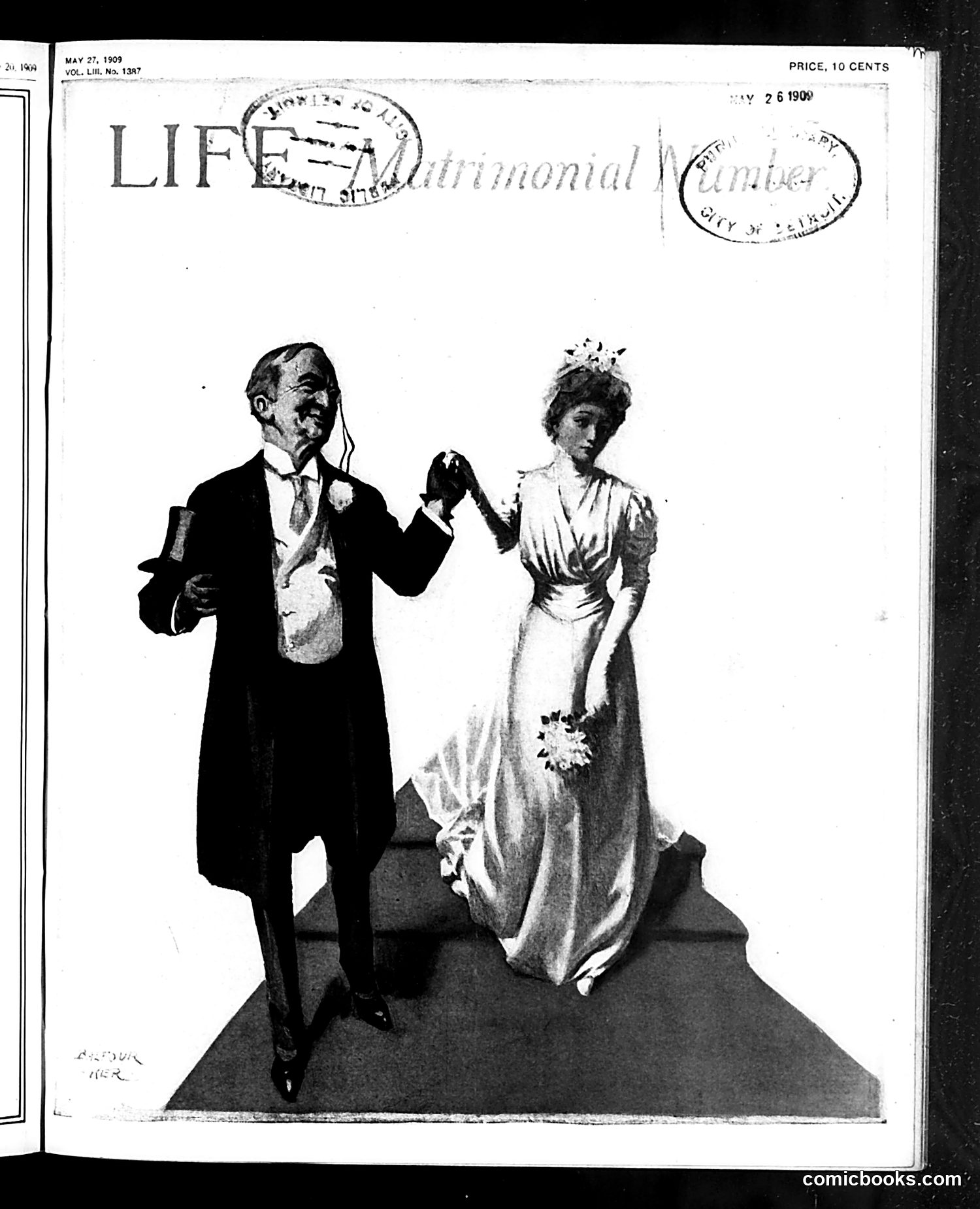
This Life magazine cover from May 27, 1909 appears to show a satirical illustration of a couple in formal attire—a man in evening dress holding what looks like a small object, and a woman in a wedding gown with flowers. Without clearer OCR text or additional context visible on the page, I cannot definitively identify the specific figures being caricatured or pinpoint the exact political or social event being satirized. The formal dress and wedding-like setting suggest commentary on either a high-society marriage, an engagement, or possibly a matrimonial scandal involving prominent figures of 1909. The magazine's satirical intent is evident, but identifying the specific targets and the precise joke requires additional historical documentation I cannot reliably extract from this image alone.
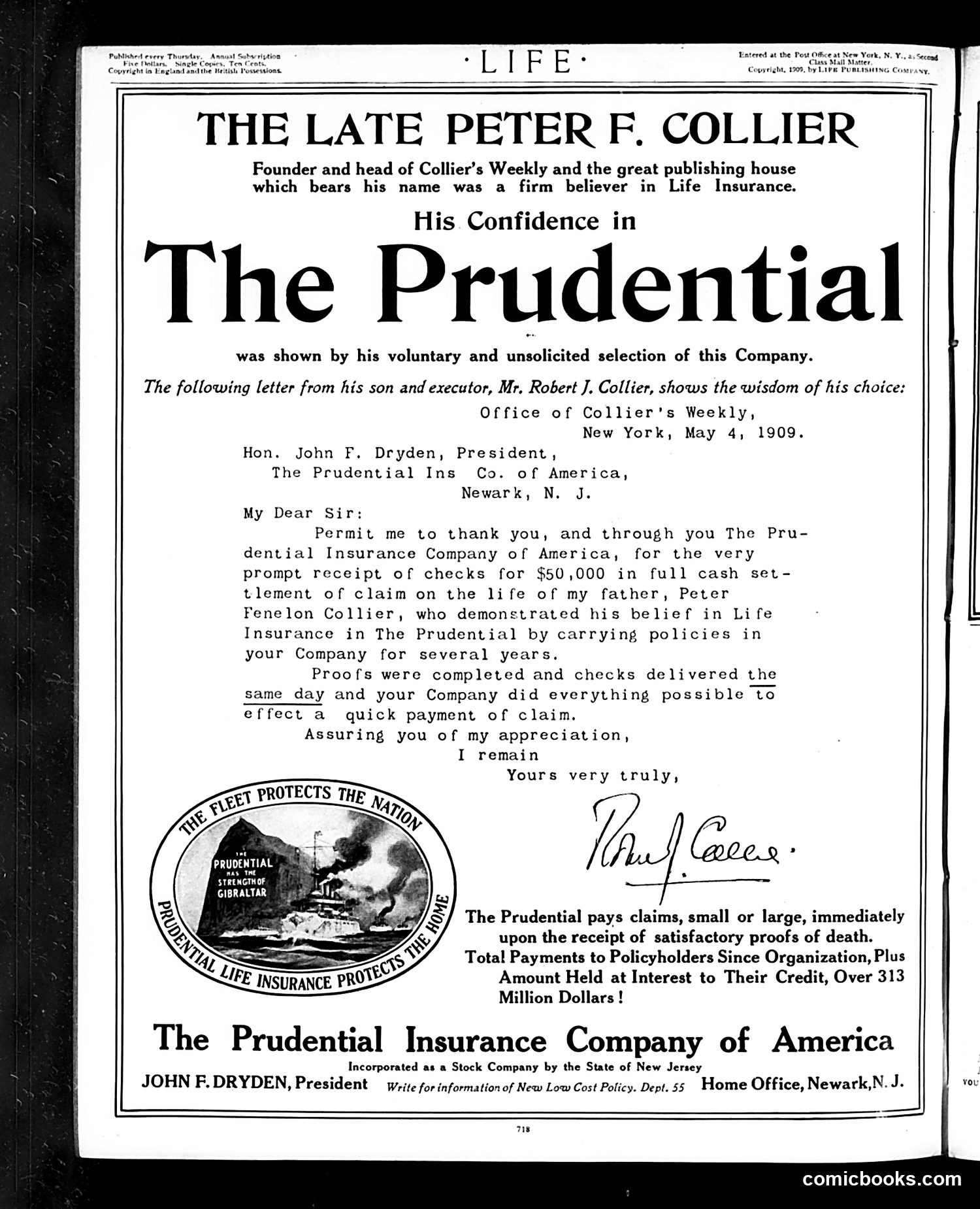
This is **not a satirical cartoon page**, but rather a **testimonial advertisement** for The Prudential Insurance Company of America, dated May 4, 1909. The page features a letter from Robert J. Collier, son of Peter F. Collier (founder of Collier's Weekly magazine and publishing house), praising Prudential for promptly paying a $50,000 life insurance claim on his father's death. The letter emphasizes that Prudential completed proofs and delivered checks "the same day" with "quick payment of claim." The only visual element is Prudential's corporate logo showing a naval fleet, with their slogan "The Fleet Protects the Nation" and "Prudential Life Insurance Protects the Home." This is a paid endorsement leveraging a prominent publisher's credibility to advertise insurance reliability to wealthy readers.
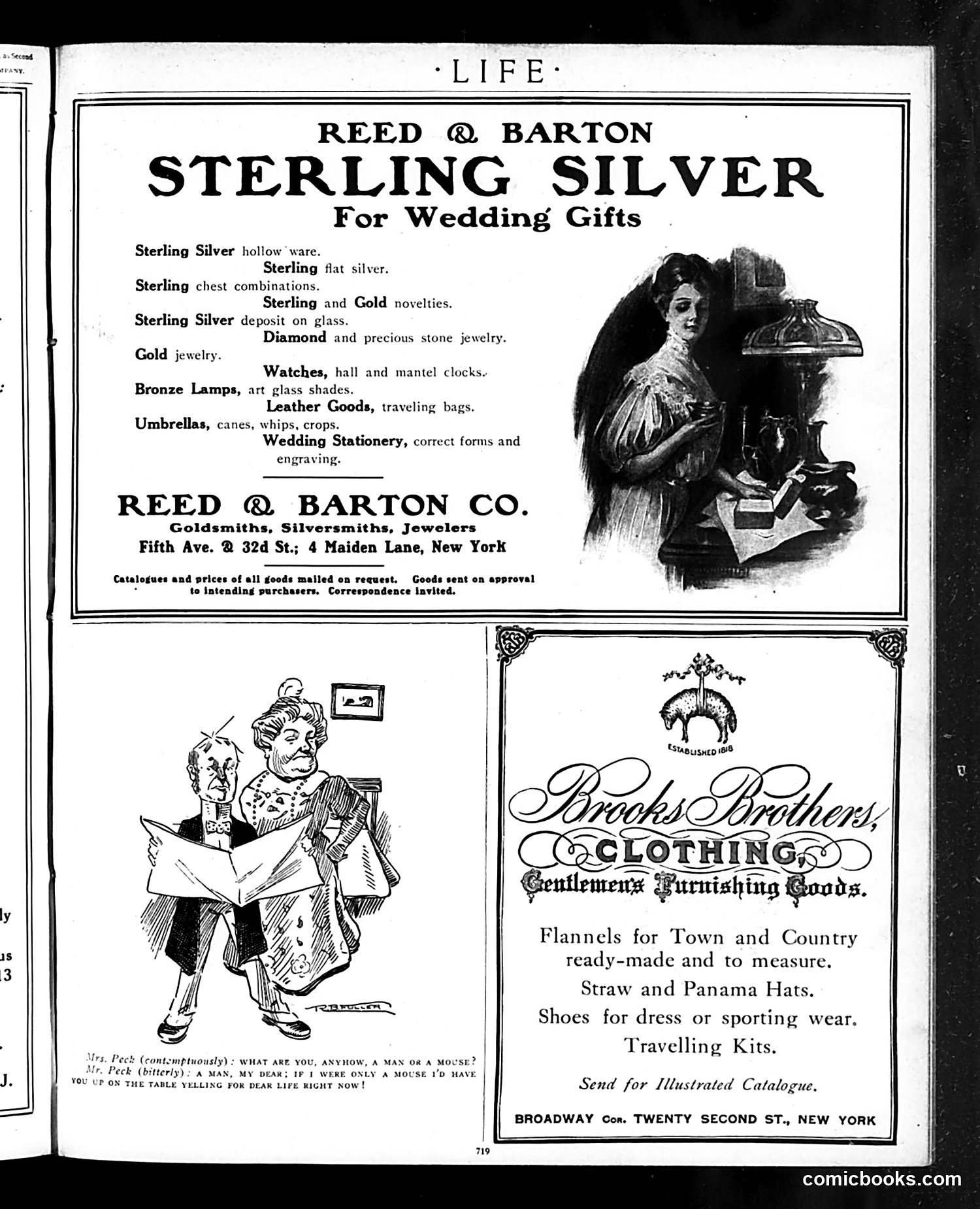
This page is primarily **advertising**, not political satire. The top two-thirds features Reed & Barton's sterling silver wedding gifts advertisement, with an illustration of an elegant woman displaying decorative items. The lower left contains a **humorous cartoon** showing two men examining what appears to be a picture or document. The caption reads: "Mrs. Peck (comtemtuously): 'What ARE you going a man, my dear; if I were only a mouse I'd have you up on the table yelling for dear life right now!'" This appears to be **domestic humor** playing on gender roles and marital dynamics—likely satirizing a henpecked husband or commenting on women's frustrations with men's behavior. The specific reference to "Mrs. Peck" and the mouse comment suggests wordplay, though the full context is unclear without additional information. The remaining space features Brooks Brothers clothing advertisement.
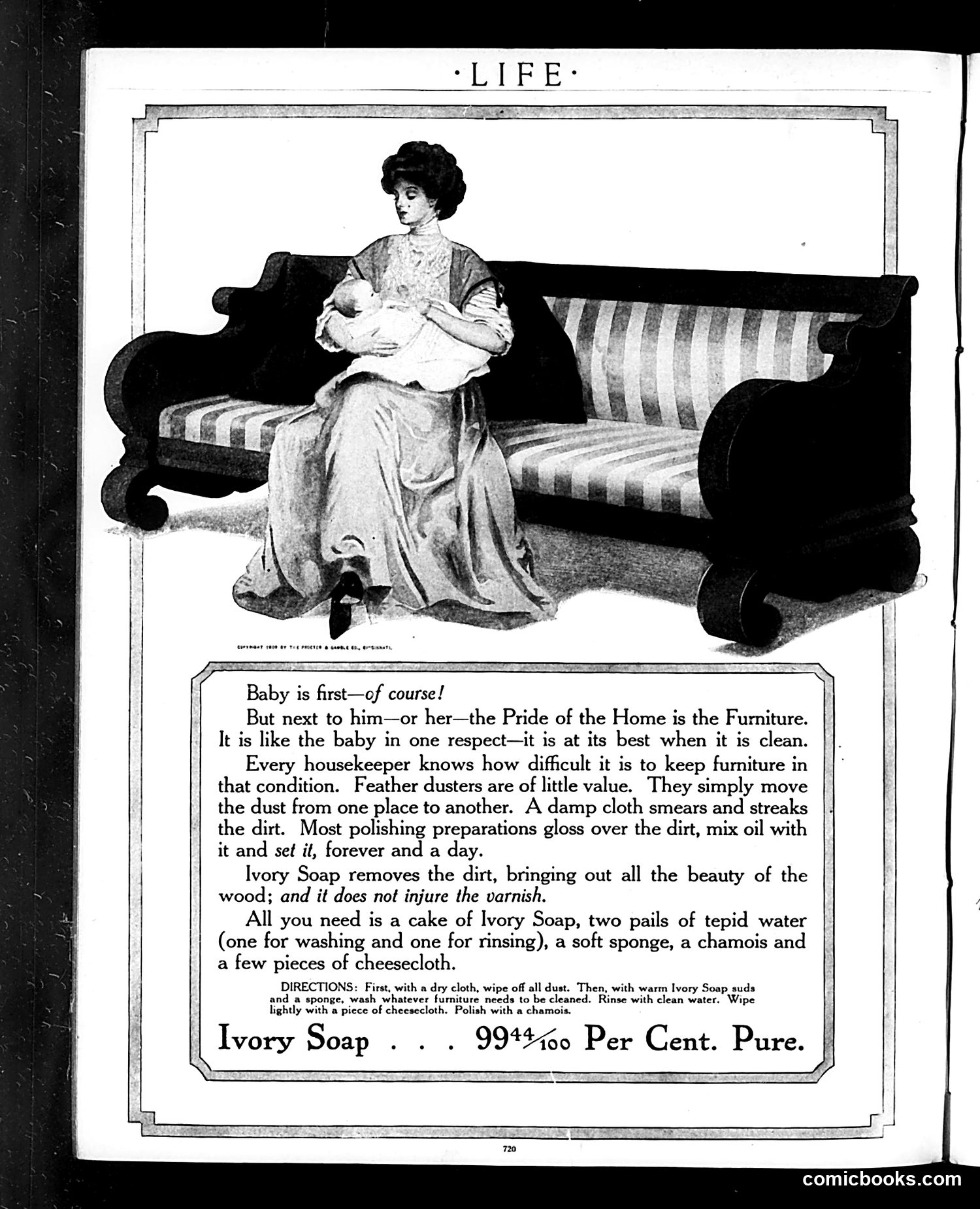
This is **not a political cartoon or satire**, but rather a straightforward **early 20th-century domestic advertisement**. The image shows a woman sitting on an ornate sofa, holding a baby, positioned as an idealized housewife. The ad promotes Ivory Soap for furniture cleaning, using the era's common marketing strategy of equating domestic labor with maternal care. The text establishes a hierarchy: "Baby is first—of course! But next to him...the Pride of the Home is the Furniture." The message reflects period attitudes about women's domestic responsibilities. It positions furniture maintenance as nearly equivalent to childcare—both requiring constant attention and cleanliness. The ad emphasizes Ivory Soap's gentleness, claiming it cleans without damaging varnish. This reflects early 1900s gender roles and consumer culture targeting housewives.
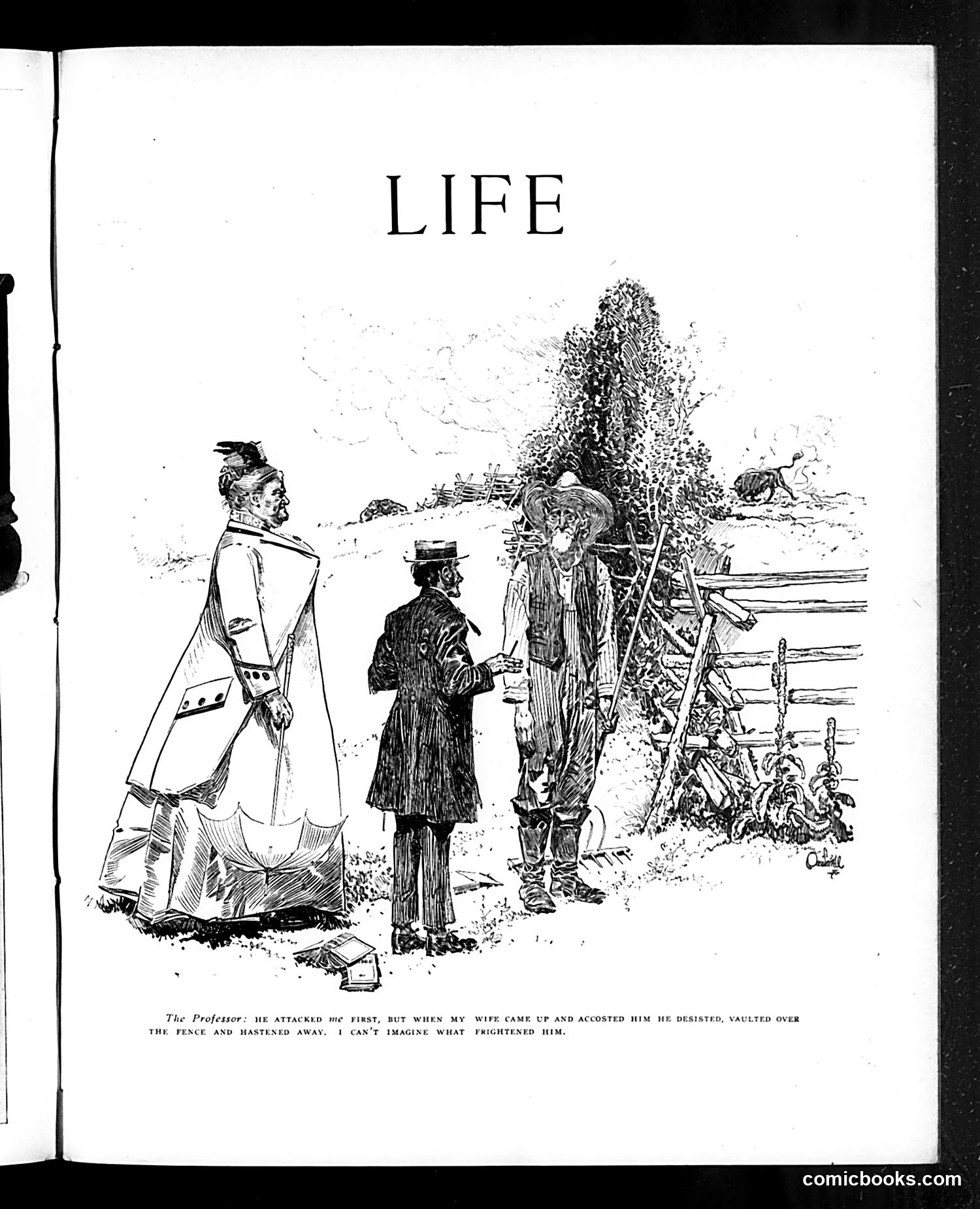
This page titled "LIFE" presents a single cartoon with three figures in a rural setting. The caption reads: "The Professor: HE ATTACKED ME FIRST, BUT WHEN MY WIFE CAME UP AND ACCUSED HIM HE DESISTED, VAULTED OVER THE FENCE AND HASTENED AWAY. I CAN'T IMAGINE WHAT FRIGHTENED HIM." The joke appears to satirize a professor's naïveté or obliviousness. A well-dressed man (the "professor") recounts an encounter where another man fled upon seeing the professor's wife, yet the professor claims bewilderment at what scared the intruder away—the implication being his wife's appearance or reputation was the real deterrent. This is a domestic humor joke playing on traditional stereotypes about unattractive spouses, common in early 20th-century American satirical magazines.
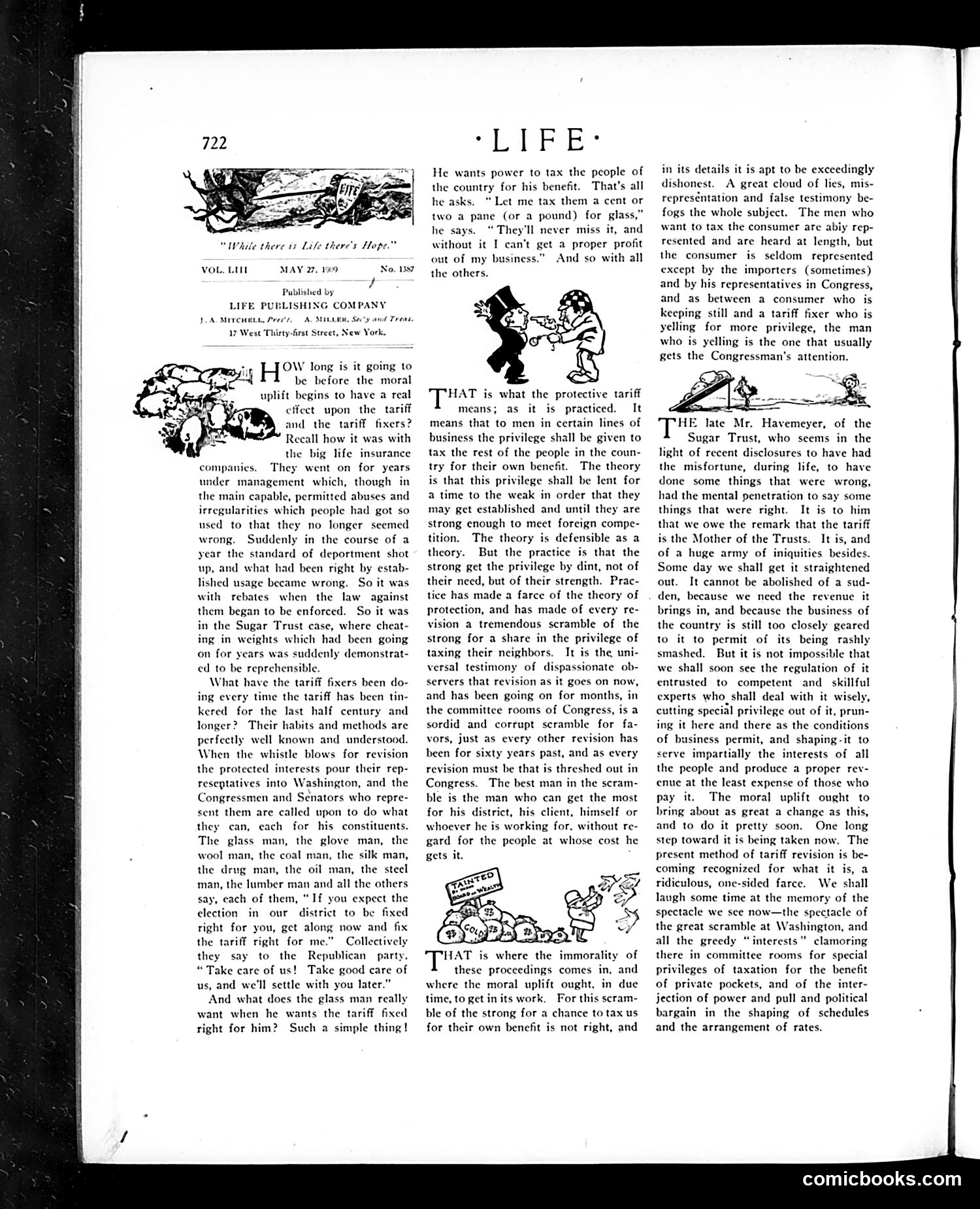
This page critiques the tariff revision process in Congress. The text argues that tariff "protection" ostensibly benefits weak American industries, but actually serves special interests at consumers' expense. The cartoons illustrate this hypocrisy: figures representing different business sectors (identified by labels like "glass man," "wool man," "steel man") lobby Congress for tariff privileges. The satire suggests these businessmen falsely claim they need protection to compete internationally, when really they're exploiting Congress to tax ordinary citizens for private profit. The author (likely mocking Republican party rhetoric) suggests tariff fixers have corrupted the revision process for "sixty years," turning legitimate economic policy into a "scramble" where powerful interests manipulate schedules and rates behind closed committee doors, harming consumers who have no representation in these dealings.
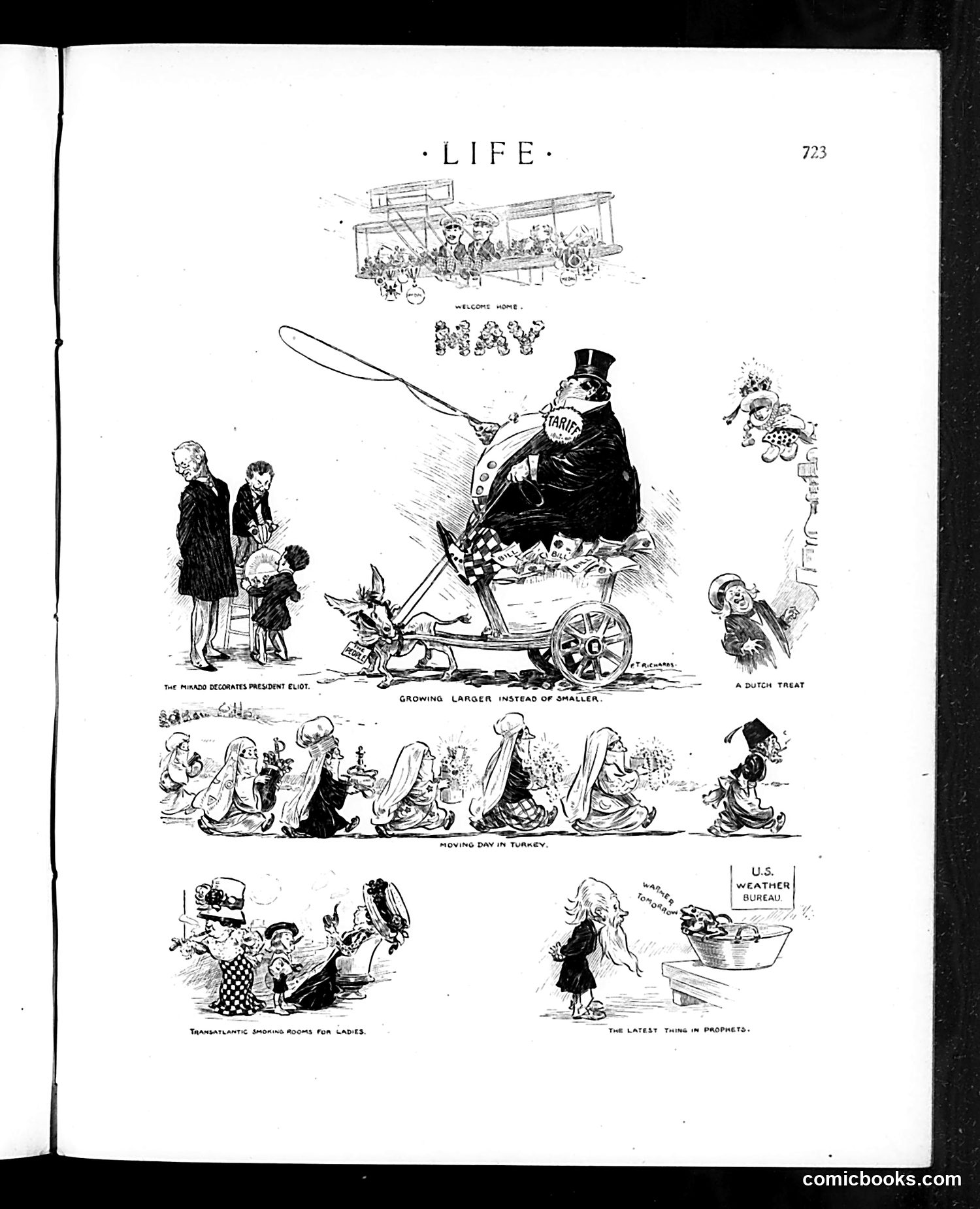
This political cartoon page contains several satirical sketches commenting on early 20th-century affairs: The central cartoon shows a figure labeled "TARIFF" in a top hat, pushing an enormous baby carriage labeled "BABY" - titled "GROWING LARGER INSTEAD OF SMALLER." This satirizes government tariff policy as bloated and expanding beyond control. "The Mikado Decimates President Eliot" (left) appears to reference Japanese-American relations, possibly commenting on President Eliot's views. "A Dutch Treat" (right) and "Moving Day in Turkey" reference international politics and Ottoman Empire affairs. Lower panels address "Transatlantic Smoking Rooms for Ladies" and "The Latest Thing in Prophets," likely satirizing social customs and contemporary fads. The overall tone criticizes government policies, international relations, and modern society's peculiarities through sharp, humorous illustration.
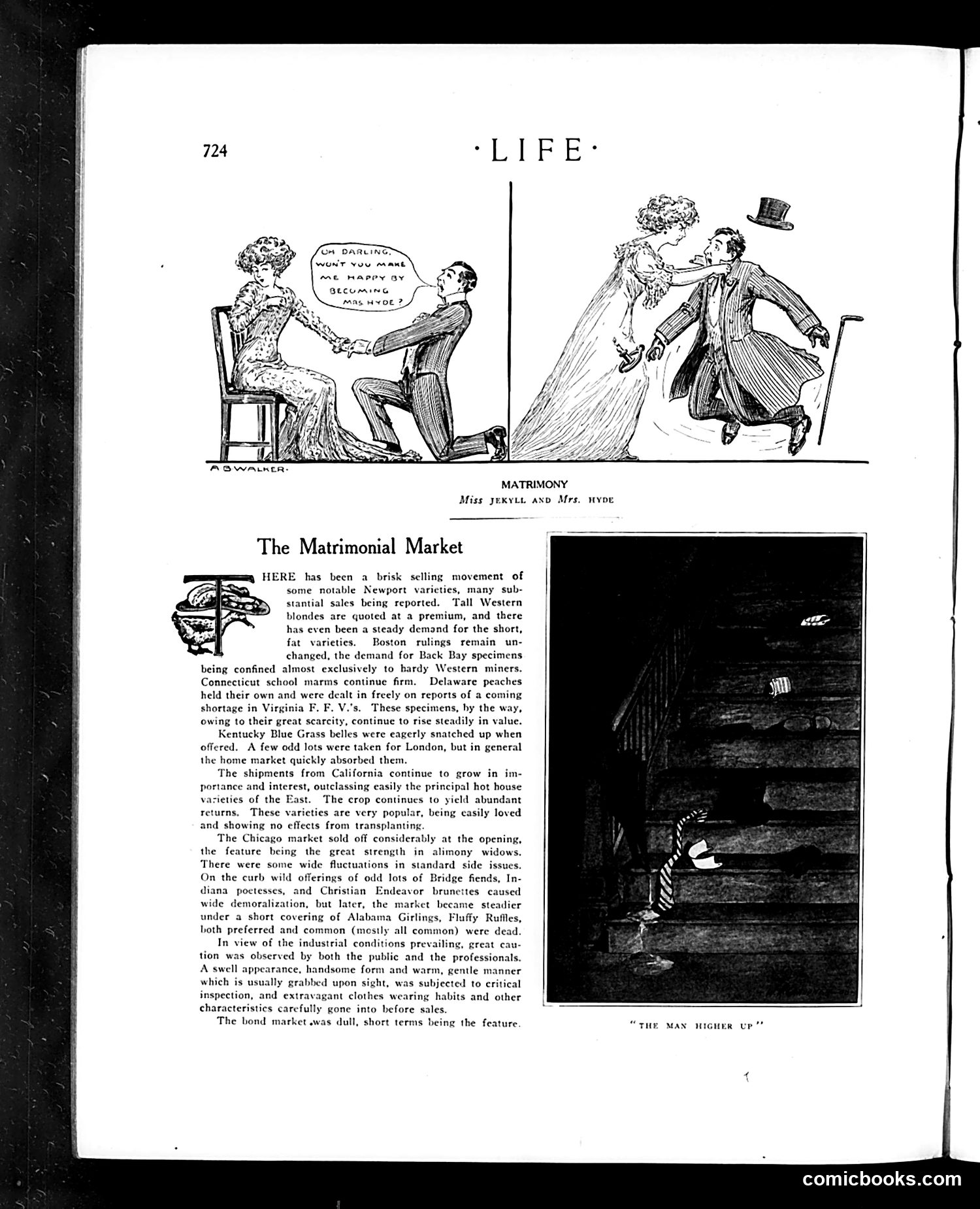
This page satirizes the marriage market through two cartoons. The top cartoon, titled "Matrimony: Miss Jekyll and Mrs. Hyde," depicts a woman transforming from an angelic, refined bride (left) into a demanding, sharp-tongued wife (right)—a common Victorian joke about how women changed after marriage. Below, "The Matrimonial Market" article uses agricultural/commodity language to mock marriage as a commercial transaction. It treats women like livestock being bought and sold, discussing "Newport varieties," "Connecticut school marms," and regional "breeds" with humorous seriousness. The accompanying photograph "The Man Higher Up" appears to show a man, possibly illustrating the power dynamic being satirized. The satire critiques how marriage—supposedly romantic—functioned as literal marketplace commerce.
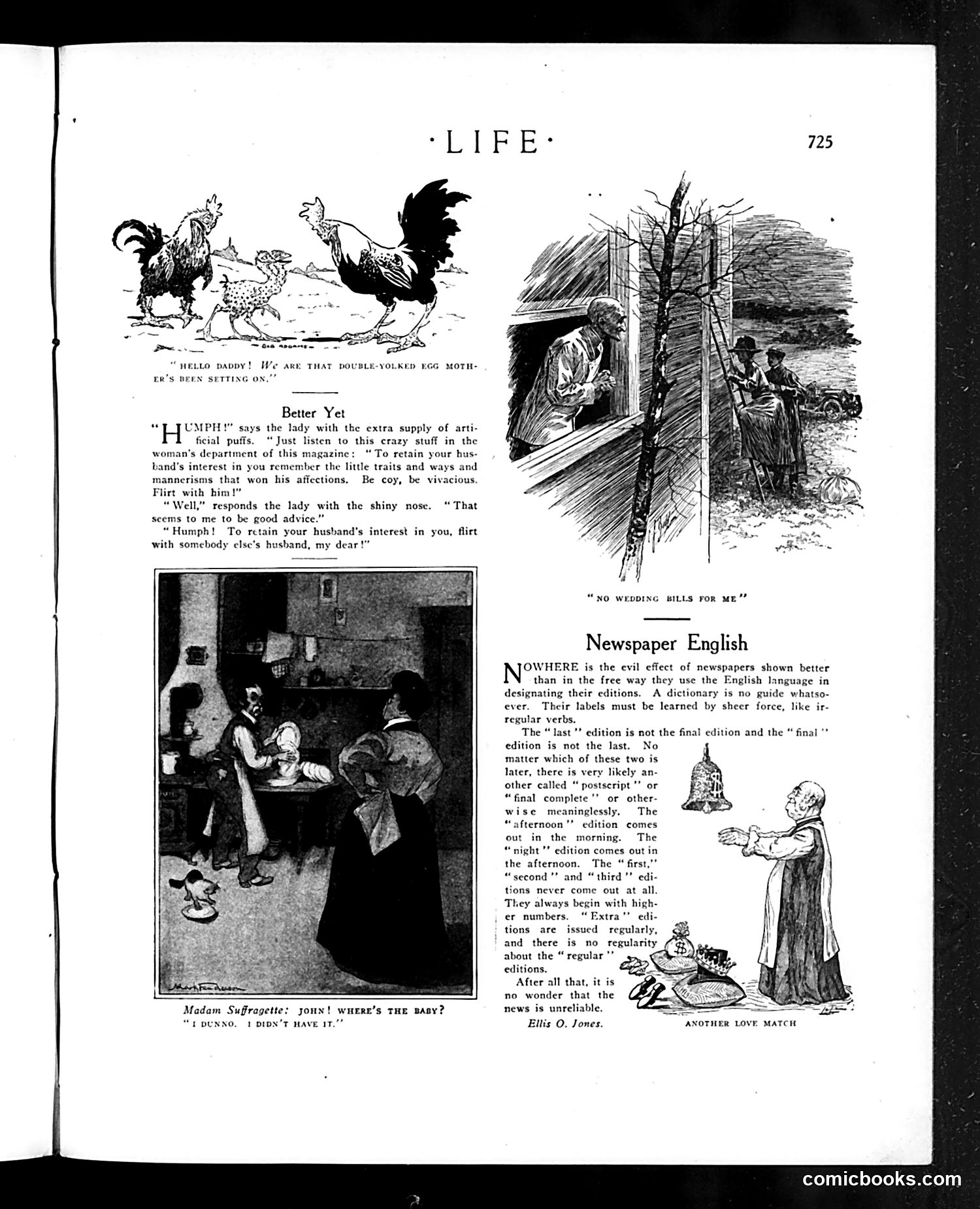
The page contains two distinct satirical pieces: 1. **"Better Yet"** (top): A humorous advice column mocking relationship dynamics. A woman with "artificial puffs" (fashion accessories) dismisses conventional wisdom about keeping a husband's interest through demure behavior, instead advocating flirtation "with somebody else's husband." The satire critiques both dated marital advice and women's competitive social strategies. 2. **"Newspaper English"** (right): This section satirizes newspapers' misuse of English language in headlines and editions. It mocks their confusing terminology—"last" vs. "final" editions, "afternoon" vs. "night" editions appearing at illogical times, and meaningless "extra" editions. The satire highlights newspapers' arbitrary and misleading labeling practices that confuse readers about publication timing and status.
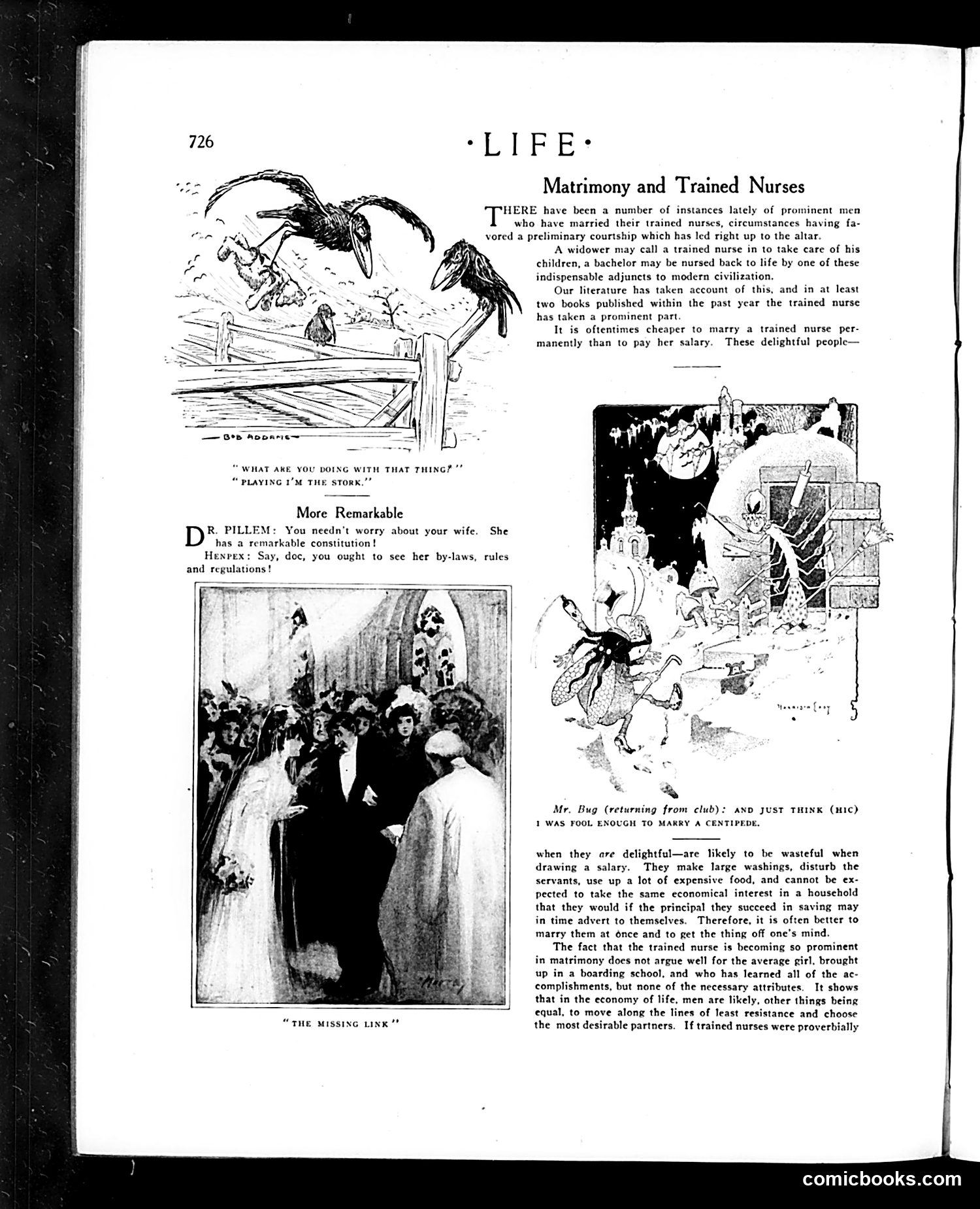
This page satirizes marriages between prominent men and trained nurses. The top cartoon shows storks (symbolizing babies/marriage) with the caption "What are you doing with that thing? Playing I'm the stork" — a joke about nurses becoming wives rather than caregivers. The article mocks men who marry nurses, suggesting it's cheaper than paying a nurse's salary. It argues trained nurses make poor wives because they're accustomed to command, create household disorder, run expensive establishments, and lack the "necessary attributes" for domestic life. The lower photograph titled "The Missing Link" appears to show a wedding scene, likely illustrating an actual such marriage. The satire reflects early 20th-century anxieties about changing gender roles as women entered professional nursing.
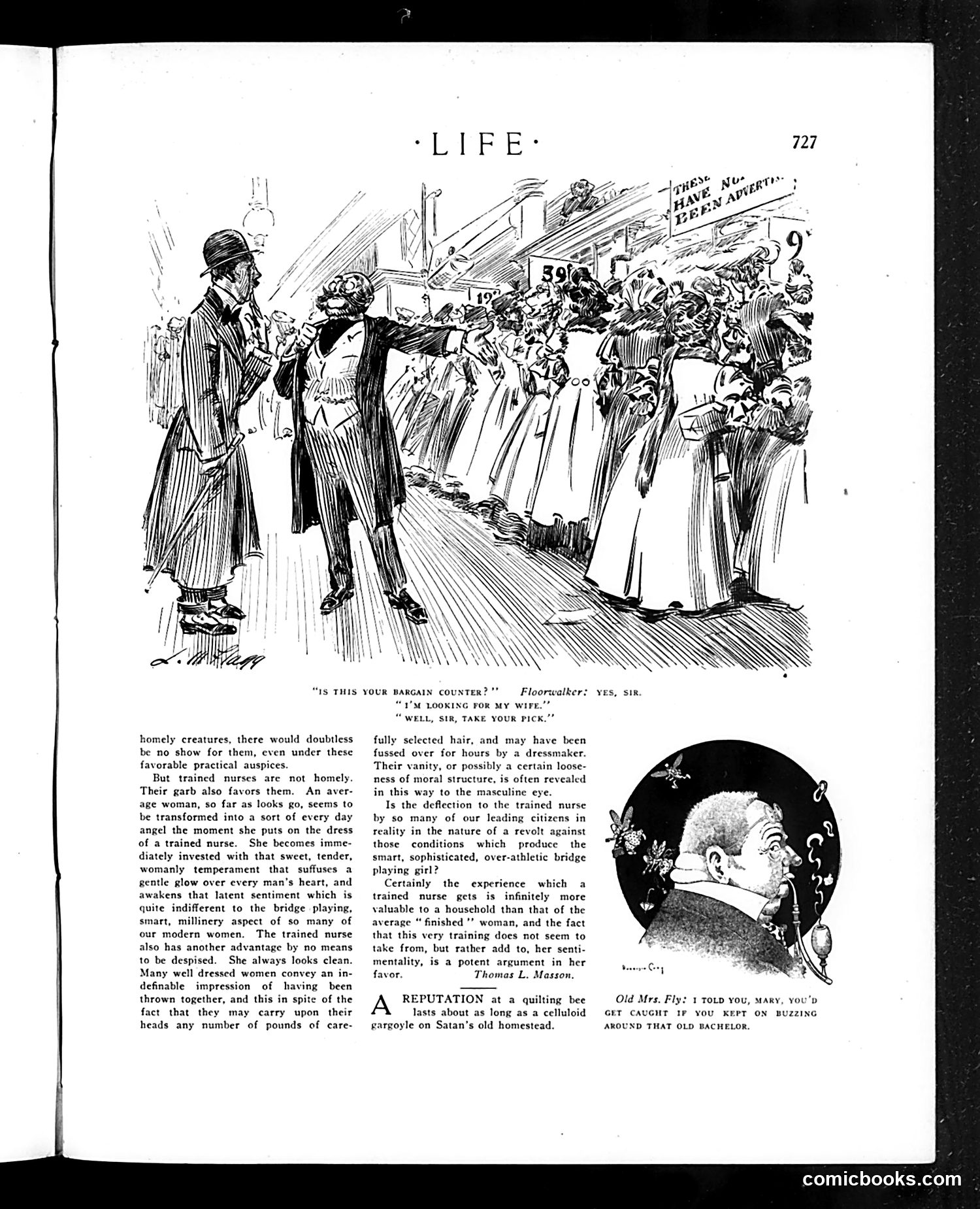
The main cartoon depicts a social scene at what appears to be a public venue or marketplace. A well-dressed man in a suit and hat addresses a floorwalker, asking "Is this your bargain counter?" and "I'm looking for my wife," to which the floorwalker replies "Well, sir, take your pick." The satire mocks the uniformity and interchangeability of fashionable women of the era—suggesting that well-dressed women at such venues all look identical, making wives indistinguishable from one another. It's a commentary on conformity in women's fashion and social behavior during this period. The accompanying article discusses trained nurses, their professional training, and their value to households, suggesting contemporary debates about women's professional roles.
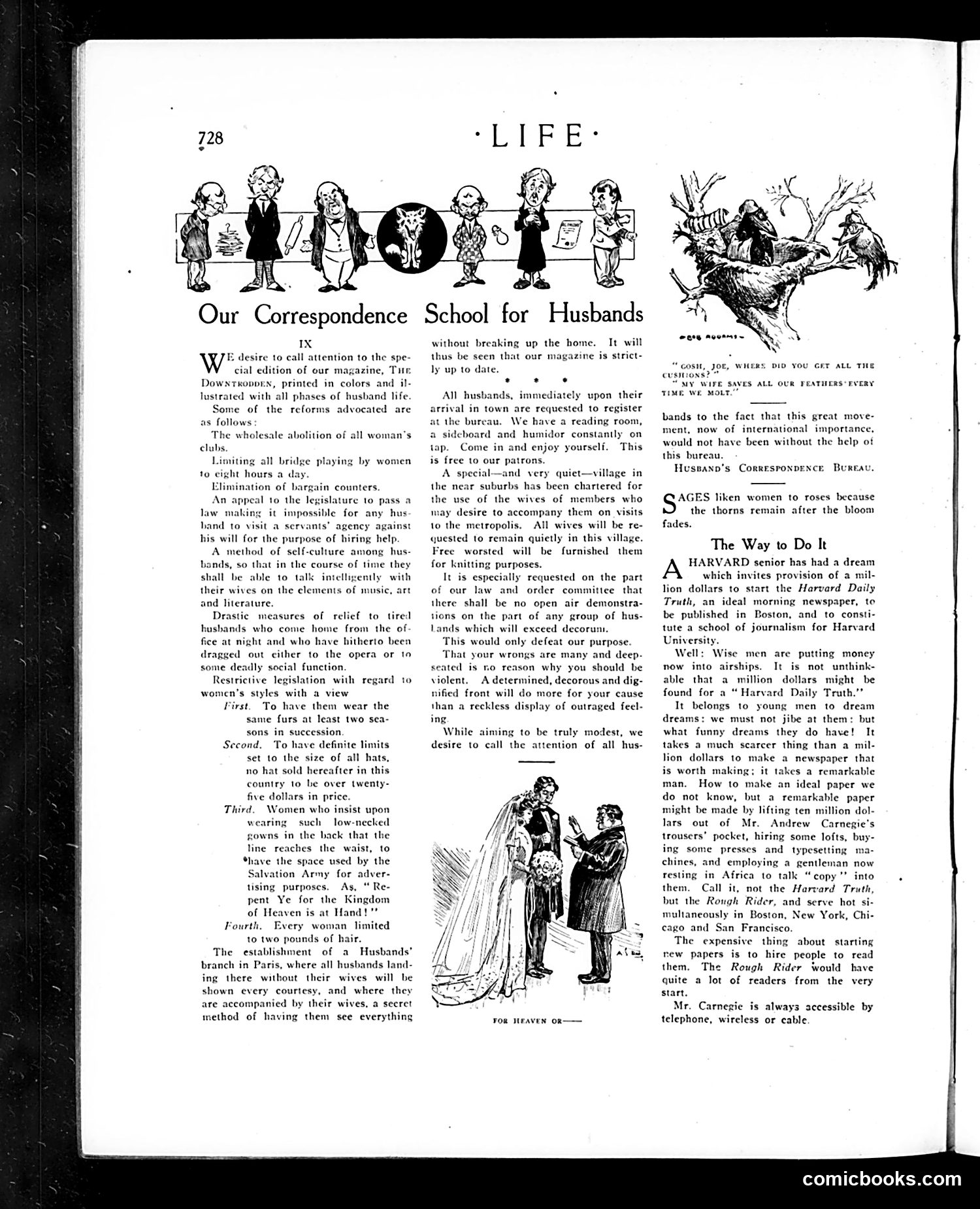
This satirical piece mocks early 20th-century women's suffrage and changing gender roles. The cartoon depicts a "Husbands' Correspondence Bureau" offering remedial instruction to men—reversing traditional educational hierarchies. The text proposes absurd "reforms": eliminating women's clothes, banning bridge (card games), restricting hat sizes, and preventing women from wearing low necklines. These exaggerated demands parody actual suffragist proposals while portraying husbands as incompetent students needing correction. The satire cuts both ways: it ridicules both the emerging women's rights movement (suggesting their demands are ridiculous) and husbands (implying they're too foolish to understand women). The overall tone is light mockery of shifting domestic power dynamics during the Progressive Era.
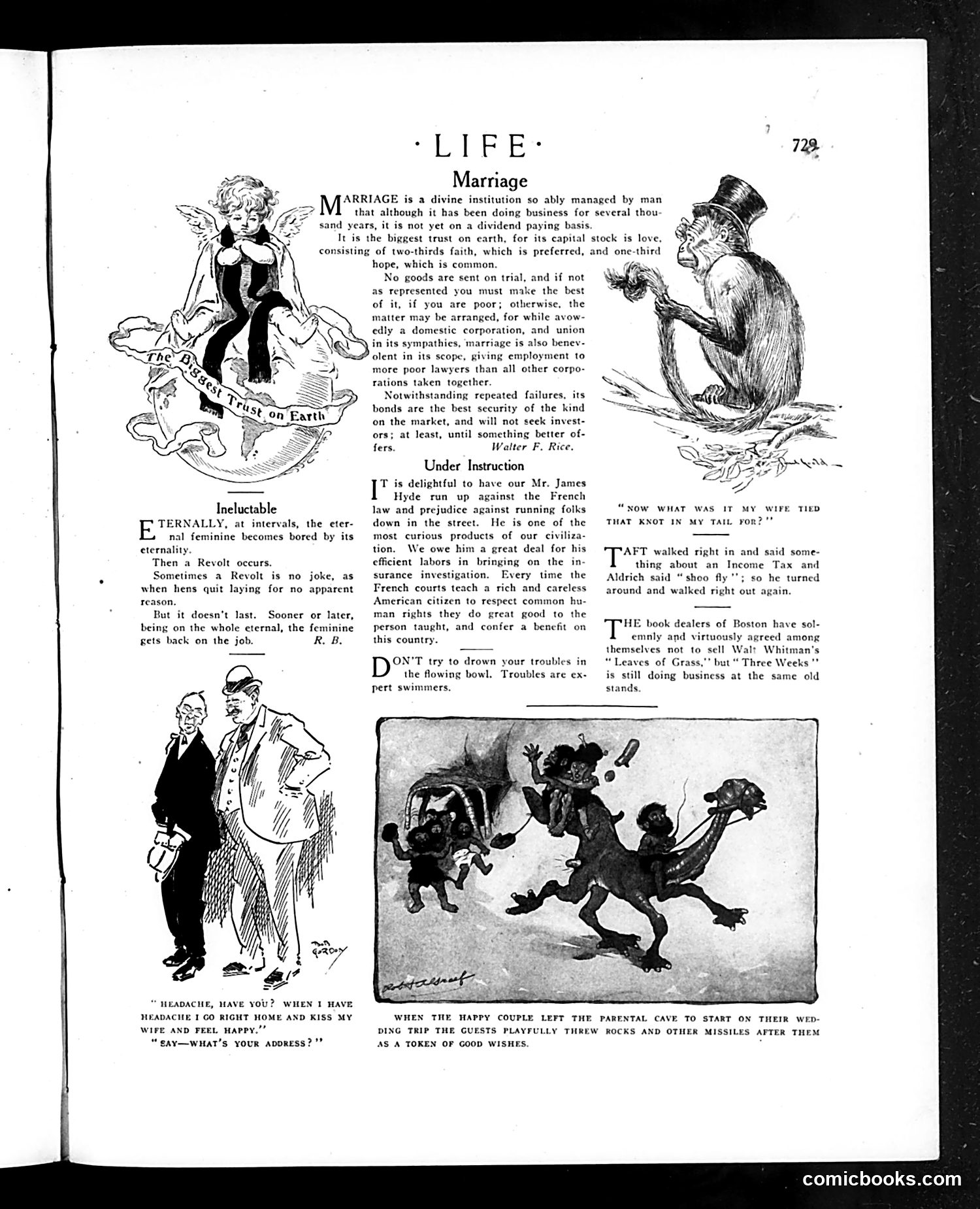
This page from *Life* magazine contains satirical commentary on marriage and domestic life. The main essay titled "Marriage" by Walter F. Rice describes marriage as "the biggest trust on earth" whose "capital stock is love." The piece humorously critiques marriage as a struggling financial institution, comparing it to a poorly-managed business that doesn't pay dividends. The accompanying cartoons mock marital discord and gender relations. One shows a man with a headache asking his wife about remedies, with the punchline about kissing her upon returning home. Another depicts a honeymoon scene with cave-dwelling figures throwing rocks—likely satirizing primitive or base human behavior underlying supposedly refined matrimonial institutions. The satire targets both marriage's financial precariousness and domestic unhappiness.
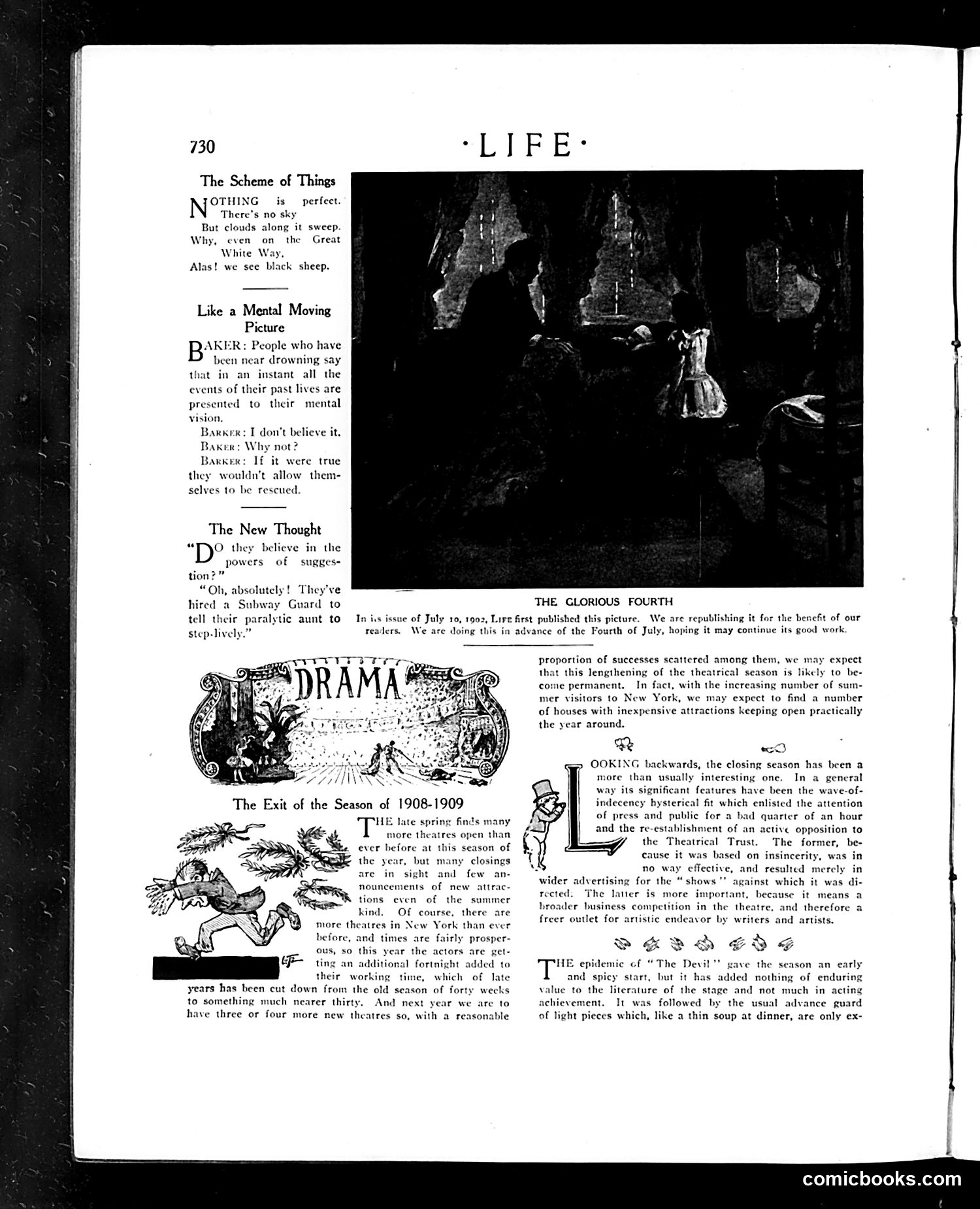
This page from *Life* magazine (circa 1902-1909) contains three separate humorous pieces: **"The Scheme of Things"**: A short poem about imperfection, using the metaphor of clouds on the sky and "black sheep" on Broadway—likely critiquing moral failings in New York's theater district. **"Like a Mental Moving Picture"**: A joke dialogue between Baker and Barker about near-death experiences. The humor relies on the contemporary belief that drowning victims see their entire lives flash before them—Barker cynically suggests no one would allow themselves to be rescued if this were true. **"The New Thought"**: A brief joke about "New Thought" philosophy (a popular early-1900s movement emphasizing mind-over-matter healing). The satire mocks its believers for hiring a subway guard to use "suggestion" to cure a paralyzed aunt—implying the philosophy's absurd overreach. The remaining text discusses Broadway's theatrical season, closings, and debates over indecency in theater and monopolistic practices by the "Theatrical Trust."
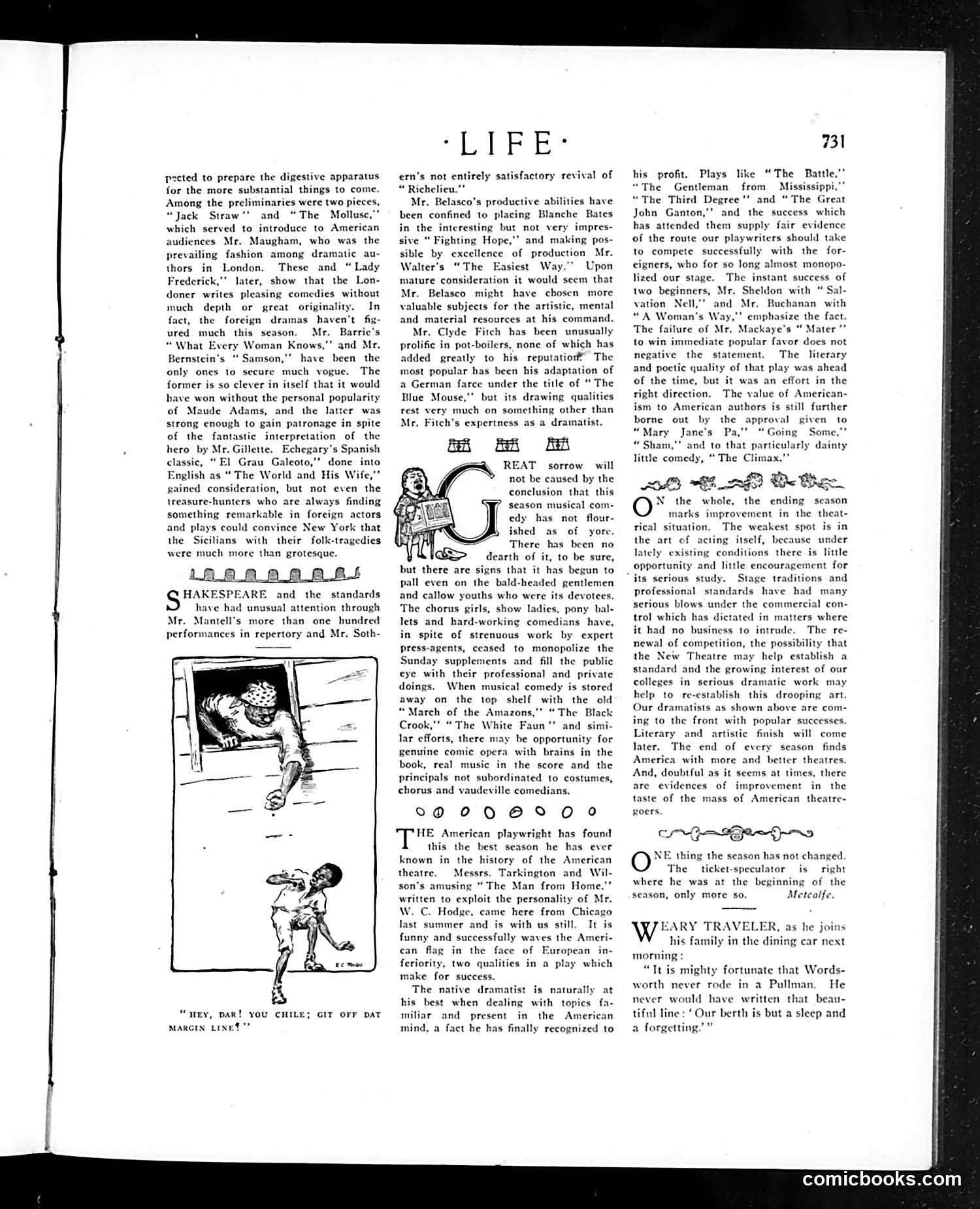
This theater review page discusses the 1908-1909 Broadway season. The two cartoon illustrations appear to satirize theatrical performance styles. The cartoons feature exaggerated figure drawings—likely caricatures of specific actors or performance types popular at the time. Based on the surrounding text's discussion of musical comedy, these sketches probably mock the physical comedy and broad gesturing typical of vaudeville and farce performers who dominated musical theater. The caption "HEY, PAH! YOU CHILE; GIT OFF DAT MARGIN LINE!" uses dialect humor (appearing to reference minstrelsy-influenced speech patterns), which was common in early 1900s American satire. The review's main point: American playwrights had their best season yet, particularly those writing comedies about American life. The text dismisses both foreign dramas and worn-out musical comedy formulas, praising instead native dramatists who explored American themes and characters—a nationalist sentiment typical of the era.
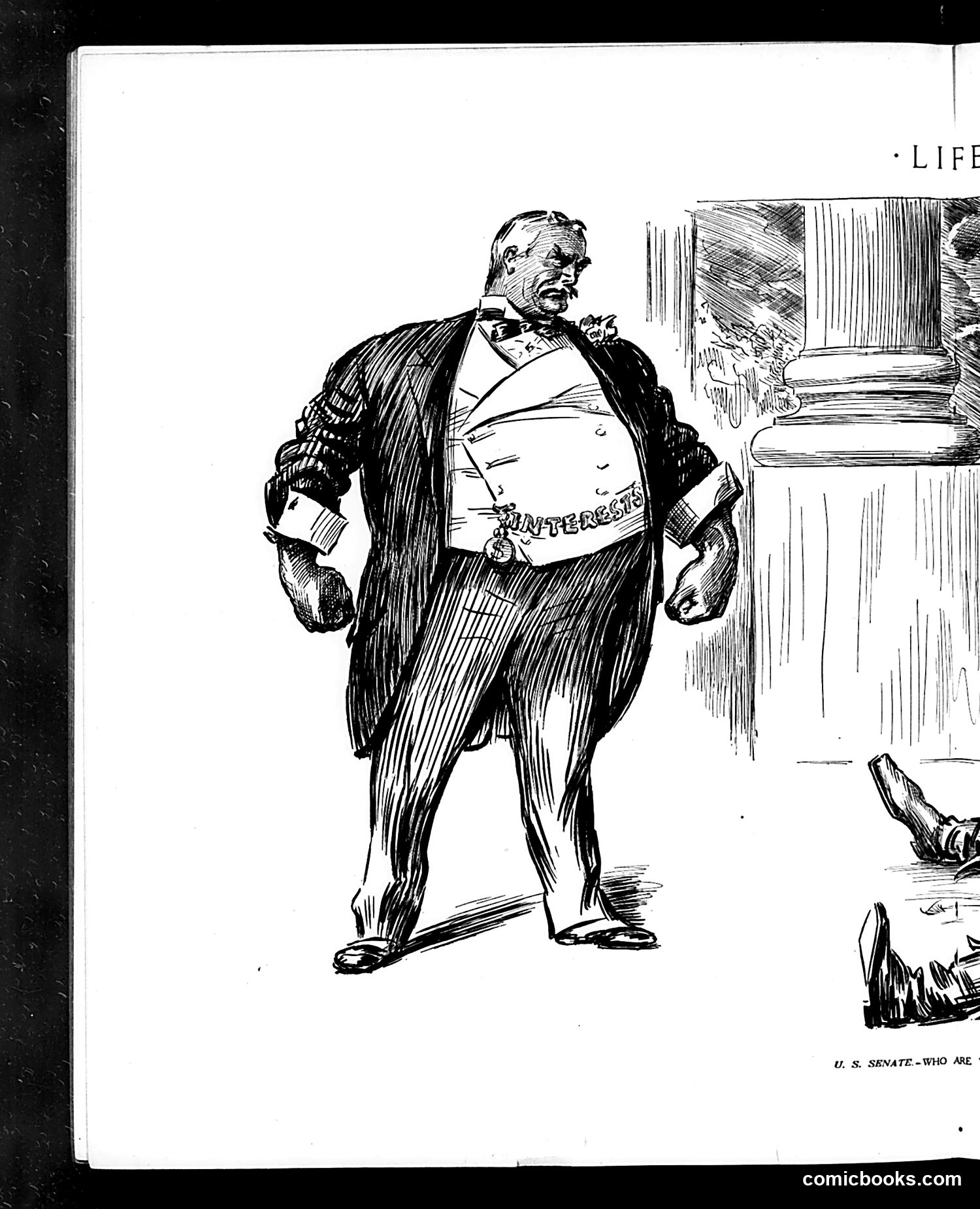
This is a political cartoon from *Life* magazine depicting a portly gentleman in formal evening wear (tuxedo and tail coat) adjusting or displaying an oversized belly marked "INTERESTS." The figure appears to be a caricature of a U.S. Senator, based on the caption reference "U.S. SENATE - WHO ARE" visible at the bottom. The satire critiques senators as self-interested and corrupt, with their literal "interests" (financial and political) grotesquely enlarged and on full display. The exaggerated physique suggests gluttony for power and money. The formal setting implies hypocrisy—these supposedly dignified public servants are reduced to shameless displays of personal greed. This reflects Progressive Era skepticism toward political corruption and corporate influence in government.
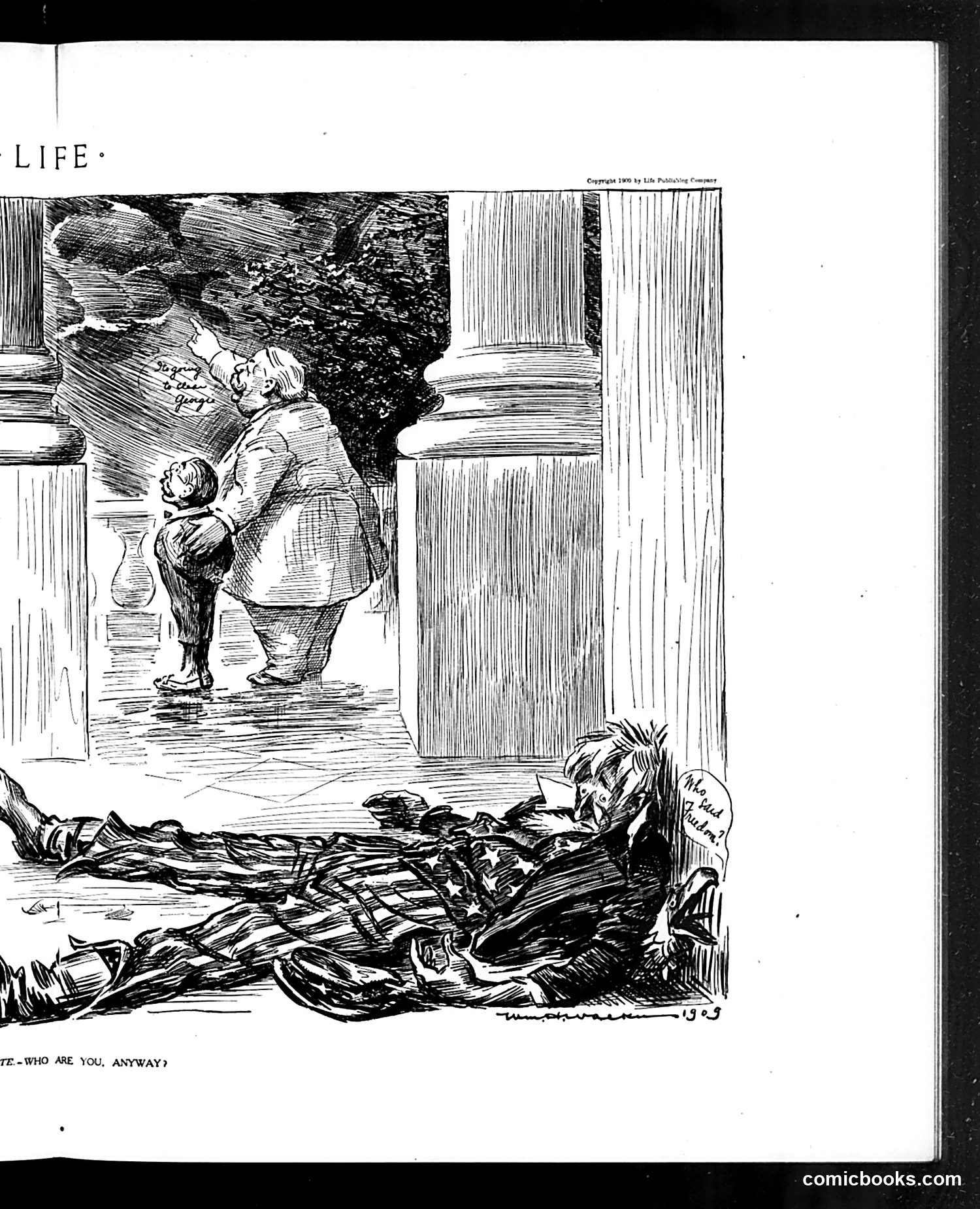
This is a stark political cartoon depicting class conflict. An adult and child stand in a doorway looking outward at what appears to be a homeless or destitute figure lying amid scattered possessions on the ground. The child asks "Who are you, anyway?"—a naive question highlighting the social invisibility of the poor. The cartoon critiques indifference to poverty and homelessness. The well-dressed figures (representing the comfortable classes) literally look down on the vagrant below, yet don't truly "see" him—he's outside their world, beyond their concern or recognition. The satire suggests how society ignores the destitute while children grow up unconcerned with their existence. This reflects Life magazine's tradition of social commentary on inequality and human dignity during economically turbulent times.
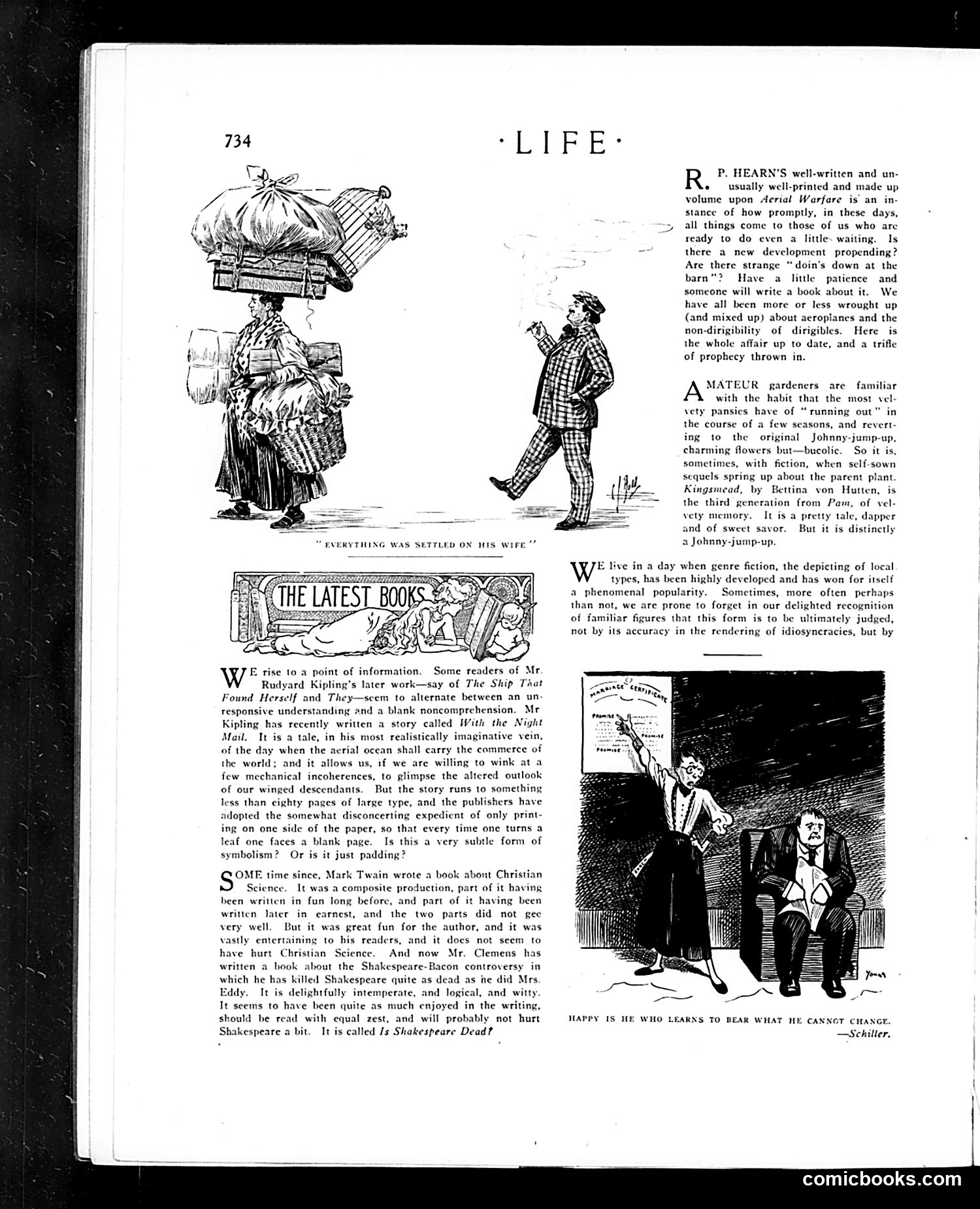
This page contains literary reviews rather than political cartoons. The main illustration—"Everything Was Settled on His Wife"—depicts a domestic scene of a man unloading parcels onto an overburdened woman, likely satirizing the division of household labor and domestic responsibility. The text reviews several books: P. Hearn's work on aerial warfare; "Kingsmead" by Bettina von Hutten (criticized as a weak sequel, a "Johnny-jump-up"); Kipling's "With the Night Mail" (praised as imaginative futurism but criticized for its awkward one-sided printing); and Mark Twain's "Is Shakespeare Dead?" (about the Shakespeare-Bacon authorship controversy). The reviews mock pretentious literature, publishing gimmicks, and Twain's quarrelsome tone. The closing Schiller epigraph emphasizes acceptance of circumstances beyond one's control—fitting the domestic scene depicted above.
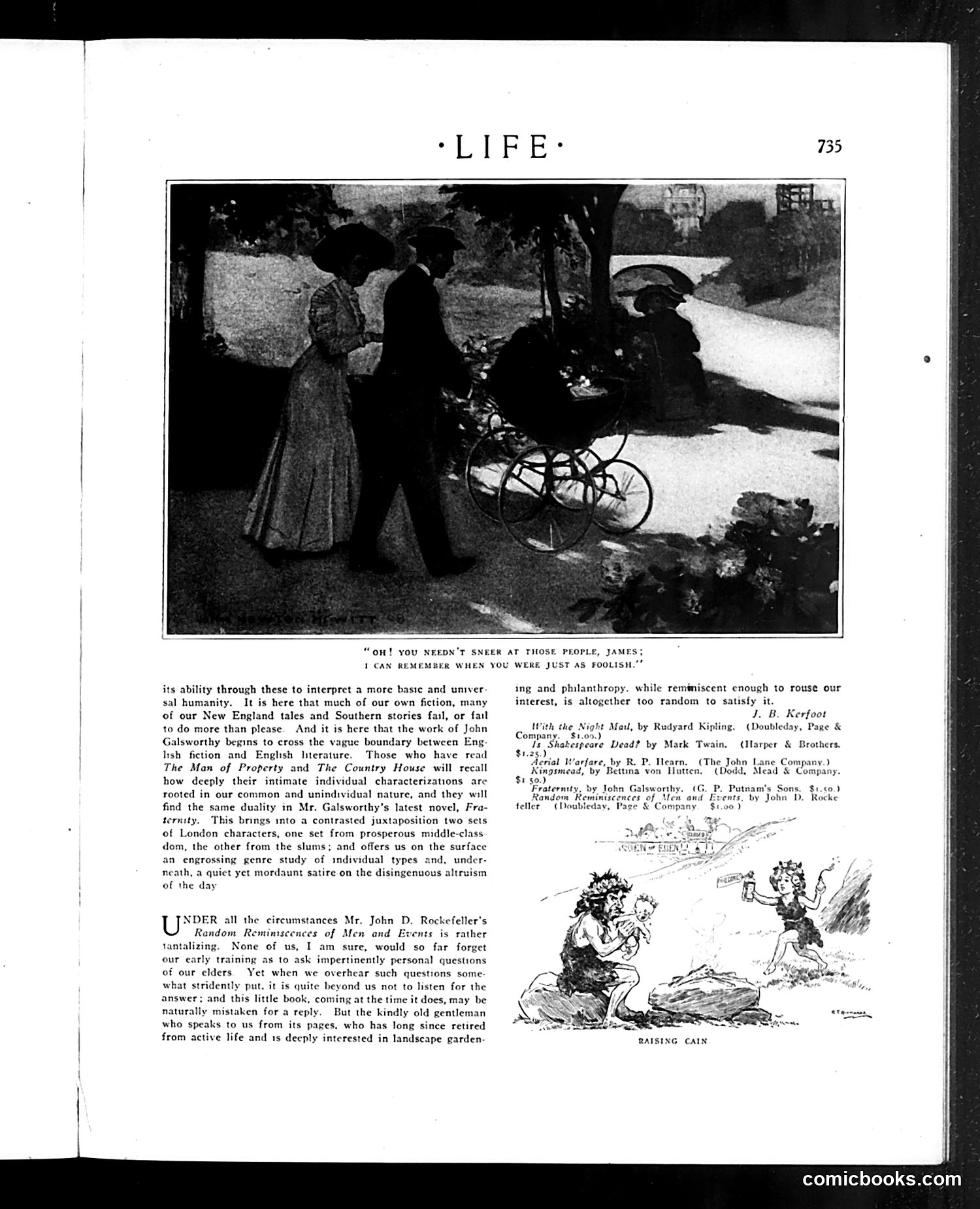
The page contains a photograph captioned with dialogue suggesting class commentary: "Oh! you needn't sneer at those people, James; I can remember when you were just as foolish." The image shows well-dressed figures with a baby carriage, apparently depicting middle-class individuals being reminded of their humble origins. The accompanying illustration titled "Raising Cain" depicts a mischievous cherub or child figure, a visual pun on the phrase meaning to cause trouble. The text reviews John Galsworthy's novel *Fraternity*, praising its exploration of class divisions between prosperous middle-class Londoners and slum-dwellers. It also discusses Rockefeller's memoir, describing it as somewhat evasive despite promising personal revelations. **The satire's point:** The page critiques class pretension and "disingenuous altruism"—the tendency of the wealthy to moralize about the poor while forgetting their own modest beginnings. This reflects Progressive Era concerns about class hypocrisy and genuine social understanding.
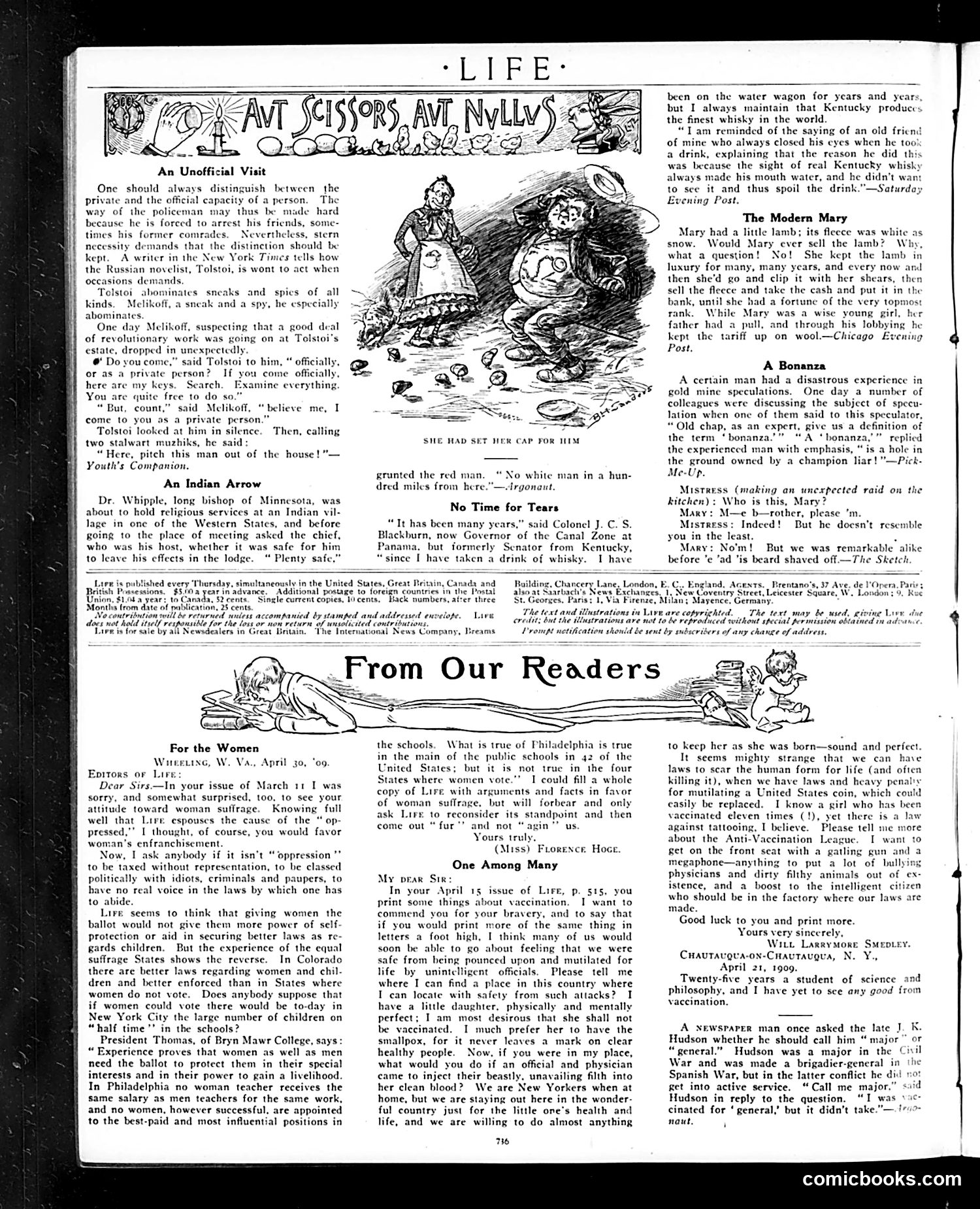
This page contains several brief humorous anecdotes satirizing contemporary issues: **"An Unofficial Visit"** mocks Russian imperial bureaucracy through Tolstoi's distinction between official and private capacity—when a spy (Melikoff) claims to visit privately, Tolstoi has him thrown out, exposing the hypocrisy of using "private" as cover for state surveillance. **"The Modern Mary"** is economic satire: a modernized nursery rhyme where Mary profits by shearing her lamb repeatedly and selling wool, while her father's political lobbying maintains tariff protection. It critiques how industrial profits depend on political favoritism rather than genuine economic value. **"A Bonanza"** cynically defines mining speculation as "a hole in the ground owned by a champion liar"—mocking get-rich-quick schemes and investor fraud. The reader letters address women's suffrage and vaccination debates, reflecting Progressive-era social controversies. The overall tone is irreverent mockery of authority figures, political corruption, and financial schemes.
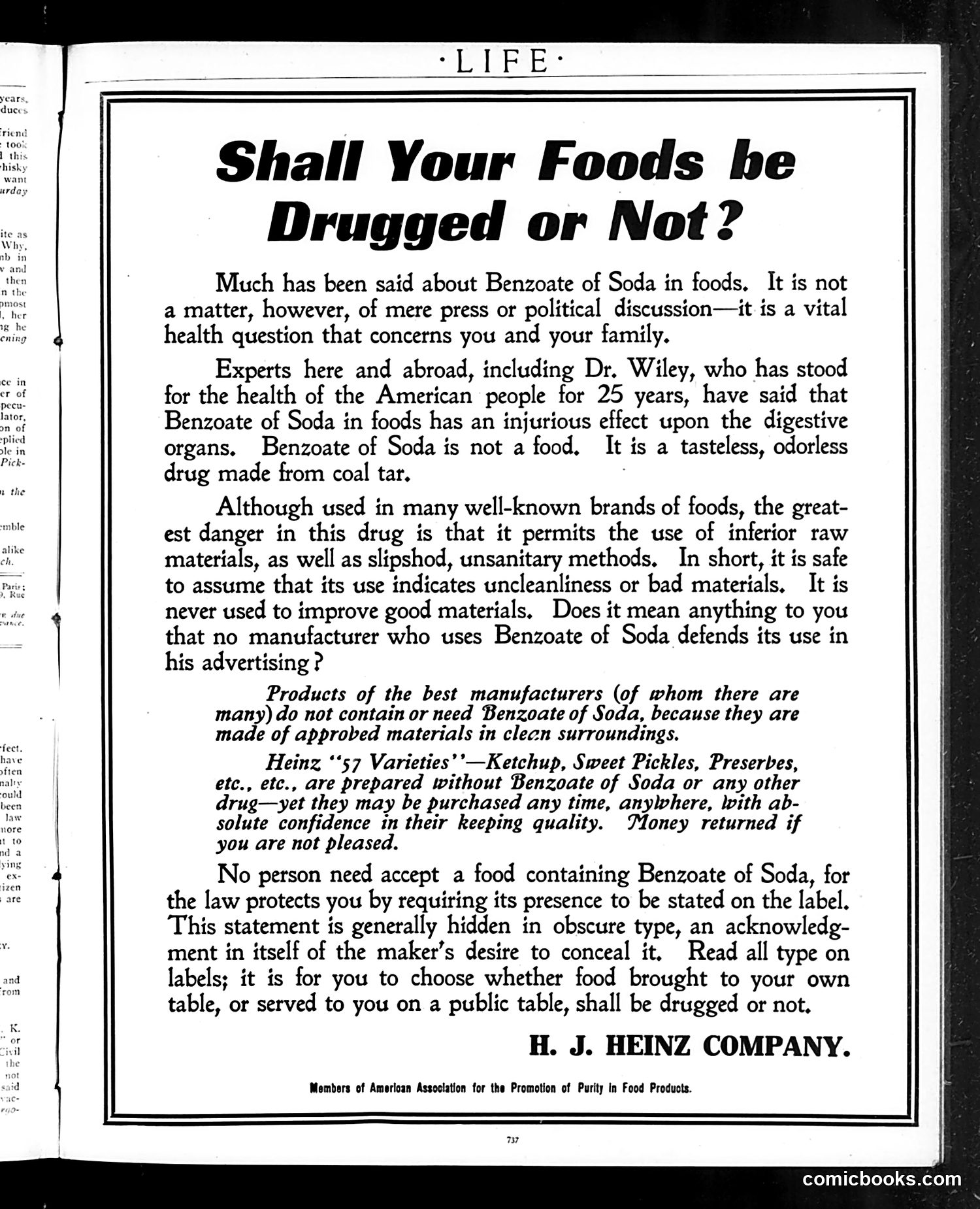
This is a **full-page advertisement** by the H.J. Heinz Company, not a cartoon. It's a polemical piece addressing a genuine early-1900s food safety debate. **The Issue:** Benzoate of soda, a chemical preservative made from coal tar, was used by many food manufacturers. Heinz attacks it as a "drug" that: - Harms digestion - Permits use of inferior, unsanitary ingredients - Is concealed on labels in tiny print **The Authority:** The ad invokes Dr. Wiley (Harvey Wiley), a real crusader for food purity who led the USDA's push for the 1906 Pure Food and Drug Act. **Heinz's Strategy:** By advertising that their "57 Varieties" contain *no* benzoate of soda, Heinz positions themselves as the ethical competitor, implying rivals use dangerous shortcuts. This reflects genuine Progressive Era anxieties about unregulated food manufacturing, though modern historians note Heinz's self-interested motivation.
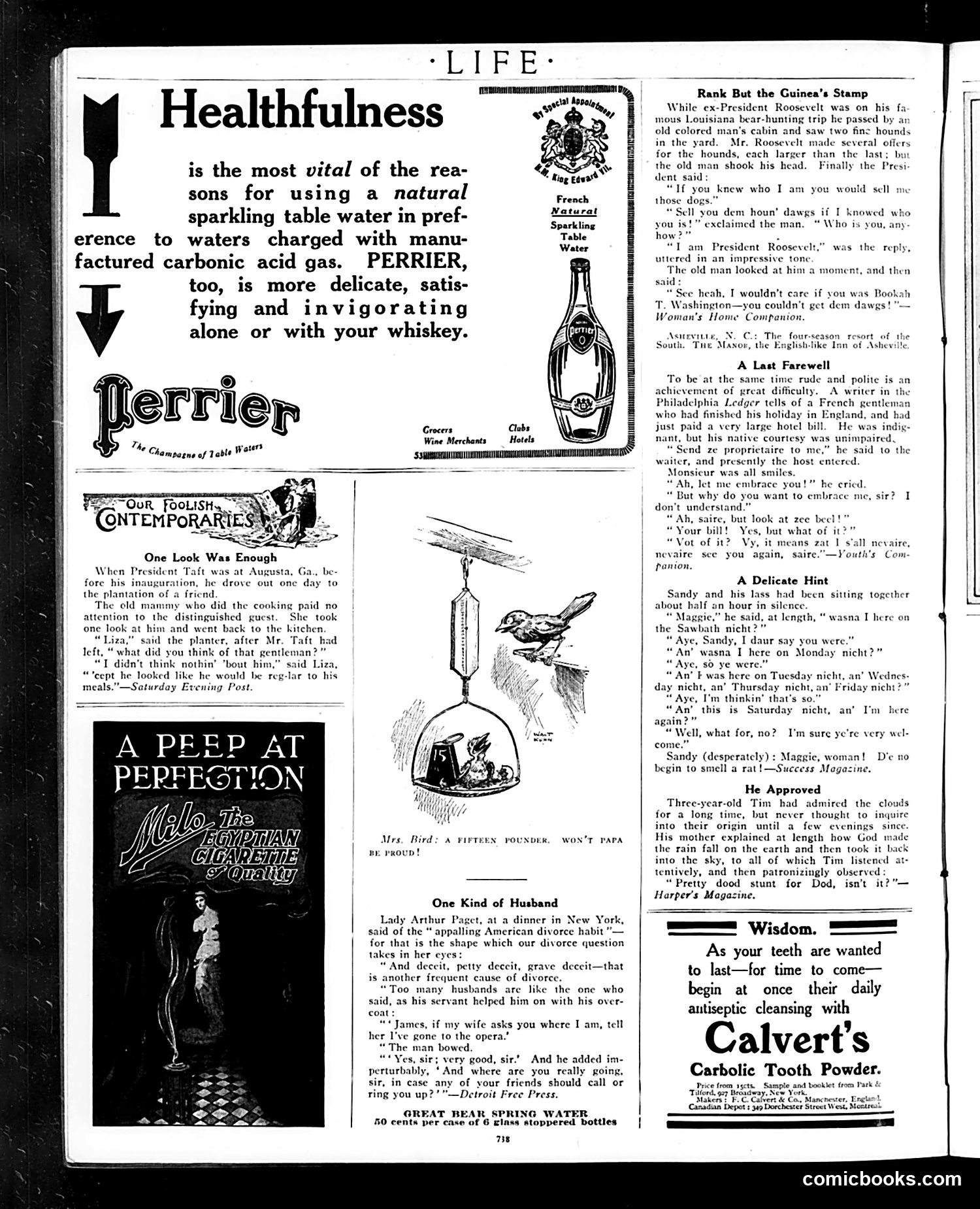
This is primarily an **advertising page** with several short humorous anecdotes interspersed. The main advertisements promote Perrier sparkling water and Calvert's tooth powder. The cartoons are brief satirical stories: **"One Look Was Enough"** mocks President Taft's appearance, suggesting an elderly Black cook judged him unsuitable company based solely on his large physique. **"One Kind of Husband"** satirizes marital deception—a husband instructs his servant to lie about his whereabouts to his wife, and the servant pointedly asks where he's *actually* going, highlighting the absurdity. **"Rank But the Guinea's Stamp"** references Theodore Roosevelt's recent bear-hunting trip, showing a rural Black man unimpressed by Roosevelt's presidential status, valuing his hunting dogs above the famous figure. **"A Last Farewell"** presents a French guest's polite relief at never returning, sarcastically "embracing" his host while complaining about the exorbitant bill. These pieces reflect early 20th-century attitudes: casual racial stereotyping through dialect humor, marital commentary on infidelity, and mockery of political figures.
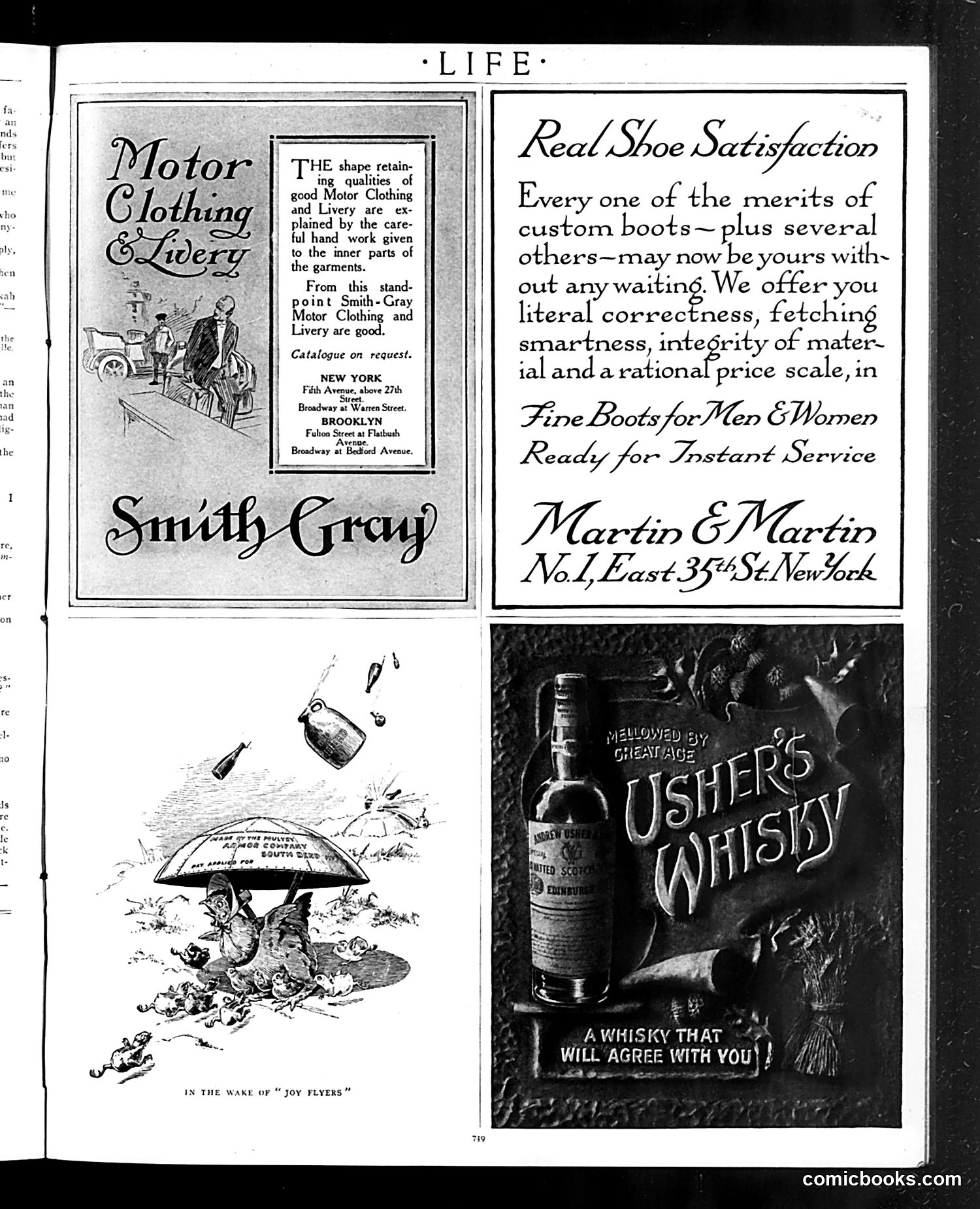
This page is primarily **advertising**, not political satire. It contains four commercial advertisements: 1. **Smith-Gray Motor Clothing & Livery** (top left): Promotes custom automotive wear and accessories, emphasizing quality craftsmanship. 2. **Martin & Martin Fine Boots** (top right): Advertises custom-made boots for men and women, emphasizing fit and value. 3. **Bottom left cartoon**: A humorous illustration labeled "In the Wake of 'Joy Flyers'" showing figures sheltering under what appears to be armor or protective equipment, surrounded by chaos. The caption suggests this is a joke about protection—likely referencing contemporary aviation or mechanical hazards, though the specific reference to "Joy Flyers" is unclear without additional context. 4. **Usher's Whisky** (bottom right): A period advertisement for scotch whisky with the tagline "A whisky that will agree with you." The page reflects early 20th-century consumer culture, mixing practical automotive/fashion advertising with lifestyle products (liquor). The one cartoon's meaning requires knowledge of what "Joy Flyers" referenced at publication date.
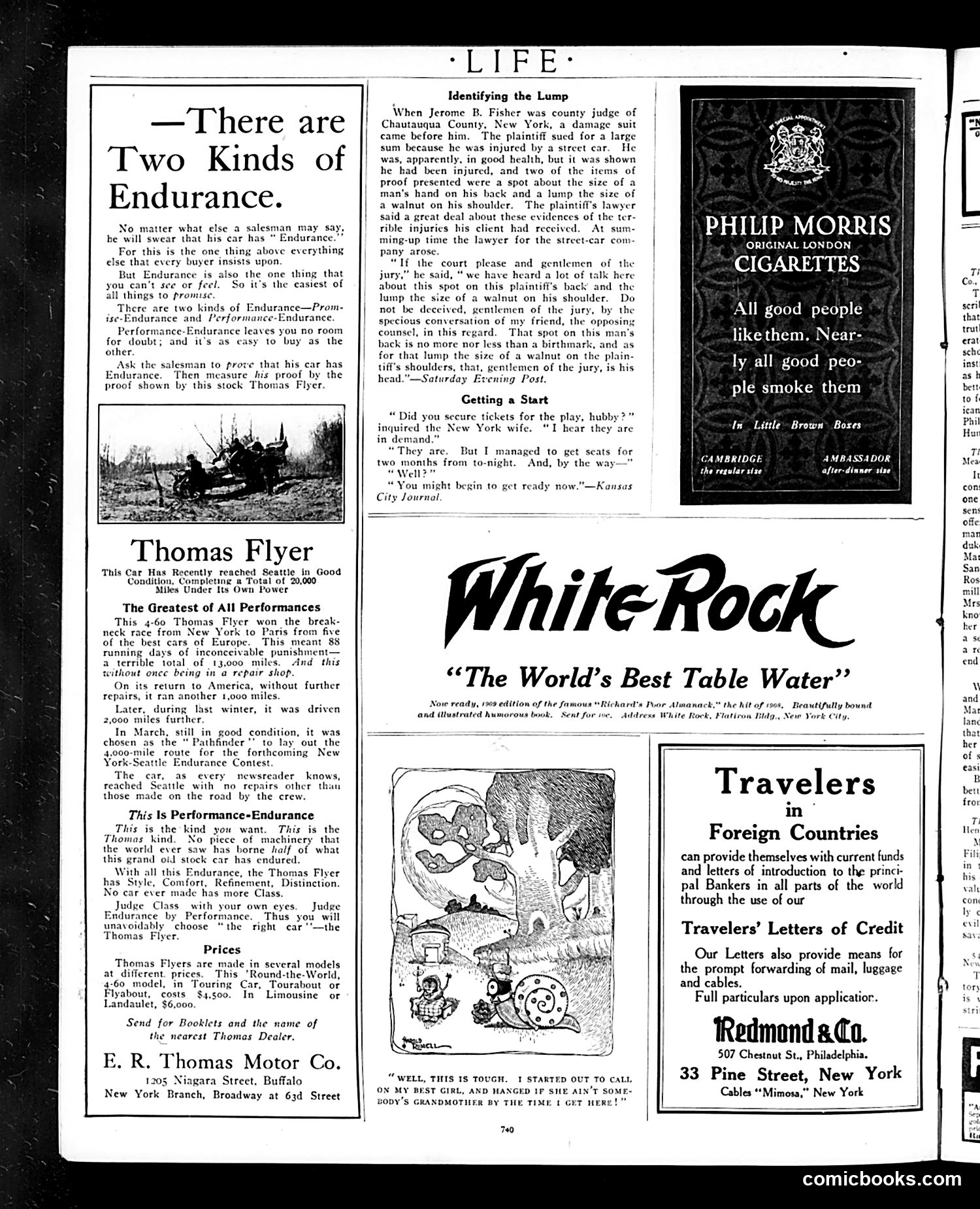
This page (circa early 1900s) contains primarily **advertisements and humorous anecdotes** rather than political cartoons. The main content features a **Thomas Flyer automobile advertisement** emphasizing "Performance-Endurance"—contrasting promises with proven results. The ad highlights the car's famous 1908 New York-to-Paris race victory and subsequent 20,000-mile journey, arguing that real performance (not mere salesmen's claims) proves reliability. Below are two **brief humor pieces**: 1. "Identifying the Lump" recounts a legal anecdote where a street-car company's lawyer sarcastically dismisses a plaintiff's injury claims (a birthmark and a lump), making a crude joke that the "lump" is actually the man's head. 2. "Getting a Start" is a short comedic dialogue about theater tickets and marital planning. The page also contains **period cigarette and financial services advertisements** (Philip Morris, White Rock water, Redmond & Co. travelers' letters of credit). These reflect early 20th-century consumer culture and are not satirical content themselves.
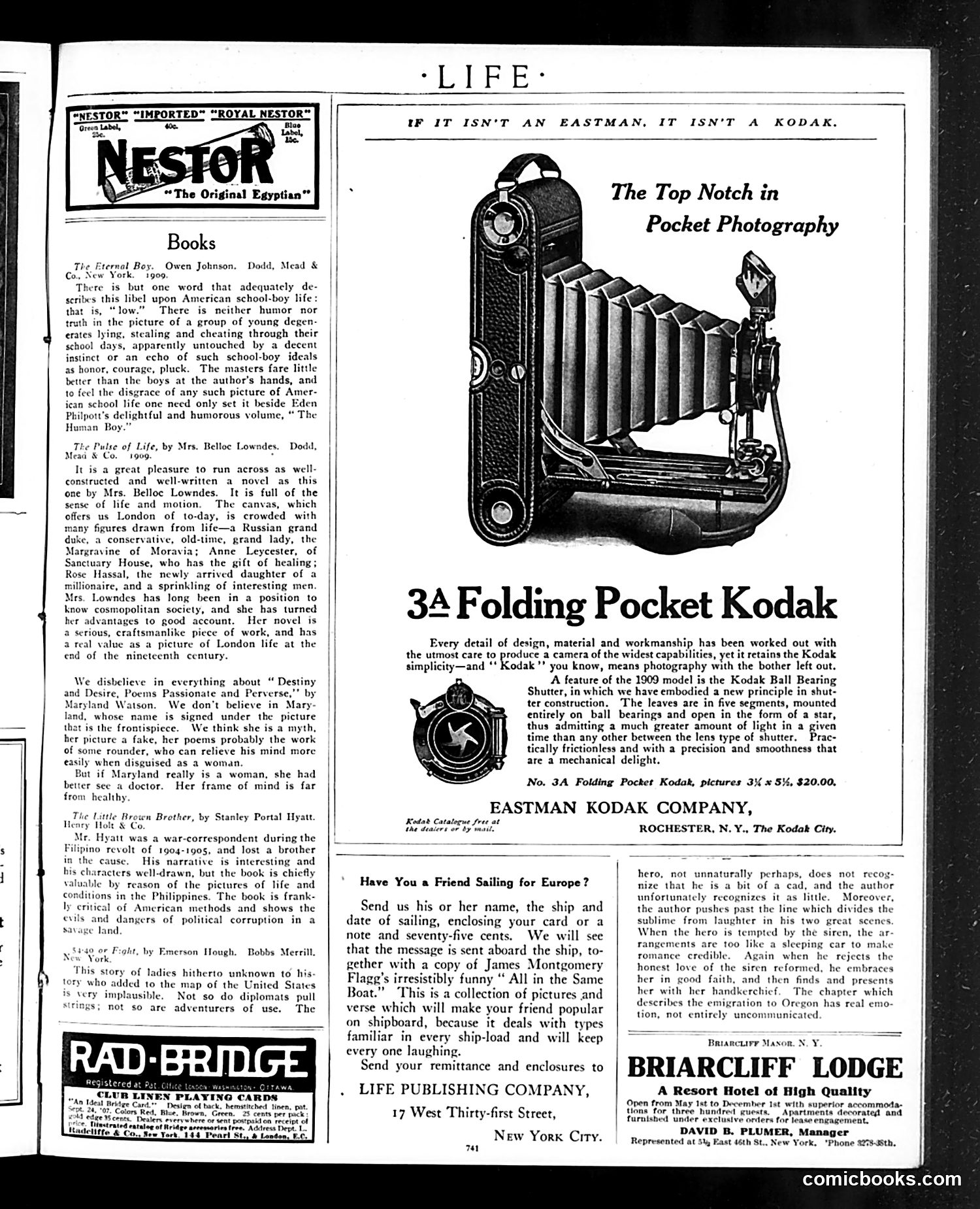
This page is primarily **advertising and book reviews**, not political satire. The **book reviews** critique recent 1909 publications: Owen Johnson's *The Eternal Boy* is harshly dismissed as depicting immoral schoolboys lacking honor; Mrs. Belloc Lowndes's *The Pulse of Life* is praised as a well-crafted novel of London society; and a collection attributed to "Maryland Watson" is sarcastically attacked, with the reviewer suggesting the author is likely fictional or mentally unstable. The **dominant advertising** features the **Kodak 3A Folding Pocket Camera** with the company's famous slogan: "If it isn't an Eastman, it isn't a Kodak." The ad emphasizes the camera's mechanical sophistication (ball-bearing shutter) while maintaining Kodak's brand promise of simplicity for amateur photographers. Additional advertisements include Nestor film, Rad-Bridge playing cards, and Briarcliff Lodge hotel. There is **no political cartoon** on this page.
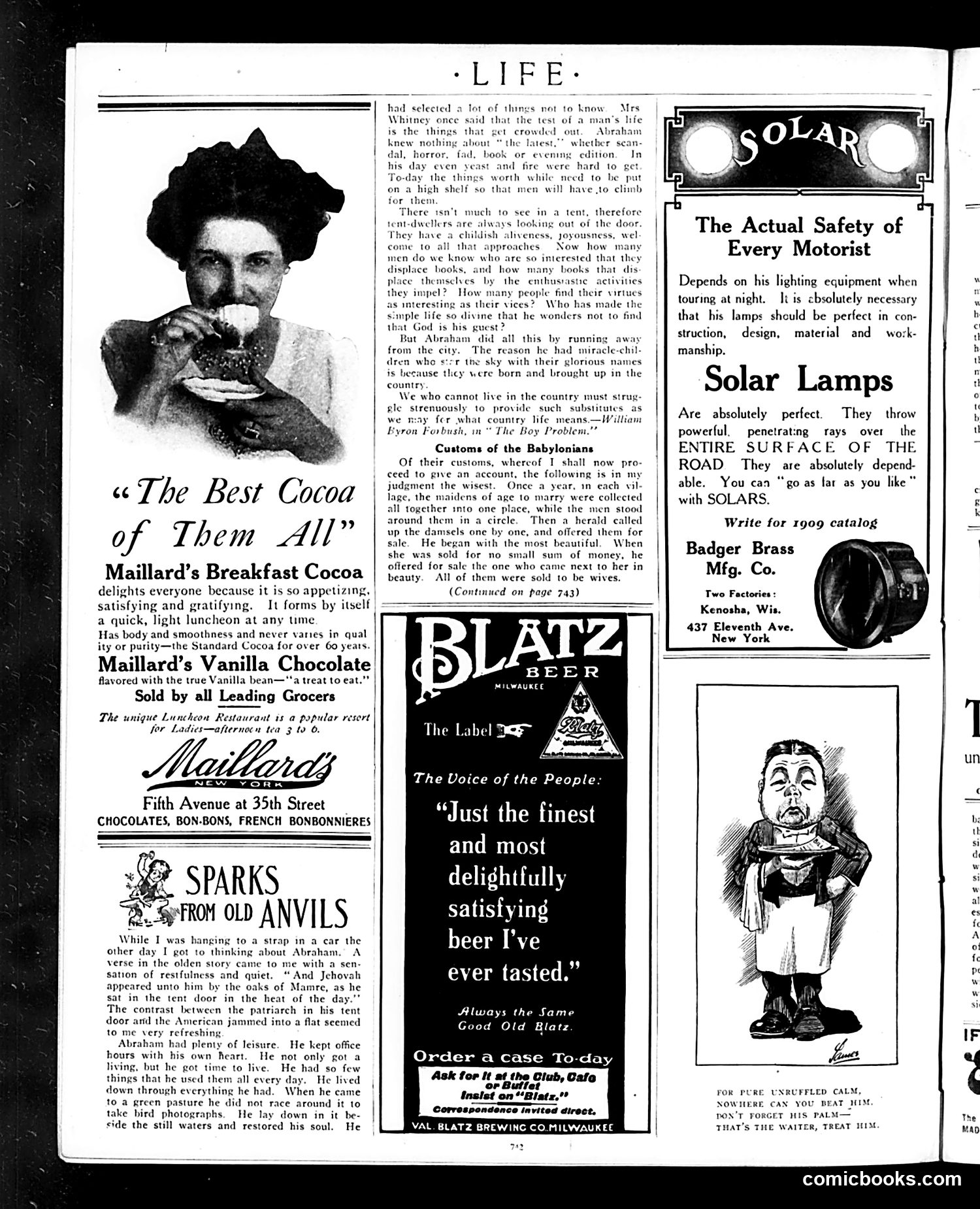
This is primarily a **advertising page** from Life magazine, with minimal political or satirical content. The layout features multiple product advertisements (cocoa, chocolate, beer, lamps, brass fixtures) interspersed with editorial text. The one potentially meaningful piece is the article "Sparks from Old Anvils," which contrasts the patriarch Abraham's leisurely tent life with the cramped existence of modern Americans "jammed into a flat." The satire targets **industrial urbanization**—suggesting contemporary Americans have sacrificed leisure and spiritual contemplation for crowded city living. Abraham's peaceful communion with God under the oaks represents an idealized pastoral past, implicitly critiquing modern life's frantic pace. The **Blatz Beer advertisement** includes a caricatured figure (unclear who), likely a celebrity endorsement common in early 1900s advertising. Otherwise, the page demonstrates Life's mixed editorial-advertising model typical of early 20th-century magazines.
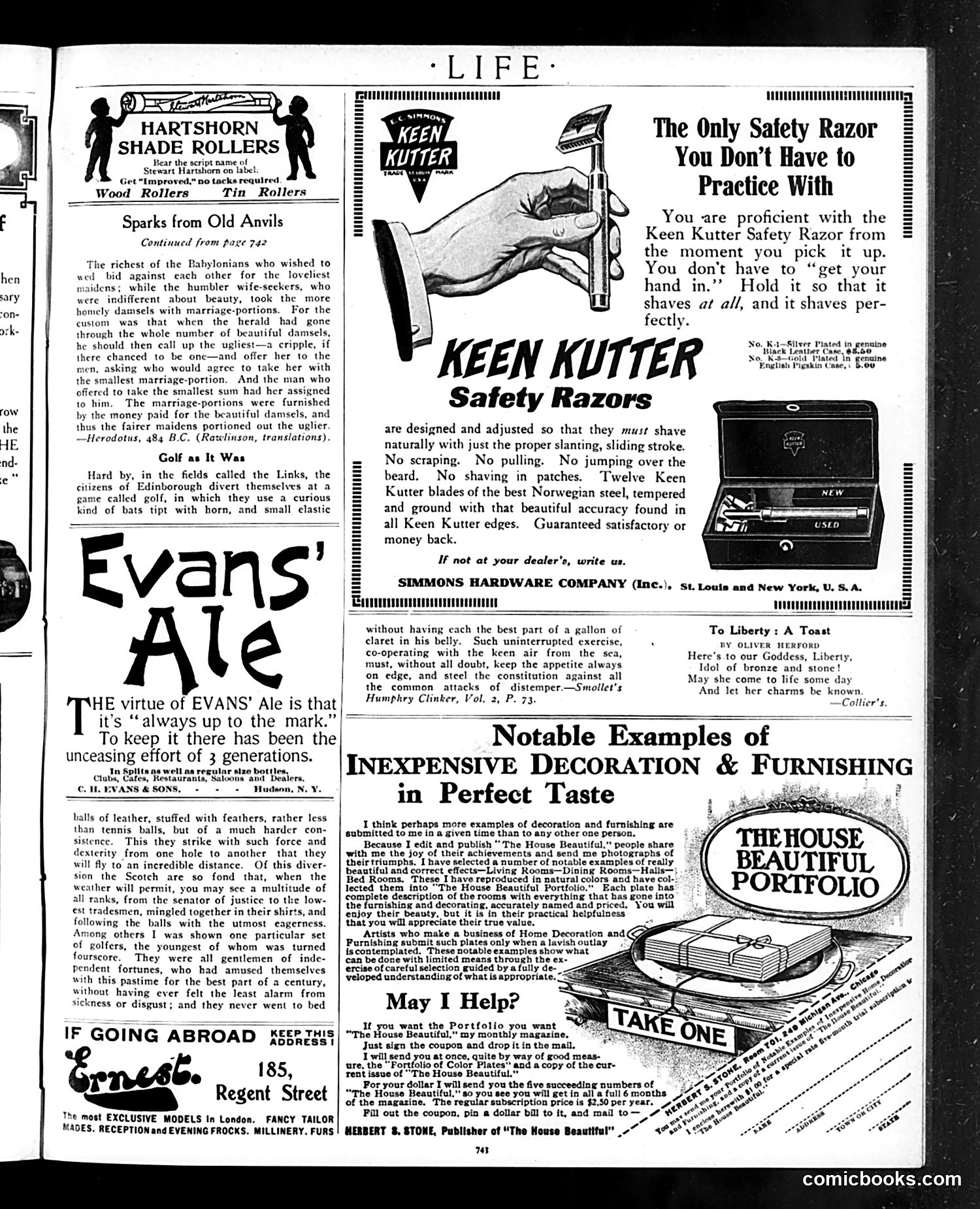
This page is primarily **advertising** interspersed with historical and literary content. There are no political cartoons or satirical commentary requiring historical context. The advertisements include: - **Keen Kutter Safety Razors**: Claims the razor requires no practice—users are "proficient" immediately upon purchase, contrasting with competitors requiring skill development. - **Evans' Ale**: Emphasizes three generations maintaining quality standards. - **Hartshorn Shade Rollers**: Promotes improved design with no tacks required. The editorial content includes historical excerpts (Herodotus on Babylonian marriage customs, Smollet on Scottish golf) and a patriotic poem "To Liberty" by Oliver Herford. The bottom section advertises "The House Beautiful Portfolio" for home decoration advice. This is a standard early 20th-century magazine page mixing consumer products with cultural/educational content—not satirical commentary.
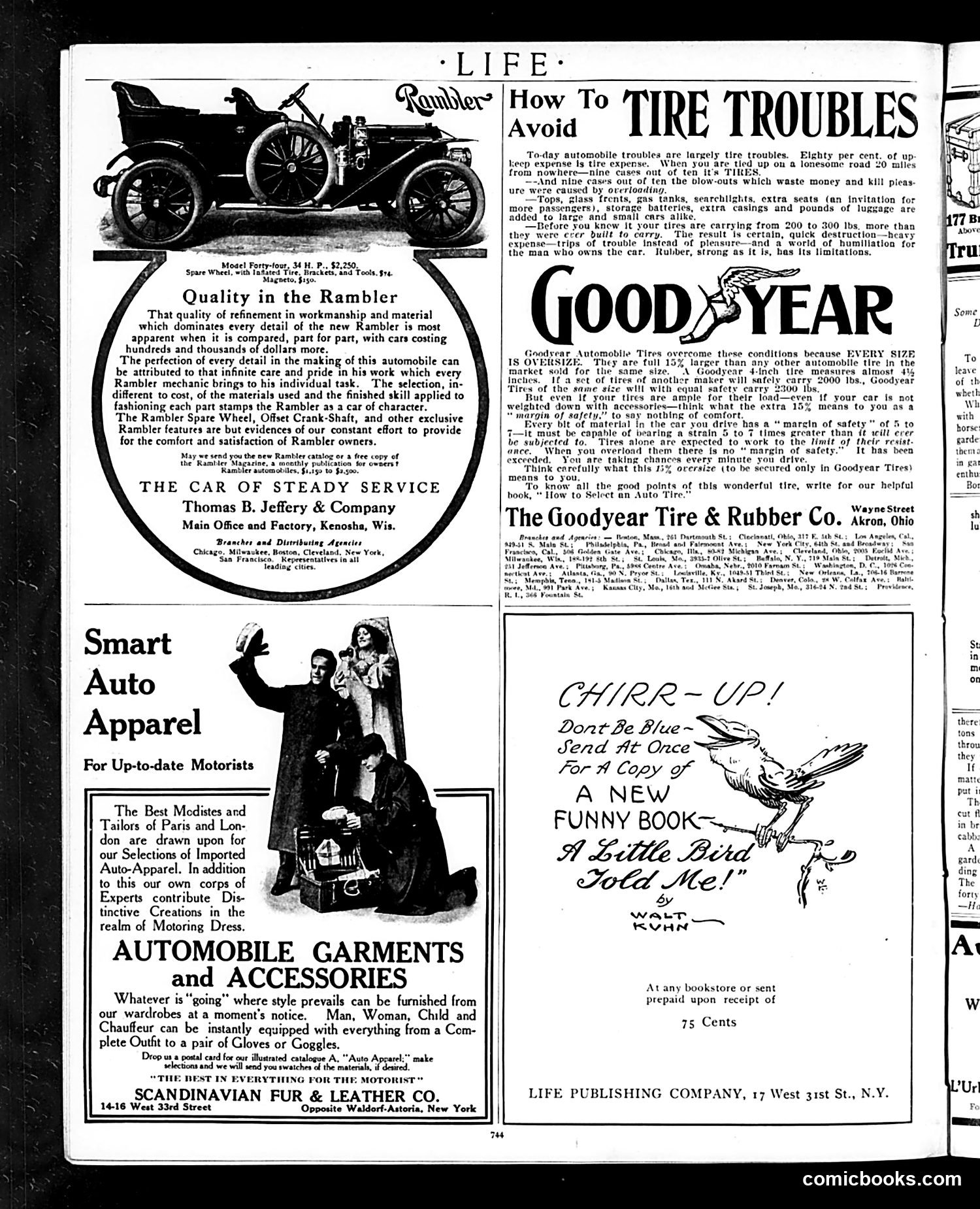
This page is primarily **advertising**, not satire or political commentary. It contains three major automobile-related advertisements: 1. **Rambler automobile** (top left): Emphasizes quality craftsmanship and steady service, with pricing details for the Model Forty-four. 2. **Goodyear Tires** (right side): The dominant advertisement addresses a genuine practical concern—tire failures caused by vehicle overloading. It argues Goodyear tires are 15% larger than competitors and can safely carry greater loads. The ad explicitly warns against adding excessive accessories, passengers, and luggage, which strains tires beyond their limits. 3. **Scandinavian Fur & Leather Co.** (bottom left): Advertises automobile clothing and accessories for motorists. A small book advertisement for "A Little Bird Told Me!" appears at bottom right. The page reflects early 1900s automotive concerns: tire reliability was a genuine problem in this era, making Goodyear's size-superiority claim a legitimate selling point.
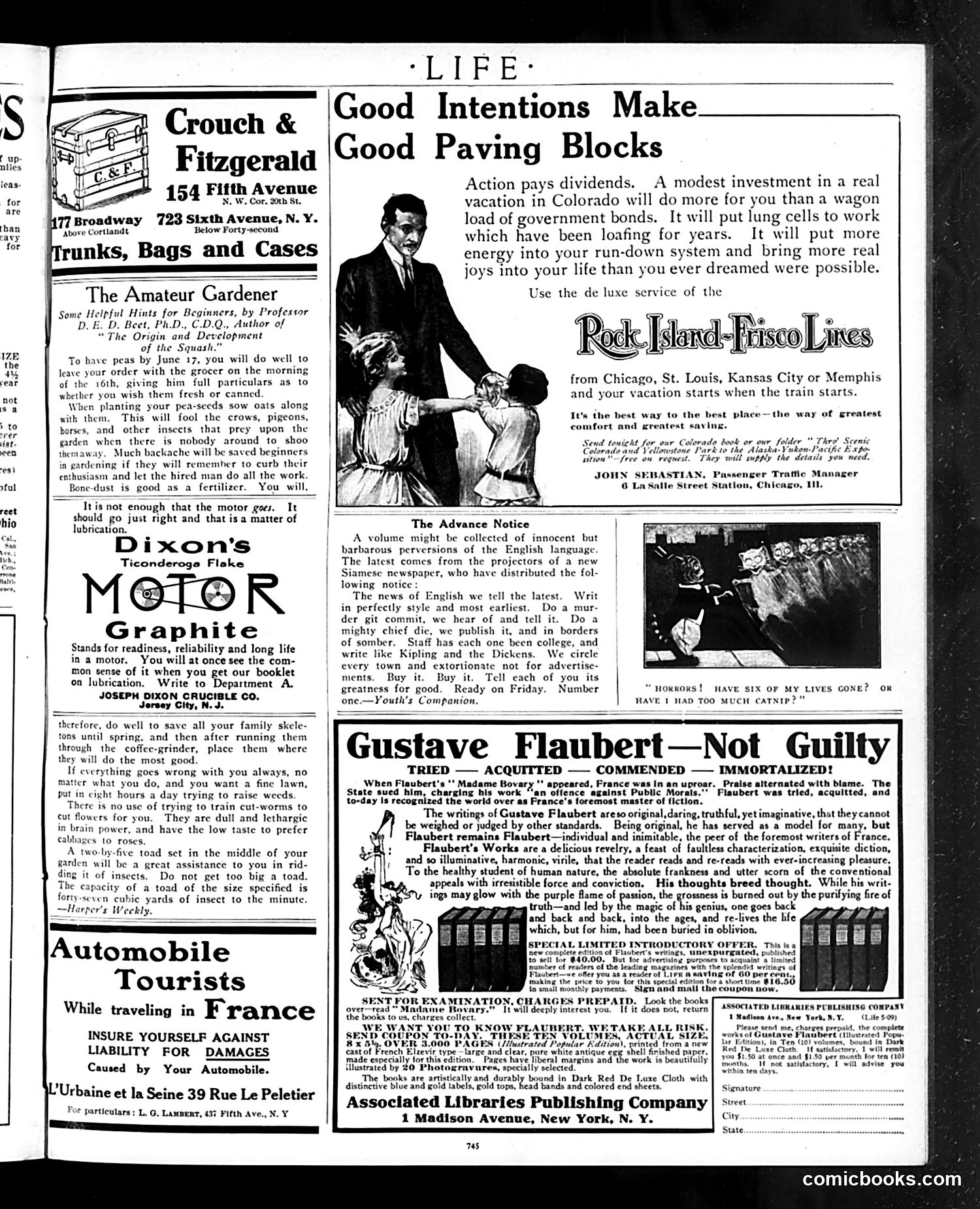
This page is primarily **advertising**, with one notable satirical piece about Gustave Flaubert. ## The Flaubert Section The main editorial content celebrates French author Gustave Flaubert, noting that his novel *Madame Bovary* (1857) caused scandal—the French state sued him for "offence against Public Morals." He was acquitted and is now "recognized the world over as France's greatest master of fiction." For modern readers: This commemorates a famous literary censorship case. The piece celebrates how controversial, morally challenging literature can endure and achieve greatness despite initial outrage. It's a defense of artistic freedom against censorship. ## Satirical Elements "The Amateur Gardener" column contains **mild satire** on gardening advice—absurd tips like "sow oats with peas to fool the crows" and the suggestion to grind family skeletons for fertilizer are obviously tongue-in-cheek humor. "The Advance Notice" mocks the garbled English of a Siamese newspaper, presenting humorously mangled syntax as comedy based on language differences. The page otherwise contains straightforward period advertisements for luggage, motor oil, and travel services.
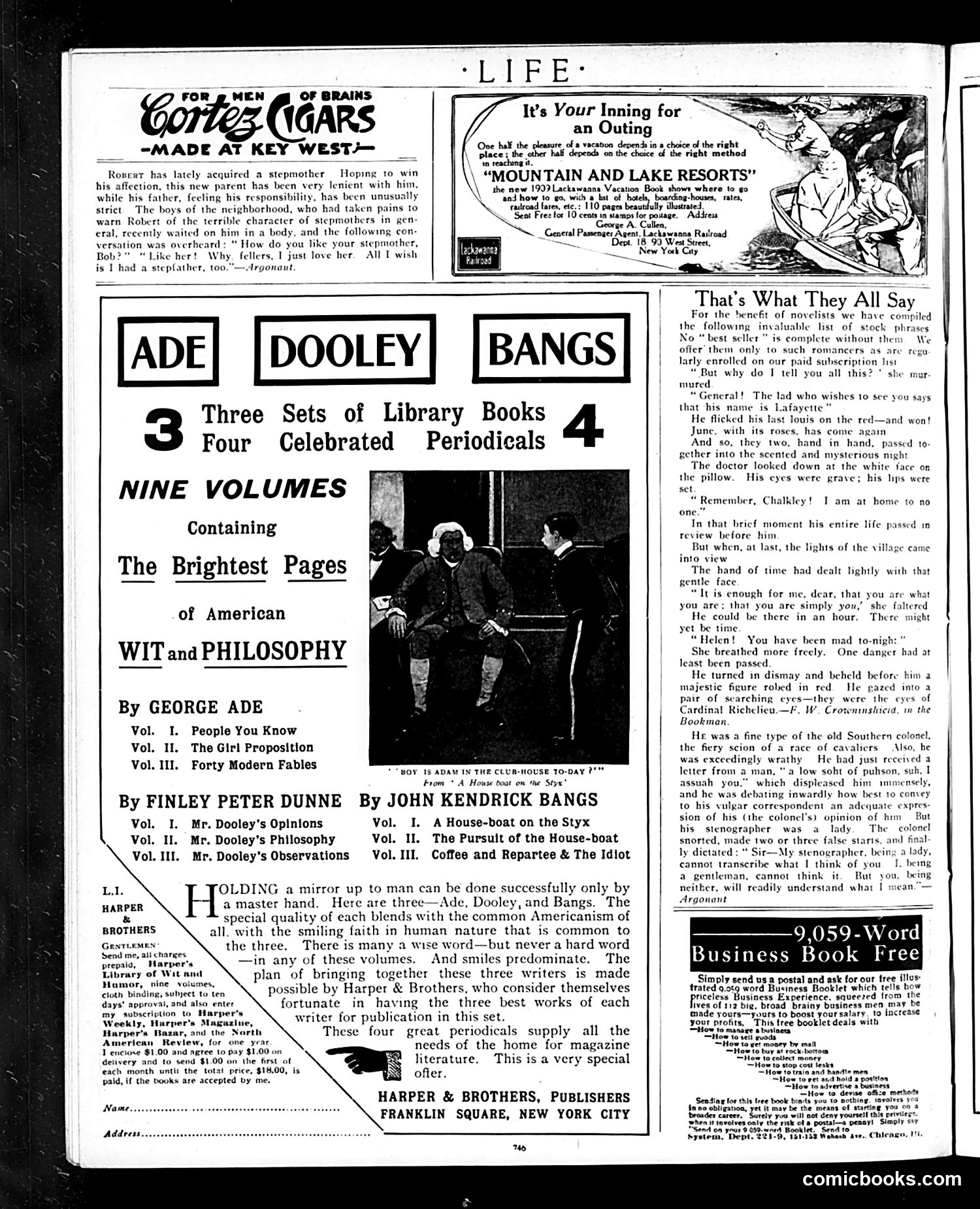
This is primarily an **advertising and literary promotion page** rather than political satire. The main content advertises three sets of library books by American humorists—George Ade, Finley Peter Dunne, and John Kendrick Bangs—published by Harper & Brothers. The small anecdote at top left about a stepmother is a light domestic joke with no political content: a boy tells neighborhood kids he loves his new stepmother so much he wishes he had a stepfather too—humor based on family dynamics, not satire. The photograph shows two men in what appears to be a club setting, illustrating a scene from Bangs' "A House-boat on the Styx." The right column parodies "stock phrases" found in contemporary romance novels (melodramatic lines like "General!" and "In that brief moment his entire life passed in review"). This mocks formulaic popular fiction of the era. **No significant political or social satire appears here.** The page is essentially marketing humor literature to middle-class readers.
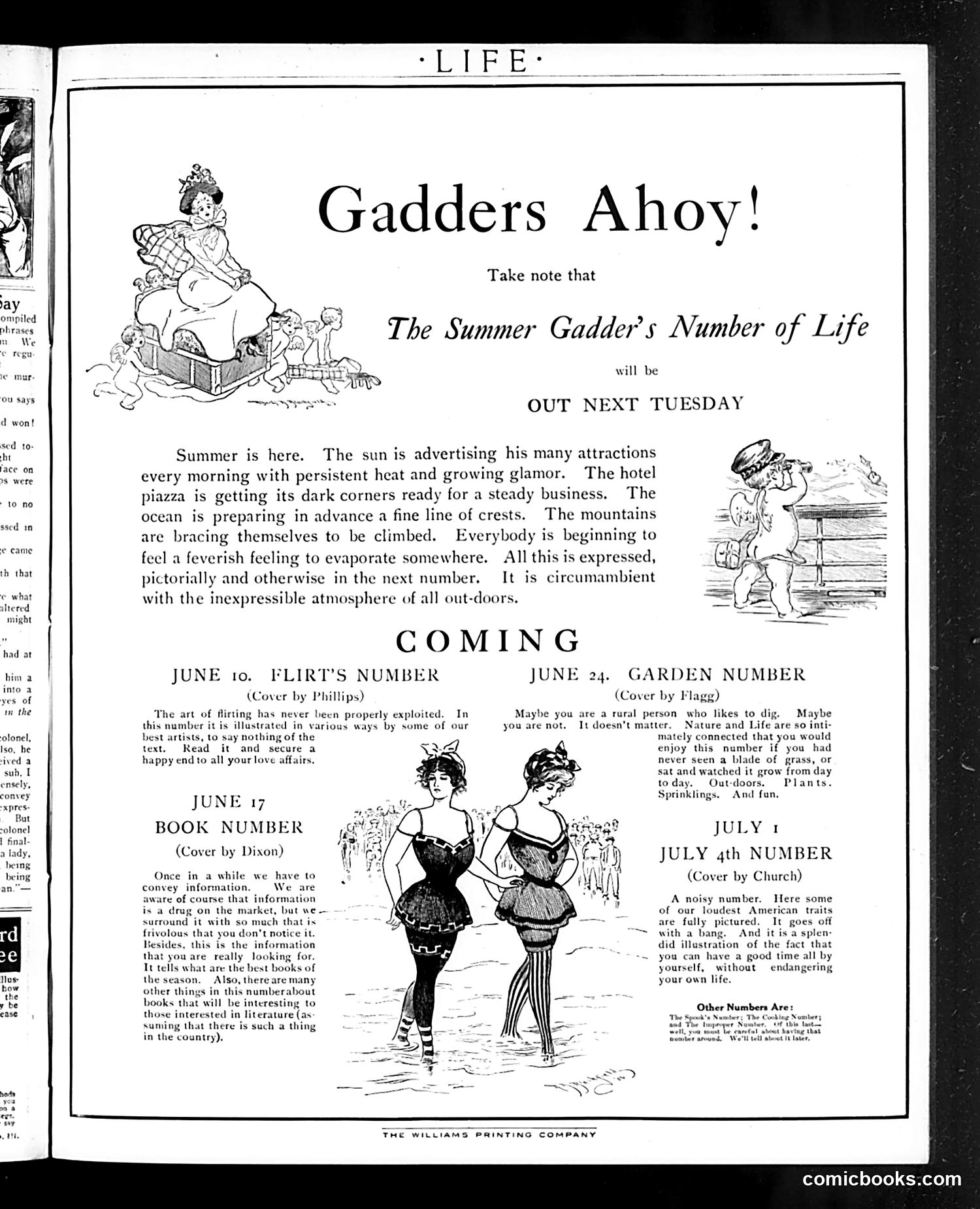
This is an advertisement/promotional page announcing upcoming summer issues of Life magazine. "Gadder" was period slang for someone who gadabouts or travels for leisure—the page celebrates summer vacation season arriving. The page promises themed issues featuring illustrations by notable artists (Phillips, Dixon, Flagg, Church). Each upcoming issue targets specific summer interests: flirting, books, gardening, and July 4th celebrations. The text uses playful, breathless language ("feverish feeling to evaporate somewhere") to capture summer excitement. The small illustrations show typical summer activities—a woman at the beach, figures enjoying outdoor leisure. This is essentially clickbait-style marketing encouraging readers to purchase upcoming issues by highlighting appealing content themes tied to seasonal interests and social activities popular among Life's middle-class readership.
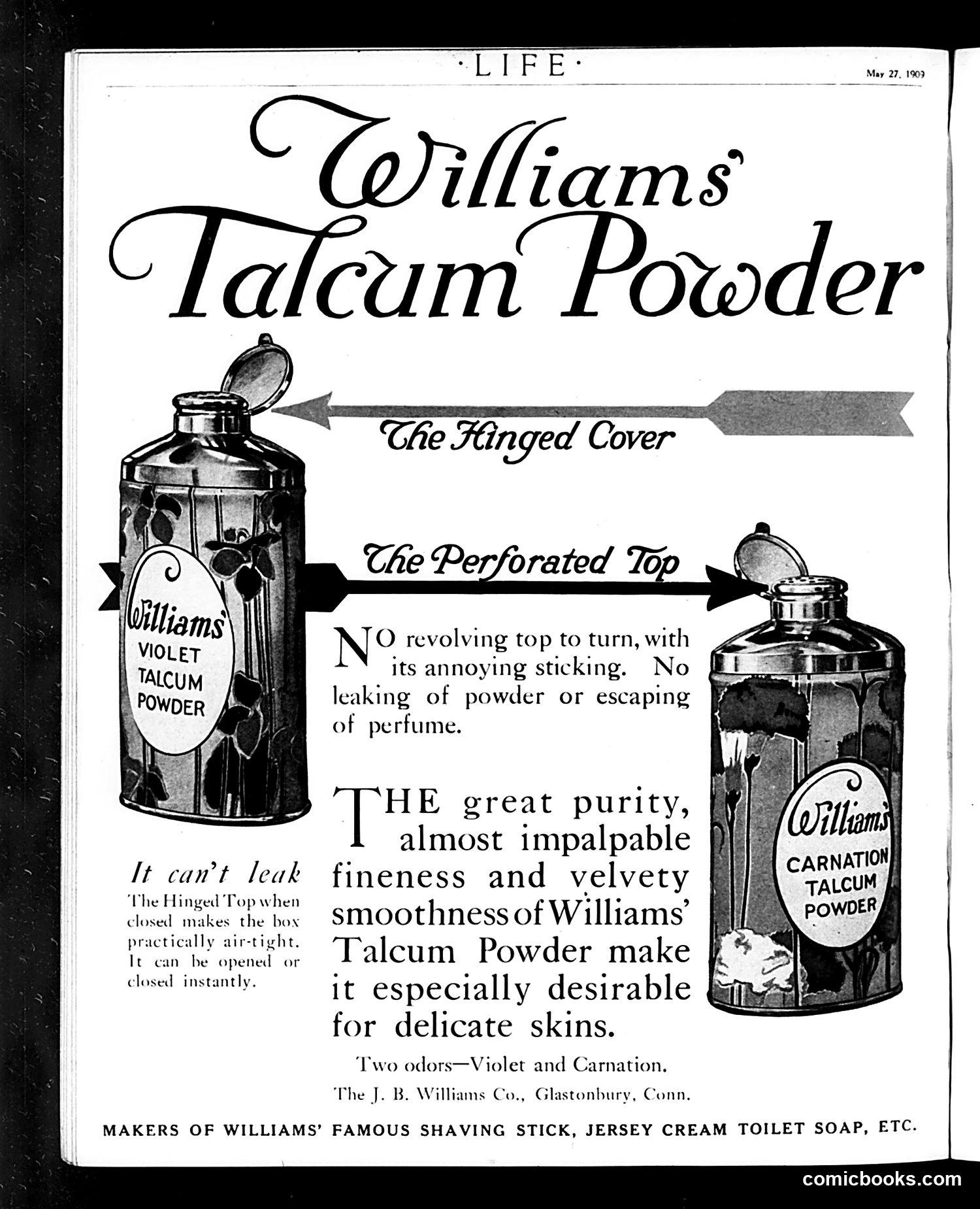
This is **not a political cartoon or satire**—it's a straightforward product advertisement from *Life* magazine's May 27, 1909 issue. The page promotes Williams' Talcum Powder, featuring two product bottles (Violet and Carnation scents). The advertisement highlights technical innovations: a hinged cover and perforated top designed to prevent powder leakage and perfume escape—solving common frustrations with competing products. The copy emphasizes purity, fineness, and suitability for "delicate skins," reflecting early 1900s marketing toward women. The manufacturer, J.B. Williams Co. of Connecticut, is clearly identified. There is no satire, caricature, or political reference here—just period advertising using detailed product illustrations and descriptive copy, typical of *Life*'s commercial content alongside its satirical editorial material.