
Life, 1909-05-27 · page 6 of 32
Life — May 27, 1909 — page 6: what you’re looking at
What you’re looking at
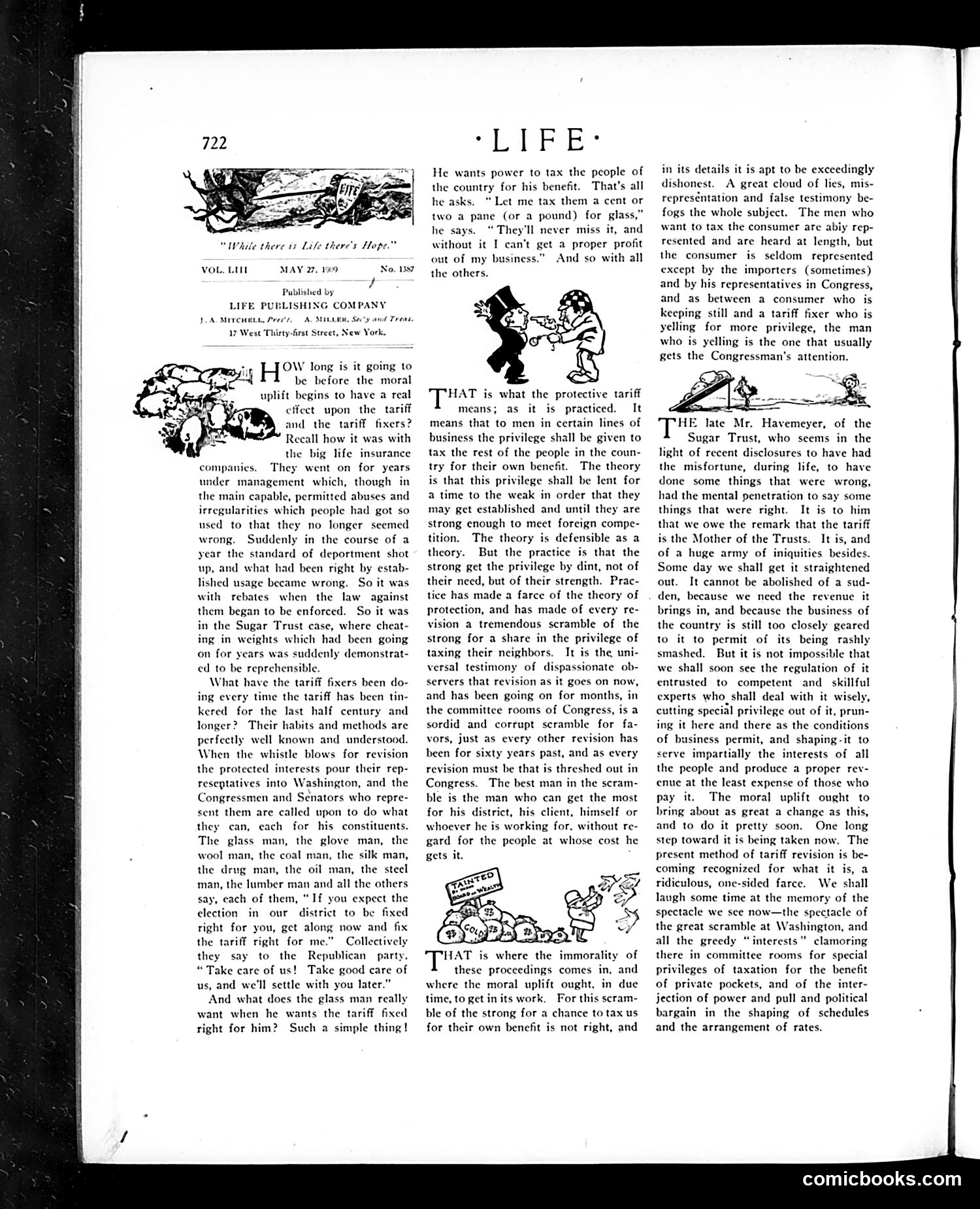
This page critiques the tariff revision process in Congress. The text argues that tariff "protection" ostensibly benefits weak American industries, but actually serves special interests at consumers' expense. The cartoons illustrate this hypocrisy: figures representing different business sectors (identified by labels like "glass man," "wool man," "steel man") lobby Congress for tariff privileges. The satire suggests these businessmen falsely claim they need protection to compete internationally, when really they're exploiting Congress to tax ordinary citizens for private profit. The author (likely mocking Republican party rhetoric) suggests tariff fixers have corrupted the revision process for "sixty years," turning legitimate economic policy into a "scramble" where powerful interests manipulate schedules and rates behind closed committee doors, harming consumers who have no representation in these dealings.
📄 Transcribed text from this page (OCR, searchable)
Machine-transcribed from the original scan — historical spelling and the odd misread are preserved.
No. 1397 t VOL. LIL MAY 27, 109 Published by LIFE PUBLISHING COMPANY 1A Mirren AM 17 West Thirty-first Street, New York. Pree he, Sec"y aved Treas OW long is it going to be before the moral uplift begins to have a real ir » ciicct upon the tariff KA and the tariff fixers? ~ Recall how it was with the big life insurance companies. They went on for years under management which, though in the main capable, permitted abuses and irregularities which people had got so used to that they no longer seemed wrong. Suddenly in the course of a year the standard of deportment shot up, and what had been right by estab- lished usage became wrong. So it was with rebates when the law against them began to be enforced. So it was in the Sugar Trust case, where cheat- ing in weights which had been going on for years was suddenly demonstrat- ed to be reprehensible. What have the tariff fixers been do- ing every time the tariff has been tin- kered for the last half century and longer? Their habits and methods are perfectly well known and understood. When the whistle blows for revision the protected interests pour their rep- reseptatives into Washington, and the Congressmen and Senators who repre- sent them are called upon to do what they can, each for his constituents. The glass man, the glove man, the wool man, the coal man, the silk man, the drug man, the oil man, the steel man, the lumber man and all the others say, each of them, “If you expect the election in our district to be fixed right for you, get along now and fix the tariff right for me.” Collectively they say to the Republican party. “Take care of us! Take good care of us, and we'll settle with you later.” And what does the glass man really want when he wants the tariff fixed right for him? Such a simple thing! “LIFE™ He wants power to tax the people of the country for his benefit. That's all he asks. “Let me tax them a cent or two a pane (or a pound) for glass,” he says. “They'll never miss it, and without it I can’t get a proper profit out of my business.” And so with all the others. Ey I HAT is what the protective tariff means; as it is practiced. It means that to men in certain lines of business the privilege shall be given to tax the rest of the people in the coun- try for their own benefit. The theory is that this privilege shall be lent for a time to the weak in order that they may get established and until they are strong enough to meet foreign compe- tition. The theory is defensible as a theory. But the practice that the strong get the privilege by dint, not of their need, but of their strength. Prac- tice has made a farce of the theory of protection, and has made of every re- vision a tremendous scramble of the strong for a share in the privilege of taxing their neighbors. It is the uni- versal testimony of dispassionate ob- servers that revision as it goes on now, and has been going on for months, in the committee rooms of Congress, is a sordid and corrupt scramble for fa- vors, just as every other revision has been for sixty years past, and as every revision must be that is threshed out in Congress. The best man in the scram- ble is the man who can get the most for his district, his client, himself or whoever he is working for. without re- gard for the people at whose cost he gets it. HAT is where the immorality of these proceedings comes in, and where the moral uplift ought, in due time, to get in its work. For this scram- ble of the strong for a chance to tax us for their own benefit is not right, and in its details it is apt to be exceedingly dishonest. A great cloud of lies, mis- represéntation and false testimony be- fogs the whole subject. The men who want to tax the consumer are abiy rep- resented and are heard at length, but the consumer is seldom represented except by the importers (sometimes) and by his representatives in Congress, and as between a consumer who is keeping still and a tariff fixer who is yelling for more privilege, the man who is yelling is the one that usually gets the Congressman’s attention. HE late Mr. Havemeyer, of the Sugar Trust, who seems in the light of recent disclosures to have had the misfortune, during life, to have done some things that were wrong, had the mental penetration to say some things that were right. It is to him that we owe the remark that the tariff is the Mother of the Trusts. It is, and of a huge army of iniquities besides. Some day we shall get it straightened out. It cannot be abolished of a sud- den, because we need the revenue it brings in, and because the business of the country is still too closely geared to it to permit of its being rashly smashed. But it is not impossible that we shall soon see the regulation of it entrusted to competent and_ skillful experts who shall deal with it wisely, cutting special privilege out of it, prun- ing it here and there as the conditions of business permit, and shaping-it to serve impartially the interests of all the people and produce a proper rev- enue at the least expense of those who pay it. The moral uplift ought to bring about as great a change as this, and to do it pretty soon. One long step toward it is being taken now, The present method of tariff revision is be- coming recognized for what it is, a ridiculous, one-sided farce. We shall laugh some time at the memory of the spectacle we see now—the spectacle of the great scramble at Washington, and all the greedy “interests clamoring there in committee rooms for special privileges of taxation for the benefit of private pockets, and of the inter- jection of power and pull and political bargain in the shaping of schedules and the arrangement of rates. comicbooks.com