
Life, 1909-05-27 · page 19 of 32
Life — May 27, 1909 — page 19: what you’re looking at
What you’re looking at
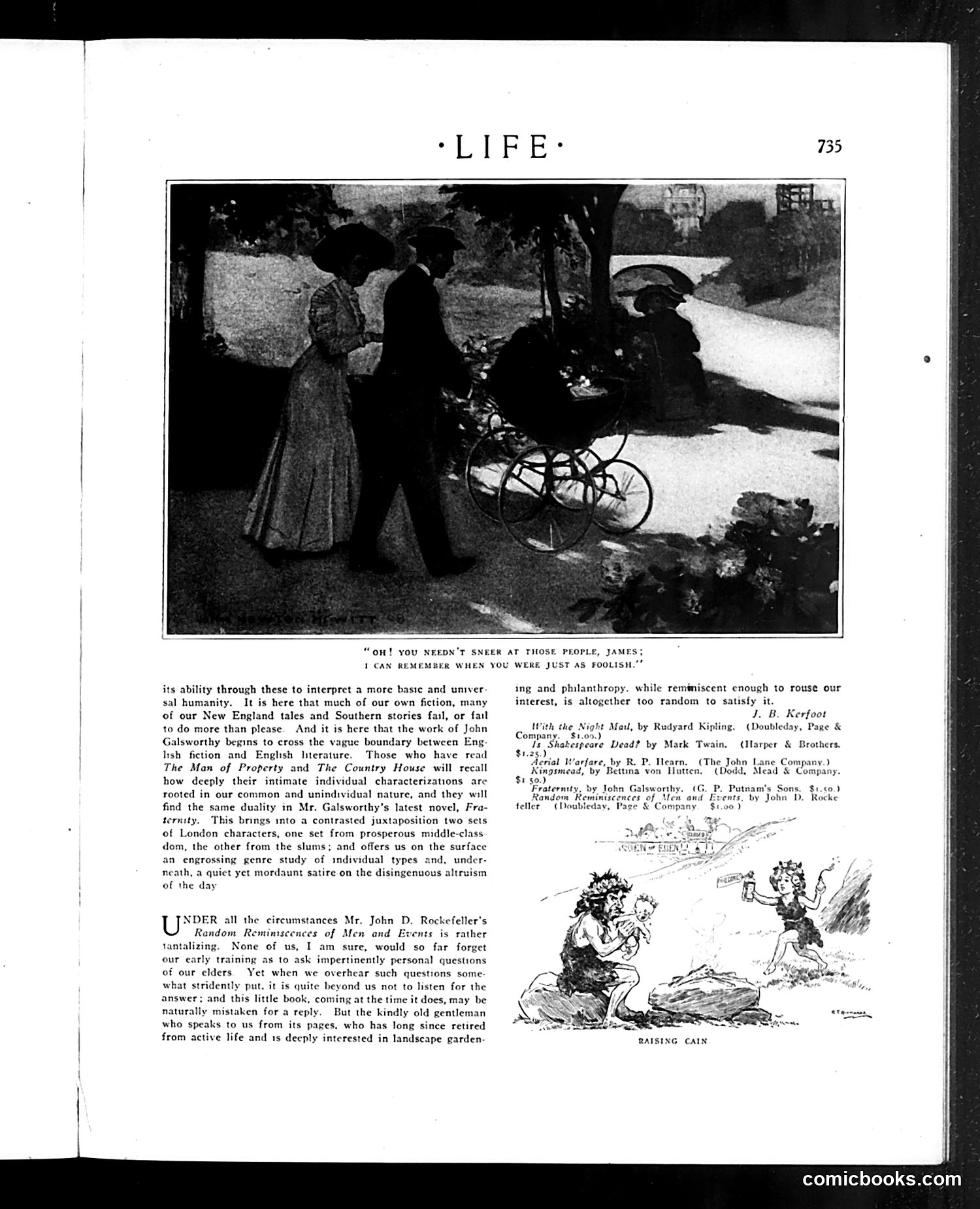
The page contains a photograph captioned with dialogue suggesting class commentary: "Oh! you needn't sneer at those people, James; I can remember when you were just as foolish." The image shows well-dressed figures with a baby carriage, apparently depicting middle-class individuals being reminded of their humble origins. The accompanying illustration titled "Raising Cain" depicts a mischievous cherub or child figure, a visual pun on the phrase meaning to cause trouble. The text reviews John Galsworthy's novel *Fraternity*, praising its exploration of class divisions between prosperous middle-class Londoners and slum-dwellers. It also discusses Rockefeller's memoir, describing it as somewhat evasive despite promising personal revelations. **The satire's point:** The page critiques class pretension and "disingenuous altruism"—the tendency of the wealthy to moralize about the poor while forgetting their own modest beginnings. This reflects Progressive Era concerns about class hypocrisy and genuine social understanding.
📄 Transcribed text from this page (OCR, searchable)
Machine-transcribed from the original scan — historical spelling and the odd misread are preserved.
'T SNEER AT THOSE PEOPLE, JAMES; 1 CAN REMEMBER WHEN YOU WERE JUST AS FOOLISH.’” its ability through these to interpret a more basic and univer sal humanity. It is here that much of our own fiction, many of our New England tales and Southern stories fail, or fail to do more than please. And it is here that the work of John Galsworthy begins to cross the vague boundary between Eng lish fiction and English Interature. Those who have read The Man of Property and The Country House will recall how deeply their intimate individual characterizations are rooted in our common and unindividual nature, and they will find the same duality in Mr. Galsworthy’s latest novel, Fra- ternity. This brings into a contrasted juxtaposition two sets of London characters, one set from prosperous middle-class dom, the other from the slums; and offers us on the surface an engrossing genre study of individual types and, under- neath, a quiet yet mordaunt satire on the disingenuous altruism of the day NDER all the circumstances Mr. John D. Rockefeller's Random Remimscences of Men and Events is rather tantalizing. None of us, I am sure, would so far forget our early training as to ask impertinently personal questions of our elders Yet when we overhear such questions some- at stridently put, it is quite heyond us not to listen for the answer; and this little book, coming at the time it does, may be naturally mistaken for a reply. But the kindly old gentleman who speaks to us from its pages. who has long since retired from active life and 1s deeply interested in landscape garden. ing and philanthropy. while remimiscent enough to rouse our interest, is altogether too random to satisfy it. J. B. Kerfoot Conllitt, the, Night Maul, by Rudyard Kipling. (Doubleday, Page & ‘ompany. $1.09.) Is Shakespeare Dead? by Mark Twain. (Harper & Brothers. $1.25.) rial Warfare, by R. P. Hearn. (The John Lane Com Kingsmead, by Bettna von Hutten, (Dodd, Mead & Co: $1 $0.) Fraternty, dy John Galsworthy. (G. P. Putnam's Sons. $1.50.) Random Reminiscences of Men and Events, by John D. Rocke feller (Doubleday, Page & Com $1.00) RAISING CAIN comicbooks.com