
Life, 1909-05-27 · page 20 of 32
Life — May 27, 1909 — page 20: what you’re looking at
What you’re looking at
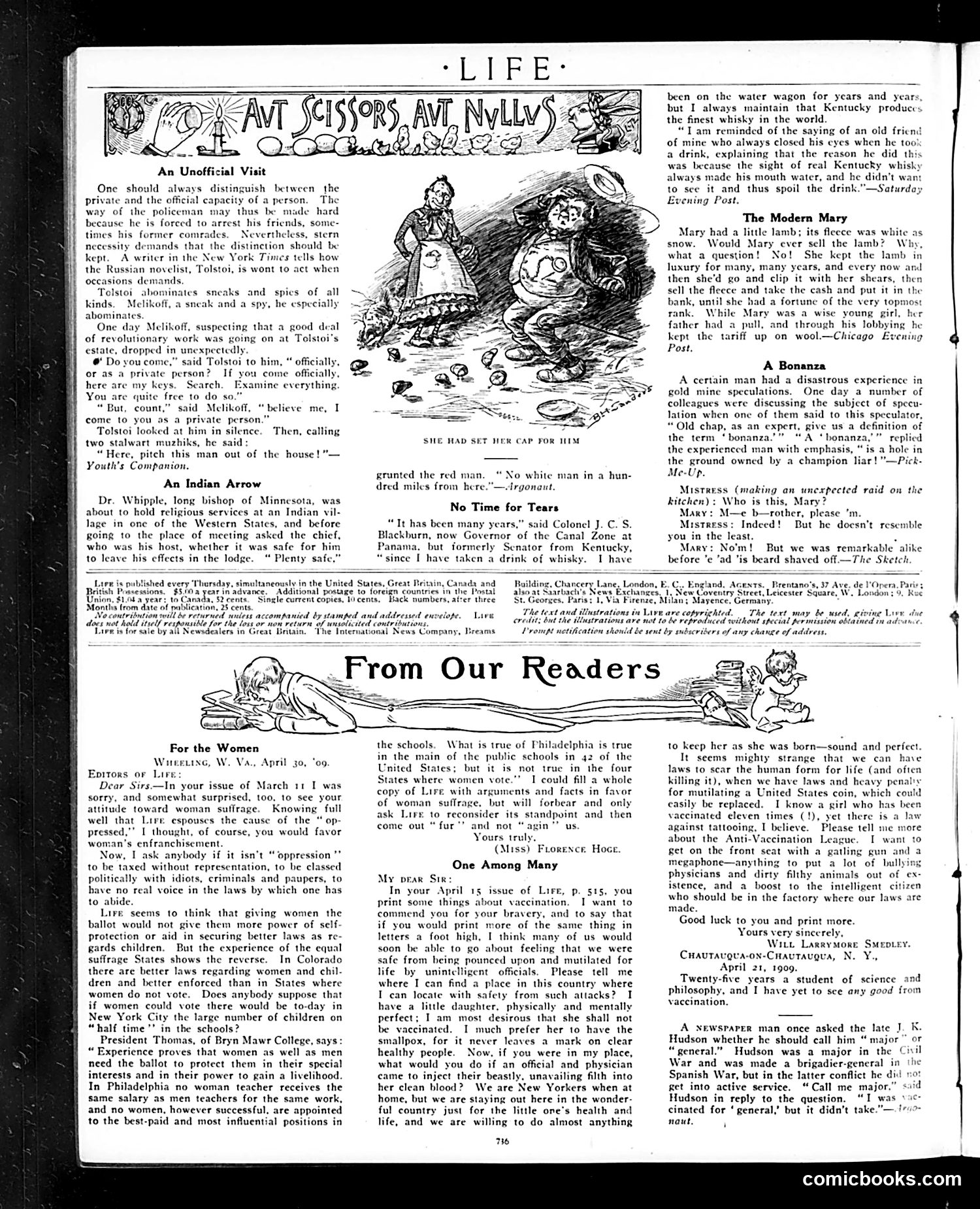
This page contains several brief humorous anecdotes satirizing contemporary issues: **"An Unofficial Visit"** mocks Russian imperial bureaucracy through Tolstoi's distinction between official and private capacity—when a spy (Melikoff) claims to visit privately, Tolstoi has him thrown out, exposing the hypocrisy of using "private" as cover for state surveillance. **"The Modern Mary"** is economic satire: a modernized nursery rhyme where Mary profits by shearing her lamb repeatedly and selling wool, while her father's political lobbying maintains tariff protection. It critiques how industrial profits depend on political favoritism rather than genuine economic value. **"A Bonanza"** cynically defines mining speculation as "a hole in the ground owned by a champion liar"—mocking get-rich-quick schemes and investor fraud. The reader letters address women's suffrage and vaccination debates, reflecting Progressive-era social controversies. The overall tone is irreverent mockery of authority figures, political corruption, and financial schemes.
📄 Transcribed text from this page (OCR, searchable)
Machine-transcribed from the original scan — historical spelling and the odd misread are preserved.
An Unofficial Visit One should always distinguish between the private and the official capacity of a person. The way of the policeman may thus be made hard because he is forced to arrest his friends, some- times his former comrades. Nevertheless, stern necessity demands that the distinction should be kept, A writer in the New York Times tells how the Russian novelist, Tolstoi, is wont to act when occasions demands. Tolstoi_abominates sneaks and spics of all kinds. Melikoff, a sneak and a spy, he especially abominates. One day Mclikoff, suspecting that a good deal of revolutionary work was going on at Tolsto estate, dropped in unexpectedly @' Do you come,” said Tolstoi to him, “ officially, or as a private person? If you come officially, here are my keys. Search. Examine everything. You are quite free to do so.” “But, count,” said Melikoff, “believe me, I come to you as a private person.” Tolstoi looked at him in silence. Then, calling two stalwart muzhiks, he said : “Here, pitch this man out of the house! "”— Youth's Companion. An Indian Arrow Dr. Whipple, long bishop of Minnesota, was about to hold religious services at an Indian vil- lage in one of the Western States, and before going to the place of meeting asked the chief, who was his host, whether it was safe for him to Ieave his effects in the lodge.“ Plenty safe,” IAT SCIs<oR® ; SHE HAD SET HER CAP FOR TIM grunted the red man. “No white man in a hun- dred miles from here."—irgonaut. No Time for Tears “It has been many years,” said Colonel J. C. S. Blackburn, now Governor of the Canal Zone at Panama. but formerly Scnator from Kentucky since I have taken a drink of whisky. I have been on the water wagon for years and years, but I always maintain that Kentucky produc: the finest whisky in the world “Tam reminded of the saying of an old friend of mine who always closed his eyes when he too’ a drink, explaining that the reason he did this was because the sight of real Kentucky whisky always made his mouth water, and he didn’t wa to sce it and thus spoil the drink."”—Saturday Evening Post. The Modern Mary Mary had a little lamb; its fleece was white as snow. Would Mary ever sell the lamb? Why, what a question! No! She kept the lamb in luxury for many, many years, and every now and then she'd go and clip it with her shears, the sell the fleece and take the cash and put it in the bank, until she had a fortune of the very topmost rank. While Mary was a wise young girl, her father had a pull, and through his lobbying he kept the tariff up on wool—Chicago Evening Post. A Bonanza A certain man had a disastrous experience in gold mine speculations. One day a number of colleagues were discussing the subject of specu- lation when one of them said to this speculator, “Old chap, as an expert, give us a definition of the term ‘bonanza’” “A ‘bonanza,’” replied the experienced man with emphasis, “is a hole in the ground owned by a champion liar!"—Pick- Me-Up. Mistarss (making an unexpected raid on the kitchen): Who is this, Mary? Mary: M—e b—rother, please 'm. Mistress: Indeed! But he docsn't resemble you in the least. : Mary: No'm! But we was remarkable before ’e ‘ad ‘is beard shaved off —The Sketch ike Lirx is published every ‘Thursday, Union, $1.04 a Months from date of pablication, 25 cents. does not hold itrelf responsible for the tos Wirenixe, W. Epitors oF Lire: Dear Sirs.—In your issue of March 11 I was sorry, and somewhat surprised, too, to see your attitude toward woman sutfrage. Knowing full well that Lire espouses the cause of the “ op- pressed,” I thought, of course, you would favor woman’s enfranchisement. Now, I ask anybody if it isn’t “oppression to be taxed without representation, to he classed politically with idiots, criminals and paupers, to have no real voice in the laws by which one has to abide. Liv seems to think that giving women the ballot would not give them more power of self- protection or aid in securing better laws as re- gards children. But the experience of the equal suffrage States shows the reverse. In Colorado there are better laws regarding women and chil- dren and better enforced than in States where women do not vote. Does anybody suppose that if women could vote there would be to-day in New York City the large number of children on “half time’ in the schools? President Thomas, of Bryn Mawr College, says: Experience proves that women as well as men need the ballot to protect them in their special interests and in their power to gain a livelihood. In Philadelphia no woman teacher receives the same salary as men teachers for the same work, and no women, however successful, are appointed to the best-paid and most influential positions in 30, imultaneously in the United States, Great Britain, Cana ish Possessions. $5.00 year in advance. Additional postage to foreign countries in the Postal ari 1 Canada, 2eents. Single current copies, 1 cents, Back numbers, after three ll be returned undess accompanied by stamped and addressed envelope. 1 ctr of unsol Live is for sale by ail Newsdealers in Great Britain. ‘The Int onal News Company, Breams and Railding, Chancery also at Saarbach's News St. Georges, Paris 1, V: eer tbutions, From Our Reader the schools. What is true of Philadelphia is true in the main of the public schools in 42 of the United States; but it is not truc in the four States where women vote."” I could fill a whole copy of Lire with arguments and facts in favor of woman suffrage, but will forbear and only ask Lire to reconsider its standpoint and then come out “ fur’ and not “agin” us. Yours trul aM One Among Many My prak Ste: In your April 15 issue of Lire, p. 515, you print some things about vaccination. I want to commend you for your bravery, and to say that if you would print more of the same thing in letters a foot high, I think many of us would soon be able to go about feeling that we were safe from being pounced upon and mutilated for life by unintelligent officials. Please tell me where I can find a place in this country where I can locate with safety from such attacks? T have a little daughter, physically and mentally perfect; Iam most desirous that she shall not be vaccinated. I much prefer her to have the smallpox, for it never leaves a mark on clear healthy people. Now. if you were in my place, what would you do if an official and physician came to inject their beastly. unavailing filth into her clean blood? We are New Yorkers when at home, but we are staying out here in the wonder- ful country just for the little one’s health and life, and we are willing to do almost anything ) Frorexce Hose. 76 ane, London, changes, Firenze, Milan ve The text and ilinstrations in Live are copyrighted. credit; bit the illustrations are net to be reproduced without special permission obtained 07 ad: Prompt nctification shonid be sent by nbscribers of any change of address G, England, Acexts. Prentano Yew Coventry fayence, «37 Ave. de l'Onera. Pai reet, Leicester Square, W, London ; 9, 1, The text may be wed, giving Live due to keep her as she was born—sound and perfect. It seems mighty strange that we can have laws to scar the human form for life (and often killing it), when we have laws and heavy penalty for mutilating a United States coin, which could casily be replaced. I know a girl who has been vaccinated eleven times (!), yet there is a law against tattooing, I believe. Please tell me more about the Anti-Vaccination League. [ want to get on the front seat with a gatling gun and a megaphone—anything to put a lot of bull physicians and dirty filthy animals out of ex- istence, and a boost to the intelligent citizen who should be in the factory where our laws are made. Good luck to you and print more. Yours very sincerely, Witt Larrymore Smepiey. Cuavravgva-on-Cravtaugua, N. Y., April 21, 1909. Twenty-five years a student of science and philosophy, and I have yet to see any good from vaccination. A Newsrarer man once asked the late J. K. Hudson whether he should call him “ major” or “general.” Hudson was a major in the Civil War and was made a brigadier-general in the Spanish War, but in the latter conflict he d get into active service. “Call me major. Hudson in reply to the question. “I was cinated for ‘general,’ but it didn’t take."”— f79- naut. d comicbooks.com