
Life, 1909-05-27 · page 15 of 32
Life — May 27, 1909 — page 15: what you’re looking at
What you’re looking at
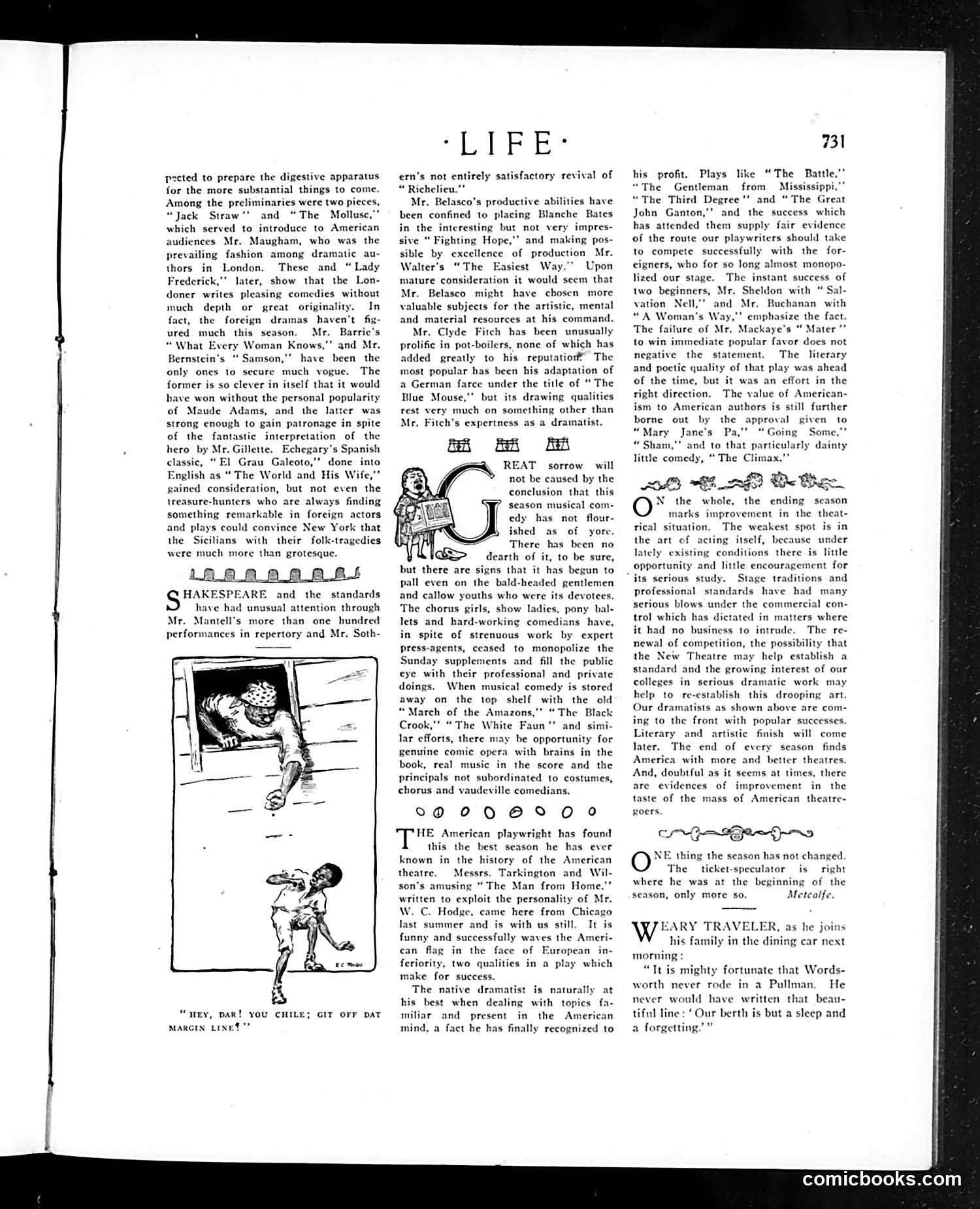
This theater review page discusses the 1908-1909 Broadway season. The two cartoon illustrations appear to satirize theatrical performance styles. The cartoons feature exaggerated figure drawings—likely caricatures of specific actors or performance types popular at the time. Based on the surrounding text's discussion of musical comedy, these sketches probably mock the physical comedy and broad gesturing typical of vaudeville and farce performers who dominated musical theater. The caption "HEY, PAH! YOU CHILE; GIT OFF DAT MARGIN LINE!" uses dialect humor (appearing to reference minstrelsy-influenced speech patterns), which was common in early 1900s American satire. The review's main point: American playwrights had their best season yet, particularly those writing comedies about American life. The text dismisses both foreign dramas and worn-out musical comedy formulas, praising instead native dramatists who explored American themes and characters—a nationalist sentiment typical of the era.
📄 Transcribed text from this page (OCR, searchable)
Machine-transcribed from the original scan — historical spelling and the odd misread are preserved.
pected to prepare the digestive apparatus for the more substantial things to come. Among the preliminaries were two pieces, “Jack Straw’? and “The Mollusc,” which served to introduce to American audiences Mr. Maugham, who was the prevailing fashion among dramatic au- thors in London. These and “Lady Frederick,” later, show that the Lon- doner writes pleasing comedies without much depth or great originality. In fact, the foreign dramas haven't fig- ured much this season. Mr. Barrie's “What Every Woman Knows,’’ and Mr. Bernstcin’s “Samson,’’ have been the only ones to secure much vogue. The former is so clever in itself that it would have won without the personal popularity of Maude Adams, and the latter was strong enough to gain patronage in spite of the fantastic interpretation of the hero by Mr. Gillette. Echegary’s Spanish classic, “El Grau Galeoto,"” done into English as “The World and His Wife,” gained consideration, but not even the Ireasure-hunters who are always finding something remarkable in foreign actors and plays could convince New York that the Sicilians with their folk-tragedies were much more than grotesque. HAKESPEARE and the standards have had unusual attention through Mr. Mantell’s more than one hundred performances in repertory and Mr. Soth- “wey, par! you CHILE MARGIN LINE’ "? *LIFE* ern’s not entirely satisfactory revival of “ Richelieu.” Mr. Belasco’s productive abilities have been confined to placing Blanche Bates in the interesting but not very impres- sive “ Fighting Hope," and making pos- sible by excellence of production Mr. Walter’s “The Easiest’ Way."” Upon mature consideration it would seem that Mr. Belasco might have chosen more valuable subjects for the artistic, mental and material resources at his command. Mr. Clyde Fitch has been unusually prolific in pot-boilers, none of which has added greatly to his reputatior® The most popular has been his adaptation of a German farce under the title of “ The Blue Mouse,” but its drawing qualities rest very much on something other than Mr. ch’s expertness as a dramatist. a i RBA REAT sorrow will not be caused by the conclusion that this season musical com- edy has not flour- ished as of yore. There has been no dearth of it, to be sure, but there are signs that it has begun to pall even on the bald-headed gentlemen and callow youths who were its devotees. The chorus girls, show ladies, pony bal- lets and hard-working comedians have, in spite of strenuous work by expert Press-agents, ceased to monopolize the Sunday supplements and fill the public eye with their professional and private doings. When musical comedy is stored away on the top shelf with the old “March of the Amazons,’ “The Black Croo! The White Faun’? and simi- lar efforts, there may be opportunity for genuine comic opera with brains in the book, real music in the score and the principals not subordinated to costumes, chorus and vaudeville comedians. Sd90Q0 O69 00 HE American playwright has found this the best season he has ever known in the history of the American theatre. Messrs. Tarkington and Wil- son’s amusing “The Man from Home. written to exploit the personality of Mr. W. C. Hodge, came here from Chicago last summer and is with us still. It is funny and successfully waves the Ameri- can flag in the face of European in- feriority, two qualities in a play which make for success. The native dramatist is naturally at his best when dealing with topics fa- miliar and present in the American mind, a fact he has finally recognized to 731 his profit, Plays like “The Battle," “The Gentleman from Mississippi, “The Third Degree" and “The Great John Ganton,’? and the success which has attended them supply fair evidence of the route our playwriters should take to compete successfully with the for- cigners, who for so long almost monopo- lized our stage. The instant success of two beginners, Mr. Sheldon with “ Sal- vation Nell,’ and Mr. Buchanan with Woman's Way,’? emphasize the fact. The failure of Mr. Mackaye’s “ Mater" to win immediate popular favor docs not negative the statement. The literary and poctic quality of that play was ahead of the time, but it was an effort in the right direction. The value of American- ism to American authors is still further borne out by the approval given to “Mary Jane’s Pa," “Going Some,’* “Sham,” and to that particularly dainty little comedy, “ The Climax.’” O the whole, the ending season marks improvement in the theat- rical situation, The weakest spot is in the art of acting itself, because under lately existing conditions there is little opportunity and little encouragement for its serious study. Stage traditions and professional standards have had many serious blows under the commercial con- trol which has dictated matters where it had no business to intrude. The re- newal of competition, the possibility that the New Theatre may help establish a standard and the growing interest of our colleges in serious dramatic work may help to re-establish this drooping art. Our dramatists as shown above are com- ing to the front with popular successes. Literary and artistic finish will come later. The end of every season finds America with more and better theatres. And, doubtful as it seems at times, there are evidences of improvement in the taste of the mass of American theatre- CA QREGRMA IAS O NE thing the season has not changed. The ticket-speculator is right where he was at the beginning of the season, only more so. Metcalfe. Weary TRAVELER, as he joins his family in the dining car next morning: “It is mighty fortunate that Words- worth never rode in a Pullman. He never would have written that beau- tiful line : ‘Our berth is but a sleep and a forgetting. comicbooks.com