
Life, 1909-05-27 · page 18 of 32
Life — May 27, 1909 — page 18: what you’re looking at
What you’re looking at
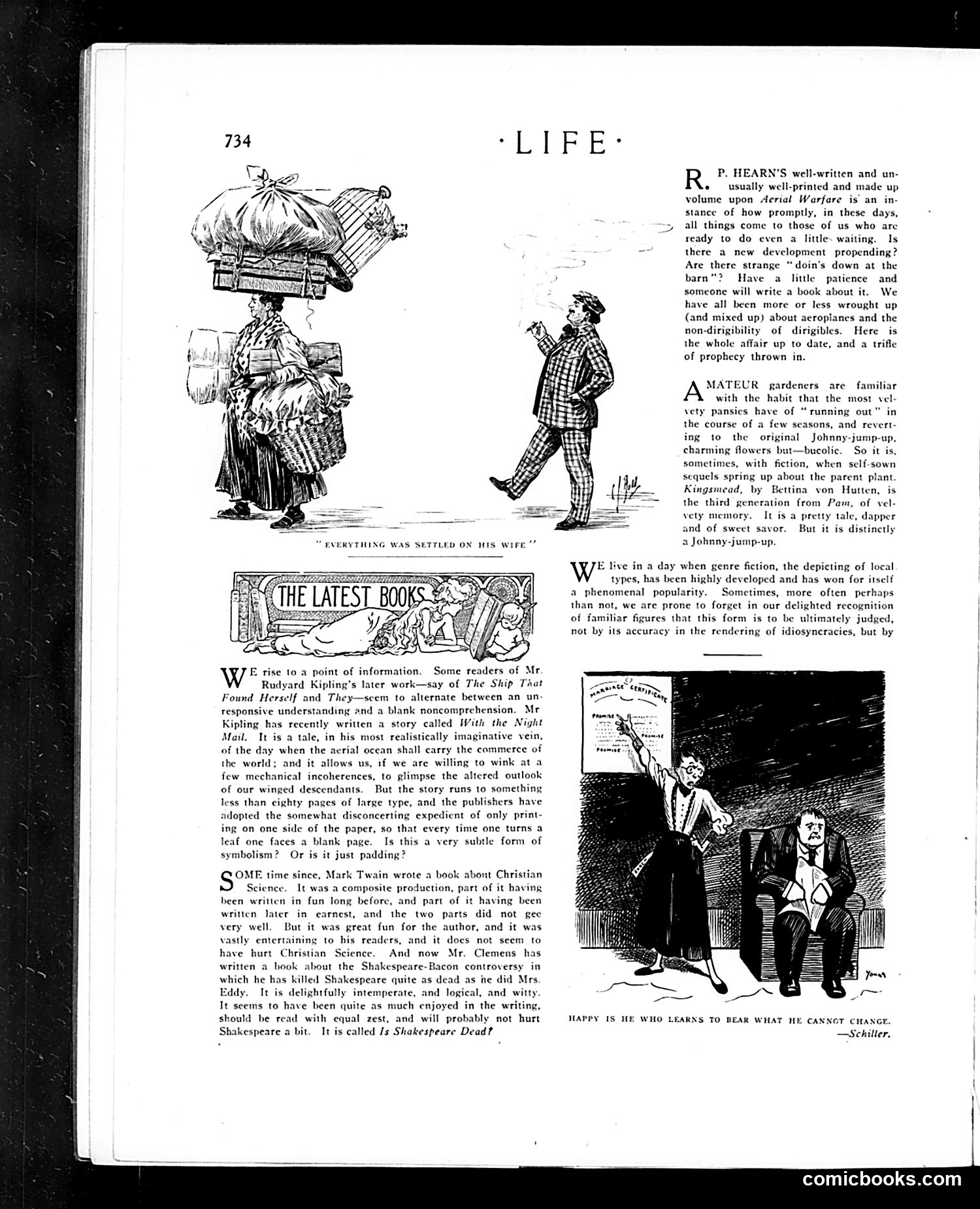
This page contains literary reviews rather than political cartoons. The main illustration—"Everything Was Settled on His Wife"—depicts a domestic scene of a man unloading parcels onto an overburdened woman, likely satirizing the division of household labor and domestic responsibility. The text reviews several books: P. Hearn's work on aerial warfare; "Kingsmead" by Bettina von Hutten (criticized as a weak sequel, a "Johnny-jump-up"); Kipling's "With the Night Mail" (praised as imaginative futurism but criticized for its awkward one-sided printing); and Mark Twain's "Is Shakespeare Dead?" (about the Shakespeare-Bacon authorship controversy). The reviews mock pretentious literature, publishing gimmicks, and Twain's quarrelsome tone. The closing Schiller epigraph emphasizes acceptance of circumstances beyond one's control—fitting the domestic scene depicted above.
📄 Transcribed text from this page (OCR, searchable)
Machine-transcribed from the original scan — historical spelling and the odd misread are preserved.
LIFE P. HEARN’S well-written and un- © usually well-printed and made up volume upon Aerial Warfare is’ an in- stance of how promptly, in these days, all things come to those of us who arc ready to do even a little waiting. Is there a new development propending? Are there strange “doin’s down at the barn”? Have a little patience and someone will write a book about We have all been more or less wrought up (and mixed up) about aeroplanes and the non-dirigibility of dirigibles. Here is the whole affair up to date, and a trifle of prophecy thrown in. Y MATEUR gardeners are familiar with the habit that the most vel- vety pansies have of “running out" in the course of a few scasons, and revert- ing to the original Johnny-jump-up, charming flowers but—bucolic. So it is, sometimes, with fiction, when self-sown sequels spring up about the parent plant. | Kingsmead, by Bettina von Hutten, is the third generation from Pam, of vel- vety memory. It is a pretty tale, dapper and of sweet savor. But it is distinctly ” a Johnny-jump-up. W live in a day when genre fiction, the depicting of local types, has been highly developed and has won for itself a phenomenal popularity. Sometimes, more often perhaps than not, we are prone to forget in our delighted recognition of familiar figures that this form is to be ultimately judged, not by its accuracy in the rendering of idiosyncracies, but by rise to a point of information. Some readers of Mr Rudyard Kipling’s later work—say of The Ship Taat Found Herself and They—scem to alternate between an un- responsive understanding and a blank noncomprehension. Mr Kipling has recently written a story called With the Night Mail. It is a tale, in his most realistically imaginative vein, of the day when the aerial ocean shall carry the commerce of the world; and it allows us, if we are willing to wink at a few mechanical incoherences, to glimpse the altered outlook of our winged descendants. But the story runs to something less than cighty pages of large type, and the publishers have adopted the somewhat disconcerting expedient of only print- ing on one side of the paper, so that every time one turns a leaf one faces a blank page. Is this a very subtle form of symbolism? Or is it just padding? OME time since, Mark Twain wrote a book abont Christian Science. It was a composite production, part of it having been written in fun long before, and part of it having been written later in earnest, and the two parts did not gee very well. But it was great fun for the author, and it was vastly entertaining to his readers, and it does not seem to have hurt Christian Science. And now Mr. Clemens has written a book about the Shakespeare-Bacon controversy in which he has killed Shakespeare quite as dead as ie did Mrs Eddy. It is delightfully intemperate, and logical, and witty It seems to have been quite as much enjoyed in the writing, should be read with equal zest, and will probably not hurt MAPPY IS ME WHO LEARNS TO BEAR WHAT HE CANNOT CHANGE. Shakespeare a It is called Is Shakespeare Dead? —Schiller. comicbooks.com