
A complete issue · 48 pages · 1909
Life — May 6, 1909
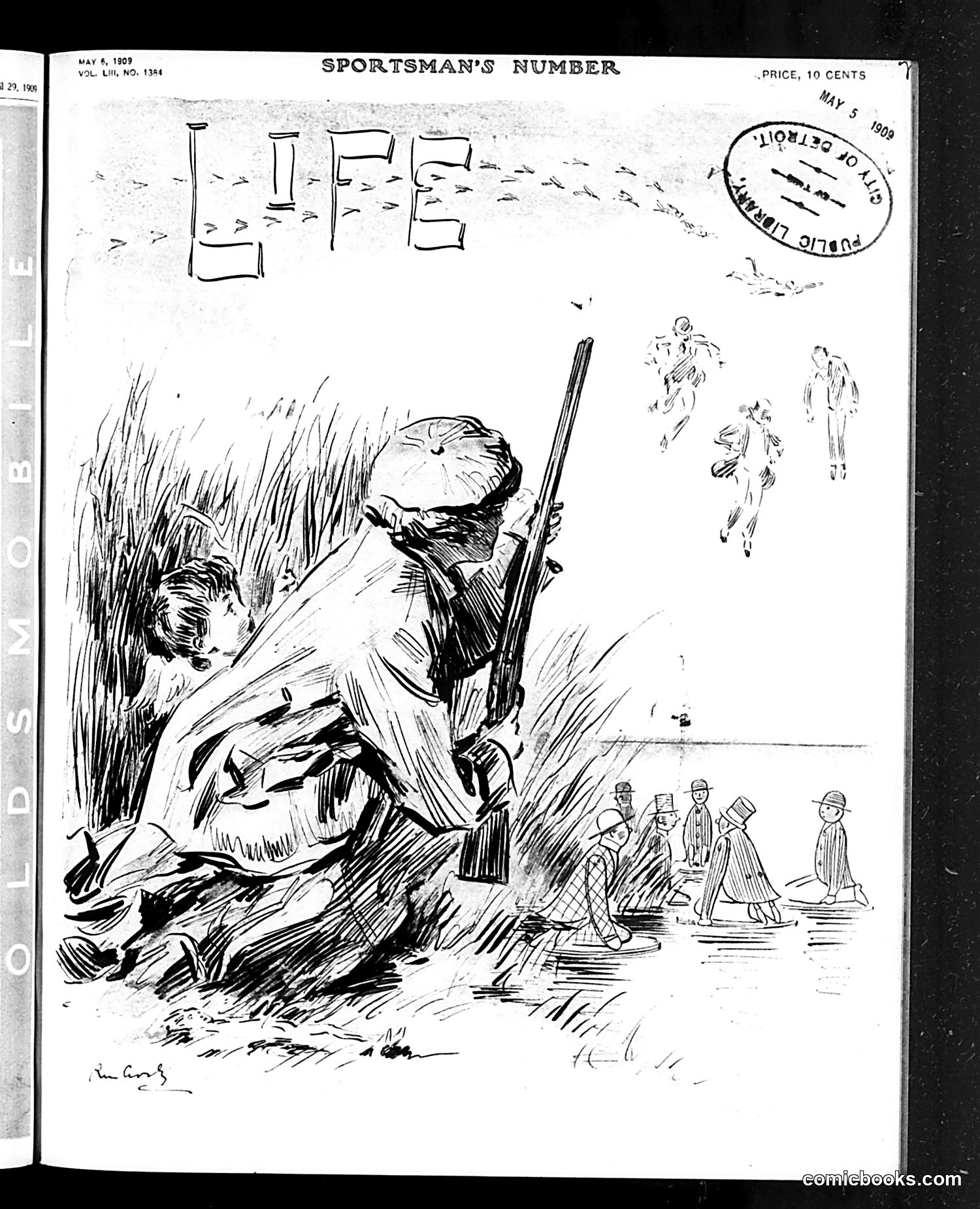
This is the cover of Life magazine's "Sportsman's Number" (price 10 cents). The main illustration depicts a large hunter or outdoorsman in tall grass, carrying a rifle and accompanied by a hunting dog. The figure appears exhausted or struggling, with several smaller figures visible in the background near water, suggesting a hunting or fishing scene. The word "LIFE" dominates the upper portion in large letters. The cartoon likely satirizes contemporary hunting or sport-fishing culture, popular leisure activities among affluent Americans in the Edwardian era. The exaggerated, struggling pose of the hunter may mock overzealous or incompetent sportsmen, or comment on the physical demands of outdoor recreation. Without additional context, the specific satirical target remains unclear.
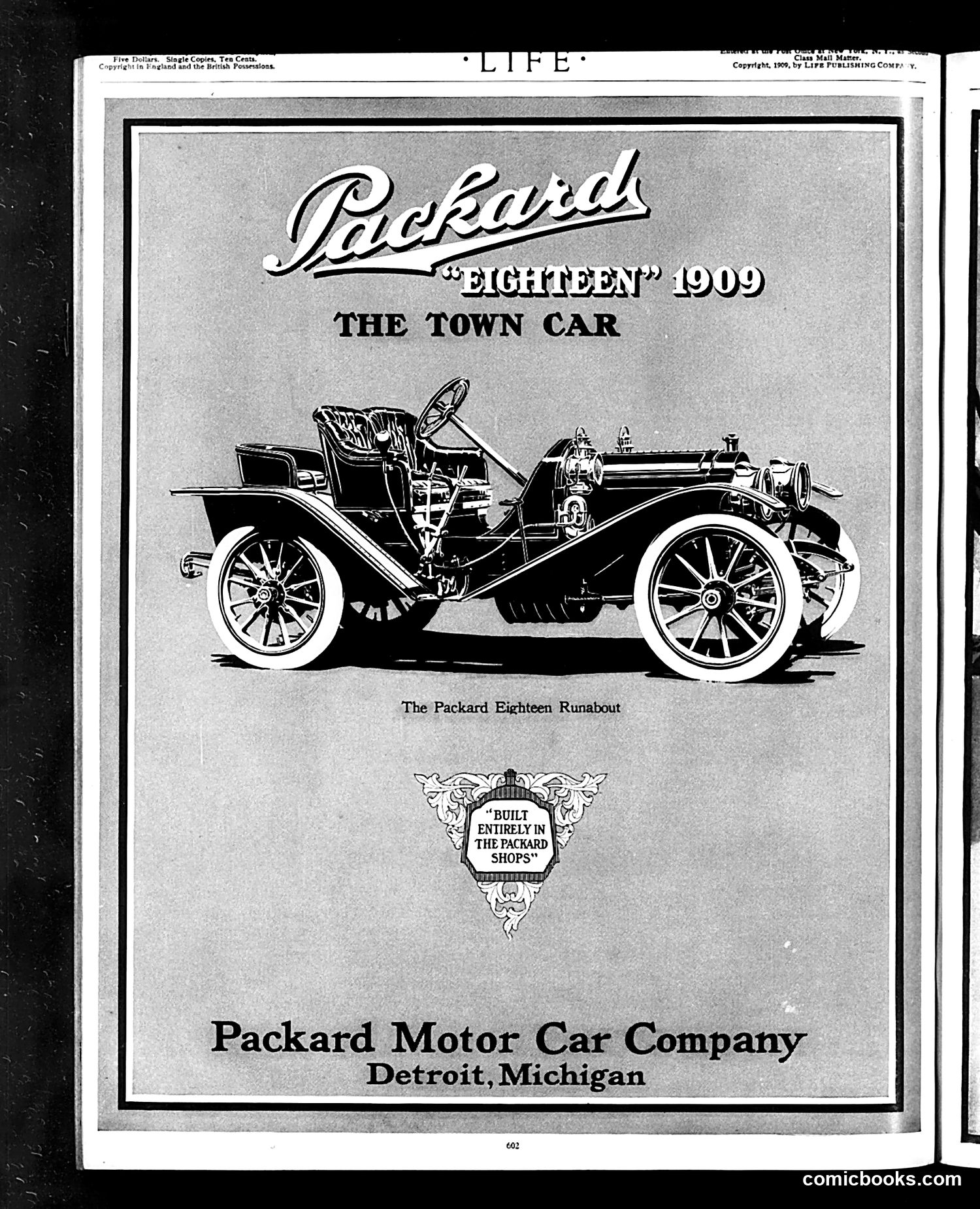
This is **not a political cartoon or satire**—it's a straightforward advertisement from Life magazine (circa 1909) for the Packard Motor Car Company of Detroit, Michigan. The page promotes the "Packard Eighteen" 1909 model, specifically marketed as "The Town Car." The illustration shows a high-end automobile with an open-air design typical of early 1900s luxury vehicles. The tagline "Built Entirely in the Packard Shops" emphasizes manufacturing quality and American craftsmanship during an era when automobiles were rare, expensive luxury goods. This represents early automotive advertising targeting wealthy consumers—the car's prominence in Life magazine itself signals its status as aspirational, elite merchandise.
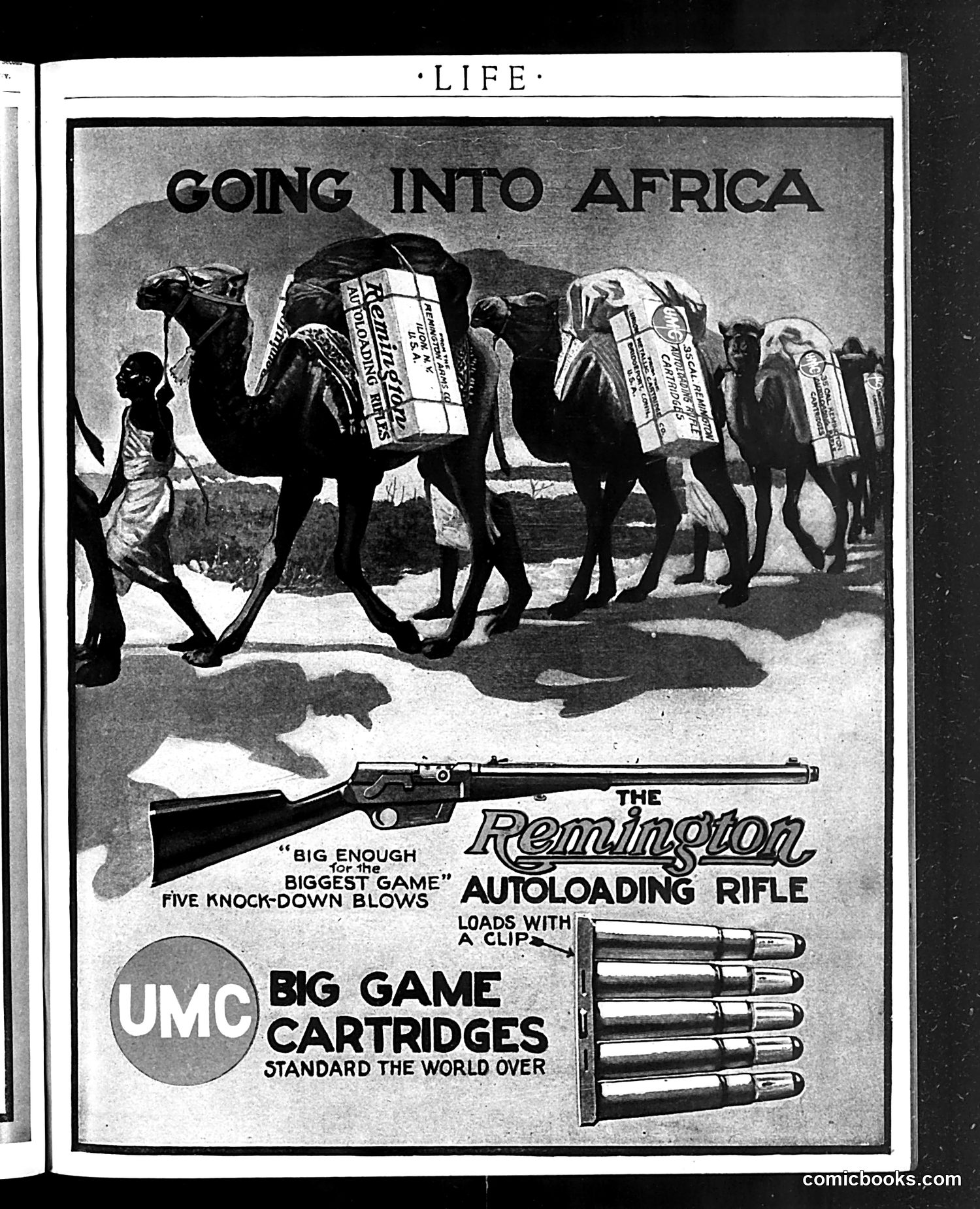
This is a **Remington rifle advertisement**, not political satire. The image depicts a colonial-era caravan crossing African desert terrain with camels carrying cargo and armed guards. The ad uses imperialist imagery to market the Remington autoloading rifle and UMC ammunition as suitable for African expeditions. The headline "Going Into Africa" and claim that the rifle is "Big Enough for the Biggest Game" with "Five Knock-Down Blows" position the weapon as essential equipment for colonial hunters and adventurers. The figures appear to represent generic colonial explorers and local carriers. This reflects early-20th-century marketing that exploited European imperial expansion into Africa, presenting African hunting/exploration as a desirable consumer activity for Western audiences. The advertisement assumes readers saw this as aspirational rather than problematic.
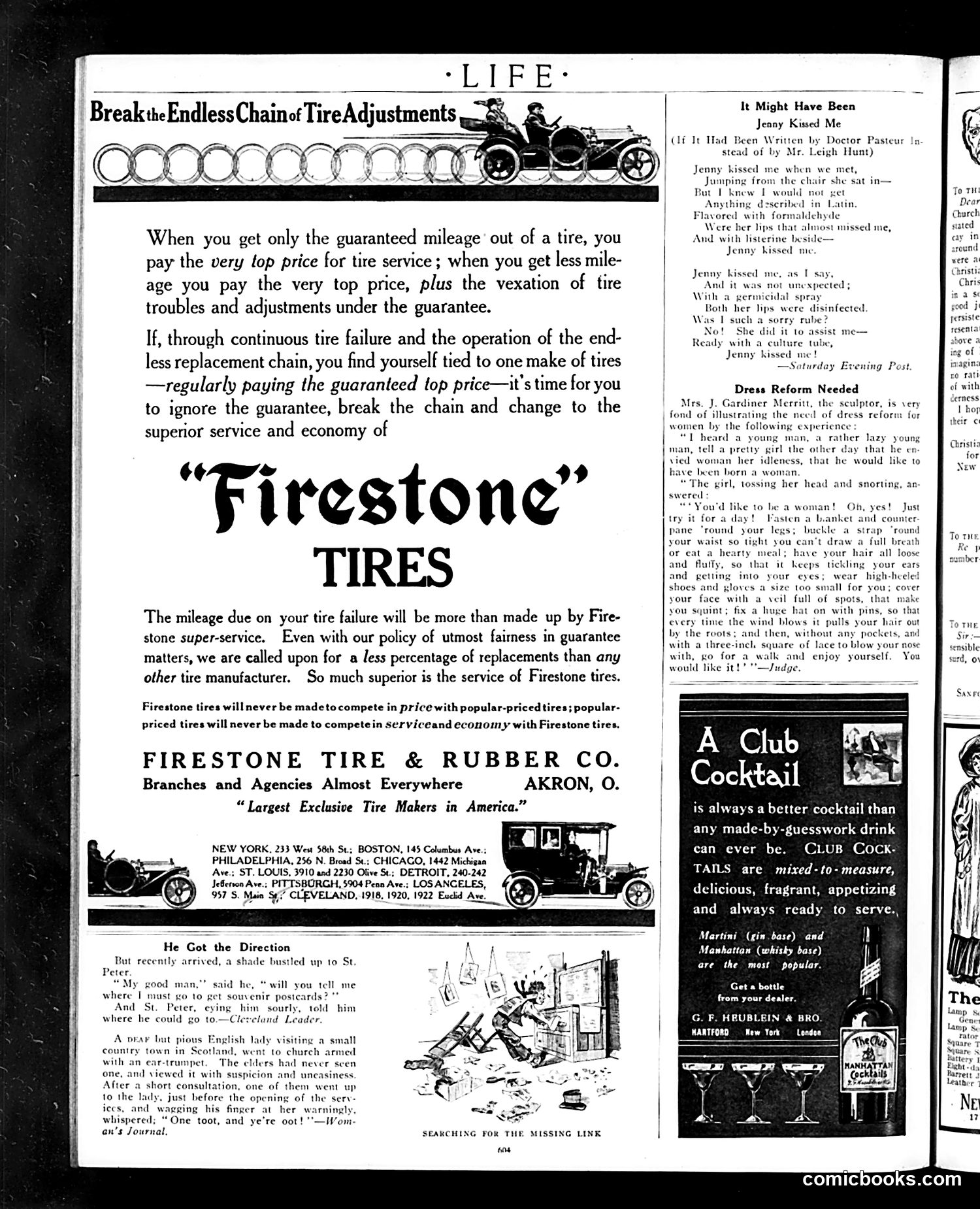
This page is primarily **advertising**, not political satire. The dominant content is a Firestone Tires advertisement occupying roughly two-thirds of the left side, arguing that Firestone's guarantee and service justify premium pricing despite higher costs than competitors. The remaining editorial content includes: - **"It Might Have Been Jenny Kissed Me"**: A humorous poem riffing on Leigh Hunt's famous poem, describing an unexpected kiss - **"How Fashion Affects Dress"**: An anecdote about sculptor Mrs. J. Gardiner Merritt, recounting a young woman's exaggerated description of fashionable female discomfort (tight corseting, etc.) - **"He Got the Direction"**: A short joke about religious pilgrims - **"A Club Cocktail"** advertisement for mixed drinks The page reflects early 20th-century Life magazine's mix of advertising, light humor, and brief satirical commentary on social conventions—particularly fashion and courtship.
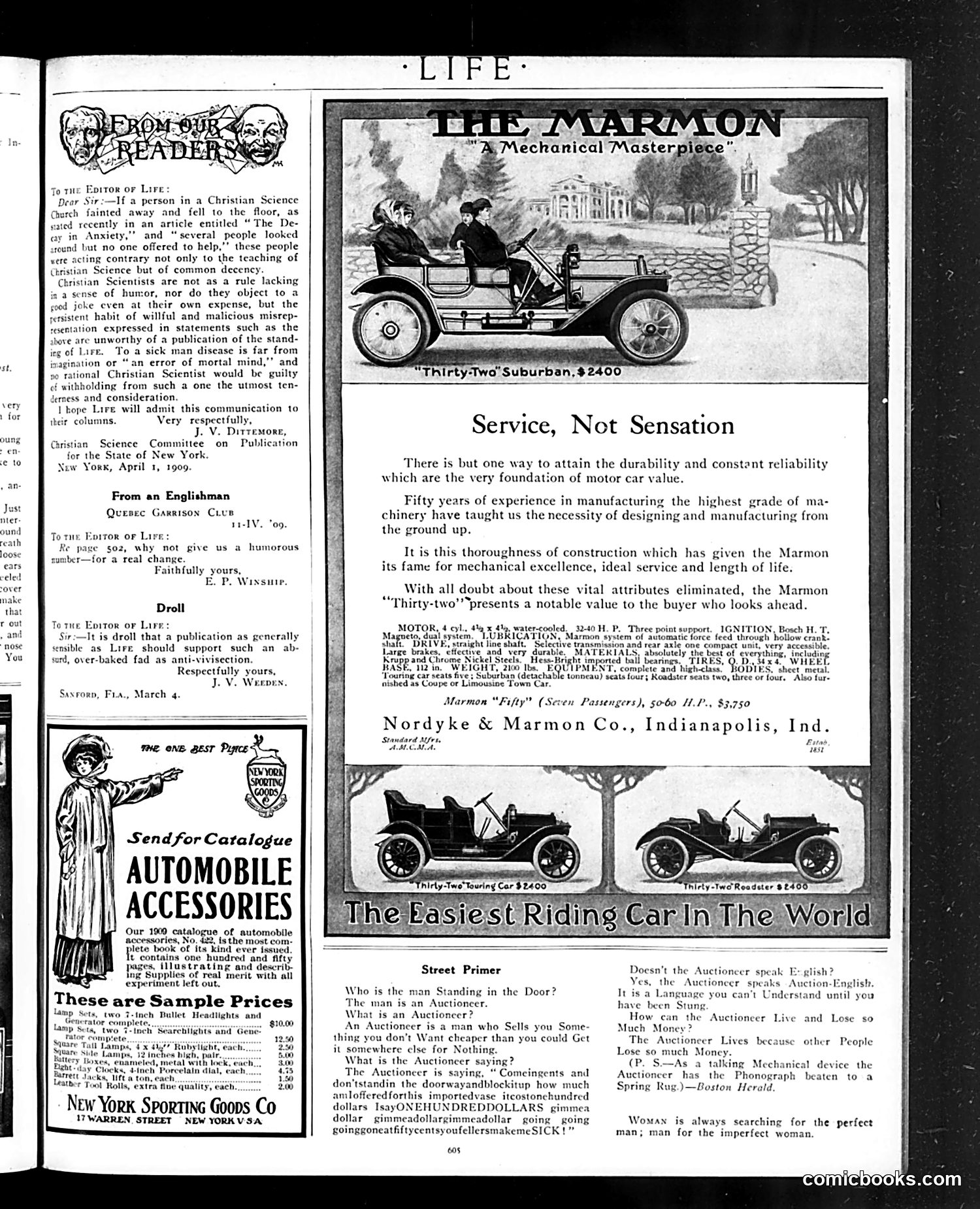
This page is primarily **advertising**, not satire. The dominant content is a Marmon automobile advertisement ("Service, Not Sensation") featuring the "Thirty-Two" model priced at $2400. The ad emphasizes manufacturing quality and mechanical reliability. The left column contains reader letters to *Life*'s editor on various topics (Christian Science, humor), and a small classified ad for automobile accessories. The bottom includes a "Street Primer" humor section defining an "Auctioneer" for readers unfamiliar with the term—a common educational feature in *Life*. A separate quip about a woman seeking "the perfect man" follows. **No political cartoons or social satire appear on this page.** It represents typical early-1900s magazine content: reader correspondence, automotive advertising, and light humor.
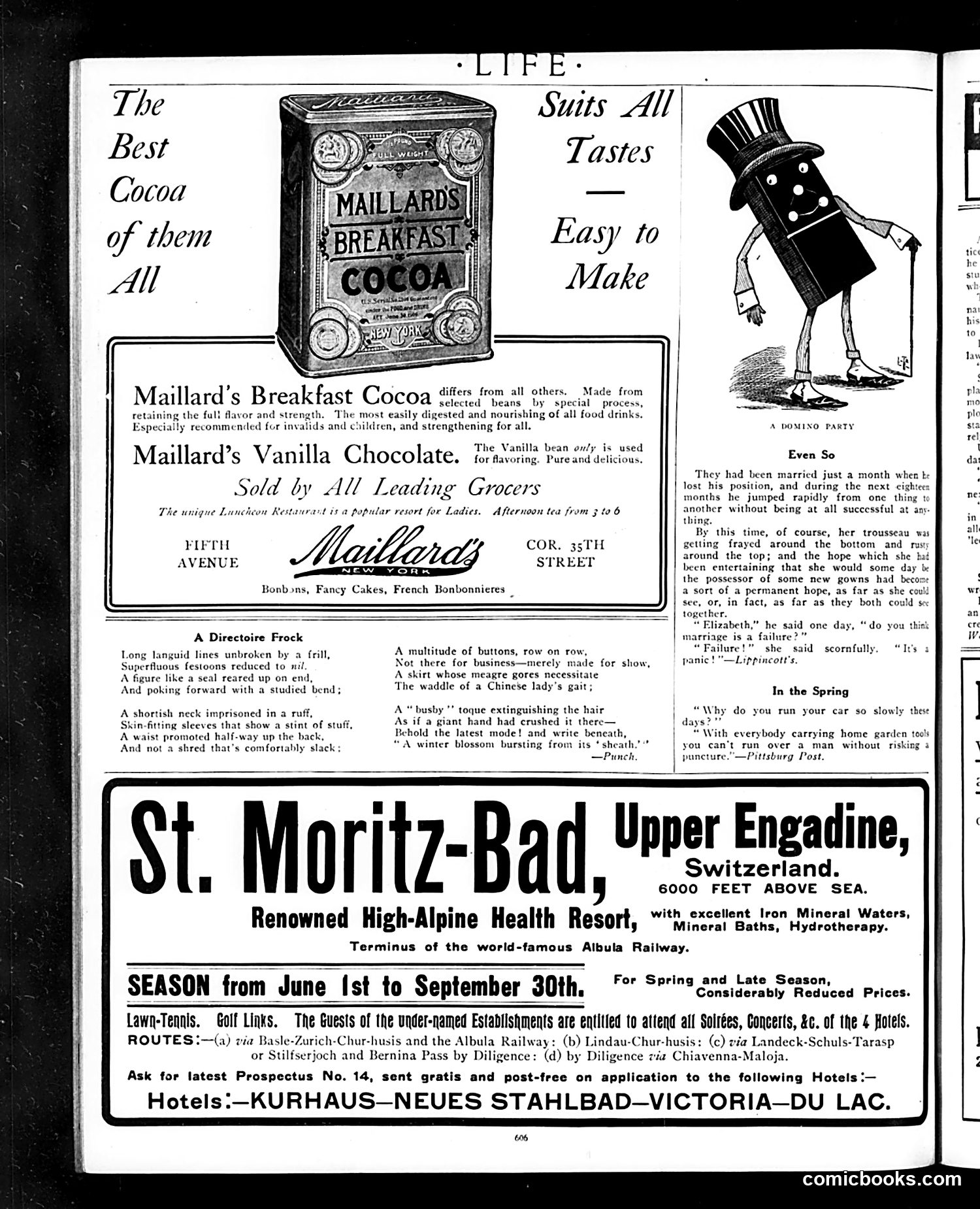
This page is primarily **advertising rather than political satire**. The main content consists of three ads: 1. **Maillard's Cocoa and Chocolate** - A straightforward product advertisement emphasizing quality ingredients and suitability for "invalids and children." 2. **"A Directoire Frock"** - A fashion commentary poem mocking women's clothing trends, specifically criticizing the Directoire style's excessive buttons, poor fit, and unflattering silhouette. The accompanying cartoon shows a anthropomorphized chocolate bar as a "Domino Party" figure—a playful visual pun rather than political commentary. 3. **St. Moritz-Bad, Switzerland** - A health resort advertisement promoting mineral waters and hydrotherapy. The page contains no identifiable political cartoons or satire addressing contemporary events. It reflects early 20th-century consumer culture and fashion commentary rather than social or political critique.
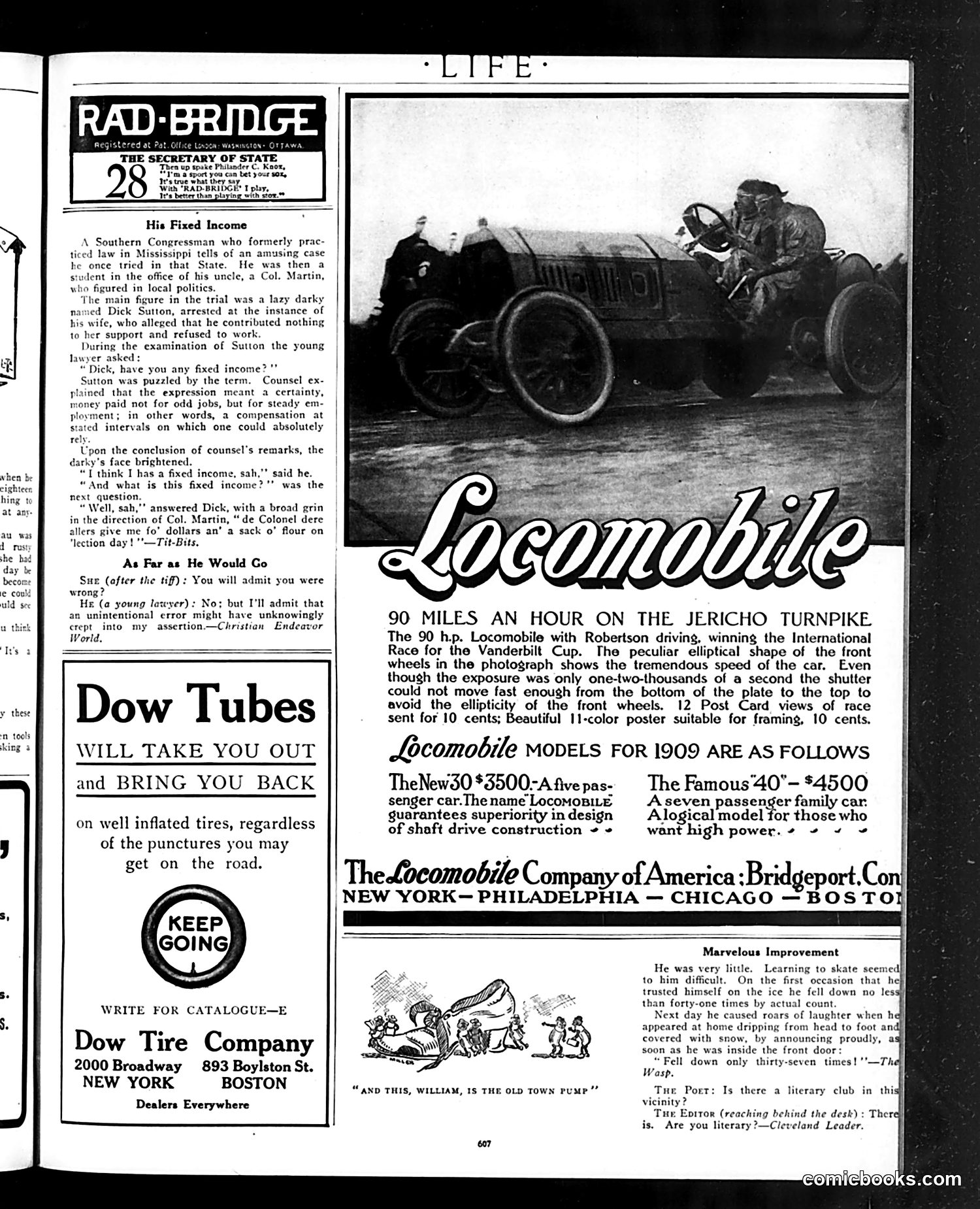
This page is primarily **advertising and entertainment content** rather than political satire. The main visual is a photograph of a Locomobile automobile racing at 90 mph on the Jericho Turnpike, with accompanying advertisements for the vehicle and Dow Tubes tires. The left column contains a humorous anecdote titled "His Fixed Income" about a Southern congressman and a character named Dick Sutton being questioned about "fixed income" in a courtroom—a joke playing on the term's ambiguity between steady financial support and fixed/predictable circumstances. The page also includes a small domestic humor illustration about a child learning to ice skate. The content reflects early 1900s American popular culture: automobiles as exciting technology, legal humor, and family entertainment.
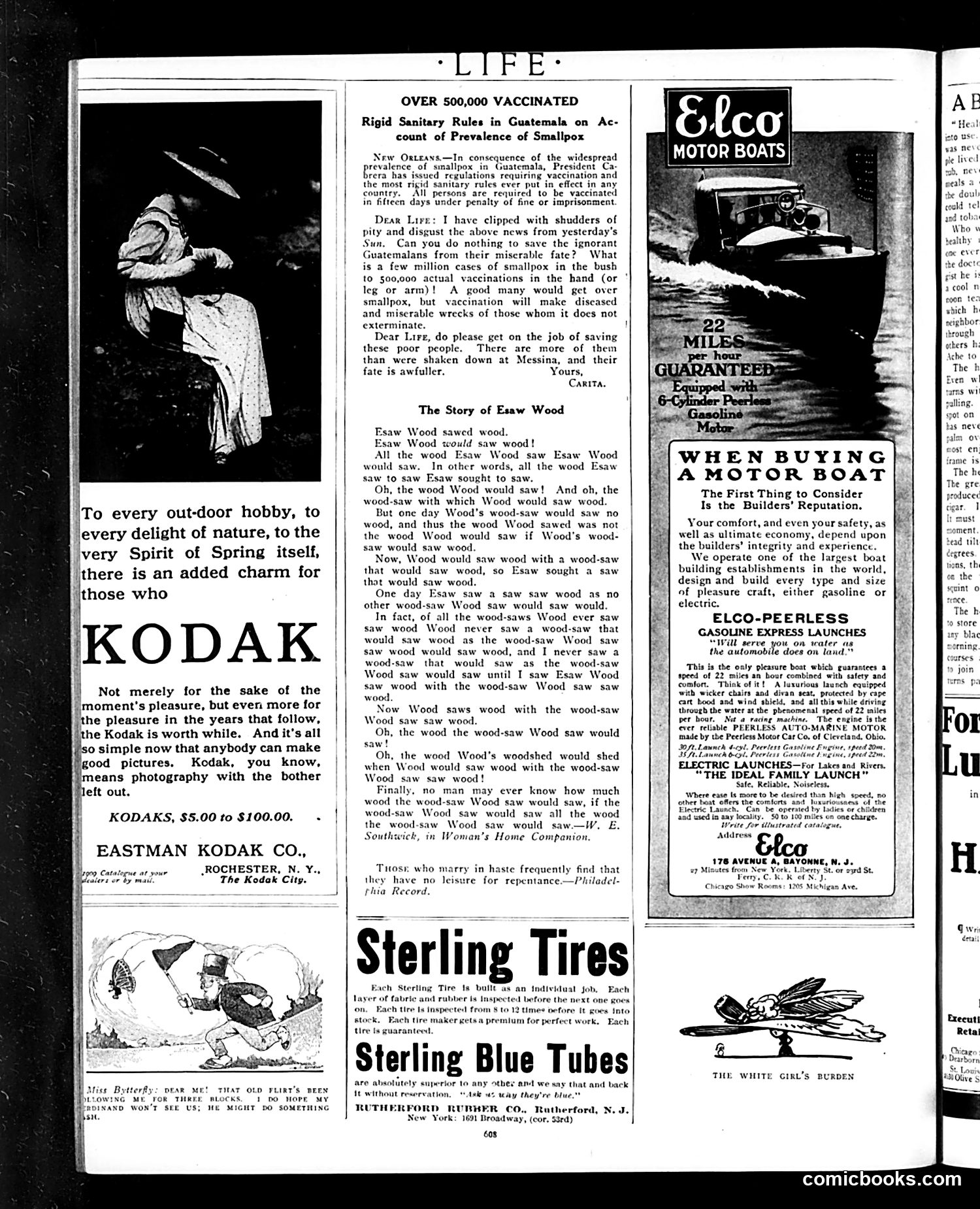
This page is primarily **advertising and light humor**, not political satire. The main left-side illustration shows a woman in period dress (appears to be early 1900s) holding a camera, advertising **Kodak cameras** ($5-$100). The text emphasizes photography's appeal to outdoor enthusiasts and nature lovers—a lifestyle marketing pitch. Below is a cartoon captioned "Jim Bristled: 'Dear Old Hunting Me for Three Blocks. I do hope we See Us; He might do Something'" showing a hunter in an awkward situation, illustrating amateur photography mishaps. The remaining content includes advertisements for **Elco Motor Boats**, **Sterling Tires**, and **Sterling Blue Tubes**, plus a humorous piece titled "The Story of Esaw Wood"—a tongue-twister about a woodsman. The page reflects early-1900s consumer culture and leisure activities, with minimal political content.
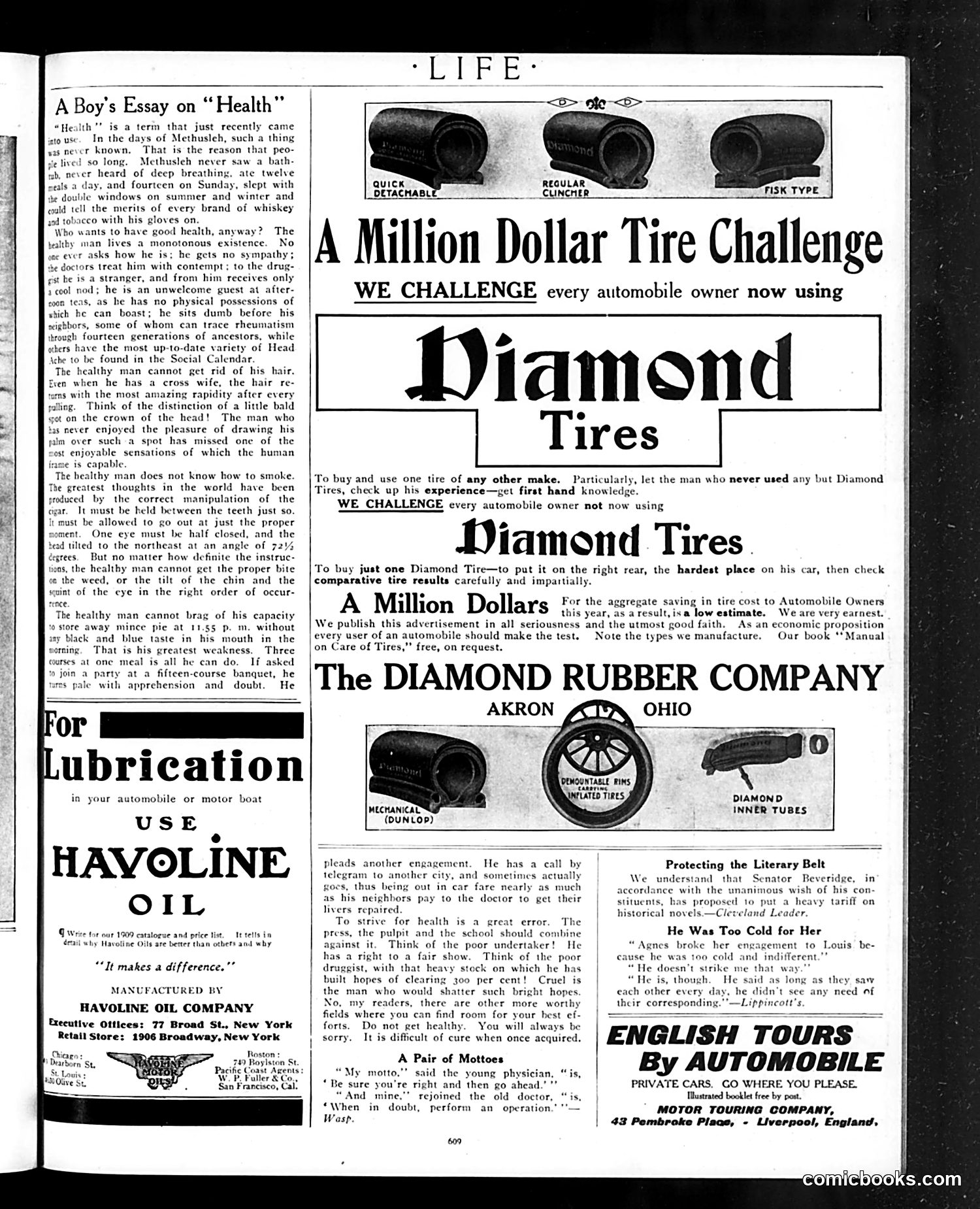
This page is primarily **advertising**, not editorial satire. The dominant feature is a full-page Diamond Rubber Company advertisement for tires, featuring a "Million Dollar Tire Challenge" that dares automobile owners to test Diamond tires against competitors. The page also includes: - A boy's essay on "Health" (left column) — appears to be genuine reader-submitted content, not satire - Advertisements for Havoline Oil and English Tours by Automobile - A brief humorous anecdote titled "A Pair of Mottos" about a young physician and old doctor The Diamond Tire ad is the only content with persuasive intensity, but it's straightforward commercial messaging rather than political or social commentary. There are no identifiable political figures or satirical cartoons on this page.
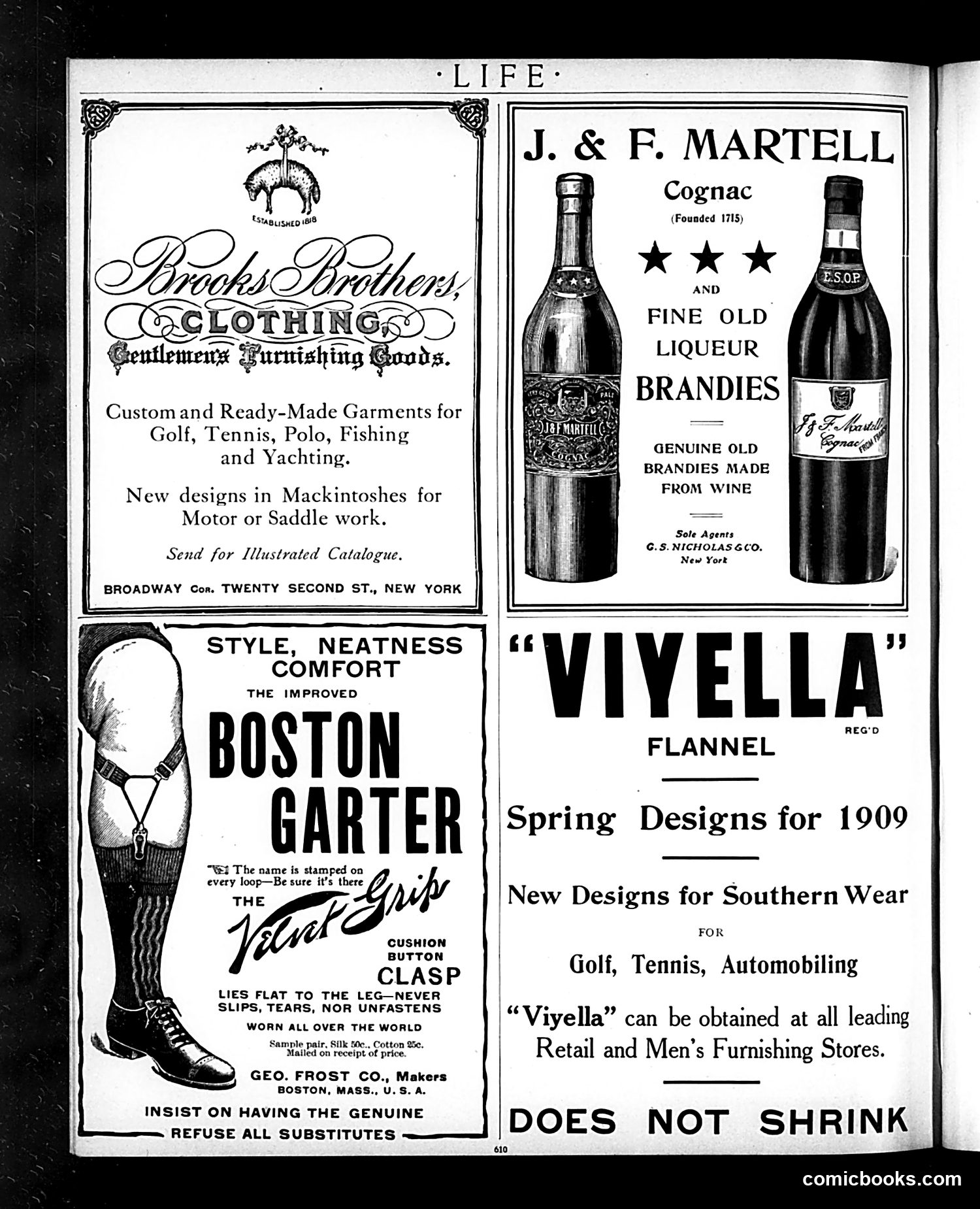
This is **not a cartoon or satirical content page** — it's a page of vintage advertisements from Life magazine, likely from around 1909 based on the "Viyella" ad's date reference. The ads include: - **Brooks Brothers** clothing for gentlemen's sports and fashion - **J. & F. Martell** cognac and brandies (with two bottle illustrations) - **Boston Garter** for men (emphasizing it "lies flat to the leg") - **Viyella Flannel** fabric for spring wear, golf, and tennis These are straightforward commercial advertisements targeting affluent male consumers interested in quality clothing, spirits, and sporting wear. There is no political satire or social commentary present — just period marketing for luxury goods and accessories.
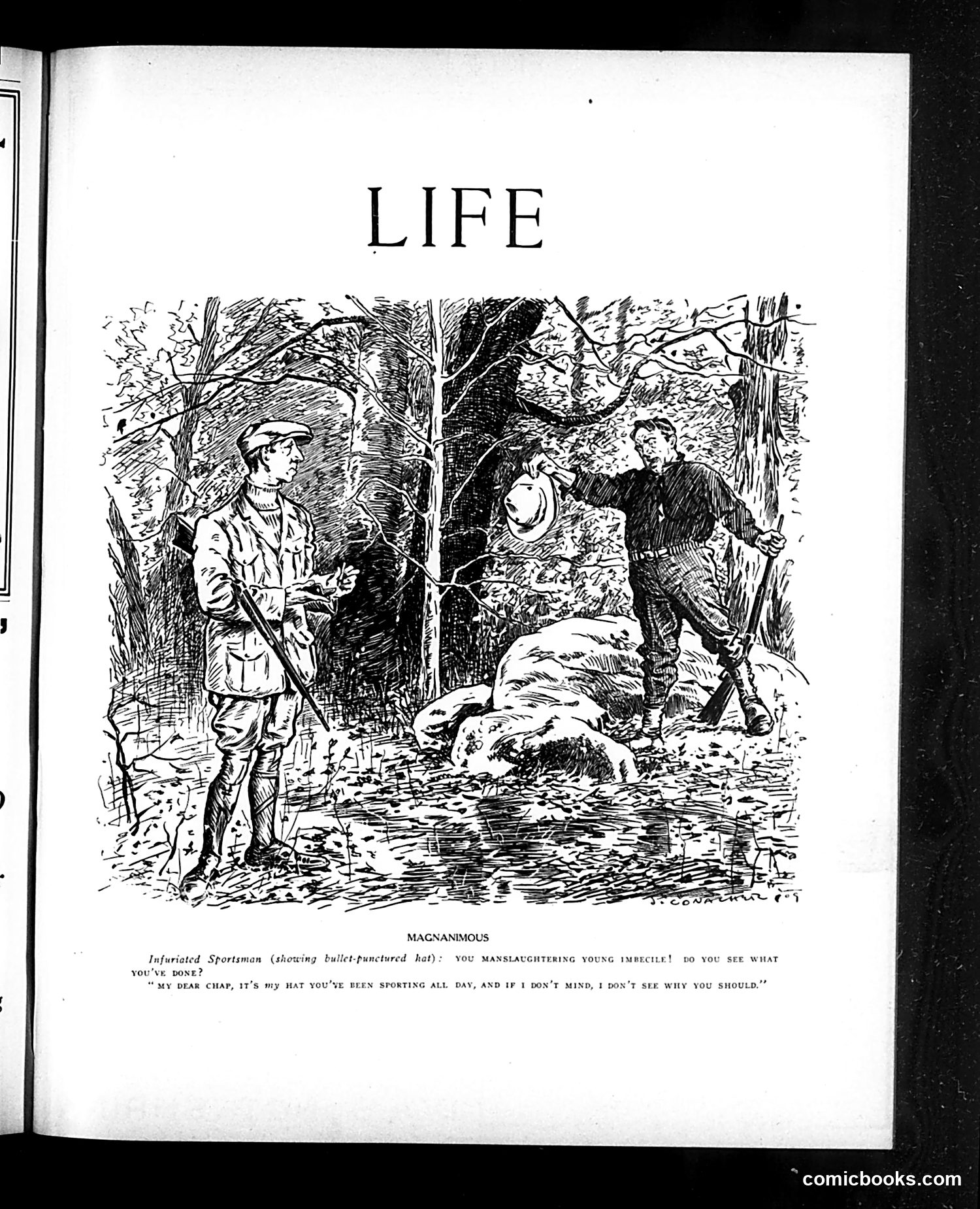
This cartoon depicts an **infuriated sportsman** with a bullet-punctured hat confronting two other men in a wooded setting. The caption indicates the sportsman has been "sporting all day" and is now angrily accusing the others of recklessness, saying his hat has been shot through. The satire targets **careless hunters** who endanger others in the field. The sportsman's rage contrasts with his claim to be "magnanimous" (generous/forgiving)—he's doing anything but. The joke plays on the gap between what hunters claim about their civility and their actual dangerous behavior. This reflects turn-of-century concerns about hunting safety and the conduct of sportsmen in American forests.
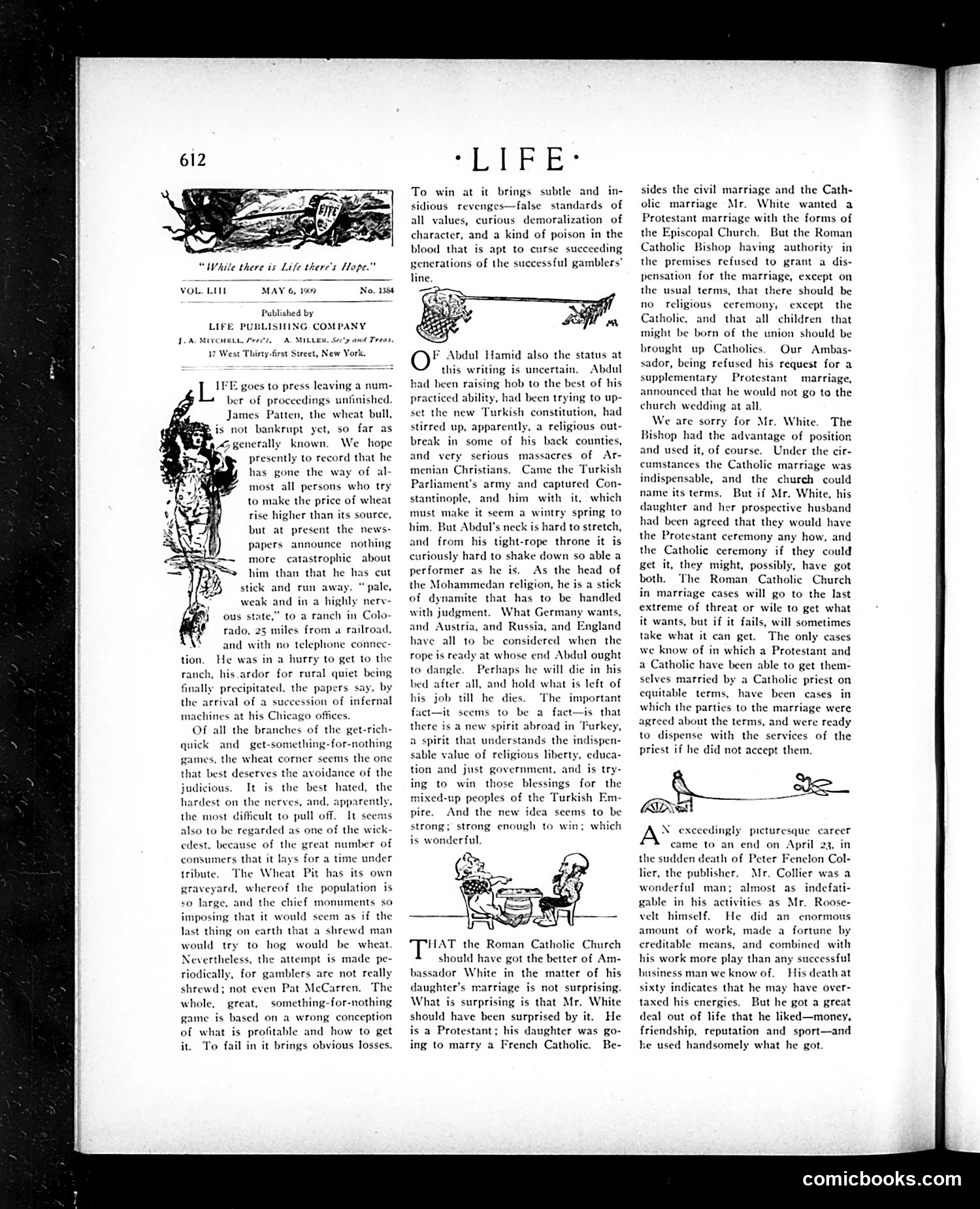
This page contains two distinct articles. The main piece discusses Turkish politics under Abdul Hamid (the Ottoman Sultan), satirizing his precarious political position—he's described as difficult to control and facing pressure from multiple powers (Germany, Austria, Russia, England). The cartoon accompanying this shows a figure in distress, likely representing Abdul Hamid navigating these international pressures. The second article concerns Ambassador White's daughter's interfaith marriage—a Protestant marrying a French Catholic. The satirical point critiques White's surprise at the situation, noting that as a Protestant diplomat, he should have anticipated complications with Catholic marriage requirements and the church's authority over such unions. The satire mocks both religious rigidity and diplomatic naïveté.
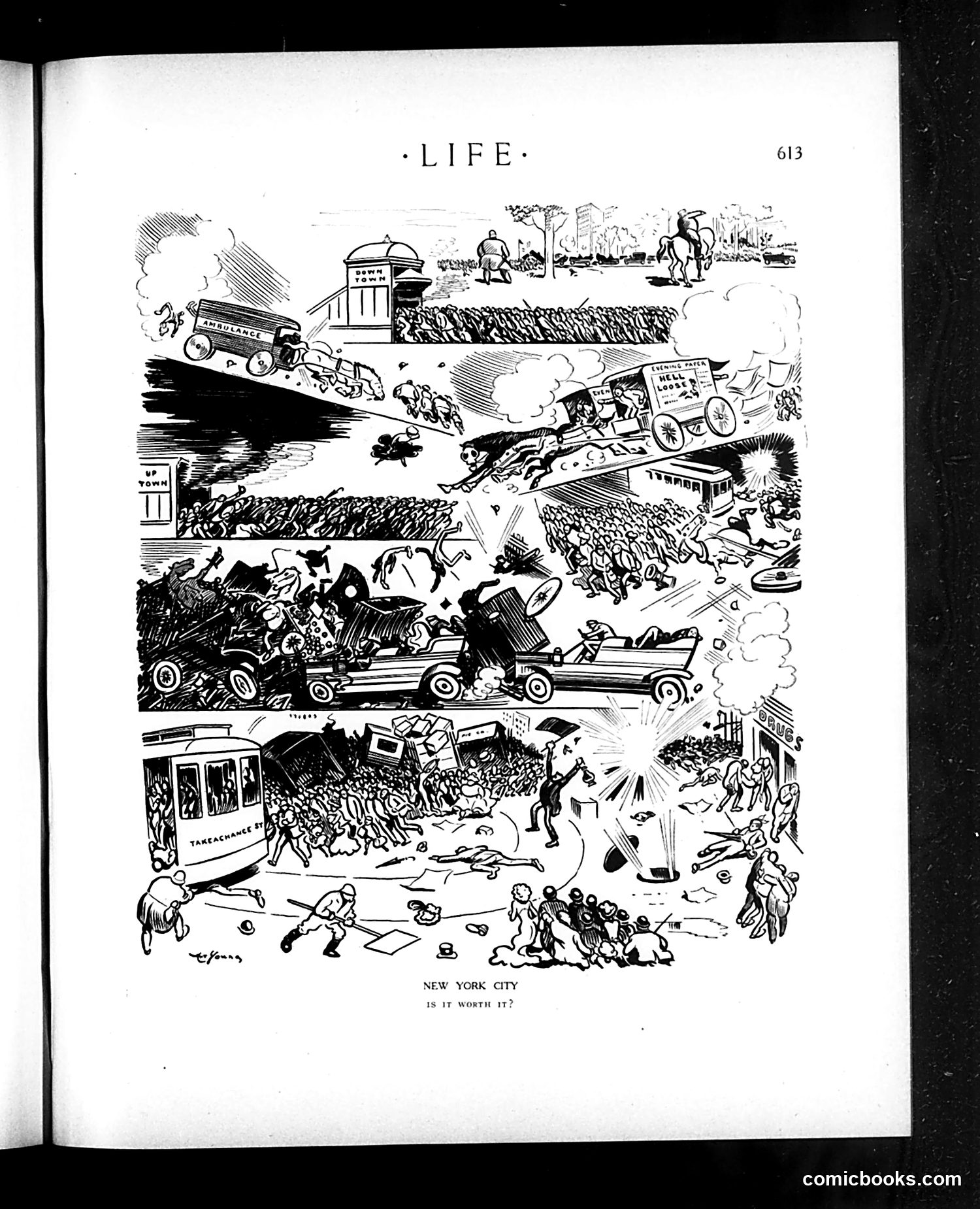
This is a satirical cartoon titled "NEW YORK CITY: IS IT WORTH IT?" depicting urban chaos and overcrowding in layered scenes from top to bottom. The cartoon shows the progression of city life: pastoral farmland at the top transitions to increasingly congested and chaotic urban scenes—packed streets, colliding automobiles, a streetcar labeled "TAMMANY" (referencing the corrupt political machine), and masses of people in disarray at ground level. The satire critiques whether the densely packed, accident-prone, politically corrupt conditions of New York City justify living there. The "Tammany" reference specifically targets the Democratic political organization notorious for corruption. The visual stacking emphasizes how urban development and congestion have replaced natural space, questioning the quality of life urban residents accept.
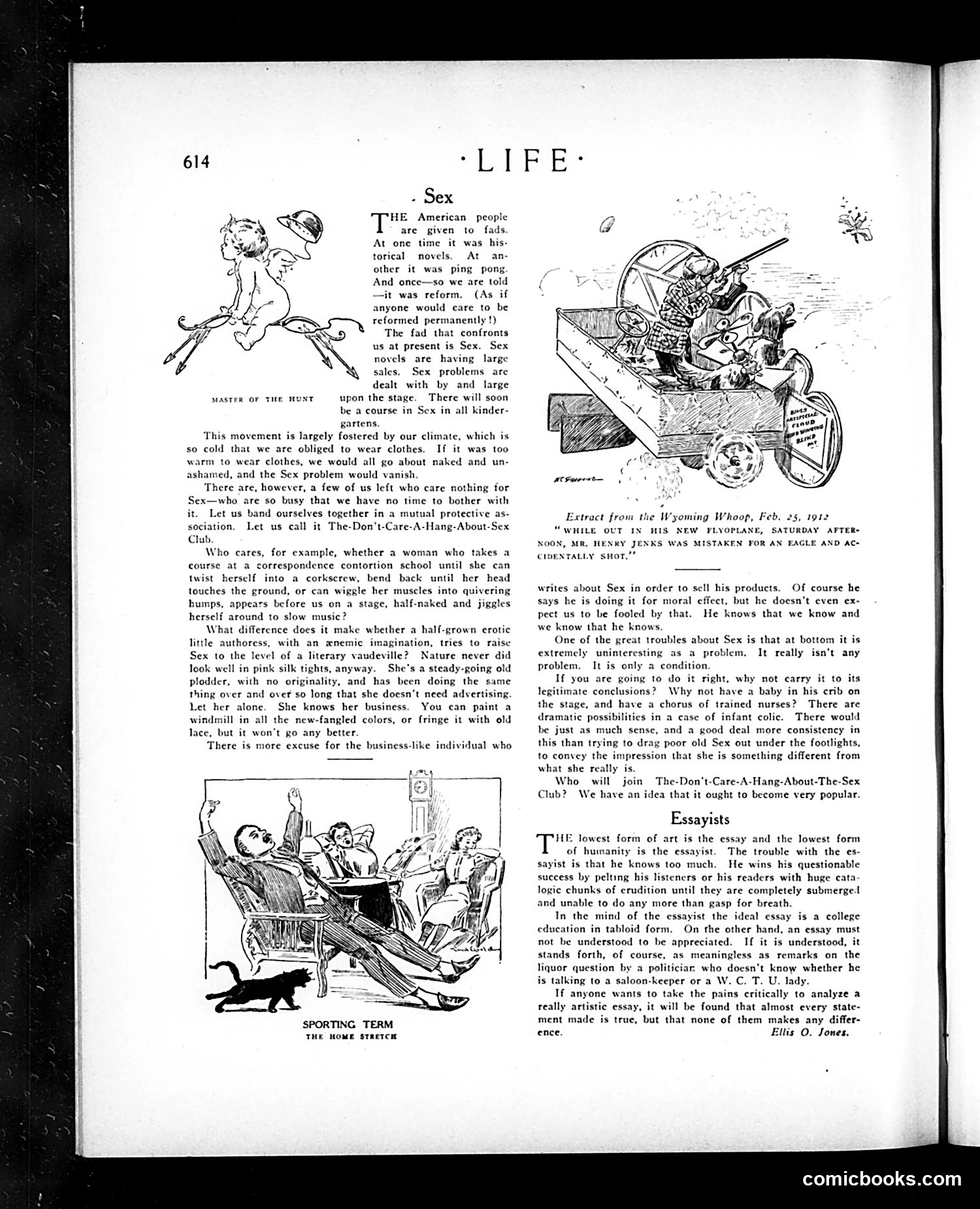
This page contains two satirical essays mocking contemporary American fads and cultural trends, circa 1912. **"Sex"** ridicules the era's obsession with sex as entertainment and literary subject matter. The author proposes a "Don't-Care-A-Hang-About-Sex Club" for those uninterested in the trend. He sarcastically critiques sex novels, stage performances, and "erotic little authoresses" (female writers), arguing that nature and human sexuality don't need artificial embellishment or marketing. The accompanying illustrations—"Masters of the Hunt" and "Sporting Term: The Home Stretch"—are crude visual puns about the subject. **"Essayists"** attacks essay-writers as pretentious know-it-alls who overwhelm readers with "huge catalogs of erudition" rather than producing clear, meaningful work. Both pieces exemplify Life's satirical house style: attacking intellectual and cultural pretension through exaggerated mockery and ironic praise of the opposite position.
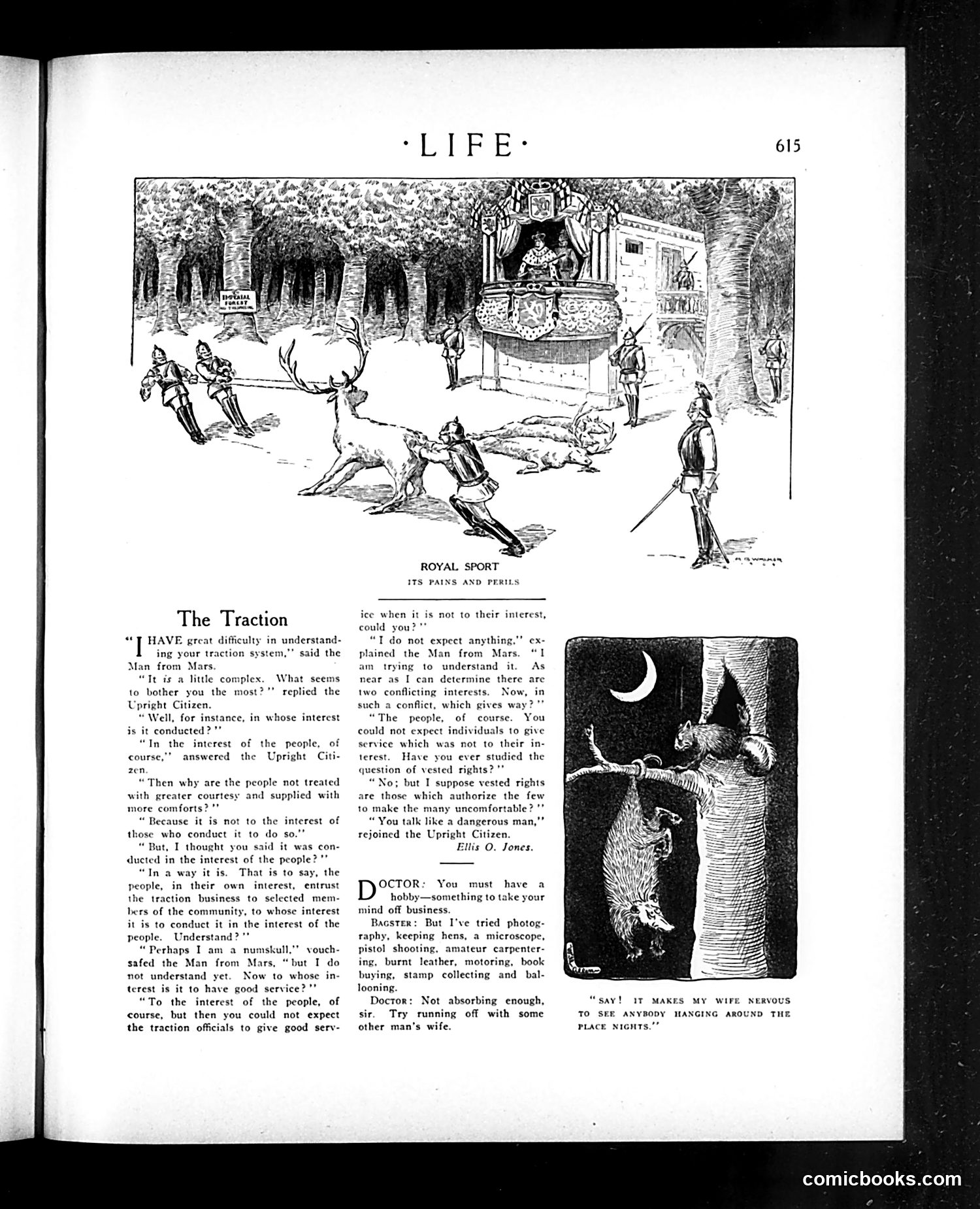
This dialogue satirizes the contradictions of early 20th-century American streetcar (traction) systems. A visitor from Mars exposes the logical absurdity: transit companies claim to serve "the people's interest" while actually prioritizing their own profits, resulting in poor service and discomfort for passengers. The satire works by having an "Upright Citizen" defend this circular reasoning—that officials needn't provide good service because it's not *their* financial interest to do so, yet they operate "in the public interest." The Man from Mars's naive questions reveal the hypocrisy: if service conflicts with company profits, the public loses. The secondary comic exchange about hobbies is unrelated wordplay on infidelity as a distraction from work stress. This reflects real Progressive Era criticism of utility monopolies and corruption in municipal transit systems.
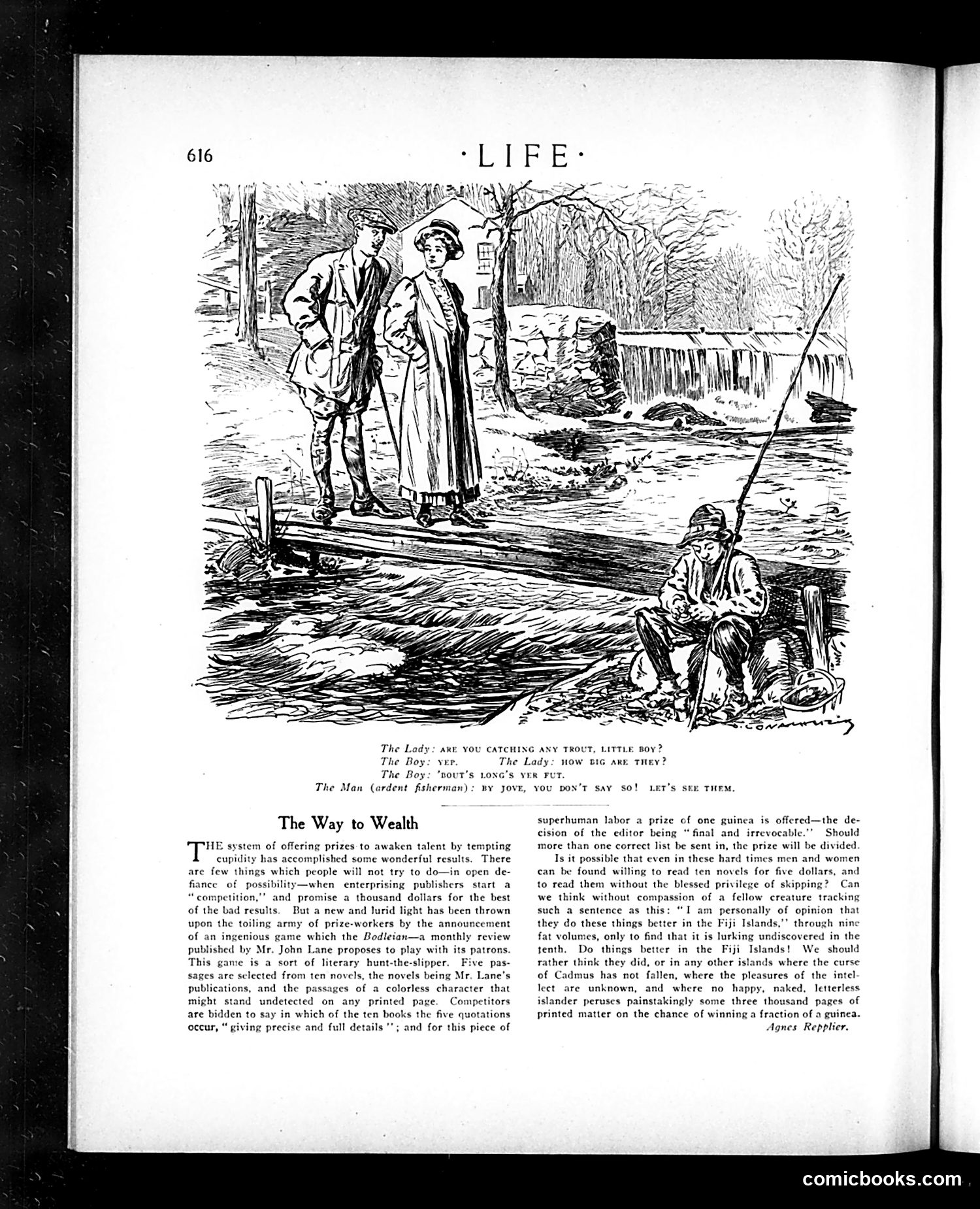
The cartoon depicts a fishing scene where a well-dressed couple encounters a boy who claims to have caught trout "about's long's yer fut" (about a foot long). An excited gentleman fisherman wants to see them. The humor appears to rest on the boy's exaggeration or deception about his catch. The accompanying essay, "The Way to Wealth," satirizes a literary competition by *The Bodleian* magazine. Publisher John Lane offered one guinea (minimal pay) for competitors to identify which of ten novels contained five specific passages. Essayist Agnes Repplier mocks the absurdity: readers would labor through thousands of pages of tedious prose for trivial reward, searching for unremarkable sentences like "I am personally of opinion that they do these things better in the Fiji Islands." The satire targets both exploitative publishing practices and the desperation of writers and readers willing to endure such pointless work for pittance—linking the cartoon's theme of exaggeration to the essay's critique of false promises of easy money.
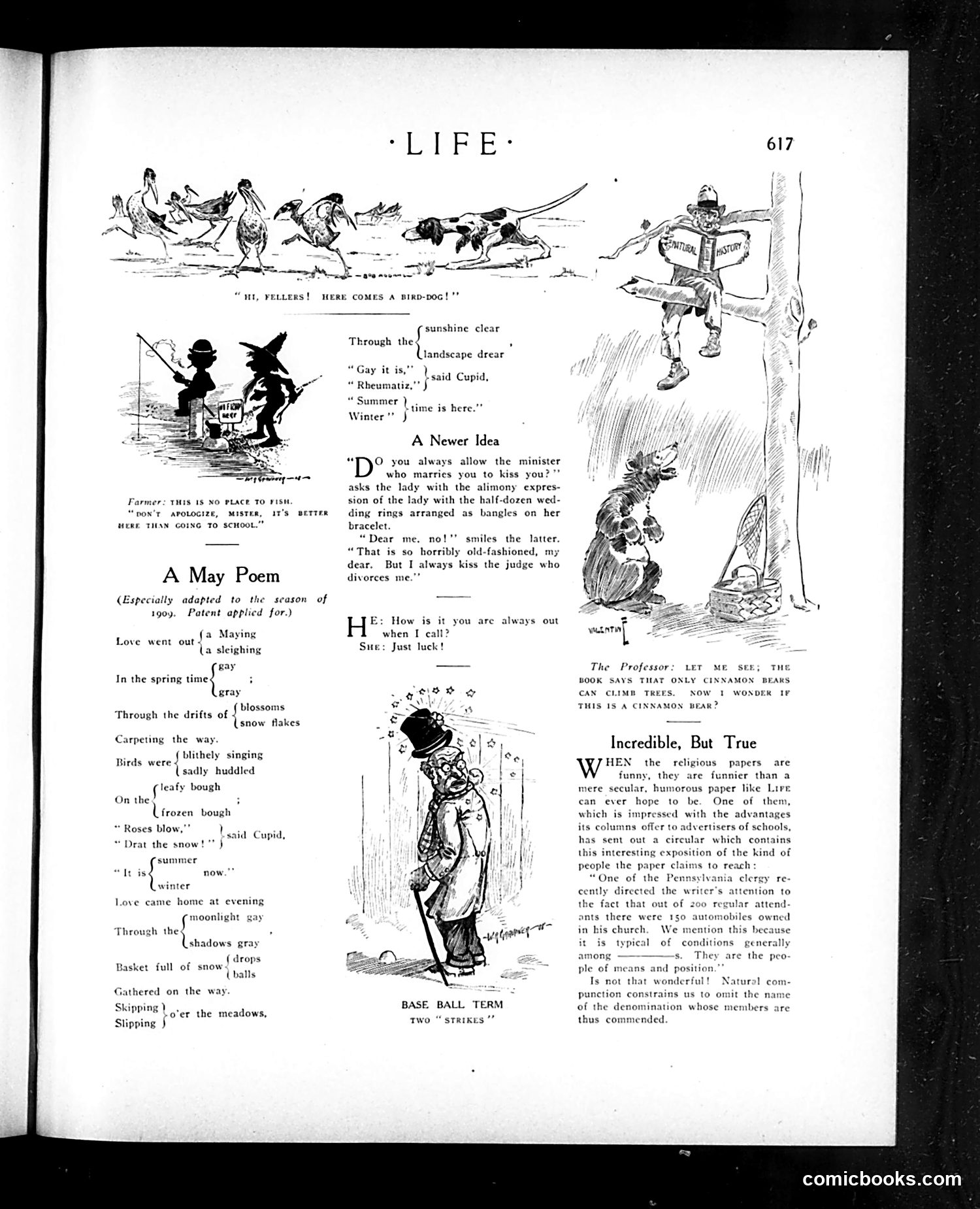
This page contains several satirical pieces typical of early 1900s American humor: **"A Newer Idea"**: Satirizes divorce culture. A woman with multiple wedding rings (suggesting serial marriages) reveals she no longer allows the minister to kiss her at weddings—instead, she kisses "the judge who divorces me." This mocks the apparent frequency of divorce among certain social circles and suggests cynicism about marriage. **"A May Poem"**: A parody of romantic spring poetry, contrasting love's hopeful beginning ("sleighing," "gay") with its disappointing reality (winter, snow, "drat the snow"). The format mimics sentimental verse while undercutting it. **"Incredible, But True"**: Mocks religious publications' tendency to boast about their moral influence. It reports absurdly that a Pennsylvania church had 150 automobiles among regular attendants—presented as evidence of virtue, though the satire suggests this actually reveals materialism and vanity among the supposedly pious. The cartoons feature various vignettes poking fun at contemporary social pretensions, romantic disappointments, and religious hypocrisy.
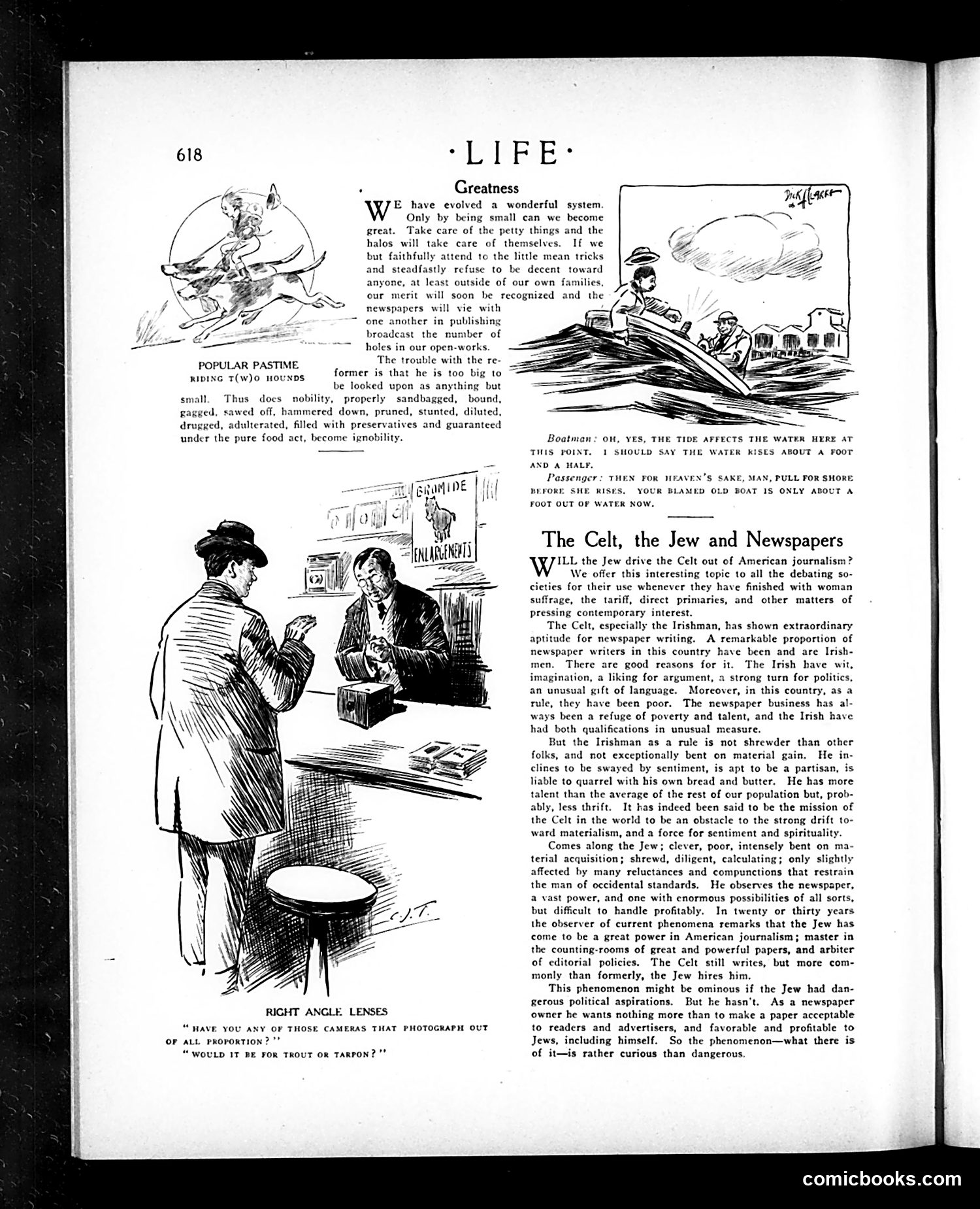
This page contains multiple satirical pieces reflecting early 20th-century American attitudes: **"Greatness"** (top left): A cynical commentary on small-mindedness masquerading as virtue—the satire suggests that neglecting basic decency while focusing on trivial matters will earn newspaper recognition and public merit. **Boatman/Passenger cartoon** (top right): A joke about misunderstanding tidal mechanics. The passenger, panicked that rising tide will sink the boat, doesn't grasp that the boat rises *with* the water. **"The Celt, the Jew and Newspapers"** (main article): This discusses Irish and Jewish influence in American journalism. It characterizes Irish newspaper writers as talented but sentimental and poor, while Jews are portrayed as shrewd, calculating, and materialistic—yet ultimately harmless because they seek only profit, not political power. The piece frames this as "curious rather than dangerous," revealing the era's ethnic stereotyping while attempting to reassure readers about Jewish economic influence. The lower cartoon shows a photographer discussing distorting lenses, likely commenting on exaggeration in reporting.
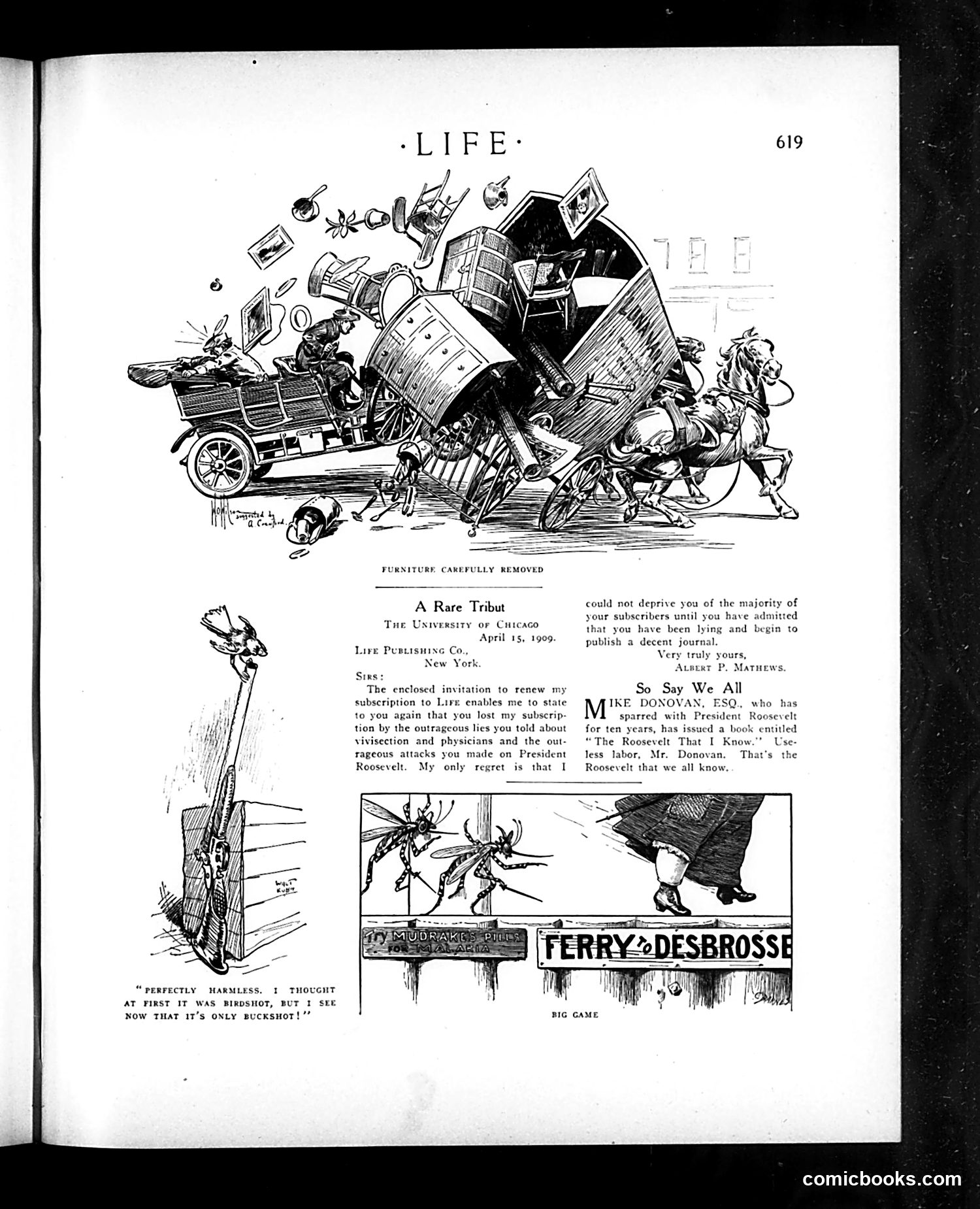
The top cartoon satirizes moving day chaos—furniture literally flies through the air as horses pull an overloaded cart. The caption "Furniture Carefully Removed" is ironic; nothing appears careful about this disaster. This appears to be generic slapstick humor rather than political commentary. Below are reader letters criticizing *Life* magazine itself. A University of Chicago subscriber accuses the publication of spreading "outrageous lies" about vivisection (animal testing) and attacking President Roosevelt. Another notes that Mike Donovan, who has "sparred with President Roosevelt for ten years," published a book about him—implying Donovan's perspective is predictable or irrelevant since readers already know Roosevelt. The "Big Game" cartoon at bottom appears to reference hunting, with the caption's joke about buckshot versus birdshot suggesting confusion about what ammunition one is actually being shot with—likely mocking someone's poor judgment. The page reveals *Life* as a publication willing to publish criticism of itself while maintaining satirical commentary on contemporary figures, particularly President Roosevelt.
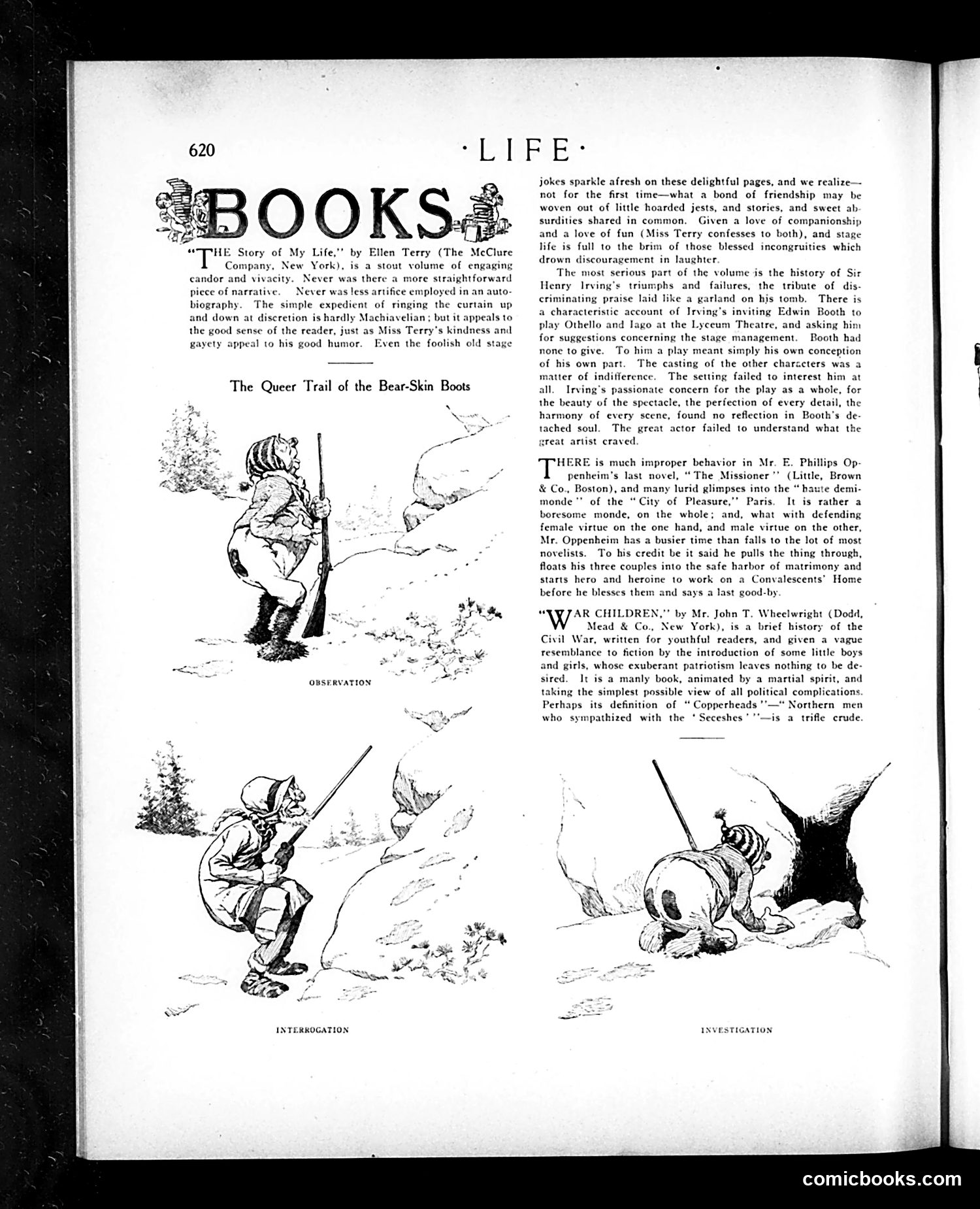
This page reviews three books but features three humorous illustrations labeled "Observation," "Interrogation," and "Investigation." The cartoons depict a child in bear-skin boots encountering a bear in progressively comedic scenarios—first spotting it, then questioning/confronting it, finally investigating its den. The satire likely plays on the book's title itself: a child's foolish adventures in impractical footwear. The three-panel progression humorously illustrates the escalating consequences of poor judgment, paralleling how the reviewed books (particularly the children's Civil War history) treat their subjects with varying degrees of sophistication. The "Copperheads" reference in the text notes the children's book oversimplifies Civil War politics with crude definitions. The cartoons similarly mock simplistic approaches to complex situations—a child in bear boots encountering actual bears.
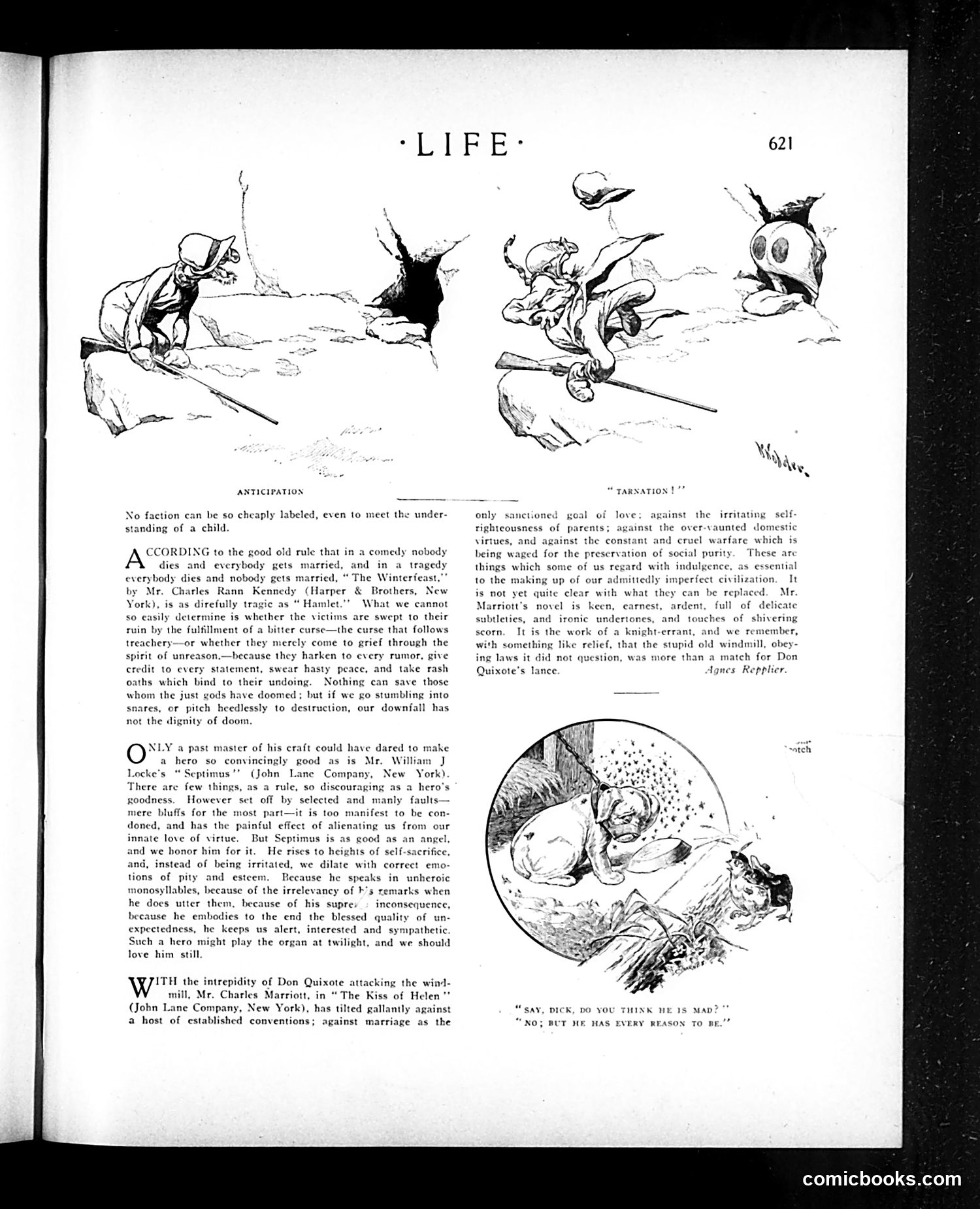
This page reviews three novels with accompanying satirical cartoons. The top illustration depicts characters in comedic distress—appearing to represent themes of fate and foolish decision-making discussed in the review of "The Winterfeast" by Charles Rann Kennedy. The middle section reviews William J. Locke's "Septimus," praising its unusually compelling hero whose virtue doesn't alienate readers because he speaks in "unheroic monosyllables" and maintains blessed unpredictability. The bottom review covers Charles Marriott's "The Kiss of Helen," which challenges social conventions—particularly marriage as love's only sanctioned goal and parental authority. The accompanying circular illustration shows a character in apparent madness or distress, with the caption "Say, Dick, do you think he is mad?" / "No; but he has every reason to be"—suggesting the novel's critique of restrictive social conventions that drive characters to desperation. The satire targets rigid Victorian morality and social expectations.
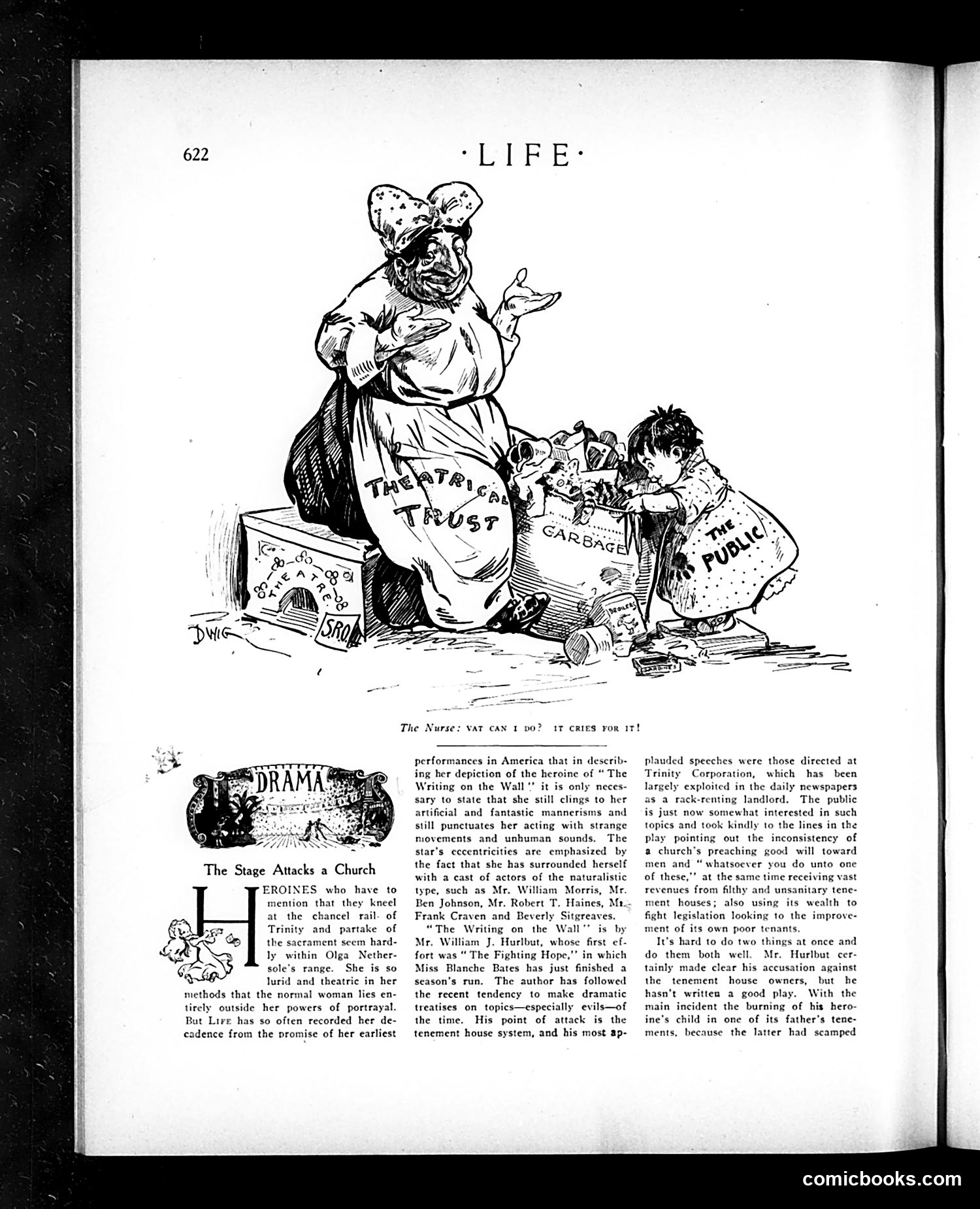
This Life magazine page satirizes actress Olga Nethersole's performance in "The Writing on the Wall," a play attacking Trinity Corporation's ownership of squalid tenement housing in New York City. The main cartoon depicts a corpulent figure labeled "The Patriarchal Trust" surrounded by garbage and a child labeled "The Public." The satire targets the hypocrisy of Trinity Church: it preaches Christian charity ("whatsoever you do unto one of these") while profiting from filthy, unsafe tenements that endanger poor families—literally represented by the garbage and suffering child. The text criticizes both Nethersole's overwrought acting style and praises the play's social message about tenement reform, though faults its dramatic execution. The cartoon and article together illustrate Progressive Era concerns about wealthy institutions exploiting the poor, using the church's moral contradiction as the central point of attack.
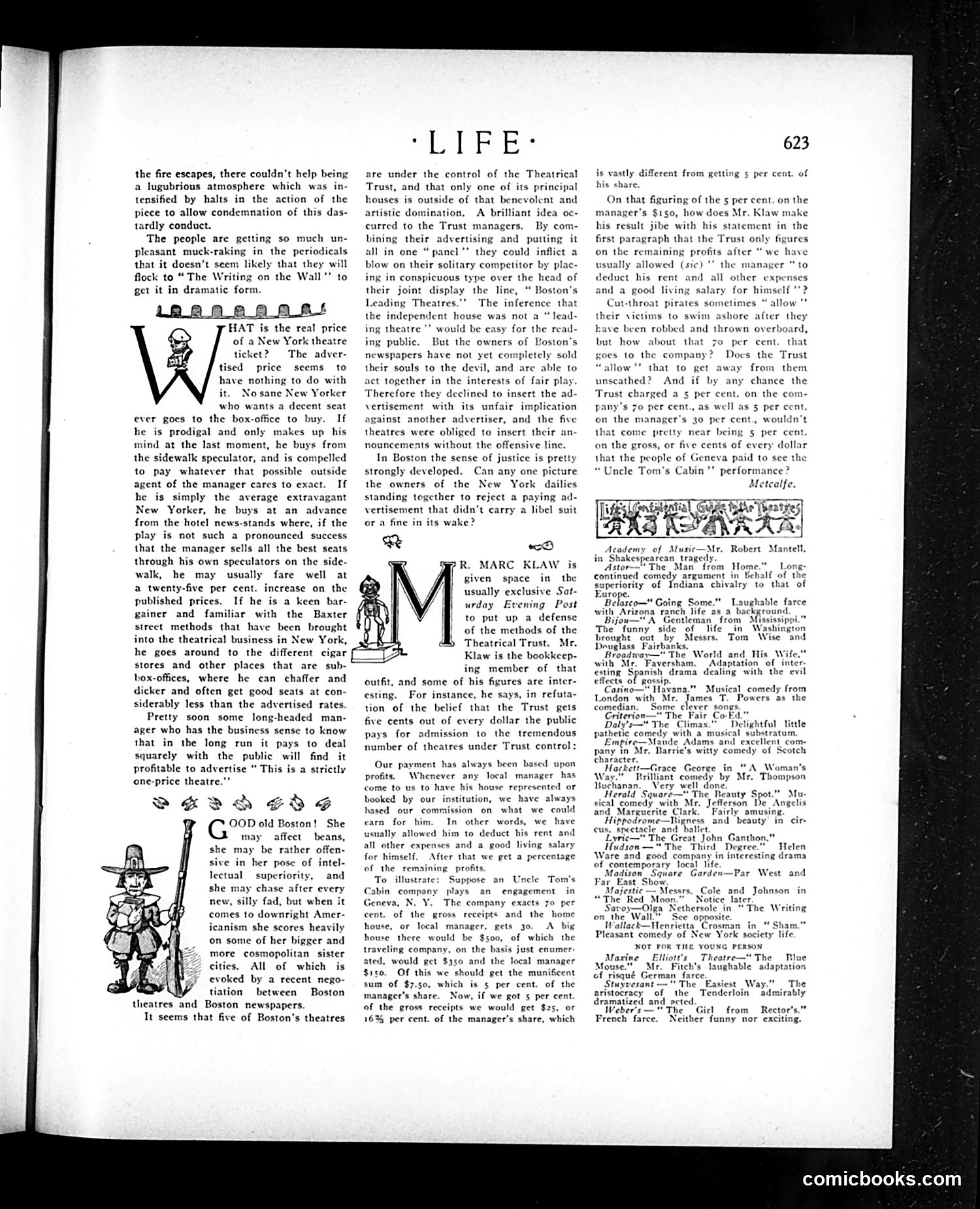
This page from *Life* magazine satirizes theatrical monopolies and corrupt New York business practices around 1900-1910. **The Main Articles:** The top section mocks New York theater ticket scalping—how advertised prices mean nothing because managers collude with sidewalk speculators and hotel news-stands to mark up tickets 25% or more. The author calls for "one-price theater" honesty. The lower section praises Boston for business ethics: five Trust-controlled theaters tried to advertise together with a line calling themselves "Boston's Leading Theatres" (implying the one independent house wasn't leading). Boston newspapers *refused* this unfair ad. The satirist contrasts this with corrupt New York newspapers, which would accept any paying advertisement regardless of deceptive implications. **The Satire:** Life is praising Boston's moral superiority while mocking New York's shameless profit-over-principle approach. The Theatrical Trust (a real monopoly controlling most American theaters) and complicit newspapers exemplify Gilded Age corruption—unfair competition disguised as normal business.
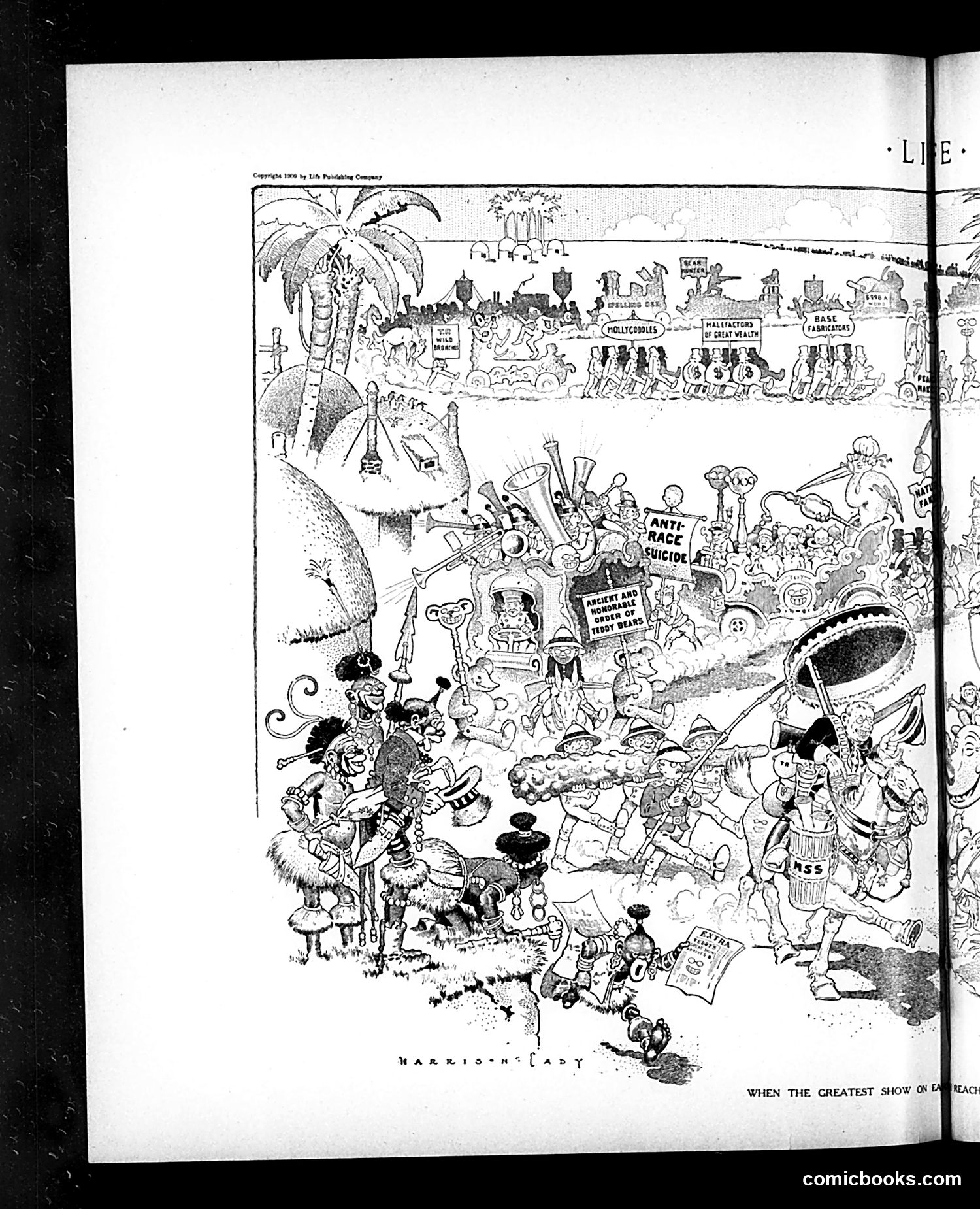
This appears to be a satirical cartoon depicting a chaotic carnival or circus scene labeled "Harrison's Lady" at the bottom. The illustration is crowded with exaggerated caricatured figures engaged in various absurd activities. Visible signs reference "Anti-Race Suicide" and what appears to be social commentary on contemporary issues. The scene suggests political or social disorder presented as entertainment—a "greatest show on earth" metaphor for American politics or society. The dense, frenzied composition with numerous labeled vignettes is typical of Life magazine's style for depicting multiple social problems or political controversies simultaneously as interconnected chaos. However, without clearer text or additional context about the specific date and Harrison reference, the precise political targets remain unclear.
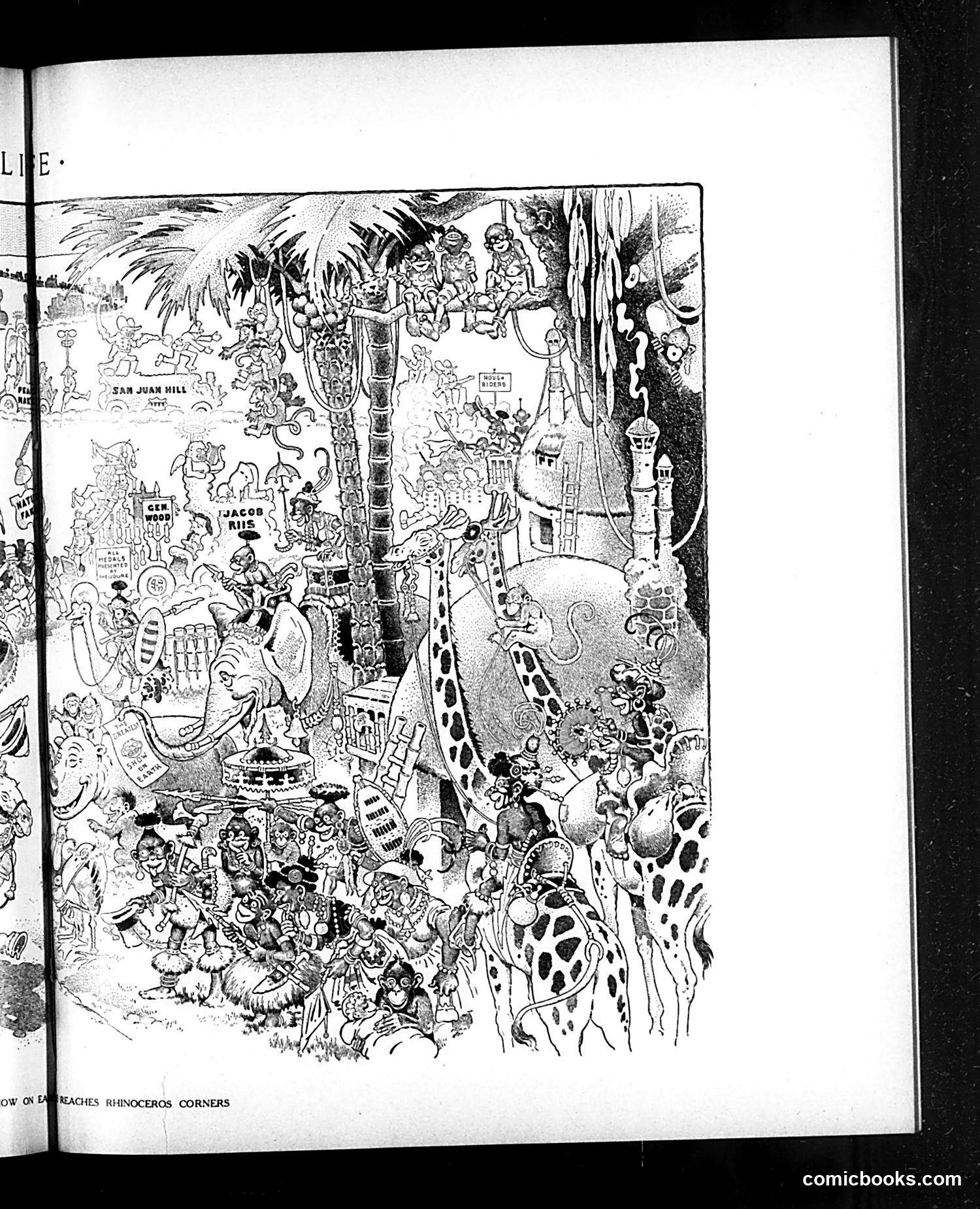
This appears to be a whimsical, densely-packed cartoon illustration rather than political satire. The image shows an elaborate fantasy landscape featuring: - Large rhinoceros figures with spotted patterns on the right side - A tall central structure (possibly a tower or castle) with palm trees - Numerous small figures engaged in various activities throughout - Text labels visible including "San Juan Hill," "Jacob's Hill," and "Ger. Hill" The title "Reaches Rhinoceros Corners" suggests this depicts an imaginative, crowded scene—possibly satirizing a particular location or social gathering. However, without clearer labeling or historical context beyond the visible text, the specific satirical targets remain **unclear**. The style suggests early-to-mid 20th century humor magazine illustration, but the exact social or political commentary is difficult to determine from the image alone.
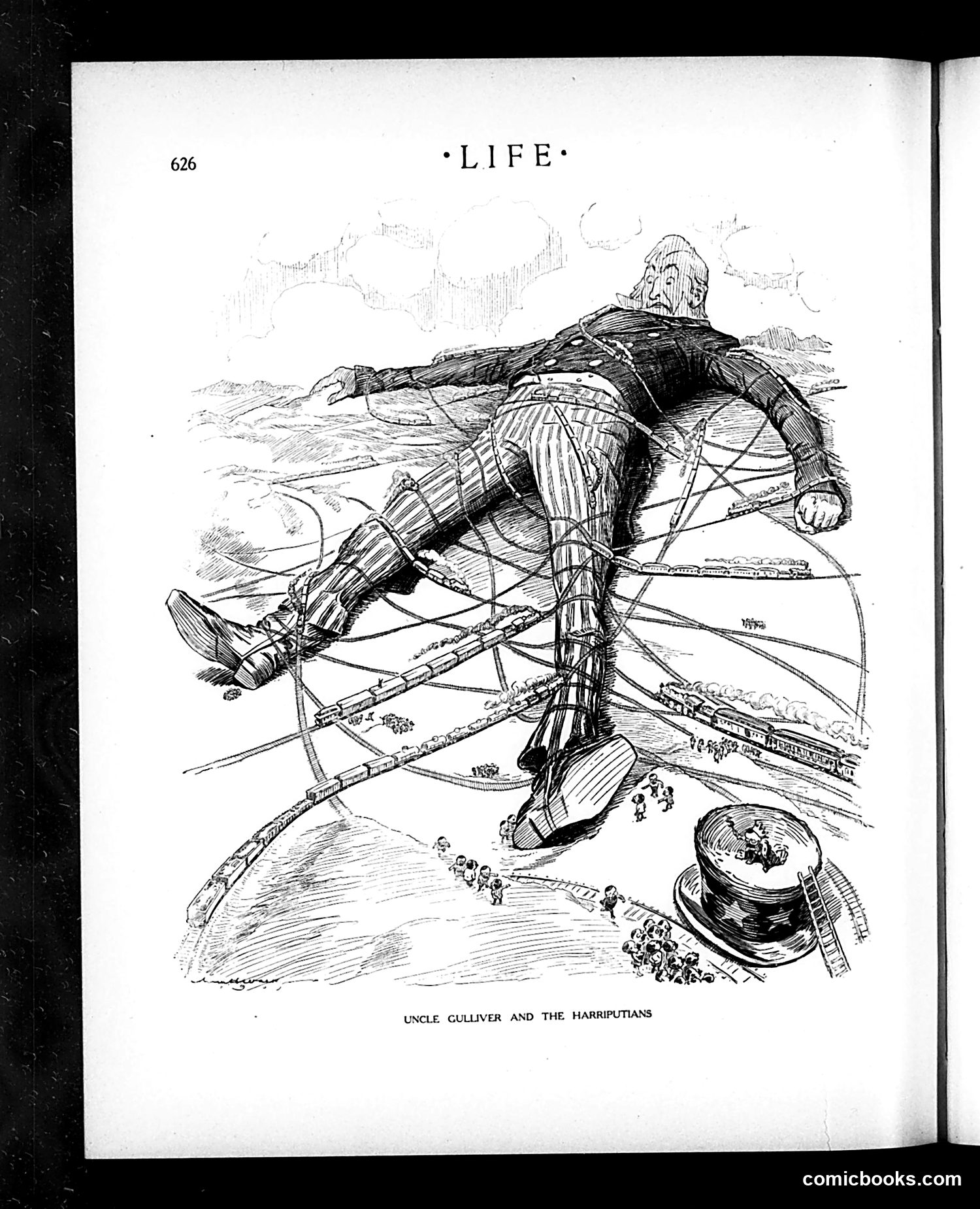
This is a satirical illustration referencing Jonathan Swift's *Gulliver's Travels*. The giant figure labeled "Uncle Gulliver" appears to be bound by numerous ropes held by tiny figures (the "Harliputians"—a play on "Lilliputians"), who swarm around his feet and over his body. The cartoon likely satirizes American political or social constraints of the era. The imagery suggests a powerful figure (possibly representing America or a political leader) being restrained or controlled by numerous smaller forces—whether depicted as politicians, special interests, or bureaucratic entanglements. The visual metaphor emphasizes how collective small obstacles can immobilize even a giant. Without additional context about *Life* magazine's publication date, the precise identity of "Uncle Gulliver" and specific historical events referenced remain unclear, though the Swiftian allegory was a common satirical device for political commentary.
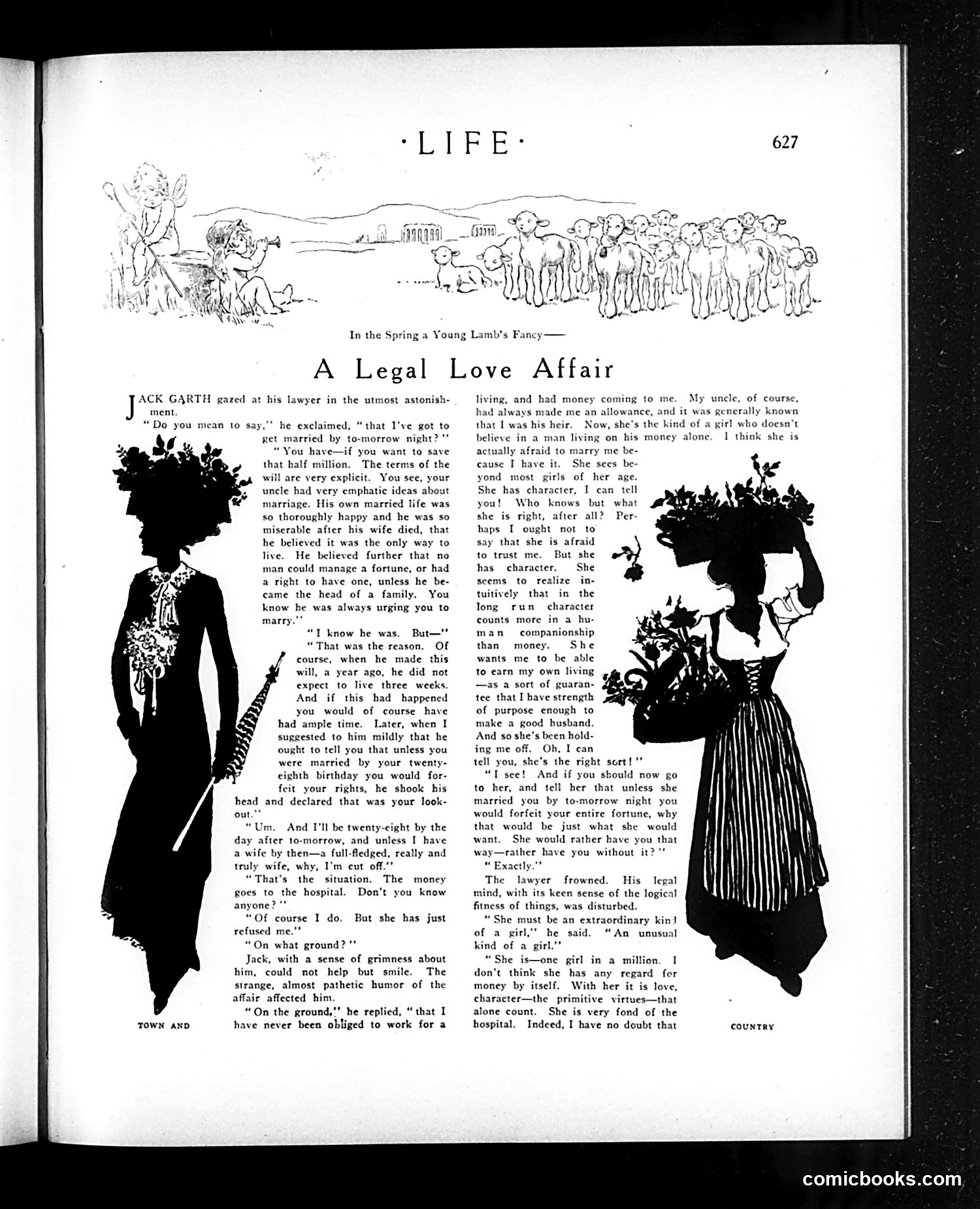
This is a serialized short story, not a political cartoon. It depicts a romantic comedy premise popular in early 20th-century magazines. **The Setup:** Jack Garth learns from his lawyer that his uncle's will requires him to marry by tomorrow (his 28th birthday) to inherit half a million dollars. Otherwise, the money goes to a hospital. **The Satire/Social Commentary:** The story mocks wealthy idleness and questions about character. Jack's love interest has already rejected him because she believes he's too dependent on inherited wealth—she wants proof he can work and support himself. The irony: when Jack tells her about the inheritance condition, she'll be pleased because losing the money will prove his worthiness as a husband. **The Point:** This satirizes both the idle rich (Jack) and romantic ideals about money versus character. The humor lies in how the inheritance ultimatum might actually *help* his romantic prospects by forcing the appearance of self-reliance, even if unintentionally. The silhouette illustrations labeled "Town" and "Country" appear decorative rather than satirical.
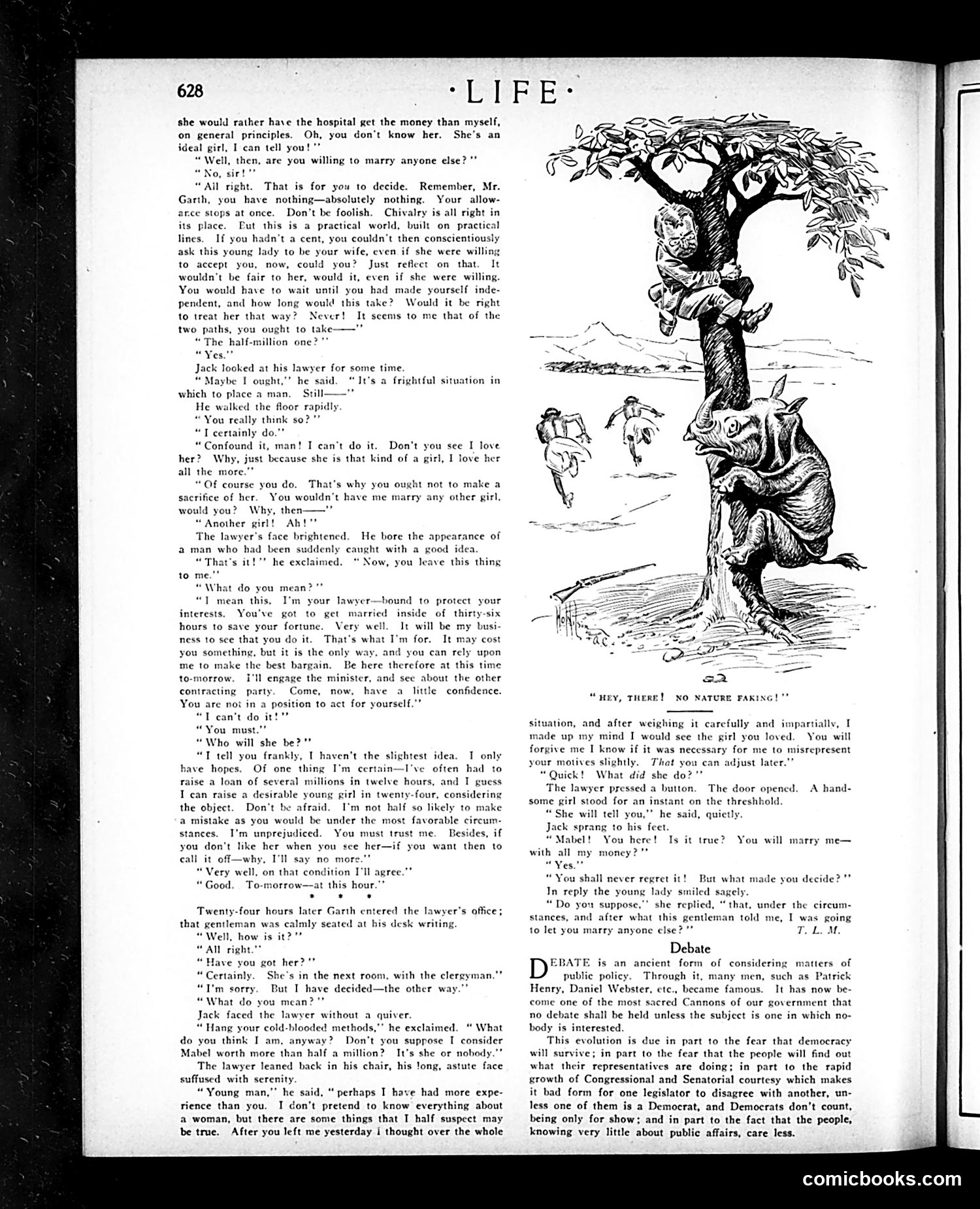
This page depicts a dialogue between a young man (Jack Garth) and his lawyer about a marriage ultimatum. The satire targets **late 19th/early 20th-century attitudes about wealth, love, and practical marriage**. The joke: Jack's father has cut off his allowance unless he marries within 36 hours. The lawyer cynically proposes to *arrange a marriage to any suitable girl*—treating matrimony as a mere business transaction. Jack initially refuses on romantic grounds, insisting he loves a particular woman. The satire's point appears to be **mockery of how the wealthy approached marriage as financial negotiation rather than love**. The lawyer's attitude—that he can "raise a desirable young girl in twenty-four" hours like securing a loan—reduces women to commodities and exposes the mercenary logic underlying supposedly respectable society marriages. The accompanying illustration shows figures in a pastoral setting, likely contrasting innocent romance with the cynical legal/financial machinery discussed in the text. The section titled "Debate" below discusses democracy and legislative disagreement—unrelated to the main narrative.
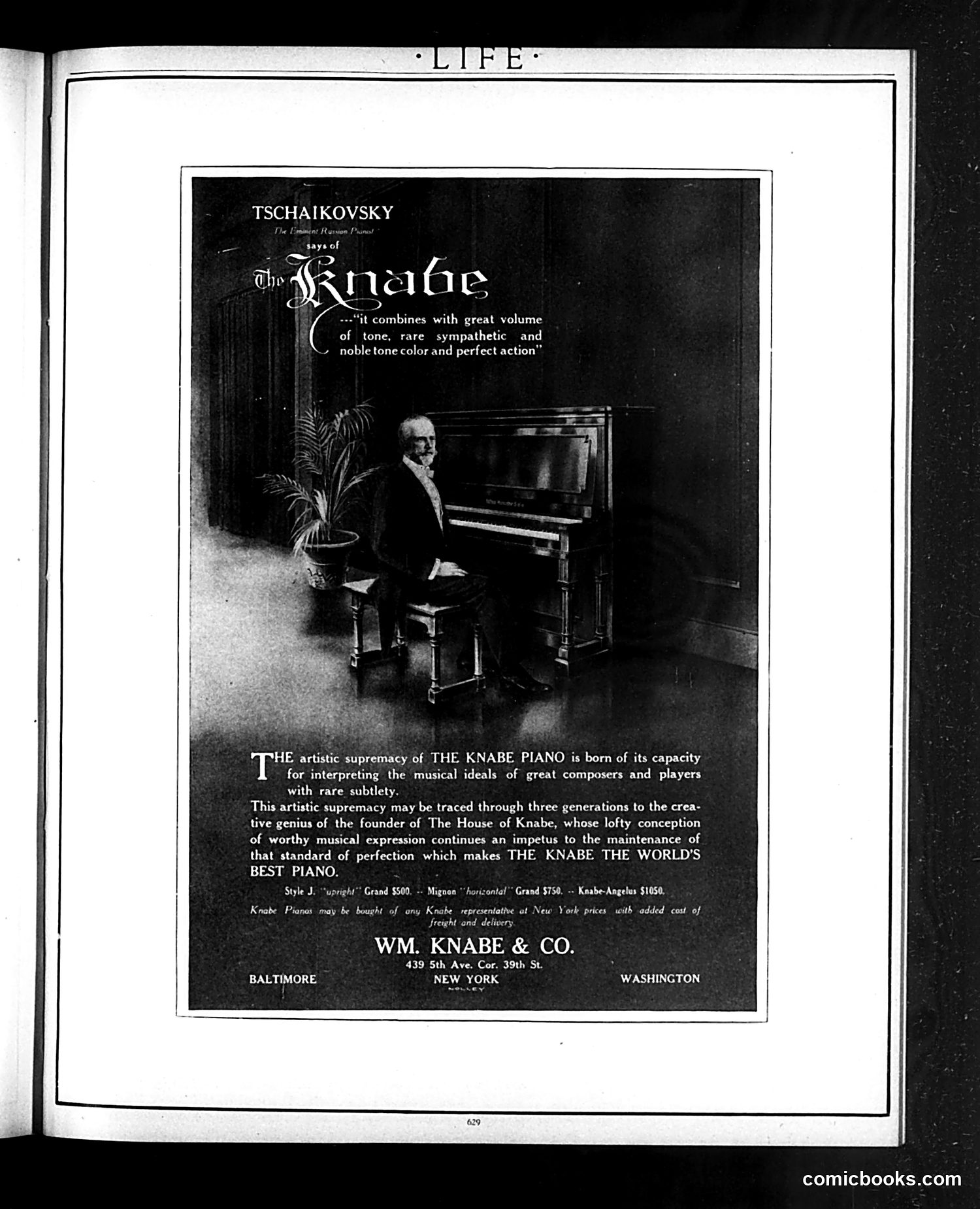
This is a **Knabe Piano advertisement**, not political satire or a cartoon. It features a photograph of an elderly man seated at a grand piano in an elegant interior setting. The ad attributes a quotation about piano quality to **Tchaikovsky**, the famous Russian composer, lending prestige to the Knabe brand by suggesting even great composers endorsed their instruments. The text claims Knabe pianos' superiority derives from three generations of the founding family's "creative genius." The page emphasizes luxury ("the world's best piano") and aspirational selling—associating piano ownership with high culture and artistic refinement. Prices range from $500-$1,050, positioning Knabe as a premium product for wealthy households. This represents typical early-20th-century advertising strategy: using famous cultural figures and claims of tradition to justify premium pricing.
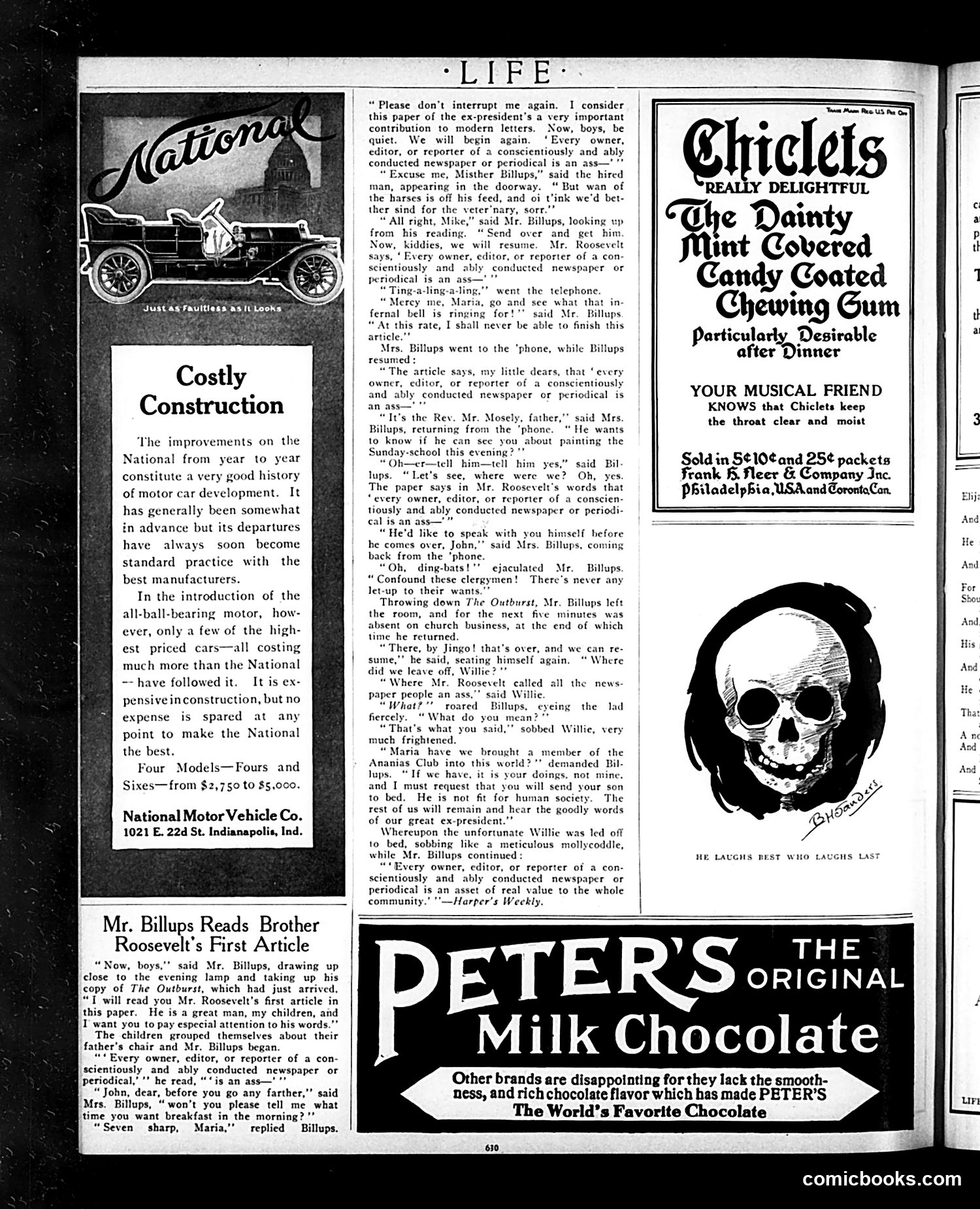
This page satirizes Theodore Roosevelt's attempt at journalism. The main story, "Mr. Billups Reads Brother Roosevelt's First Article," mocks Roosevelt's contribution to *The Outburst* magazine by depicting a father repeatedly trying to read aloud Roosevelt's opening line—that every newspaper owner, editor, or reporter "is an ass"—to his family. The joke is that Mr. Billups keeps getting interrupted by domestic and professional demands (his wife asking about breakfast, the hired man about a sick horse, a telephone call, a pastor needing painting estimates), yet he doggedly persists in attempting to share this "important contribution to modern letters." The humor lies in the contrast between Billups's reverence for the "great man" Roosevelt and the banality of the actual interruptions, suggesting Roosevelt's article is pompous and his opening insult to the press is comically blunt. This satirizes Roosevelt's post-presidency public persona and his tendency toward bombastic pronouncements.
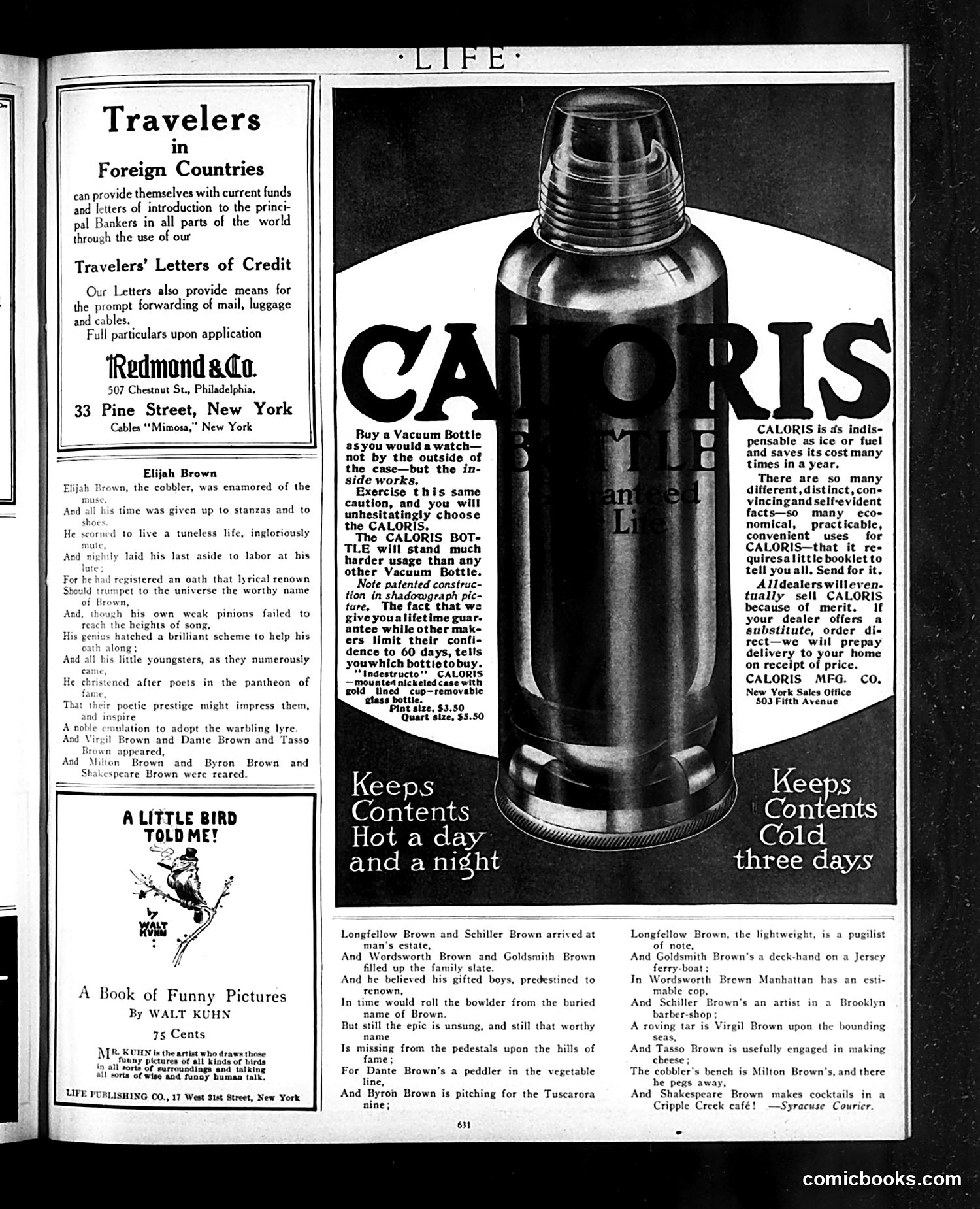
This Life magazine page contains **mostly advertisements** alongside a humorous narrative poem titled "Elijah Brown." **The main satire:** The poem mocks a cobbler named Elijah Brown who, obsessed with literary prestige, names all his sons after famous poets (Dante, Byron, Milton, Shakespeare, Virgil, etc.), believing their poetic names will inspire them toward artistic greatness. The joke is the ironic outcome: despite their lofty names, the boys become ordinary working-class men—a peddler, baseball pitcher, lightweight boxer, ferry-boat worker, cop, cheese-maker, and bartender. **The point:** This satirizes both parental ambition and the false belief that names or pretense can determine destiny. It's a gentle jab at social climbing and romantic notions of artistic success meeting harsh reality. **Advertisements:** The page also features banking services (Redmond & Co.'s travelers' letters of credit) and Caloris vacuum bottles, plus a Walt Kuhn cartoon book advertisement.
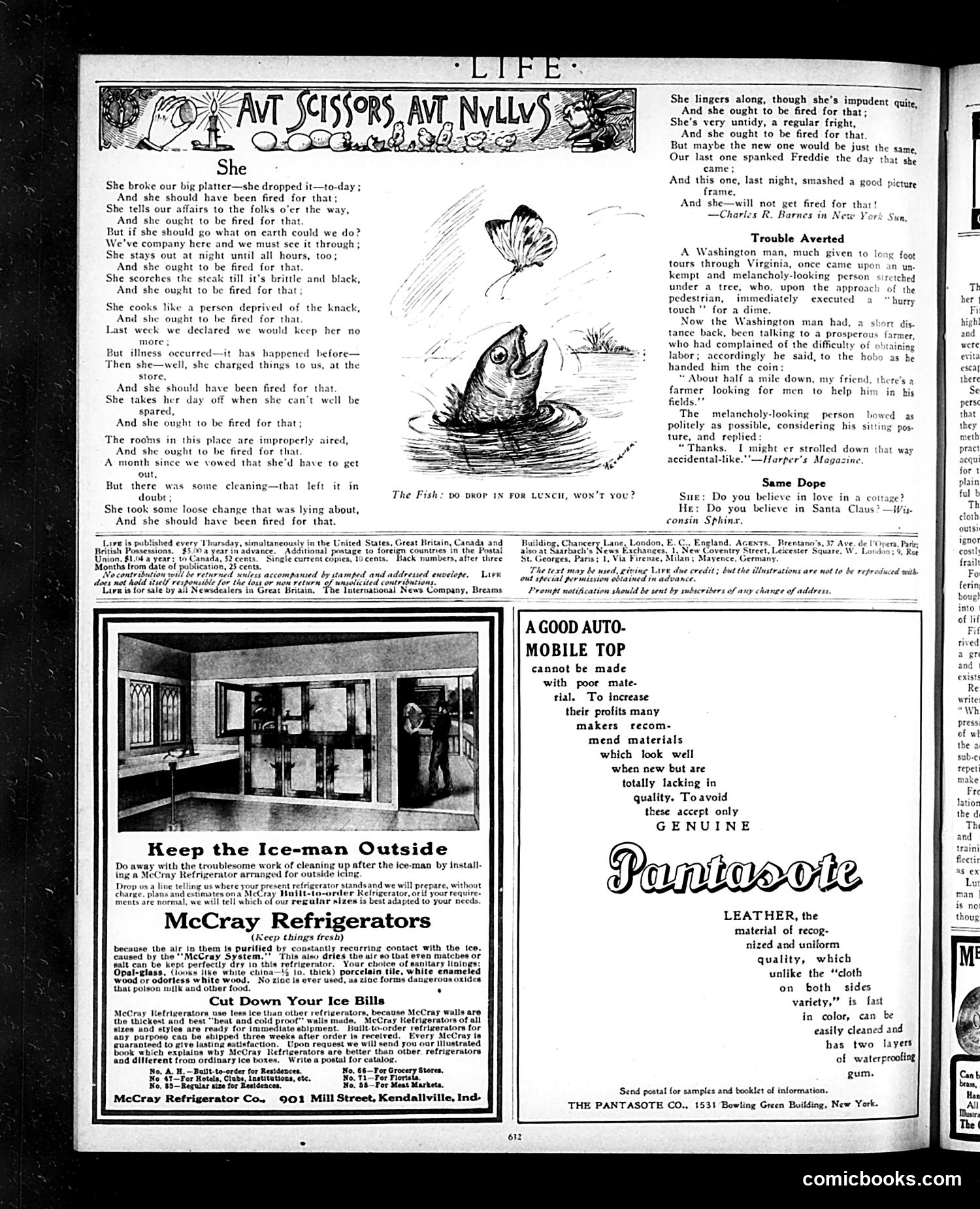
This Life magazine page contains two main satirical pieces: **"She" (left column):** A humorous poem about a domestic servant (likely a maid or housekeeper) who is perpetually criticized—she breaks things, scorches food, stays out late, and overspends. The running refrain demands she be fired for each transgression. The joke's irony: despite all her faults, the family cannot actually fire her because she's essential to their household functioning. When she once got ill, she resourcefully charged expenses to them at local stores, making her indispensable despite her incompetence. This satirizes the employer-servant relationship of the early 1900s and the paradox of keeping obviously unsuitable household help. **"Trouble Averted" and "The Fish" (right column):** Two brief humorous anecdotes about social encounters and practical wisdom. The page is otherwise dominated by **advertisements** for McCray Refrigerators and Pantosofe leather products—typical commercial content for Life magazine of this era.
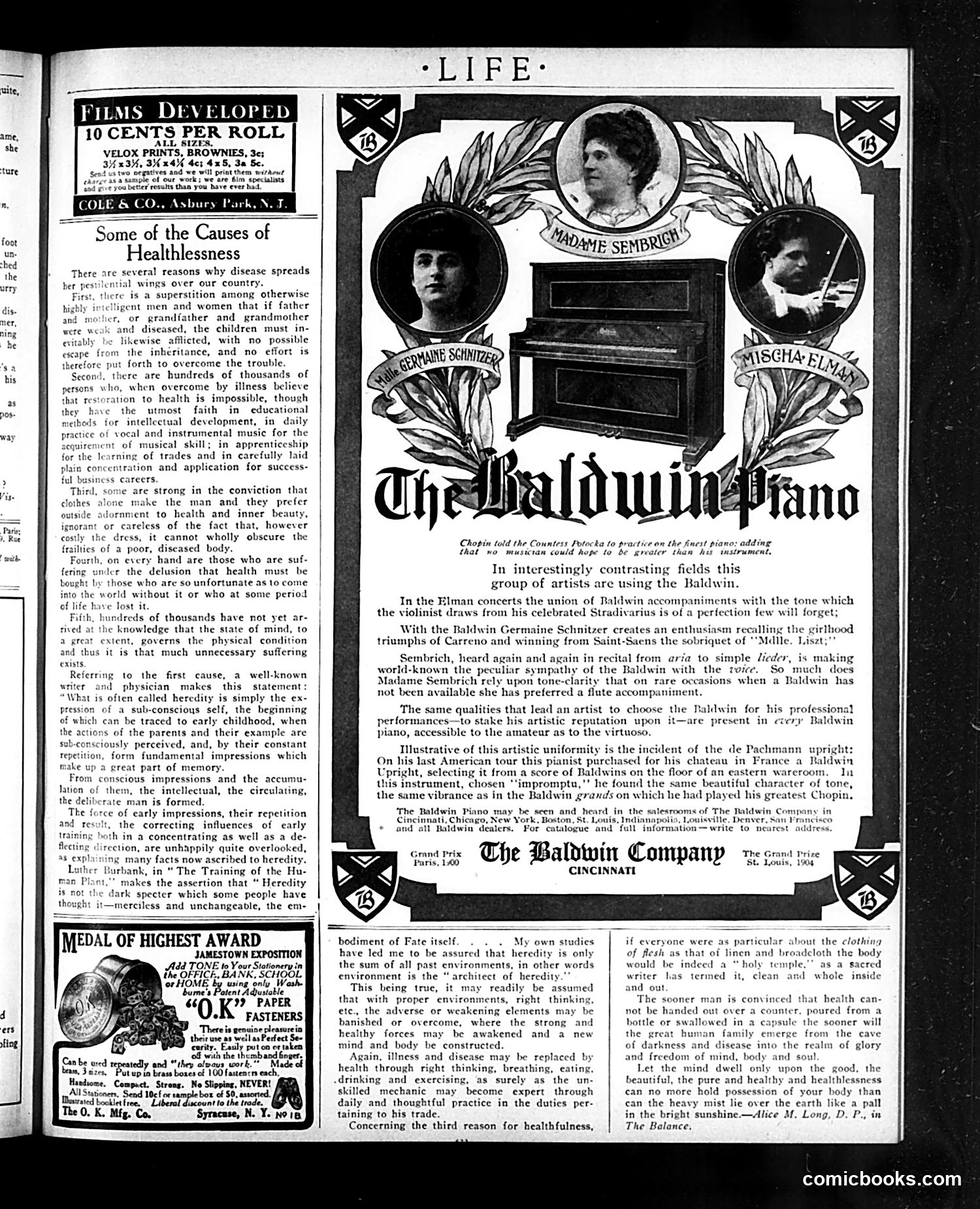
This page is primarily a **Baldwin piano company advertisement** featuring endorsements from famous classical musicians of the era. The central image shows three acclaimed performers in circular portraits: **Madame Sembrich** (top center), **Germaine Schnitzer** (bottom left), and **Mischa Elman** (right)—all prominent concert artists of the early 20th century. The advertisement's strategy is to associate the Baldwin piano with artistic excellence by claiming these virtuosos prefer it. The text cites specific endorsements: Elman's violin concerts paired with Baldwin accompaniments, Schnitzer's "girlhood triumphs," and Sembrich's reliance on the instrument's "tone-clarity." The quote attributed to Chopin ("practice on the finest piano") anchors the implicit argument: superior instruments produce superior performances. For modern readers, this represents **celebrity endorsement advertising**—a common marketing technique then and now—where prestigious names legitimate a commercial product.
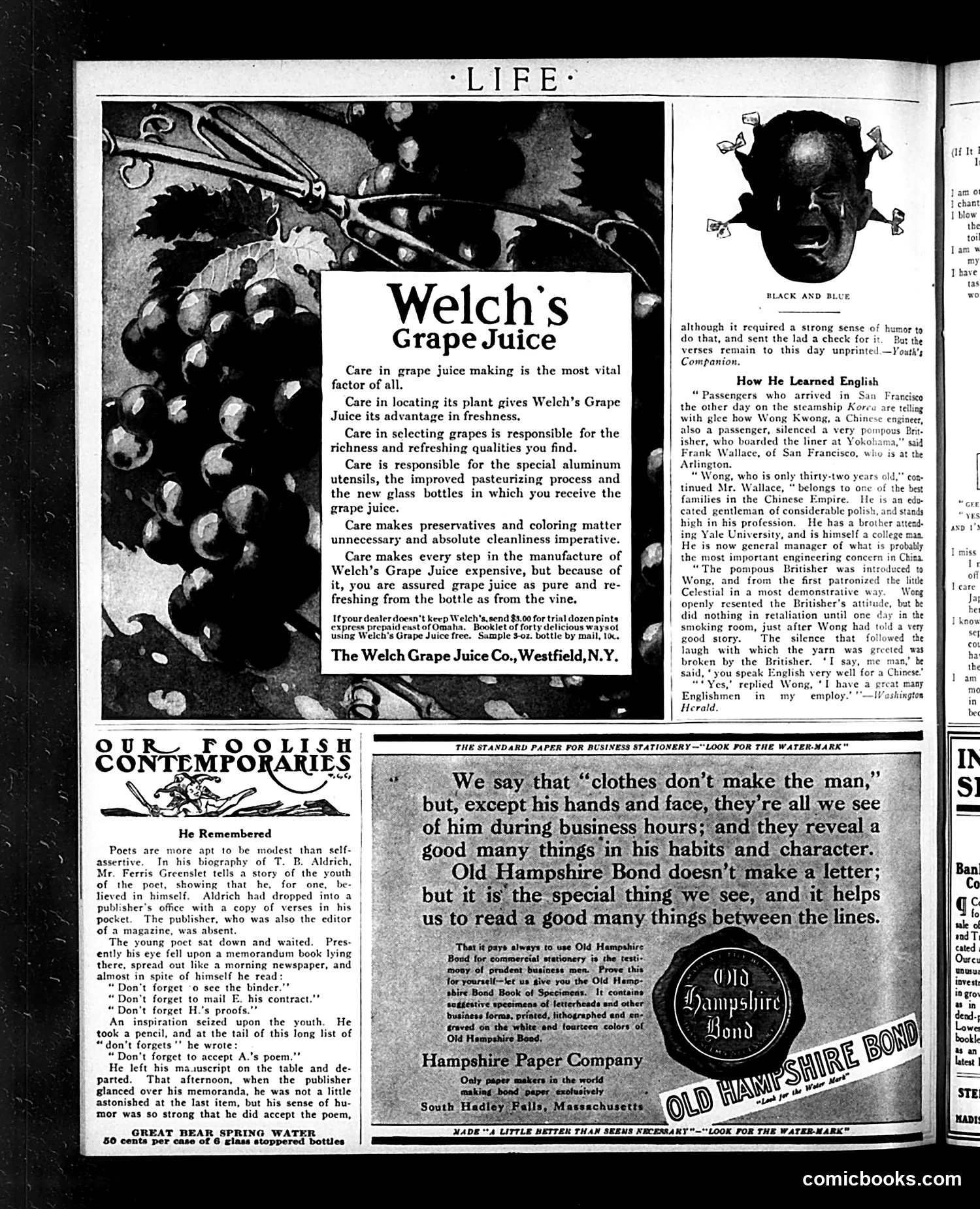
This page contains three distinct pieces of content: **"Black and Blue"** (top right): A brief anecdote about Wong Kwong, a Chinese engineer aboard a steamship, who silences a pompous British passenger. When the Britisher condescendingly remarks on Wong's English, Wong retorts that he has Englishmen working in his employ—a witty reversal establishing Wong's superior social position. The satire mocks British colonial arrogance and stereotyping of Asian people. **"Our Foolish Contemporaries: He Remembered"** (bottom left): A humorous story about a young poet (T.B. Aldrich) who boldly adds "Don't forget to accept A.'s poem" to a publisher's memo pad. The anecdote celebrates poetic self-confidence and satirizes the publishing industry's tendency to overlook talent. **Advertisements** dominate the page: Welch's Grape Juice emphasizes quality control and purity; Hampshire Paper Company advertises business stationery with claims about character assessment through correspondence. The page reflects early 1900s attitudes: patronizing humor about non-Western people coexisting with admiration for individual wit and self-advocacy.
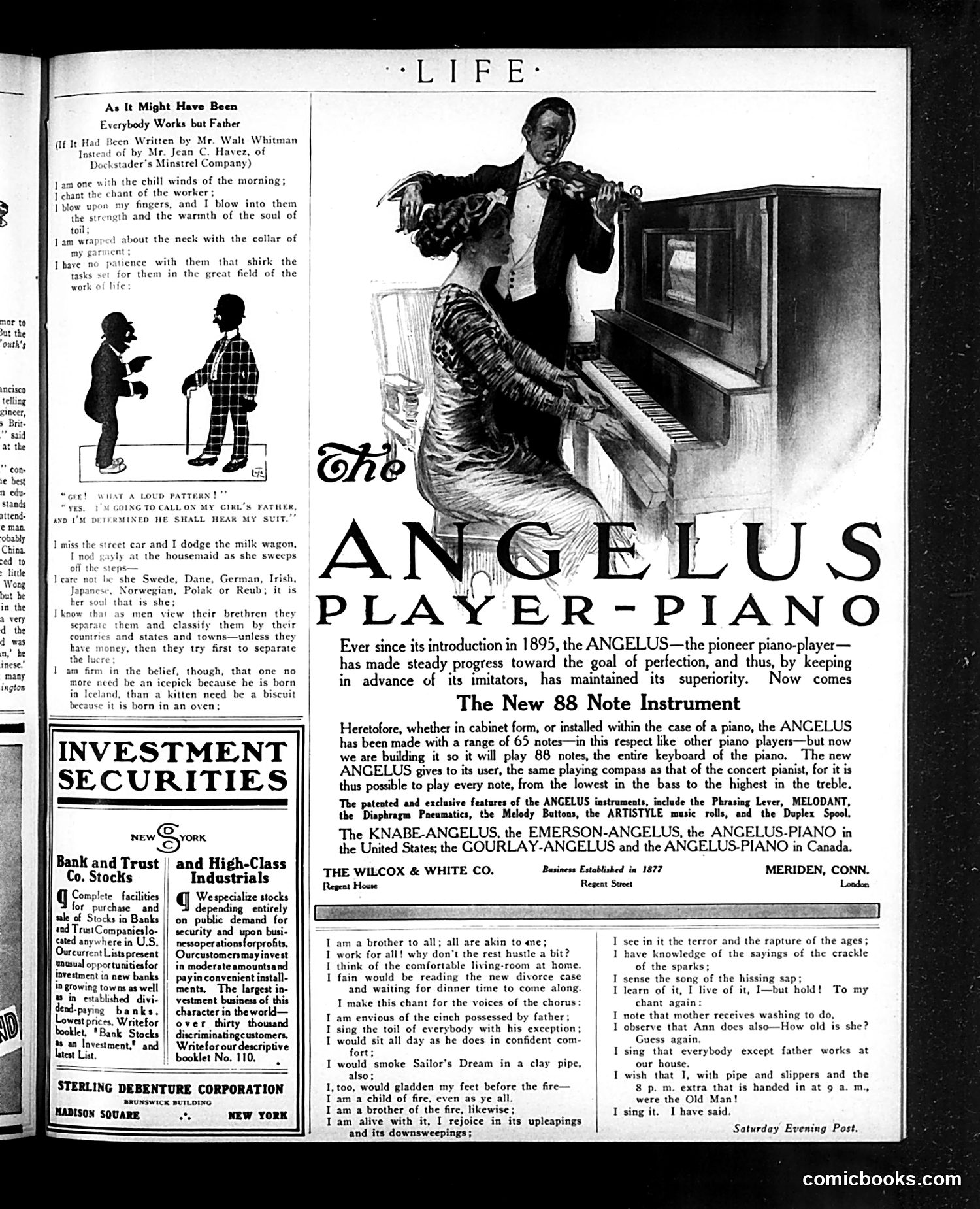
This page satirizes the popular song/play "Everybody Works but Father" by reimagining it in the pretentious style of poet Walt Whitman. The joke targets Whitman's grandiose free-verse poetry and his tendency to find profound meaning in everyday working-class life. The small cartoon shows a child telling his father he's determined to "call on my girl's father"—a mundane domestic situation rendered absurd through Whitman's verbose, self-important literary treatment. The text parodies Whitman's characteristic catalog technique and his rhapsodic elevation of common workers and simple moments. The satire mocks both Whitman's overwrought poetic style and the contrast between his democratic ideals and his actual separation from ordinary working experience. By applying his grandiose voice to a silly domestic complaint about fathers not working, Life magazine ridicules pretentious literary affectation.
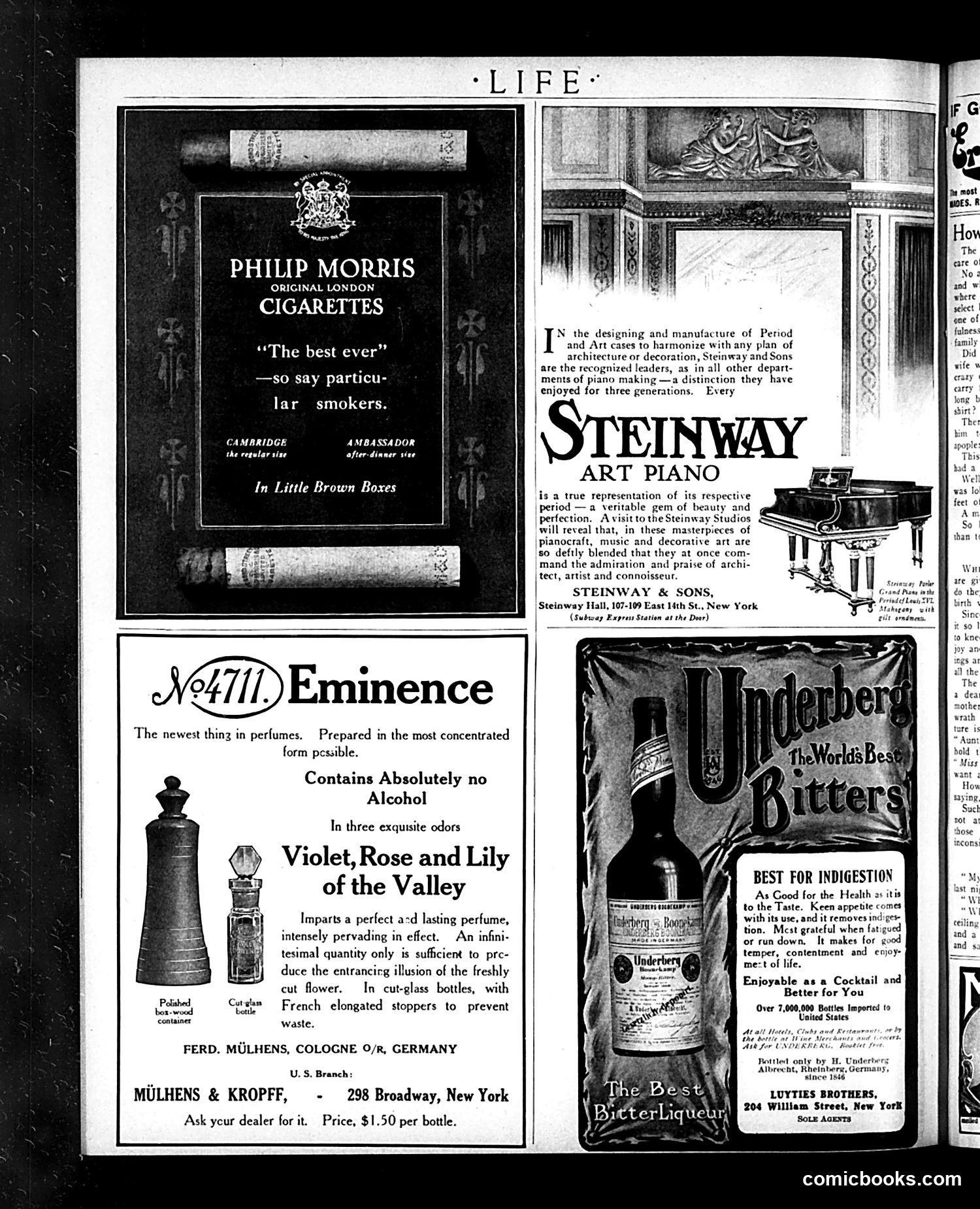
This is **not a cartoon page** but rather a **advertisements section** from Life magazine. The page contains four distinct luxury product ads: 1. **Philip Morris Cigarettes** — marketed as "The best ever" to "particular smokers," sold in "Little Brown Boxes" 2. **Steinway Art Piano** — positioning their pianos as design objects that harmonize with interior decoration, emphasizing three generations of craftsmanship 3. **No. 4711 Eminence Perfume** — a German fragrance (alcohol-free) in violet, rose, and lily scents, sold by a New York distributor 4. **Underberg Bitters** — a German digestif marketed for indigestion relief, also available in the United States These ads reflect early 20th-century consumer culture targeting affluent readers, emphasizing Old World European luxury goods (German perfume, German bitters, quality American pianos) and positioning them as status symbols. The page itself contains no satire or political commentary—it's straightforward advertising.
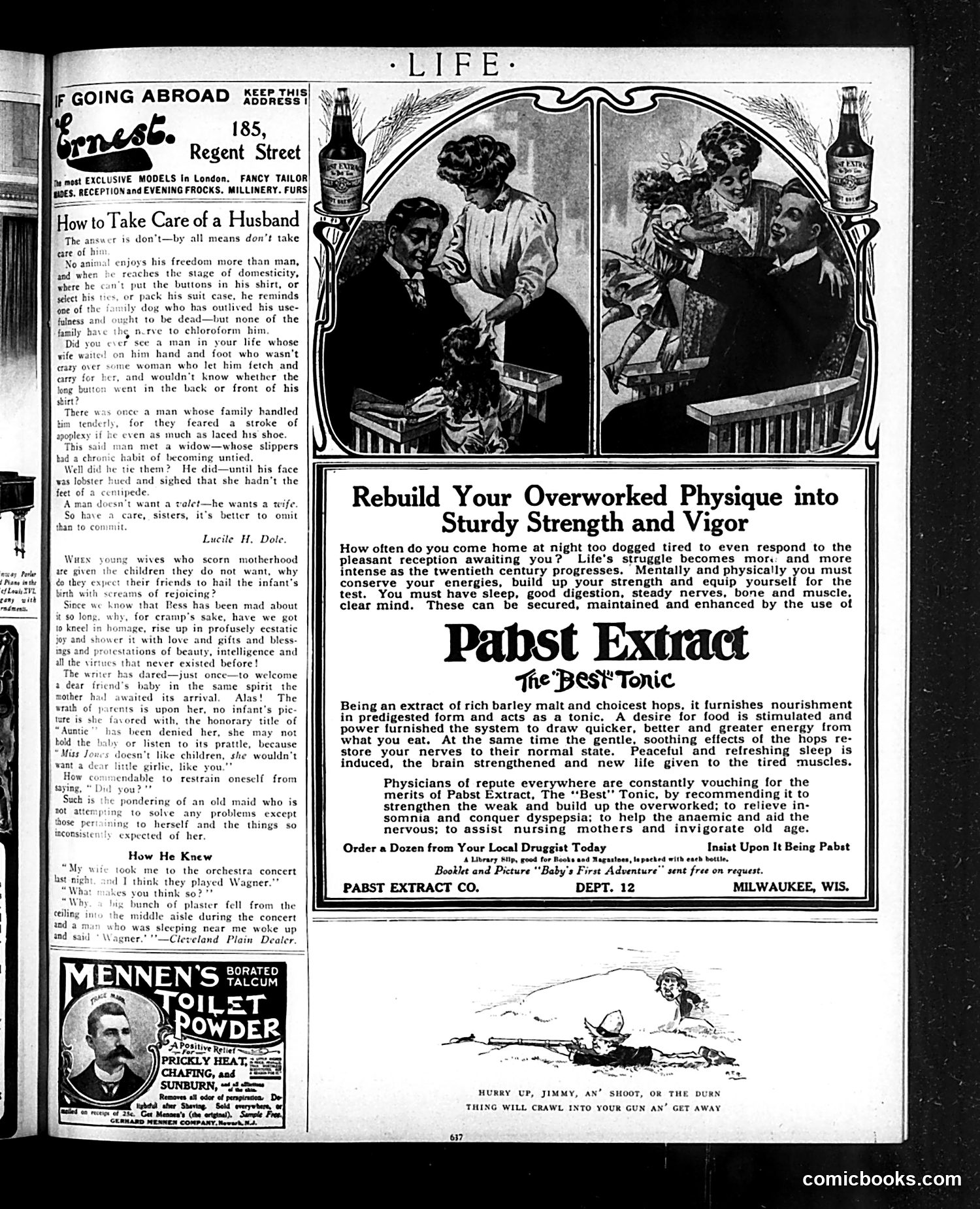
This page combines satirical advice columns with period advertising. The main content includes: **"How to Take Care of a Husband"** by Lucile H. Dole mocks the era's domestic ideals. It satirizes wives who over-coddle husbands, suggesting that men—like animals—resent being domesticated. The column uses absurd examples (a widow whose slippers constantly untie) to argue that excessive wifely attentiveness infantilizes men rather than pleasing them. **Other advice columns** address contemporary social anxieties: one criticizes women who reject motherhood yet expect others to celebrate their children; another features a husband-wife exchange joking that a man fell asleep during Wagner at a concert. **The Pabst Extract advertisement** dominates the right side, promising to cure fatigue and weakness through a barley-malt tonic. It reflects early 20th-century medical pseudoscience, positioning the product as a cure-all for modern exhaustion, poor digestion, and nerve problems—ailments supposedly caused by intense contemporary life. The page exemplifies Life's blend of gender-focused satire and patent medicine advertising typical of the era.
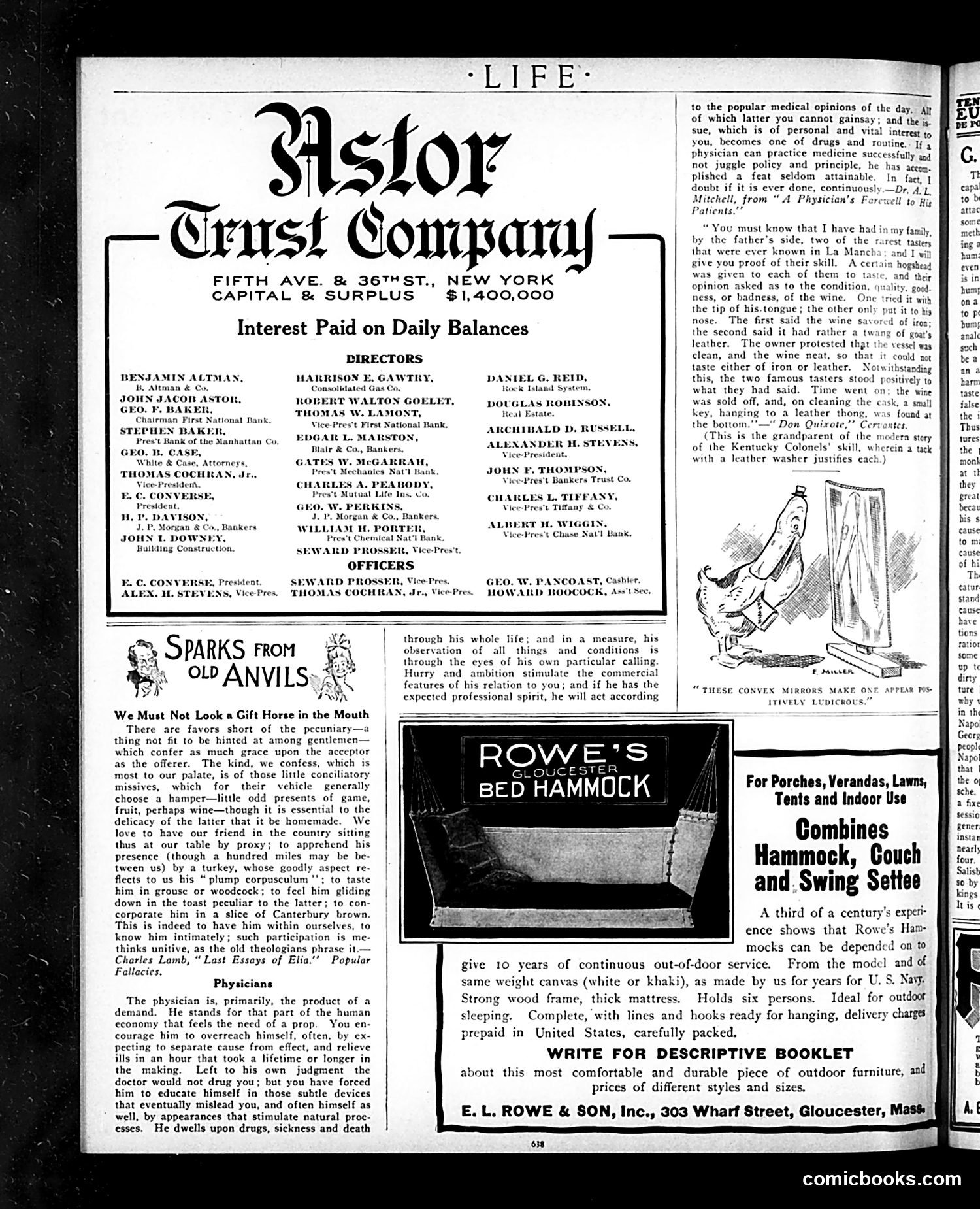
This page is primarily **a bank advertisement and corporate directory** for Astor Trust Company, with minimal cartoon content. The only substantive illustration is a small cartoon titled "These Convex Mirrors Make One Appear Divinely Ludicrous," showing a distorted reflection—a visual joke about funhouse mirrors. The page's main text includes two literary excerpts: one from a physician's medical ethics essay, and another from *Don Quixote* (the famous wine-tasters episode). These serve as intellectual padding for what is essentially a financial institution's listing of its prominent board members—names like Astor, Vanderbilt, and Rockefeller indicating New York's wealthiest families circa early 1900s. The surrounding advertisements (Rowe's Bed Hammock, etc.) are typical period marketing. This page represents Life magazine's dual function: satirical commentary mixed with high-end advertising targeting wealthy readers.
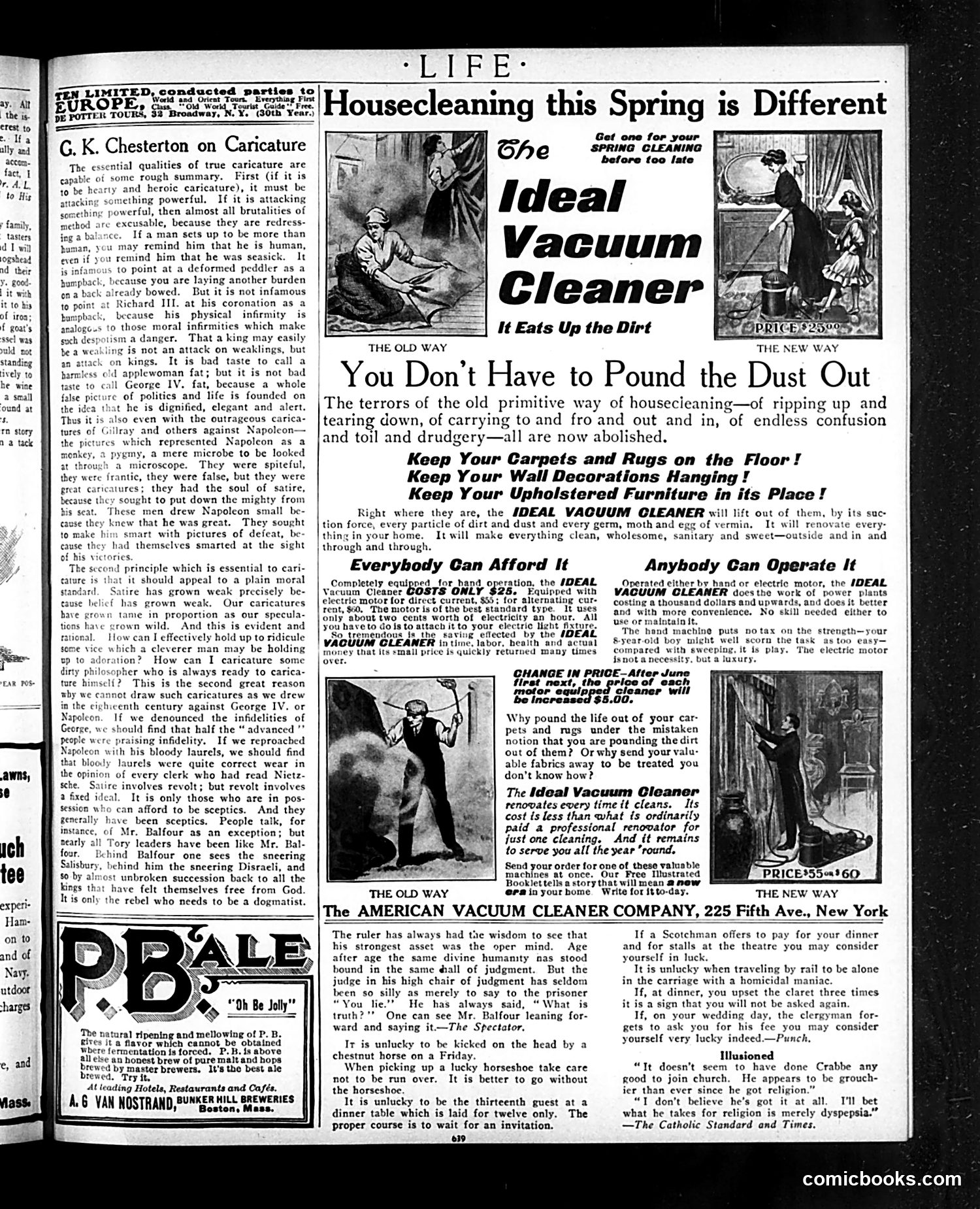
This page is primarily **advertising content** for the Ideal Vacuum Cleaner, not political satire. The main feature contrasts "THE OLD WAY" and "THE NEW WAY" of spring housecleaning. Illustrations show a woman laboriously beating carpets and rugs outdoors (old method) versus operating an electric vacuum cleaner indoors (new method). The advertisement emphasizes convenience: you needn't remove furniture or carpets anymore. The only non-advertising content is **G.K. Chesterton's essay on caricature** (left column), which discusses the principles of effective political/social satire. Chesterton argues that caricature requires attacking something powerful and appeals to "plain moral standard." He notes modern caricature has weakened because contemporary thinkers (like those following Nietzsche) lack fixed ideals to defend against. There are no political cartoons on this page—just a consumer product advertisement and an intellectual essay about satire's nature.
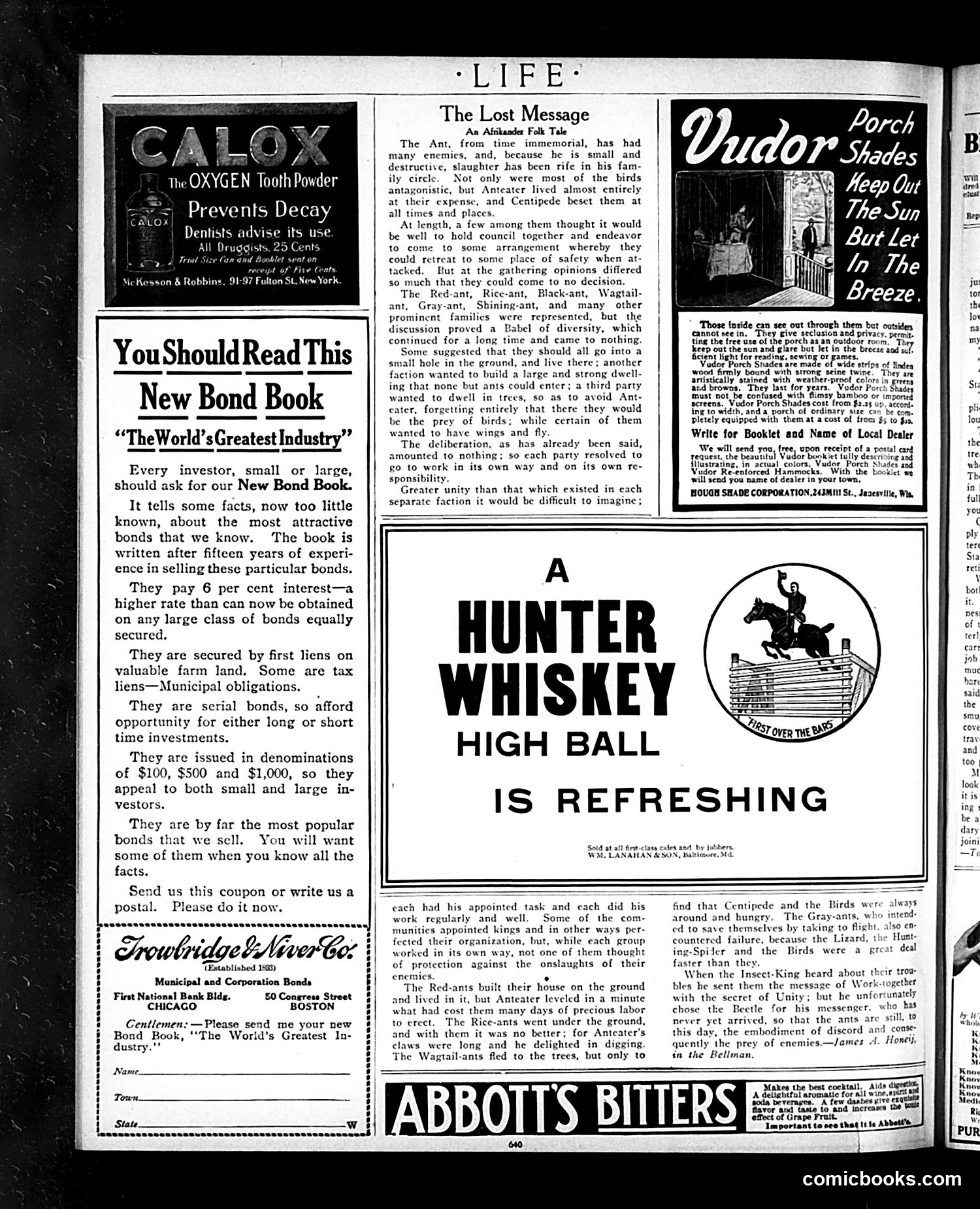
This page is primarily **advertising and financial promotion** rather than political satire or cartooning. The main elements are: 1. **Product advertisements** (Calox tooth powder, Vudor porch shades, Abbott's bitters) using standard early 20th-century marketing appeals 2. **A bond investment pitch** from Routledge & River Co., promoting farm-secured bonds at 6% interest to small investors 3. **"The Lost Message"** — an Aesop's fable-style story about ants unable to agree on defense strategy, each faction pursuing separate goals. This appears to be **moral instruction** rather than political commentary, though it *could* function as an allegory about unity and divided interests. 4. **Hunter Whiskey advertisement** with a horse-jumping illustration The page reflects early 1900s commercial culture: financial opportunity pitched to middle-class readers, folklore presented as edifying content, and branded products occupying significant space. There is no clear political cartoon or satirical commentary visible here.
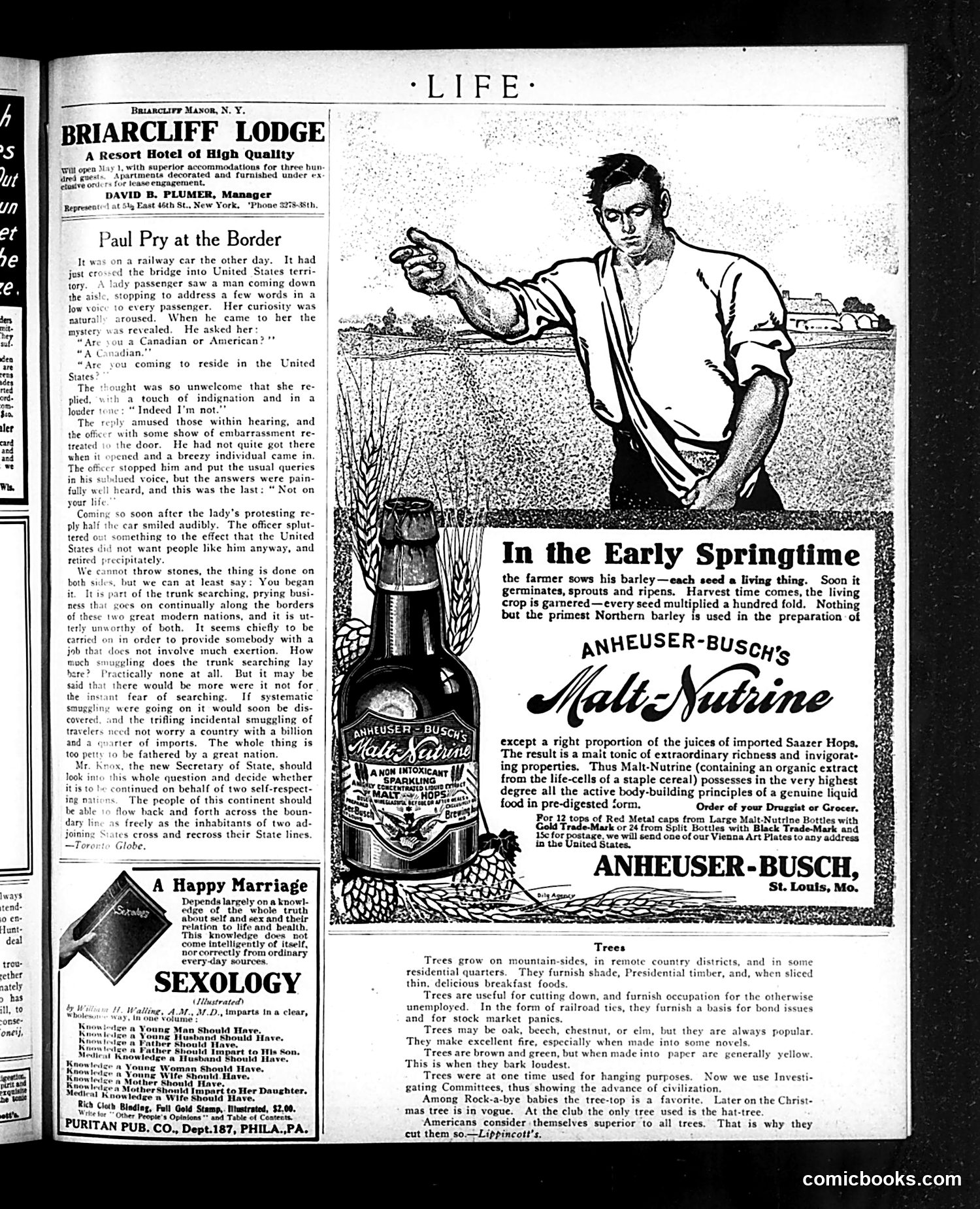
This satirical piece mocks U.S. border agents' interrogation practices. It describes two encounters on a railway car crossing into American territory: first, a Canadian woman indignantly denies wanting to reside in the U.S., drawing amusement from other passengers; second, a man bluntly refuses entry, embarrassing the officer. The satire criticizes the "trunk searching, prying business" conducted by immigration officials at U.S.-Canadian borders—portrayed as intrusive, ineffective, and beneath a great nation's dignity. The article argues such searches catch only minor smuggling and suggests Secretary of State Philander Knox should end the practice, allowing continental movement as freely as between U.S. states. The humor lies in the officers' discomfiture when questioned about their own country's desirability.
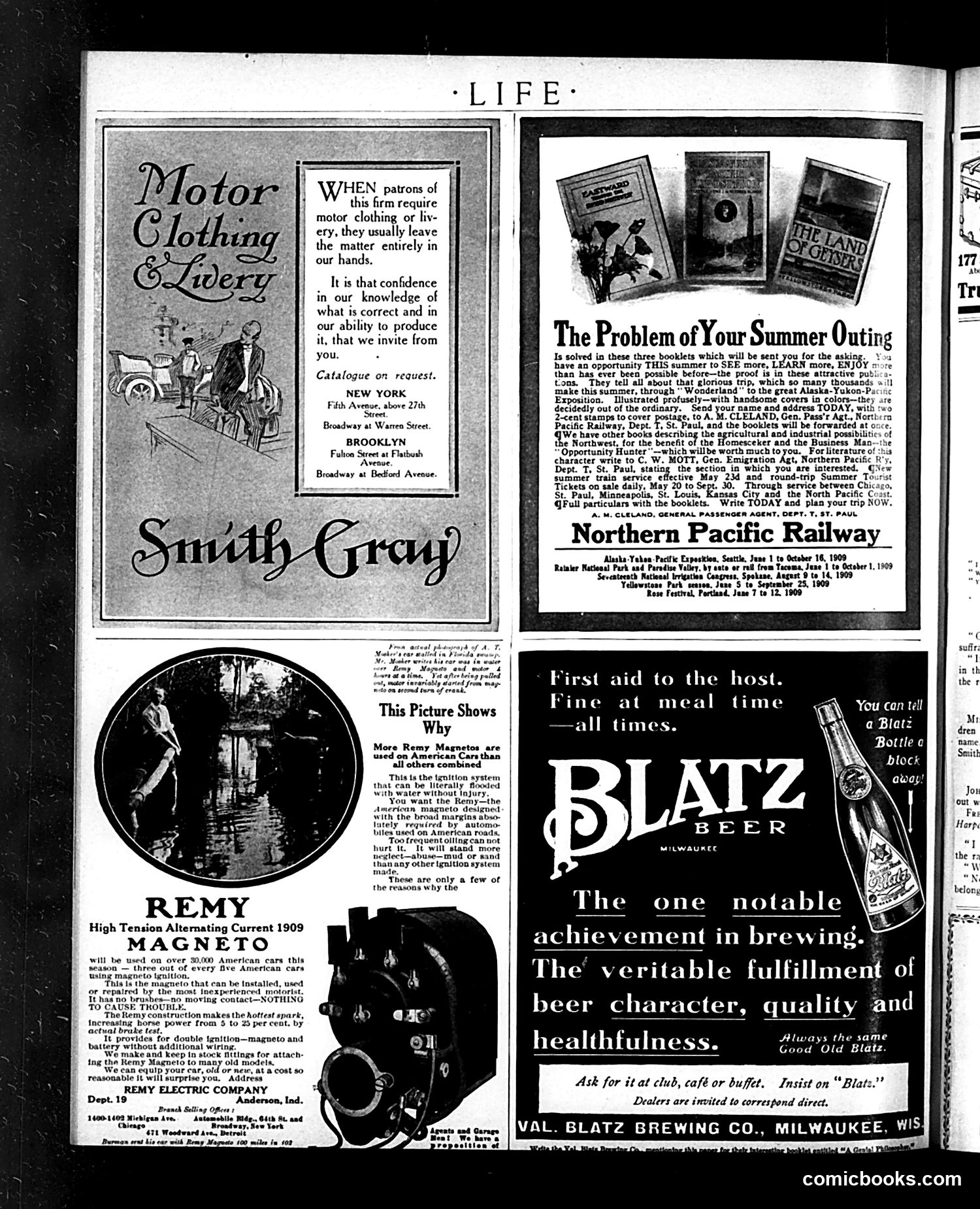
This page is primarily **advertising**, not satire or political commentary. It contains four distinct ads: 1. **Smith Gray Motor Clothing & Livery** (top left): Promotes custom automotive attire and car services in New York and Brooklyn. 2. **Northern Pacific Railway** (top right): Advertises summer travel packages to the Alaska-Yukon-Pacific Exposition (1909) and other northwestern destinations, targeting both tourists and settlers. 3. **Remy Magneto** (bottom left): Promotes automotive ignition systems, claiming superiority over competitors through technical specifications and reliability. 4. **Blatz Beer** (bottom right): Milwaukee brewery ad emphasizing product quality and character. The circular image accompanying the Remy ad shows a magneto in water, demonstrating its waterproof durability. These are straightforward commercial advertisements typical of early 1900s magazines, with no apparent satirical intent or political messaging.
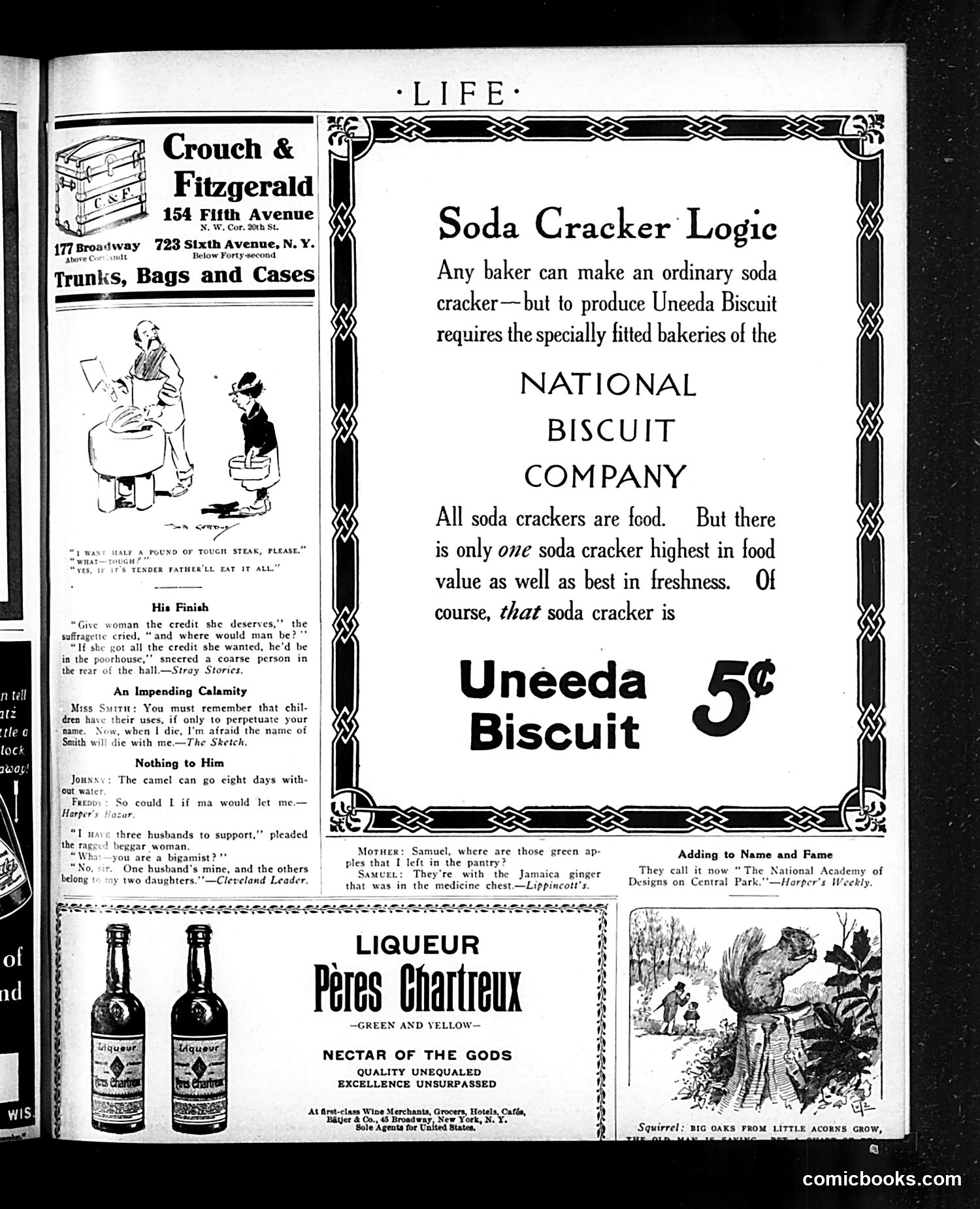
This Life magazine page is primarily **advertising and humor vignettes** rather than political satire. The main content includes: 1. **Advertisements**: Crouch & Fitzgerald (luggage), Uneeda Biscuit (soda crackers), and Peres Chartreux liqueur dominate the page. 2. **Comic Vignettes**: Brief humorous dialogue snippets titled "His Finish," "An Impending Calamity," and "Nothing to Him" present domestic and social situations played for laughs—typically centered on marriage complications, child-rearing concerns, and economic struggles. 3. **The Biscuit Ad's "Logic"**: The Uneeda advertisement uses pseudo-logical argumentation to claim superiority over generic soda crackers, a typical early-20th-century marketing approach. 4. **Bottom Illustration**: A squirrel with acorns and the caption "Big oaks from little acorns grow"—a conventional inspirational saying. The page reflects **Life's format as a satirical humor magazine** mixing editorial cartoons with advertisements and comedic sketches targeting middle-class American audiences.
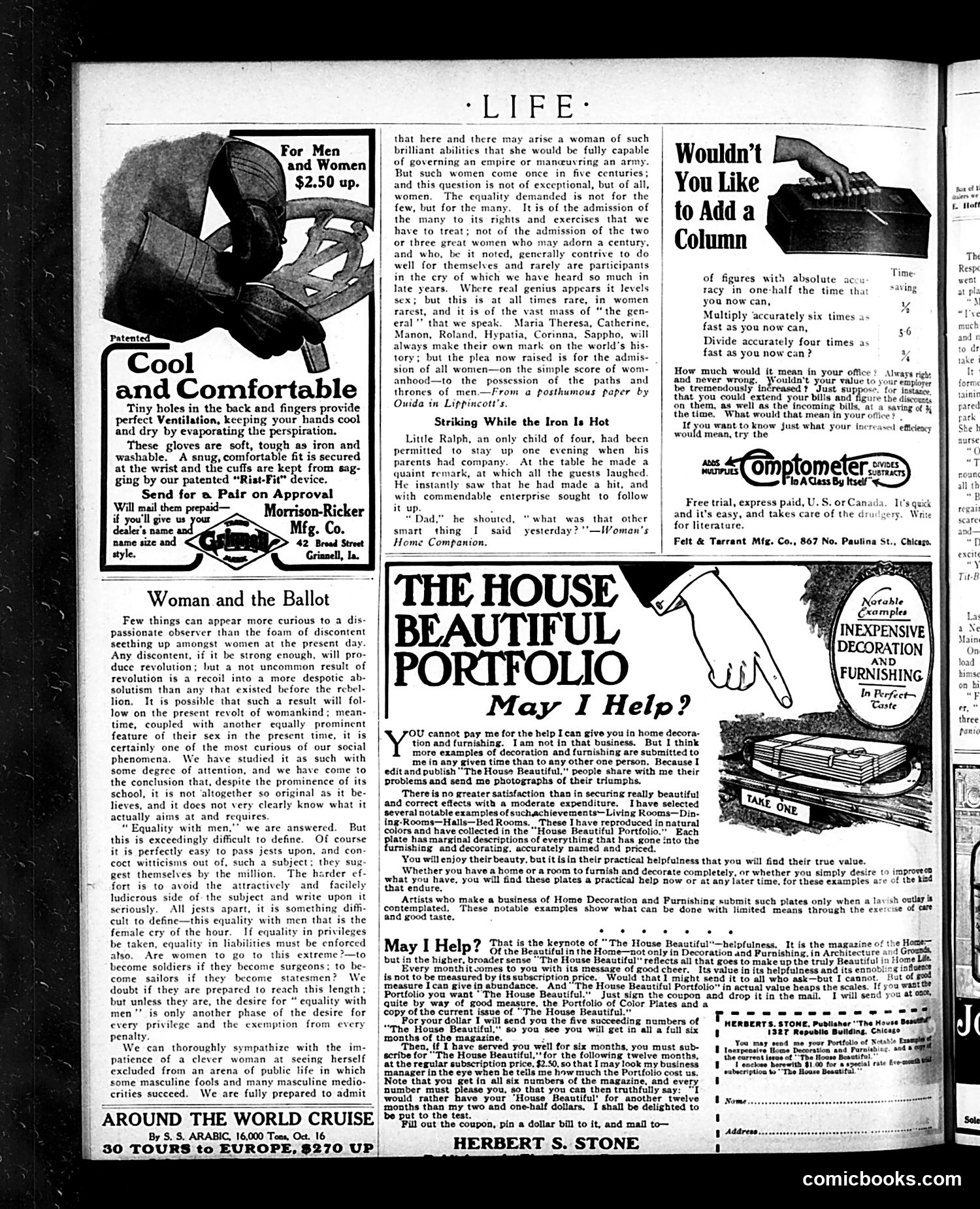
This page contains **editorial content opposing women's suffrage**, framed as a serious philosophical argument rather than satire. The essay "Woman and the Ballot" argues against voting rights for women by distinguishing between rare exceptional women (Maria Theresa, Catherine the Great) and ordinary women. The author claims women demand "equality" selectively—wanting privileges without corresponding liabilities like military service. He argues true equality would require women become soldiers and sailors, implying this proves their demands are unreasonable. The piece is **anti-feminist rhetoric disguised as rational debate**—a common approach in early 20th-century publications. It concedes women of "genius" exist but dismisses the broader movement for equal rights as confused and inconsistent. The rest of the page contains typical period advertisements (gloves, cruises, home decoration magazine) unrelated to this political content. This demonstrates how Life magazine mixed satirical commentary with commercial messaging.
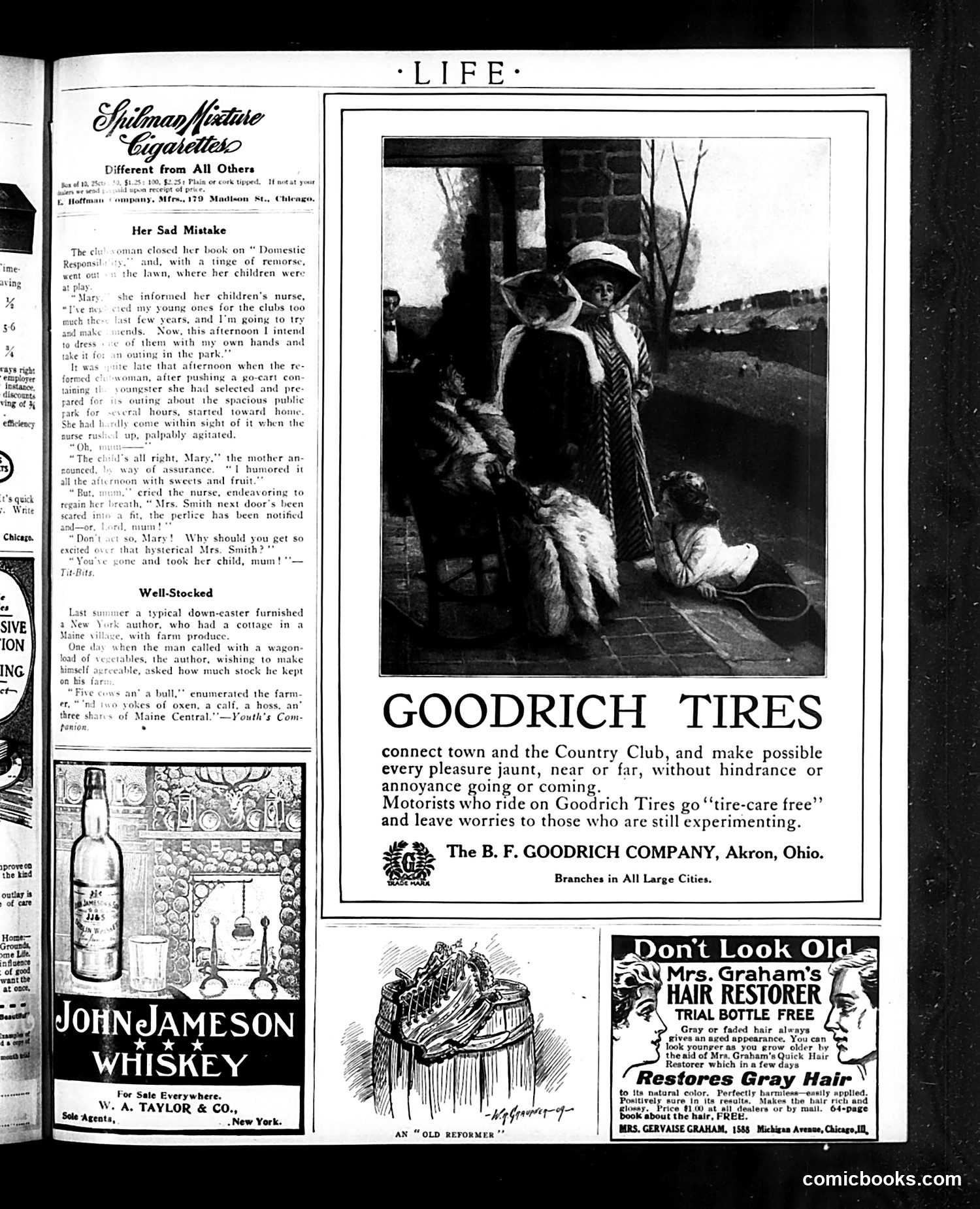
This page contains three distinct advertisements and two short stories, typical of Life's satirical format. **"Her Sad Mistake"** depicts a wealthy woman who, after reading a book on domestic responsibility, decides to personally supervise her children at a public park—a rare act for her social class. When the nurse reports the children missing, the woman panics. The satire targets upper-class mothers who neglect their children to servants, portraying her sudden maternal interest as performative and ultimately ineffective. **"Well-Stocked"** humorously describes a Maine farmer's livestock inventory, with the joke being his literal interpretation of "stock" as animals rather than financial assets. The page also features period advertisements for John Jameson Whiskey, Goodrich Tires, and Mrs. Graham's Hair Restorer—products targeting affluent readers concerned with status, modern convenience, and aging appearance. The cartoon titled "An 'Old Reformer'" (bottom) appears to comment on hypocrisy, though details are unclear from the OCR text.
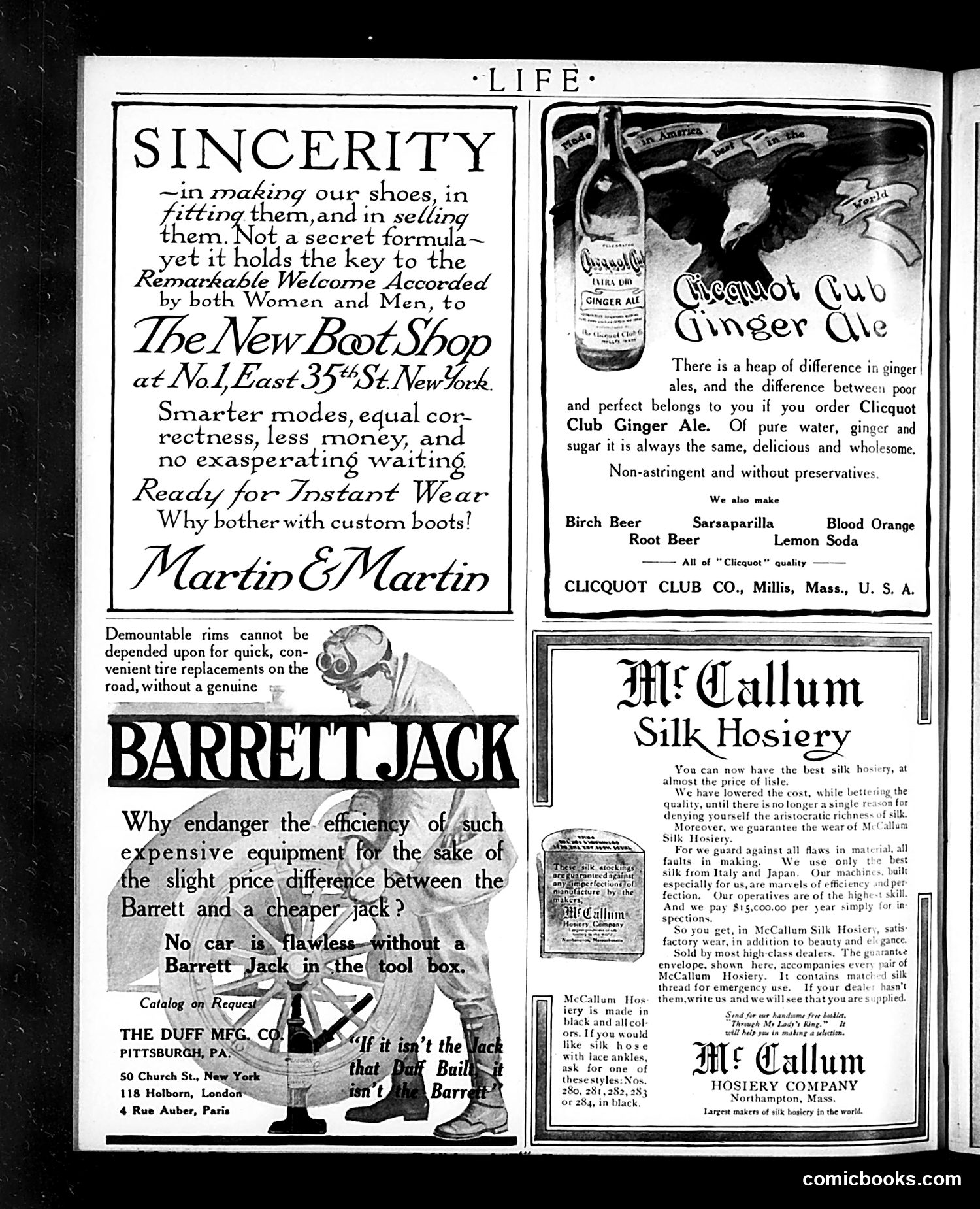
This page contains **no political cartoons or satire**—it is primarily **advertising content** from what appears to be an early 20th-century issue of Life magazine. The ads feature consumer products: The New Boot Shop emphasizes affordability and convenience over custom tailoring; Clicquot Club promotes its ginger ale as pure and preservative-free; Barrett Jack argues for quality automotive jacks as essential equipment; and McCallum Silk Hosiery claims to offer luxury silk stockings at affordable prices. The underlying theme across these advertisements reflects **early 20th-century consumer culture values**: democratization of quality goods, rejection of custom/handmade items in favor of ready-made convenience, and marketing through claims of purity and value. The ads target primarily middle-class consumers seeking modern efficiency and respectability without extravagance.
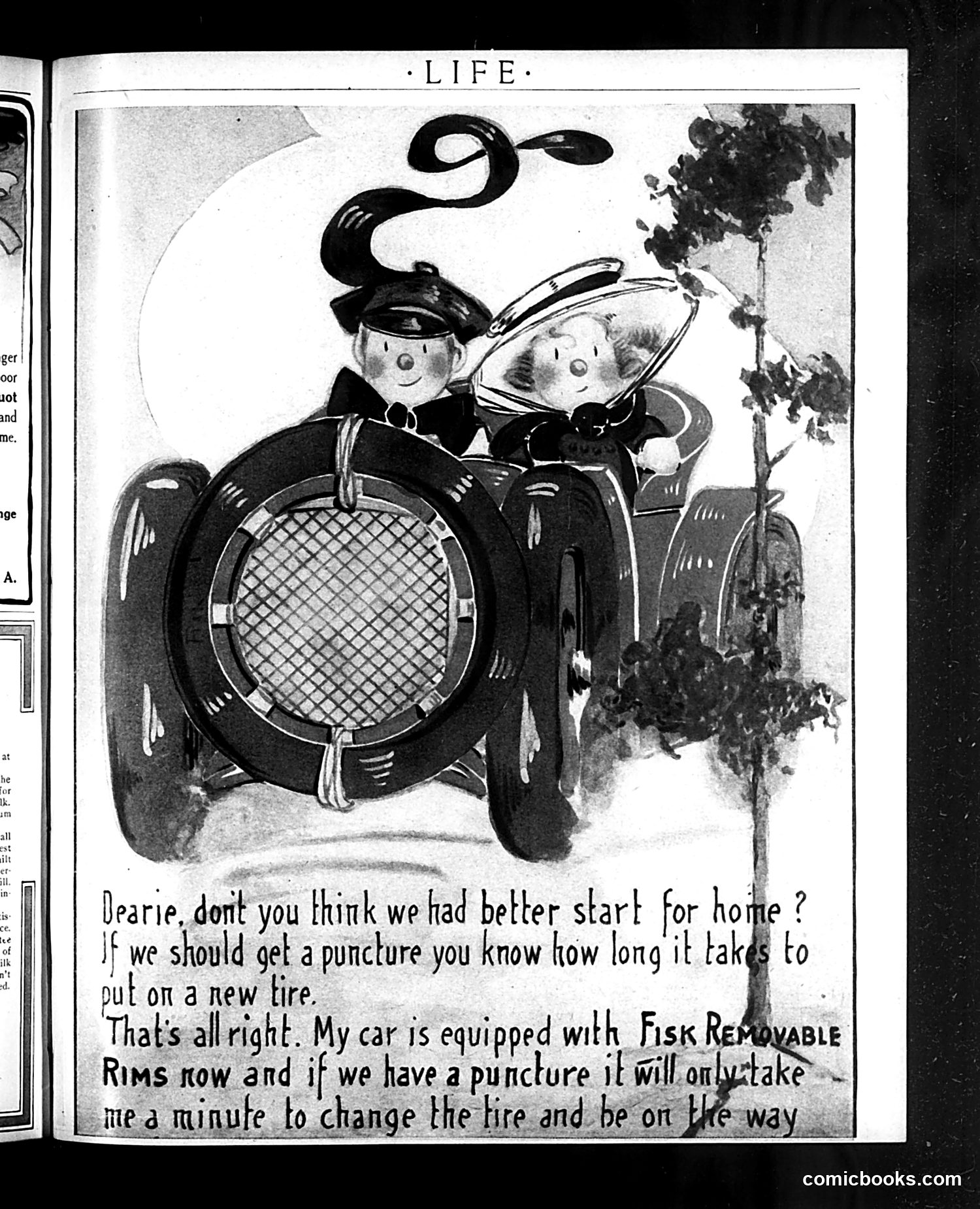
This is an advertisement disguised as a comic dialogue, appearing in Life magazine. Two cartoon characters in an early automobile discuss whether to depart for home, with one expressing concern about tire puncture delays. The other reassures him that their car uses **Fisk Removable Rims**, which allow a puncture tire to be changed in just one minute rather than requiring lengthy tire replacement procedures. This is a product advertisement highlighting a genuine automotive innovation from the early 20th century—removable rims that made tire changes faster and more convenient. The "joke" is really the reassuring pitch: new technology solves the common travel anxiety of the era. Fisk was a major tire manufacturer of this period.
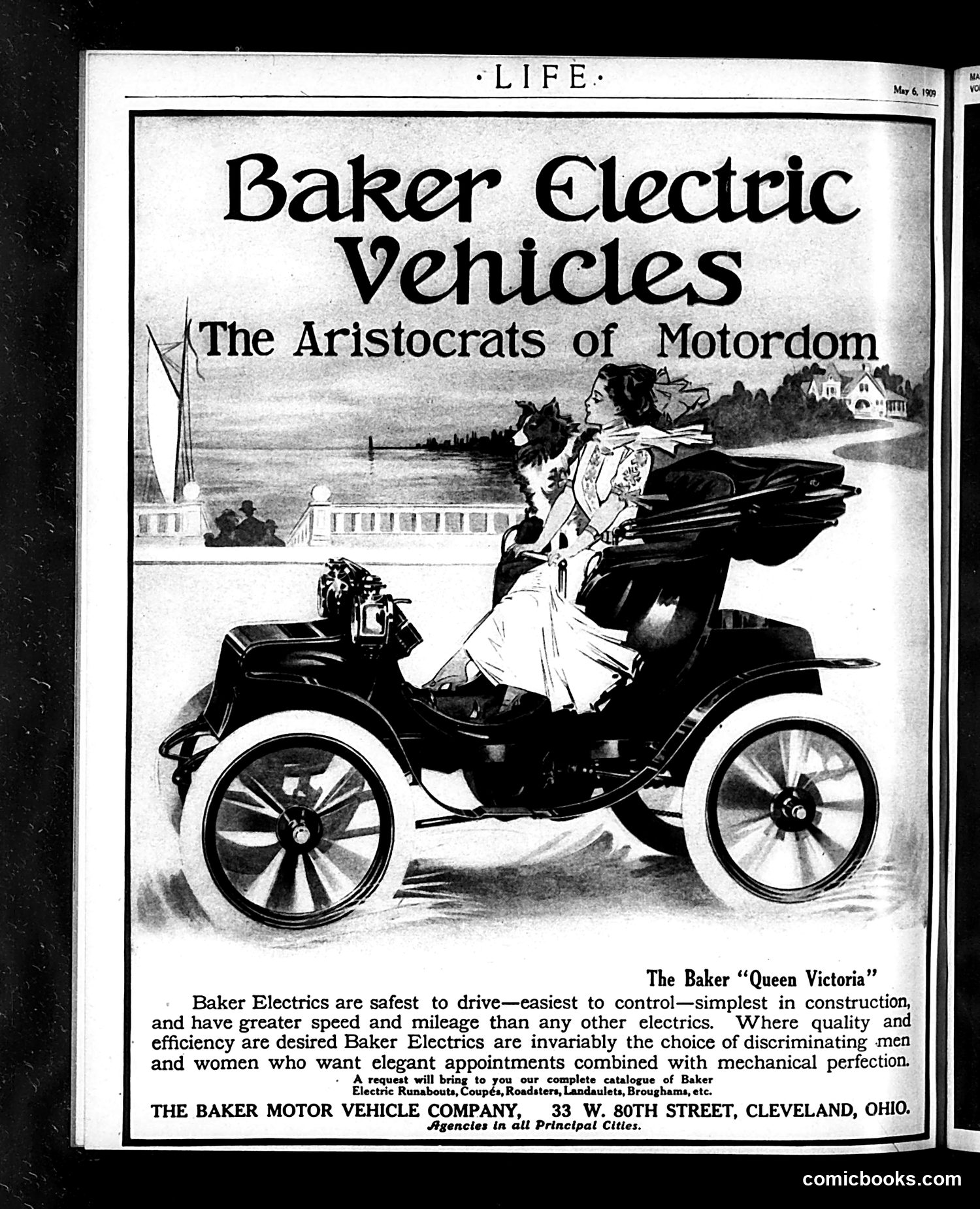
This is a **full-page advertisement**, not satire or political commentary. It promotes the Baker Motor Vehicle Company's electric automobiles, specifically the "Queen Victoria" model. The imagery depicts an elegantly dressed woman in early 1900s attire riding in a luxury electric carriage, establishing the target market: wealthy, refined consumers—"discriminating men and women" seeking both mechanical reliability and aesthetic sophistication. The "Queen Victoria" name evokes royalty and prestige. The pastoral background suggests leisure and grace. The advertisement emphasizes electric vehicles' advantages: safety, ease of control, speed, and mileage compared to competitors. This reflects the early automotive era (pre-1910) when electric cars were considered superior to gasoline vehicles—quieter, cleaner, and more elegant—appealing particularly to wealthy urban consumers before gasoline engines dominated the market.