
Life, 1909-05-06 · page 12 of 48
Life — May 6, 1909 — page 12: what you’re looking at
What you’re looking at
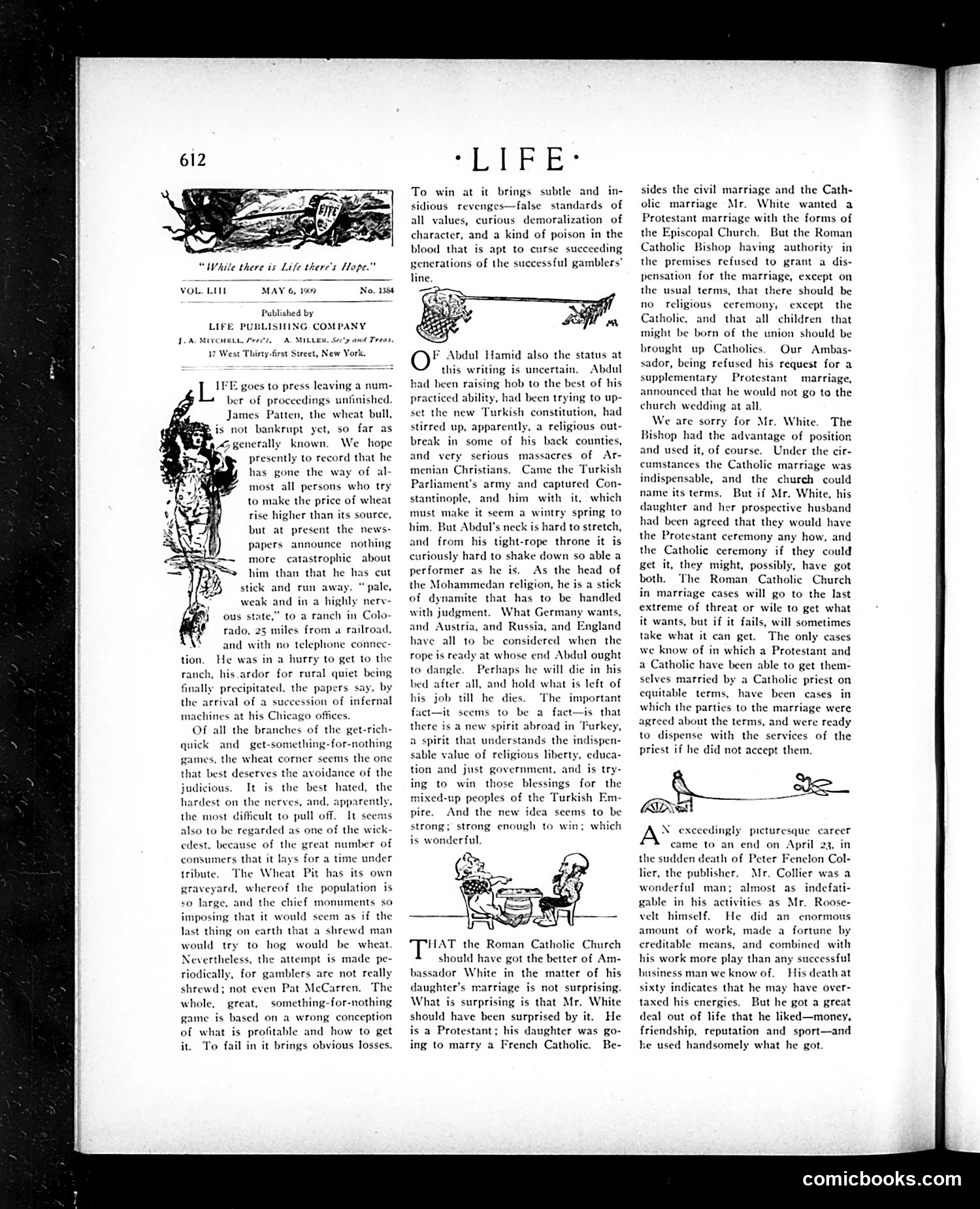
This page contains two distinct articles. The main piece discusses Turkish politics under Abdul Hamid (the Ottoman Sultan), satirizing his precarious political position—he's described as difficult to control and facing pressure from multiple powers (Germany, Austria, Russia, England). The cartoon accompanying this shows a figure in distress, likely representing Abdul Hamid navigating these international pressures. The second article concerns Ambassador White's daughter's interfaith marriage—a Protestant marrying a French Catholic. The satirical point critiques White's surprise at the situation, noting that as a Protestant diplomat, he should have anticipated complications with Catholic marriage requirements and the church's authority over such unions. The satire mocks both religious rigidity and diplomatic naïveté.
📄 Transcribed text from this page (OCR, searchable)
Machine-transcribed from the original scan — historical spelling and the odd misread are preserved.
“While there is Life VOL. Lill MAY 6, 199 No. 1358 Published by LIFE PUBLISHING COMPANY A MILLER, Secty and Treas, ere’s Hope.” CORLL, Prete, 17 West Thirty-first Street, New York. L" 2 goes to press leaving a num- ber of proceedings unfinished. James Patten, the wheat bull, is not bankrupt yet, so far as generally known. We hope presently to record that he has gone the way of al- most all persons who try to make the price of wheat rise higher than its source, but at present the new: papers announce nothing more tastrophic about ps him than that he has cut Bs stick and run away, “ pale, weak and in a highly nerv- ous state,” to a ranch in Colo- rado, 25 miles from a railroad, and with no telephone conne tion. He was in a hurry to get to the ranch, his.ardor for rural quiet being finally precipitated. the papers say. by the arrival of a succession of infernal machines at his Chicago offices. Of all the branches of the get-rich- quick and get-something-for-nothing games, the wheat corner seems the one that best deserves the avoidance of the judicious. It is the best hated, the hardest on the nerves, and, apparentl, the most difficult to pull off. It seen also to be regarded as one of the wick- cdest, because of the great number of consumers that it lays for a time under tribute. The Wheat Pit has its own graveyard, whercof the population is so large, and the chief monuments so imposing that it would seem as if the last thing on earth that a shrewd man would try to hog would be wheat Nevertheless, the attempt is made p riodically, for gamblers are not re: shrewd; not even Pat McCarren, The whole, great, something-for-nothing game is based on a wrong conception tis profitable and how to get brings obvious losses. of wh it. To fail in oP ei To win at it brings subtle and in- sidious revenges—false standards of all values, curious demoralization of character, and a kind of poison in the blood that is apt to curse succeeding generations of the successful gamblers’ Oo Abdul Hamid also the status at this writing is uncertain, Abdul had been raising hob to the best of his practiced ability, had been trying to up- set the new Turkish constitution, had stirred up, apparently, a religious out- break in some of his back counties, and very serious massacres of Ar- menian Christians. Came the Turkish Parliament's army and captured Con- stantinople, and him with it, which must make it seem a wintry spring to him, But Abdul’s neck is hard to stretch, and from his tight-rope throne it is curiously hard to shake down so able a performer as he is. As the head of the Mohammedan religion, he is a stick of dynamite that has to be handled with judgment. What Germany wants, and Austria, and Russia, and England have all to be considered when the rope is ready at whose end Abdul ought to dangle. Perhaps he will die in his bed after all, and hold what is left of his job till he ‘The important fact—i is that there is a new spirit abroad in Turkey, a spirit that understands the indispen- sable value of religious liberty, educa- tion and just government, and is try- ing to win those blessings for the mixed-up peoples of the Turkish Em- pire. And the new idea seems to be strong; strong enough to win; which is wond dies. scems to be a fact- HAT the Roman Catholic Church should have got the better of Am- ador White in the matter of his daughter’s marriage is not surprising. What is surprising is that Mr. White should have been surprised by it. He is a Protestant; his daughter was go- ing to marry a French Catholic. Be- sides the civil marriage and the Cath- olic marriage Mr. White wanted a Protestant marriage with the forms of the Episcopal Church. But the Roman Catholic Bishop having authority in the premises refused to grant a dis- pensation for the marriage, except on the usual terms, that there should be no religious ceremony, except the Catholic, and that all children that might be born of the union should be brought up Catholics. Our Ambas- sador, being refused his request for a supplementary Protestant marriage, announced that he would not go to the church wedding at all. We are sorry for Mr. White. The Bishop had the advantage of position and used it, of course. Under the cir- cumstances the Catholic marriage was indispensable, and the church could name its terms. But if Mr. White, his daughter and her prospective husband had been agreed that they would ha the Protestant ceremony any how, and the Catholic ceremony if they could get it, they might, possibly, have got both. The Roman Catholic Church in marriage cases will go to the last extreme of threat or wile to get what it wants, but if it fails, will sometimes take what it can get. The only cases we know of in which a Protestant and a Catholic have been able to get them- selves married by a Catholic priest on equitable terms, have been cases in which the parties to the marriage were agreed about the terms, and were ready to dispense with the services of the priest if he did not accept them. St ADs exceedingly picturesque career A’ came to an end on April 23, in the sudden death of Peter Fenelon Col- lier, the publisher, Mr. Collier was a wonderful man; almost as indefati- gable in his activities as Mr. Roose- velt himself. He did an enormous amount of work, made a fortune by creditable means, and combined with his work more play than any successful business man we know of. His death at sixty indicates that he may have over- taxed his energies, But he got a great deal out of life that he liked—money, friendship, reputation and sport—and he used handsomely what he got. comicbooks.com