
Life, 1909-05-06 · page 28 of 48
Life — May 6, 1909 — page 28: what you’re looking at
What you’re looking at
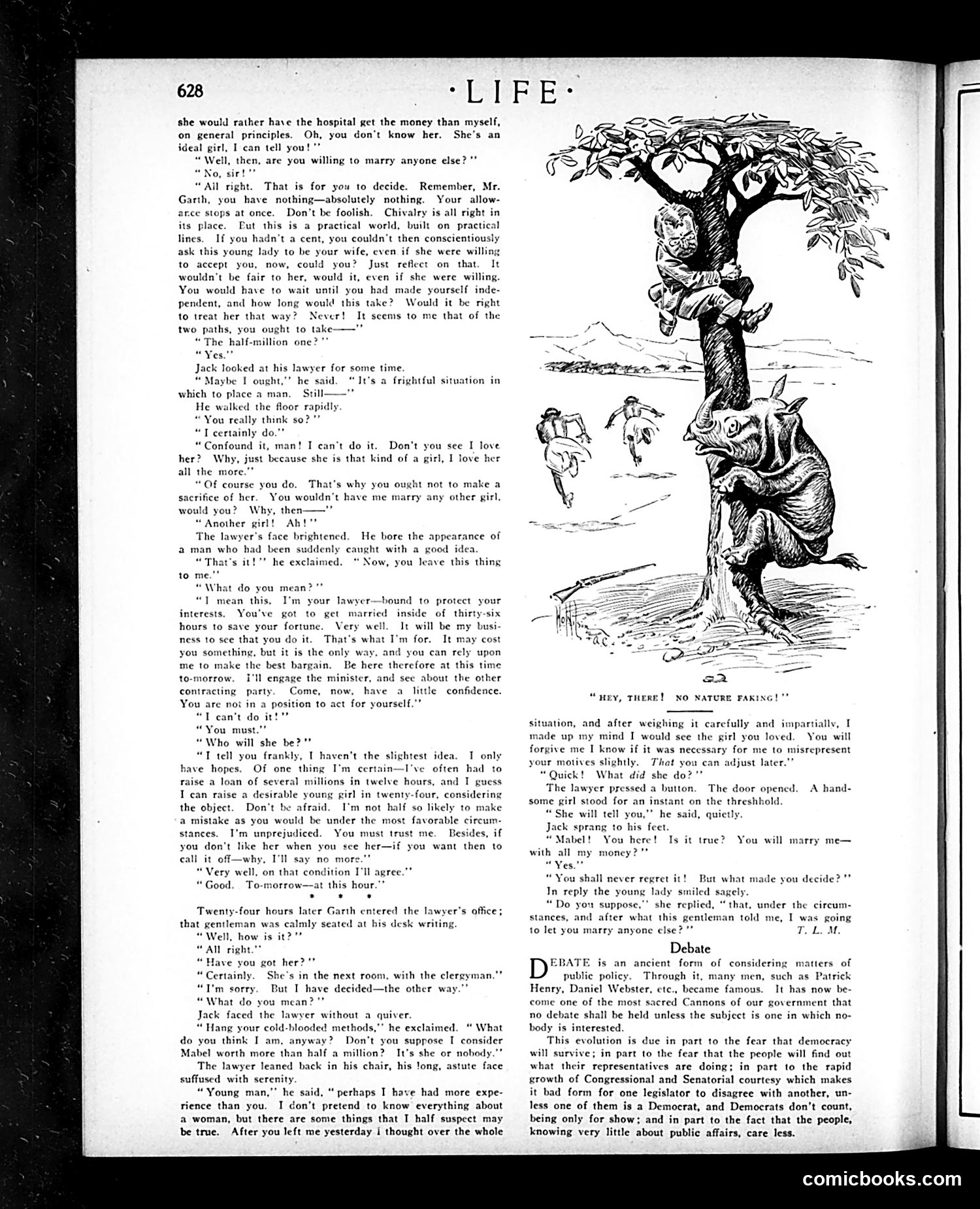
This page depicts a dialogue between a young man (Jack Garth) and his lawyer about a marriage ultimatum. The satire targets **late 19th/early 20th-century attitudes about wealth, love, and practical marriage**. The joke: Jack's father has cut off his allowance unless he marries within 36 hours. The lawyer cynically proposes to *arrange a marriage to any suitable girl*—treating matrimony as a mere business transaction. Jack initially refuses on romantic grounds, insisting he loves a particular woman. The satire's point appears to be **mockery of how the wealthy approached marriage as financial negotiation rather than love**. The lawyer's attitude—that he can "raise a desirable young girl in twenty-four" hours like securing a loan—reduces women to commodities and exposes the mercenary logic underlying supposedly respectable society marriages. The accompanying illustration shows figures in a pastoral setting, likely contrasting innocent romance with the cynical legal/financial machinery discussed in the text. The section titled "Debate" below discusses democracy and legislative disagreement—unrelated to the main narrative.
📄 Transcribed text from this page (OCR, searchable)
Machine-transcribed from the original scan — historical spelling and the odd misread are preserved.
628 . + LIFE: she would rather have the hospital get the money than myself, ‘on general principles. Oh, you don't know her. She's an ideal girl, I can tell you!” Well, then, are you willing to marry anyone else? ”* “No, sir!” “Ail right. That is for you to decide. Remember, Mr. Garth, you have nothing—absolutely nothing. Your allow- arce stops at once. Don't be foolish. Chivalry is all right in its place. Put this is a practical world, built on practical lines. If you hadn't a cent, you couldn't then conscientiously ask this young lady to be your wife, even if she were willing to accept you, now, could you? Just reflect on that. It wouldn't be fair to her, would it, even if she were willing. You would have to wait until you had made yourself inde- pendent, and how long would this take? Would it be right to treat her that way? Never! It seems to me that of the two paths, you ought to take—"" The half-million one?’ “ves. Jack looked at h “Maybe I ought,” he said. which to place a man, Still——"” He walked the floor rapidly “You really think so?" “T certainly do." “Confound it, man! I can't do it, Don't you see I love her? Why, just because she is that kind of a girl, I love her all the more.”” “Qf course you do. That's why you ought not to make a sacrifice of her. You wouldn't have me marry would you? Why, then——"" Another girl! Ah!" The lawyer's face brightened lawyer for some time. It’s a frightful situation in other girl, He bore the appearance of a man who had been suddenly caught with a good idea. “That's it!” he exclaimed. “Now, you leave this thing to me, “What do you mean?” “1 mean this, I'm your lawyer—bound to protect your interests, You've got to get married inside of thirty-six hours to save your fortune. Very well. It will be my busi- ness to see that you do it. That's what I'm for. It may cost you something, but it is the only way, and you can rely upon me to make the best bargain. Be here therefore at t time to-morrow. I'll engage the minister, and see about the other contracting party. Come, now, have a little confidence. You are noi in a position to act for yourself.” “T can't do it!” “You must.” “Who will she be?” “T tell you frankly, I haven't the slightest idea. I only have hopes, Of one thing I’m certain—I've often had raise a loan of several millions in twelve hours, and T I can raise a desirable young girl in twenty-four, consideri the object. Don't be afraid. I'm not half so likely to make a mistake as you would be under the most favorable circum- stances. I'm unprejudiced. You must trust me. Besides, if you don't like her when you sce her—if you want then to call it off—why, I'll say no more Very well, on that condition I'll agree.”* “Good. To-morrow—at this hour.’’ Twenty-four hours later Garth entered the lawyer's office; that gentleman was calmly se: 1 at his desk writing. “Well, how is it?’” “ All right.” “Have you got her? "? “Certainly. She's in the next room, with the clergyman.” “I'm sorry. But I have decided—the other way.” “What do you mean?” Jack faced the lawyer without a quiver. “ Hang your cold-blooded methods,” he exclaimed. “ What do you think I am, anyway? Mabel worth more than half a million? It's she or nobody.” ‘The lawyer leaned back in his chair, his !ong, astute face suffused with serenity “Young man,’” he said, “ perhaps I have had more expe- rience than you. I don’t pretend to know everything about a woman, but there are some things that T half suspect may be true. After you left me yesterday i thought over the whole Don’t you suppose I consider “wey, THERE! NO NATURE FAKING!” situation, and after weighing it carefully and impartially, [ made up my mind I would see the girl you loved. You will forgive me I know if it was necessary for me to misrepresent your motives slightly, That y “Quick! What did she do? The lawyer pressed a button. The door opened. A hand- some girl stood for an instant on the threshhold. She will tell you," he said, quietly. Jack sprang to his feet “Mabel! You here! with all my money?’* “Yes.” “You shall never regret it! But what made you decide In reply the young lady smiled sagely. “Do you suppose,’ she replied, “that, under the circum- stances, and after what this gentleman told me, I was going to let you marry anyone else?” T. LM. Debate De® E is an ancient form of considering matters of public policy, Through it, many men, such as Patrick Henry, Daniel Webster, etc., became famous. It has now be- come one of the most sacred Cannons of our government that no debate shall be held unless the subject is one in which no- body is interested. This evolution is due in part to the fear that democracy will survive; in part to the fear that the people will find out what their representatives are doing; in part to the rapid growth of Congressional and Senatorial courtesy which makes it bad form for one legislator to disagree with another, un- less one of them is a Democrat, and Democrats don’t count, being only for show; and in part to the fact that the people, knowing very little about public affairs, care less. can adjust later Is it true? You will marry me— comicbooks.com