
Life, 1909-05-06 · page 27 of 48
Life — May 6, 1909 — page 27: what you’re looking at
What you’re looking at
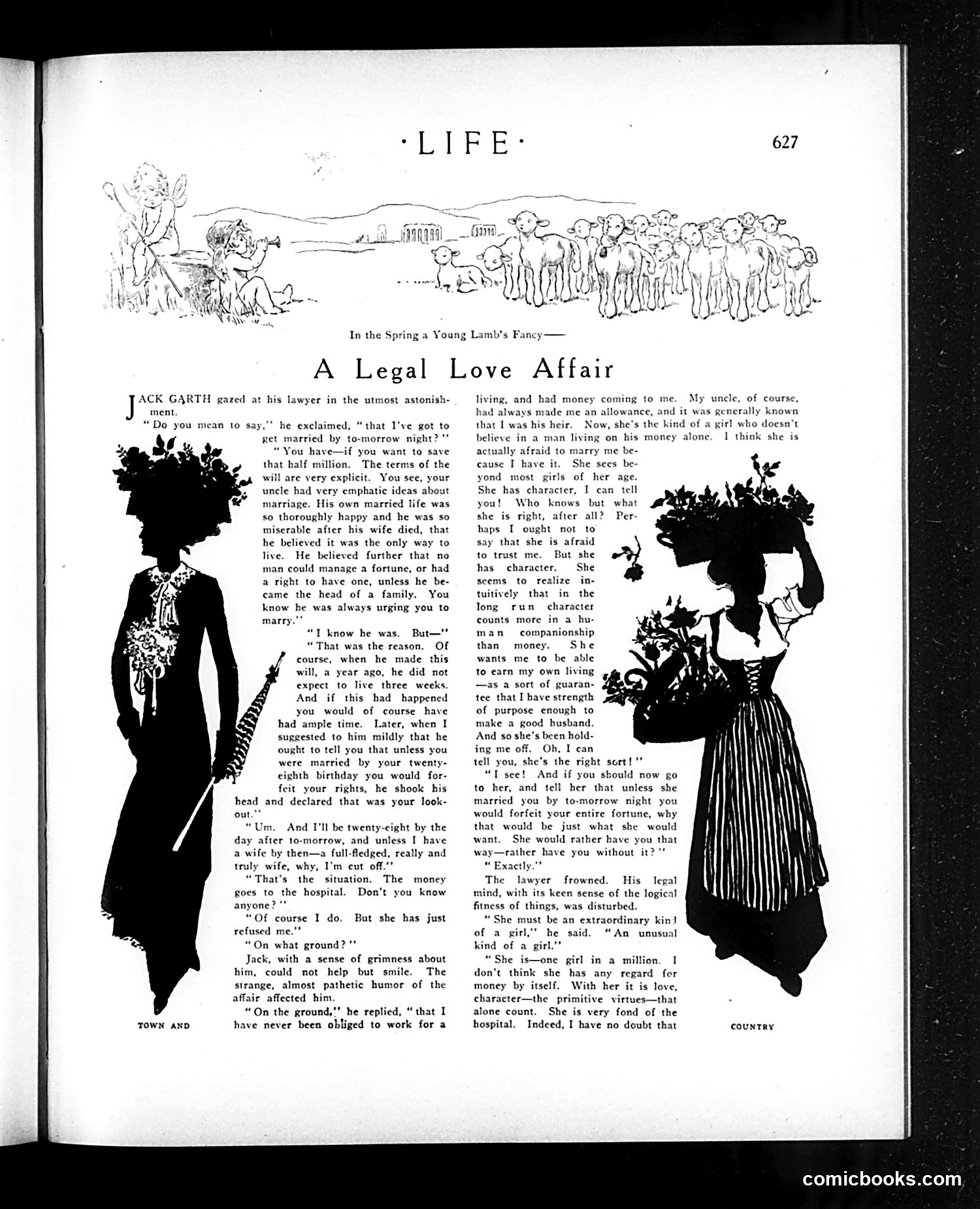
This is a serialized short story, not a political cartoon. It depicts a romantic comedy premise popular in early 20th-century magazines. **The Setup:** Jack Garth learns from his lawyer that his uncle's will requires him to marry by tomorrow (his 28th birthday) to inherit half a million dollars. Otherwise, the money goes to a hospital. **The Satire/Social Commentary:** The story mocks wealthy idleness and questions about character. Jack's love interest has already rejected him because she believes he's too dependent on inherited wealth—she wants proof he can work and support himself. The irony: when Jack tells her about the inheritance condition, she'll be pleased because losing the money will prove his worthiness as a husband. **The Point:** This satirizes both the idle rich (Jack) and romantic ideals about money versus character. The humor lies in how the inheritance ultimatum might actually *help* his romantic prospects by forcing the appearance of self-reliance, even if unintentionally. The silhouette illustrations labeled "Town" and "Country" appear decorative rather than satirical.
📄 Transcribed text from this page (OCR, searchable)
Machine-transcribed from the original scan — historical spelling and the odd misread are preserved.
In the Spring a Young Lamb's Fa A Legal Love Affair ACK GARTH gazed at his lawyer in the utmost astonish- living, and had money coming to me. My uncle, of course, ment. had always made me an allowance, and it was generally known “Do you mean to say,’’ he exclaimed, “that I've got to that I was his heir. Now, she’s the kind of a girl who doesn’t believe in a man living on his money alone. I think she is TOWN AND get married by to-morrow night?" “You have—if you want to save that half million. The terms of the will are very explicit. You see, your uncle had very emphatic ideas about marriage. His own married life was so thoroughly happy and he was so miserable after his wife died, that he believed it was the only way to live. He believed further that no man could manage a fortune, or had a right to have one, unless he be- came the head of a family. You know he was always urging you to marry."" “T know he was, But—'? “That was the reason. Of course, when he made this will, a year ago, he did not expect to live three weeks. And if this had happened you would of course have had ample time. Later, when I suggested to him mildly that he ought to tell you that unless you were married by your twenty- cighth birthday you would for- feit your rights, he shook his head and declared that was your look- out.”* “Um. And I'll be twenty-eight by the day after to-morrow, and unless I have a wife by then—a full-fledged, really and truly wife, why, I'm cut off.”* “That's the situation. The money goes to the hospital. Don’t you know anyone? "’ “Of course I do. But she has just refused me.”” “On what ground?” Jack, with a sense of grimness about him, could not help but smile, The strange, almost pathetic humor of the affair affected him. “On the ground,’” he replied, “that I have never been obliged to work for a actually afraid to marry me be- cause I have it. She sees be- yond most girls of her age. She has character, I can tell you! Who knows but what she is right, after all? Per haps I ought not to say that she is afraid to trust me. But she has character. She seems to realize in- tuitively that in the long run character counts more in a hu- man companionship than money. She wants me to be able to earn my own living —as a sort of guaran- tee that I have strength of purpose enough to make a good husband. And so she’s been hold- ing me off. Oh, I can tell you, she’s the right sort!’ “T see! And if you should now go to her, and tell her that unless she married you by to-morrow night you would forfeit your entire fortune, why that would be just what she would want. She would rather have you that way—rather have you without it?” xactly.” The lawyer frowned. His legal mind, with its keen sense of the logical fitness of things, was disturbed. She must be an extraordinary kin! of a girl,” he said. “An unusual kind of a girl.” “She is—one girl in a million. I don’t think she has any regard for money by itself. With her it is love, character—the primitive virtues—that alone count. She is very fond of the hospital. Indeed, I have no doubt that COUNTRY comicbooks.com