
Life, 1909-05-06 · page 21 of 48
Life — May 6, 1909 — page 21: what you’re looking at
What you’re looking at
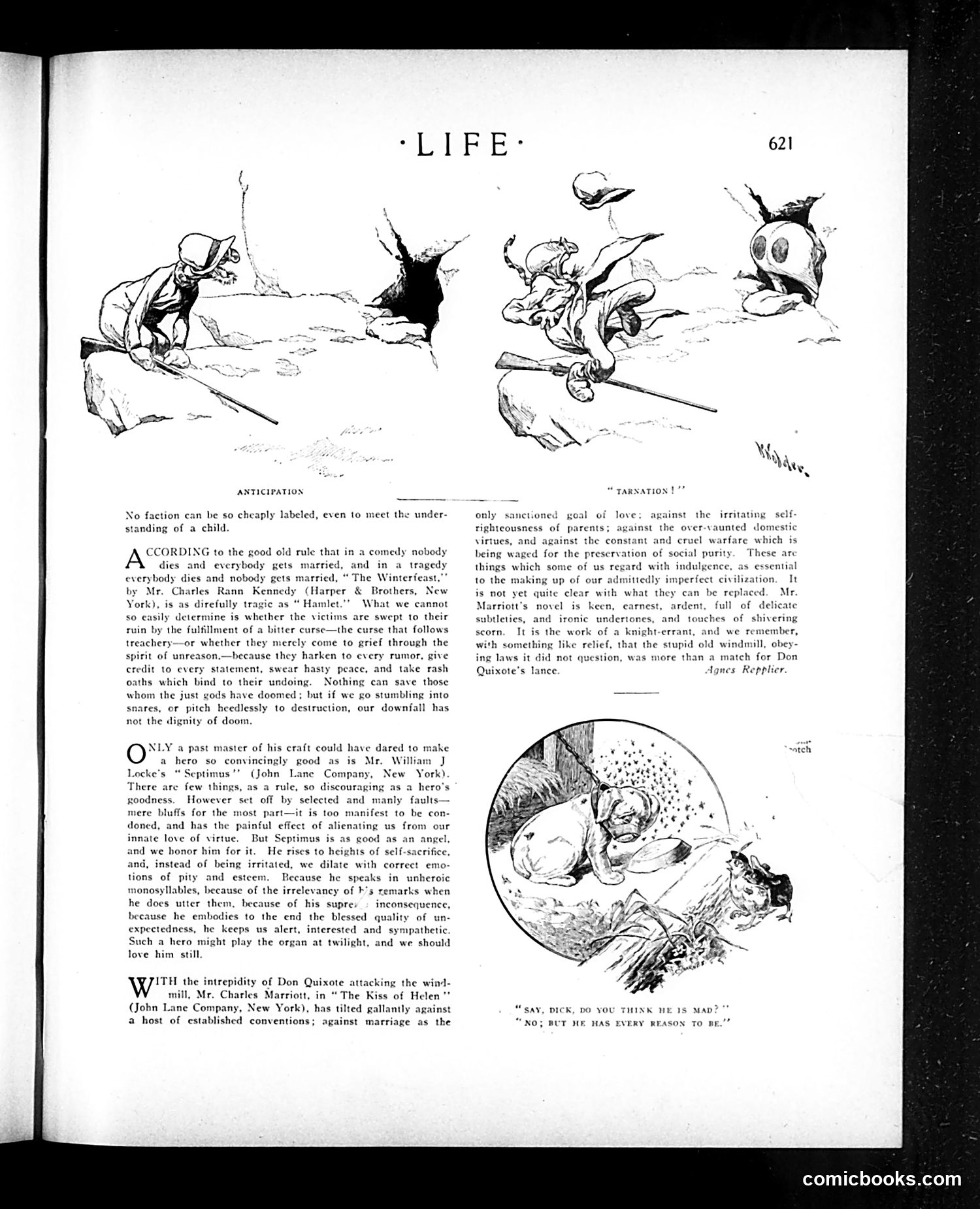
This page reviews three novels with accompanying satirical cartoons. The top illustration depicts characters in comedic distress—appearing to represent themes of fate and foolish decision-making discussed in the review of "The Winterfeast" by Charles Rann Kennedy. The middle section reviews William J. Locke's "Septimus," praising its unusually compelling hero whose virtue doesn't alienate readers because he speaks in "unheroic monosyllables" and maintains blessed unpredictability. The bottom review covers Charles Marriott's "The Kiss of Helen," which challenges social conventions—particularly marriage as love's only sanctioned goal and parental authority. The accompanying circular illustration shows a character in apparent madness or distress, with the caption "Say, Dick, do you think he is mad?" / "No; but he has every reason to be"—suggesting the novel's critique of restrictive social conventions that drive characters to desperation. The satire targets rigid Victorian morality and social expectations.
📄 Transcribed text from this page (OCR, searchable)
Machine-transcribed from the original scan — historical spelling and the odd misread are preserved.
ANTICIPATION No faction can be so cheaply labeled, even to meet the under- standing of a child. CCORDING to the good old rule that in a come dies and everybody gets married, and in everybody dies and nobody gets marrie by Mr. Charles Rann Kennedy (Harper & Brothers, New York), is as direfully tragic as “ Hamlet."” What we cannot so easily determine is whether the victims are swept to their ruin by the fulfillment of a bitter curse—the curse that follows treachery—or whether they merely come to grief through the spirit of unreason,—because they harken to every rumor, give statement, swear hasty peace, and take rash oaths which bind to their undoing. Nothing can save those whom the just gods have doomed ; but if we go stumbling into snares, or pitch heedlessly to destruction, our downfall has not the dignity of doom. y nobody 1 tragedy The Winterfeast, credit to every NLY a past master of his craft could have dared to make a hero so convincingly is Mr. William J Locke's“ Septimus’? (John Company, New York) There are few things, as a rule, so discouraging as a hero's goodness. However set off by selected and manly faults— mere bluffs for the most part—it is too manifest to be con- doned, and has the painful effect of alienating us from our innate love of virtue, good as Lane But Septimus is as good as an angel, He rises to heights of self-sacrifice, and, instead of being irritated, we dilate with correct ¢ tions of pity and esteem. Because he speaks in unheroic monosyllables, because of the irrelevancy of b's remarks when he does utter them, because of his supre: » inconsequence, because he embodies to the end the blessed quality of un- expectedness, he keeps us alert, interested and sympathetic Such a hero might play the organ at twilight, and we should love him still. and we honor him for it ITH the intrepidity of Don Quixote attacking the wind- mill, Mr. Charles Marriott, in “ The Kiss of Helen’ (John Lane Company, New York), has tilted gallantly against a host of established conventions; against marriage as the UY Wy de * TARNATION ! 77 only sanctioned goal of love: the righteousness of parents; virtues, and inst irritating self the over-vaunted domestic nd cruel warfare being waged for the preservation of social purity inst against the consta which is These arc things which some of us regard with indulgence, to the making up of our adm is not yet quite clear wit Marriott's keen, subtleties, undertones, S essential tedly imperfect civilization, It Mr. delicate what they can be replaced full of s of shivering novel is and ir and It is the work of a knight-errant, id we remember, with something like relief, that the stupid old windmill, obey- ing laws it did not question, was more than a match for Don Quixote’s lance Ignes Reppli earnest, ardent nic touc scorn, “SAY, DICK, DO YOU “NO; BUT HE THINK ME IS MAD MAS EVERY REASON TO nE.’? vy comicbooks.com