
Life, 1909-05-06 · page 18 of 48
Life — May 6, 1909 — page 18: what you’re looking at
What you’re looking at
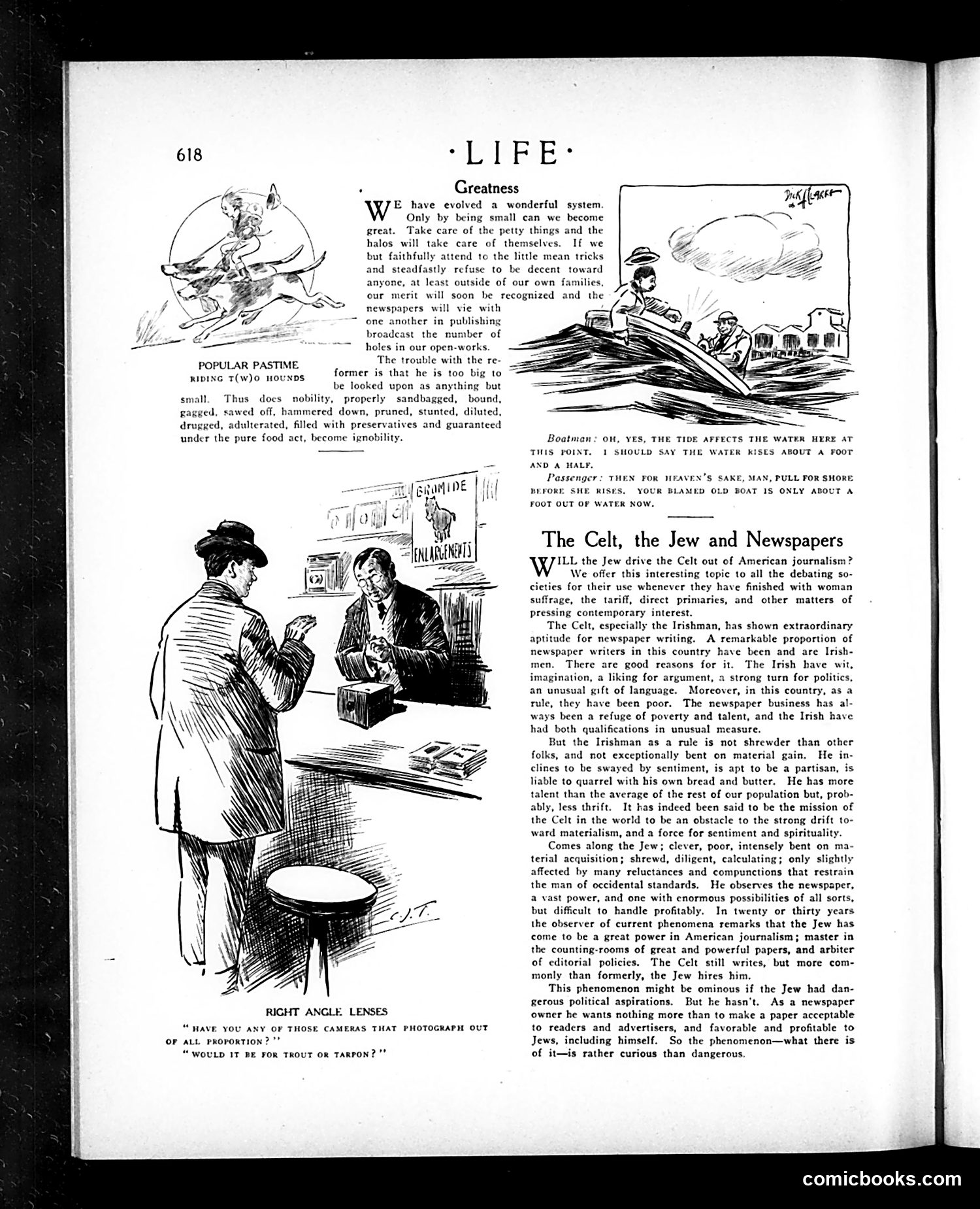
This page contains multiple satirical pieces reflecting early 20th-century American attitudes: **"Greatness"** (top left): A cynical commentary on small-mindedness masquerading as virtue—the satire suggests that neglecting basic decency while focusing on trivial matters will earn newspaper recognition and public merit. **Boatman/Passenger cartoon** (top right): A joke about misunderstanding tidal mechanics. The passenger, panicked that rising tide will sink the boat, doesn't grasp that the boat rises *with* the water. **"The Celt, the Jew and Newspapers"** (main article): This discusses Irish and Jewish influence in American journalism. It characterizes Irish newspaper writers as talented but sentimental and poor, while Jews are portrayed as shrewd, calculating, and materialistic—yet ultimately harmless because they seek only profit, not political power. The piece frames this as "curious rather than dangerous," revealing the era's ethnic stereotyping while attempting to reassure readers about Jewish economic influence. The lower cartoon shows a photographer discussing distorting lenses, likely commenting on exaggeration in reporting.
📄 Transcribed text from this page (OCR, searchable)
Machine-transcribed from the original scan — historical spelling and the odd misread are preserved.
wR E* Greatness E have evolved a wonderful system. Only by being small can we become great. Take care of the petty things and the halos will take care of themselves. If we but faithfully attend to the little mean tricks and steadfastly refuse to be decent toward anyone, at least outside of our own families our merit will soon be recognized and th newspapers will vie with one another in publishing broadcast the number of holes in our open-works. POPULAR PASTIME F rhs treable with ibe re- RIDING T(W)o HOUNDS ‘ormer is that he is too big to be looked upon as anything but small. Thus docs nobility, properly sandbagged, bound, gagged, sawed off, hammered down, pruned, stunted, diluted, drugged, adulterated, filled with preservatives and guaranteed under the pure food act, become ignobility. Boatman: om, YES, THE TIDE AFFECTS THE WATER HERE AT THIS POINT. 1 SHOULD SAY THE WATER KISES ABOUT A FOOT AND A HALF. Passenger: THEN FOR HEAVEN'S SAKE, MAN, PULL FOR SHORE BEFORE SHE RISES, YOUR BLAMED OLD BOAT 1S ONLY ABOUT A FOOT OUT OF WATER NOW. The Celt, the Jew and Newspapers ILL the Jew drive the Celt out of American journalism? We offer this interesting topic to all the debating so- cicties for their use whenever they have finished with woman suffrage, the tariff, direct primaries, and other matters of pressing contemporary interest. The Celt, especially the Irishman, has shown extraordinary aptitude for newspaper writing. A remarkable proportion of newspaper writers in this country have been and are Irish- men. There are good reasons for it. The Irish have wit, imagination, a liking for argument, a strong turn for politics, an unusual gift of language. Moreover, in this country, as a rule, they have been poor. The newspaper business has al- ways been a refuge of poverty and talent, and the Irish have had both qualifications in unusual measure. But the Irishman as a rule is not shrewder than other folks, and not exceptionally bent on material gain, He in- clines to be swayed by sentiment, is apt to be a partisan, is liable to quarrel with his own bread and butter. He has more talent than the average of the rest of our population but, prob- ably, less thrift, It has indeed been said to be the mission of the Celt in the world to be an obstacle to the strong drift to- ward materialism, and a force for sentiment and spirituality. Comes along the Jew; clever, poor, intensely bent on ma- terial acquisition; shrewd, diligent, calculating; only slightly affected by many reluctances and compunctions that restrain the man of occidental standards. He observes the newspaper, a vast power, and one with enormous possibilities of all sorts, but difficult to handle profitably. In twenty or thirty years the observer of current phenomena remarks that the Jew has come to be a great power in American journalism; master in the counting-rooms of great and powerful papers, and arbiter of editorial policies. The Celt still writes, but more com- monly than formerly, the Jew hires him. This phenomenon might be ominous if the Jew had dan- gerous political aspirations. But ke hasn't. As a newspaper RIGHT ANGLE LENSES owner he wants nothing more than to make a paper acceptable “ MAVE YOU ANY OF THOSE CAMERAS THAT PHOTOGRAPH OUT to readers and advertisers, and favorable and profitable to OF ALL PROPORTION ?”? Jews, including himself. So the phenomenon—what there is “ WOULD IT BE FOR TROUT OR TARPON?"* of it—is rather curious than dangerous. comicbooks.com