
Life, 1909-05-06 · page 22 of 48
Life — May 6, 1909 — page 22: what you’re looking at
What you’re looking at
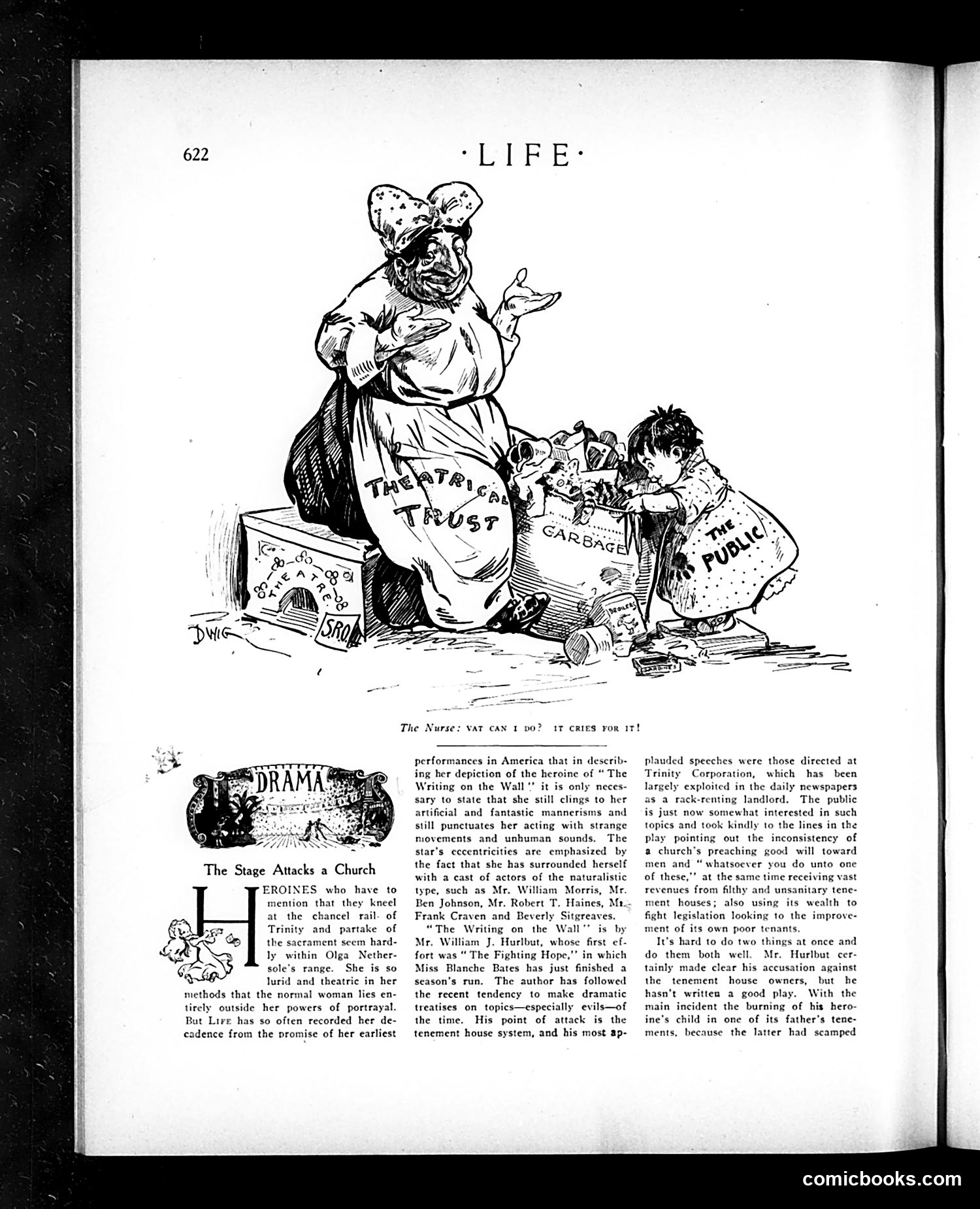
This Life magazine page satirizes actress Olga Nethersole's performance in "The Writing on the Wall," a play attacking Trinity Corporation's ownership of squalid tenement housing in New York City. The main cartoon depicts a corpulent figure labeled "The Patriarchal Trust" surrounded by garbage and a child labeled "The Public." The satire targets the hypocrisy of Trinity Church: it preaches Christian charity ("whatsoever you do unto one of these") while profiting from filthy, unsafe tenements that endanger poor families—literally represented by the garbage and suffering child. The text criticizes both Nethersole's overwrought acting style and praises the play's social message about tenement reform, though faults its dramatic execution. The cartoon and article together illustrate Progressive Era concerns about wealthy institutions exploiting the poor, using the church's moral contradiction as the central point of attack.
📄 Transcribed text from this page (OCR, searchable)
Machine-transcribed from the original scan — historical spelling and the odd misread are preserved.
W SONS 14 The Stage Attacks a Church EROINES who have to mention that they kneel at the chancel rail: of Trinity and partake of the sacrament seem hard- ly within Olga Nether- sole’s range. She is so lurid and theatric in her methods that the normal woman lies en- irely outside her powers of portrayal. Live has so often recorded her de- cadence from the promise of her earliest The Nurse: vat can 1 vo? performances in America that in describ- ing her depiction of the heroine of “ The Writing on the Wall" it is only neces- sary to state that she still clings to her artificial and fantastic mannerisms and still punctuates her acting with strange movements and unhuman sounds. The star's eccentricities are emphasized by the fact that she has surrounded herself with a cast of actors of the naturalistic type, such as Mr. William Morris, Mr. Ben Johnson, Mr. Robert T. Haines, Mt Frank Craven and Beverly Sitgreaves. “The Writing on the Wall'’’ is by Mr. William J, Hurlbut, wh fort was “ The Fighting Hope Miss Blanche Bates has just finished a season's run. The author has followed the recent tendency to m: treatises on topics—especially the time. His point of attack is the tenement house system, and his most ap- 1T CRIES Yor 1T! plauded speeches were those directed at Trinity Corporation, which has been largely exploited in the daily newspapers as a rack-renting landlord. The public is just now somewhat interested in such topics and took kindly to the lines in the play pointing out the inconsistency of a church's preaching good will toward men and “whatsoever you do unto one of these,”’ at the same time receiving vast revenues from filthy and unsanitary tene- ment houses; also using its wealth to fight legislation looking 10 the improve- ment of its own poor tenants. It’s hard to do two things at once and do them both well. Mr. Hurlbut cer- tainly made clear his accusation against the tenement house owners, but he hasn't written a good play. With the main incident the burning of his hero- ine’s child in one of its father's tene- ments, because the latter had scamped comicbooks.com