
Life, 1909-05-06 · page 23 of 48
Life — May 6, 1909 — page 23: what you’re looking at
What you’re looking at
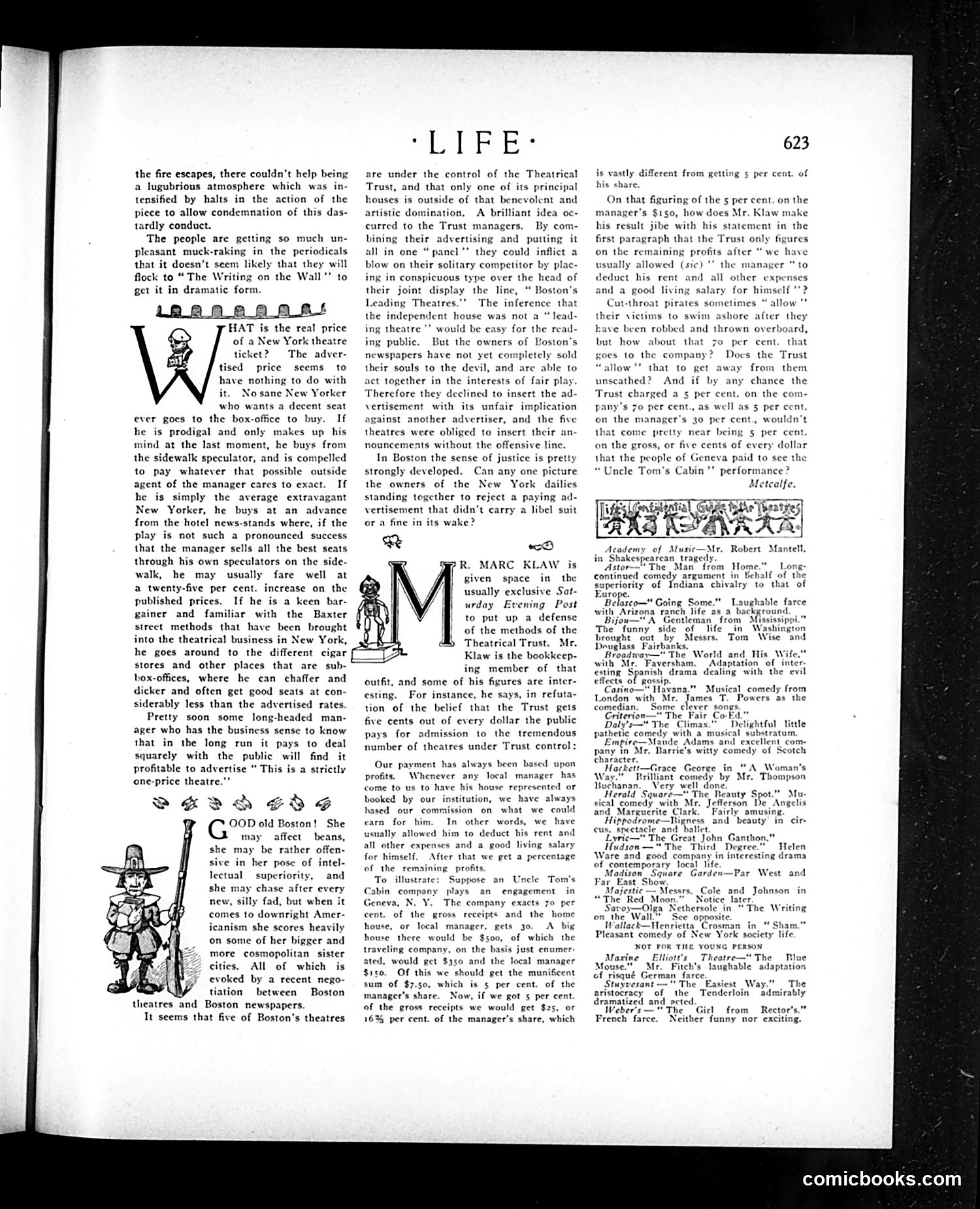
This page from *Life* magazine satirizes theatrical monopolies and corrupt New York business practices around 1900-1910. **The Main Articles:** The top section mocks New York theater ticket scalping—how advertised prices mean nothing because managers collude with sidewalk speculators and hotel news-stands to mark up tickets 25% or more. The author calls for "one-price theater" honesty. The lower section praises Boston for business ethics: five Trust-controlled theaters tried to advertise together with a line calling themselves "Boston's Leading Theatres" (implying the one independent house wasn't leading). Boston newspapers *refused* this unfair ad. The satirist contrasts this with corrupt New York newspapers, which would accept any paying advertisement regardless of deceptive implications. **The Satire:** Life is praising Boston's moral superiority while mocking New York's shameless profit-over-principle approach. The Theatrical Trust (a real monopoly controlling most American theaters) and complicit newspapers exemplify Gilded Age corruption—unfair competition disguised as normal business.
📄 Transcribed text from this page (OCR, searchable)
Machine-transcribed from the original scan — historical spelling and the odd misread are preserved.
the fire eseapes, there couldn't help being a lugubrious atmosphere which tensified by halts in the action of the piece to allow condemnation of this das- tardly conduct. The people are getting so much un- pleasant muck-raking in the periodicals that it doesn’t seem likely that they will flock to “The Writing on the Wall" get it in dramatic form. 112A A 9 A At HAT is the real price of a New York theatre ticket? The adver- tised price seems to have nothing to do with it. No sane New Yorker who wants a decent seat ever goes to the box-office to buy. If he is prodigal and only makes up his mind at the last moment, he buys from the sidewalk speculator, and is compelled to pay whatever that possible outside agent of the manager cares to exact. If he is simply the average extravagant New Yorker, he buys at an advance from the hotel news-stands where, if the play is not such a pronounced success that the manager sells all the best seats through his own speculators on the side- walk, he may usually fare well at a twenty-five per cent. increase on the published prices. If he is a keen bar- gainer and familiar with the Baxter street methods that have been brought into the theatrical business in New York, he goes around to the different cigar stores and other places that are sub- hox-offices, where he can chaffer and dicker and often get good seats at con- siderably less than the advertised rates Pretty soon some long-headed man- ager who has the business sense to know that in the long run it pays to deal squarely with the public will find it profitable to advertise “ This is a strictly one-price theatre.”” SEZ?zVdEIEG OOD old Boston! She may affect beans, she may be rather offen- sive in her pose of intel- lectual superiority, and she may chase after every new, silly fad, but when it comes to downright Amer- icanism she scores heavily on some of her bigger and more cosmopolitan sister cities. All of which is evoked by a recent nego- tiation between Boston theatres and Boston newspapers. It seems that five of Boston's theatres was in- LIFE are under the control of the Theatrical Trust, and that only one of its principal houses is outside of that benevolent and artistic domination, A brilliant idea oc- curred to the Trust managers. By com: bining their advertising and putting it all in one “ panel’? they could inflict a blow on their solitary competitor by plac- ing in conspicuous type over the head of their joint display the line, “ Boston's Leading Theatres."? The inference the independent house was not a “1 ing theatre "’ would be easy for the read- ing public. But the owners of newspapers have not yet completely sold their souls to the devil, and are able to act together in the interests of fair play. Therefore they declined to insert the ad- vertisement with its unfair implication against another advertiser, and the five theatres were obliged to insert their an- nouncements without the offensive line. In Boston the sense of justice is pretty strongly developed. Can any one picture the owners of the New York dailies standing together to reject a paying ad- vertisement that didn't carry a libel suit or a fine in its wake? <S R. MARC KLAW is given space in the usually exclusive Sat- urday Evening Post to put up a defense of the methods of the Theatrical Trust. Mr. Klaw is the bookkeep- ing member of that outfit, and some of his figures are inter- esting. For instance, he says, in refuta- tion of the belief that the Trust gets five cents out of every dollar the public pays for admission to the tremendous number of theatres under Trust control : Our payment has always been based upon profits. Whenever any local manager has come to us to have his house represented oF booked by our institution, we have always hased commission on what we could carn for bim. In other words, we have usually allowed him to deduct his rent and all other expenses and a good living salary for himself. After that we get a percentage of the remaining profits To illustrate: Suppose an Cabin company plays an Geneva, N. Y. The company exacts 70 per cent. of the gross receipts and the home house, or lecal manager, gets 30. A bik house there would be $500, of which the traveling company, on the basis just enumer: ated, would get $350 and the local manager $150. Of this we should get the munificent sum of $7.50, which is 5 per cent. of the manager's share. if we got 5 per cent. of the gross receipts we would get $25, oF 16% per cent. of the manager's share, which Uncle Tom's engagement in Now, 623 is vastly different from getting s per cent. of his share. On that figuring of the 5 per cent. on the manager's $150, how does Mr. Klaw make his result jibe with his statement in the first paragraph that the Trust only figures on the remaining profits after “we have usually allowed (sic) "* the manager “to deduct his rent and all other expenses and a good living salary for himself ""? Cut-throat pirates sometimes “ allow their victims to swim ashore after the have been robbed and thrown overboard, per cent. that Does the Trust but how about that 70 es 10 the company ow’? that to get away from them unscathed? And if by any chance the Trust charged a 5 per cent. on the com- pany’s 70 per cent, as well as 5 per cent. on the manager's 30 per cent, wouldn't that come pretty near being 5 per cent. on the gross, or five cents of every dollar that the people of Geneva paid to see the Uncle Tom’s Cabin" perfor Robert Mantell. in “Shake Astor—"The Man from Home.” Long: continued comedy argument in Behalf of th periority of Indiana chivalry to that of Europe. Belascom" Going Some.” Laughable farce with Arizona ranch life asa background. Bijou—" A Gentleman. from Mississippi.” The funny side of life in Washington brought out by Messrs. Tom Wise and Douglass Fairbanks. Broadway—" The World and His Wife.” with Mr. Faversham. Adaptation of inter. esting Spanish drama dealing with the evil effects of gossip. Casino—" Havana." Musical comedy from London with Mr. James T. Powers as the comedian, me clever songs. Griterion—" The Fair Co-Ed.” ; Daly's—" The Climax.” Delightful tittle pathetic comedy with a musical substratum. ‘mpire—Mande Adams and excellent. com in Mr. Barrie's witty comedy of Scotch “A Woman's Thompson Hackett—Grace George in Way.” Brilliant comedy by Mr. Buchanan. Very well done. Herald Square—" The Treauty Spot.” M I comedy with Mr. Jefferson De Angelis and Marguerite Clark. “Fairly amusing. Hitpodrome—Tigness and beauty’ in cir- cus, spectacle and ballet. Lyric—* The Great John Ganthon. Hudson—" The Third Degree.” Helen Ware and good company in interesting drama of contemporary local life Madison Square Garden—Par West and Far East, Show Majestic — Messrs. Cole and Johnson in “The Red Moon.” Notice later oy—Olga Nethersole in “The Writing ‘on the Wall.” See opposite. Wallack—Henrietta, Crosman in. Sham.” Pleasant comedy of New York society life XOT FOR TILE YOUNG PERSON Maxine Elliott's Theatre—"The Tilue Mouse." Mr. Fitch's laughable adaptation of risqué German farce. Stuyvesant —" The Way.” The aristocracy of the irably dramatized and acted. Weber's—" The C French farce. Easiest Tenderloin adn h from _ Rector’s.” Neither funny nor exciting. comicbooks.com