
A complete issue · 68 pages · 1908
Life — December 3, 1908
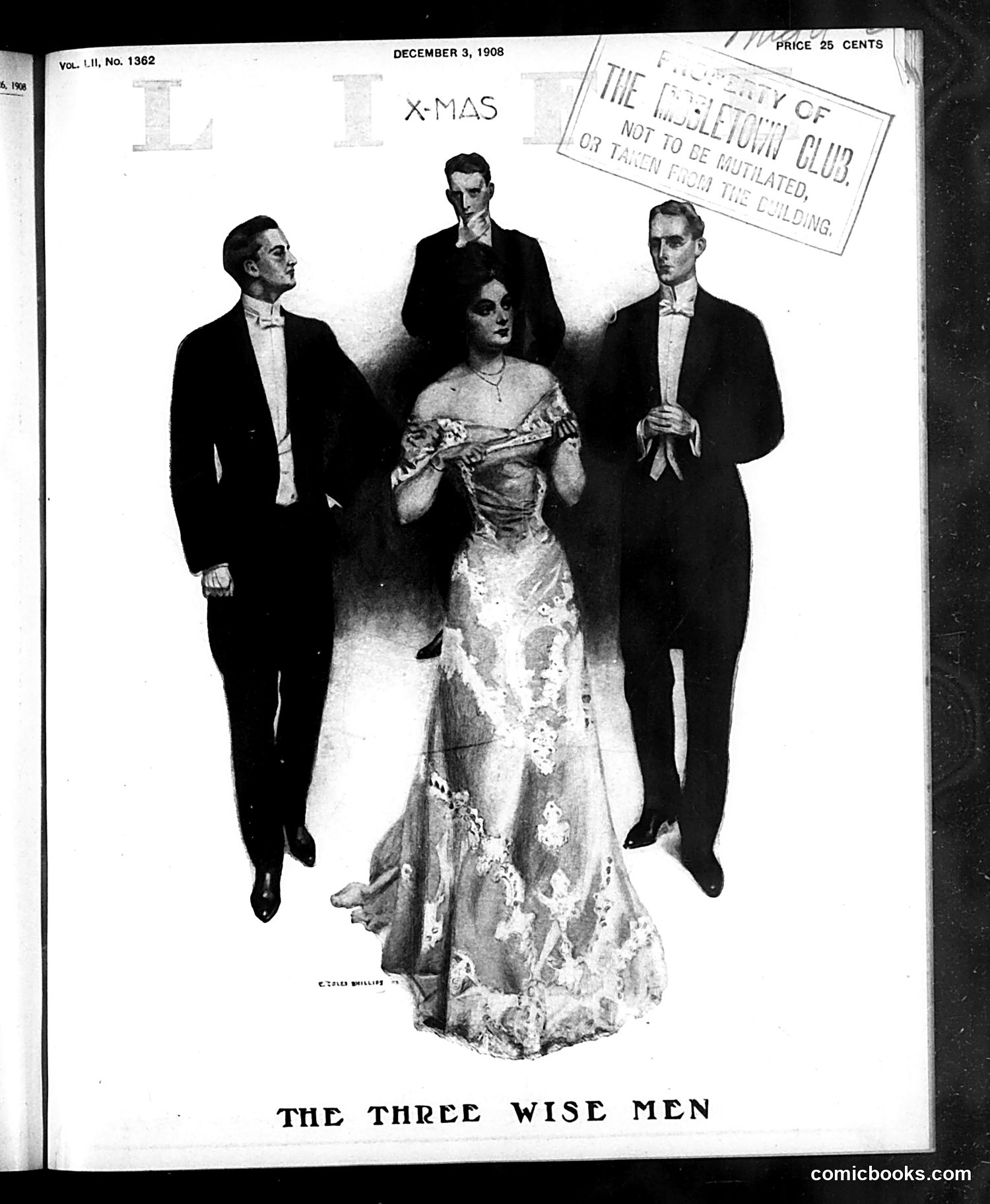
This Christmas-themed satirical illustration depicts three well-dressed men escorting a woman holding what appears to be a gift or child. The caption references "The Three Wise Men" (the biblical Magi), inverting the traditional nativity narrative. The stamp reading "THE PROPRIETY OF [?] CLUB NOT TO BE MUTILATED OR TAKEN FROM THE BUILDING" suggests this was a club publication—likely critiquing wealthy New York society's behavior or a specific scandal involving prominent men and a woman during this period. Without clearer identification of the specific figures or the referenced event, the precise satirical target remains unclear. However, it appears to mock upper-class male conduct or expose some contemporary social impropriety through the inverted nativity framing.
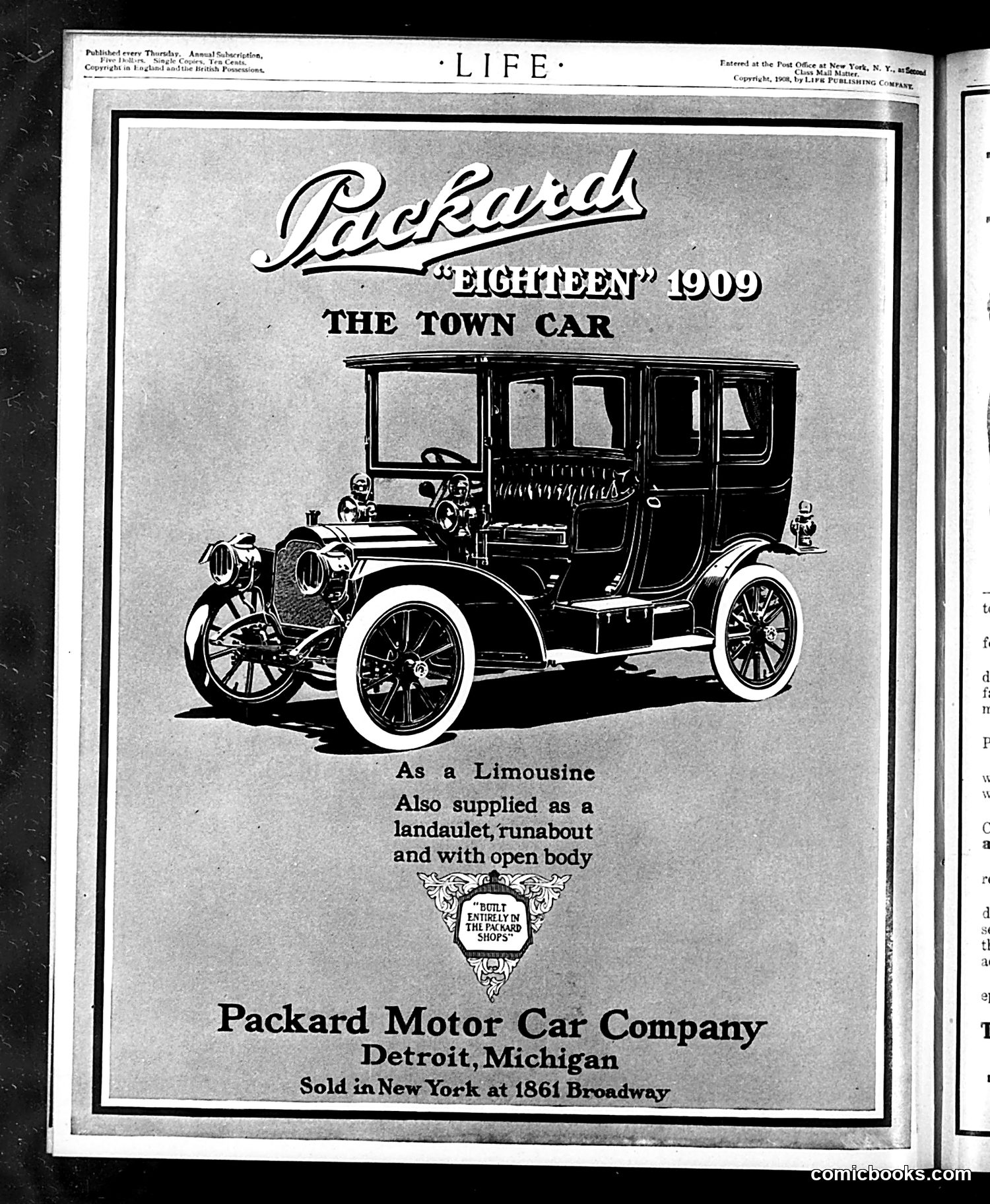
This page is **primarily an automobile advertisement**, not political satire. It features the Packard "Eighteen" 1909 Town Car—a luxury vehicle manufactured by the Packard Motor Car Company of Detroit, Michigan. The ad emphasizes the car's versatility: it could be configured as a limousine, landaulet, runabout, or open-body vehicle. The illustration shows an early motorcar with prominent features typical of 1909 automobiles: large spoked wheels, acetylene headlamps, and an enclosed passenger compartment. The decorative emblem notes the vehicle is "built entirely in the Packard shops," suggesting quality manufacturing. The ad targets wealthy urban buyers, with a sales location listed at 1861 Broadway in New York. There is no political cartoon or satire present on this page.
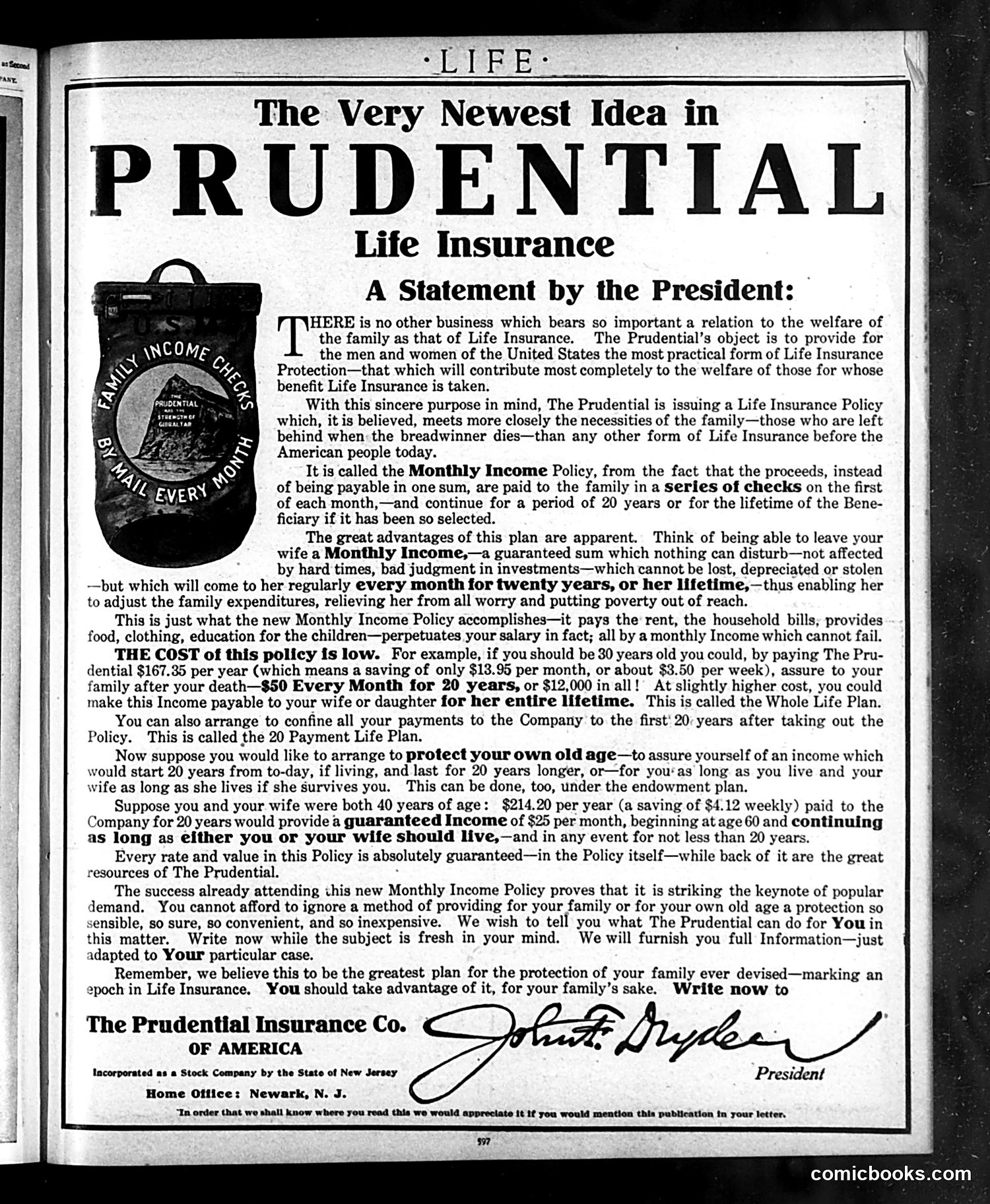
This is **not satirical content** — it's a straightforward **insurance advertisement** from The Prudential Insurance Company of America. There are no political cartoons or caricatures to analyze. The ad promotes Prudential's new "Monthly Income Policy," pitched as innovative life insurance that pays beneficiaries monthly installments rather than a lump sum. The President of Prudential (John F. Dryden, based on the signature) personally endorses the product, emphasizing its affordability and practicality for working families. The only visual element is a decorative insurance policy bag/envelope labeled "Family Income Check—Mail Every Month." This represents early 20th-century consumer advertising targeting middle-class breadwinners concerned about their families' financial security.
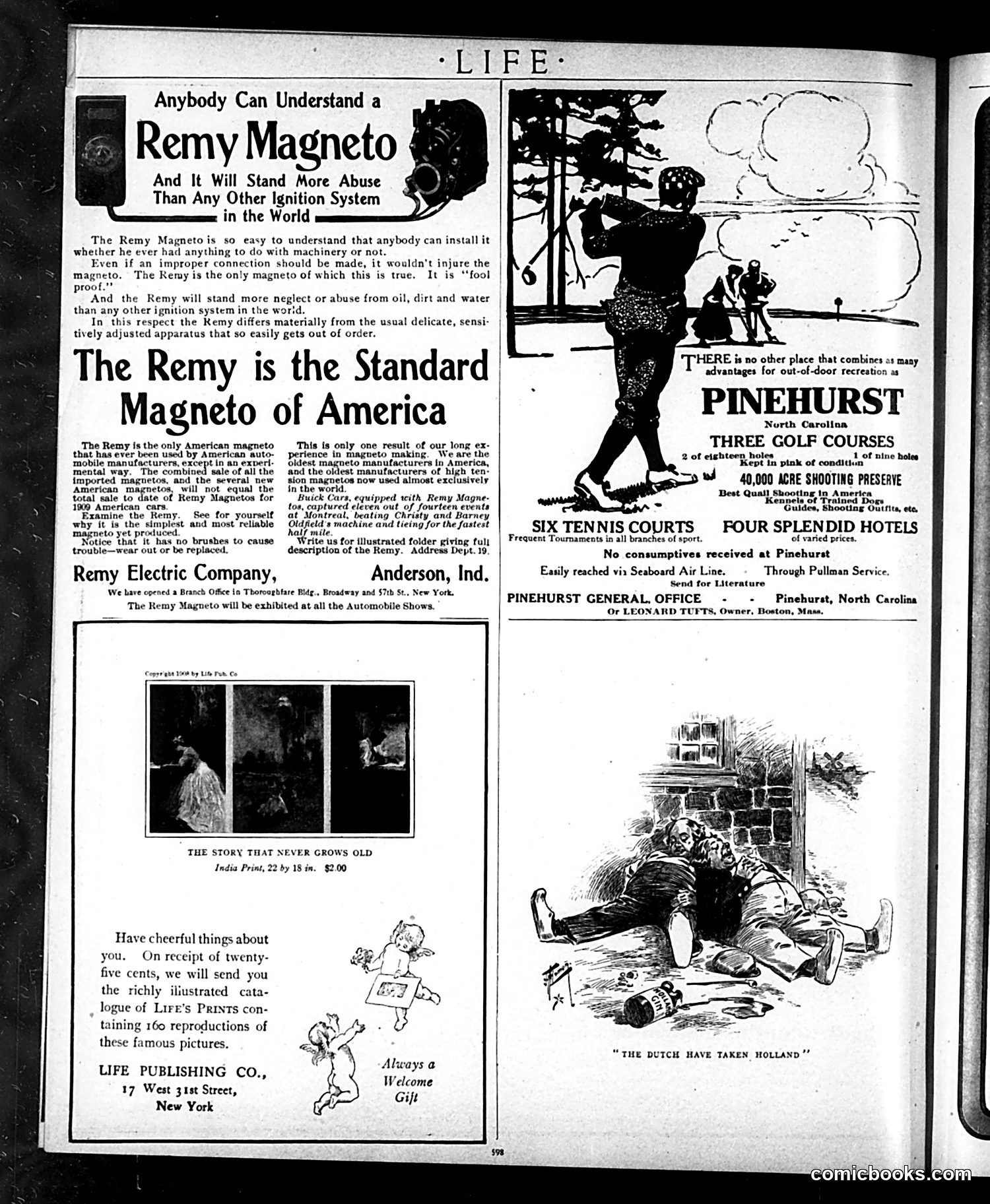
This page is primarily **advertising rather than political satire**. The left side promotes the Remy Magneto ignition system from Anderson, Indiana—marketed as durable and easy to understand for automobile owners. Below that is an ad for Life Publishing Company's print reproductions. The right side advertises **Pinehurst, North Carolina** as a leisure destination, highlighting golf courses, tennis courts, shooting preserves, and hotels. A small illustration captioned "The Dutch Have Taken Holland" appears at the bottom, likely a satirical reference to WWI-era conflicts, though details are unclear without broader context. The page reflects early 20th-century magazine content mixing commercial advertisements with occasional political imagery, typical of Life's format during this period.
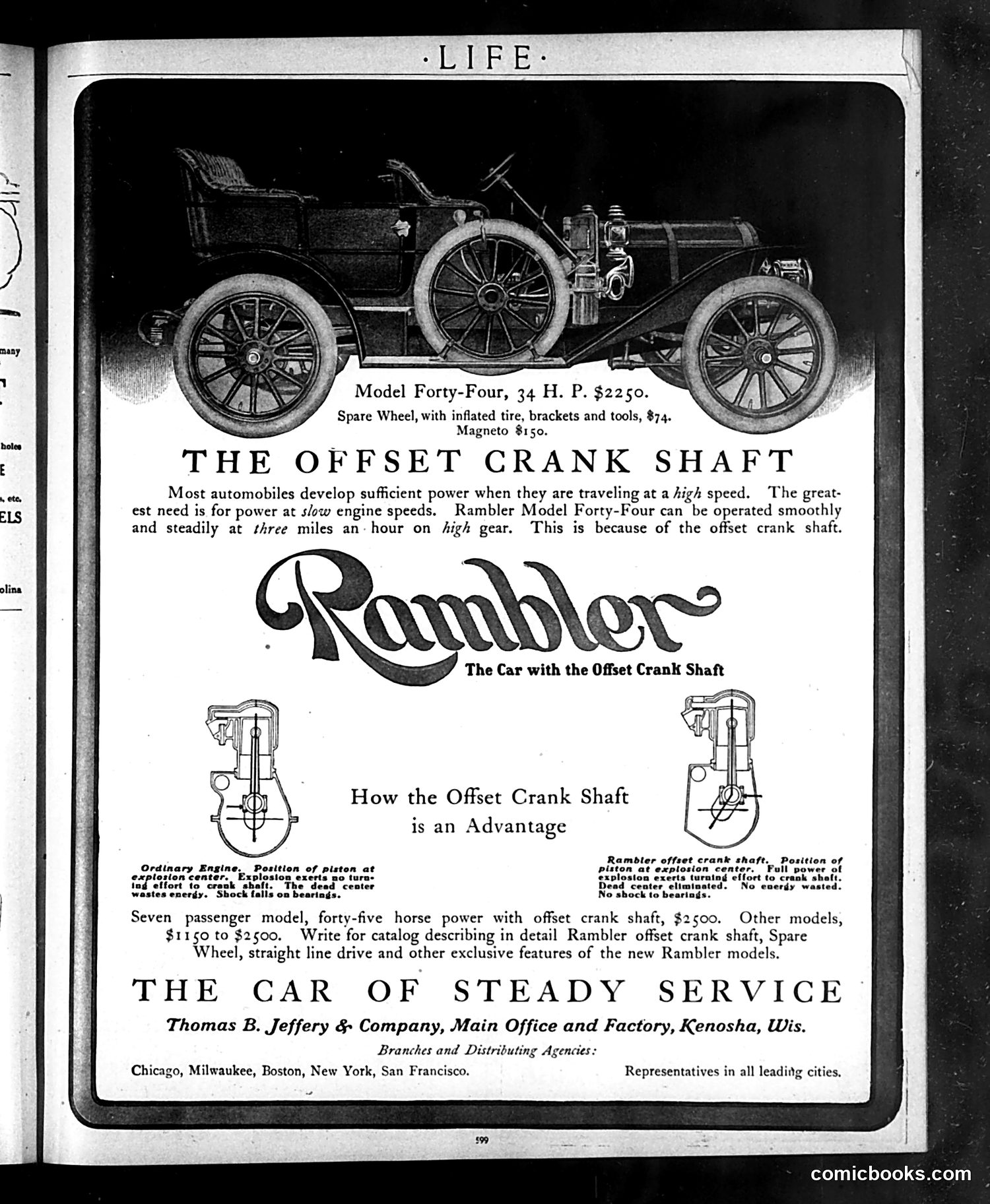
This page is **not satirical or political content**—it's a straightforward automobile advertisement for the Rambler car, manufactured by Thomas B. Jeffery & Company of Kenosha, Wisconsin. The ad promotes the Model Forty-Four, priced at $2,250, highlighting its distinctive "offset crank shaft" as a technical advantage. The text explains that this engineering feature allows the car to operate smoothly at low speeds (three miles per hour), addressing a genuine mechanical problem competitors faced. The page includes a product photograph of the automobile and technical diagrams showing how the offset crank shaft functions differently from standard designs. This represents typical early 1900s automotive advertising, emphasizing mechanical innovation to prospective buyers.
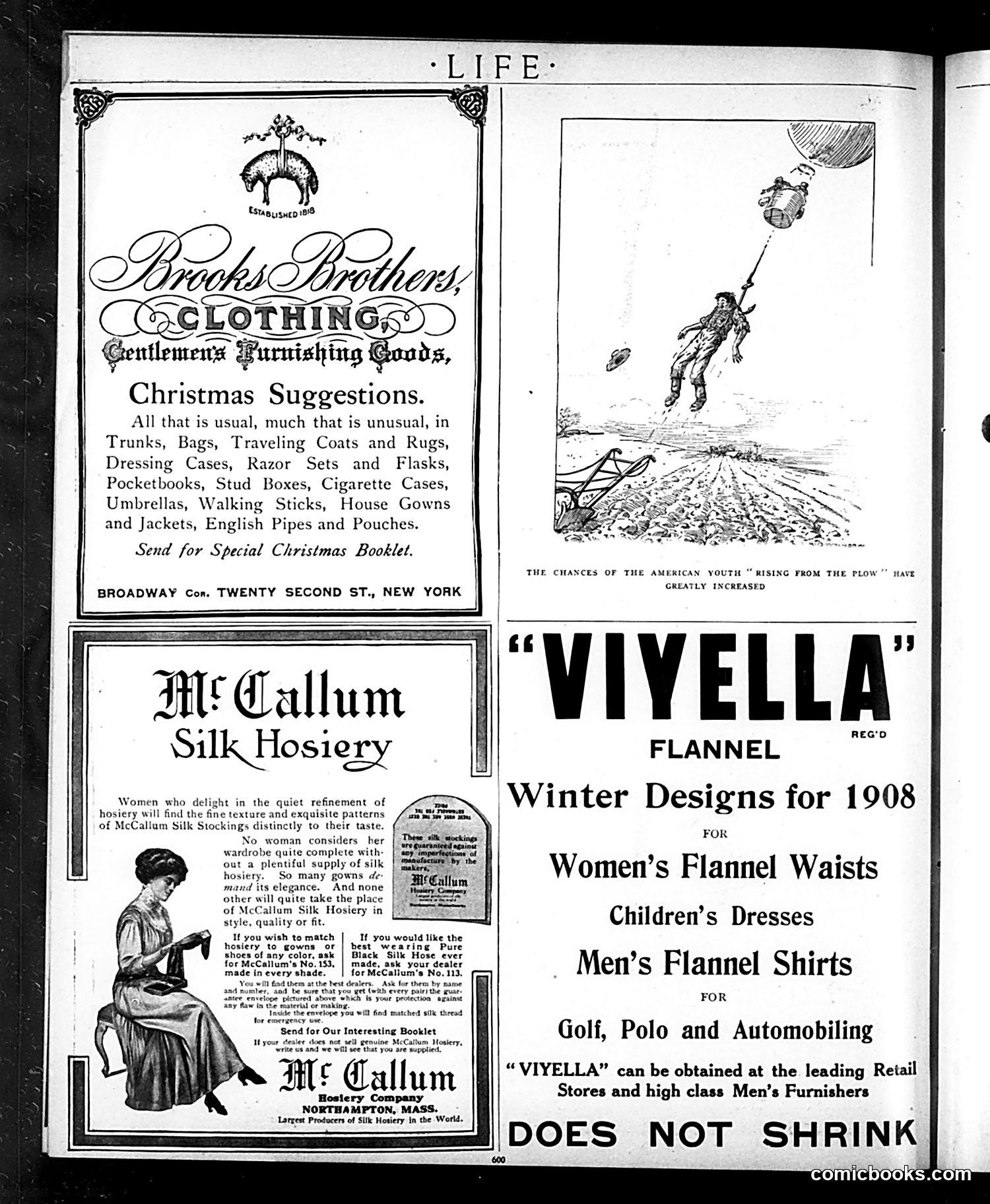
This page is primarily **advertising** rather than editorial content. The left side features Brooks Brothers clothing and McCallum Silk Hosiery ads aimed at holiday shoppers. The right side advertises Vivella flannel fabrics for women's and men's garments. The only cartoon is a small illustration accompanying text stating "THE CHANCES OF THE AMERICAN YOUTH 'RISING FROM THE PLOW' HAVE GREATLY INCREASED." It depicts a figure being lifted by a balloon or parachute away from farmland—likely satirizing popular narratives about social mobility and urbanization in early 1900s America. The image suggests irony about whether farming youth could realistically "rise" economically, or whether this is an exaggerated claim.
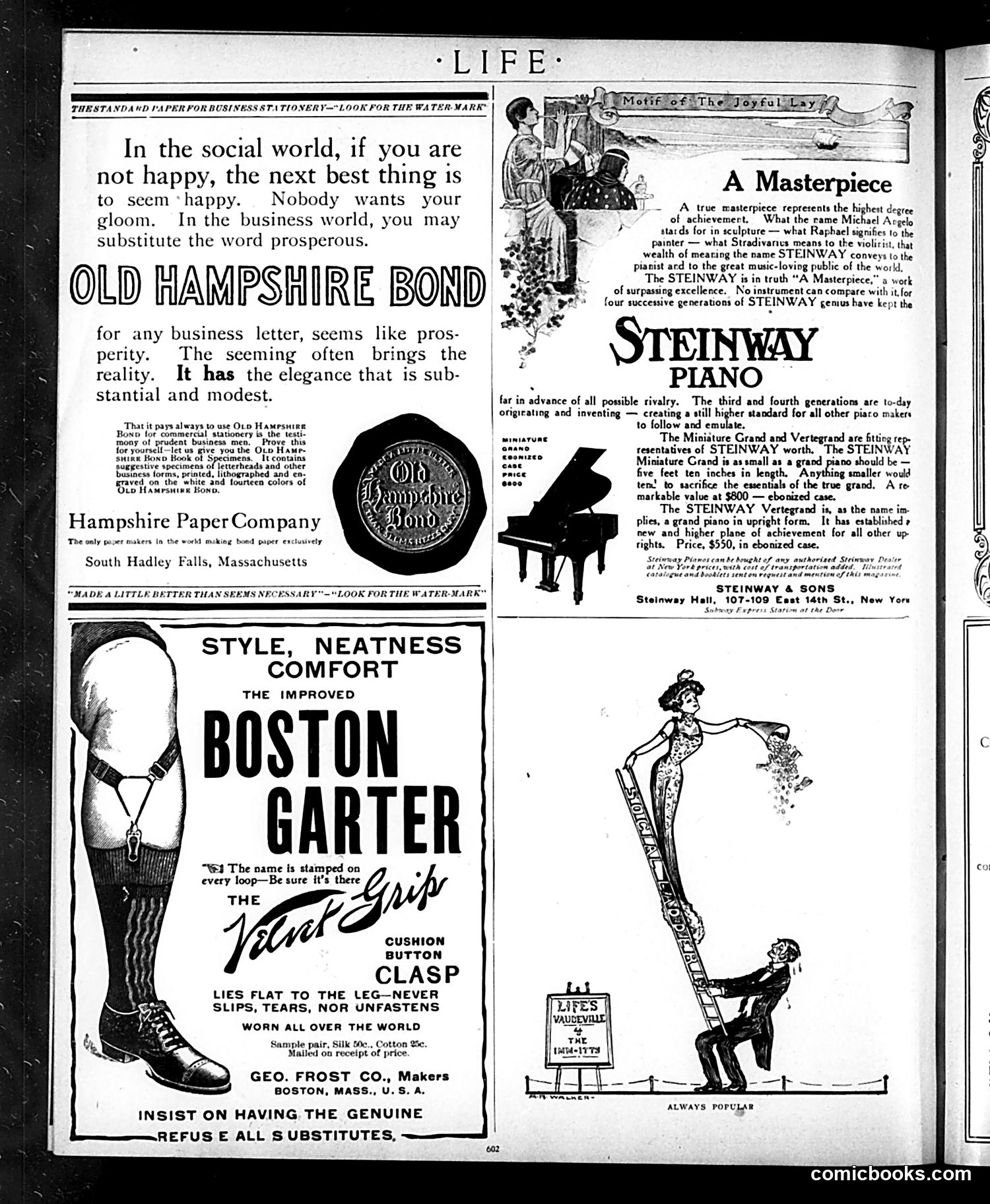
This page is primarily **advertising**, not satire or political commentary. It contains four product advertisements from the early 20th century: 1. **Old Hampshire Bond** paper—positioning business stationery as conveying prosperity and elegance 2. **Steinway Piano**—emphasizing it as a "masterpiece" superior to rivals, appealing to wealthy consumers 3. **Boston Garter**—men's hosiery with a "Velvet Grip" cushion button, featuring anatomical product imagery 4. **Life's Margarine** (bottom right)—showing a couple, presumably advertising food products The opening text about appearing happy in social settings serves as editorial framing for the advertisements. There is no identifiable political satire or caricature on this page—it represents typical *Life* magazine advertising from approximately the 1910s-1920s era, targeting middle and upper-class consumers.
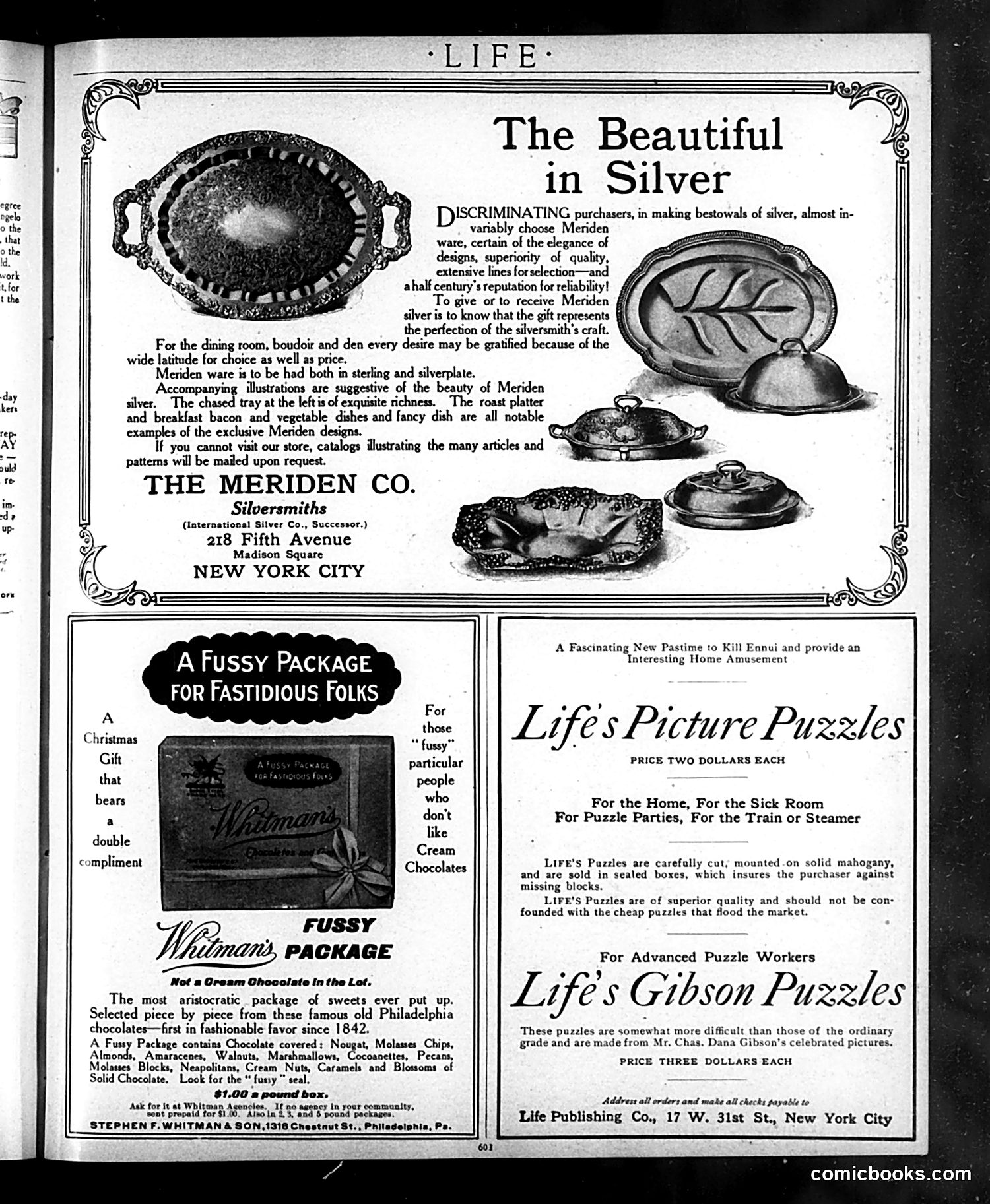
This page is primarily **advertising, not satire or political commentary**. It contains three distinct ads: 1. **Meriden silverware** — promotes elegant dining and serving pieces, emphasizing quality craftsmanship and design options for wealthy households 2. **Whitman's chocolates** — advertises a luxury "Fussy Package" of assorted cream chocolates as a Christmas gift, marketed to discriminating consumers 3. **Life's Picture Puzzles** — promotes jigsaw puzzles at two price points ($2 and $3), positioned as entertainment for homes, sick rooms, and social gatherings The page reflects early 20th-century consumer culture and gift-giving conventions. No political figures or satire are present. The humor is minimal—merely in the playful language ("fussy," "fascinating pastime"). This appears to be a standard advertising section from *Life* magazine.
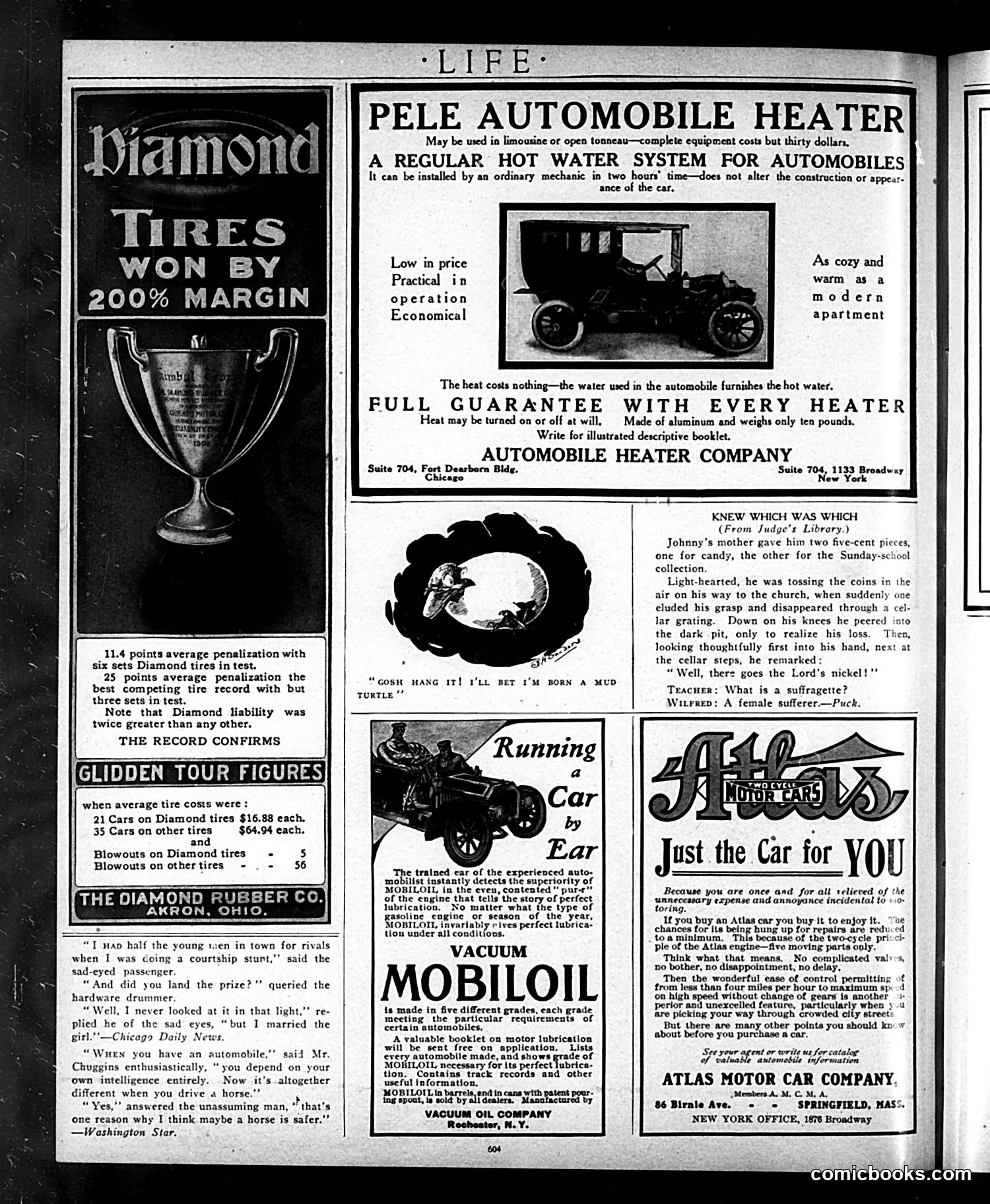
This is primarily a **vintage advertising page** from an early 20th-century *Life* magazine, not a political cartoon page. The advertisements feature automotive products: Diamond Tires (emphasizing durability), a Pele automobile heater, Mobiloil lubricant, and an Atlas motor car. The only satirical element is a small cartoon titled **"Knew Which Was Which"** showing a boy who lost his nickel down a cellar grating while heading to church. The joke plays on the phrase "Lord's nickel"—the humor derives from the child's mistaken belief that losing money meant losing God's money specifically, rather than his own. The page otherwise contains product testimonials and automotive industry data typical of period advertisements.
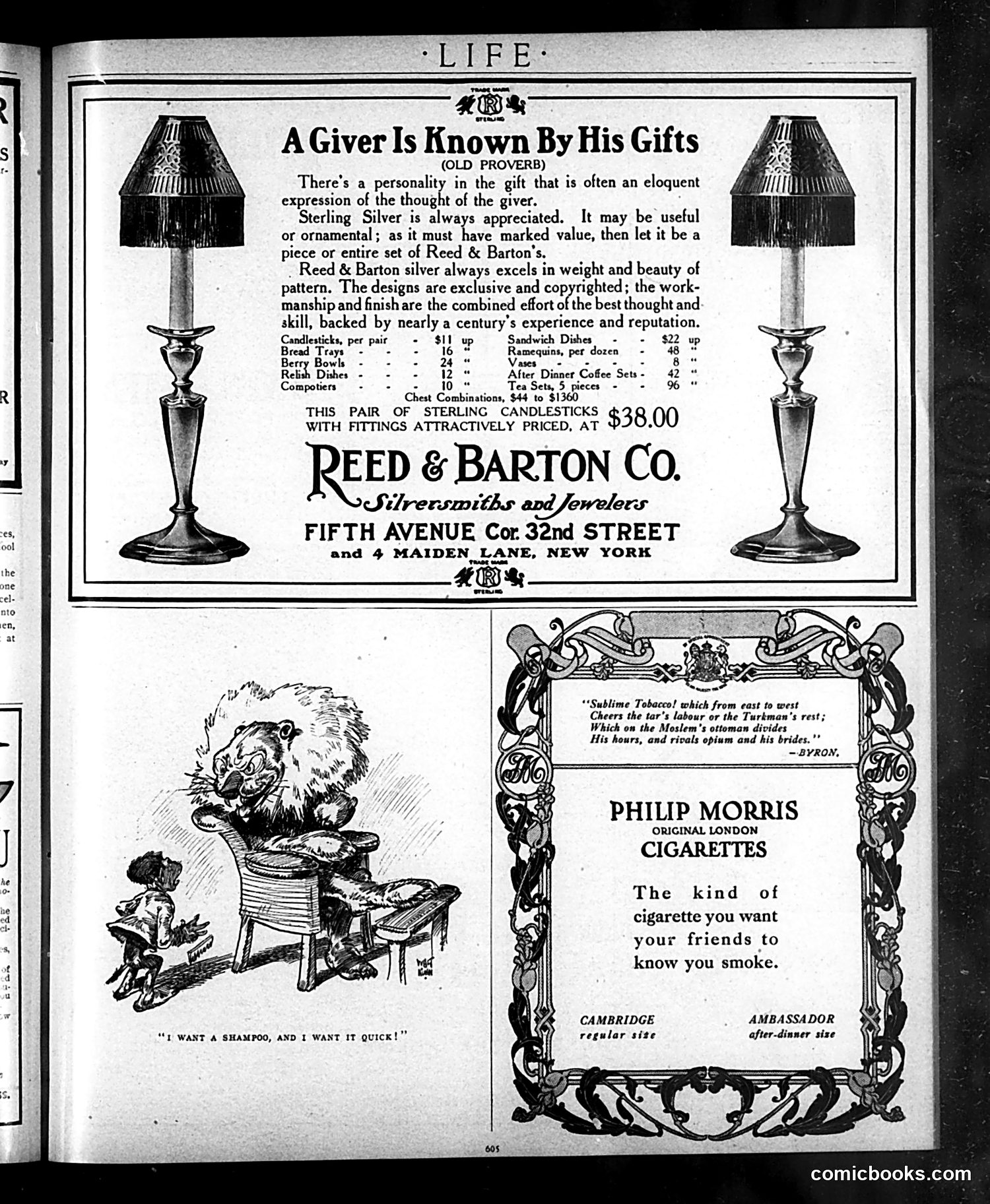
This page is primarily **advertising**, not satire or political commentary. The top half features a Reed & Barton silver candlestick advertisement with the proverb "A Giver Is Known By His Gifts"—positioning sterling silver as an appropriate gift choice. The bottom left contains a humorous illustration of a disheveled animal (appears to be a badger or similar creature) sitting in a chair demanding "I WANT A SHAMPOO, AND I WANT IT QUICK!"—likely advertising a shampoo product, though the advertiser isn't clearly visible in this excerpt. The bottom right promotes **Philip Morris Original London Cigarettes**, using a Byron quote about tobacco and positioning the brand as a status symbol: "the kind of cigarette you want your friends to know you smoke." Two varieties are listed: Cambridge (regular size) and Ambassador (after-dinner size). All content reflects early 20th-century consumer advertising conventions and attitudes.
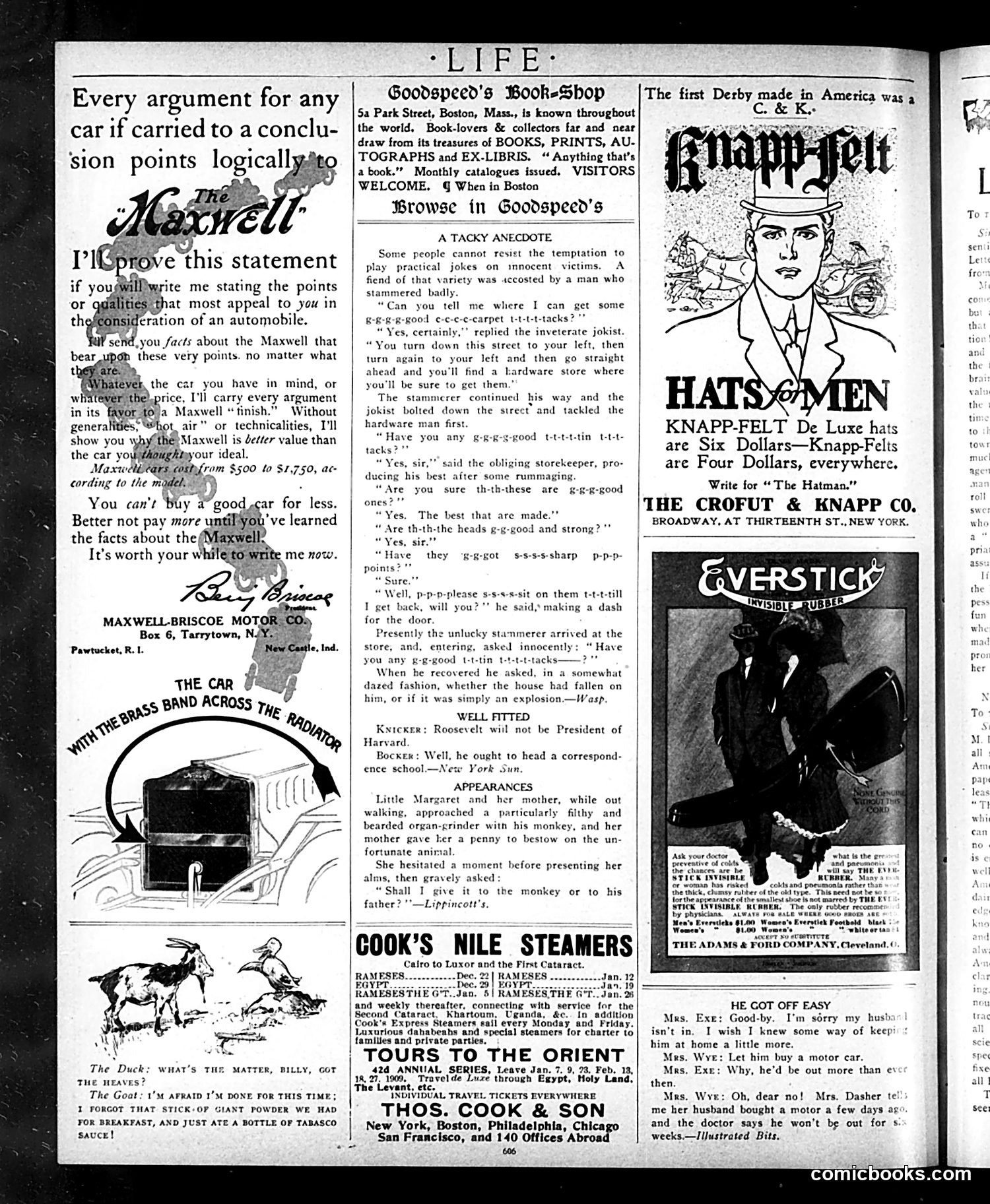
This page is primarily **advertising and light humor** rather than political commentary. The main content includes: - **Maxwell automobile ad** (top left): Argues the Maxwell is logically superior to other cars, using typical early 1900s marketing rhetoric about durability and value. - **Goodspeed's Book Shop ad**: Promotes a Boston rare books dealer. - **"Hats of Men" advertisement**: For Knapp-Felt hats, featuring an illustrated male face. - **Humor sections**: Include anecdotes about stammering customers and absurd situations, representing typical *Life* magazine's satirical humor style—lighthearted, character-based jokes rather than political satire. - **Cook's Nile Steamers ad** and other travel/product advertisements round out the page. The content reflects early 20th-century advertising practices and genteel humor aimed at middle-class readers.
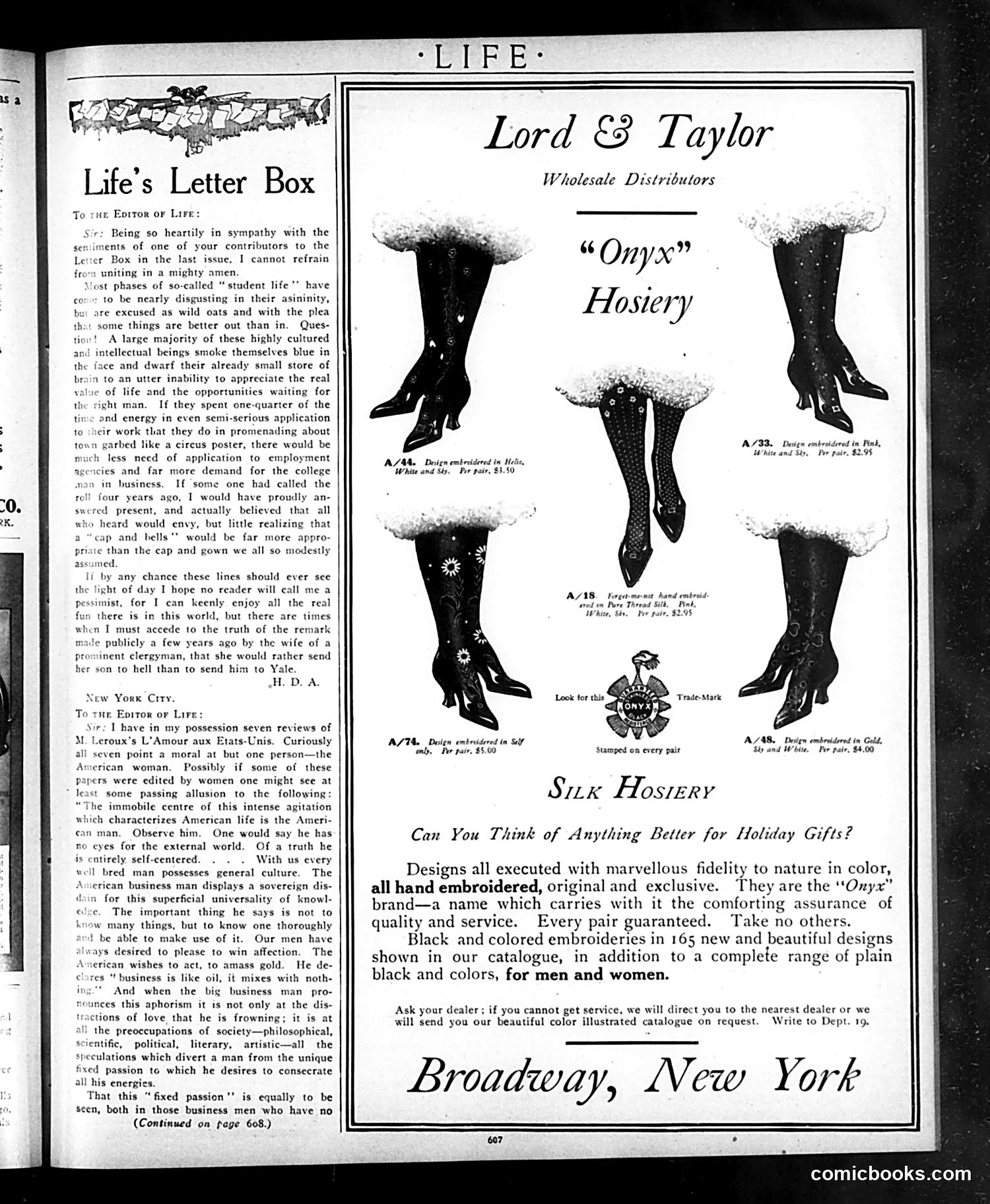
This page is **primarily an advertisement**, not a political cartoon. It features a full-page ad for Lord & Taylor's "Onyx" brand hosiery, showcasing various women's stockings with decorative details like lace trim and embroidered designs. The left side contains **"Life's Letter Box,"** a reader advice column addressing "student life" concerns. One letter criticizes college students for lacking intellectual seriousness and ambition. Another discusses American identity and cultural values. There is **no political cartoon or satire** on this page. The content consists of commercial advertising and a letters-to-the-editor section typical of Life magazine's format during this era (appears to be early 20th century based on the hosiery styles and typography).
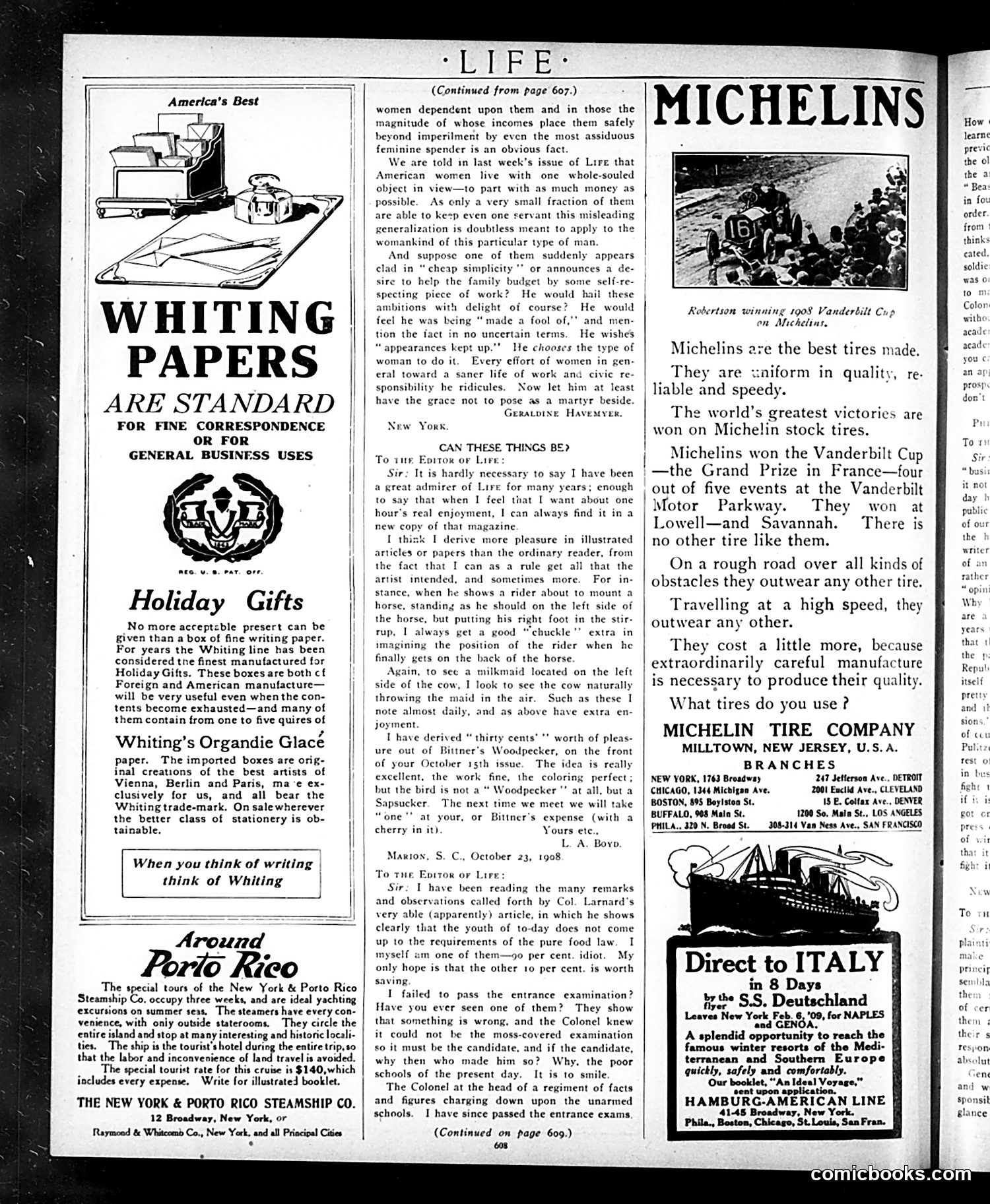
This page is primarily **advertising**, with minimal satirical content. The main elements are: **Advertisements:** - Whiting Papers (fine stationery for correspondence) - New York & Porto Rico Steamship Company (tourist cruises) - Michelin Tires (winning racing competitions) - Direct to Italy steamship service **Editorial Content:** Letters to the editor discussing Life magazine itself. One correspondent praises Life's illustrated articles, noting he enjoys spotting artists' "mistakes"—like horses positioned incorrectly or anatomically impossible poses. He's found "$0.30 worth of pleasure" in such errors. Another letter criticizes an earlier Life article claiming American women spend excessively, arguing this stereotype unfairly targets women while ignoring men who demand "appearances be kept up." **No political cartoons appear on this page.** The content reflects early-1900s advertising practices and readers' engagement with the magazine's humor and social commentary, rather than containing satirical visual commentary itself.
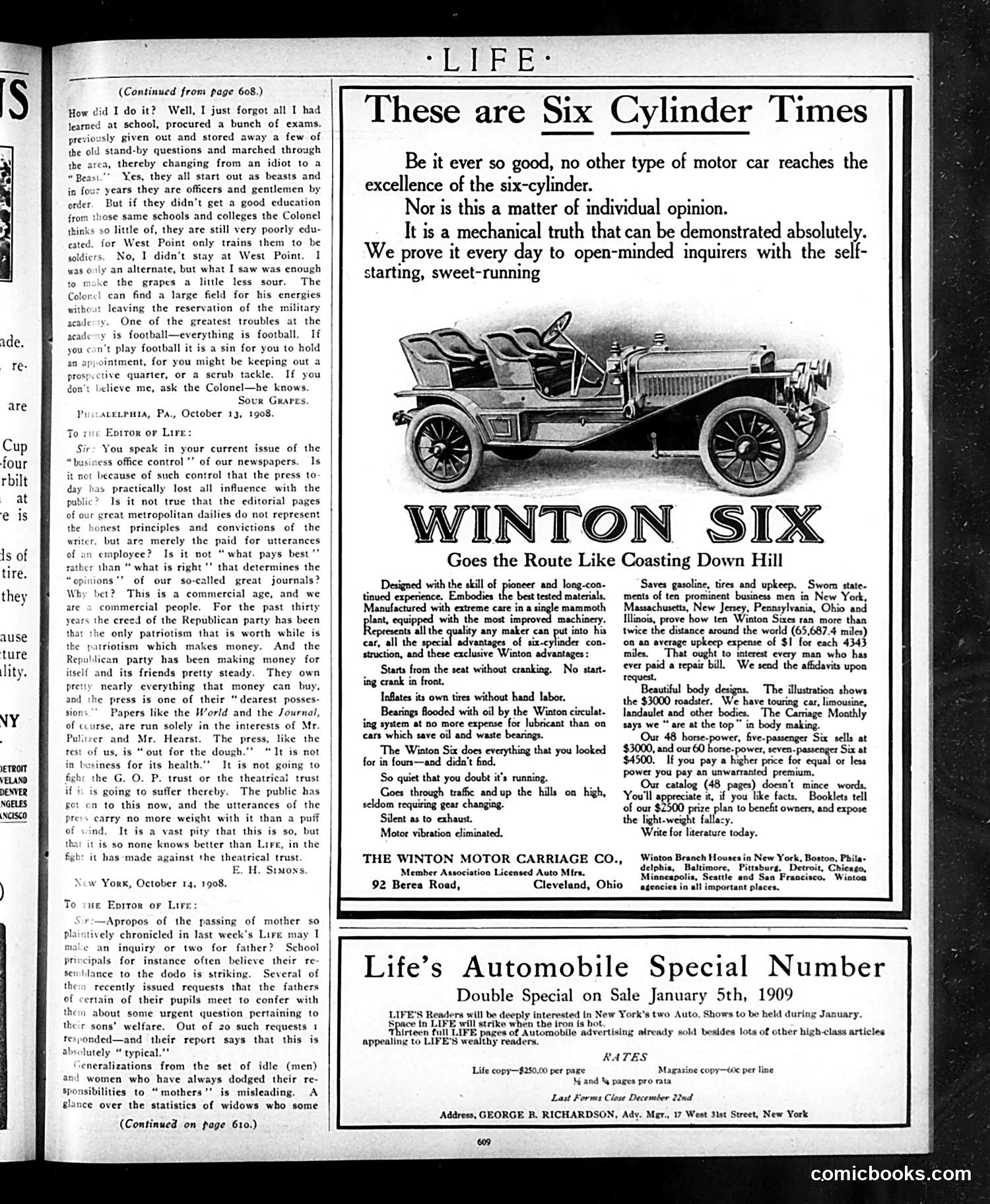
This page is **primarily advertising**, not political satire. The dominant content is a full-page advertisement for the **Winton Six automobile** (1908), which claims superiority of six-cylinder engines over other motor types. The ad uses typical early automotive marketing language about "mechanical truth" and customer testimonials. The left column contains readers' letters to *Life* magazine's editor—standard editorial content addressing serious topics: military education at West Point, newspaper editorial independence, and parental involvement in schools. These are earnest social commentary rather than satire. **No significant political cartoon or satirical content appears here.** The page reflects early 1900s concerns about institutional reform and commercial influence on journalism, but these are presented as straight opinion pieces, not humorous or caricatured commentary.
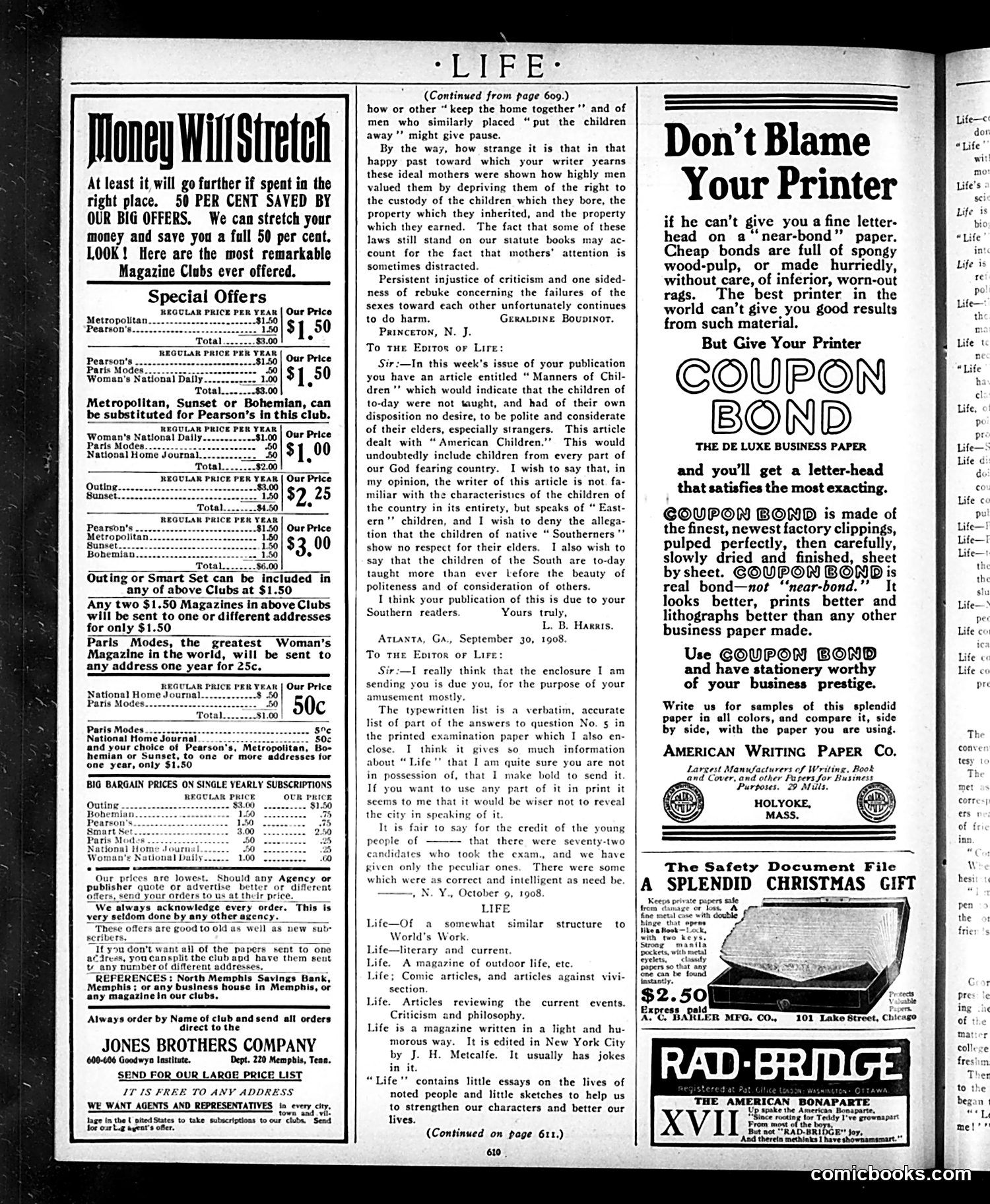
This page is primarily **advertising and subscription offers**, not satirical content. The dominant feature is Jones Brothers Company's magazine club promotions, offering discounted bundled subscriptions to publications like *Pearson's*, *Metropolitan*, and *Sunset* at roughly 50% savings. The small text content visible includes letters to the editor responding to a previous *Life* article about children's manners. Writers defend Southern and regional children against generalizations, arguing the article unfairly characterized American youth as impolite and disrespectful to elders. One correspondent notes the irony of criticizing mothers while historically denying them legal custody and property rights. The page also contains advertisements for *Coupon Bond* paper and *Rad-Bridge* playing cards. **This is essentially a commercial page with reader correspondence**—typical of early 20th-century magazine layouts mixing editorial content, letters, and revenue-generating ads.
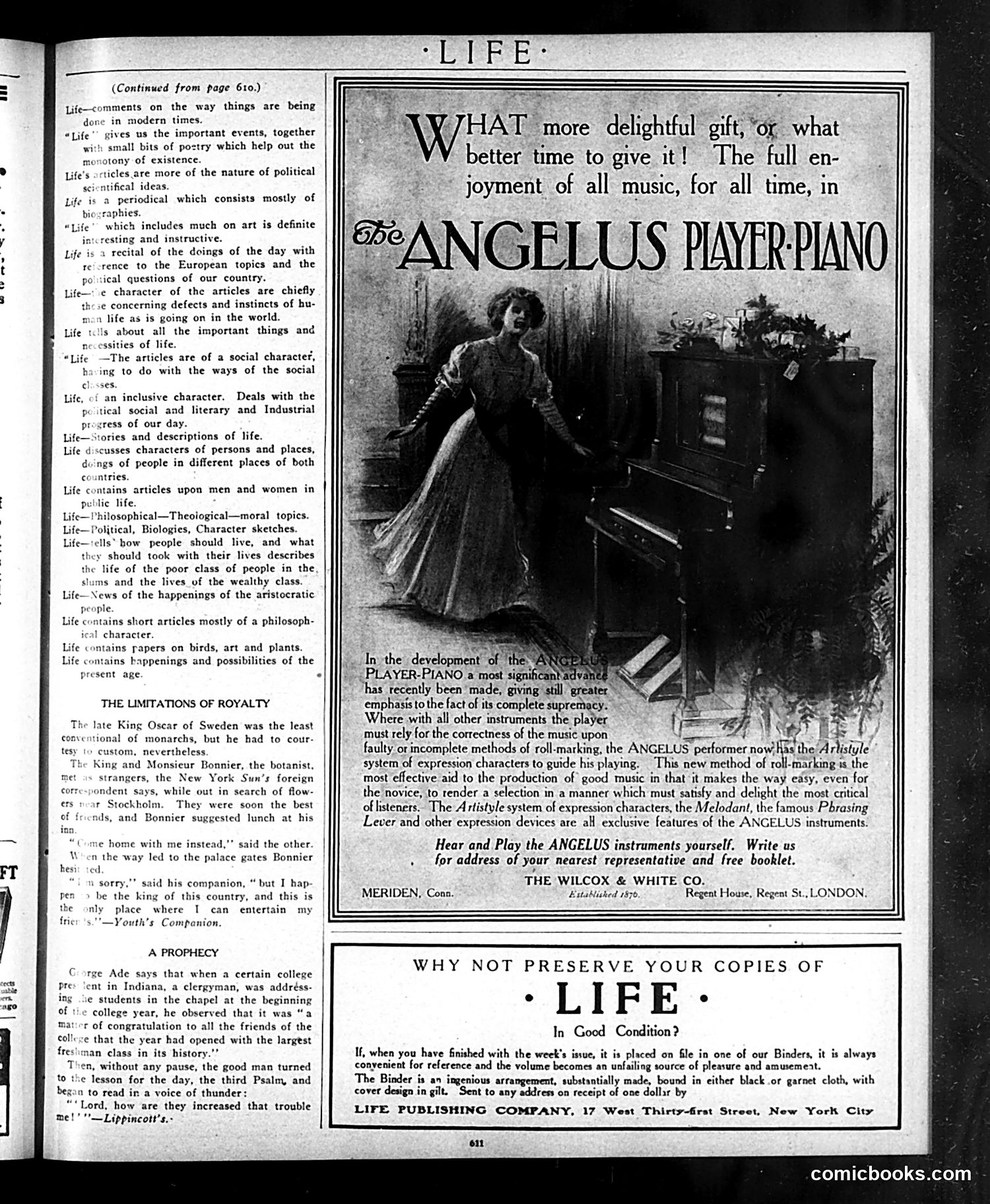
This page combines editorial content with advertising. The left column describes *Life* magazine's coverage scope—political commentary, social issues, character sketches, and philosophical topics. The center-right features a large **advertisement for the Angelus Player-Piano**, showing a woman at the instrument. The ad emphasizes the piano's "Artistyle system" of expression characters, positioning it as superior to competitors by allowing even novices to produce artistically satisfying performances. Below is a humorous anecdote about **King Oscar of Sweden**, illustrating the constraints of royal protocol: though the king wished to lunch casually with a botanist friend at the botanist's home, royal custom forced him to entertain at the palace instead—a gentle satire on the "limitations of royalty." The page reflects early 20th-century Life magazine content: mixing light social humor with consumer advertising targeting affluent readers who could afford player-pianos.
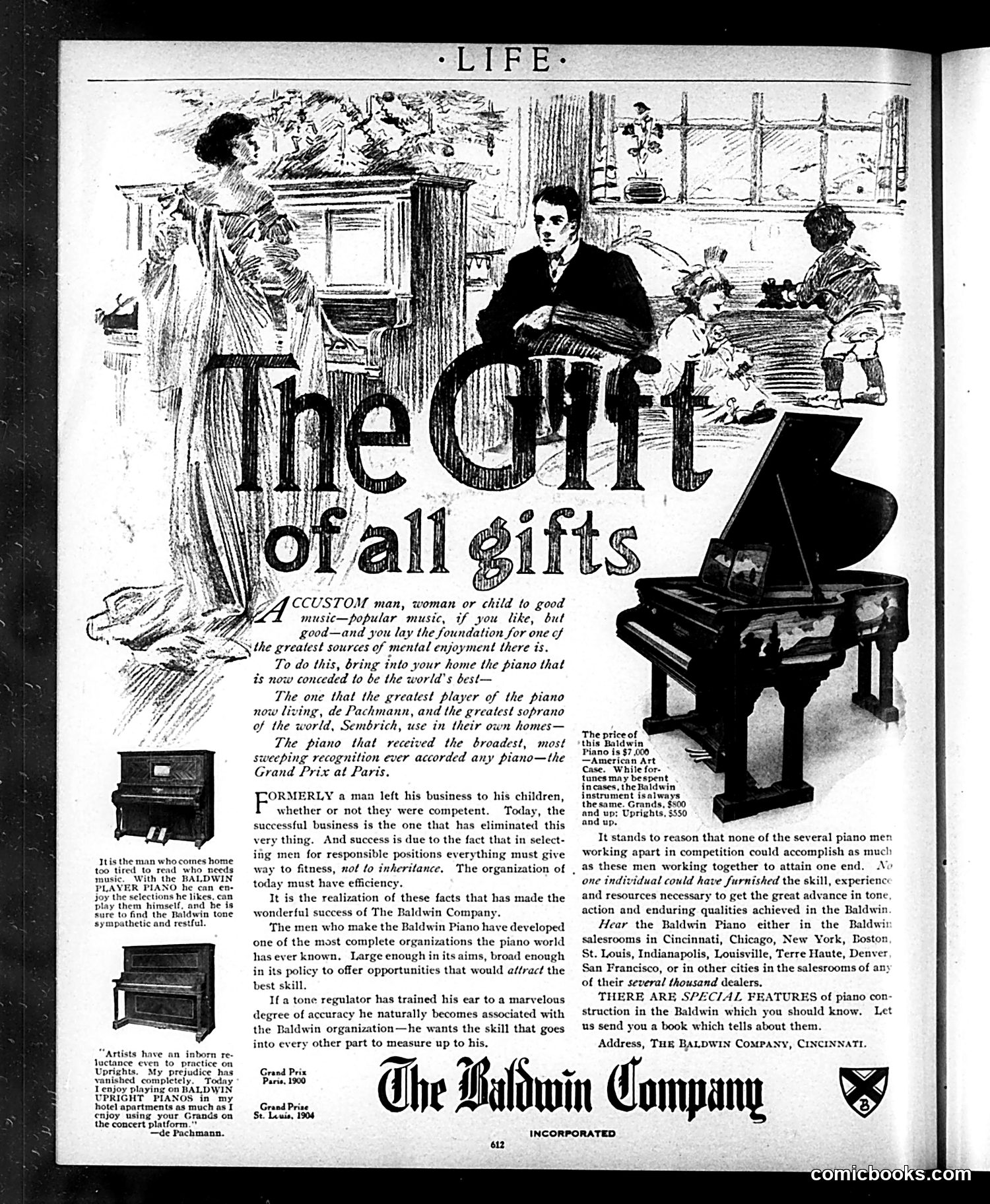
This is primarily a **piano advertisement**, not political satire. The page promotes Baldwin pianos as the superior choice for home music enjoyment. The central argument uses a **meritocracy comparison**: just as modern successful businesses now hire based on talent rather than family inheritance, Baldwin pianos succeed through superior organization and skilled craftsmen working collectively toward excellence—not individual competing makers. The advertisement invokes endorsements from famous musicians (de Pachmann, a renowned pianist, and Sembrich, described as "the greatest soprano of the world") to establish prestige. It references Baldwin's Grand Prix awards from Paris (1900) and St. Louis (1904) fairs as proof of quality. The satirical subtext targets wealthy customers: owning a Baldwin provides "mental enjoyment" and cultured living. The $7,000 price tag (substantial for the era) positions it as a luxury item for the affluent, while smaller uprights start at $550—making music accessible to the aspiring middle class. The cartoon illustrations show domestic contentment through music-making, reinforcing the product's appeal to family life and leisure.
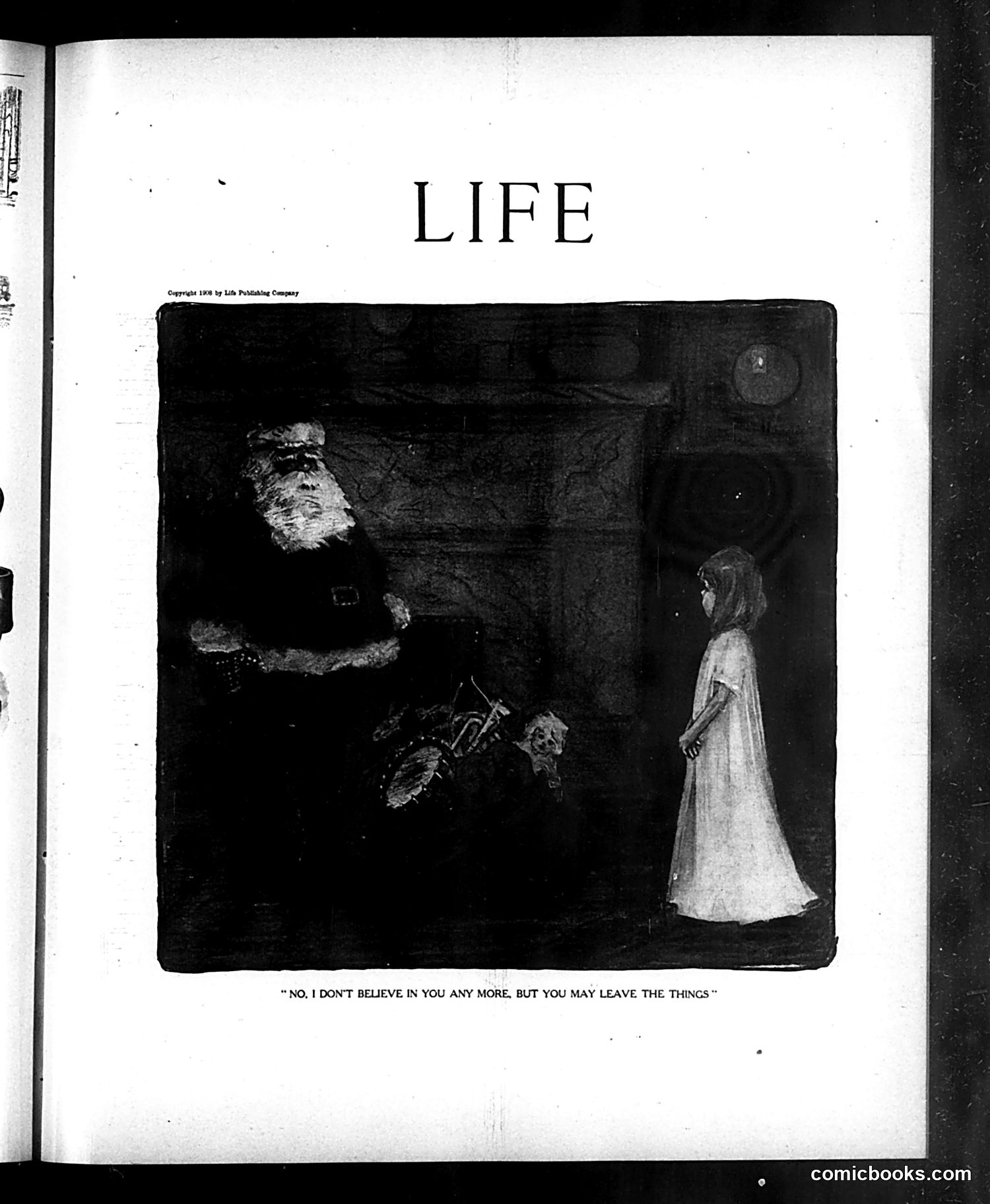
This appears to be a satirical cartoon depicting a dramatic domestic confrontation. A figure in dark clothing (left, appearing elderly or imposing) faces a woman in a light dress (right, shown from behind). The caption—"No, I don't believe in you any more, but you may leave the things"—suggests a relationship dissolution, likely a marriage or partnership ending. The satire likely comments on material values versus emotional connection: the departing figure prioritizes possessions over the relationship itself. Without the specific publication date visible, the exact historical or political context remains unclear, but the cartoon appears to mock either matrimonial discord or the materialistic priorities that sometimes characterize such separations. The dramatic lighting and composition emphasize the emotional gravity of the moment.
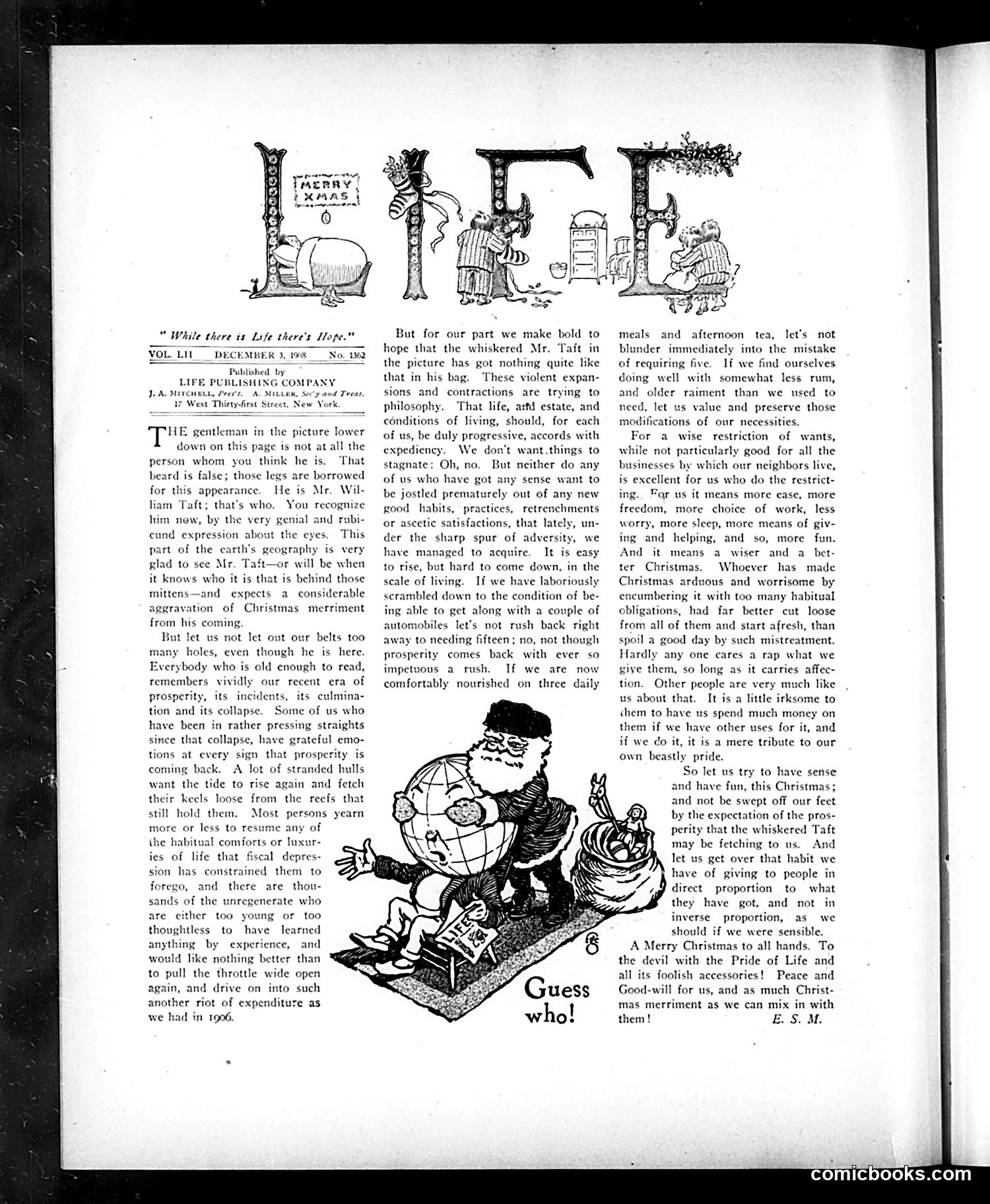
This page features a satirical editorial welcoming President William Taft's visit, accompanied by a humorous illustration of Santa Claus holding a globe labeled "Guess who!"—a visual pun identifying Taft with Christmas gift-giving. The text mocks recent economic boom-and-bust cycles, particularly the 1906 prosperity followed by financial collapse. While welcoming Taft's arrival, the author argues *against* returning to excessive spending habits. Instead, the piece advocates restraint—contentment with fewer automobiles, simpler meals, and worn clothing acquired during hard times. The satire targets two audiences: those desperate for renewed prosperity (wanting to "pull the throttle wide open again") and the wealthy accustomed to luxury. The author suggests that modest living actually brings more freedom and happiness than conspicuous consumption. The editorial cleverly uses Taft's visit as a hook to promote post-Depression financial prudence, warning that even returning prosperity shouldn't resurrect wasteful pre-collapse habits.
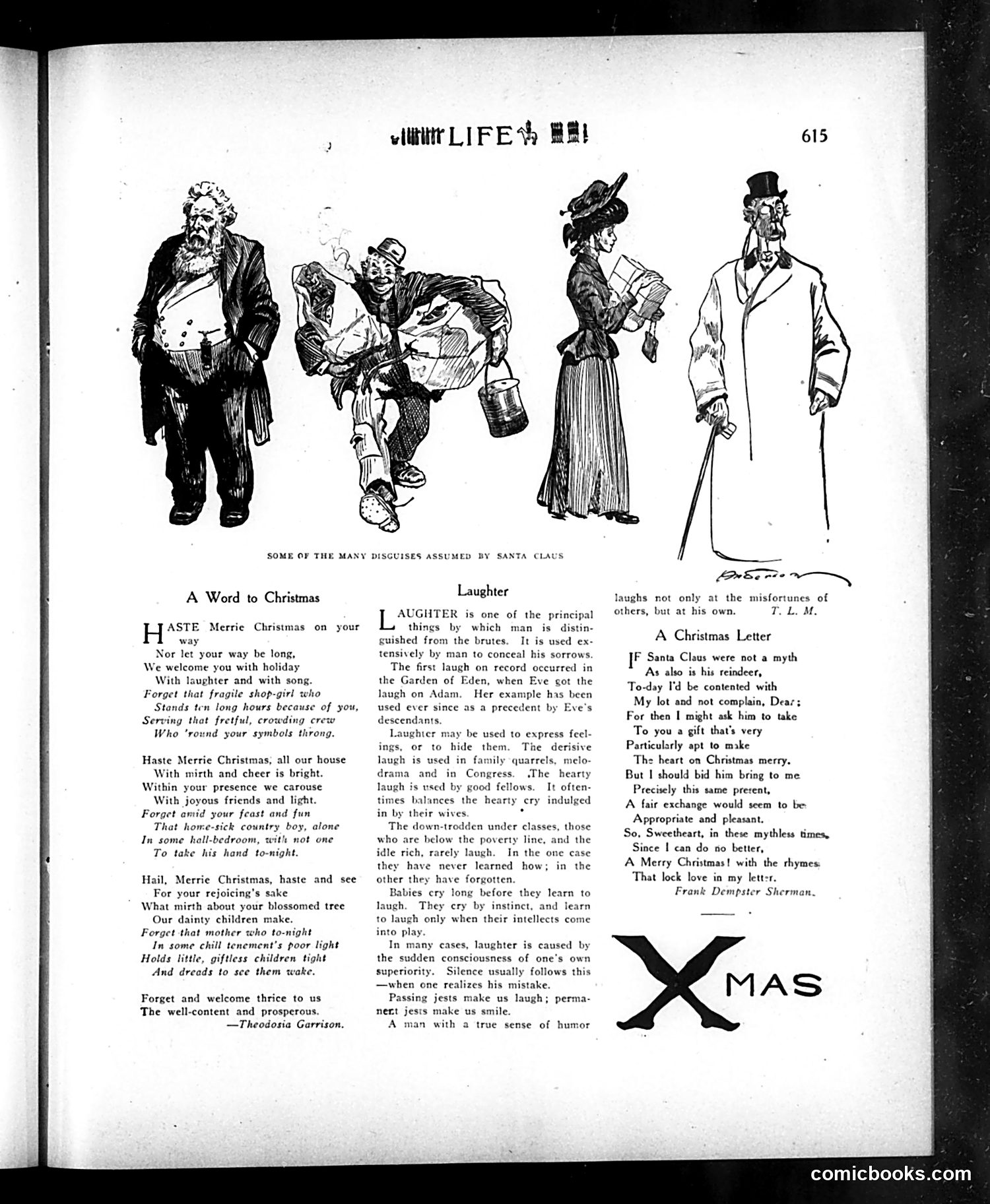
This page combines Christmas-themed content with social commentary typical of early 20th-century satire. **The Four Figures ("Disguises Assumed by Santa Claus"):** These illustrations depict Santa in various social guises—likely representing how different classes experience Christmas differently, from wealthy gentlemen to working poor. **"A Word to Christmas":** This poem by Theodosia Garrison is *ironic satire*. It repeatedly tells readers to "forget" the suffering working class—exhausted shop girls, lonely country boys in boarding houses, mothers in tenements with giftless children—while celebrating Christmas prosperity. The poem critiques how comfortable Americans ignore working-class hardship during holiday celebrations. **"Laughter":** A philosophical essay noting that laughter often masks sorrow and that the poor rarely laugh (having "never learned" or having "forgotten"). This reinforces the page's underlying message about class division. **"A Christmas Letter":** A romantic poem offering love as a gift substitute for material presents. The page's *central point*: Christmas celebration often ignores or requires forgetting the genuine misery of working people.
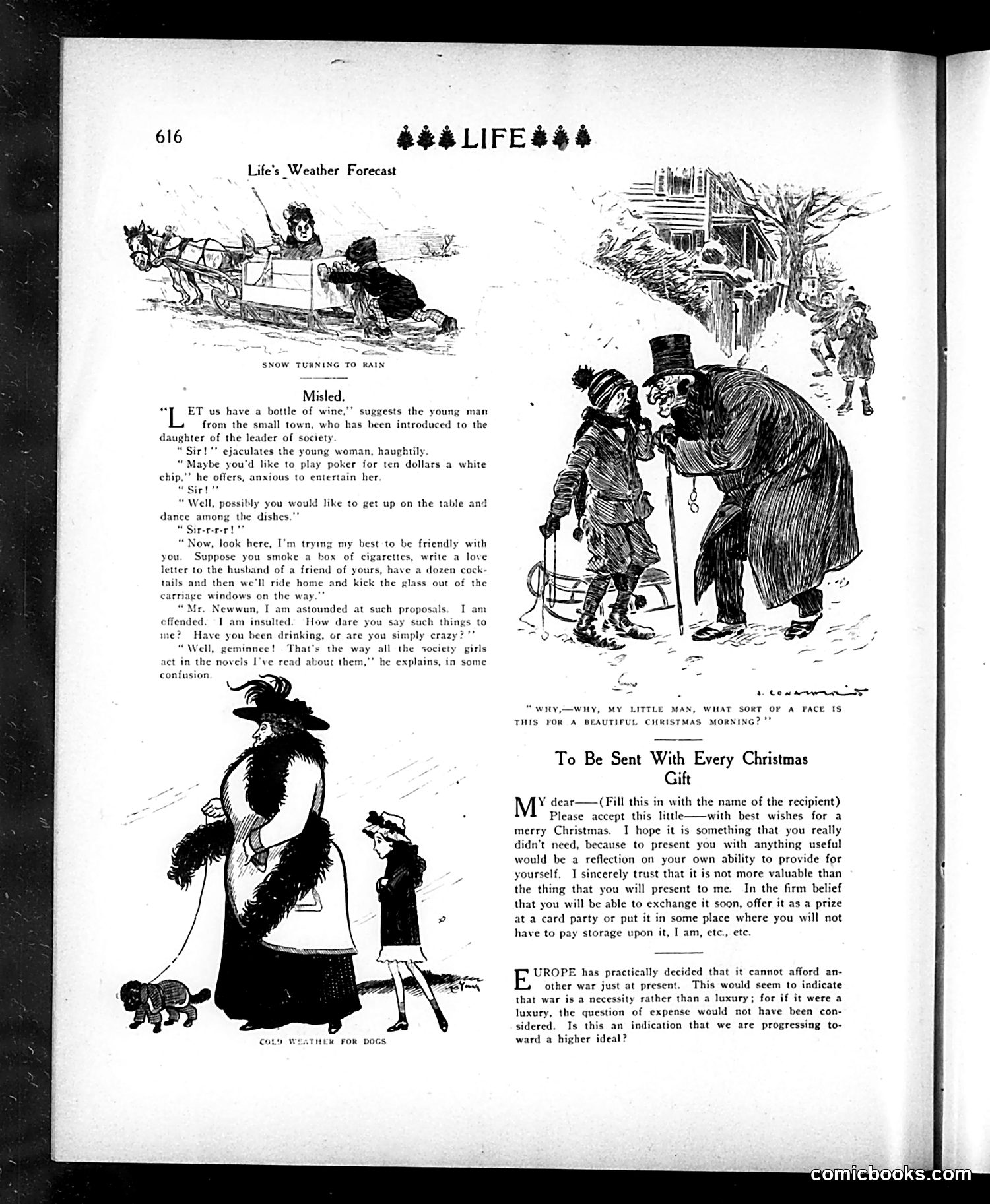
The central cartoon mocks a provincial young man's misunderstanding of high-society etiquette. Having read popular novels about "society girls," he arrives in the city believing their behavior reflects authentic aristocratic norms. He proposes increasingly scandalous activities—wine-drinking, poker, dancing on tables, writing love letters to others' husbands, vandalism—all drawn from fictional depictions. The society woman's horror reveals the gap between literary fantasy and actual upper-class conduct. The satire targets two audiences: rural social climbers naïve about city ways, and perhaps the serialized novels themselves for promoting exaggerated, unrealistic portrayals of wealth and sophistication. The accompanying Christmas gift text and "weather forecast" cartoons continue Life's typical satirical commentary on American social pretension and hypocrisy during the early 20th century.
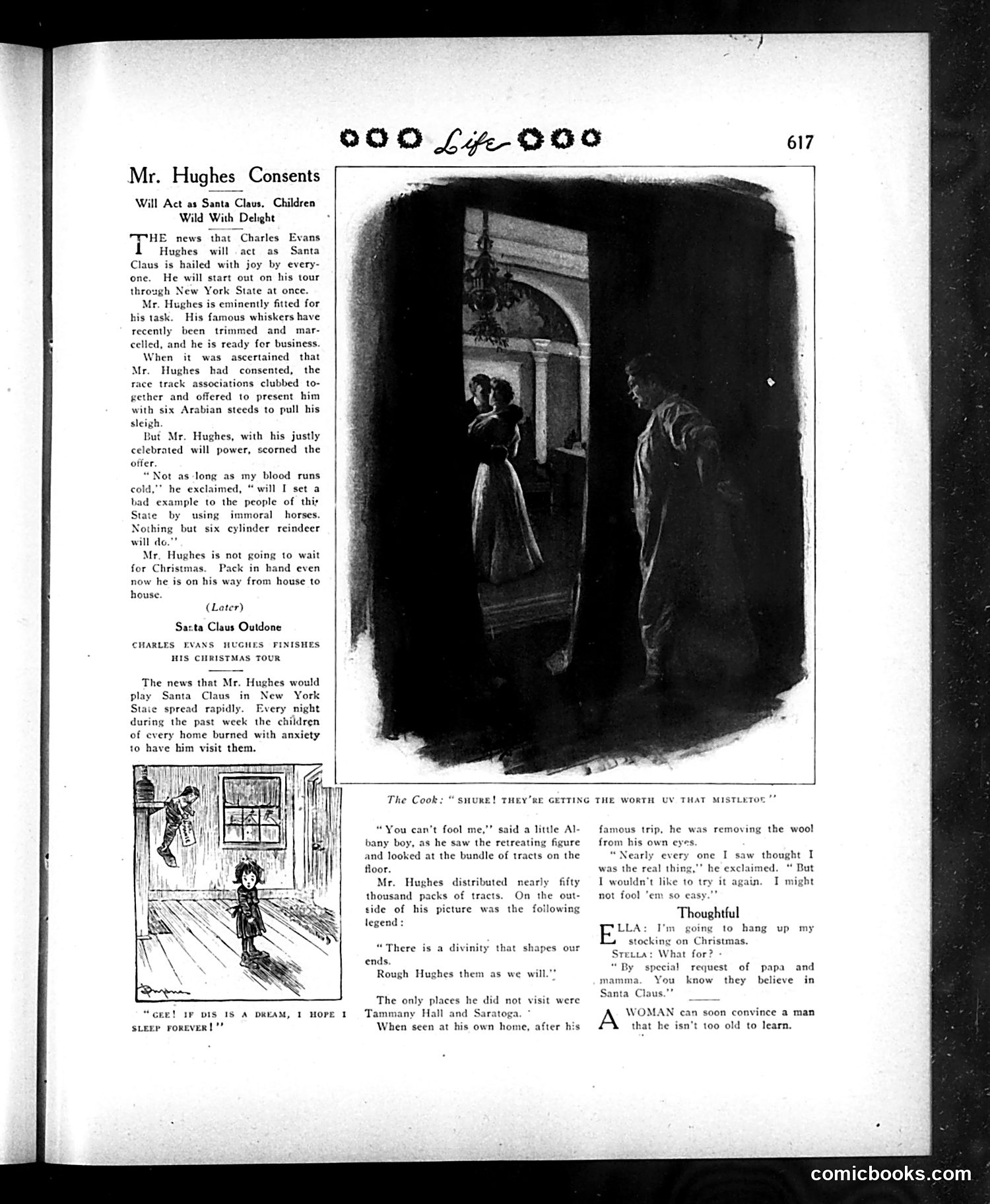
This piece mocks Charles Evans Hughes, the 1916 Republican presidential candidate, by imagining him as Santa Claus touring New York State. The satire targets Hughes's stern, humorless public image—emphasized by his famous whiskers and "celebrated will power." The joke: Hughes famously rejected race-track associations' offer of Arabian horses for his sleigh, declaring he'd use only "six cylinder reindeer" to avoid setting a "bad example." Instead of toys, "Santa Hughes" distributes religious tracts, and children see through the charade immediately ("You can't fool me," says an Albany boy). The satire suggests Hughes is self-righteously preachy rather than genuinely generous—he spreads moral instruction instead of joy. References to "Tammany Hall" (the Democratic political machine) and "Saratoga" suggest his tour deliberately avoided Democratic strongholds. The underlying political critique: Hughes is a sanctimonious, joyless figure unsuited to public affection, despite his reformist credentials.
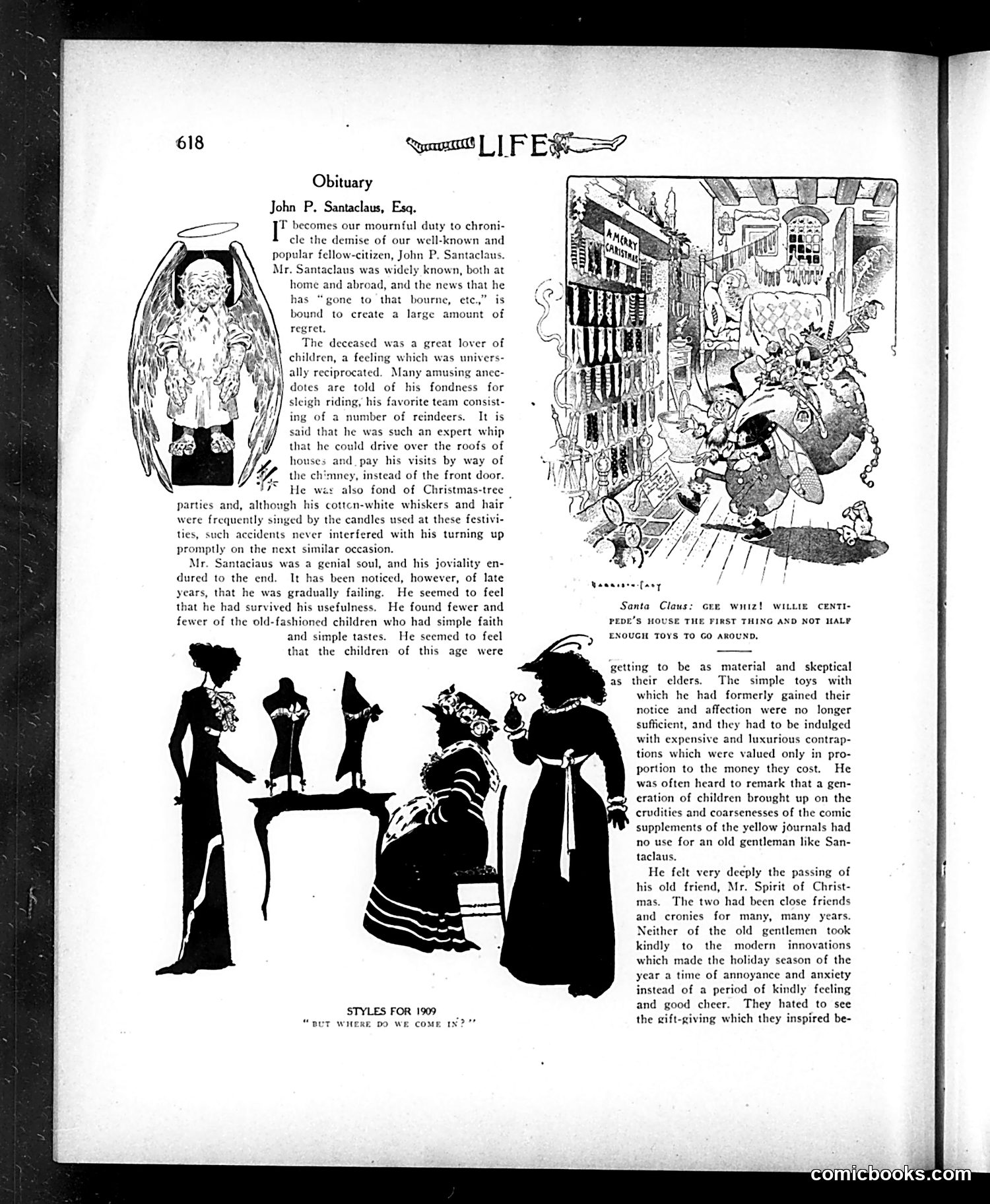
This page presents a mock obituary lamenting the decline of traditional Christmas values. "John P. Santaclaus" (Santa Claus) represents the old-fashioned Christmas spirit, depicted as a genial figure who embodied simple joy and child-like wonder. The satire targets early 1900s materialism: modern children have become "material and skeptical," rejecting simple toys for expensive "luxurious contraptions" valued only by cost. The deceased is portrayed as obsolete, unable to compete with "comic supplements of the yellow journals" (sensationalist newspapers) that corrupted childhood innocence. The lower cartoon captioned "Styles for 1909: But Where Do We Come In?" shows fashionable adults at a Christmas party, suggesting that holiday focus has shifted from children to adult social display and consumption. The overall message critiques commercialization and the loss of Christmas's spiritual meaning—a concern that ironically remains relevant today.
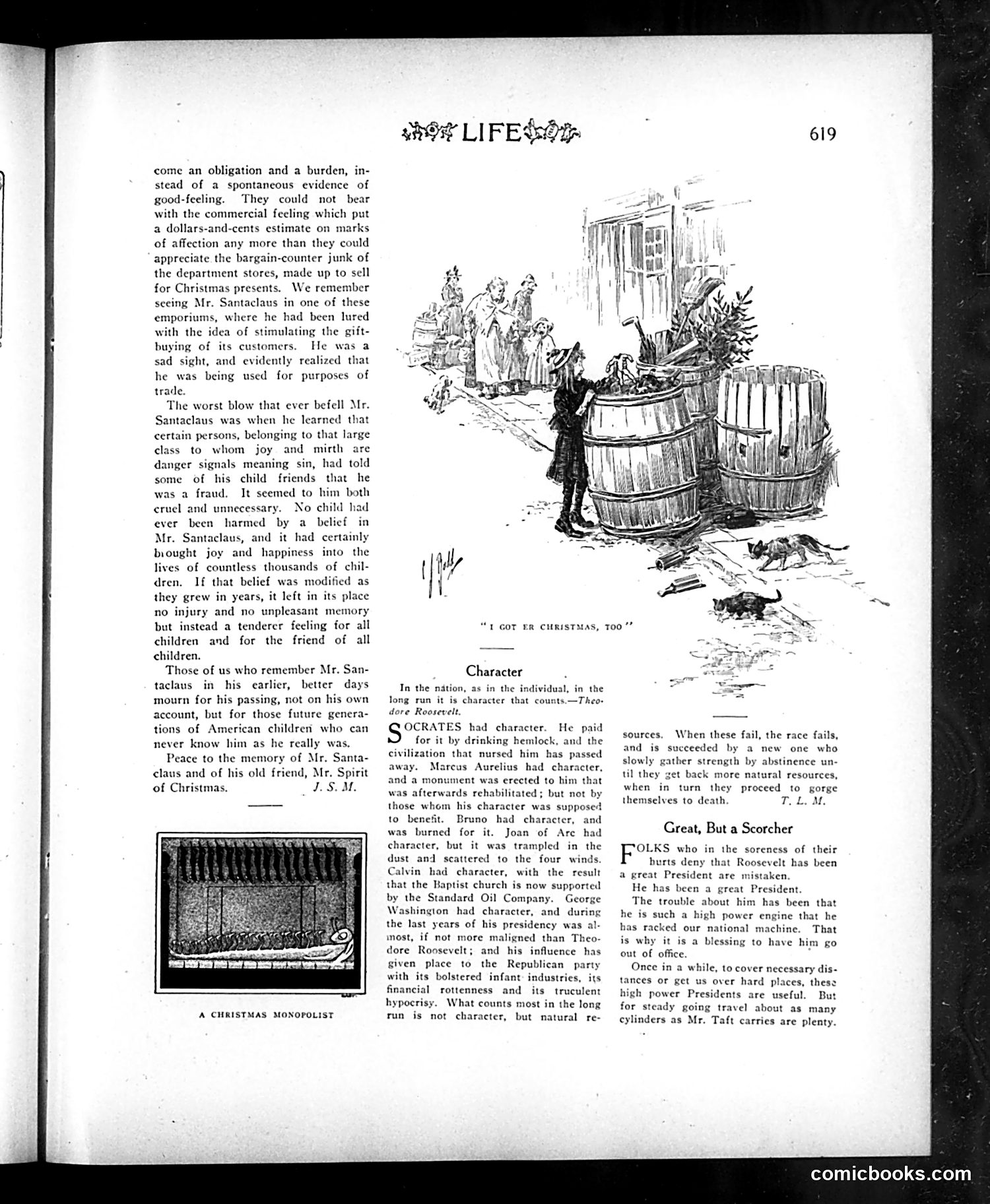
**The Cartoons/Content:** This page contains two distinct pieces of satire: 1. **"A Christmas Monopolist"** (illustrated): Shows Santa Claus as a commercialized figure being used by department stores to drive gift-buying. The satire critiques how retail has corrupted Santa from a symbol of joy into a marketing tool—a "sad sight" reduced to commercial purposes. 2. **"Great, But a Scorcher"** (text essay): A backhanded compliment about Theodore Roosevelt's presidency, which has just ended (likely 1909, as Taft is mentioned as successor). The author acknowledges Roosevelt was "great" but compares him to a "high power engine" that "racked our national machine"—he was too forceful and destabilizing. The conclusion suggests the gentler Taft administration ("as many cylinders as Mr. Taft carries") is preferable for routine governance. **Modern Context:** Both pieces critique commercialization (Christmas) and political excess (Roosevelt's aggressive executive power), using humor to suggest moderation and authenticity are preferable to intense, profit-driven or power-driven excess.
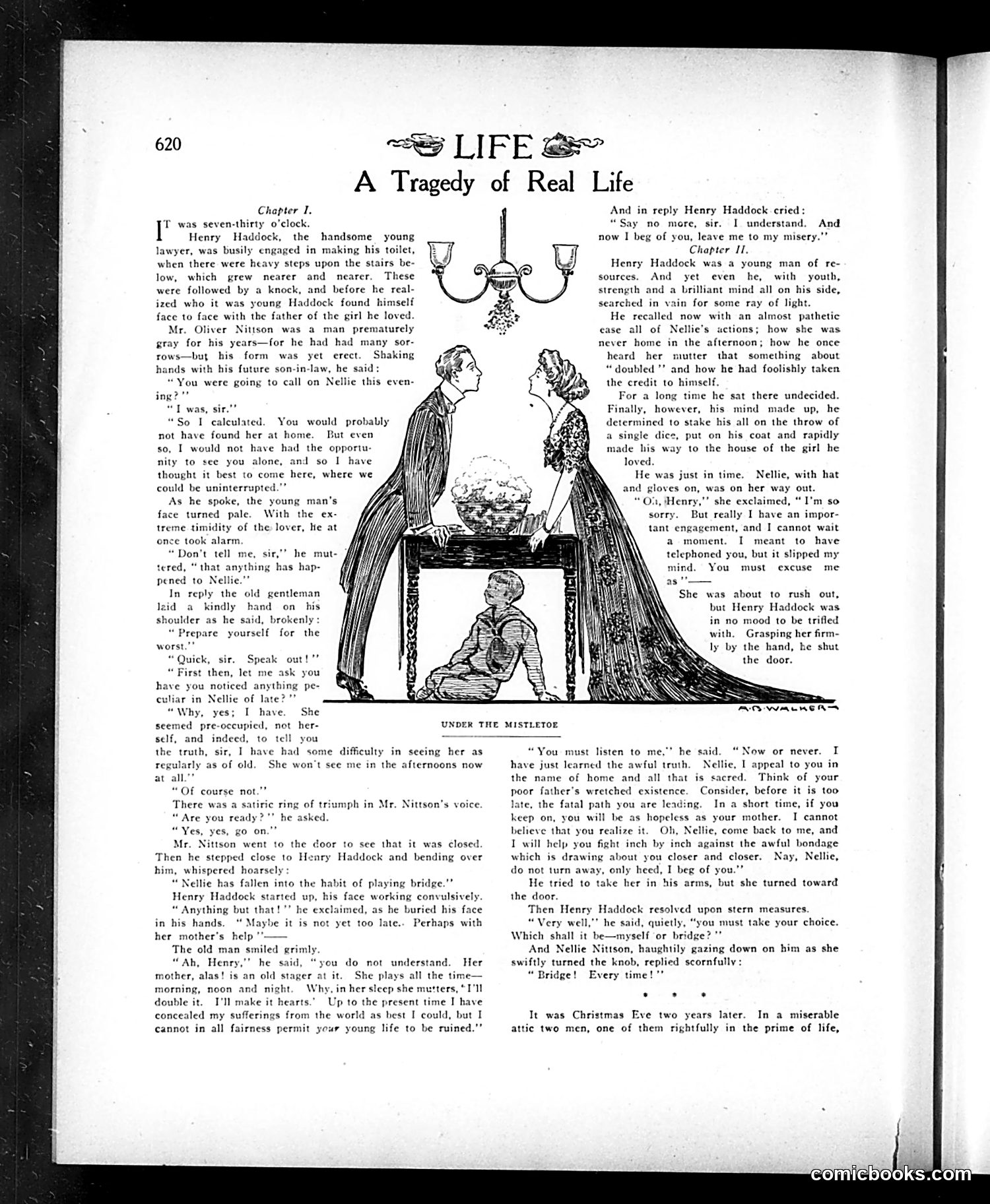
This is a serialized comedic story satirizing the social craze of bridge playing among upper-class Americans in the early 20th century. The narrative presents bridge addiction as a genuine domestic crisis, treating it with mock-serious melodrama. The plot concerns Henry Haddock, a young lawyer engaged to Nellie, who discovers that his fiancée and her mother have become obsessed with the card game bridge. Her father, Oliver Nittson, visits Henry to warn him that Nellie "has fallen into the habit of playing bridge"—presented as a catastrophic character flaw worthy of tragic drama. The satire mocks both the excessive social prominence of bridge among the wealthy and the overwrought Victorian/melodramatic tone of contemporary fiction. By treating a card game habit as a moral crisis equivalent to serious vices, the author ridicules contemporary attitudes toward leisure activities and domestic life among the upper classes.
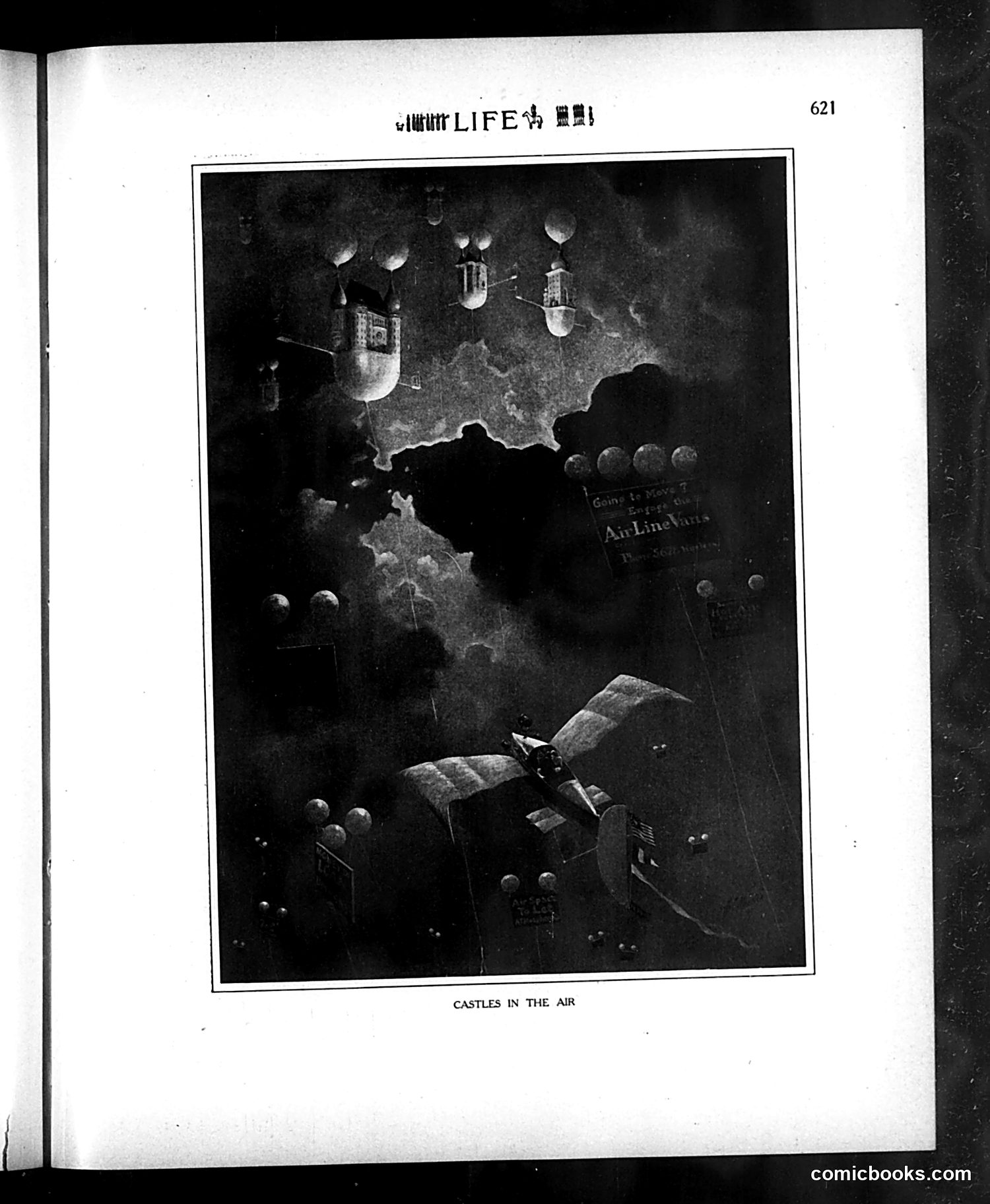
This is a satirical illustration depicting futuristic flying structures—castles and fortified buildings suspended in the sky, along with what appears to be an airship or early aircraft in the lower portion. The image likely represents speculative, impractical schemes or overly ambitious technological fantasies of the era. The title "Castles in the Air" is an idiom meaning unrealistic dreams or plans with no solid foundation. This appears to be satirizing contemporary enthusiasm for aviation technology and grandiose visions of aerial civilization, perhaps mocking either utopian predictions or specific proposed projects that Life magazine's editors viewed as fanciful or economically unfeasible. The dramatic nighttime setting and ominous tone suggest skepticism toward these ambitious visions.
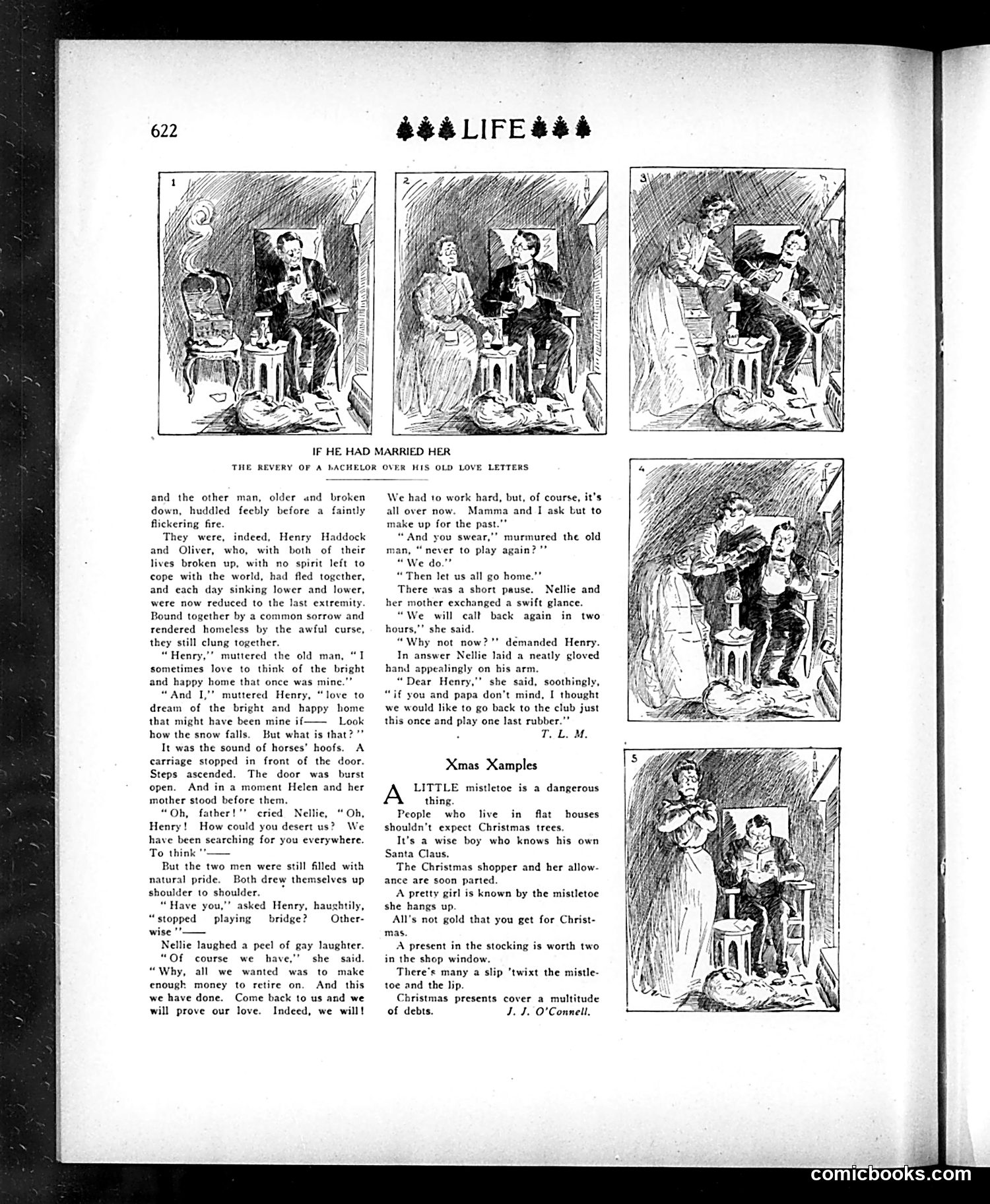
This is a multi-panel comic story about a bachelor reminiscing over old love letters from a woman named Helen (Nellie). The narrative depicts a cautionary fantasy: had he married her, both he and her father (Henry Haddock and Oliver) would have ended up impoverished and broken men, reduced to destitution by some unspecified "awful curse." The satire's punchline arrives when Helen and her mother rescue them—but reveal their true priority: they want to return to their social club to play bridge, not help the men. This deflates the romantic fantasy entirely, suggesting that marrying into this family would have meant financial ruin chasing after women more devoted to leisure activities than domestic responsibility. The accompanying "Xmas Xamples" section offers witty aphorisms mocking Christmas materialism and romantic expectations—including the final jab that "Christmas presents cover a multitude of debts." The humor targets both sentimental bachelor nostalgia and the perceived frivolousness of upper-class women.
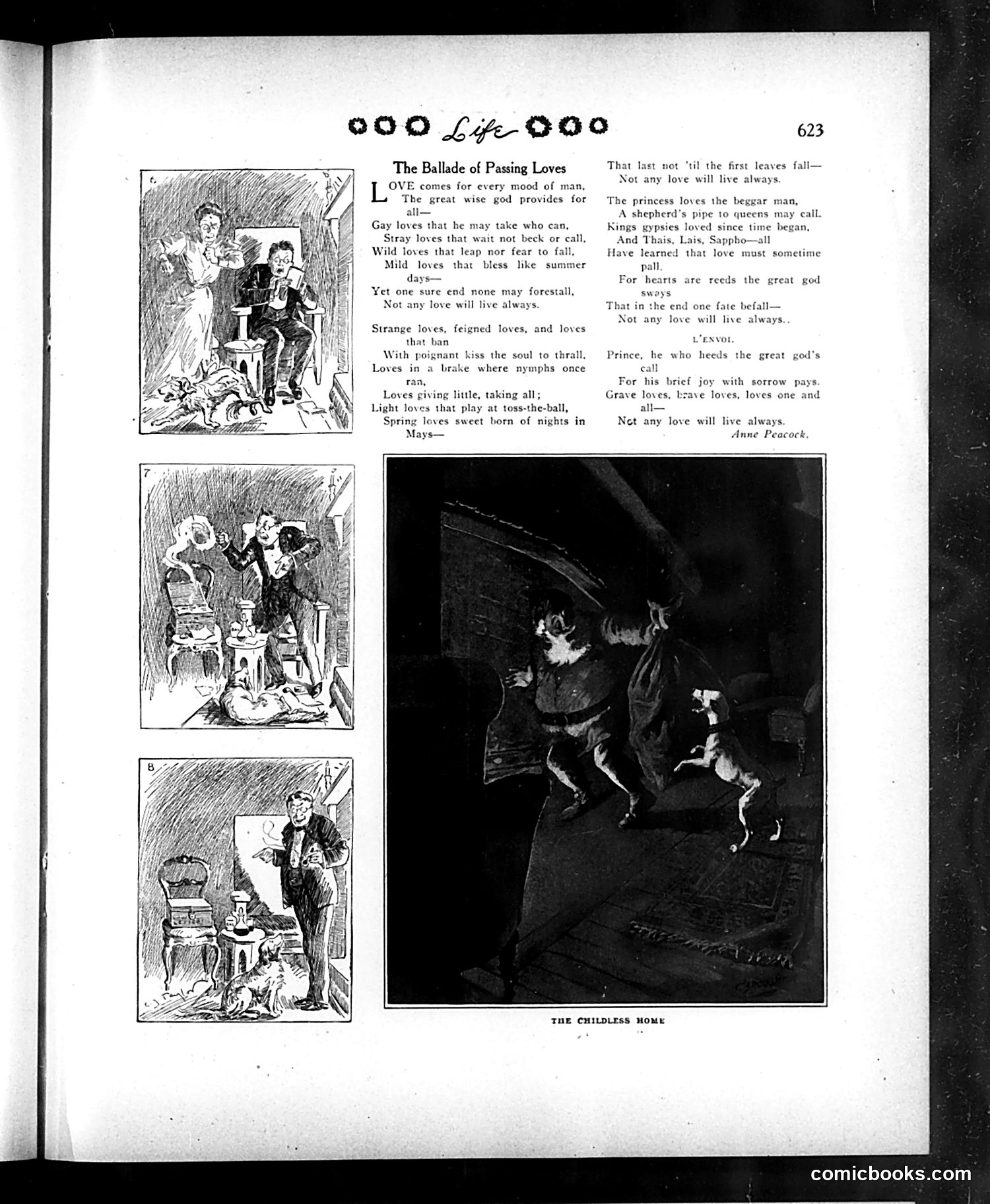
This page presents "The Ballade of Passing Loves," a melancholic poem by Anne Peacock using the formal French ballade structure. The text explores love's impermanence across social classes—from princesses and beggars to kings and gypsies—arguing that all romantic love eventually fades ("Not any love will live always"). The three pen-and-ink sketches on the left depict couples in intimate moments, illustrating the poem's theme of transient romance. The large photograph labeled "THE CHILDLESS HOME" shows what appears to be a somber domestic interior with figures, likely reinforcing the poem's meditation on love's ultimate emptiness or failure. For modern readers, this reflects early 20th-century *Life* magazine's sophisticated literary content—mixing high-art poetry with illustration to explore romantic disillusionment, a common theme in that era's writing. The message is essentially: all love is temporary, regardless of social station.
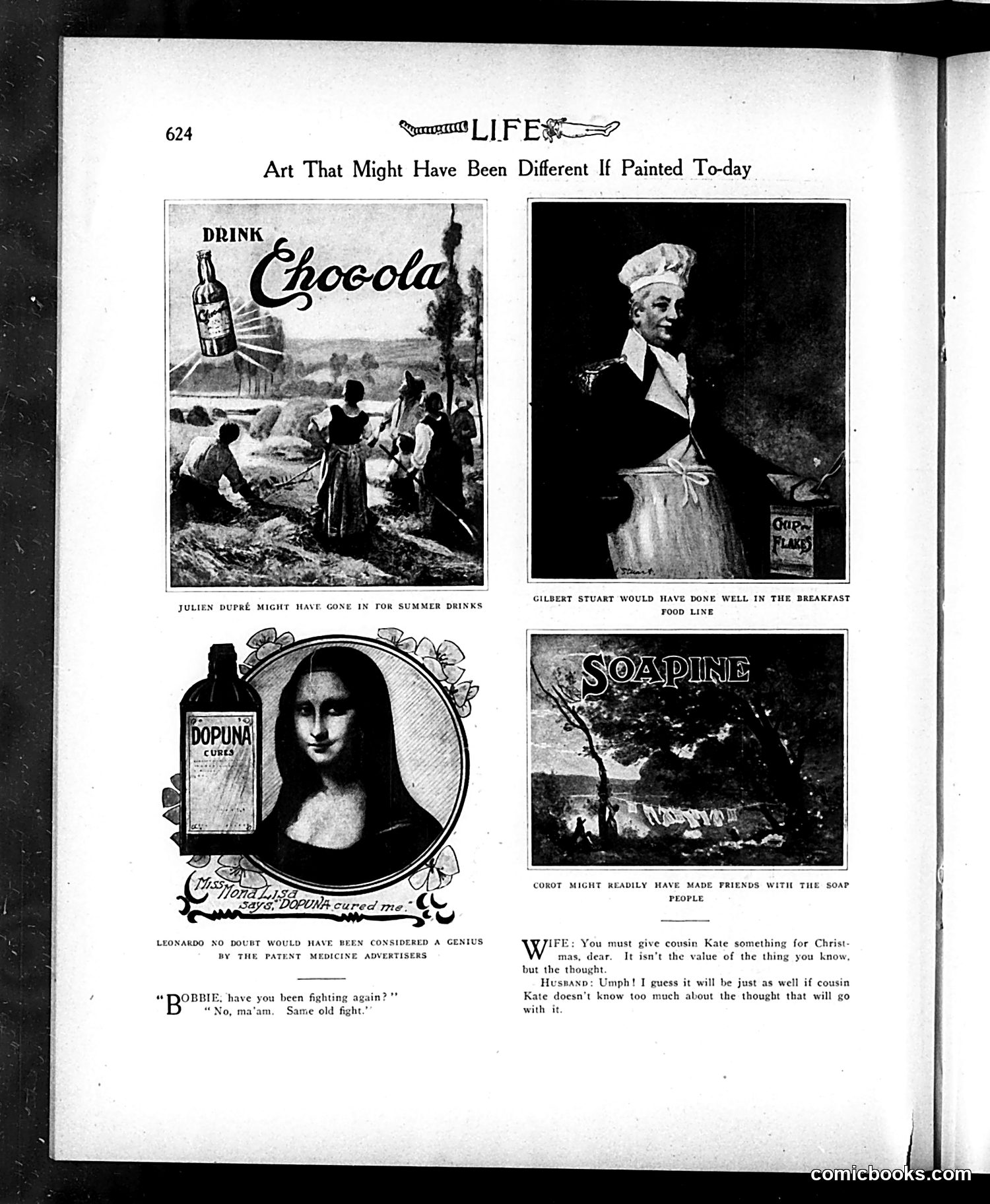
This Life magazine page satirizes how famous historical artists would fare if working in the modern (early 20th-century) commercial world. Each panel reimagines a master painter as an advertiser: - **Julien Dupré** (landscape painter) becomes a chocolate beverage pitchman - **Gilbert Stuart** (portraitist) sells breakfast cereals - **Leonardo da Vinci** appears as a patent medicine advertiser—the caption jokes that his genius would be "recognized" only by quack medicine companies - **Corot** (landscape painter) advertises soap The satire mocks both: (1) the commercialization of art and (2) the prevalence of dubious patent medicines and mass advertising of the era. The implication is that serious art has no place in modern consumer culture—only commercial hucksterism does. The dialogue snippet at bottom appears unrelated.
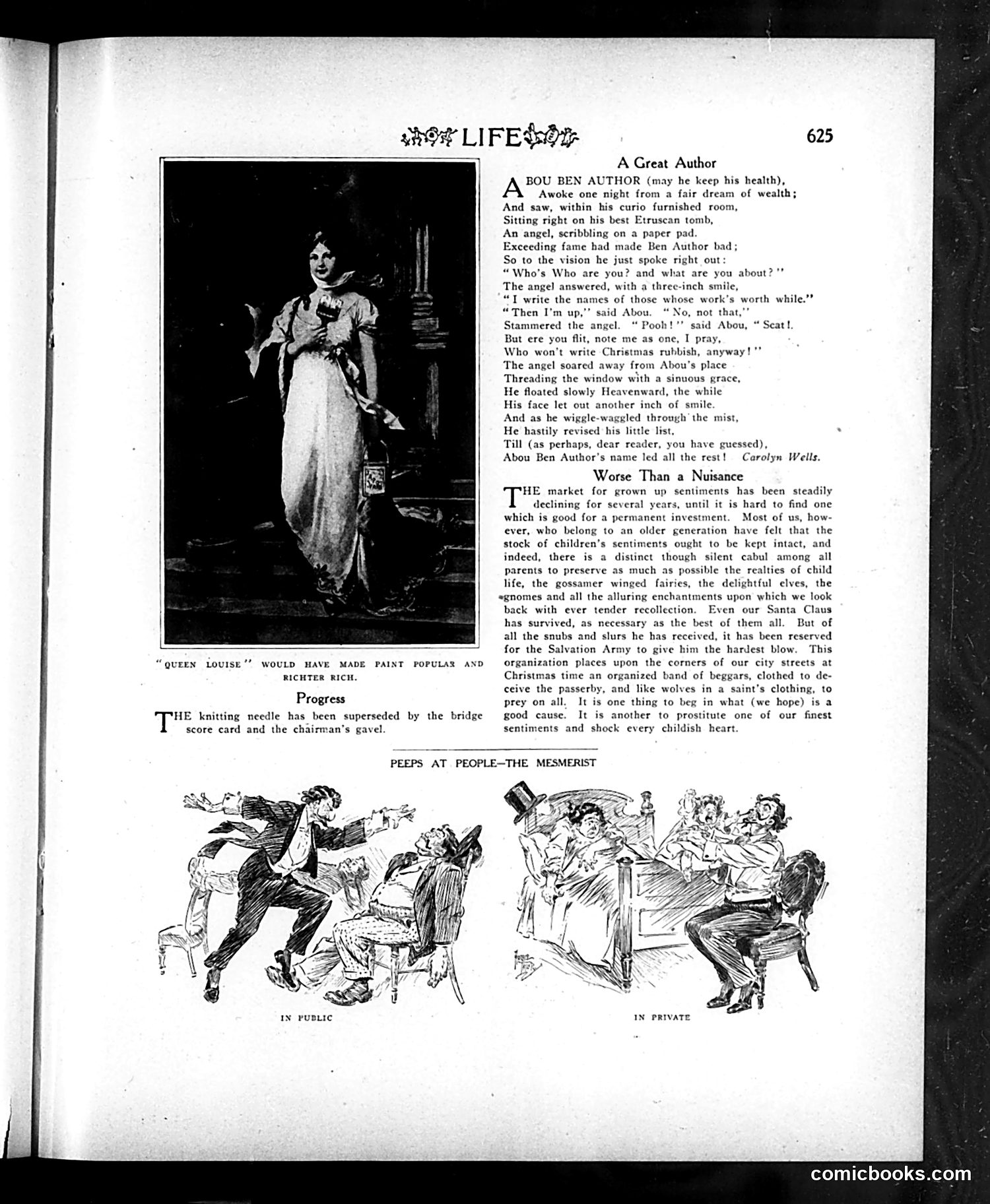
This page contains satirical commentary on early 20th-century American culture: **"A Great Author"** is a parody of the poem "Abou Ben Adhem" by Leigh Hunt. The satire mocks vain authors obsessed with fame and recognition. "Ben Author" refuses to write Christmas sentiment (commercial holiday material) to appear above commercial pressures, then ironically becomes celebrated anyway—suggesting such posturing is transparent and self-defeating. **"Worse Than a Nuisance"** criticizes the Salvation Army for using costumed beggars (dressed as Santa) during Christmas charity drives. The author argues this exploits children's innocence and sentimentality—using Santa's cultural magic for fundraising manipulates families' emotional attachments to childhood traditions. It's presented as corrupting something sacred. **"Peeps at People—The Mesmerist"** contrasts public versus private behavior, showing how the same performer acts differently depending on audience, satirizing social hypocrisy. The page reflects genteel Progressive-era concerns about commercialism, sentimentality, and authentic versus performative morality.
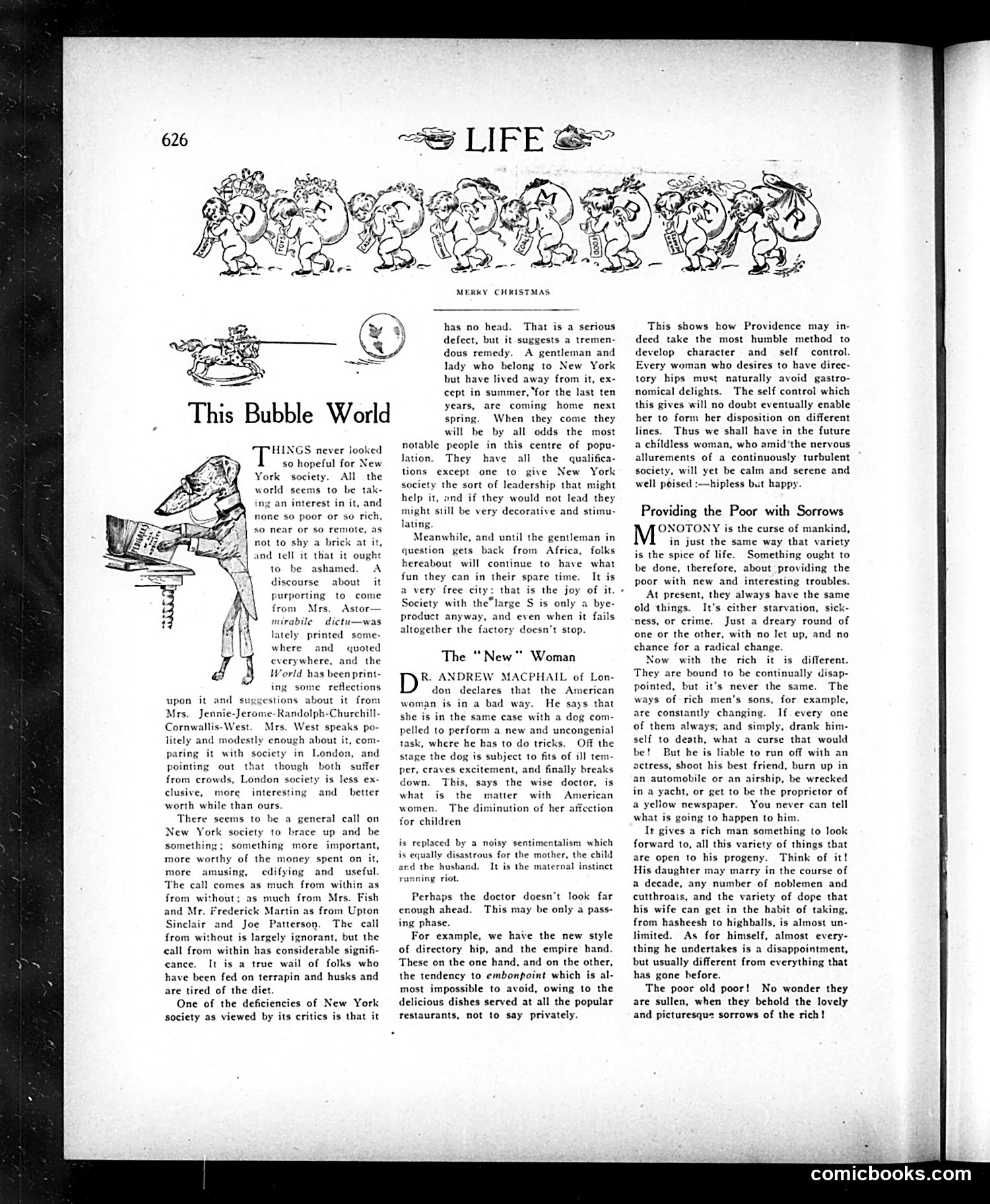
This page satirizes New York's upper class as frivolous and directionless. "This Bubble World" mocks wealthy society for lacking leadership and substance—they're criticized by everyone from society matrons (Mrs. Astor, Mrs. Fish) to muckraking journalists (Upton Sinclair, Joe Patterson). The piece suggests society is exhausted ("fed on terrapin and husks") and needs reform, though it doubts improvement will occur since the unnamed couple who might lead the city won't return from Africa. The second article mocks Dr. Andrew Macphail's claim that American women are in "a bad way," comparing them to circus dogs forced into unnatural behaviors. Life satirizes this sexist critique, ironically suggesting that women's pursuit of fashionable "directory hips" and "empire hand" silhouettes will naturally teach them self-control through dietary restraint—implying Macphail's logic is absurd. The cartoon illustrations (upper portion) appear to show cherubic figures, likely representing holiday frivolity or innocent indulgence.
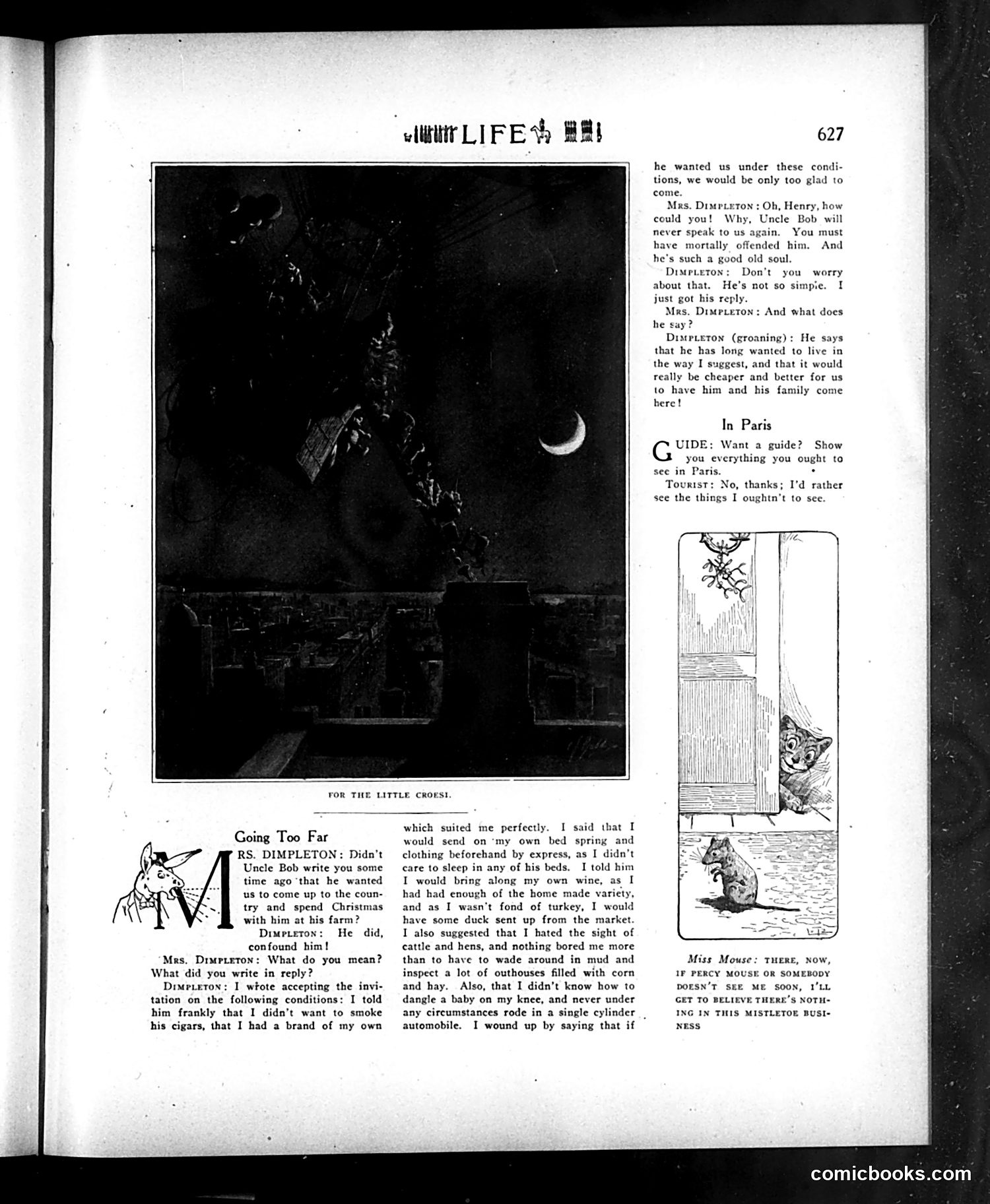
**"Going Too Far"** satirizes social pretentiousness and the absurdity of excessive hospitality demands. Mr. Dimpleton accepts his Uncle Bob's Christmas farm invitation while insulting everything about the visit—refusing the host's cigars, beds, wine, and food; mocking rural life; and rejecting farm activities. His wife is mortified, assuming he's destroyed the relationship. The joke's twist: Uncle Bob accepts *all* these conditions and invites *himself* to stay at the Dimpletons' house instead, turning the tables. The satire mocks guests who disguise ingratitude as fastidiousness, while also suggesting that genuine (if simple) hospitality cannot be truly offended—Uncle Bob calls Dimpleton's bluff by adopting his own stated preferences. The secondary cartoon "In Paris" shows a mouse in mistletoe, making a lighthearted reference to the Christmas kissing tradition while playing on tourist clichés.
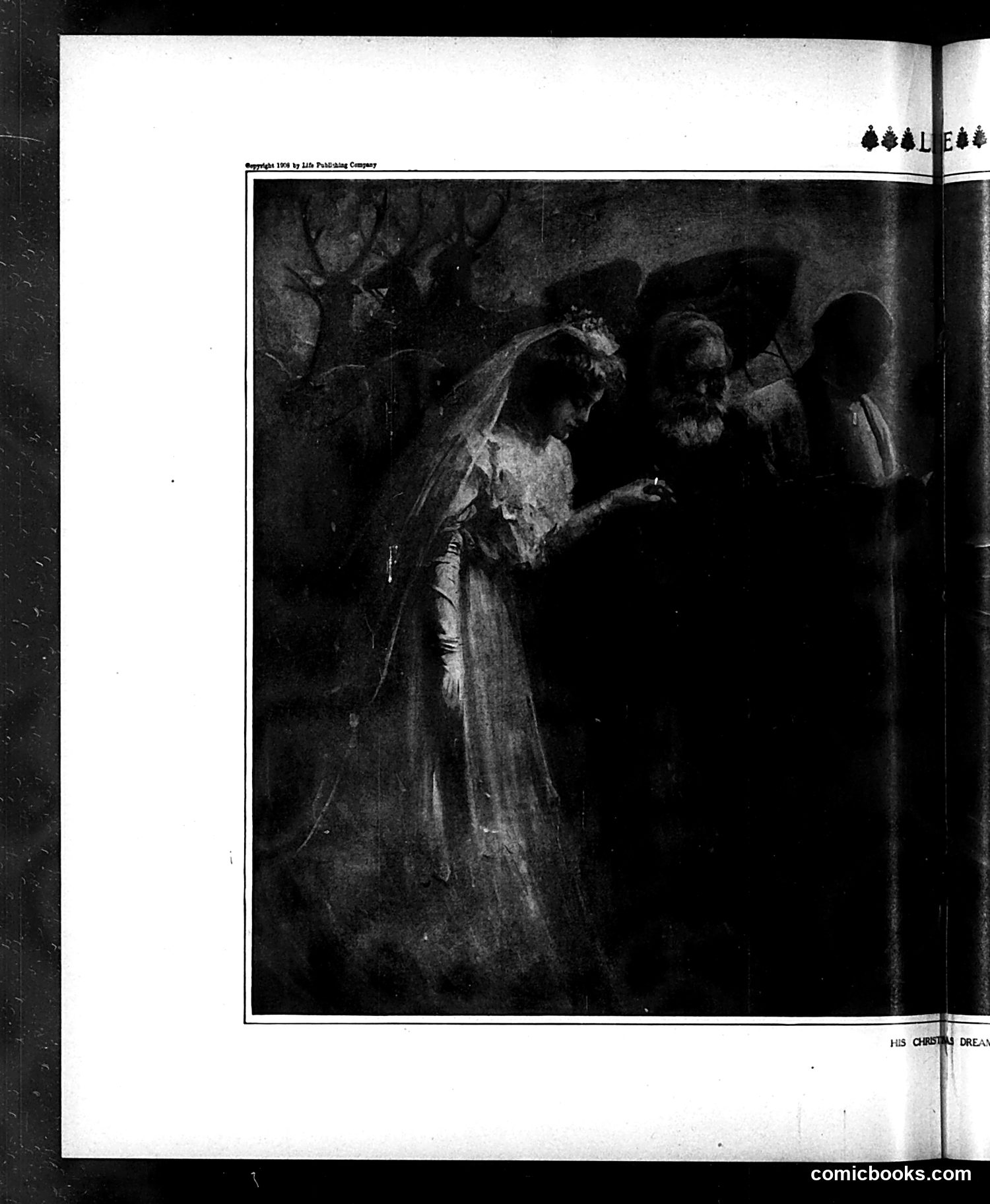
The OCR text is largely unreadable, consisting only of scattered letters and symbols. Based on the **image alone**: This appears to be a dark, atmospheric black-and-white illustration showing a woman in a long dress with a veil or head covering, positioned among shadowy figures. The dramatic lighting and composition suggest a theatrical or narrative scene, possibly depicting something supernatural or mysterious. The caption at bottom reads "HIS CHRISTMAS DREAM," indicating this relates to a Christmas-themed story or satirical commentary. **Without legible OCR text, I cannot reliably identify the specific figures, political references, or satirical intent.** The image quality and dramatic staging suggest this may be illustrating a ghost story, supernatural tale, or allegorical Christmas narrative typical of Life magazine's satirical style, but the exact meaning remains unclear without supporting text.
This appears to be a page from Life magazine featuring a darkly lit scene, likely a dramatic illustration or photograph rather than a traditional cartoon. The image shows a figure seated at what appears to be a desk or table with a lamp overhead, rendered almost entirely in shadow against a black background. The OCR text provides minimal context—only "comicbooks.com" appears at the bottom, which is a modern website reference rather than original magazine content. Without additional visible text or clear identifying details in the image itself, I cannot confidently identify the specific political or social commentary this page intended. The theatrical lighting and composition suggest dramatic storytelling, but the exact satirical point remains unclear from what's visible here.
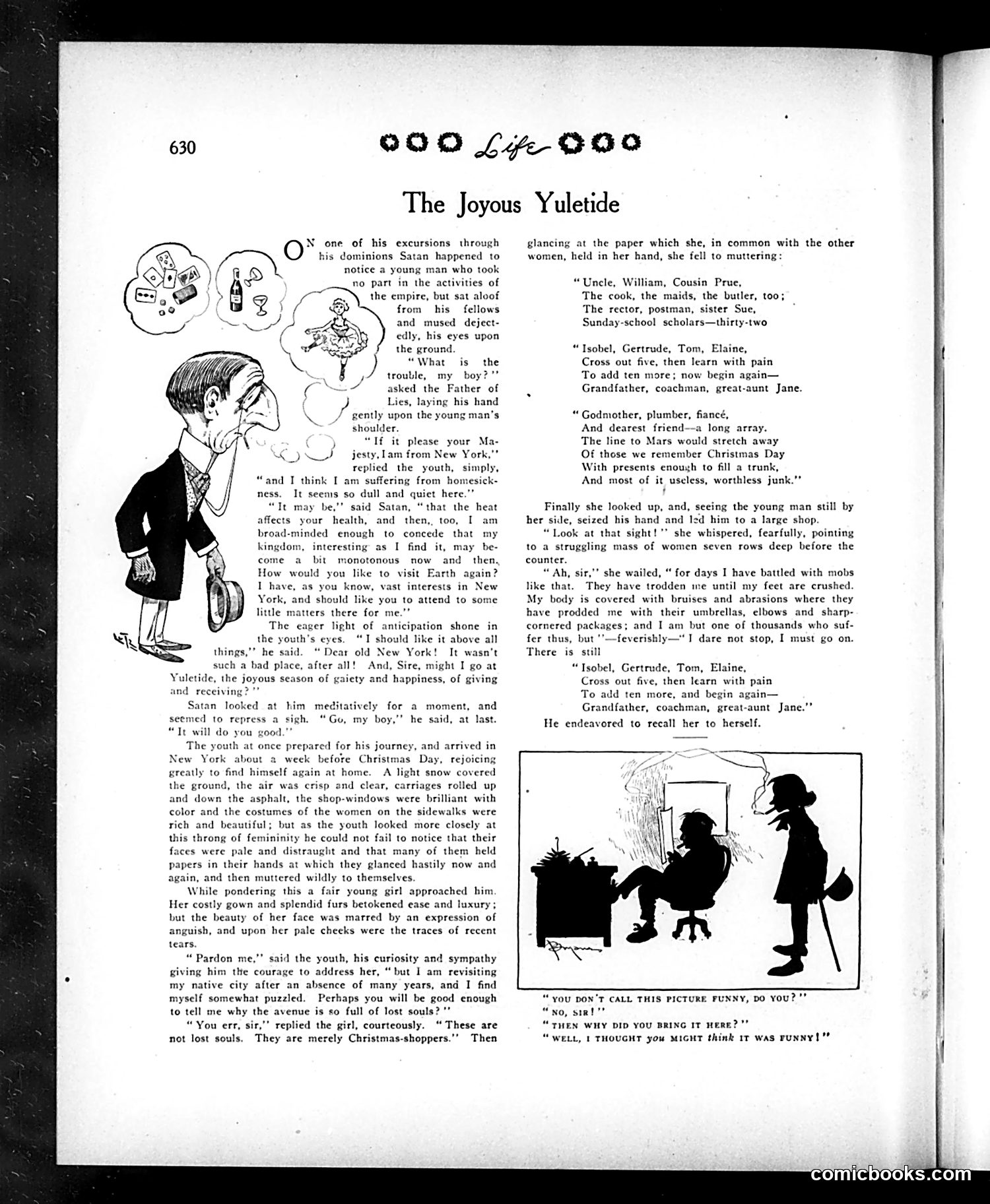
This story satirizes the commercialization and stress of Christmas shopping in early 20th-century America. A young man from New York, visiting Hell, is shocked to discover that the frenzied Christmas shoppers on Manhattan's streets are worse off than Satan's dominions—they appear like "lost souls." The joke centers on a wealthy woman with an impossibly long gift list (32 people, then more added), buying "useless, worthless junk." She describes the physical toll of holiday shopping: crowds "seven rows deep," being trampled, crushed feet, and emotional exhaustion. The satire's point: Christmas has become a joyless obligation of mass consumption rather than genuine celebration. The cartoon contrasts Satan's Hell (portrayed as at least honest) with the real "hell" of American consumer culture during the holidays. For modern readers, it reflects surprisingly timeless anxieties about holiday materialism and retail chaos—problems that persist today.
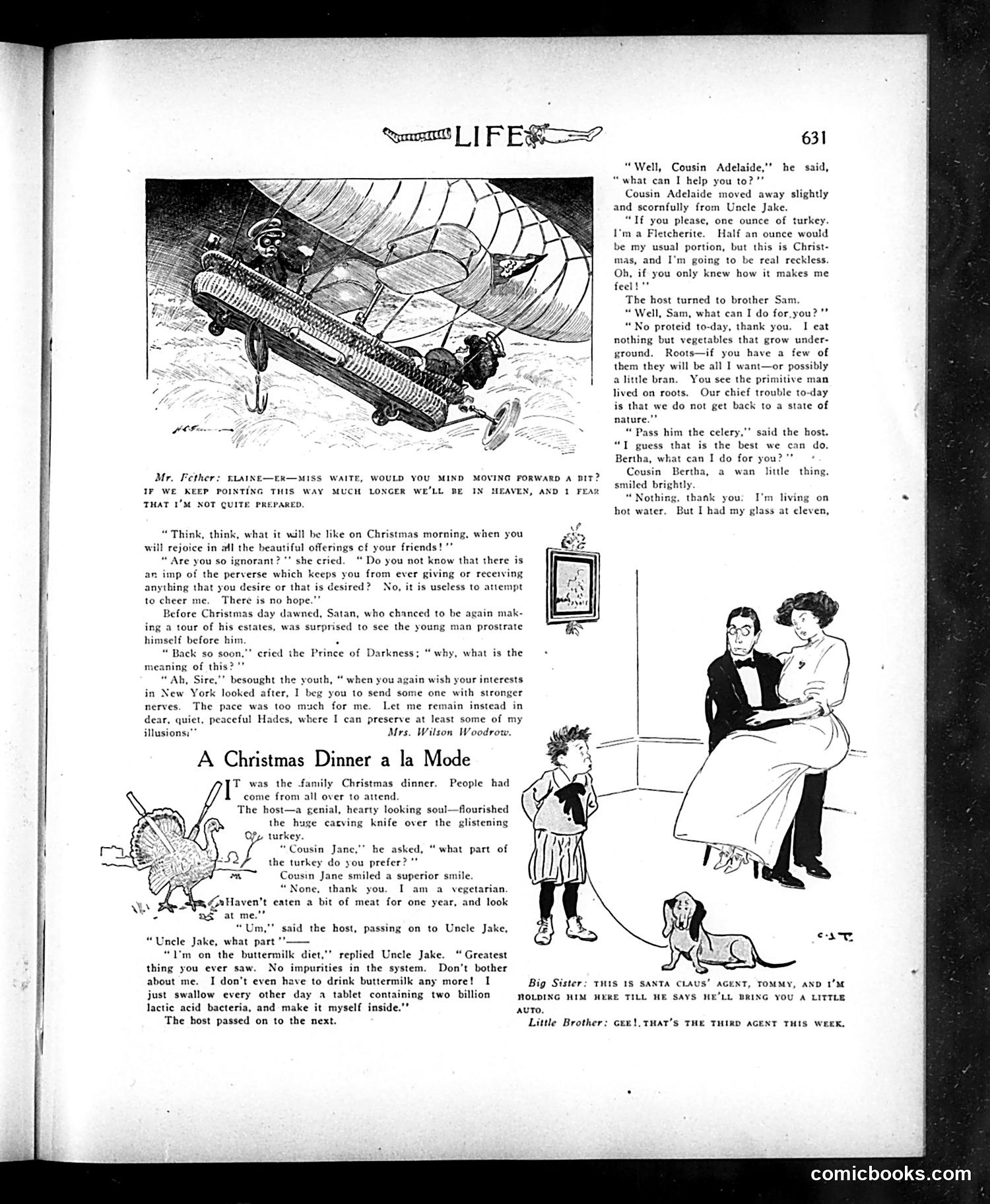
This satirical piece mocks the fad diets and health crazes of early 20th-century America. At a family Christmas dinner, the host attempts to serve turkey, but each guest refuses traditional food in favor of trendy dietary restrictions: - **Cousin Jane** is a vegetarian - **Uncle Jake** follows an extreme "buttermilk diet" involving tablets of bacteria - **Cousin Adelaide** practices "Fletcherism" (extremely small portions) - **Brother Sam** eats only underground vegetables, claiming primitives did so - **Cousin Bertha** survives on hot water The joke satirizes how these competing dietary fads make a normal family meal impossible—the host's generous Christmas dinner becomes absurd when guests reject it for pseudoscientific health trends. The satire targets both the diets themselves and the self-righteous superiority of their adherents. The accompanying illustrations of the host's frustration reinforce the humor of this modern inconvenience.
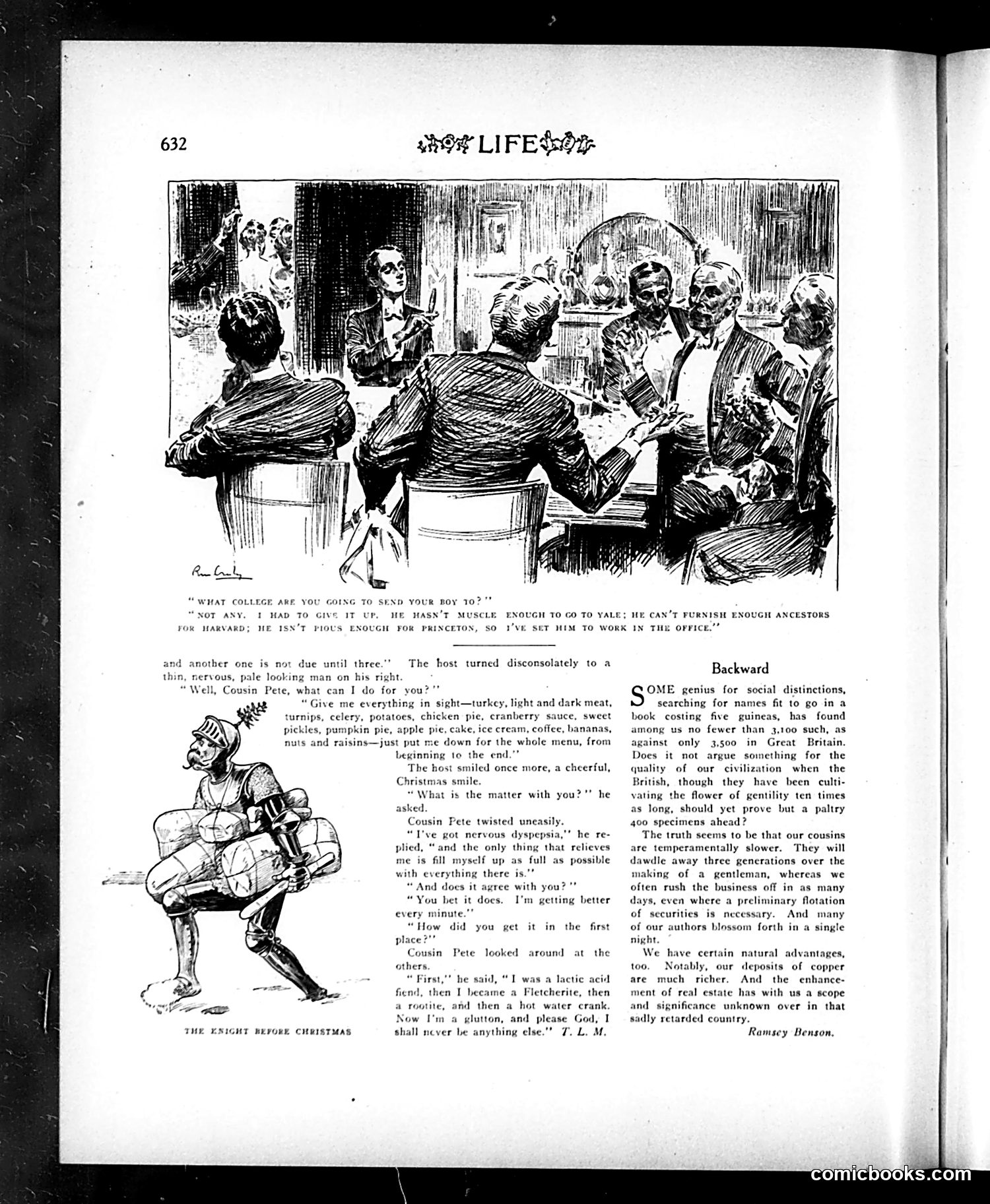
**Top Cartoon:** A wealthy host questions guests about their sons' colleges. One father admits he cannot afford Yale or Harvard, and his son lacks the "piety" for Princeton, so he's put the boy to work instead. This mocks the era's assumption that only the wealthy could educate sons at prestigious institutions, and satirizes how colleges served as markers of social class and religious affiliation. **Bottom Section ("The Knight Before Christmas"):** "Cousin Pete" suffers from "nervous dyspepsia" and believes overeating relieves it. He's cycled through various health fads (Fletcherism, water-cures, etc.), now embracing gluttony. This satirizes early 20th-century Americans' obsession with dietary trends and pseudo-scientific wellness crazes. **"Backward" Essay:** Satirizes American social-climbing and genealogy-book publishing. While Britain boasts 3,500 "distinguished" names versus America's 3,100, the piece mocks American aspirants for rushing into "gentility" through real estate speculation and quick social advancement, lacking Britain's slow historical cultivation.
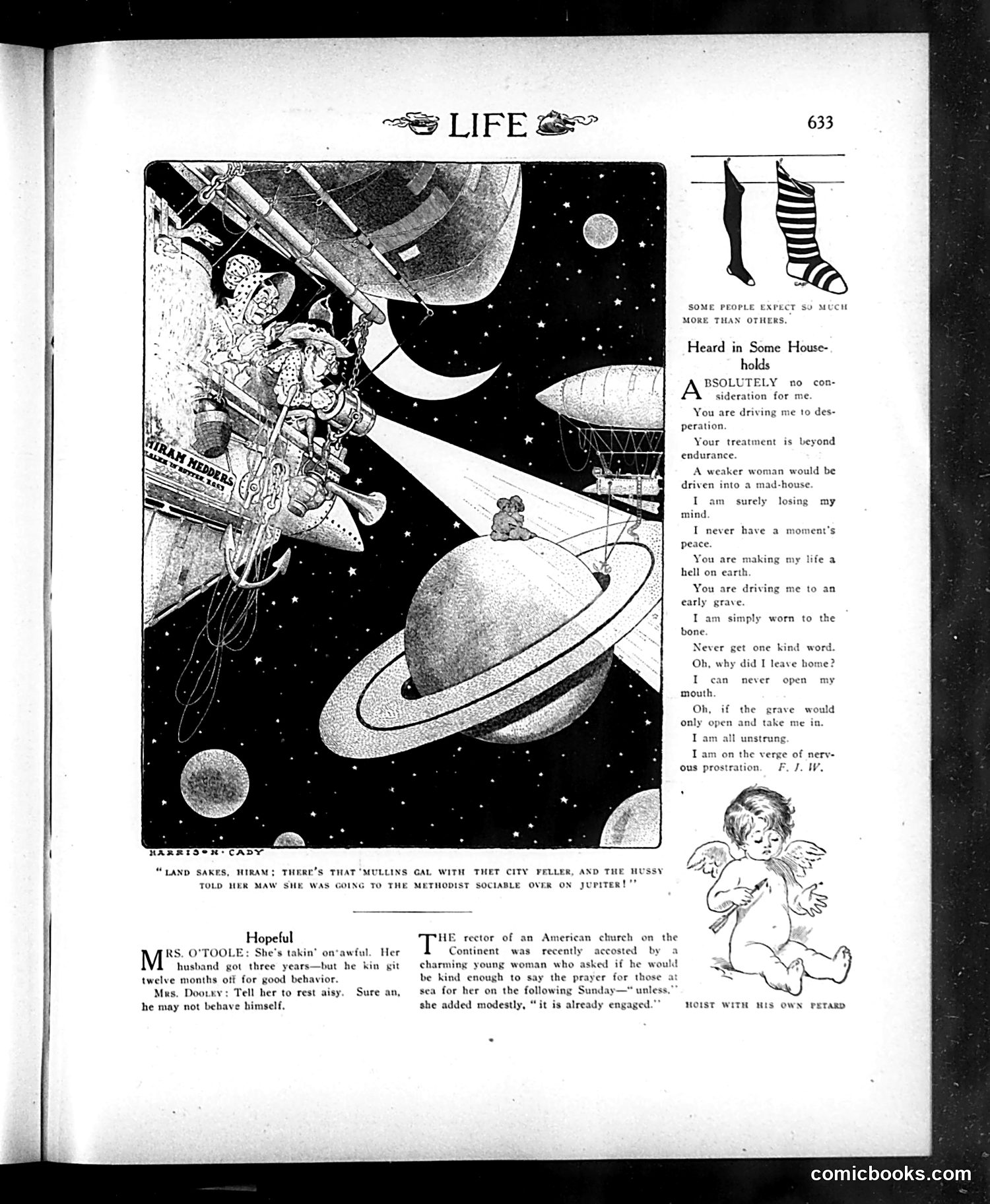
This page contains three separate satirical pieces targeting domestic and social complaints: **Top cartoon** ("Land Sakes, Hiram"): A rural couple gossips about a young woman's impropriety—she's attending a Methodist social event with a city man, behavior they find scandalous. The joke mocks small-town moral judgment and the gap between rural and urban social standards. **Middle text block** ("Heard in Some Households"): A list of exaggerated complaints a wife supposedly makes to her husband—driving him to desperation, making life "hell on earth," etc. The satire targets wives who constantly complain and emotionally manipulate their husbands, portraying them as unreasonably demanding and theatrical about minor grievances. **Bottom anecdote**: A church rector is asked to pray for someone, with the caveat "unless it is already engaged"—implying prayer slots are so competitive they book up. The joke satirizes superficial religiosity and the fashionable performance of piety. Overall, the page mocks women's complaints, small-town prudishness, and insincere religious practice—representing attitudes typical of early-20th-century American satirical magazines.
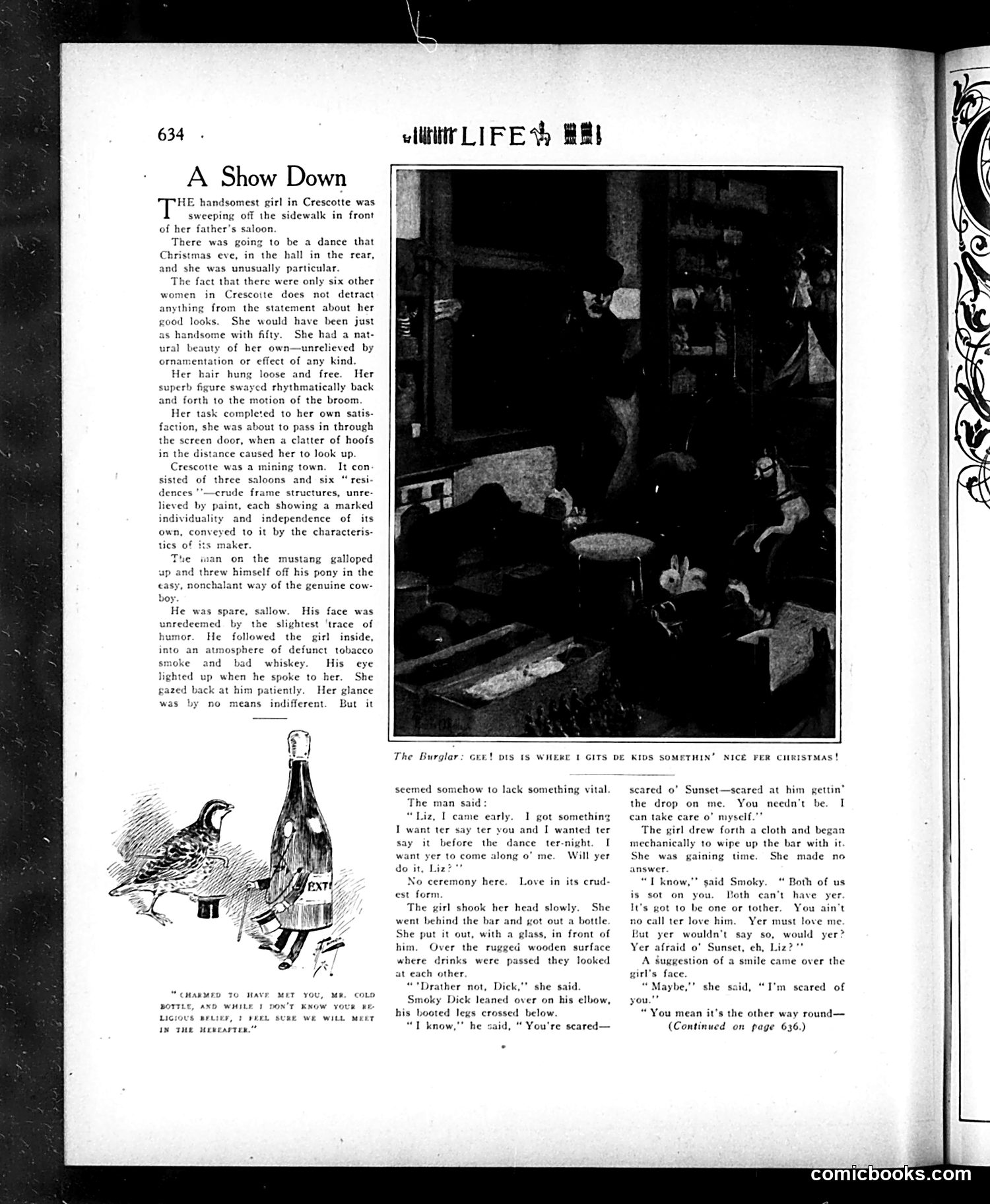
This is a serialized short story, not a political cartoon. Set in a mining town called Crescotte on Christmas Eve, it depicts a romantic conflict in a saloon. The story concerns a beautiful girl (Liz) whose father owns the saloon. Two men compete for her affection: "Smoky Dick," a cowboy who arrives on horseback proposing marriage, and an unnamed rival (apparently "Sunset") whom Dick fears will "get the drop on" him—a reference to gunplay. The satire targets Western frontier romance tropes: Dick's blunt, crude proposal ("Love in its crudest form"), the saloon setting, the threat of gunfighting over a woman, and the girl's passive acceptance of male dominance. The final panel suggests Liz may actually prefer the rival, subverting the expected outcome. The illustration and accompanying dialogue ("Charmed to have met you") show Dick's rough, inarticulate courtship contrasted with civilized society's expectations—the core joke being frontier brutality masquerading as romance.
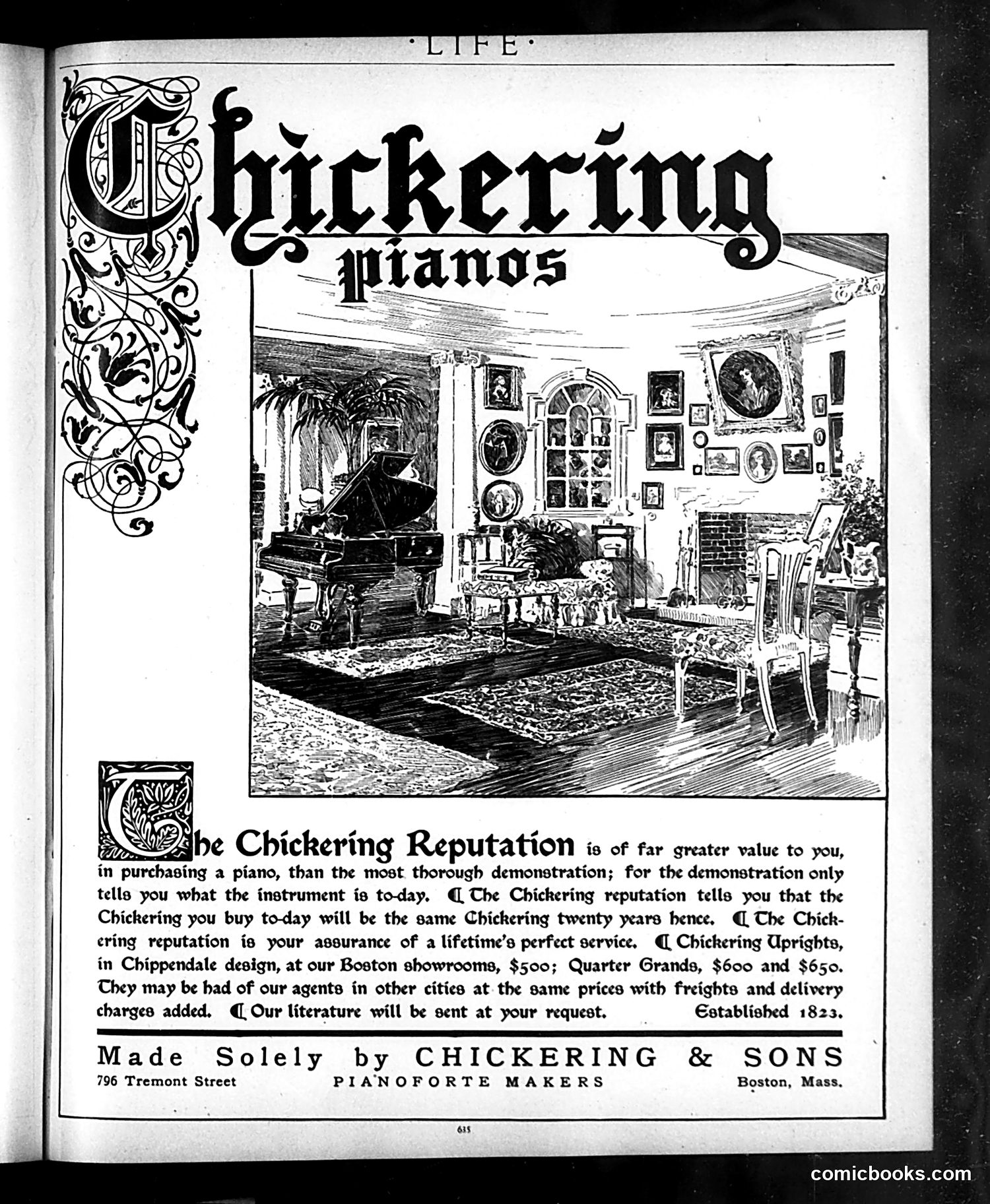
This page is **not a cartoon or satire**—it's a straightforward advertisement for Chickering & Sons pianos, a Boston-based manufacturer established in 1823. The illustration shows an elegant parlor room with a grand piano as the centerpiece, surrounded by refined furnishings, portraits, and decorative elements. This reflects the era's association of piano ownership with wealth, culture, and social status. The advertisement's argument is that Chickering's **reputation matters more than a demonstration**, since reputation promises long-term reliability ("lifetime's perfect service"). Prices ranged from $500 for uprights to $650 for quarter grands pianos. For modern readers: this reveals how pianos were luxury status symbols in early 20th-century American homes, marketed to affluent households as both musical instruments and markers of refinement and respectability.
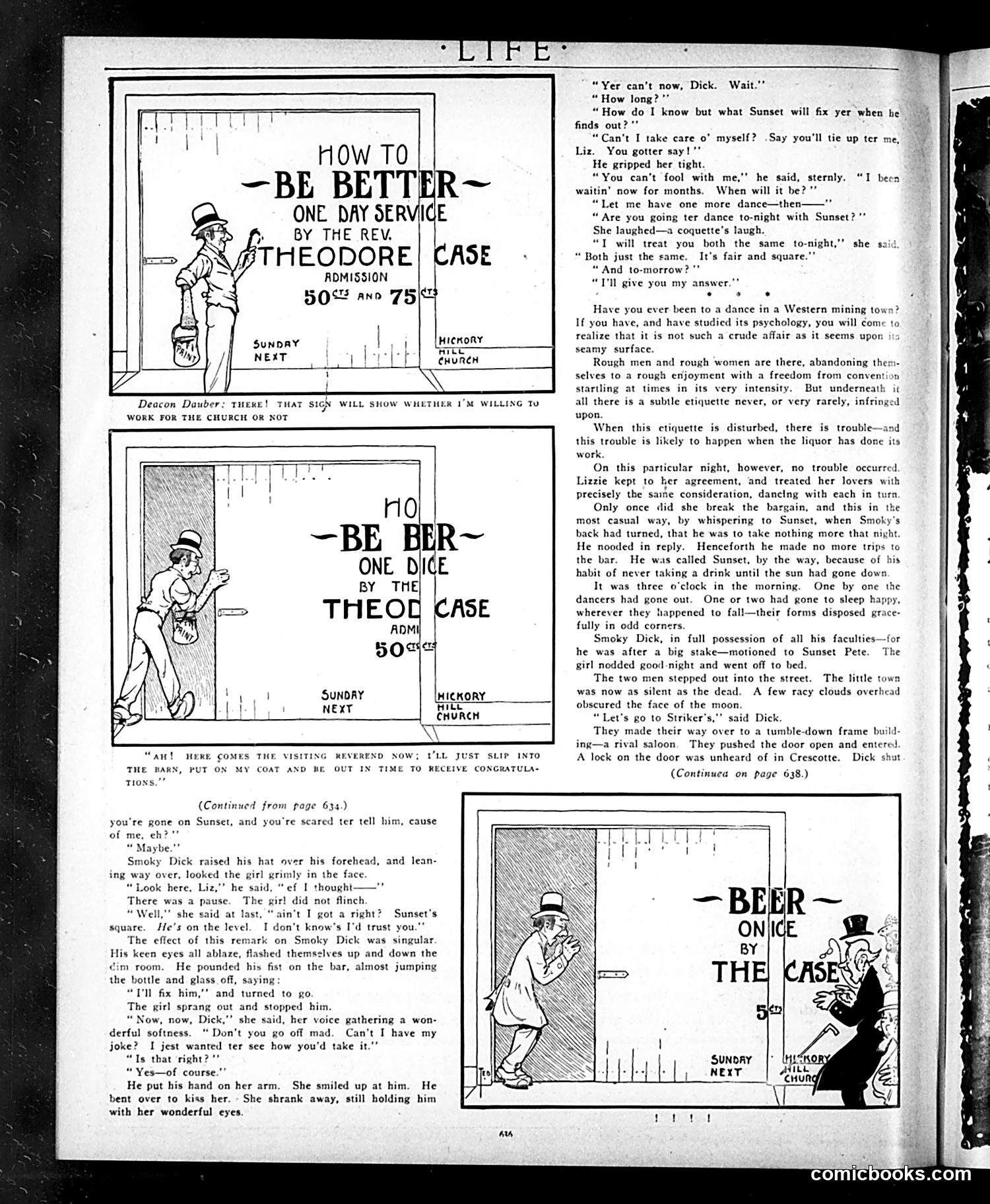
This page from *Life* magazine presents a serialized Western melodrama titled "Beer on Ice" by Theodore Case, interspersed with advertisements for the author's self-help book "How to Be Better One Day" (priced at 50¢-75¢). The story depicts a love triangle in a mining-town saloon: Smoky Dick and Sunset Pete compete for a woman named Lizzie. The narrative captures rough frontier social dynamics—specifically the unwritten "etiquette" governing behavior in such establishments. The text notes that while rough miners and women "abandon themselves" to drinking and dancing with unusual freedom, they still observe subtle social rules. The drama hinges on jealousy: Smoky Dick, discovering Lizzie favors the levelheaded Sunset (who abstains until sundown), threatens violence ("I'll fix him"). The reverend character in the sidebar suggests satirical commentary on hypocrisy—church officials sneaking into bars. The advertisements alongside the lurid fiction offer comical juxtaposition: self-improvement books marketed to readers simultaneously consuming tales of frontier vice and passion.
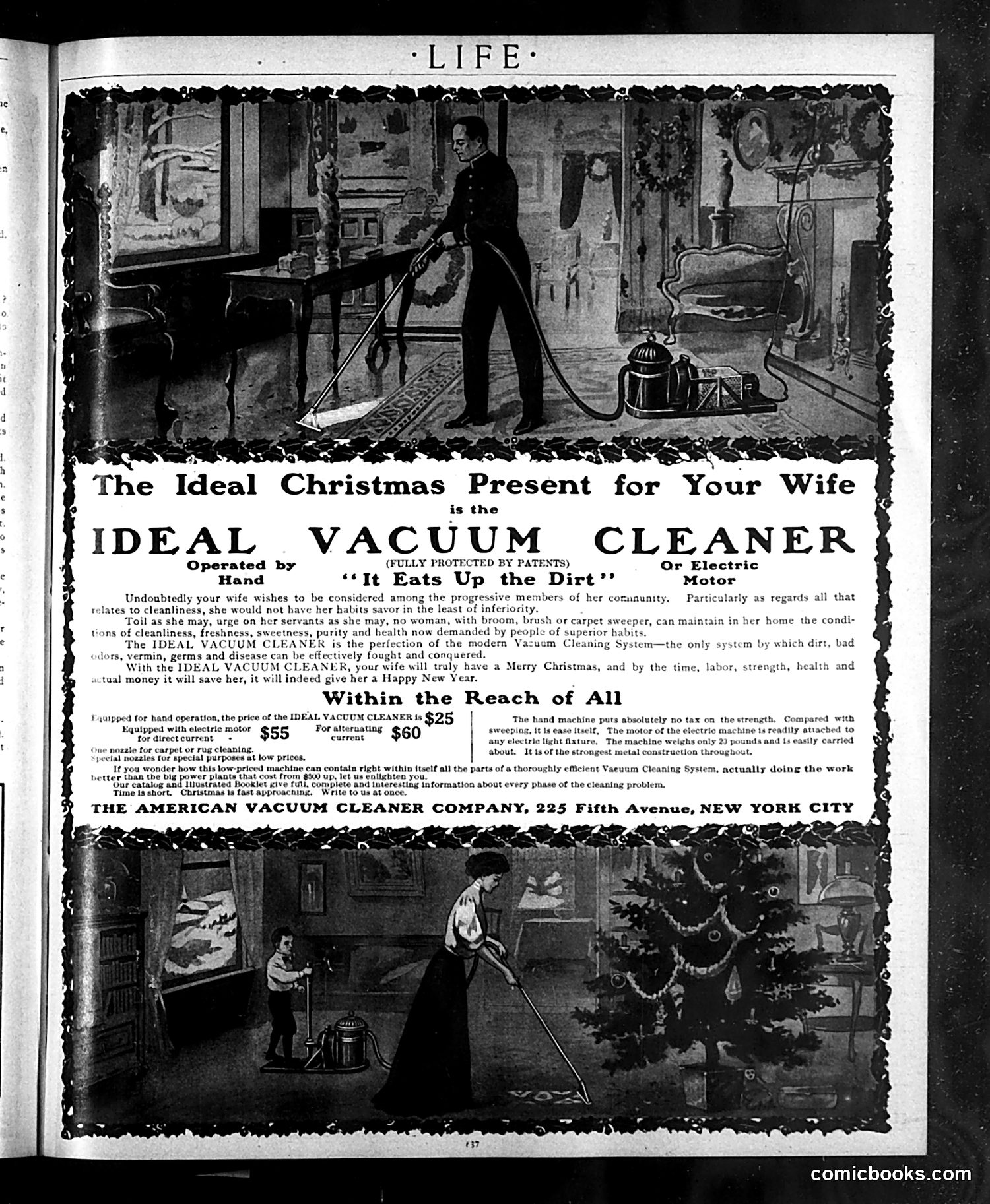
This is a **product advertisement**, not political satire. The page promotes the Ideal Vacuum Cleaner as a Christmas gift for wives. **The "satire" (if any) is in the messaging**: The ad uses social pressure and class anxiety to market the product. It argues that a wife's worth is measured by household cleanliness and that modern women of "superior habits" cannot maintain proper standards with old-fashioned tools like brooms. The vacuum cleaner becomes a status symbol proving the family's progressiveness and wealth. **Key pitch**: Available in hand-operated ($25), electric motor ($55), or electric with alternating current ($60) versions—placing it "within the reach of all" social classes. The two illustrated scenes show women using the device in elegant homes, reinforcing aspirational messaging. This reflects early 20th-century advertising's use of gender roles and social climbing to sell domestic technology—positioning household machines as markers of modernity and respectability.
This page contains a serialized fiction story (continued from page 636) about two rivals, "Sunset" and "Smoky," competing for a woman named "Liz." The narrative culminates in a high-stakes poker game where the loser agrees to commit suicide—a dramatic, darkly comedic Western scenario typical of early 20th-century pulp fiction. The story appears to be satirical melodrama: two men resolve their love triangle through increasingly absurd stakes (drawing revolvers to their own heads, then playing cards for life-or-death). This reflects contemporary satirical magazines' tendency to mock overwrought masculine honor codes and frontier mythology. The bottom half is a full-page advertisement for The Gorham Company, a Sterling silver and luxury goods manufacturer located in New York, listing products like silverware, ecclesiastical wares, and bronzes. **Modern context:** The fictional scenario parodies exaggerated Western masculine honor culture; the advertisement represents early 20th-century luxury marketing.
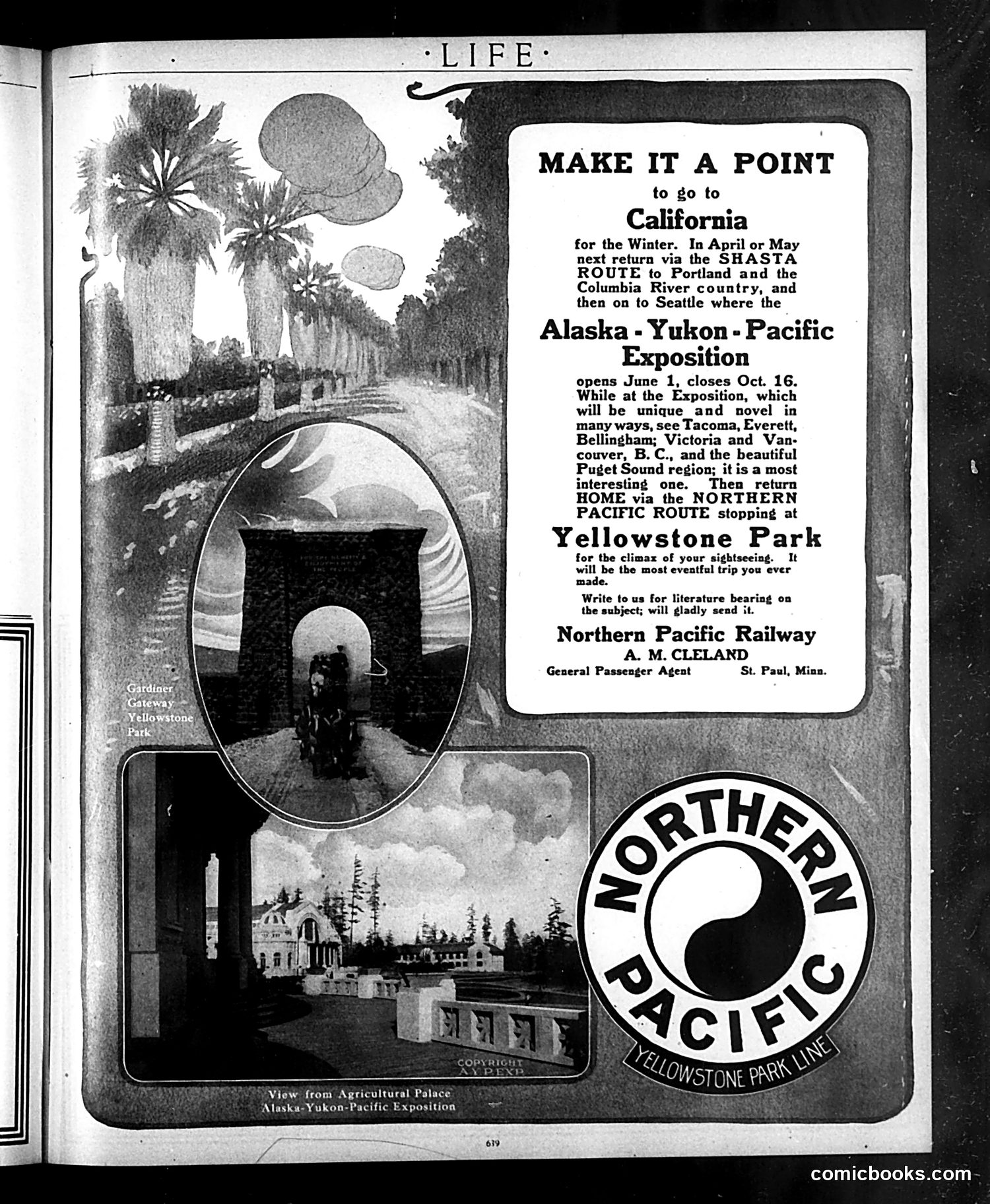
This is **not a political cartoon or satire**, but rather a **travel advertisement** for the Northern Pacific Railway, published in Life magazine. The page promotes a winter vacation itinerary: travel to California, then return northward via the Shasta Route through Portland and the Columbia River region to Seattle, where visitors can attend the Alaska-Yukon-Pacific Exposition (running June 1–October 16). The ad encourages side trips to Tacoma, Everett, Bellingham, and British Columbia, then return home via the Northern Pacific Route with a stop at Yellowstone Park. The images show scenic destinations: palm trees (California), a tunnel (likely the Gardner Gateway to Yellowstone), and the Agricultural Palace from the Alaska-Yukon-Pacific Exposition. The Northern Pacific Railway logo appears at bottom right. This is straightforward promotional material designed to encourage rail travel and tourism during the early 1900s, with no satirical intent.
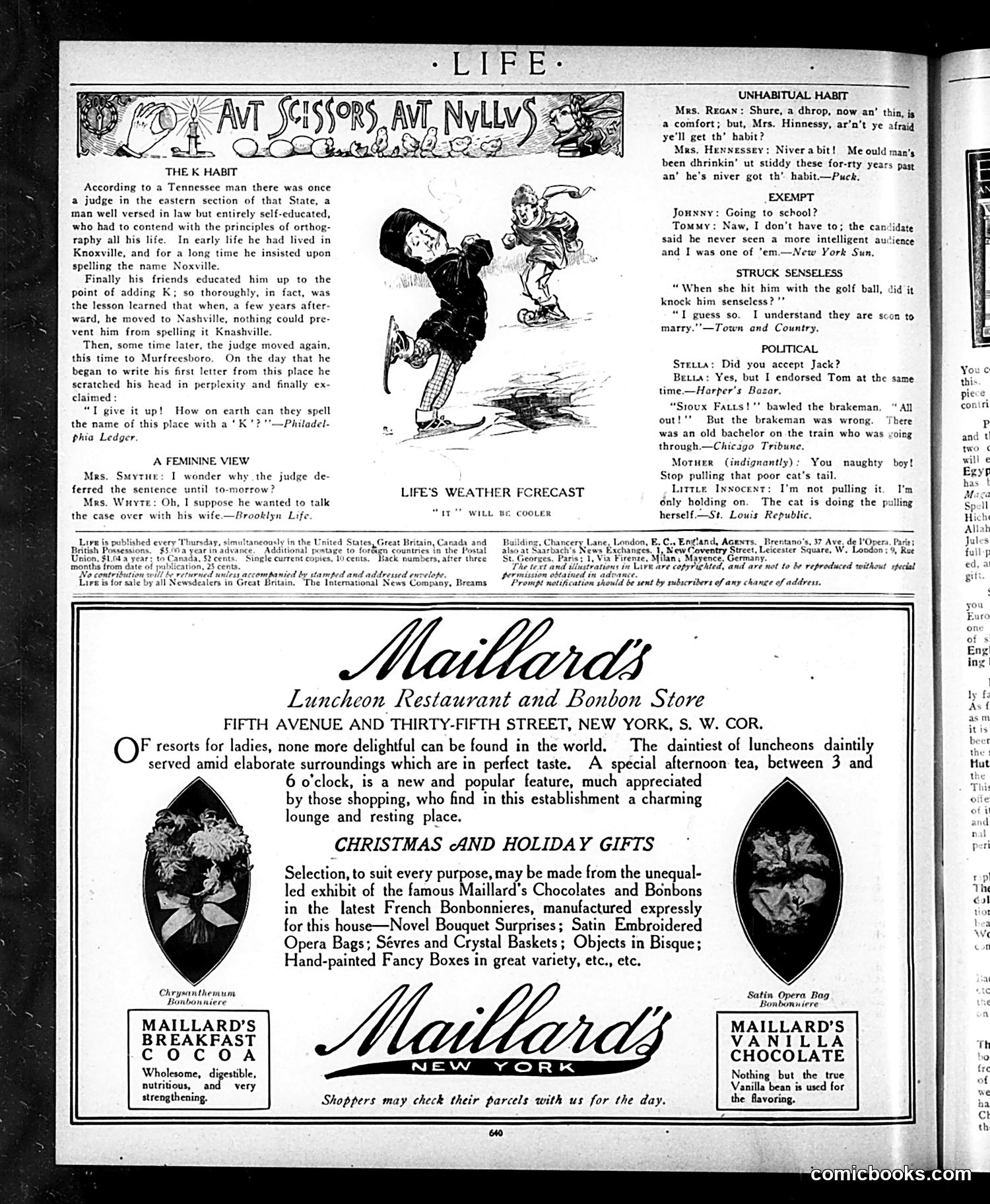
This page contains several short humorous anecdotes targeting common human foibles, plus a major advertisement for Maillard's restaurant and chocolates. **"The K Habit"** jokes about a self-educated Tennessee judge who, after learning to spell "Knoxville" with a K, compulsively adds K to subsequent town names—spelling "Nashville" as "Knashville" and becoming confused about "Murfreesboro." The humor lies in how mechanical habit overrides judgment. **Other brief satirical pieces** mock: - A wife's influence over her husband's legal decisions ("Feminine View") - Alcohol dependency rationalized as harmless ("Unhabitual Habit") - Political inconsistency—a woman accepting one suitor while endorsing another ("Political" section) - Logic failures in romance and animal behavior The page is predominantly a **full-page advertisement** for Maillard's, a luxury Manhattan restaurant and bonbon shop, positioned as an upscale destination for female shoppers seeking afternoon tea and holiday gifts. This reflects the magazine's dual nature as satirical commentary mixed with commercial content.
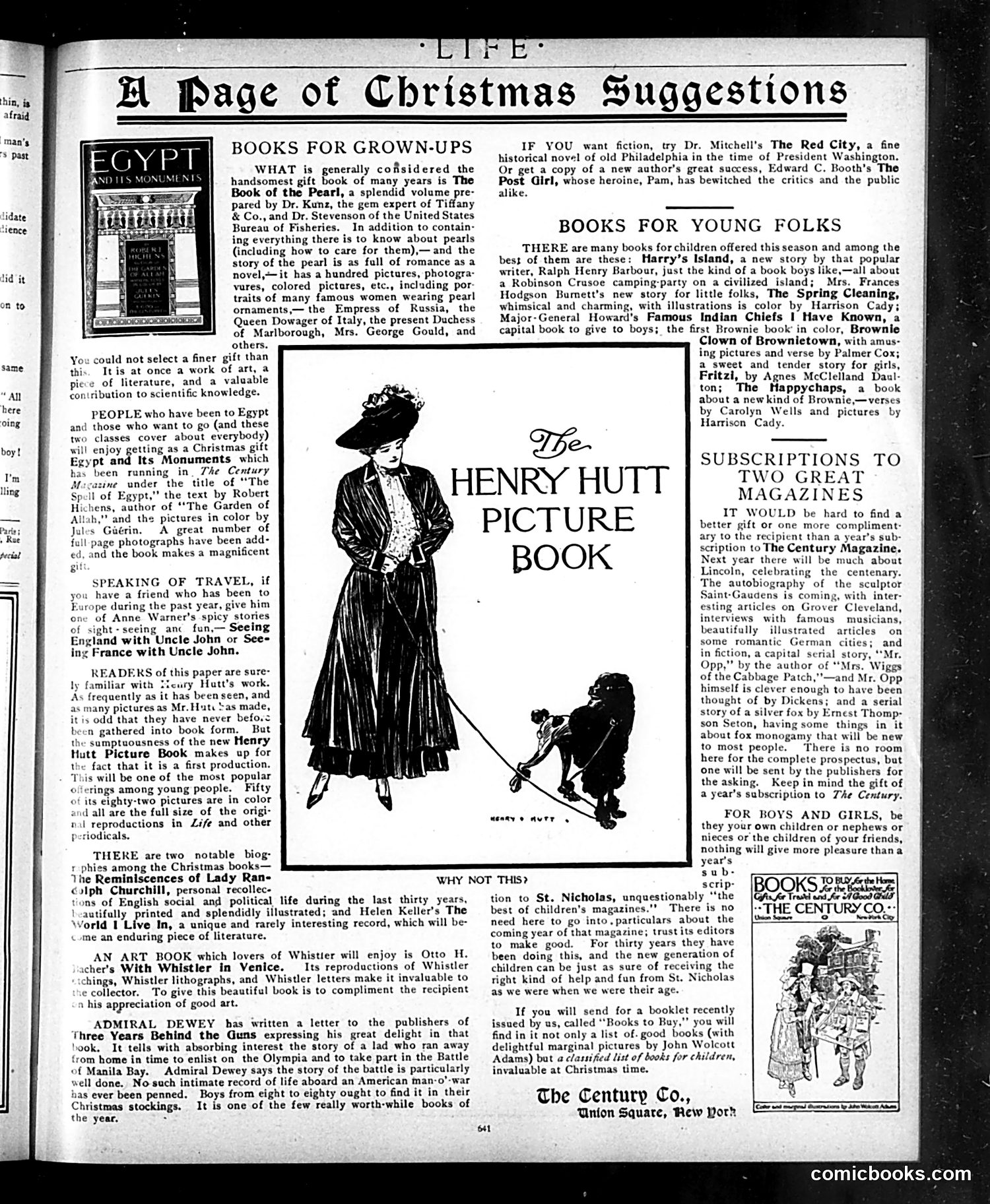
This is primarily a **gift-book advertisement page**, not satirical content. It showcases luxury holiday gift recommendations from The Century Co. publisher, organized by recipient type (grown-ups, young folks, boys and girls). The central illustration features **Henry Hutt's Picture Book**—a collection of his commercial illustrations previously published in *Life* and other periodicals. Hutt was a popular illustrator of the era whose work appealed to young people. The page emphasizes **high-end, beautifully-produced volumes**: pearl encyclopedias from Tiffany & Co., illustrated travel narratives, biographies by society figures (Lady Randolph Churchill) and Helen Keller, and art books featuring James McNeill Whistler. Notable: Admiral Dewey's endorsement of *Three Years Behind the Guns* reflects early 1900s patriotic fervor around the Spanish-American War and Manila Bay. This represents **Edwardian-era gift culture**—when illustrated books were luxury items signaling taste and refinement.
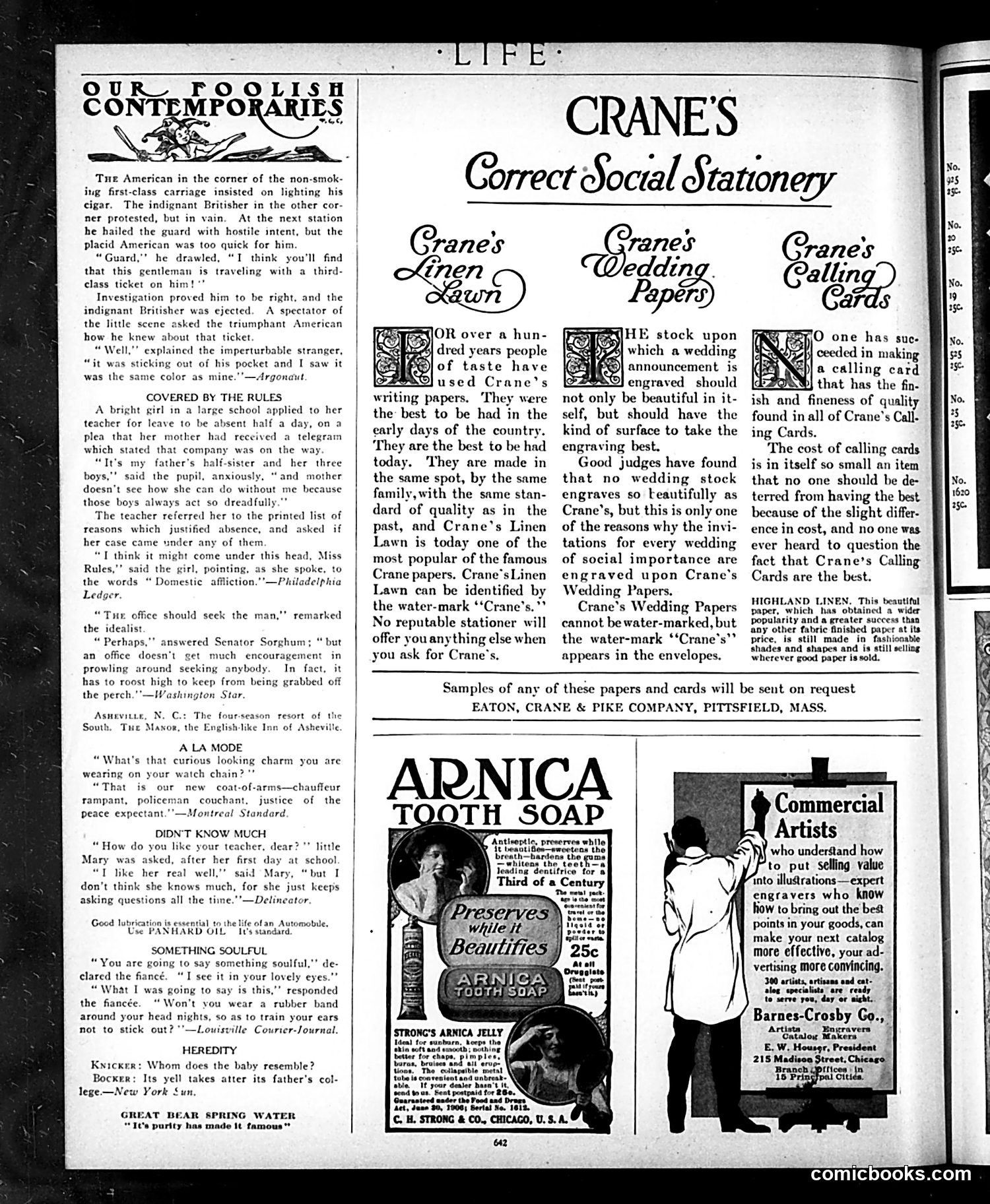
This page is primarily **advertising and humorous anecdotes** rather than political satire. The main content features **six brief comedic stories** mocking social pretension and human folly: 1. **"Covered by the Rules"**: An American outsmarts a British passenger by falsely claiming he's traveling in third-class, using a discarded ticket as "proof." 2. **"Domestic Affliction"**: A schoolgirl cleverly exploits vague absence rules by claiming her father's visiting half-sister counts as a family crisis. Other anecdotes mock: office-seekers, new coat-of-arms (mocking nouveau riche), teachers who ask questions, overly sentimental romance, and heredity. The page's **primary purpose is commercial**: Large advertisements for **Crane's stationery** (wedding papers, calling cards, linen), **Arnica Tooth Soap**, and **Commercial Artists services** dominate the layout. The humor reflects early 20th-century class anxieties—Americans vs. British, social climbing, and proper etiquette—typical of *Life* magazine's genteel, middle-class satirical tone.
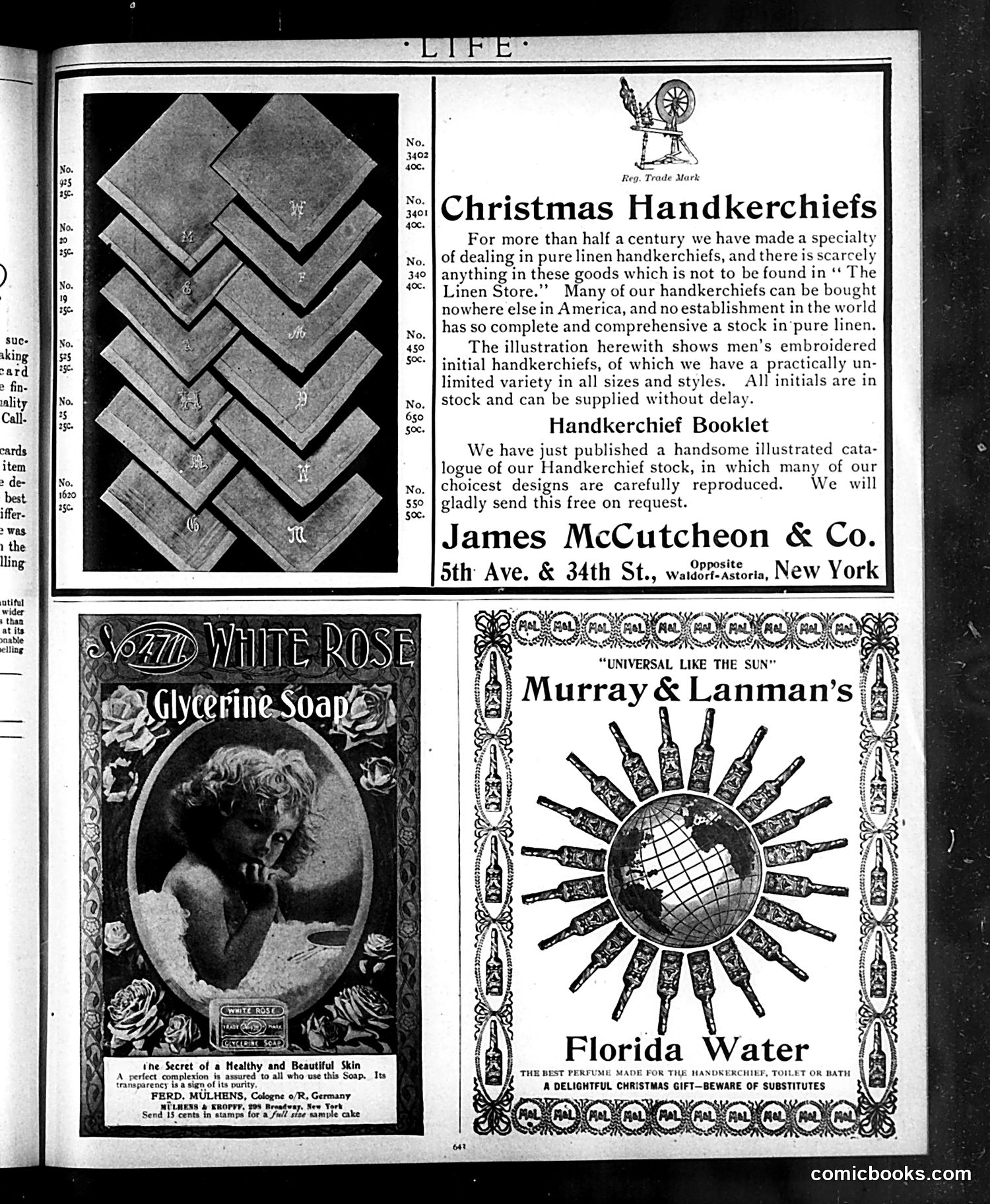
This is **not a political cartoon** but rather a **vintage advertisement page**, likely from the early 1900s based on typography and design. The page features three ads for luxury gift items: 1. **James McCutcheon & Co.** (top): Advertises men's embroidered linen handkerchiefs with monogrammed initials—a high-end gift marketed as unavailable elsewhere in America. They're promoting a free illustrated catalog. 2. **White Rose Glycerine Soap** (bottom left): Features an allegorical female figure (likely representing beauty or purity) and markets skin care as a health product, reflecting period beliefs about soap's medicinal properties. 3. **Murray & Lanman's Florida Water** (bottom right): Marketed as "the best perfume made for the handkerchief, toilet or bath"—a cologne/fragrance product positioned as an ideal Christmas gift. All three target affluent consumers seeking refined gift options. The page exemplifies early 20th-century advertising's emphasis on exclusivity, beauty, and genteel consumption rather than humor or satire.
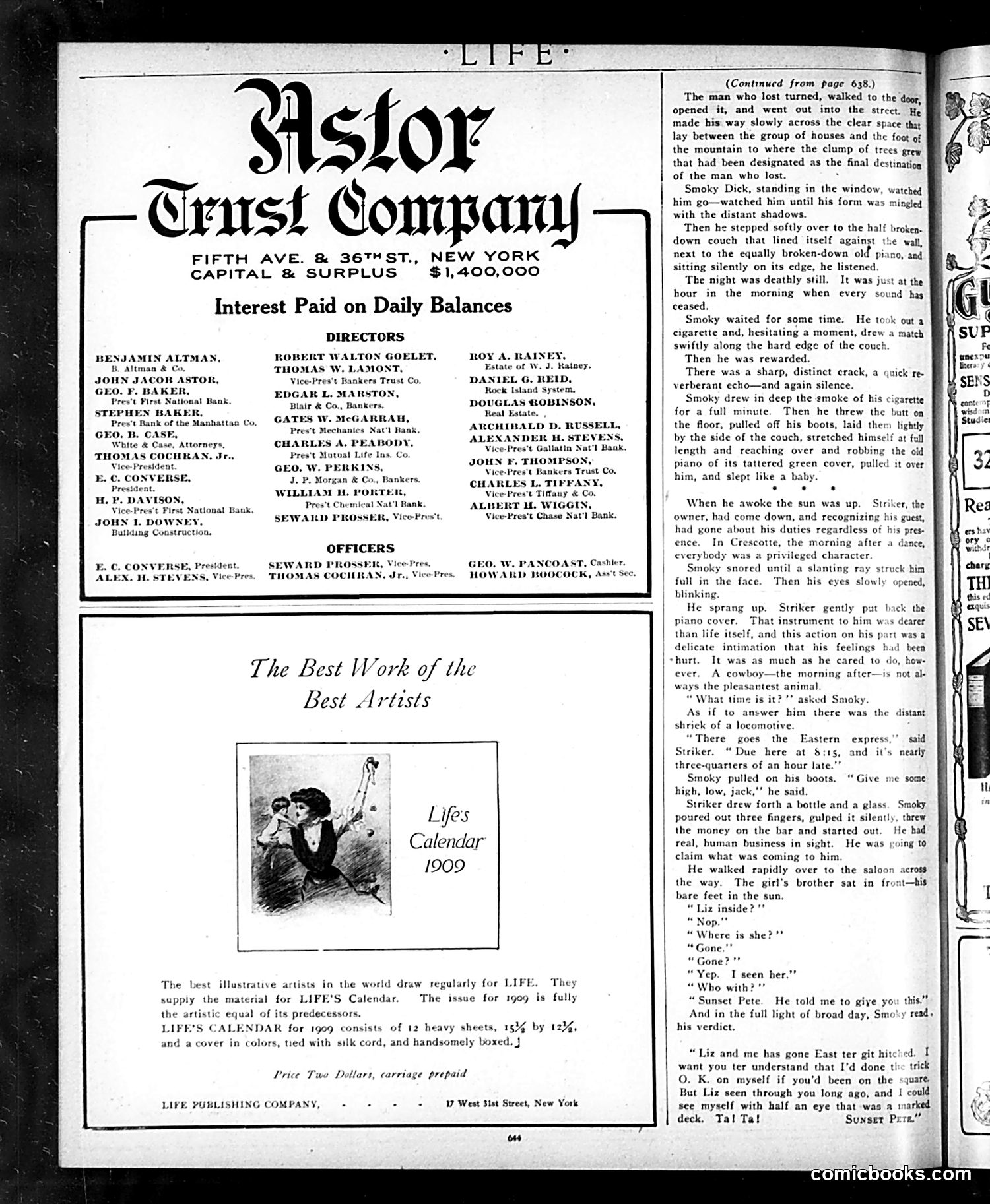
This page contains a **serialized story** ("Continued from page 638") featuring a character named Smoky, set in what appears to be a frontier or mining town. The narrative describes Smoky waiting in a saloon after someone has left, then waking the next morning and preparing to settle accounts with someone—likely the girl's brother he encounters. The bulk of the page is **corporate advertising** for the Astor Trust Company, listing wealthy Manhattan business leaders as directors and officers. This represents typical *Life* magazine content: satirical fiction paired with prestigious commercial advertising targeting wealthy readers. The story itself appears to be a **Western-style morality tale** about debts, honor, and consequences—common pulp fiction themes of the era. There is **no political satire** visible on this particular page; it's primarily entertainment and advertising content typical of early-1900s *Life* magazine.
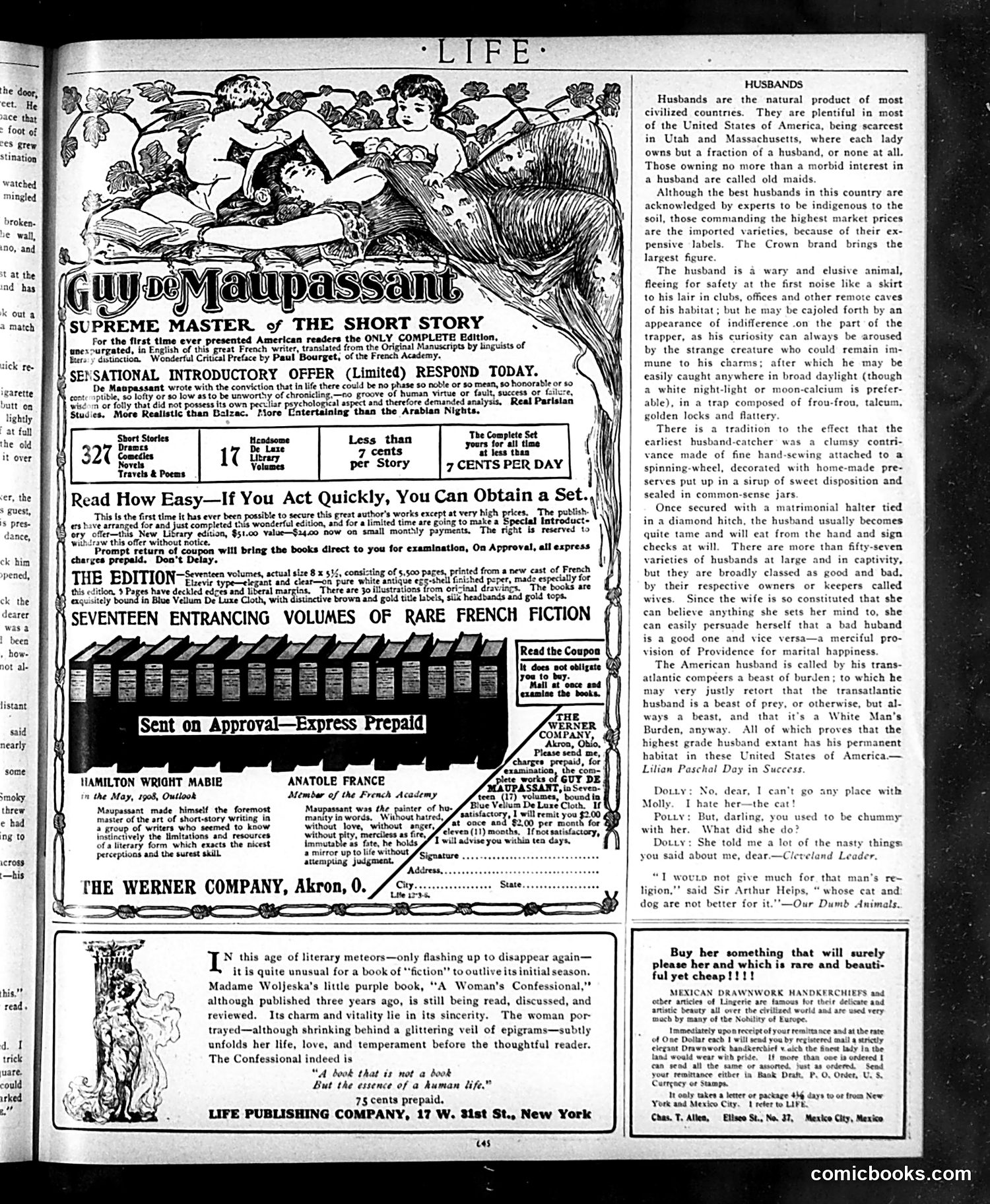
This page is primarily **advertising and literary promotion**, not political satire. The dominant content advertises a complete edition of Guy de Maupassant's short stories through The Werner Company. The small satirical element appears in the right column under "HUSBANDS"—a humorous tongue-in-cheek definition essay. It jokes that husbands are "natural products" of civilized countries, notably scarce in Utah (referencing polygamy) and Massachusetts. The piece anthropomorphizes husbands as wary animals requiring "hand-sewing" courtship rituals and suggests wives can manipulate them through strategic behavior. The Maupassant advertisement itself features endorsements from Hamilton Wright Mabie and Anatole France, emphasizing the author's psychological realism and moral complexity—standard literary marketing for early 20th-century publishers. The page's satire is **light and domestic** rather than political, targeting gender relations and marriage through gentle mockery rather than social critique.
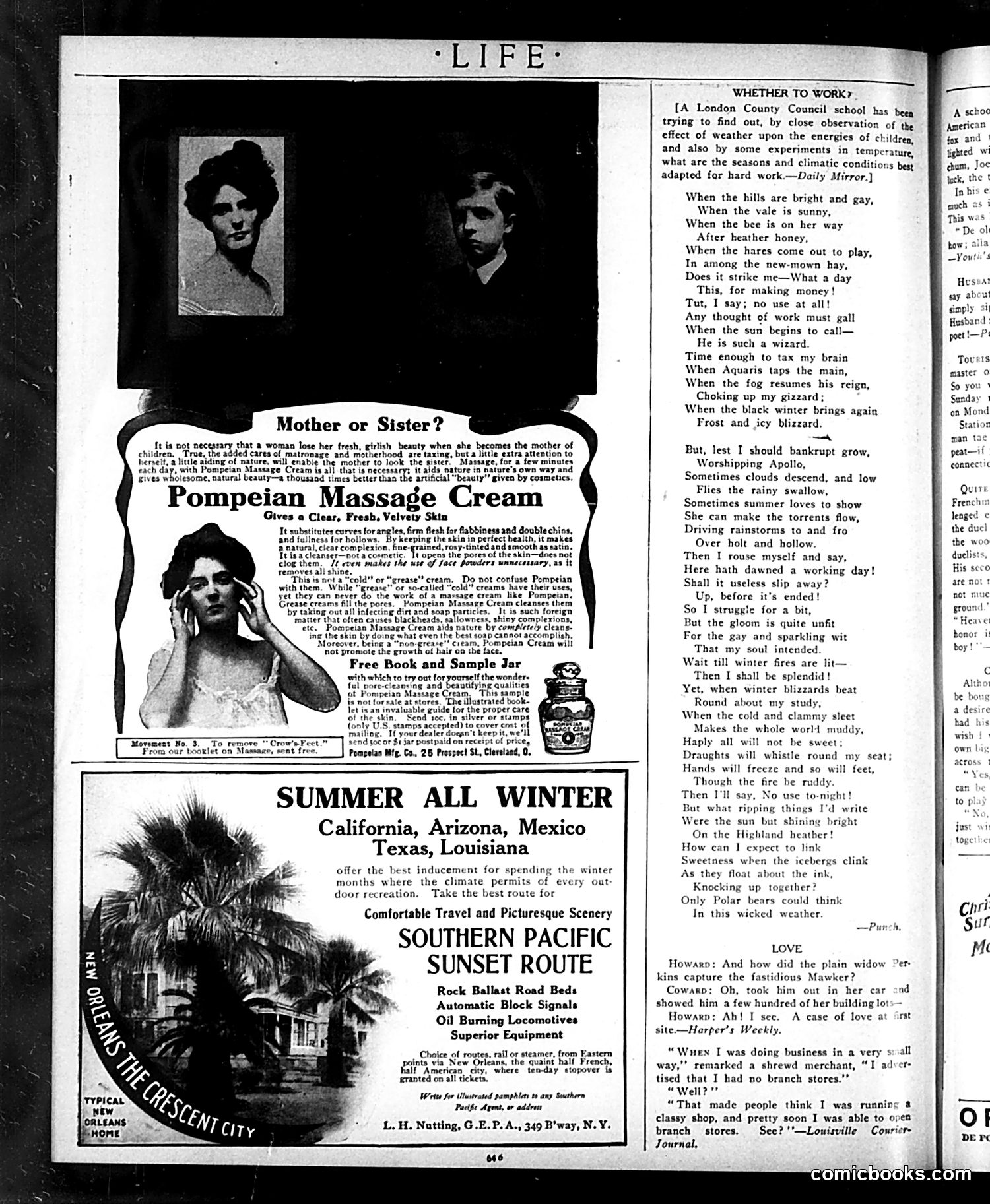
This page contains **advertising and light verse**, not political satire. The dominant content is a **Pompeian Massage Cream advertisement** using a "Mother or Sister?" pitch—a common early-20th-century beauty marketing trope suggesting women needn't lose youth and attractiveness after becoming mothers. The ad contrasts itself with greasy cold creams, claiming to cleanse rather than clog pores. Below is a **Southern Pacific Railroad advertisement** promoting winter travel to warm climates (California, Arizona, Mexico, Louisiana) via their "Sunset Route." On the right is **verse about whether to work**, apparently commenting on weather's effect on productivity, referencing a London County Council school study. The poem uses seasonal metaphors to suggest sunny weather discourages work—a lighthearted observation rather than satire. The page exemplifies early-20th-century *Life* magazine's mix of commercial advertising with whimsical editorial content, lacking the sharp political commentary the publication became known for.
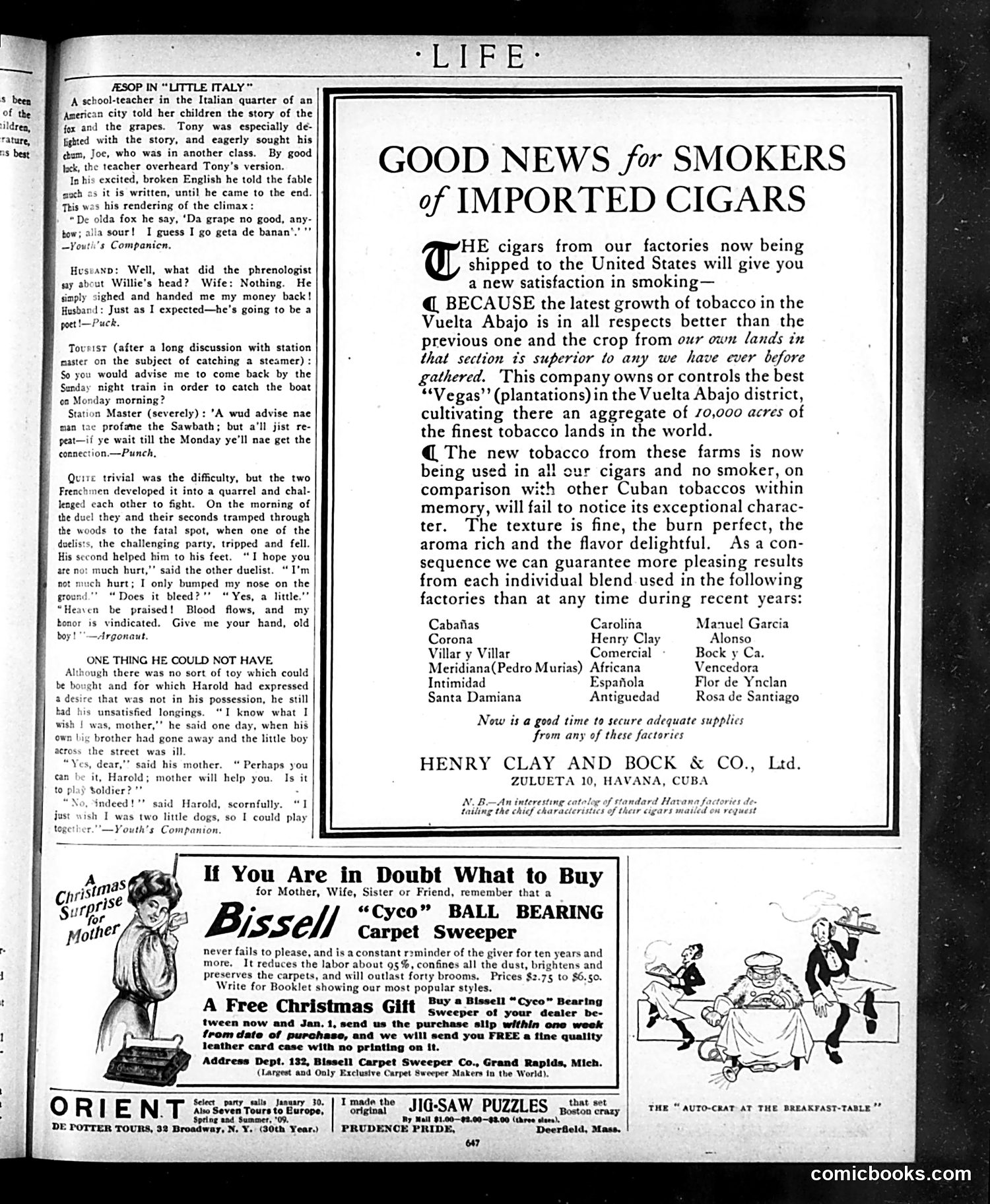
This page contains primarily **advertising and light humor** rather than political satire. The top section presents short humorous anecdotes ("Aesop in Little Italy," "Husband and Phrenologist," etc.)—typical filler content for Life magazine. These include ethnic humor: an Italian-American child's malapropism ("de banan'" for grapes) reflects early 20th-century stereotyping. The dominant content is a **full-page advertisement for imported Cuban cigars** by Henry Clay and Bock & Co., Ltd. The ad emphasizes superior tobacco from the Vuelta Abajo region and lists various cigar brand names. This represents routine commercial advertising of the era. Below appears an advertisement for **Bissell "Cyco" ball-bearing carpet sweepers**—a Christmas gift suggestion with illustrations of children using the product. There is **no political cartoon or satire** on this page. It's essentially a commercial page with minor humor pieces, typical of Life's revenue model during this period.
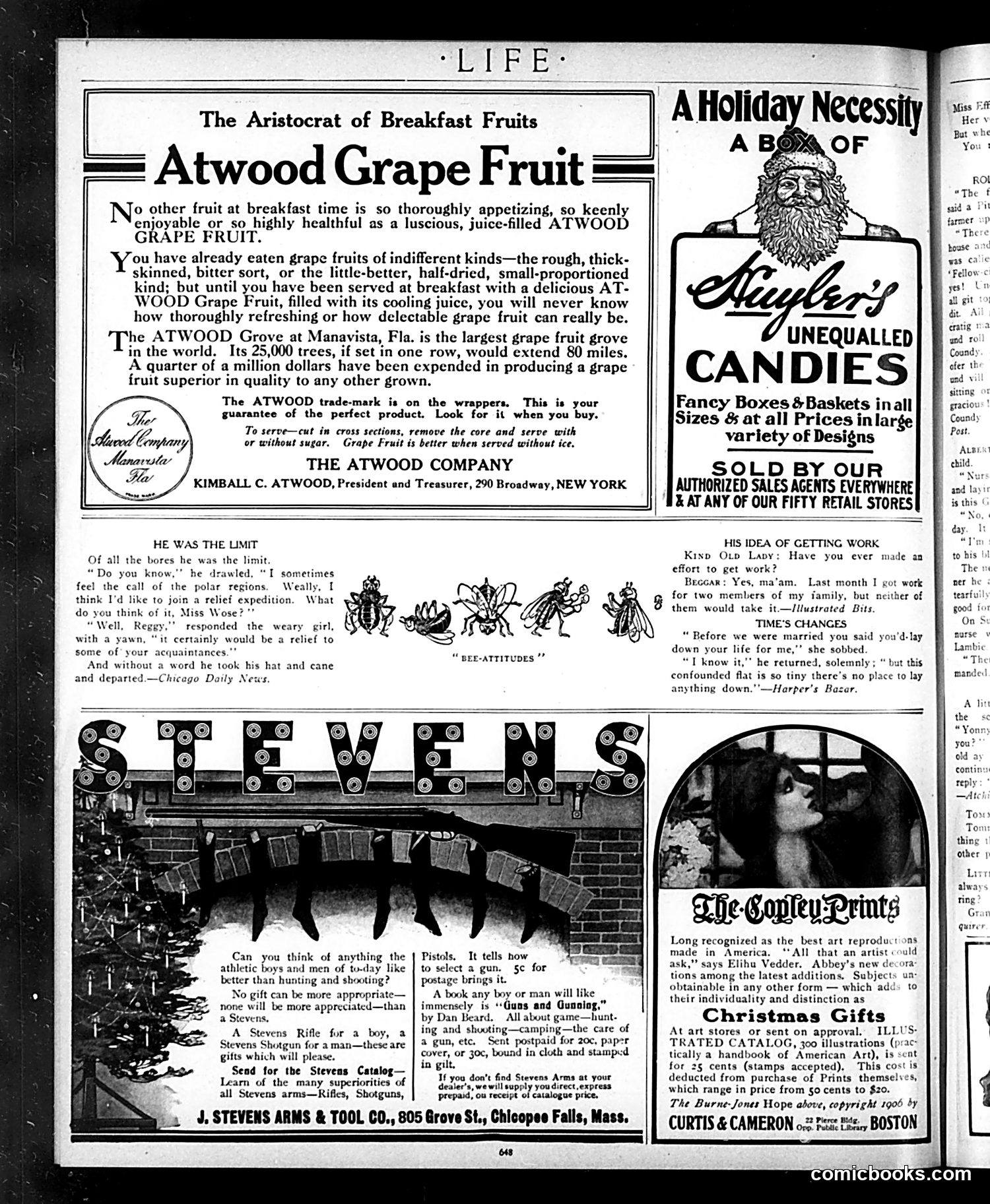
This page is primarily **advertising**, not political satire. It contains: **Major Advertisements:** - Atwood Grapefruit (top): Markets Florida grapefruit as a superior breakfast fruit, emphasizing the Manavista grove's size and quality investment - Suyler's Candies (top right): Holiday gift boxes - Stevens Arms & Tool Co. (bottom): Rifles and shotguns marketed as gifts for "athletic boys and men," with reference to Dan Beard's hunting guide - The Goupley Prints (bottom right): Art reproductions as Christmas gifts **Humorous Filler Content:** The page includes three brief comic anecdotes ("He Was the Limit," "His Idea of Getting Work," "Time's Changes") typical of early 20th-century magazine humor—short, gentle jokes about social situations and relationships with no political content. **Context:** This reflects early 1900s consumer culture and gift-giving traditions, with no discernible political satire or social commentary.
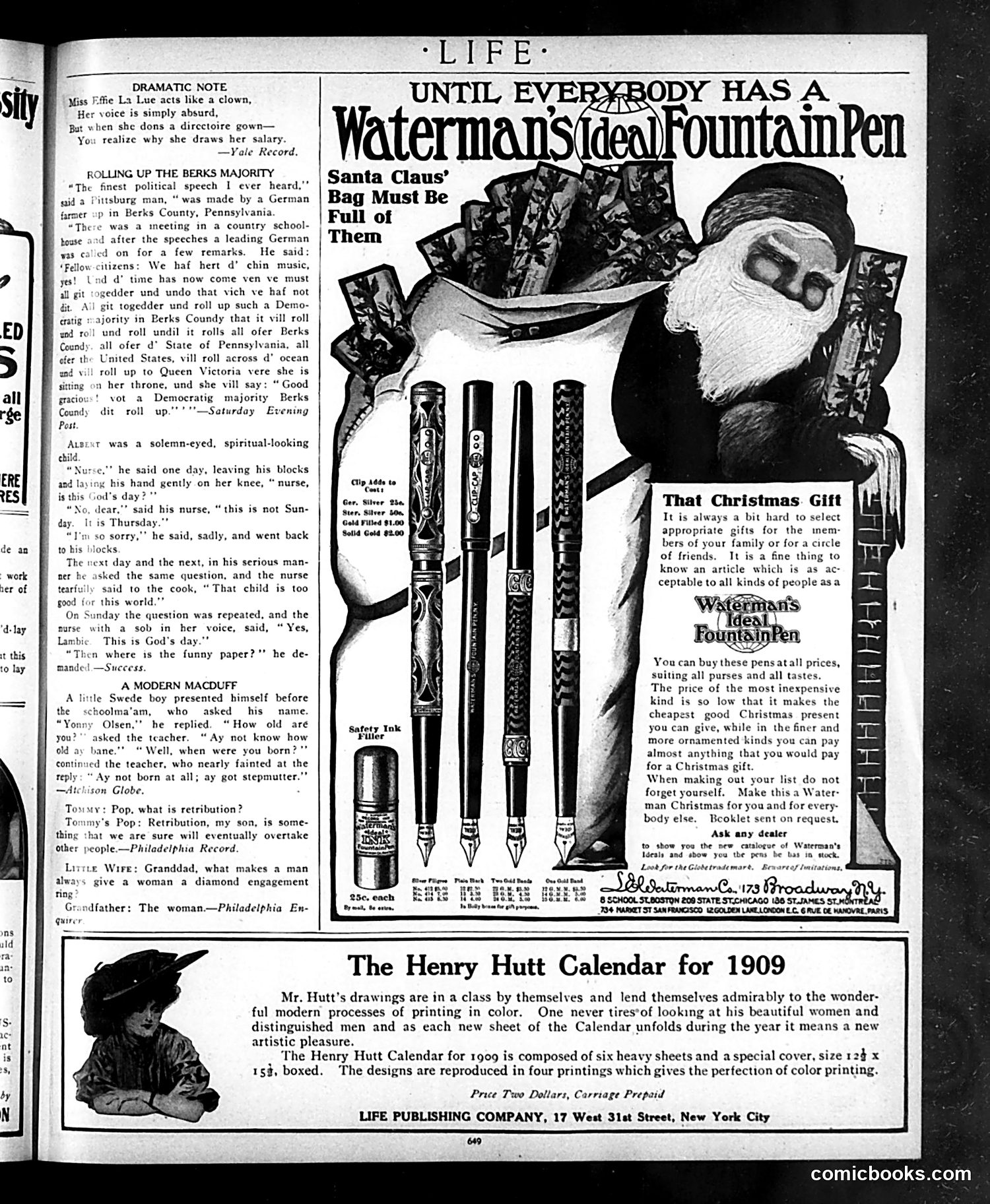
This page contains **humorous anecdotes and advertisements** rather than political cartoons. The text snippets are brief jokes exploiting ethnic stereotypes common to early 1900s American humor: - **"Rolling Up the Berks Majority"** features a German immigrant's malapropistic speech about rolling up a Democratic voting majority—the humor derives from his accent and grammatical errors ("haf," "vich," "togedder"). - **"A Modern Macduff"** presents a Swedish boy character ("Yon Olsen") whose broken English and reply about having a "stepmutter" instead of a birth provides the punchline. These reflect the era's casual ethnic mockery of recent immigrant populations. The **dominant content is advertising**: a large Waterman's Ideal Fountain Pen advertisement featuring Santa Claus, promoting pens as Christmas gifts at various price points. Below appears an advertisement for Henry Hutt's 1909 Calendar. The page demonstrates how Life mixed satirical commentary with commercial advertising, while normalizing caricatured immigrant speech patterns as entertainment.
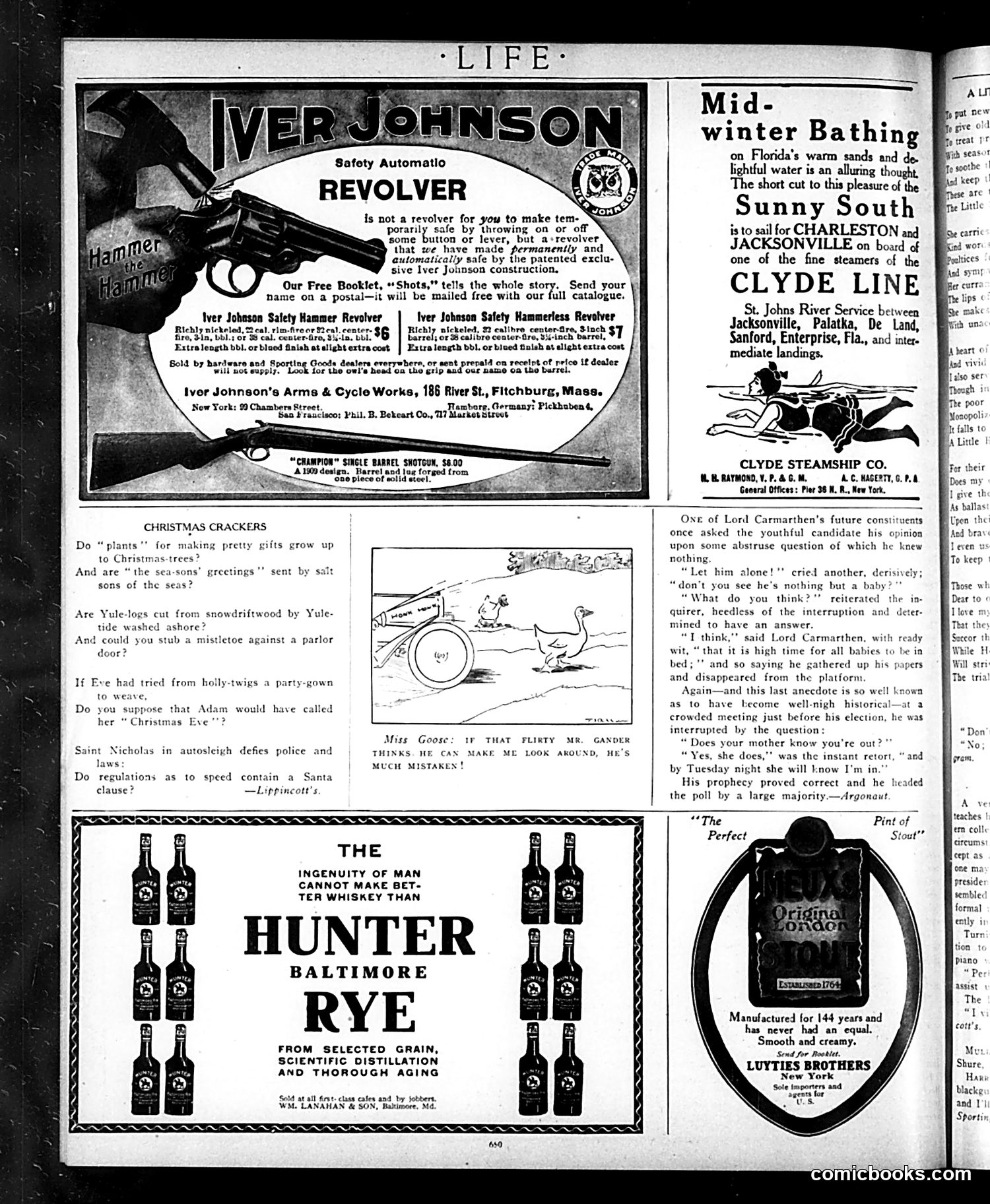
This page is primarily **advertising** with some light humor content interspersed. **Main advertisements:** - **Iver Johnson Safety Revolver**: Promotes a firearm with safety features, marketed as "automatically safe" through patented design - **Clyde Steamship Company**: Advertises steamship travel to Florida destinations (Charleston, Jacksonville) - **Hunter Baltimore Rye**: Whiskey advertisement - **Lutties Brothers Stout**: Beer advertisement **Humor section - "Christmas Crackers":** A series of playful riddles with puns on holiday traditions (Yule logs, mistletoe, holly). The final joke features "Miss Goose" and "Mr. Gander"—anthropomorphic waterfowl—a light satirical jab at flirtation. **Anecdotes:** Two brief stories about Lord Carmarthen, a political candidate, demonstrating quick wit and rhetorical skill. The page reflects early 20th-century Life magazine's format: mixing commercial sponsorships with modest comedic content and social commentary. Nothing here constitutes serious political satire—it's largely consumer-oriented entertainment typical of the era.
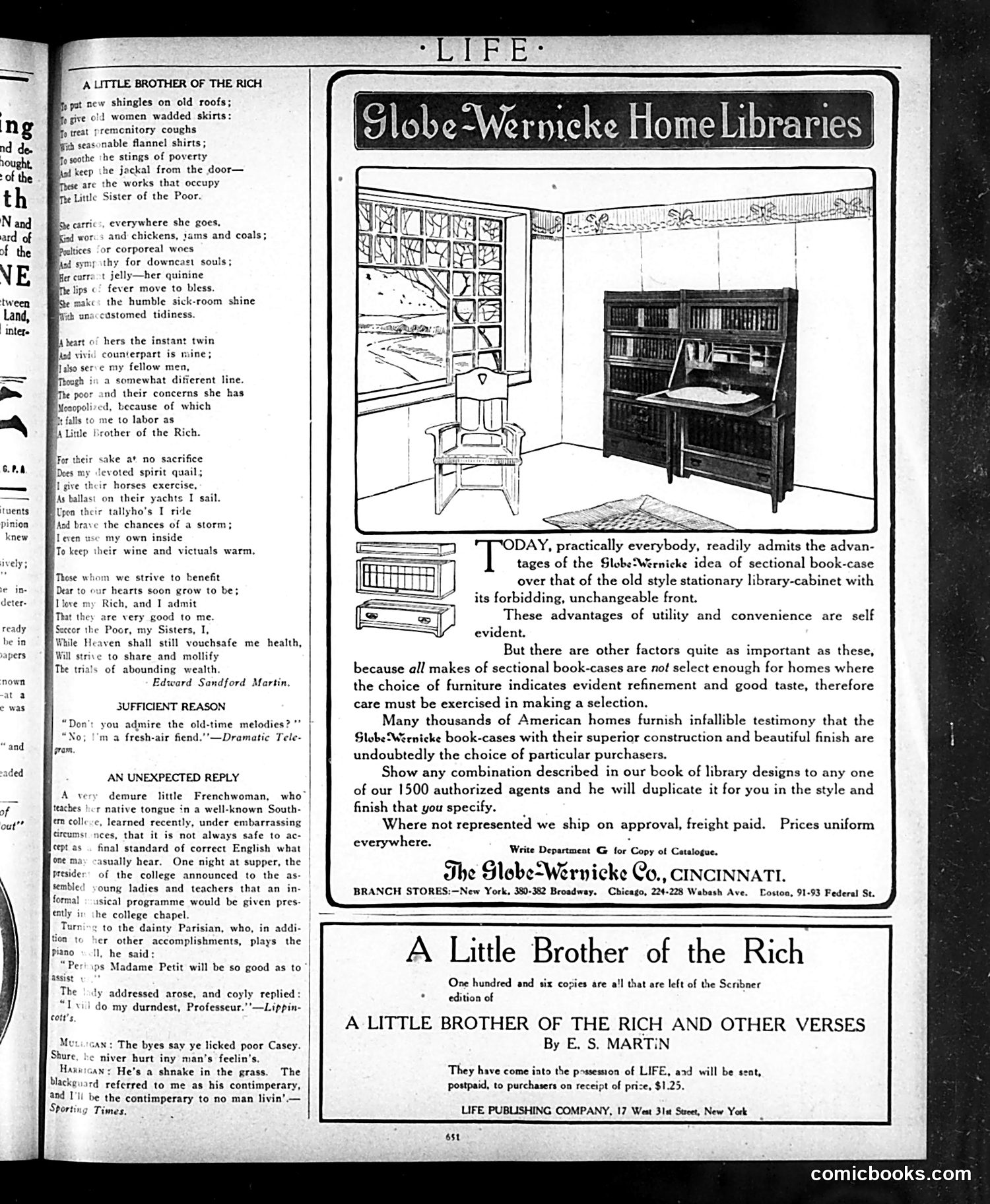
This page contains a poem by E. S. Martin titled "A Little Brother of the Rich," which uses satirical contrast to critique wealth inequality. The poem juxtaposes two figures: the "Little Sister of the Poor" (a charitable worker who mends clothes, distributes food, and helps the sick) with the speaker—an unnamed wealthy person who enjoys luxuries (horseback riding, yachting, keeping wine warm) while the poor struggle. The satire's point: the speaker claims to "labor" for the poor's benefit, but actually lives a life of leisure entirely dependent on their wealth. The title's irony—calling this privileged person a "brother of the rich" rather than helper of the poor—undercuts any pretense of genuine charity or moral equivalence. The remainder of the page is primarily **advertising for Globe-Wernicke sectional bookcases**, unrelated to the poem's social commentary.
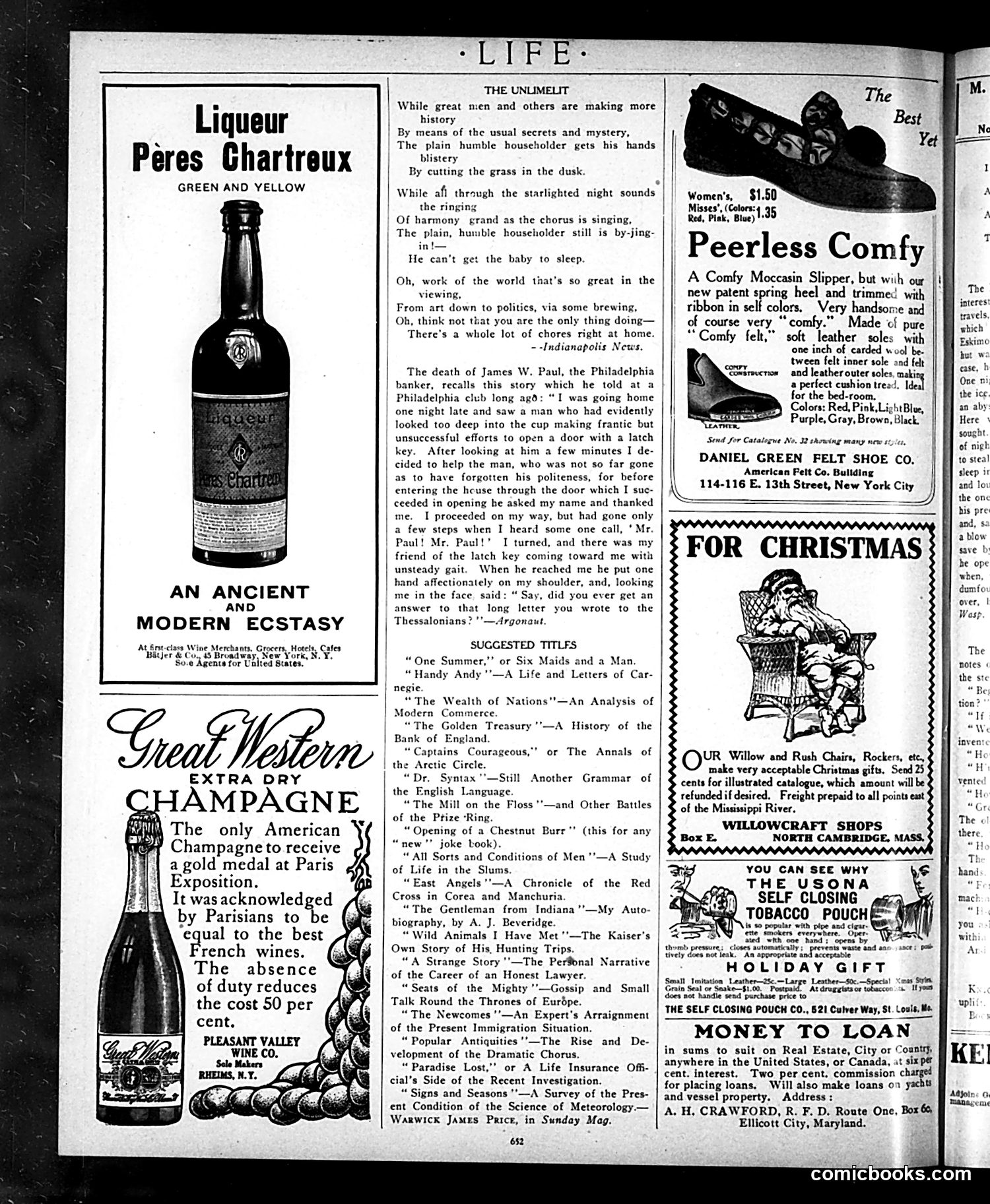
This page contains primarily **advertisements and light satirical content**, not political cartoons. The main satirical piece is "The Unlimelit" (likely "The Unlit"), a poem about ordinary domestic life. It contrasts great historical events and grand accomplishments with humble householders' mundane struggles—particularly a father unable to get his baby to sleep while cutting grass at dusk. The satire gently mocks how major world events seem insignificant compared to everyday household problems. Below this is an anecdote about a Philadelphia banker helping a drunk man with a door, only to be asked a nonsensical theological question—mild humor about drunken confusion. The "Suggested Titles" section provides **literary parodies**, creating funny fake book titles by mixing real titles with contemporary references (insurance scandals, immigration debates, prize fighting). This was typical Life magazine humor. The rest of the page contains **product advertisements** for liqueur, champagne, and women's slippers—standard early 20th-century magazine content with no satirical intent.
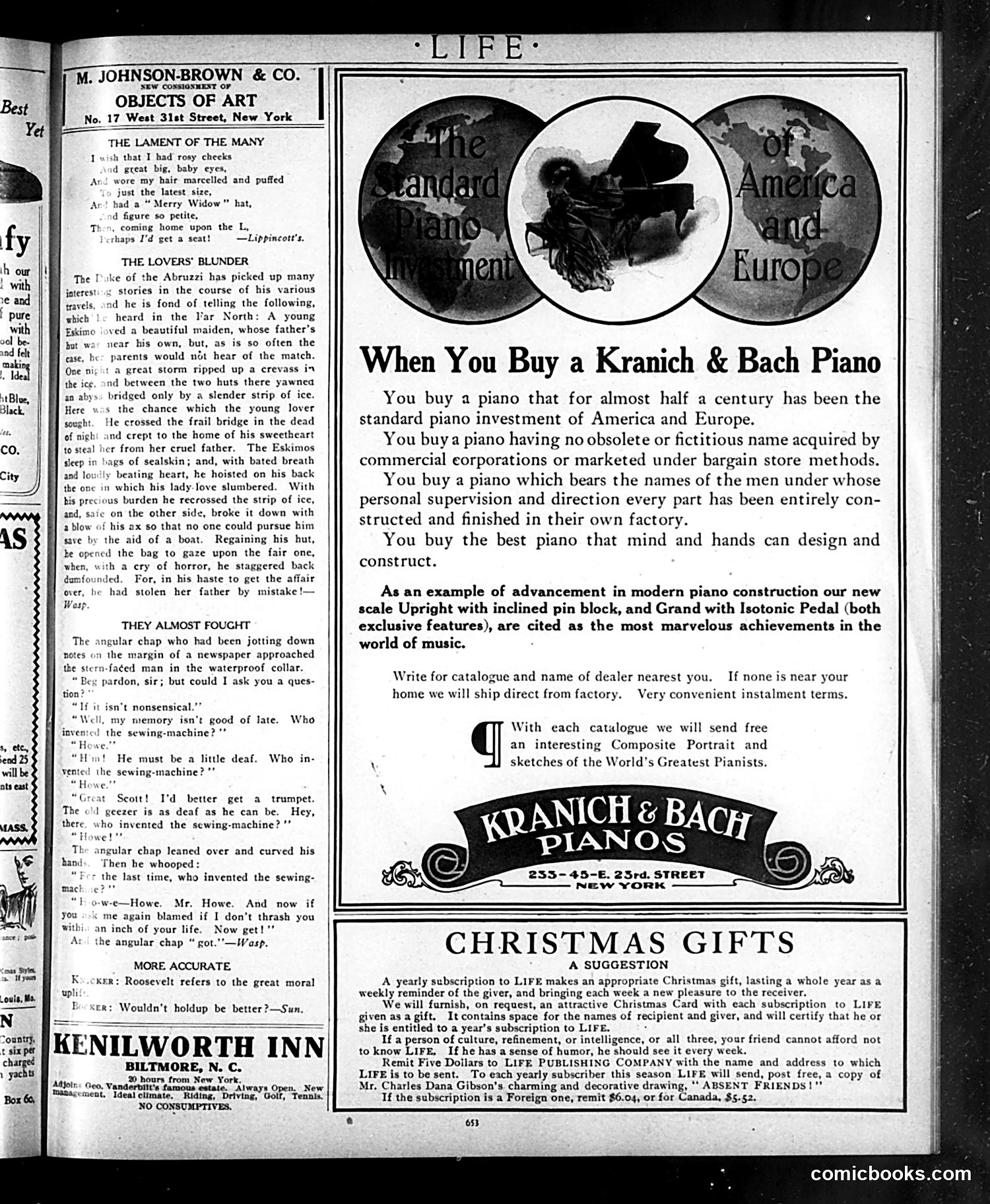
This page combines humor pieces with advertising, primarily featuring three short satirical stories targeting human folly and miscommunication. **The cartoons/jokes:** - "The Lament of the Many" mocks women's beauty standards and fashion obsessions - "The Lovers' Blunder" presents an Eskimo folk-tale setup where a young man abducts the wrong person—a comedic mix-up based on mistaken identity - "They Almost Fought" satirizes a deaf man's repeated misunderstandings about who invented the sewing machine, escalating to threatened violence over a simple communication failure **Social references:** The humor reflects early 20th-century American attitudes toward women's appearance ("marcelled" hair, the "Merry Widow" hat), exoticized non-Western peoples (the Eskimo narrative), and everyday frustrations with deafness treated as comedy fodder. **The satire's point:** These pieces mock human vanity, miscommunication, and foolishness—standard Life magazine fare emphasizing the absurdities of modern life and social pretension. The Kranich & Bach piano advertisement and Kenilworth Inn ad occupy significant space, indicating this is primarily a commercial publication.
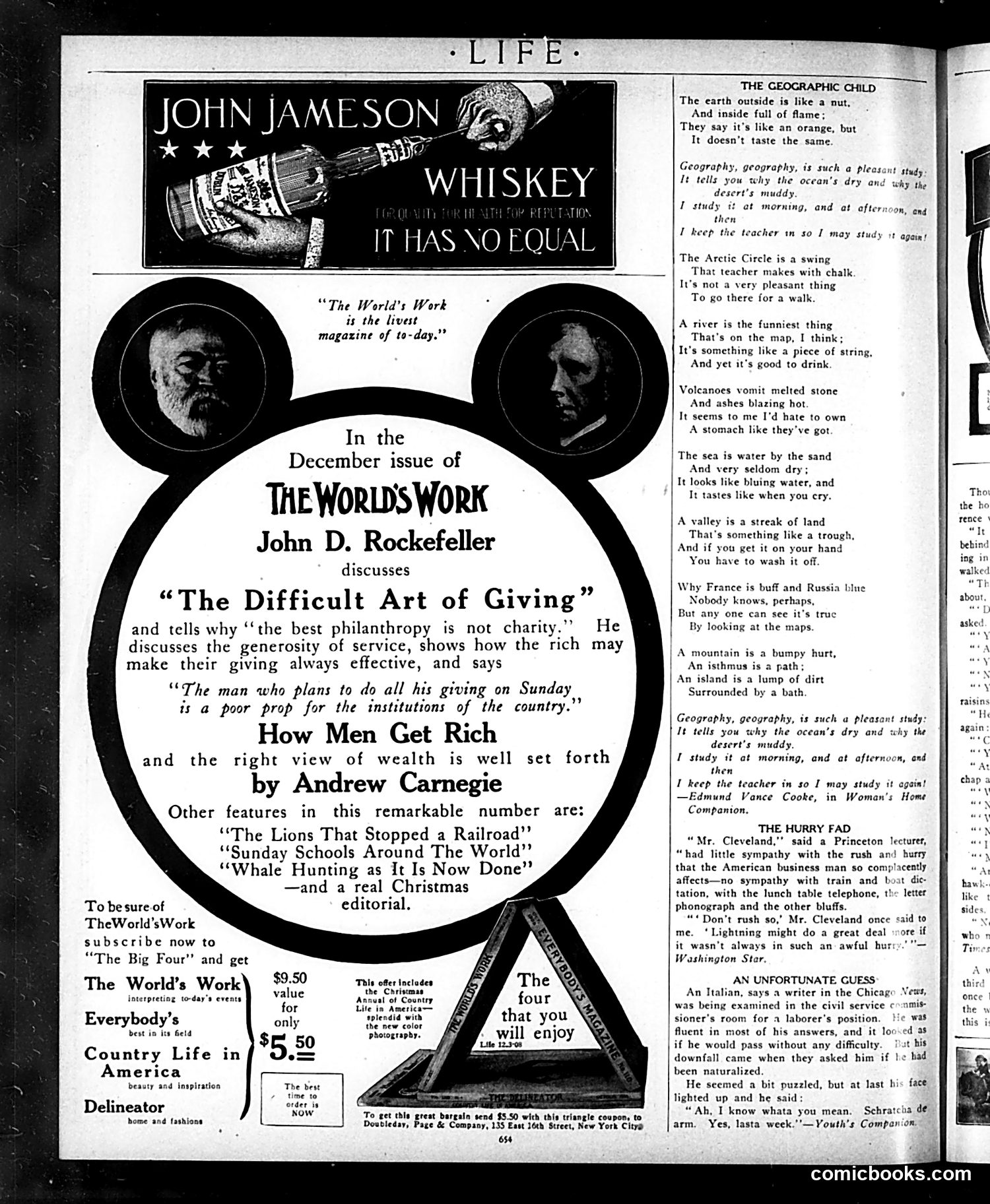
This is primarily a **magazine advertisement and subscription page** rather than satirical content. The dominant feature is a large circular illustration promoting *The World's Work* magazine's December issue, which will feature articles by **John D. Rockefeller** (on philanthropy) and **Andrew Carnegie** (on wealth). The page advertises a subscription bundle deal combining four publications. The accompanying **John Jameson Whiskey ad** at top is straightforward product advertising with no satirical intent. The right column contains light **humorous poetry** ("The Geographic Child") mocking children's misunderstandings of geography lessons, plus two brief **comic anecdotes** about the American obsession with speed and an Italian immigrant's confusion over "naturalization." **Overall context**: This reflects early 1900s *Life* magazine's shift toward becoming a general-interest publication mixing satire, humor, and advertising—here emphasizing wealthy industrialists' ideas about philanthropy and business, alongside genteel comic pieces aimed at affluent readers.
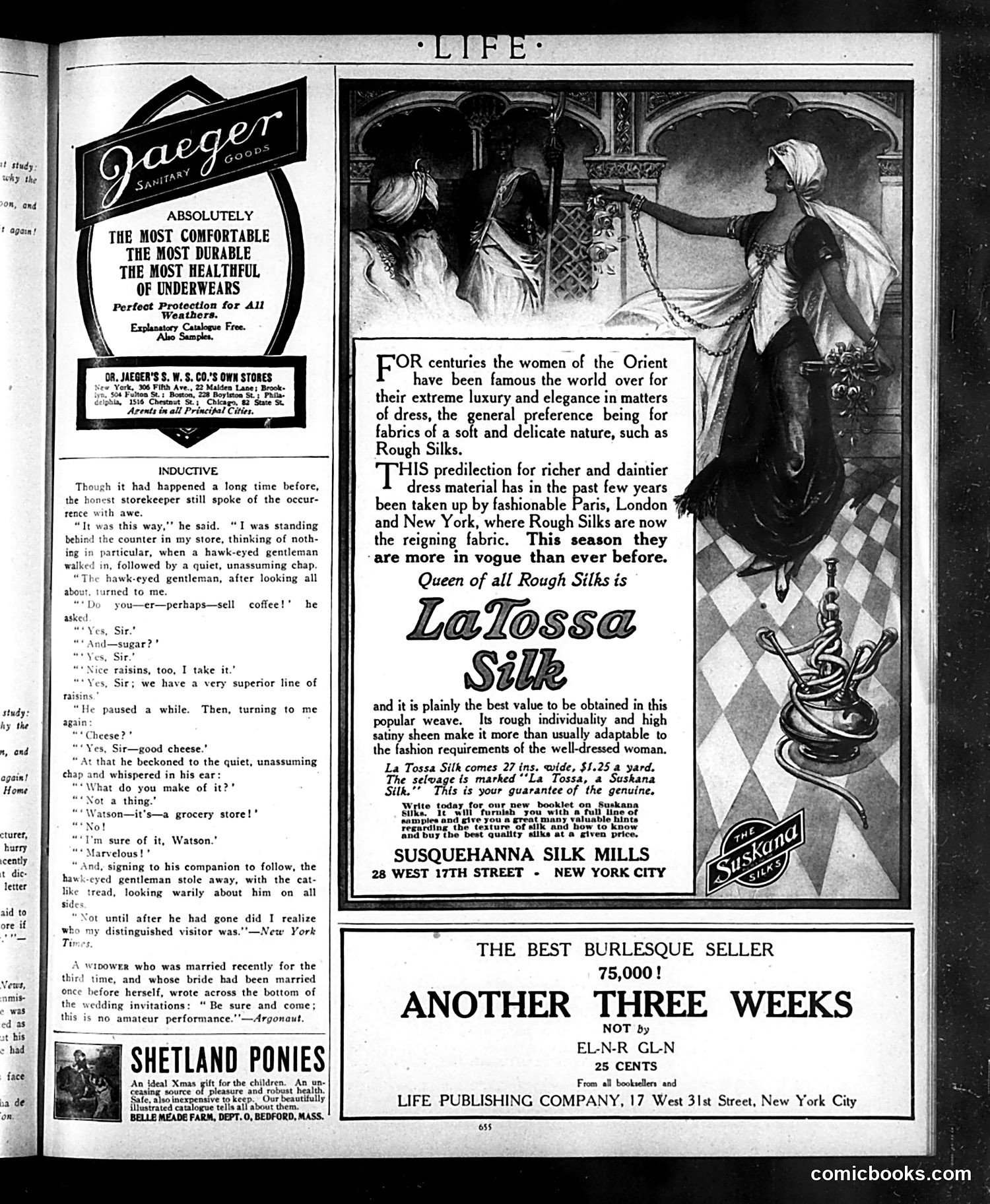
This page is primarily **advertising**, not political satire. However, it contains one notable humorous piece: The "INDUCTIVE" story (left column) is a **Sherlock Holmes parody**. A "hawk-eyed gentleman" and his "quiet, unassuming chap" companion visit a grocery store. The hawk-eyed man deduces it's a grocery store, impresses his companion ("Watson"), then leaves. The storekeeper realizes his famous visitor was Sherlock Holmes himself. The joke satirizes **Holmes's obsessive deductive method** as applied to the absurdly obvious—identifying a grocery store requires no deduction whatsoever. It mocks the character's reputation for brilliant reasoning by showing him performing elementary observations, treating mundane reality as a mystery to solve. The remaining content comprises **period advertisements** (underwear, silk fabric, Shetland ponies, burlesque theater) typical of Life's commercial pages. The Oriental women imagery advertises luxury silk products to wealthy readers.
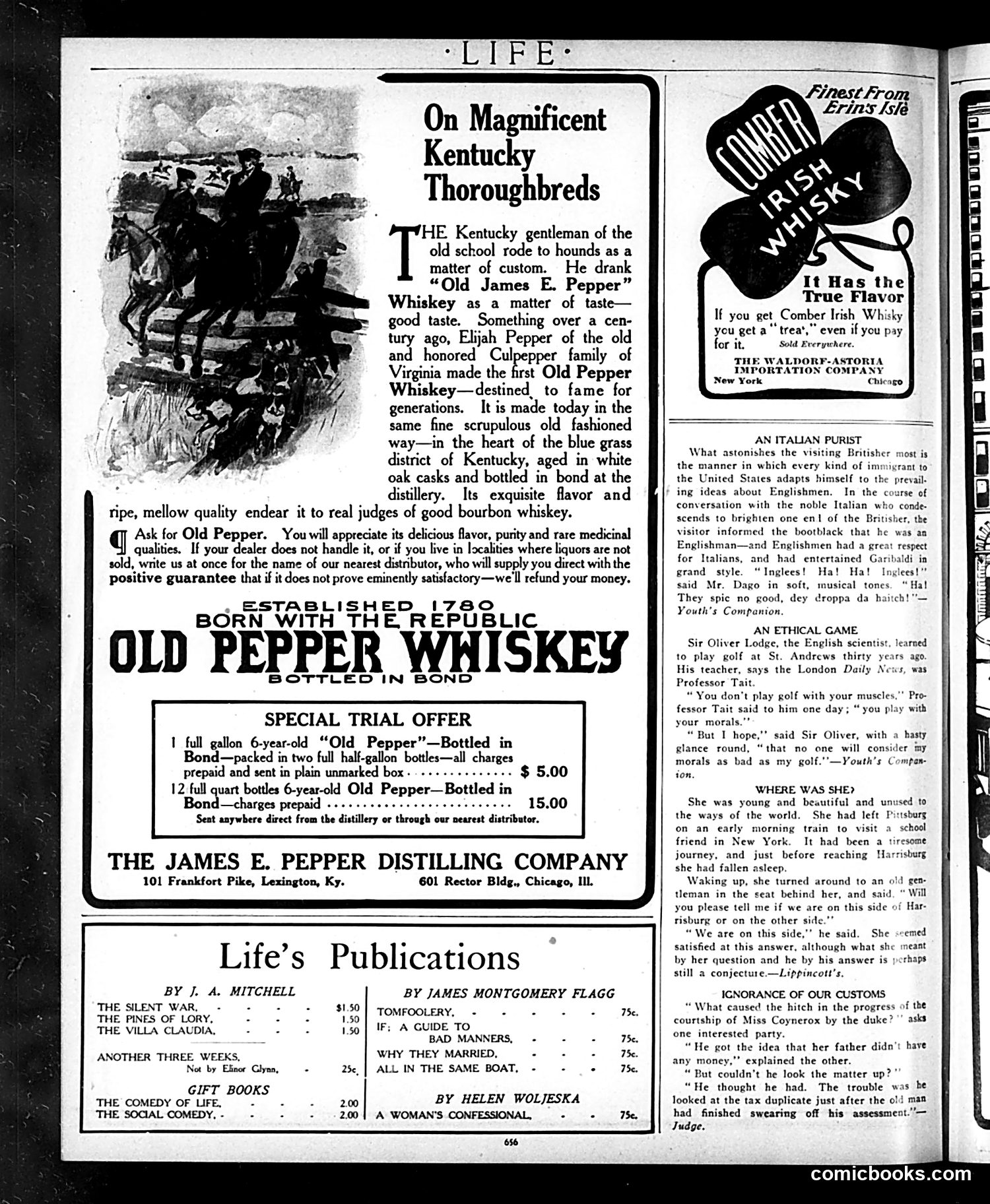
This page is primarily **advertising**, dominated by a full-page whiskey ad for "Old Pepper Whiskey." The ad features an illustration of Kentucky gentlemen on horseback—evoking antebellum Southern aristocracy and fox-hunting traditions. The copy frames whiskey-drinking as a mark of refined taste and gentlemanly custom, tracing the brand's lineage to 1780 and the "old school" Kentucky planter class. The smaller items are filler: a competing Irish whisky ad, and three brief humorous anecdotes ("An Italian Purist," "An Ethical Game," "Where Was She?") typical of Life's satirical content. These mock immigrant stereotypes and social awkwardness in gentle, period-appropriate ways. The page also lists Life Publications titles available for purchase. No political cartoons appear here—this is primarily a commercial publication page from the Prohibition era, using nostalgic imagery to market luxury goods.
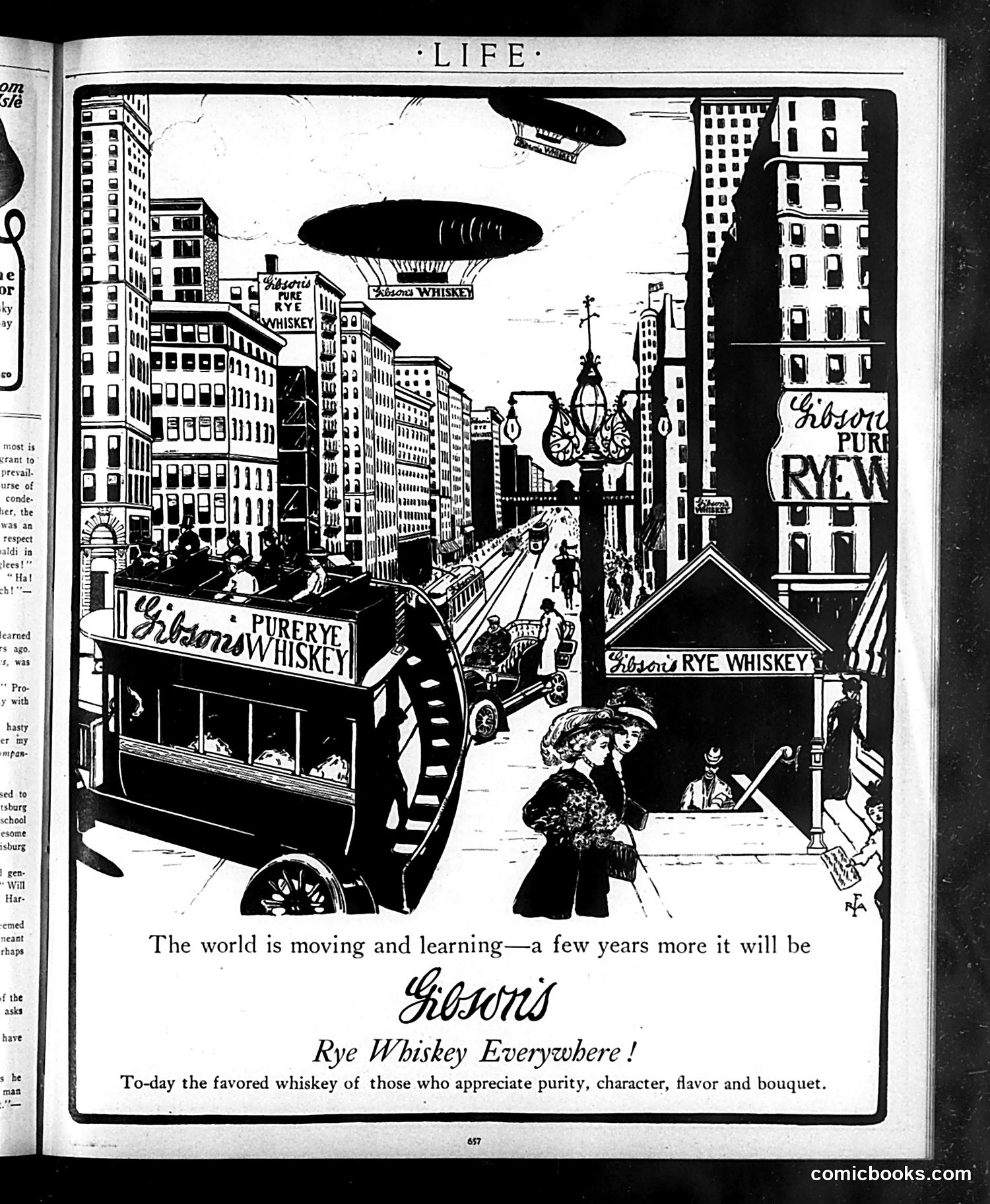
This is a **Gibson's Rye Whiskey advertisement**, not political satire. The image depicts a futuristic cityscape with flying vehicles (airships/zeppelins) overhead, bustling streets, and modern skyscrapers—imagining technological progress. The advertisement's joke is that whiskey will become so universally popular that in "a few years more it will be Gibson's Rye Whiskey Everywhere!" The ad targets affluent consumers who "appreciate purity, character, flavor and bouquet"—emphasizing quality and sophistication. The forward-looking imagery suggests optimism about modernity and progress, positioning Gibson's as part of that advancing world. This reflects early 20th-century advertising that merged product promotion with aspirational visions of the future. There's no political message—it's purely commercial persuasion through visionary imagery.
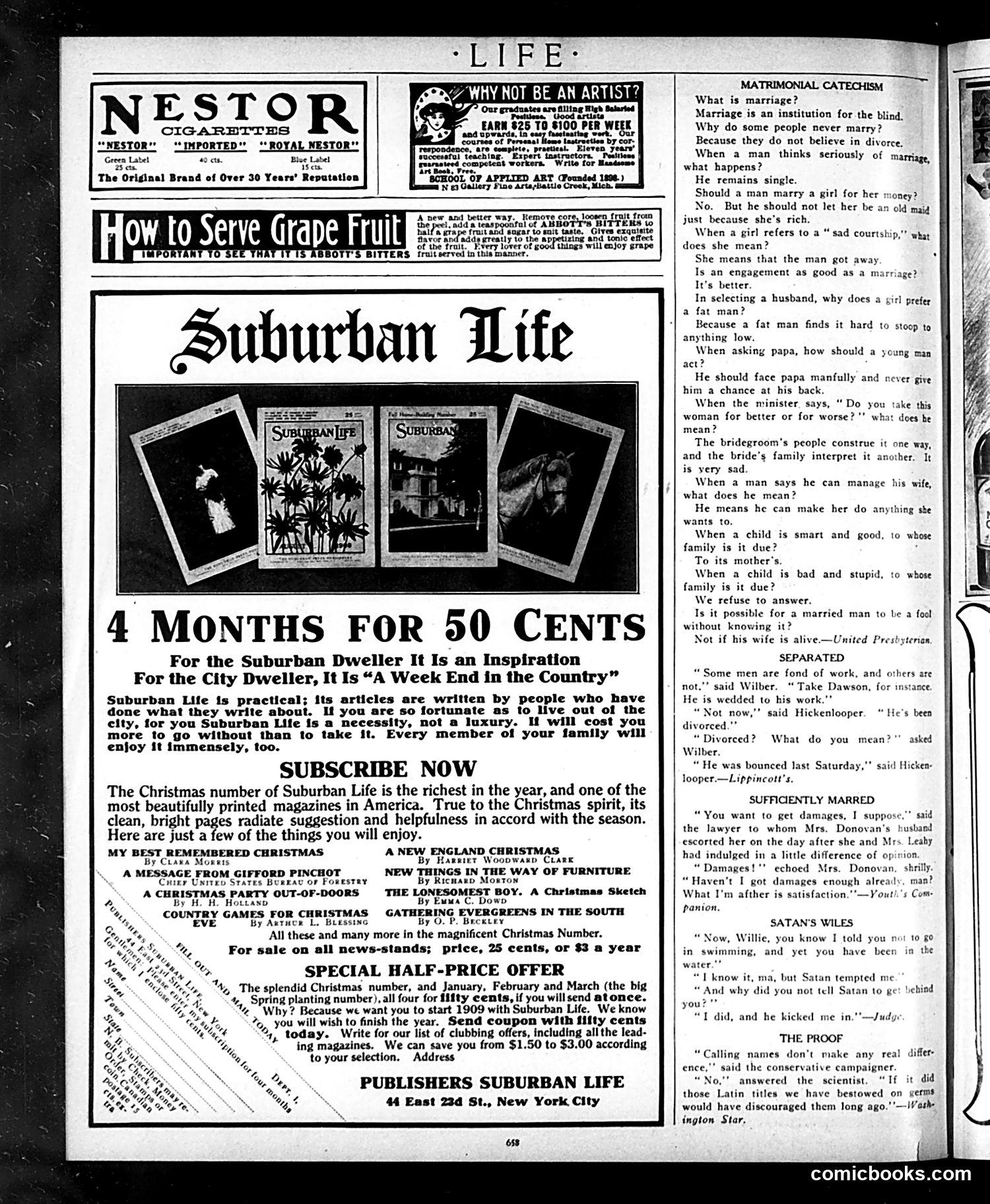
This page is primarily **advertising and humor columns**, not political cartoons. The main content includes: 1. **Nestor Cigarettes & Abbott's Bitters ads** - period product promotion 2. **"Suburban Life" Magazine subscription** - targeting middle-class homeowners with practical domestic articles (Christmas entertaining, gardening, furniture). The pitch emphasizes it's both "inspiration" for suburban dwellers and "a week end in the country" for city folk. 3. **"Matrimonial Catechism"** - A **satirical Q&A humor column** mocking marriage conventions. The jokes present cynical observations: marriage is "for the blind," engagements are "better" than marriage, husbands can't actually manage wives, wives are credited with smart children but husbands with foolish ones. The satire targets **Victorian marriage assumptions** — poking fun at courtship rituals, gender dynamics, and the gap between romantic ideals and marital reality. It reflects early-1900s attitudes about women's intelligence and marital power dynamics through darkly comedic commentary.
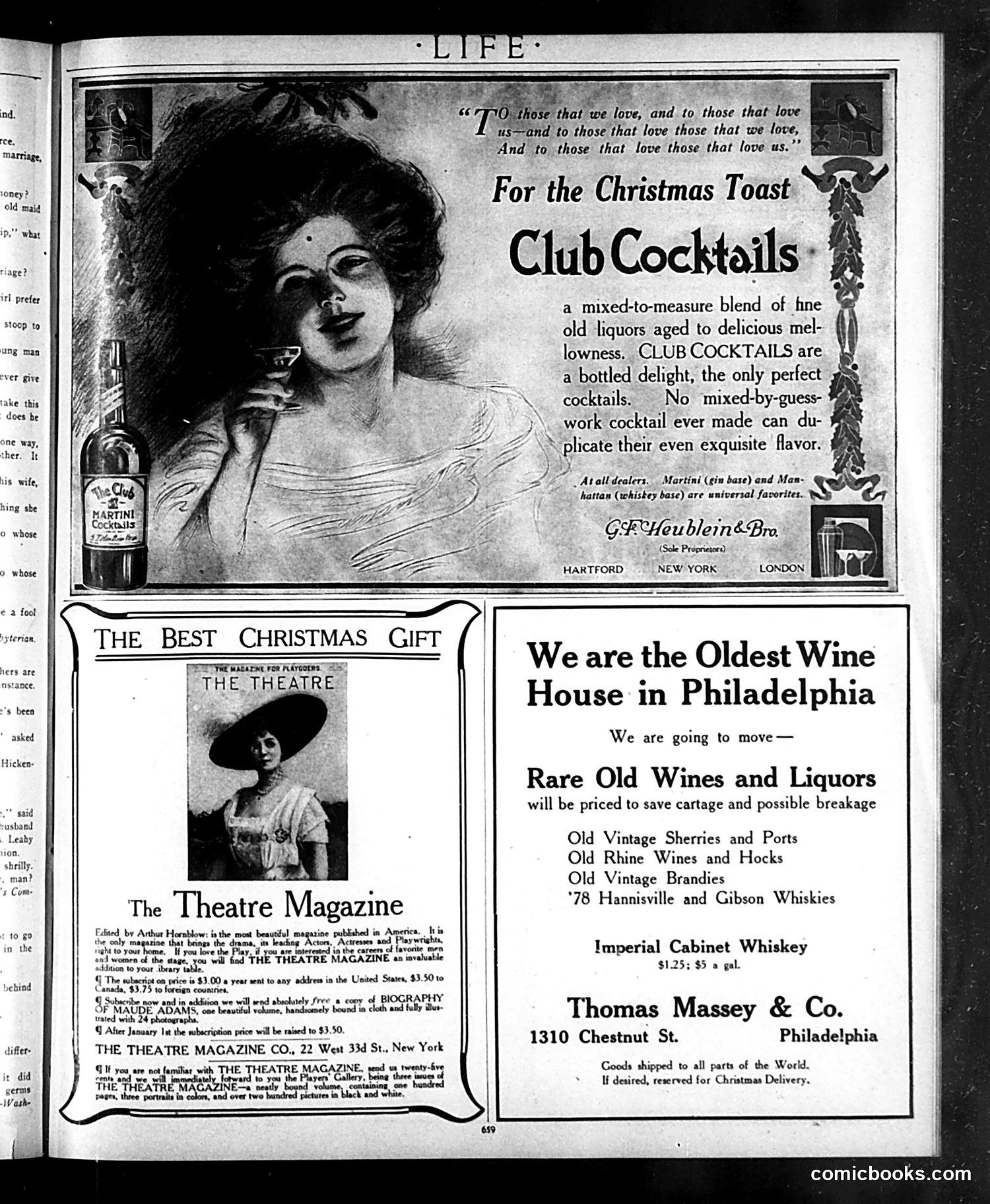
This page contains **no political cartoons or satire**—it is primarily **advertising and promotional content**. The top features a Club Cocktails ad with an elegant woman holding a drink, marketing pre-mixed cocktails as superior to home-made versions. Below is an ad for *The Theatre Magazine*, edited by Arthur Hornblow, promoting it as essential reading for theater enthusiasts, with a subscription offer and a free biography book of actress Maude Adams included. The right side advertises Thomas Massey & Co., Philadelphia's oldest wine house, announcing a move and offering discounts on rare wines and whiskeys—likely timed for Christmas gift-giving. The quotation at the top about love and Christmas toasts frames the seasonal commerce. This is a typical early-20th-century magazine page mixing commercial appeals with upscale entertainment and luxury goods targeting affluent readers.
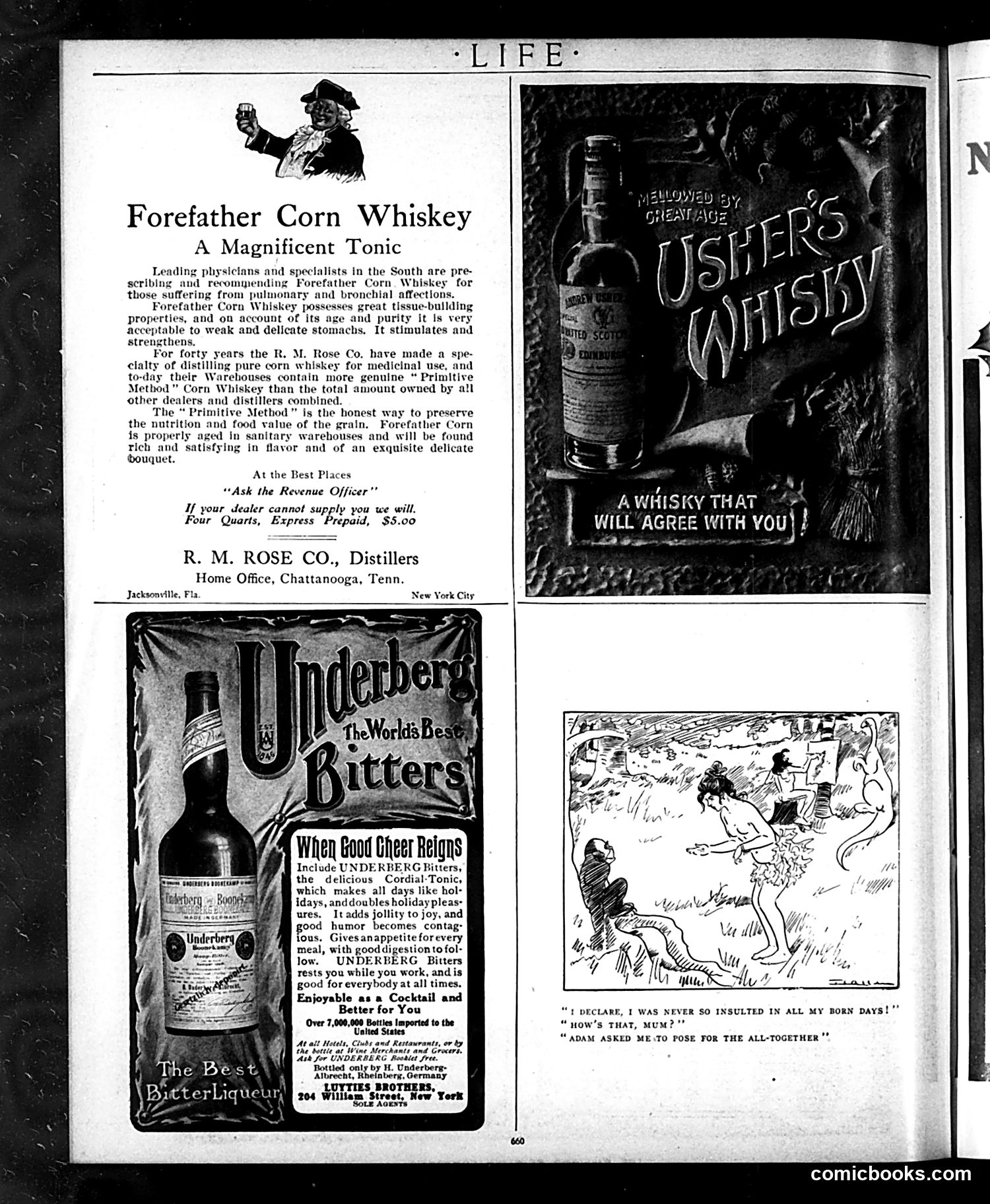
This page combines advertisements with a single cartoon. The ads promote "medicinal" whiskey and bitters—products marketed as tonics and health remedies, exploiting a loophole in Prohibition or pre-Prohibition regulation that allowed alcohol sales for "medicinal use." The cartoon at bottom depicts a woman indignantly refusing to pose nude for an artist, claiming she was "never so insulted." Her companion asks "how's that, mum?" and she explains "Adam asked me to pose for the all-together"—"all-together" being period slang for nudity. The joke relies on the double meaning: Adam (the biblical first man, or possibly a person's name) requesting she pose nude is the "insult." The cartoon's humor centers on Victorian-era prudishness about the female body and artistic nudity, treating such a request as deeply offensive to respectability.
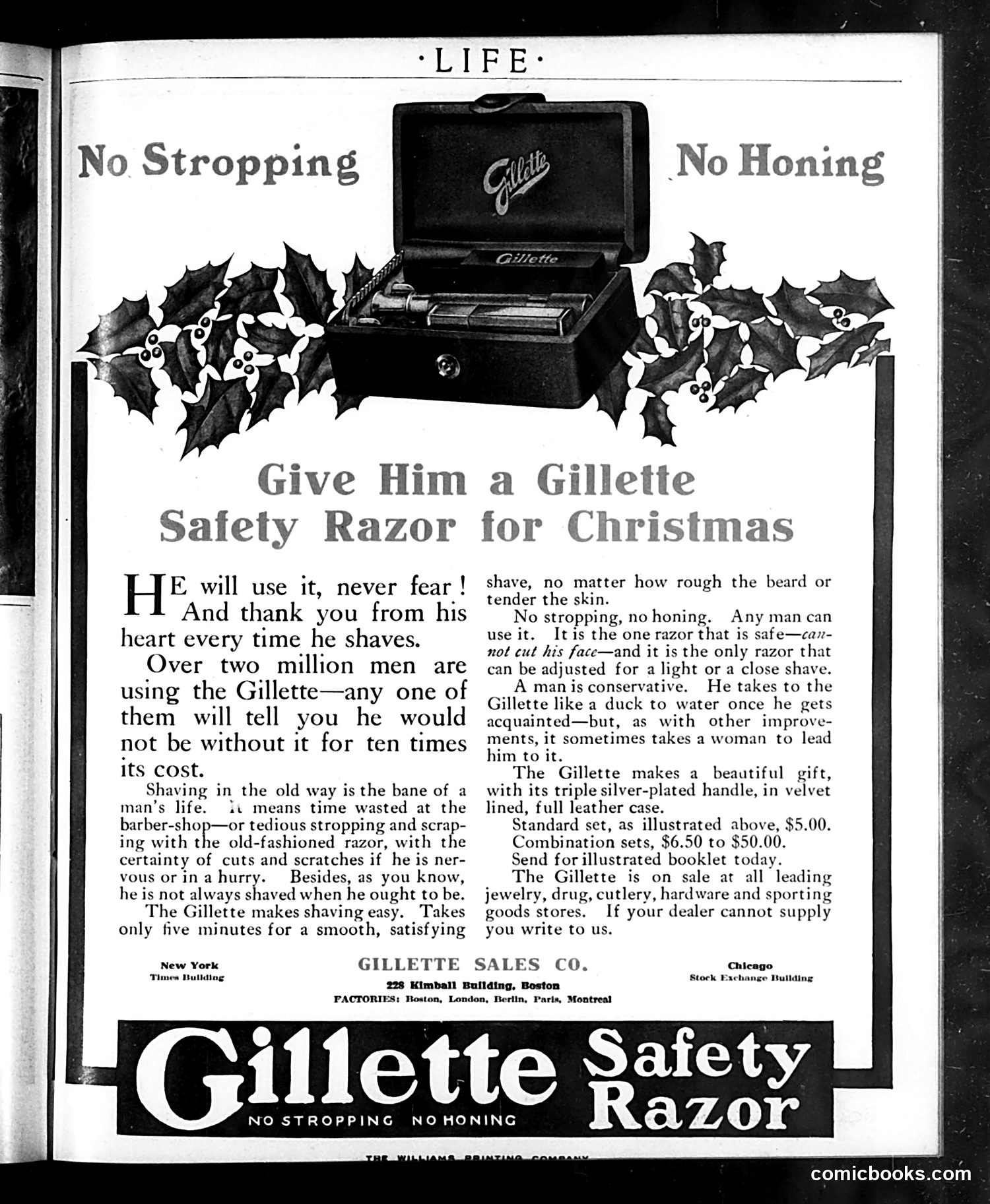
This is a **Christmas gift advertisement**, not satire or political commentary. It promotes Gillette's safety razor by contrasting modern convenience with old-fashioned shaving methods. The ad targets male gift-givers, claiming the Gillette eliminates tedious barber visits and dangerous stropping/honing of straight razors. Key selling points: takes only five minutes, requires no maintenance, adjustable for different shave preferences, and safe from cuts. The text includes a mild joke about male resistance to innovation—"it sometimes takes a woman to lead him to it"—suggesting men are conservative but will appreciate the product once introduced. The holly and gift box imagery establish the Christmas gift angle. At $5.00 standard (expensive for the era), it's positioned as a premium, desirable present for any man. The company lists multiple international factories, indicating Gillette's established market dominance. This reflects early 20th-century consumer culture emphasizing convenience and time-saving technology.
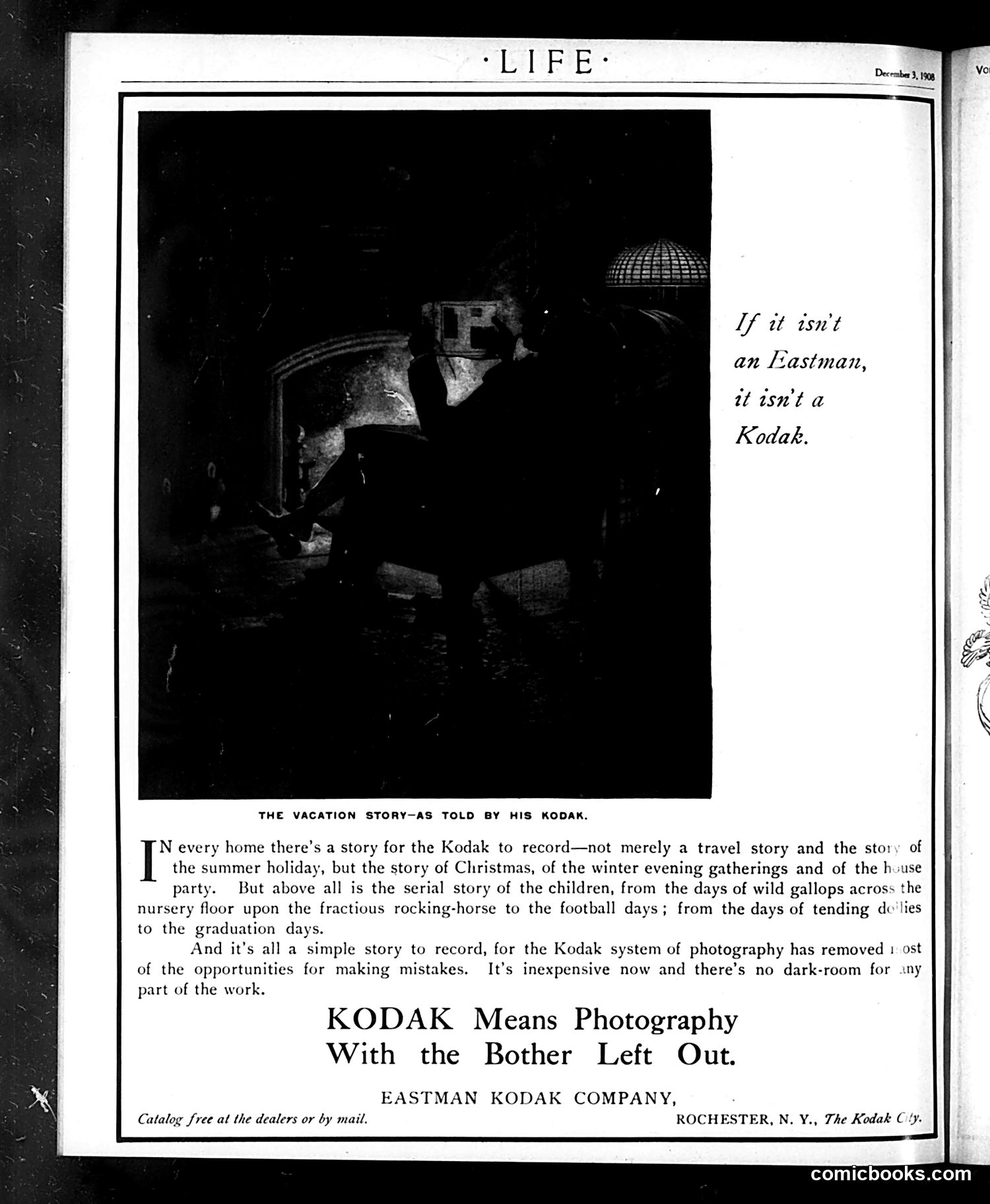
This is a **Kodak advertisement**, not a political cartoon. It appears in *Life* magazine (dated December 3, 1908, based on visible text). The ad uses a dramatic nighttime photograph showing what appears to be someone using a camera to illustrate Kodak's marketing slogan: "If it isn't an Eastman, it isn't a Kodak." The accompanying text promotes Kodak cameras as simple, mistake-proof tools for recording family life—vacations, holidays, children's milestones, and domestic moments. The key selling point is that Kodak has made photography accessible to ordinary households by removing technical complexity ("the Bother Left Out") and eliminating the need for darkroom work. **For modern readers:** This represents early consumer photography marketing, positioning the camera as essential for documenting family memories—a concept that remains central to photography advertising today, though now applied to smartphones rather than dedicated cameras.