
Life, 1908-12-03 · page 20 of 68
Life — December 3, 1908 — page 20: what you’re looking at
What you’re looking at
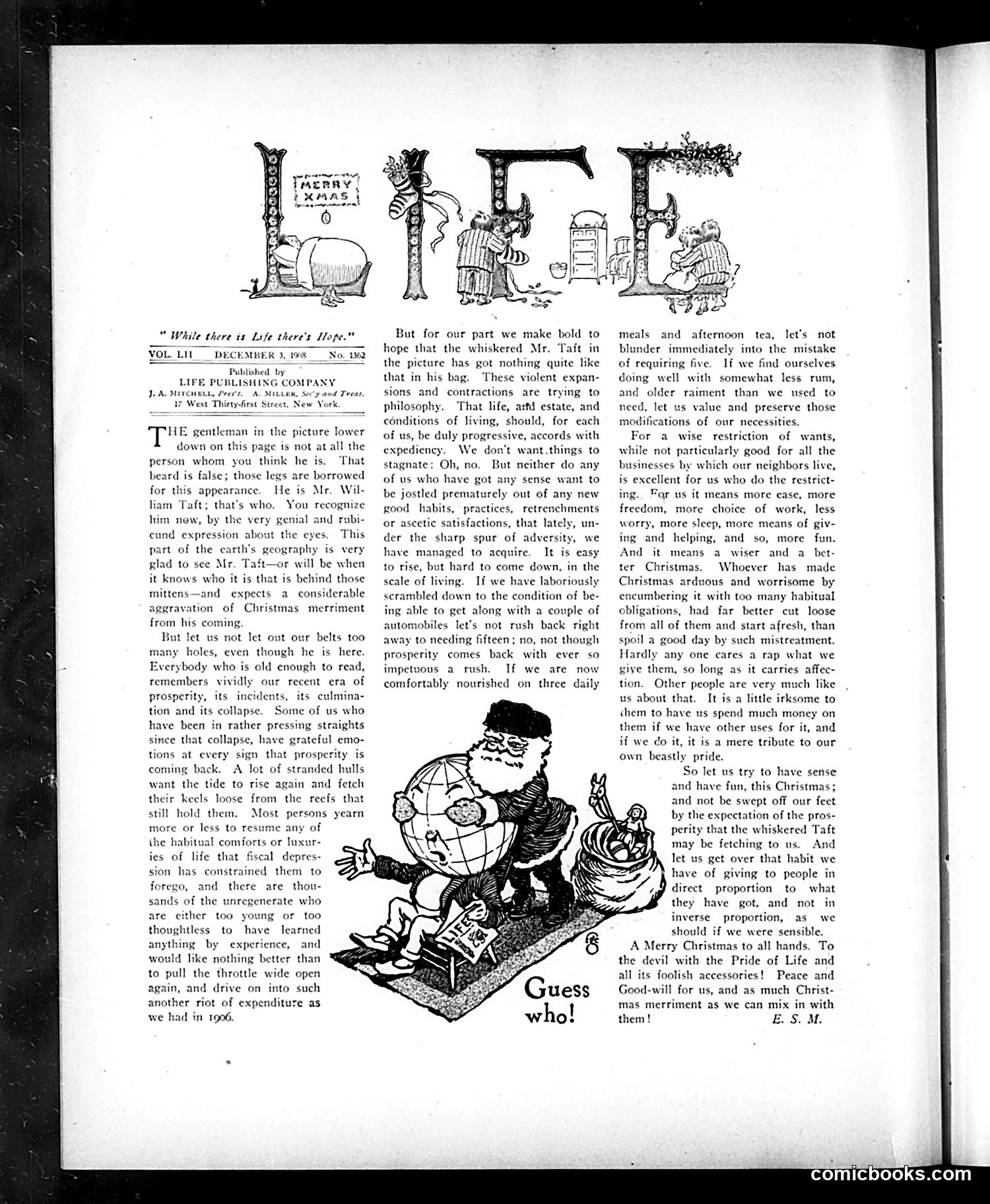
This page features a satirical editorial welcoming President William Taft's visit, accompanied by a humorous illustration of Santa Claus holding a globe labeled "Guess who!"—a visual pun identifying Taft with Christmas gift-giving. The text mocks recent economic boom-and-bust cycles, particularly the 1906 prosperity followed by financial collapse. While welcoming Taft's arrival, the author argues *against* returning to excessive spending habits. Instead, the piece advocates restraint—contentment with fewer automobiles, simpler meals, and worn clothing acquired during hard times. The satire targets two audiences: those desperate for renewed prosperity (wanting to "pull the throttle wide open again") and the wealthy accustomed to luxury. The author suggests that modest living actually brings more freedom and happiness than conspicuous consumption. The editorial cleverly uses Taft's visit as a hook to promote post-Depression financial prudence, warning that even returning prosperity shouldn't resurrect wasteful pre-collapse habits.
📄 Transcribed text from this page (OCR, searchable)
Machine-transcribed from the original scan — historical spelling and the odd misread are preserved.
ae Trerny, bMPMAS ¢ S&S " While there is Life there's Hope.” VOL.LIL DE EMBER 3,196 No. 1362 Published by LIFE PUBLISHING COMPANY JA. MITCHMLL, Prese. A. MILLER, Sec'y and Treas, 17 West Thirty- New York. THe gentleman in the picture lower down on this page is not at all the person whom you think he is. That beard is false; those legs are borrowed for this appearance. He is Mr. Wil- liam Taft; that’s who. You recognize him now, by the very genial and rubi- cund expression about the eyes. This part of the earth’s geography is very glad to see Mr. Taft—or will be when it knows who it is that is behind those mittens—and expects a considerable aggravation of Christmas merriment from his coming. But let us not let out our belts too many holes, even though he is here. Everybody who is old enough to read, remembers vividly our recent era of prosperity, its incidents, its culmina- tion and its collapse. Some of us who have been in rather pressing straights since that collapse, have grateful emo- tions at every sign that prosperity is coming back. A lot of stranded hulls want the tide to rise again and fetch their keels loose from the reefs that still hold them. Most persons yearn more or less to resume any of the habitual comforts or luxur- ies of life that fiscal depres- sion has constrained them to forego, and there are thou- sands of the unregenerate who are cither too young or too thoughtless to have learned anything by experience, and would like nothing better than to pull the throttle wide open again, and drive on into such another riot of expenditure as we had in 1906. But for our part we make bold to hope that the whiskered Mr. Taft in the picture has got nothing quite like that in his bag. These violent expan- sions and contractions are trying to philosophy. That life, arfd estate, and conditions of living, should, for each of us, be duly progressive, accords with expediency. We don't want.things to stagnate: Oh, no. But neither do any of us who have got any sense want to be jostled prematurely out of any new good habits, practices, retrenchments or ascetic satisfactions, that latel: der the sharp spur of adversit have managed to acquire. It is easy to rise, but hard to come down, in the scale of living. If we have laboriously scrambled down to the condition of be- ing able to get along with a couple of automobiles let's not rush back right away to needing fifteen; no, not though prosperity comes back with ever so impetuous a rush. If we are now comfortably nourished on three daily meals and afternoon tea, let’s not blunder immediately into the mistake of requiring five. If we find ourselves doing well with somewhat less rum, and older raiment than we used to need, let us value and preserve those modifications of our necessities. For a wise restriction of wants, while not particularly good for all the businesses by which our neighbors live, is excellent for us who do the restrict- ing. Far us it means more ease, more freedom, more choice of work, less worry, more sleep, more means of giv- ing and helping, and so, more fun. And it means a wiser and a_bet- ter Christmas. Whoever has made Christmas arduous and worrisome by encumbering it with too many habitual obligations, had far better cut loose from all of them and start afresh, than spoil a good day by such mistreatment. Hardly any one cares a rap what we giye them, so long as it carries affec- tion. Other people are very much like us about that. It is a little irksome to chem to have us spend much money on them if we have other uses for it, and if we do it, it is a mere tribute to our own beastly pride. So let us try to have sense and have fun, this Christmas ; and not be swept off our feet by the expectation of the pros- perity that the whiskered Taft may be fetching to us. nd let us get over that habit we have of giving to people in direct. proportion to what they have got, and not in inverse proportion, as we should if we were sensible. A Merry Christmas to all hands. To the devil with the Pride of Life and all its foolish accessories! Peace and Good-will for us, and as much Christ- mas merriment as we can mix in with them! E. S. M. Comicbooks.com