
Life, 1908-12-03 · page 60 of 68
Life — December 3, 1908 — page 60: what you’re looking at
What you’re looking at
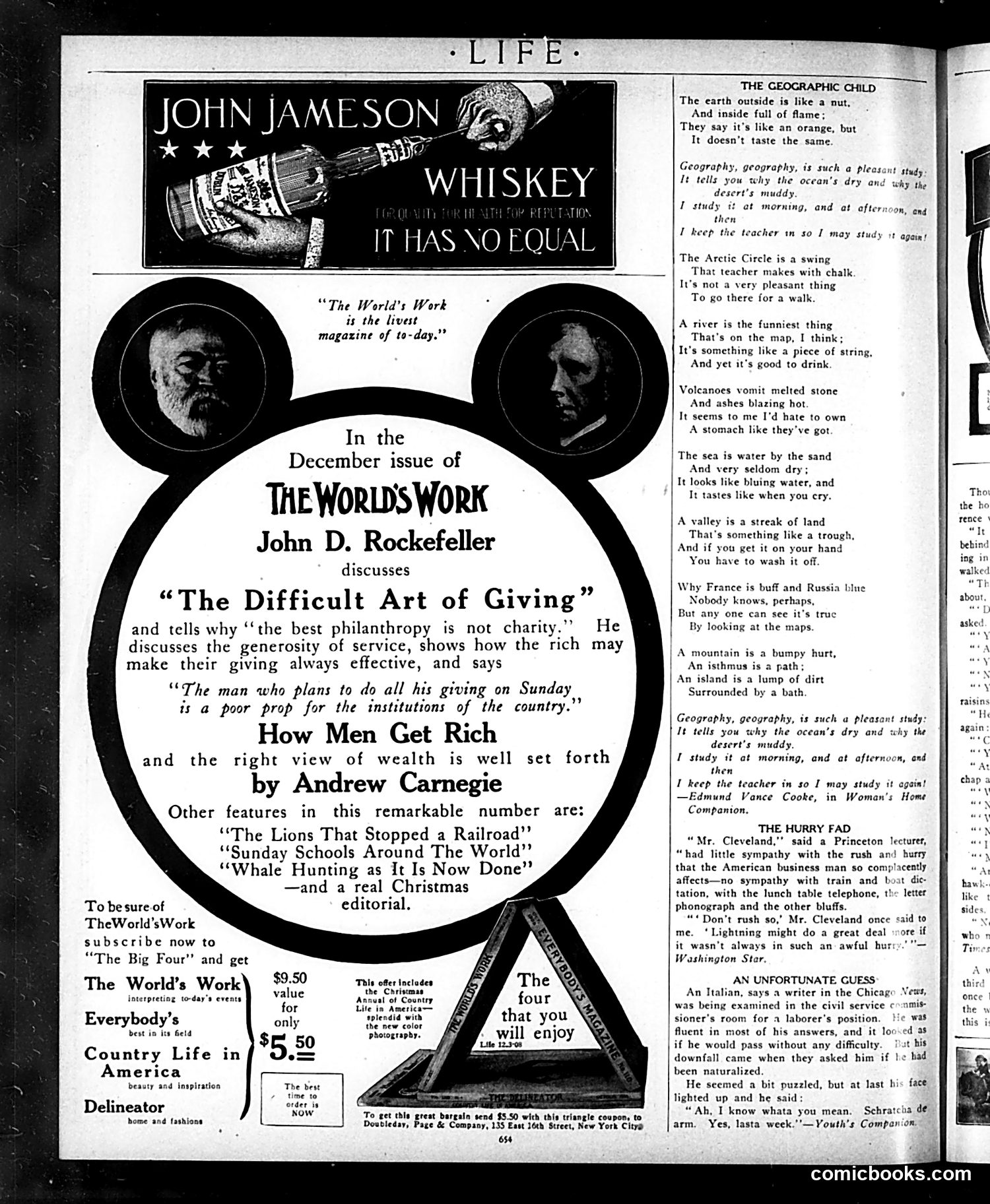
This is primarily a **magazine advertisement and subscription page** rather than satirical content. The dominant feature is a large circular illustration promoting *The World's Work* magazine's December issue, which will feature articles by **John D. Rockefeller** (on philanthropy) and **Andrew Carnegie** (on wealth). The page advertises a subscription bundle deal combining four publications. The accompanying **John Jameson Whiskey ad** at top is straightforward product advertising with no satirical intent. The right column contains light **humorous poetry** ("The Geographic Child") mocking children's misunderstandings of geography lessons, plus two brief **comic anecdotes** about the American obsession with speed and an Italian immigrant's confusion over "naturalization." **Overall context**: This reflects early 1900s *Life* magazine's shift toward becoming a general-interest publication mixing satire, humor, and advertising—here emphasizing wealthy industrialists' ideas about philanthropy and business, alongside genteel comic pieces aimed at affluent readers.
📄 Transcribed text from this page (OCR, searchable)
Machine-transcribed from the original scan — historical spelling and the odd misread are preserved.
WHISKEY IT HAS NO EQUAL za = Jor N JAMES “The World's Work is the livest magazine of to-day.” In the December issue of THE WORLDS WORK John D. Rockefeller discusses “The Difficult Art of Giving” and tells why ‘‘the best philanthropy is not charity.’ He discusses the generosity of service, shows how the rich may make their giving always effective, and says “The man who plans to do all his giving on Sunday is @ poor prop for the institutions of the country.” How Men Get Rich and the right view of wealth is well set forth by Andrew Carnegie Other features in this remarkable number are: “The Lions That Stopped a Railroad”’ “Sunday Schools Around The World” “Whale Hunting as It Is Now Done” —and a real Christmas To be sure-of editorial. TheWorld’sWork subscribe now to “The Big Four’? and get The World’s Work interpreting today's events $9.50 value for Everybody's only best i es Geld $5 50 The dest time to Delineator sitet home and fashions This ofer inclades the Christmas Annual of Country four that you pawillsentey Country Life in America beauty and inspiration To get thie great bargain send $5.50 with this triangle coupon, to Doubleday, Page & Company, 135 East 16th Street, New York Citya 654 THE GEOGRAPHIC CHILD The earth outside is like a nut, And inside full of flame; They say it’s like an orange, but It doesn’t taste the same. Geography, geography, is such a pleasant study It tells you why the ocean's dry and why the desert’s muddy. I study it at morning, and at oftern then I keep the teacher in so I may study st agains Om, and. The Arctic Circle is a swing That teacher makes with chalk It's not a very pleasant thing To go there for a walk. A river is the funniest thing That's on the map, I think; It's something like a piece of string, And yet it’s good to drink Volcanoes vomit melted stone And ashes blazing hot It seems to me I'd hate to own A stomach like they've got | The sea is water by the sand And very seldom dry ; It looks like bluing water, and It tastes like when you ery. A valley is a streak of land That's something like a trough, And if you get it on your hand You have to wash it off. Why France is buff and Russia bine Nobody knows, perhaps, But any one can see it’s truc By looking at the maps. A mountain is a bumpy hurt, An isthmus is a pat! An island is a lump of dirt Surrounded by a bath. Geography, geography, is such a pleasant study: It tells you why the ocean’s dry and why the desert’s muddy. I study it at morning, and at afternoon, ond then I keep the teacher in so I may study it again —Edmund Vance Cooke, in Woman's Home Companion. THE HURRY FAD “Mr. Cleveland,’ said a Princeton lecturer, “had little sympathy with the rush and bury that the American business man so complacently affects—no sympathy with train and boat dic- tation, with the lunch table telephone, the letter phonograph and the other bluffs. “*Don't rush so,’ Mr. Cleveland once said to me. ightning might do a great deal ‘ore if it wasn’t always in such an awful hurry.’ ""— Washington Star, AN UNFORTUNATE GUESS: An Italian, says a writer in the Chicago News, was being examined in the civil service commis sioner's room for a laborer’s position. was | fluent in most of his answers, and it loosed as if he would pass without any difficulty. Pst his downfall came when they asked him if he bad been naturalized. He seemed a bit puzzled, but at last his face lighted up and he said: “Ah, I know whata you mean. Schratcha dé arm. Yes, lasta week.'"—Youth’s Companion raisins “He again comicbooks.com