
Life, 1908-12-03 · page 36 of 68
Life — December 3, 1908 — page 36: what you’re looking at
What you’re looking at
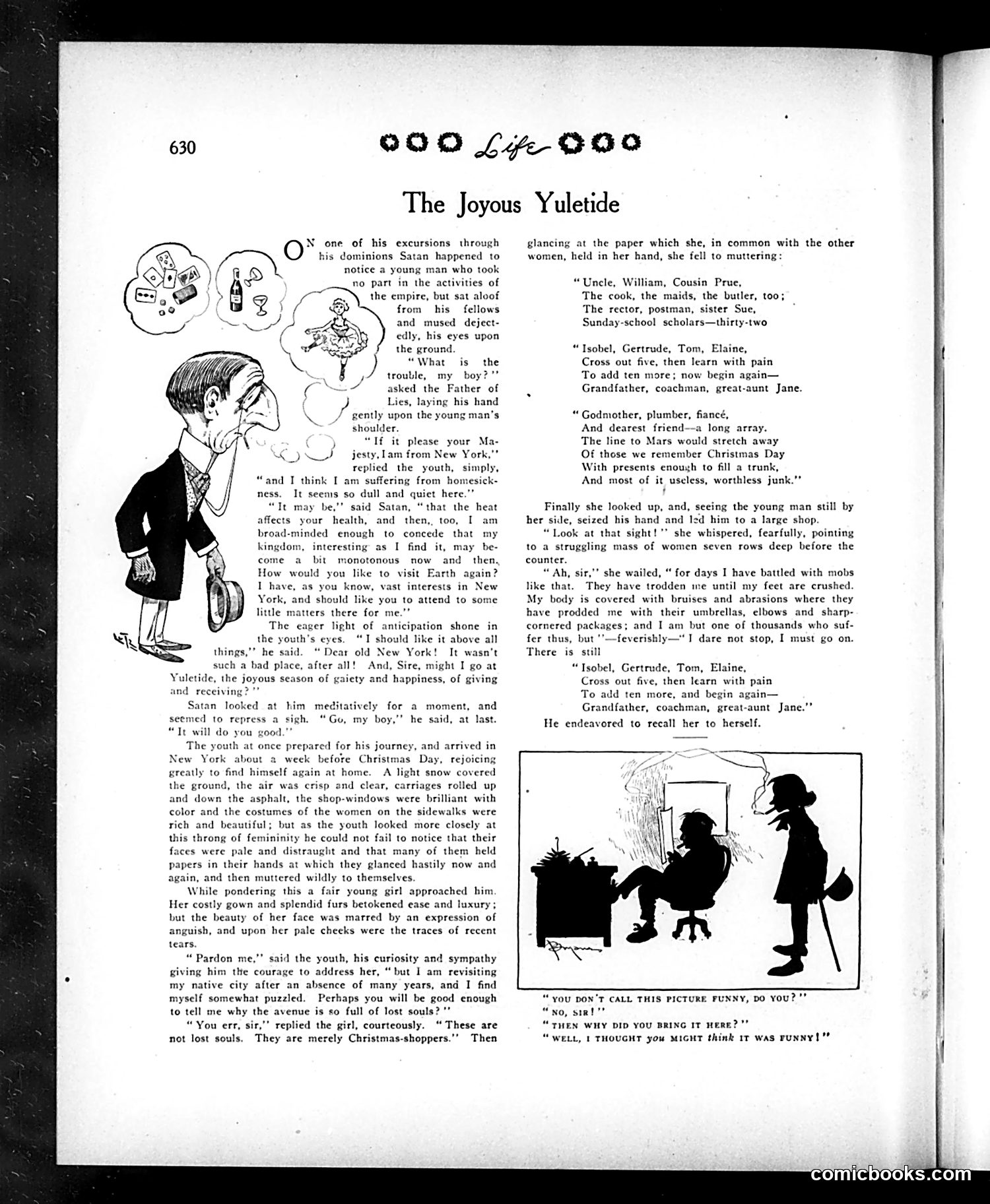
This story satirizes the commercialization and stress of Christmas shopping in early 20th-century America. A young man from New York, visiting Hell, is shocked to discover that the frenzied Christmas shoppers on Manhattan's streets are worse off than Satan's dominions—they appear like "lost souls." The joke centers on a wealthy woman with an impossibly long gift list (32 people, then more added), buying "useless, worthless junk." She describes the physical toll of holiday shopping: crowds "seven rows deep," being trampled, crushed feet, and emotional exhaustion. The satire's point: Christmas has become a joyless obligation of mass consumption rather than genuine celebration. The cartoon contrasts Satan's Hell (portrayed as at least honest) with the real "hell" of American consumer culture during the holidays. For modern readers, it reflects surprisingly timeless anxieties about holiday materialism and retail chaos—problems that persist today.
📄 Transcribed text from this page (OCR, searchable)
Machine-transcribed from the original scan — historical spelling and the odd misread are preserved.
800 LA CHIG The Joyous Yuletide N one of his excursions through his dominions Satan happened to notice a young man who took no part in the activities of the empire, but sat aloof from his fellows and mused deject- edly, his eyes upon the ground. “What is the trouble, my boy? ~ asked the Father of Lies, laying his hand gently upon the young man’s shoulder. “If it please your Ma- jesty, lam from New York replied the youth, simpl: “and I think [am suffering from homesick- ness. It seems so dull and quiet here.” “It may be,’? said Satan, “that the heat affects your health, and then, too, [ am broad-minded enough to concede that my kingdom, interesting as I find it, may be- come a bit monotonous now and_ then, How would you like to visit Earth again? I have, as you know, vast interests in New York, and should like you to attend to some little matters there for me.”’ The eager light of anticipation shone in the youth's eyes. “I should like it above all things,” he said. “Dear old New York! It wasn’t such a bad place, after all! And, Sire, might I go at Yuletide, the joyous season of gaiety and happiness, of giving and receiving?" JN Satan looked at him meditatively for a moment, and seemed to repress a sigh. “Go, my boy,” he said, at last. “It will do you good The youth at once prepared for his journey, and arrived in New York about a week before Christmas Day, rejoicing greatly to find himself again at home. A light snow covered the ground, the air was crisp and clear, carriages rolled up and down the asphalt, the shop-windows were brilliant with color and the costumes of the women on the sidewalks were rich and beautiful; but as the youth looked more closely at this throng of femininity he could not fail to notice that their faces were pale and distraught and that many of them held papers in their hands at which they glanced hastily now and again, and then muttered wildly to themselves While pondering this a fair young girl approached him Her costly gown and splendid furs betokened ease and luxury; but the beauty of her face was marred by an expression of ish, and upon her pale cheeks were the traces of recent tears. “Pardon me,” said the youth, his curiosity and sympathy giving him the courage to address her, “but 1 am revisiting my native city after an absence of many years, and I find myself somewhat puzzled. Perhaps you will be good enough to tell me why the avenue is so full of lost soul “You err, sir,’" replied the girl, courteously. “ These are not lost souls. They are merely Christmas-shoppers."” Then glancing at the paper which she, in common with the other women, held in her hand, she fell to muttering: “Uncle, William, Cousin Prue, The cook, the maids, the butler, too; The rector, postman, sister Sue, Sunday-school scholars—thirty-two “Isobel, Gertrude, Tom, Elaine, Cross out five, then learn with pain To add ten more; now begin again— Grandfather, coachman, great-aunt Jane. “Godmother, plumber, fiancé, And dearest friend—a long array. The line to Mars would stretch away Of those we remember Christmas Day With presents enough to fill a trunk, And most of it useless, worthless junk.’ Finally she looked up, and, seeing the young man still by her side, seized his hand and Icd him to a large shop. “Look at that sight!” she whispered, fearfully, pointing to a struggling mass of women seven rows deep before the counter. “Ah, sir,”” she wailed, “for days I have battled with mobs like that. They have trodden me until my feet are crushed. My body is covered with bruises and abrasions where they have prodded me with their umbrellas, elbows and sharp- cornered packages; and I am but one of thousands who suf- fer thus, but ''—feverishly—"I dare not stop, I must go on. There is still “Isobel, Gertrude, Tom, Elaine, Cross out five, then learn with pain To add ten more, and begin again— Grandfather, coachman, great-aunt Jane." He endeavored to recall her to herself. “YoU DON'T CALL THIS PICTURE FUNNY, DO You? "” “No, sin!" “THEN WHY DID YOU BRING IT HERE “WELL, 1 THOUGHT you MIGHT think 17 was FUNNY! 2”