
Life, 1908-12-03 · page 21 of 68
Life — December 3, 1908 — page 21: what you’re looking at
What you’re looking at
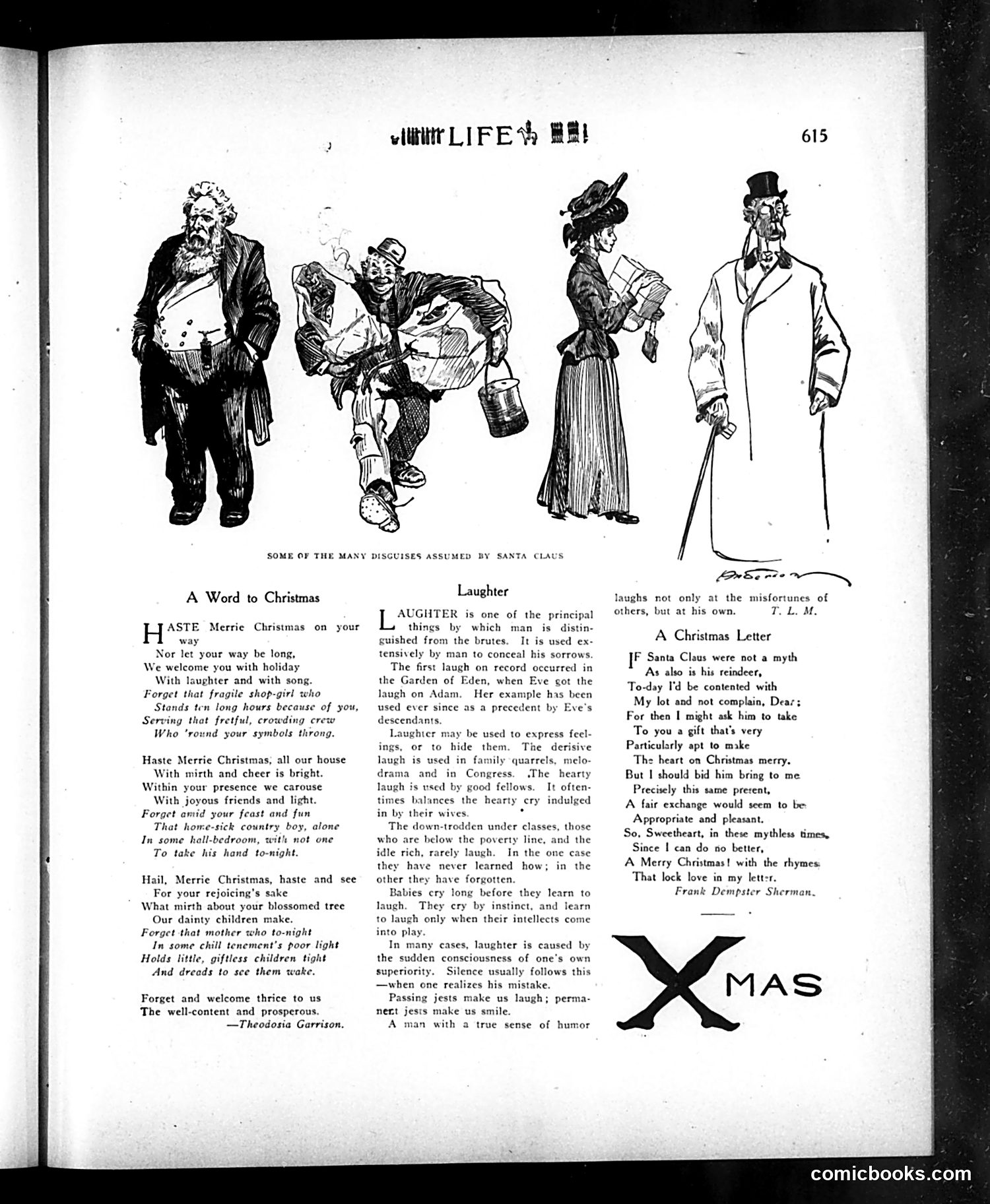
This page combines Christmas-themed content with social commentary typical of early 20th-century satire. **The Four Figures ("Disguises Assumed by Santa Claus"):** These illustrations depict Santa in various social guises—likely representing how different classes experience Christmas differently, from wealthy gentlemen to working poor. **"A Word to Christmas":** This poem by Theodosia Garrison is *ironic satire*. It repeatedly tells readers to "forget" the suffering working class—exhausted shop girls, lonely country boys in boarding houses, mothers in tenements with giftless children—while celebrating Christmas prosperity. The poem critiques how comfortable Americans ignore working-class hardship during holiday celebrations. **"Laughter":** A philosophical essay noting that laughter often masks sorrow and that the poor rarely laugh (having "never learned" or having "forgotten"). This reinforces the page's underlying message about class division. **"A Christmas Letter":** A romantic poem offering love as a gift substitute for material presents. The page's *central point*: Christmas celebration often ignores or requires forgetting the genuine misery of working people.
📄 Transcribed text from this page (OCR, searchable)
Machine-transcribed from the original scan — historical spelling and the odd misread are preserved.
SOME OF THE MANY DISGUISES ASSUMED A Word to Christmas ASTE Merrie way or let your way be long, We welcome you with holiday With laughter and with song. Forget that fragile shop-girl who Stands ten long hours because of you, Serving that fretful, crowding crew Who ‘round your symbols throng. Christmas on your Haste Merrie Christmas, all our house With mirth and cheer is bright. Within your presence we carouse With joyous friends and light. Forget amid your feast and fun That home-sick country boy, alone In some hall-bedroom, with not one To take his hand to-night. Hail, Merrie Christmas, haste and see For your rejoicing’s sake What mirth about your blossomed tree Our dainty children make. Forget that mother who to-night In some chill tenement's poor light Holds little, giftless children tight And dreads to see them wake. Forget and welcome thrice to us The well-content and prosperous. —Theodosia Garrison. Laughter UGHTER is one of the principal things by which man is distin- guished from the brutes. It is used ex- tensively by man to conceal his sorrows The first laugh on record occurred in the Garden of Eden, when Eve got the laugh on Adam. Her example has been used ever since as a precedent by Eve's descendants. Laughter may be used to express feel- ings, or to hide them. The derisive laugh is used in family quarrels, melo- Congress. .The hearty It often- indulged ma and in laugh is used by good fellows. times balances the hearty cry in by their wives : The down-trodden under classes, those who are below the poverty line, and the idle rich, rarely laugh. In the one case they have never learned how; in the other they have forgotten. Babies ¢ long before they learn to laugh. They cry by instinct, and learn to laugh only when their intellects come into play In many cases, laughter is caused by the sudden consciousness of one’s own superiority, Silence usually follows this —when one realizes his mistake. Passing jests make us laugh; perma- nert jesis make us smile. A with a true sense of humor nS orF 0 the misfortunes of T. L. M. laughs not only at others, but at his own. A Christmas Letter JF Santa Claus were not a myth As also is his reindeer, To-day I'd be contented with My lot and not complain, Deas; For then I might ask him to take To you a gift that's very Particularly apt to make The heart on Christmas merry. But I should bid him bring to me Precisely this same prerent, A fair exchange would seem to be Appropriate and pleasant, So, Sweetheart, in these mythless times, Since | can do no better, A Merry Christmas! with the rhymes That lock love in my lettsr. Frank Dempster Sherman, MAS comicbooks.com