
Life, 1908-12-03 · page 26 of 68
Life — December 3, 1908 — page 26: what you’re looking at
What you’re looking at
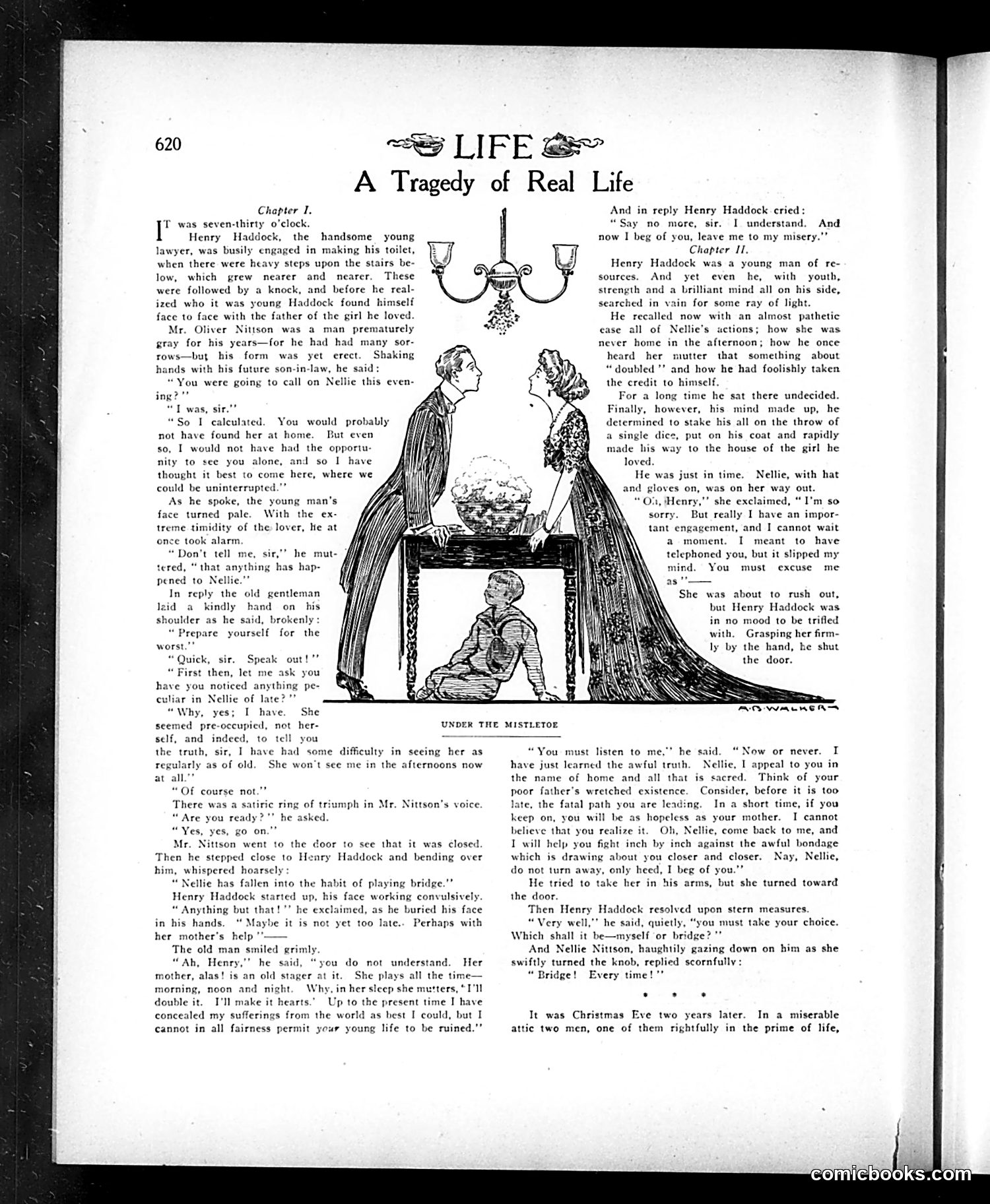
This is a serialized comedic story satirizing the social craze of bridge playing among upper-class Americans in the early 20th century. The narrative presents bridge addiction as a genuine domestic crisis, treating it with mock-serious melodrama. The plot concerns Henry Haddock, a young lawyer engaged to Nellie, who discovers that his fiancée and her mother have become obsessed with the card game bridge. Her father, Oliver Nittson, visits Henry to warn him that Nellie "has fallen into the habit of playing bridge"—presented as a catastrophic character flaw worthy of tragic drama. The satire mocks both the excessive social prominence of bridge among the wealthy and the overwrought Victorian/melodramatic tone of contemporary fiction. By treating a card game habit as a moral crisis equivalent to serious vices, the author ridicules contemporary attitudes toward leisure activities and domestic life among the upper classes.
📄 Transcribed text from this page (OCR, searchable)
Machine-transcribed from the original scan — historical spelling and the odd misread are preserved.
*S LIFE Sa A Tragedy of Real Life Chapter I. r was seven-thirty o'clock. Henry Haddock, the handsome young lawyer, was busily engaged in making his toilet, when there were heavy steps upon the stairs be- low, which grew nearer and nearer. These were followed by a knock, and before he real- ized who it was young Haddock found himself face to face with the father of the girl he loved. Mr. Oliver Nittson was a man prematurely gray for his years—for he had had many sor- rows—but his form was yet erect. Shaking ds with his future son-in-law, he said: “You were going to call on Nellie this even- You would probably But even “So I calculated not have found her at home. so, I would not have had the opportu- nity to see you alone, and so I have thought it best to come here, where we could be uninterrupted As he spoke, the young man’s face turned pale. With the ex- treme timidity of the lover, He at once took alarm “Don't tell me, sir,” he mut- tered, “that anything has hap- pened to Nellie.” In reply the old gentleman laid a kindly hand on his shoulder as he said, brokenly : “Prepare yourself for the worst “Quick, sir. out 1" “ First then, let me ask you have you noticed anything pe- culiar in Nellie of 7 “Why, yes; [Toh seemed pre-occupied, not her- self, and indeed, to tell you the truth, sir, I have had some difficulty in seeing her as regularly as of old. She won't see me in the afternoons now at all. “OF course not.” There was a satiric ring of triumph in Mr. Nittson’s voice “ Are you ready?’ he asked. “Yes, yes, go on.” Mr. Nittson went to the door to sce that it was closed. Then he stepped close to Henry Haddock and bending over him, whispered hoarsely: “ Nellie has fallen into the habit of playing bridge.” Henry Haddock started up, his face working convulsively. “ Anything but that!"? he exclaimed, as he buried his face in his hands. “Maybe it is not yet too late. Perhaps with her mother’s help "°— The old man smiled grimly “Ah, Henry," he said, “you do not understand. Her mother, alas! is an old stager at it. She plays all the time— morning, noon and night. Why, in her sleep she mutters, “I'll double it. I'll make it hearts.’ Up to the present time I have concealed my sufferings from the world as best I could, but I cannot in all fairness permit your young life to be ruined.”” And in reply Henry Haddock cried: “Say no more, sir. I understand. And now I beg of you, leave me to my misery.”” Chapter II. Henry Haddock was a young man of re- sources. And yet even he, with youth, strength and a brilliant mind all on his side, searched in vain for some ray of light. He recalled now with an almost pathetic case all of Nellie’s uctions; how she was never home in the afternoon; how he once heard her mutter that something about “ doubled’? and how he had foolishly taken the credit to himself. For a long time he sat there undecided. Finally, however, his mind made up, he determined to stake his all on the throw of a single dice, put on his coat and rapidly made his way to the house of the girl he loved. He was just in time. Nellie, with hat and gloves on, was on her way out. “On, Henry,” she exclaimed, “I'm so sorry. But really I have an impor- tant engagement, and I cannot wait a moment. I meant to have telephoned you, but it slipped my mind. You must excuse me She was about to rush out, but Henry Haddock was in no mood to be trifled with. Grasping her firm- ly by the hand, he shut the door. UNDER THE MISTLETOE “You must listen to me," he said ow or never. T have just learned the awful truth. Nellie, I appeal to you in the name of home and all that is sacred. Think of your poor father’s wretched existence. Consider, before it is too late, the fatal path you are leading. In a short time, if you keep on, you will be as hopeless as your mother. I cannot believe that you realize it. Oh, Nellie, come back to me, and 1 will help you fight inch by inch against the awful bondage which is drawing about you closer and closer. Nellie, do not turn away, only heed, I beg of you.”” He tried to take her in his arms, but she turned toward the door. Then Henry Haddock resolved upon stern measures. “Very well,”’ he said, quietly, “you must take your choice. Which shall it be—myself or bridge? And Nellie Nittson, haughtily gazing down on him as she swiftly turned the knob, replied scornfully : “Bridge! Every time!"* It was Christmas Eve two years later. In a miserable attic two men, one of them rightfully in the prime of life,