
A complete issue · 44 pages · 1908
Life — October 1, 1908
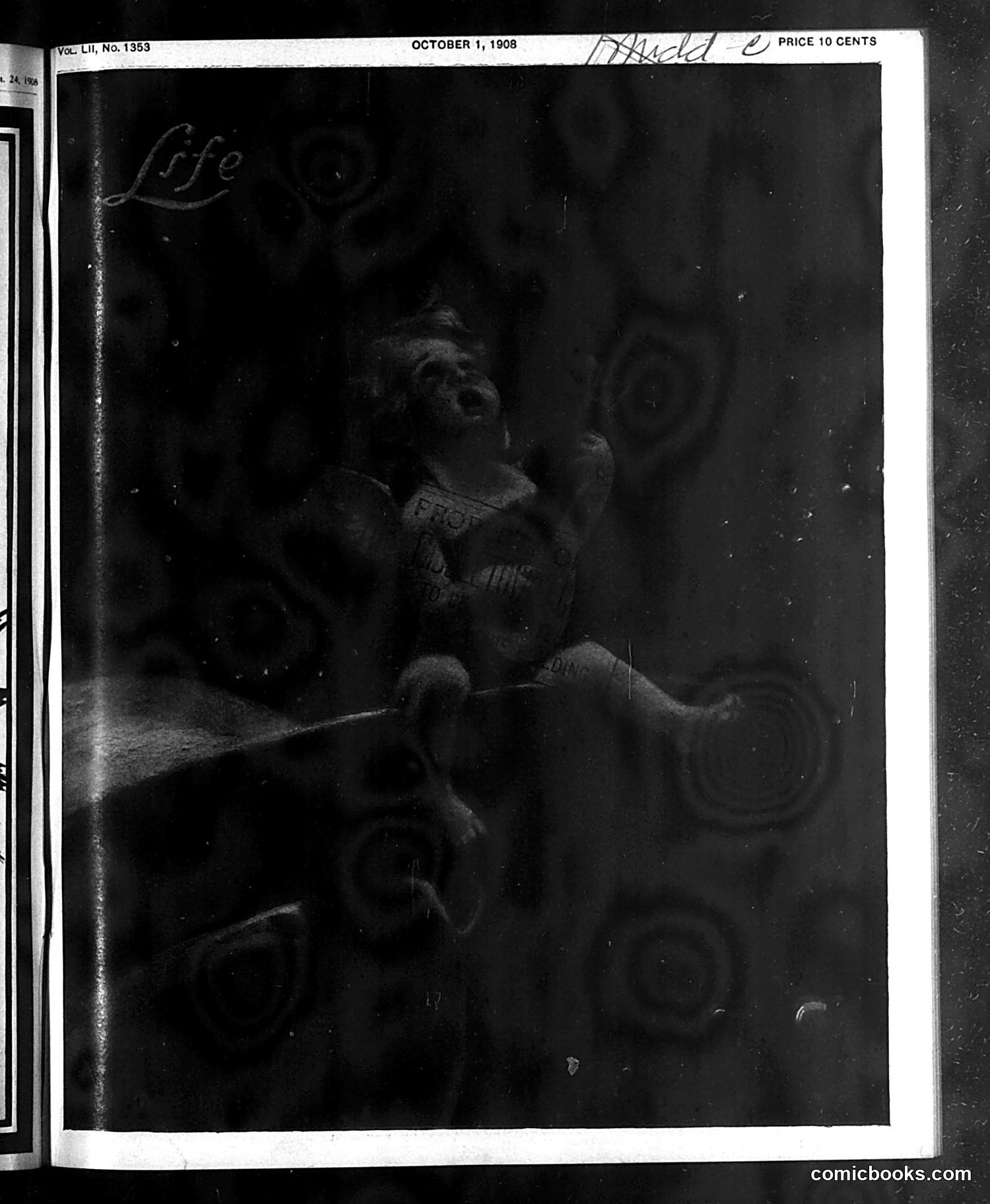
This is the cover of *Life* magazine from **October 1, 1908**, priced at 10 cents. The image shows what appears to be a chimpanzee or ape looking upward, seemingly fascinated or distressed by something above (possibly its own reflection in a mirror or glass). The satirical intent likely references the contemporary debate over **evolution and Darwinism**—a politically and socially contentious topic in 1908. The ape gazing upward could be commenting on humanity's relationship to animal ancestry, or satirizing public anxiety about evolutionary theory. The word "Life" on the cover may suggest commentary on the nature of life itself. Without clearer text visible on the cover, the exact satirical target remains somewhat unclear, though it almost certainly engages with early-20th-century anxieties about Darwinism.
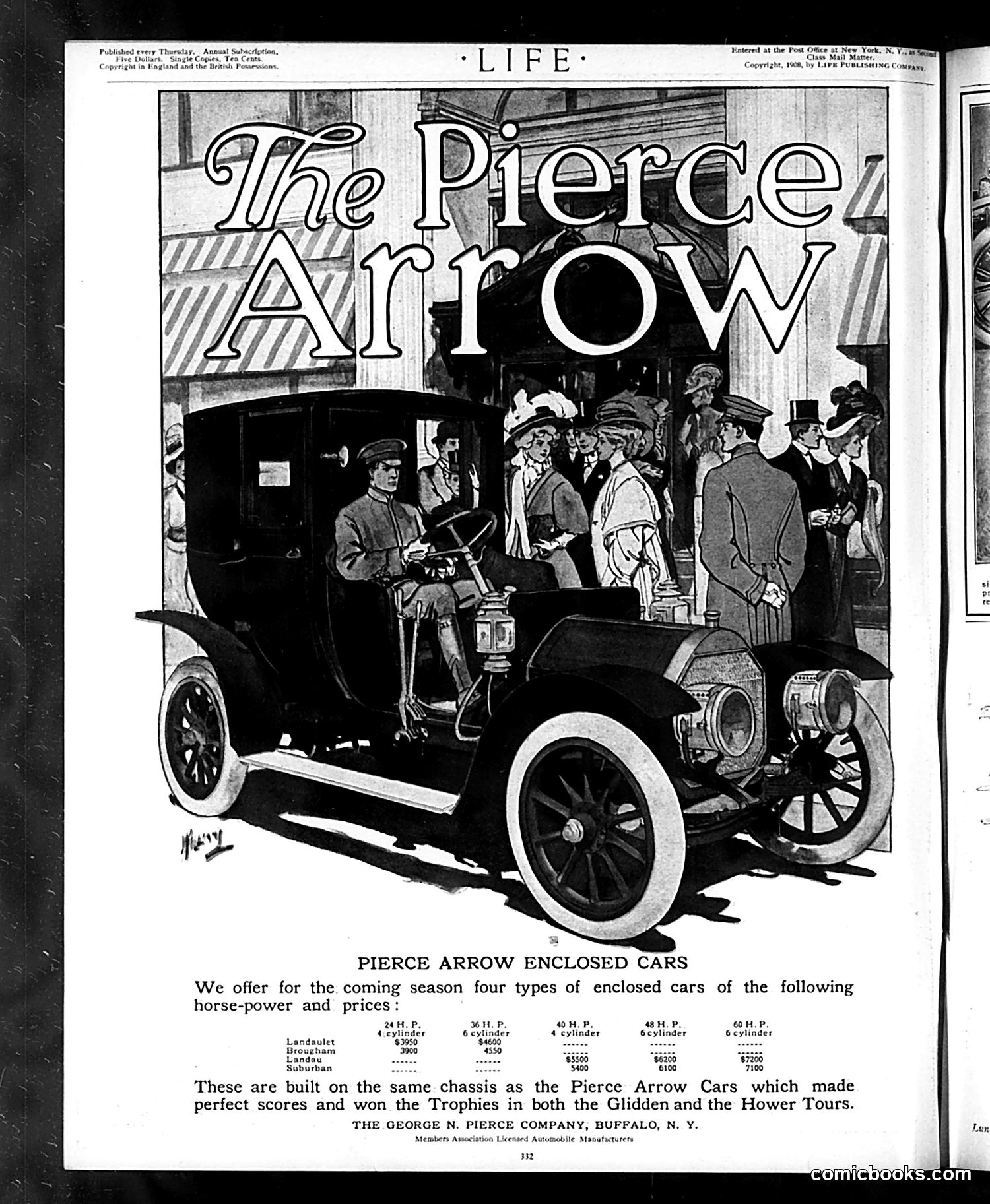
This page is **primarily an advertisement**, not political satire. It showcases Pierce Arrow enclosed automobiles, featuring an illustration of an early 1910s car parked outside what appears to be a fashionable venue with well-dressed pedestrians observing it. The ad emphasizes that Pierce Arrow cars were built on chassis that "won the Trophies in both the Glidden and the Hower Tours"—reference to early automotive reliability competitions that were significant marketing tools. The company lists four enclosed car models with varying horsepower (24-66 H.P.) and prices, positioning them as premium vehicles. The illustration's social subtext—showing the automobile as an object of public admiration—reflects the early automobile era's fascination with this new technology as a status symbol among the wealthy.
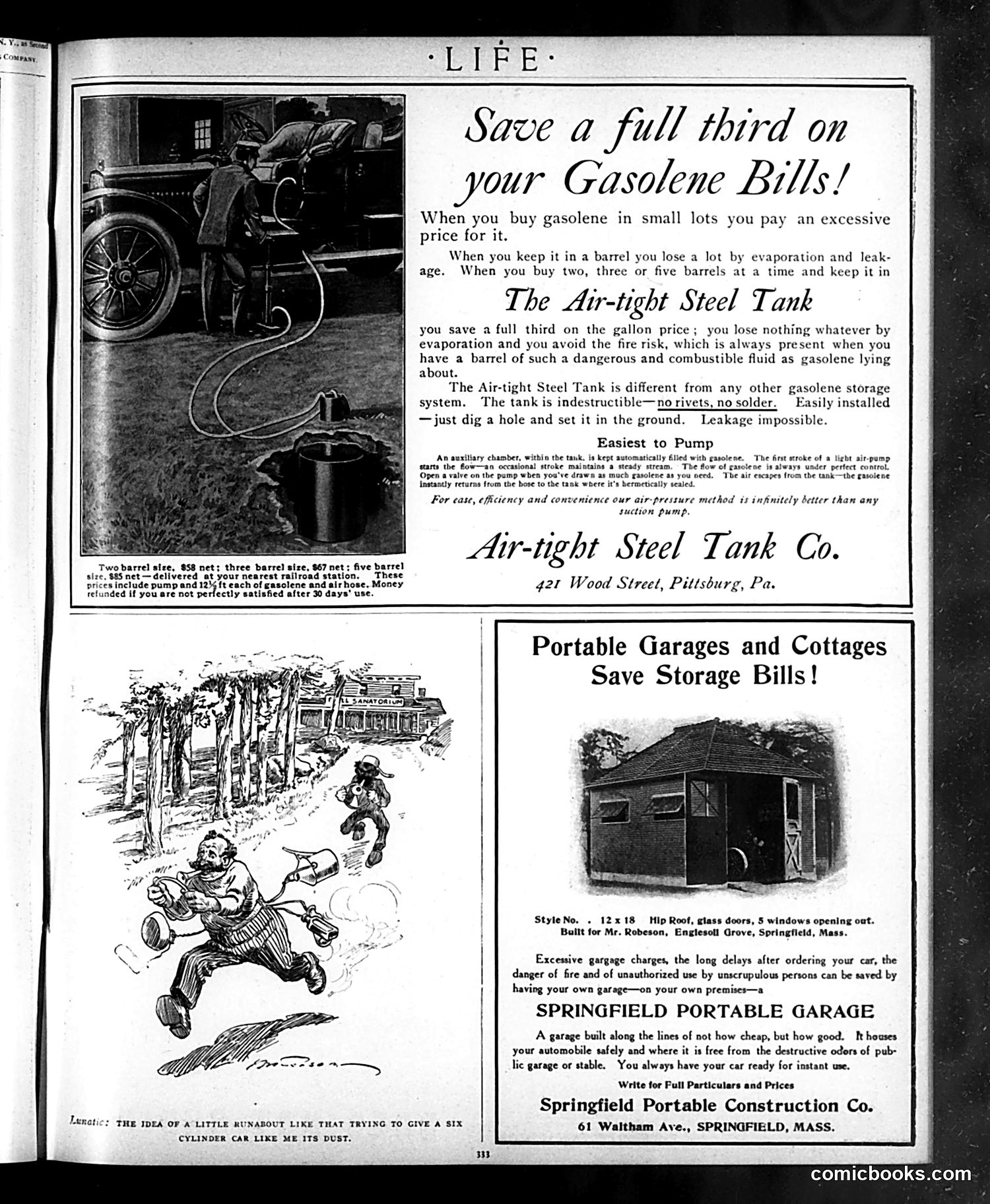
This page is primarily **advertising rather than satire or political commentary**. It contains three commercial advertisements from what appears to be the early 1900s automotive era: 1. **Air-tight Steel Tank Co.** (Pittsburgh): Promotes gasoline storage tanks, emphasizing savings and safety benefits over buying fuel in small quantities. 2. **Springfield Portable Garage**: Advertises prefabricated garages to protect automobiles and save storage costs. 3. **Cartoon caption** (bottom left): A humorous illustration showing someone frantically trying to prevent a runaway car, with a caption about "a little runaway" and cylinder car use—likely a joke about early automobile dangers. The page reflects **early-20th-century concerns**: automobile ownership logistics, fuel storage inefficiency, and the novelty of automotive infrastructure. The humor derives from the era's primitive automotive technology rather than political satire.
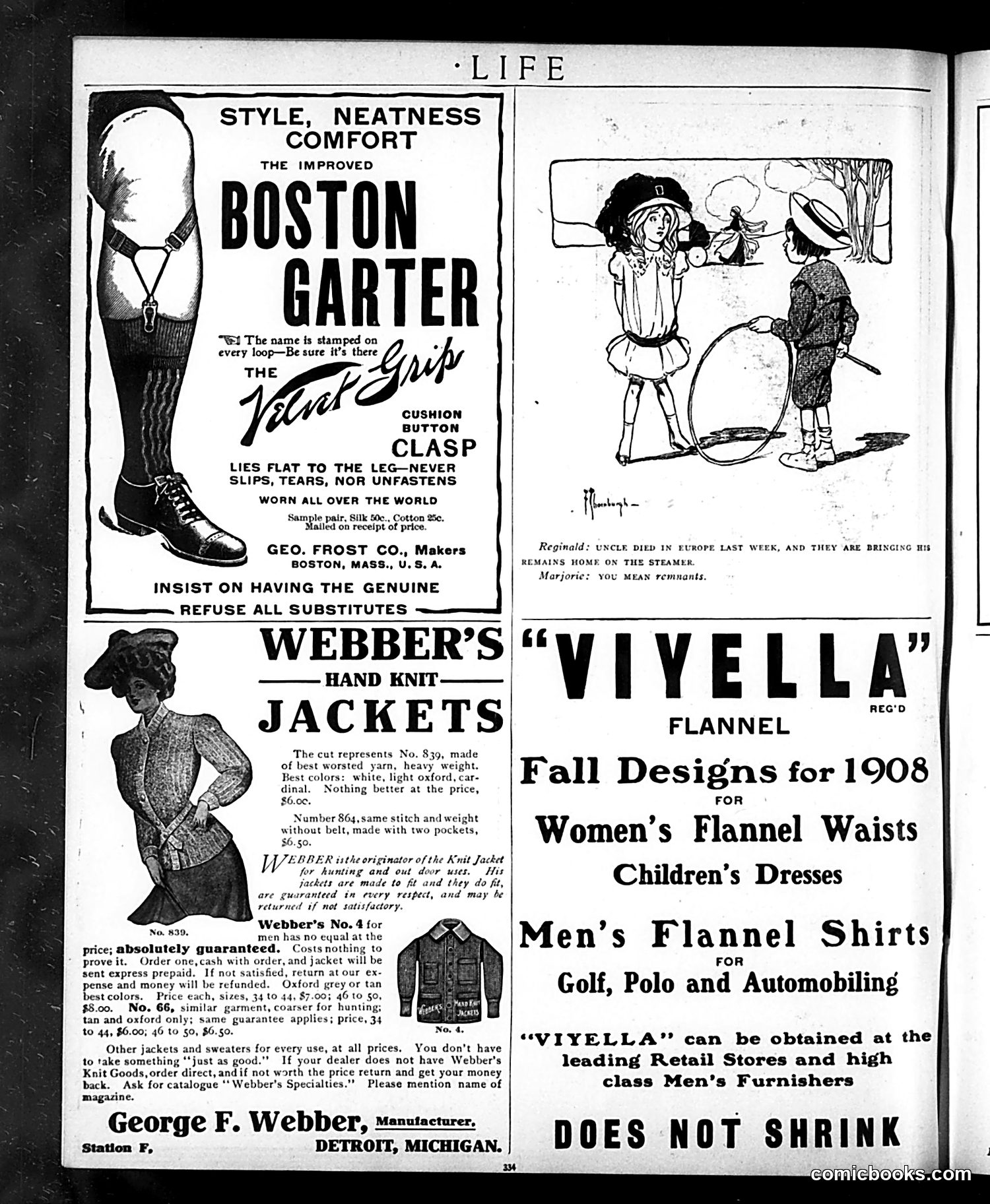
This page consists primarily of **advertisements** rather than political cartoons or satire. The main content includes: 1. **Boston Garter advertisement** - promoting a men's garter with a "Velvet Grip" clasp 2. **Webber's Hand Knit Jackets** - advertising knitted garments for women, manufactured in Detroit 3. **Vivella Flannel advertisement** - promoting fall 1908 designs for women's waists, children's dresses, and men's flannel shirts for golf and automobiling The one cartoon present (upper right) shows children playing jump rope with minimal satirical content—it's largely illustrative. This appears to be a typical early 20th-century magazine page mixing commercial advertisements with light humor rather than political commentary.
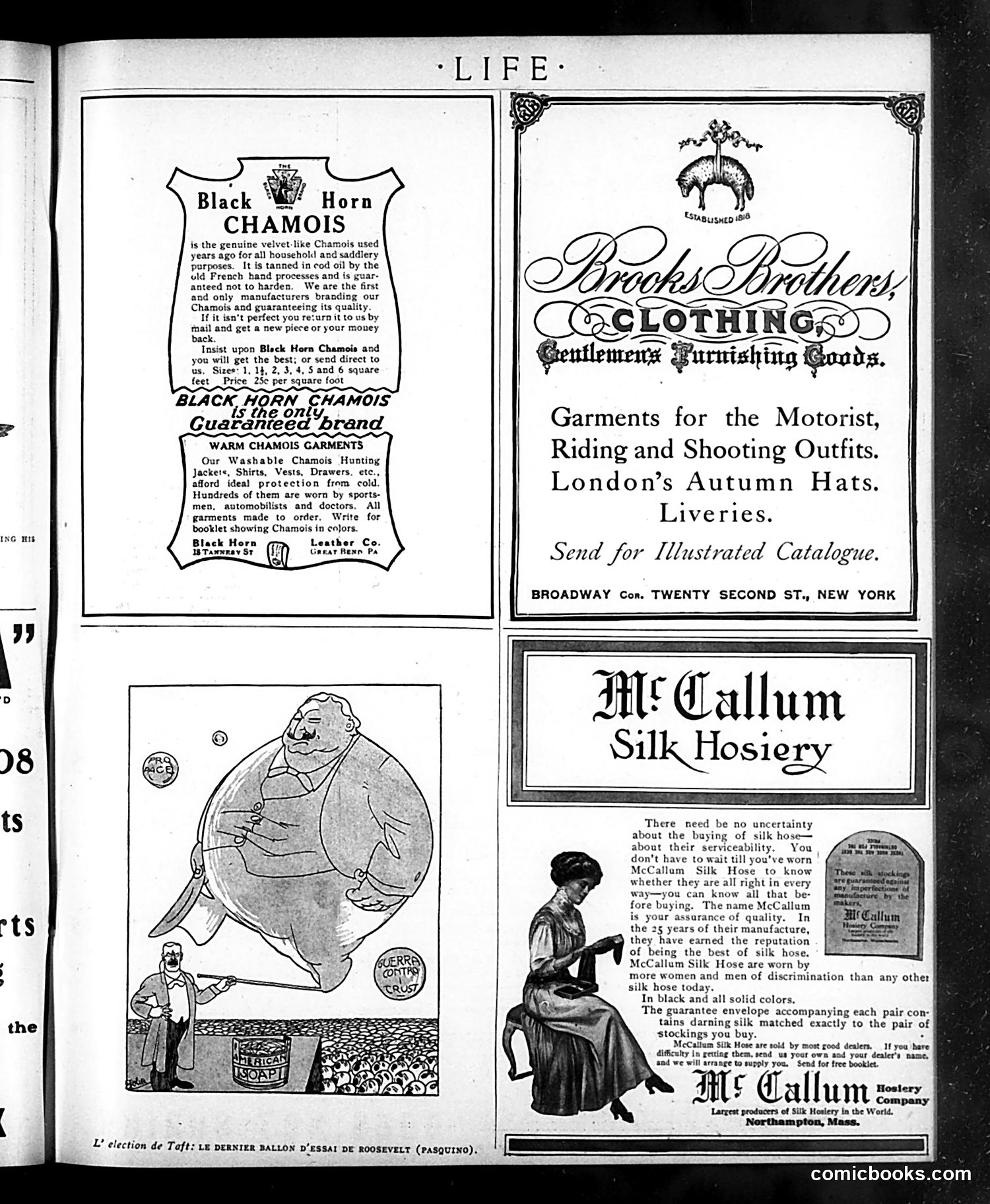
This page is primarily **advertising content**, not satirical cartoons. It contains four vintage ads from what appears to be an early 20th-century issue of Life magazine: 1. **Black Horn Chamois** - promotes chamois leather for household use 2. **Brooks Brothers** - advertises gentlemen's clothing and furnishings in New York 3. **A large illustration** (bottom left) - appears to be a soap advertisement featuring a rotund figure, though the text is partially illegible 4. **McCallum Silk Hosiery** - markets silk stockings for women, emphasizing quality and durability Rather than satire, this represents Life magazine's business model: combining editorial content with paid advertising. The ads reflect early 1900s consumer goods and gender-specific marketing (women's hosiery, men's clothing).
This page is primarily **advertising and business content** from an early 20th-century *Life* magazine. The main content includes: - **Astor Trust Company** advertisement (upper left): Lists New York financial leaders and bank officers - **Waukesha Addidian Ginger Ale** ad: Claims superiority to imported beverages - **Hotel des Champs Elysées** advertisement: Luxury Paris hotel - **The Glorious Orient** travel service - **Henry Clay and Bock y Ca Cabanas** cigar advertisement The right column contains **"The Camel's Complaint"** and **"Nipping a Career"** — brief satirical verses about animals' digestive abilities and a young actor's theatrical ambitions. These are light social commentary rather than political satire. The page functions primarily as a **commercial vehicle** rather than presenting substantial political or social commentary.
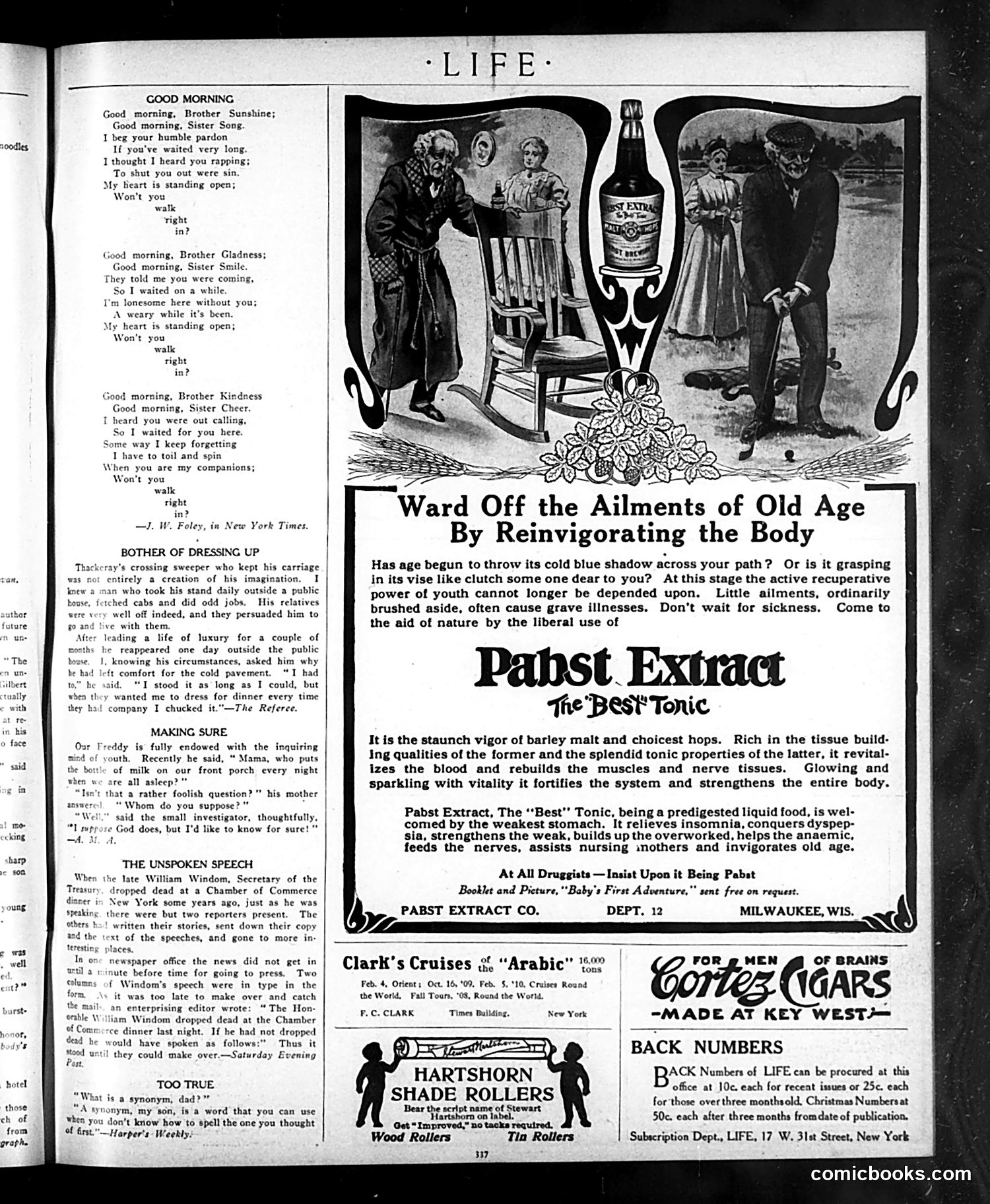
This page is primarily **advertisements and miscellaneous content** rather than political satire. The main visual is a large ad for **Pabst Extract**, a malt tonic marketed as a remedy for "ailments of old age" and general bodily weakness. The advertisement uses gothic, somewhat macabre imagery—skeletal or death-like figures—to dramatize aging and disease, then promotes the product as a reinvigorating solution. The page includes poems ("Good Morning," "Bother of Dressing Up," "Making Sure") and brief humorous pieces ("The Unspoken Speech," "Too True"), along with ads for Clark's Cruises, Cortez Cigars, and Hartshorn Shade Rollers. **Historical note**: Patent medicines and tonics like Pabst Extract were common in early 20th-century advertising, often making exaggerated health claims that would later be regulated.
This page is primarily **advertising**, not political satire. It contains three major advertisements: 1. **El Principe de Gales Havana Cigars** - promoting Cuban cigars as a 65-year standard, priced 3-for-25¢ to 50¢ 2. **White Rock** - bottled water advertised as "The World's Best Table Water" 3. **Dawson's Scotch Whiskey** - promoted as an "All-around Favorite" The right side contains reader letters under headings "A MAN OF LETTERS" and "A WOMAN'S LETTERS," including commentary about someone named Cyrus Watterhouse and discussions of letter-writing etiquette. There is **no political cartoon** on this page. The content reflects early 20th-century consumer advertising and general interest magazine editorial matter typical of *Life* magazine during this era.
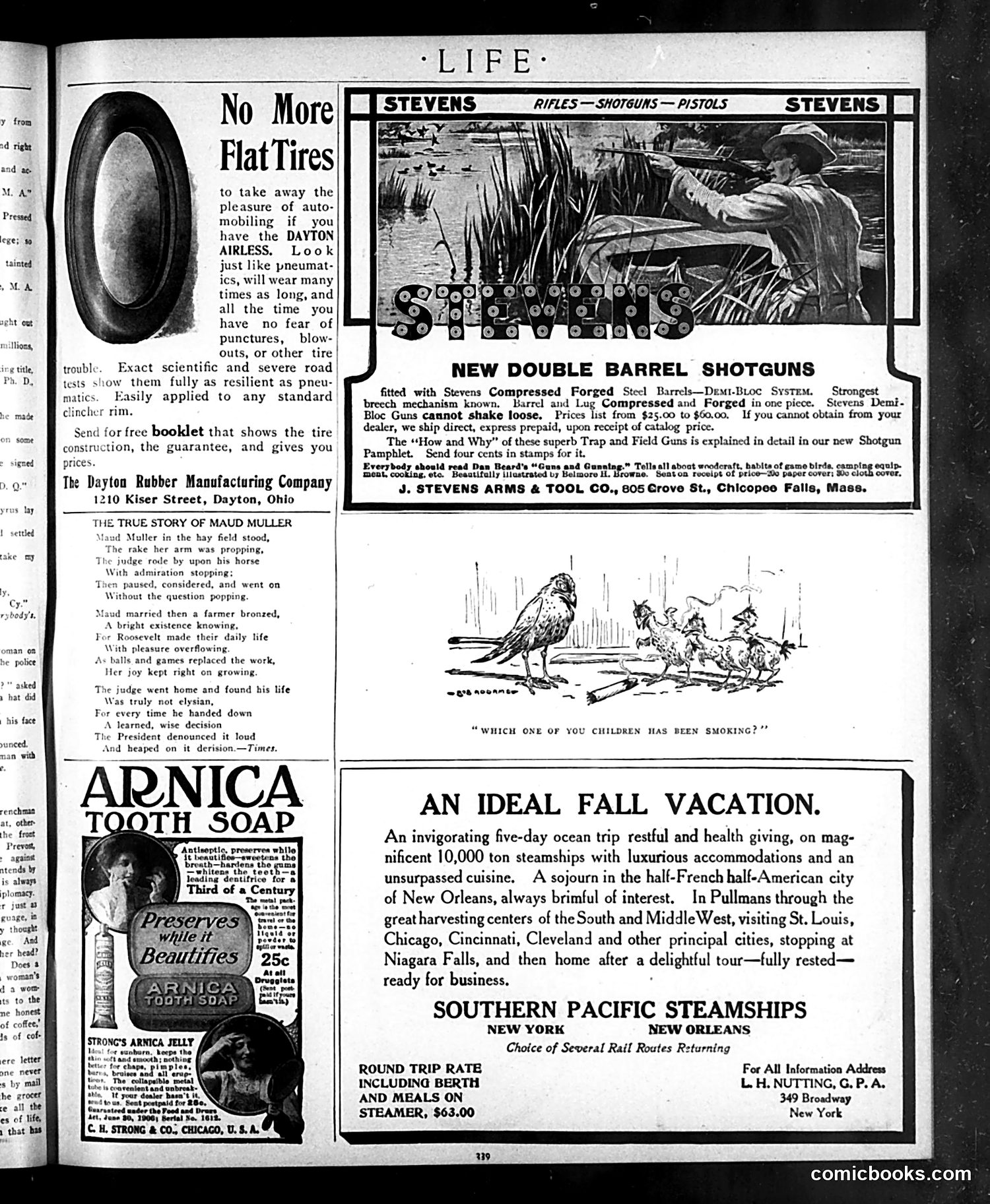
This page is primarily **advertising and miscellaneous content** rather than political satire. The main elements are: 1. **Dayton Airless Tires** ad (left): Promotes puncture-proof tires for automobiles—a practical innovation for early motorists concerned about flat tires. 2. **Stevens Shotguns** ad (top right): Advertises hunting weapons with an illustration of a man shooting waterfowl. 3. **"The True Story of Maud Muller"** (left): A satirical poem loosely based on Whittier's famous work, likely mocking sentimental literature. 4. **Arnica Tooth Soap** ad (bottom left): Patent medicine claiming to preserve teeth and beauty. 5. **Southern Pacific Steamships** ad (bottom right): Vacation travel promotion to New Orleans. The only potentially satirical element is the bird cartoon asking "Which one of you children has been smoking?" — a gentle joke about children's mischief.
This page is primarily **advertising and commercial content**, not political satire. It features: 1. **Whiting's Organdie Glacé** — an advertisement for linen-finished paper, emphasizing it as "the first linen finished paper made in America" 2. **Manning-Bowman Alcohol Gas Stove** — ads for a portable cooking device 3. **Calox Oxygen Tooth Powder** — dental product advertisement 4. **American Hosiery Underwear** — undergarment advertisement The page also contains some short humorous pieces: "The Cyclist's Dog" (a poem), "Too Argumentative" (a brief anecdote), and "A New Vehicle" (likely a joke about naming a buggy "Pat"). These are **light humor pieces**, not political commentary. The page reflects early 20th-century magazine advertising and entertainment content rather than satirical commentary on current events.
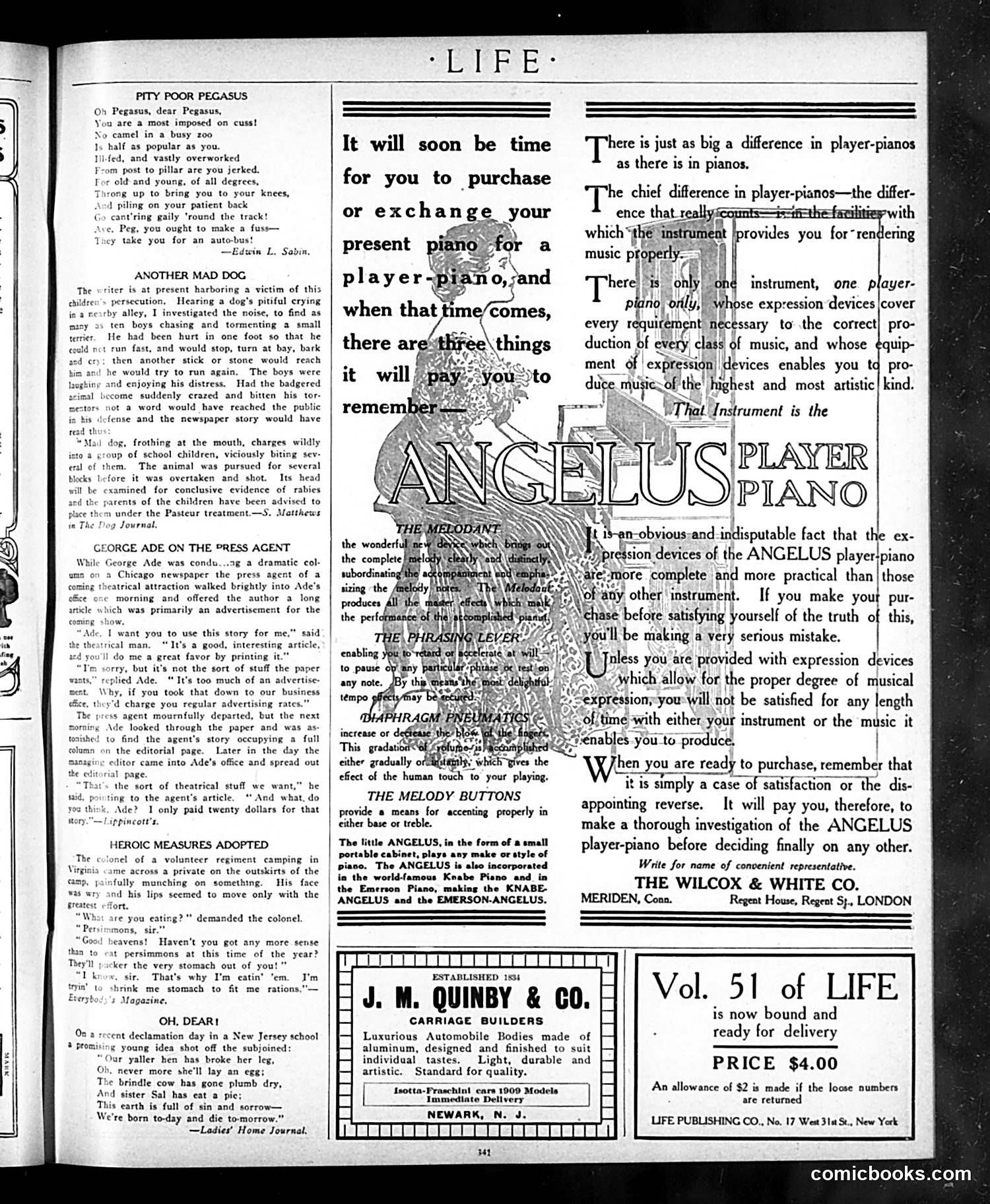
This page is primarily **advertising and humorous prose pieces** rather than political cartoons. The content includes: **Left column:** Three brief satirical stories—"Pity Poor Pegasus," "Another Mad Dog," and "George Ode on the Press Agent"—poking fun at various social types (a cab driver, mad dogs, theatrical agents). These are light social satire rather than political commentary. **Center/Right:** A large **Angelus Player Piano advertisement** featuring an illustration of a woman at the piano. The ad emphasizes the instrument's superiority for musical expression. **Bottom:** Advertisements for J.M. Quinby & Co. (carriage builders) and Life Publishing's bound volume sale. The page lacks significant political content or identifiable caricatures of public figures. It represents Life magazine's mix of humor, satire of everyday life, and commercial advertising typical of early 20th-century publications.
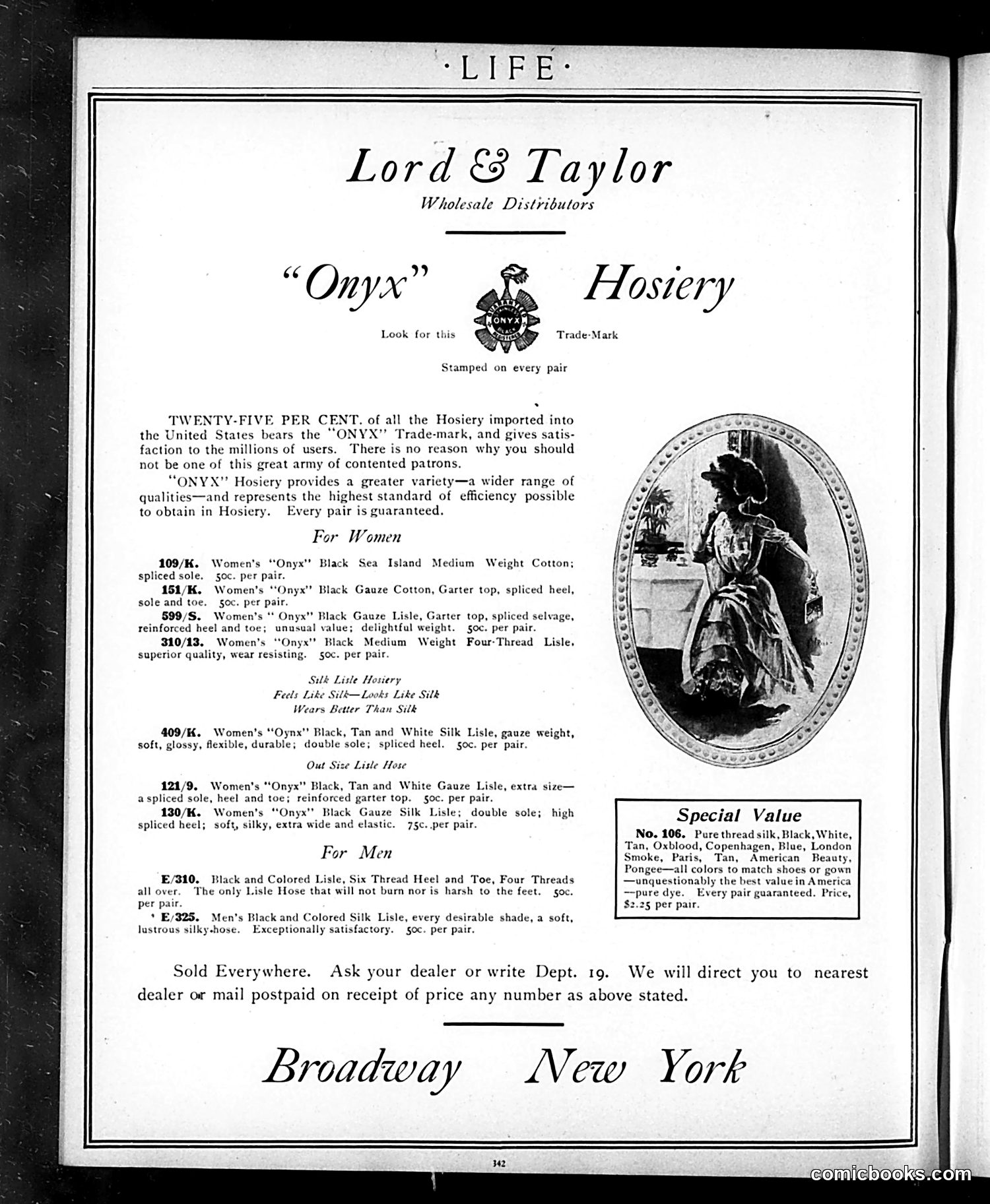
This page is **primarily an advertisement**, not satire or political commentary. It's a Lord & Taylor wholesale hosiery ad for "Onyx" brand stockings, occupying most of the page. The only illustrative element is an **oval-framed vintage engraving** on the right side depicting a woman in classical or period dress—likely aesthetic decoration meant to convey elegance and appeal to female consumers. The ad emphasizes that 25% of hosiery imported to the U.S. carries the "Onyx" trademark, listing various women's and men's styles with prices (ranging from 25¢ to $2.75 per pair). It includes a "Special Value" section highlighting a pure-thread silk option. There is no political cartoon, satire, or social commentary visible on this page—it is straightforward commercial advertising typical of early 20th-century magazine content.
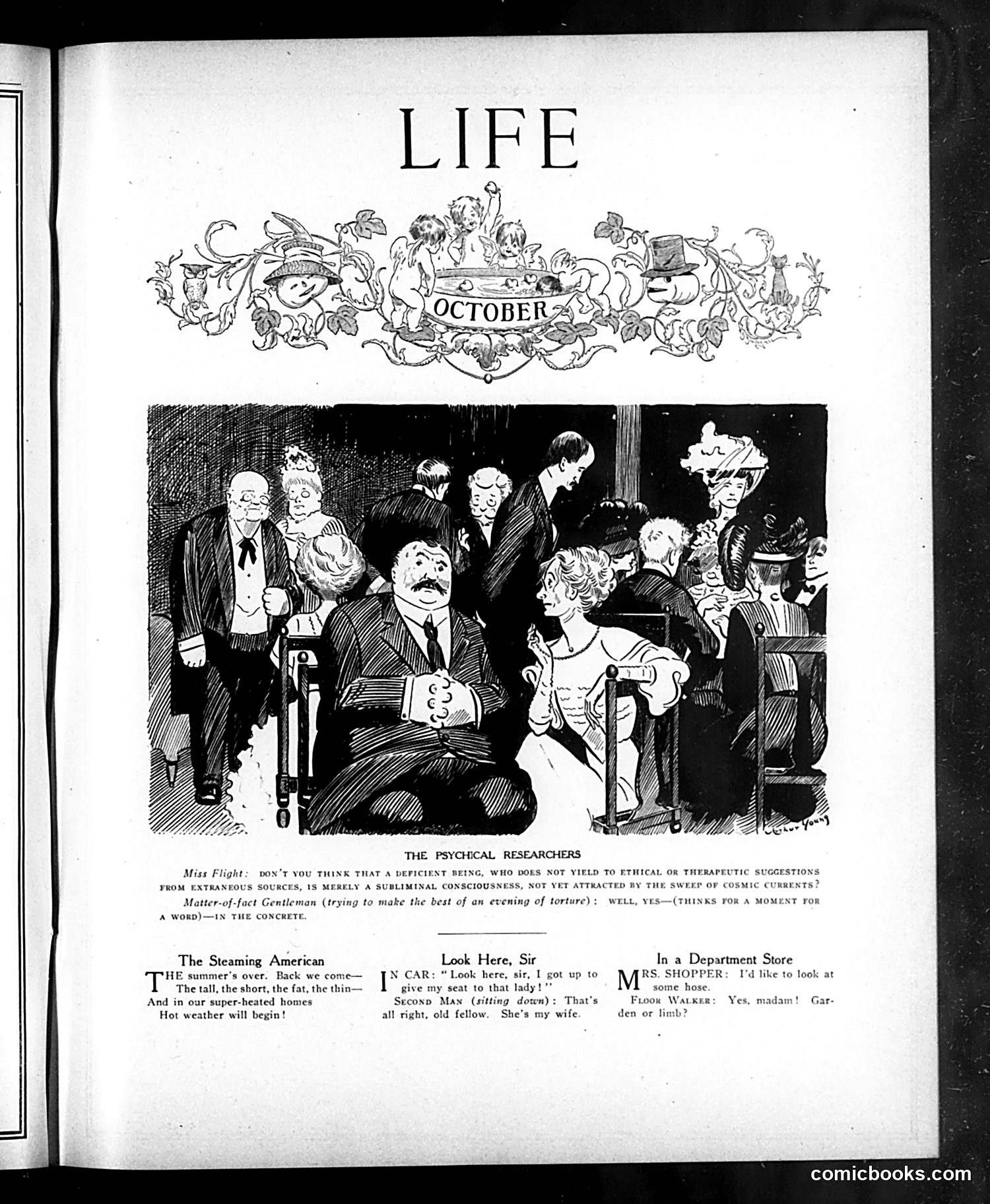
This cartoon satirizes spiritualism and psychical research, popular pseudoscientific movements of the early 20th century. The illustration depicts a séance or spiritualist gathering where well-dressed participants attempt to contact the supernatural. The caption mocks believers who claim to receive messages from "subliminal consciousness" or cosmic forces rather than admitting these are simply concrete, rational explanations. The three brief comic vignettes below ("The Steaming American," "Look Here, Sir," and "In a Department Store") appear unrelated—typical of Life's satirical format featuring multiple jokes per page. The overall message ridicules the credulity of educated people who embraced spiritualism despite lacking scientific evidence, a common target of American humor during this period.
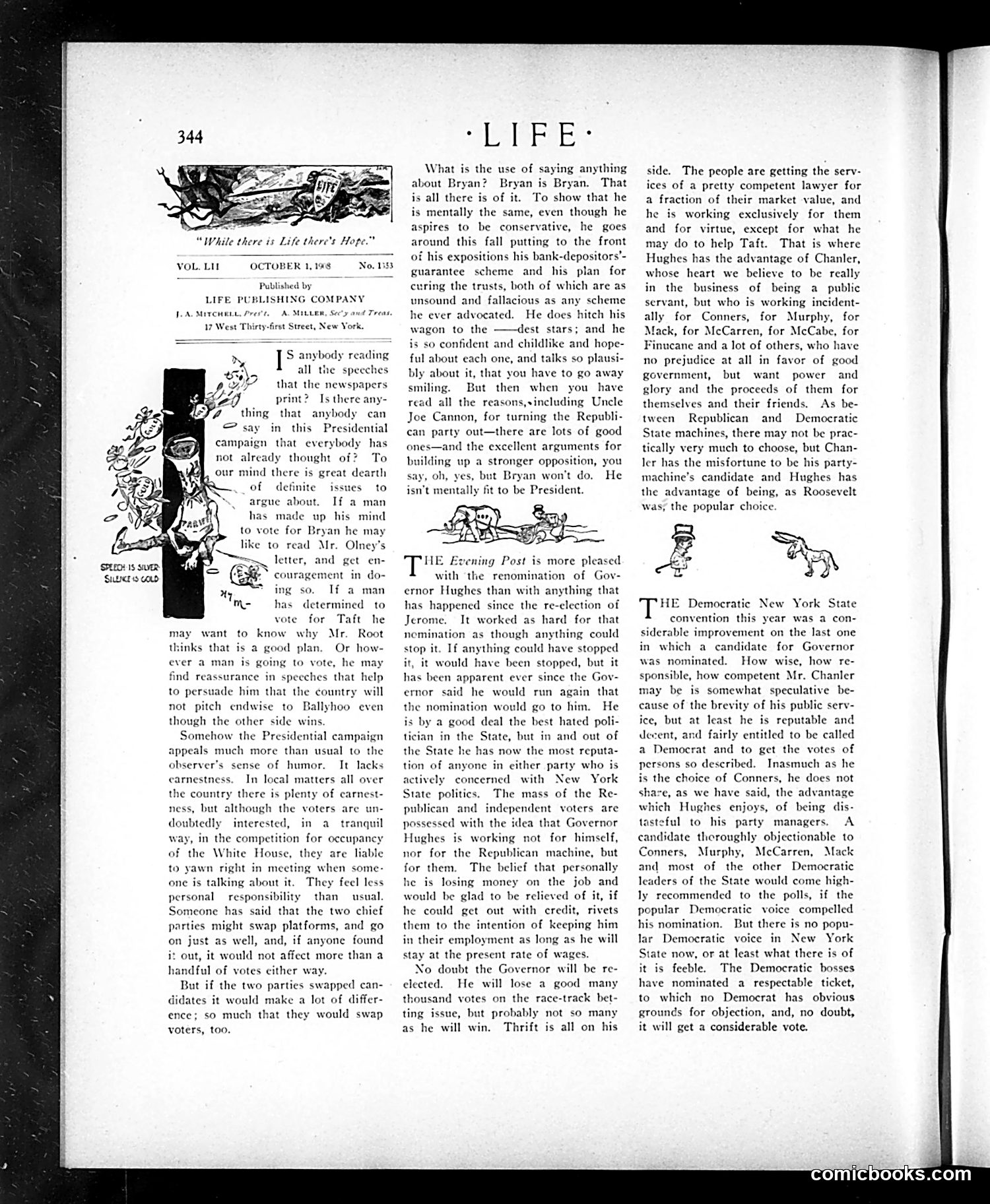
This page satirizes the 1908 U.S. Presidential campaign, mocking both major candidates. The main cartoon (left) shows a figure labeled "SUFFERER IS COLD," criticizing the glut of campaign speeches—none of which offer anything substantive or new to voters. The text attacks **William Jennings Bryan**, the Democratic candidate, as mentally unfit for presidency despite his charisma. He repeatedly pushes the same failed ideas (bank deposit guarantees, trust-busting) that voters find appealing but fundamentally unsound. The article praises **Governor Charles Evans Hughes**, the Republican nominee, as genuinely working for the public interest rather than personal gain or party machinery. Unlike Bryan, Hughes is portrayed as competent and truly concerned with voters' welfare. The satire's broader point: personality and reputation matter more than platform differences—the parties could literally swap platforms without voters noticing, but swapping *candidates* would cause massive electoral shifts. Bryan's charm cannot compensate for his lack of fitness for office.
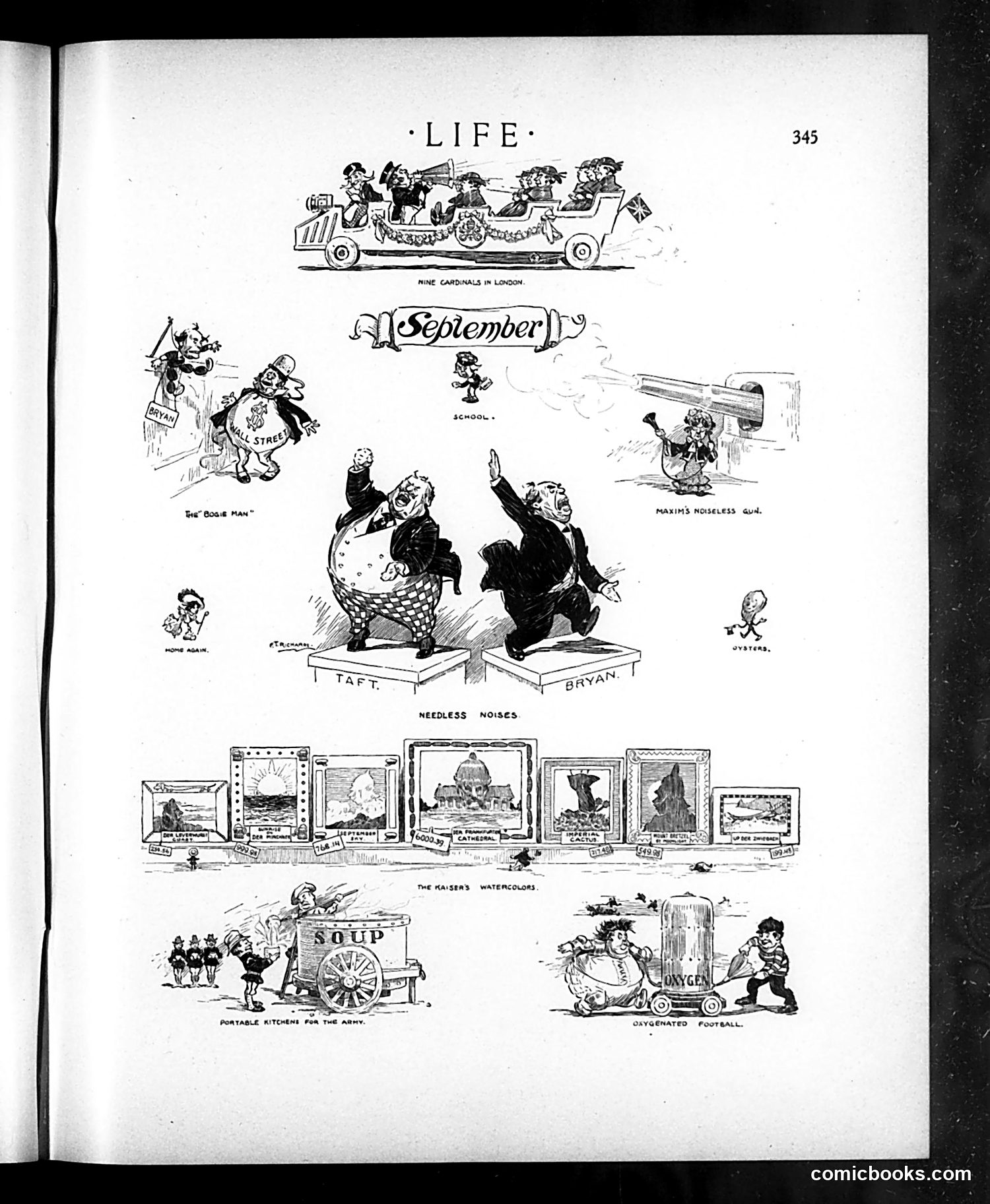
This is a September-themed satirical page from Life magazine featuring several visual jokes about contemporary issues. The central cartoon "Needless Noises" depicts two rotund politicians labeled "TAFT" and "BRYAN" on platforms, appearing to make exaggerated gestures—likely mocking their heated campaign rhetoric during a presidential election. Other sketches satirize contemporary concerns: "The Kaiser's Watercolors" displays framed artwork (unclear reference without date), while "Oxygenated Football" shows someone kicking a large oxygen tank labeled "OXYGEN," satirizing either medical trends or sports innovations. Additional vignettes mock "Portable Kitchens for the Army," "Making Noiseless," and other topics. The page's title suggests these are absurd or frivolous "needless" innovations and political posturing of the era.
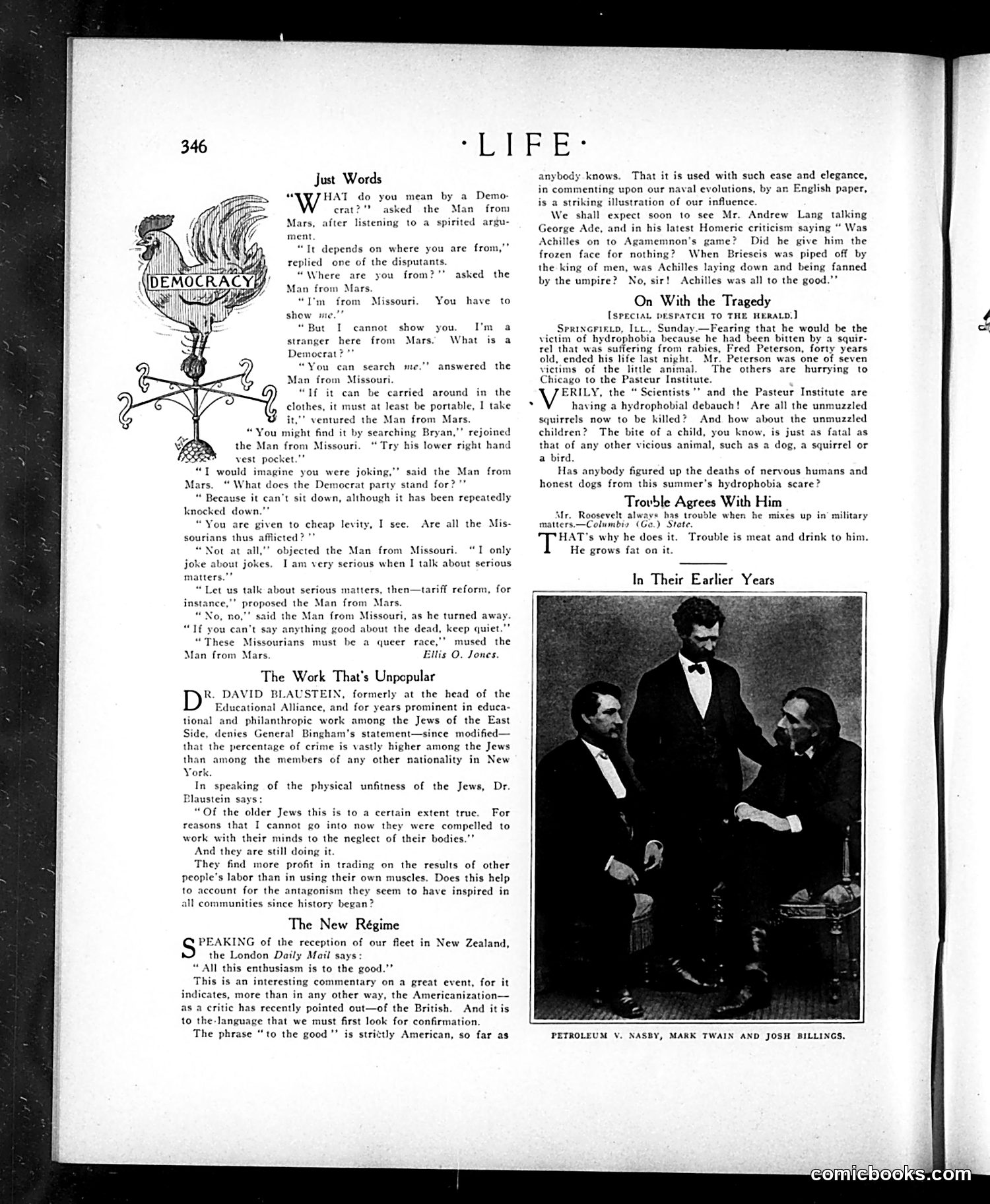
## "Just Words" — The Man from Mars Dialogue This satirical piece uses an extraterrestrial visitor to mock American political discourse, particularly targeting Democrats and Missourians. The joke hinges on the Man from Mars's literal-minded questions about what a "Democrat" actually *is*—exposing that it's an empty abstraction with no concrete meaning. References to "Bryan" (likely William Jennings Bryan, Democratic presidential candidate) and searches through "lower right hand vest pocket" suggest Democratic politicians are morally compromised or corrupt. When the Missourian dismisses tariff reform discussion as talking about "the dead," it implies the Democratic party itself is defunct. ## "The Work That's Unpopular" This section critiques David Blaustein's defense of Jewish immigrants against Police Commissioner Bingham's crime statistics. The author sarcastically suggests Jews' intellectual pursuits over manual labor create antagonism, implying they exploit others' labor—a period antisemitic stereotype. ## Minor pieces mock British adoption of American slang ("to the good") and report a rabies tragedy.
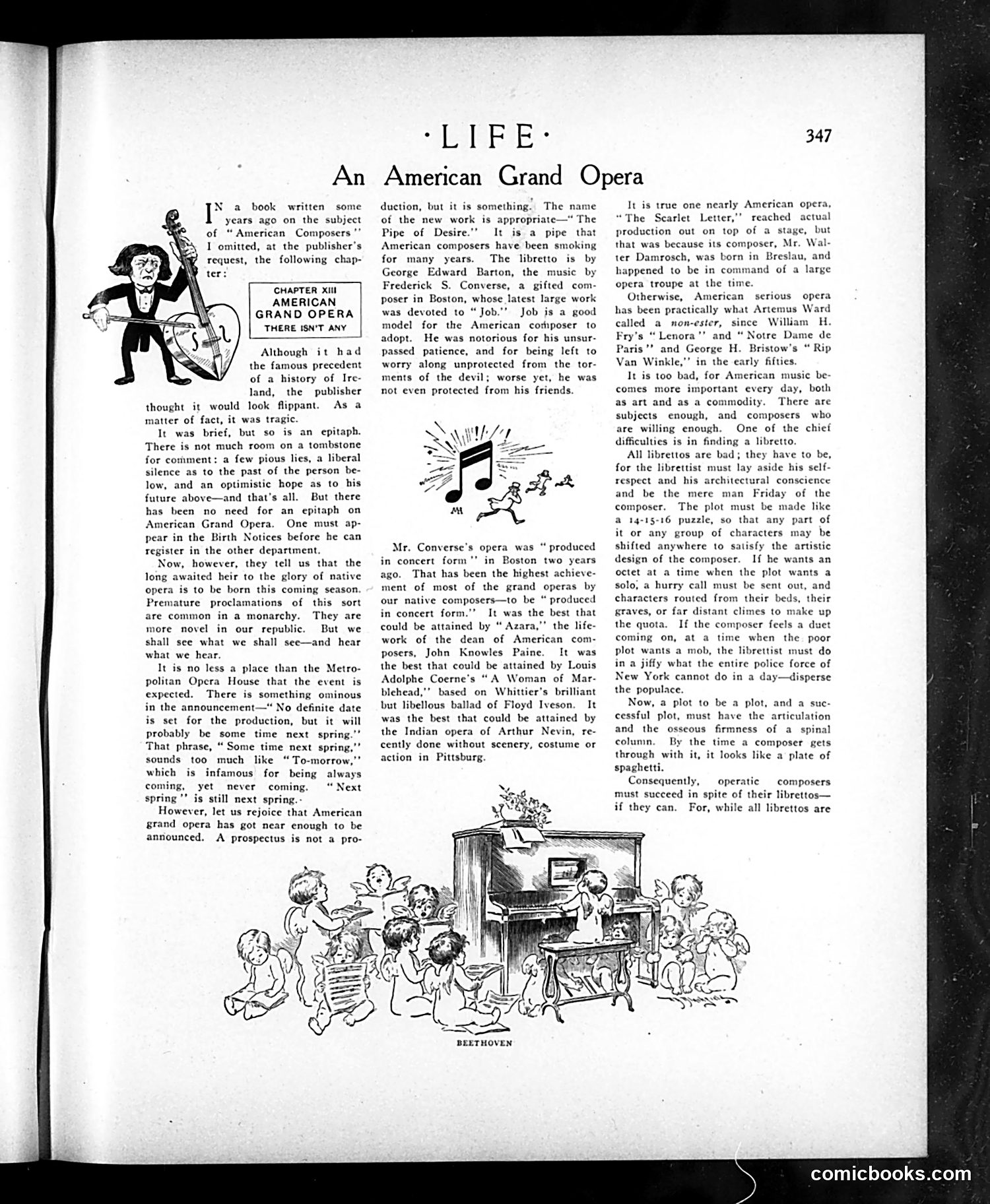
This article satirizes the complete absence of successful American grand opera. The author sarcastically notes that Chapter XIII of a book on American composers was omitted—titled "American Grand Opera: There Isn't Any." The piece mocks the Metropolitan Opera's announcement of an upcoming native opera ("The Pipe of Desire" by Frederick Converse), treating it as a birth announcement for something stillborn. The satire lies in the vague timeline ("some time next spring"—perpetually postponed) and past failures: earlier American operas like Paine's "Azara" and Coerne's "A Woman of Marblehead" achieved only "concert form" productions, not full stagings. Even "The Scarlet Letter" succeeded only because its composer, Walter Damrosch, was foreign-born and happened to have an opera company. The cartoon of Beethoven at bottom contrasts European musical achievement with American failure. The author concludes that while American subjects and willing composers exist, finding a quality libretto remains the chief obstacle—a coded way of saying American opera lacks essential elements for success.
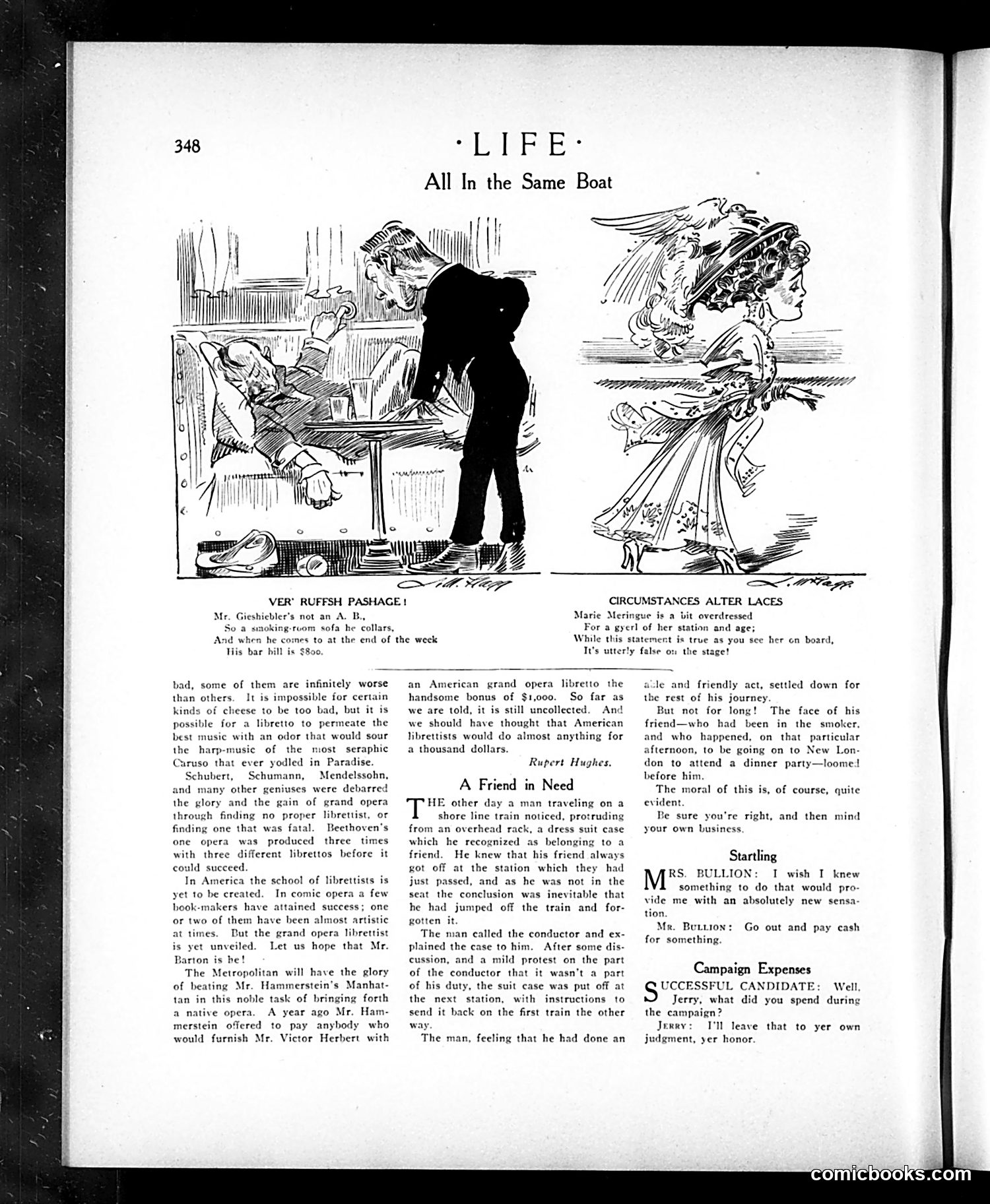
This page contains three separate satirical pieces from the early 20th century: **"All In the Same Boat"** (top cartoons): Two sketches mocking social pretense. The left cartoon ridicules a man posing as educated ("not an A.B.") while running up debts at bars. The right cartoon satirizes a woman overdressed for her social station aboard a ship, though appearing appropriately dressed on stage—mocking the gap between reality and theatrical artifice. **"A Friend in Need"** (middle text): A humorous anecdote about a man who helpfully retrieves his friend's abandoned suitcase from a train, only to discover the friend never wanted it retrieved and was traveling onward. The moral: mind your own business—a common satirical jab at well-intentioned meddling. **"Campaign Expenses"** (bottom): A politician humorously deflects questions about campaign spending to "yer honor," satirizing the opacity and corruption surrounding political campaign finances—a perennial target of satire.
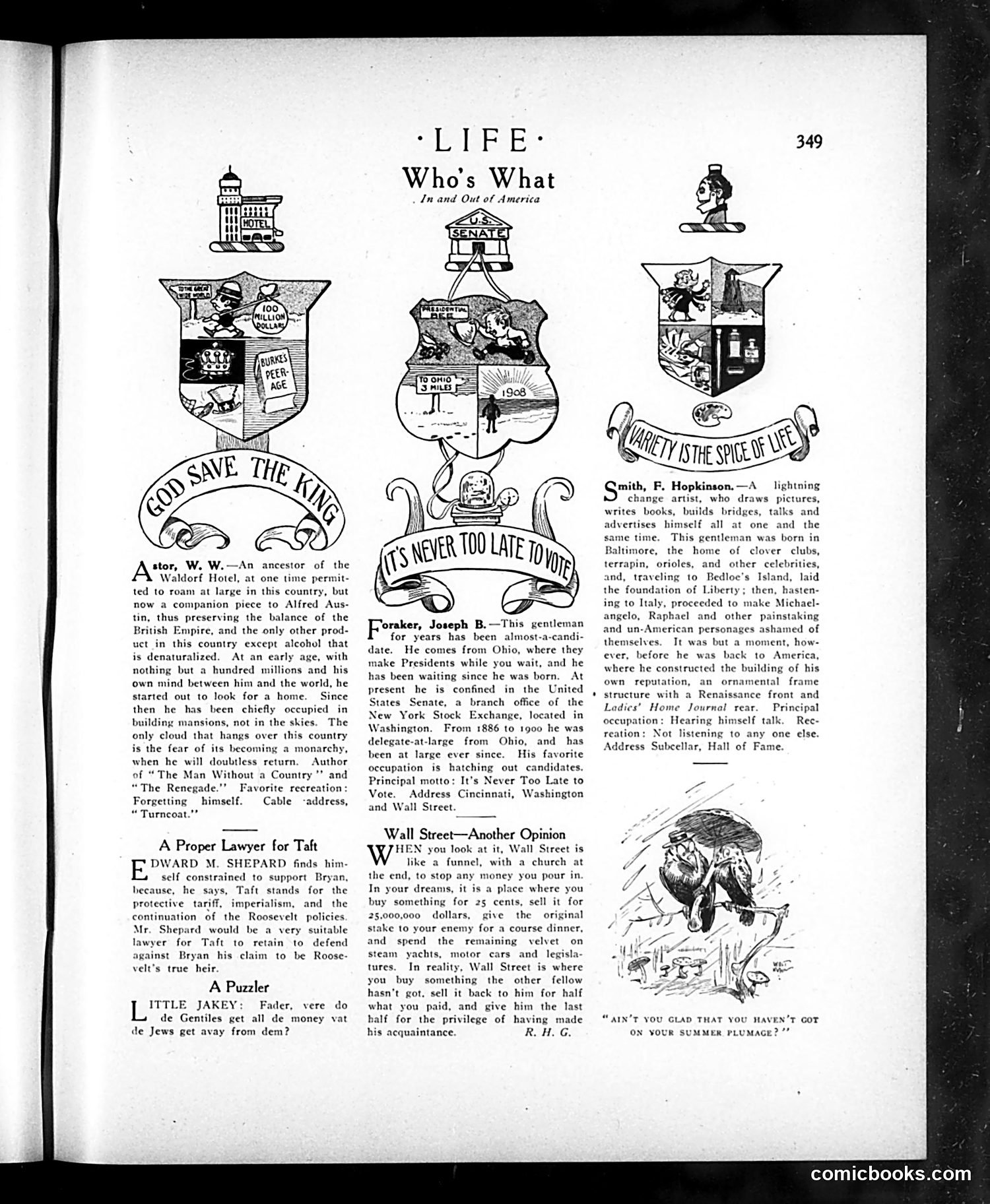
This page from Life magazine features satirical biographical sketches of notable figures from the early 1900s. The "Who's What" section mocks prominent Americans through exaggerated caricatures: **W.W. (likely William Waldorf Astor)**: A wealthy American criticized for his mansion-building and preference for living abroad—portrayed as so obsessed with wealth that he might return if America became a monarchy. **Edward M. Shepard**: A lawyer who uncomfortably supports William Jennings Bryan despite ideological disagreement, creating an ironic contradiction Life finds laughable. **Joseph B. Foraker**: An Ohio politician described as perpetually "waiting" to become president while confined in the Senate, which Life sarcastically calls a "branch office of the New York Stock Exchange." **F. Hopkinson Smith**: A Renaissance man of letters celebrated for simultaneous careers in art, writing, and engineering. The **"Wall Street" section** offers cynical commentary: wealth flows in like a funnel but churches stop the money, and traders profit by selling items back at inflated prices. This reflects Progressive-era skepticism toward Wall Street capitalism.
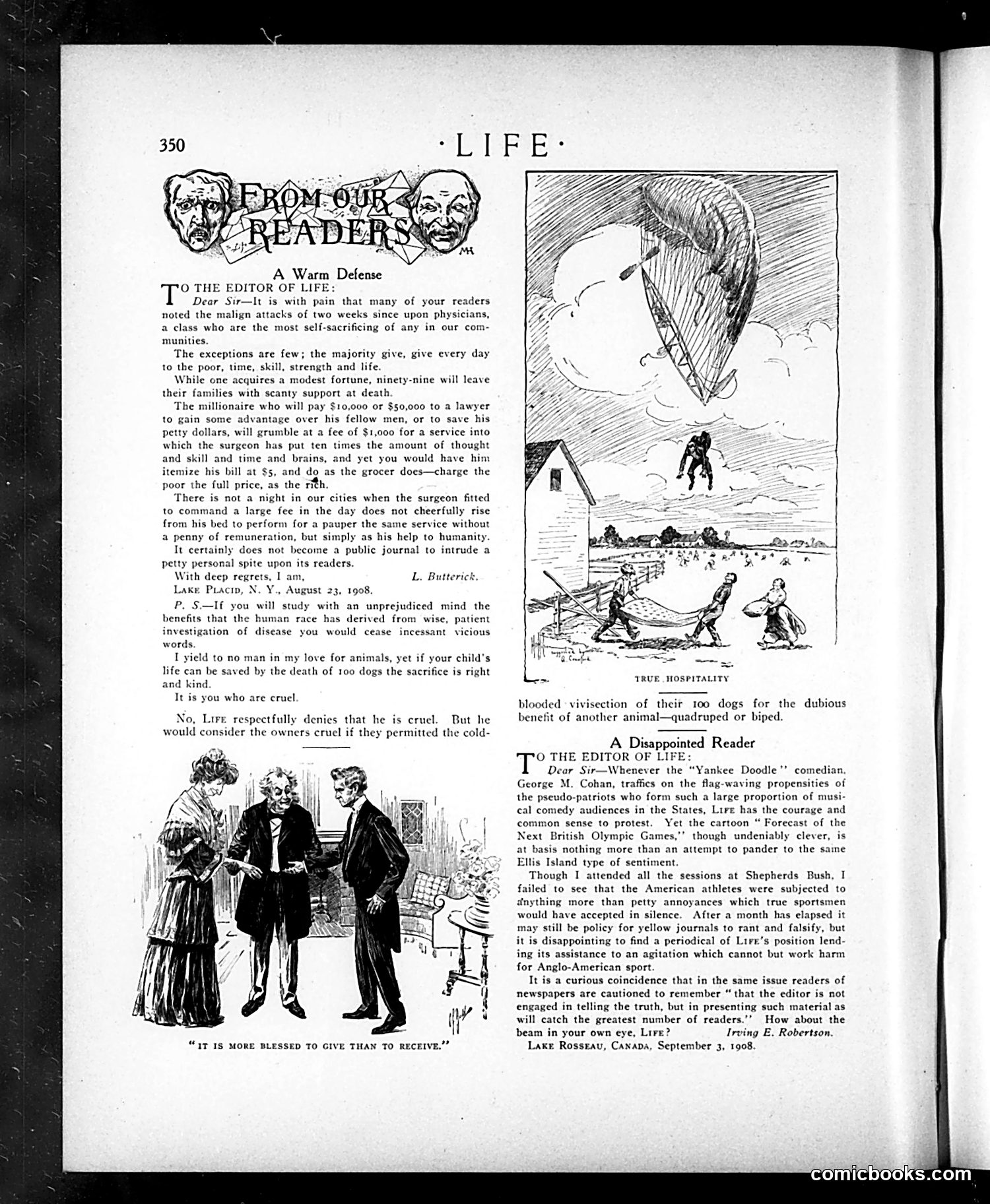
This page presents two reader letters responding to recent Life magazine content: **"A Warm Defense"** defends physicians against prior criticism. The letter (signed L. Butterick, Lake Placid, NY) argues doctors sacrifice greatly for minimal pay—especially treating the poor without charge. It attacks Life's implied suggestion they itemize bills "like grocers," arguing surgeons deserve respect comparable to expensive lawyers. The P.S. defends medical vivisection (animal testing) as justified if human lives are saved, challenging Life's apparent animal-rights stance. **"A Disappointed Reader"** criticizes Life for mocking the British Olympic Games in xenophobic terms (appealing to "Ellis Island type sentiment"). The writer, Irving Robertson (Lake Rosseau, Canada), argues this undermines Anglo-American sporting relations and questions why Life—which supposedly doesn't report truth—deserves credibility on such matters. The page includes period illustrations: a sketch of three figures discussing charity, and a rural scene titled "True Hospitality." The cartoons visually complement the earnest debate about professional ethics and patriotic sentiment.
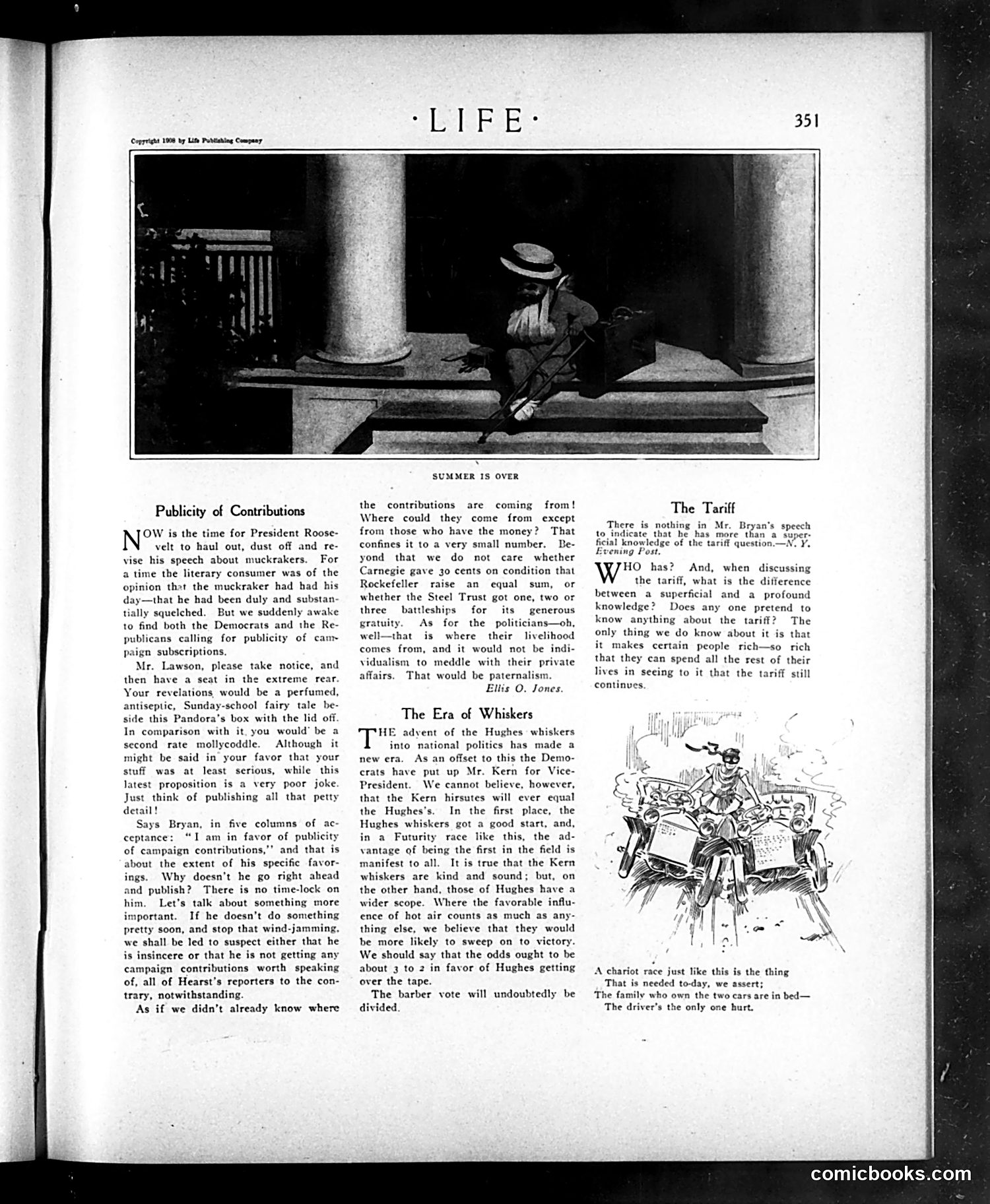
This page contains three satirical opinion pieces from the 1908 election cycle: **"Publicity of Contributions"** mocks both major parties for suddenly demanding campaign finance transparency while doing nothing about it themselves. The writer particularly ridicules William Bryan for grandly announcing support for disclosure without actually publishing his own donations—suggesting his campaign contributions are either nonexistent or he's being hypocritical. **"The Era of Whiskers"** is a tongue-in-cheek comparison of Republican Charles Evans Hughes's famous facial hair to Democratic VP nominee James Sherman's, treating the election as a comic "race" between their respective beards. It's lightweight satire playing on the candidates' appearances. **"The Tariff"** dismisses Bryan's tariff knowledge as superficial, then broadly mocks everyone's understanding of tariff policy—suggesting the entire debate is meaningless theater while wealthy industrialists manipulate policy to stay rich. All three pieces share cynical skepticism toward campaign rhetoric and politicians' sincerity.
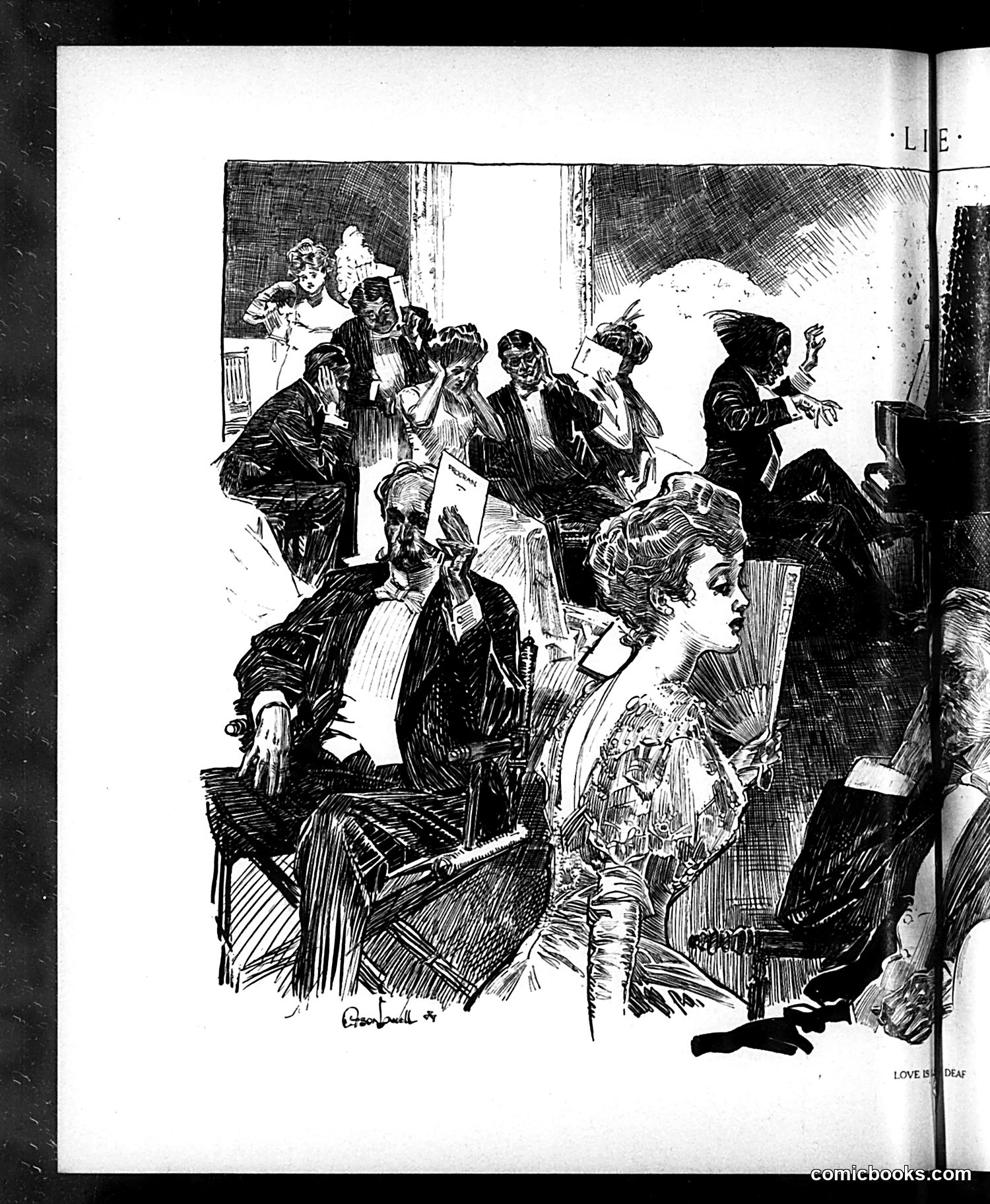
This is a satirical illustration from *Life* magazine depicting a formal social gathering or theatrical scene. The sketch shows elegantly dressed men and women in early 20th-century attire engaged in conversation and socializing. The artist's signature appears to read "Clanwell" or similar. The caption at bottom reads "LOVE IS DEAF" (partially visible as "LOVE IS D[EAF]"), suggesting the cartoon satirizes romantic or social pretense—that people in love (or claiming to be) ignore obvious truths or inconvenient realities around them. The formal dress and indoor setting suggest this depicts high society, possibly mocking the artificiality of upper-class social conventions where people maintain appearances while ignoring or dismissing uncomfortable truths. Without additional context or visible caption text, the specific social critique remains somewhat unclear.
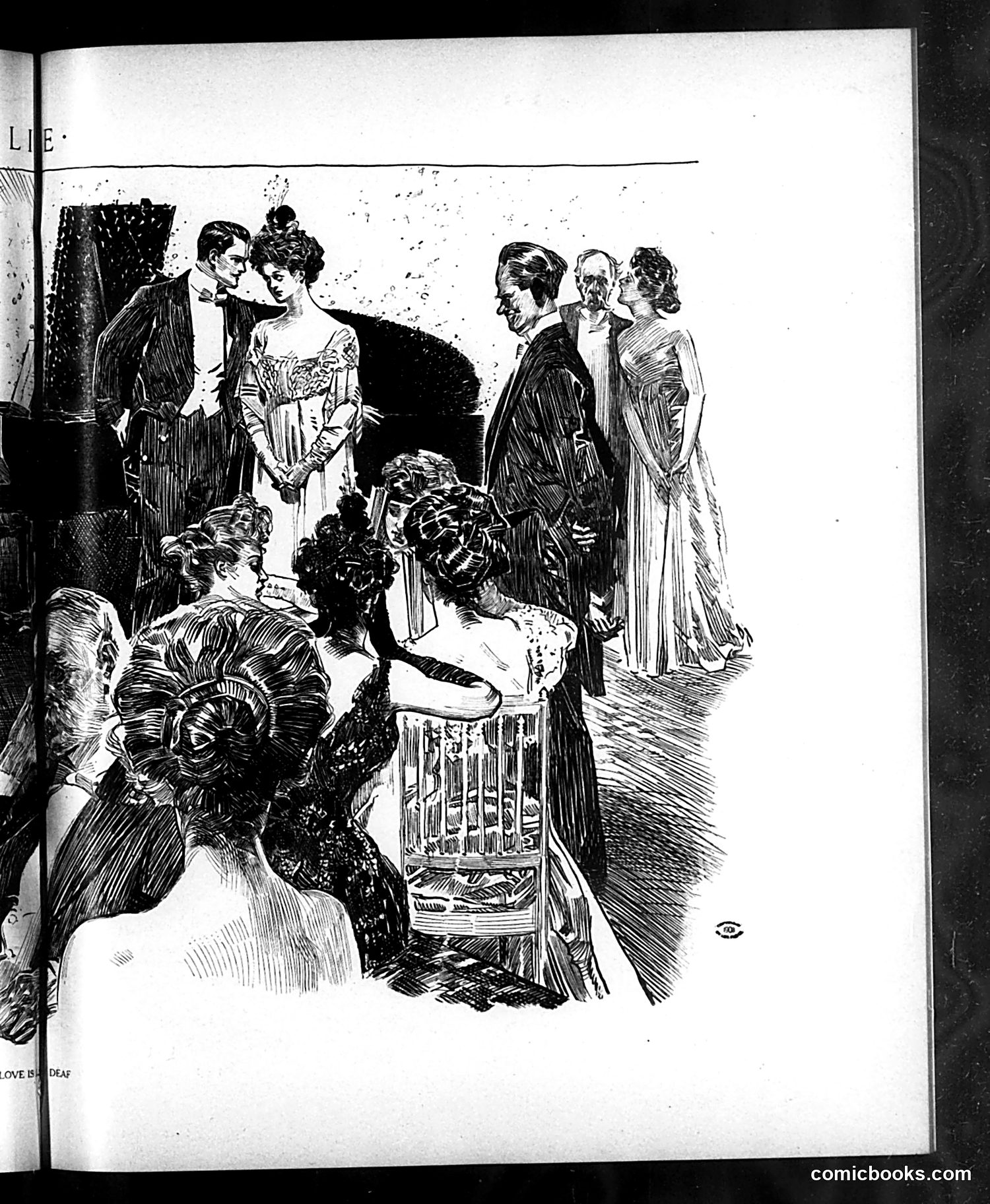
This appears to be a satirical illustration from Life magazine depicting a formal social gathering or reception. The sketch shows elegantly dressed figures in early 20th-century attire—men in tuxedos and women in elaborate gowns with ornate hairstyles typical of that era. The image captures what seems to be a moment of social interaction or gossip at a high-society event, with figures clustered in conversation groups. The detailed cross-hatching and line work is characteristic of Life's satirical illustration style. However, without clearer text identifying specific individuals or events, I cannot definitively state which social scandal, political figure, or contemporary event this references. The page header reads "LIE" (possibly "LIFE"), but the OCR text is insufficient to determine the cartoon's specific satirical target or intended meaning.
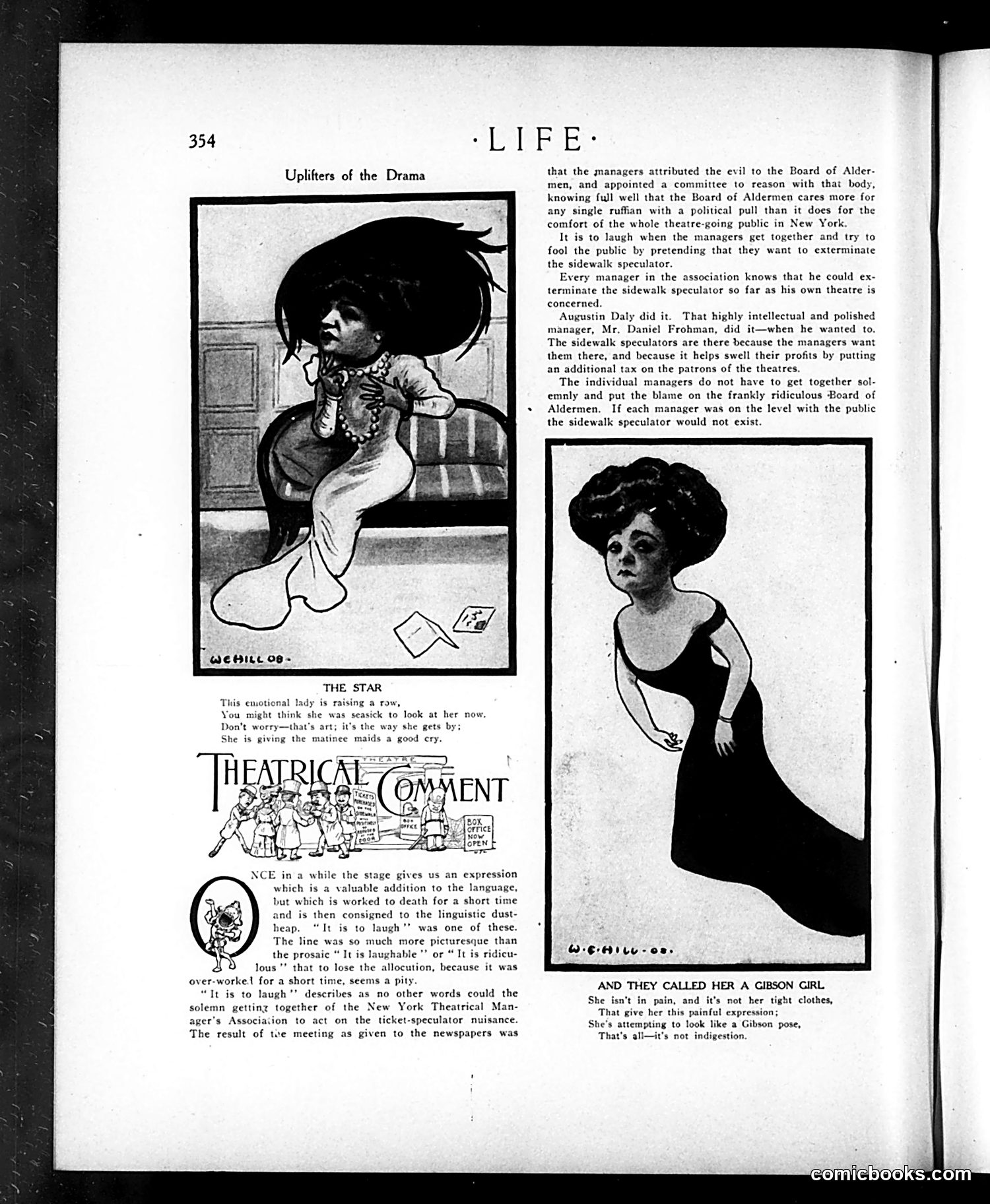
This 1900s Life magazine page satirizes theatrical hypocrisy. The main article mocks New York theater managers who publicly blamed the Board of Aldermen for ticket scalpers ("sidewalk speculators"), while the text argues managers actually *enabled* scalping to pad profits. The satire's point: the managers' elaborate committee meetings to "solve" the problem were theatrical performance themselves—dishonest PR. Notably, the text credits managers Augustin Daly and Daniel Frohman as having actually *stopped* scalping at their theaters, proving individual action was possible. The phrase "It is to laugh" (meaning "how ridiculous") anchors the mockery. The right image, "And They Called Her a Gibson Girl," satirizes the popular Gibson Girl ideal—the fashionable female silhouette of that era. It suggests women contorting themselves into the stylized pose looked absurdly pained, yet attributed this discomfort to mere fashion rather than recognizing the physical strain of the trend itself.
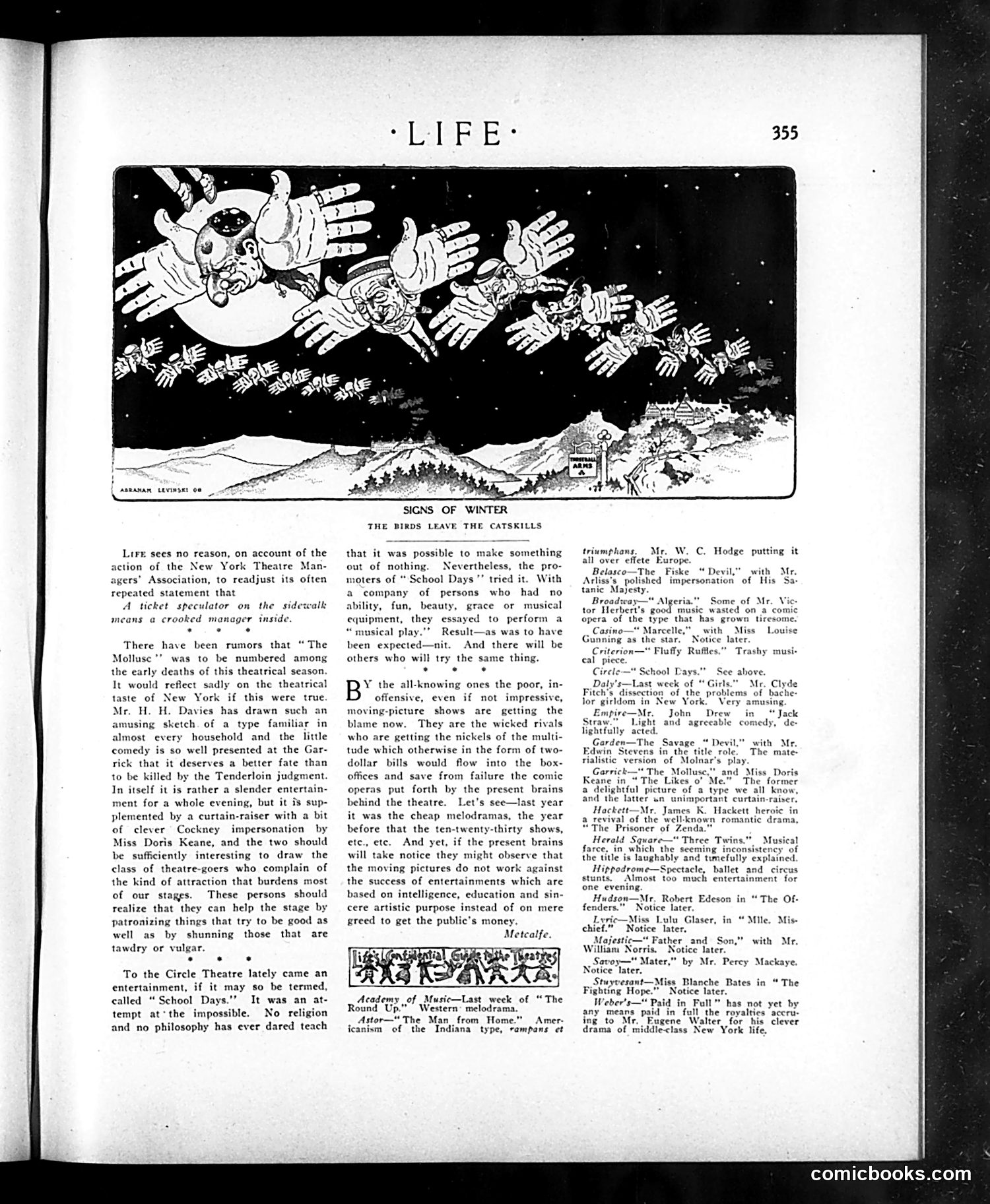
## The Cartoon The illustration titled "Signs of Winter: The Birds Leave the Catskills" depicts demonic or grotesque bird-figures flying away from a mountain landscape. This is political allegory: the "birds" represent theatrical producers or entertainers fleeing the Catskill region as winter approaches. ## The Editorial Content Life's theater critic (likely Metcalfe, signed at bottom) attacks the Broadway theater establishment on multiple fronts: 1. **Theater managers' corruption**: The opening statement condemns ticket scalpers as evidence of crooked management. 2. **Blame-shifting**: Producers blame "moving pictures" (early cinema) for stealing audiences and box-office revenue, rather than acknowledging their own artistic failures. Life argues that intelligent, sincere theatrical productions succeed regardless of movie competition. 3. **Low-quality productions**: The critic savagely reviews a show called "School Days"—attempting something from nothing with untalented performers—as emblematic of Broadway's artistic bankruptcy. The satire suggests theater's decline stems from greed and mediocrity, not cinema competition.
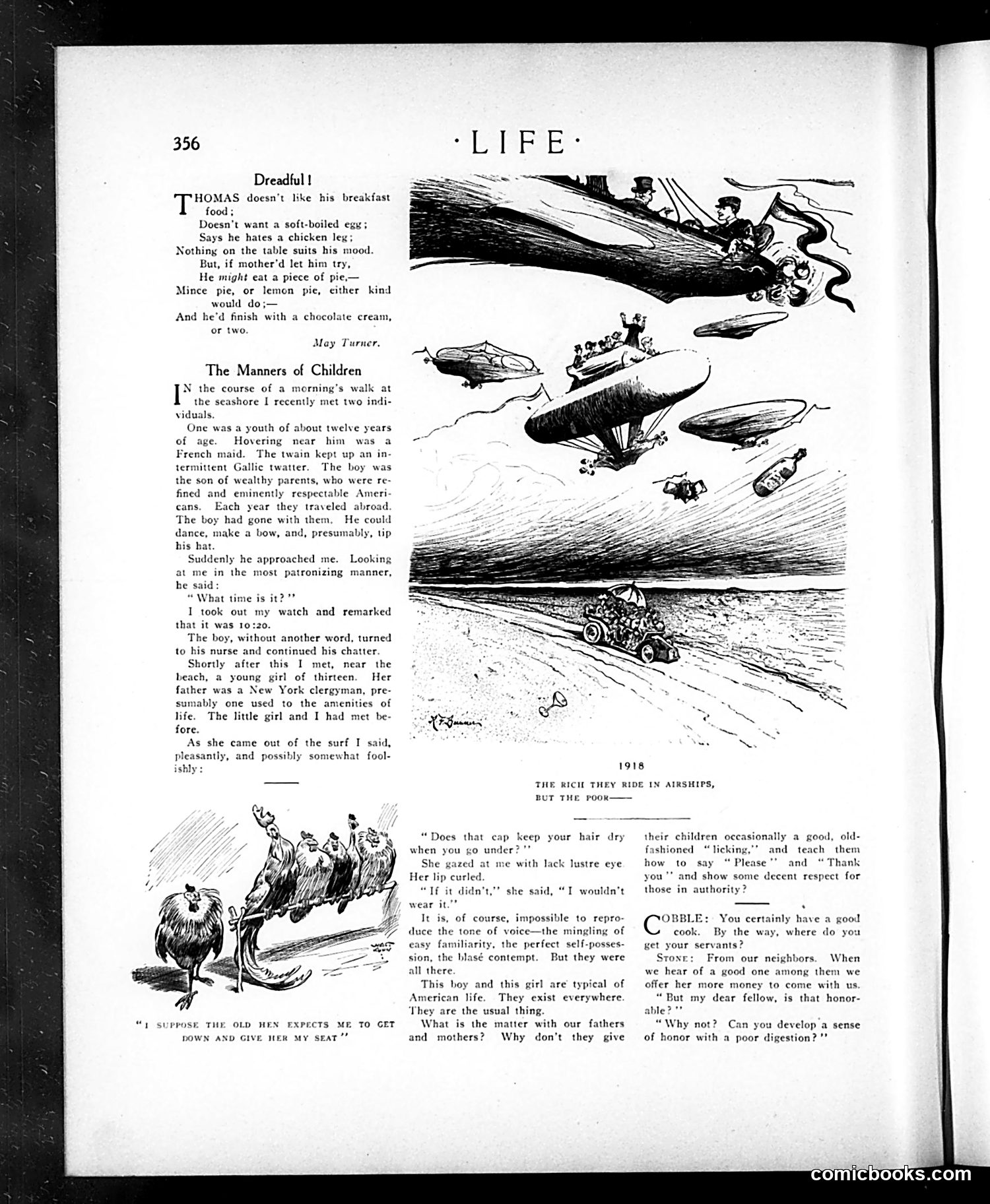
This page contains two satirical pieces about American manners and class behavior circa 1918. **"The Manners of Children"** criticizes wealthy American children's rudeness and entitlement. The author describes encountering a boy and girl from affluent families who are condescending and disrespectful to adults—the boy patronizingly asks a stranger for the time, the girl smugly refuses to acknowledge the author's friendly greeting. The essay condemns parents for failing to discipline children with old-fashioned spanking ("licking") and teach them respect for authority. **The cartoon and dialogue below** satirize wealthy people's moral hypocrisy. When asked how they obtain servants, a rich man admits to stealing household staff from neighbors by offering higher wages—then brazenly justifies this dishonorable behavior by claiming poverty prevents him from developing ethical standards ("Can you develop a sense of honor with a poor digestion?"). Both pieces target upper-class Americans for raising spoiled, arrogant children and excusing their own unethical conduct through self-interest.
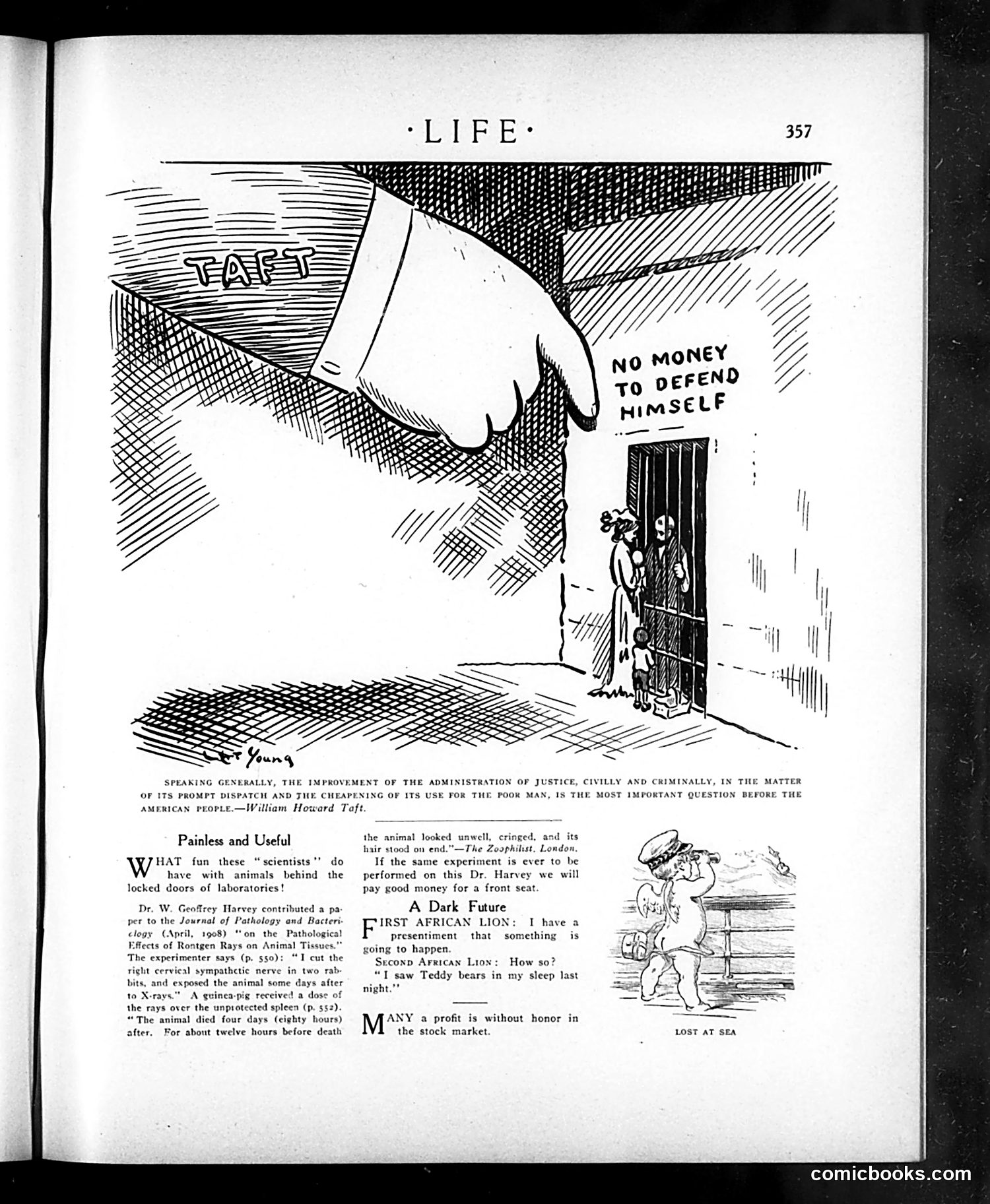
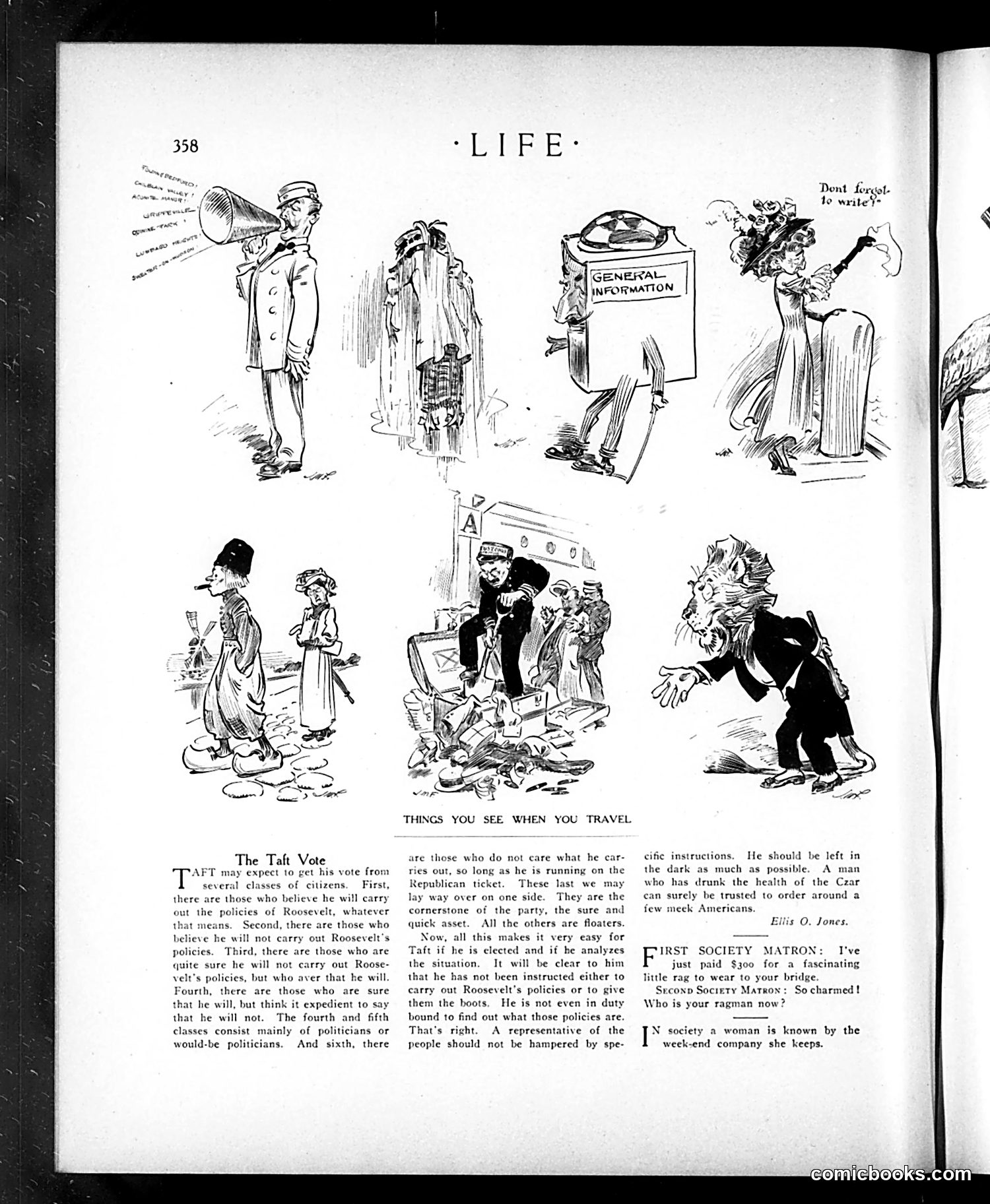
This page satirizes William Howard Taft's ambiguous mandate as Theodore Roosevelt's chosen successor. The main article "The Taft Vote" mocks voters' contradictory expectations—some believe Taft will continue Roosevelt's progressive policies, others that he'll abandon them, and some expect him to do both simultaneously. The satirical point: politicians like Taft exploit this confusion, remaining deliberately vague about their actual intentions. The accompanying cartoons titled "Things You See When You Travel" appear to depict various types encountered during campaigns—including what appears to be political operators and confused citizens. The brief society jokes at bottom offer comic relief unrelated to the main political content. The satire suggests Taft's election success depends on voters projecting their own wishes onto him rather than understanding his actual positions—a timeless critique of electoral ambiguity.
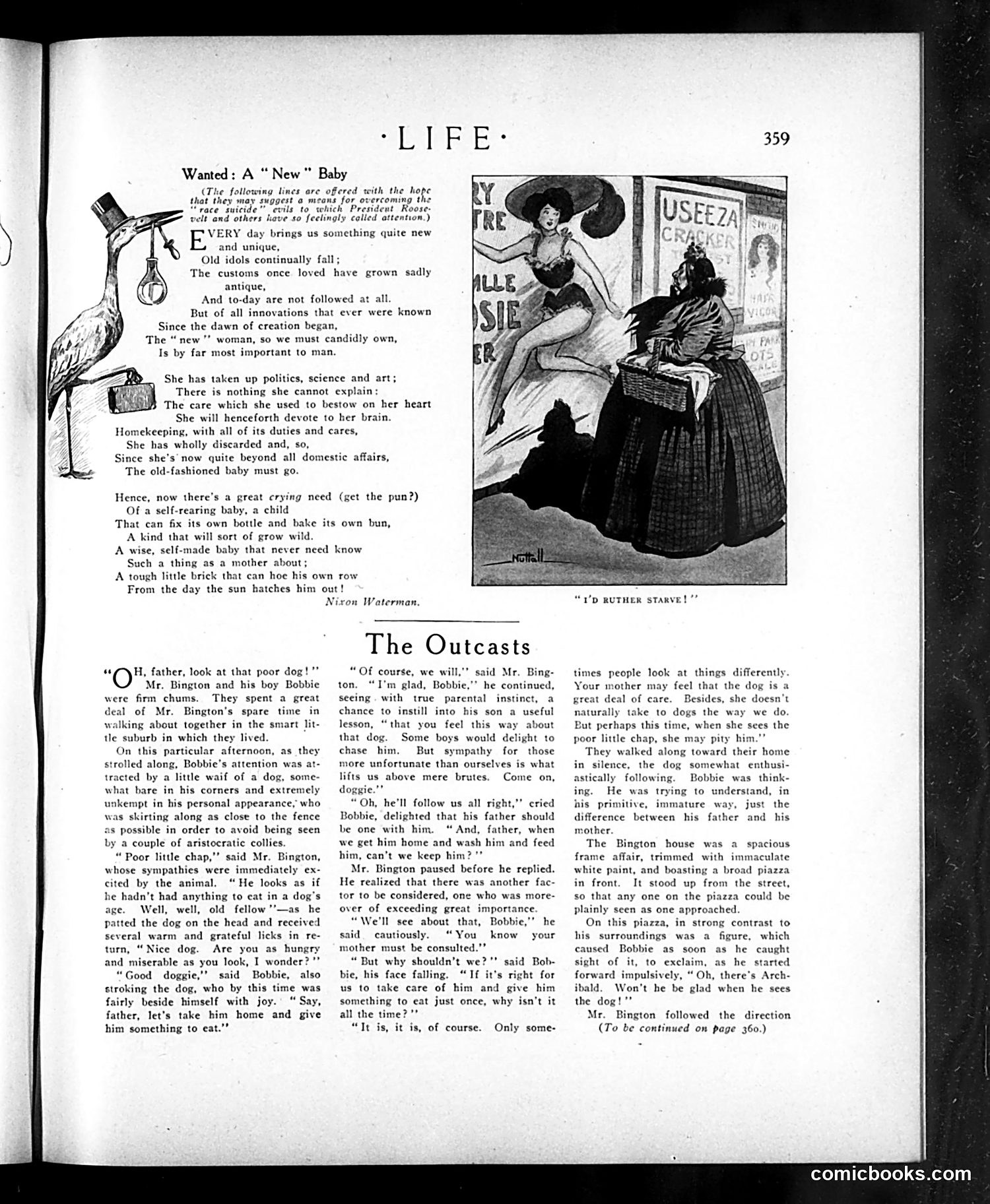
This page contains two distinct pieces addressing early 1900s social anxieties. **"Wanted: A 'New' Baby"** is satirical verse mocking President Theodore Roosevelt's concerns about "race suicide"—the period's worry that educated women were having fewer children. The poem ridicules the "New Woman" who pursues politics, science, and art instead of domestic duties, sarcastically proposing a self-rearing, motherless baby as the solution. The stork illustration reinforces the fertility theme. This reflects anxiety about women's changing roles and independence. **"The Outcasts"** is a serialized story (continued on page 363) depicting Mr. Bington and his son Bobbie discovering a starving stray dog. The accompanying cartoon shows the dog's desperation ("I'D RUTHER STARVE!") contrasted with aristocratic collies—suggesting class divisions and social outcasting. The narrative emphasizes sympathy for the unfortunate as a moral lesson, while tension arises over whether Bobbie's mother will permit keeping the dog, highlighting domestic power dynamics of the era.
This is a satirical story about racial prejudice and childhood innocence. Mr. Bington, a respectable white man, discovers his son Bobbie playing with Archibald, "the little colored boy" from next door. Though Archibald is polite and well-spoken (trained in public school), Bington is horrified—not because of Archibald's character, but because allowing a Black child on his piazza violates social convention and risks neighbors' mockery. He forces Archibald to leave, calling it a lesson in "democracy" while actually teaching the opposite. The satire mocks Bington's hypocrisy: he's "outraged" about propriety and neighbors' opinions, yet his own actions are deeply improper. The boys' innocent friendship contrasts sharply with adult racial prejudice. The story exposes how social conformity and fear of judgment perpetuate discrimination, even among seemingly civilized people.
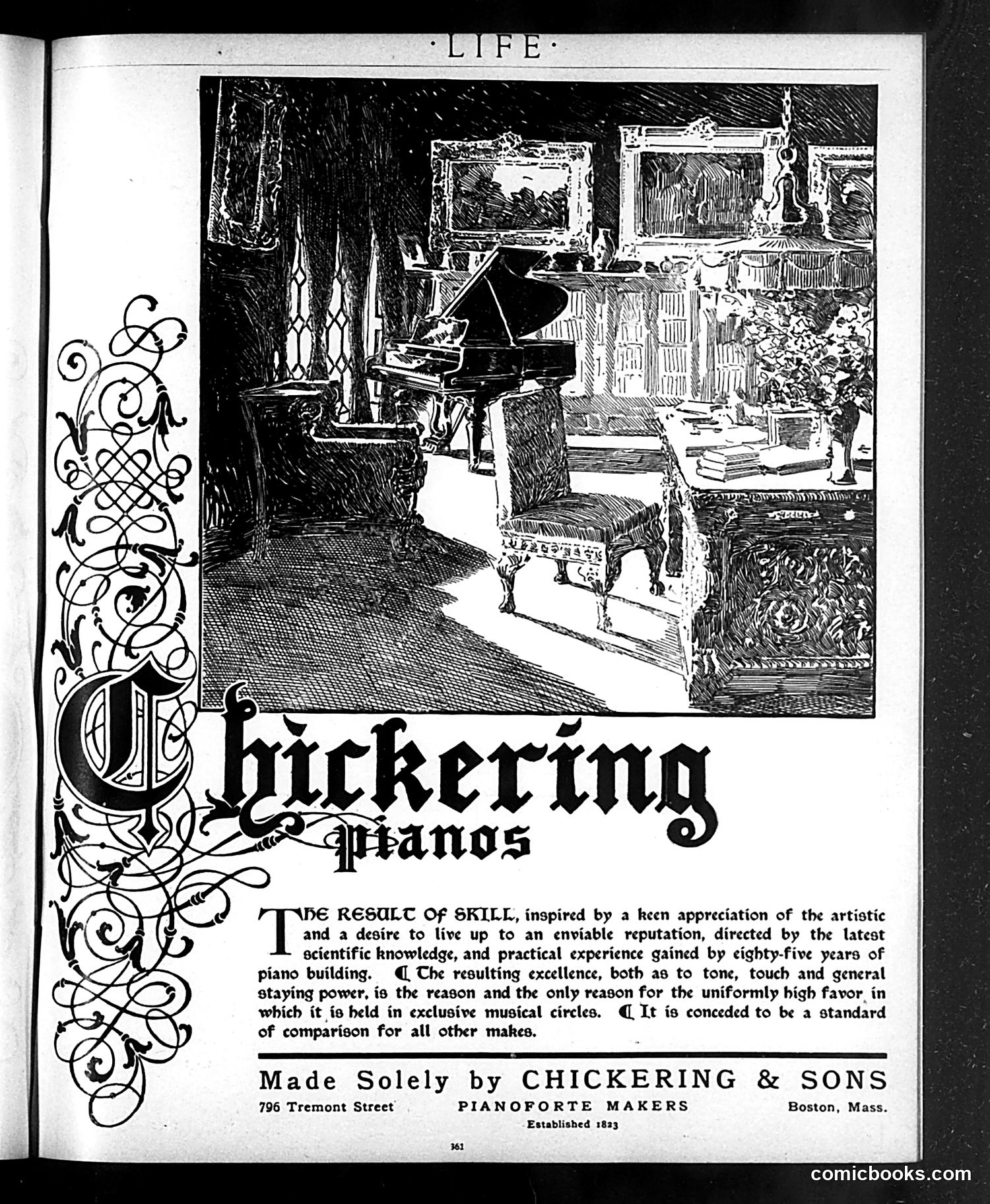
This page is **primarily an advertisement**, not political satire. It promotes Chickering & Sons pianos, a Boston-based manufacturer established in 1823. The illustration shows an elegant parlor interior with a grand piano, featuring period furnishings, framed artwork, and windows overlooking a garden—depicting the aspirational lifestyle associated with piano ownership in wealthy households. The text emphasizes the company's 85 years of expertise and claims their pianos are the standard by which all others are judged, particularly valued in "exclusive musical circles." This appeals to status-conscious readers seeking to signal refinement and cultural sophistication through musical instrument ownership. The ornate decorative border with the elaborate "C" initial is typical of early-20th-century commercial design, lending prestige and artisanal credibility to the product. No satire or political commentary appears present—this is straightforward luxury marketing.
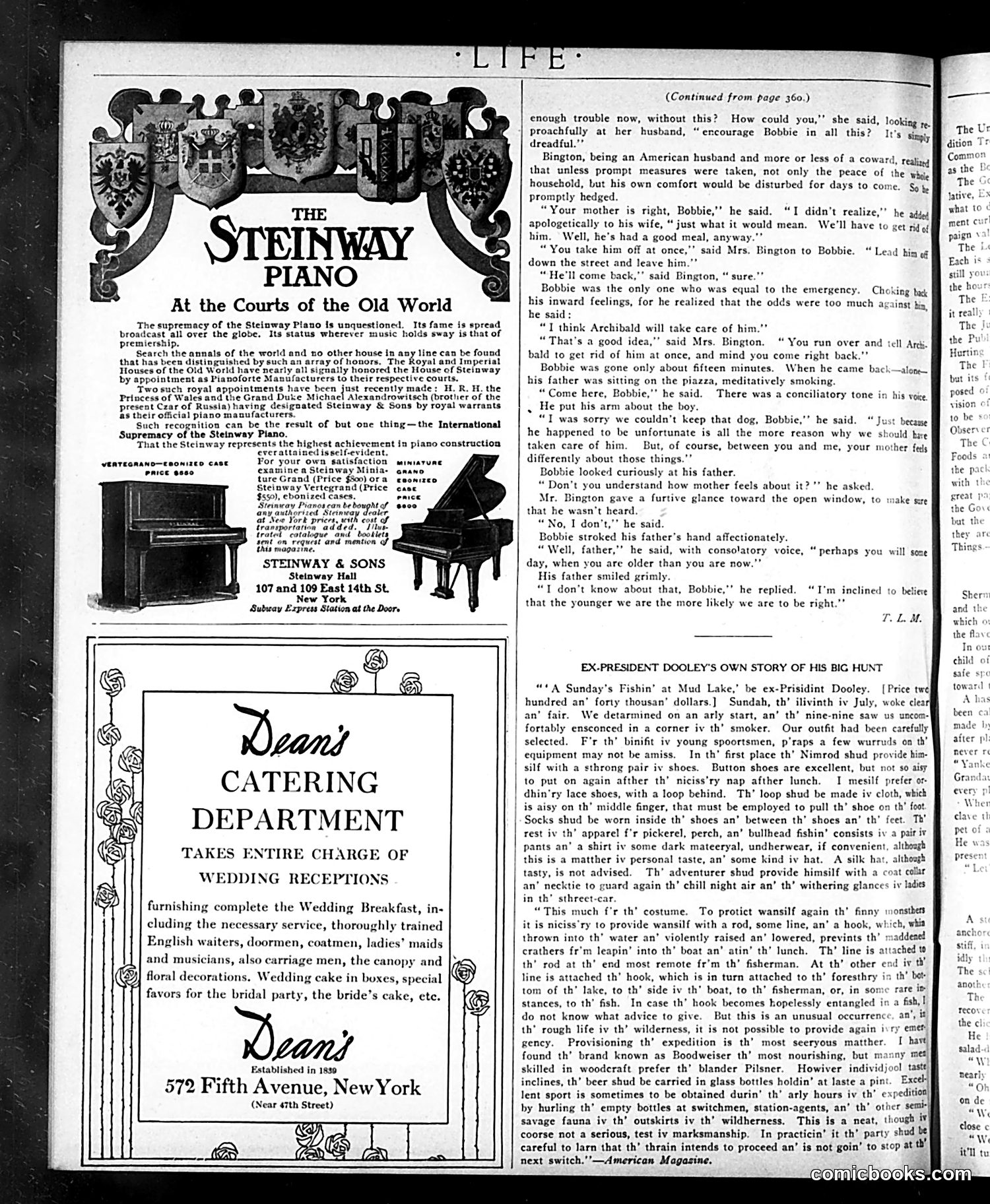
This page is primarily **advertising and serialized fiction**, not political satire. The top third features a **Steinway Piano advertisement** emphasizing the brand's prestige by claiming royal endorsement from European courts (Princess of Wales, Grand Duke Michael of Russia). This appeals to aspirational American wealth by associating the piano with Old World aristocracy. Below that is a **Dean's Catering advertisement** for wedding services. The right column continues a **serialized domestic story** titled "At the Courts of the Old World" involving characters named Bington, Bobbie, and Mrs. Bington. The narrative concerns a disagreement about keeping a dog—Bobbie wants to keep it; his mother opposes it; his father initially sides with his wife but privately sympathizes with his son. The text shows the father telling Bobbie he "didn't realize" what it would mean, suggesting parental conflict over child-rearing values. This appears to be light domestic fiction typical of Life's entertainment content, not satirical commentary.
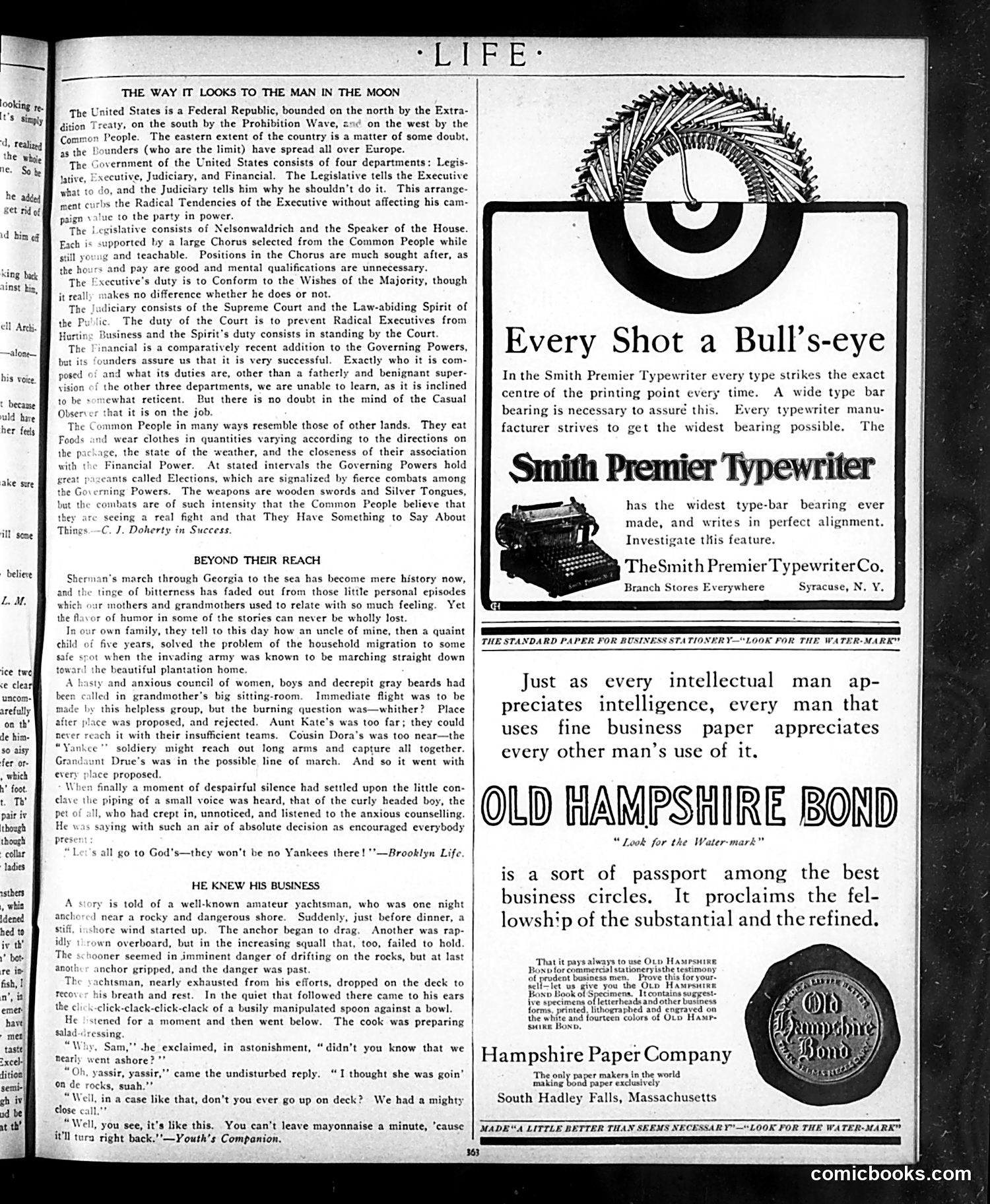
This page is primarily **satirical political commentary** disguised as a mock geographical/governmental description titled "The Way It Looks to the Man in the Moon." ## The Satire The text humorously describes U.S. government as absurd and dysfunctional. Key satirical points include: - The legislative branch consists only of "Nelsonwaldrich" (likely Senator Nelson Aldrich) and the Speaker, supported by an interchangeable "Chorus" of Common People - The three branches exist mainly to obstruct each other rather than govern effectively - A mysterious, secretive fourth "Financial" department mysteriously controls everything - Elections are theatrical combats using "wooden swords and Silver Tongues"—meaningless spectacle ## Context This appears to be **Progressive Era** satire (early 1900s), mocking: corporate influence over government, the ineffectiveness of checks-and-balances, oligarchic control by wealthy interests, and the illusion of democratic participation. The "man in the moon" perspective frames American governance as absurdly dysfunctional when viewed objectively. The remainder features advertisements and unrelated stories.
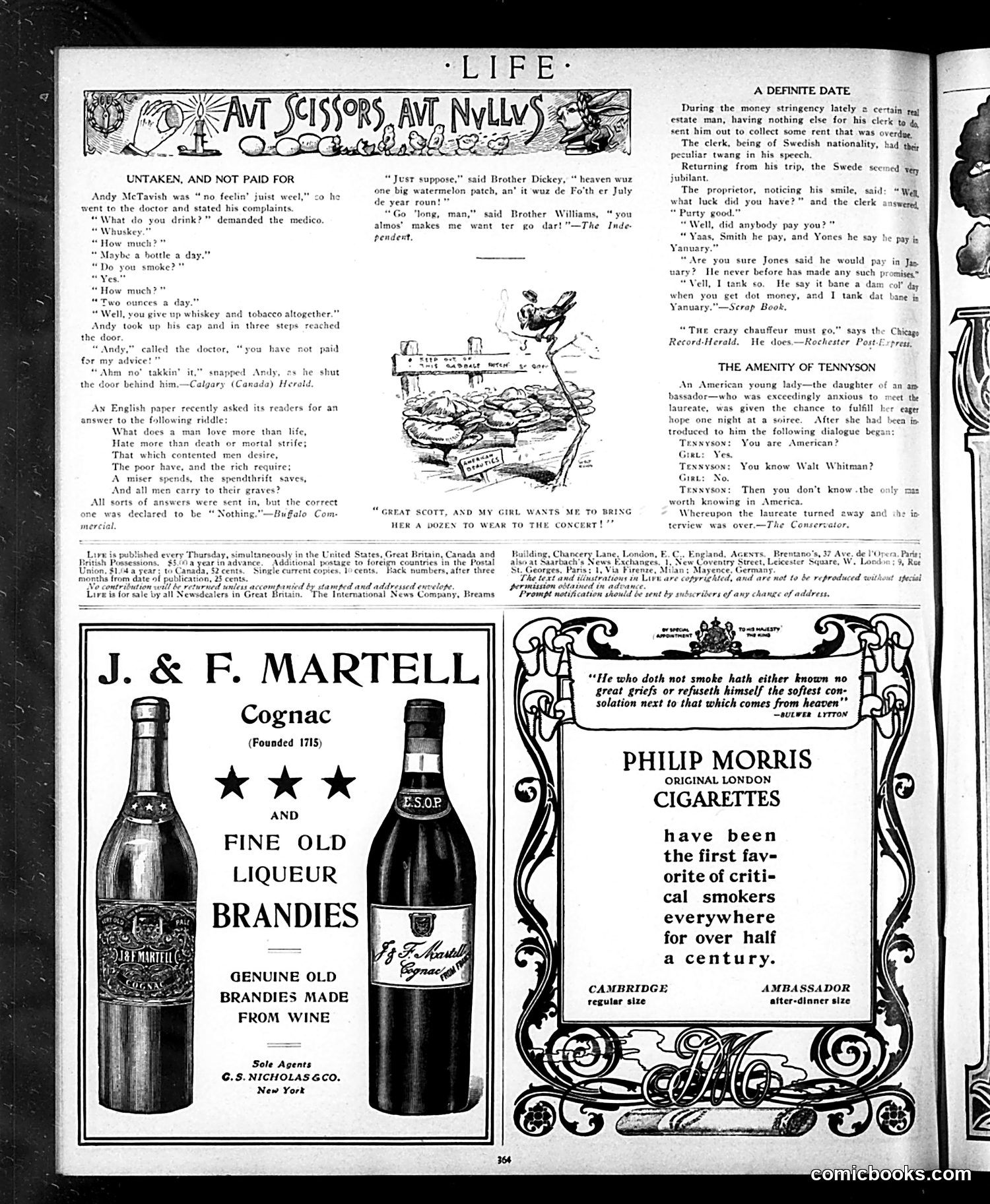
This *Life* magazine page contains three distinct humor pieces and advertisements: **"Untaken, and Not Paid For"**: A brief joke about Andy McTavish visiting a doctor to complain about his drinking habits. The doctor's prescribed solution—giving up whiskey and tobacco—proves so extreme that Andy abandons treatment rather than accept it. The humor relies on a drunk character's priorities. **"The Amenity of Tennyson"**: A satirical anecdote about the poet Alfred, Lord Tennyson meeting an American woman. When she asks if he knows Walt Whitman, Tennyson dismisses all American literature except Whitman, then refuses further conversation. The joke satirizes both Tennyson's pomposity and his paradoxical snobbery about American culture. **Additional content**: Several short humorous sketches about clerks collecting rent and a "crazy chauffeur" reference. The page is primarily **advertisements** for J. & F. Martell Cognac, Philip Morris cigarettes, and related luxury goods—typical of *Life*'s revenue model targeting affluent readers.
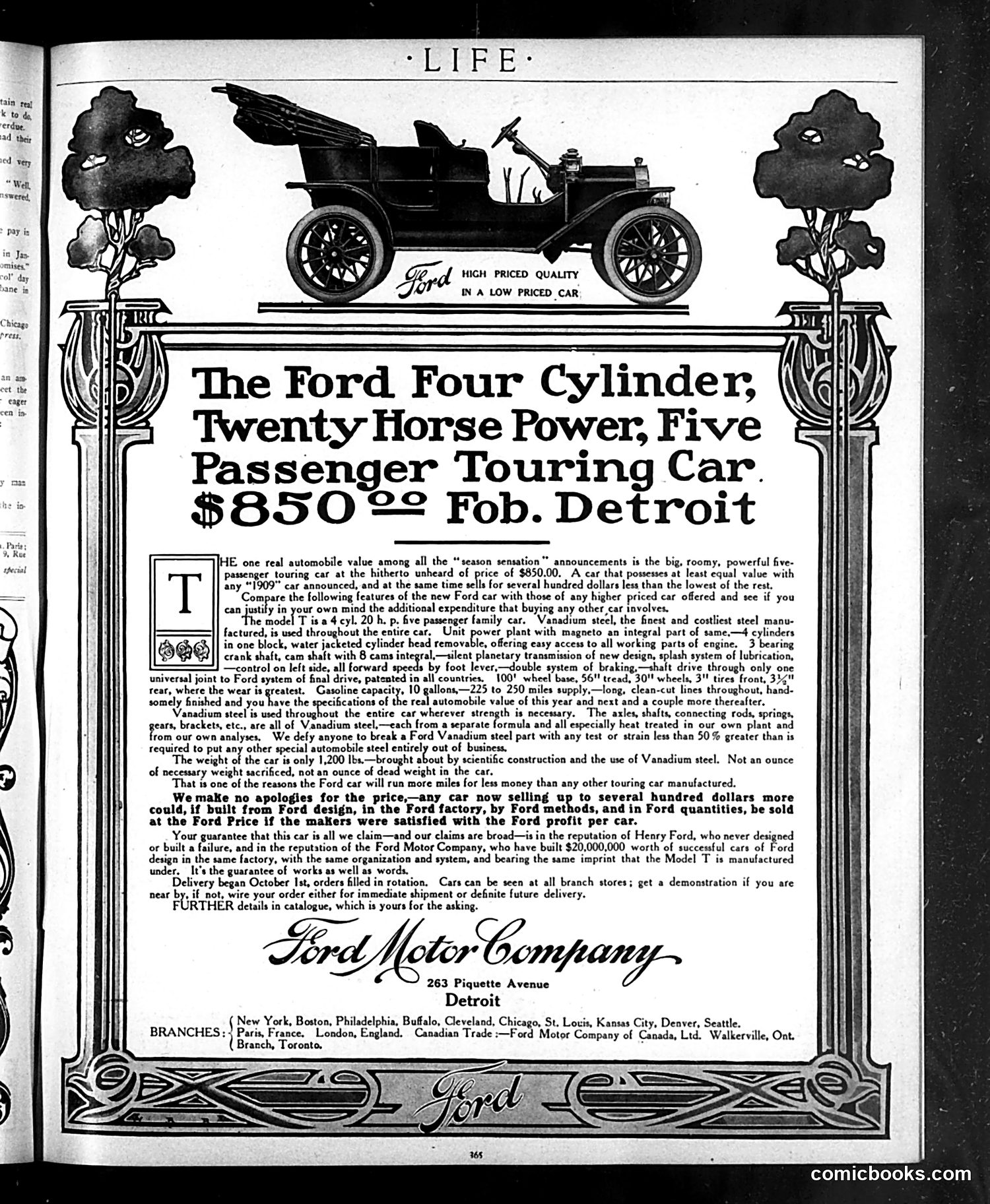
This is primarily a **Ford Motor Company advertisement**, not political satire. It promotes the Model T touring car at $850, positioning it as revolutionary value—high quality at low price, undercutting competitors by "several hundred dollars." The ad emphasizes Ford's manufacturing innovations: Vanadium steel construction, lightweight design (1,200 lbs), and efficient production methods. It appeals to middle-class buyers by attacking the high markups of competitors, claiming they could match Ford's price "if the makers were satisfied with the Ford profit per car." The decorative border and formal layout are typical of early-1900s advertising. While the text mentions "season sensation announcements" from rivals, this is commercial competition, not political commentary. For modern readers, it's notable that $850 was significant money (roughly $28,000 in today's dollars), yet marketed as accessible to ordinary families—a key to the Model T's historical importance in democratizing automobiles.
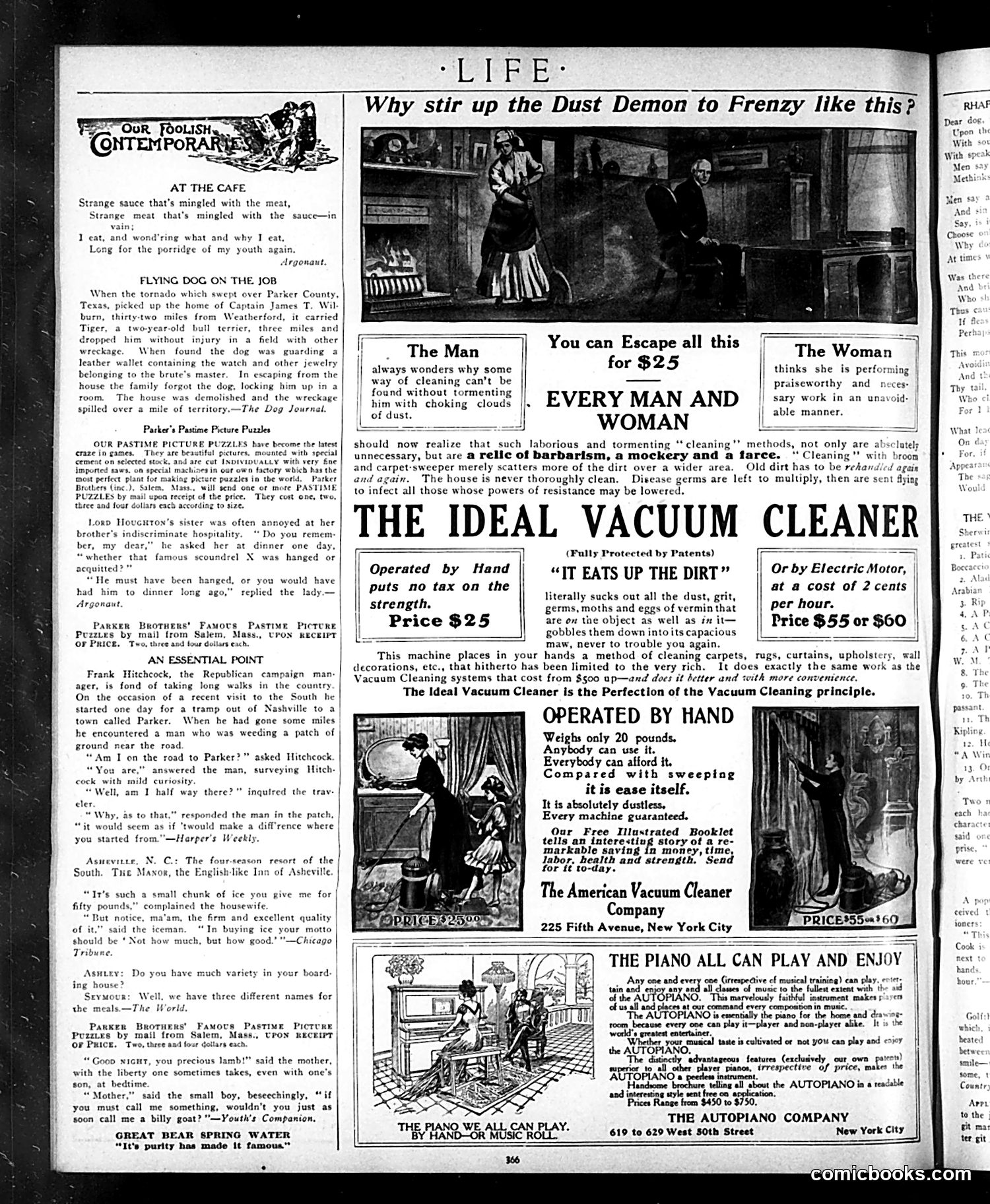
This page is primarily **advertising**, with brief humorous anecdotes as filler. The dominant content is a large advertisement for **The Ideal Vacuum Cleaner** (priced $25 hand-operated or $55-$60 electric), which satirizes contemporary household cleaning. The ad's humor targets gender roles: it depicts a man bewildered by housework mess and a woman performing "praiseworthy and necessary" cleaning—yet frames traditional sweeping as barbaric "drudgery." The vacuum cleaner is positioned as liberation from "choking clouds of dust," mocking both the inefficiency of old methods and contemporary anxieties about household labor. The page's small text items are period humor: one anecdote involves a tornado-surviving dog, another features a Republican campaign manager lost on a road, and domestic quips about naming meals and calling children "billy goats." The lower advertisements promote **player pianos** and **picture puzzles**—both leisure products for the affluent. **Context**: This reflects early 20th-century consumer capitalism marketing household technology as solutions to (gendered) domestic problems.
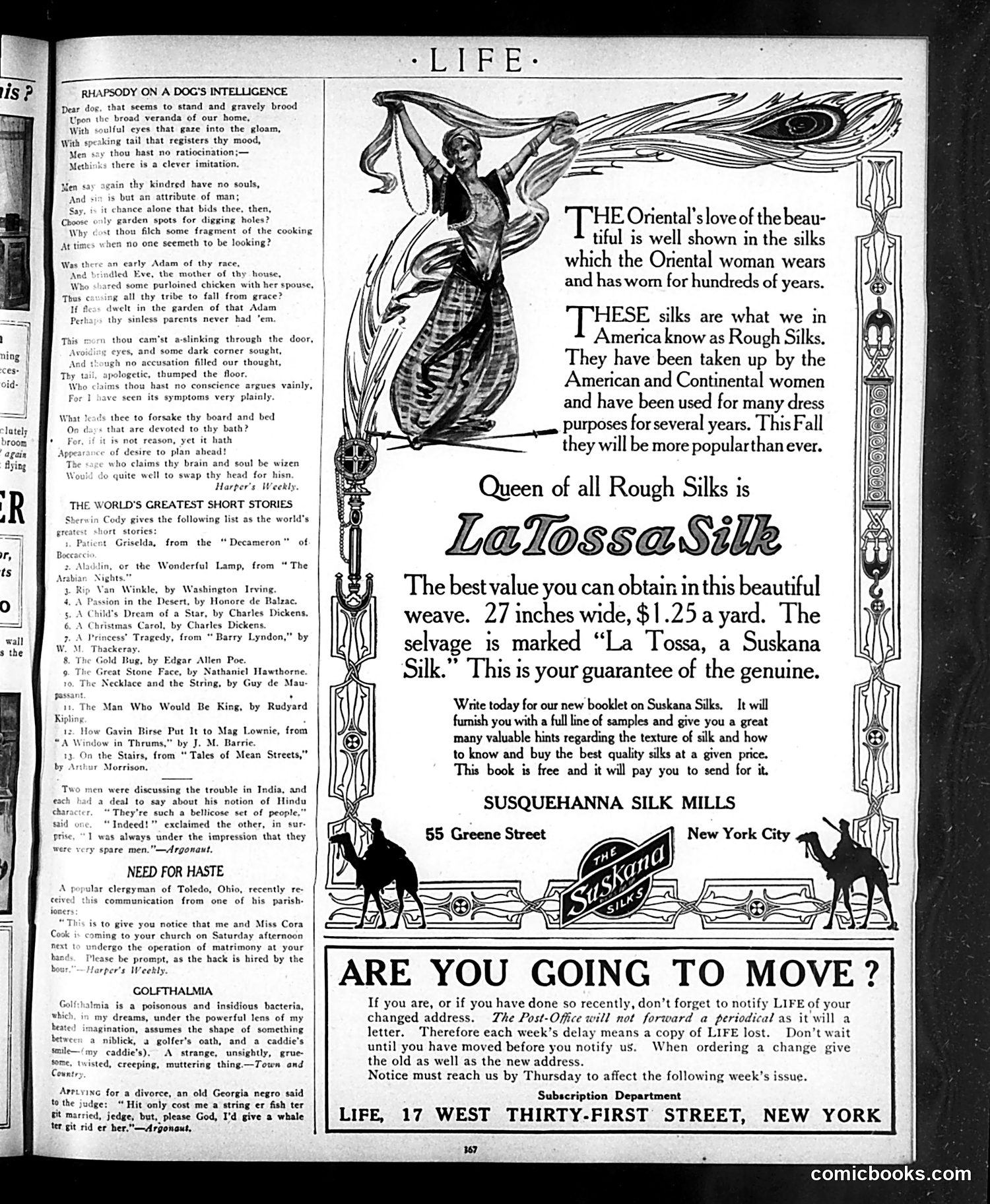
This page is primarily **advertising and literary content** rather than political satire. The main elements are: **Poetry Section**: "Rhapsody on a Dog's Intelligence" humorously questions whether dogs possess actual reasoning or merely imitate it—a light philosophical joke about animal cognition versus human attribution of intelligence. **Literary Lists**: References to "The World's Greatest Short Stories," citing canonical works by Irving, Dickens, Poe, and others—standard cultural content for an educated audience. **Humor Columns**: Brief anecdotes (Hindu soldiers, a hasty wedding, "Golfthalmia") present genteel, period-appropriate jokes about stereotypes and everyday absurdities. **Dominant Advertising**: The page is largely occupied by a substantial **La Tossa Silk advertisement** from Susquehanna Silk Mills, featuring an orientalist illustration of a draped woman. The ad exploits "Oriental" aesthetics to market rough silks to American women, reflecting early 20th-century consumer culture and exoticist marketing. The page reflects *Life's* dual function as sophisticated literary magazine and advertising vehicle for affluent readers.
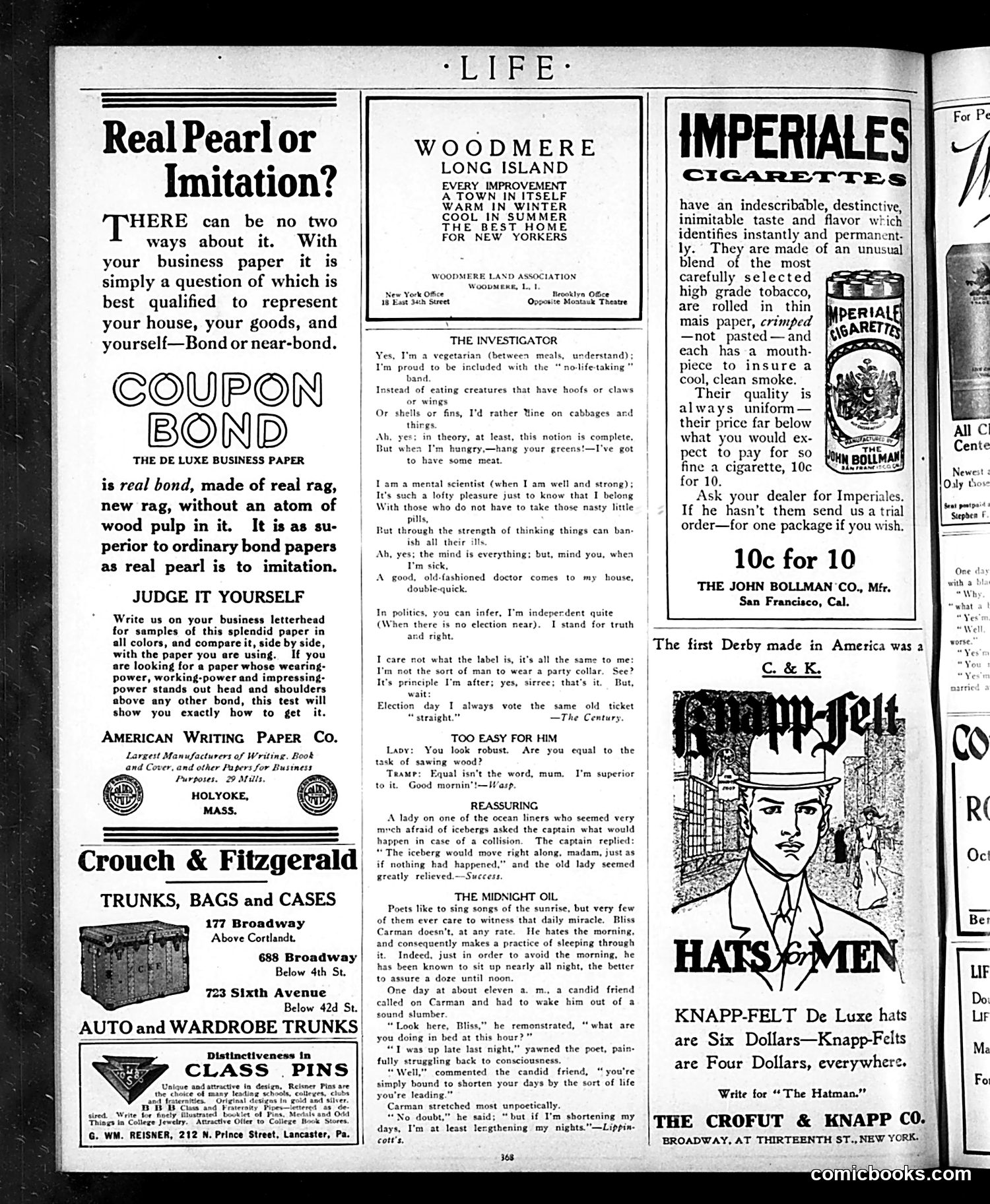
This page is primarily **advertisements and light humor pieces**, not political satire. The main content includes: **"The Investigator"** — A humorous monologue about a hypocrite who claims vegetarianism, mental science, and political independence, yet admits eating meat when hungry, visiting doctors when sick, and voting the same party ticket every election. The joke targets people who espouse idealistic principles but abandon them for practical convenience. **Other humor pieces** ("Too Easy for Him," "Reassuring") are brief jokes with no political content—just wordplay and situational comedy. **The advertisements** (Coupon Bond paper, Woodmere real estate, Imperiales cigarettes, hats, trunks) dominate the page and represent typical early 20th-century commercial messaging. There are **no identifiable political figures or cartoons** requiring historical context. This is a mixed editorial/advertising page typical of Life magazine's format during this era.
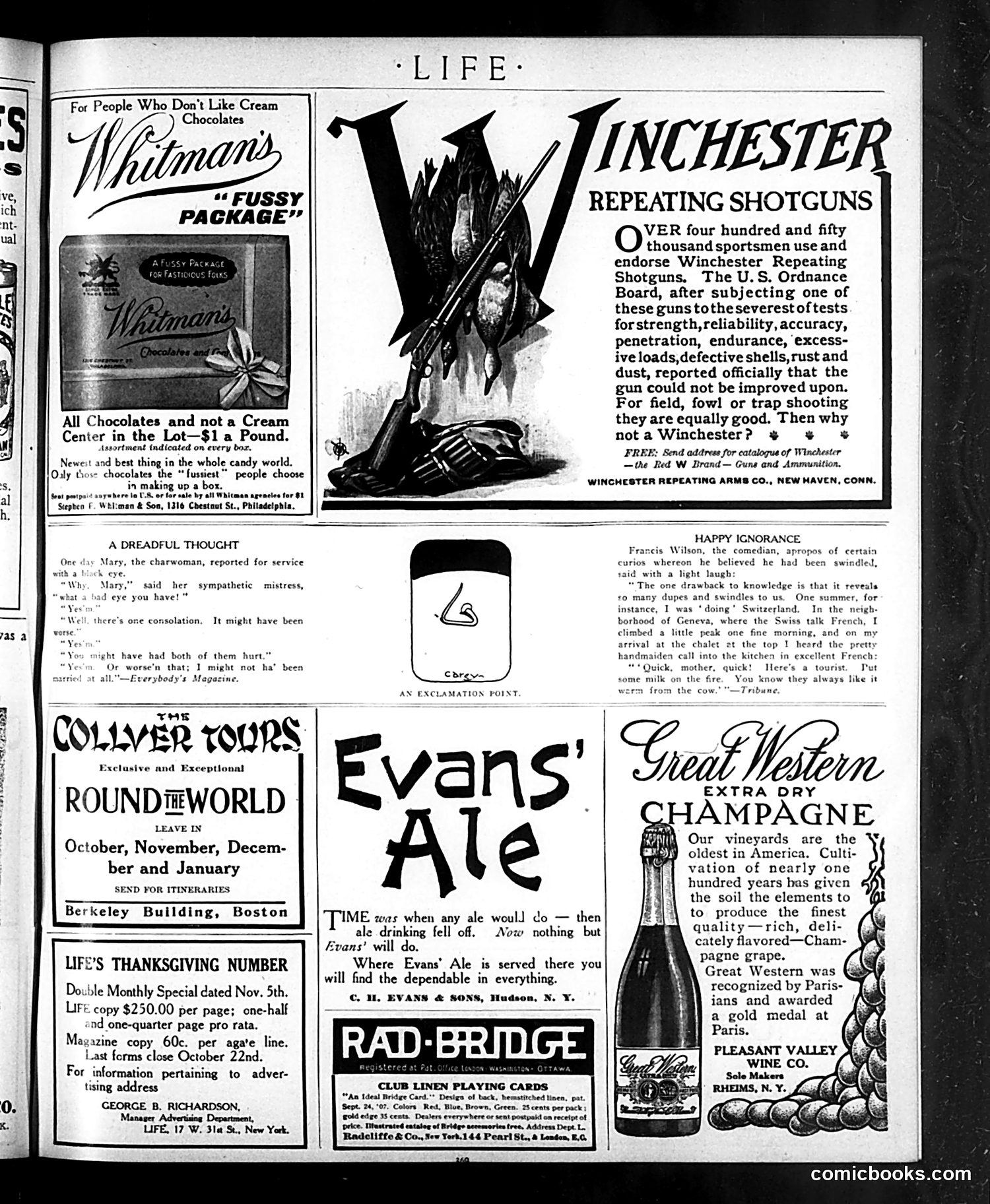
This page consists primarily of **advertisements** rather than editorial cartoons. The main visual elements are: 1. **Winchester Repeating Shotguns ad** (center-top): A large illustration of dead game birds promotes Winchester shotguns, claiming they've been tested and endorsed by the U.S. Ordnance Board as superior for hunting. 2. **Small cartoon titled "An Exclamation Point"** (center): A simple line drawing of what appears to be an exclamation mark, accompanying an ad for Evans' Ale—a play on words suggesting the product's quality is emphatic or noteworthy. 3. **"A Dreadful Thought"** (upper-left): A brief humorous anecdote about a charwoman (cleaning woman) who lost an eye, with her employer offering sympathy. The joke relies on working-class dialect humor typical of early 20th-century American magazines. The remaining content includes travel tours, chocolates, champagne, and playing cards. This is largely a **commercial page** with minimal political or social satire—typical advertising and light humor for a general-audience magazine of this era.
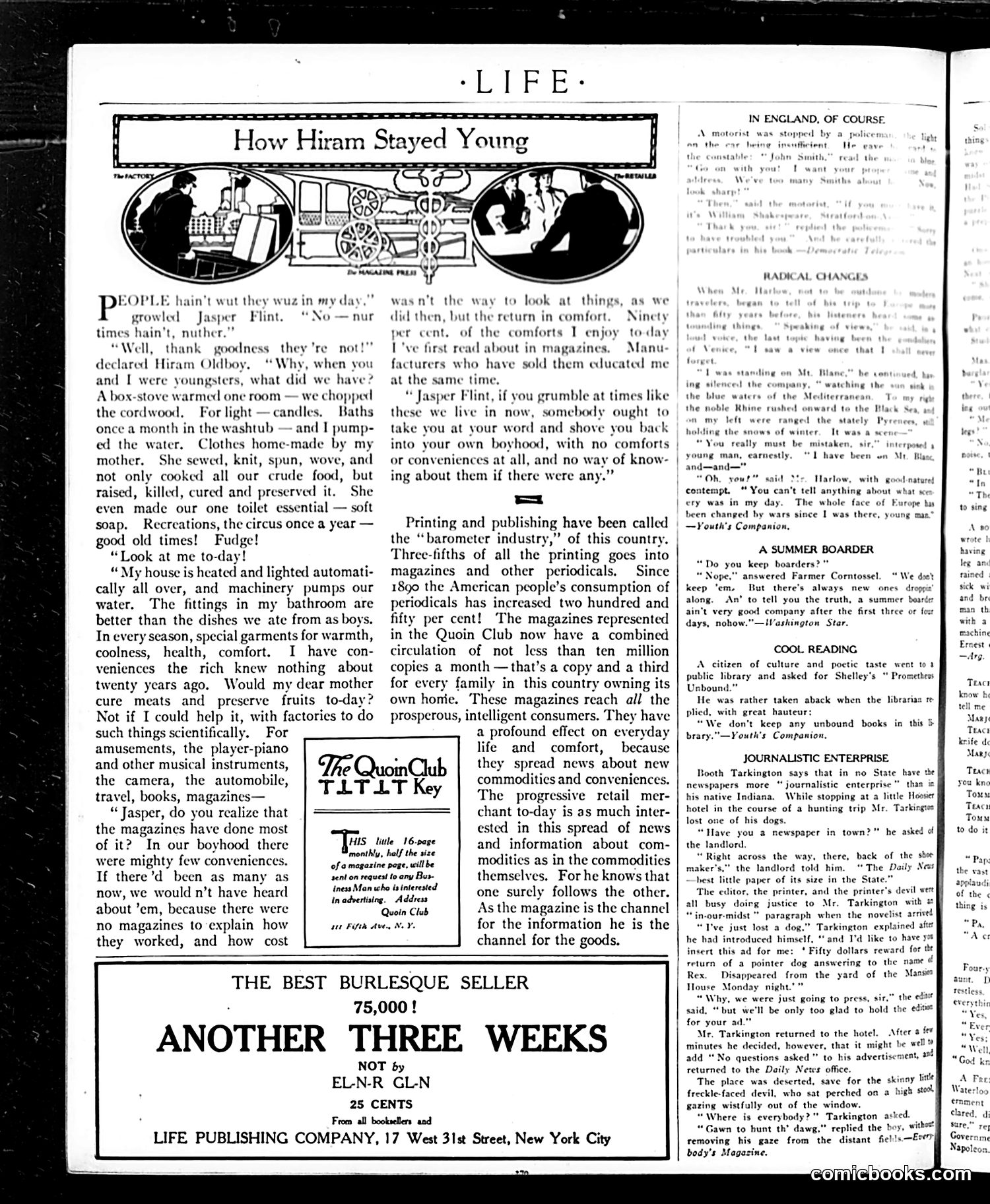
This page satirizes generational complaints about "the good old days." Two elderly men, Jasper Flint and Hiram Oldboy, debate whether modern times are worse than the past. Oldboy wins the argument by listing concrete comforts unavailable in his youth: central heating, indoor plumbing, electric light, manufactured clothing, and factory-processed food. He credits **magazines** for educating the public about these conveniences. The satire targets nostalgia itself—Flinty's vague complaints collapse when confronted with actual evidence of progress. The page then pivots to praising magazines as drivers of consumer culture and industrial growth. It argues that magazines inform the public about new products, enabling retailers to profit from increased demand. This reflects early 20th-century American optimism about technology, mass media, and consumer capitalism—positioning magazines as essential to modernization and prosperity.
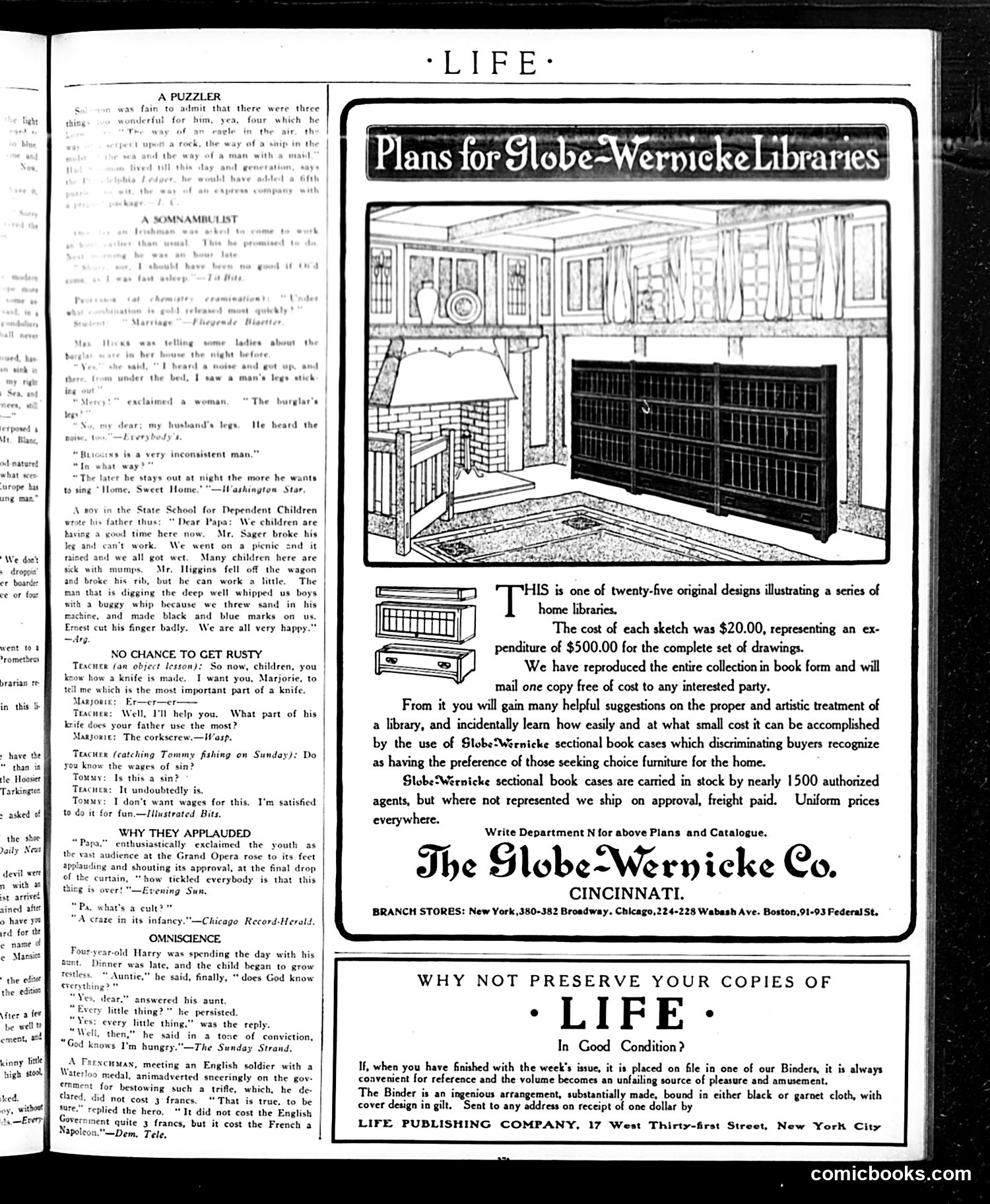
This page is primarily **advertising** for Globe-Wernicke library furniture, occupying roughly half the space with an architectural illustration and promotional text. The advertisement emphasizes the company's "twenty-five original designs" for home libraries and mentions branch stores in major cities. The remaining content consists of brief **humorous anecdotes and jokes** typical of Life magazine's satirical humor: - A child's letter describing mishaps at a boarding school - Teachers testing students' knowledge (a child defining a knife's "most important part" as the corkscrew) - A boy caught fishing on Sunday - A youth applauding opera enthusiastically - A child's logical conclusion about God knowing everything, therefore God must know he's hungry - An anecdote about a Waterloo medal's cost These jokes rely on **innocent wordplay and child logic** rather than political satire—they exploit double meanings and children's literal interpretations for mild humor. The page concludes with a subscription pitch for preserving Life magazine copies in binders.
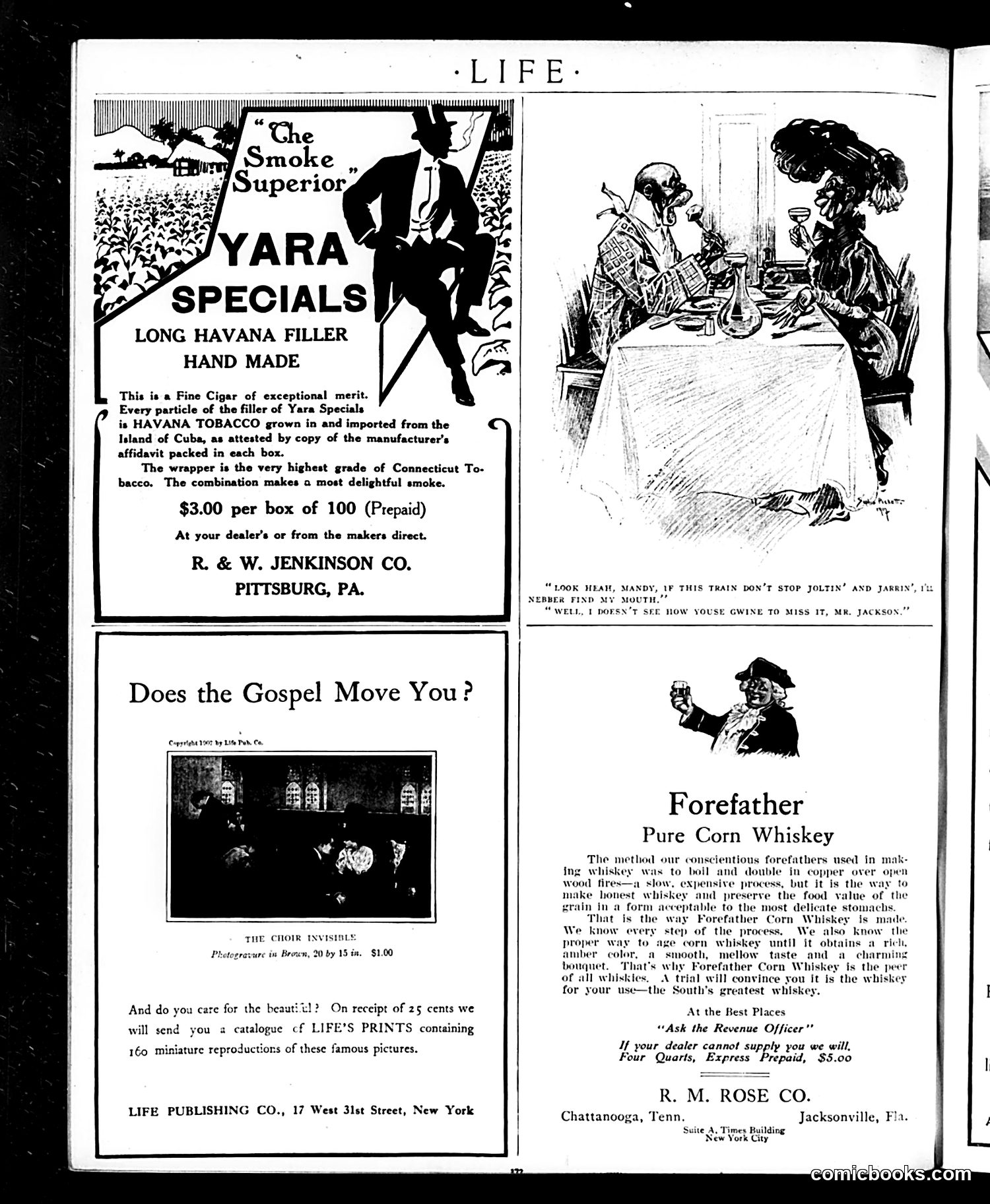
This page primarily contains **period advertisements** rather than satirical cartoons. The notable content includes: **The train scene** (upper right) depicts two African American passengers, with one asking the other to help him find his mouth if the train stops jolting. This uses racist dialect humor common to early 20th-century American comedy—a form of minstrelsy that modern readers would recognize as deeply offensive stereotyping. **The remaining content** consists of product ads: Yara Specials cigars, a "Gospel Move You?" religious print catalog, and Forefather Pure Corn Whiskey. The whiskey ad emphasizes "forefather" authenticity and traditional production methods—likely appealing to nostalgia during Prohibition era tensions. The page reflects early 1900s advertising conventions and racial attitudes that are jarring to contemporary audiences. The racist caricature and dialect represent entertainment norms that have since been widely rejected.
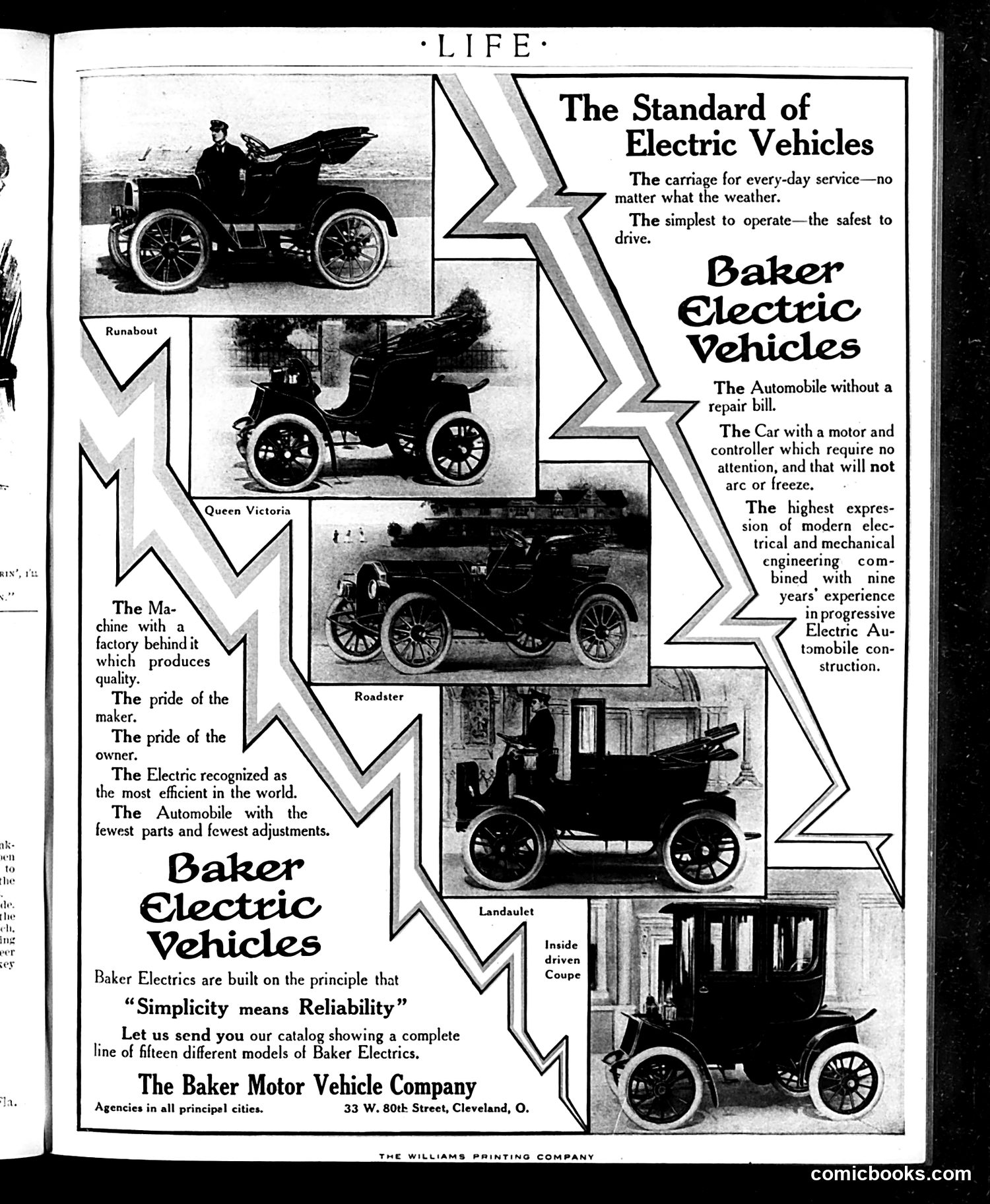
This is a full-page advertisement, not satire or political cartoon. It promotes Baker Electric Vehicles from Cleveland, Ohio, showcasing five different models (Runabout, Queen Victoria, Roadster, Landaulet, and Inside-driven Coupe). The ad reflects early 1900s automobile competition, when electric vehicles rivaled gasoline cars. Baker emphasizes electric cars' advantages: simplicity, reliability, no repair bills, no cranking or freezing issues, and efficiency. The phrase "Simplicity means Reliability" was their corporate principle. For modern readers: this reveals that electric vehicles were once mainstream competitors, not recent innovations. The ad's emphasis on lack of maintenance and no "arc or freeze" (electrical arcing or engine freeze-up) addresses genuine concerns of the era. Electric cars eventually lost to gasoline vehicles due to better range and refueling infrastructure—not inherent superiority.
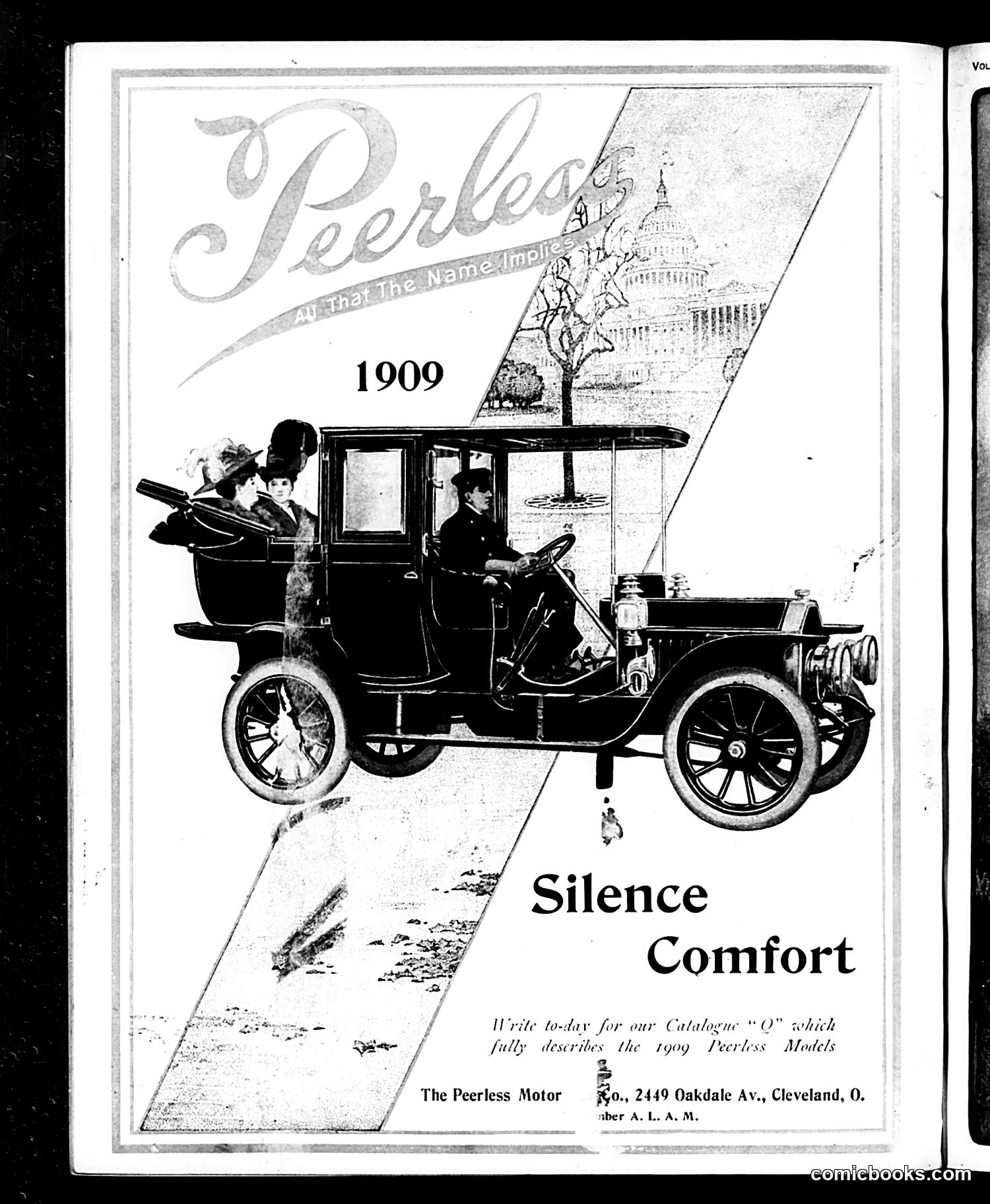
This is primarily a **Peerless automobile advertisement** from 1909, not political satire. The page features an early motorcar with well-dressed passengers near the U.S. Capitol building. The tagline "Silence Comfort" emphasizes the vehicle's appealing qualities to potential buyers—likely referring to the relatively quiet, smooth operation of this automobile compared to noisier competitors of the era. The Capitol imagery suggests prestige and American pride. The advertisement encourages readers to request "Catalogue 'O'" from the Peerless Motor Company in Cleveland, Ohio. This represents typical early automotive advertising that appealed to affluent consumers by associating the product with elegance and national significance.