
Life, 1908-10-01 · page 17 of 44
Life — October 1, 1908 — page 17: what you’re looking at
What you’re looking at
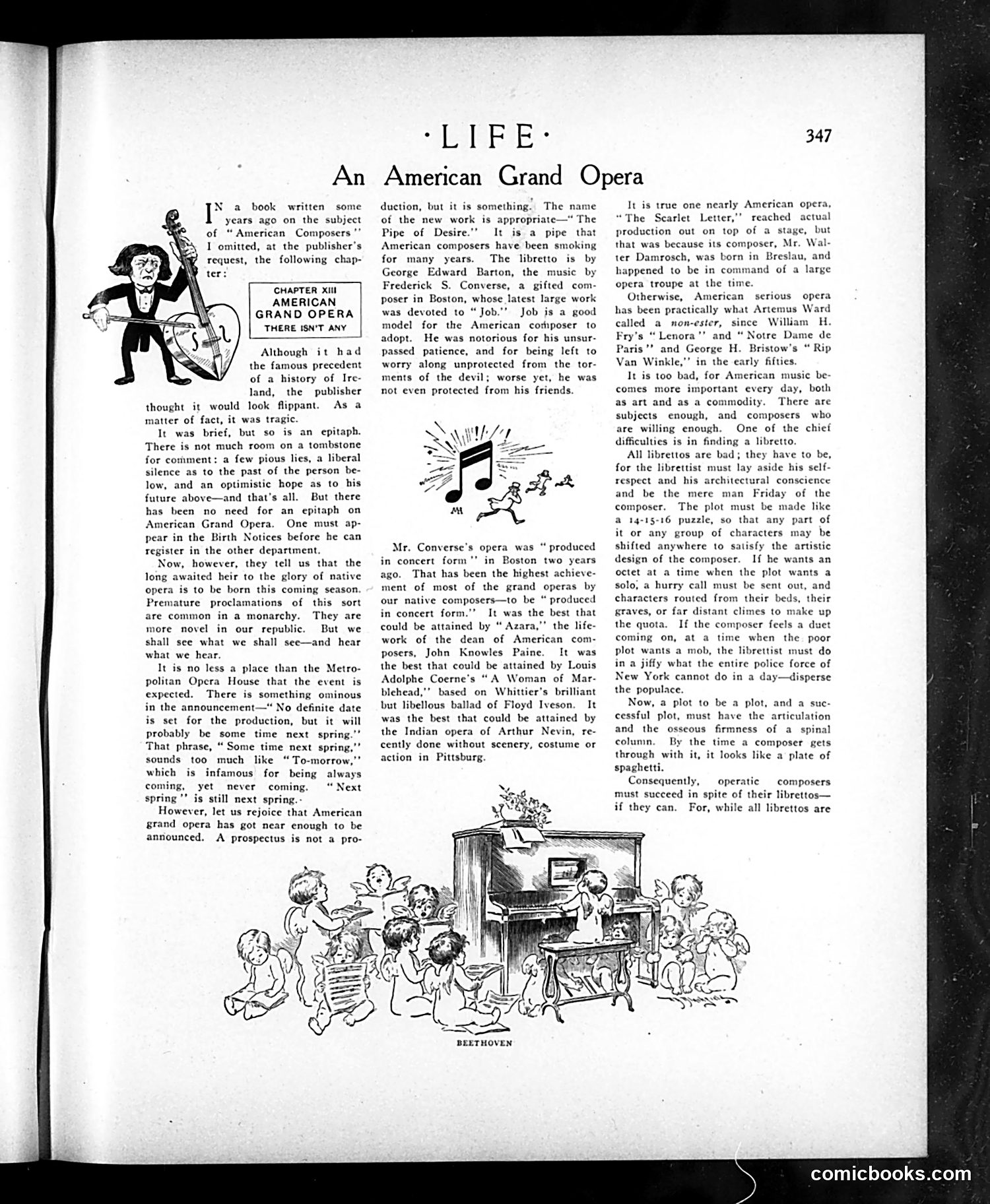
This article satirizes the complete absence of successful American grand opera. The author sarcastically notes that Chapter XIII of a book on American composers was omitted—titled "American Grand Opera: There Isn't Any." The piece mocks the Metropolitan Opera's announcement of an upcoming native opera ("The Pipe of Desire" by Frederick Converse), treating it as a birth announcement for something stillborn. The satire lies in the vague timeline ("some time next spring"—perpetually postponed) and past failures: earlier American operas like Paine's "Azara" and Coerne's "A Woman of Marblehead" achieved only "concert form" productions, not full stagings. Even "The Scarlet Letter" succeeded only because its composer, Walter Damrosch, was foreign-born and happened to have an opera company. The cartoon of Beethoven at bottom contrasts European musical achievement with American failure. The author concludes that while American subjects and willing composers exist, finding a quality libretto remains the chief obstacle—a coded way of saying American opera lacks essential elements for success.
📄 Transcribed text from this page (OCR, searchable)
Machine-transcribed from the original scan — historical spelling and the odd misread are preserved.
AIG RRIE An American Grand Opera a book written some ] years ago on the subject of “American Composers" 1 omitted, at the publisher's request, the following chap- ter: CHAPTER Xill AMERICAN GRAND OPERA THERE ISN'T ANY Although it had the famous precedent of a history of Ire- land, the publisher thought it would look flippant. As a matter of fact, it was tragic. It was brief, but so is an epitaph. There is not much room on a tombstone for comment: a few pious lies, a liberal silence as to the past of the person be- low, and an optimistic hope as to his future above—and that’s all. But there has been no need for an epitaph on American Grand Opera. One must ap- pear in the Birth Notices before he can register in the other department. Now, however, they tell us that the long awaited heir to the glory of native opera is to be born this coming season. Premature proclamations of this sort are common in a monarchy. They are more novel in our republic. But we shall see what we shall see—and hear what we hear. It is no less a place than the Metro- politan Opera House that the event is expected. There is something ominous in the announcement—" No definite date is set for the production, but it will probably be some time next spring." That phrase, “Some time next spring, sounds too much like “To-morrow, which is infamous for being always coming, yet never coming. “Next spring" is still next spring.- However, let us rejoice that American grand opera has got near enough to be announced. A prospectus is not a pro- duction, but it is something. The name of the new work is appropriate— The Pipe of Desire."” It is a pipe that American composers have been smoking for many years. The libretto is by George Edward Barton, the music by Frederick S. Converse, a gifted com- poser in Boston, whose latest large work was devoted to “Job.” Job is a good model for the American cotiposer to adopt. He was notorious for his unsur- passed patience, and for being left to worry along unprotected from the tor- ments of the devil; worse yet, he was not even protected from his friends. w/e Mr. Converse’s opera was “ produced in concert form’ in Boston two years ago. That has been the highest achieve- ment of most of the grand operas by our native composers—to be “ produced in concert form.” It was the best that could be attained by " Azara,”’ the life- work of the dean of American com- posers, John Knowles Paine. It was the best that could be attained by Louis Adolphe Coerne’s “A Woman of Mar- blehead,"” based on Whittier’s brilliant but libellous ballad of Floyd Iveson. It was the best that could be attained by the Indian opera of Arthur Nevin, re- cently done without scenery, costume or action in Pittsburg. BEETHOVEN It is true one nearly American opera, “The Scarlet Letter,"’ reached actual production out on top of a stage, but that was because its composer, Mr. Wal- ter Damrosch, was born in Breslau, and happened to be in command of a large opera troupe at the time. Otherwise, American opera has been practically what Artemus Ward called a non-ester, since William H. Fry’s “ Lenora’? and “Notre Dame de Paris" and George H. Bristow’s “ Rip Van Winkle,"’ in the early fifties. It is too bad, for American music be- comes more important every day, both as art and as a commodity. There are subjects enough, and composers who are willing enough. One of the chief difficulties is in finding a libretto. Alll librettos are bad; they have to be, for the librettist must lay aside his self- respect and his architectural conscience and be the mere man Friday of the composer. The plot must be made like & 14-15-16 puzzle, so that any part of it or any group of characters may be shifted anywhere to satisfy the artistic design of the composer. If he wants an octet at a time when the plot wants a solo, a hurry call must be sent out, and characters routed from their beds, their graves, or far distant climes to make up the quota. If the composer feels a duet coming on, at a time when the poor plot wants a mob, the librettist must do in a jiffy what the entire police force of New York cannot do in a day—disperse the populace. Now, a plot to be a plot, and a suc- cessful plot, must have the articula and the osseous firmness of column. By the time a composer gets through with it, it looks like a plate of spaghetti. Consequently, operatic composers must succeed in spite of their librettos— if they can. For, while all librettos are serious comicbooks.com