
Life, 1908-10-01 · page 29 of 44
Life — October 1, 1908 — page 29: what you’re looking at
What you’re looking at
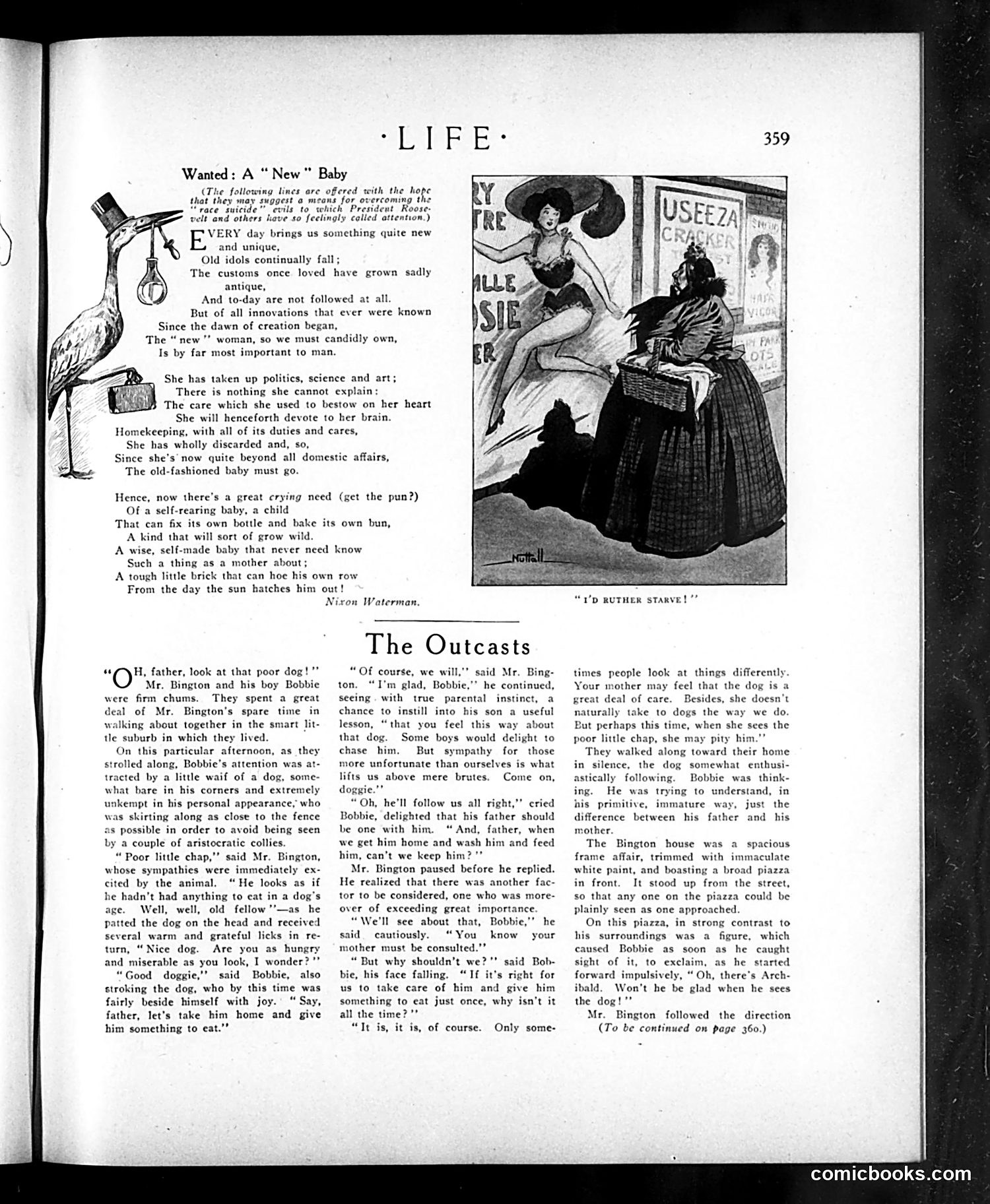
This page contains two distinct pieces addressing early 1900s social anxieties. **"Wanted: A 'New' Baby"** is satirical verse mocking President Theodore Roosevelt's concerns about "race suicide"—the period's worry that educated women were having fewer children. The poem ridicules the "New Woman" who pursues politics, science, and art instead of domestic duties, sarcastically proposing a self-rearing, motherless baby as the solution. The stork illustration reinforces the fertility theme. This reflects anxiety about women's changing roles and independence. **"The Outcasts"** is a serialized story (continued on page 363) depicting Mr. Bington and his son Bobbie discovering a starving stray dog. The accompanying cartoon shows the dog's desperation ("I'D RUTHER STARVE!") contrasted with aristocratic collies—suggesting class divisions and social outcasting. The narrative emphasizes sympathy for the unfortunate as a moral lesson, while tension arises over whether Bobbie's mother will permit keeping the dog, highlighting domestic power dynamics of the era.
📄 Transcribed text from this page (OCR, searchable)
Machine-transcribed from the original scan — historical spelling and the odd misread are preserved.
Wanted: A “ New" Baby (The following lines are offered that they may suggest a means for overcoming the “race suicide” evils to which President Roose- velt and others have so feelingly called attention.) E RY day brings us something quite new and unique, Old idols continually fall; The customs once loved have grown sadly antique, And to-day are not followed at all. But of all innovations that ever were known Since the dawn of creation began, The “new '’ woman, so we must candidly own, Is by far most important to man. She has taken up politics, science and art; There is nothing she cannot explai' The care which she used to bestow on her heart She will henceforth devote to her brain. Homekeeping, with all of its duties and cares, She has wholly discarded and, so, Since she’s now quite beyond all domestic affairs, The old-fashioned baby must go. Hence, now there's a great crying need (get the pun?) Of a self-rearing baby, a child That can fix its own bottle and bake its own bun, A kind that will sort of grow wild. A wise, self-made baby that never need know Such a thing as a mother about A tough little brick that can hoe his own row From the day the sun hatches him out! Nixon Waterman, The Outcasts “C)H, father, look at that poor dog! "” “ Of course, we will,” said Mr. Bing- Mr. Bington and his boy Bobbie ton. “I’m glad, Bobbie,” he continued, Your mother may feel that the dog is a were firm chums. They spent a great seeing. with true parental instinct, a great deal of care. Besides, she doesn’t deal of Mr. Bington’s spare time in chance to instill into his son a useful naturally take to dogs the way we do walking about together in the smart lit- lesson, “that you feel this way about — But perhaps this time, when she sees the tle suburb in which they lived. that dog. Some boys would delight to poor little chap, she may pity him.’” On this particular afternoon, as they chase him, But sympathy for those They walked along toward their home “1’D RUTHER STARVE!” times people look at things differently. strolled along, Bobbie’s attention was at- tracted by a little waif of a dog, some- what bare in his corners and extremely unkempt in his personal appearance, who was skirting along as close to the fence as possible in order to avoid being seen by a couple of aristocratic collies. “ Poor little chap,”” said Mr. Bington, whose sympathies were immediately ex- cited by the animal. “He looks as if he hadn’t had anything to cat in a dog's age. Well, well, old fellow ""—as he patted the dog on the head and received several warm and grateful licks in re- turn, “Nice dog. Are you as hungry and miserable as you look, I wonder?" “Good doggie"? said Bobbie, also stroking the dog, who by this time was fairly beside himself with joy. “ Say, father, let's take him home and give him something to eat.”” more unfortunate than ourselves is what lifts us above mere brutes. Come on, doggie.”” “Oh, he'll follow us all right,”” cried Bobbie, delighted that his father should be one with him. “And, father, when we get him home and wash him and feed him, can’t we keep him?"’ Mr. Bington paused before he replied. He realized that there was another fac- tor to be considered, one who was more- over of exceeding great importance “We'll see about that, Bobbie,’ he said. cautiously. “You know your mother must be consulted.” “But why shouldn’t we?" said Bob- bie, his face falling. “If it's right for us to take care of him and give him something to eat just once, why isn’t it all the time?” “Tt is, it is, of course. Only some- in silence, the dog somewhat enthusi- astically following. Bobbie was think- ing. He was trying to understand, in his primitive, immature way, just the difference between his father and his mother. The Bington house was a spacious frame affair, trimmed with immaculate white paint, and boasting a broad piazza in front. It stood up from the street, so that any one on the piazza could be plainly seen as one approached. On this piazza, in strong contrast to his surroundings was a figure, which caused Bobbie as soon as he caught sight of it, to exclaim, as he started forward impulsively, “Oh, there's Arch- ibald. Won't he be glad when he sees the dog Mr. Bington followed the direction (To be continued on page 360.) comicbooks.com