
Life, 1908-10-01 · page 26 of 44
Life — October 1, 1908 — page 26: what you’re looking at
What you’re looking at
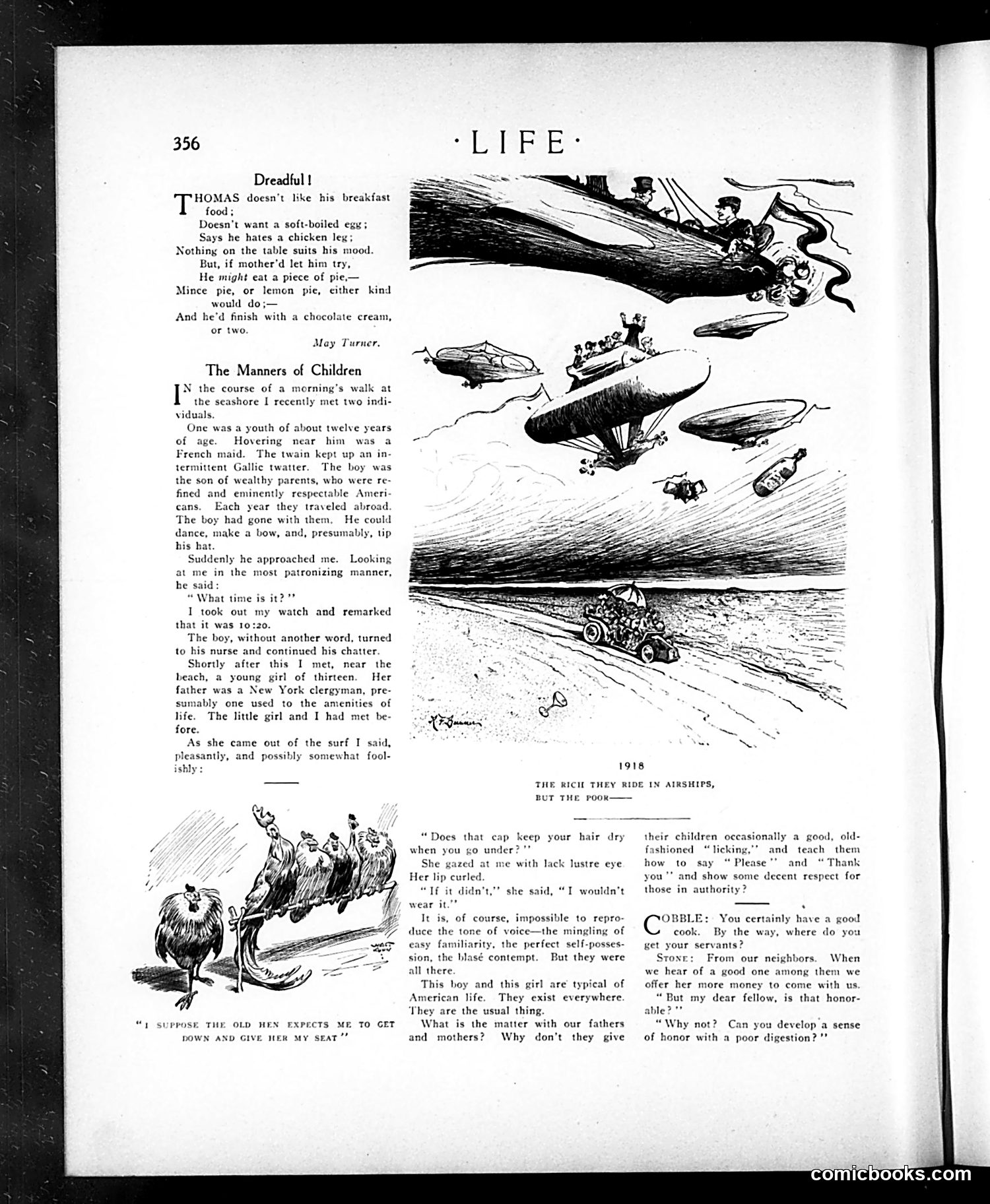
This page contains two satirical pieces about American manners and class behavior circa 1918. **"The Manners of Children"** criticizes wealthy American children's rudeness and entitlement. The author describes encountering a boy and girl from affluent families who are condescending and disrespectful to adults—the boy patronizingly asks a stranger for the time, the girl smugly refuses to acknowledge the author's friendly greeting. The essay condemns parents for failing to discipline children with old-fashioned spanking ("licking") and teach them respect for authority. **The cartoon and dialogue below** satirize wealthy people's moral hypocrisy. When asked how they obtain servants, a rich man admits to stealing household staff from neighbors by offering higher wages—then brazenly justifies this dishonorable behavior by claiming poverty prevents him from developing ethical standards ("Can you develop a sense of honor with a poor digestion?"). Both pieces target upper-class Americans for raising spoiled, arrogant children and excusing their own unethical conduct through self-interest.
📄 Transcribed text from this page (OCR, searchable)
Machine-transcribed from the original scan — historical spelling and the odd misread are preserved.
356 Dreadful ! HOMAS doesn’t like his food ; Doesn't want a soft-boiled eg: Says he hates a chicken le Nothing on the table suits his But, if mother’d let him tr; He might eat a piece of pie,— Mince pie, or lemon pie, cither kind would do;— And he'd finish with a chocolate cream, or two. breakfast May Turner. The Manners of Children N the course of a morning’s walk at the seashore I recently met two indi- viduals, One was a youth of about twelve years of Hovering near him French maid. The twain kept up an in- termittent Gallic twatter. The boy was the son of wealthy parents, who were re- fined and eminently respectable Ameri- cans. Each year they traveled The boy had gone with them dance, make a bow, and, presumably, tip his 1 Suddenly he approached me. Looking at me in the most patronizing manner, he said: “What time is it?” I took out watch and remarked that it was 10:20. The boy, without another word, turned to his nurse and continued his chatter. Shortly after this I met, near the h, a young girl of thirteen. Her father was a New York clergyman, pre- ably one used to the amenities of The little girl and I had met be- was a abroad. He could my life. fore. As she came out of the surf I said, pleasantly, and possibly somewhat fool- SUPPOSE THE OLD HEN EXPECTS 10 GET DOWN AND GIVE HER MY SEAT’? ME 1918 THE RICH THEY RIDE BUT THE POOR—— “Do when you go under?" that cap keep your hair dry She gazed at me with lack lustre eye Her lip curled. “Tf it didn't wear it.” * she said, “I wouldn't It is, of course, impossible to repro: duce the tone of voice—the mingling of easy familiarity, the perfect self-posses- sion, the blasé contempt. But they were all there. This boy and this girl are typical of American life. They exist everywhere ‘They are the usual thing. What is the matter with our fathers and mothers? Why don’t they give IN AIRSHIPS, their children occasionally a good, old- fashioned “licking,’’ and teach them “ and“ Thank Jecent respect for how to Please you" and show some those in authority? Com 2: You certainly have a good cook. By the w get your servants? Stoxr: From our neighbors. When we hear of a good one among them we offer her more money to come with us. “But my dear fellow, is that honor- able? “Why not? Can you develop'a sense of honor with a poor digestion? where do you Comicbooks.com