
Life, 1908-10-01 · page 25 of 44
Life — October 1, 1908 — page 25: what you’re looking at
What you’re looking at
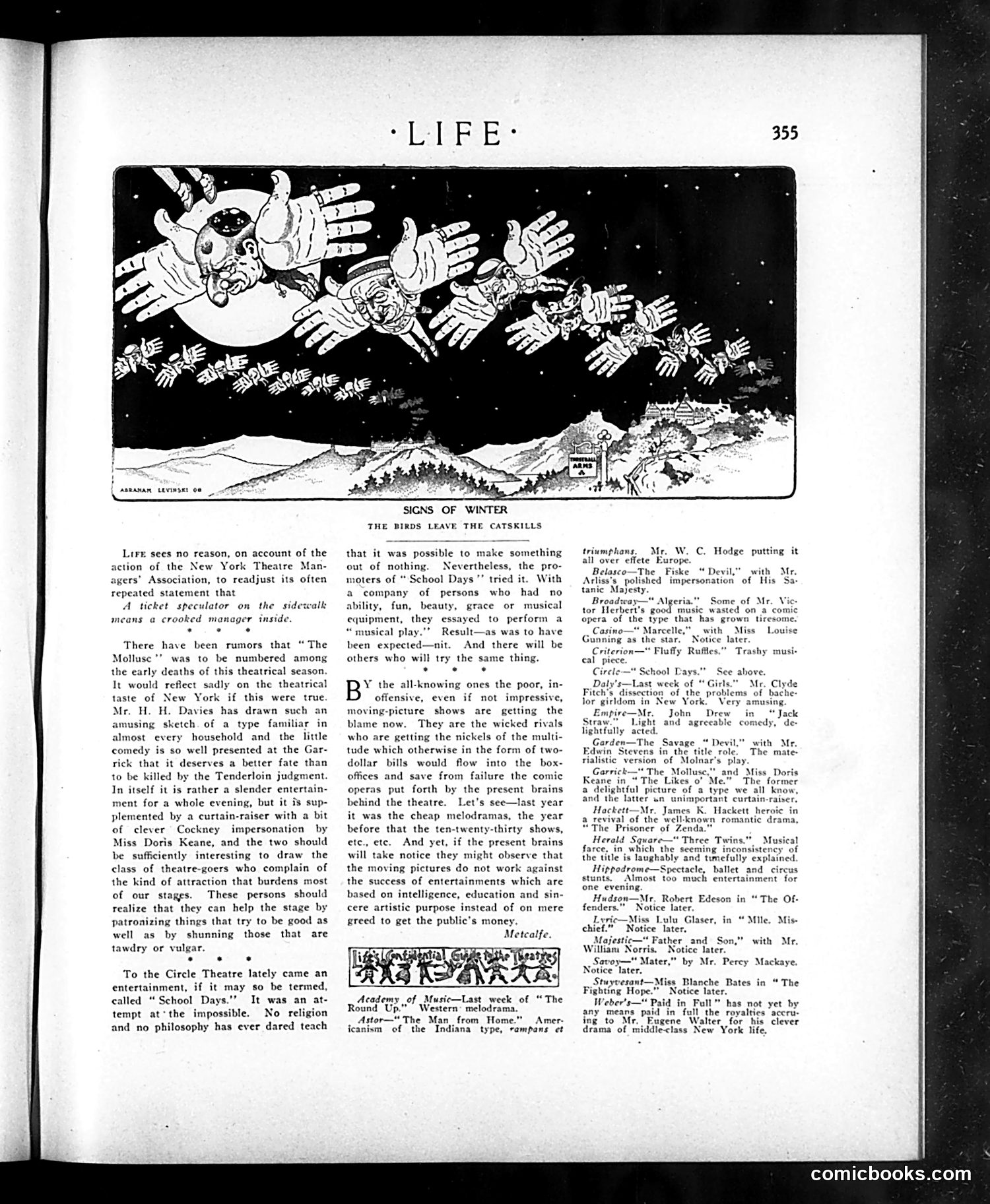
## The Cartoon The illustration titled "Signs of Winter: The Birds Leave the Catskills" depicts demonic or grotesque bird-figures flying away from a mountain landscape. This is political allegory: the "birds" represent theatrical producers or entertainers fleeing the Catskill region as winter approaches. ## The Editorial Content Life's theater critic (likely Metcalfe, signed at bottom) attacks the Broadway theater establishment on multiple fronts: 1. **Theater managers' corruption**: The opening statement condemns ticket scalpers as evidence of crooked management. 2. **Blame-shifting**: Producers blame "moving pictures" (early cinema) for stealing audiences and box-office revenue, rather than acknowledging their own artistic failures. Life argues that intelligent, sincere theatrical productions succeed regardless of movie competition. 3. **Low-quality productions**: The critic savagely reviews a show called "School Days"—attempting something from nothing with untalented performers—as emblematic of Broadway's artistic bankruptcy. The satire suggests theater's decline stems from greed and mediocrity, not cinema competition.
📄 Transcribed text from this page (OCR, searchable)
Machine-transcribed from the original scan — historical spelling and the odd misread are preserved.
oe AREOAN LEVINSE! 08 Lire sees no reason, on account of the action of the New York Theatre Man- agers’ Association, to readjust its often repeated statement that A ticket speculator on the sidewalk means a crooked manager inside. There have been rumors that “ The Molluse "’ was to be numbered among the early deaths of this theatrical season. It would reftect sadly on the theatrical taste of New York if this were true Mr. H. H. Davies has drawn such an amusing sketch. of a type familiar in almost every household and the little comedy is so well presented at the Gar- rick that it deserves a better fate than to be killed by the Tenderloin judgment. In itself it is rather a slender entertain- ment for a whole evening, but it 38 sup- plemented by a curtain-raiser with a bit of clever Cockney impersonation by Miss Doris Keane, and the two should be sufficiently interesting to draw the class of theatre-goers who complain of the kind of attraction that burdens most of our stages. These persons should realize that they can help the stage by patronizing things that try to be good as well as by shunning those that are tawdry or vulgar. oMitaa te To the Circle Theatre lately came an entertainment, if it may so be termed, called tempt at‘the impossible. No religion and no philosophy has ever dared teach SIGNS OF WINTER THE DIRDS LEAVE THE CATSKILLS that it was possible to make something out of nothing. Nevertheless, the pro- moters of “School Days" tried it. With a company of persons who had no ability, fun, beauty, grace or musical equipment, they essayed to perform a sical play.” Result—as was to have been expected—nit. And there will be others who will try the same thing. BY the all-knowing ones the poor, in- offensive, even if not impressive, moving-picture shows are getting the blame now. They are the wicked rivals who are getting the nickels of the multi- tude which otherwise in the form of two- dollar bills would into the box- offices and save from failure the comic operas put forth by the present brains behind the theatre. Let's see—last year it was the cheap melodramas, the year before that the ten-twenty-thirty shows, cte., ete. And yet, if the present brains will take notice they might observe that the moving pictures do not work against the success of entertainments which are based on intelligence, education and sin- cere artistic purpose instead of on mere greed to get the public's money. Metcalfe. flow Academy of Music—Last week of “The Round Up." Western: melodrama. Astor—" The Man from Home.” Amer- icanism of the Indiana type, rampans et Mr. W. C. all over effete Europe. Belasco—The | Fiske“ Devil,” with Mr. Arliss’s polished impersonation of His Sa- tanic Majesty. Broadway—" Algeria.” Some of Mr tor Herbert's good music wasted on a opera of the type that has grown tiresoi Casino—" Marcelle,” with Miss anning as the star.’ Notice later Criterion—" Fluffy Ruffles.” Trashy musi- cal piece. Cirele—" School Lays.” Daly's—Last week of “Girls.” Mr Fitch's dissection of the lor girldom in New York Empire—Mr. John Drew in Straw.” Light and agree lightfully acted. Garden—The Savage “ Dev Edwin Stevens in the title role rialistic version of Molnar’s play _Garrick—" The Mollusc," and Miss D. Keane in “The Likes o’ Me.” The for ad 1 picture of a type we all know the latter un unimportant curtain-raiser, Hackett—Mr. James K. i a al of the well-known ro “The Prisoner of Zenda.” Herold Square—" Three Twins.” Musical farce, in which the seeming inconsistency of the title is laughably and tumefully explained Hippodrome—Spectacle, ballet and circus stunts. Almost too much entertainment for one evening. Hudson—Mr, Robert Edeson fenders.” Notice later. Lyric—Miss Lulu Glaser, in “ Mile. Mi chief.” Notice later. Majestic— rand So: William Norris. Notice later. ater,” by Mr. Percy Mackaye. Hodge putting it See above. Clyde bache- using “ Jack ble comedy, de- problems Very ar with Mr, The mate: in “The Of with Mr. Stuyvesant—Miss Blanche Bates in “ The Fighting Hope.” Notice later. Weber’s—" Paid in Full” has not yet b any means pa in full the royalties acer ing to Mr. Eugene Walter for his clever drama of middleclass New York life. comicbooks.com