
Life, 1908-10-01 · page 14 of 44
Life — October 1, 1908 — page 14: what you’re looking at
What you’re looking at
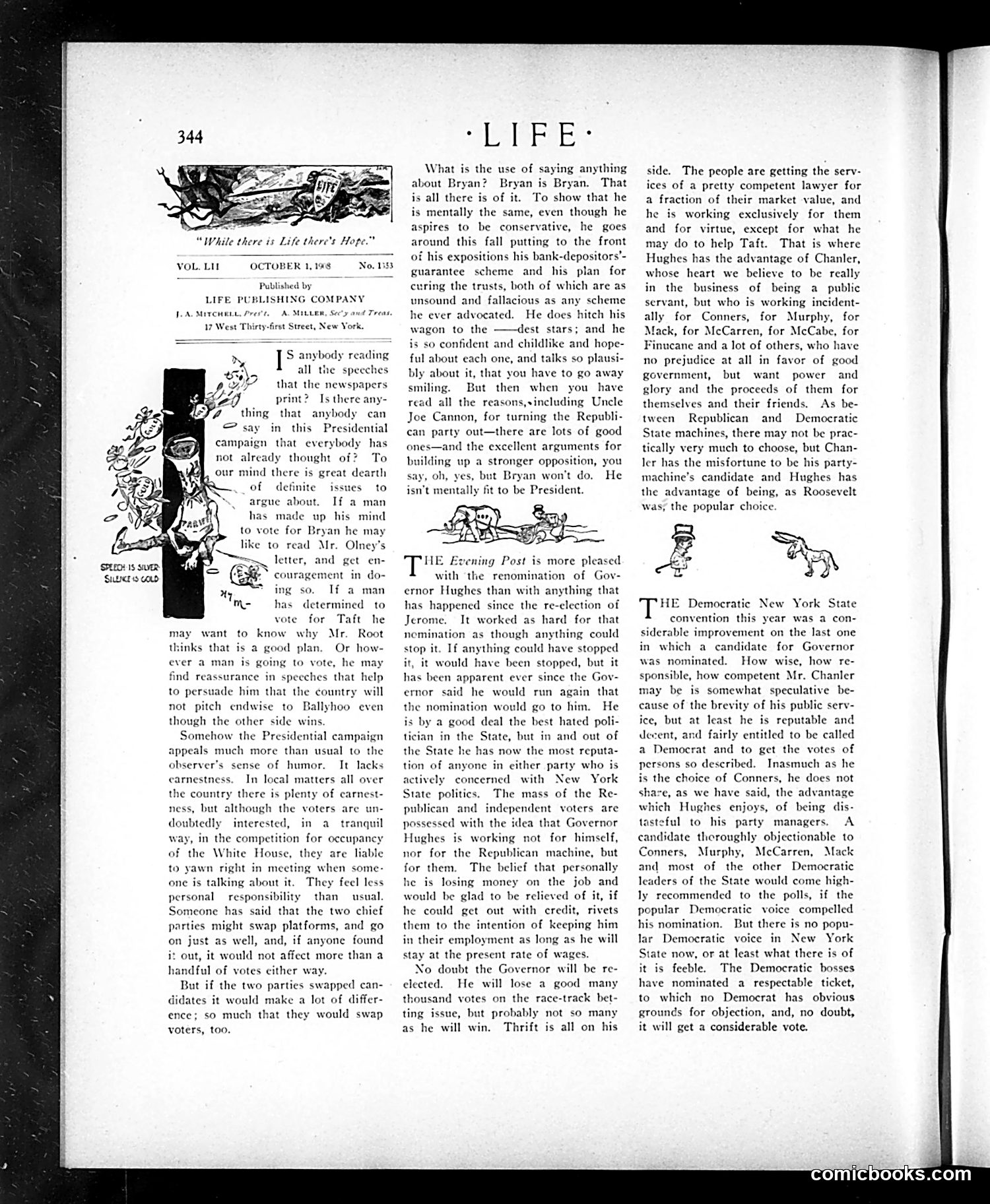
This page satirizes the 1908 U.S. Presidential campaign, mocking both major candidates. The main cartoon (left) shows a figure labeled "SUFFERER IS COLD," criticizing the glut of campaign speeches—none of which offer anything substantive or new to voters. The text attacks **William Jennings Bryan**, the Democratic candidate, as mentally unfit for presidency despite his charisma. He repeatedly pushes the same failed ideas (bank deposit guarantees, trust-busting) that voters find appealing but fundamentally unsound. The article praises **Governor Charles Evans Hughes**, the Republican nominee, as genuinely working for the public interest rather than personal gain or party machinery. Unlike Bryan, Hughes is portrayed as competent and truly concerned with voters' welfare. The satire's broader point: personality and reputation matter more than platform differences—the parties could literally swap platforms without voters noticing, but swapping *candidates* would cause massive electoral shifts. Bryan's charm cannot compensate for his lack of fitness for office.
📄 Transcribed text from this page (OCR, searchable)
Machine-transcribed from the original scan — historical spelling and the odd misread are preserved.
SuLrEE 4S COLD VOL. LI OCTOBER 1,1 Published by LIFE PUBLISHING COMPANY A. MILLER, Sec*y ane Treas FA MITCHELL Preset. 17 West Thirty-firet Street, New York. S anybody reading all the speeches that the newspapers print? Is there any- that anybody can this Presidential campaign that everybody not already thought of? To our mind there is great dearth of detinite argue about. If a man has made up his mind to vote for Bryan he may like to read Mr. Olney’s Sf letter, and get en- couragement in do- ing so. If a man determined to for Taft he why Mr. Root Or how: e, he may thing = say in issues to has vote may want to know thinks that is a good plan ever a man is going to ve find reassurance in speeches that help to persuade him that the country will not pitch endwise to Ballyhoo even though the other side wins. Somehow the Presidential campaign appeals much more than usual to the observer's sense of humor. It lacks earnestness. In local matters all over the country there is plenty of carnest- ness, but although the voters are un- doubtedly interested, in a tranquil way, in the competition for occupancy of the White House, they are liable to yawn right in meeting when some- one is talking about it. They feel less personal responsibility than usual. Someone has said that the two chief parties might swap platforms, and go on just as well, and, if anyone found it out, it would not affect more than a handful of votes cither way. But if the two parties swapped can- didates it would make a lot of differ- ence; so much that they would swap voters, too. aRIGERES What is the use of saying anything about Bryan? Bryan is Bryan. That is all there is of it. To show that he is mentally the same, even though he aspires to be conservative, he goes around this fall putting to the front of his expositions his bank-deposito guarantee scheme and his plan for curing the trusts, both of which are as. unsound and fallacious as any scheme he ever advocated. He does hitch his wagon to the ——dest stars; and he is so confident and childlike and hope- ful about each one, and talks so plausi- bly about it, that you have to go away smiling. But then when you have read all the reasons,sincluding Uncle Joe Cannon, for turning the Republi- can party out—there are lots of good ones—and the excellent arguments for building up a stronger opposition, you say, oh, yes, but Bryan won't do. isn’t mentally fit to be President. He ening Post is more pleased with the renomination of Gov- ernor Hughes than with anything that has happened since the re-election of Jerome. It worked as hard for that nomination as though anything could stop it. If anything could have stopped it, it would have been stopped, but it has been apparent ever since the Gov- ernor said he would run again that the nomination would go to him. He is by a good deal the best hated poli- tician in the State, but in and out of the State he has now the most reputa- tion of anyone in either party who is actively concerned with New York State politics. The mass of the Re- publican and independent voters are possessed with the idea that Governor Hughes is working not for himself, nor for the Republican machine, but for them. The belief that personally he is losing money on the job and would be glad to be relieved of it, if he could get out with credit, rivets them to the intention of keeping him in their employment as long as he will stay at the present rate of wages. No doubt the Governor will be re- elected. He will lose a good many thousand votes on the race-track bet- ting issue, but probably not so many as he will win. Thrift is all on his side. The people are getting the serv- ices of a pretty competent lawyer for a fraction of their market value, and he is working exclusively for them and for virtue, except for what he may do to help Taft. That is where Hughes has the advantage of Chanler, whose heart we believe to be really in the business of being a public servant, but who is working incident- ally for Conners, for Murphy, for Mack, for McCarren, for McCabe, for inucane and a lot of others, who have no prejudice at all in favor of good government, but want power and glory and the proceeds of them for themselves and their friends. As be- tween Republican and Democratic State machines, there may not be prac- tically very much to choose, but Chan- ler has the misfortune to be his party- machine’s candidate and Hughes has the advantage of being, as Roosevelt was; the popular choi HE Democratic New York State convention this year was a con- able improvement on the last one in which a candidate for Governor was nominated. How wise, how re- sponsible, how competent Mr. Chanler may be is somewhat speculative be- cause of the brevity of his public serv- ice, but at least he is reputable and decent, and fairly entitled to be called a Democrat and to get the votes of persons so described. Inasmuch as he is the choice of Conners, he does not share, as we have said, the advantage which Hughes enjoys, of being dis- tasteful to his party managers. A candidate thoroughly objectionable to Conners, Murphy, McCarren, Mack and most of the other Democratic leaders of the State would come high- ly recommended to the polls, if the popular Democratic voice compelled his nomination. But there is no popu- lar Democratic voice in New York State now, or at least what there is of it is feeble. The Democratic bosses have nominated a respectable ticket, to which no Democrat has obvious grounds for objection, and, no doubt, it will get a considerable vote. side