
Life, 1908-10-01 · page 40 of 44
Life — October 1, 1908 — page 40: what you’re looking at
What you’re looking at
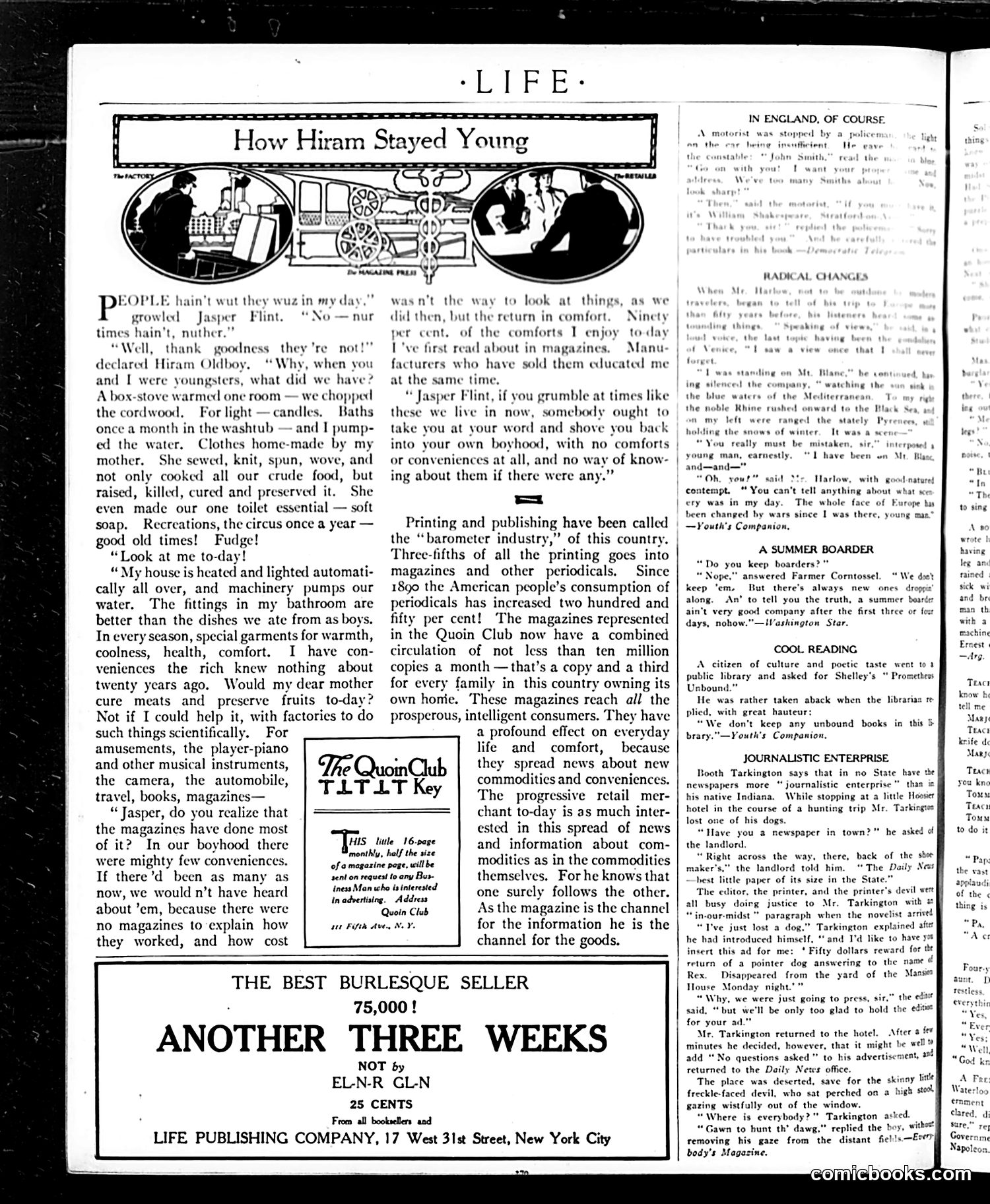
This page satirizes generational complaints about "the good old days." Two elderly men, Jasper Flint and Hiram Oldboy, debate whether modern times are worse than the past. Oldboy wins the argument by listing concrete comforts unavailable in his youth: central heating, indoor plumbing, electric light, manufactured clothing, and factory-processed food. He credits **magazines** for educating the public about these conveniences. The satire targets nostalgia itself—Flinty's vague complaints collapse when confronted with actual evidence of progress. The page then pivots to praising magazines as drivers of consumer culture and industrial growth. It argues that magazines inform the public about new products, enabling retailers to profit from increased demand. This reflects early 20th-century American optimism about technology, mass media, and consumer capitalism—positioning magazines as essential to modernization and prosperity.
📄 Transcribed text from this page (OCR, searchable)
Machine-transcribed from the original scan — historical spelling and the odd misread are preserved.
EOPLE hain't wut they wuz in my day,” growlel Jasper Flint. “No —nur times hain't, nuther.”” “Well, thank goodness they're not!" declared Hiram Oldboy. ‘Why, when you and I were youngsters, what did we have? A box-stove warmed one room — we chopped the cordwood, For light — candles. Baths once a month in the washtub — and I pump- ed the water. Clothes home-made by my mother. She sewed, knit, spun, wove, and not only cooked all our crude food, but raised, killed, cured and preserved it. She even made our one toilet essential — soft soap. Recreations, the circus once a year — good old times! Fudge! “Look at me to-day! “ My house is heated and lighted automati- cally all over, and machinery pumps our water. The fittings in my bathroom are better than the dishes we ate from as boys. In every season, special garments for warmth, coolness, health, comfort. I have con- veniences the rich knew nothing about twenty years ago. Would my dear mother cure meats and preserve fruits to-day? Not if I could help it, with factories to do such things scientifically. For amusements, the player-piano and other musical instruments, the camera, the automobile, travel, books, magazines— “Jasper, do you realize that the magazines have done most of it? In our boyhood there were mighty few convenience: If there’d been as many as now, we would n’t have heard about ’em, because there were no magazines to explain how they worked, and how cost The QuoinClub | '*s TILT ALT Key [is litle 16-page ‘monthly, half the size of e magazine pore, will be sent on request fo any Bus- iness Man who is interested Inadvertising. Address Quoin Club M1 Fifth Ave, Ne things, as we Ninety wasn't the to look at did then, but the return in comfort per of the comforts 1 enjoy today I've first read about in magazines. Manu facturers who have sold them cducated me at the same time, asper Flint, if you grumble at times like these we live in now, somebody ought to take you at your word and shove you back into your own boyhood, with no comforts or conveniences at all, and no way of know- ing about them if there were any.” = Printing and publishing have been called the “barometer industry,” of this country. Three-fifths of all the printing goes into magazines and other periodicals. Since 1890 the American people’s consumption of periodicals has increased two hundred and fifty per cent! The magazines represented in the Quoin Club now have a combined circulation of not less than ten million copies a month —that’s a copy and a third for every family in this country owning its own honie. These magazines reach all the prosperous, intelligent consumers. They have a profound effect on everyday life and comfort, because spread news about new commodities and conveniences. The progressive retail mer- chant to-day is as much inter- ested in this spread of news and information about com- modities as in the commodities themselves. For he knows that one surely follows the other. As the magazine is the channel for the information he is the channel for the goods. way cent, THE BEST BURLESQUE SELLER ANOTHER 75,000 ! THREE WEEKS NOT by EL-N-R GL-N 25 CENTS From all booksellers and LIFE PUBLISHING COMPANY, 17 West 31st Street, New York City IN ENGLAND, OF COURSE. RADICAL CHANGES e * watching the sok Medite 7 Rh onward to t ged the winter the blue waters Tt was a seen must be mistaken, sir,” interposed + & man, earnestly and—and—" Oh, your Harlow, wi contempt. “You can’t tell anything about what ery was in my day. The whole face of Europe bis been changed by wars since I was there, young man” Youth's Companion, “LT ohave been on Mt. Bla said 3 ‘natured A SUMMER BOARDER “Do you keep boarders?” “Nope.” answered Farmer Corntossel. “We doet keep ‘em. But there's always new ones dr along. An’ to tell you the truth, a summer boar’ ain't very good company after the first three days, nohow."—Washington Star. COOL READING A citizen of culture and poetic taste went to public library and asked for Shelley's “ Promethess Unbound.” He was rather taken aback when the librarias re with great hauteur: We don't keep any unbound books in this & brary."—Youth's Companion, JOURNALISTIC ENTERPRISE Booth Tarkington says that in no State have newspapers more “journalistic enterprise" thas his native Indiana, While stopping at a little Hoosier hotel in the course of a hunting trip Mr. Tarking lost one of his dogs. “Have you a newspaper in town?" he asked of the landlord. “Right across the way, there, back of the maker's,” the landlord told him. hest little paper of its size in the State. th a rived all busy doing justice to Mr. Tarkington “in-our-midst ” paragraph when the novelist I've just lost a dog.” Tarkington exp he had introduced himself, ‘and I'd like to have y%* insert this ad for m ty dollars reward for te return of a pointer dog answering to the name | Rex. Disappeared from the yard of the Manse House Monday night.’ ” “Why, we were just going to press, sir,” the eh said, “but we'll be only too glad to hold the ¢& for your ad.” Mr. Tarkington returned to the hotel. minutes he decided, however, that it might add “No questions asked” to his advertisement, # returned to the Daily Nets office. The place was deserted. freckle-faced devil, who sat perched on a ! gazing wistfully out of the window. “Where is everybody? i awn to hunt th’ dawg,” replied the removing his gaze from the distant fiel!s— body's Magazine. Miter af t be well The editor, the printer, and the printer's devil wer ff sick wi and be, man th with a