
A complete issue · 28 pages · 1908
Life — May 21, 1908
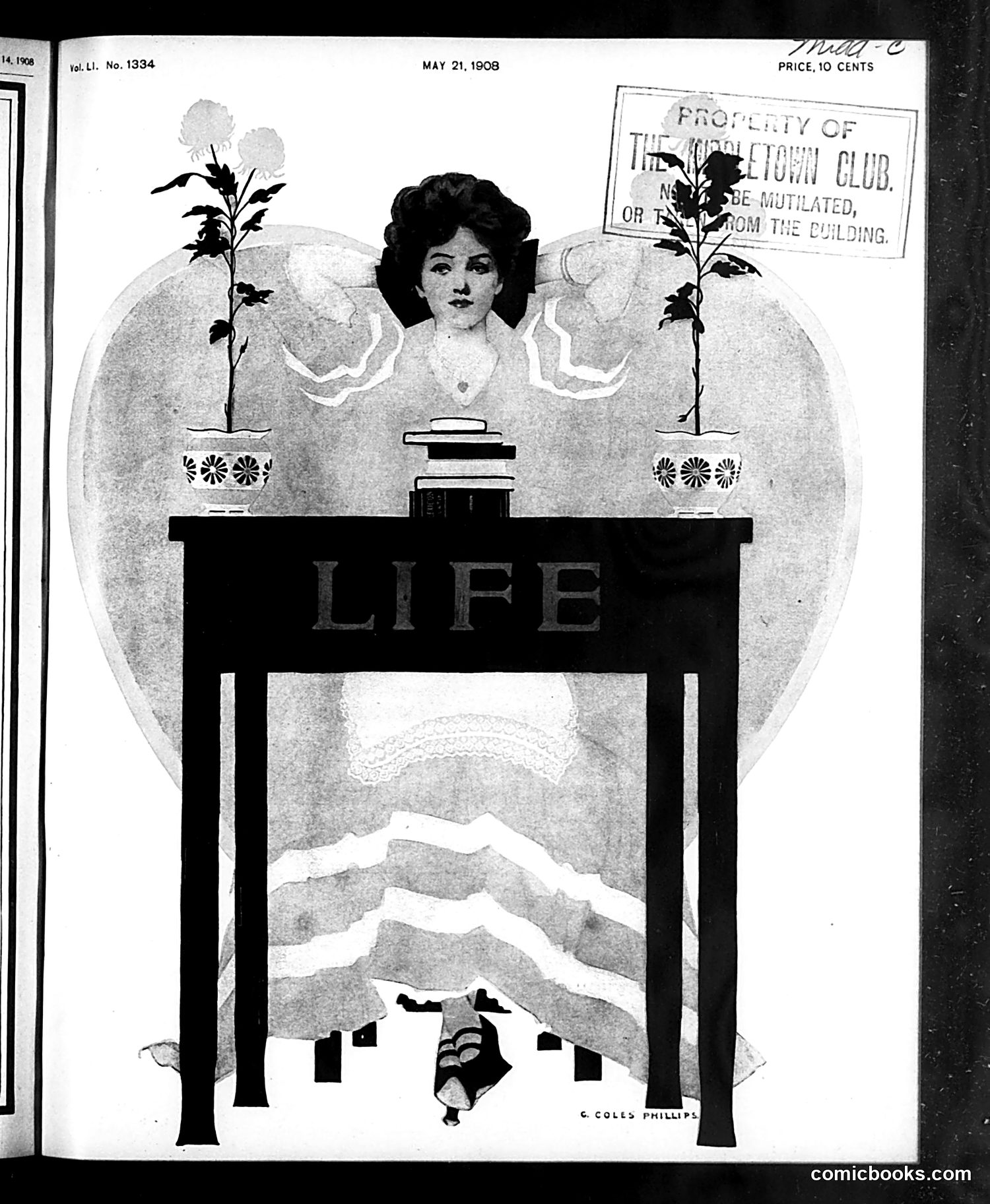
This allegorical cartoon depicts "Life" as a classical female figure presiding over an altar or stage. She holds potted flowers and gazes downward at a mountainous landscape below, where a small human figure appears to be climbing or struggling. The composition suggests a meditation on human ambition and mortality—the vast, indifferent natural world dwarfs individual human effort. The classical styling and the woman's serene expression contrast with the laborer's small scale below, emphasizing themes common to early 1900s American satire: the individual's insignificance against fate, nature, or social forces. The property stamp indicates institutional ownership. Without additional context, the specific satirical target remains unclear, though the visual hierarchy clearly comments on human striving versus larger forces.
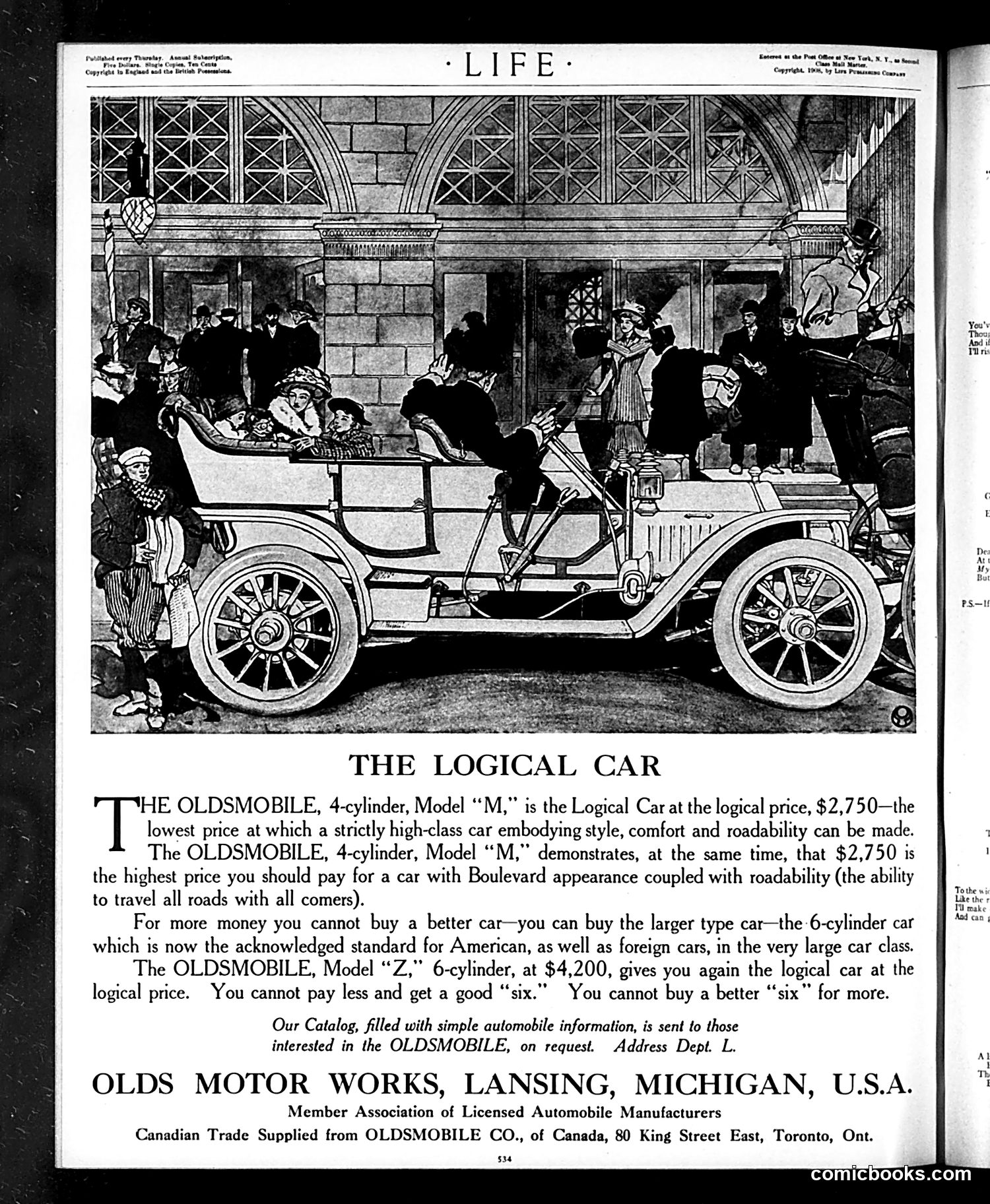
This page is **primarily an advertisement**, not satire. It promotes the Oldsmobile Model "M" 4-cylinder automobile, priced at $2,750, which the ad claims represents "The Logical Car"—the best value in its class. The elaborate illustration shows the car in an upscale urban setting with well-dressed pedestrians and architectural grandeur, designed to associate the vehicle with luxury and sophistication. The advertising copy argues this mid-range car offers the best price-to-quality ratio: you cannot buy a better car for less money, nor a better "six-cylinder" for more. The ad also mentions Oldsmobile's 6-cylinder Model "Z" at $4,200. **There is no political satire on this page.** It's a straightforward product advertisement from Life magazine's commercial pages.
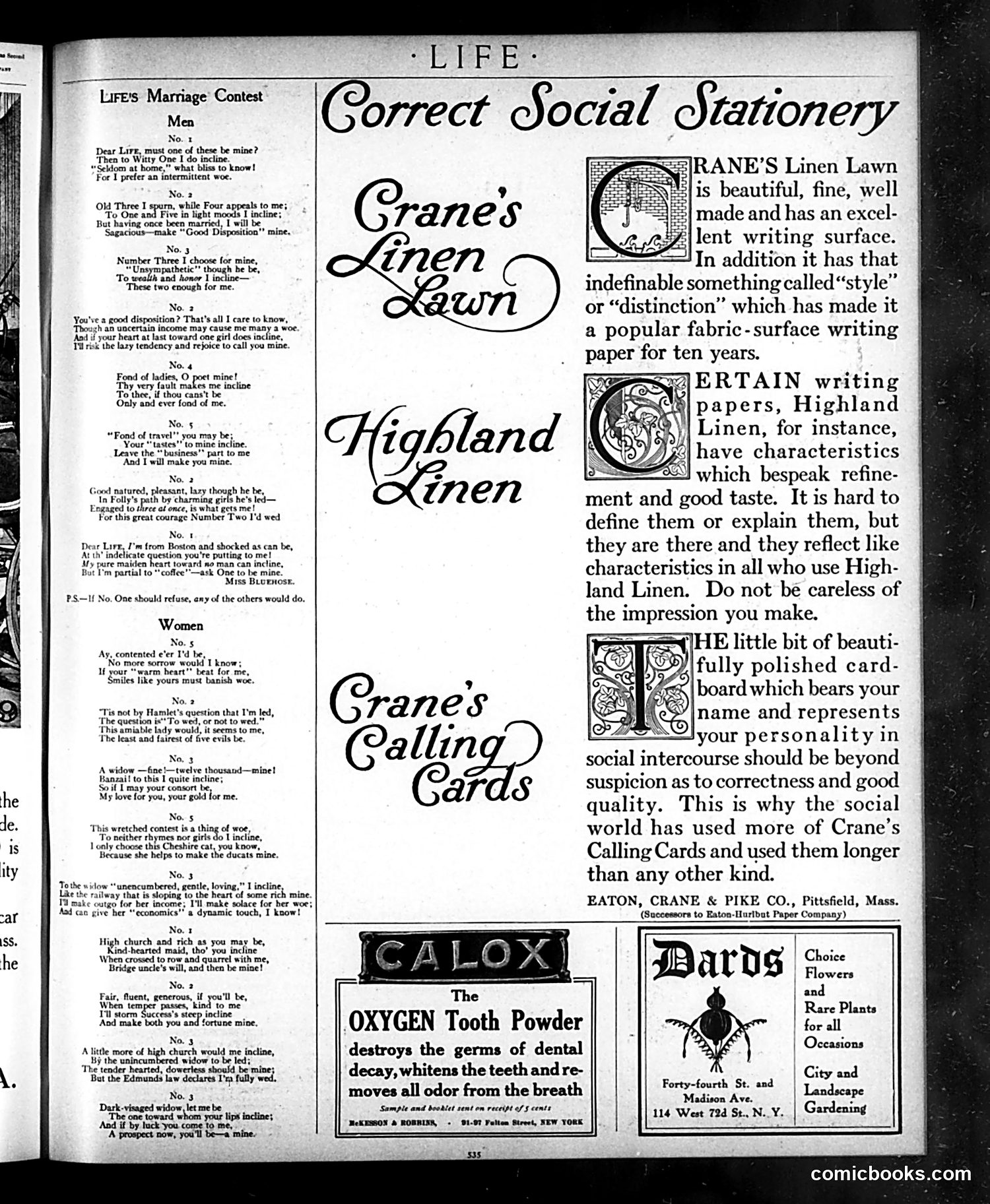
This page is **primarily advertising**, not satire or political commentary. The left column contains "Life's Marriage Contest," a humorous reader-submission feature where men and women write playful verses about their romantic preferences—a lighthearted entertainment section typical of Life magazine's format. The right side advertises three commercial products: 1. **Crane's stationery** (linen and calling cards)—emphasizing social propriety and quality writing materials 2. **Calox tooth powder**—claiming to destroy decay germs and eliminate bad breath 3. **Dards flowers**—offering rare plants and bouquets These ads target middle-class consumers concerned with social respectability, personal hygiene, and gift-giving. The page reflects early 20th-century commercial culture and social anxieties around proper etiquette and appearance.
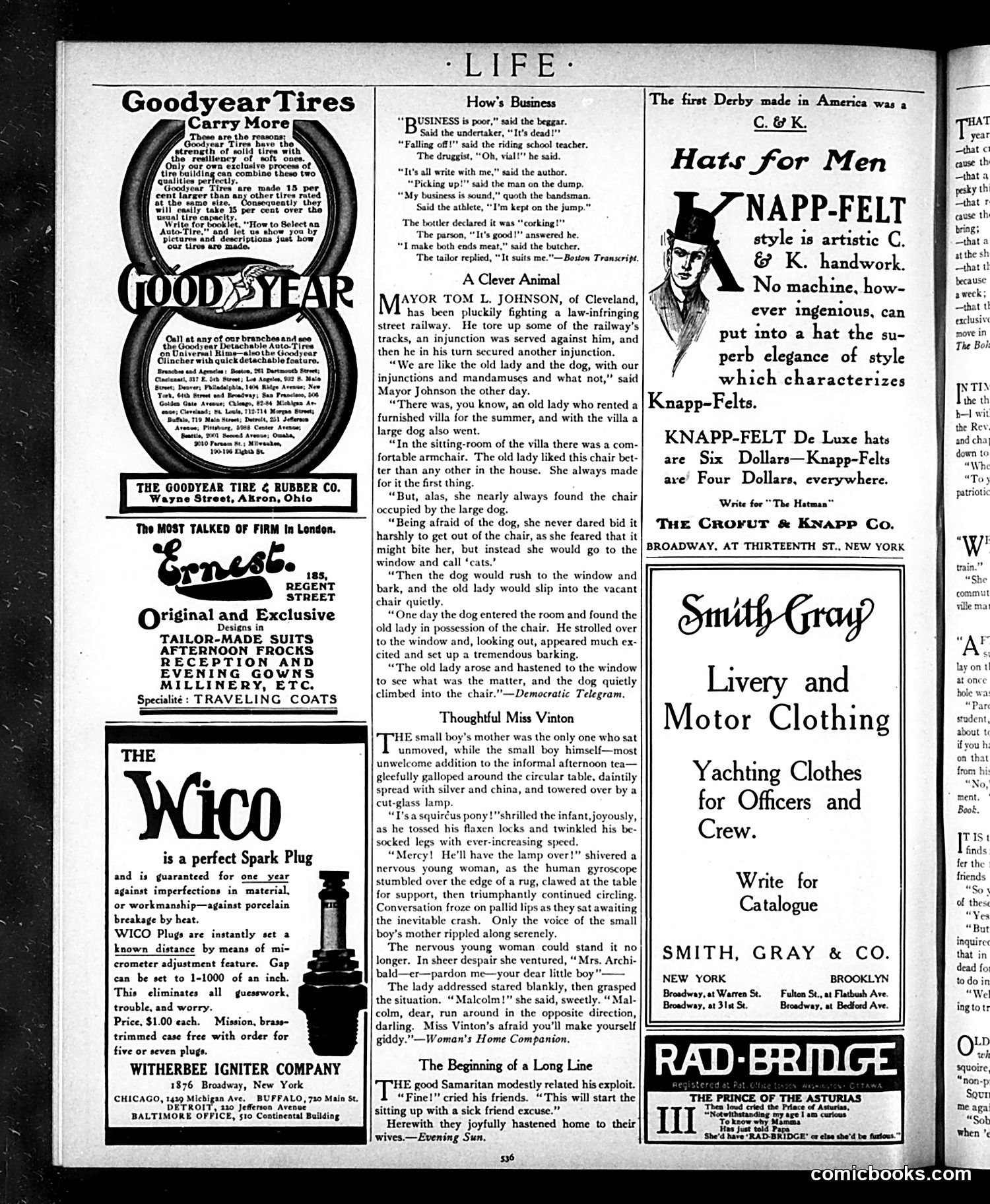
This page is predominantly **advertising**, not satire or political commentary. The ads feature: - **Goodyear Tires** (top left): Standard product advertisement emphasizing tire quality and durability - **Ernest** (tailor-made suits): London fashion advertisement - **Wico spark plugs**: Automotive product promotion - **Knapp-Felt hats**: Men's fashion advertisement - **Smith, Gray & Co.**: Clothing and yacht wear merchant - **Radbridge**: Appears to be a hotel or lodging advertisement The page also contains two brief humorous stories ("How's Business," "A Clever Animal," "Thoughtful Miss Vinton," "The Beginning of a Long Line") typical of Life's satirical content, but these are **not caricatures or political cartoons**—they're light, domestic humor pieces common to the era's magazines. The page reflects 1920s consumer culture and leisure activities rather than political commentary.
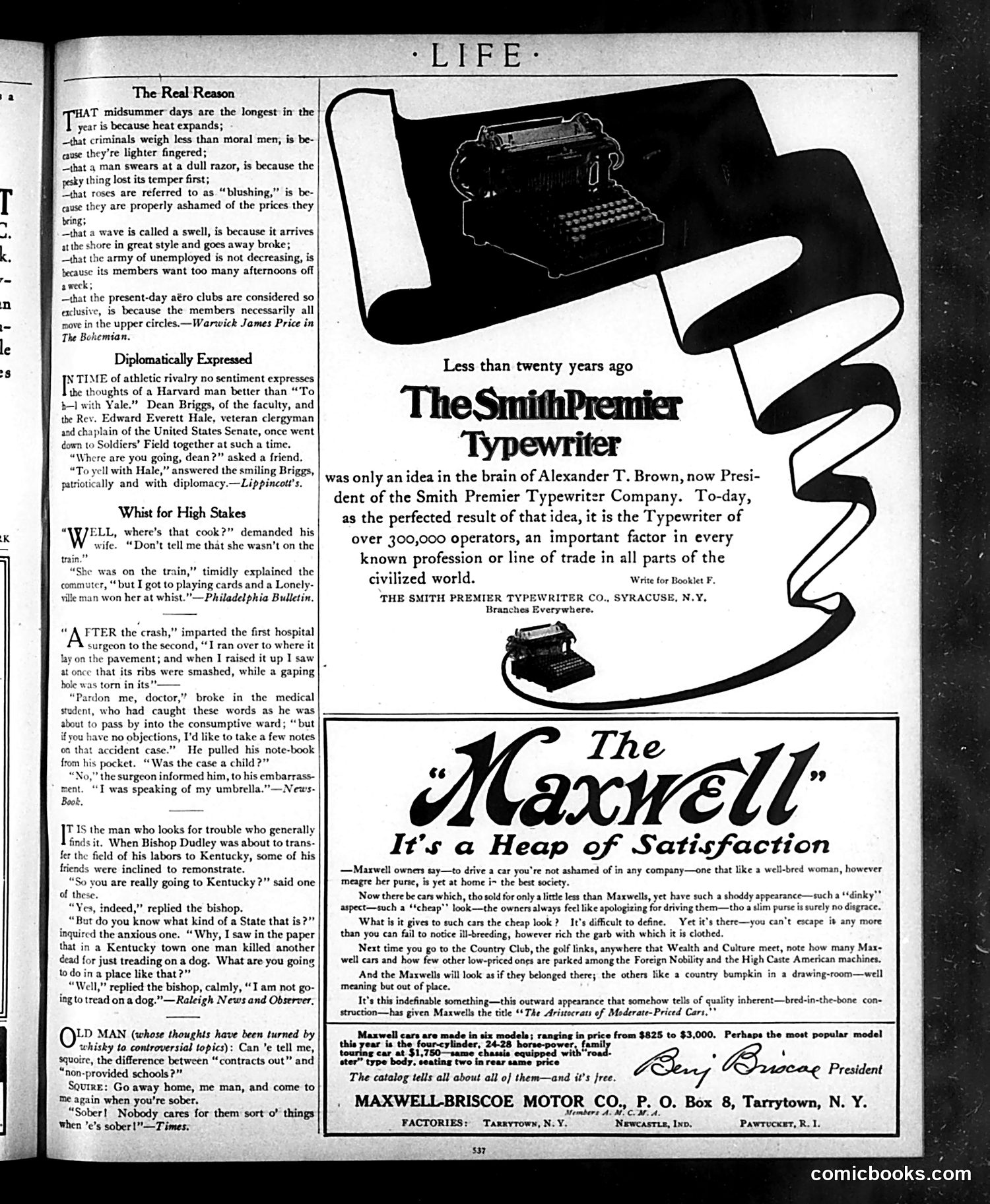
This Life magazine page is predominantly **advertising**, not political commentary. The two main ads are: 1. **Smith Premier Typewriter** — promoting that Alexander T. Brown's idea from twenty years prior has become the typewriter used by over 300,000 operators across professions. 2. **Maxwell automobile** — emphasizing the car's quality and affordability, calling it "The Aristocrat of Moderate-Priced Cars." The left column contains brief humorous anecdotes ("The Real Reason," "Diplomatically Expressed," "What for High Stakes," etc.) — typical of Life's satirical filler content. These are jokes about everyday life, not political cartoons. No identifiable political figures or events are referenced on this page. The content reflects early 20th-century consumer culture and light social humor rather than political satire.
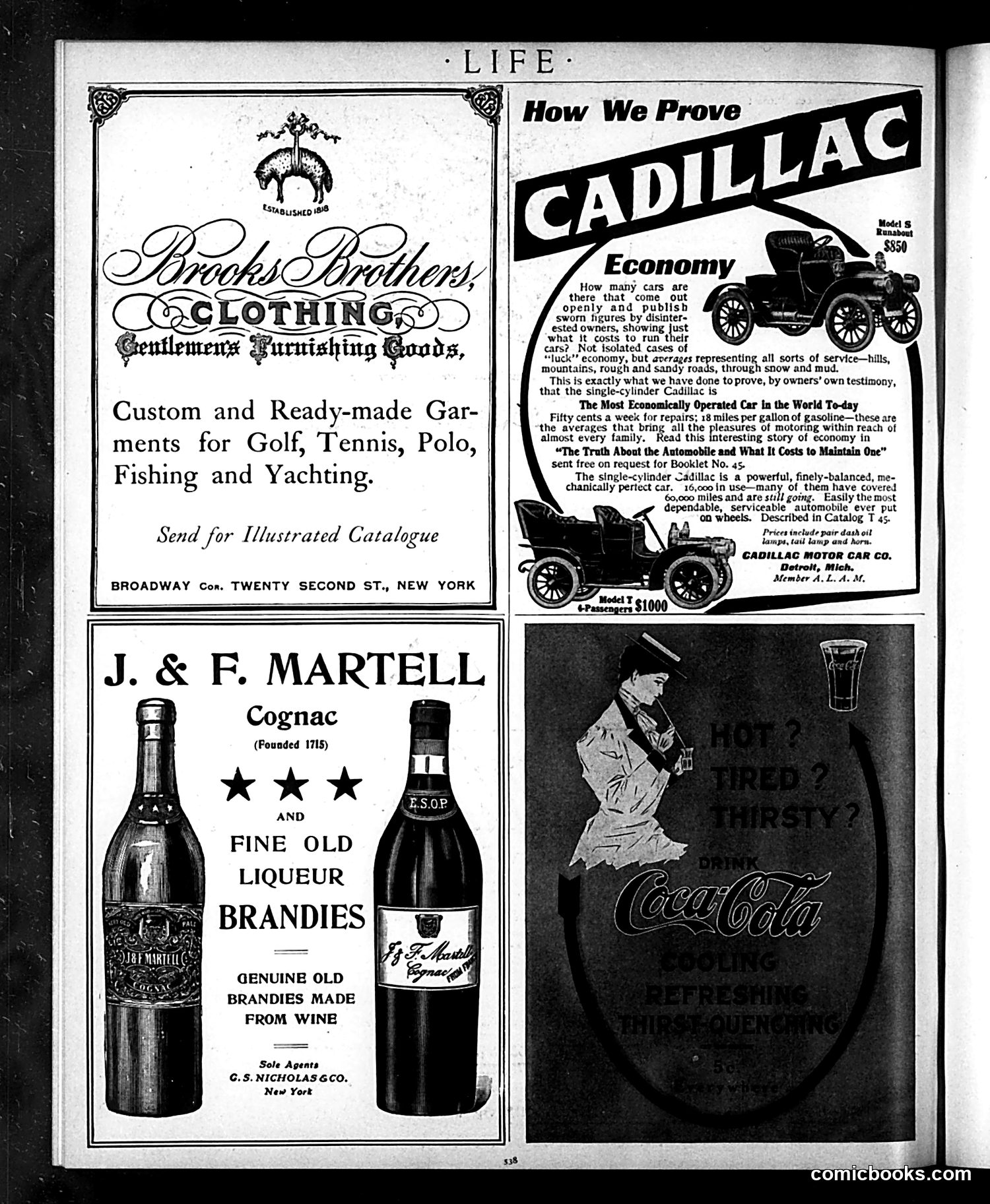
This page is primarily **advertising**, not satire or editorial content. It contains four distinct ads: 1. **Brooks Brothers** - clothing retailer advertising custom and ready-made garments for sports 2. **Cadillac** - automobile ad emphasizing economy and reliability, featuring a Model T comparison 3. **J. & F. Martell** - cognac and brandy advertisement 4. **Coca-Cola** - beverage ad with the slogan "Hot? Tired? Thirsty?" The Cadillac ad is notable for its era-appropriate marketing strategy: contrasting the single-cylinder Cadillac favorably against unspecified competitors (likely Ford's Model T), emphasizing engineering superiority over price competition. This reflects early automotive market positioning before mass production dominated pricing strategy. No political satire or social commentary appears on this page.
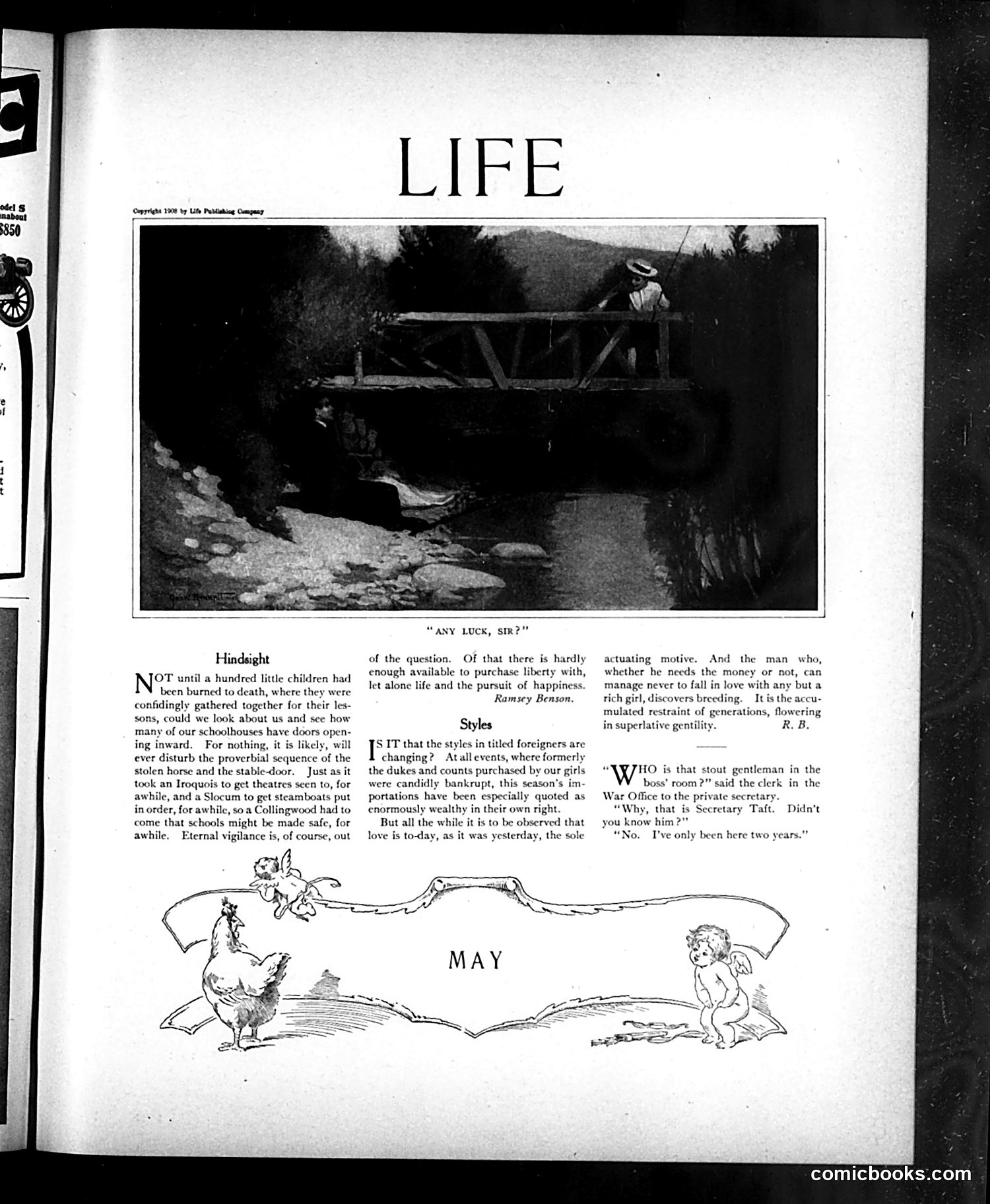
This page from Life magazine (May issue, based on the decorative header) contains three distinct elements: 1. **Photograph**: "Any Luck, Sir?" shows a man fishing from a bridge over a stream, illustrating the caption's question about fishing success. 2. **Editorial Column "Hindsight"**: Criticizes school surveillance policies, arguing that constant monitoring of children undermines their development and creates an atmosphere of distrust rather than fostering genuine responsibility. 3. **"Styles" Section**: Satirizes changing fashion trends among wealthy women, noting that formerly expensive items (like bankrupted bankers' wives wearing "candid bankrupt" styles) are now being imitated by society women, making high fashion less exclusive. The decorative "MAY" banner features cherubs and a rooster, typical of Life's ornamental style from this era.
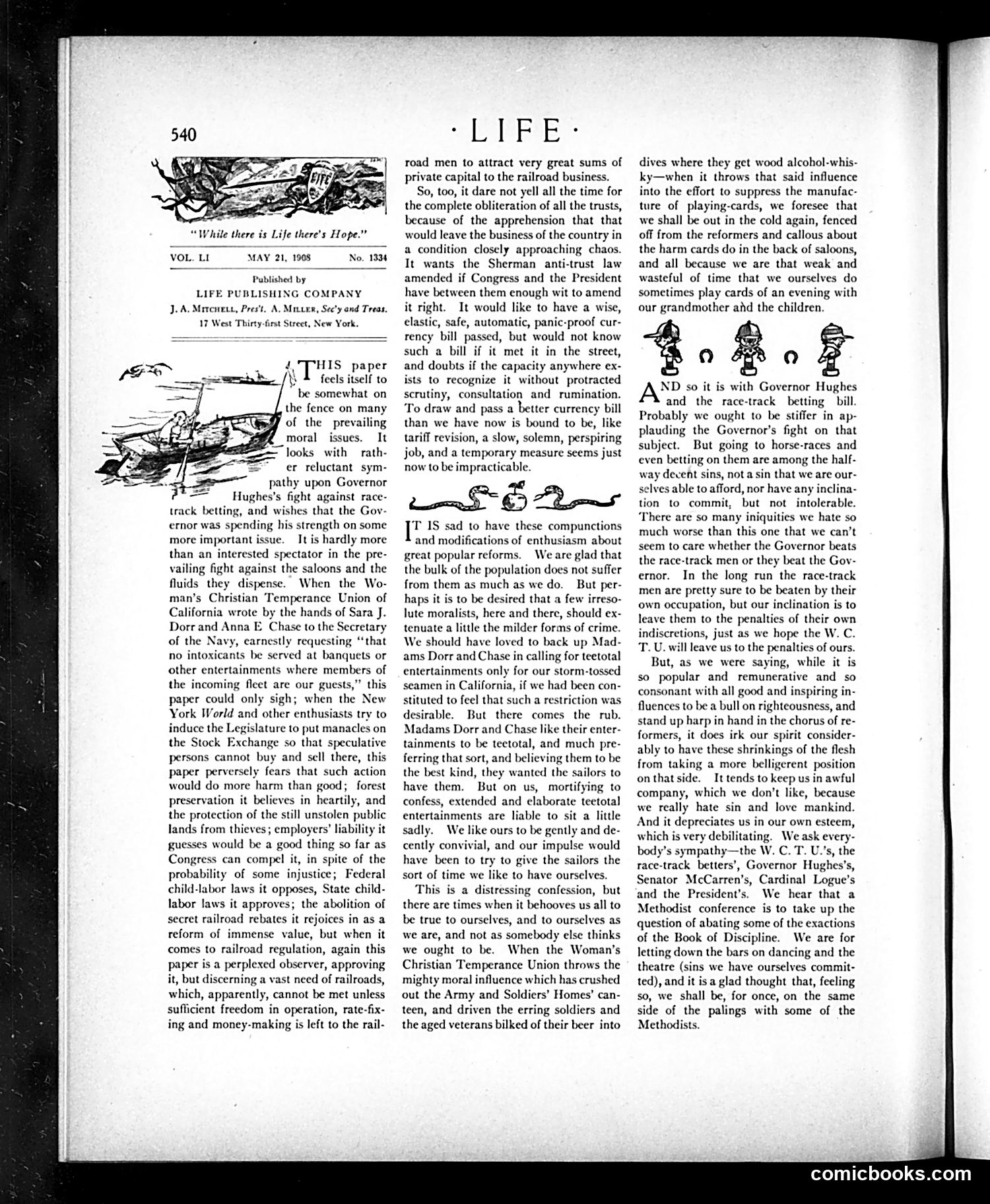
This page contains editorial commentary on several reform issues rather than political cartoons. The text discusses Governor Hughes's fight against horse-race track betting and gambling, referencing concerns about railroad monopolies and trust-busting. The main illustration shows what appears to be a boat or maritime scene, accompanying discussion of moral reform movements. The editorial criticizes the hypocrisy of selective moral crusading—specifically mentioning the Woman's Christian Temperance Union's campaigns against saloons and the Army's restrictions on soldiers' drinking, while overlooking other vices. The piece argues that moral reformers should be consistent and fair-minded rather than imposing selective restrictions they wouldn't accept applied to themselves. It's a critique of reform movements as potentially self-righteous and inconsistently applied.
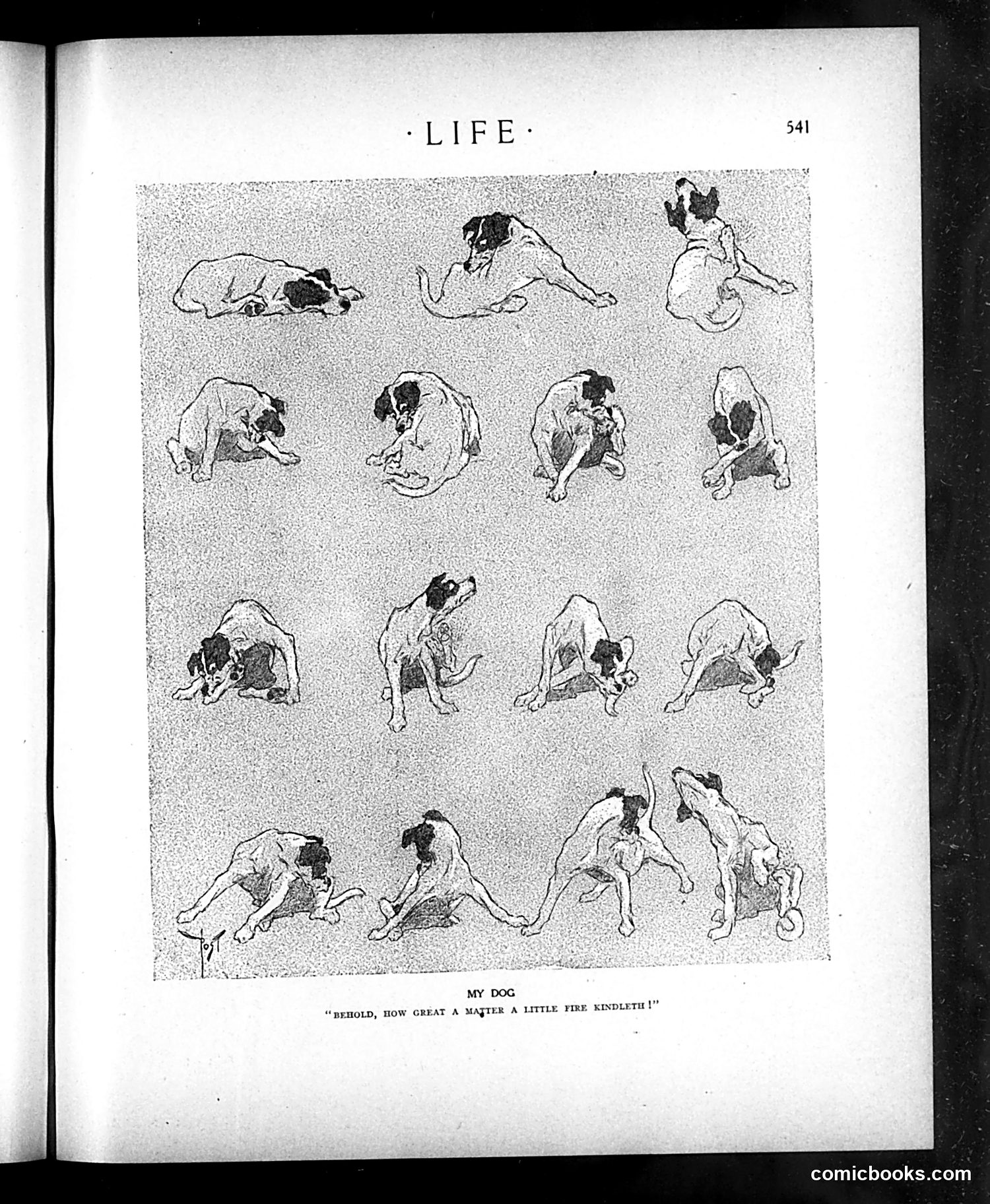
This page from *Life* magazine shows a humorous illustration sequence titled "My Dog" with the caption: "Behold, how great a matter a little fire kindleth!" The image depicts approximately 16 sketches of a dog in various playful, energetic poses—rolling, jumping, running, and interacting with what appears to be fire or flames. The caption is a biblical reference (from James 3:5) about how small things can have great consequences. The satire appears to mock the chaos and unpredictability of pet ownership: a small stimulus (the "fire") causes disproportionate reactions and uncontrollable behavior from the dog. This is likely gentle social humor about the absurd antics pets display over minor stimuli, comparing the dog's exaggerated responses to the biblical warning about small causes producing large effects.
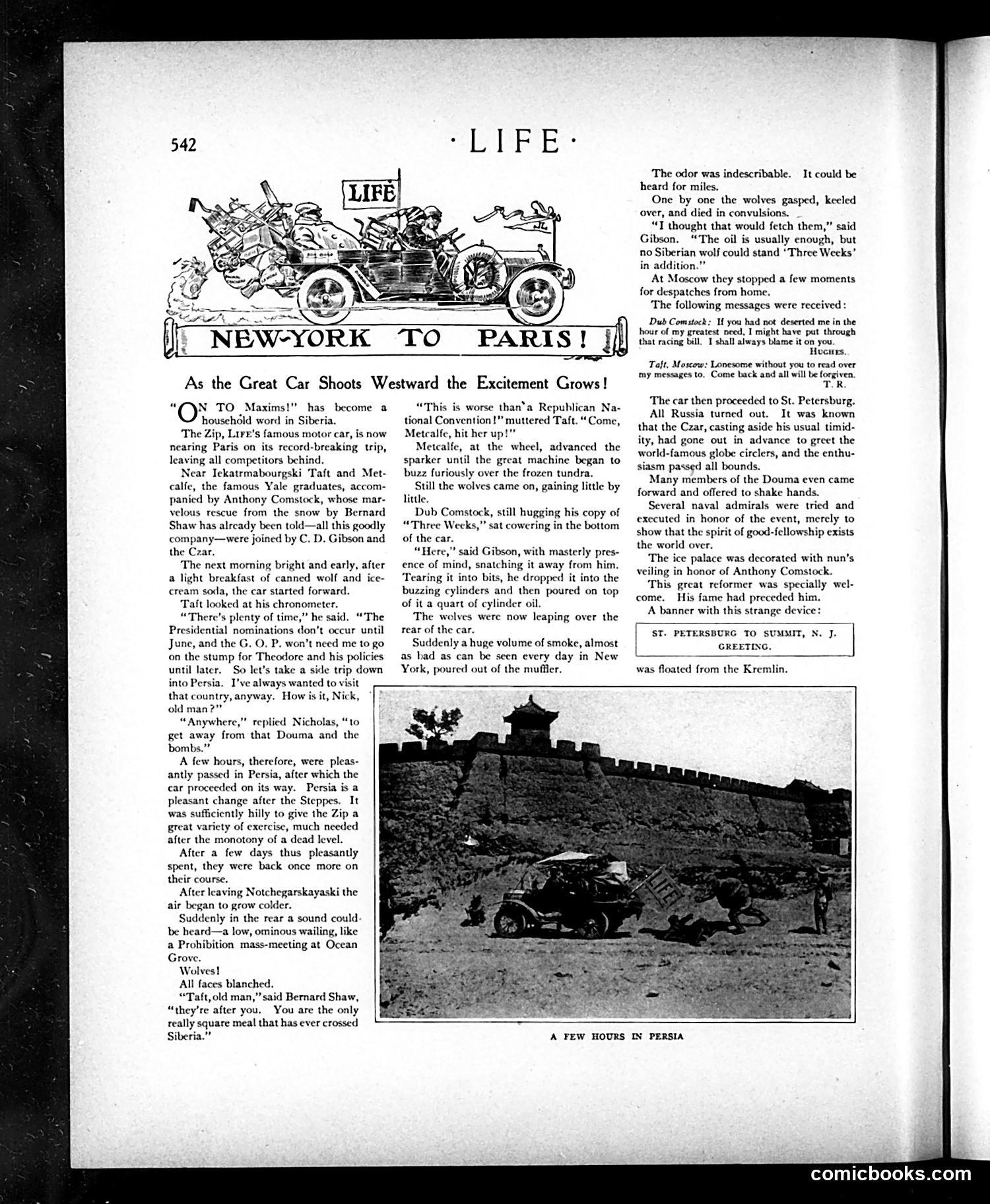
This page depicts a satirical account of an automobile race from New York to Paris. The illustrated masthead shows an overloaded car packed with passengers and luggage, emphasizing the absurdity of the journey. The narrative describes wealthy adventurers—including references to C.D. Gibson, Yale graduates, and Anthony Comstock—attempting this record-breaking trip. The text mocks their pretensions through dialogue and commentary, with characters like "Taft" and "Gibson" making self-important pronouncements. The satire targets Gilded Age excess: the ostentatious ambition of wealthy men undertaking dangerous "adventures," their disregard for practical obstacles (wolves, harsh terrain), and their self-congratulatory attitudes. References to "Prohibition mass-meetings" and political figures suggest broader social commentary on American hubris and moral posturing during the Progressive Era.
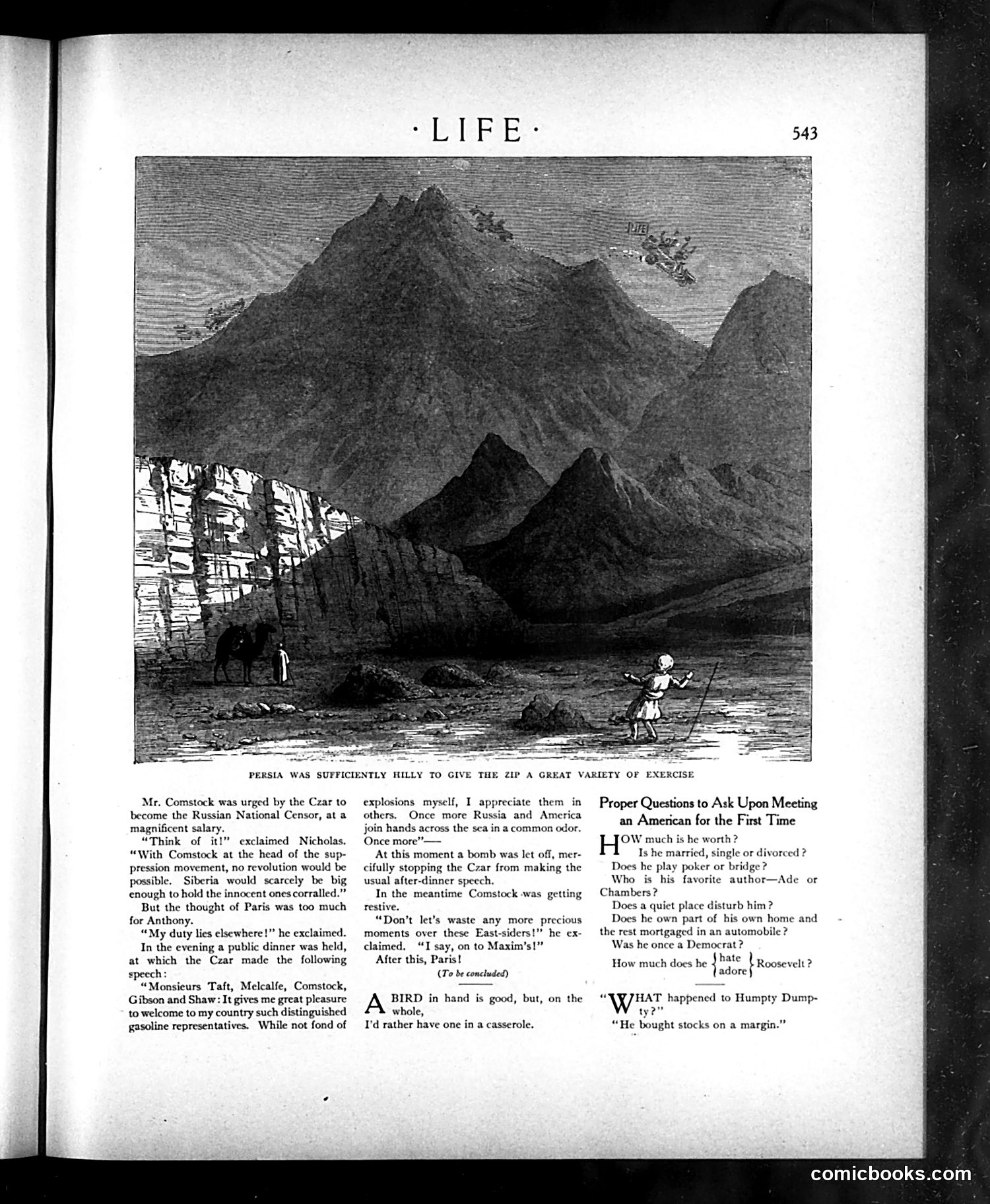
The main illustration depicts a mountainous landscape with what appears to be a wooden structure or boat on the left and figures in the foreground. The caption reads: "PERSIA WAS SUFFICIENTLY HILLY TO GIVE THE ZIP A GREAT VARIETY OF EXERCISE." The accompanying text discusses Mr. Comstock being urged by the Czar to become Russian National Censor, with Nicholas exclaiming "Think of it!" The passage satirizes Comstock's censorship activities by humorously suggesting he would find work in Russia. The joke appears to reference Anthony Comstock, the famous American moral crusader and censor, implying his rigorous censorship would suit an autocratic Russian regime. The lower section contains unrelated content including "Proper Questions to Ask Upon Meeting an American for the First Time" and a brief exchange about "Humpty Dumpty."
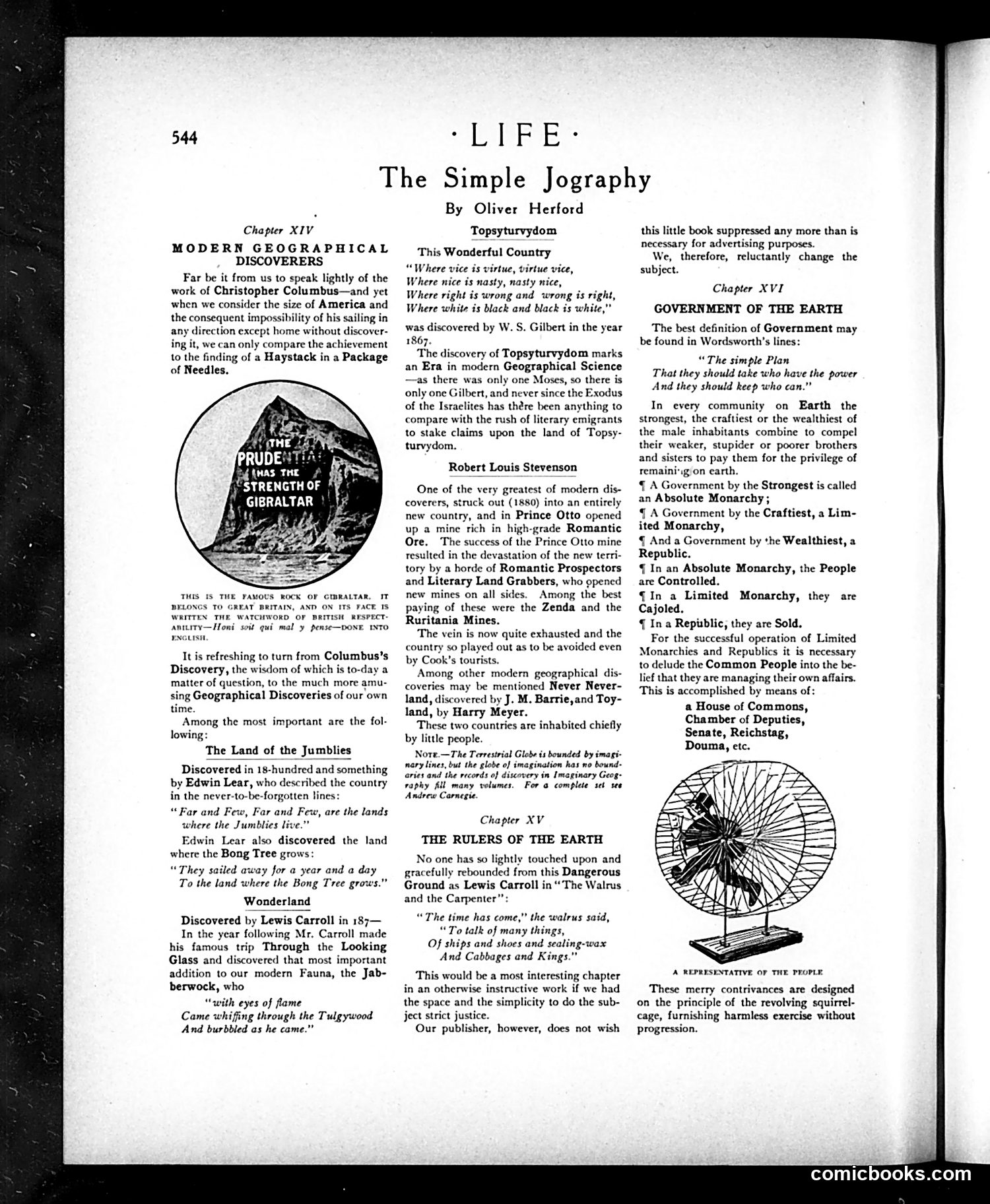
This page is primarily **educational content, not political satire**. It's Chapter XIV from Oliver Herford's "The Simple Jography," a humorous geography book. The main illustration shows the **Rock of Gibraltar** labeled with "Prudentia" and "Strength of Gibraltar"—a classical reference to the famous British military fortress as a symbol of strength and prudence. The text discusses geographical discoveries (Columbus, modern explorers) and Chapter XVI explains forms of government: absolute monarchies, limited monarchies, and republics. The revolving-squirrel illustration represents "A Representative of the People"—a gentle joke implying ordinary citizens spin in circles like hamsters in a cage. The satire is mild: poking fun at democratic representation rather than attacking specific figures or events.
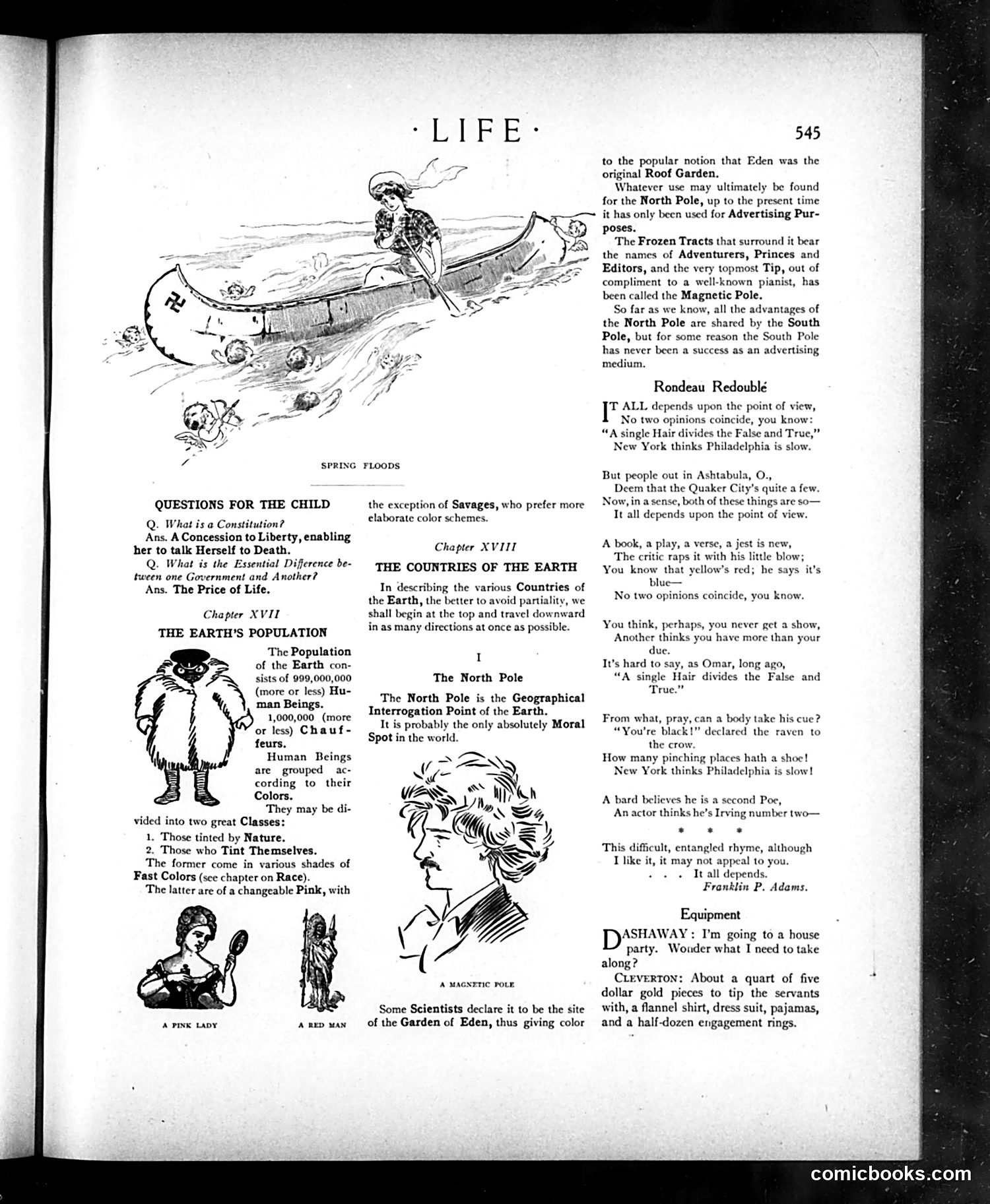
This page contains satirical content about geographical and racial classification systems. The top illustration depicts Arctic exploration, mocking the "Magnetic Pole" naming convention used to advertise products in polar regions. The main section, "The Earth's Population," classifies human beings into racial categories using period-typical crude stereotypes: "Fine Lady," "Red Man," and others grouped by "Colors." The text states humans are "divided into two great Classes" based on appearance. The "Rondeau Redoublé" poem satirizes regional prejudices, suggesting different American cities hold contradictory opinions about each other—mocking local pride and provincial attitudes. The "Equipment" dialogue jokes about preparing for a house party with minimal but absurd necessities, including "engagement rings." This reflects early-20th-century satire addressing racial pseudoscience and American social pretension.
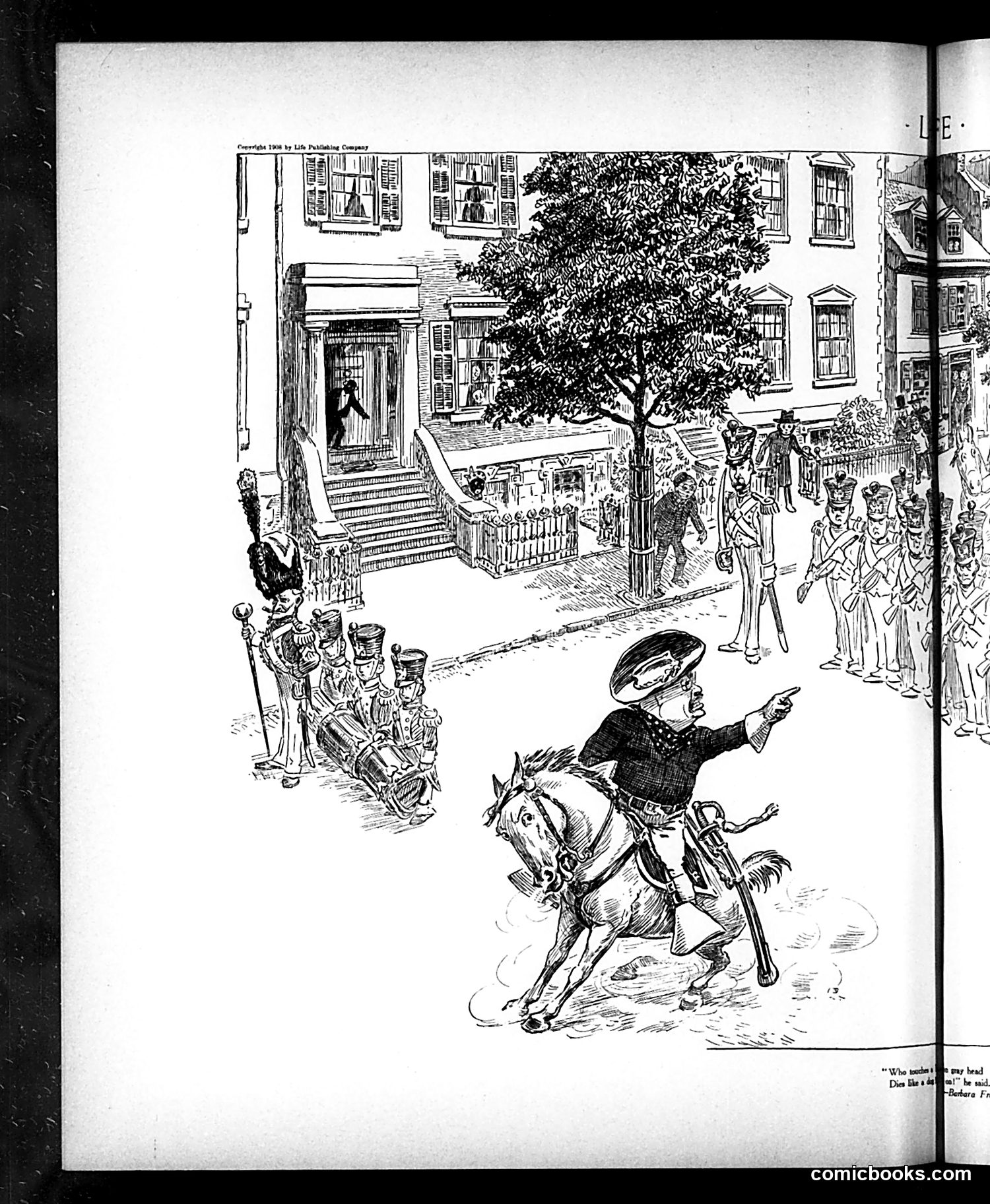
This 1908 *Life* magazine illustration depicts a military officer on horseback pointing and directing attention, while uniformed soldiers stand at attention on the left. A crowd of civilians gathers on the right near a residential building with a large tree. The cartoon appears to satirize military authority and command during the early 1900s. The officer's dramatic gesture and prominent positioning suggest he's issuing orders or making declarations to both military and civilian populations. The contrast between the formal military contingent and ordinary citizens implies commentary on civil-military relations or perhaps military overreach into civilian affairs. Without visible caption text, the specific political reference remains unclear, though it likely relates to contemporary military or political events of 1908.
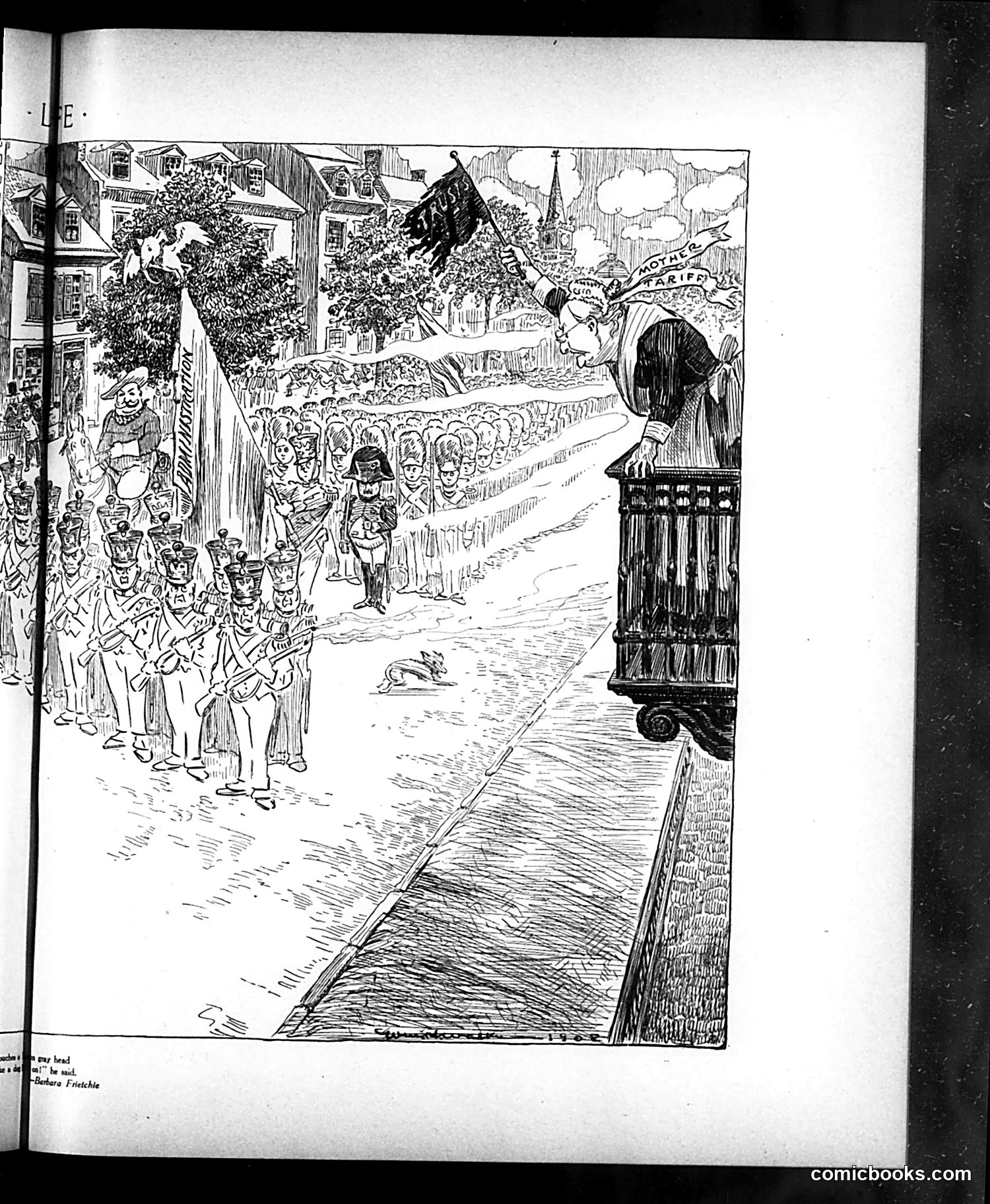
This illustration depicts the famous legend of Barbara Fritchie, a Civil War-era figure from Frederick, Maryland. The cartoon shows an elderly woman defiantly waving a Union flag from a balcony while Confederate soldiers march past below. According to popular legend (later immortalized in John Greenleaf Whittier's 1864 poem), Fritchie boldly displayed the American flag despite Confederate occupation, declaring "Shoot if you must this old gray head, but spare your country's flag." The image satirizes or commemorates this act of patriotic defiance—a civilian woman's courage against military authority. The crowded street of soldiers contrasts with her solitary figure above, emphasizing individual moral conviction against institutional power. The cartoon likely appeared during or after the Civil War period.
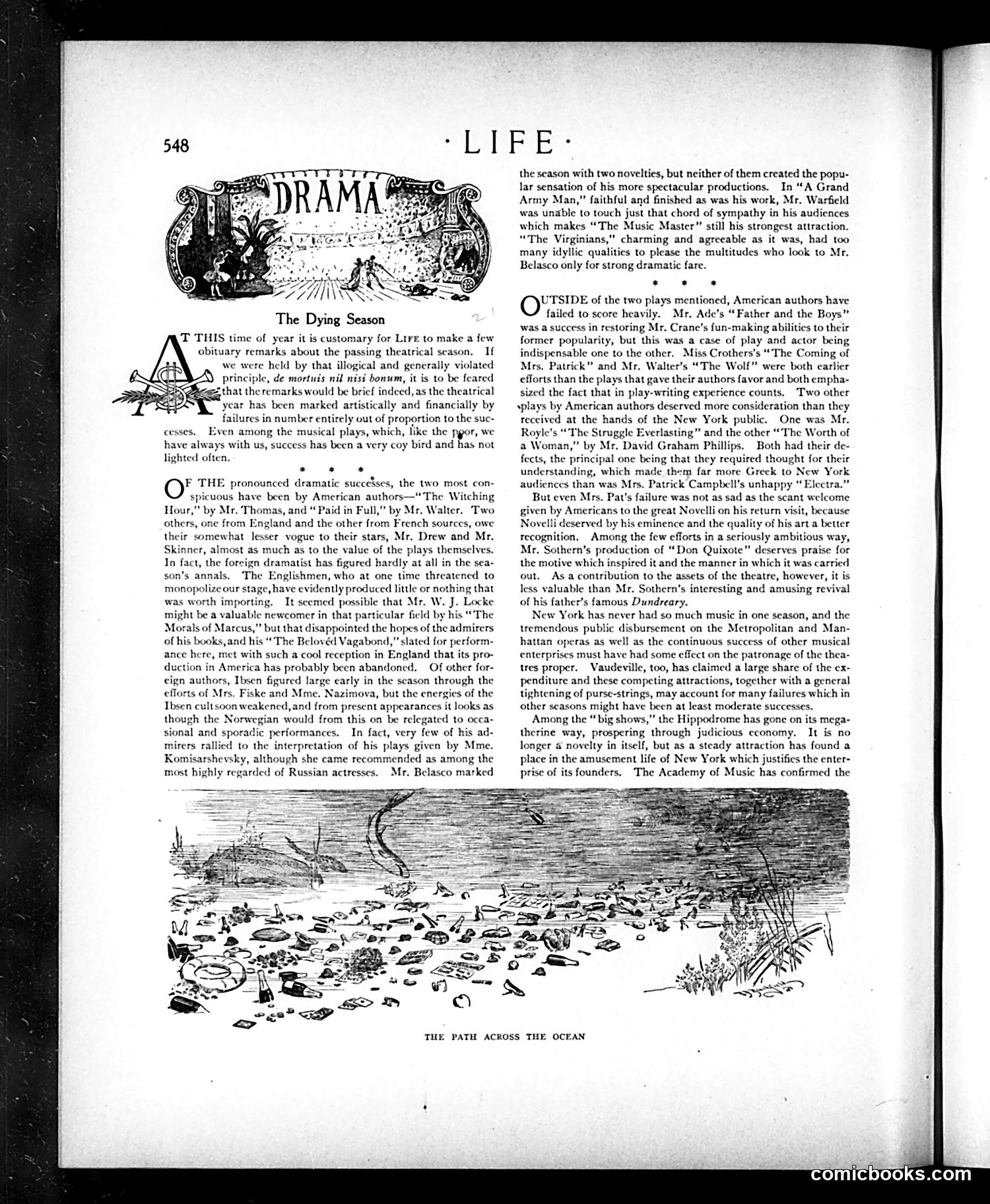
This page reviews the theatrical season, using "dying" as metaphor for a disappointing year. The text criticizes American and foreign drama as largely unsuccessful. **Key points:** - Only two American plays succeeded: "The Witching Hour" (Thomas) and "Paid in Full" (Walter) - Foreign dramatists disappointed—English imports proved worthless; Ibsen's popularity waned despite Mme. Nazimova's efforts - David Belasco's two productions underperformed despite his reputation - American playwrights like Ade, Crothers, and Walter showed talent but required experienced actors to succeed - The article laments that audiences rejected serious drama (like Eleonora Duse's "Electra") while preferring lighter fare **The illustration** ("The Path Across the Ocean") depicts theatrical debris scattered on a beach—likely satirizing failed European dramatic imports washing ashore in America. The overall tone is snobbish disappointment in popular theatrical taste.
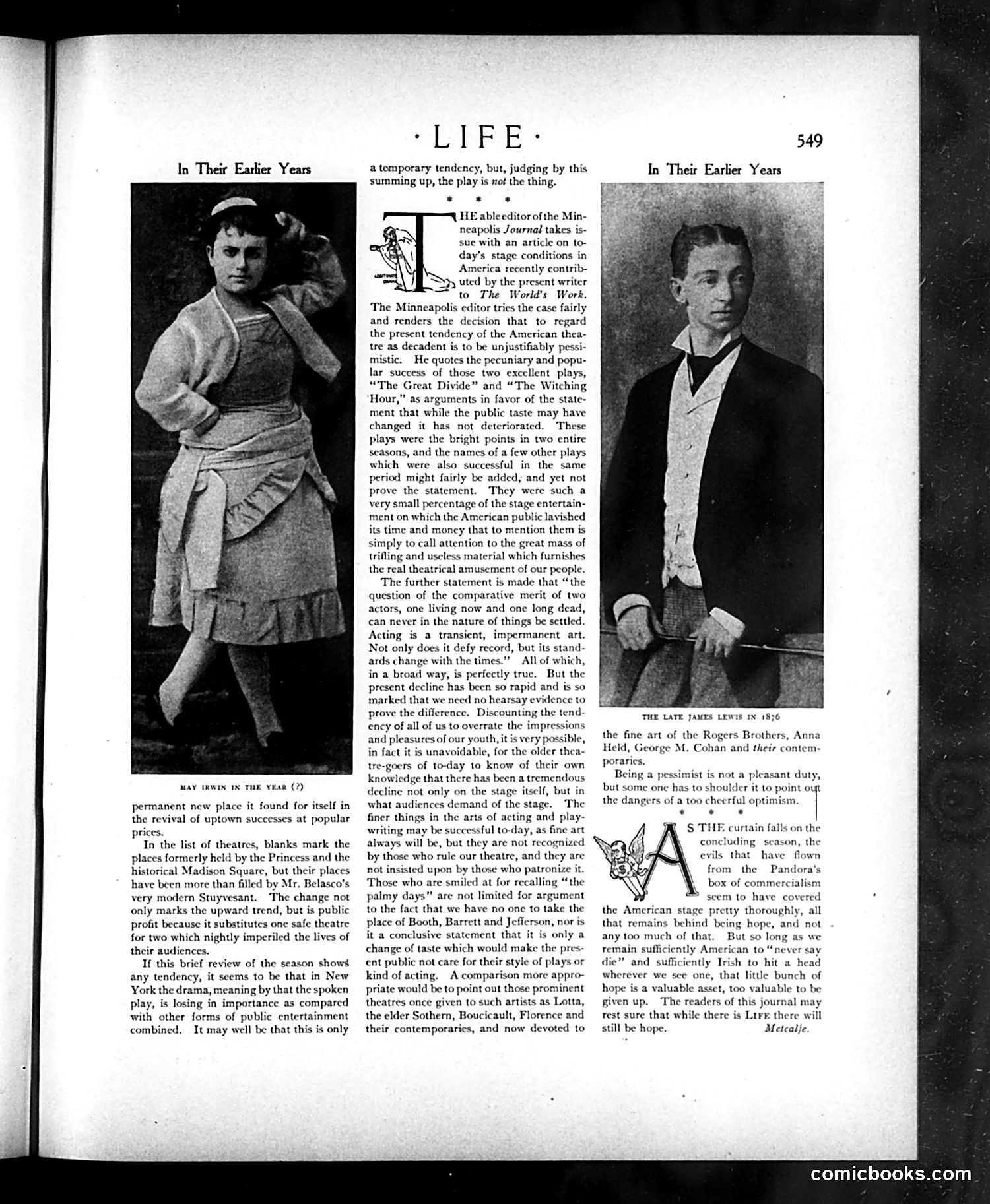
This page examines the decline of American theatrical art. The text argues that while some successful plays exist (citing "The Great Divide" and "The Witching Hour"), they represent a tiny fraction of stage entertainment, which is dominated by "trifling and useless material." The two photographs compare performers from different theatrical eras—**May Irwin** (identified by caption as from an earlier year) and **James Lewis in 1876** (identified in the right photo). The implicit argument is that earlier actors like Lewis represented a higher standard of performance, whereas contemporary performers lack comparable merit. The author contends that the decline is measurable and real, not merely nostalgia. The article claims that fine theatrical arts are undervalued in modern theater, and audiences no longer demand or recognize quality acting and playwriting. The comparison of past and present performers illustrates this deterioration visually.
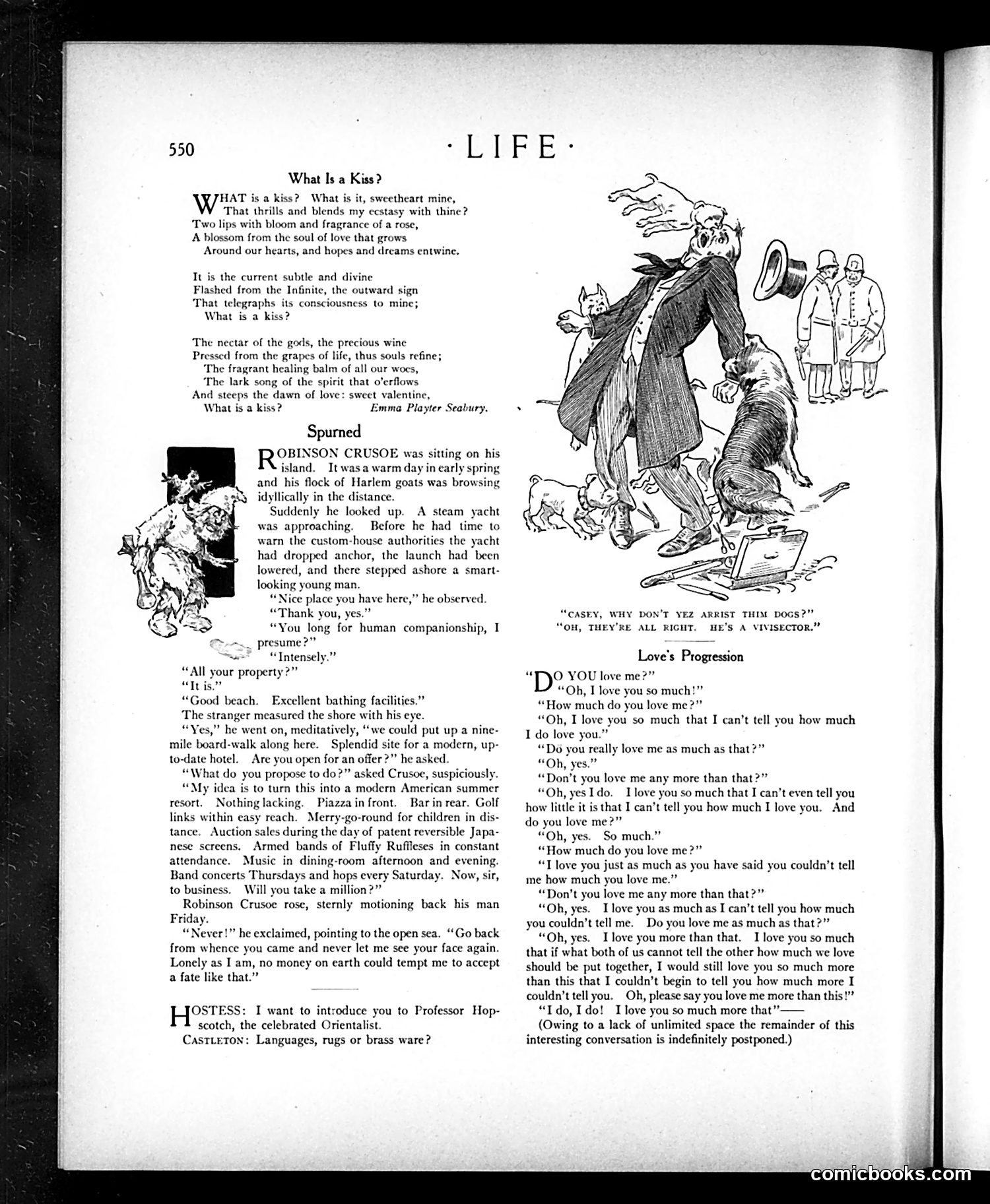
This page contains three distinct satirical pieces: **"What is a Kiss?"** — A sentimental poem by Emma Playter Seabury using flowery romantic language ("nectar of the gods," "soul of love") to describe kissing. The satire is gentle, poking fun at overwrought Victorian sentimentality. **"Spurned"** — A cartoon satirizing American commercial development and greed. A wealthy businessman arrives at Robinson Crusoe's isolated island offering a million dollars to develop it into a modern resort with board-walks, hotels, golf links, and "Fluffy Ruffleses" (appears to reference a contemporary vaudeville act). Crusoe rejects the offer, preferring solitude to commercialization. The satire critiques American entrepreneurial excess and the commodification of natural spaces. **"Love's Progression"** — A dialogue satirizing couples' repetitive expressions of love, where both parties endlessly restate affection in increasingly circular and nonsensical language. The satire mocks the verbosity and redundancy of romantic discourse, concluding that the conversation is "indefinitely postponed" due to space constraints—suggesting it could continue meaninglessly forever.
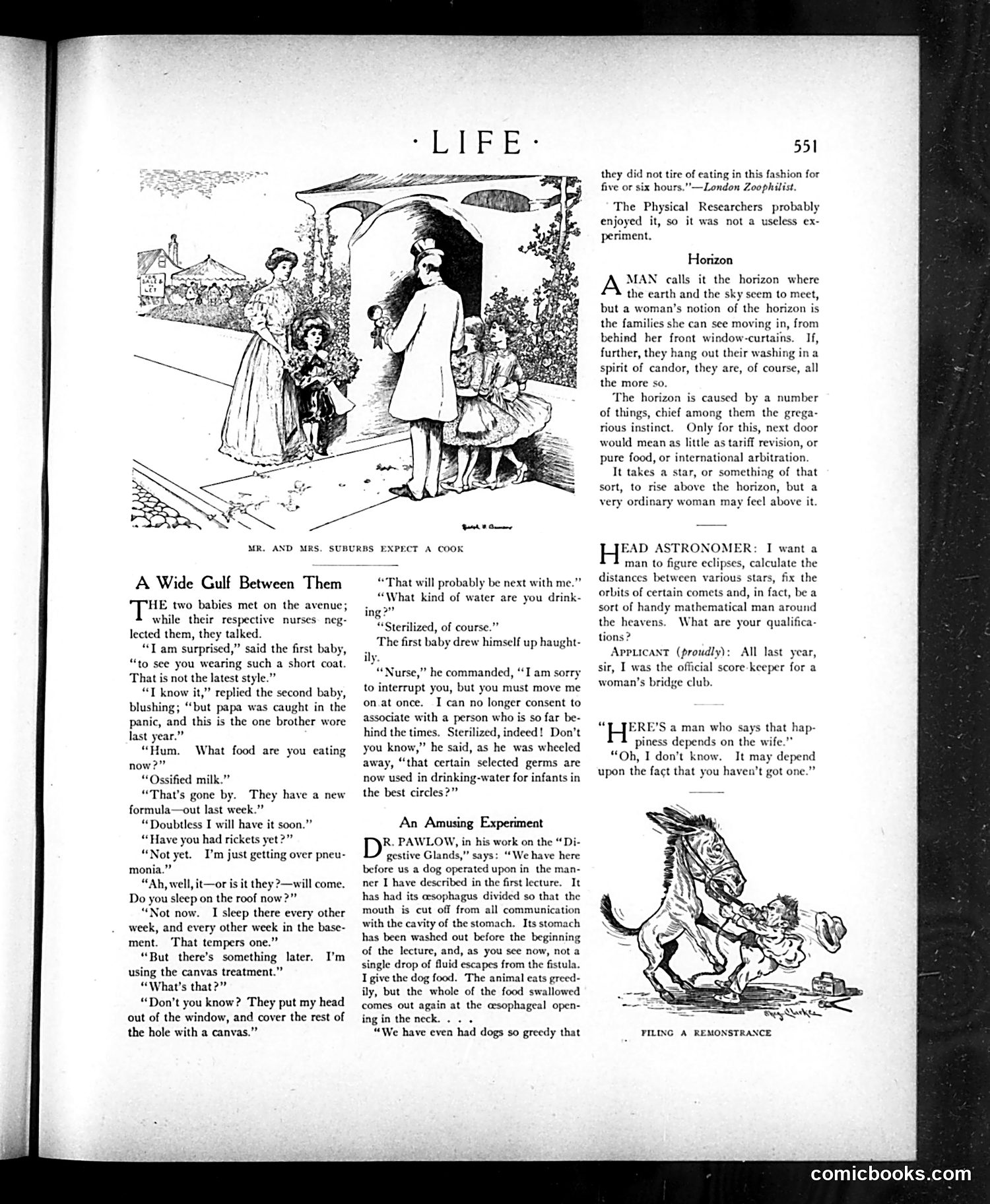
This page contains three separate satirical pieces mocking early 20th-century American social anxieties: **"A Wide Gulf Between Them"** depicts two babies whose nurses neglect them, conversing as snobbish adults. The satire targets parental obsession with fashionable child-rearing trends—sterilized milk, rickets, pneumonia, roof-sleeping, and "canvas treatment" (exposing children to fresh air). The humor lies in babies judging each other's social status by these faddish health practices, mocking how parents adopt trendy theories to signal superiority. **"Horizon"** provides tongue-in-cheek commentary on women's limited worldview, suggesting women's horizons extend only to observing neighbors' activities through windows and laundry—a dig at domesticity and gossip. **The remaining sections** include a scientific anecdote about dogs repeatedly eating food that passes through a surgically-divided esophagus (commentary on scientific detachment), and brief jokes about astronomers and marriage. The page satirizes status-seeking, pseudoscientific parenting fads, and gender stereotypes common to the era.
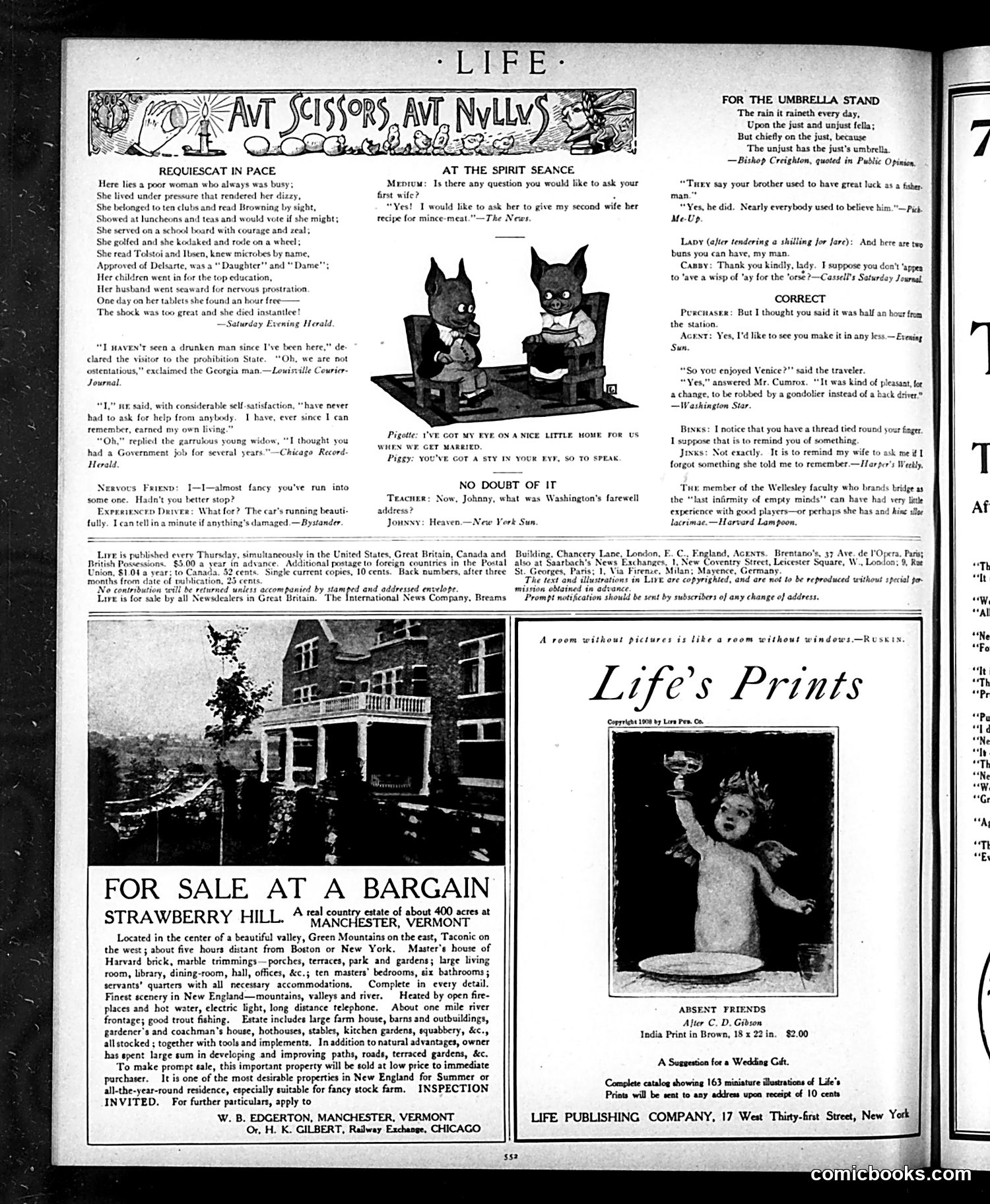
This page contains multiple short humorous anecdotes and jokes typical of Life magazine's satirical format, rather than traditional political cartoons. **Key content:** The "Spirit Séance" cartoon depicts two cat-like figures at a séance, representing common parlor entertainment of the era. The jokes mock contemporary social pretensions and hypocrisy: a woman dies from overwork despite her progressive interests (Browning, Delsarte, women's organizations); a Georgian boasts of no drunkenness while implying prohibition is merely theatrical; a man claims self-sufficiency while having held government jobs. Other jokes target marital dynamics, class differences (a lady offering "tee buns" to a cabman), tourist experiences (Venice robbery), and academic snobbery (a Wellesley professor dismissing bridge as shallow). **Context for modern readers:** These reflect early 20th-century American social anxieties—women's expanding roles and education, prohibition-era hypocrisy, and middle-class pretension—presented through gentle satire rather than sharp political critique.
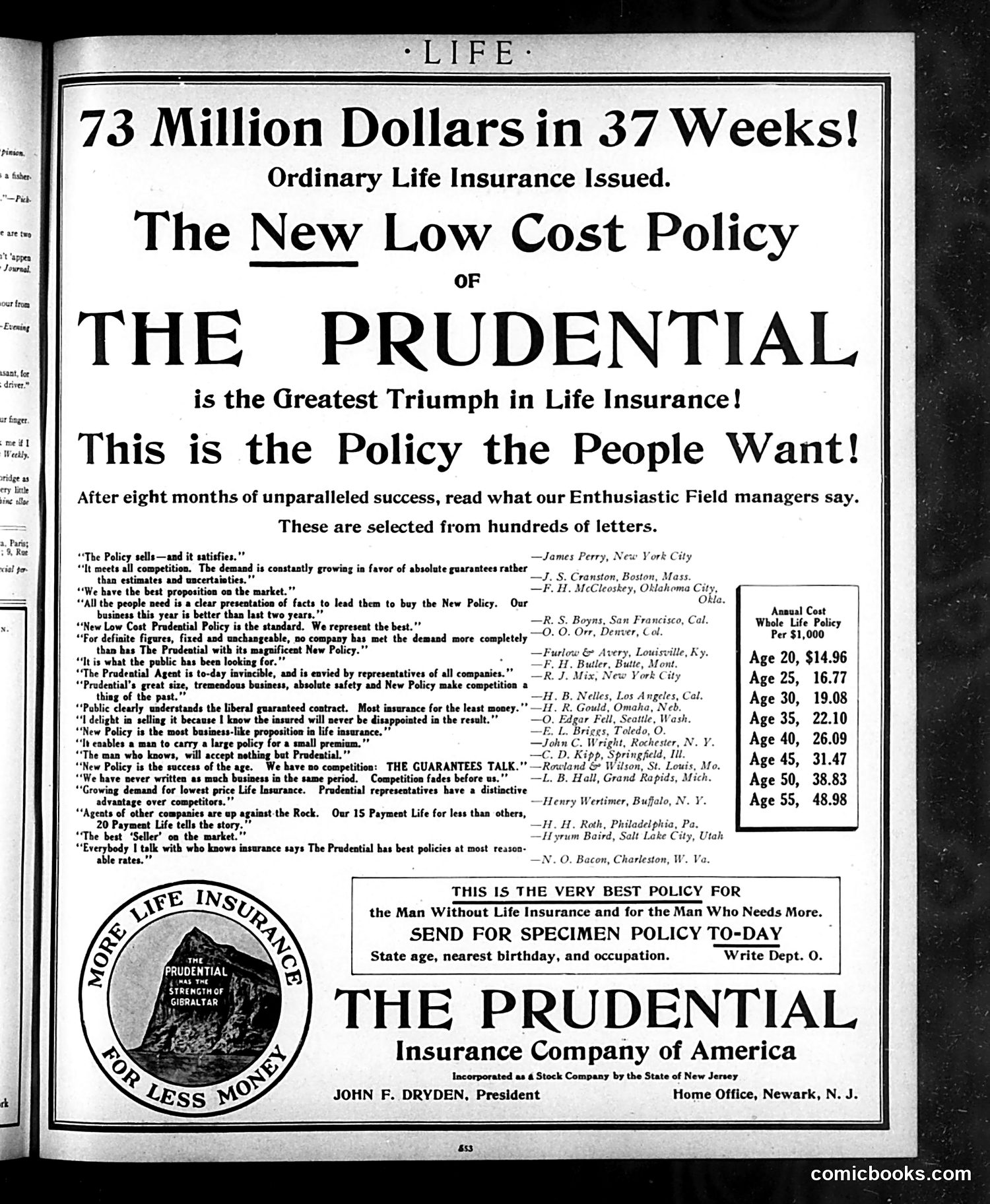
This is not a cartoon or satire—it's a straightforward **insurance advertisement** from Life magazine's early era (Life began in 1883 as a humor/satire publication but carried advertisements). The Prudential Insurance Company is promoting its "New Low Cost Policy" for ordinary life insurance. The headline claims $73 million in policies were issued in 37 weeks, positioning this as revolutionary success. The page features testimonials from field managers praising the policy's competitiveness, guaranteed contracts, and affordability. A price table shows annual costs ranging from $14.96 (age 20) to $48.98 (age 55) per $1,000 of coverage. The company's logo emphasizes "More Life Insurance for Less Money"—their marketing angle. **For modern readers:** This demonstrates early 20th-century life insurance marketing, before modern regulation. The breathless claims and testimonial format were standard advertising of the era. The Prudential (still operating today) used this aggressive sales campaign to establish market dominance.
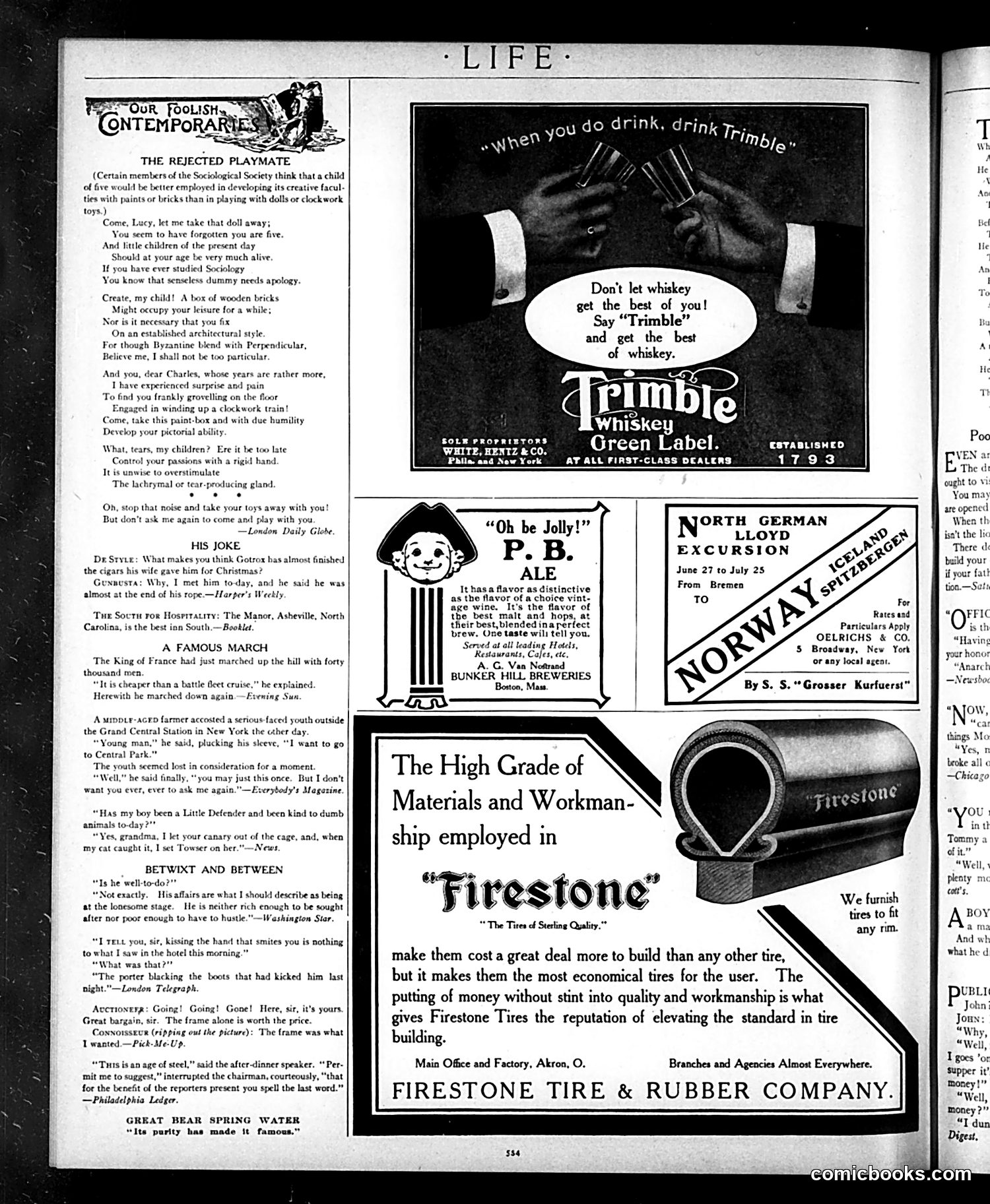
This page from Life magazine (a satirical publication, not the modern photo magazine) contains several distinct pieces: **"The Rejected Playmate"** is the main cartoon, satirizing early-20th-century progressive educational theory. Progressive reformers—specifically members of the "Sociological Society"—argued that five-year-old children should develop creativity through construction (building blocks, painting) rather than imaginative play with dolls or toy trains. The cartoon mocks this ideology by showing a stern adult forbidding a child from playing with her doll, insisting she use "wooden bricks" instead. The child's tears reveal the emotional cost of this rigid, joyless educational philosophy. The satire criticizes over-intellectualized child-rearing as emotionally damaging. The remainder consists of short humorous anecdotes and advertisements typical of the era, including ads for Trimble whiskey, P.B. ale, and Firestone tires—standard commercial content mixed with satirical commentary on contemporary life.
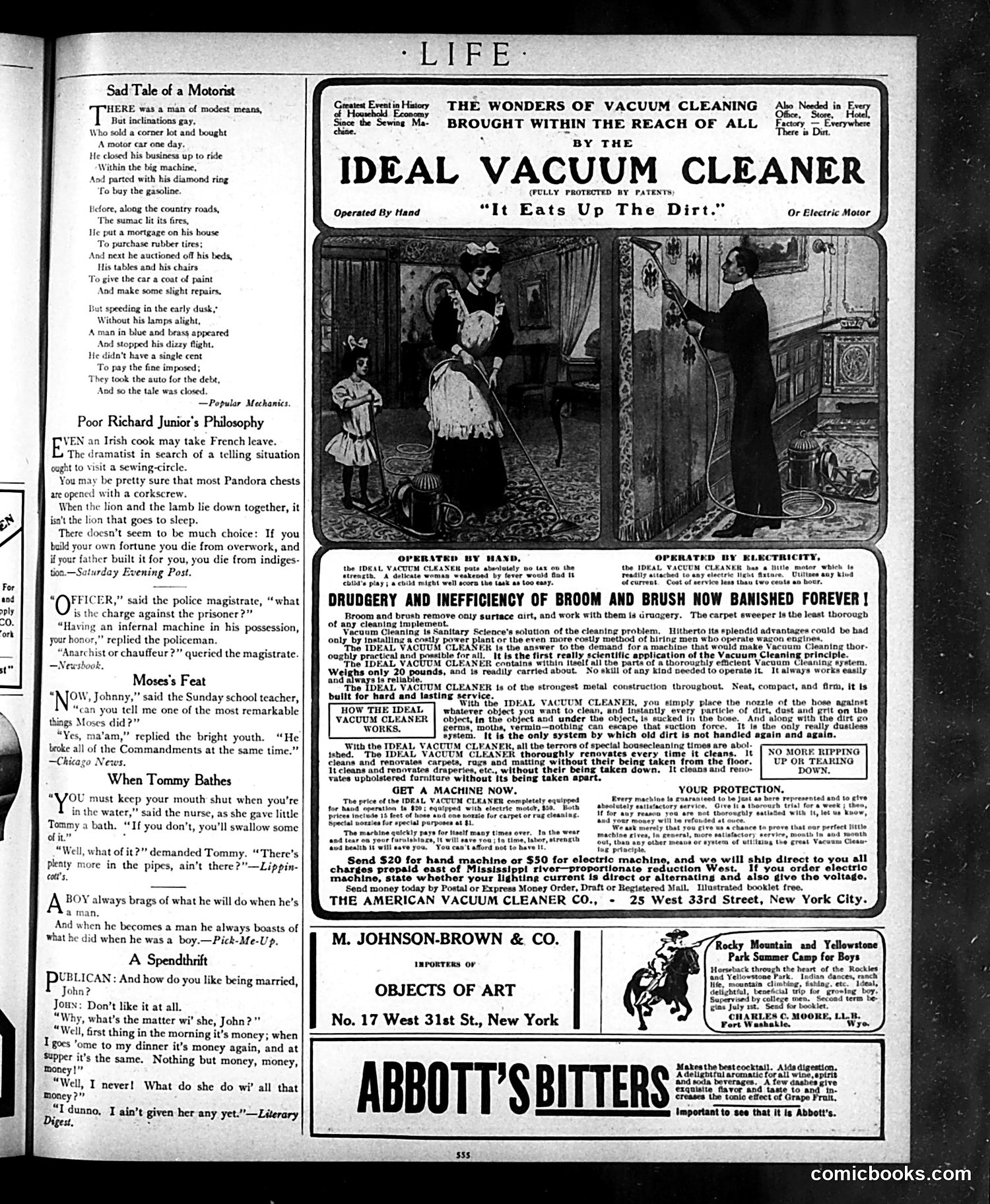
This page is primarily **advertising and humorous prose**, not political satire. The left column contains comic verses and anecdotes mocking everyday frustrations: **"Sad Tale of a Motorist"** satirizes the automobile craze of the early 1900s—a man sells everything (house, furniture, jewelry) to buy a car, then loses it to fines. The joke critiques the obsessive materialism around the new technology. **"Poor Richard Junior's Philosophy"** offers sardonic observations on daily life (Irish cooks, Pandora boxes opened with corkscrews, etc.)—mild social commentary on human nature. **Other vignettes** mock domestic situations: a priest/officer confusion, religious instruction mishaps, marriage complaints about money-seeking wives. The **right side is dominated by a full-page advertisement** for the Ideal Vacuum Cleaner, targeting housewives by promising to eliminate "drudgery" of brooms and brushes through new "sanitary science." **Overall**: This is a typical Life magazine page blending lightweight social humor with commercial advertising, reflecting early-20th-century consumer culture and gender roles.
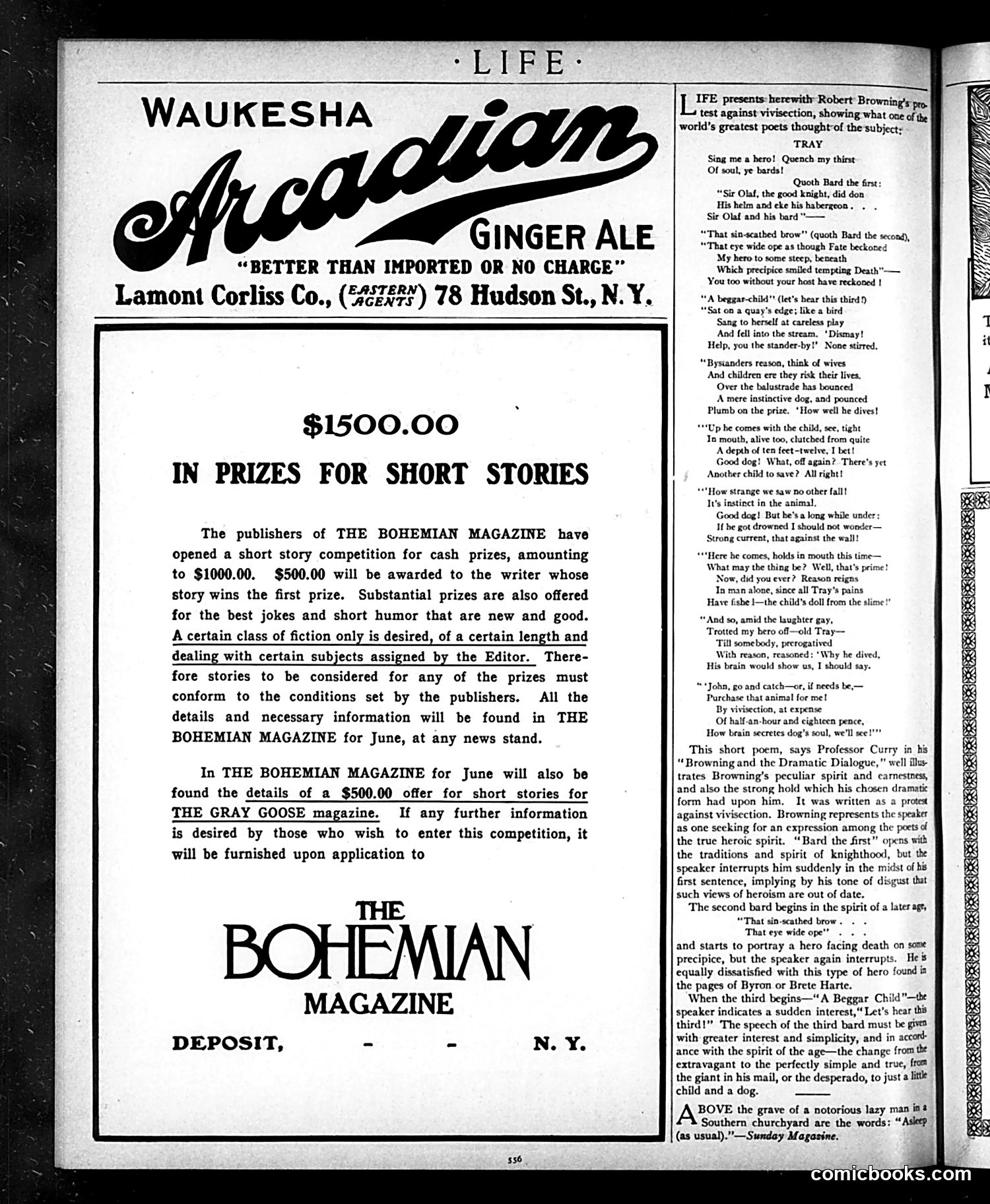
This page consists primarily of **advertisements and literary content**, not political satire. The left side advertises Waukesha Ginger Ale and announces a $1,500 short-story competition by *The Bohemian Magazine*. The right side presents Robert Browning's poem **"Tray,"** introduced as his protest against vivisection (animal experimentation). The poem contrasts three definitions of heroism: a knight's valor, a Romantic poet's passionate idealism, and a dog's instinctive selflessness. Browning's satire targets the final twist—that "reasonable" humans would capture and dissect the heroic dog to study its brain, reducing noble instinct to scientific commodification. **For modern context:** Vivisection was a heated Victorian controversy between scientists and animal-rights advocates. Browning's poem mocks how rationalism and scientific progress can strip away moral consideration for living beings.
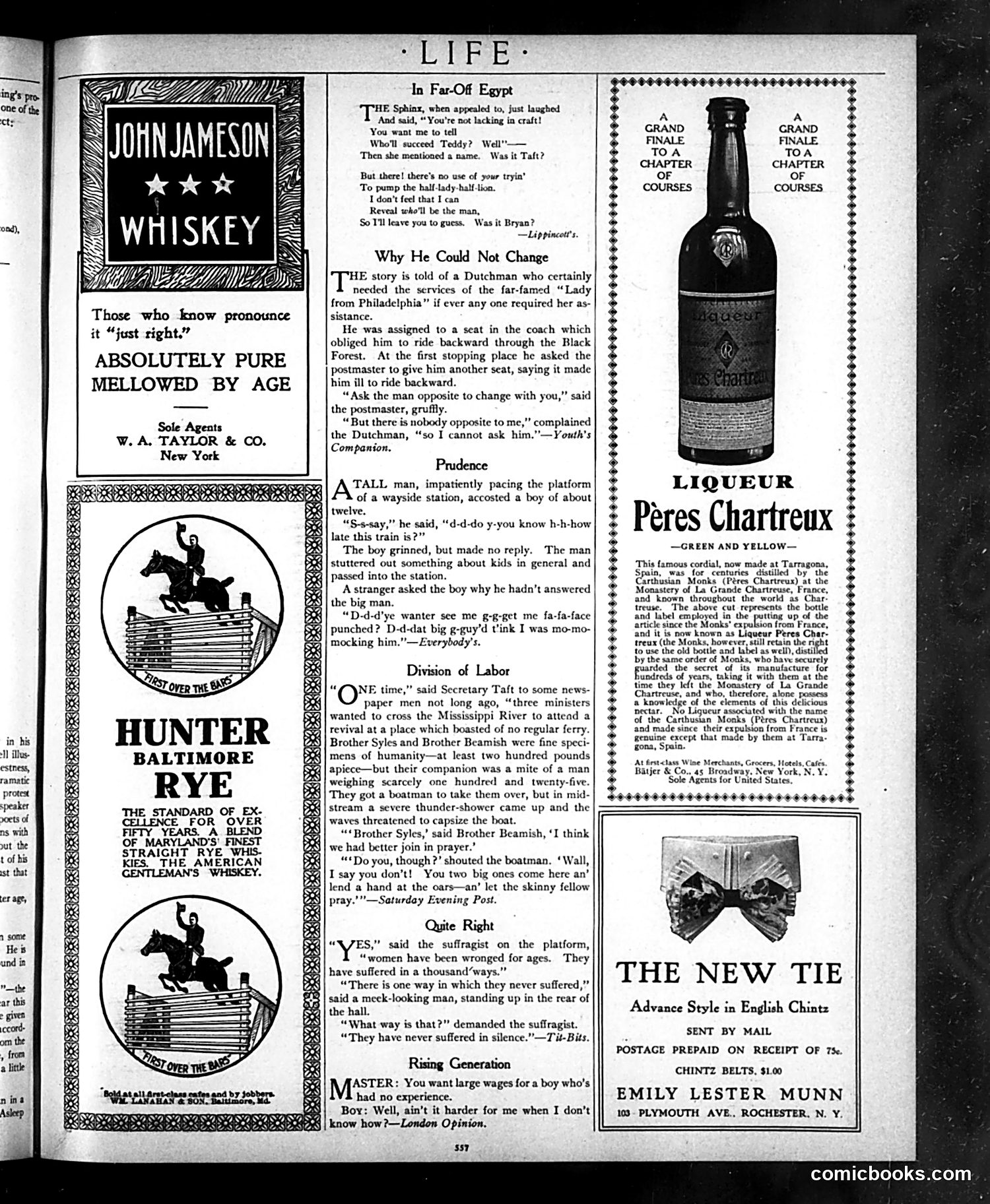
This page combines humorous anecdotes with period advertisements. The jokes reference contemporary figures and issues: **"In Far-Off Egypt"** is a riddle-poem playing on uncertainty about who will succeed President Theodore Roosevelt. It mentions "Taft" and "Bryan"—likely William Howard Taft (Roosevelt's eventual successor) and William Jennings Bryan (three-time presidential candidate). The Sphinx represents unknowability. **Other brief humor pieces** follow standard early-1900s formats: absurdist scenarios about mishearing, awkward situations, and wordplay—typical of magazines like *Youth's Companion* and *Saturday Evening Post*. **The advertisements** dominate: Hunter Baltimore Rye whiskey emphasizes aristocratic masculine appeal; Liqueur Pères Chartreux markets an exotic French cordial; Emily Lester Munn advertises "Chintz Belts" ($1.00). The page reflects Edwardian-era magazine culture—mixing light satire, genteel humor, and luxury goods marketing aimed at educated middle/upper-class readers. No sharp political critique appears; the content is entertainment and commerce.
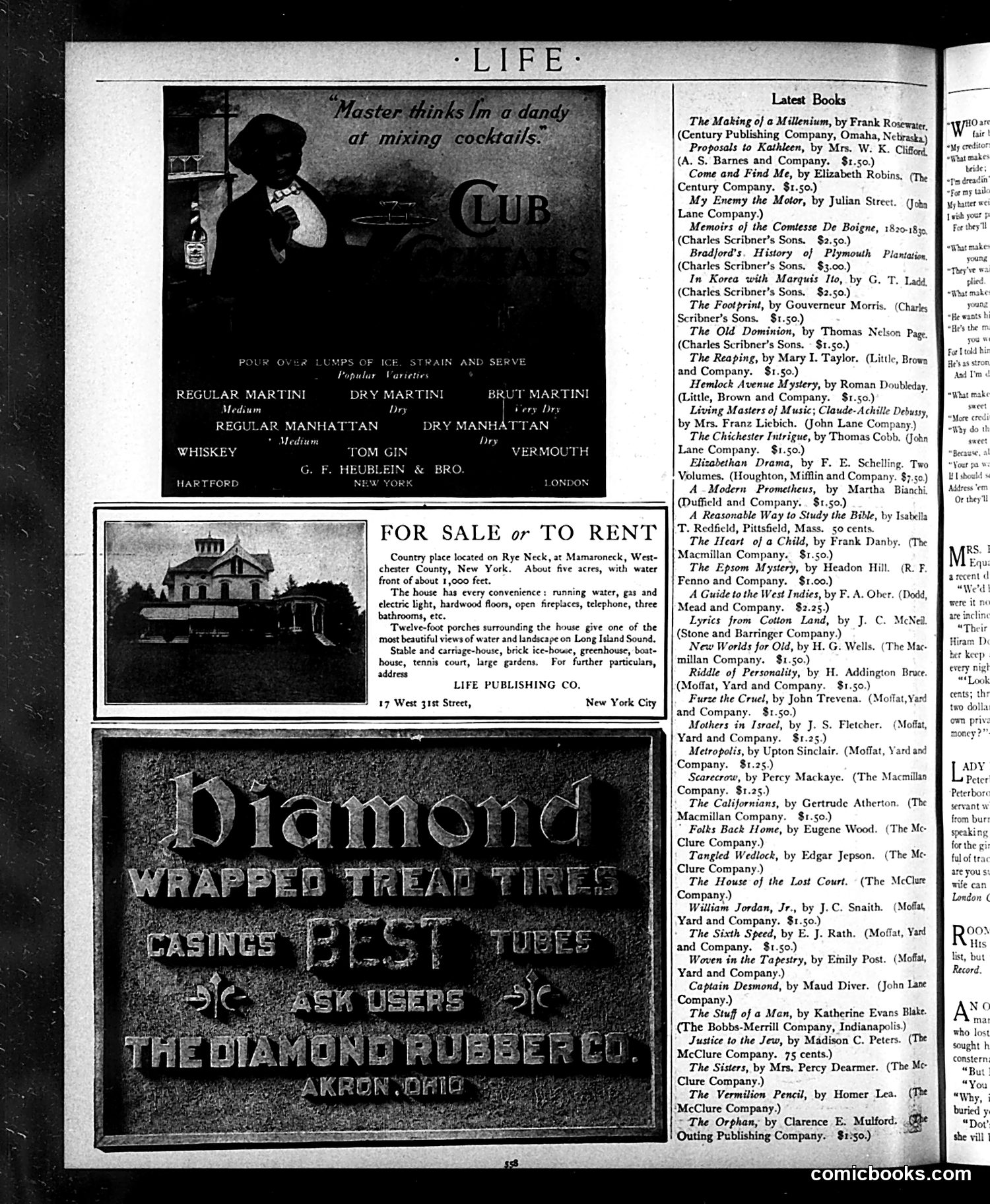
This page is primarily **advertising and book listings**, not political satire. The top features a cocktail advertisement for Heublein & Bros. liquor, showing a bartender mixing drinks with the caption "Master thinks I'm a dandy at mixing cocktails." Below that is a property listing for a country estate in Mamaroneck, New York, and a large Diamond brand tire advertisement. The right column contains an extensive "Latest Books" section listing 1920s-era novels and non-fiction titles from major publishers like Scribner's, Century, and McClure Company. There is **no political cartoon or satire** visible on this page. It appears to be a standard interior page from *Life* magazine devoted to commercial advertisements and publishing announcements—typical filler content for periodicals of that era.
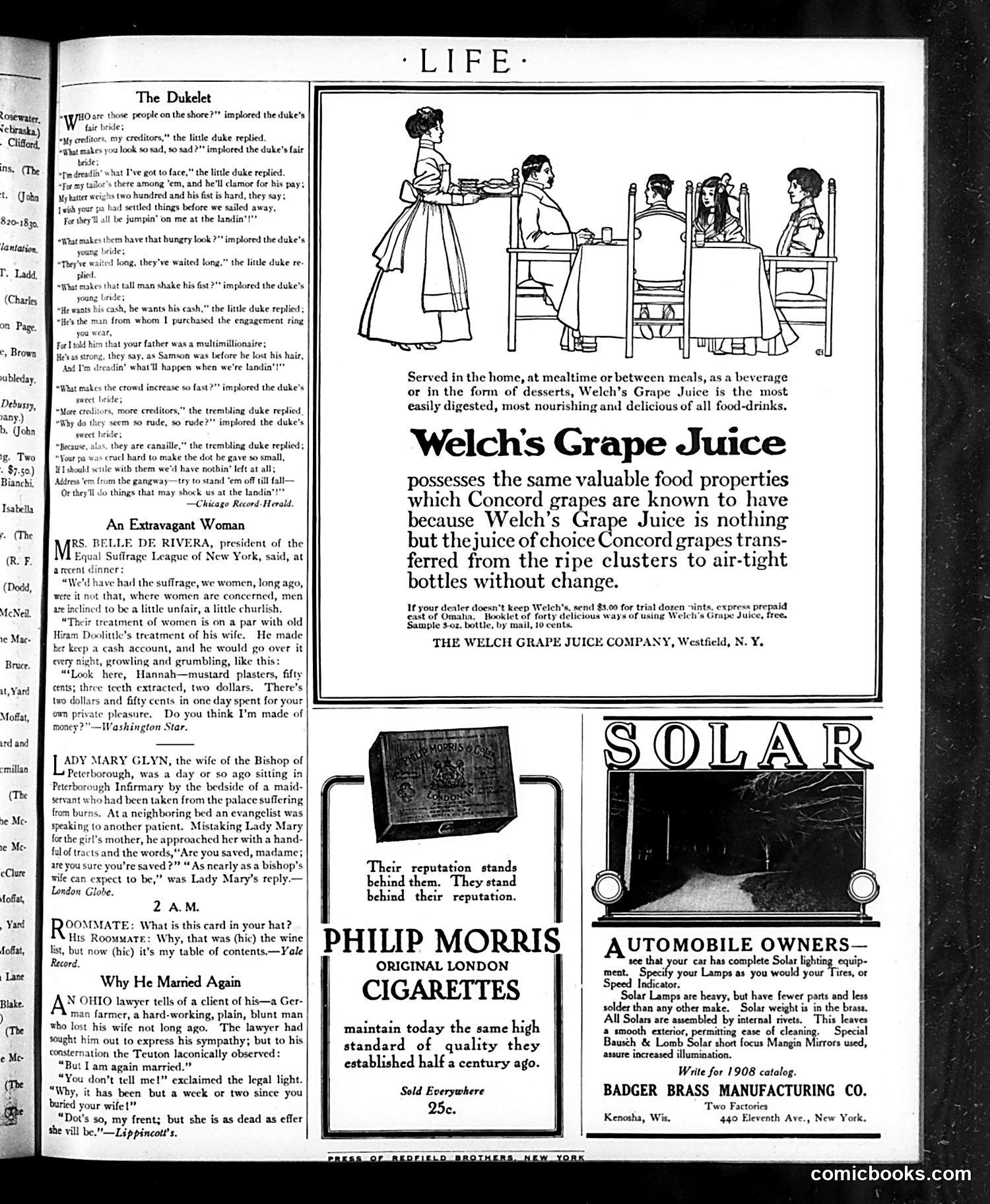
This page combines satirical humor with period advertising (circa 1908). **"The Dukelet" cartoon** satirizes European aristocratic financial irresponsibility. A cash-strapped duke repeatedly encounters creditors during his honeymoon—a visual gag showing how his extravagant lifestyle and his bride's expensive tastes leave him perpetually pursued by debt collectors. The humor targets old-money snobbery meeting modern financial consequences. **Anecdotal humor pieces** mock gender dynamics and social pretension: Mrs. Belle de Rivera's suffrage speech critiques men's unfairness to women; the "extravagant woman" anecdote satirizes wives' household spending; the German farmer's quick remarriage jokes about pragmatism over sentiment; and the roommate's "wine list/table of contents" puns on drunkenness. **Advertisements** for Welch's Grape Juice, Philip Morris cigarettes, and Solar automobile lighting represent typical early-20th-century product marketing, using aspirational lifestyle imagery rather than evidence-based claims. The overall tone reflects Life's satirical mission: mocking aristocratic pretension, gender relations, and consumer excess through humor accessible to educated readers.
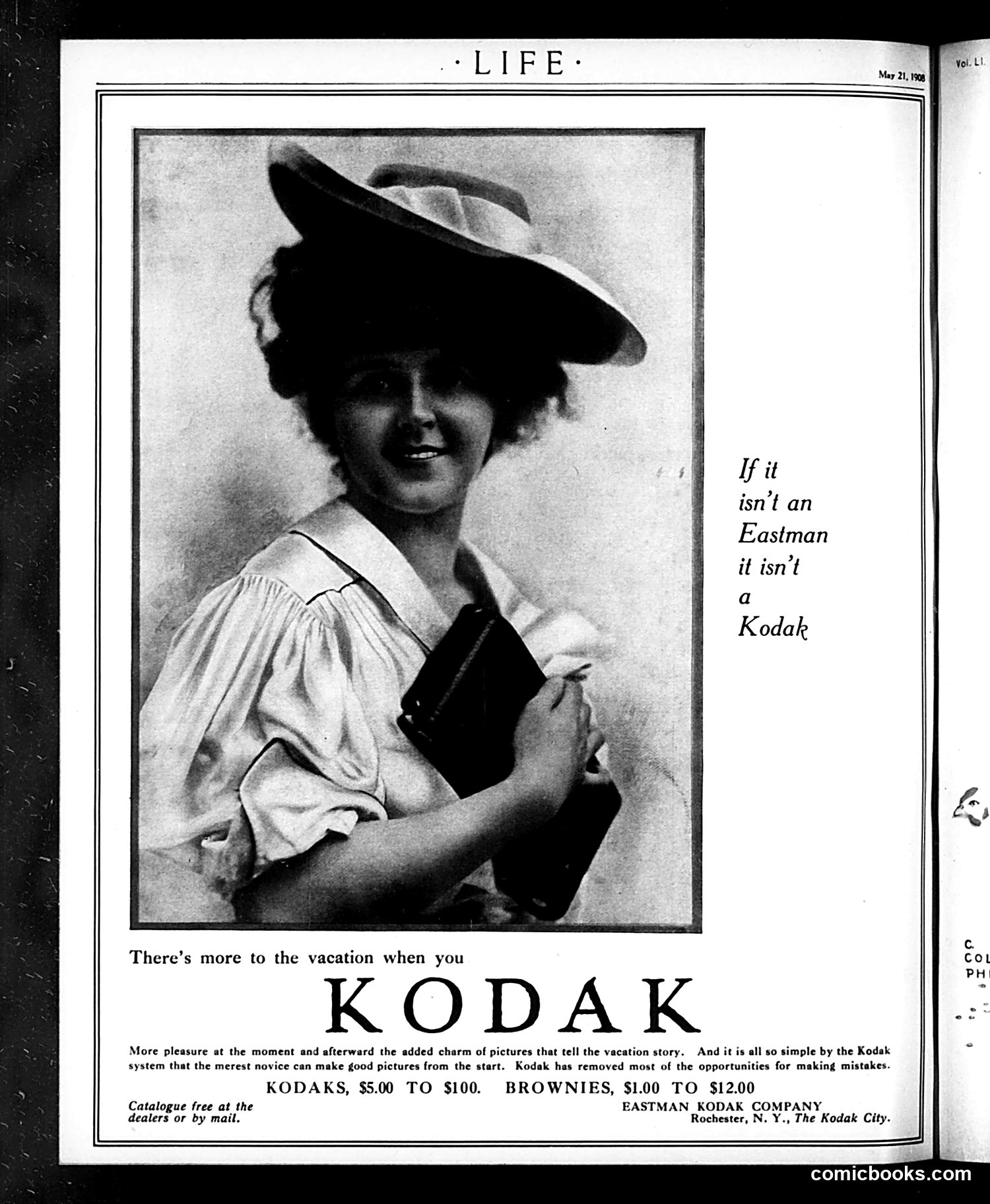
This is primarily a **Kodak camera advertisement**, not political satire. The page features a woman in early 1900s attire (wide-brimmed hat, puffy-sleeved blouse) holding a camera and smiling at the viewer. The messaging emphasizes that vacations are enhanced by photography—capturing memories creates "added charm of pictures that tell the vacation story." The tagline "If it isn't an Eastman it isn't a Kodak" is a brand-protection slogan asserting Kodak's market dominance. The ad targets amateur photographers by claiming Kodak cameras are so simple "the merest novice can make good pictures from the start" with minimal opportunity for error. This was marketing genius for the era—democratizing photography by suggesting anyone could use it successfully. The product range ($5-$100 cameras, $1-$12 "Brownies") indicates pricing for different consumer segments. There is no political or social satire present; this is straightforward consumer advertising from *Life* magazine's revenue model.