
Life, 1908-05-21 · page 8 of 28
Life — May 21, 1908 — page 8: what you’re looking at
What you’re looking at
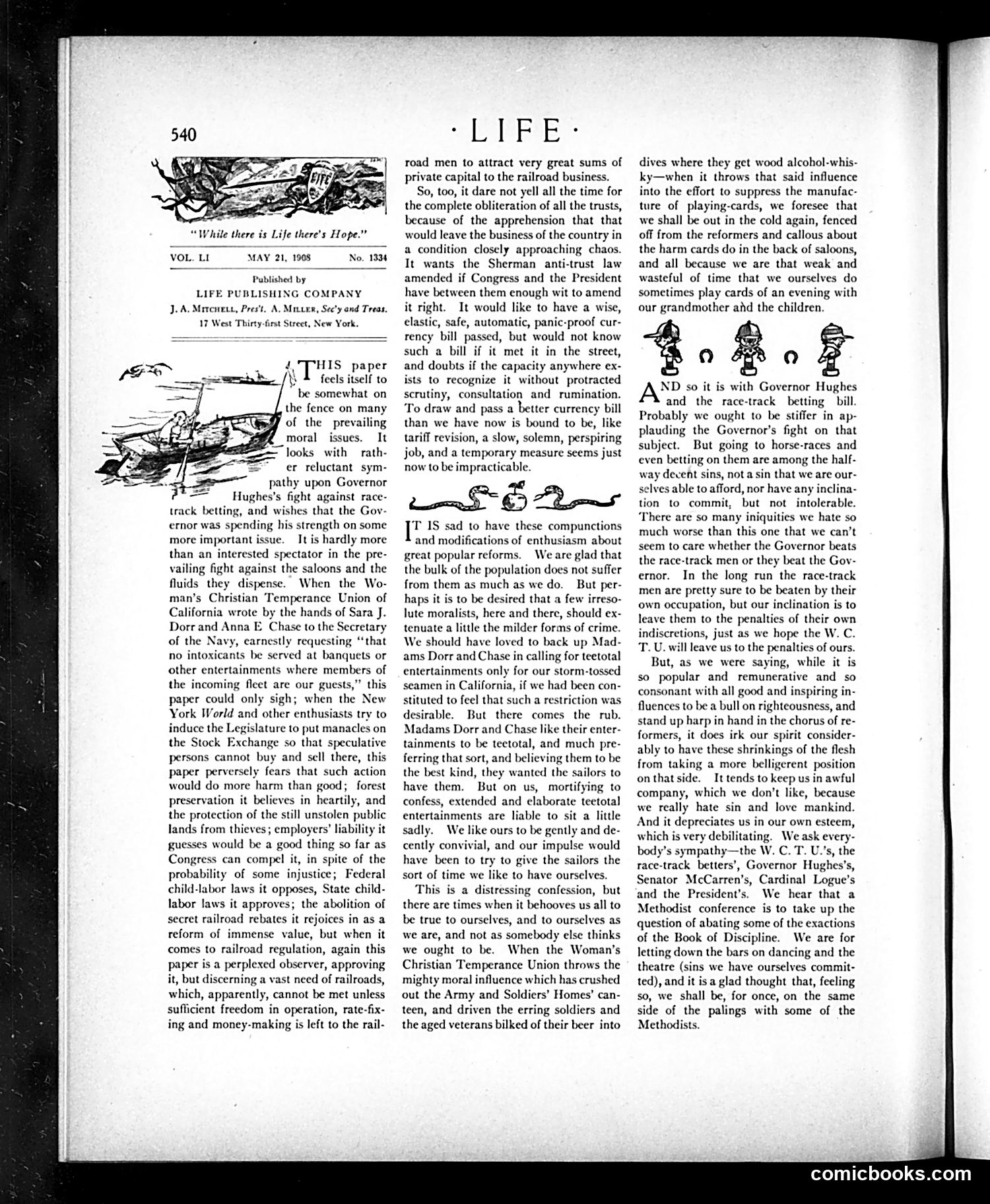
This page contains editorial commentary on several reform issues rather than political cartoons. The text discusses Governor Hughes's fight against horse-race track betting and gambling, referencing concerns about railroad monopolies and trust-busting. The main illustration shows what appears to be a boat or maritime scene, accompanying discussion of moral reform movements. The editorial criticizes the hypocrisy of selective moral crusading—specifically mentioning the Woman's Christian Temperance Union's campaigns against saloons and the Army's restrictions on soldiers' drinking, while overlooking other vices. The piece argues that moral reformers should be consistent and fair-minded rather than imposing selective restrictions they wouldn't accept applied to themselves. It's a critique of reform movements as potentially self-righteous and inconsistently applied.
📄 Transcribed text from this page (OCR, searchable)
Machine-transcribed from the original scan — historical spelling and the odd misread are preserved.
“While there is Life there's Hope.” VOL. LI MAY 21, 1908 No. 1334 Published by LIFE PUBLISHING COMPANY J.A. Mircuent, Pres’t, A. Minure, Sec’y and Treas, 17 West Thirty-first Street, New York. 4 THIS paper \S 4 feels itself to be somewhat on the fence on many Te of the prevailing It —looks with rath- er reluctant sym- pathy upon Governor Hughes's fight against race- track betting, and wishes that the Gov- ernor was spending his strength on some more important issue. It is hardly more than an interested spectator in the pre- vailing fight against the saloons and the fluids they dispense. When the Wo- man’s Christian Temperance Union of California wrote by the hands of Sara J. Dorr and Anna E. Chase to the Secretary of the Navy, earnestly requesting “that no intoxicants be served at banquets or other entertainments where members of the incoming fleet are our guests,” this paper could only sigh; when the New York World and other enthusiasts try to induce the Legislature to put manacles on the Stock Exchange so that speculative persons cannot buy and sell there, this paper perversely fears that such action would do more harm than good; forest preservation it believes in heartily, and the protection of the still unstolen public lands from thieves; employers’ liability it guesses would be a good thing so far as Congress can compel it, in spite of the probability of some injustice; Federal child-labor laws it opposes, State child- labor laws it approves; the abolition of secret railroad rebates it rejoices in as a reform of immense value, but when it comes to railroad regulation, again this paper is a perplexed observer, approving it, but discerning a vast need of railroads, which, apparently, cannot be met unless sufficient freedom in operation, rate-fix- ing and money-making is left to the rail- “AF ERE road men to attract very great sums of private capital to the railroad business. So, too, it dare not yell all the time for the complete obliteration of all the trusts, because of the apprehension that that would leave the business of the country in a condition closely approaching chaos. It wants the Sherman anti-trust law amended if Congress and the President have between them enough wit to amend it right. It would like to have a wise, elastic, safe, automatic, panic-proof cur- rency bill passed, but would not know such a bill if it met it in the street, and doubts if the capacity anywhere ex- ists to recognize it without protracted scrutiny, consultation and rumination. To draw and pass a better currency bill than we have now is bound to be, like tariff revision, a slow, solemn, perspiring job, and a temporary measure seems just now to be impracticable. I 1S sad to have these compunctions and modifications of enthusiasm about great popular reforms. We are glad that the bulk of the population does not suffer from them as much as we do. But per- haps it is to be desired that a few irreso- lute moralists, here and there, should ex- tenuate a little the milder forms of crime. We should have loved to back up Mad- ams Dorr and Chase in calling for teetotal entertainments only for our storm-tossed seamen in California, if we had been con- stituted to feel that such a restriction was desirable. But there comes the rub. Madams Dorr and Chase like their enter- tainments to be tectotal, and much pre- ferring that sort, and believing them to be the best kind, they wanted the sailors to have them. But on us, mortifying to confess, extended and elaborate teetotal entertainments are liable to sit a little sadly. We like ours to be gently and de- cently convivial, and our impulse would have been to try to give the sailors the sort of time we like to have ourselves. This is a distressing confession, but there are times when it behooves us all to be true to ourselves, and to ourselves as we are, and not as somebody else thinks we ought to be. When the Woman’s Christian Temperance Union throws the mighty moral influence which has crushed out the Army and Soldiers’ Homes’ can- teen, and driven the erring soldiers and the aged veterans bilked of their beer into dives where they get wood alcohol-whis- ky—when it throws that said influence into the effort to suppress the manufac- ture of playing-cards, we foresee that we shall be out in the cold again, fenced off from the reformers and callous about the harm cards do in the back of saloons and all because we are that weak and wasteful of time that we ourselves do sometimes play cards of an evening with our grandmother afd the children. Go Bo F ‘D so it is with Governor Hughes and the race-track betting _ bill Probably we ought to be stiffer in ap- plauding the Governor’s fight on that subject. But going to horse-races and even betting on them are among the half- way decent sins, not a sin that we are our- selves able to afford, nor have any inclina- tion to commit, but not intolerable. ‘There are so many iniquities we hate so much worse than this one that we can’t seem to care whether the Governor beats the race-track men or they beat the Gov- ernor. In the long run the race-track men are pretty sure to be beaten by their own occupation, but our inclination is to leave them to the penalties of their own indiscretions, just as we hope the W. C. T. U. will leave us to the penalties of ours. But, as we were saying, while it is so popular and remunerative and so consonant with all good and inspiring in- fluences to be a bull on righteousness, and stand up harp in hand in the chorus of re- formers, it does irk our spirit consider- ably to have these shrinkings of the flesh from taking a more belligerent position on that side. It tends to keep us in awful company, which we don’t like, because we really hate sin and love mankind. And it depreciates us in our own esteem, which is debilitating. We ask every- body’s sympathy—the W. C. T. U.’s, the race-track betters’, Governor Hughes's, Senator McCarren’s, Cardinal Logue’s and the President’s. We hear that a Methodist conference is to take up the question of abating some of the exactions of the Book of Discipline. We are for letting down the bars on dancing and the theatre (sins we have ourselves commit- ted), and it isa glad thought that, feeling we shall be, for once, on the same side of the palings with some of the Methodists. comicbooks.com