
Life, 1908-05-21 · page 24 of 28
Life — May 21, 1908 — page 24: what you’re looking at
What you’re looking at
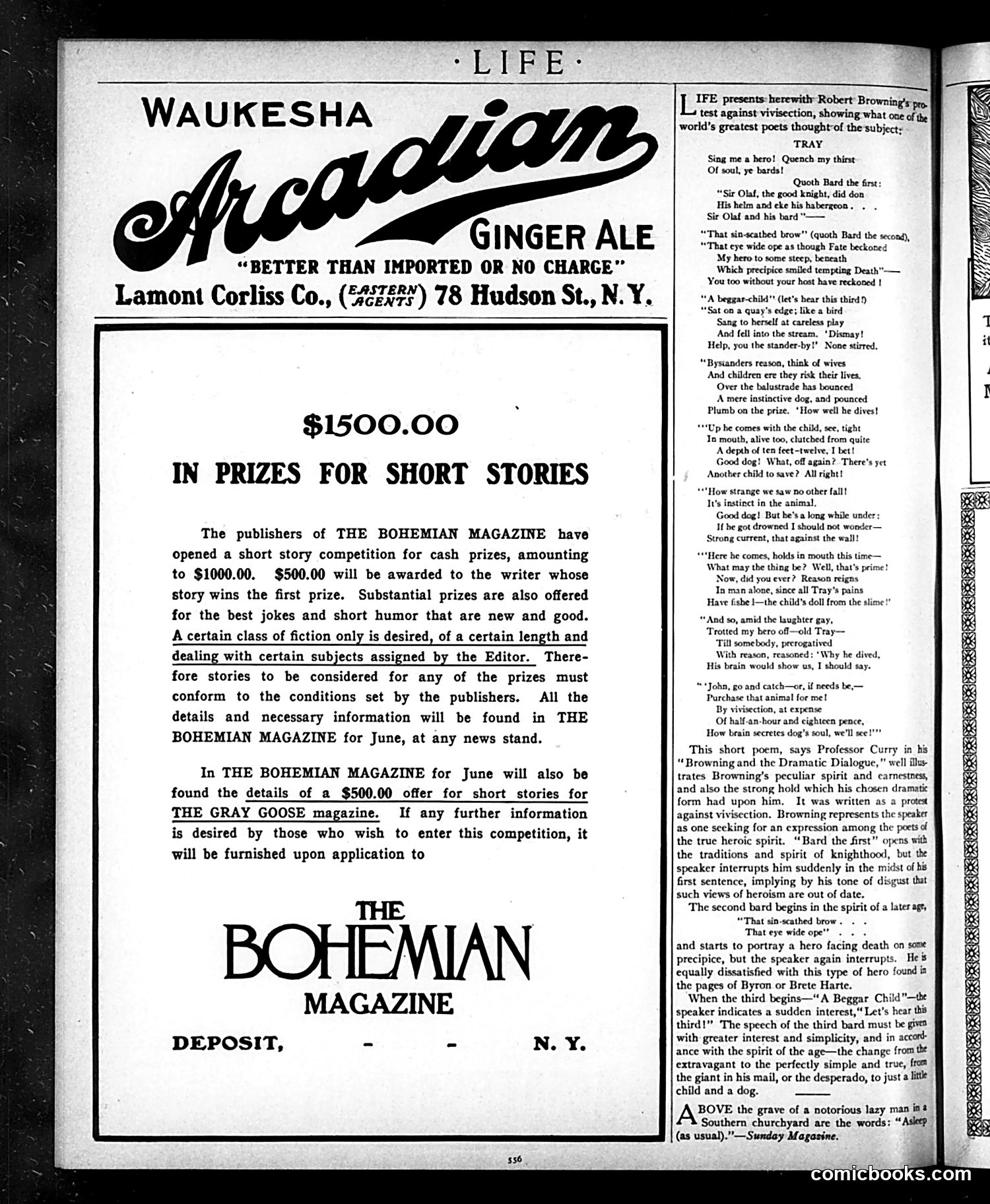
This page consists primarily of **advertisements and literary content**, not political satire. The left side advertises Waukesha Ginger Ale and announces a $1,500 short-story competition by *The Bohemian Magazine*. The right side presents Robert Browning's poem **"Tray,"** introduced as his protest against vivisection (animal experimentation). The poem contrasts three definitions of heroism: a knight's valor, a Romantic poet's passionate idealism, and a dog's instinctive selflessness. Browning's satire targets the final twist—that "reasonable" humans would capture and dissect the heroic dog to study its brain, reducing noble instinct to scientific commodification. **For modern context:** Vivisection was a heated Victorian controversy between scientists and animal-rights advocates. Browning's poem mocks how rationalism and scientific progress can strip away moral consideration for living beings.
📄 Transcribed text from this page (OCR, searchable)
Machine-transcribed from the original scan — historical spelling and the odd misread are preserved.
WAUKESHA GINGER ALE “BETTER THAN IMPORTED OR NO CHARGE” Lamont Corliss Co., (Zz?!) 78 Hudson St., N.Y. $1500.00 IN PRIZES FOR SHORT STORIES The publishers of THE BOHEMIAN MAGAZINE have opened a short story competition for cash prizes, amounting to $1000.00. $500.00 will be awarded to the writer whose story wins the first prize. Substantial prizes are also offered for the best jokes and short humor that are new and good. A certain class of fiction only is desired, of a certain length and dealing with certain subjects assigned by the Editor. There- fore stories to be considered for any of the prizes must conform to the conditions set by the publishers. All the details and necessary information will be found in THE BOHEMIAN MAGAZINE for June, at any news stand. In THE BOHEMIAN MAGAZINE for June will also be found the details of a $500.00 offer for short stories for THE GRAY GOOSE magazine. If any further information is desired by those who wish to enter this competition, it will be furnished upon application to THE MAGAZINE DEPOSIT, Lm presents: herewith Robert Browning's pro test against vivisection, showing what one of the world’s greatest poets thoughtvof the subject; TRAY Sing me a hero! Quench my thirst Of soul, ye bards! Quoth Bard the first: “Sir Olaf, the good knight, did don His helm and eke his habergeon. Sir Olaf and his bard "— “That sin-scathed brow” (quoth Bard the second), “That eye wide ope as though Fate beckoned My hero to some steep, beneath Which precipice smiled tempting Death" ‘You too without your host have reckoned | “A beggar-child"* (let's hear this third) “Sat on a quay’s edge; like a bird Sang to herself at careless play And fell into the stream. ‘Dismay! Help, you the stander-by!” None stirred, “Bysianders reason, think of wives And children ere they risk their lives, Over the balustrade has bounced A mere instinctive dog, and pounced Plumb on the prize. ‘How well he dives! *“Up he comes with the child, see, tight In mouth, alive too, clutched from quite A depth of ten feet-twelve, I bet! Good dog! What, off again? There's yet Another child to save? All right! “How strange we saw no other fall! It’s instinct in the animal, Good dog! But he's a long while under: If be got drowned I should not wonder— Strong current, that against the wall! ***Here he comes, holds in mouth this time— What may the thing be? Well, that’s prime! Now, did you ever? Reason reigns In man alone, since all Tray’s pains Have fishe !—the child's doll from the slime!" “And so, amid the laughter gay, Trotted my hero off—old Tray— Till somebody, prerogatived With reason, reasoned: ‘Why he dived, His brain would show us, I should say. 'Joha, go and catch—or, if needs be,— Purchase that animal for me! By vivisection, at expense Of half-an-hour and eighteen pence, How brain secretes dog's soul, we'll see!""" This short poem, says Professor Curry ia his “Browning and the Dramatic Dialogue,” well il trates Browning’s peculiar spirit and carnestness, and also the strong hold which his chosen dramatic form had upon him. It was written as a protest against vivisection. Browning represents the speaker as one seeking for an expression among the poets o the true heroic spirit, “Bard the first” opens with the traditions and spirit of knighthood, but the speaker interrupts him suddenly in the midst of bis first sentence, implying by his tone of disgust thit such views of heroism are out of date. ‘The second bard begins in the spirit of a later agt, “That sin-scathed brow. . . That eye wide ope’ 2 . . and starts to portray a hero facing death on some precipice, but the speaker again interrupts. Hes equally dissatisfied with this type of hero found i= the pages of Byron or Brete Harte. When the third begins—“A Beggar Child”—the speaker indicates a sudden interest,“ Let’s hear this third!” The speech of the third bard must be give? with greater interest and simplicity, and in accord ance with the spirit of the age—the change from the extravagant to the perfectly simple and true, from the giant in his mail, or the desperado, to just a litte child and a dog. BOVE the grave of a notorious lazy man in Southern churchyard are the words: “Aske? (as usual).”"—Sunday Magazine.