
Life, 1908-05-21 · page 17 of 28
Life — May 21, 1908 — page 17: what you’re looking at
What you’re looking at
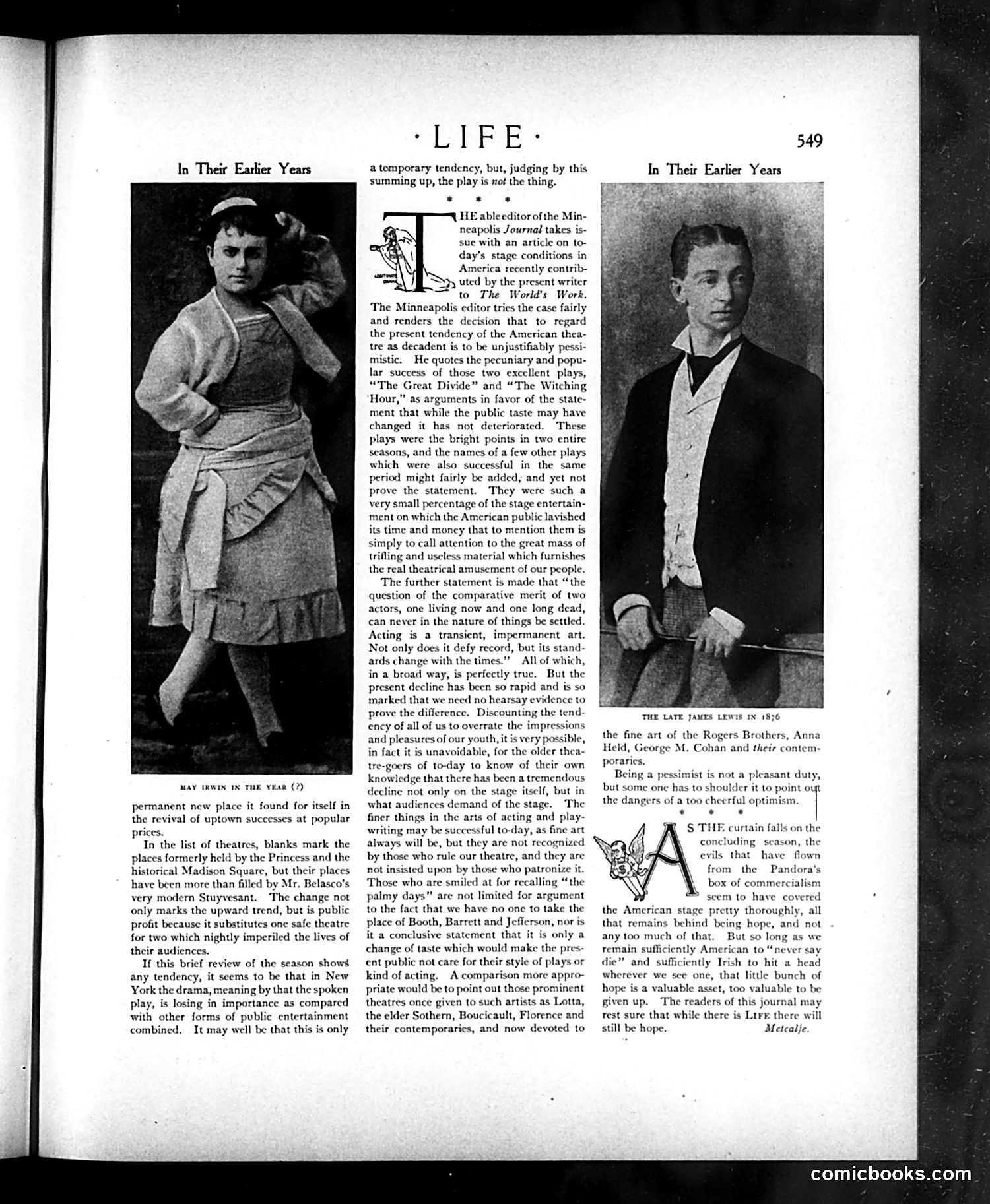
This page examines the decline of American theatrical art. The text argues that while some successful plays exist (citing "The Great Divide" and "The Witching Hour"), they represent a tiny fraction of stage entertainment, which is dominated by "trifling and useless material." The two photographs compare performers from different theatrical eras—**May Irwin** (identified by caption as from an earlier year) and **James Lewis in 1876** (identified in the right photo). The implicit argument is that earlier actors like Lewis represented a higher standard of performance, whereas contemporary performers lack comparable merit. The author contends that the decline is measurable and real, not merely nostalgia. The article claims that fine theatrical arts are undervalued in modern theater, and audiences no longer demand or recognize quality acting and playwriting. The comparison of past and present performers illustrates this deterioration visually.
📄 Transcribed text from this page (OCR, searchable)
Machine-transcribed from the original scan — historical spelling and the odd misread are preserved.
In Their Earlier Years MAY IRWIN IN THE VEAR (?) permanent new place it found for itself in the revival of uptown successes at popular price In the list of theatres, blanks mark the places formerly held by the Princess and the historical Madison Square, but their places have been more than filled by Mr. Belasco's very modern Stuyvesant. The change not only marks the upward trend, but is public profit because it substitutes one safe theatre for two which nightly imperiled the lives of their audiences. If this brief review of the season shows any tendency, it seems to be that in New York the drama, meaning by that the spoken play, is losing in importance as compared with other forms of public entertainment combined. It may well be that this is only “LAKE E * a temporary tendency, but, judging by this summing up, the play is not the thing. * 2 6 HE ableeditor ofthe Min- neapolis Journal takes is- sue with an article on to- day’s stage conditions in America recently contrib- Syq uted by the present writer to The World's Work. The Minneapolis editor tries the case fairly and renders the decision that to. regard the present tendency of the American thea- tre as decadent is to be unjustifiably pessi- mistic. He quotes the pecuniary and popu- lar success of those two excellent plays, “The Great Divide” and “The Witching Hour,” as arguments in favor of the state- ment that while the public taste may have changed it has not deteriorated. ‘These plays were the bright points in two entire seasons, and the names of a few other plays which were also successful in the same period might fairly be added, and yet not prove the statement. They were such a very small percentage of the stage entertain- ment on which the American public lavished its time and money that to mention them is simply to call attention to the great mass of trifling and useless material which furnishes the real theatrical amusement of our people. The further statement is made that “the question of the comparative merit of two actors, one living now and one long dead, can never in the nature of things be settled. Acting is a transient, impermanent art. Not only does it defy record, but its stand- ards change with the times.” All of which, in a broad way, is perfectly true. But the present decline has been so rapid and is so marked that we need no hearsay evidence to prove the difference. Discounting the tend- ency of all of us to overrate the impressions and pleasures of our youth, it is very possible, in fact it is unavoidable, for the older the tre-goers of to-day to know of their own knowledge that there has been a tremendous decline not only on the stage itself, but in what audiences demand of the stage. The finer things in the arts of acting and play- writing may be successful to-day, as fine art always will be, but they are not recognized by those who rule our theatre, and they are not insisted upon by those who patronize it. Those who are smiled at for recalling “the palmy days” are not limited for argument to the fact that we have no one to take the place of Booth, Barrett and Jefferson, nor is it a conclusive statement that it is only a change of taste which would make the pre: ent public not care for their style of plays or kind of acting. A comparison more appro- priate would be to point out those prominent theatres once given to such artists as Lotta, the elder Sothern, Boucicault, Florence and their contemporaries, and now devoted to In Their Earlier Years THE LATE JAMES LEWIS IN 1876 the fine art of the Rogers Brothers, Held, George M. Cohan and their contem- porarics. Being a pessimist is not a pleasant duty, but some one has to shoulder it to point o4 the dangers of a too cheerful optimism. | S THE curtain falls on the concluding season, the evils that have flown from the Pandora's box of commercialism * seem to have covered the American stage pretty thoroughly, all that remains behind being hope, and not any too much of that. But so long as we remain sufficiently American to “never say die” and sufficiently Irish to hit a head wherever we see one, that little bunch of hope is a valuable asset, too valuable to be given up. The readers of this journal may rest sure that while there is Lire there will still be hope. Metcalfe comicbooks.com