
Life, 1908-05-21 · page 16 of 28
Life — May 21, 1908 — page 16: what you’re looking at
What you’re looking at
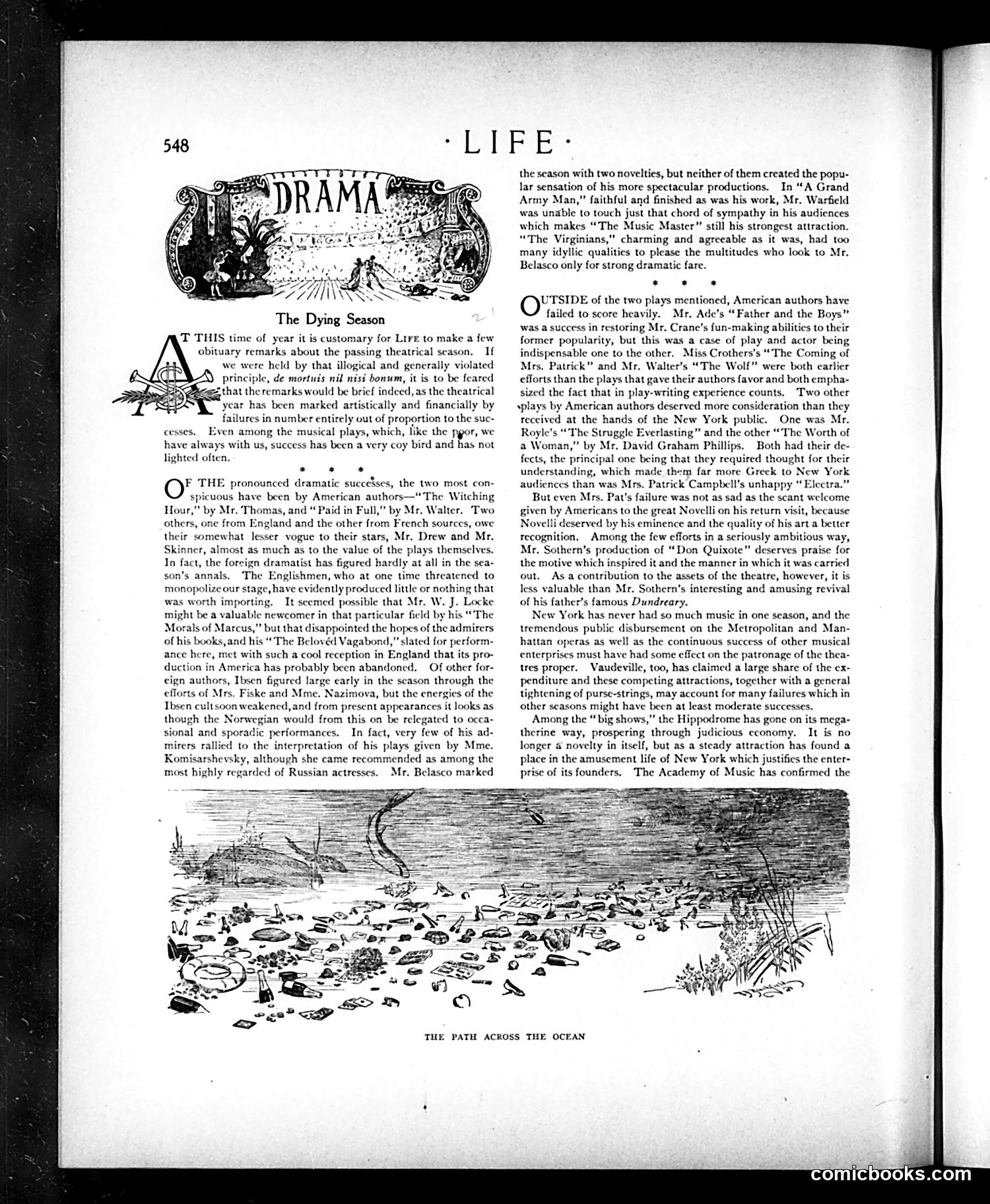
This page reviews the theatrical season, using "dying" as metaphor for a disappointing year. The text criticizes American and foreign drama as largely unsuccessful. **Key points:** - Only two American plays succeeded: "The Witching Hour" (Thomas) and "Paid in Full" (Walter) - Foreign dramatists disappointed—English imports proved worthless; Ibsen's popularity waned despite Mme. Nazimova's efforts - David Belasco's two productions underperformed despite his reputation - American playwrights like Ade, Crothers, and Walter showed talent but required experienced actors to succeed - The article laments that audiences rejected serious drama (like Eleonora Duse's "Electra") while preferring lighter fare **The illustration** ("The Path Across the Ocean") depicts theatrical debris scattered on a beach—likely satirizing failed European dramatic imports washing ashore in America. The overall tone is snobbish disappointment in popular theatrical taste.
📄 Transcribed text from this page (OCR, searchable)
Machine-transcribed from the original scan — historical spelling and the odd misread are preserved.
"EE The Dying Season T THIS time of year it is customary for Lire to make a few obituary remarks about the passing theatrical season. If we were held by that illogical and generally violated 3A principle, de mortuis nil nisi bonum, it is to be feared = that the remarks would be brief indeed, as the theatrical r has been marked artistically and financially by tures in number entirely out of proportion to the suc- Even among the musical plays, which, like the pgor, we have always with us, success has been a very coy bird and has not lighted often. cesses. * 2 8 F THE pronounced dramatic succe’ses, the two most con- uous have been by American authors—“The Witching Hour,” by Mr. Thomas, and “Paid in Full,” by Mr. Walter. Two others, one from England and the other from French sources, owe their somewhat lesser vogue to their stars, Mr. Drew and Mr. Skinner, almost as much as to the value of the plays themselves. In fact, the foreign dramatist has figured hardly at all in the sea- son's annals. The Englishmen, who at one time threatened to monopolize our stage, have evidently produced little or nothing tha was worth importing. It seemed possible that Mr. W. J. Lock might be a valuable newcomer in that particular field by his 7 Morals of Marcus,” but that disappointed the hopes of the admirers of his books, and his “The Belovéd Vagabond,” slated for perform- ance here, met with such a cool reception in England that its pro- du nerica has probably been abandoned, Of other for- cign authors, Ibsen figured large early in the scason through the efforts of Mrs. Fiske and Mme. Nazimova, but the energies of the Ibsen cultsoon weakened, and from present appearances it looks as though the Norwegian would from this on be relegated to occa- sional and sporadic performances. In fact, very few of his ad- mirers rallied to the interpretation of his plays given by Mme. Komisarshevsky, although she came recommended as among the most highly regarded of Russian actresses. Mr. Belasco marked the season with two novelties, but neither of them created the popu- lar sensation of his more spectacular productions. In “A Grand Army Man,” faithful and finished as was his work, Mr. Warfield was unable to touch just that chord of sympathy in his audiences which makes “The Music Master” still his strongest attraction. “The Virginians,” charming and agreeable as it was, had too many idyllic qualities to please the multitudes who look to Mr. Belasco only for strong dramatic fare. eo 8 UTSIDE of the two plays mentioned, American authors have failed to score heavily. Mr. Ade’s “Father and the Boys” was a success in restoring Mr. Crane’s fun-making abilities to their former popularity, but this was a case of play and actor being indispensable one to the other. Miss Crothers’s “The Coming of Mrs. Patrick” and Mr. Walter’s “The Wolf” were both earlier efforts than the plays that gave their authors favor and both empha- sized the fact that in play-writing experience counts. Two other splays by American authors deserved more consideration than they : lasting” and the other “The Worth of a Woman,” by Graham Phillips. Both had their de- fects, the principal one being that they required thought for their understanding, which made them far more Greek to New York audiences than was Mrs. Patrick Campbell’s unhappy “Electra.” But even Mrs. Pat's failure was not as sad as the scant welcome given by Americans to the great Novelli on his return visit, because Novelli deserved by his eminence and the quality of his art a better recognition, Among the few efforts in a seriously ambitious w Mr. Sothern’s production of “Don Quixote” deserves praise for the motive which inspired it and the manner in which it was carried out. As acontribution to the assets of the theatre, however, it less valuable than Mr. Sothern’s interesting and amusing revival of his father’s famous Dundreary. New York has never had so much music in one season, and the tremendous public disbursement on the Metropolitan and Man- hattan operas as well as the continuous success of other musical enterprises must have had some effect on the patronage of the thea- tres proper. Vaudeville, too, has claimed a large share of the x- penditure and these competing attractions, together with a general tightening of purse-strings, may account for many failures which in other seasons might have been at least moderate successes. Among the “big shows,” the Hippodrome has gone on its mega- therine way, prospering through judicious economy. It is no longer @ novelty in itself, but as a steady attraction has found a place in the amusement life of New York which justifies the enter- prise of its founders. The Academy of Music has confirmed the THE PATH ACROSS THE OCEAN comicbooks.com