
A complete issue · 22 pages · 1908
Life — January 30, 1908
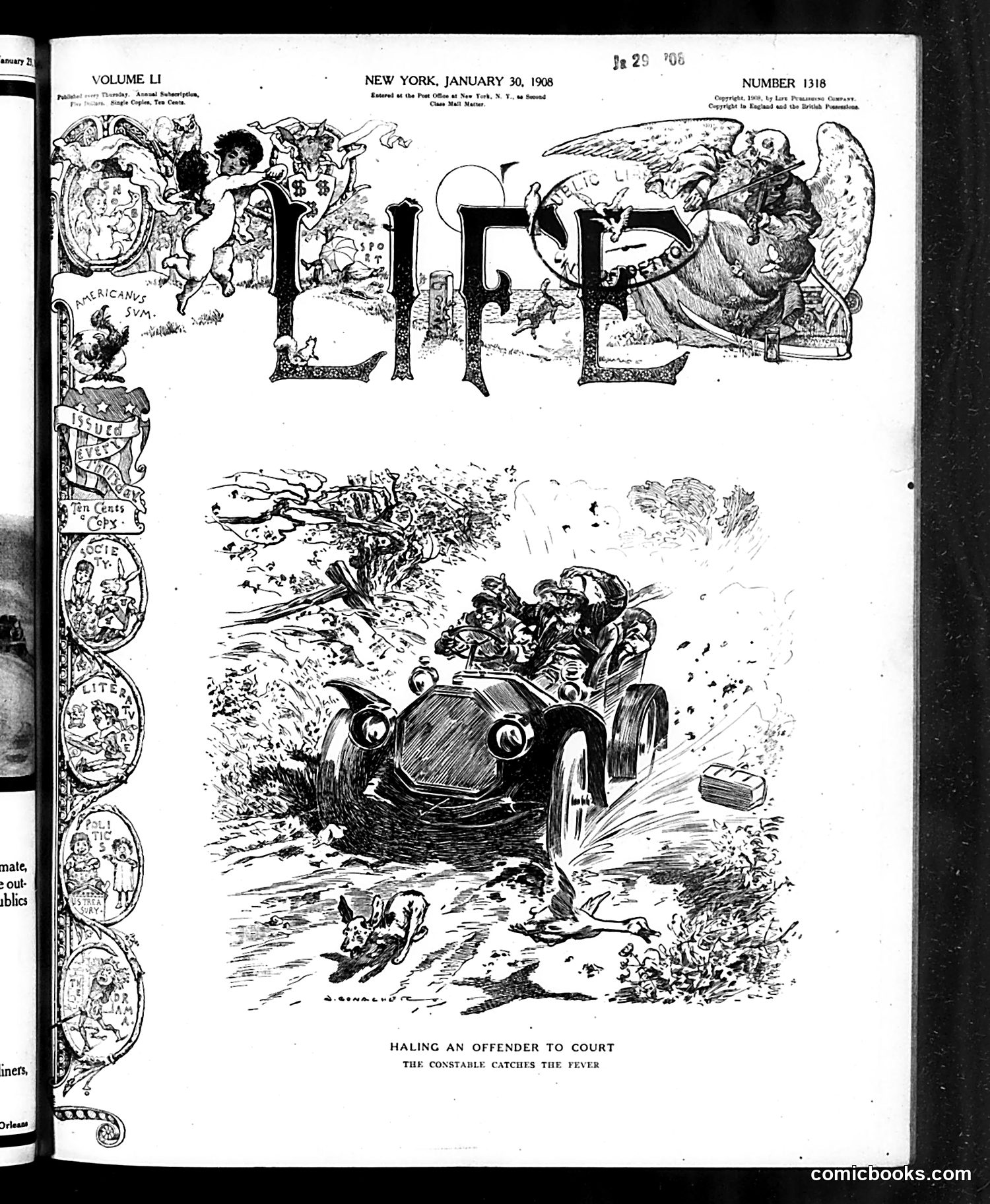
This page features a satirical cartoon titled "Haling an Offender to Court: The Constable Catches the Fever." The illustration depicts a car overflowing with passengers speeding recklessly down a road, with a small dog fleeing in terror below. The satire appears to reference the early automotive era's "speeding fever"—widespread reckless driving by motorists. The cartoon's title suggests a law enforcement officer (constable) pursuing the vehicle, but ironically the officer has caught the same "fever," driving equally wildly in pursuit of the speeding offender. The joke mocks how the excitement of automobiles infected even authorities meant to regulate them, suggesting widespread societal intoxication with motoring and disregard for traffic laws across all classes.
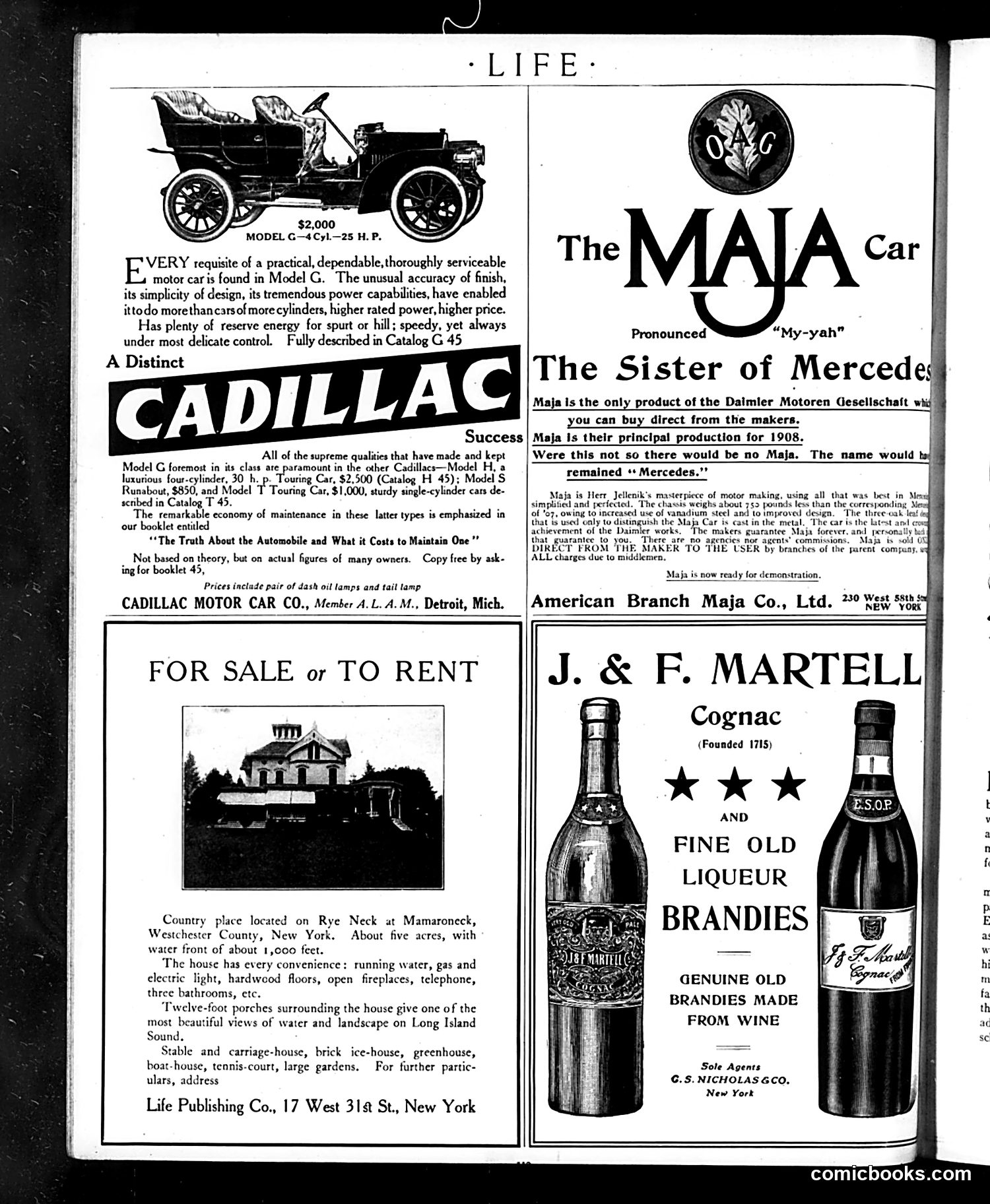
This page is primarily **advertising rather than political satire or cartooning**. It contains three distinct advertisements: 1. **Cadillac Model G** (upper left): Promotes a $2,000 luxury automobile as practical and serviceable, emphasizing precision engineering and economy of maintenance. 2. **Maia Car** (upper right): Advertises a German-made vehicle (Daimler Motoren Gesellschaft product) as "The Sister of Mercedes," available directly from makers through their American branch in New York. 3. **Property and Liquor Ads** (lower half): A country estate for sale/rent in Westchester County, New York, and J. & F. Martell Cognac and brandies. The page reflects early 20th-century consumer culture targeting wealthy readers—no satirical content is evident.
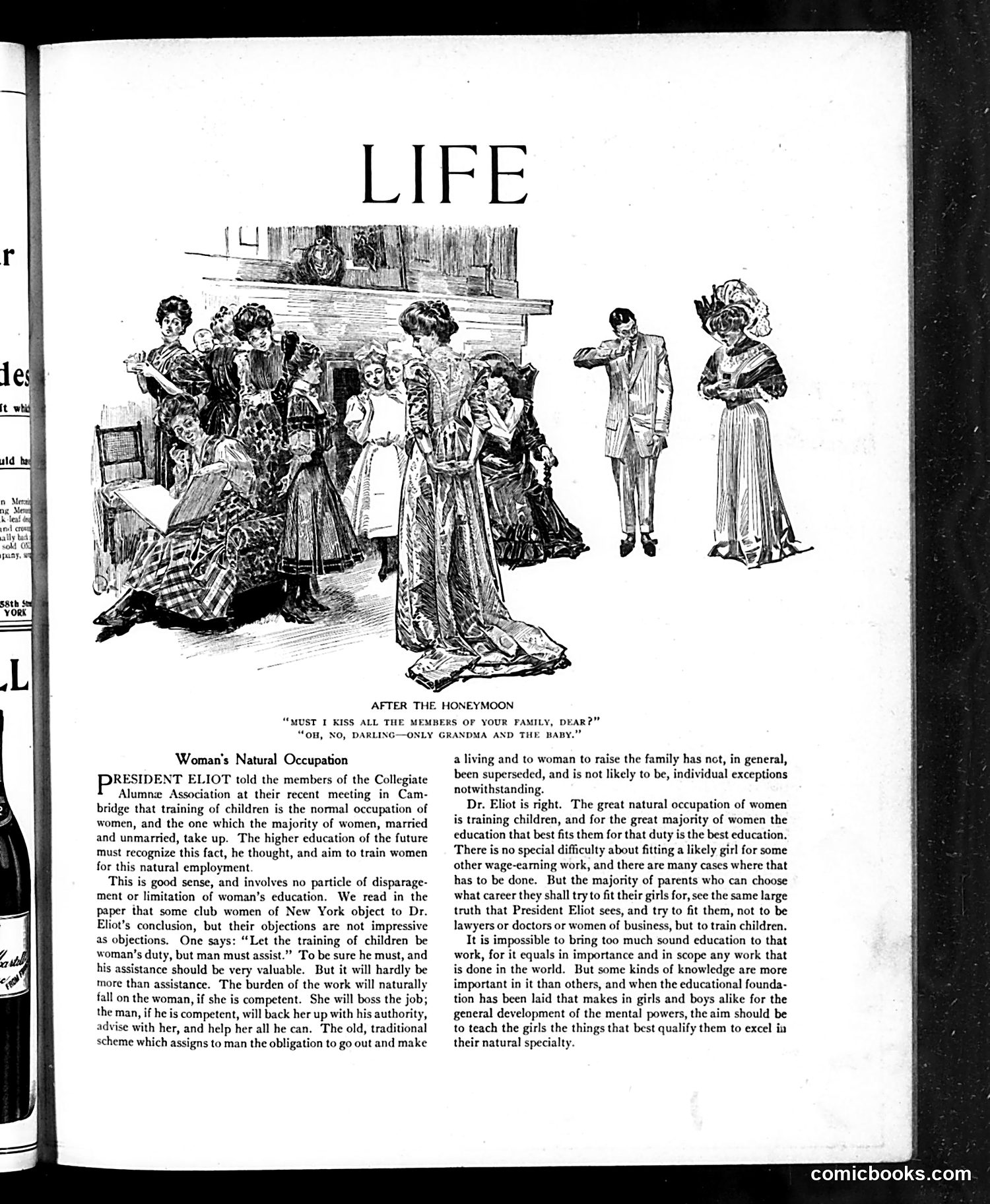
**The Cartoon**: The illustration titled "After the Honeymoon" depicts a newlywed couple with the husband asking whether his bride must kiss all family members, and she replying she'll only kiss grandma and the baby. This is a gentle marital humor cartoon common to the era. **The Article**: "Woman's Natural Occupation" reports on a speech by President Eliot of the Collegiate Alumnae Association arguing that child-rearing is women's primary role. The piece debates whether higher education for women is wasted if they become mothers and housewives. **The Satire**: The juxtaposition suggests irony—celebrating women's education while simultaneously endorsing their confinement to domestic duties, reflecting early 1900s tensions over women's roles and rights.
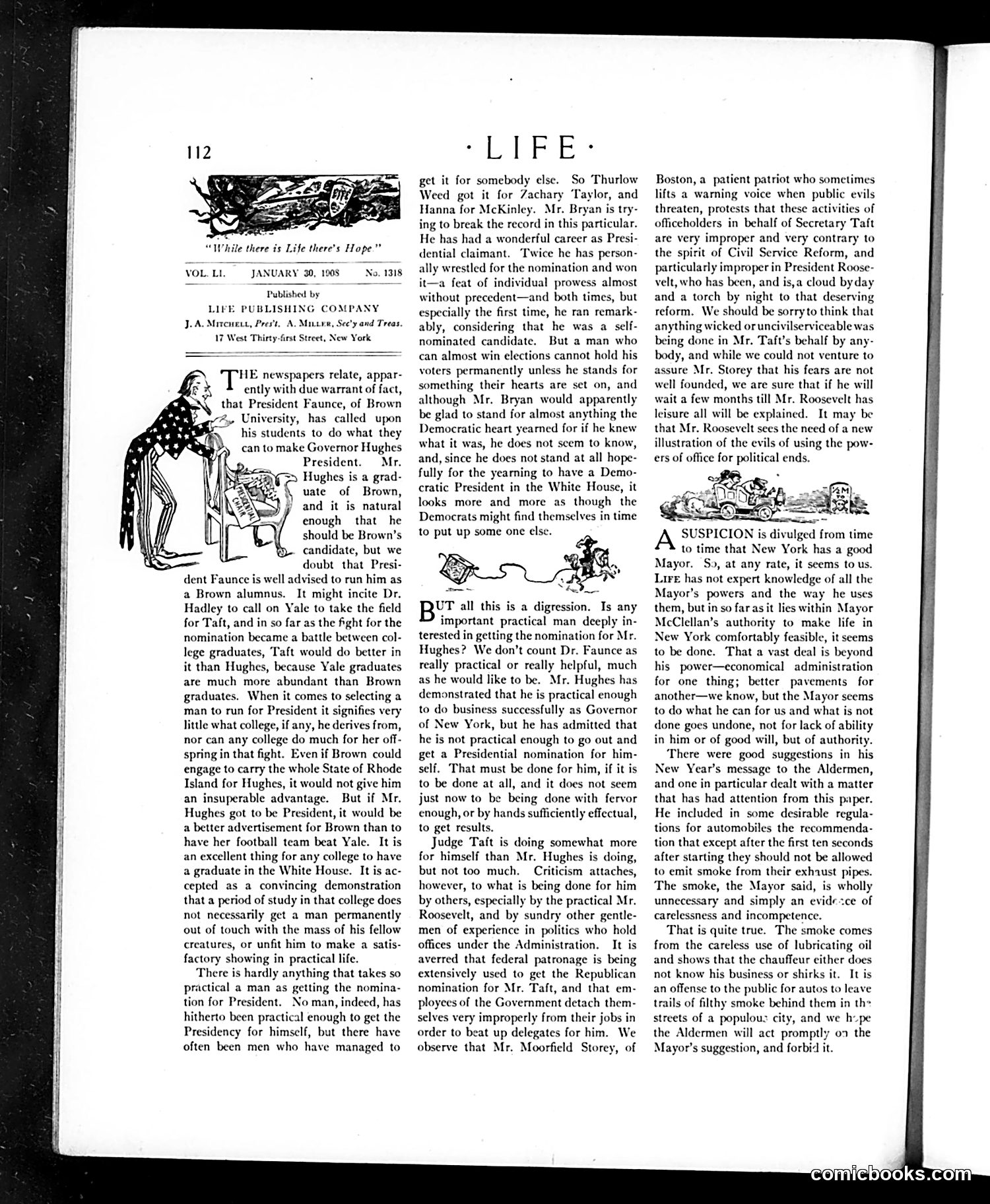
This page discusses President William Howard Taft's potential nomination for another term. The left illustration shows **Uncle Sam presenting candidates to Brown University**, satirizing how political nominations are made. The text criticizes that while newspapers urge Brown University students to support Governor Hughes as a presidential candidate, **Hughes lacks practical political experience**—he's "not practical enough to go out and get a Presidential nomination for himself." The satire targets the gap between academic credentials and political viability: Brown graduates and practical politicians like Taft are more effective than idealistic reformers. The piece suggests that despite Hughes's merit, **actual political nomination requires skills beyond intellectual qualification**—a commentary on how American presidential selection actually works versus how reformers wish it would work.
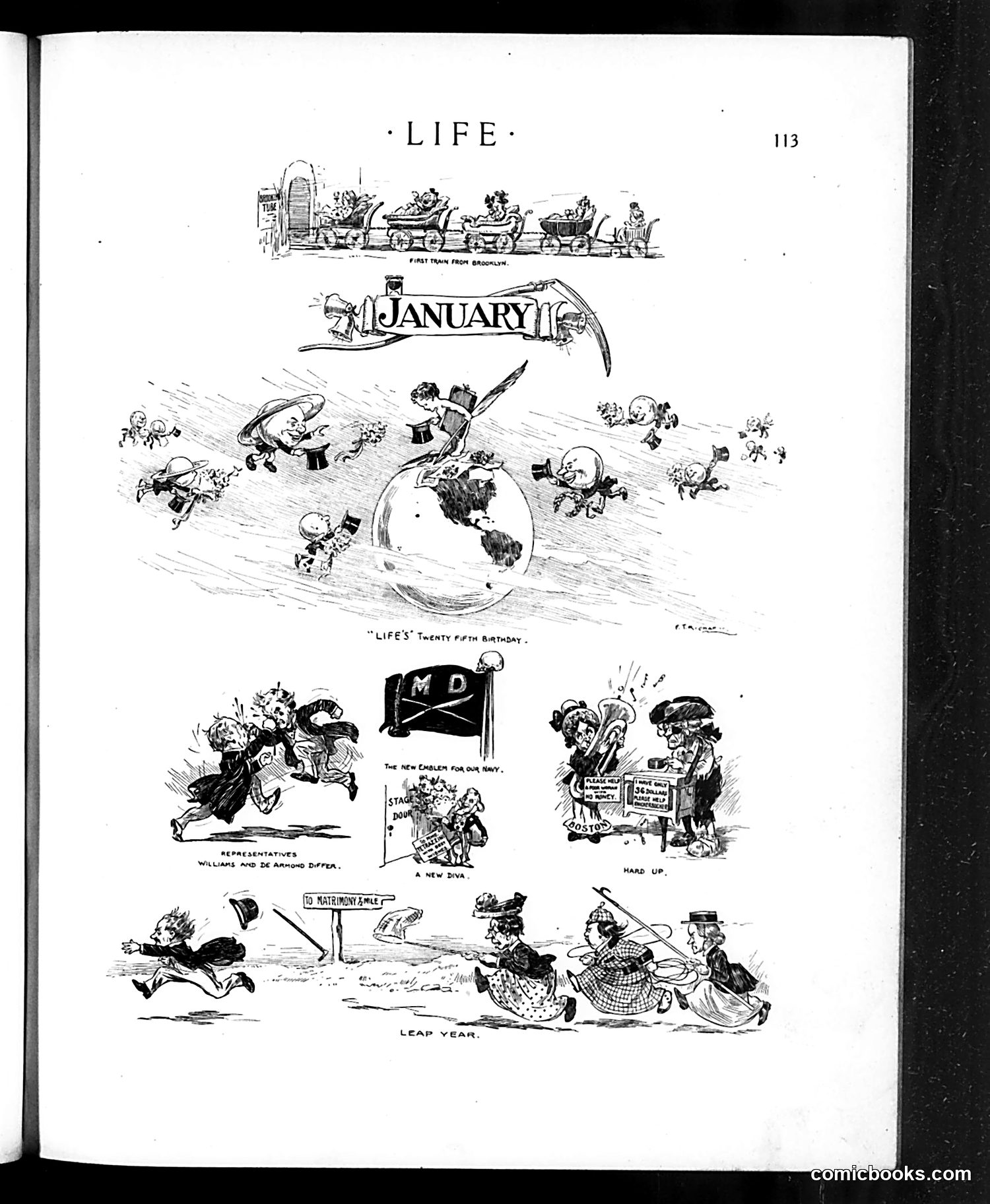
This is a satirical January calendar page from Life magazine. The cartoons reference several early 20th-century events and figures: **Top section**: "First train from Brooklyn" shows produce arriving via rail—likely commenting on agricultural commerce or transportation improvements. **Main illustration**: Depicts "Life's Twenty-Fifth Birthday" with children in a bubble, celebrating the magazine's anniversary. **Lower cartoons** reference contemporary issues: - "New emblem for old navy" shows an "MD" flag (meaning unclear without additional context) - "A new diva" and "Hard up" appear to mock theatrical/entertainment figures - "Leap year" shows women pursuing men, satirizing the tradition of women proposing during leap years The overall tone is lighthearted satire of current events, social customs, and popular culture typical of Life's satirical approach during this era.
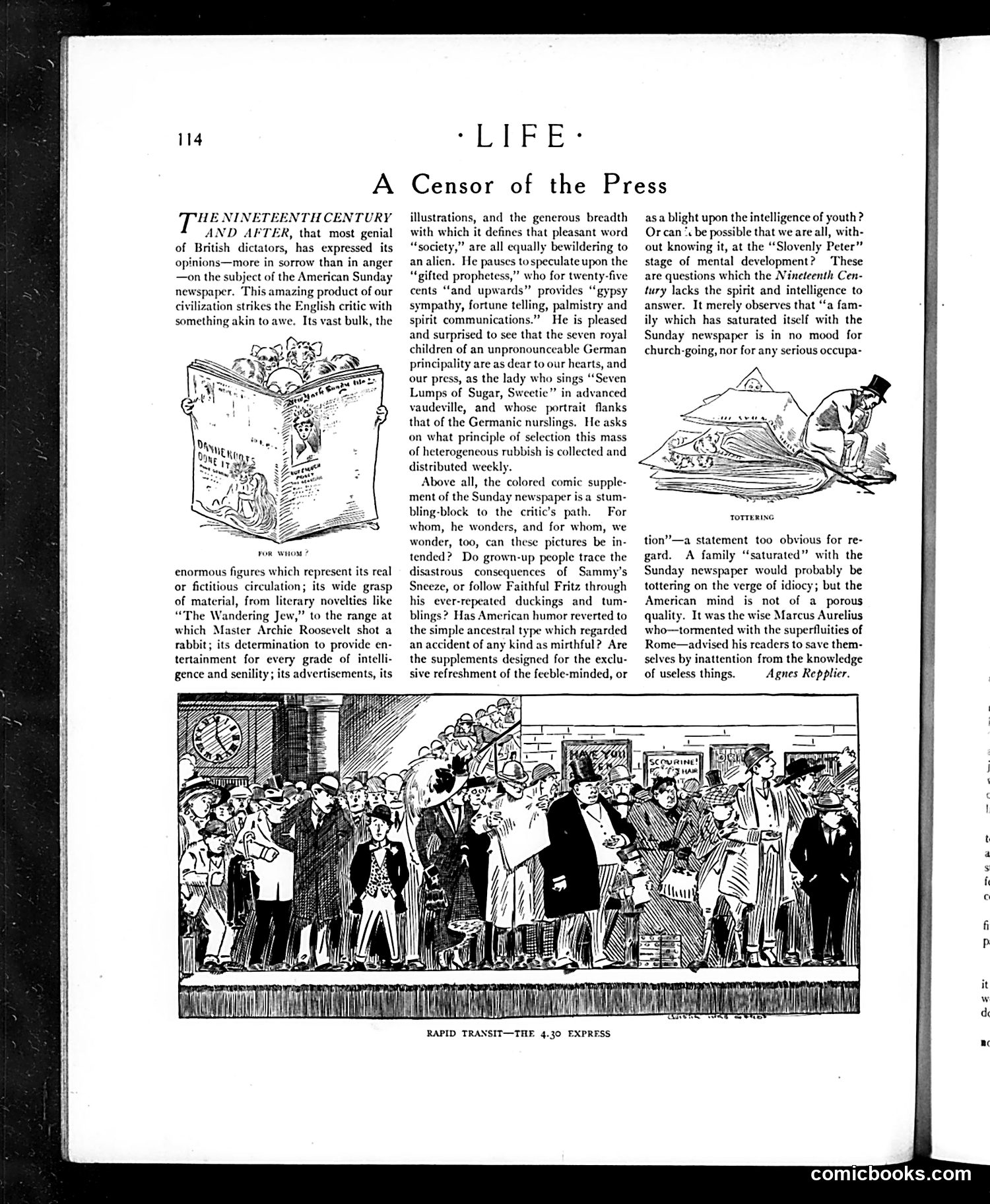
This article critiques British media censorship and sensationalism in newspapers. The text attacks the Sunday newspaper's publication of vulgar "colored comic supplements" aimed at mass audiences, arguing they degrade public taste and intelligence—particularly among youth. The top cartoon depicts a oversized, grotesque newspaper bursting with crude illustrations, labeled "FOR WHOM?"—questioning who genuinely benefits from such content. The bottom illustration shows crowded "Rapid Transit—The 4:30 Express," satirizing how newspapers are consumed during daily commutes by ordinary citizens. The author (Agnes Repplier, per signature) argues these publications represent journalistic irresponsibility, comparing them to ancient Roman decline, warning that mindless entertainment threatens cultural standards and public discourse.
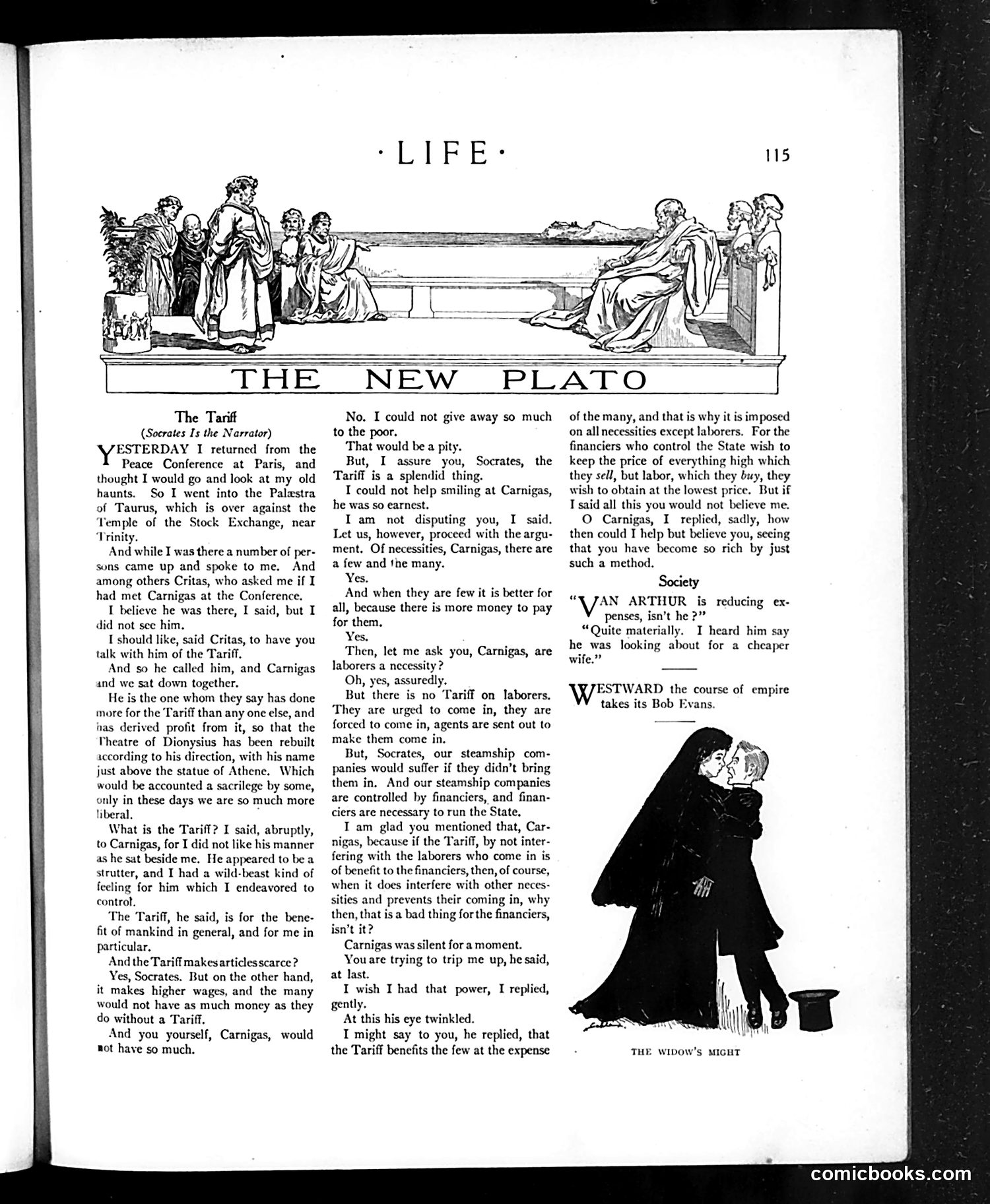
**Main Dialogue:** A Socratic debate between Socrates and a character named Carnigas about tariffs. Socrates argues tariffs harm the poor by making necessities expensive and reducing wages. Carnigas defends tariffs as necessary for state finances and laborers, insisting they benefit the working class. The satire mocks protectionist economic arguments of the era by presenting them as circular logic—a common Life magazine approach to contemporary policy debates. **Secondary Item:** "The Widow's Might" shows a widow and child, illustrating social commentary on economic hardship. This likely connects thematically to the tariff debate's effects on ordinary people. The page reflects early-20th-century American debates over trade protectionism and its impact on working-class families.
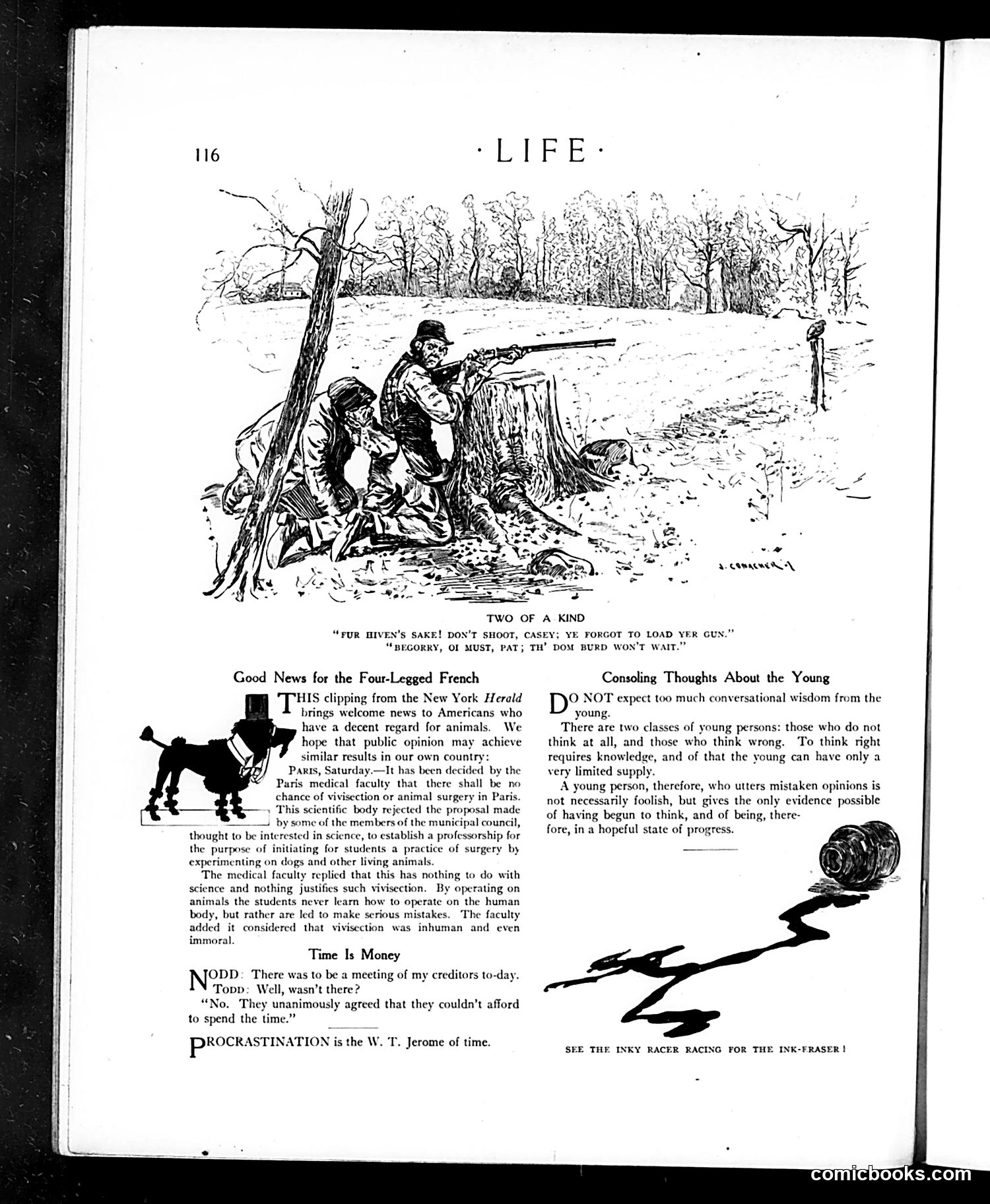
**The Main Cartoon** ("Two of a Kind"): Shows two hunters hiding behind a tree stump. One tells the other not to shoot, saying they forgot to load their gun and "the Dom burd won't wait"—a dialect joke playing on hunting incompetence. **"Good News for the Foul-Legged French"**: Satirizes the Paris medical faculty's rejection of a proposal to teach vivisection (surgery practice on live animals). The piece mocks this decision as scientifically backwards, contrasting French squeamishness about animal cruelty with practical American medical training. **Other sections** include brief humorous pieces on procrastination and creditors' meetings, typical of Life's satirical commentary on everyday American life and attitudes.
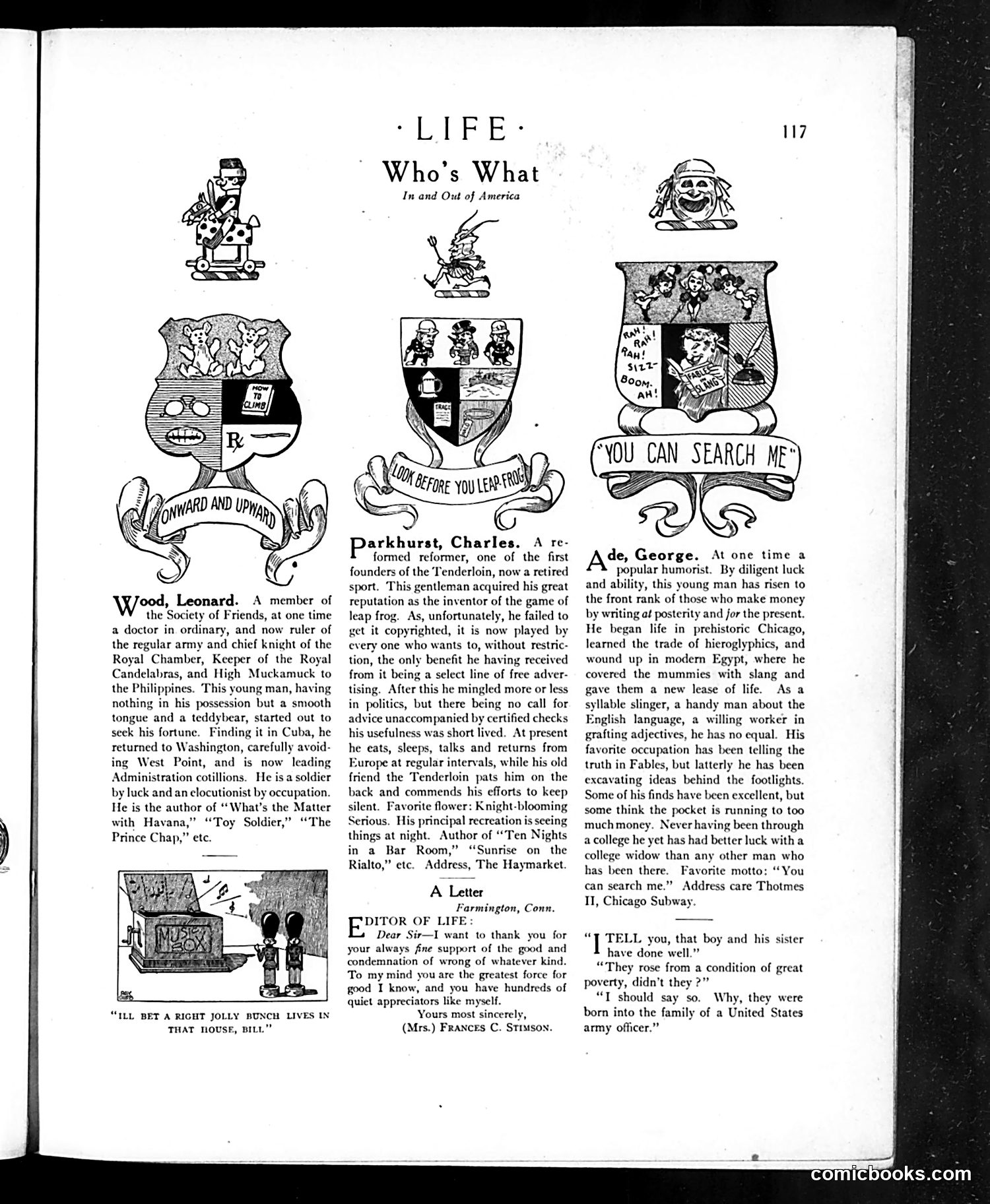
This "Who's What" section profiles two notable figures with satirical heraldic shields: **Leonard Wood** (left shield): A military officer and reformer, founder of the Tenderloin social movement. The shield mockingly displays medical/pharmaceutical symbols (Rx bottle, glasses) and references his various writings and interests. His motto reads "Onward and Upward." **Charles Parkhurst** (center): A reformed minister and moral crusader, depicted with various theatrical/entertainment references in his shield, suggesting his varied pursuits. **A. de George** (right shield): A humorist and writer, with his shield containing references to his literary work and the Chicago Subway. The satirical heraldic format mocks these public figures by reducing their accomplishments and pretensions to visual symbols—a common Life Magazine technique for lampooning prominent Americans of the era.
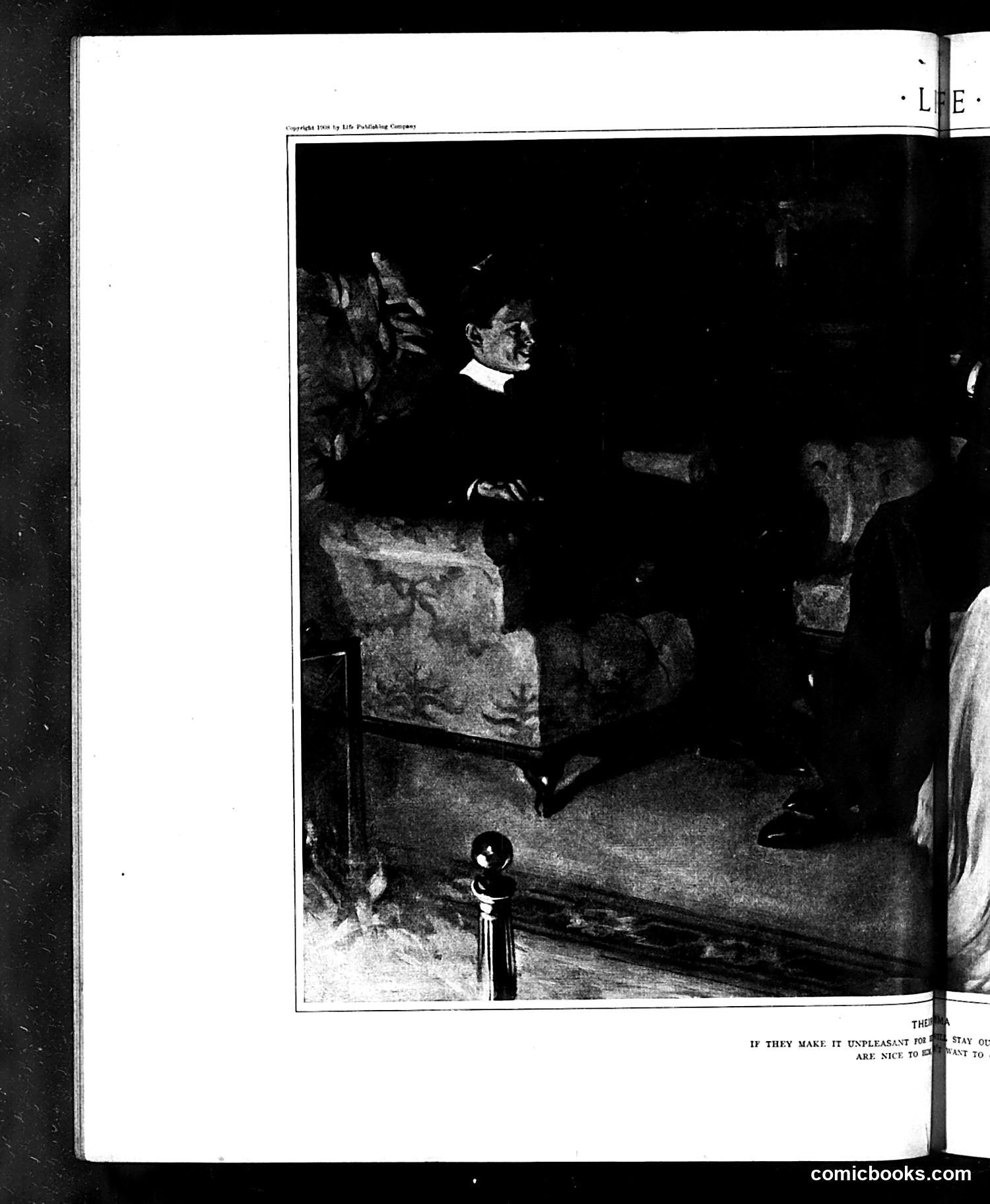
This page from *Life* magazine shows a black and white photograph of what appears to be a formal interior scene. A man in dark clothing with a white collar stands prominently in the center, surrounded by other figures in formal dress. The partially visible caption at the bottom reads: "IF THEY MAKE IT UNPLEASANT FOR... STAY OU... ARE NICE TO E..." Without the complete caption text visible, the specific satirical meaning is unclear. The formal setting and the fragmented caption suggest social commentary, possibly about hospitality, social etiquette, or interpersonal dynamics, but I cannot definitively identify the individuals depicted or pinpoint the exact political or social reference intended. The image quality and incomplete text prevent certain interpretation of this page's satirical point.
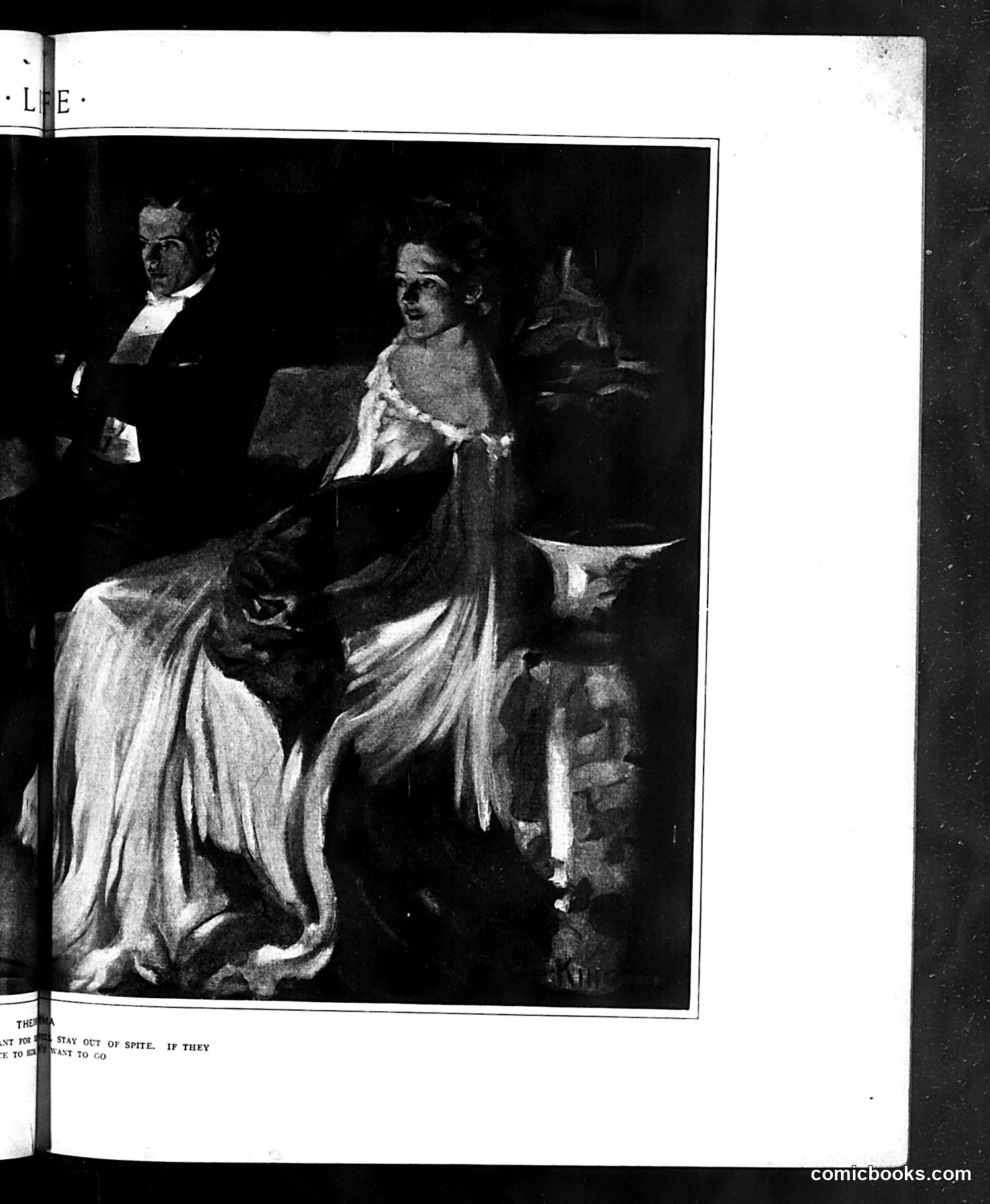
This appears to be a formal portrait illustration showing two elegantly dressed figures from the early 20th century. The woman wears an elaborate gown with a flowing train and decorative white lace detail at the neckline, while a man in formal evening wear stands behind her. The visible text fragment at bottom references someone being told to "STAY OUT OF SPITE" and mentions "IF THEY" and "ANT TO GO," though the complete sentence is cut off and unclear. Without the full caption or surrounding context, I cannot definitively identify the specific figures or the satirical point being made. The formal dress and composition suggest this may be commentary on high society or political figures of that era, but I cannot specify the intended satire without more visible text.
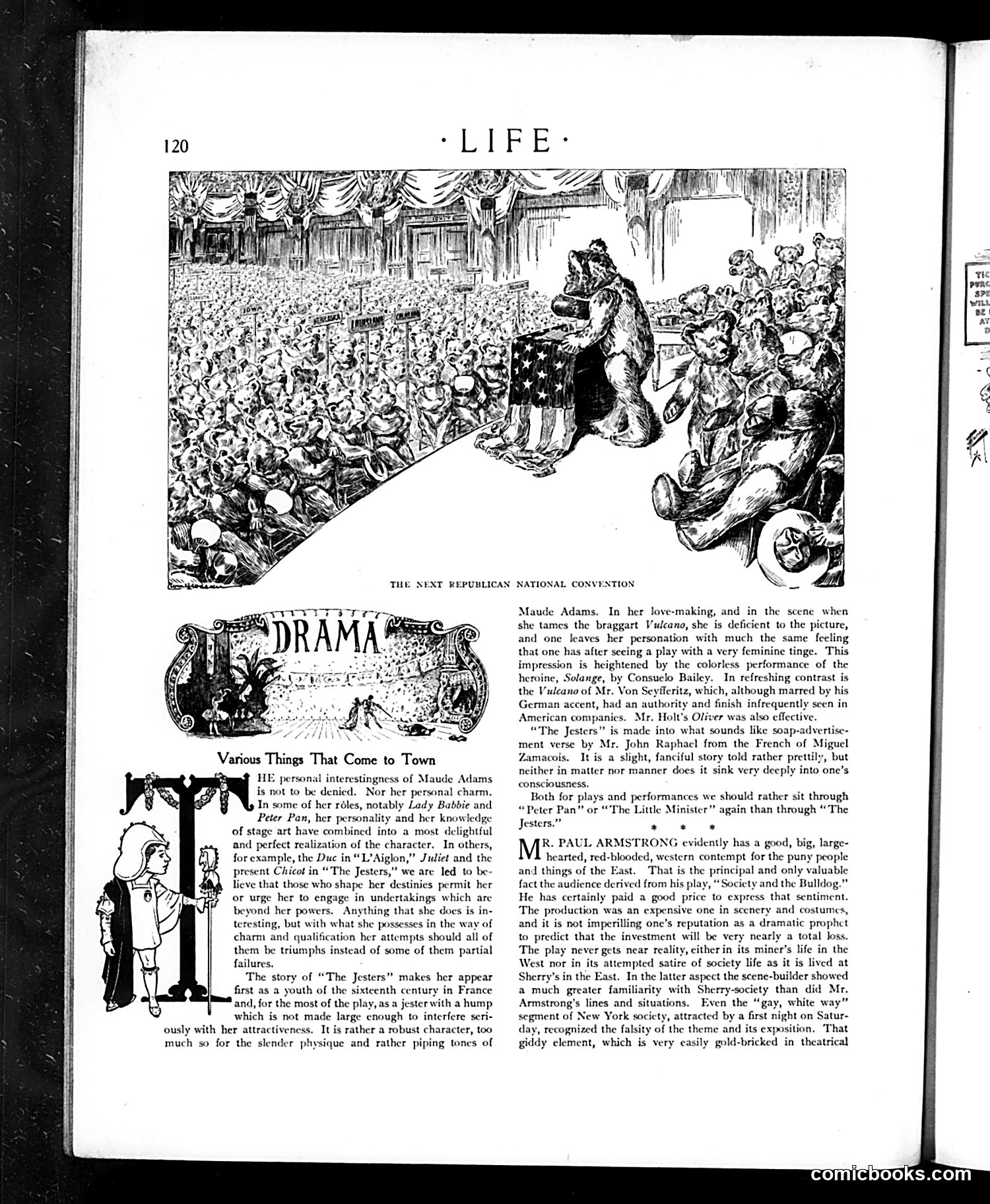
This political cartoon satirizes a Republican National Convention by depicting it as a circus-like spectacle. A figure at a podium (likely representing party leadership) addresses an enormous, chaotic crowd beneath ornate decorative draping. The scene suggests the Republican party has become a mass entertainment event rather than a serious political gathering—hence the circus atmosphere with crowds packed together. The satire appears to mock the spectacle and disorder of contemporary Republican politics, portraying the convention as theatrical and ungovernable rather than dignified or orderly. The text references various theatrical productions and performers like Maude Adams, suggesting the blending of entertainment culture with politics that Life's editors found ridiculous or concerning.
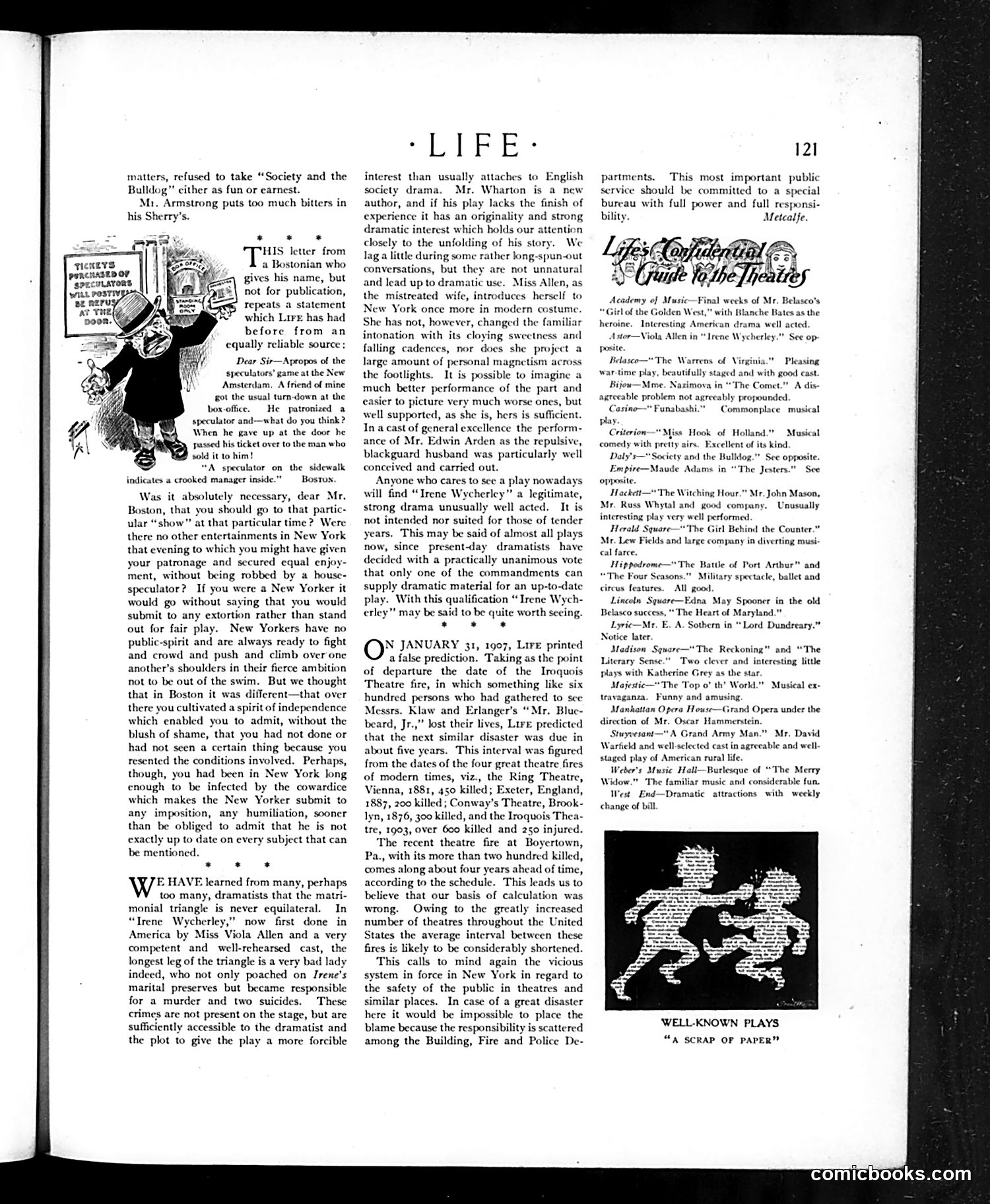
The cartoon depicts a dishonest theatrical manager—identifiable by his formal attire and scheming expression—literally depicted as crooked or bent. The caption "A crooked manager inside" suggests this is satirizing fraudulent theater management practices. The surrounding text discusses theater safety and disasters, particularly referencing the Iroquois Theatre fire (1903) and criticism of New York's theater safety regulations. The cartoon's point appears to be that corrupt managers prioritize profit over public safety, with their moral "crookedness" creating dangerous conditions. This reflects early 20th-century concerns about unchecked business practices and inadequate building codes in entertainment venues—a timely critique given the era's multiple theater fires and the deaths they caused.
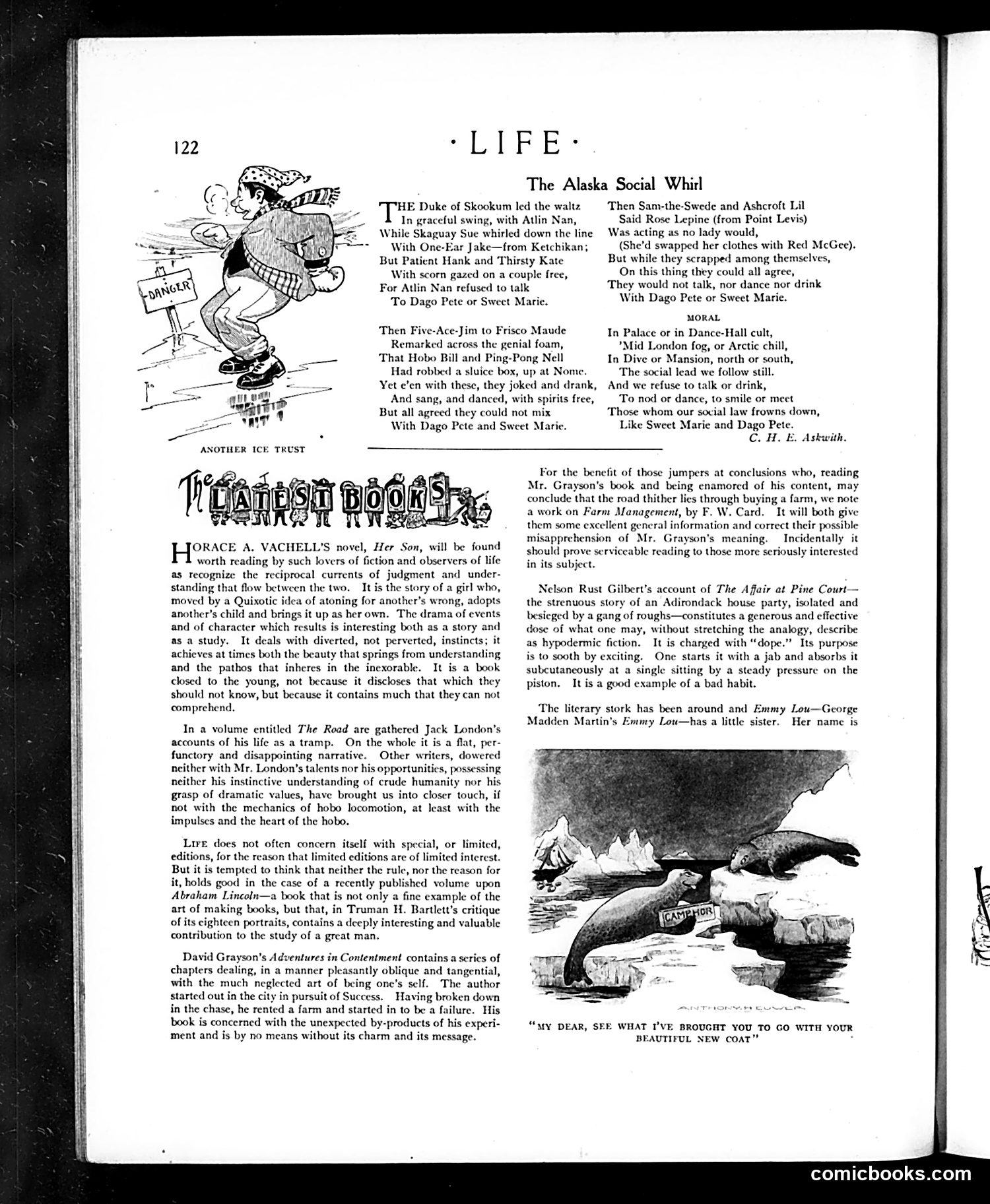
This satirical poem mocks rigid class prejudice among Alaska's rough frontier population. Despite their crude circumstances—characters with names like "Hobo Bill," "One-Ear Jake," and "Dago Pete"—these miners and prospectors strictly enforce social exclusion. The joke is ironic: even people living in harsh conditions with criminal pasts (they robbed a sluice box) maintain pretentious class boundaries, refusing to associate with certain outcasts like "Dago Pete" and "Sweet Marie" (the latter apparently disreputable). The moral undercuts their hypocrisy—whether in "Palace or Dance-Hall cult," society enforces the same arbitrary social rules. The cartoon's accompanying illustration (showing a rough character with a new coat) reinforces this theme: even frontier folk concern themselves with maintaining respectability and status despite their marginal position. Life magazine satirizes how universal and absurd social snobbery is, penetrating even the least refined communities.
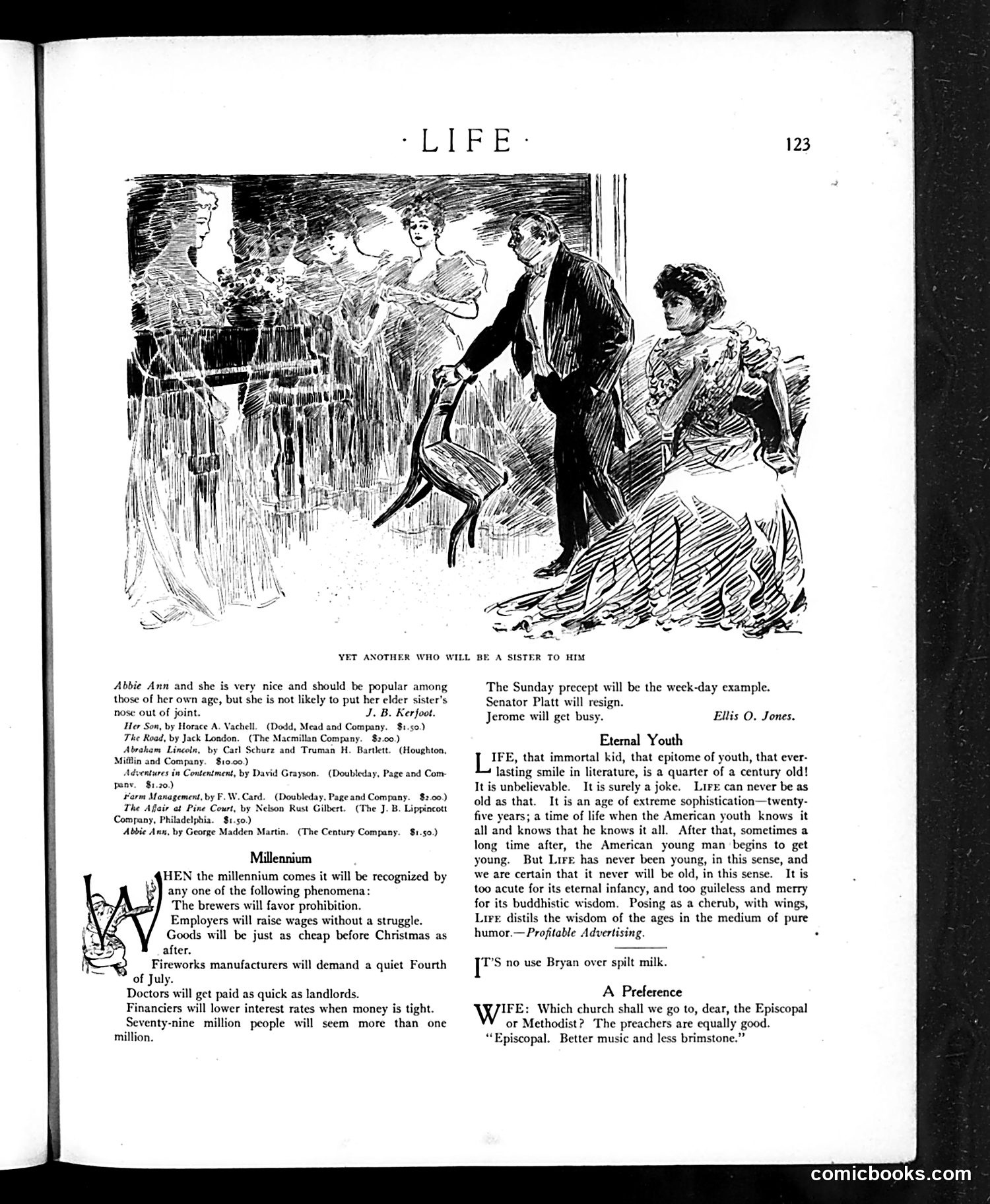
This page contains book reviews, advertisements, and satirical commentary typical of *Life* magazine's early 1900s format. **The Main Cartoon** ("Yet Another Who Will Be a Sister to Him") depicts a social scene where a man introduces a young woman to established society figures. The caption suggests she won't overshadow her "elder sister"—likely referring to a previous romantic interest or social rival. **"Millennium" Section** is political satire listing absurd conditions that would signal the millennium's arrival, including "Senator Platt will resign" and "Jerome will get busy"—references to likely New York political figures of that era. These mock corrupt politicians' unlikely reformation. **"Eternal Youth"** celebrates *Life* magazine's 25th anniversary, praising its youthful irreverence and satirical humor. **"A Preference"** is a brief joke about church choice, where the wife prefers Episcopal services for "better music and less brimstone"—satirizing Methodist preaching as hellfire-focused and musically inferior. The page emphasizes *Life's* role as a forum for social and political satire targeting contemporary public figures and institutions.
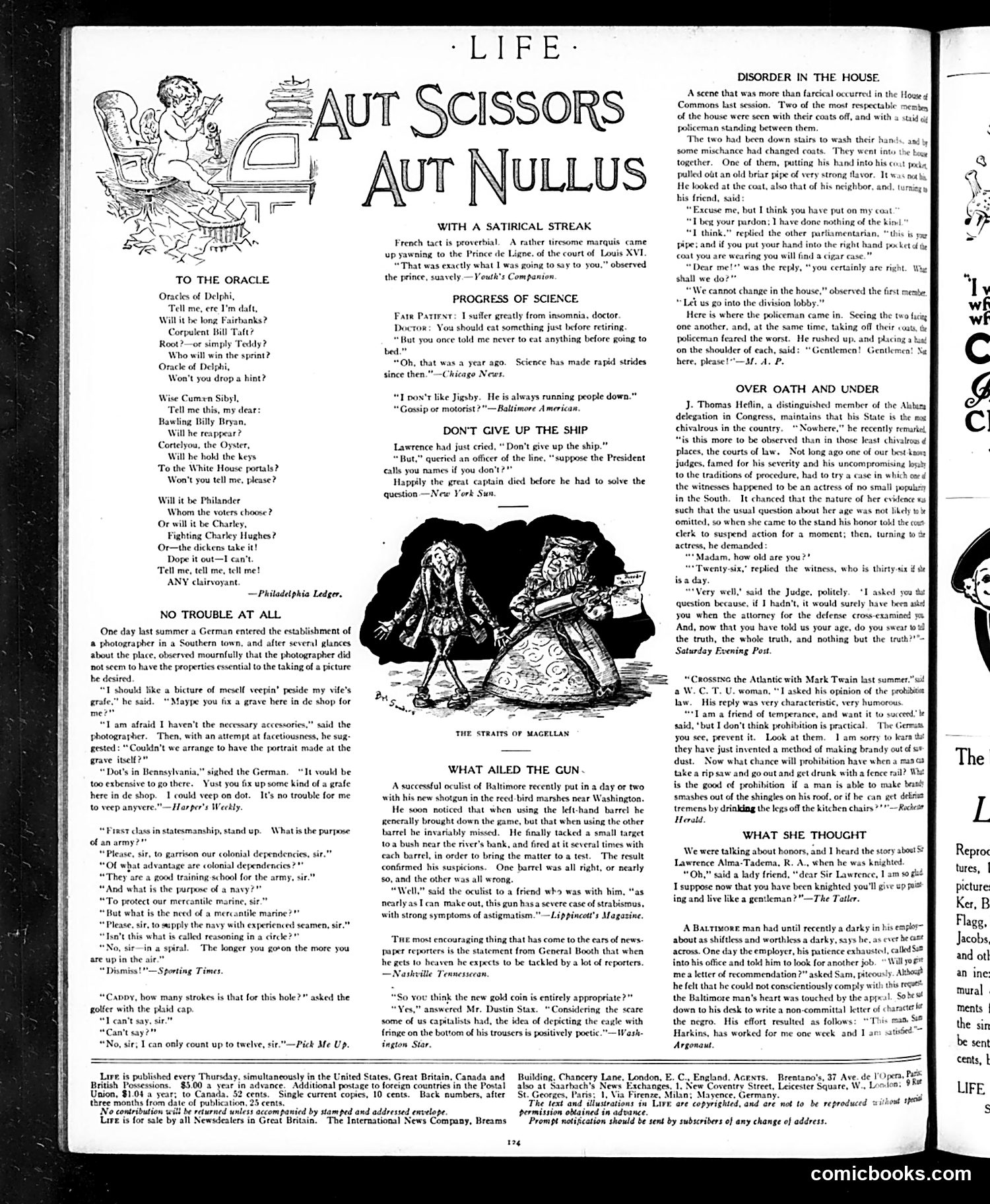
This page from Life magazine (a satirical publication) contains several jokes and cartoons satirizing American politics and society circa the early 1900s. **"Aut Scissors Aut Nullus" (main cartoon):** The title translates roughly to "either scissors or nothing," satirizing political indecision. The accompanying "Oracle" poem mocks uncertainty about the 1908 presidential succession, referencing potential candidates: Fairbanks, Taft, Theodore Roosevelt, Bryan, and Charley Hughes—reflecting contemporary confusion over who would follow the current president. **Other humor pieces** include anecdotes mocking: - German immigrants and their accents - Circular military logic (armies train for colonies; colonies justify armies) - Scientific "progress" (doctors reversing advice yearly) - Political cowardice (a naval officer afraid the President will criticize him) The cartoons and jokes reflect early 20th-century American anxieties about political succession, immigration, and imperial military expansion—topics that dominated public discourse before the 1908 election.
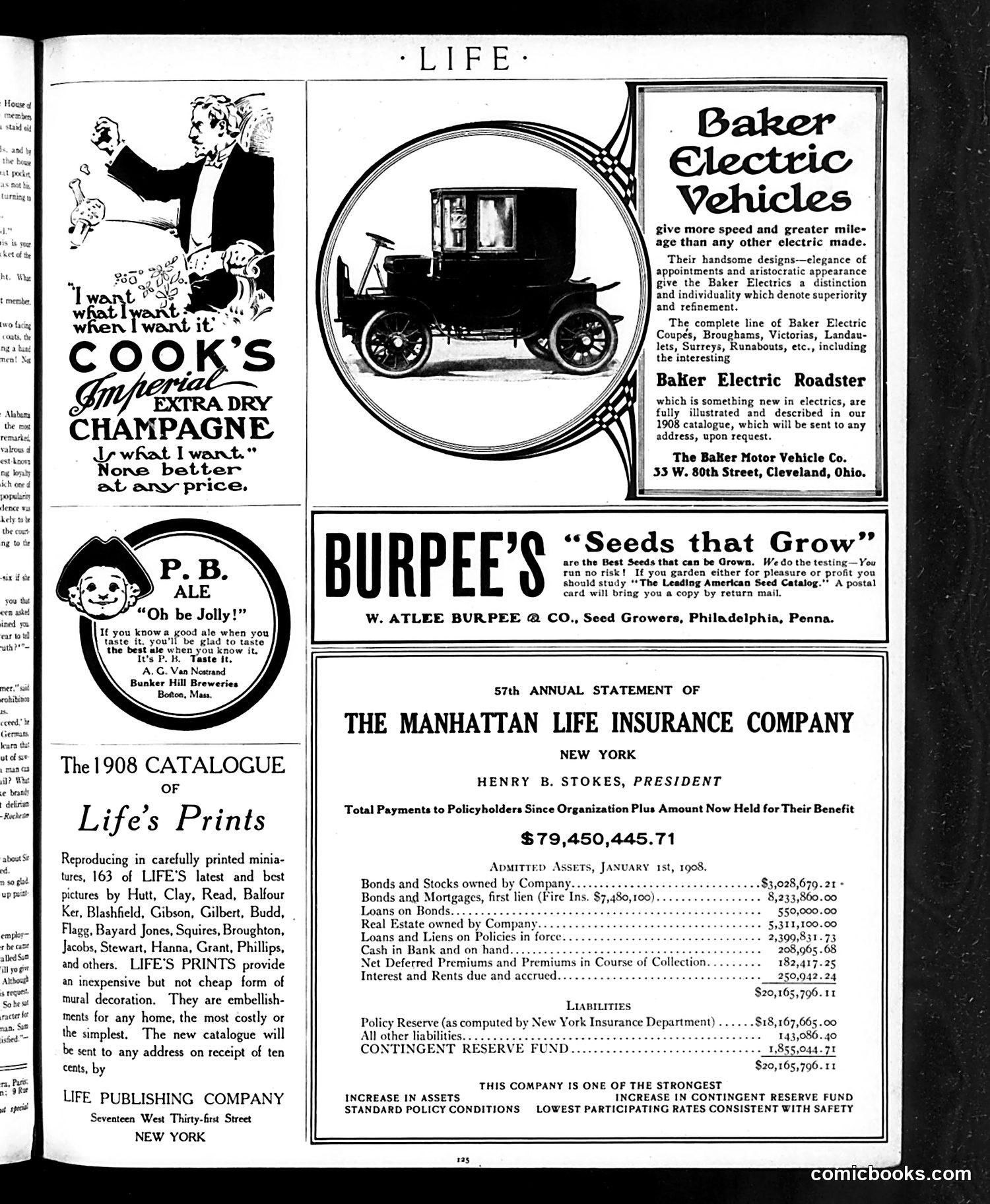
This is primarily an **advertising page** with minimal editorial content. The cartoons are product endorsements rather than political satire: **Cook's Champagne ad** (top left): Shows a gentleman offering champagne to a woman, with the slogan "I want what I want when I want it." This reflects early-1900s consumer culture messaging—marketing luxury goods by appealing to personal desire and immediacy. **P.B. Ale ad** (lower left): A jovial mascot promotes beer with "Oh be Jolly!"—typical period advertising equating alcohol consumption with good cheer. **Baker Electric Vehicles ad** (top right): Showcases an electric automobile, reflecting the era's early automotive enthusiasm and the temporary popularity of electric cars before gasoline engines dominated. The remaining content includes advertisements for **Life's Prints** (art reproductions), **Burpee Seeds**, and a **Manhattan Life Insurance Company financial statement**. There is **no political satire** on this page—it's purely commercial advertising typical of early-1900s magazine content.
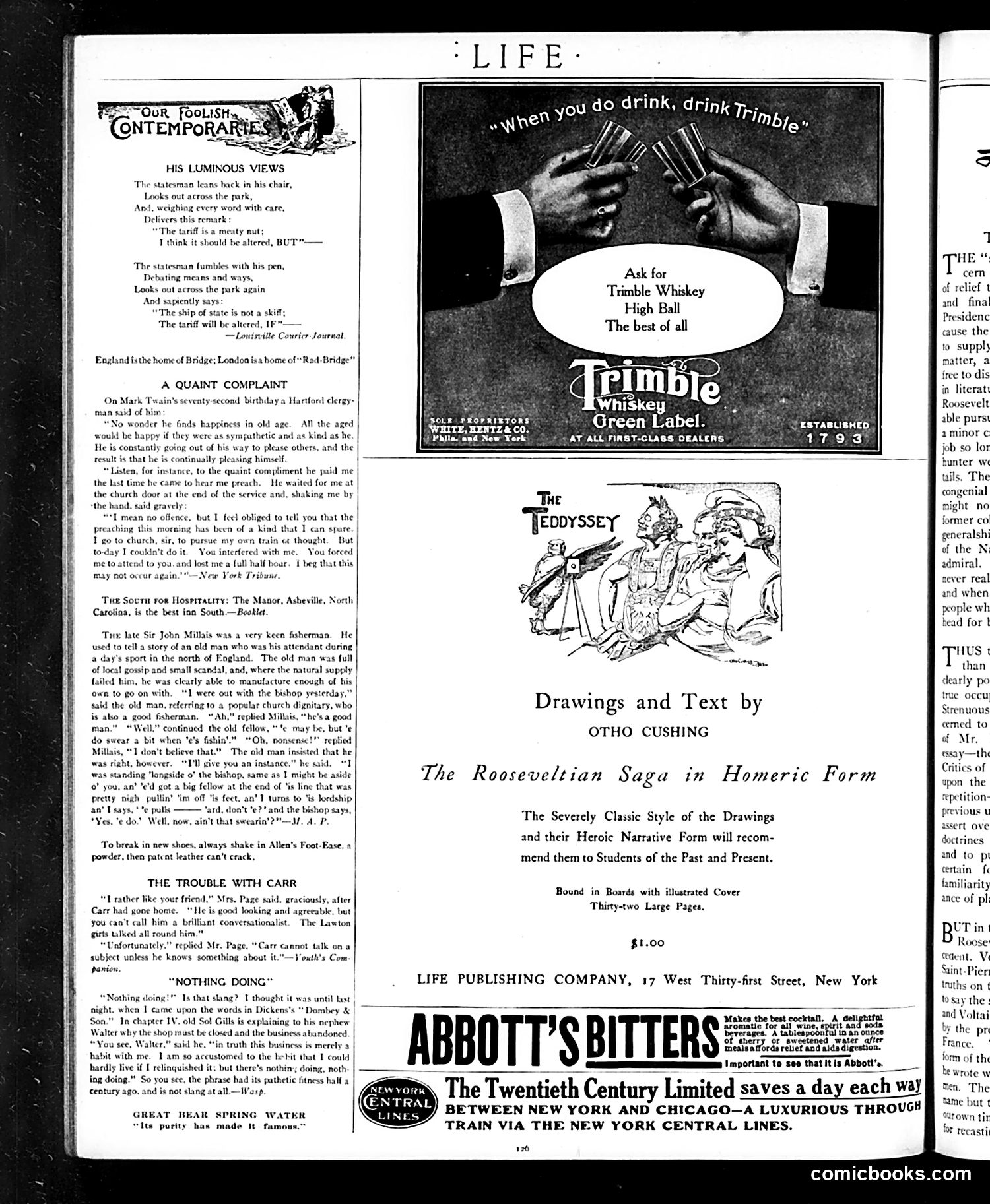
This page is primarily **advertising and literary content** rather than political cartoons, though it contains period humor. The main visual element is a **Trimble Whiskey advertisement** featuring two hands clinking glasses with the slogan "When you do drink, drink Trimble." This represents early 1900s liquor marketing. Below that is an illustration titled **"The Teddysey"** by Otho Cushing, promoting a book about "The Rooseveltian Saga in Homeric Form"—likely satirizing President Theodore Roosevelt by comparing his exploits to classical Greek epic narratives. This was a common satirical approach to Roosevelt's robust public persona. The text sections are anecdotal humor pieces, including one about Mark Twain's response to a clergyman's compliment about his kindness, and stories about fishing and conversation. The page represents **Life magazine's typical format**: mixing satirical commentary on public figures with genteel humor and advertisements, aimed at educated readers of the early 1900s.
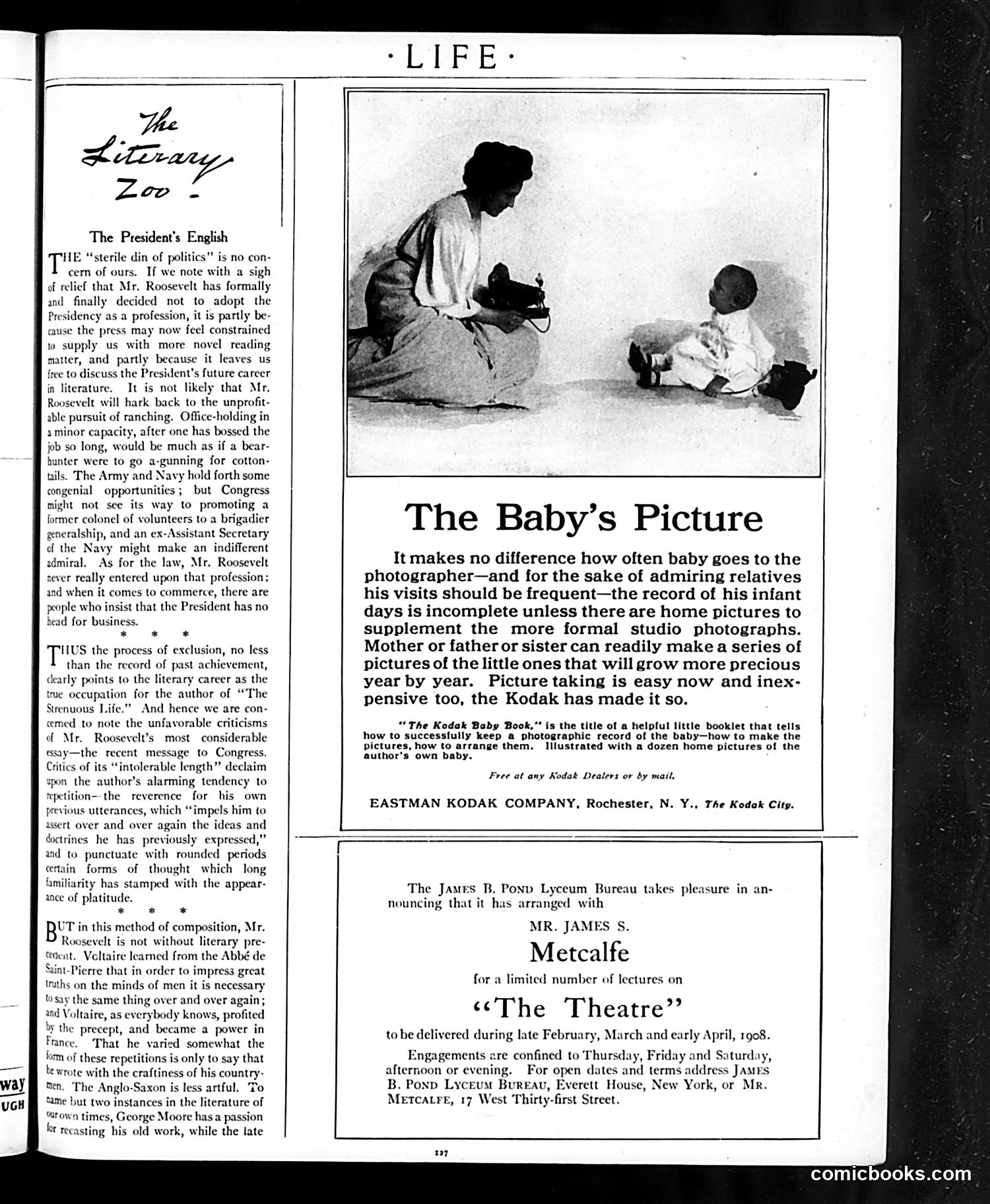
This page contains no political cartoon but rather editorial criticism of President Theodore Roosevelt's writing style, alongside period advertisements. **The Literary Critique:** The article mocks Roosevelt's tendency toward repetition and platitude in his recent Congressional message. Critics complained of "intolerable length" and his habit of restating ideas multiple times. The author defends this style by comparing Roosevelt to Voltaire, arguing that repetition serves to impress important truths on readers—though noting Roosevelt, as "Anglo-Saxon," lacks Voltaire's stylistic variety and craftsmanship. **Context for Modern Readers:** Roosevelt had recently announced he wouldn't run for another presidential term. The magazine sarcastically celebrates this, predicting literature would now be his occupation. The piece gently ridicules Roosevelt's verbose, repetitive writing as ill-suited to elegant prose. **Advertisements:** The page includes a Kodak camera ad (picturing a mother with baby) and an announcement for lecturer James S. Metcalfe's upcoming theater talks.
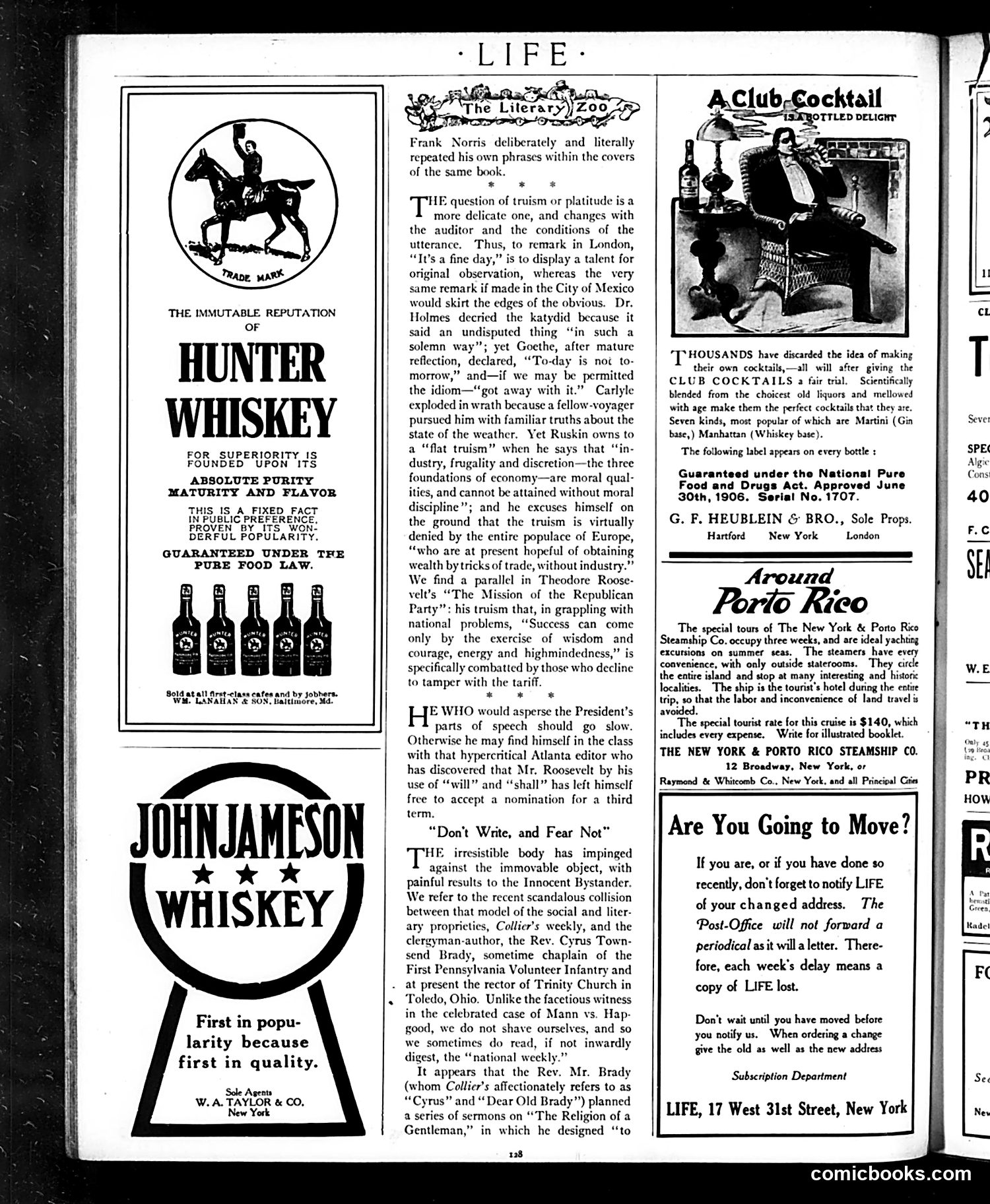
This page is primarily **advertising**, not political satire. It features whiskey and cocktail ads (Hunter Whiskey, John Jameson, Club Cocktails) with marketing claims about purity and quality. The editorial text discusses **literary and political platitudes**. It critiques Frank Norris for repetitive writing, then explores when obvious statements ("It's a fine day") become acceptable. The piece references **Theodore Roosevelt**, noting critics who attacked his grammar (use of "will" vs. "shall") as evidence he'd seek a third presidential term—likely a subtle jab at Roosevelt's political ambitions. The final section describes a conflict between *Collier's* magazine and Reverend Cyrus Townsend Brady over his planned sermon series. *Collier's* apparently mocked Brady's religious authority, calling him "Dear Old Brady" in a condescending manner. Life presents this as a collision between "social and literary proprieties." Overall, the page mixes consumer advertising with light political commentary about Roosevelt and media conflict with clergy—typical early-1900s Life magazine content.
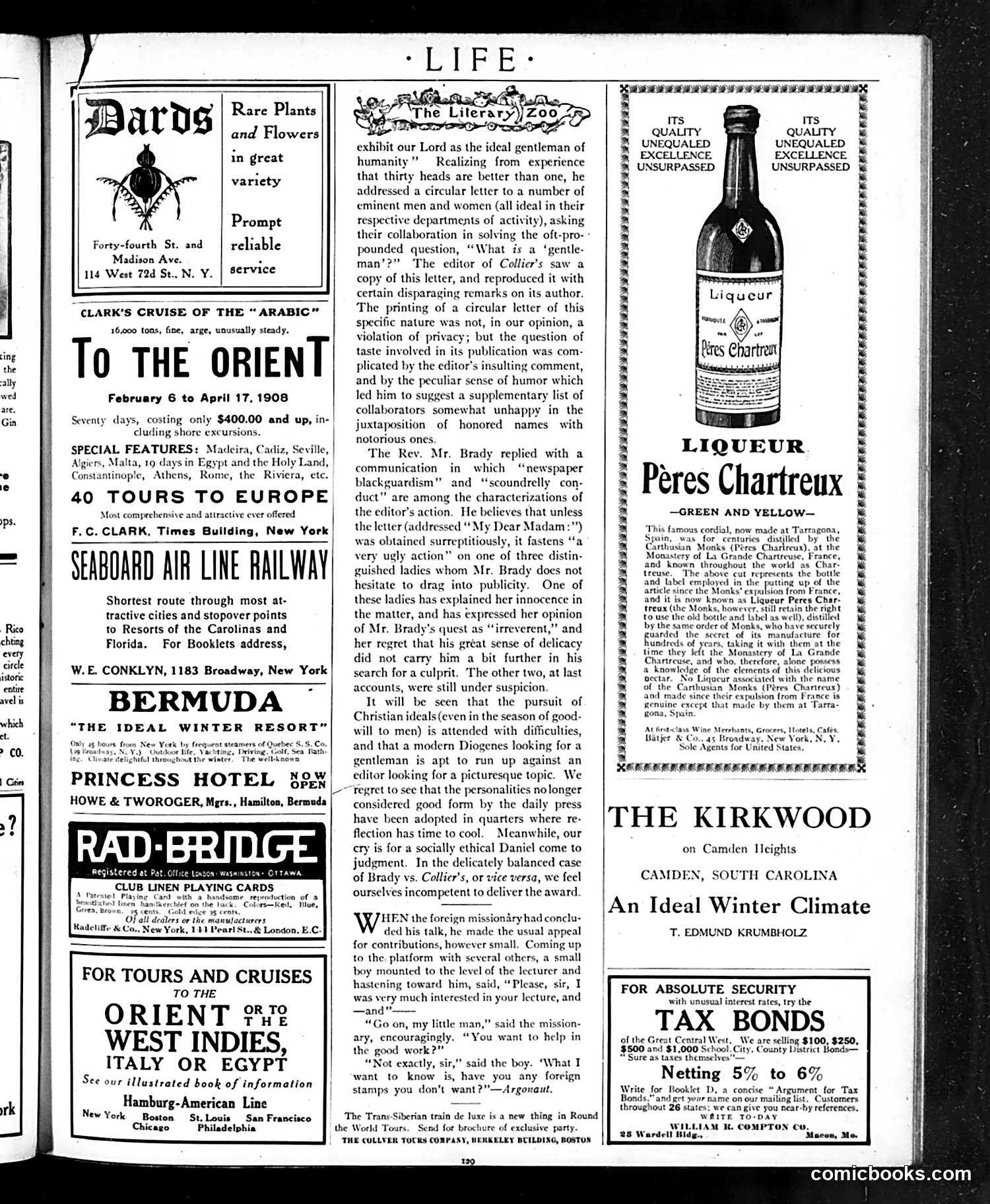
This page's central content is a satirical editorial commentary on a public dispute between Rev. Mr. Brady and the editor of *Collier's* magazine. **The Controversy:** Brady had circulated a letter to prominent men and women asking them to define what constitutes "a gentleman." *Collier's* obtained and republished the letter with mocking editorial commentary. Brady responded angrily, accusing the magazine of "newspaper blackguardism" and suggesting the letter was obtained unethically—which implicated three distinguished women as potential sources. **The Satire:** Life magazine titles this "The Literary Zoo," sarcastically framing the dispute as a spectacle of notable people behaving badly. The piece criticizes both sides: Brady for dragging innocent women into public controversy under the guise of seeking virtue, and *Collier's* for using insulting commentary. **The Point:** Life uses this petty squabble between religious and journalistic figures to mock how earnest pursuits of "Christian ideals" and editorial sensationalism descend into undignified personal attacks—suggesting the modern press and public figures lack basic decorum.
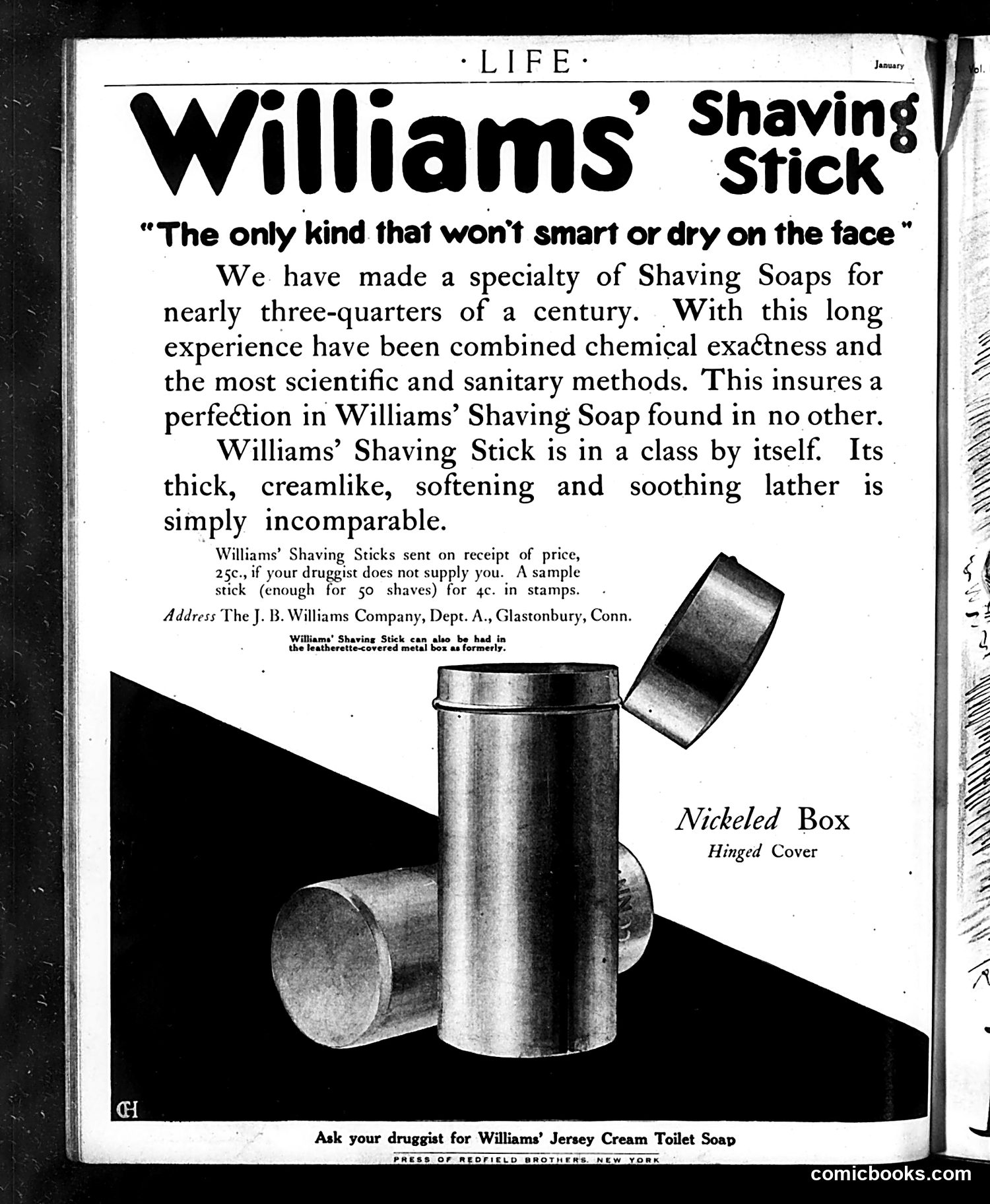
This is a **product advertisement**, not political satire. It appears in *Life* magazine (January, date unclear) promoting Williams' Shaving Stick soap. The ad emphasizes the product's superiority through claims of nearly 75 years of specialization, "chemical exactness," and scientific methods. The tagline—"The only kind that won't smart or dry on the face"—addresses a common complaint about competing shaving soaps of the era, which apparently irritated or dried skin. The central visual shows the shaving stick in a nickel-plated cylindrical box with hinged cover. The ad includes pricing (25¢) and a mail-order option (4¢ sample). There is **no cartoon or satire here**—this is straightforward early-20th-century advertising using claims of scientific superiority and convenience to sell a men's grooming product. The company address in Glastonbury, Connecticut suggests this was a regional or national brand competing in the shaving soap market.