
Life, 1908-01-30 · page 4 of 22
Life — January 30, 1908 — page 4: what you’re looking at
What you’re looking at
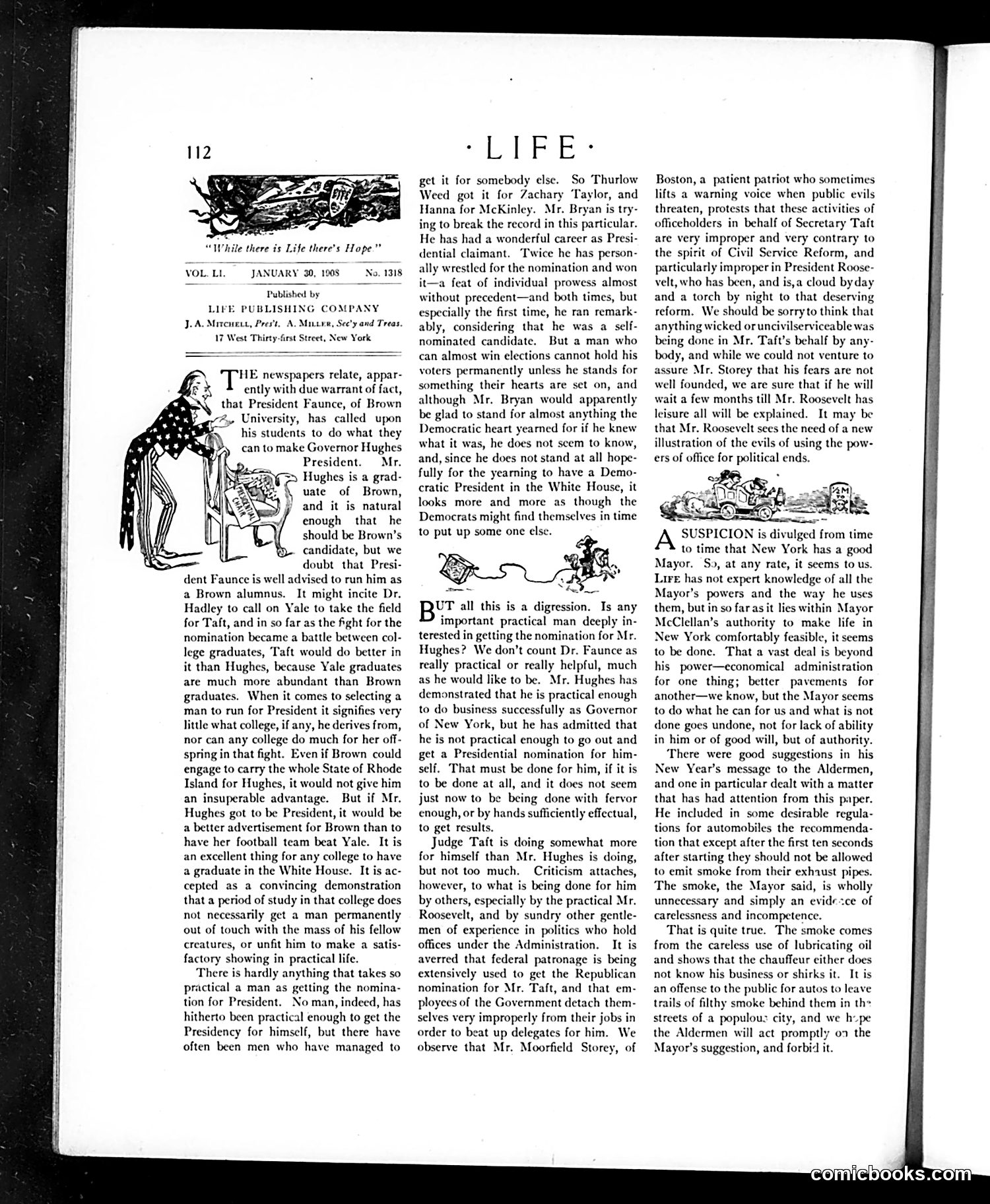
This page discusses President William Howard Taft's potential nomination for another term. The left illustration shows **Uncle Sam presenting candidates to Brown University**, satirizing how political nominations are made. The text criticizes that while newspapers urge Brown University students to support Governor Hughes as a presidential candidate, **Hughes lacks practical political experience**—he's "not practical enough to go out and get a Presidential nomination for himself." The satire targets the gap between academic credentials and political viability: Brown graduates and practical politicians like Taft are more effective than idealistic reformers. The piece suggests that despite Hughes's merit, **actual political nomination requires skills beyond intellectual qualification**—a commentary on how American presidential selection actually works versus how reformers wish it would work.
📄 Transcribed text from this page (OCR, searchable)
Machine-transcribed from the original scan — historical spelling and the odd misread are preserved.
“While there is Life there’s Hope” VOL. LI. 1908 No. 1318 JANUARY 30, Published by LIFE PUBLISHING COMPANY J.A. Mirenent, Pres't, A. Muntre, See'y and Treas. 17 West Thirty-first Street, New York his students to do what they can to make Governor Hughes President. Mr. >> Hughes is a grad- uate of Brown, and it is natural enough that he should be Brown’s candidate, but we doubt that Presi dent Faunce is well advised to run him as a Brown alumnus. It might incite Dr. Hadley to call on Yale to take the field for Taft, and in so far as the fight for the nomination became a battle between col- lege graduates, Taft would do better in it than Hughes, because Yale graduates are much more abundant than Brown graduates. When it comes to selecting a man to run for President it signifies very little what college, if any, he derives from, nor can any college do much for her off- spring in that fight. Even if Brown could engage to carry the whole State of Rhode Island for Hughes, it would not give him an insuperable advantage. But if Mr. Hughes got to be President, it would be a better advertisement for Brown than to have her football team beat Yale. It is an excellent thing for any college to have a graduate in the White House. It is ac- cepted as a convincing demonstration that a period of study in that college does not necessarily get a man permanently out of touch with the mass of his fellow creatures, or unfit him to make a satis- factory showing in practical life. There is hardly anything that takes so practical a man as getting the nomina- tion for President. No man, indeed, has hitherto been practical enough to get the Presidency for himself, but there have often been men who have managed to «LIFE * get it for somebody else. So Thurlow Weed got it for Zachary Taylor, and Hanna for McKinley. Mr. Bryan is try- ing to break the record in this particular. He has had a wonderful career as Presi- dential claimant. Twice he has person- ally wrestled for the nomination and won it—a feat of individual prowess almost without precedent—and both times, but especially the first time, he ran remark- ably, considering that he was a self- nominated candidate. But a man who can almost win elections cannot hold his voters permanently unless he stands for something their hearts are set on, and although Mr. Bryan would apparently be glad to stand for almost anything the Democratic heart yearned for if he knew what it was, he does not scem to know, and, since he does not stand at all hope- fully for the yearning to have a Demo- cratic President in the White House, it looks more and more as though the Democrats might find themselves to put up some one el UT all this is a digression. Is any important practical man deeply in- terested in getting the nomination for Mr. Hughes? We don’t count Dr. Faunce as really practical or really helpful, much as he would like to be. Mr. Hughes has demonstrated that he is practical enough to do business successfully as Governor of New York, but he has admitted that he is not practical enough to go out and get a Presidential nomination for him- self. That must be done for him, if it is to be done at all, and it does not seem just now to be being done with fervor cnough, or by hands sufficiently effectual, to get results. Judge Taft is doing somewhat more for himself than Mr. Hughes is doing, but not too much. Criticism attaches, however, to what is being done for him by others, especially by the practical Mr. Roosevelt, and by sundry other gentle- men of experience in politics who hold offices under the Administration. It is averred that federal patronage is being extensively used to get the Republican nomination for Mr. Taft, and that em- ployces of the Government detach them- selves very improperly from their jobs in order to beat up delegates for him. We observe that Mr. Moorfield Storey, of Boston, a patient patriot who sometimes, lifts a warning voice when public evils threaten, protests that these activities of officeholders in behalf of Secretary Taft are very improper and very contrary to the spirit of Civil Service Reform, and particularly improper in President Roose- velt, who has been, and is,a cloud byday and a torch by night to that deserving reform. We should be sorryto think that anything wicked oruncivilserviceable was being done in Mr. Taft’s behalf by any- body, and while we could not venture to assure Mr. Storey that his fears are not well founded, we are sure that if he will wait a few months till Mr. Roosevelt has leisure all will be explained. It may be that Mr. Roosevelt sees the need of a new illustration of the evils of using the pow- ers of office for political ends. A is divulged from time to time that New York has a good Mayor. So, at any rate, it seems to us. Lire has not expert knowledge of all the Mayor’s powers and the way he uses them, but in so faras it lies within Mayor McClellan’s authority to make life in New York comfortably feasible, it seems to be done. That a vast deal is beyond his power—economical administration for one thing; better pavements for another—we know, but the Mayor to do what he can for us and what is not done goes undone, not for lack of ability in him or of good will, but of authority. There were good suggestions in his New Year’s message to the Aldermen, and one in particular dealt with a matter that has had attention from this paper. He included in some desirable regula- tions for automobiles the recommenda- tion that except after the first ten seconds after starting they should not be allowed to emit smoke from their exhaust pipes. The smoke, the Mayor said, is wholly unnecessary and simply an evide=ce of carelessness and incompetence. That is quite true. The smoke comes from the careless use of lubricating oil and shows that the chauffeur either does not know his business or shirks it. It is an offense to the public for autos to leave trails of filthy smoke behind them in th* streets of a populous city, and we h~pe the Aldermen will act promptly o7 the Mayor’s suggestion, and forbid it.