
Life, 1908-01-30 · page 19 of 22
Life — January 30, 1908 — page 19: what you’re looking at
What you’re looking at
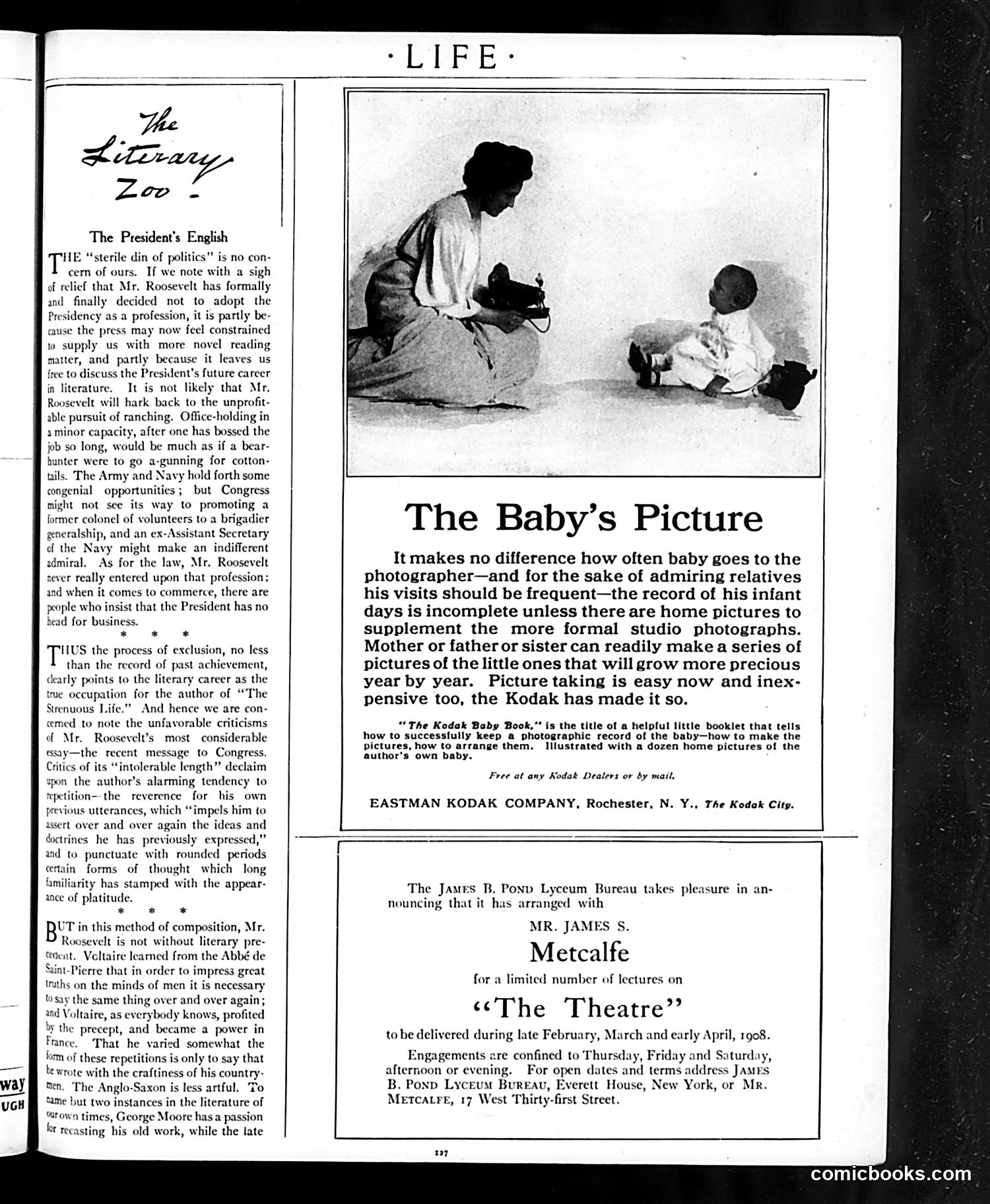
This page contains no political cartoon but rather editorial criticism of President Theodore Roosevelt's writing style, alongside period advertisements. **The Literary Critique:** The article mocks Roosevelt's tendency toward repetition and platitude in his recent Congressional message. Critics complained of "intolerable length" and his habit of restating ideas multiple times. The author defends this style by comparing Roosevelt to Voltaire, arguing that repetition serves to impress important truths on readers—though noting Roosevelt, as "Anglo-Saxon," lacks Voltaire's stylistic variety and craftsmanship. **Context for Modern Readers:** Roosevelt had recently announced he wouldn't run for another presidential term. The magazine sarcastically celebrates this, predicting literature would now be his occupation. The piece gently ridicules Roosevelt's verbose, repetitive writing as ill-suited to elegant prose. **Advertisements:** The page includes a Kodak camera ad (picturing a mother with baby) and an announcement for lecturer James S. Metcalfe's upcoming theater talks.
📄 Transcribed text from this page (OCR, searchable)
Machine-transcribed from the original scan — historical spelling and the odd misread are preserved.
She “ey The President's English HE “sterile din of politics” is no con- cern of ours. If we note with a sigh of relief that Mr. Roosevelt has formally and finally decided not to adopt the Presidency as a profession, it is partly be cause the press may now feel constrained to supply us with more novel reading matter, and partly because it leaves us free to discuss the President’s future career in literature. It is not likely that Mr. Roosevelt will hark back to the unprofit- able pursuit of ranching. Office-holding in aminor capacity, after one has bossed the job so long, would be much as if a bear- hunter were to go a-gunning for cotton- tils, The Army and Navy hold forth some congenial opportunities; but Congress might not see its way to promoting a former colonel of volunteers to a brigadier generalship, and an ex of the Navy might m: an indifferent admiral. As for the law, Mr. Roosevelt rever really entered upon that profession: and when it comes to commerce, there are pople who insist that the President has no head for business. * * & Ts the process of exclusion, no less than the record of past achievement, dearly points to the literary career as the tue occupation for the author of “The Strenuous Life.” And hence we are con- cemed to note the unfavorable criticisms of Mr. Roosevelt’s most considerable the recent message to Congress. Critics of its “intolerable length” declaim spon the author’s alarming tendency to rpetition—-the reverence for his own previous utterances, which “impels him to. assert over and over again the ideas and doctrines he has previously expressed,” and to punctuate with rounded periods in forms of thought which long tamliarty has stamped with the appear- ance of platitude. * * * B JT in this method of composition, Mr. Roosevelt is not without literary pre- (dent. Voltaire leamed from the Abbé de Saint-Pierre that in order to impress great truths on the minds of men it is necessary tosay the same thing over and over again; and Voltaire, as everybody knows, profited by the precept, and became a power in France. That he varied somewhat the form of these repetitions is only to say that tewrote with the craftiness of his ony ten. ‘The Anglo-Saxon is less artful. tame but two instances in the literature ‘of carown times, George Moore hasa passion for recasting his old work, while the late The Baby’s Picture It makes no difference how often baby goes to the photographer—and for the sake of admiring relatives his visits should be frequent—the record of his infant days is incomplete unless there are home pictures to supplement the more formal studio photographs. Mother or father or sister can readily make a series of pictures of the little ones that will grow more precious year by year. Picture taking is easy now and inex- pensive too, the Kodak has made it so. “The Kodak Baby Book,” is the title of a helpful little booklet that tells how to successfully keep a photographic record of the baby—how to make the pictures, how to arrange them. Illustrated with a dozen home pictures of the author's own baby. Free at any Kodak Dealers or by mail, EASTMAN KODAK COMPANY, Rochester, N. Y., The Kodak City. The James B. Ponp Lyceum Bureau takes pleasure in an- nouncing that it has arranged with MR. JAMES S. Metcalfe for a limited number of lectures on ‘eThe Theatre’’ to be delivered during late February, March and early April, 1908. Engagements are confined to Thursday, Friday and Saturday, afternoon or evening. For open dates and terms address J AME: B. Ponp Lyceum Bureau, Everett House, New York, or Mr. MetcaLrE, 17 West Thirty-first Street. comicbooks.com