
Life, 1908-01-30 · page 7 of 22
Life — January 30, 1908 — page 7: what you’re looking at
What you’re looking at
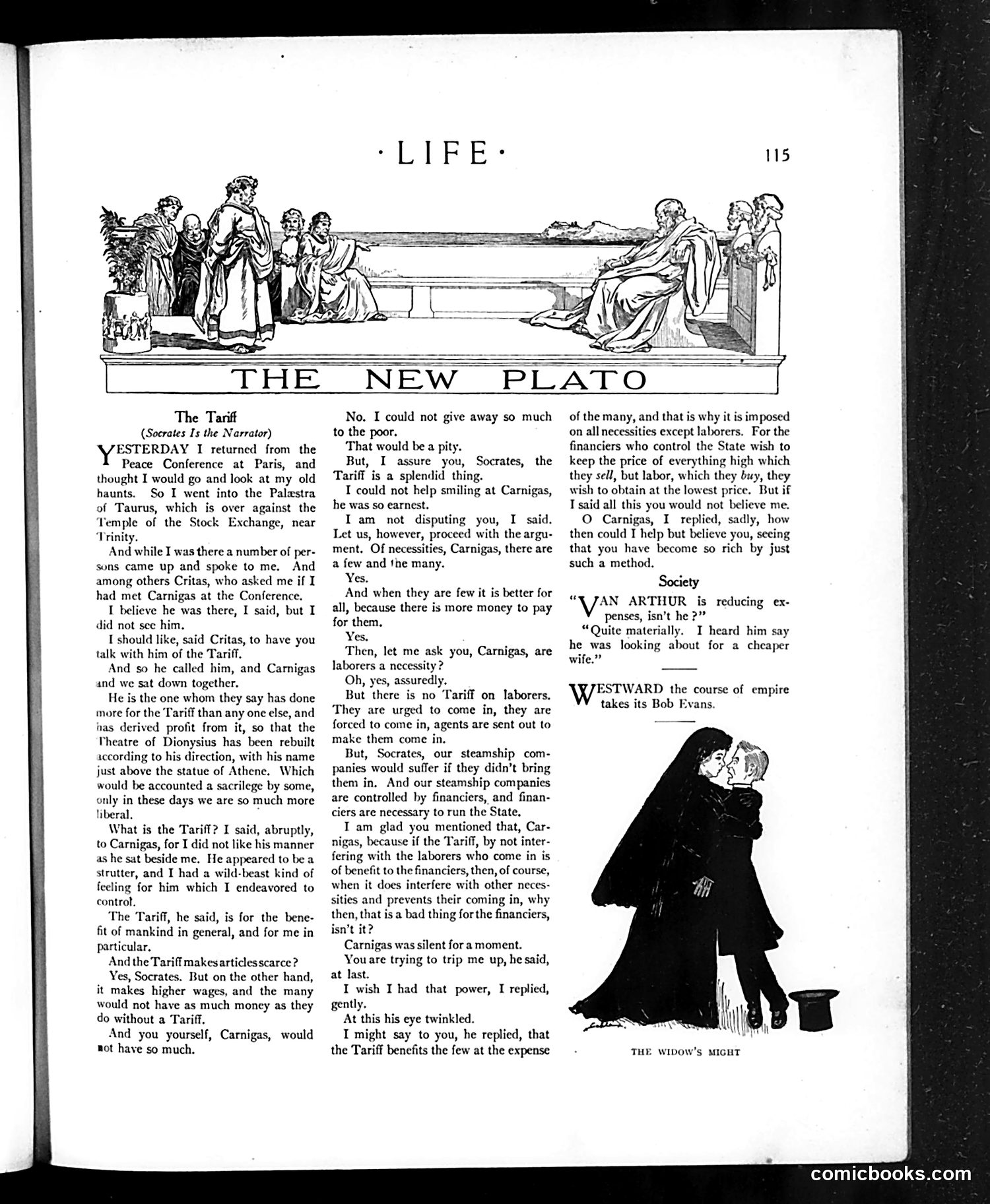
**Main Dialogue:** A Socratic debate between Socrates and a character named Carnigas about tariffs. Socrates argues tariffs harm the poor by making necessities expensive and reducing wages. Carnigas defends tariffs as necessary for state finances and laborers, insisting they benefit the working class. The satire mocks protectionist economic arguments of the era by presenting them as circular logic—a common Life magazine approach to contemporary policy debates. **Secondary Item:** "The Widow's Might" shows a widow and child, illustrating social commentary on economic hardship. This likely connects thematically to the tariff debate's effects on ordinary people. The page reflects early-20th-century American debates over trade protectionism and its impact on working-class families.
📄 Transcribed text from this page (OCR, searchable)
Machine-transcribed from the original scan — historical spelling and the odd misread are preserved.
The Tariff (Socrates Is the Narrator) ESTERDAY I returned from the Peace Conference at Paris, and thought I would go and look at my old haunts. So I went into the Palastra of Taurus, which is over against the ‘Temple of the Stock Exchange, near ‘Trinity. And while I was there a number of per- sons came up and spoke to me. And among others Critas, who asked me if I had met Carnigas at the Conference. I believe he was there, I said, but I did not sec him, I should like, said Critas, to have you talk with him of the Tariff, And so he called him, and Carnigas and we sat down together. He is the one whom they say has done more for the Tariff than any one else, and nas derived profit from it, so that the Vheatre of Dionysius has been rebuilt according to his direction, with his name just above the statue of Athene. Which would be accounted a sacrilege by some, only in these days we are so much more liberal, What is the Tariff? I said, abruptly, to Carnigas, for I did not like his manner as he sat beside me. He appeared to be a strutter, and I had a wild-beast kind of feeling for him which I endeavored to control. The Tariff, he said, is for the bene- fit of mankind in general, and for me in particular, And the Tariff makesarticlesscarce ? Yes, Socrates. But on the other hand, it makes higher wages, and the many would not have as much money as they do without a Tariff. And you yourself, Carnigas, would not have so much. No. I could not give away so much to the poor. That would be a pity. But, I assure you, Socrates, the Tariff is a splendid thing. I could not help smiling at Carnigas, he was so earnest. Iam not disputing you, I said. Let us, however, proceed with the argu- ment. Of necessities, Carnigas, there are a few and the many. Yes. And when they are few it is better for all, because there is more money to pay for them. Yes, Then, let me ask you, Carnigas, are laborers a necessity ? Oh, yes, assuredly, But there is no Tariff on laborers, They are urged to come in, they are forced to come in, agents are sent out to make them come in. But, Socrates, our steamship com- panies would suffer if they didn’t bring them in. And our steamship companies are controlled by financiers, and finan- ciers are necessary to run the State. I am glad you mentioned that, Car- nigas, because if the Tariff, by not inter- fering with the laborers who come in is of benefit to the financiers, then, of course, when it does interfere with other neces- sities and prevents their coming in, why then, that is a bad thing forthe financiers, isn’t it? Carnigas was silent for a moment. Youare trying to trip me up, he said, at last. I wish I had that power, I replied, gently. At this his eye twinkled. I might say to you, he replied, that the Tariff benefits the few at the expense of the many, and that is why it is imposed on all necessities except laborers. For the financiers who control the State wish to keep the price of everything high which they sell, but labor, which they buy, they wish to obtain at the lowest price. But if T said all this you would not believe me. O Carnigas, I replied, sadly, how then could I help but believe you, seeing that you have become so rich by just such a method. Society “\ JAN ARTHUR is reducing ex- penses, isn’t he ?”” “Quite materially. I heard him say he was looking about for a cheaper wife.” ESTWARD the course of empire takes its Bob Evans. THE Wipow's MIGHT comicbooks.com